Bitpanda is an Austrian cryptocurrency broker and multi-asset investment platform that combines crypto trading with stocks, ETFs, precious metals, and other investment products.
Founded in 2014, the Vienna-based company has developed a strong European regulatory presence and an accessible retail investing experience. Its appeal is straightforward: users can buy Bitcoin, build an ETF portfolio, and invest in gold without managing separate brokerage accounts. However, that convenience comes with relatively high standard cryptocurrency trading fees and different custody arrangements across its products.
This Bitpanda review examines its trading fees, security, regulation, supported assets, and investment features. We also compare Bitpanda Broker and Fusion, explore its stocks, ETFs, and crypto offerings, and assess how it stacks up against Kraken, Bitvavo, and Coinbase.
Editor's Note (Oct. 25, 2026): We fully updated this Bitpanda review in October 2026 to reflect the platform's expanded investment offerings, revised trading fees, regulatory developments, and security disclosures. We've added a detailed comparison of Bitpanda Broker and Fusion, including real-world fee examples, and expanded coverage of stocks, ETFs, precious metals, staking, Earn, and leveraged trading. We've updated our comparisons with Kraken, Bitvavo, and Coinbase to help readers determine whether Bitpanda remains competitive in 2026.
Bitpanda Review 2026: Quick Verdict
Bitpanda is a European multi-asset investment platform combining more than 650 cryptocurrencies with stocks, ETFs, ETCs and precious metals. Its accessible interface, European regulatory authorizations and expanded real-securities offering make it appealing to everyday investors. However, standard crypto trading fees of 0.99% to 2.49% are relatively high, while custody arrangements, investor protections and financial risks differ significantly across its products.
Our take: Bitpanda is best suited to eligible European investors who want cryptocurrency and traditional investments in one account. Its strongest advantages are convenience, product variety and regulatory coverage. Bitpanda Fusion improves its value considerably by lowering entry-level crypto trading fees to 0.25%. However, Bitvavo may be cheaper for EUR-focused crypto investors, Kraken offers stronger reserve transparency and advanced security controls, and Bitpanda's yield and leveraged products require careful risk assessment.
Category Assessment
-
1Security & Custody Established Controls, Product-Specific Risks Bitpanda describes predominantly cold-storage cryptocurrency custody, two-factor authentication, device verification and external security examinations. It holds ISO 27001 certification and completed its first SOC 2 Type II attestation in February 2026. However, these controls do not guarantee financial solvency or eliminate custody risk. Securities, staking, stablecoin lending and derivatives have different ownership arrangements and investor protections.
-
2Trading Fees & Costs Expensive Broker, Competitive Fusion Standard Broker crypto fees are 0.99% for Bitcoin and supported stablecoins, 1.49% for most altcoins and 2.49% for selected Spotlight assets. Fusion charges 0.25% to 0.02% based on 30-day trading volume. A €1,000 Bitcoin round trip costs €19.80 in stated Broker commissions versus €5 through entry-level Fusion. Spreads, slippage, FX costs and withdrawal charges can increase total expenses.
-
3Markets & Investment Products Extensive Multi-Asset Selection Bitpanda advertises more than 650 cryptocurrencies and expanded into over 10,000 real stocks, ETFs and ETCs in January 2026. Its offering also includes physically backed precious metals, crypto indices, staking, stablecoin Earn, Cash Plus and selected leveraged products. This breadth is a major advantage, although ownership rights, costs, liquidity and counterparty exposure vary between investment categories.
-
4Liquidity & Execution Aggregated Trading, Limited Independent Testing Bitpanda Fusion aggregates liquidity from more than 12 trading venues and supports over 2,000 cryptocurrency pairs. Its advanced order functionality provides greater price control than standard Broker quotations. However, Bitpanda remains the contractual counterparty rather than directly matching independent customer orders. Live spreads, execution speed, available depth and slippage were not independently tested.
-
5Trading Tools & Usability Accessible Broker, Advanced Fusion Bitpanda Broker provides a streamlined web and mobile experience for buying crypto, securities and precious metals, alongside recurring investments, portfolio tracking and supported limit functions. Fusion adds TradingView charts, market and limit orders, stop functions, and API and MCP integrations. The two interfaces accommodate different experience levels, although no independent onboarding, funded trading or mobile-app testing was conducted.
-
6Regulation & Accessibility Strong European Presence, Regulatory Caveats Bitpanda operates through MiCAR-authorized entities supervised by Austria's FMA, Germany's BaFin and Malta's MFSA. Its UK entity holds FCA anti-money laundering registration, which does not provide ordinary crypto customers with FSCS protection. In August 2026, Austria's FMA announced a €70,000 MiCAR penalty involving white-paper and marketing requirements. A separate review of the sanction's publication began in October. Standard US retail access remains unavailable.
-
7Overall Verdict Best for European Multi-Asset Investors Bitpanda is a compelling option for eligible investors seeking cryptocurrency, real securities and precious metals through a single platform. Its regulated European operations, broad asset coverage and simplified investment experience are meaningful advantages. Fusion provides a substantially cheaper option for active crypto trading. However, high Broker fees, product-specific custody and counterparty risks, and withdrawal verification requirements limit its appeal. Bitvavo is worth considering for lower-cost EUR crypto trading, while Kraken may better suit security-focused active traders.
Best For
- European investors combining crypto, stocks, ETFs and precious metals
- Beginners seeking an accessible multi-asset investing interface
- Long-term investors using recurring purchases and savings plans
- Experienced crypto traders using Fusion's lower commissions
- EUR-based investors seeking convenient SEPA funding
- Investors who value established European regulatory oversight
Not Ideal For
- US residents seeking standard retail account access
- Frequent crypto traders paying standard Broker fees
- Users seeking the lowest possible EUR trading commissions
- Investors expecting identical protections across every product
- Users uncomfortable with custodial cryptocurrency holdings
- Investors seeking bank deposit guarantees on Earn or Cash Plus
- Customers needing unrestricted or instant withdrawals
- Beginners unfamiliar with lending, leverage or liquidation risks
Disclosure and Methodology
Some links in this article may be affiliate links. If you choose to use a product or service through these links, we may earn a commission at no additional cost to you.
For this Bitpanda review, we evaluated six main categories: security and custody, trading fees and costs, markets and investment products, liquidity and execution, trading tools and usability, and regulation and accessibility.
Our research examined official Bitpanda fee schedules, MiCAR authorizations, regulatory disclosures, custody and security documentation, investment product terms, trading-platform features, payment methods and withdrawal policies through Oct. 25, 2026. We also considered the Austrian FMA's August 2026 enforcement announcement and its October publication-review update.
We assessed how Bitpanda's different investment products affect customer ownership, counterparty exposure, redemption rights and applicable financial protections. Particular attention was given to the distinction between spot cryptocurrency custody, real securities, stablecoin lending, staking, Cash Plus and leveraged products.
Trading-cost comparisons use published fee schedules and illustrative transaction amounts. We compared Bitpanda Broker and Fusion against documented offerings and entry-level trading fees from Kraken, Bitvavo and Coinbase. These calculations exclude live spreads, slippage, currency conversion and applicable withdrawal charges.
We also considered publicly available customer feedback, including Trustpilot reviews and online complaints concerning verification, account restrictions, withdrawals and support. Individual complaints were not independently verified and should not be treated as evidence of platform-wide failure rates.
This is a documentation-led review, not a hands-on trading test. We did not create or fund an account, complete KYC, execute live trades, deposit or withdraw assets, test the mobile applications or contact customer support. Consequently, actual execution quality, withdrawal processing times, onboarding reliability and support responsiveness were not independently verified.

Bitpanda At a Glance
Bitpanda has grown from a cryptocurrency broker into a European investment platform offering more than 650 cryptocurrencies alongside traditional financial assets. Its standard Broker interface targets everyday investors, while Bitpanda Fusion provides a separate trading environment for users seeking more control over execution and pricing.
| Category | Bitpanda Details |
|---|---|
| Founded | 2014 |
| Headquarters | Vienna, Austria |
| Main platform | Bitpanda Broker |
| Advanced platform | Bitpanda Fusion |
| Main crypto entity | Bitpanda GmbH |
| Regulatory oversight | Austrian FMA, German BaFin, Maltese MFSA; UK FCA registration through the relevant UK entity |
| Regulatory framework | Markets in Crypto-Assets Regulation (MiCAR), alongside separate financial-services authorizations |
| Cryptocurrencies | 650+ advertised |
| Other investments | 10,000+ stocks, ETFs and ETCs, precious metals, crypto indices, and investment products |
| Standard crypto fees | 0.99% for Bitcoin and supported stablecoins; 1.49% for most altcoins; 2.49% for Spotlight assets |
| Fusion trading fees | 0.25% to 0.02%, depending on 30-day trading volume |
| Supported fiat wallets | EUR, USD, GBP, CHF, and PLN, subject to regional availability |
| Payment methods | SEPA, bank transfers, Visa, Mastercard, PayPal, and selected local payment methods |
| Platforms | Web, iOS, Android |
| Geographic availability | Primarily Europe and selected additional markets, with country-specific restrictions |
| US availability | Standard retail services unavailable to US residents |
Note: Information is current as of Oct. 25, 2026.
Is Bitpanda Safe and Regulated?
Bitpanda is a regulated cryptocurrency service provider with established security controls, but the protections available to customers depend on their location and the products they use. Its European authorizations govern activities such as crypto custody and exchange services, while securities, derivatives, and lending products operate under separate arrangements.
For investors holding spot cryptocurrency, Bitpanda's custody framework and operational security measures provide some reassurance. Those protections do not extend automatically to every product offered through the same account.
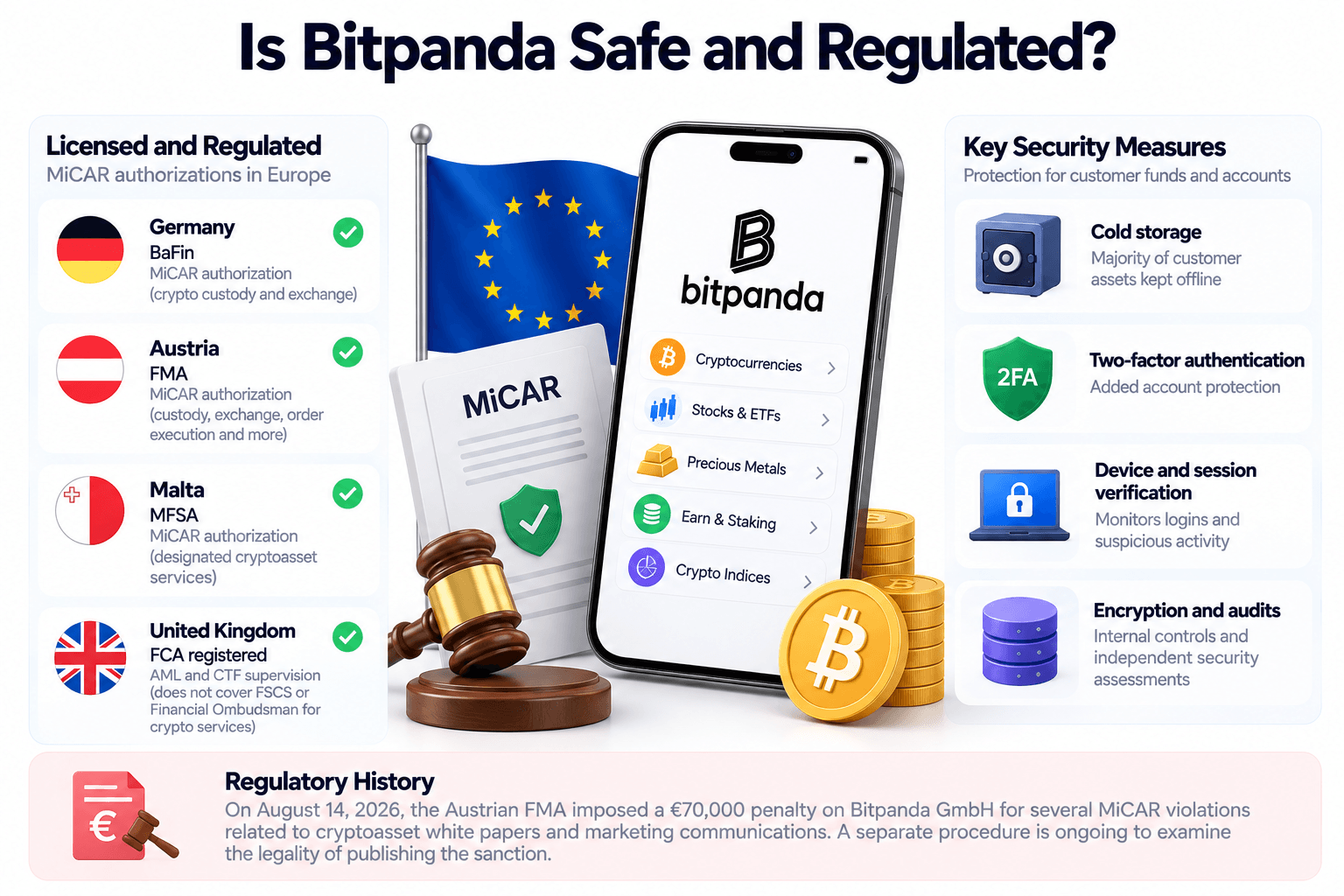
Bitpanda's Licenses, MiCA Compliance and Regulatory History
Bitpanda operates through several legal entities, each authorized to provide specific services. Within the European Union, the group has obtained three authorizations under the Markets in Crypto-Assets Regulation (MiCAR).
The relevant entities and supervisors are:
- Germany: Bitpanda Asset Management GmbH received MiCAR authorization from the Federal Financial Supervisory Authority (BaFin) in January 2025. Its permissions cover specified cryptoasset services, including custody and exchange activities.
- Austria: Bitpanda GmbH received MiCAR authorization on April 9, 2025. The Austrian Financial Market Authority (FMA) authorized crypto custody, exchange services, order execution, order transmission, and other activities.
- Malta: BP23 CA Limited received authorization from the Malta Financial Services Authority (MFSA) in January 2025 for designated cryptoasset services.
These authorizations allow the respective entities to provide approved services under the EU framework, including cross-border operations where passporting requirements are satisfied. They do not mean every Bitpanda product is regulated by all three authorities.
The group's financial-services operations also involve separately regulated entities. For example, Bitpanda Financial Services GmbH provides execution-only investment services involving eligible stocks, ETFs, and ETCs.
In the United Kingdom, Bitpanda Broker UK Ltd holds registration with the Financial Conduct Authority (FCA) for anti-money laundering and counter-terrorist financing supervision. Its UK regulatory disclosures clarify that this registration does not extend the Financial Services Compensation Scheme (FSCS) or Financial Ombudsman Service protections to its ordinary cryptoasset services.
Bitpanda's regulatory record includes enforcement action as well.
On Aug. 14, 2026, the Austrian FMA announced a €70,000 penalty against Bitpanda GmbH for several MiCAR violations involving cryptoasset white papers and marketing communications. The breaches included failing to submit a required white paper within the prescribed period and distributing marketing communications without the required disclosures.
The regulator described the penal order as final. However, on Oct. 1, 2026, it confirmed that a separate procedure had begun at Bitpanda's request to examine the legality of publishing the sanction.
The October review concerns the publication of the enforcement announcement. It does not establish that the underlying penalty was overturned.
How Does Bitpanda Protect Customer Funds?
Bitpanda uses cold storage, authentication controls, encryption, and independently assessed security processes to protect its operations and customer accounts.
Its security framework describes offline cryptocurrency custody arrangements, internal access controls, ongoing monitoring, and external security examinations.
Keeping most custodial cryptocurrency offline reduces exposure to attacks targeting internet-connected wallets. However, assets must still be managed through operational systems when customers deposit, trade, or withdraw funds, leaving some exposure to internal failures and security incidents.
At the account level, Bitpanda supports two-factor authentication (2FA), device verification, session monitoring, and additional checks for sensitive actions. These controls make unauthorized access more difficult, particularly when users enable stronger authentication methods.
| Security Measure | Supporting Evidence | What It Does Not Guarantee |
|---|---|---|
| Cold storage | Bitpanda describes predominantly offline custody arrangements | Protection against every custody or operational failure |
| Two-factor authentication | Supported account authentication controls | Protection if customers disclose credentials or approve fraudulent requests |
| Device and session verification | Account monitoring and security checks | Immediate detection of every account compromise |
| Encryption and access controls | Published security policies and external assessments | Immunity from software or internal-control failures |
| ISO 27001 | Independently assessed information-security management certification | Financial solvency or full backing of customer assets |
| SOC 2 Type II | Independent assessment of operational controls over an examination period | Insurance against losses or future incidents |
| External custody examinations | Bitpanda describes independent reviews of its custody arrangements | Continuous public verification of all customer liabilities |
Bitpanda achieved ISO 27001 certification in 2022 and completed its first SOC 2 Type II attestation in February 2026.
Bitpanda also states that customer cryptocurrency holdings are fully backed and subject to regular external examination.
Coin Bureau's safest crypto exchanges comparison examines how custody controls, reserve disclosures, account security, and incident histories differ between platforms.
Customers can reduce their account-level exposure by using strong authentication, checking active sessions, and following established crypto security practices.
Bitpanda Fees Explained: Broker, Fusion and Hidden Costs
Bitpanda's trading fees vary substantially between its standard Broker interface and Bitpanda Fusion.
Broker charges a percentage-based fee according to the cryptocurrency category, while Fusion uses a trading-volume schedule with lower starting commissions. The difference can be substantial for regular traders, especially when both purchases and sales are included.
Fees are only part of execution costs, however. Quoted prices, bid-ask spreads, slippage, currency conversion, and network withdrawals can influence how much cryptocurrency the investor ultimately receives.
Bitpanda Broker Trading Fees
Bitpanda Broker charges standard trading fees ranging from 0.99% to 2.49% for the main cryptocurrency categories.
Its published trading-fee schedule identifies the following rates:
| Cryptocurrency Category | Standard Trading Fee | Fee on a €1,000 Trade |
|---|---|---|
| Bitcoin | 0.99% | €9.90 |
| Supported stablecoins | 0.99% | €9.90 |
| Most altcoins | 1.49% | €14.90 |
| Selected Spotlight assets | 2.49% | €24.90 |
Individual exceptions apply. For example, LUNC carries a published 1.99% rate, while XRT is listed at 2.49%.
The standard fee schedule makes smaller transactions easy to understand, but investors should distinguish the stated commission from the total economic cost of execution.
Bitpanda provides an executable purchase or sale quote, and the final price may differ from a reference market price.
Bitpanda Fusion Trading Fees
Bitpanda Fusion offers lower cryptocurrency trading commissions through a seven-tier fee schedule based on trading volume over the preceding 30 days.
The published Fusion schedule begins at 0.25% and declines to 0.02% for the highest-volume accounts.
| 30-Day Trading Volume | Trading Fee |
|---|---|
| Up to €100,000 | 0.25% |
| €100,000 to €500,000 | 0.21% |
| €500,000 to €2.5 million | 0.17% |
| €2.5 million to €10 million | 0.13% |
| €10 million to €50 million | 0.08% |
| €50 million to €250 million | 0.05% |
| Above €250 million | 0.02% |
Fusion applies a unified volume-based pricing schedule rather than advertising separate standard maker and taker rates.
On conventional order-book exchanges, maker orders add liquidity and taker orders remove it. Fusion's execution model is different, so users should compare the actual applicable commission instead of assuming that placing a limit order qualifies for a maker rebate.
For a €1,000 Bitcoin purchase, Fusion's entry-level fee is €2.50, compared with €9.90 through Broker.
That reduces the stated commission by approximately 75%.
Actual execution costs also depend on market conditions. A large market order may execute across several price levels, while a limit order can control the acceptable price but may remain unfilled.
Deposit, Withdrawal and Other Investment Fees
Bitpanda generally does not charge platform-level fees for standard fiat deposits and withdrawals through supported payment methods. Customers may still encounter bank charges, payment-provider costs, currency-conversion differences, and network fees.
Its investment products also have separate pricing arrangements.
| Transaction or Product | Main Cost |
|---|---|
| SEPA bank transfers | Generally no Bitpanda-imposed fee |
| Supported cards and PayPal | No standard Bitpanda deposit fee; provider and regional conditions may apply |
| Fiat withdrawals | Generally no Bitpanda-imposed fee; receiving-bank charges may apply |
| Cryptocurrency withdrawals | Applicable blockchain/network withdrawal charge |
| Currency conversion | Exchange-rate differences and applicable conversion costs |
| Real stocks, ETFs, and ETCs | €1 per standard transaction, plus other applicable costs |
| Crypto Index | 1.99% trading premium on ordinary transactions and relevant rebalancing activity |
| Eligible Crypto Index savings-plan purchases | 0% buy fee |
| Staking | Commission deducted from staking rewards |
| Margin trading | Trading, borrowing, and possible liquidation charges |
For stocks and ETFs, the €1 transaction fee is particularly sensitive to order size.
For staking, Bitpanda's published standard commission is 20% of staking rewards, subject to the applicable product terms. The yield displayed inside the account should therefore be assessed on a net basis.
Investors should also retain transaction records for applicable crypto taxes, as trading, swaps, staking rewards, and disposals can produce taxable events depending on their jurisdiction.
How Much Does It Really Cost to Trade €100, €1,000 or €10,000?
A direct comparison shows how quickly Bitpanda Broker's higher commission becomes expensive.
The following calculations use the published entry-level fees as of Oct. 25, 2026. They assume a Bitcoin purchase followed by a sale of the same notional value, with no change in the reference price.
These examples are fee calculations rather than independently executed transactions. They exclude live spreads, slippage, third-party charges, and network withdrawal costs.
| Trade Size | Broker Buy (0.99%) | Fusion Buy (0.25%) | Broker Buy + Sell | Fusion Buy + Sell |
|---|---|---|---|---|
| €100 | €0.99 | €0.25 | €1.98 | €0.50 |
| €1,000 | €9.90 | €2.50 | €19.80 | €5.00 |
| €10,000 | €99.00 | €25.00 | €198.00 | €50.00 |
On a €10,000 round trip, using Fusion instead of Broker reduces the stated commissions by €148.
For investors placing several trades each month, the difference can accumulate quickly.
The comparison becomes more useful when other European cryptocurrency platforms are included.
| Platform | Entry-Level Fee Assumption | €1,000 Buy | €1,000 Buy + Sell |
|---|---|---|---|
| Bitpanda Broker | 0.99% | €9.90 | €19.80 |
| Bitpanda Fusion | 0.25% | €2.50 | €5.00 |
| Kraken Pro | 0.80% taker | €8.00 | €16.00 |
| Bitvavo | 0.25% taker | €2.50 | €5.00 |
The comparison uses Kraken's published Pro fees and Bitvavo's EUR trading schedule. Equivalent immediately executable taker orders are assumed where maker/taker pricing applies.
Kraken Pro's entry-level maker fee is 0.40%, while Bitvavo's entry-level EUR maker fee is 0.15%. Traders using qualifying maker orders could therefore pay different amounts.
If the purchased cryptocurrency is subsequently withdrawn to an external wallet, the total cost also includes the applicable network charge.
The complete transaction cost can be expressed as:
Total cost = trading commission + execution-price difference + applicable payment or FX costs + cryptocurrency withdrawal fee.
A €100 Bitcoin purchase may be inexpensive to execute on Fusion, but transferring the purchased amount after every transaction could make the overall strategy less efficient.
For investors accumulating cryptocurrency over time, grouping supported withdrawals can reduce the number of separate network charges.
These calculations establish that Fusion is substantially cheaper than Broker on stated commissions. The actual cheapest platform depends on live order-book liquidity, execution price, payment method, and withdrawal requirements.
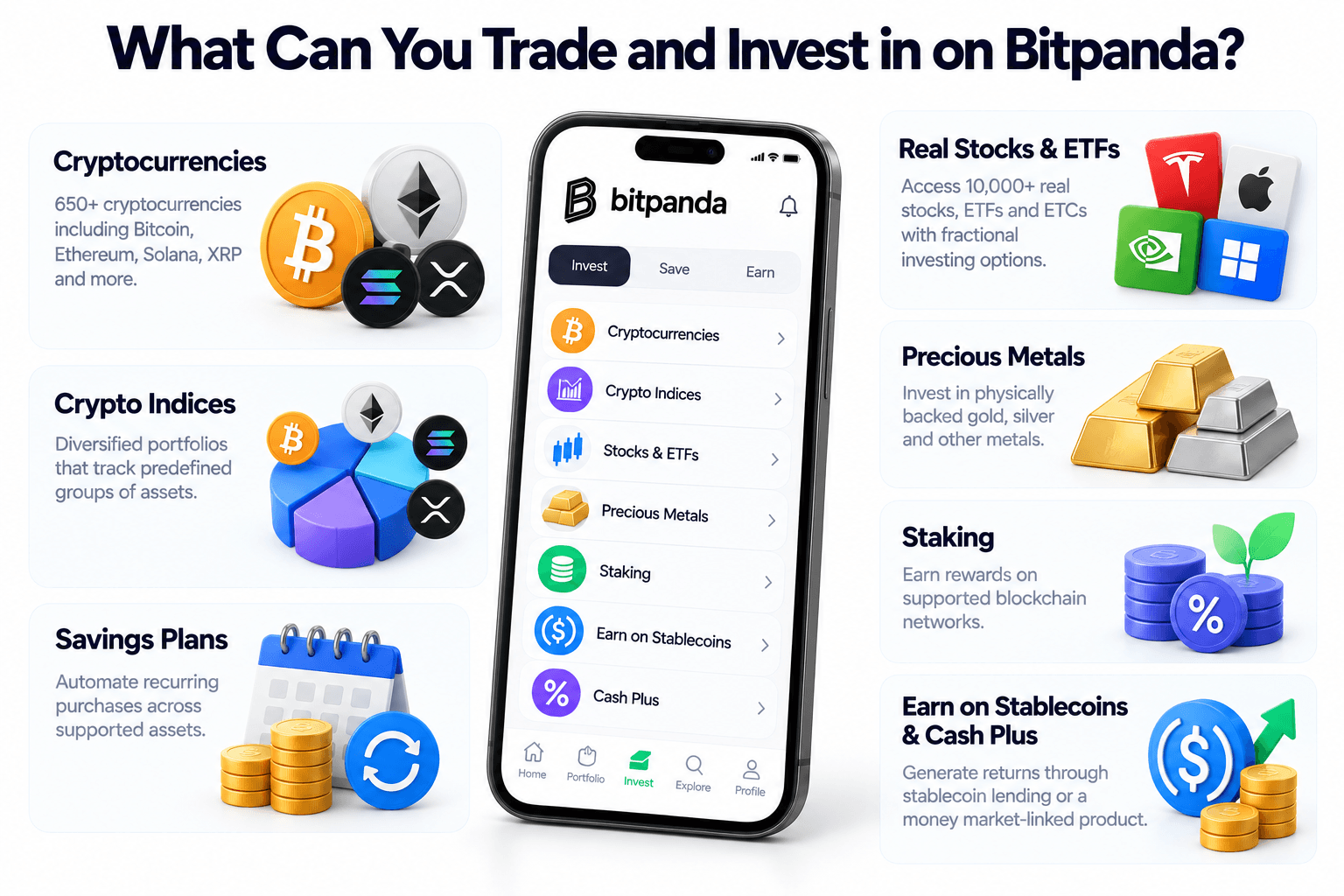
What Can You Trade and Invest in on Bitpanda?
Bitpanda supports several investment categories through one account, allowing customers to combine cryptocurrency exposure with conventional financial assets and selected yield-generating products.
The instruments differ in ownership, fees, liquidity, and financial risk. Buying ordinary cryptocurrency creates a different relationship from purchasing a stock fraction, entering a derivative contract, or lending stablecoins to Bitpanda.
| Asset Category | Investment Arrangement | Main Costs | Principal Risks |
|---|---|---|---|
| Cryptocurrencies | Custodial spot holdings | Trading and network fees | Volatility, custody, liquidity |
| Crypto Indices | Holdings of constituent cryptocurrencies | Trading and rebalancing premiums | Crypto-market and concentration risk |
| Real Stocks and ETFs | Securities and eligible fractional interests | €1 transaction fee and other costs | Market, FX, custody, and transfer restrictions |
| Precious Metals | Ownership interests in physically stored metals | Premiums, spreads, applicable storage charges | Commodity prices and storage arrangements |
| Staking | Rewards from eligible blockchain staking | Commission on rewards | Validator, slashing, liquidity, and price risk |
| Earn on Stablecoins | Transfer-of-title loan to Bitpanda | Product-specific reward terms | Counterparty default and insolvency |
| Cash Plus | Derivative linked to money market funds | Fund expenses and applicable product costs | Issuer, derivative, and market risk |
Cryptocurrencies, Stablecoins and Crypto Indices
Bitpanda advertises access to more than 650 cryptocurrencies, including established digital assets, stablecoins, and smaller-cap tokens.
Its selection includes Bitcoin, Ethereum, Solana, XRP, and other major cryptocurrencies.
The platform also supports selected stablecoins, allowing eligible users to hold digital assets designed to track fiat currencies.
The available selection makes it possible to manage a diversified cryptocurrency portfolio without opening accounts on several exchanges.
For investors who prefer diversified cryptocurrency exposure, the Bitpanda Crypto Index offers portfolios that automatically track predefined groups of assets. Available options include indices focused on major cryptocurrencies and selected market categories. The portfolios are constructed using index methodologies developed with MarketVector Indexes.
Bitpanda periodically adjusts the constituent holdings and their weights through monthly rebalancing.
For example, if one cryptocurrency loses its place in an index because its market capitalization falls below the inclusion threshold, the portfolio may sell that asset and purchase a replacement. The rebalancing process maintains the index methodology, but each eligible transaction can generate a premium.
Stocks, ETFs and Precious Metals
Bitpanda expanded its traditional investment offering on January 29, 2026, introducing access to more than 10,000 real stocks, ETFs, and ETCs.
The launch changed the ownership arrangements available through its securities platform.
Bitpanda's earlier stock offering relied on derivatives that tracked the prices of underlying financial instruments. Customers received economic exposure to securities without directly owning the shares.
The newer offering allows eligible investors to purchase real securities or fractional beneficial interests through the relevant investment-services arrangements. That enables investors to build portfolios containing conventional shares and funds rather than relying exclusively on derivative-based price exposure.
The €1 standard transaction fee can be attractive for larger investments, while fractional purchasing allows customers to invest smaller amounts in relatively expensive shares. Dividends are distributed according to the customer's entitlement, including proportional treatment for eligible fractional positions.
However, fractions generally do not carry voting rights and cannot be transferred or certificated. Their custody arrangements may also involve omnibus accounts, where assets are held collectively through a regulated custodian.
The platform also offers physically backed precious metals, including gold, silver, platinum, and palladium.
Customers acquire ownership interests in bullion held through secure storage arrangements in Switzerland, avoiding the need to purchase and store physical bars themselves. This provides a convenient route into precious-metals exposure, although quoted spreads, premiums, and applicable storage-related charges affect returns.
Bitpanda Staking, Earn and Savings Products
Bitpanda offers several products intended to generate rewards or investment income. Their names may appear together under the Earn ecosystem, but their return mechanisms and customer protections differ.
Staking involves eligible proof-of-stake cryptocurrencies, Earn on Stablecoins operates through lending, and Cash Plus provides derivative exposure linked to money market funds.
| Product | Source of Returns | Access to Funds | Main Risk |
|---|---|---|---|
| Staking | Blockchain validation-related rewards | Depends on protocol and unstaking conditions | Token volatility, slashing, validator risk |
| Earn on Stablecoins | Stablecoins lent to Bitpanda | 14-day redemption period | Unsecured counterparty exposure |
| Cash Plus | Derivative linked to money market fund performance | Flexible access under applicable terms | Issuer, derivative, and market risks |
Supported assets include Ethereum, Solana, Cardano, and other proof-of-stake cryptocurrencies, with availability depending on the network and jurisdiction.
Users allocate their cryptocurrency through Bitpanda, which manages the operational staking process and distributes eligible rewards.
Returns depend on network conditions, validator performance, and the platform's commission. Bitpanda's general published staking charge is 20% of rewards, so investors should compare net APYs rather than relying on gross blockchain yields.
Unstaking conditions also differ by asset. Some networks allow relatively quick access, while others impose waiting periods during which holdings cannot be freely transferred or sold. Those restrictions can become costly if cryptocurrency prices fall sharply while assets remain unavailable.
Earn on Stablecoins operates through lending rather than blockchain validation.
Eligible users lend USDC or EURCV to Bitpanda and receive periodic rewards. The product terms specify that legal ownership of the stablecoins transfers to Bitpanda during the arrangement.
The published reward structure includes a 3% base component and a discretionary bonus, with promotional total APYs reaching 7%. The bonus can change according to market conditions and the applicable reward cycle.
Customers can request redemption, but their assets remain unavailable during the 14-day waiting period. Rewards continue to accrue during that period under the published terms. If Bitpanda cannot meet its repayment obligations, customers could lose part or all of the lent assets.
Investors comparing this product with other crypto lending platforms should examine the borrower's financial exposure, redemption terms, and ownership transfer before comparing advertised APYs.
Its Cash Plus product provides exposure to selected money market funds through derivative contracts offered by Bitpanda Financial Services GmbH.
The available currency options include EUR, GBP, and USD. Returns generally respond to the performance of the relevant underlying money market fund, which invests in short-term financial instruments.
Customers can access their investment according to the product's flexible redemption terms rather than accepting a conventional fixed lockup.
Cash Plus is still an investment contract. Its payout may differ from the underlying fund's performance because of fees, charges, and the derivative arrangement.
It is also outside ordinary bank deposit-guarantee protection.
For investors seeking yield, choosing between these products requires understanding the source of the return. Staking rewards depend primarily on a blockchain, stablecoin Earn introduces Bitpanda credit exposure, and Cash Plus depends on the relevant derivative and money market investment.
Bitpanda Broker vs. Bitpanda Fusion: Trading Platforms Compared
Bitpanda provides two main cryptocurrency trading experiences.
Broker prioritizes accessibility, recurring investments, and portfolio management. Fusion offers advanced order execution, aggregated liquidity, and lower trading commissions for users who want more control over how orders are placed.
| Feature | Bitpanda Broker | Bitpanda Fusion |
|---|---|---|
| Primary audience | Beginners and general investors | Active and experienced traders |
| Interface | Simplified investing dashboard | Advanced trading workspace |
| Standard crypto pricing | Asset-based brokerage fees | Volume-based fees from 0.25% |
| Order execution | Broker quotations and supported order functions | Aggregated liquidity and advanced orders |
| Order types | Direct purchases, recurring buys, and supported limit functions | Market, limit, stop, and related advanced functions |
| Charts | Basic charts and portfolio information | TradingView integration |
| Liquidity | Broker execution arrangements | Aggregated from 12+ venues |
| Automation | Savings plans and investment automation | API and MCP integrations |
| Investment coverage | Crypto, securities, metals, and investment products | Primarily cryptocurrency trading |
| Main limitation | Higher cryptocurrency transaction fees | Greater complexity |
Bitpanda Broker: Trading Experience and Mobile App
Bitpanda Broker is designed for investors who want to purchase an asset without navigating a professional trading terminal.
The web and mobile interfaces organize investments into categories, with portfolio balances, market prices, charts, transaction history, and available trading actions accessible through the account.
To purchase cryptocurrency, users select an asset, enter the investment amount, examine the quoted price and fees, and confirm the order.
The same general interface supports eligible stocks, ETFs, and precious metals, allowing investors to monitor different holdings without switching between unrelated applications.
For someone investing €200 in cryptocurrency each month while building an ETF portfolio, that consolidated view simplifies routine account management.
The platform also provides recurring purchases, price notifications, and product-specific limit-order functionality.
Those tools allow customers to automate investments or set certain transaction conditions without navigating an advanced order book.
The Bitpanda mobile app extends these functions to iOS and Android, including account management and supported security settings.
However, the simple interface gives users less direct control over execution than Fusion.
A standard Broker customer receives an executable quotation rather than managing orders against multiple displayed liquidity sources.
For occasional investors, this is convenient. For frequent traders, the combination of higher fees and less granular order management makes Fusion worth considering.
Bitpanda Fusion: Liquidity, Order Types and Advanced Trading
Bitpanda Fusion aggregates liquidity from more than 12 trading venues and offers access to more than 2,000 cryptocurrency pairs.
Its trading platform supports multiple quote currencies, including EUR, GBP, and CHF, allowing eligible users to trade directly in supported fiat pairs.
Liquidity aggregation combines available quotes from several sources, helping traders access prices beyond a single trading venue.
For example, a larger Bitcoin order may encounter limited quantity at the best quoted price on one market. Fusion can draw on several liquidity sources when determining execution, although the final fill still depends on available prices and order conditions.
Traders can use several order types:
- Market orders: Execute against available prices, prioritizing speed over precise price control.
- Limit orders: Specify the maximum purchase price or minimum sale price, allowing traders to avoid unwanted fills.
- Stop orders: Trigger trading instructions when selected price conditions are reached.
- Advanced order functions: Support additional entry, exit, and risk-management workflows where available.
Fusion also integrates TradingView charting, providing technical indicators, drawing tools, and more detailed market analysis.
Unlike the standard Broker interface, its trading environment is designed around order execution and active position monitoring.
Bitpanda remains the sole contractual counterparty for trades executed through the platform. Although Fusion displays an aggregated order book, it does not operate a multilateral trading system that directly matches independent customer orders.
Instead, Bitpanda acts as principal and fulfills transactions through its execution arrangements.
The current Fusion service operates within Bitpanda's ecosystem and shares account infrastructure with the main retail platform.
In July 2026, the company expanded Fusion with automated trading through its API and Model Context Protocol (MCP). The API allows developers to build trading systems that access market data and place orders programmatically. MCP supports connections with compatible AI tools, enabling authorized trading functions through natural-language or automated workflows.
For technically experienced traders, these integrations reduce reliance on manual execution. However, poorly configured strategies, excessive API permissions, or incorrect instructions can produce unintended orders.
Users evaluating automation can compare the tools and risk controls discussed in our best AI trading bots guide.
Does Bitpanda Support Margin and Leverage Trading?
Bitpanda supports leveraged trading on selected cryptocurrency and securities products, although available leverage and borrowing terms depend on the instrument.
Its crypto margin trading service offers up to 10x leverage on eligible assets.
Investors can open larger positions by borrowing funds against collateral, increasing their exposure beyond the amount initially committed.
Bitpanda also supports leveraged trading on eligible stocks, ETFs, and ETCs, with leverage reaching 20x on selected instruments.
These securities arrangements can involve borrowing EURCV and pledging eligible assets as collateral.
The relevant risks include:
- Borrowing costs: Financing charges accumulate while the position remains open, reducing net returns.
- Margin requirements: Customers must maintain sufficient collateral to support their exposure.
- Liquidation: The platform can close positions when losses breach the applicable thresholds.
- Residual obligations: Certain securities margin arrangements can leave customers owing borrowed amounts and fees after collateral has been sold.
Investors unfamiliar with collateral maintenance or liquidation should avoid leveraged products until they understand the mechanics of margin trading.
For beginners, ordinary unleveraged spot purchases provide a simpler way to obtain cryptocurrency exposure without borrowing or maintaining leveraged positions.
How Easy Is Bitpanda to Use? KYC, Deposits, Withdrawals and Support
Bitpanda provides a relatively accessible onboarding and payment experience for eligible users. Its account registration, identity verification, and funding processes follow the standard requirements of a regulated European cryptocurrency service provider.
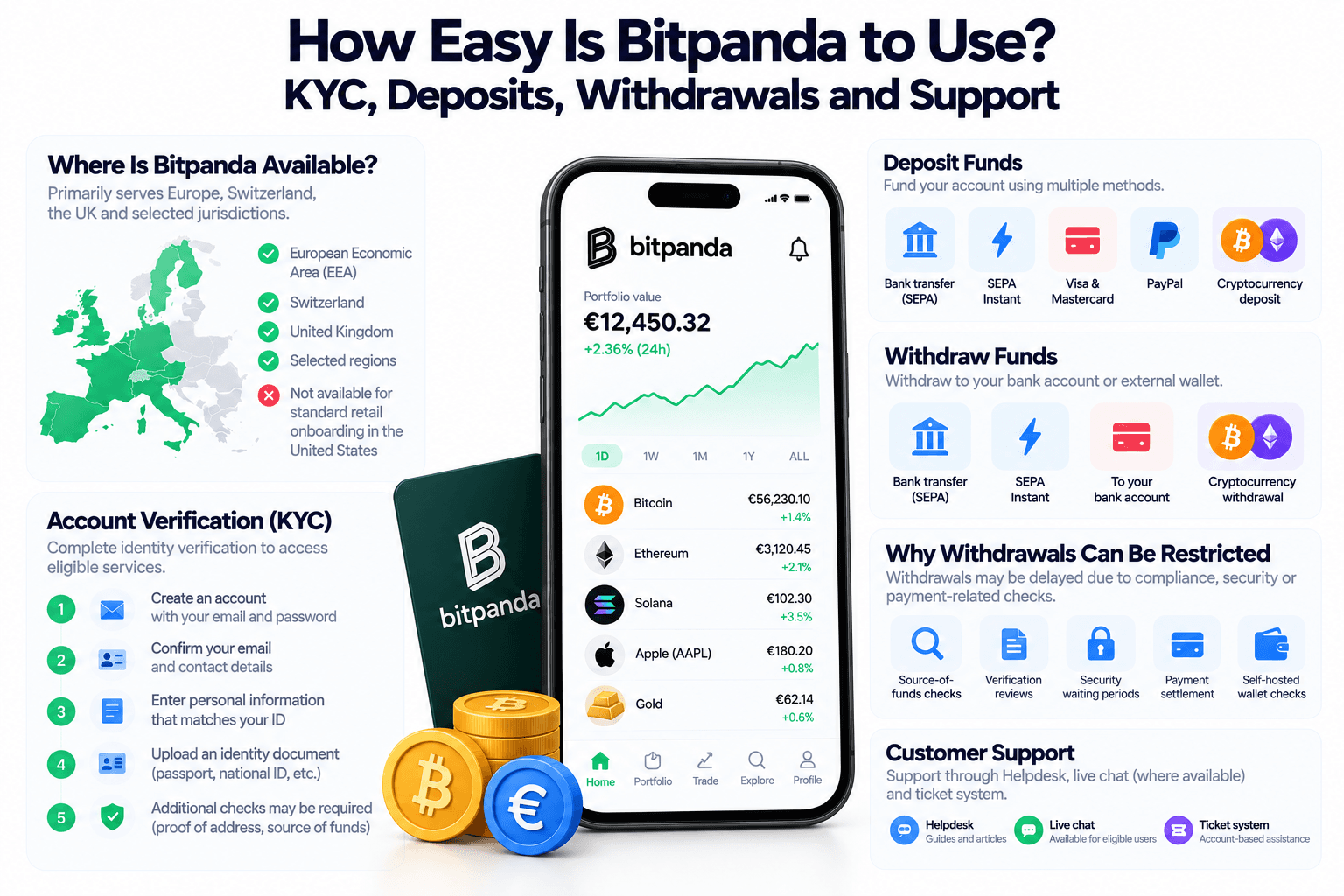
Where Is Bitpanda Available, and How Does Verification Work?
Bitpanda primarily serves European customers, with supported markets extending across the European Economic Area, Switzerland, the United Kingdom, and selected additional jurisdictions.
The United Kingdom operates under a separate account and regulatory framework. Bitpanda Broker UK Ltd is registered with the FCA for cryptoasset anti-money laundering supervision, and UK customers must satisfy applicable financial-promotion and onboarding requirements.
These include a mandatory 24-hour cooling-off period for relevant newly registered retail customers before their first cryptocurrency trade.
Bitpanda does not generally provide standard retail onboarding to residents of the United States.
For eligible customers, account verification involves several steps:
- Create an account using an email address and password.
- Confirm the registered email address and relevant contact information.
- Enter personal details matching the identification document.
- Upload an accepted identity document and complete the verification process.
- Provide additional residency or financial documentation if requested.
Bitpanda's verification requirements cover accepted identity documents, supported verification procedures, and account eligibility conditions.
Depositing and Withdrawing Fiat or Cryptocurrency
Bitpanda supports bank transfers, cards, PayPal, and selected local funding methods. Cryptocurrency can also be deposited or withdrawn through supported blockchain networks.
| Method | Main Purpose | Processing Considerations | Regional Availability |
|---|---|---|---|
| SEPA transfer | EUR deposits and withdrawals | Bank processing and settlement requirements | Eligible European accounts |
| SEPA Instant | Faster EUR transfers | Dependent on participating banks | Supported SEPA markets |
| Visa and Mastercard | Card funding | Authorization, limits, and payment restrictions | Supported countries |
| PayPal | Fiat funding | Withdrawal waiting period on affected deposits | Selected jurisdictions |
| Local banking providers | Fiat deposits | Provider-specific processing and settlement | Country-dependent |
| Cryptocurrency transfers | Crypto deposits and withdrawals | Network confirmation, withdrawal limits, and network fees | Supported assets and networks |
A standard transaction follows this process:
- Register and verify: Complete identity verification and enable account security features before transferring funds.
- Choose a funding method: Select an eligible fiat wallet or cryptocurrency deposit route and review its limits.
- Make a deposit: Transfer funds through the selected bank, card, payment provider, or blockchain network.
- Purchase an investment: Select the supported asset, review the quotation and charges, and confirm the transaction.
- Sell cryptocurrency if necessary: Convert the holdings into an eligible fiat balance through Broker or Fusion.
- Withdraw funds: Transfer fiat to an eligible bank account or send supported cryptocurrency to an external wallet.
For fiat withdrawals, processing depends partly on the receiving bank and the payment network.
For cryptocurrency withdrawals, Bitpanda must process the request before the blockchain transaction can begin receiving network confirmations.
For readers comparing exchange custody with direct wallet control, our crypto exchange vs. wallet guide explains how the transfer changes who can authorize future transactions.
Why Does Bitpanda Restrict or Delay Withdrawals?
Bitpanda can delay or restrict withdrawals when a transaction has not fully settled, an account requires additional verification, or the platform identifies a security or compliance concern.
These restrictions can affect customers even when the funds remain visible in their balances.
The most common documented categories include:
- Source-of-funds checks: Customers may be asked to provide bank statements, salary records, investment-sale documentation, or other evidence explaining the origin of funds.
- Verification reviews: Missing or inconsistent account information can delay transactions until the relevant details are confirmed.
- Security waiting periods: Certain account changes, authentication resets, or security events can trigger temporary withdrawal restrictions.
- Payment settlement: Funds deposited through some payment methods remain subject to waiting periods before they can be withdrawn.
- Self-hosted wallet checks: Transfers may require additional ownership or beneficiary information under applicable anti-money laundering and Travel Rule requirements.
Bitpanda's withdrawal policy includes restrictions on PayPal-funded deposits and other payment-specific conditions.
Bitpanda Customer Support and User Complaints
Bitpanda provides support through its online Helpdesk, account-based assistance, and ticket system.
The Bitpanda Helpdesk covers identity verification, account access, payment issues, cryptocurrency transfers, and investment products.
Live-chat functionality and additional assistance may be available according to account status and service eligibility.
Customer feedback indicates that experiences vary considerably.
Public reviews on Trustpilot include positive comments about interface accessibility, supported investments, and successful support interactions.
Negative reports frequently involve verification requirements, temporary account restrictions, delayed withdrawals, and difficulty resolving complicated support cases. Similar complaints appear in online communities, although individual reports rarely provide complete account histories or enough evidence to establish the precise cause of a restriction.
Bitpanda vs. Kraken, Bitvavo and Coinbase: Which Is Better?
Bitpanda competes with several established European cryptocurrency services, although the best alternative depends on whether the customer prioritizes low-cost trading, investment selection, or account functionality.
A crypto-only investor evaluating EUR trading costs has different requirements from someone purchasing ETFs and precious metals alongside cryptocurrency.
| Platform | Entry-Level Advanced Trading Fees | Main Strength | Main Limitation |
|---|---|---|---|
| Bitpanda | Fusion: 0.25% | Integrated crypto and traditional investments | Higher standard Broker fees |
| Kraken | Kraken Pro: 0.40% maker / 0.80% taker | Advanced trading and security controls | Higher entry-level taker costs |
| Bitvavo | 0.15% maker / 0.25% taker on EUR markets | Competitive EUR cryptocurrency trading | More limited traditional investment offering |
| Coinbase | Tier-dependent maker/taker schedule | Accessible retail interface and extensive crypto services | Variable retail purchase costs and regional restrictions |
The comparison uses published entry-level rates and general product availability as of Oct. 25, 2026. Actual charges depend on the transaction, account tier, and jurisdiction.
Bitpanda vs. Kraken
Kraken is particularly attractive to experienced cryptocurrency traders who prioritize account security controls, advanced trading functionality, and reserve transparency.
Kraken publishes recurring Proof of Reserves disclosures and offers account protections such as security-key authentication, withdrawal-address controls, and additional account locks. It also holds MiCA authorization through its Irish entity, allowing eligible European cryptoasset services under the EU framework.
Bitpanda offers an easier route for users who want to combine cryptocurrency holdings with conventional investment products. Its standard Broker interface is simpler than a professional trading terminal, although frequent crypto transactions become expensive at the ordinary brokerage rate.
Kraken has also expanded into stocks, ETFs, and tokenized-equity products, with eligibility varying between markets.
- Choose Kraken if advanced trading functionality, reserve disclosures, and detailed security controls are priorities.
- Choose Bitpanda if an integrated European investment account is more useful, particularly when traditional securities and precious metals form part of the portfolio.
Bitpanda vs. Bitvavo
Bitvavo is a close competitor for investors who primarily want to buy and sell cryptocurrency in euros.
Its EUR trading fees start at 0.15% for maker orders and 0.25% for taker orders.
These rates are substantially below Bitpanda Broker's standard cryptocurrency charges and comparable with Fusion's entry-level commission for immediately executable trades.
Bitvavo also supports SEPA funding and external cryptocurrency withdrawals, providing the core functions required by many European retail investors. Its cryptocurrency selection covers hundreds of assets, although supported tokens and trading pairs differ from Bitpanda.
The regulatory comparison is also relatively close. Bitvavo obtained MiCA authorization from the Dutch Authority for the Financial Markets in June 2025, while Bitpanda operates through its separately authorized European entities.
The investment selection is where the platforms diverge.
Bitvavo concentrates on cryptocurrency trading and related services, while Bitpanda combines digital assets with stocks, ETFs, ETCs, and precious metals.
For an investor purchasing €500 of Bitcoin each month, Bitvavo's low-cost EUR trading may offer better value than standard Bitpanda Broker purchases.
For someone managing a diversified portfolio across several asset classes, Bitpanda's additional functionality may justify paying more for convenience.
Bitpanda vs. Coinbase
Coinbase offers an accessible retail cryptocurrency experience, backed by a developed ecosystem of trading, custody, staking, wallet, and onchain services.
Its standard retail interface supports simplified purchases, while Coinbase Advanced provides professional trading tools and a volume-based fee schedule. Ordinary retail transaction costs vary with payment method, transaction size, market conditions, and the displayed quotation.
Coinbase also operates through region-specific regulated entities. Its European cryptoasset services include a MiCA-authorized Luxembourg entity, while access to individual products depends on the customer's jurisdiction.
Compared with Coinbase, Bitpanda provides a more integrated route into conventional European investing through real stocks, ETFs, ETCs, and precious metals.
Coinbase has a stronger focus on cryptocurrency-related services, including advanced trading, staking, wallet infrastructure, and onchain activity.
For users interested primarily in buying, transferring, and using cryptocurrency, Coinbase may provide a better match.
For European investors who want their cryptocurrency holdings alongside conventional financial assets, Bitpanda's offering is more directly aligned with that requirement.
Best Platform by User Type
| Investor Type | Platform Worth Considering | Main Reason |
|---|---|---|
| Beginner combining crypto and traditional investments | Bitpanda Broker | Accessible multi-asset account |
| Frequent cryptocurrency trader | Bitpanda Fusion or Bitvavo | Competitive trading commissions |
| Security-focused active trader | Kraken | Advanced controls and reserve transparency |
| EUR-focused crypto investor | Bitvavo | Low entry-level EUR trading fees |
| Investor using onchain cryptocurrency services | Coinbase | Broader wallet and crypto ecosystem |
| European multi-asset investor | Bitpanda | Integrated securities, metals, and crypto products |
Investors who remain undecided can use our best crypto exchanges guide to compare security, trading costs, regional access, and supported features across additional platforms.

Is Bitpanda Worth Using in 2026? Our Final Verdict
Bitpanda is worth considering for European investors who want a straightforward way to manage cryptocurrency and conventional investments through one account.
Its European regulatory authorizations, established operating history, and expanded securities offering support its position as a multi-asset platform. However, standard cryptocurrency trading costs remain high compared with several alternatives.
The value proposition improves considerably for eligible users who switch to Bitpanda Fusion.