Some crypto platforms feel like they were built for traders who already speak the language. Coinbase is different. It has spent years positioning itself as the clean, beginner-friendly front door to crypto, while quietly growing into something much bigger: a public company, a major custody provider, a payments platform, and a serious piece of market infrastructure.
That range is exactly what makes a Coinbase review more interesting than a simple “is it good?” verdict. The real question is whether Coinbase still earns its place as one of the default choices for buying, storing, and using crypto; or whether its convenience now comes at too high a price in a market that now has user-friendly alternatives as well.
Editor's Note (April 11, 2026): We fully updated this article in April 2026 to reflect how Coinbase has evolved from a simple retail on-ramp into a broader crypto ecosystem spanning Advanced Trade, Coinbase One, Base, institutional services, and derivatives expansion. This refresh also updates our view on Coinbase’s safety, fees, usability, and competitive position in 2026, with a sharper focus on who it suits best and where the main trade-offs still remain.
Quick Verdict
Coinbase is one of the best crypto exchanges for beginners and compliance-first users in 2026. It stands out for trust, ease of use, and product depth, with a public-company profile, strong security tooling, and a clean path from simple buys to Advanced Trade. The main trade-off is cost: Coinbase is rarely the cheapest option unless you use Advanced Trade or structure purchases carefully. For most users, Coinbase is best as a safe, easy fiat-to-crypto gateway rather than the lowest-fee platform for high-volume trading.
Our take: Coinbase is a strong choice for users who want a trusted, easy-to-use exchange with good security, solid product breadth, and a smoother onboarding experience than most rivals, but it is a weaker fit for traders who care most about rock-bottom fees, broader altcoin access, or a more crypto-native experience.
Scorecard
-
1Security Features 4.8/5 Coinbase offers strong account protections, including passkeys, security keys, 2-step verification, withdrawal protections, and a mature security stack that feels more robust than many retail rivals.
-
2Trust and Transparency 4.9/5 Its public-company disclosures, audited reporting, institutional custody business, and regulation-heavy profile make Coinbase one of the easiest exchanges to trust, even if no custodian model is risk-free.
-
3Fee Competitiveness 4.5/5 Coinbase can be expensive in its simplest buy flow, but Advanced Trade materially improves pricing and makes the platform much more competitive for users who know how to use it.
-
4Product Breadth 4.8/5 Coinbase now stretches well beyond basic spot trading, with Advanced Trade, staking, USDC tools, Coinbase One, institutional services, wallet products, and Base as part of the wider ecosystem.
-
5Ease of Use 4.8/5 The platform remains one of the cleanest onramps in crypto, especially for first-time buyers moving from cash to crypto without wanting a full trader-first interface from day one.
-
6Overall Score 4.8/5 A strong all-round crypto exchange for beginners, mainstream users, and compliance-first investors who value trust, usability, and ecosystem depth more than the absolute lowest trading fees.
Best For
- Beginners buying their first crypto with a familiar, polished interface
- Compliance-first users who value public-company transparency and trust signals
- Users who want one brand for spot trading, staking, USDC tools, and wallet access
- People moving from simple buys toward more advanced order-book trading over time
Not Ideal For
- Fee-sensitive traders who want the cheapest possible default buy flow
- Altcoin hunters looking for broader offshore-style listings
- Users who primarily want deep derivatives, copy trading, or a pro-trader environment
- People who prefer full self-custody over exchange-based custody from the start
Coinbase At A Glance
| Category | Details |
|---|---|
| Type | Centralized crypto exchange |
| Core Use Cases | Buying, selling, holding, staking, and trading crypto through a mainstream retail platform |
| Main Identity | Beginner-friendly, compliance-forward exchange with a wider ecosystem around wallets, USDC, Base, and institutional services |
| Trading Tools | Simple Trade for beginners and Advanced Trade for order-book trading, charting, and maker/taker pricing |
| Pricing | Advanced Trade uses volume-based maker/taker fees, while Simple Trade is convenience-first and usually more expensive due to spread and transaction costs |
| Trust Signals | Public-company reporting, audited disclosures, institutional custody business, and strong account-security tooling |
| Higher-Risk Tools | Derivatives in supported regions, staking risks, and exchange-custody exposure common to centralized platforms |
| Watchouts | Higher retail costs in basic buy flows, regional feature differences, account-review friction, and narrower token breadth than some rivals |
Disclosure and Methodology
Some links in this Coinbase review may be affiliate links. If you choose to use a service through these links, we may earn a commission at no additional cost to you. That does not change how we assess Coinbase’s security features, pricing model, product breadth, trust signals, retail usability, or overall fit for different types of crypto users.
For this review, we evaluated Coinbase across five main categories: security features, trust and transparency, fee competitiveness, product breadth, and ease of use. We reviewed Coinbase’s exchange materials covering Advanced Trade pricing, account-security tools, Coinbase One plans, custody and support documentation, and the broader product stack around wallets, Base, and institutional services. We also weighed how Coinbase works in practice for beginners versus active traders, while treating exchange-custody risk, phishing risk, regional product limits, and convenience-driven pricing as core parts of the final score.
What Is Coinbase?
Coinbase has grown from a simple crypto buying app into one of the biggest names in the industry. To understand why it still matters, it helps to look at both how the platform works and the role it now plays across the wider market.
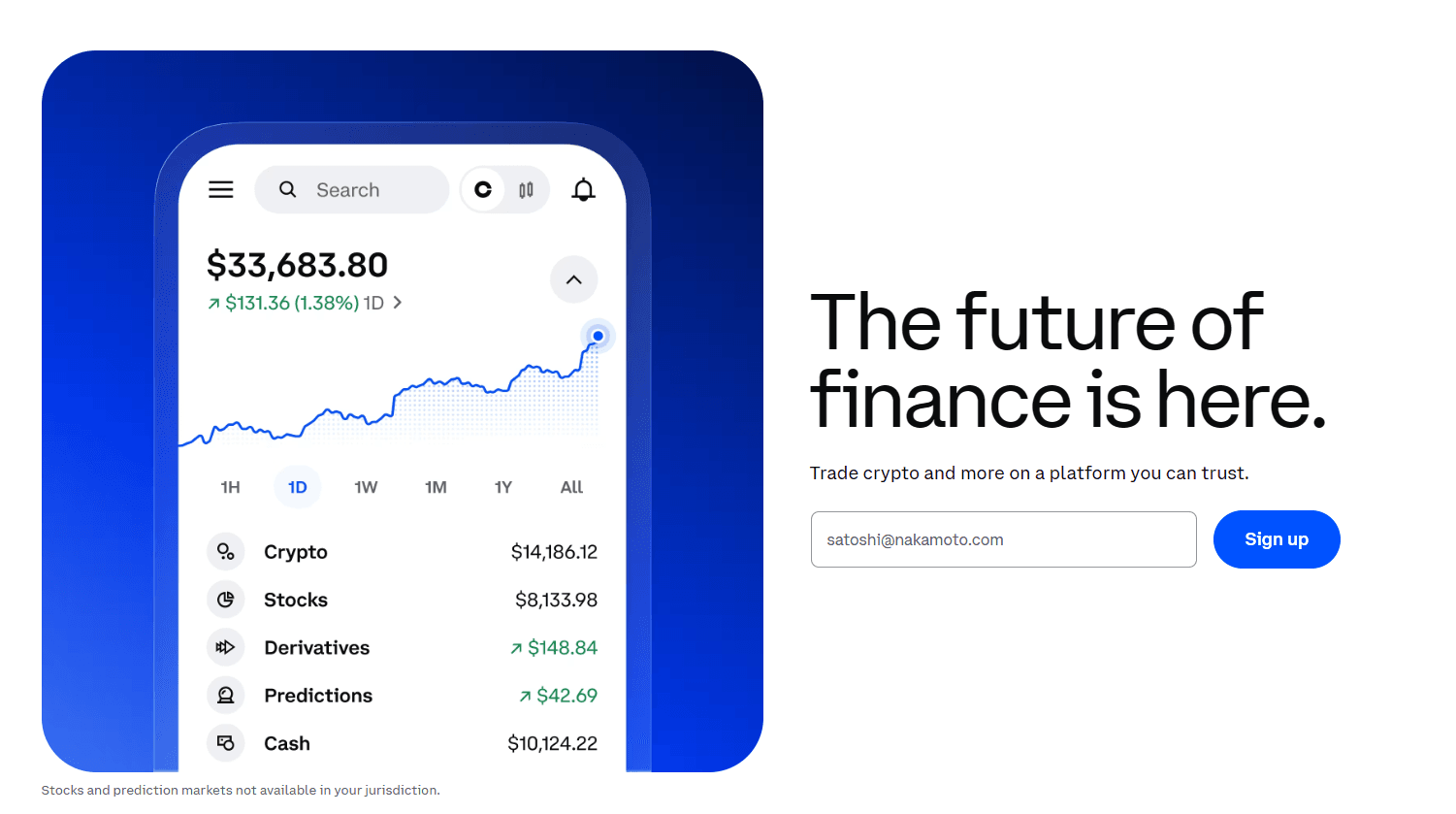 Coinbase has Grown from a Simple Crypto Buying App into One of the Biggest Names in the Industry. Image via Coinbase
How Coinbase Works
Founded by Brian Armstrong and Fred Ehrsam, Coinbase is a centralized crypto exchange that lets users buy, sell, hold, transfer, stake, and in some cases spend digital assets through one account. For beginners, it works a bit like a crypto brokerage: the platform handles the trading interface, custody layer, and payment rails in the background, which makes the process easier than using a fully self-custodial wallet.
Users can access assets like Bitcoin and Ethereum, while Coinbase also serves institutions through Coinbase Prime and supports onchain activity through Base, its Ethereum Layer 2 network.
Is Coinbase Safe in 2026?
Yes, Coinbase is one of the safer large crypto platforms in 2026, though no exchange is risk-free. Its safety case rests on a mix of account protections, custody controls, public disclosures, and a more regulation-heavy operating model than many offshore rivals.
 Coinbase is One of the Safer Large Crypto Platforms in 2026, though No Exchange is Risk-Free
Account Security and User Protections
Coinbase offers several account-level protections designed to reduce unauthorized access. These include:
- 2-Step Verification, which adds a second layer beyond a password and is required for sensitive actions.
- Hardware Security Keys such as YubiKey, which Coinbase itself treats as a stronger option than basic SMS-based login.
- Biometric Login on supported devices, which improves convenience without relying only on reusable credentials.
- Passkeys, which are designed to make sign-ins both easier and harder to phish than traditional passwords.
- Allowlisting for approved withdrawal addresses, which can slow or block unauthorized withdrawals.
- Anti-Phishing Guidance and Scam Warnings, which matter because many crypto losses begin with impersonation rather than a direct exchange breach.
Custody, Insurance, and Asset Protection
Coinbase makes an important distinction between crypto and cash. It states that crypto holdings are not covered by FDIC insurance, which is something often misunderstand.
Some of the key protection points are:
- U.S. dollar balances may be held in pooled custodial accounts at insured institutions, subject to limits and conditions.
- Institutional custody emphasizes cold storage, which reduces online exposure.
- Client assets are handled through a qualified custodian structure under Coinbase Prime.
- Coinbase references SOC 1 and SOC 2 Type II audits for custody controls.
Coinbase’s Security Record
Coinbase’s record is stronger than many peers, but it is not flawless. Two incidents matter most:
- In 2021, Coinbase warned that SMS-based authentication can be weaker than app-based or hardware-based methods.
- In 2025, Coinbase disclosed to the SEC that rogue overseas support agents were bribed to steal customer data for social-engineering attacks.
- Later filings said no passwords or private keys were compromised, though the company still recorded reimbursement and legal costs.
It's important to note here that Coinbase has never been hacked.
Public-Company Transparency vs Traditional Proof of Reserves
Unlike many offshore exchanges, Coinbase does not rely only on Proof of Reserves. Its trust model also includes:
- Public-Company Disclosures, which give regular visibility into the business.
- Audited Financial Reporting, including audited financial statements and internal-control reporting.
- Outside Scrutiny from regulators and markets, since Coinbase is listed on Nasdaq.
- Broader Ongoing Disclosure through quarterly reporting, which gives users more regular visibility than a one-time reserve snapshot.
Regulatory Position and Trust Signals
Coinbase’s compliance posture is part of its appeal. Its filings describe registration with FinCEN, while global AML expectations are shaped by FATF standards. On top of that, the OCC has an active Coinbase National Trust Company filing on record, reinforcing the idea that regulation is part of the product story, not just a legal formality.
Overall, Coinbase looks safer than many crypto exchanges because of its controls, disclosures, and regulatory footprint. Even so, the biggest risks for most users still come from phishing, impersonation, and weak account hygiene rather than the platform alone.
Coinbase Fees Explained
Coinbase’s fee structure looks simple at first, but it actually depends on which product you use and how you fund the account. In practice, most users pay either for convenience, speed, or better execution.
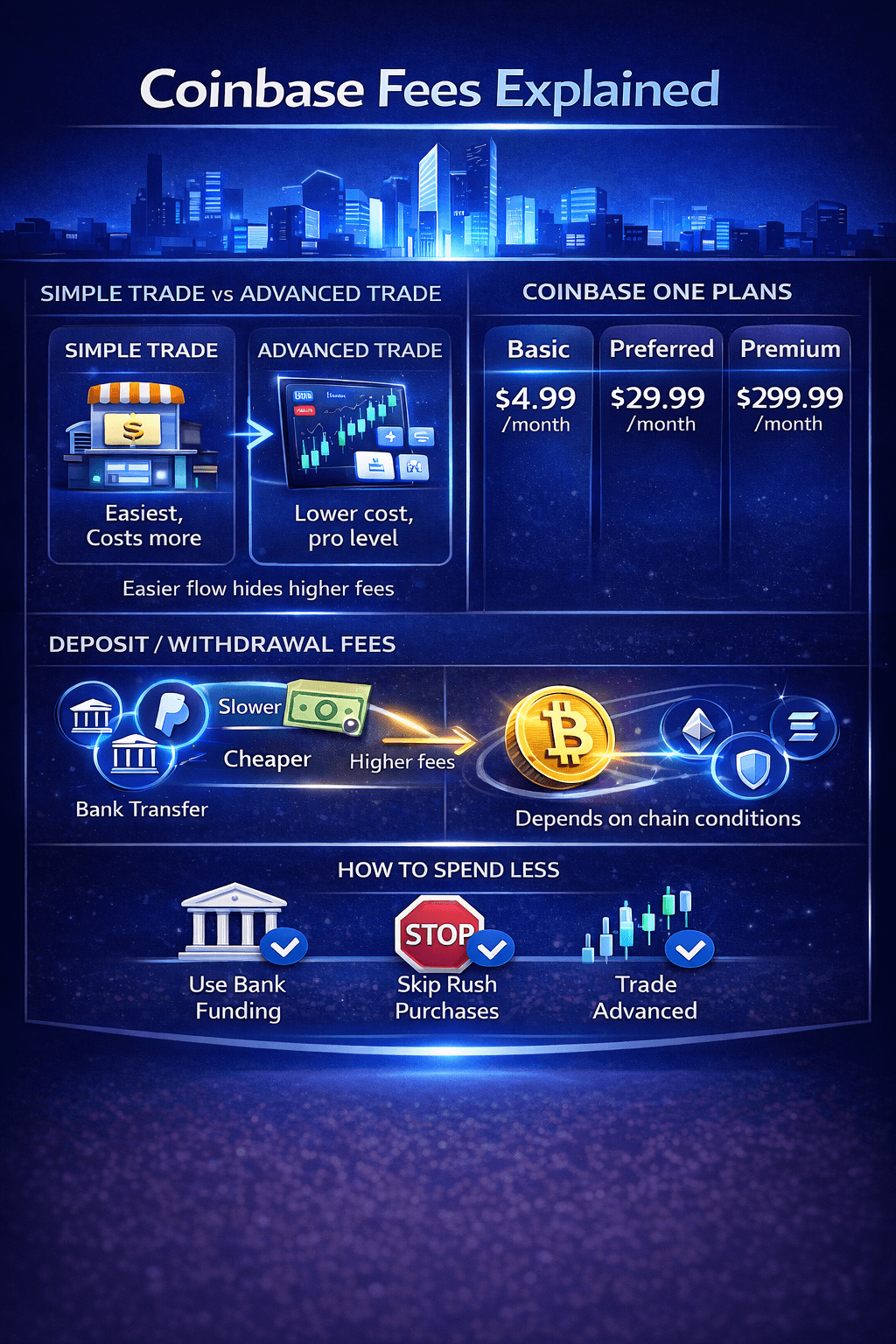 Coinbase’s Fee Structure Looks Simple, but it Depends on Which Product You Use and How You Fund the Account
Simple Trade vs Advanced Trade
For beginners, the biggest trap is using the easiest interface without realizing it often costs more. Coinbase’s standard buy flow typically wraps cost into a spread plus any disclosed transaction fee, while Coinbase Advanced uses a visible maker/taker model.
That means beginners often overpay for convenience, while experienced users can usually save by using limit orders. If you want a refresher on when market and limit orders make sense, our guide to crypto order types is a useful companion.
- Simple Trade is one-tap crypto buying that bakes a spread into the quoted price. It is the easiest path for new users but carries higher effective costs.
- Advanced Trade exposes an order book with maker/taker fees that start at ≤0.40% maker / ≤0.60% taker at the lowest volume tier, with discounts as your 30-day volume climbs. It supports market, limit, and stop orders and integrates TradingView-style charting. For cost control, step up to Advanced once you’re comfortable.
Product | How Pricing Works | Best For |
|---|---|---|
Simple Trade | Uses a spread and convenience-first flow | First-time buyers |
Advanced Trade | Uses volume-based maker and taker fees with an order book | Cost-conscious traders |
Coinbase One Plans
Coinbase One now has three tiers, and the difference mainly comes down to how much fee relief and support you want.
Monthly Price | Zero-Fee Simple Trades | Extra Perks | Good Fit For | |
|---|---|---|---|---|
Basic | $4.99 | Up to $500/month | 3.5% USDC rewards, 5% staking boost, standard support, up to $1K account protection in eligible regions | Light users |
Preferred | $29.99 | Up to $10,000/month | 3.5% USDC rewards, 10% staking boost, 24/7 priority support, up to $10K account protection, up to $100/month in Coinbase Advanced spot-fee rebates | Regular buyers |
Premium | $299.99 | Unlimited | 3.5% USDC rewards, 15% staking boost, Concierge support, up to $250K account protection, unlimited Coinbase Advanced spot-fee rebates | High-balance or heavy users |
Coinbase notes that even where zero-fee Simple Trades are included with Coinbase One, a spread still applies, so “zero-fee” does not mean the trade is completely cost-free.
Deposit, Withdrawal, and Network Fees
Funding costs depend on method and region. Key points include:
- ACH and Bank Transfers are usually cheaper, but slower.
- SEPA Withdrawals on Exchange are listed as free.
- Wire Deposits can carry fixed fees, $10 deposit fee for Fedwire.
- PayPal is convenient, but availability and holds can vary.
- Apple Pay is supported in some Coinbase flows.
- Crypto Withdrawals include network fees, which depend on chain conditions.
How to Spend Less on Coinbase
A simple rule works well: use bank funding, skip rush purchases, and trade through Advanced when possible. For example, buying on Simple Trade with a card can cost noticeably more than placing a limit order on Advanced, and moving assets on cheaper networks such as Arbitrum or Optimism can reduce transfer costs.
Coinbase is rarely the cheapest option by default, but it becomes far more reasonable once you choose the right product. Most fee mistakes come from convenience, not from hidden math.
Coinbase Features and Products
Coinbase now covers much more than simple crypto buys. The platform stretches from beginner trading tools to onchain apps, payments, staking, and developer infrastructure.
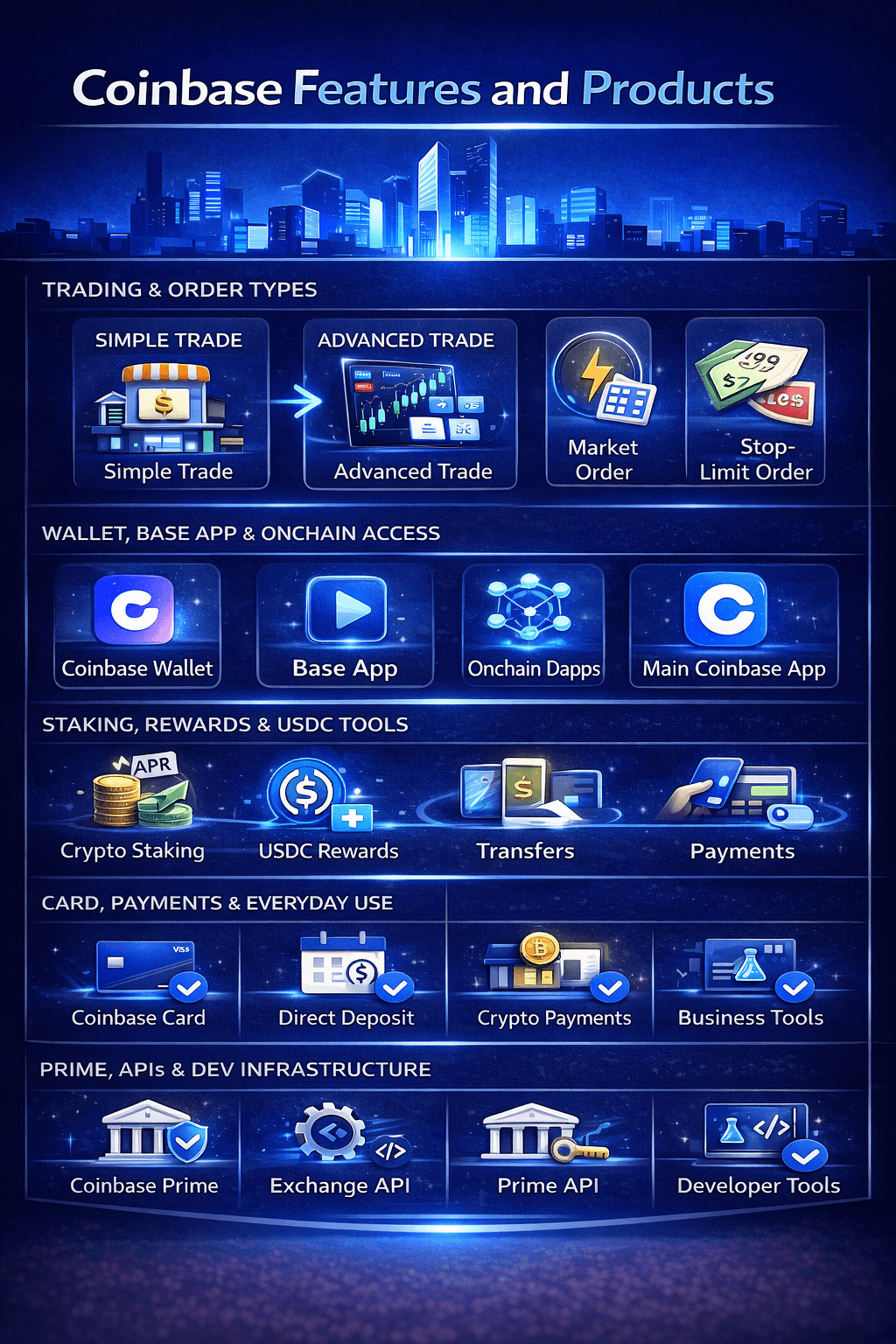 In 2026, Coinbase Stretches from Beginner Trading Tools to Onchain Apps, Payments, Staking, and Developer Infrastructure
Trading and Order Types
Coinbase splits trading into a simpler retail flow and a more detailed advanced interface. Simple Trade is built for speed, while Coinbase Advanced adds an order book, deeper charting, and more control over execution.
Advanced users can work with:
- Market Orders for instant execution.
- Limit Orders for price control.
- Stop-limit Orders for risk management.
That makes Coinbase usable for both first-time buyers and more active traders.
Wallet, Base App, and Onchain Access
Coinbase separates its main exchange from its wallet products. The regular Coinbase account is custodial, while Coinbase Wallet is self-custodied. The newer Base App is now the standalone wallet experience, and Coinbase says existing Wallet users can still access their assets there.
You can check out our review of Base App for more details.
For onchain access, the key points are:
- Coinbase Wallet can interact with DApps.
- Base App is designed for storing, managing, and using crypto in onchain apps.
- The Main Coinbase App is still primarily for buying, selling, and trading.
Staking, Rewards, and USDC Tools
Coinbase also bundles in yield and stablecoin features. Eligible users can stake supported assets, though availability depends on the asset and region. For USDC, Coinbase promotes rewards and utility across trading balances, transfers, and payment-style use cases, but these benefits can vary by product and geography.
Card, Payments, and Everyday Use
On the consumer side, Coinbase Card and Direct Deposit push the platform closer to everyday finance. For merchants, Coinbase Business adds payment links, payouts, and crypto acceptance tools.
Prime, APIs, and Developer Infrastructure
Beyond retail, Coinbase has built serious tools for institutions and builders. Coinbase Prime covers trading and custody, while the Developer Platform offers consumer and business tools built around APIs and SDKs. That includes the Exchange API, Prime API, and a Python SDK for Advanced Trade.
Taken together, these products show why Coinbase is no longer just an exchange. It is now a retail app, wallet ecosystem, payment layer, and developer stack all under one brand.
Coinbase and the Bigger Ecosystem
Coinbase's role touches institutions, ETFs, onchain infrastructure, and a growing derivatives business.
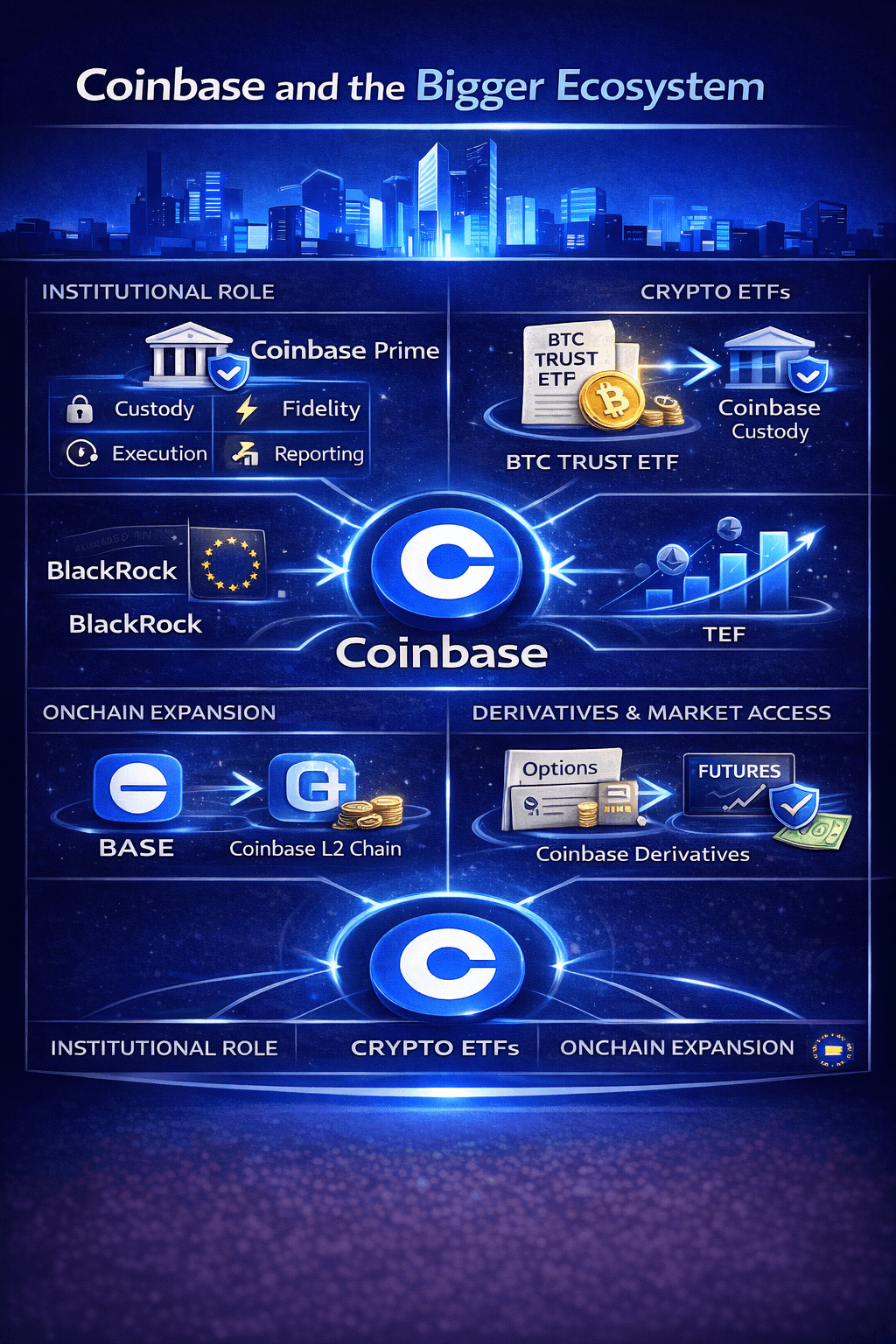 Coinbase's Role Touches Institutions, ETFs, Onchain Infrastructure, and a Growing Derivatives Business
Coinbase’s Institutional Role
On the institutional side, Coinbase Prime is designed as more than a trading portal. Coinbase positions it as a full-service platform for institutional custody, execution, financing, and reporting, which helps explain why its relevance goes beyond retail users. In simple terms, Coinbase is now part exchange and part infrastructure provider for larger market participants.
Coinbase and Crypto ETFs
That institutional footprint shows up clearly in crypto ETFs. On BlackRock’s official iShares Bitcoin Trust, IBIT identifies Coinbase Custody Trust Company as the Bitcoin custodian, while related iShares materials also reference Coinbase affiliates in trading and operational roles. ETF custody is a trust business: large issuers need a credible partner to safeguard assets. When Coinbase appears in that stack, it strengthens the view that the firm has become a serious institutional operator, not just a retail brand. Readers who want the mechanics can brush up on our guide on how spot Bitcoin ETFs work.
Base and Coinbase’s Onchain Expansion
Coinbase’s expansion also runs through Base, its Ethereum Layer 2 network. Base is important not just as “wallet stuff,” but as strategic infrastructure for bringing users, apps, and payments onchain. In practice, that means Coinbase is trying to own more of the rails beneath crypto activity, not just the front-end app. Metrics like TVL help track that kind of adoption, but the bigger point is that Base extends Coinbase deeper into the onchain economy.
Beyond Spot Trading
Coinbase has also moved further into derivatives and broader market access. Its Deribit deal expanded its options footprint, while Coinbase says futures are now available through Coinbase Advanced in 26 European countries. It has also discussed broader ambitions around equities and other markets, showing that Coinbase increasingly sees itself as more than a spot exchange.
These pieces make Coinbase easier to understand as a broader ecosystem company. It still serves retail users, but its growing importance now comes from the infrastructure it provides around them.
Coinbase User Experience
Coinbase’s user experience is one of the main reasons it stays popular with beginners. The platform generally does a good job of reducing friction, though some of that simplicity comes at the cost of speed, flexibility, or occasional review delays.
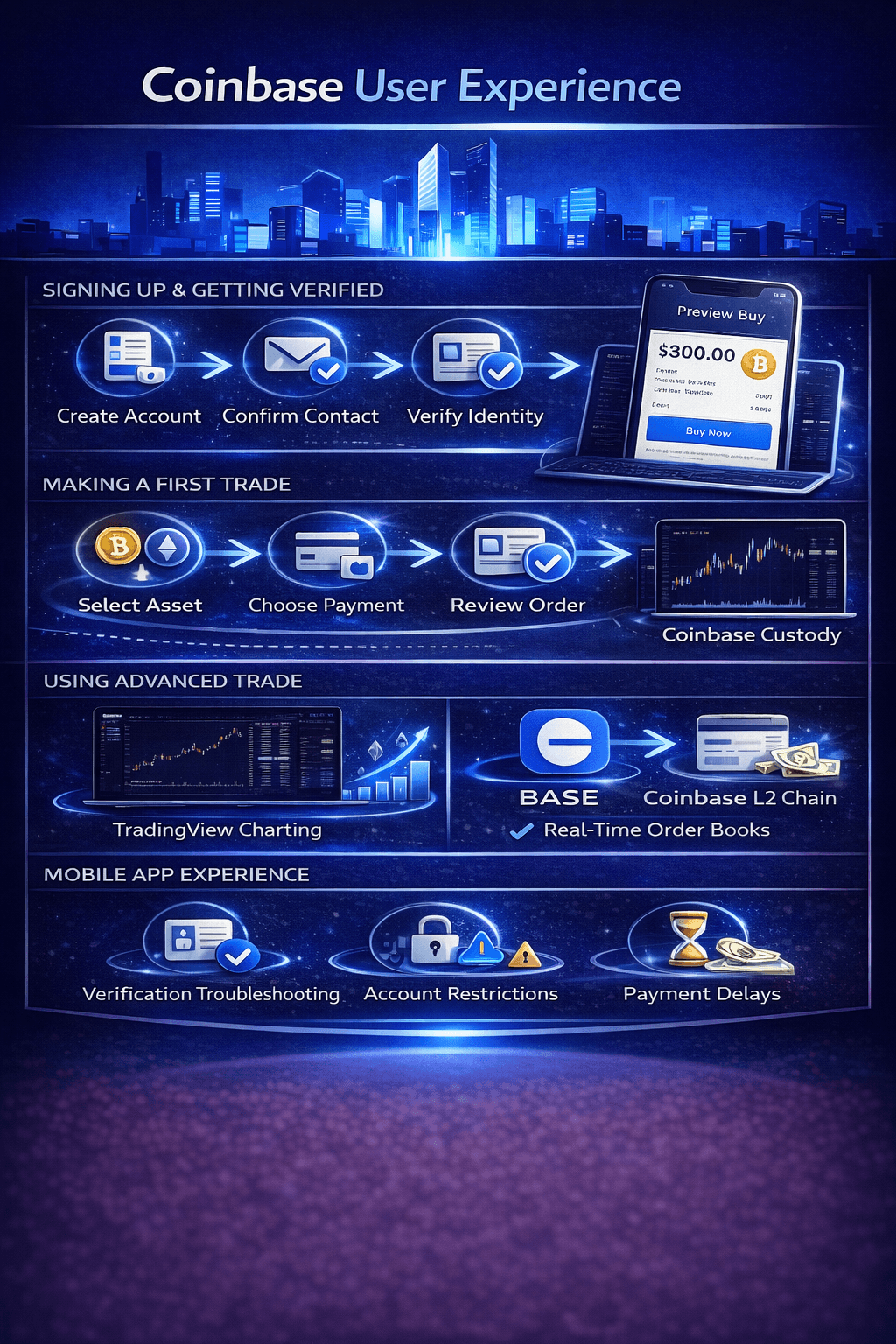 Coinbase’s User Experience is One of the Main Reasons it Stays Popular with Beginners
Signing Up and Getting Verified
The sign-up flow is pretty straightforward: create an account, confirm contact details, and complete identity verification. Coinbase makes clear that KYC is required for legal and fraud-prevention reasons, and says accounts have limited functionality until verification is complete.
Making a First Trade
The first-buy flow is easy to follow. Coinbase’s own buy flow walks users through asset selection, payment choice, and an order-review screen, while its fee disclosure notes that fees and spread can be previewed before submission. That helps with clarity, though card checks and payment authorizations can still create friction.
Using Advanced Trade
The jump from beginner mode to Advanced is noticeable but not overwhelming. Coinbase Advanced adds deeper controls, while TradingView charting, real-time order books, and more order types make it more usable for active traders.
Mobile App Experience
On mobile, Coinbase remains polished and familiar. The app supports Face ID and other biometrics, and current listings show strong sentiment on the App Store (Rated 4.7/5 by 1.8M Ratings) and an average score on Google Play (Rated 3.3/5 by 924K Reviews), Review complaints mention support and account issues.
Where the Experience Still Falls Short
The weak spots are mostly operational:
- Verification Troubleshooting can still be needed.
- Account Restrictions can interrupt normal use.
- Delays may happen during payment checks or volatile markets.
Coinbase feels easier to use than many rivals, especially for newcomers. The trade-off is that compliance and security reviews can sometimes make the experience feel slower than the interface suggests.
Coinbase Availability, Minimum Deposit, and Withdrawals
Coinbase is widely available, but the actual experience depends on where you live and how you move money in and out of the platform. Access to rewards, payment rails, withdrawals, and derivatives is not the same in every market.
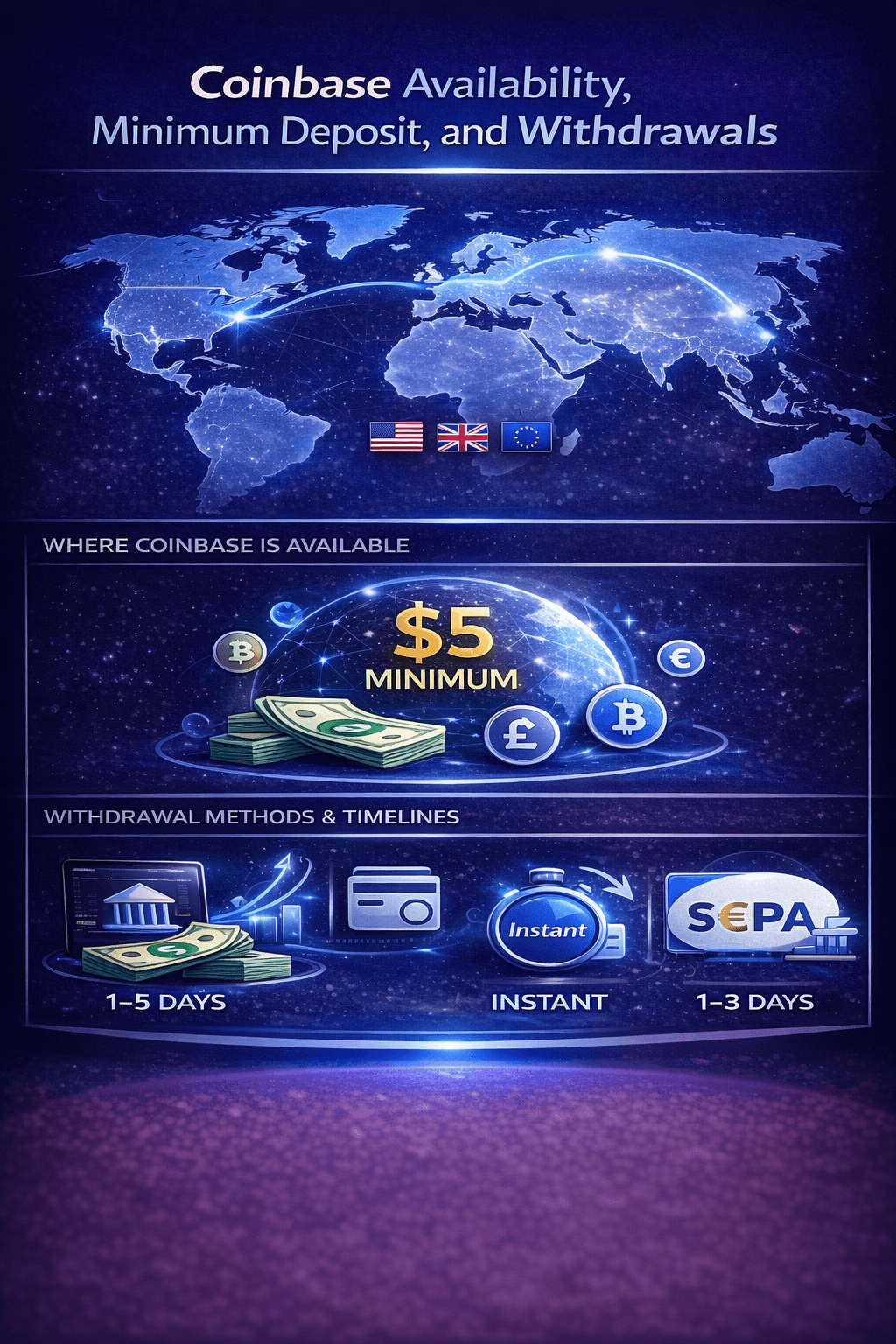 Coinbase is Widely Available, but the Actual Experience Depends on your Location and Trading Frequency
Where Coinbase Is Available
Coinbase operates across the United States, the UK, and many parts of Europe through a patchwork of local registrations and licenses. But feature availability still varies by jurisdiction: Coinbase says its regulated futures offering is available to residents of the US and most countries in the EU, which means derivatives are not universally available across all Coinbase markets.
Minimum Deposit and Purchase Requirements
Coinbase does not publish one universal minimum that applies everywhere. Instead, it says purchase and deposit limits vary by location, payment method, and account status, and users can check the exact figures in their account limits page. One concrete official number it does publish is that for certain limit-order flows, the minimum buy or sell amount is $5, though that should not be read as a universal minimum across every rail and region.
Withdrawal Methods and Timelines
For cash withdrawals, Coinbase lists:
- ACH Cashouts to Bank Accounts: 1–5 business days
- Instant Cashout to Eligible Bank Accounts: Instant
- Wire Transfer Cashouts: 1–3 business days
- SEPA Euro Withdrawals: 1–3 business days
Payment methods such as ACH, cards, and PayPal can also come with holds or verification checks, while crypto withdrawals are usually faster but can still be affected by network congestion and security reviews.
Coinbase Customer Support and Common Complaints
Coinbase offers more support options than many crypto platforms, but user satisfaction still depends heavily on speed and account context. In practice, the support experience looks strongest for routine issues and weaker when compliance or account reviews get involved.
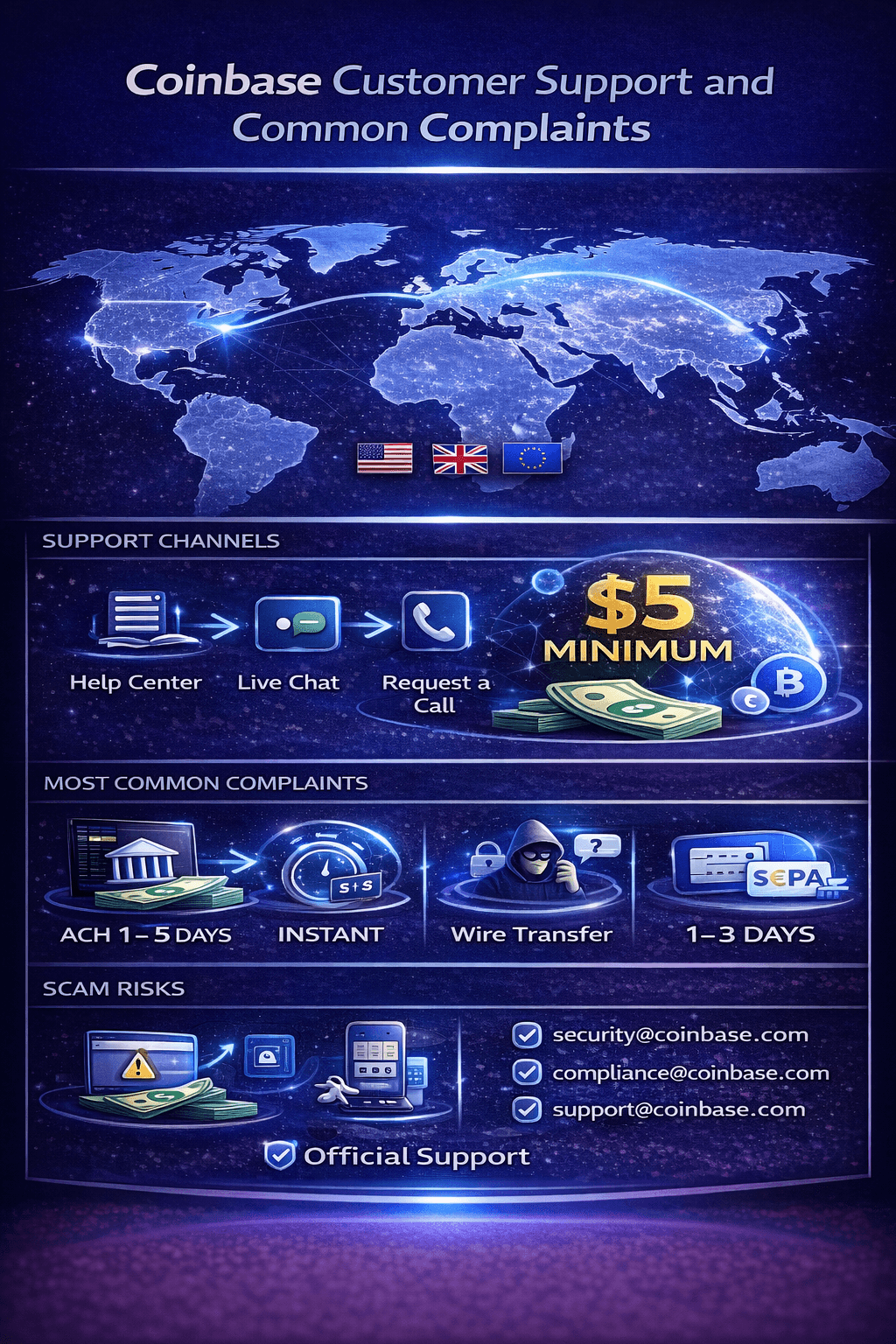 Coinbase Offers more Support Options than many Crypto Platforms, but User Satisfaction still Depends heavily on Speed and Account Context
Support Channels
Coinbase’s official support stack includes a Help Center, live chat, the option to request a call, and complaint handling through formal support channels. Coinbase also publishes verified email addresses for account and security issues, which helps users confirm whether a message is genuine.
Most Common User Complaints
The same themes come up repeatedly in public feedback: support delays, verification loops, account restrictions, and slow response times during periods of market stress. Those patterns are visible across Coinbase’s Trustpilot page (rating Coinbase at 4.0/5 with 21,734 reviews) and its Better Business Bureau complaint history, where login, access, and fund-restriction issues appear often. Questions around tax forms and reporting can also add friction.
Scam Risks and Support Impersonation
Support scams are a real part of the Coinbase experience. Coinbase warns that attackers use phishing, fake support pages, and spoofed calls, and says it will never ask users to transfer funds or share login codes. Coinbase has also publicly thanked ZachXBT for contributions tied to a recent impersonation-scam investigation.
Coinbase’s support setup is stronger than many exchanges on paper, but the real test is how it performs when something goes wrong. For users, that makes scam awareness and account security just as important as the support channels themselves.
Coinbase vs Other Exchanges
Coinbase is not the cheapest exchange, but it is often one of the easiest to trust. The trade-off usually comes down to convenience and compliance versus lower fees, deeper derivatives, or broader token access elsewhere.
 Coinbase is not the Cheapest Exchange, but it is often one of the Easiest to Trust
Coinbase vs Binance
Exchange | Fees | Listings | Regulation | Derivatives Depth |
|---|---|---|---|---|
Coinbase | Base Spot Fee: 0.40% Maker / 0.60% Taker Base Futures Fee: 0.020% Maker / 0.040% Taker | Narrower and more selective, with a stronger focus on mainstream assets. This still includes thousands of assets with all ERC-20 tokens and all assets on EVM-compatible chains | Public company with a more compliance-forward profile and stronger disclosure standards. | Offers futures, but the suite is still smaller than Binance’s. |
| Base Spot Fee: 0.10% Maker / 0.10% Taker Base Futures Fee: 0.020% Maker / 0.050% Taker | Much broader token coverage and deeper global listing breadth. | Broad global reach, but not built around the same public-company transparency model. | Much deeper derivatives offering across futures and perpetuals. |
Our Binance vs Coinbase comparison goes deeper into that trade-off.
Coinbase vs Kraken
Exchange | Fees | Support | Spot Trading | Compliance-First Users |
|---|---|---|---|---|
Coinbase | Base Spot Fee: 0.40% Maker / 0.60% Taker Base Futures Fee: 0.020% Maker / 0.040% Taker | Broad retail support system with live chat, phone-request options, and a large help center. | Simpler for beginners, with a cleaner path from basic buys to Advanced Trade. | A better fit for users who want a mainstream, regulation-heavy platform. |
| Base Spot Fee: 0.40% Maker / 0.80% Taker Base Futures Fee: 0.0200% Maker / 0.0500% Taker | Often favored by more experienced users, though support experiences still vary. | Strong spot trading environment through Kraken Pro. | Also trusted, but often feels more crypto-native than beginner-friendly. |
For a fuller breakdown, see Kraken vs Coinbase.
Coinbase vs KuCoin
Exchange | Fees | Altcoin Breadth | Speculative Traders | Niche Pairs |
|---|---|---|---|---|
Coinbase | Base Spot Fee: 0.40% Maker / 0.60% Taker Base Futures Fee: 0.020% Maker / 0.040% Taker | More selective and focused on larger, more established assets. | Better suited to conservative or mainstream users than high-risk traders. | Limited compared with offshore exchanges. |
| Base Spot Fee: 0.10% Maker / 0.10% Taker Base Futures Fee: 0.020% Maker / 0.060% Taker | Much broader token menu, especially outside the largest assets. | More appealing to traders chasing smaller or newer tokens. | Stronger coverage of niche pairs and lower-liquidity markets. |
For an in-depth comparison, check out KuCoin vs Coinbase.
Coinbase wins on ease of use and trust signals, while rivals often win on fees, listings, or derivatives depth.

Final Verdict: Is Coinbase Worth It in 2026?
For a lot of users, Coinbase is still worth it in 2026. It remains one of the easiest ways to move from cash to crypto, and its blend of trust, convenience, and product depth is hard to ignore. Between Coinbase Advanced, Coinbase One, Base, USDC, and the broader reach gained through Deribit, it now feels more like a crypto ecosystem than a simple exchange.
That said, Coinbase is not the cheapest date at the crypto dance. It is still one of the best choices for beginners, compliance-first users, and anyone who values clean UX over rock-bottom fees, while more active traders may prefer some of the Best Coinbase Alternatives.