Guarda Wallet is a non-custodial, multi-chain crypto wallet supporting 1M+ tokens across 70+ blockchains. It combines broad asset support with staking, swaps, fiat purchases, DApp connectivity and Ledger integration across web, desktop, mobile and browser-extension interfaces.
In this Guarda Wallet review, we examine how it works, its security and recovery model, supported assets, fees, staking features and key limitations to help you decide whether it is the right wallet for your crypto portfolio.
Editor's Note (Aug. 16 2026): We fully updated this Guarda Wallet review in August 2026 to reflect current asset support, platform availability, staking options, fees, security features and recovery procedures. The refresh also adds deeper coverage of Guarda's backup model, Ledger integration, DApp risks, third-party services, platform update cadence and the 2020 domain compromise.
Guarda Wallet Review 2026: Quick Verdict
Guarda is a broad multi-chain, non-custodial software wallet that supports 1M+ tokens across 70+ blockchains, multiple device types, staking, swaps, fiat purchases and Ledger integration. It is best suited to users managing assets across several ecosystems, while hot-wallet exposure, an unusual backup model and variable third-party costs require more care than the simple interface initially suggests.
Our take: Guarda is strongest as a convenient multi-chain wallet rather than a maximum-security storage solution. Its asset coverage and cross-platform access are excellent, but users should understand the encrypted backup-plus-password recovery model and consider Ledger-backed signing for larger holdings.
Scorecard
-
1Asset Support 4.8/5 Guarda advertises 1M+ tokens across 70+ blockchains, including Bitcoin, Ethereum, Solana, BNB Chain, Tron, Cardano, Monero, XRP and Cosmos. Support is exceptionally broad, although not every asset receives the same staking, swap, fiat or DApp functionality.
-
2Security 4.1/5 Private keys are generated locally and remain under user control, with encrypted backups, password protection, mobile biometrics and Ledger integration available. The standard wallet is still a hot wallet, so malware, phishing and malicious transactions remain significant risks.
-
3Backup & Recovery 3.8/5 Guarda provides user-controlled recovery and individual private-key export, but its default encrypted backup file plus password system is less familiar than a standard 12 or 24-word recovery phrase. Losing the wrong combination of credentials can make recovery impossible.
-
4Staking 4.3/5 Staking is available across 14 networks, with support for assets including ETH, ADA, ATOM, TRX and XTZ. Reward rates, validator fees, lockups and claiming rules differ substantially by network, so the headline yield should never be treated as a platform-wide guarantee.
-
5Ease of Use 4.3/5 Web, mobile, desktop and browser-extension interfaces make Guarda convenient for managing diverse portfolios from one wallet. The main UX hurdle is understanding recovery, while development cadence also differs noticeably between platforms.
-
6Fees & Value 4.0/5 The wallet itself is free and normal transfers primarily incur blockchain fees. Integrated swaps and fiat purchases can introduce partner charges, spreads, payment-provider costs and network fees, so users should compare the final amount received rather than relying on a headline "zero wallet fee."
-
7Overall Score 4.2/5 Guarda is a strong choice for multi-chain users who prioritize asset breadth, self-custody and access across several device types. Its recovery architecture, hot-wallet exposure and third-party service costs keep it from being the best choice for every crypto holder.
Best For
- Multi-chain crypto holders
- Users wanting web, mobile, extension and desktop access
- Ledger owners wanting hardware-backed signing
- Users who value built-in staking and swaps
- Beginners willing to learn Guarda's recovery process
Not Ideal For
- Large long-term balances held entirely in a hot wallet
- High-frequency traders seeking the lowest execution costs
- Users who strongly prefer 12 or 24-word recovery phrases
- Highly active DeFi users wanting specialist Web3 tooling
- Single-chain users better served by a dedicated wallet
Disclosure and Methodology
Some links in this article may be affiliate links. If you choose to use a service through these links, we may earn a commission at no additional cost to you.
For this Guarda Wallet review, we evaluated the wallet across six main categories: asset support, security, backup and recovery, staking, ease of use, and fees and value.
Research was conducted in August 2026 using Guarda's live product interface, website, recovery documentation, support materials, staking pages, exchange pages, Ledger and WalletConnect instructions, and current mobile, desktop and browser-extension listings.
We validated wallet creation, backup and restoration requirements against Guarda's documented flows and reviewed available transaction, staking and integration paths. We did not execute funded sends, swaps or staking transactions, so we do not claim independently measured transaction times, swap costs, execution quality or staking returns.
We also considered Guarda's main risks, including hot-wallet exposure, malware, phishing, backup or password loss, malicious DApp interactions, third-party integrations, variable swap costs, staking lockups and the uneven development cadence across supported platforms.
Guarda Wallet At A Glance
| Feature | Guarda Wallet |
|---|---|
| Wallet Type | Non-custodial multi-chain software wallet |
| Platforms | Web, Windows/macOS/Linux desktop, iOS, Android, Chrome extension |
| Asset Support | 1M+ tokens across 70+ blockchains |
| Custody Model | Users control private keys |
| Staking | 14 supported networks |
| Hardware Wallet Support | Ledger integration |
| DApp Connectivity | WalletConnect and browser-extension Web3 access |
| Fiat Purchases | Available through integrated third-party providers |
| Crypto Swaps | Built-in partner-powered swaps |
| Price | Free wallet; blockchain and third-party service costs apply |
| Best For | Multi-chain holders wanting broad asset support from one interface |
| Biggest Drawback | Hot-wallet exposure combined with a backup model users need to understand carefully |
What Is Guarda Wallet?
Guarda is a multi-chain, non-custodial wallet interface that lets users interact directly with supported blockchain networks. With a standard Guarda wallet, the company says it does not store users' passwords or private keys. Public and private keys are generated locally, while the wallet provides the interface for creating addresses, checking balances and signing transactions.
That custody model is central to understanding the product. With a custodial exchange, the provider ultimately controls the keys associated with customer balances. In Guarda's standard self-custody setup, control sits with the user. Our guide to custodial vs non-custodial wallets explains the wider trade-off between those models.
Guarda currently advertises 70+ blockchain networks and 1M+ tokens, including major crypto assets such as Bitcoin, Ethereum, Solana, BNB, Cardano, Tron, Litecoin and Polygon. Users can send and receive assets, view transaction history, stake supported cryptocurrencies, access swaps, purchase crypto with fiat, connect to DApps and use several specialized wallet features.
There is one boundary worth keeping clear throughout this review. Guarda the wallet and every service visible inside Guarda are not necessarily the same economic entity. The wallet manages keys and blockchain interaction, while swaps, card purchases and some other services can depend on external providers.
How Guarda Wallet Works
Creating a Guarda wallet starts with key generation. The current web-wallet flow asks the user to create a password, after which Guarda generates the wallet's keys and requires a backup to be saved. The password encrypts the wallet and its private keys rather than acting like a server-side account password that Guarda can reset.
From there, the wallet acts as an interface between the user and each supported blockchain. When someone sends Bitcoin, for example, Guarda builds the relevant transaction and the user's key authorizes it. The blockchain records the transaction and determines settlement. Guarda cannot later reverse that blockchain transaction.
The same separation applies when additional services enter the flow. A swap may route through an exchange partner, while a fiat purchase can send the user into a third-party payment and KYC process. The resulting crypto can still arrive in a Guarda-controlled address, but the transaction may temporarily involve service providers operating under their own terms.
In practical terms, Guarda consists of four layers:
- Key creation and storage: Keys are generated locally and controlled by the user.
- Wallet interface: Guarda displays addresses, balances, transaction history and supported actions.
- Blockchain interaction: Signed transactions are broadcast to the relevant network.
- Integrated services: Swaps, purchases and selected other functions can introduce external providers and separate terms.
Which Devices and Platforms Support Guarda?
Guarda remains broadly cross-platform, although its interfaces are not moving at the same development pace. The current website offers web, desktop, iOS, Android and Chrome-extension access.
| Platform | Available | Main Capabilities | Important Limitations |
|---|---|---|---|
| Web | Yes | Core wallet management, sends/receives, swaps, staking, recovery and several advanced tools | Browser and device security affect the hot-wallet threat model |
| Desktop | Windows, macOS, Linux | Full wallet interface, staking, purchases, swaps, multisig | Guarda's public desktop page still lists version 1.1.1 from Sept. 29, 2021 |
| iOS | Yes | Mobile wallet management, transactions, buying, swapping, staking and newer integrations | Some functionality differs from web/desktop |
| Android | Yes | Mobile wallet management and integrated services | Feature availability can vary by asset |
| Chrome Extension | Yes | Browser wallet and direct DApp interaction | Browser extensions carry additional phishing and Web3-signing exposure |
The update cadence is visibly uneven. Guarda's iOS App Store history listed version 3.1.20 two days before this review, adding Polymarket access and transaction improvements, while the Chrome Web Store listed version 1.2.12, updated April 17, 2026. The public desktop download page, meanwhile, still identifies 1.1.1 as its current downloadable release.
Is Guarda Wallet Safe?
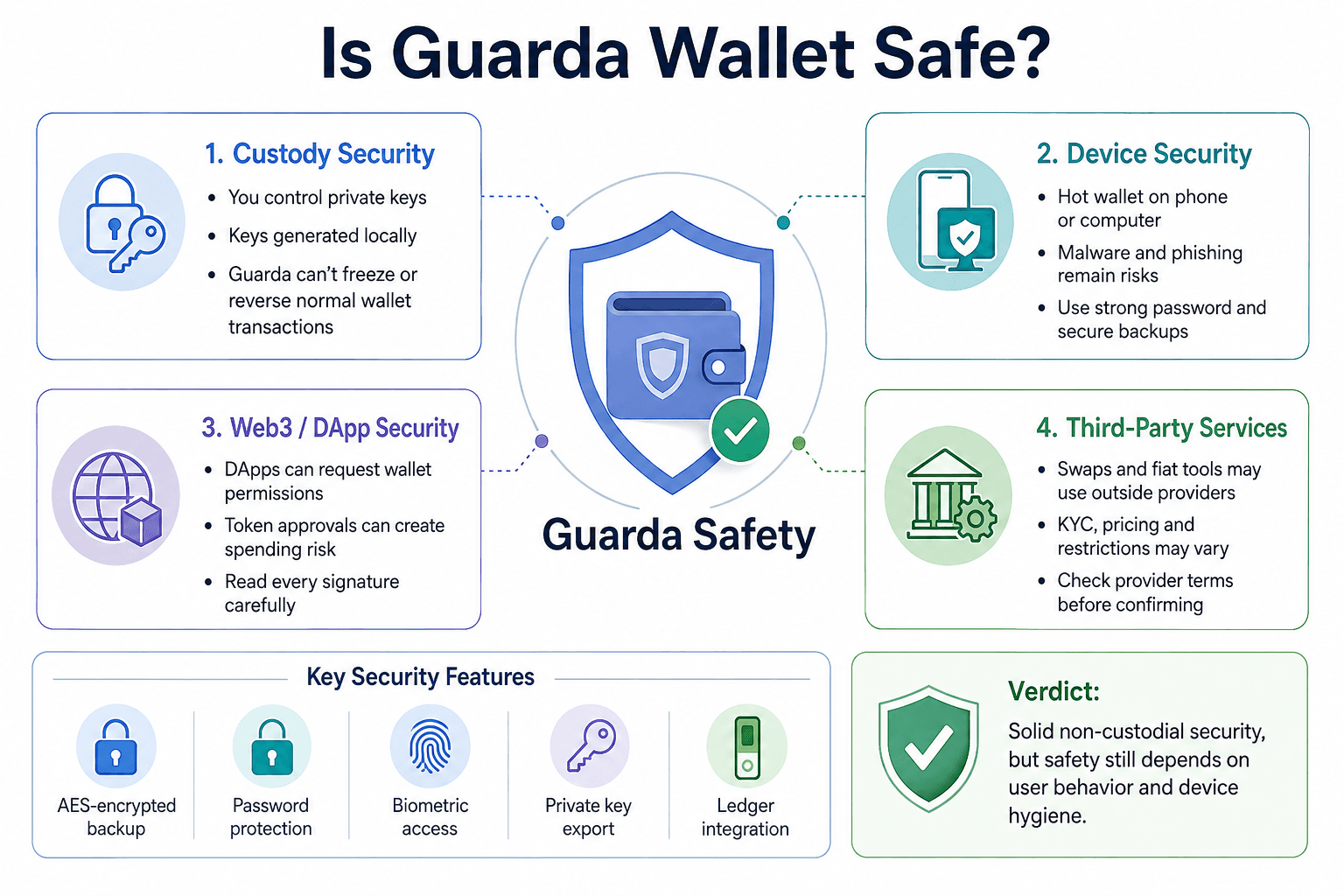
Guarda has a non-custodial security foundation, but safe use still depends heavily on the device, password, backup handling, DApp behavior and third-party integrations.
 Guarda Wallet Security, Private Keys, And Main Threats
Who Controls Your Private Keys?
With a standard Guarda wallet, the user controls the keys. Guarda describes its architecture as non-custodial and says keys are generated locally rather than stored on company servers. Its Chrome-extension documentation also says private keys and backups are generated on the user's device, encrypted and never sent over the internet.
The password has a narrower role. During wallet creation, it encrypts the wallet and private-key data. Guarda cannot reset that password because it does not hold the underlying credentials required to reconstruct the wallet.
Users can also export individual private keys. This is useful for migration or recovering access through another compatible interface, although exporting a key also creates another copy of the most sensitive credential in the wallet.
This architecture also answers the question of whether Guarda can freeze crypto in a normal self-custody wallet. Guarda says it cannot access a user's wallet, edit private keys, reset the wallet password or reverse blockchain transactions. A specific third-party service used through the interface can still impose its own compliance or transaction restrictions, particularly when fiat or external swap providers become involved.
Guarda's Security Features
The strongest security feature is local key control. Guarda's current materials also identify AES encryption for backup data, password confirmation for transactions and biometric controls on supported mobile devices.
The main controls include:
- Local private-key storage: Keys for standard Guarda wallets remain under user control rather than exchange custody.
- AES-encrypted backup: Guarda encrypts wallet backup data, with the password serving as the decryption key.
- Password protection: The wallet password encrypts private-key material and authorizes access.
- Biometric/mobile protection: Guarda's mobile materials advertise fingerprint and other supported biometric access controls.
- Individual key export: Users can retrieve private keys instead of being permanently dependent on one Guarda installation.
- Ledger integration: A supported hardware wallet can move signing-key protection away from the internet-connected host device.
The last option produces the biggest change in the security model. A normal Guarda software wallet keeps key material on the phone or computer. When Guarda is used with Ledger, Guarda becomes the management interface while the Ledger device protects the private key and authorizes transactions separately.
What Are the Main Guarda Wallet Risks?
| Risk | How It Could Affect You | Mitigation |
|---|---|---|
| Malware | Key material, passwords or clipboard data could be targeted on the device | Keep devices patched, use trusted software and avoid storing large balances in a general-purpose hot wallet |
| Phishing | Fake Guarda websites, extensions or support accounts may request recovery data | Bookmark official pages and verify app/extension publishers |
| Backup loss | Losing the required recovery material can leave the wallet unrecoverable | Maintain multiple secure copies away from the device |
| Password loss | An encrypted Guarda backup cannot simply be opened without its corresponding password | Store the password securely and separately from the backup |
| Malicious DApp | A harmful smart-contract interaction or token approval can authorize loss | Read transaction prompts and disconnect/revoke permissions when appropriate |
| Hot-wallet exposure | Standard keys remain on an internet-connected phone or computer | Use Ledger or another appropriate cold-storage setup for larger holdings |
| Third-party integration | Swap/on-ramp partners can introduce separate KYC, availability, pricing and operational risks | Identify the provider and terms before confirming |
A Ledger does not eliminate every risk in that table. Users can still sign a harmful blockchain transaction on a hardware wallet. Its main advantage is protecting the signing key from extraction by ordinary malware on the connected computer. Ledger describes its devices as keeping keys and transaction signing inside a Secure Element isolated from the online host.
DApps add another security boundary. A wallet connection can expose addresses, while transaction signatures and token approvals can create actual spending authority. Users who plan to spend much of their time in DeFi may therefore prefer separating a smaller active wallet from their long-term storage wallet.
Has Guarda Wallet Ever Been Hacked?
Yes, Guarda has experienced a serious security incident.
On Dec. 30, 2020, control of Guarda's domains was compromised following an incident involving its domain provider, GoDaddy. The attacker changed DNS records for guarda.com and guarda.co and redirected visitors to a phishing page designed to look like Guarda's interface. Crucially, the fake page requested users' wallet backups. Guarda later said its internal resources remained intact, but it believed users who uploaded backups to the phishing page could have exposed their wallet addresses and private keys. Guarda published a detailed incident report after regaining control.
That incident is useful precisely because it shows the limits of a narrow "who stores the keys?" security analysis. Guarda's internal key store did not have to be breached. A compromised trusted domain created a convincing route for users to hand the keys over themselves.
No current evidence we reviewed points to a later comparable breach of Guarda's internal wallet infrastructure. That should not be translated into an absolute claim that individual Guarda users cannot be compromised. Malware, phishing, fake support accounts, malicious DApps and exposed backups remain independent routes to wallet loss.
How Guarda Wallet Backup and Recovery Work
A newly created Guarda wallet uses an encrypted wallet backup and password, and users should avoid assuming the normal recovery flow is identical to the conventional 12 or 24-word seed phrase model.
Guarda requires new users to save a backup during wallet creation. The backup can later be downloaded as a .txt file or copied as backup text. Guarda says the underlying wallet data is protected with AES encryption, while the wallet password acts as the key needed to decrypt it.
The backup represents more than one address. Guarda says it contains encrypted data needed to restore the wallet and its private keys. When the wallet configuration changes, that file can change as well. Its support documentation specifically tells users to save the latest backup after adding or deleting a currency.
That makes storage strategy slightly different from a conventional seed phrase. Keeping the backup and password together defeats much of the value of encryption if both are stolen. Guarda itself tells users to store them separately.
Guarda also supports importing mnemonic phrases and individual private keys, but those capabilities should not be confused with the default recovery flow for a newly generated Guarda wallet. The current restore-from-backup instructions explicitly require the backup plus its corresponding password.
What Do You Need to Restore Guarda Wallet?
A normal backup restoration requires two things:
- The current Guarda backup file or backup text
- The password associated with that backup
The official restoration flow directs the user to choose "Import or Restore," select restoration from backup, provide the .txt file or backup code and then enter the password.
A lost-device scenario looks roughly like this:
Device lost → install or open a fresh Guarda interface → choose Restore from Backup → provide the encrypted backup → enter the correct password → verify restored addresses and balances before sending funds.
Before relying on this process with a large portfolio, a controlled recovery test using a small wallet is sensible. A backup that has never been tested is still an assumption.
What Happens If You Lose Your Password or Backup?
The recovery outcome depends on which credential survives.
| Situation | Likely Outcome |
|---|---|
| Backup available, password lost | The backup remains encrypted. Guarda cannot simply reset the password for you. |
| Password remembered, backup lost | The password alone does not recreate the encrypted key data. If an existing wallet session is still accessible, save a fresh backup immediately. |
| Backup and password both lost | The native Guarda recovery route is unavailable unless separate usable private keys or imported-wallet recovery credentials were preserved elsewhere. |
| Individual private key separately exported | The corresponding blockchain wallet may be recoverable through Guarda or another compatible wallet. |
| Device survives and wallet remains accessible | Export/safeguard keys and create a fresh backup before losing that remaining access path. |
Guarda's support documentation is explicit that it cannot restore or reset a forgotten wallet password and cannot recreate private keys it never held.
This arrangement creates two different failure modes. The encrypted file can be stolen while remaining unreadable without its password, which is useful. The same encryption also means a legitimate owner who forgets the password can lock themselves out.
Can You Move Your Crypto Out of Guarda Without Guarda?
In many cases, yes. Guarda allows individual private keys to be exported, and its cross-device documentation also supports importing wallets through private keys.
That provides a degree of portability if Guarda's application becomes unavailable. A compatible wallet that accepts the same private-key format can potentially reconstruct access to the relevant blockchain address.
Universal portability should not be assumed, however. Different networks can use different key representations, derivation paths, account structures and wallet standards. A raw key for one address also differs conceptually from a mnemonic that deterministically regenerates many addresses.
There is an additional wrinkle for staking and integrated products. Access to the underlying private key does not guarantee another wallet will provide an identical user interface for a Guarda staking pool, multisig arrangement or partner service. For serious holdings, test the recovery path you intend to rely on rather than treating "private keys are exportable" as the end of the recovery plan.
Which Cryptocurrencies and Networks Does Guarda Support?
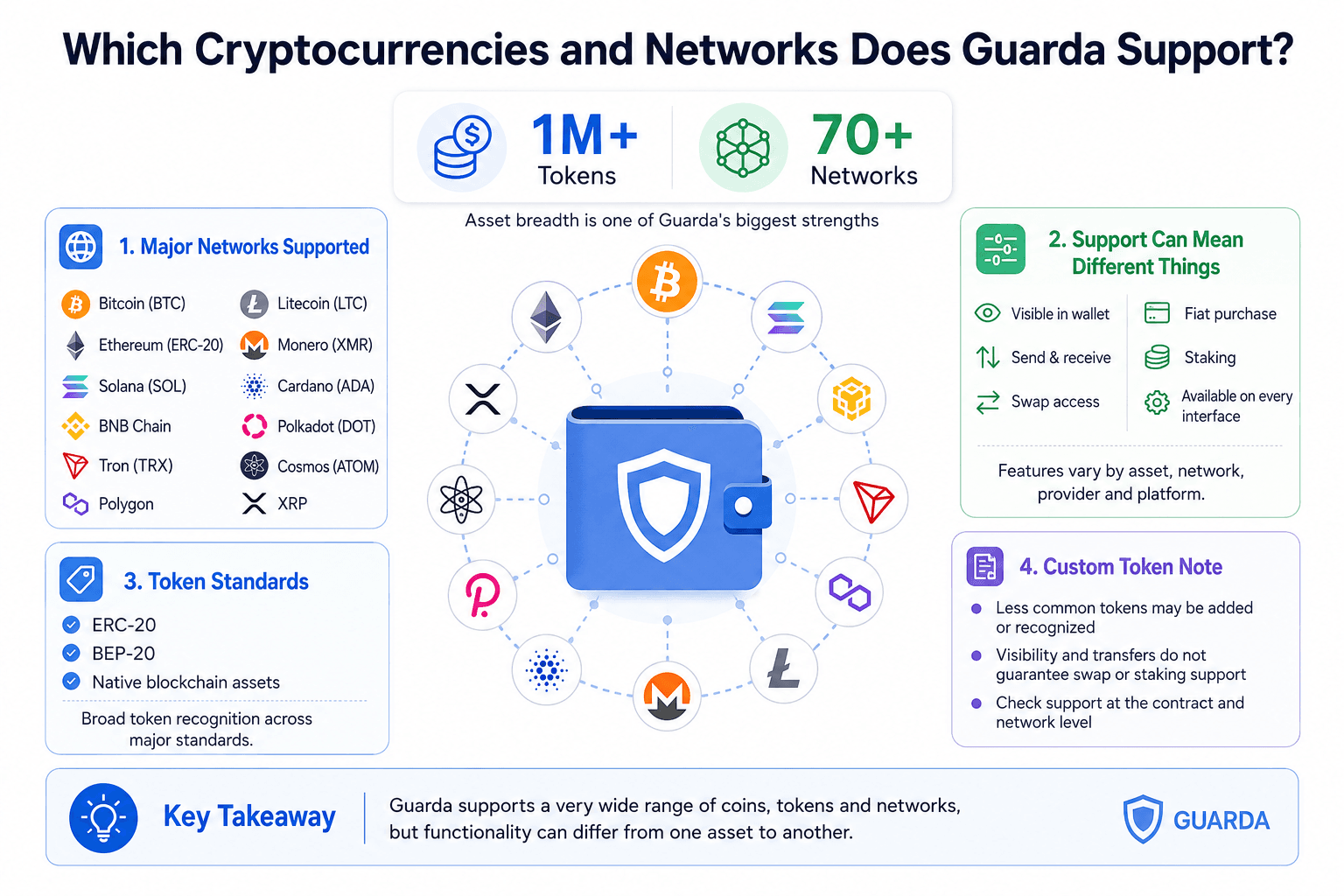
Guarda's asset breadth remains one of its clearest strengths. As of Aug. 16, 2026, its homepage advertises 1M+ tokens across 70+ blockchain networks.
The number needs context. Token recognition and full product support are different things.
A cryptocurrency might be:
- Visible in the wallet
- Sendable and receivable
- Available for an integrated swap
- Purchasable through a fiat provider
- Eligible for staking
- Accessible on every Guarda interface
Those capabilities depend on the blockchain, token, provider and platform.
 Guarda Wallet Asset Support Across Major Blockchain Networks
Major Networks Supported by Guarda
Guarda currently lists support for major networks including:
- Bitcoin (BTC)
- Ethereum (ETH) and ERC-20 assets
- Solana (SOL)
- BNB Chain
- Tron (TRX)
- Polygon
- Litecoin (LTC)
- Monero (XMR)
- Cardano (ADA)
- Polkadot (DOT)
- Cosmos (ATOM)
- XRP
The current Guarda homepage directly displays Bitcoin, Ethereum, Solana, BNB, Tron, Litecoin, Polygon, Cosmos and several other major blockchain ecosystems among its supported assets. Its Chrome Web Store listing also advertises support for Bitcoin, Ethereum, Tron, Solana and Monero.
Monero support is especially relevant because XMR compatibility has disappeared from a number of mainstream wallet and exchange products. Guarda continues to publish and maintain dedicated XMR wallet material in 2026.
Does Guarda Support Custom Tokens?
Guarda supports major token standards in addition to native blockchain assets. Its current homepage explicitly includes ERC-20 and BEP-20 support.
For users adding a less common token, support should be checked at the contract and network level rather than assuming any token deployed on a supported blockchain will receive every integrated feature. Manual token recognition can make an asset visible and transferable without creating automatic swap, staking or fiat-purchase support.
That distinction becomes particularly useful with obscure ERC-20 assets. Seeing the balance proves the wallet can recognize the token contract. It says nothing about whether an exchange partner has liquidity for it.
Guarda Wallet Fees
Guarda does not have one universal wallet fee. The cost depends on what the user is doing.
A simple blockchain transfer primarily creates a network fee. A swap can add a partner fee and exchange-rate spread. A fiat purchase can introduce payment-provider charges, conversion costs and KYC-dependent processing terms. Lumping those together under "Guarda fees" produces a misleading comparison.
Sending Crypto
For normal on-chain transfers, Guarda says it does not add an extra wallet fee. The sender pays the commission required by the relevant blockchain network.
That network fee does not go to Guarda simply because the transaction was created inside its interface. It compensates the network's miners, validators or other transaction-processing mechanism.
The amount varies widely by blockchain. Bitcoin fees depend partly on transaction size and network demand. Ethereum gas changes with network activity and the computational demands of the transaction. Other chains use different fee markets altogether.
Some Guarda interfaces expose adjustable transaction fees for supported networks, including Bitcoin. Users should treat lower fee settings as a speed trade-off rather than a discount offered by the wallet.
Guarda Swap Fees and Real Exchange Costs
An in-wallet swap can cost more than the headline fee suggests because the economic cost sits inside the quote.
Current Guarda pair pages say there is no additional Guarda platform fee on swaps. Instead, the quoted transaction can contain network costs and a partner fee included in the displayed exchange rate. Minimum amounts also move with network conditions and liquidity. Guarda's exchange page currently identifies services including ChangeNOW and Swapzone within its exchange infrastructure.
That creates three separate costs to watch:
- Network fee: Blockchain cost for moving or settling the assets.
- Partner/service fee: Compensation to the swap or liquidity provider.
- Spread/exchange-rate cost: Difference between a market reference price and the rate actually offered to the user.
The third item is easy to miss. A "zero Guarda fee" swap can still be materially more expensive than an order on a liquid exchange if the quoted conversion rate is worse.
For this review, we verified the current fee structure and live exchange pages on Aug. 16, 2026. A real cost test should use the following calculation at the exact time of the transaction:
Effective swap cost = reference market value of the input minus reference market value of the output received
Then divide that difference by the input value to get an effective percentage cost. Run the comparison immediately, since crypto prices and partner quotes can move within seconds.
Buying and Selling Crypto With Fiat
Fiat transactions add another provider layer.
Guarda currently advertises purchases through methods such as Visa, Mastercard, Apple Pay, Google Pay and bank transfers, depending on region. Its purchase pages make clear that card transactions can be completed through third-party providers rather than Guarda itself acting as the card processor.
That distinction affects identity checks. Creating a basic non-custodial Guarda wallet does not require the same centralized account-opening process as a crypto exchange. A payment partner can still require KYC before processing fiat.
The final purchase cost can contain:
- Provider/service charges
- Card or bank-payment costs
- Fiat conversion costs
- The rate used to convert fiat into crypto
- Network costs where relevant
Current Guarda purchase material says any applicable provider and payment-method charges are presented in the final quote before confirmation. Availability and KYC requirements vary by country and provider, so there is no responsible single percentage that describes every Guarda fiat purchase.
Guarda Wallet Staking
Guarda currently advertises staking across 14 networks, making staking a meaningful part of the product rather than a token side feature. The economics differ considerably by asset, however. Minimums, validator commissions, lockups and reward distribution all depend on the underlying network or Guarda staking structure.
The figures below are snapshots from Guarda's public staking pages on Aug. 16, 2026. They can change with validator performance, network parameters and staking participation.
| Asset | Indicative Reward | Minimum | Provider/Validator Structure | Key Exit Detail |
|---|---|---|---|---|
| ETH | Around 3% annual rate | 0.1 ETH | Guarda ETH pool; user receives GETH | GETH can be exchanged back to ETH through Guarda, subject to validator/network withdrawal conditions |
| ADA | Around 5% | 10 ADA | Guarda Cardano validator | ADA is not subject to a fixed lock period |
| ATOM | Around 9% on Guarda's guide | Network/product dependent | Delegation to validator | 21-day unbonding after undelegation |
| TRX | Network/validator dependent | 1 TRX | Guarda Tron validator | Guarda states the deposit is frozen for three days |
| XTZ | Around 6% | 10 XTZ | Delegation to Guarda baker | Guarda says funds are not frozen |
ETH has an additional structural difference. Guarda's pool issues GETH at a 1:1 ratio to deposited ETH, with rewards also distributed to eligible GETH holders. The current ETH page lists a 10% service fee on on-chain rewards and an approximate gross annual rate of 3%. That makes the headline percentage an estimate rather than a fixed interest product.
Commission is also network-specific. Guarda's current validator-statistics page lists a 10% fee for its ETH validator infrastructure, a 2.5% figure for Cardano and 10% for Tezos. Users should still confirm the current staking screen because validator rates and network parameters can change independently of an article.
Reward handling also varies. Guarda's ATOM guide describes automatic reward distribution, while Zilliqa requires manual reward claiming and charges the applicable network fee when rewards are claimed. There is no sensible platform-wide statement that "Guarda staking automatically compounds."
Read our top picks for the best DeFi staking platforms.
How Does Unstaking Work?
Guarda does not have one universal unstaking period because the blockchain sets many of the important rules.
ATOM is a good example. Users can initiate undelegation whenever they choose, but Guarda's Cosmos guide says the coins then enter a 21-day lock period before becoming transferable again. TRX uses a different structure: Guarda currently states that a staking deposit remains frozen for three days before it can be withdrawn through the Unstake function.
Cardano has no comparable fixed lockup in Guarda's current staking description, while delegated Tezos funds remain transferable. Zilliqa adds another workflow requirement: rewards must be claimed before the user initiates the unstake process.
The practical checklist is therefore asset-specific:
- Check whether the network has an unbonding period.
- Check whether pending rewards must be claimed first.
- Check which network fees apply.
- Check whether an unstaking request can be canceled after broadcast.
- Check when the funds actually become transferable.
If the Guarda interface itself becomes unavailable, having the private key remains valuable, but alternative unstaking routes depend on the blockchain and staking architecture. A simple delegation may be manageable through another compatible wallet. A pool receipt token or Guarda-specific workflow can require additional steps. Test migration assumptions before staking a large balance.
Guarda Wallet Features Worth Knowing About
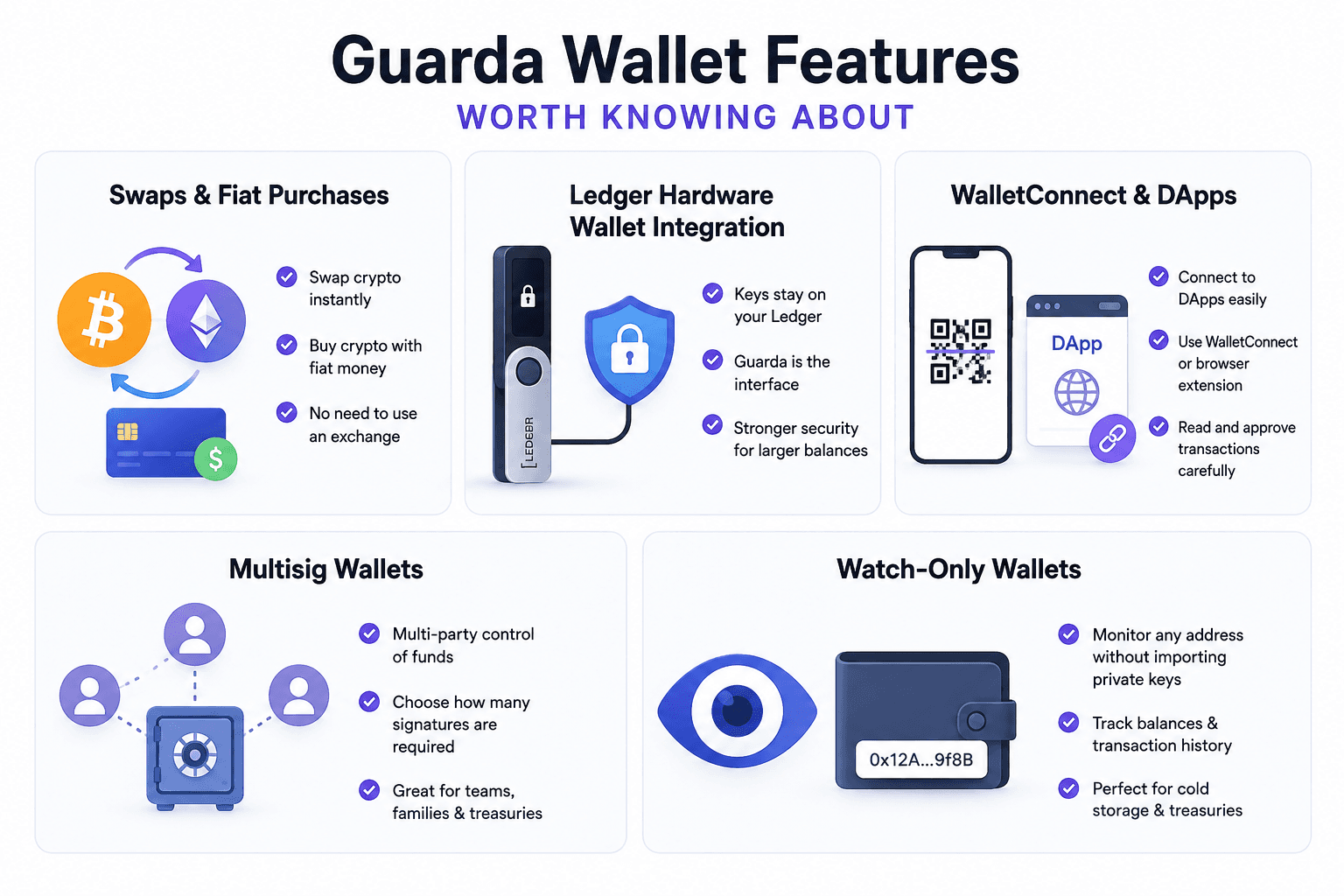
Several Guarda features change the wallet's practical use case . The most useful are integrated swaps and fiat access, Ledger pairing, WalletConnect, multisig and watch-only wallets.
 Guarda Wallet Features That Actually Influence User Decisions
Swaps and Fiat Purchases
Built-in swaps and fiat purchases remove friction. A holder can move between supported assets or buy crypto without first sending funds to a centralized exchange.
Convenience introduces provider dependency. Guarda's current swap pages embed partner costs in the exchange rate, while fiat purchases can introduce external payment providers, KYC and geographic restrictions.
That makes these tools best suited to users who value speed and fewer application hops. Someone making large or frequent trades should compare the final amount received against a liquid cryptocurrency exchange before confirming.
Ledger Hardware Wallet Integration
Ledger integration is one of Guarda's more useful security features because it changes where transaction-signing keys live.
Guarda's current Ledger tutorial describes connecting a Ledger Nano S or Nano X to a PC or laptop over USB, selecting the relevant blockchain application on the Ledger and adding the hardware-wallet account inside Guarda. Exact device and asset compatibility should still be checked before relying on the setup, particularly as Ledger's hardware lineup has expanded beyond the Nano models covered in Guarda's tutorial.
The conceptual advantage is straightforward: Guarda becomes the interface while the Ledger device protects the signing keys. The computer can display balances and prepare transactions, but the private key remains on the hardware device.
That setup makes more sense for larger balances than keeping every key solely inside a software wallet. Our Ledger review covers the current hardware lineup.
WalletConnect and DApps
Guarda supports Web3 interaction through both its browser extension and WalletConnect.
The current WalletConnect instructions describe a mobile flow where the user opens WalletConnect in Guarda settings, scans a DApp's QR code, selects the ETH wallet and approves the connection. Guarda's Chrome extension separately advertises direct access to DApps and DeFi from the browser.
Platform and blockchain coverage should therefore be checked for the specific DApp rather than treating "WalletConnect support" as universal compatibility across every Guarda network.
Connecting is also only the first security step. A wallet connection exposes account information to the application, while a later token approval or transaction signature can grant actual on-chain authority. Read the contract interaction before signing, especially when unlimited token approvals are involved.
Multisig and Watch-Only Wallets
Guarda currently offers multisig support for Bitcoin and Ethereum. Its multisignature interface lets users choose how many participating keys are required to authorize a transaction.
That can be useful for:
- Families separating control across multiple devices
- Teams and crypto treasuries requiring more than one approver
- Users trying to reduce dependence on a single signing key
- Escrow-like arrangements requiring multiple parties
Guarda Wallet User Experience
Guarda's main UX advantage is consolidation. A user can manage a large multi-chain portfolio, send and receive funds, stake supported assets and access integrated services without switching between a dozen chain-specific wallets.
Initial creation is short. Guarda's current web flow asks for a password, generates the wallet and then presents the backup step. Adding assets and receiving crypto follow familiar wallet patterns: choose the cryptocurrency, open the relevant address and use the displayed address or QR code.
Sending adds the usual blockchain-specific details such as network fees and destination requirements. Integrated swaps and purchases compress several steps into one flow, although the extra convenience makes the final quote more important than the number of clicks.
The recovery prompt is where Guarda differs more sharply from wallets such as Exodus or Trust Wallet. Users accustomed to immediately writing down 12 words may need to retrain themselves around the encrypted backup file plus password architecture. The UX is manageable once understood, but recovery deserves more than a "download backup" button clicked during onboarding.
Cross-platform access is useful because the same wallet can be restored on another Guarda interface using its backup and password. Yet platform consistency has limits. Mobile development appears active, the Chrome extension received an April 2026 update, and the public desktop download page still shows a release from September 2021.
For beginners comparing wallet interfaces rather than raw asset counts, our current best crypto wallets guide gives Guarda useful context against wallets that put more emphasis on mobile UX, hardware security or DApp interaction.
How We Tested Guarda Wallet
Research for this Guarda Wallet review was conducted in August 2026. We checked Guarda's live product interface and current website, recovery documentation, support material, staking pages, exchange pages, Ledger and WalletConnect instructions, current app-store listings and platform release information.
The versions and listings checked included:
- iOS: Guarda 3.1.20, listed two days before August 13, 2026.
- Chrome extension: Version 1.2.12, updated April 17, 2026.
- Desktop: Guarda's public page continued to offer version 1.1.1, released September 29, 2021.
- Android: Current Google Play listing reviewed for supported functionality.
We validated wallet creation, backup and restoration requirements against Guarda's current documented flows and checked available transaction, staking and integration paths. We did not execute funded sends, swaps or staking transactions. Consequently, this review does not manufacture live swap quotes, transaction times or staking results that were not independently observed.
Guarda Wallet Customer Support
Guarda provides a help center and direct support channels, with its current product pages advertising 24/7 customer support.
Support can be useful when diagnosing:
- Transaction status
- Incorrect network selections
- Wallet-interface problems
- Exchange or purchase identifiers
- Integration issues
- General recovery instructions
The non-custodial architecture creates a hard boundary around what support can solve. Guarda explicitly says it cannot recover or edit users' private keys, reset a lost wallet password or cancel blockchain transactions.
Guarda Wallet Limitations and Risks
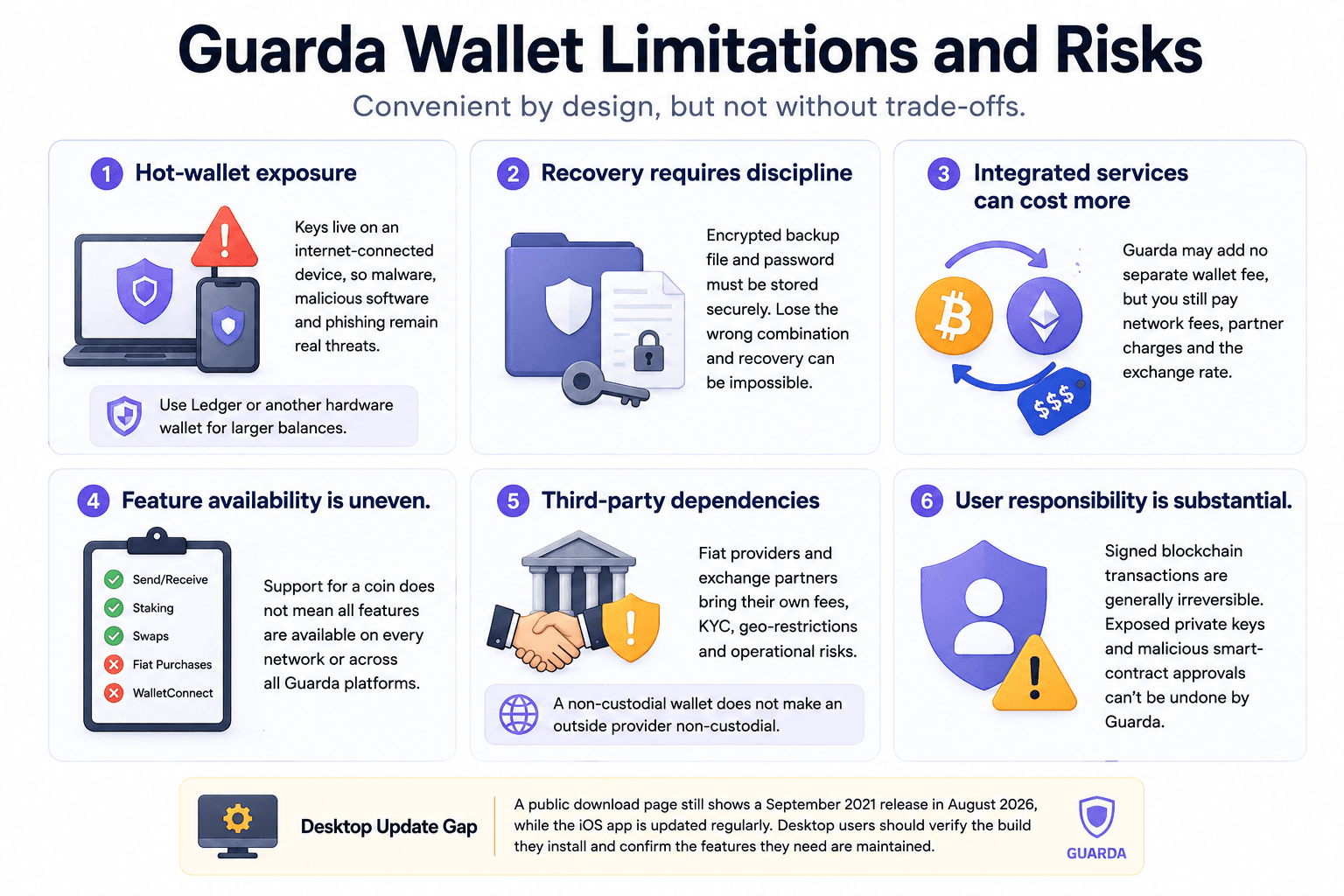
Guarda's weaknesses mostly follow from the same design choices that make it convenient.
 Where Guarda Wallet Convenience Creates Security And Cost Trade-Offs
- Hot-wallet exposure: In its normal software configuration, key material lives on an internet-connected device. Device malware, malicious browser software and phishing therefore remain relevant. Ledger pairing can improve the setup for users storing larger balances.
- Recovery requires discipline: Guarda's encrypted backup file and password architecture works, but users need to understand what each component does and where it is stored. Losing the wrong combination of credentials can make recovery impossible.
- Integrated services can cost more: Guarda may add no separate wallet fee to a swap while the user still pays through network fees, partner charges and the exchange rate. Convenience should be priced against the amount actually received.
- Feature availability is uneven: Support for a cryptocurrency does not imply staking, fiat purchases, swaps, WalletConnect and identical functionality across every Guarda platform.
- Third-party dependencies: Fiat providers and exchange partners introduce their own fees, KYC procedures, geographic restrictions and operational risk. A non-custodial wallet does not make an outside payment processor non-custodial.
- User responsibility is substantial: Signed blockchain transactions generally cannot be reversed by Guarda. The same principle applies to exposed private keys and malicious smart-contract approvals.
Guarda Wallet vs Other Crypto Wallets
Guarda occupies the broad multi-chain software-wallet end of the market. Exodus comes closest in overall positioning, Trust Wallet leans more heavily toward mobile Web3, MetaMask remains deeply embedded in DApps, and Ledger changes the custody architecture by moving keys into dedicated hardware.
| Wallet | Custody | Best For | Hardware Integration | Web3 | Main Trade-Off |
|---|---|---|---|---|---|
| Guarda | Self-custody software wallet | Broad multi-chain management across multiple interfaces | Ledger integration | WalletConnect + extension | Hot-wallet exposure and less conventional backup architecture |
| Exodus | Self-custody software wallet | Polished everyday multi-chain UX | Ledger and Trezor integrations | Web3 extension | Still a hot wallet without hardware pairing |
| Trust Wallet | Self-custody software wallet | Mobile-first multi-chain users | Browser-extension hardware support | Strong DApp/Web3 focus | No dedicated native desktop application |
| MetaMask | Self-custody software wallet | Heavy DApp and DeFi users | Ledger and other hardware-wallet integrations | Core strength | More Web3-centric than Guarda's general multi-chain portfolio approach |
| Ledger | Hardware self-custody | Long-term storage and hardware signing | Native hardware architecture | Integrates with multiple Web3 interfaces | Device cost and extra signing friction |
- Guarda makes the most sense when asset breadth and cross-platform access come first.
- Exodus is the cleaner direct alternative for users who prioritize interface polish and conventional recovery.
- Trust Wallet is compelling for mobile-heavy users and advertises support for 100+ blockchains.
- MetaMask remains the stronger specialist for frequent DApp interaction
- Ledger changes the security equation by keeping private keys in dedicated hardware.
Who Should Use Guarda Wallet?
Guarda is most compelling for users whose portfolios cross several blockchain ecosystems and who want one self-custody interface for everyday management. Its value falls when the user's priorities become highly specialized, such as lowest-cost active trading or maximum offline security.
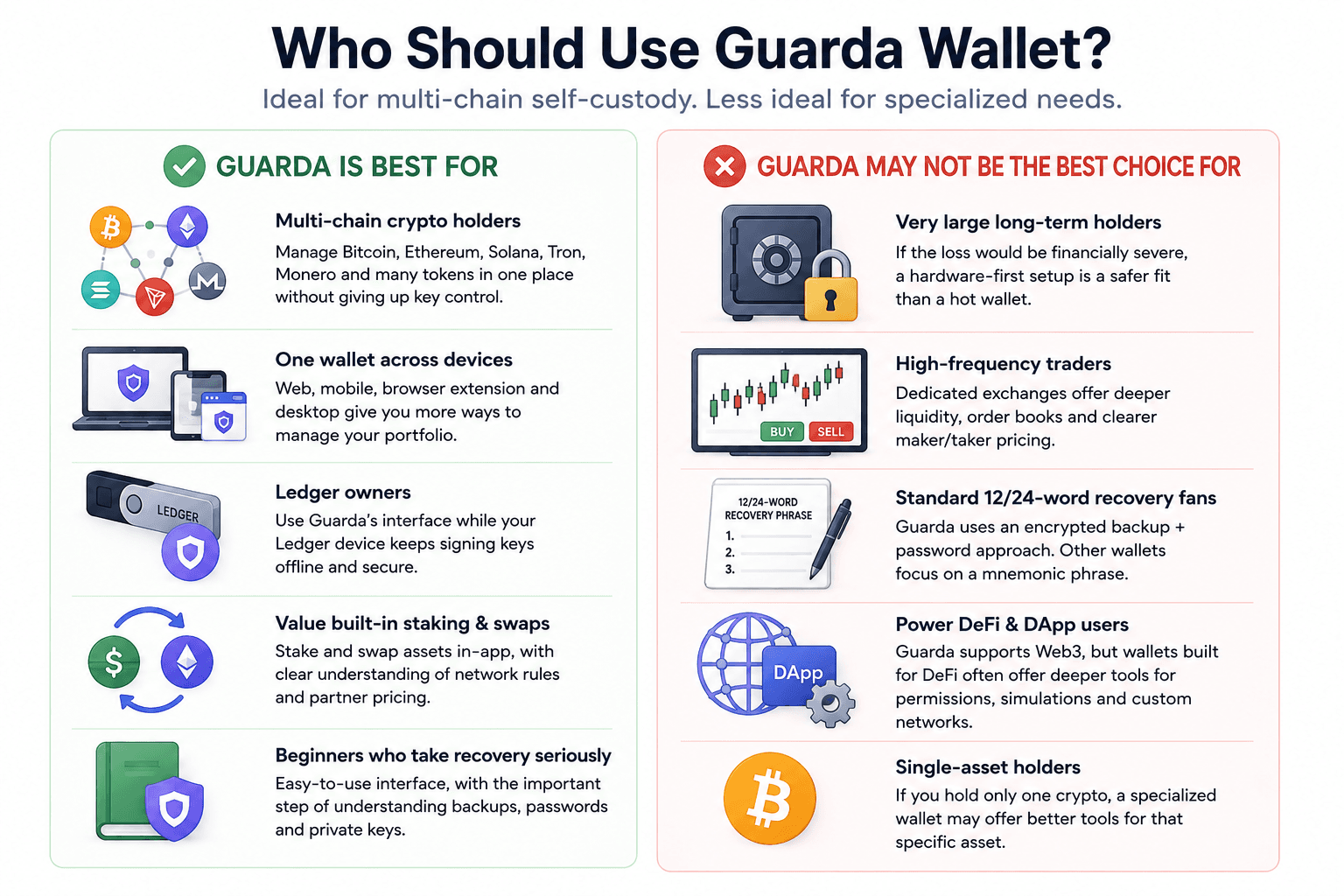 Which Crypto Users Benefit Most From Guarda Wallet
Guarda Is Best For
- Multi-chain crypto holders
- Users who want web, mobile, browser-extension and desktop access
- Ledger users who want hardware-backed signing
- Users who value built-in staking and swaps
- Beginners willing to learn Guarda's backup and recovery process
Guarda May Not Be the Best Choice For
- Users storing very large long-term balances in a hot wallet
- High-frequency traders
- Users who prefer a standard 12 or 24-word recovery phrase
- Highly active DeFi and DApp users
- Single-asset holders who may benefit more from a specialized wallet

Guarda Wallet Review: Final Verdict
Guarda is a legitimate, long-running non-custodial wallet with broad multi-chain support, several platform options and useful integrations for staking, swaps and Ledger hardware wallets. Its strongest use case is giving users one interface for managing many crypto assets while retaining control of their private keys.
The main trade-offs are hot-wallet exposure, a backup and recovery model that users need to understand properly, and integrated swap or fiat costs that may be higher than dedicated exchanges. Guarda is a good fit for multi-chain holders who value convenience and self-custody, while users prioritizing maximum security, the lowest trading fees or specialized DeFi tooling may prefer alternatives.
For larger long-term holdings, Guarda makes more sense when paired with supported Ledger hardware rather than used solely as a software wallet.