


Binance is the stronger all-round platform for liquidity, while OKX stands out for trading bots and a cleaner interface.
This Binance vs OKX review compares trading fees, liquidity, supported spot and futures markets, fiat deposits, derivatives, bots, wallets, security and usability.
Editor's Note (Aug. 1, 2026): We fully updated this Binance vs OKX review in August 2026 to reflect each exchange’s current products, fees and regional availability. The refresh adds account-specific fee comparisons, clearer coverage of legal entities and country restrictions, and expanded analysis of trading bots, Web3 wallets, fiat and P2P services, Earn products, Proof of Reserves and exchange security. We also strengthened the methodology, risk disclosures and final recommendations to show where Binance is the stronger all-round exchange and where OKX has an advantage for automation and integrated Web3 access.
Quick Verdict: Binance or OKX?
Binance is best overall, while OKX is best for bots, Web3 workflows and streamlined navigation.
Binance is the stronger general exchange for eligible users who prioritize liquidity, market breadth, fiat access and P2P trading. OKX is the better specialist choice for automation, integrated wallet access and a more cohesive trading interface. Regional entities, fee schedules and product eligibility can change the result.
Who Should Choose Which?
Choose Binance if you want:
- The stronger general crypto exchange for most eligible users
- Deeper liquidity across major and selected mid-cap markets
- A broader range of spot and derivatives markets
- Wider fiat funding and P2P coverage in many regions
- BNB fee deductions on eligible spot and futures accounts
Choose OKX if you want:
- A more automation-focused trading platform
- Integrated grid, DCA, arbitrage and slicing tools
- A closer connection between the exchange and OKX Wallet
- Cleaner navigation across spot, margin and derivatives
- A specific regional product or fee schedule that beats Binance
Binance vs OKX Winner by Use Case
| Use Case | General Choice | Reason |
|---|---|---|
| Overall exchange | Binance | Binance combines broader markets, deeper liquidity, fiat access and a larger exchange ecosystem. |
| Spot liquidity | Binance | Binance generally provides deeper major and mid-cap order books, including across the tested markets. |
| Trading bots | OKX | Automation is more central to the OKX experience, with bots, strategy discovery and risk controls closely connected. |
| Web3 wallet | OKX | OKX provides a more integrated exchange-to-Web3 workflow across DApps, swaps, bridges and wallet tools. |
| Fiat access | Binance | Binance generally offers broader bank, card and P2P coverage across supported markets. |
| Interface | OKX | OKX uses cleaner and more consistent navigation across trading, automation and wallet functions. |
| Region-specific access | Depends | The serving legal entity, country, account classification and product eligibility determine the available features. |
| Long-term storage | Neither | Exchange accounts introduce centralized custody risk and are not substitutes for properly secured self-custody. |
Data checked Aug. 1, 2026. Fees, payment routes, reserves, restrictions and supported products should be confirmed through the live account before depositing or trading.
Disclosure
Some links in this guide may be affiliate links. If you choose to use a service through these links, we may earn a commission at no additional cost to you.
Disclaimer
This guide is educational only and is not financial advice. The comparison is based on platform testing, official documentation, public fee schedules, regional availability, market data, security information and Proof of Reserves reports.
Binance vs OKX at a Glance
The table covers the global platforms and highlights where regional accounts can differ. A quoted rate or product should not be assumed to apply to Binance.US, an EEA account, a UK retail account or another separately served customer.
Data checked: Aug. 1, 2026
| Comparison factor | Binance overview | OKX overview | General result |
|---|---|---|---|
| Founded | 2017 | 2017 under the current exchange lineage | Tie |
| Primary exchange type | Centralized spot and derivatives exchange with Earn, P2P and Web3 products | Centralized spot and derivatives exchange with bots, Earn and Web3 products | Depends |
| Serving entity by region | Binance.US and several separately regulated regional entities sit apart from Binance Global | Separate US, EEA, UK, Australian, UAE and Singapore structures | Depends |
| Standard spot fee | 0.10% maker and taker on the cited regular global tier | 0.08% maker and 0.10% taker on the cited global regular tier; regional rates differ | Depends |
| Fee discount mechanism | Eligible BNB deductions and VIP tiers | 30-day trading volume or qualifying account assets; OKB does not offset exchange trading fees or independently change the fee tier | Depends |
| Standard futures fee | Tier and contract-specific. Common regular-tier USDⓈ-M example: 0.02% maker and 0.05% taker; contract, VIP tier and region can change the rate | Entity, contract and tier-specific. Common regular-tier perpetual example: 0.02% maker and 0.05% taker; entity, contract and tier can change the rate | Depends |
| Supported cryptocurrencies | 466 coins and 1,368 pairs in the Aug. 1 CoinGecko global snapshot | 306 coins and 1,138 pairs in the Aug. 1 CoinGecko global snapshot | Binance |
| Spot liquidity | Deeper in the tested BTC, ETH, SOL and ONDO markets | Competitive on majors but thinner in the tested markets | Binance |
| Futures and options | Broad futures and options coverage where eligible | Broad futures, portfolio margin and options where eligible | Depends |
| Fiat deposits and withdrawals | Broad but region-dependent bank, card and P2P coverage | Regional bank, card and third-party routes | Binance |
| P2P marketplace | Large global marketplace | Available in selected markets | Binance |
| Trading bots | Grid, DCA, rebalancing, arbitrage and signal tools | Grid, DCA, arbitrage, slicing and marketplace strategies | OKX |
| Copy trading | Spot and futures copying where eligible | Spot and futures copying where eligible | Depends |
| Web3 wallet | Binance Wallet | OKX Wallet | OKX |
| Earn products | Flexible, locked, staking and structured products | Simple Earn, onchain products and structured products | Depends |
| Proof of reserves | Monthly Merkle and zk-SNARK system | Monthly reserve and liability files with zk-STARK verification | Tie |
| User protection fund | SAFU, holding crypto assets valued at approximately $1 billion as of February 2026; asset composition can change | No direct SAFU equivalent | Binance |
| Mobile application | Full exchange and wallet access, subject to region | Full exchange and wallet access, subject to region | Depends |
| Best suited to | Liquidity, market breadth, fiat and P2P | Bots, Web3 workflows and streamlined navigation | Depends |
| Main limitation | Dense interface and regional fragmentation | Narrower market and fiat coverage | Depends |
How This Binance vs OKX Comparison Was Built (Methodology)
This comparison reviews the main areas users should check before depositing funds:
Trading fees, spot and derivatives markets, liquidity, bots, Web3 tools, fiat access, regional restrictions, Proof of Reserves, security history and beginner suitability.
For fees and products, we used official Binance and OKX documentation and account-specific regional pages. For market depth, trading pairs and asset counts, we used dated CoinGecko snapshots and public order-book data.
Security findings were based on official reserve reports, account protection documentation and confirmed public incidents. Proof of Reserves was treated as a transparency tool, not a complete financial audit.
Can You Use Binance or OKX in Your Country?
Binance and OKX use separate entities, permissions and payment networks, so country access must be checked before fees or features.
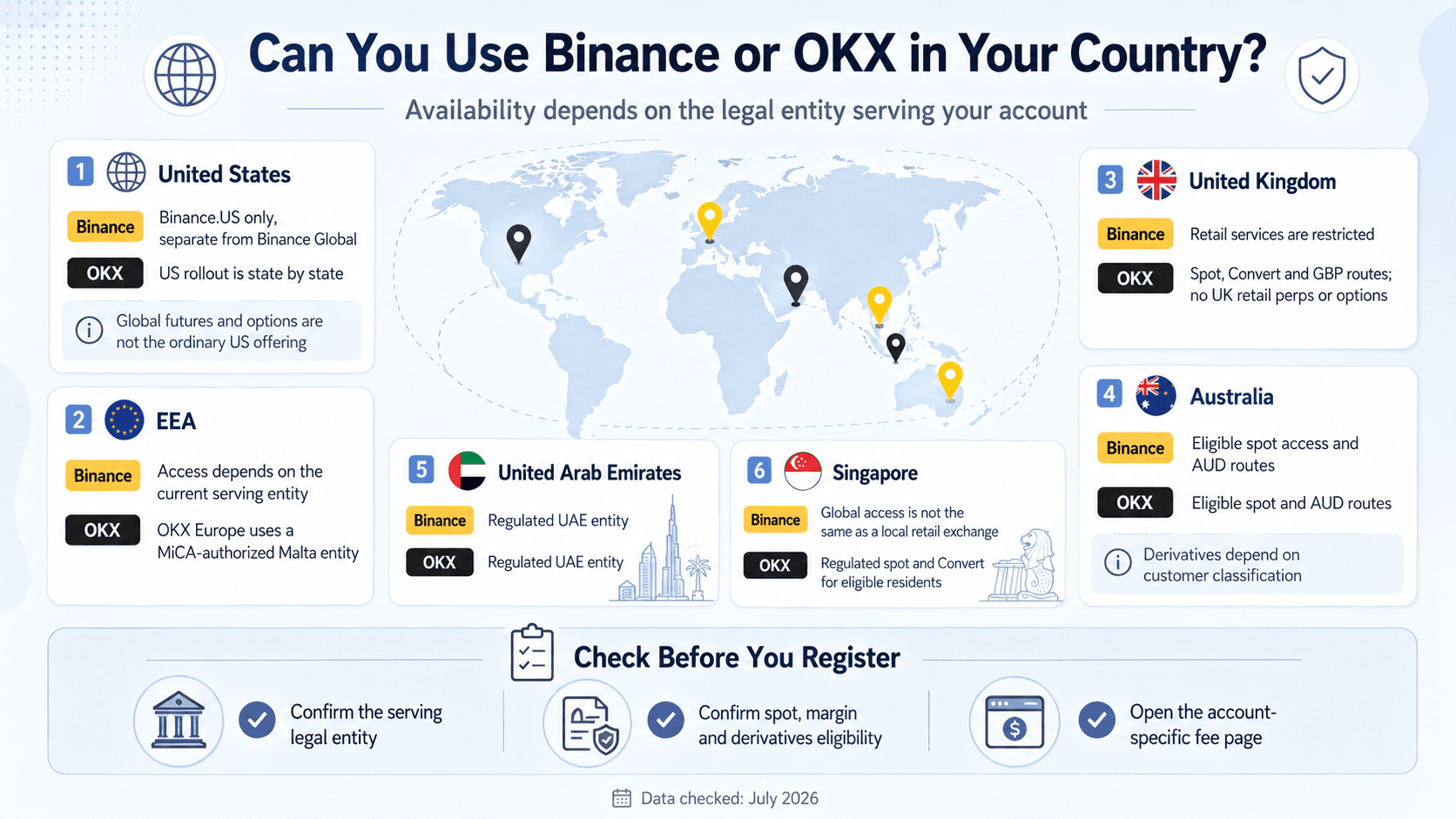 Regional Access Depends on Local Entities, Product Permissions, and Account Eligibility Before Either Exchange Can Be Used
Regional Availability and Legal Entities
The table focuses on high-intent markets rather than attempting a global country directory.
Last checked: Aug. 1, 2026
| Region | Binance access | OKX access | Spot trading | Derivatives | Fiat services | Important qualification |
|---|---|---|---|---|---|---|
| United States | Binance Global is unavailable; Binance.US is separate | Phased US rollout launched in April 2025 | Both regional services offer spot, subject to state and asset limits | Global futures and options are not included in the ordinary US product set | USD access varies by state and route | Binance.US lists unsupported and crypto-only states; OKX products also roll out by state |
| European Economic Area | Binance withdrew its Greek MiCA application in June 2026 and said it would pursue authorization in another EU member state. Access and service changes must be confirmed by country and account | OKX Europe Limited serves eligible EEA users through its MiCA-authorized Malta entity | OKX spot is available through eligible EEA accounts. Binance users must confirm current access through their account and country-specific notices | OKX X-Perps uses a separate eligible account structure. Binance derivatives access must be confirmed by country and customer classification | EUR payment rails vary by country, entity and account | MiCA authorization, serving entity and post-July 1 account notices determine access. |
| United Kingdom | Retail services remain restricted, with some products reserved for professional clients | Spot, Convert and GBP services are available | Available within each platform's UK scope | Retail access is restricted; OKX lists no UK retail margin, futures or options | GBP routes are account-specific | Appropriateness and financial-promotion rules apply |
| Canada | Binance Global does not provide ordinary Canadian onboarding | Availability must be confirmed during registration | Limited by platform eligibility | Do not assume availability | Local fiat access is not guaranteed | Use the current registration and restricted-country screens |
| Australia | Binance Australia provides eligible spot access; derivatives and banking require separate checks | OKX Australia offers spot and AUD services; derivatives depend on classification | Available to eligible users | Retail or wholesale status can change access | AUD bank and card routes vary | Legal entity and customer classification control products |
| United Arab Emirates | Binance FZE offers regulated spot, futures, Earn and savings | OKX Middle East Fintech FZE serves eligible UAE users | Available | Available products depend on local authorization | Both support eligible AED routes | Customers must onboard to the UAE entity |
| Singapore | Global Binance services are not equivalent to a locally licensed retail exchange | OKX Singapore offers regulated spot and Convert | OKX spot is available to eligible residents | Product scope is narrower than global OKX | SGD purchase and transfer routes apply | Check the Singapore entity and supported-token list |
| Globally served markets | Binance Global serves many eligible countries | OKX global and regional entities serve many eligible countries | Region-dependent | Region-dependent | Region-dependent | Local law, KYC, sanctions screening and product suitability control access |
In the United States, Binance.US and Binance Global are separate platforms, so neither global brand page defines the available United States crypto exchange account. Binance.US state eligibility listed 200-plus assets in August 2026, but several states remained unsupported and Kansas and Wisconsin were crypto-only. OKX’s US launch was also phased, so neither US account should be compared with a global derivatives dashboard.
In the EEA, OKX operates through OKX Europe Ltd., a Malta-based entity authorized as a crypto-asset service provider under MiCA. Its X-Perps product uses a separate eligible account structure, assessment process and fee schedule.
Binance withdrew its Greek MiCA application in June 2026 and said it would seek authorization in another EU member state.
Read our full Binance review.
Also Read
- How to Sign Up on Binance: A Step-by-Step Guide
- Binance App Review: Mobile Trading on the Go
- Is Binance Safe?
- Top Binance Alternatives
- A Guide to Trading on Binance
- Binance Earn Review
- Binance Wallet Review
- Binance Sharia Earn
Why Account Type Changes the Comparison
Two users can receive different fees and products even when both pass KYC verification. The account entity, local fee schedule and presence of a derivatives account can each change the result. The serving legal entity determines the contract, while verification status controls limits and payment access. Retail investors may be blocked from products offered to a professional client, and a spot-only account cannot be assessed as though it had derivatives enabled.
OKX’s EEA X-Perps account illustrates the effect. It can carry a different spot fee schedule from an ordinary EEA account and requires an eligibility assessment. Local Binance entities can likewise change futures access, BNB deductions, banking routes and supported pairs.
Complete this checklist before registering:
- Confirm the serving legal entity and governing terms.
- Confirm spot, margin and derivatives eligibility for your classification.
- Open the account-specific fee page rather than a global marketing table.
- Confirm fiat payment methods and crypto withdrawal networks before sending funds.
Read our full OKX review.
Also Read
Binance vs OKX Fees and Total Trading Cost
Binance usually offers the simpler spot benchmark, while OKX can be cheaper for selected account types and maker orders.
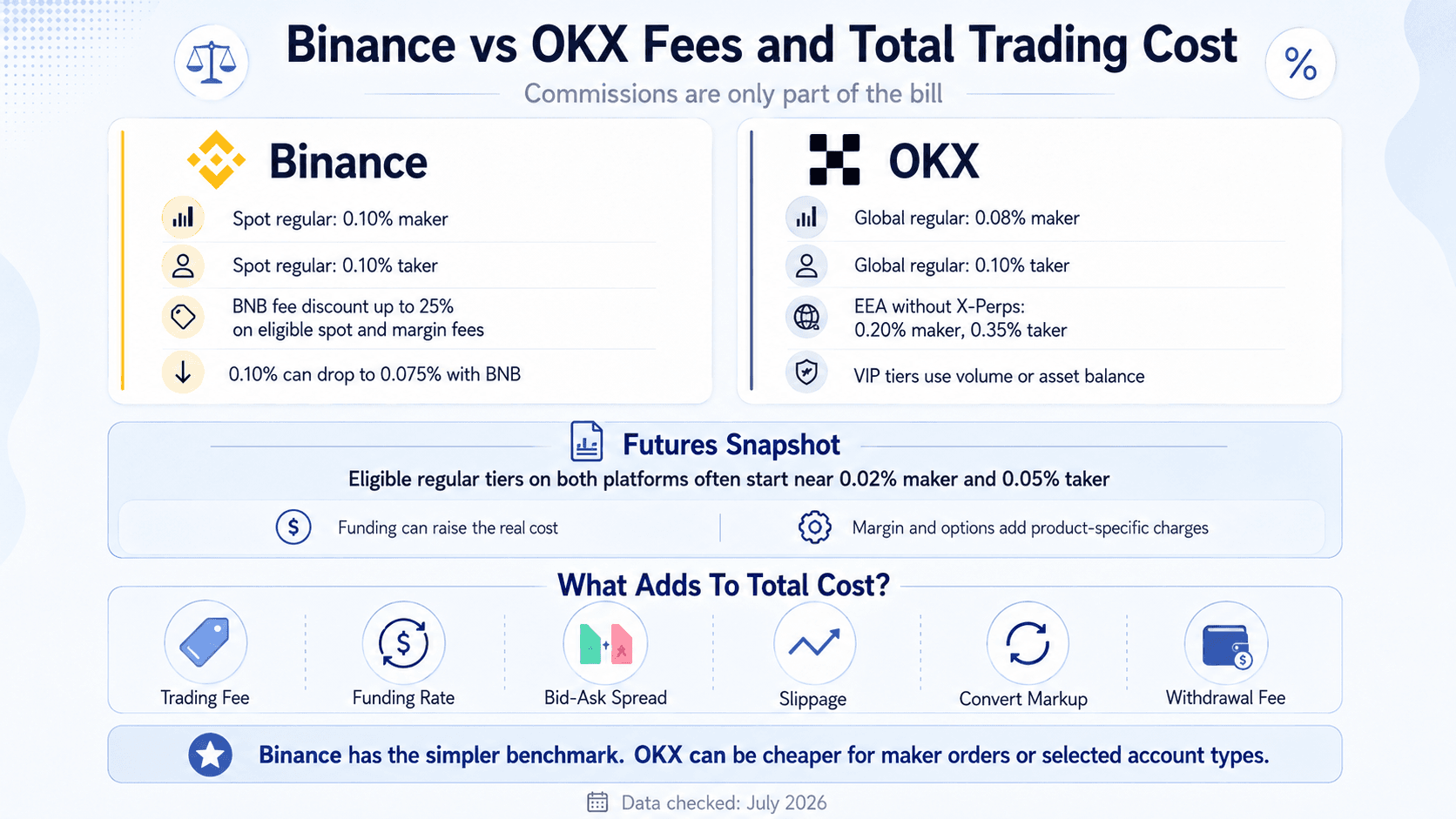 Binance Offers Simpler Baseline Fees, While OKX Can Be Cheaper for Makers and Selected Account Types
Spot Trading Fees
The regular Binance spot fee schedule uses a 0.10% maker and taker rate for standard global spot pairs. Paying eligible spot and margin fees with BNB can provide a discount of up to 25%, reducing a 0.10% charge to 0.075%. The discount must be enabled on the account, requires sufficient BNB and exposes the user to BNB price movement.
OKX does not have one universal spot rate. Its global fee framework lists a regular example of 0.08% maker and 0.10% taker for standard pair groups. EEA customers can receive materially different rates depending on whether they have an eligible X-Perps account.
OKX does not currently provide an OKB fee-payment discount. Its fee-reduction guidance states that OKB cannot offset trading fees and that holding OKB does not affect fee tiers. Qualification instead depends on 30-day trading volume or eligible account assets.
| Account | Maker fee | Taker fee | Discount method | VIP requirements | Date checked |
|---|---|---|---|---|---|
| Binance global regular | 0.10% | 0.10% | Up to 25% BNB deduction on eligible spot and margin fees | 30-day volume and BNB balance for higher tiers | Aug. 1, 2026 |
| Binance EEA or regional | Account-specific | Account-specific | BNB benefit may depend on product and entity | Regional schedule applies | Aug. 1, 2026 |
| OKX global regular example | 0.08% | 0.10% | Tiering through volume and qualifying assets | 30-day volume or asset balance | Aug. 1, 2026 |
| OKX EEA with an eligible X-Perps account | 0.08% | 0.10% | Account classification and tier | Regional X-Perps rules | Aug. 1, 2026 |
| OKX EEA without X-Perps | 0.20% | 0.35% | Regional tier rules | Account-specific | Aug. 1, 2026 |
Bot and copy-trading executions generally incur the same trading commission as manual orders. Copy trading can add lead-trader profit sharing, while bot strategies may generate many small commissions. Pair-specific promotions, stablecoin groups and fiat pairs can depart from the standard schedule.
Futures, Options and Margin Costs
Futures cost includes the futures maker fee, futures taker fee, funding rate and possible liquidation-related charges. Binance identifies commission, funding and an Insurance Clearance Fee separately, while OKX publishes contract-level fees, funding and margin rules.
For eligible global accounts, Binance Futures commonly starts at 0.02% maker and 0.05% taker at the regular tier. Eligible BNB payment can reduce standard USDⓈ-M Futures commission by 10%, according to the Binance Futures fee guide.
OKX commonly publishes 0.02% maker and 0.05% taker for selected perpetual tiers, but the user’s serving entity, account tier and contract remain decisive.
Perpetual funding moves between longs and shorts. A positive rate normally means longs pay shorts, while a negative rate reverses the direction. Holding a position through several funding timestamps can cost more than the entry fee.
The Binance options fee schedule lists a 0.024% trading fee, capped at 10% of the option’s traded value; a 0.015% exercise fee, capped at 10% of the option’s value; and a 0.19% liquidation fee, capped at 25% of the option’s value.
OKX options also have trading and exercise schedules that vary by product and tier. OKX options commissions, exercise charges and liquidation costs are contract- and tier-specific, so the authenticated fee page remains authoritative. Margin borrowing rates on both exchanges are asset-specific and variable rather than fixed platform-wide rates. Before borrowing, compare the quoted interest rate, collateral haircut, maintenance-margin requirement and liquidation terms for the exact asset. A VIP tier may lower trading commission but does not remove funding, borrowing interest, exercise or liquidation costs.
Margin borrowing adds interest, while an options trading fee, exercise charge or liquidation fee can apply to the relevant product.
Spread, Slippage, Conversion and Withdrawal Costs
The published fee is only the explicit commission. The bid-ask spread is the gap between the best buy and sell quote. Market-order slippage is the difference between the expected and average execution price as an order consumes the book.
Simple Buy and card purchases can include a payment charge or markup. Binance Convert and OKX Convert quote an all-in conversion rate rather than an order-book commission. Fiat processors may add their own fee, while a crypto withdrawal includes the exchange’s network charge. That charge is different from gas paid directly by a self-custodial wallet.
Liquidity test: Aug. 1, 2026
The test used public CoinGecko order-book data from the Binance market page and OKX market page. Estimated price impact assumes depth is distributed linearly between the best price and 2%, then uses the smaller side of the book. It excludes the displayed spread and does not guarantee an executable price.
| Pair | Platform | Spread | Smaller depth within 2% | Estimated impact at $100 / $1,000 / $10,000 / $100,000 |
|---|---|---|---|---|
| BTC/USDT | Binance | 0.01% | $21.63 million | 0.0005 / 0.0046 / 0.0462 / 0.4623 bp |
| BTC/USDT | OKX | 0.01% | $8.95 million | 0.0011 / 0.0112 / 0.1117 / 1.1170 bp |
| ETH/USDT | Binance | 0.01% | $8.83 million | 0.0011 / 0.0113 / 0.1133 / 1.1329 bp |
| ETH/USDT | OKX | 0.01% | $7.50 million | 0.0013 / 0.0133 / 0.1334 / 1.3339 bp |
| SOL/USDT | Binance | 0.01% | $3.55 million | 0.0028 / 0.0282 / 0.2816 / 2.8155 bp |
| SOL/USDT | OKX | 0.01% | $1.76 million | 0.0057 / 0.0569 / 0.5690 / 5.6905 bp |
| ONDO/USDT | Binance | 0.02% | $263,809 | 0.0379 / 0.3791 / 3.7906 / 37.9062 bp |
| ONDO/USDT | OKX | 0.02% | $113,218 | 0.0883 / 0.8833 / 8.8325 / 88.3252 bp |
Limit orders can reduce spread cost but may not fill. A $100,000 ONDO market order carries substantial price-impact and partial-fill risk on both platforms.
Withdrawal fees vary by asset and network and appear on the confirmation screen. Always match the receiving network and any required memo or tag. A low-fee chain is unusable when the destination cannot credit it.
Realistic Cost Examples
Each trading cost example uses regular global rates and a stated spread assumption. The table covers a $1,000 Bitcoin purchase, monthly trading volume and a futures round-trip fee with futures funding. Spread and slippage assumptions are stated rather than treated as permanent quotes.
| Scenario | Binance estimate | OKX estimate | Assumptions |
|---|---|---|---|
| Beginner buys $1,000 of Bitcoin | $1.05, or $0.80 with BNB | $1.05 | One taker order; $1.00 standard commission, 0.005% half-spread and modeled BTC slippage; withdrawal excluded |
| Active spot trader completes $10,000 monthly volume | $10.52, or $8.02 with BNB | $10.56 | Two $5,000 taker orders, giving $10,000 total monthly notional; half-spread and modeled BTC slippage included |
| Futures trader opens and closes a $10,000 position | $11.00, or $10.00 with the eligible 10% BNB Futures discount | $11.00 | 0.05% taker entry, one illustrative 0.01% funding payment and 0.05% taker exit; contract spread and withdrawal excluded |
The examples exclude fiat processor charges and liquidation. A maker order that crosses the book becomes a taker, while funding can be negative and produce a credit.
Markets, Liquidity and Trade Execution
Binance has the wider global market and led the tested liquidity sample. OKX still provides strong major-pair execution and an advanced derivatives toolkit.
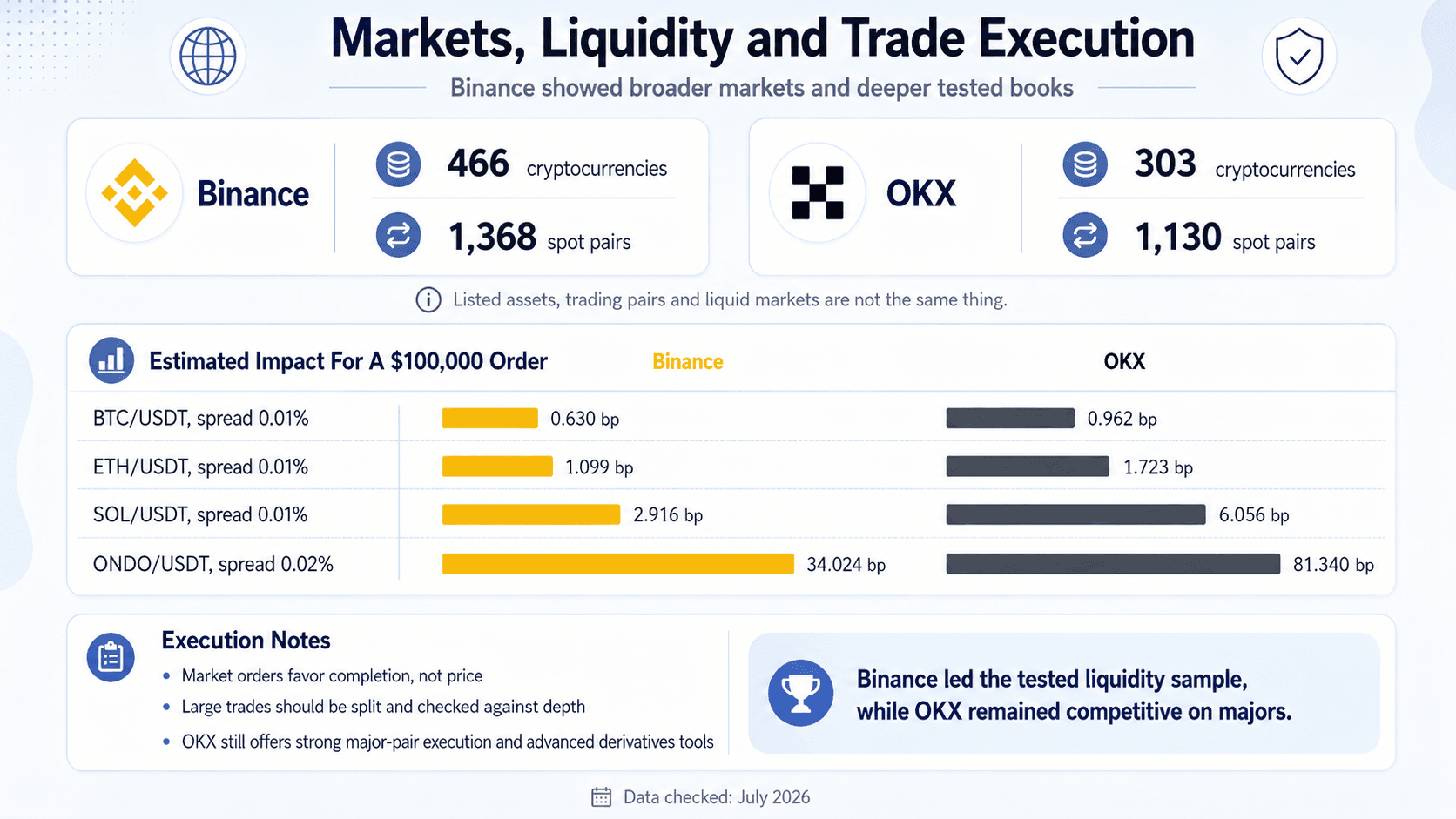 Binance Led the Tested Liquidity Sample, While OKX Remained Competitive Across Major Trading Pairs.
Supported Cryptocurrencies and Trading Pairs
The Aug. 1 CoinGecko global snapshot displayed 466 cryptocurrencies and 1,368 trading pairs for Binance, compared with 306 cryptocurrencies and 1,138 pairs for OKX. These third-party counts can move as exchanges add, remove or temporarily suspend markets, and they do not guarantee that every asset is available to a particular regional account. Those figures are not account guarantees.
Binance supports major USDT, USDC, FDUSD, BTC and regional fiat quote markets, including numerous stablecoin pairs and altcoins. OKX supports USDT, USDC, USD, EUR and selected regional quotes. Both provide margin-enabled markets, perpetual futures, expiry contracts and options where eligible.
Four counts must remain separate: listed assets, trading pairs, liquid markets and assets available to the reader's regional account. One token can produce several pairs, while a thin listing may add little practical choice. A regional entity can also remove an asset shown on the global markets page.
Margin market and derivatives availability narrow the usable set further. A coin may trade on spot without supporting isolated margin, cross margin, a futures contract or an options market. Quote currency also affects execution because liquidity can concentrate in USDT while the same asset's USDC or fiat pair remains thin. Traders should check the exact pair, withdrawal status and margin eligibility rather than assuming that one listed symbol unlocks every market.
Liquidity, Spreads and Execution Quality
Binance led the Aug. 1 liquidity snapshot across BTC/USDT, ETH/USDT, SOL/USDT and ONDO/USDT. Based on the smaller side of the order book within 2%, Binance’s measured depth was approximately 142% higher for BTC, 18% higher for ETH, 102% higher for SOL and 133% higher for ONDO. These percentages describe one time-stamped public snapshot rather than permanent execution conditions.
| Test pair and order | Quoted spread | Binance estimated impact | OKX estimated impact | Platform result |
|---|---|---|---|---|
| BTC/USDT, $100,000 | 0.01% on each platform | 0.4623 bp | 1.1170 bp | Binance |
| ETH/USDT, $100,000 | 0.01% on each platform | 1.1329 bp | 1.3339 bp | Binance |
| SOL/USDT, $100,000 | 0.01% on each platform | 2.8155 bp | 5.6905 bp | Binance |
| ONDO/USDT, $100,000 | 0.02% on each platform | 37.9062 bp | 88.3252 bp | Binance |
Execution speed was not ranked from webpage timestamps because exchange latency depends on location, API route and account load. A co-located institutional API client and a retail mobile user will not receive the same round-trip latency. Partial fills remain possible when a limit price is restrictive, the order book moves or the available quantity disappears before the request reaches the matching engine.
Market orders prioritize completion rather than price, while post-only orders prioritize maker status and can be rejected when they would cross the spread. Large traders should split orders, review depth at several price levels and compare realized average price with the quoted midpoint. Global trading volume cannot guarantee deep liquidity in every altcoin market.
Spot, Margin, Futures and Options Tools
Both exchanges support market, limit, stop-loss and post-only orders, along with good-till-cancelled and immediate-or-cancel time-in-force settings in supported interfaces. Binance also provides OCO orders that link a stop and limit instruction. OKX supports trailing stops and conditional orders across eligible products.
Both offer isolated and cross margin. Advanced users can access portfolio-margin structures, futures position controls and hedge mode where the entity permits them. Options availability, strikes and expiry depth vary by contract, so an options trader should inspect the actual chain rather than counting product labels.
Trading Platforms, Bots and Automation
OKX places automation and Web3 navigation closer to the primary workflow. Binance offers more products overall, but users often move through more menus.
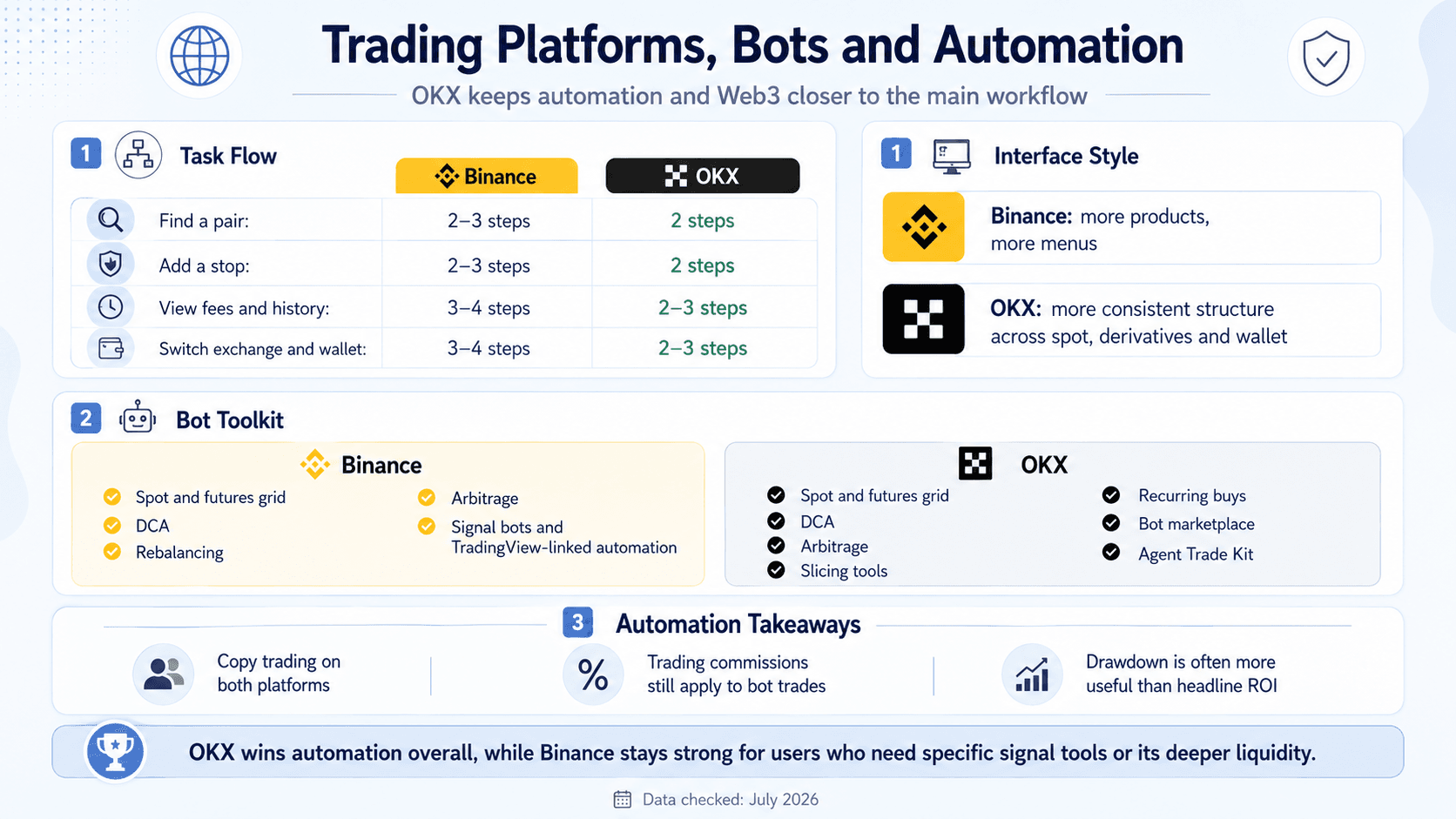 OKX Provides a More Cohesive Automation Workflow, While Binance Offers Broader Tools and Deeper Liquidity
Desktop and Mobile Trading Experience
The task-based workflow review used the same sequence on the desktop trading platform and mobile app: find BTC/USDT, fund the trading balance, place a limit order, add a stop, review the position, close it and locate the fee and trade history. One step below means a required screen change or confirmation. Counts are ranges because regional versions and saved settings can remove or add a screen.
| Workflow | Binance steps and observation | OKX steps and observation |
|---|---|---|
| Find a pair | 2–3 steps. Search is immediate, but spot, margin and futures can show the same symbol | 2 steps. Search and product switching use one consistent hierarchy |
| Fund trading | 3–5 steps. Fiat, P2P, crypto deposit and internal-transfer routes are broad | 3–4 steps. Deposit and transfer controls are grouped clearly |
| Place a limit order | 5 steps. Select market, order type, price, size and confirm | 5 steps. The compact form keeps advanced controls nearby |
| Add a stop | 2–3 steps. Available through spot and derivatives order tools | 2 steps. Take-profit and stop-loss controls are directly exposed |
| Review open positions | 1–2 steps. Detailed spot, margin and derivatives panels | 1–2 steps. A consistent position panel serves advanced products |
| Close a position | 2–3 steps. Several close and order controls are available | 2 steps. Direct close controls retain margin context |
| View fees and history | 3–4 steps. Records are comprehensive but spread across menus | 2–3 steps. Orders, fills and fee history sit closer together |
| Switch between exchange and wallet | 3–4 steps. Binance Wallet remains primarily mobile-centered | 2–3 steps. Exchange and wallet modes are closely connected |
The Binance app separates a beginner mode, Lite, from Pro mode. Lite reduces the beginner interface to purchases, transfers and portfolio controls, while Pro exposes spot, margin, futures, Earn and P2P. OKX uses a more consistent structure across basic and advanced trading, although its derivatives screens still require an understanding of leverage and margin.
Error messages, regional blocks and insufficient-margin warnings can differ by account. Position management remains account-specific, and neither interface prevents order mistakes, so users should review the asset, side, quantity, leverage, estimated fee and exit controls before confirming.
Trading Bots, Copy Trading and AI Automation
Binance trading bots and OKX trading bots both include a spot grid bot, futures grid, DCA bot, rebalancing and arbitrage-style tools. Binance also supports signal bots and automation linked to TradingView, while OKX adds slicing tools, recurring strategies and a prominent bot marketplace.
Rule-based bots execute preset conditions, while AI trading tools can generate analysis or instructions. Bot fees still include ordinary commissions and, for derivatives, funding. Copy trading follows another trader, signal automation converts alerts into orders, AI-assisted analysis proposes ideas, and autonomous execution can place trades without manual confirmation. Those categories should not be described as one product.
| Factor | Binance | OKX |
|---|---|---|
| Bot categories | Spot and futures grid, DCA, rebalancing, arbitrage and signal tools | Spot and futures grid, DCA, arbitrage, slicing, recurring buy and marketplace strategies |
| Copy trading | Spot and futures; profit sharing can apply | Spot and futures; lead-trader profit sharing can apply |
| Strategy marketplace | Available, but secondary to the broader exchange | Central part of the automation experience |
| Performance history | ROI, PnL and drawdown metrics where provided | ROI, PnL, drawdown and runtime metrics where provided |
| Risk controls | Stops, investment limits and futures liquidation controls | Stops, price ranges, investment limits and margin controls |
| AI-supported execution | Signal and strategy assistance | Agent Trade Kit and bot assistance |
| Standard fees | Trading commissions still apply | Trading commissions still apply |
Reported bot returns may omit unrealized losses, funding, commissions or failed strategies. A strategy that was liquidated can disappear from a leaderboard, while maximum drawdown often reveals more than headline ROI.
OKX wins automation overall because setup, strategy discovery and risk controls form a more cohesive workflow. Binance remains preferable when its specific bot, signal source or liquidity pool fits the strategy.
Fiat Deposits, Withdrawals and P2P Trading
Binance generally provides broader fiat and P2P coverage.
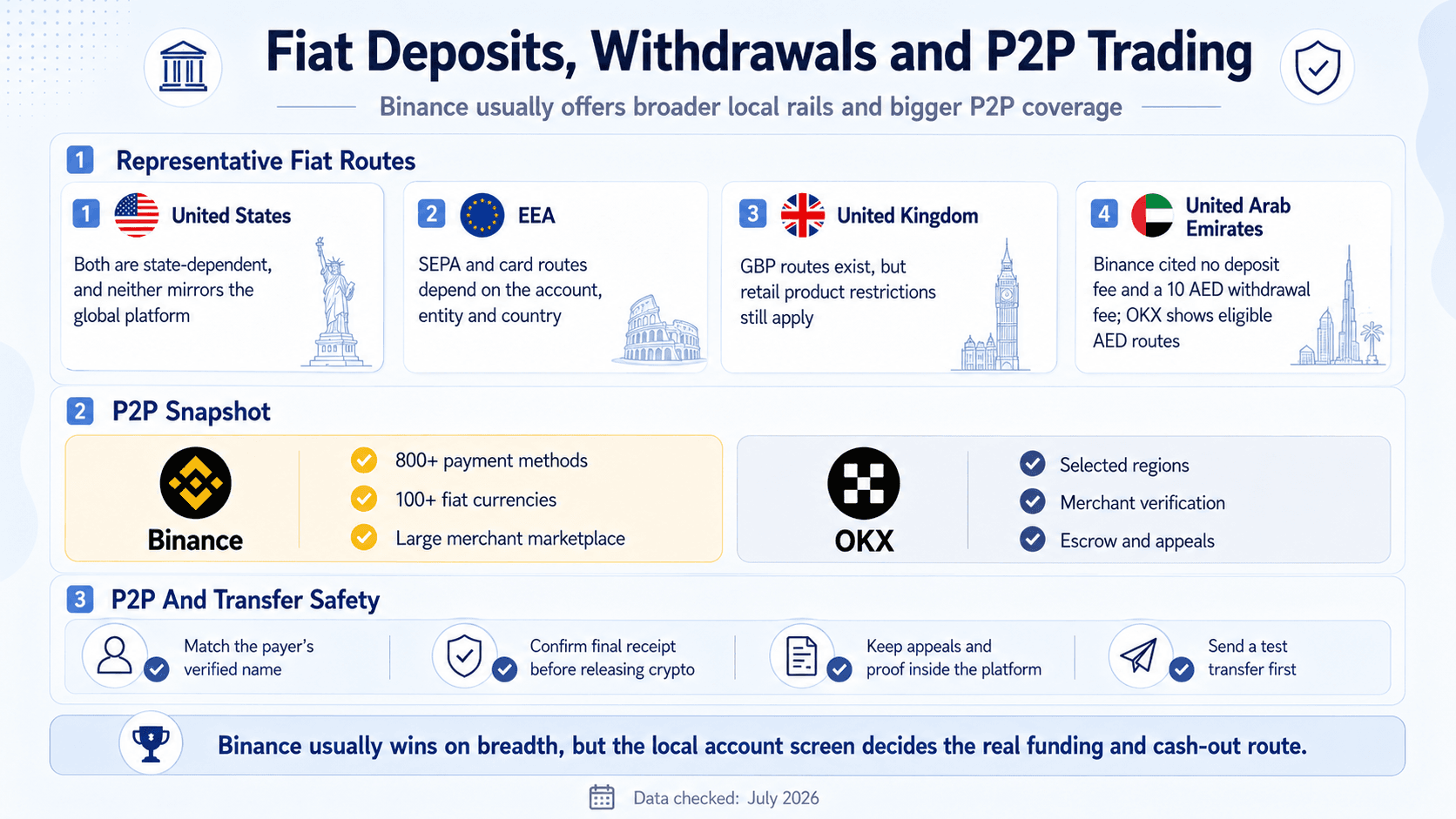 Binance Generally Offers Broader Fiat and P2P Coverage, but Local Availability Determines the Best Funding Route
Fiat Deposits and Cash Withdrawals
Representative regions show why Binance often has broader fiat support without proving that it has the cheapest route for every user. Minimums, maximums and processor charges are dynamic unless an official regional page publishes a fixed figure.
| Region | Representative route | Binance fee, limits and settlement | OKX fee, limits and settlement | Main qualification |
|---|---|---|---|---|
| United States | USD ACH or bank route | Binance.US availability, limits and holds vary by supported state and appear before confirmation | OKX US access is phased by state; the account displays the available route, limit and hold | Neither account mirrors the global platform |
| EEA | EUR SEPA or card | Route and fee depend on the current serving entity and country | OKX Europe supports eligible euro bank transfers; account limits and settlement estimates appear in the funding screen | MiCA entity, X-Perps status and bank location can change the account |
| United Kingdom | GBP Faster Payments or card | Available services remain subject to the UK product and financial-promotion framework | Eligible spot users can access supported GBP bank, card and third-party routes | Retail derivatives remain restricted |
| Australia | AUD bank transfer or card | Binance Australia displays the available payment rail, fee and limit for the account | OKX Australia supports eligible AUD deposits and withdrawals, with account-displayed limits | Customer classification changes derivatives, not only payments |
| United Arab Emirates | Direct AED bank transfer | No Binance deposit fee and a 10 AED withdrawal fee; bank cutoffs still affect settlement | Eligible AED bank and card routes are shown through the UAE entity | Banks or processors can add their own charges |
A card purchase or local payment method can settle quickly but may add a payment processor fee, foreign-exchange spread or issuer charge. Bank transfers are often cheaper, although the supported currency, settlement time, name matching, cut-off times, compliance checks and weekends affect the result.
A direct cash-out should be confirmed before depositing because a platform can support buying without offering the same currency as a withdrawal route.
P2P Trading, Withdrawal Holds and Transfer Risk
Binance P2P advertises more than 800 payment methods and over 100 fiat currencies. Each verified merchant remains subject to payment and platform rules. OKX P2P is available in selected regions and uses merchant verification, platform escrow and an appeal process.
The payer's verified name should match the account. Payment confirmation should come from the receiving account, and a P2P appeal should remain inside the platform. Sellers must confirm irreversible receipt inside their bank or payment application before releasing crypto. Screenshots and off-platform messages are not proof of settlement.
New devices, password changes, new addresses, anti-scam controls or P2P risk reviews can trigger a withdrawal hold. An address whitelist can reduce unauthorized transfers, while a network suspension can delay legitimate ones. Network maintenance can also suspend transfers. Address allowlists reduce unauthorized withdrawal risk, but a user must still select the correct chain and memo tag.
Use this safety checklist:
- Match the payer's verified name.
- Confirm final receipt before releasing crypto.
- Reject off-platform communication as payment proof.
- Check whether purchased assets have a temporary withdrawal restriction.
- Send a test transfer before moving a large amount.
To transfer from Binance to OKX, copy the OKX deposit address and memo where required, select the same network on Binance, verify the fee and send a small test first.
Earn Products, Web3 Wallets and New Asset Markets
Yield and Web3 products add utility but introduce custody, protocol and product-structure risks that ordinary spot trading does not carry.
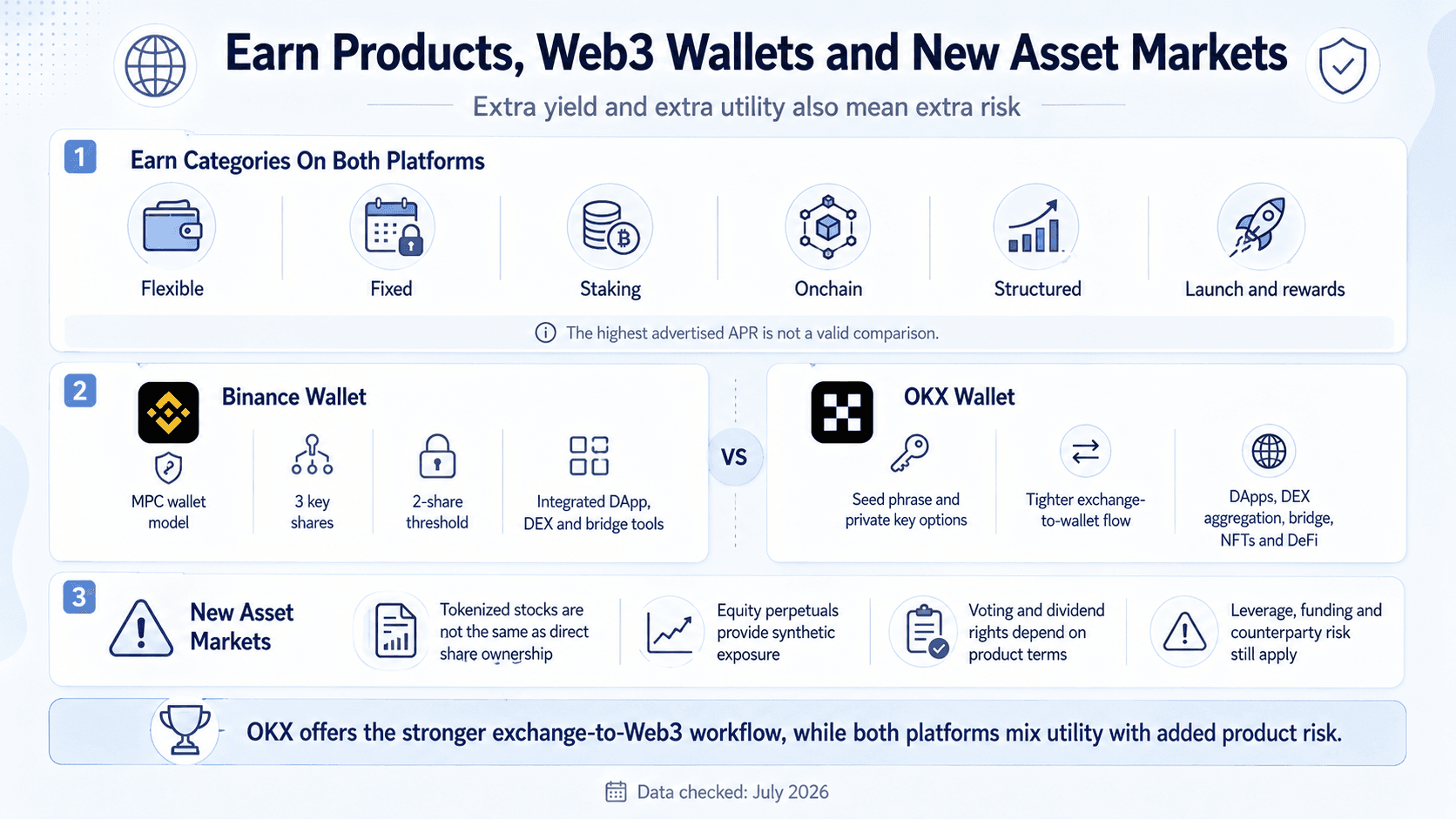 OKX Connects Exchange and Web3 Tools More Closely, While Both Platforms Add Yield and Product Risk
Binance Earn vs OKX Earn
| Product type | Binance availability | OKX availability | Liquidity | Principal risk | Main exposure |
|---|---|---|---|---|---|
| Flexible savings | Simple Earn Flexible where eligible | Simple Earn Flexible where eligible | Usually redeemable, subject to terms | Platform and borrower risk | Exchange lending or reward program |
| Fixed savings | Locked products with set terms | Fixed Simple Earn terms | Early redemption can reduce rewards | Platform, borrower and lock-up risk | Fixed-duration lending |
| Native staking | Selected proof-of-stake assets | Selected assets | Unstaking delay can apply | Validator, slashing and custody risk | Network staking |
| Onchain earning | Protocol-linked products | Protocol-linked products | Protocol-specific | Smart contract and oracle risk | DeFi or staking protocol |
| Structured product | Dual Investment and related advanced products | Dual Investment and structured products | Conditional settlement | Principal can settle in another asset | Options-linked payoff |
| Launch or reward product | Launchpool, Megadrop and campaigns | Jumpstart and campaigns where available | Campaign-specific | Token and eligibility risk | New-token distribution |
A flexible product cannot be compared directly with a structured payoff. Flexible yield may change daily, fixed products can penalize early redemption, and structured products may return principal in a falling asset. Regional rules can remove Earn entirely.
Binance Wallet vs OKX Wallet
The exchange accounts are custodial, while the Web3 wallets use user-controlled authorization models. They should be scored separately.
Binance Wallet uses multi-party computation with three key shares: one controlled by Binance, one on the device and one encrypted in cloud storage. The wallet requires two shares for access. Wallet recovery depends on the password, backup and access to the associated account or device path.
OKX Wallet supports traditional wallets controlled through a seed phrase or private key. It also continues to support existing keyless wallets created before the creation option was removed on May 23, 2025, although new users can no longer create an OKX keyless wallet.
The legacy keyless wallet uses multi-party computation to split one private key into three shares, with two shares required to sign a transaction. The shares are stored across the OKX server, the user’s device and an iCloud or Google Drive backup. Existing users can restore the wallet from a cloud backup or use the emergency-escape process to reconstruct a conventional private key. The custody and recovery process therefore depends on whether the user has a traditional wallet or a previously created keyless wallet.
OKX Wallet also integrates DApps, DEX aggregation, cross-chain swaps, bridges, NFTs and DeFi tools. Network availability and transaction support should be checked in the current wallet interface before transferring an asset.
| Wallet factor | Binance Wallet | OKX Wallet |
|---|---|---|
| Key model | MPC with three shares and a two-share threshold | Seed phrase or private key for traditional wallets; existing legacy keyless wallets use a three-share MPC model with a two-share threshold |
| Recovery | Password, cloud backup and account or device controls | Seed phrase or private-key recovery for traditional wallets; cloud restoration or emergency escape for existing legacy MPC wallets |
| DApp connection | Yes | Yes |
| DEX aggregation | Yes | Yes |
| Cross-chain bridge | Yes | Yes |
| Transaction simulation | Risk and simulation tools where supported | Route and transaction risk tools where supported |
| Approval management | Token approval controls | Token approval controls |
| Malicious-address warnings | Risk screening where supported | Address and contract warnings where supported |
| Exchange transfer | Integrated | More tightly integrated with wallet mode |
| NFT and DeFi access | Yes | Yes |
| Supported networks | Multi-chain support; verify the current asset and network in the wallet | Multi-chain support; verify the current asset and network in the wallet |
Neither warning system guarantees that a contract, bridge or token is safe. Cross-chain routes can add bridge, liquidity-provider and smart-contract risk. Users should review approvals and final output before signing.
Tokenized Stocks, Equity Perpetuals and TradFi Products
Binance separates its TradFi offering into several products. Binance Stocks gives eligible users broker-mediated access to listed stocks and ETFs through a service provided by Nest Trading Limited in partnership with an external broker. Access, ownership treatment, trading hours, fees and investor rights follow the applicable stock-trading terms and serving entity.
Binance also offers bStocks. These are tokenized certificates issued by BTech Holdings Limited and backed 1:1 by corresponding U.S. shares held with a regulated custodian. A bStock is not direct ownership of a share in the underlying company. Eligible users can trade bStocks on Binance Spot, withdraw them through BNB Smart Chain and, where supported, convert between an eligible stock position and its corresponding bStock under the product terms.
Net dividends on bStocks are reinvested into the underlying stock and reflected through an adjustment to the holder’s token balance. Holders do not receive ordinary shareholder voting rights. Conversion, deposits and withdrawals may also be paused during corporate actions, maintenance or compliance reviews.
OKX Unified Tokenized Stocks are third-party tokenized products that provide price exposure to an underlying stock or ETF. They do not represent ownership of the underlying company or automatically confer voting rights. Dividends and other corporate-action benefits apply only when the relevant provider’s terms explicitly provide them. Withdrawal and redemption rights also follow the provider’s rules rather than ordinary shareholder arrangements.
Binance and OKX additionally offer eligible derivatives linked to stocks, ETFs, indices, commodities and pre-IPO markets. Equity perpetuals provide synthetic price exposure rather than legal or beneficial ownership. They do not provide shareholder voting rights, ordinary dividend rights or a right to redeem the contract for the underlying security.
Availability depends on the user’s country, serving entity and customer classification. Before trading, confirm whether the product represents a broker-held security, tokenized certificate or derivative; check its trading hours, dividend treatment, voting rights, conversion or redemption terms, leverage and counterparty structure.
Binance vs OKX Security and Safety
Both platforms provide extensive security controls and reserve verification, but neither eliminates centralized custody, operational or regulatory risk.
Both Exchanges Offer Strong Controls and Reserve Transparency, but Centralized Custody and Regulatory Risks RemainCustody, Security History and Regulatory Record
Public descriptions do not disclose every internal key-management process, and users cannot independently verify every operational claim.
| Platform | Date | Event | User loss | Platform response | Current relevance |
|---|---|---|---|---|---|
| Binance | May 2019 | Attackers withdrew 7,000 BTC from a hot wallet | Binance covered the loss; customers were not charged | Withdrawals paused, security reviewed and SAFU used | Shows hot-wallet and account-compromise risk; reimbursement established a precedent, not a guarantee |
| Binance | November 2023 | US guilty plea involving AML and sanctions-control failures | No exchange hack alleged | More than $4.3 billion in penalties, compliance remediation and an independent monitor | Material regulatory history and ongoing compliance reform |
| OKX | October to November 2020 | Withdrawals paused because a private-key holder could not authorize transactions | No customer loss reported | Withdrawals reopened after custody procedures were reviewed | Demonstrates key-person and availability risk |
| OKX | February 2025 | US guilty plea over unlicensed transmission and AML controls | No exchange hack alleged | More than $504 million in penalties and forfeiture, with consultant retained through February 2027 | Material regulatory record alongside later US and EEA expansion |
Proof of Reserves, Liabilities and Protection Funds
Binance publishes a monthly Proof of Reserves snapshot using Merkle trees and zk-SNARKs to compare customer liabilities with disclosed on-chain assets. Its system lets a customer retrieve a Merkle leaf from the account and verify inclusion in the published liability set. Binance states that customer assets are backed at least 1:1.
OKX publishes monthly reports with wallet addresses, reserve ratios, user-liability files and zk-STARK verification. Its 45th report displayed $23.12 billion in primary assets in July 2026, including reserve ratios of 105% for BTC, 103% for ETH, 112% for USDT and 101% for USDC.
Binance’s Proof of Reserves system and its Secure Asset Fund for Users are separate structures. Binance stated that, as of February 2026, the SAFU wallet held crypto assets valued at approximately $1 billion and that the fund’s asset composition may change. SAFU is an emergency protection structure, not a contractual guarantee that every customer loss, withdrawal suspension or account dispute will be reimbursed.
To verify Binance inclusion, open the account's Proof of Reserves page, select the snapshot, retrieve the Merkle record and use the supplied verification tool. For OKX, open the audit report, export the relevant liability data or use the account verification path, then compare the result with published onchain addresses.
Proof of Reserves does not establish complete corporate solvency, every off-chain liability, the quality of every asset, asset segregation, future withdrawal access or insurance against every loss. A reserve ratio above 100% can still omit liabilities outside the published scope. Third-party attestations also differ in scope from a full financial-statement audit, and a user-verification tool only confirms inclusion in the selected snapshot.
Account Security, Recovery and Withdrawal Controls
Enable controls according to the account's risk rather than awarding points for merely offering two-factor authentication.
- Use a passkey or hardware security key where supported.
- Add an authenticator application instead of relying only on SMS.
- Set an anti-phishing code for official emails.
- Enable the withdrawal whitelist and new-address lock.
- Review every trusted device through session management.
- Apply least-privilege API key permissions and disable withdrawals.
- Use separate credentials for email and the exchange.
- Store recovery information offline.
- Expect temporary holds after password, device or security changes.
- Keep source of funds records for compliance reviews.
Binance and OKX both support passkeys, authenticator apps, email or phone checks, device management and API restrictions. Account recovery can still expose users to social-engineering and identity-document risk. A strong login setup does not protect against exchange insolvency or a network-wide withdrawal suspension.
User Experience
The Binance user experience is strongest around fiat breadth, while the OKX user experience is easier for advanced navigation and Web3 access. Neither wins every task.
Which Platform Is Easier to Use?
Registration and KYC onboarding are similar across the mobile app and desktop interface: create an account, identify the country, submit personal information and complete facial or document verification. Regional suitability questions can add steps.
Binance Lite reduces the mobile interface to purchases, transfers and basic portfolio controls. Pro mode exposes spot, margin, futures, Earn and P2P, which can make navigation dense. Fiat purchase is often easier because more local routes appear within the account.
OKX keeps spot, derivatives, bots and wallet functions under a more consistent menu system, including its futures interface. Finding a limit order, stop, open position or history typically requires fewer context changes. Its Web3 wallet is also easier to reach from the exchange interface, which improves the beginner experience for users moving onchain carefully.
| Task | Easier platform | Reason |
|---|---|---|
| Interface | OKX | More consistent navigation |
| Fiat funding | Binance | Broader representative regional coverage |
| Advanced trading | OKX | Cohesive order, margin and bot controls |
| Web3 access | OKX | Tighter wallet and DApp integration |
| Beginner purchase | Region-dependent | Binance may have the better payment route; OKX may have the simpler eligible screen |
Which Is Better, Binance or OKX?
Binance is the stronger general platform, while OKX wins several specialist workflows. The user's account determines whether either recommendation is available.
| User type | General choice | Why | When the other may be better |
|---|---|---|---|
| Beginner buying with fiat | Binance or region-dependent | Broader fiat access in many markets | OKX offers the simpler eligible workflow |
| Active spot trader | Binance | Liquidity and broader markets | OKX is cheaper for the specific account and pair |
| Futures trader | Depends | Product, liquidity and region determine the result | Compare funding and contract availability |
| Options trader | Depends | Market depth varies by contract | The other platform has better strikes or liquidity |
| Bot trader | OKX | Broader automation-centered experience | Binance offers the required strategy or AI workflow |
| Web3 user | OKX | Integrated wallet and DApp workflow | Binance Wallet supports the preferred chain or feature |
| Fiat and P2P user | Binance or region-dependent | Wider local access in many markets | OKX has stronger local merchants or bank rails |
| EEA user | OKX for a clearly defined MiCA-authorized structure; otherwise account-specific | OKX Europe Limited has a passported MiCA authorization, while Binance access requires country and account confirmation | Binance remains available to the user and provides the required market, fee schedule or payment route |
| US user | Product-specific | Binance.US and OKX do not mirror global platforms | State eligibility changes the result |
| Long-term holder | Neither | Active exchange custody is unnecessary | Limited trading funds can remain on an exchange |
| Institutional user | Due diligence required | APIs, custody, reporting and liquidity need testing | Split execution across venues |
Choose Binance If You
- Need broad spot and derivatives supported markets under your eligible regional account.
- Prioritize Binance liquidity in major and mid-cap pairs.
- Want extensive Binance fiat support and Binance P2P access.
- Can use the BNB fee discount without holding more BNB than your risk plan allows.
- Need Binance Futures, options or another specific market available to your entity.
- Prefer a large all-in-one crypto trading platform.
Choose OKX If You
- Prioritize OKX trading bots and automated trading workflows.
- Prefer the OKX interface for spot, margin and derivatives.
- Want a close exchange and OKX Web3 Wallet connection.
- Use DApp access, DEX trading, swaps or bridges frequently.
- Receive competitive OKX spot fees under your account type.
- Need a specific OKX product that is permitted in your region.
Choose Neither or Use Both If You
A Binance alternative or OKX alternative is preferable when you require full self-custody, live in a restricted jurisdiction, need local investor insurance, lack a suitable fiat withdrawal route, do not understand leverage or structured products, or require a regulated securities broker. A hardware wallet can reduce long-term centralized exchange risk when set up and backed up correctly.
Using both can make sense when each venue serves a distinct workflow, liquidity differs by pair or regional access separates products. Splitting execution can also reduce dependence on one operating system.
The disadvantages are duplicate KYC, more complex tax records, additional crypto transfers, extra withdrawal fees, more accounts to secure and exposure to two centralized counterparties. Exchange diversification does not equal self-custody.

Binance vs OKX: Final Verdict
Binance wins as the best crypto exchange choice for eligible users who prioritize liquidity, market depth, fiat access and broad product coverage. Its larger spot market and regional payment ecosystem make it the stronger general crypto exchange choice.
OKX automation is stronger for users who prioritize automation, integrated Web3 workflows and a more cohesive trading interface. Its bot marketplace and wallet connection provide a clearer specialist advantage than a marginal fee difference.
Neither platform wins universally because exchange security, fees and products remain account-specific.