KuCoin Earn gives eligible users a way to earn rewards on supported crypto without leaving the KuCoin platform. It covers simple savings-style products, staking, lending, KCS benefits and other yield tools, but the risks vary widely by product.
This review explains how KuCoin Earn works in 2026, which users can access it, what products are available, and the main fees, lockups, redemption rules and safety concerns to understand before subscribing.
Editor's Note (June 14, 2026): We fully updated this KuCoin Earn review in June 2026 to reflect KuCoin’s current Earn products, regional restrictions, APY examples, redemption rules, custody risks and recent regulatory developments. We also expanded the safety section to cover KuCoin’s DOJ guilty plea, US market exit, CFTC order and Proof of Reserves, so readers can better judge whether KuCoin Earn is suitable for their location and risk tolerance.
KuCoin Earn Review 2026: Quick Verdict
KuCoin Earn can be useful for eligible non-US users who already hold assets on KuCoin and want simple exchange-based yield. It is convenient, but it is not risk-free. Users give up self-custody, rewards are not guaranteed, and product rules can change by asset, term and region.
Key Takeaways on KuCoin Earn
-
Best for eligible non-US users KuCoin Earn is mainly worth considering for users in supported jurisdictions who already understand centralized exchange custody risk.
-
US users should avoid it KuCoin's restricted-location rules, DOJ guilty plea, US market exit and CFTC order make KuCoin Earn unsuitable for US users.
-
The product range is broad KuCoin Earn includes Simple Earn, staking, ETH staking, Crypto Lending Pro, KCS benefits, promotions and other yield tools.
-
Simple Earn is the easiest starting point Flexible savings-style products are easier to understand than lending, KCS rewards or market-linked products.
-
APY is not the whole story Users should check lockups, redemption periods, early redemption rules, product limits and whether the rate is fixed, variable or promotional.
-
Assets stay inside KuCoin's custody model While funds are in KuCoin Earn, users do not control the private keys and must rely on KuCoin for access, redemptions and withdrawals.
-
Fixed products can lock funds Fixed-term products may keep assets locked until maturity, and early redemption may be unavailable or subject to fees.
-
Lending and KCS benefits carry extra risk Lending adds borrower, liquidity and counterparty risk. KCS rewards add exchange-token price risk.
-
Proof of Reserves is helpful but limited KuCoin's reserve disclosures improve transparency, but they are not deposit insurance and do not remove platform or product risk.
-
Use it as a risk product, not a cash account KuCoin Earn should only be used with funds users can afford to lock, delay or lose if market, platform or product risks appear.
Disclaimer
This guide is for educational purposes only and is not financial advice.
Disclosure
Some links in this guide may be affiliate links. If you choose to use a service through these links, we may earn a commission at no additional cost to you.
What Is KuCoin Earn?
KuCoin Earn is KuCoin’s crypto yield marketplace, where eligible users deposit supported assets into exchange-managed products to earn rewards, interest or market-linked returns.
 How KuCoin Earn Turns Idle Crypto Into Yield
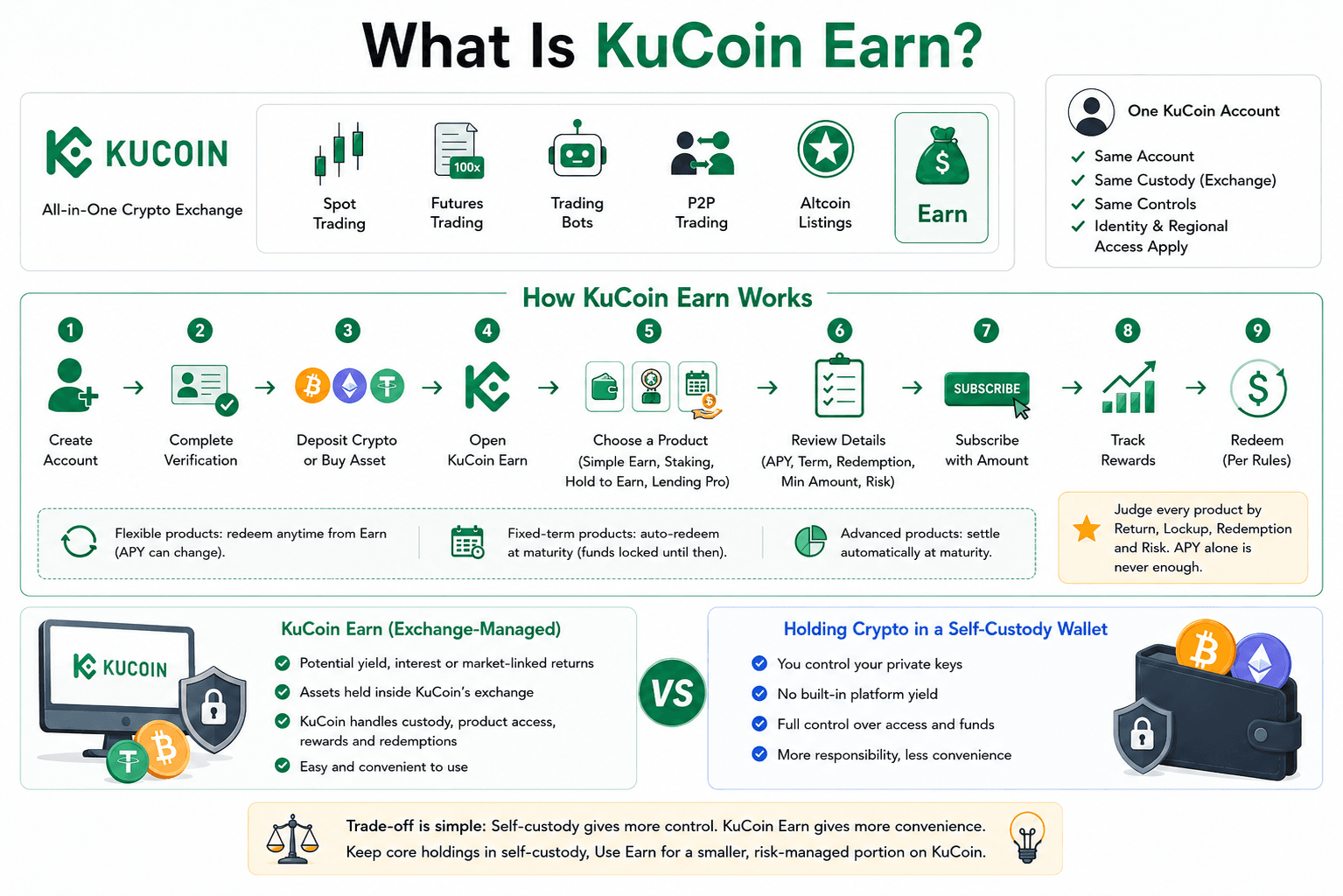
KuCoin is a full crypto exchange with spot trading, futures, trading bots, P2P, altcoin listings and an Earn section. KuCoin Earn sits inside that exchange environment, so the user experience is tied to the same account, custody model, identity checks and regional access rules.
KuCoin divides Earn into Stable, Advanced, KCS Benefits and Wealth areas.
Stable products include Simple Earn, Staking, Hold to Earn and Crypto Lending Pro.
Advanced products include structured investments such as Dual Investment, Shark Fin, Snowball, Discount Buy and Range Bound.
This is different from holding crypto in a private wallet. It is also different from staking directly from a self-custody wallet. KuCoin handles the custody, product access, reward tracking and redemption process.
That makes the experience easier than using separate wallets, validators, cross-chain bridges or DeFi protocols. It also means users depend on KuCoin’s systems.
Read our full KuCoin exchange review and our analysis on KuCoin exchange safety.
How KuCoin Earn Works
KuCoin Earn starts with a KuCoin account and a supported crypto asset.
The flow looks like this:
- Create a KuCoin account.
- Complete identity verification where required.
- Deposit crypto or buy a supported asset on KuCoin.
- Open KuCoin Earn.
- Choose a product such as Simple Earn, Staking, Hold to Earn or Crypto Lending Pro.
- Review the APY, term, redemption period, minimum amount and risk notice.
- Subscribe with the amount of crypto you want to use.
- Track rewards inside the Earn account.
- Redeem based on the product’s rules.
Subscribing is straightforward. Understanding the exit terms takes more care.
A flexible Simple Earn product may allow easier redemption, but the APY can move. A fixed-term product may offer a different rate, but funds may stay locked until maturity. KuCoin explains that flexible products can be redeemed from the Earn account, fixed-term products are automatically redeemed at maturity and Advanced products settle automatically at maturity.
Every product should be judged by four things: return, lockup, redemption and risk. APY alone is never enough.
KuCoin Earn vs Holding Crypto In A Wallet
Holding crypto in a self-custody wallet gives users control over private keys. The user has no built-in platform yield, but they control access to the funds.
KuCoin Earn gives users possible yield, but assets sit inside KuCoin's exchange environment. The user does not control the private keys while funds are in the exchange account. If access, withdrawals, redemptions or regional rules change, the user has to work through KuCoin.
Self-custody gives more control, while KuCoin Earn gives more convenience. Users who care most about long-term control should keep core holdings in self-custody. Users who already hold assets on KuCoin may find Earn useful for a smaller, risk-managed portion of their portfolio.
Can US Users Use KuCoin Earn?
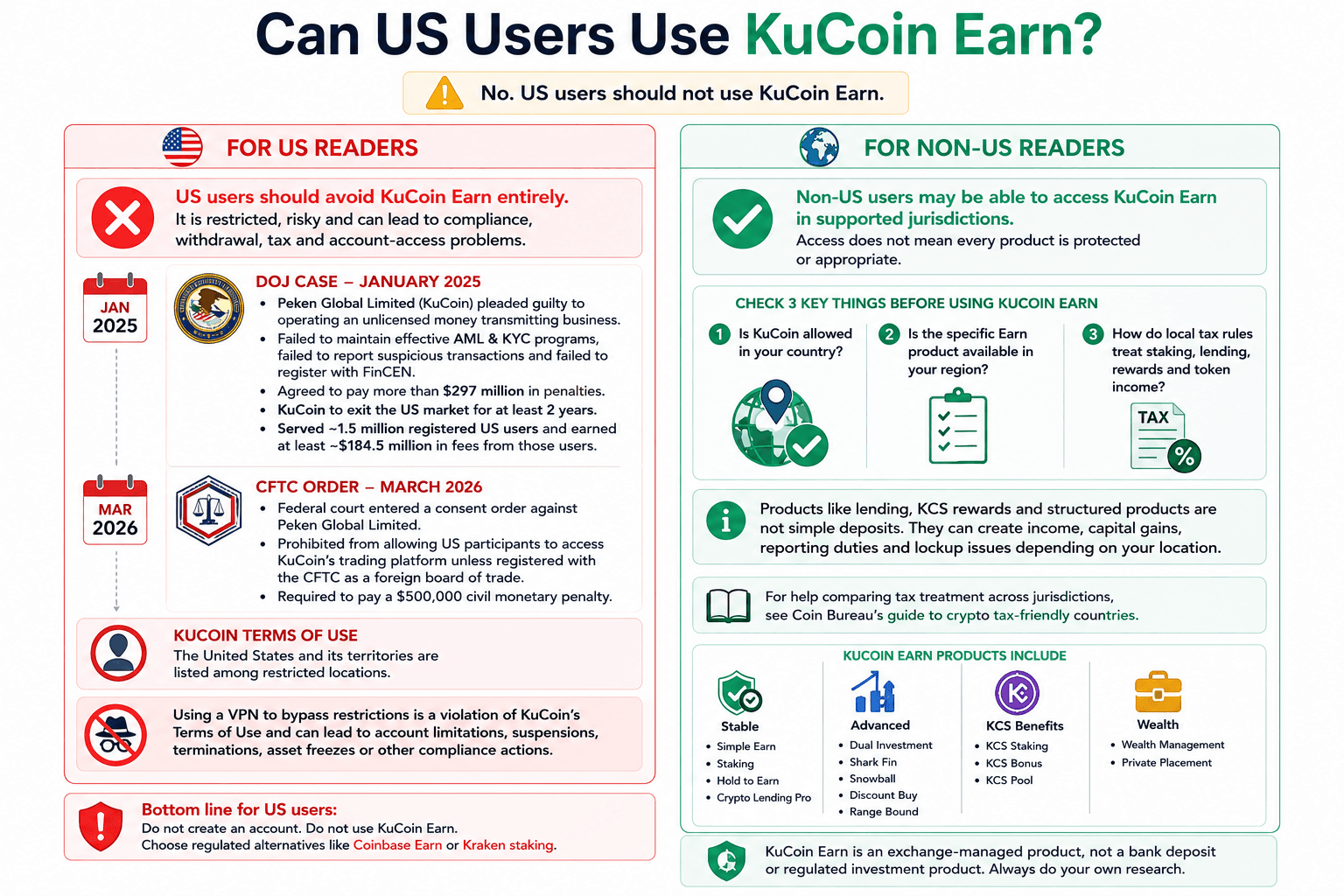
No. US users cannot use KuCoin Earn. KuCoin's own Terms of Use list the United States and its territories among restricted locations.
 Why US Users Should Avoid KuCoin Earn Access
In January 2025, the US Department of Justice announced that Peken Global Limited, a Seychelles-based entity operating KuCoin, pleaded guilty to one count of operating an unlicensed money transmitting business. The DOJ said KuCoin failed to maintain effective AML and KYC programs, failed to report suspicious transactions and failed to register with FinCEN.
The DOJ also said Peken Global agreed to pay more than $297 million in penalties and that KuCoin would exit the US market for at least two years. The same DOJ release said KuCoin had served about 1.5 million registered US users and earned at least about $184.5 million in fees from those users.
In March 2026, the CFTC announced that a federal court had entered a consent order against Peken Global. The order prohibited Peken Global from allowing US participants to access KuCoin’s electronic trading and order-matching system unless it registers with the CFTC as a foreign board of trade. The order also required Peken Global to pay a $500,000 civil monetary penalty.
KuCoin Earn Products In 2026
KuCoin Earn has a wide product menu, but the products do not belong in one risk bucket.
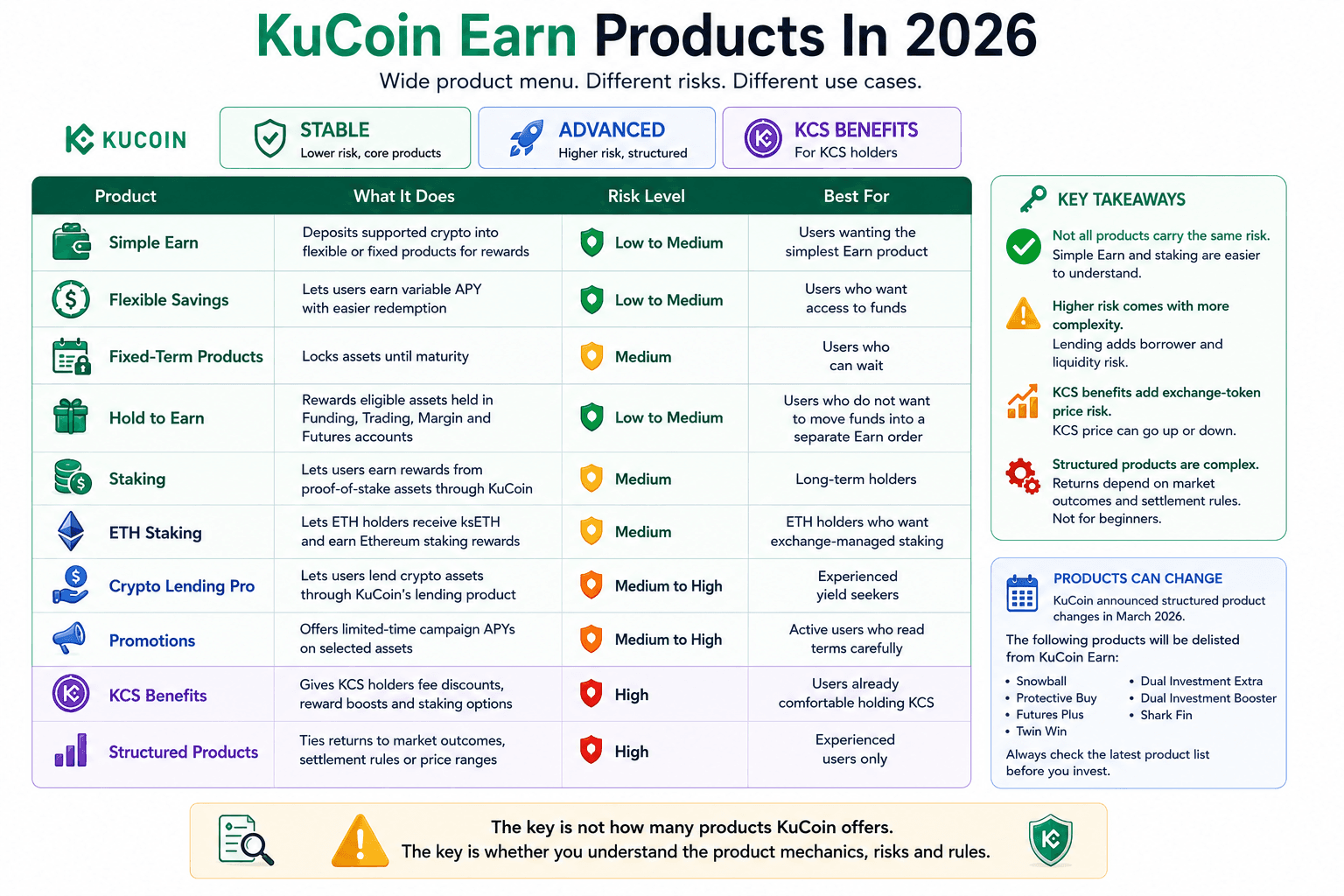 KuCoin Earn Products And Their Main Risk Profiles
KuCoin currently shows Stable products such as Simple Earn, Staking, Hold to Earn and Crypto Lending Pro. It also shows Advanced products such as Shark Fin, Dual Investment, Snowball, Discount Buy and Range Bound. The KCS Benefits area covers KCS Loyalty and KCS Staking.
| Product Type | What It Does | Risk Level | Best For |
|---|---|---|---|
| Simple Earn | Deposits supported crypto into flexible or fixed products for rewards | Low to Medium | Users wanting the simplest Earn product |
| Flexible Savings | Lets users earn variable APY with easier redemption | Low to Medium | Users who want access to funds |
| Fixed-Term Products | Locks assets until maturity | Medium | Users who can wait |
| Hold to Earn | Rewards eligible assets held in Funding, Trading, Margin and Futures accounts | Low to Medium | Users who do not want to move funds into a separate Earn order |
| Staking | Lets users earn rewards from proof-of-stake assets through KuCoin | Medium | Long-term holders |
| ETH Staking | Lets ETH holders receive ksETH and earn Ethereum staking rewards | Medium | ETH holders who want exchange-managed staking |
| Crypto Lending Pro | Lets users lend crypto assets through KuCoin’s lending product | Medium to High | Experienced yield seekers |
| Promotions | Offers limited-time campaign APYs on selected assets | Medium to High | Active users who read terms carefully |
| KCS Benefits | Gives KCS holders fee discounts, reward boosts and staking options | High | Users already comfortable holding KCS |
| Structured Products | Ties returns to market outcomes, settlement rules or price ranges | High | Experienced users only |
The product list is less useful than the risk split. Simple Earn, lending, staking and structured products behave very differently.
Simple Earn and staking are easier to understand. Lending adds borrower and liquidity risk. KCS benefits add exchange-token price risk. Structured products add settlement mechanics that can be difficult for beginners.
KuCoin Savings
KuCoin Savings is the simplest way to understand KuCoin Earn: users deposit supported crypto and earn a return based on the product terms.
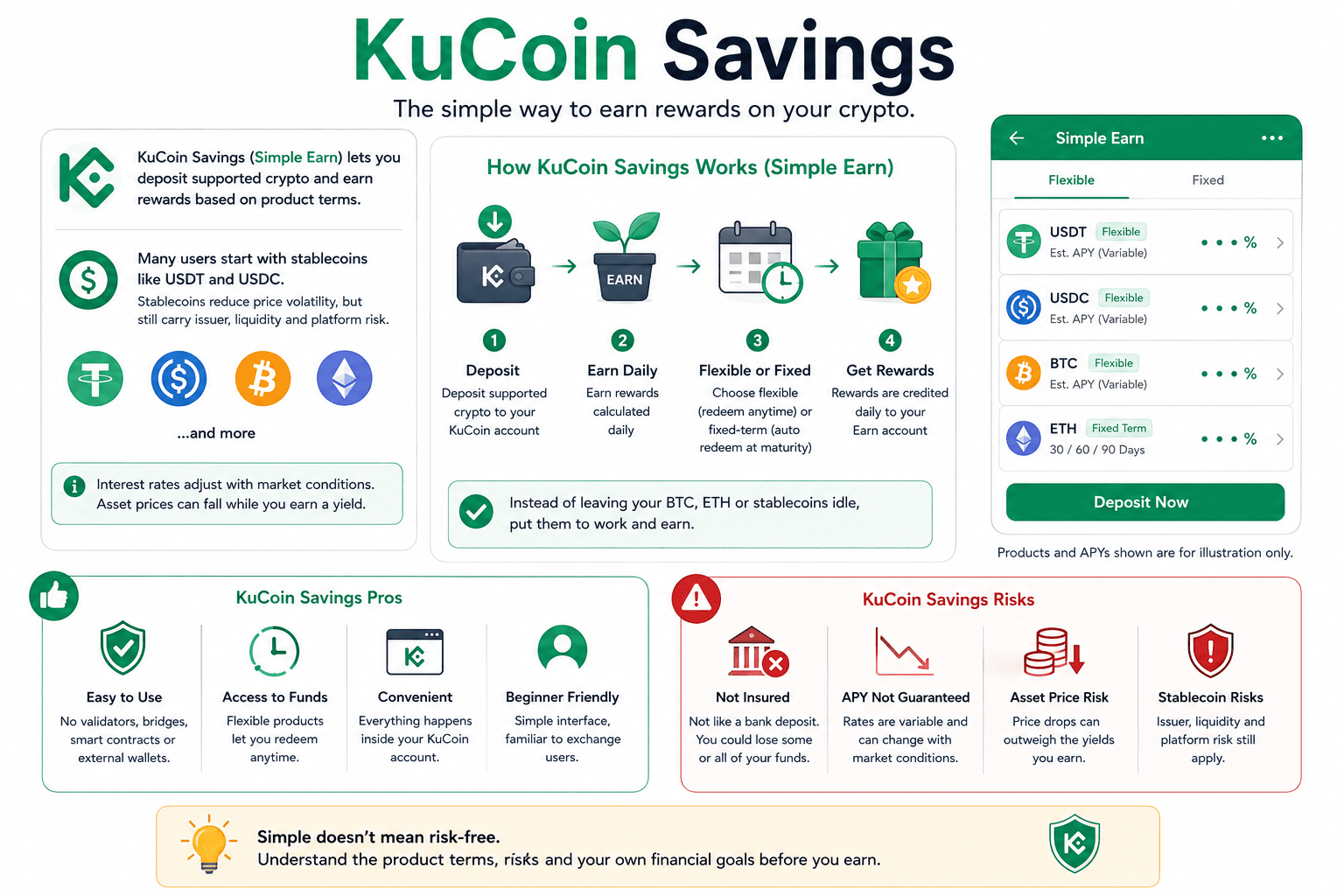 KuCoin Savings And The Risks Behind Simple Yield
In practice, many users look at savings products through stablecoins first, since assets like USDT and USDC are commonly used for exchange yield. Stablecoins reduce price volatility compared with most crypto assets, but they still carry issuer, liquidity and platform risk.
Coin Bureau’s guide to yield-bearing stablecoins helps explain why stablecoin yield can look simple while still depending on the structure behind it.
In KuCoin’s current interface, savings-style products mainly sit under Simple Earn. KuCoin describes Simple Earn as a product where users can deposit or withdraw anytime and earn daily rewards. Flexible products can be redeemed anytime in the Earn account, while fixed-term products are automatically redeemed at maturity.
This can be useful for users who already hold Bitcoin, Ethereum or supported stablecoins on KuCoin. Instead of leaving the assets idle in the account, they can move them into an Earn product.
The risk is that “simple” does not mean risk-free. KuCoin says interest rates adjust with market conditions and crypto market movement. The asset price can also fall while the user earns a small yield.
KuCoin Savings Pros
KuCoin Savings is easier to use than staking from a self-custody wallet or lending through DeFi.
Users do not need to select validators, bridge funds, approve smart contracts or manage external wallet signatures. The process happens inside the KuCoin account, which makes it more approachable for users already familiar with centralized exchanges.
Flexible products are also useful for users who want some access to funds. They are a better fit than fixed-term products for anyone who may need to move assets quickly.
The main advantage is convenience. KuCoin packages the yield route into a clean interface and removes much of the operational friction.
KuCoin Savings Risks
KuCoin Savings is not insured like a bank deposit.
KuCoin’s Risk Disclosure Statement says digital token trading can result in substantial loss, that users may sustain a total loss of funds and that liquidity can become difficult under some market conditions.
APYs are also not guaranteed long term. A user who subscribes to a variable-rate product should expect the rate to change.
The asset risk can be larger than the yield. Earning a small APY on BTC, ETH or an altcoin does not protect the user from price drops. Stablecoin savings may reduce market volatility, but stablecoins still carry issuer, liquidity and platform risk.
KuCoin Staking And ETH Staking
KuCoin staking lets users earn rewards on supported proof-of-stake assets through the exchange.
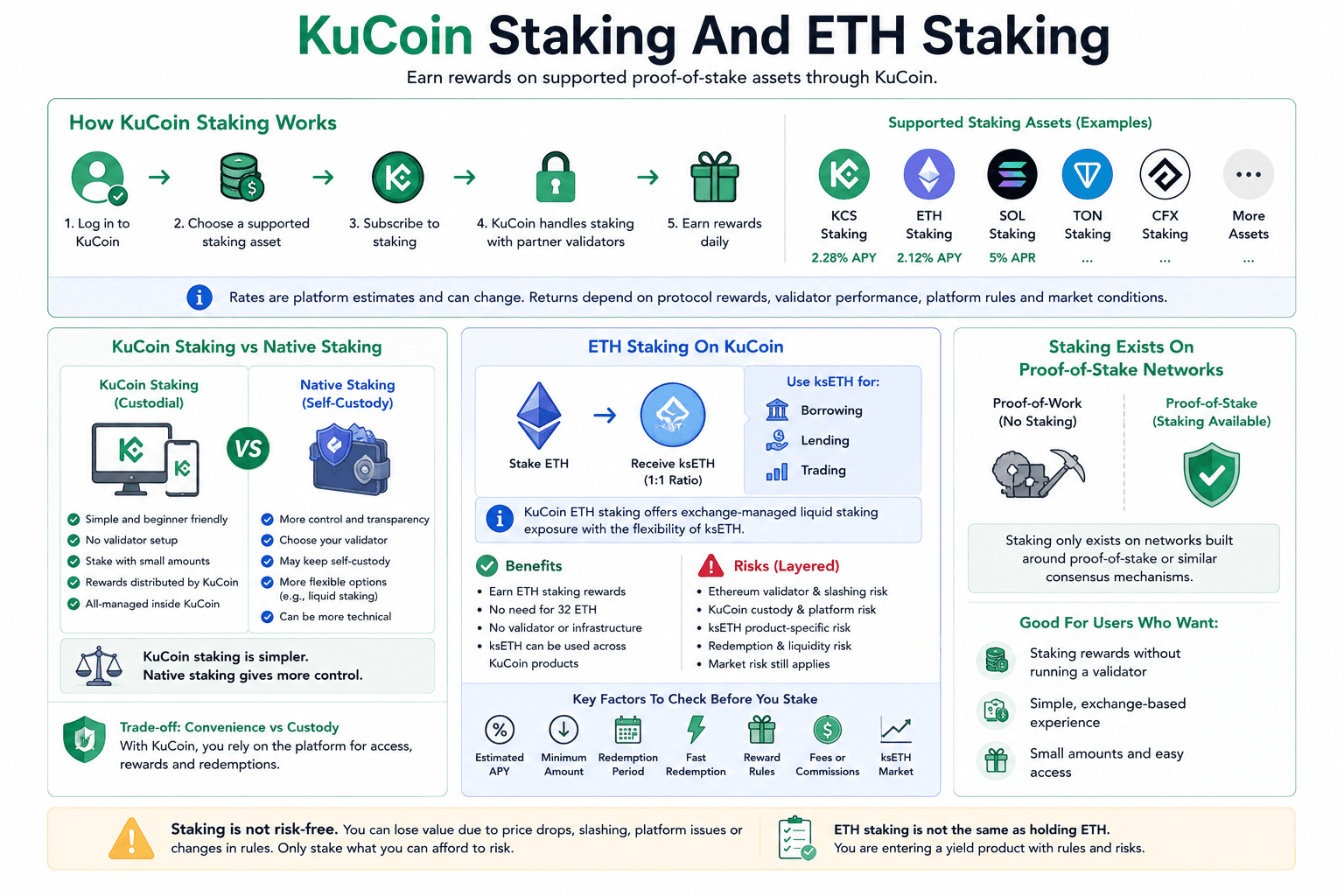 KuCoin Staking And ETH Rewards Through Exchange Custody
KuCoin staking is easier to judge once the user understands the difference between proof-of-work and proof-of-stake networks. Staking only exists on networks designed around proof-of-stake or similar consensus systems.
Our DeFi staking platforms guide is a better comparison point for users weighing custodial exchange staking against wallet-based staking routes.
KuCoin staking is built for users who want staking rewards without running a validator, choosing a validator or managing staking from a self-custody wallet. KuCoin handles the platform flow, and the user subscribes from the exchange account.
KuCoin’s staking page lists KCS Staking, ETH Staking and staking options for assets such as ETH, Solana, TON, CFX and others. As of June 14, 2026, KuCoin displayed an estimated 2.12% APY for ETH staking, 5% reference APR for SOL and 2.28% estimated APY for KCS Staking.
Those rates should be treated as platform estimates. Staking returns can move with protocol rewards, validator performance, platform rules and market conditions.
KuCoin Staking vs Native Staking
KuCoin staking is simpler. Native staking gives more control.
With native staking, users usually interact with a wallet, validator, delegation system or liquid staking protocol. That setup can feel more technical, but the user has more visibility into how the staking route works. Depending on the chain and staking method, the user may retain self-custody.
KuCoin staking is easier because the exchange packages the process. The user does not need to understand validator operations on day one.
The trade-off is custody. Users rely on KuCoin for staking access, reward distribution and redemption. If the platform has an issue, the user cannot simply bypass KuCoin and interact directly with the staking position.
ETH Staking On KuCoin
ETH staking on KuCoin is designed for users who want Ethereum staking rewards without running their own validator.
KuCoin says ETH staking users receive ksETH at a 1:1 ratio and can use it for borrowing, lending and trading. That makes the product closer to exchange-managed liquid staking than simple ETH holding.
The main appeal is access. Users do not need 32 ETH or validator infrastructure. They can stake through KuCoin and receive a platform-managed staking representation.
The risk is layered. ETH staking carries Ethereum validator and slashing risk. KuCoin adds custody, redemption and platform risk. ksETH adds product-specific complexity because users need to understand how it can be used, traded or redeemed.
ETH holders should pay attention to:
- Estimated APY
- Minimum subscription amount
- Redemption period
- Fast redemption availability
- Reward distribution rules
- Any commission or spread
- The market behavior of ksETH, if trading it
ETH staking is not the same as simply holding ETH. The user is entering a yield product with rules attached.
KuCoin Crypto Lending
KuCoin Crypto Lending is a higher-risk yield category because the return depends on lending activity, borrower demand and platform rules.
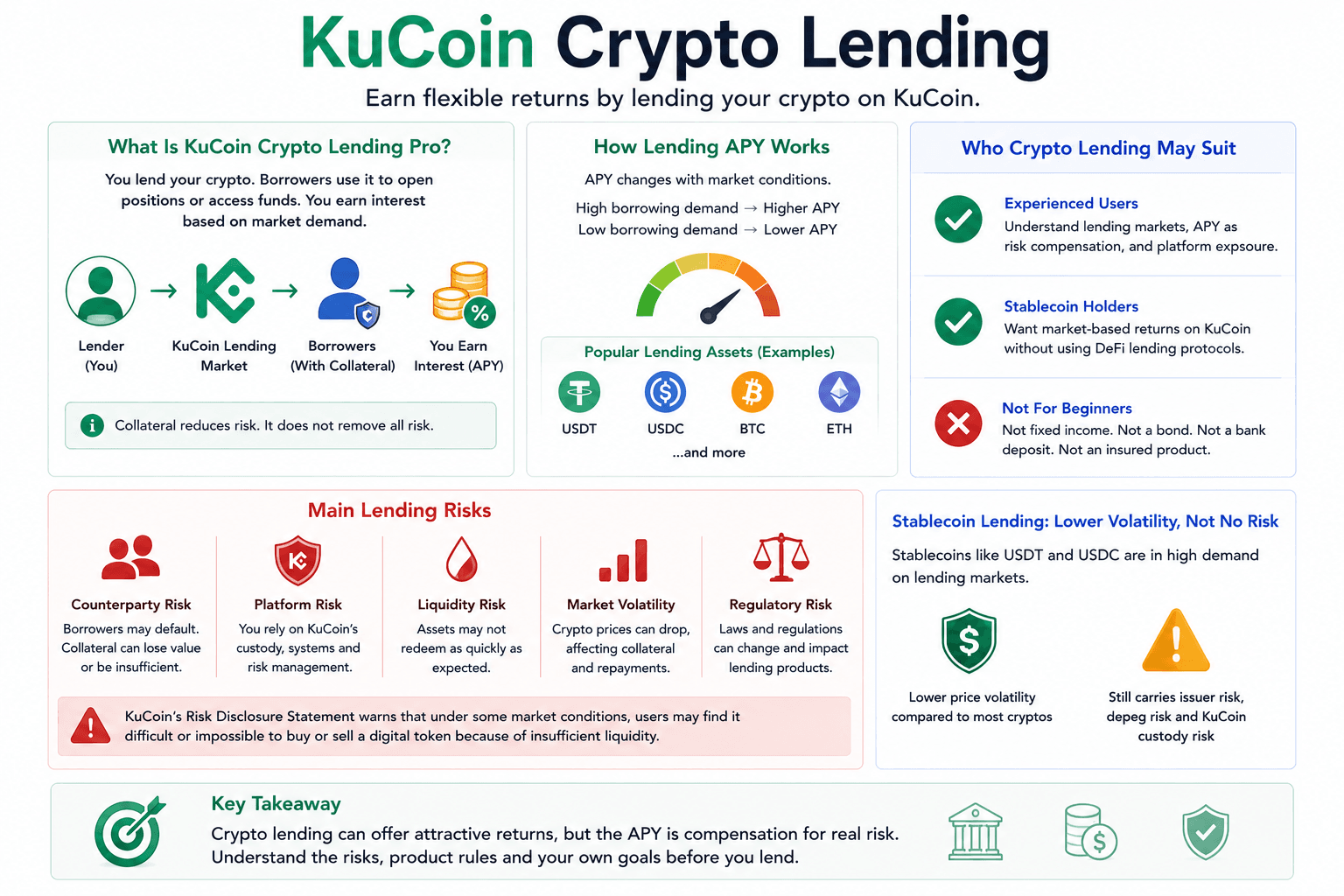 KuCoin Crypto Lending And Its Market-Based Yield Risks
Crypto lending only makes sense when it fits a specific strategy, not when the advertised number looks good. Lending products can look calm because they show an APY, but the user is taking a different risk from staking or savings.
Check out our top picks for the best crypto lending platforms.
KuCoin describes Crypto Lending Pro as a product where users can earn flexible returns by lending crypto assets. In a lending product, users are making assets available through a lending market. Borrowers may use collateral, but collateral does not remove all risk. It only changes the risk structure.
Lending APY can rise when demand to borrow is high. It can fall when demand weakens. Stablecoins such as USDT or USDC often attract lending demand, but the return is still market-based.
Who Crypto Lending May Suit
Crypto lending may suit experienced users who understand how lending markets work.
A good lending user knows that APY is compensation for risk. The user is comfortable with borrower demand, collateral mechanics, redemption delays and centralized platform exposure.
It may also suit users who already hold stablecoins on KuCoin and want to earn a market-based return without using DeFi lending protocols. For that user, KuCoin removes wallet and smart contract steps.
Crypto lending is a poor fit for users who think of it as fixed income. It is not a bond, not a bank deposit and not an insured product.
Main Lending Risks
The main risks are counterparty risk, platform risk, liquidity risk, market volatility and regulatory risk.
Counterparty risk comes from the borrower side of the market. Platform risk comes from KuCoin’s custody and internal systems. Liquidity risk appears when assets cannot be redeemed as quickly as expected.
KuCoin’s Risk Disclosure Statement also warns that under some market conditions users may find it difficult or impossible to buy or sell a digital token because of insufficient liquidity. That warning is relevant for Earn users who assume crypto products always redeem cleanly.
Stablecoin lending lowers some price volatility, but it does not remove issuer risk, depeg risk or KuCoin custody risk.
KCS Bonus: Earning With KuCoin Token
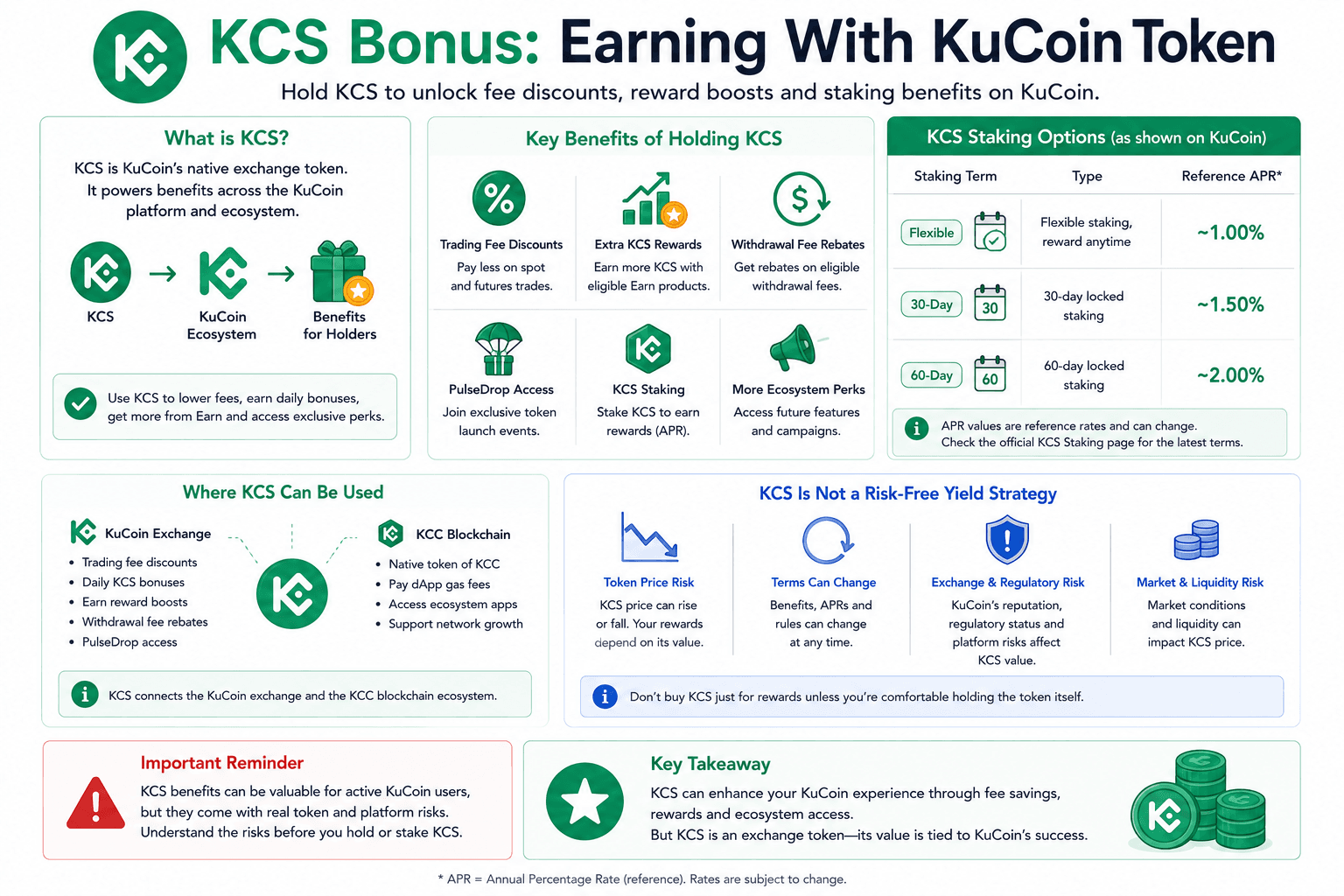
KCS is KuCoin’s native exchange token, and KuCoin gives KCS holders access to benefits such as fee discounts, reward boosts and staking options.
 KCS Bonus Rewards And Exchange Token Price Risk
KuCoin’s own KCS page describes KCS as KuCoin Token and says it can be used for trading-fee discounts, daily KCS bonuses and other ecosystem benefits. KuCoin’s KCS Benefits page now frames the Earn-related benefits through KCS Loyalty and KCS Staking.
KCS Loyalty can unlock benefits such as trading fee discounts, extra KCS rewards for fixed Earn products, withdrawal fee rebates and PulseDrop access. KuCoin’s KCS Benefits page shows KCS Staking terms such as flexible, 30-day and 60-day options, with reference APRs displayed on the product page.
This can make sense for users who already hold KCS and actively use KuCoin. It is much less convincing as a standalone yield strategy.
The reason is simple: KCS is an exchange token. Its price depends heavily on KuCoin’s reputation, trading activity, regulatory standing and the broader appetite for exchange tokens.
KCS Bonus Risks
KCS has token price risk.
The bonus or staking terms can change. The value of the rewards can change. KuCoin’s regulatory history can also affect confidence in the exchange token.
KCS also connects to the broader KCS ecosystem. The KCS whitepaper describes KCS rewards, fee discounts, initial token offering participation and the KCC ecosystem. The KCC website describes KCS as the native token for KCC and says it can be used for DApp gas fees.
That extra utility does not remove token risk. If KuCoin faces reputational, regulatory or market pressure, KCS can suffer. Users should not buy KCS only to unlock rewards unless they are comfortable holding the token itself.
Are KuCoin Structured Products Still Available?
Yes, KuCoin's structured products such as Dual Investment, Snowball, Shark Fin, Twin-Win, Futures Plus and Protective Buy are available as of June 14, 2026 under the Advanced tab on the KuCoin Earn website.
What Structured Products Are
Structured products are yield products linked to market outcomes.
A product may depend on whether BTC, ETH or another asset stays within a range, hits a strike price, moves in a direction or settles above or below a level at expiry. Some products may offer principal protection. Others may not.
A structured product can produce yield in one scenario and a weaker outcome in another. The user may receive a different asset, miss upside or take downside exposure.
Why Beginners Should Be Careful
Beginners should be careful because structured products can make risk look neat.
The APY is often the loudest number on the screen. The settlement condition is the quieter part that decides what the user actually gets.
A beginner may look at a high APY and assume it works like savings. That is the wrong mental model. These products are closer to packaged market strategies.
Before using any structured product, a user should understand:
- What asset is deposited
- What asset can be received at settlement
- Whether principal is protected
- What price level affects the outcome
- What happens at expiry
- What opportunity cost exists if the market moves sharply
If those answers are unclear, the product is too complex for that user.
KuCoin Earn APYs: What Rates Can Users Expect?
KuCoin Earn APYs move often, and the displayed rate depends on the asset, product type, term, campaign and market demand.
That is common across crypto yield products. Coin Bureau’s DeFi staking platforms guide is useful background because it separates yield sources, exit mechanics and risk types rather than treating APY as a single clean number.
| Product | Example Assets | Reference APR (June 14, 2026) | Lockup |
|---|---|---|---|
| Simple Earn | USDT, USDC, BTC, ETH | 0.01% to 100% | Flexible or fixed |
| Staking | ETH, SOL, TON, KCS | 0.3% to 13% | Flexible or fixed, with redemption periods |
| ETH Staking | ETH, ksETH | 2.12% | Flexible with redemption rules |
| Hold to Earn | Eligible account-held assets | 0.12% to 3.2% | Account and product dependent |
Users should treat Earn rates like live market data. The number inside KuCoin at the time of subscription is the number that counts, and even that may be variable depending on the product.
A sensible user does not chase the highest APY first. They ask why the APY is high, how the product works and what risk they are being paid to take.
Is KuCoin Earn Safe?
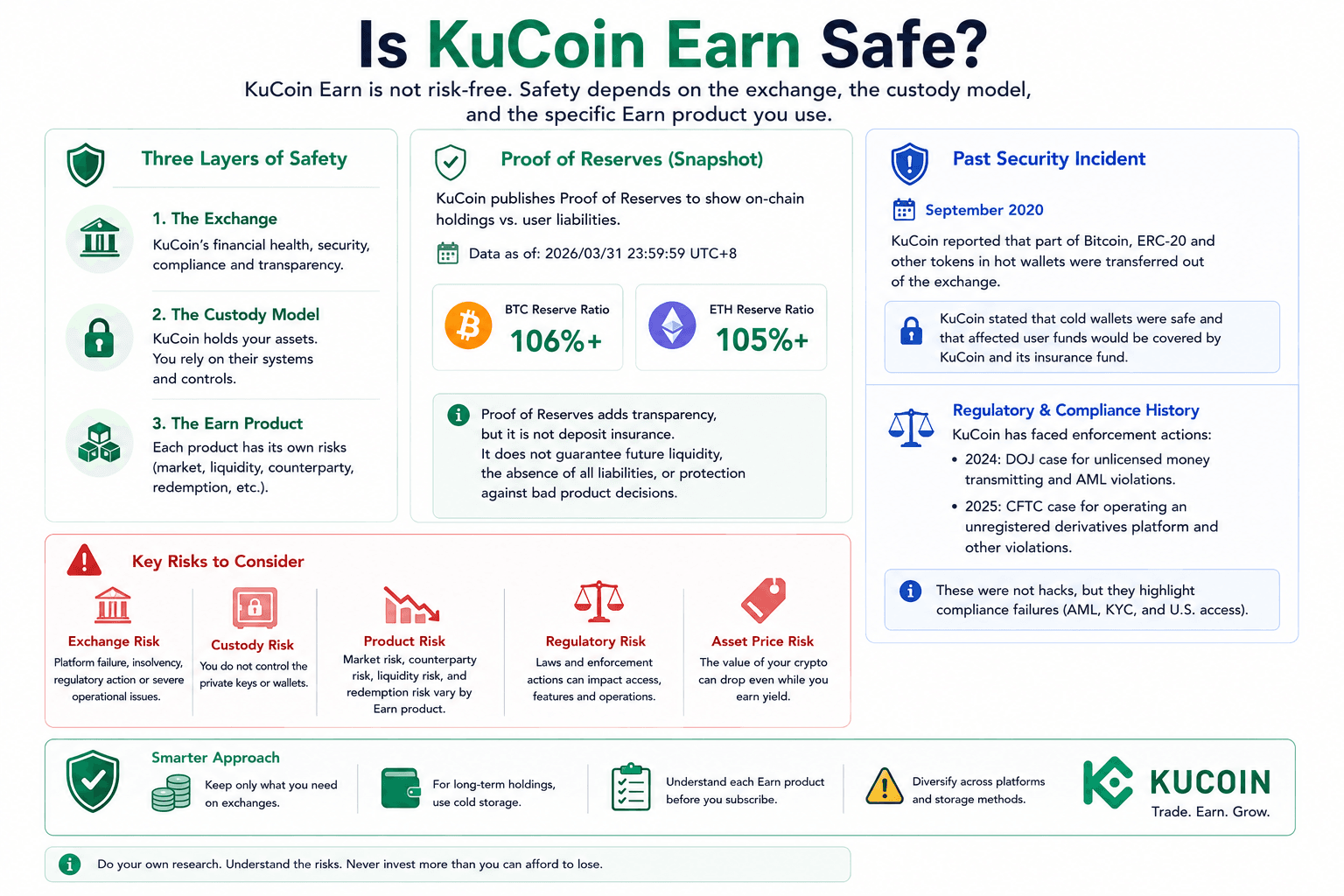
Yes, KuCoin Earn is safe. KuCoin publishes Proof of Reserves, with the page showing reserve ratios based on data at 2026/03/31 23:59:59 UTC+8. The same page showed BTC and ETH reserve ratios above 100% in that snapshot.
 KuCoin Earn Safety Depends On Custody And Compliance
Proof of Reserves adds transparency, but it is not deposit insurance. It does not automatically prove future liquidity, the absence of all liabilities or protection against bad product decisions.
KuCoin also has a past security incident. In September 2020, KuCoin said in a security incident update that part of Bitcoin, ERC-20 and other tokens in hot wallets had been transferred out of the exchange. KuCoin said cold wallets were safe and that affected user funds would be covered by KuCoin and its insurance fund.
Platform And Custody Risk
KuCoin Earn users give up direct control of assets.
The private keys are not user-controlled while funds sit inside KuCoin. That means the user depends on KuCoin for withdrawals, redemptions, account access and product settlement.
This is the central risk of any centralized exchange yield product. Even if the product itself is simple, the custody model is not the same as holding assets in a hardware wallet.
Exchange problems can affect users in several ways:
- Withdrawals may slow or pause
- Accounts may need extra verification
- Products may stop accepting subscriptions
- Redemptions may follow platform timelines
- Regional access may change
Users comfortable with those trade-offs may find KuCoin Earn useful. Users who want direct control should avoid keeping large balances in exchange-based yield products.
Regulatory Risk
Regulatory risk is one of KuCoin Earn's biggest 2026 concerns.
The DOJ guilty plea and CFTC order directly affect US users. They also show why non-US users should not assume global availability equals strong regulatory protection.
KuCoin’s Risk Disclosure Statement says the regulatory status of digital tokens is unclear or unsettled in many jurisdictions and that KuCoin may cease offering services or prohibit use in some jurisdictions if government actions make continued service unlawful or commercially undesirable.
A product can be available today and restricted later.
Product Risk
Each KuCoin Earn product carries its own risk.
Simple Earn has APY and custody risk. Staking has validator, redemption and platform risk. ETH staking adds ksETH mechanics. Lending adds borrower, liquidity and counterparty risk. KCS benefits add token price risk. Structured products add settlement and market outcome risk.
A useful way to judge the product is to ask: “What can go wrong besides the APY falling?”
For KuCoin Earn, the answers can include principal loss, delayed redemption, receiving a different settlement asset, tax complexity, token volatility and restricted access.
KuCoin Earn Fees, Lockups And Redemption Rules
KuCoin Earn products do not follow one single fee or redemption model, according to KuCoin Earn's terms of use. The terms can vary by product, so users need to check the specific subscription page before committing funds.
Fixed-term products may lock assets until maturity, and early redemption may not always be available. If KuCoin allows early redemption, it can charge an early redemption fee, and the final amount returned may be lower than the original principal.
Flexible products are generally easier to redeem, but KuCoin can still apply limits, delays, minimums, maximums or fees depending on the product and market conditions.
KuCoin also says it may charge performance-based fees, change fee rules, alter product limits, impose redemption restrictions, cancel subscriptions, or mandatorily redeem assets at its discretion.
| Area | What Users Should Know |
|---|---|
| Product terms | KuCoin Earn products can have different rules, fees, lockups and redemption conditions. Always check the specific product page before subscribing. |
| Fixed-term lockups | Fixed-term products may lock assets until maturity. Early redemption may not be available. |
| Early redemption | If KuCoin allows early redemption, it may charge a fee. The amount returned could be lower than the original principal. |
| Flexible products | Flexible products are generally easier to redeem, but they can still have limits, delays, minimums, maximums or fees. |
| Performance fees | KuCoin may charge performance-based fees and can change how those fees are calculated or deducted. |
| Rule changes | KuCoin can change product limits, redemption terms, fee rules or subscription conditions at its discretion. |
| Mandatory redemption | KuCoin may cancel a subscription or mandatorily redeem user assets in certain cases. |
Questions To Ask Before Subscribing
Before using any KuCoin Earn product, users should answer these questions:
- Is this product available in my country?
- Is the APY fixed, variable or promotional?
- Can I redeem early?
- What happens if I redeem before maturity?
- Is there a redemption period?
- Do I lose rewards during redemption?
- Is my principal protected?
- What asset do I receive at settlement?
- Is there a staking commission, spread or hidden cost?
- What happens if KuCoin restricts my account?
- How will this income be taxed?
A user who cannot answer these questions is not ready for the product. That is especially true for lending, KCS rewards and structured products.
KuCoin Earn vs Binance Earn, OKX Earn, Coinbase Earn And Kraken
 KuCoin Earn Compared With Major Exchange Yield Platforms
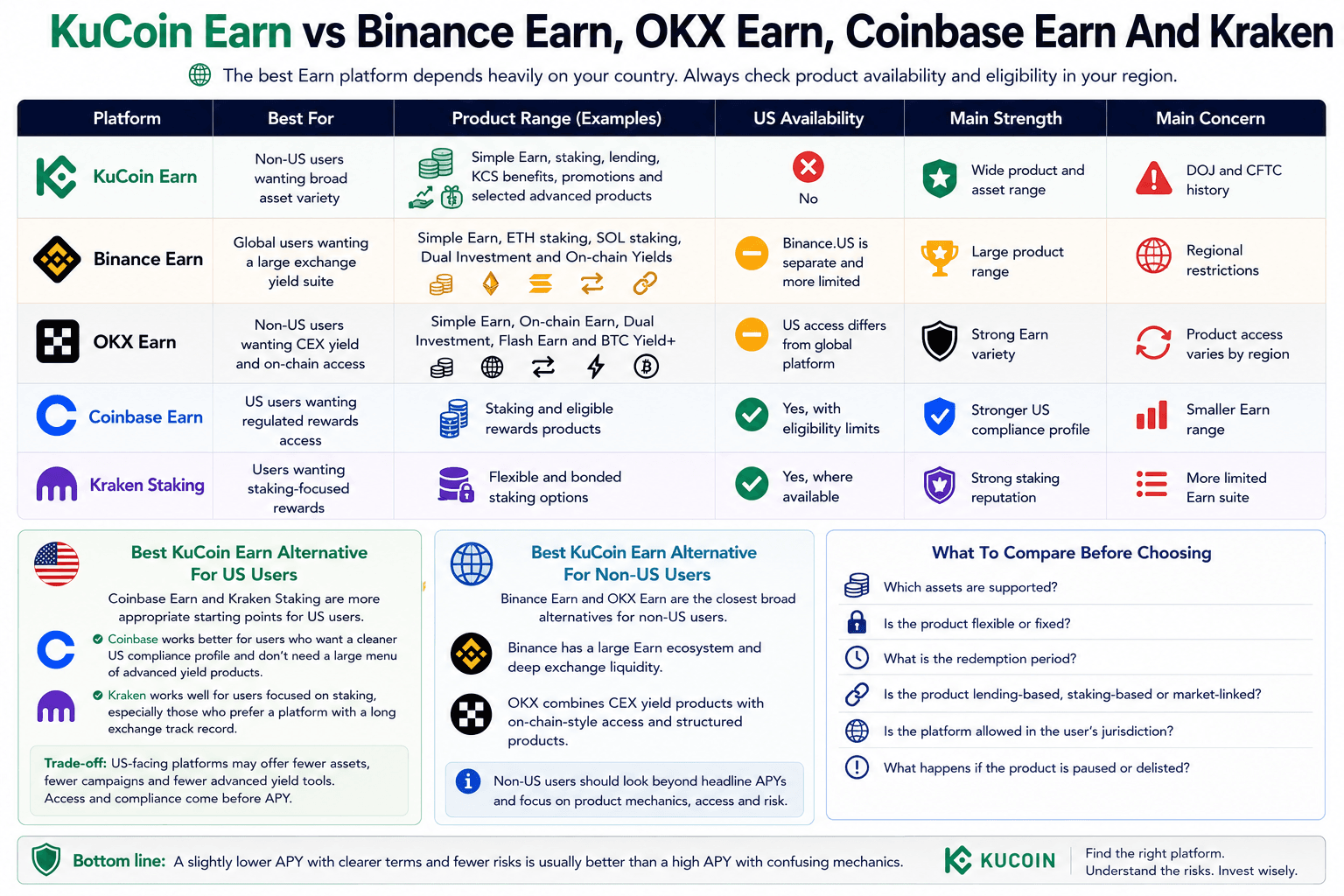
KuCoin Earn competes with other exchange-based yield platforms, but the right alternative depends heavily on the user’s country.
KuCoin’s main appeal is asset variety and a wide Earn menu for eligible non-US users. Its main weakness is US enforcement history. For US users, the better starting points are regulated platforms such as Coinbase and Kraken, depending on state and asset eligibility.
| Platform | Best For | Product Range | US Availability | Main Strength | Main Concern |
|---|---|---|---|---|---|
| KuCoin Earn | Non-US users wanting broad asset variety | Simple Earn, staking, lending, KCS benefits, promotions and selected advanced products | No | Wide product and asset range | DOJ and CFTC history |
| Binance Earn | Global users wanting a large exchange yield suite | Simple Earn, ETH staking, SOL staking, Dual Investment and On-chain Yields | Binance.US is separate and more limited | Large product range | Regional restrictions |
| OKX Earn | Non-US users wanting CEX yield and on-chain access | Simple Earn, On-chain Earn, Dual Investment, Flash Earn and BTC Yield+ | US access differs from global platform | Strong Earn variety | Product access varies by region |
| Coinbase Earn | US users wanting regulated rewards access | Staking and eligible rewards products | Yes, with eligibility limits | Stronger US compliance profile | Smaller Earn range |
| Kraken Staking | Users wanting staking-focused rewards | Flexible and bonded staking options | Yes, where available | Strong staking reputation | More limited Earn suite |
Binance Earn is the closest broad alternative for global users. Binance says it supports 300+ crypto assets through Earn and includes Simple Earn, Flexible Products, Locked Products, ETH Staking, SOL Staking, Dual Investment and On-chain Yields.
OKX Earn is also a strong non-US comparison. OKX says its Earn page offers daily rewards on 100+ tokens and lists Simple Earn, On-chain Earn, Flash Earn, Dual Investment and BTC Yield+.
Coinbase Earn is more relevant for users who prioritize regulated access. Coinbase says staking enrollment is available only in eligible jurisdictions and networks, reward rates are subject to change and users cannot sell or send staked assets until unstaking is complete.
Kraken staking is more staking-focused. Kraken says users can earn weekly staking rewards and that geographic restrictions apply. Kraken also says staking involves risks, including no guarantee of rewards, possible slashing or hacks and depreciation in the value of assets while staked.
Best KuCoin Earn Alternative For US Users
Coinbase Earn and Kraken staking are more appropriate starting points for US users.
Coinbase works better for users who want a cleaner US compliance profile and do not need a large menu of advanced yield products. Kraken works well for users focused on staking, especially those who prefer a platform with a long exchange track record.
The trade-off is product variety. US-facing platforms may offer fewer assets, fewer campaigns and fewer advanced yield tools than offshore exchanges.
That trade-off is usually worth it for US users. Access and compliance come before APY.
Best KuCoin Earn Alternative For Non-US Users
Binance Earn and OKX Earn are the closest broad alternatives for non-US users.
Binance has a large Earn ecosystem and deep exchange liquidity. OKX combines CEX yield products with on-chain-style access and structured products.
Non-US users comparing KuCoin, Binance and OKX should look beyond headline APYs. The better comparison is:
- Which assets are supported?
- Is the product flexible or fixed?
- What is the redemption period?
- Is the product lending-based, staking-based or market-linked?
- Is the platform allowed in the user’s jurisdiction?
- What happens if the product is paused or delisted?
A slightly lower APY with clearer terms can be better than a high APY with confusing mechanics.
Who Should Use KuCoin Earn?
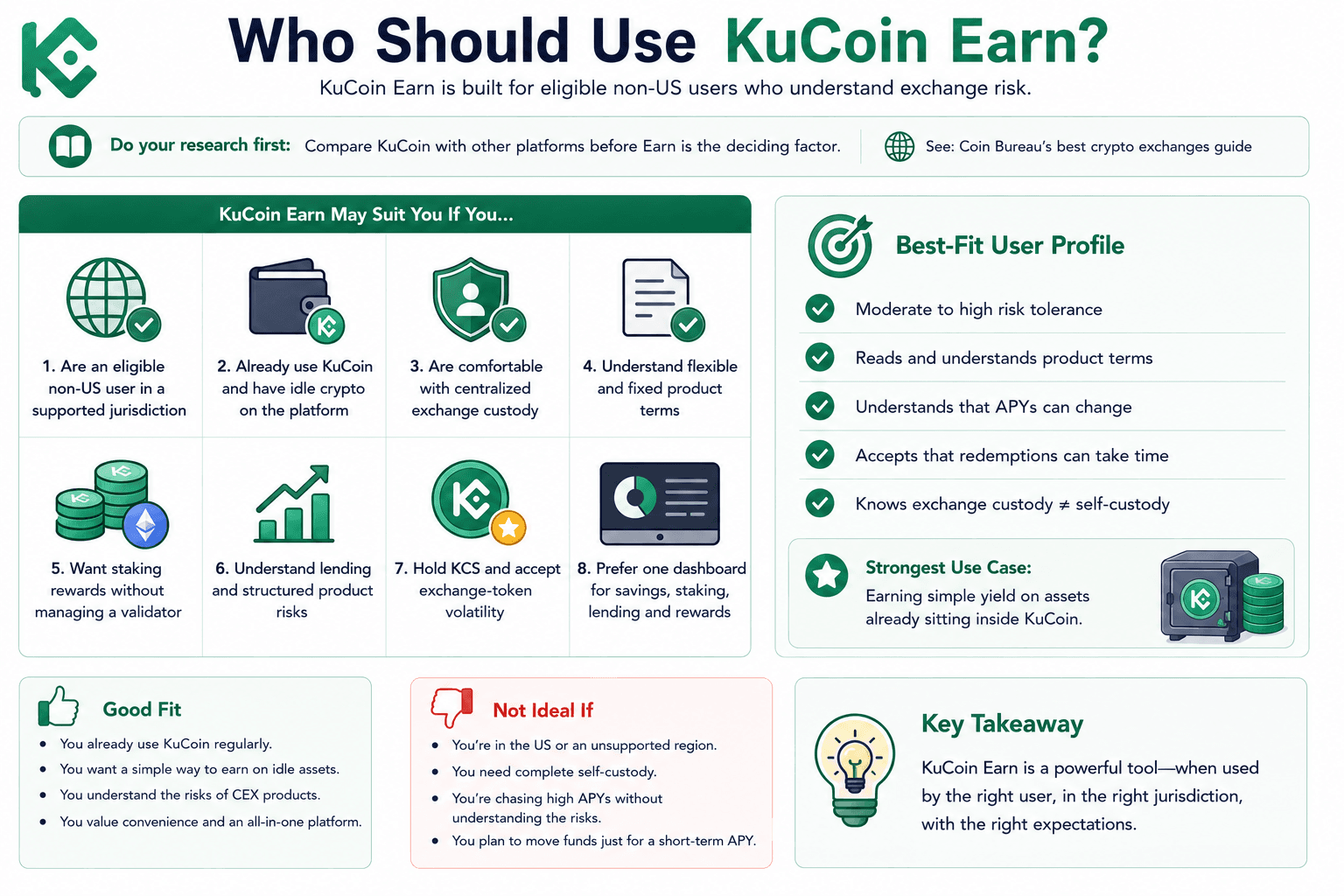
KuCoin Earn is best for eligible non-US users who already understand centralized exchange risk.
 Who KuCoin Earn Actually Makes Sense For
KuCoin Earn may suit:
- Eligible non-US users in supported jurisdictions
- Existing KuCoin users with idle crypto
- Users comfortable with centralized exchange custody
- Users who understand flexible and fixed product terms
- Long-term holders who want staking without validator management
- Experienced users who understand lending and structured product risk
- KCS holders who already accept exchange-token volatility
The strongest use case is simple yield on assets already sitting inside KuCoin. The product makes less sense if the user has to move funds onto KuCoin only to chase a temporary APY.
Who Should Avoid KuCoin Earn?
US users should avoid KuCoin Earn.
KuCoin Earn is also a bad fit for anyone who needs instant access to funds. Some products may be flexible, but staking, fixed-term products, lending and advanced products can come with delays or conditions.
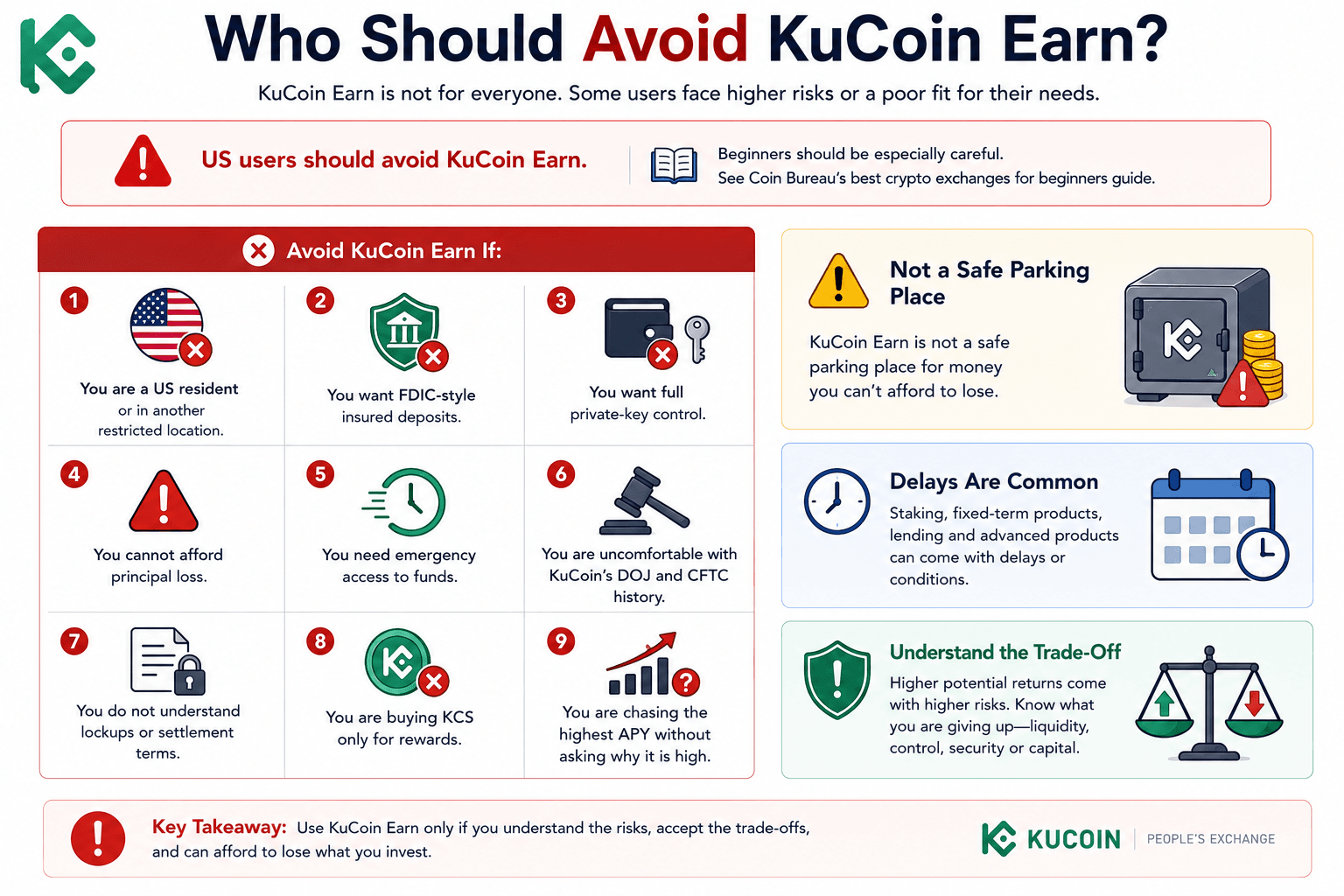 Who Should Stay Away From KuCoin Earn
Avoid KuCoin Earn if:
- You are a US resident or in another restricted location
- You want FDIC-style insured deposits
- You want full private-key control
- You cannot afford principal loss
- You need emergency access to funds
- You are uncomfortable with KuCoin’s DOJ and CFTC history
- You do not understand lockups or settlement terms
- You are buying KCS only for rewards
- You are chasing the highest APY without asking why it is high
KuCoin Earn is a tool for users who understand the trade-off. It is not a safe parking place for money someone cannot afford to lose.
How To Use KuCoin Earn Safely If You Are Eligible
The safest way to use KuCoin Earn is to treat it as a risk product, not a cash account.
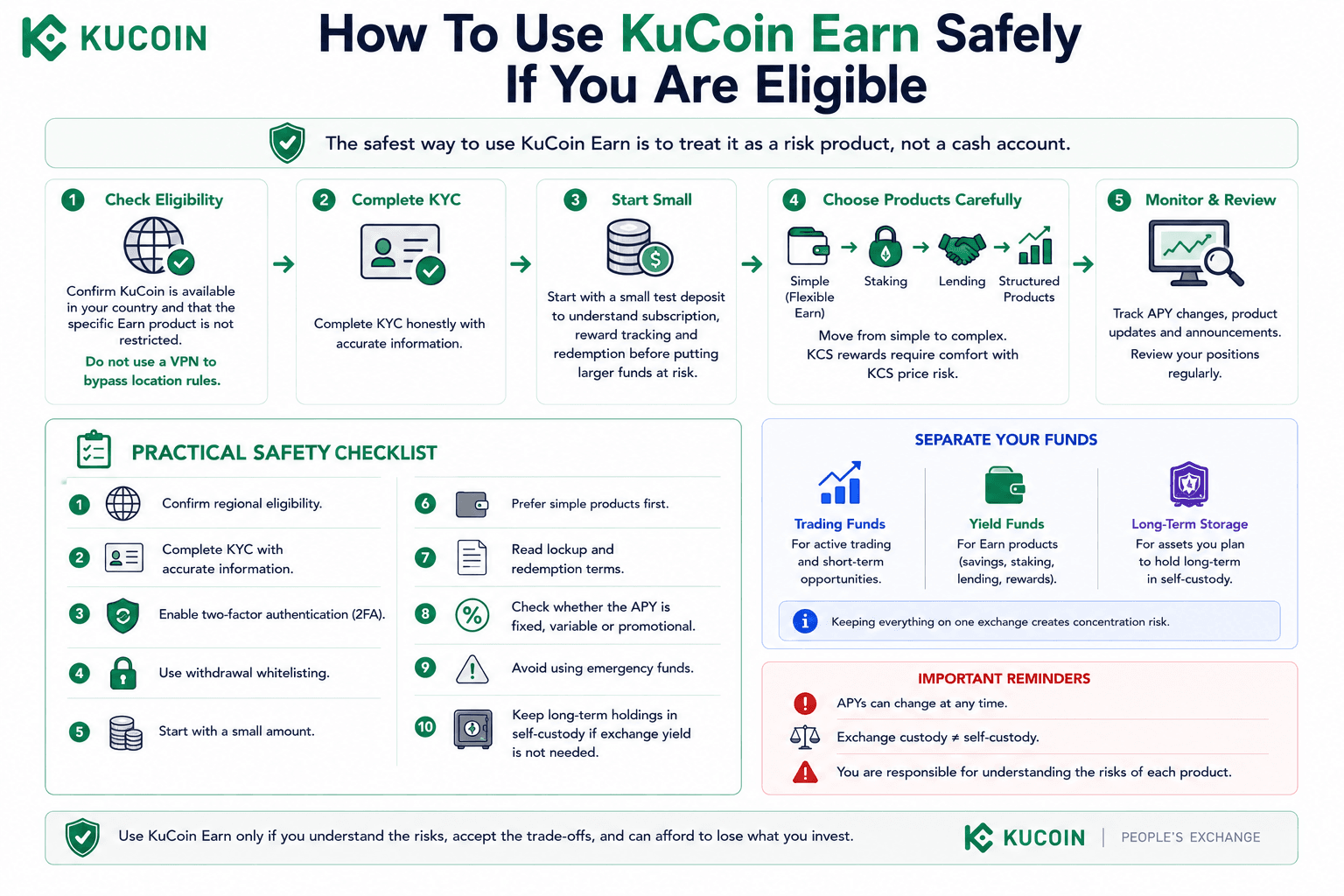 Practical Safety Steps For Eligible KuCoin Earn Users
Before using any exchange yield product, users should understand the difference between exchange custody and wallet custody. Coin Bureau’s guide to custodial vs non-custodial wallets is helpful here because it explains who controls the keys and what that means for the user.
Start with eligibility. Confirm that KuCoin is available in your country and that the specific Earn product is not restricted. Complete KYC honestly. Do not use a VPN to bypass location rules.
Then start small. A small test deposit helps users understand subscription, reward tracking and redemption before putting larger funds at risk.
For product selection, move from simple to complex. Flexible Simple Earn is easier to understand than lending. Staking is easier to understand than structured products. KCS rewards require comfort with KCS price risk.
A practical safety checklist looks like this:
- Confirm regional eligibility.
- Complete KYC with accurate information.
- Enable two-factor authentication.
- Use withdrawal whitelisting.
- Start with a small amount.
- Prefer simple products first.
- Read lockup and redemption terms.
- Check whether the APY is fixed, variable or promotional.
- Avoid using emergency funds.
- Keep long-term holdings in self-custody if exchange yield is not needed.
Users should also separate trading funds, yield funds and long-term storage funds. Keeping everything inside one exchange account creates concentration risk.

Final Verdict: Is KuCoin Earn Worth It In 2026?
KuCoin Earn is worth considering only for eligible non-US users who want exchange-based crypto yield and understand the risks.
KuCoin Earn’s strongest use case is simple yield on assets already held on KuCoin. Simple Earn, staking and selected flexible products can make sense for users who want convenience and do not want to manage wallets, validators or DeFi protocols.
US users should avoid KuCoin Earn. The DOJ guilty plea, $297 million penalty, US market exit and 2026 CFTC order make the legal context too serious to ignore.
For non-US users, KuCoin Earn sits in the middle of the risk spectrum. It is easier than DeFi, broader than many regulated exchange reward programs and riskier than simply holding assets in self-custody. It may be useful, but it should not become the place where users park funds they cannot afford to lose.