Bitcoin cloud mining promises an easier way to mine BTC without buying ASIC machines, paying electricity bills or managing mining pools. But easy does not always mean profitable. The best platform depends on the product model, fees, contract terms, withdrawal rules, regional access and how much risk you are willing to take.
This guide compares the top Bitcoin cloud mining platforms and explains which options suit beginners, advanced hashrate buyers and users who may be better off buying BTC directly.
Editor's Note (July 8, 2026): We fully updated this article in July 2026 with refreshed platform comparisons, updated fee and contract guidance, clearer distinctions between cloud mining, hosted mining, hashrate marketplaces and mining pools, and a stronger risk framework for ROI, withdrawals, KYC, regional access and scam detection. The update also adds new guidance on BitFuFu, Bitdeer, NiceHash, ECOS, Binance Cloud Mining, app-based "free mining' claims and when buying BTC directly may be the simpler option.
Quick Verdict: Best Bitcoin Cloud Mining Platforms in 2026
BitFuFu is the strongest overall Bitcoin cloud mining pick for users who want a public, infrastructure-focused provider. Bitdeer is best for public mining infrastructure exposure and cloud hashrate detail, NiceHash is best for advanced hashrate buyers, ECOS is best for beginner-friendly fixed contracts, Binance Cloud Mining may suit existing Binance users where available, and most app-based "free mining" platforms should be treated as rewards, not serious Bitcoin mining.
BitFuFu
Best for users who want a NASDAQ-listed Bitcoin mining infrastructure provider with cloud mining, miner services and clearer operational reporting.
Bitdeer
Best for users who want visible mining infrastructure, reported hashrate, BTC production updates and cloud hashrate plan details.
NiceHash
Best for experienced users who understand SHA-256 hashrate, mining pools, order pricing, algorithms and profitability calculations.
ECOS
Best for beginners who want a simple Bitcoin cloud mining contract without buying ASIC miners or managing mining pools.
Binance Cloud Mining
Best for existing Binance users in supported regions who want mining rewards connected to a familiar exchange account.
Buying BTC Directly
Best for users who mainly want Bitcoin exposure without mining contract risk, provider risk, fees or withdrawal uncertainty.
| Platform | Best for | Product model | BTC support | Contract style | Main strength | Main risk | Beginner fit |
|---|---|---|---|---|---|---|---|
| BitFuFu | Best overall for Bitcoin cloud mining | Cloud mining, miner rentals, miner sales and hosting | BTC-focused mining products | Product-specific cloud mining and Flexi Mining plans | NASDAQ-listed mining infrastructure provider with separate cloud mining and self-mining production updates | Returns still depend on BTC price, uptime, fees, mining difficulty and product terms | Medium |
| Bitdeer | Public mining infrastructure exposure | Cloud hashrate plans, hosting and self-mining | BTC cloud mining page | Cloud hash rate plans with hash rate fee and electricity fee | Visible mining infrastructure, reported hashrate and production signals | Plans can sell out and electricity rules need close reading | Medium |
| NiceHash | Advanced hashrate buyers | Hashrate marketplace | Supports SHA-256 marketplace activity for BTC mining strategies | Marketplace orders, not fixed cloud mining contracts | More control over algorithm, order price, pool direction and duration | High learning curve, user-error risk and pool-selection risk | Low |
| ECOS | Beginner-friendly fixed contracts | Cloud mining contracts, ASIC hosting and ASIC marketplace | Primarily BTC mining | Fixed cloud mining contracts, plan dependent | Simple interface, daily mining credits and low technical barrier | Service fees reduce rewards and returns depend on contract assumptions | High |
| Binance Cloud Mining | Existing Binance users, where available | Exchange-linked cloud mining through Binance Pool | BTC cloud mining products when available | Subscription-based products with limited inventory | Familiar Binance account flow and Funding Wallet payout path | Regional restrictions, KYC, exchange custody and product availability | Medium |
| App-based "free mining" | Best approached carefully | Reward-style app balances, demos or promotional mining | Often BTC-style rewards rather than direct ASIC-backed mining | Usually app rules, tasks, trading links or withdrawal thresholds | Low barrier to testing | Restrictive withdrawals, tiny rewards and misleading mining claims | Low to medium |
| Buying BTC directly | Best alternative for risk-averse users | Direct Bitcoin purchase | Direct BTC exposure | No mining contract | Simpler than trying to beat mining economics | BTC price can still fall | High |
Best Platforms by User Type
- Beginners: Start with ECOS or compare cloud mining against buying BTC directly.
- ROI-focused users: Look hardest at BitFuFu and Bitdeer because both provide more visible mining infrastructure signals than many smaller cloud mining sites.
- Advanced hashrate buyers: NiceHash is the better fit, where control is higher but so is the chance of mistakes.
- Public-company transparency seekers: Compare BitFuFu and Bitdeer first.
- Users who expect guaranteed income: Avoid Bitcoin cloud mining, especially if you cannot read fee terms or test withdrawals.
Best Bitcoin Cloud Mining Platform for Beginners
ECOS is the most beginner-friendly pick because it offers simple Bitcoin cloud mining contracts, daily mining credits and a lower technical barrier than running ASIC miners or using a hashrate marketplace. Beginners should still check service fees, contract length, withdrawal limits, regional access and live calculator assumptions before depositing.
Best Bitcoin Cloud Mining Platform for ROI-Focused Users
BitFuFu and Bitdeer are the stronger starting points for ROI-focused users because both provide more mining infrastructure visibility than many cloud mining brands. BitFuFu says it is a NASDAQ-listed Bitcoin mining infrastructure provider offering cloud mining services, and its operational updates separate self-mining production from cloud mining production. Bitdeer is useful for users who want cloud hashrate plans with clearer hash rate fee and electricity fee inputs.
Best Bitcoin Cloud Mining Platform for Advanced Users
NiceHash is the better fit for advanced users because it is a hashrate marketplace rather than a passive Bitcoin cloud mining contract. Buyers can choose an algorithm, set an order price and direct purchased hashrate to a pool, but they need to understand mining pools, SHA-256 hashrate, pricing, pool fees, difficulty changes and profitability risk.
Risk Note
Bitcoin cloud mining is not guaranteed passive income. BTC price, mining difficulty, hashrate, uptime, electricity fees, maintenance fees, service fees, withdrawal rules, KYC checks and platform risk can all change the final result. Start small, test withdrawals and compare every contract against the simpler option of buying BTC directly.
Disclosure
Some links in this guide may be affiliate links. If you choose to use a service through these links, we may earn a commission at no additional cost to you.

Best Bitcoin Cloud Mining Platforms Compared
The table below compares the main Bitcoin cloud mining and mining-adjacent platforms by product type, entry point, fees, payout structure and risk. Terms change often, so users should treat confirm live contract details before paying.
| Platform | Product model | Best for | Minimum entry | BTC-only or multi-asset | Contract length | Fee type | Payout frequency | Withdrawal support | KYC | Restricted regions | Risk level | Last checked |
|---|---|---|---|---|---|---|---|---|---|---|---|---|
| ECOS | Cloud mining contracts, ASIC hosting and ASIC marketplace | Beginners who want simple BTC mining exposure | From $99 on current cloud mining page | Primarily BTC mining, with broader crypto wallet and platform tools | Varies by plan | Hashrate rental, service fees and plan-specific costs | Daily mining results shown in app | BTC withdrawals through platform wallet rules | KYC/AML stated by ECOS | Not clearly listed on public product page, check during signup | Medium to high | July 8, 2026 |
| BitFuFu | Cloud mining, FlexPay mining, miner services and mining pool products | Users who want short-term BTC cloud mining plans or miner service options | Starter Mining plans shown from $60 | BTC-focused mining products | 1, 3, 10 days for Starter Mining, 14 to 360 days for listed FlexPay plans | Product price, service fees and plan-specific output model | Based on product and mining pool output rules | Wallet withdrawal support, subject to account rules | Required before purchasing mining products | Cloud mining restricted for residents of the US, mainland China, Crimea, Venezuela, Cuba, Iran, Russia, North Korea, Syria and Singapore | Medium to high | July 8, 2026 |
| Bitdeer | Cloud hash rate plans | Users who want transparent TH/s-based BTC cloud hash rate pricing | Listed example: 30-day 10 TH/s plan shown from $1, sold out at check time | BTC cloud mining page | 30 or 180 days on listed BTC plans | Hash rate fee plus electricity fee | Mining income shared under plan terms | Platform account withdrawal rules | Account signup required, check verification requirements by region | Not fully visible on public product page, check during signup | Medium to high | July 8, 2026 |
| NiceHash | Hashrate marketplace, not standard cloud mining | Advanced users buying or selling hashrate | Varies by order and wallet funding rules | Multi-algorithm marketplace, including SHA-256 | Order-based, not fixed cloud mining contracts | Marketplace order pricing and service charges | Mining payouts can be every 4 hours for miners using a NiceHash Mining Address once thresholds are met | BTC and supported withdrawal routes, subject to wallet and verification rules | KYC/KYB required for platform services under current terms | Service access depends on legal, sanctions and compliance rules | High | July 8, 2026 |
| ViaBTC | Mining pool, not cloud mining | Hardware miners who already own ASICs | Requires user-owned mining hardware | Multi-coin mining pool, including BTC | No cloud contract, pool participation depends on connected hardware | Pool fees and payout method | Depends on selected pool payout method | Withdrawals from pool account | Account rules apply | Region and compliance rules may apply | High for beginners, lower for experienced miners with hardware | July 8, 2026 |
How to Read This Table
The cheapest cloud mining contract is not always the best one. A low entry price can still produce weak net returns if the contract has high electricity fees, maintenance fees, service charges, short duration, low hashrate or strict withdrawal rules.
| Factor | Why it affects returns |
|---|---|
| Net return after fees | Headline yield can look better than the actual BTC payout after electricity, maintenance and service fees |
| Contract duration | Longer contracts give more time to mine, but they also increase exposure to BTC price moves and mining difficulty changes |
| Hashrate, usually shown in TH/s | More TH/s usually means more mining exposure, but only if the price and fees make sense |
| Mining difficulty | If Bitcoin mining difficulty rises, the same amount of hashrate can earn less BTC |
| Payout frequency | Daily or frequent payouts are useful, but minimum withdrawal thresholds can still delay access |
| Withdrawal rules | Minimums, wallet rules, KYC checks and fees can affect when users actually receive BTC |
| Region restrictions | Some platforms block users from certain countries, even if their marketing pages are visible globally |
| Product model | A fixed cloud mining contract, hosted miner service, marketplace order and mining pool are not interchangeable |
How We Ranked the Best Bitcoin Cloud Mining Platforms (Methodology)
We ranked Bitcoin cloud mining platforms by safety, clarity and user fit, not by advertised returns.
The main ranking criteria were:
| Ranking factor | What we checked |
|---|---|
| Business model clarity | Whether the product is a cloud mining contract, hosted mining, hashrate marketplace, mining pool or app reward system |
| Company transparency | Legal entity, operating history, leadership, public-company status or visible ownership |
| Mining infrastructure evidence | Mining facilities, ASIC miner information, hashrate data, production updates or pool activity |
| Contract terms | Contract duration, hashrate, plan structure and what users are actually buying |
| Fee disclosure | Electricity fees, maintenance fees, service fees, pool fees and withdrawal fees |
| Payout rules | BTC payout frequency, minimum withdrawal limits and wallet support |
| KYC and regional availability | Verification requirements, restricted countries and account access limits |
| Security features | Account protections such as 2FA, withdrawal checks and platform controls |
| User reviews and complaint patterns | Repeated complaints about withdrawals, support, hidden fees or misleading returns |
| Unrealistic return risk | Whether the platform promotes guaranteed profit or fixed daily income |
| Beginner usability | Ease of use, dashboard clarity, contract calculator and support visibility |
| Last checked date | Whether product terms were reviewed against current public information |
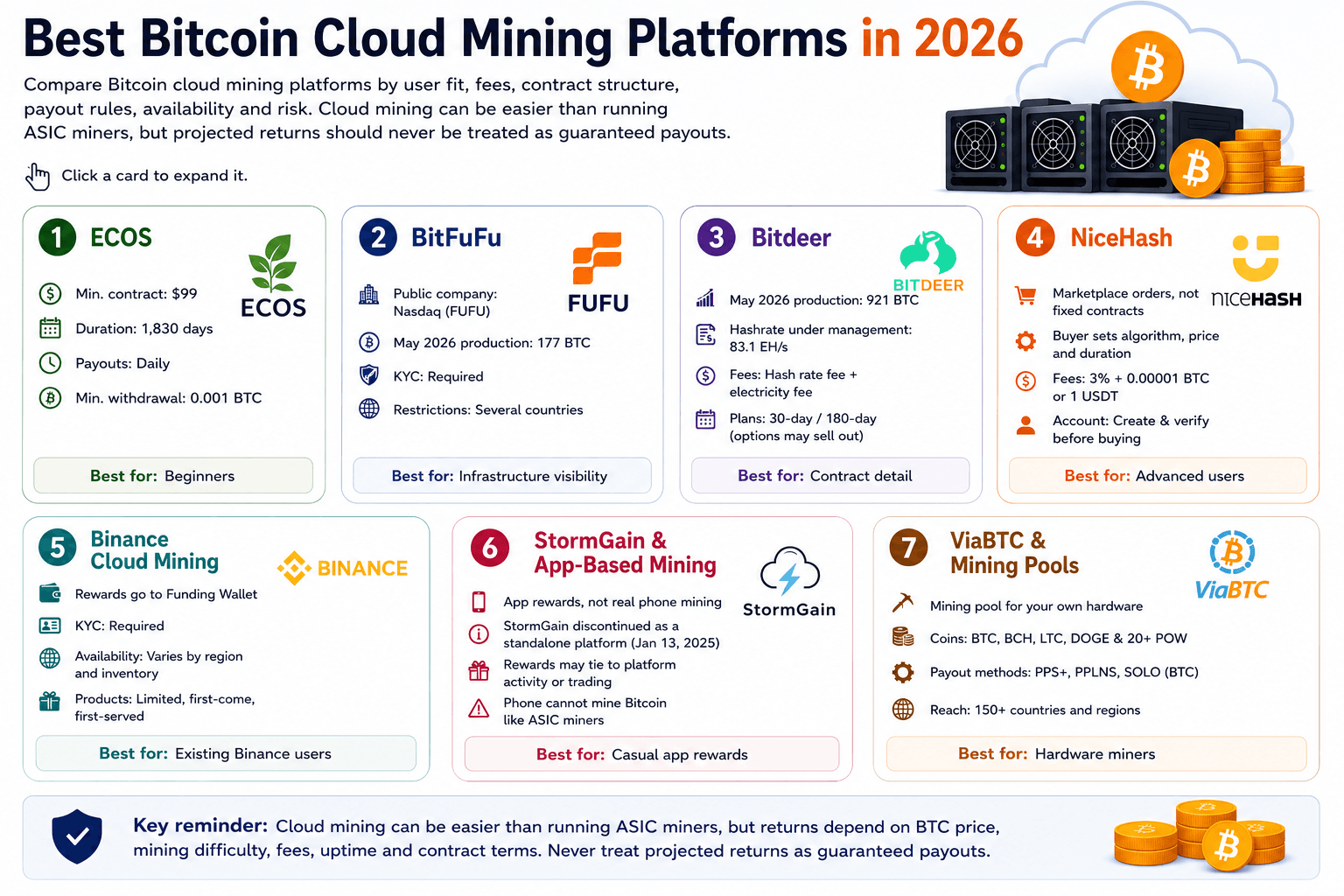 A Snapshot Of Leading Bitcoin Cloud Mining Options
Best Bitcoin Cloud Mining Platforms in 2026
Compare Bitcoin cloud mining platforms by user fit, fees, contract structure, payout rules, availability and risk. Cloud mining can be easier than running ASIC miners, but projected returns should never be treated as guaranteed payouts.
1
ECOS Review: Best for Beginner-Friendly Bitcoin Cloud Mining
Best for: Beginners · Focus: Bitcoin cloud mining contracts
⌄
ECOS Review: Best for Beginner-Friendly Bitcoin Cloud Mining
ECOS is a Bitcoin cloud mining platform that has operated since 2017. It offers cloud mining contracts, mining farm services for ASIC buyers and an all-in-one app for wallet, mining and market tools.
- Easy interface
- Bitcoin-focused contracts
- Daily mining credits
- Low technical barrier
- Limited multi-coin mining scope
- Service fee reduces BTC rewards
- Returns depend on contract assumptions
- Withdrawal rules need checking
2
BitFuFu Review: Best Overall for Bitcoin Cloud Mining Infrastructure
Best for: Infrastructure visibility · Focus: Cloud mining, rentals, hosting
⌄
BitFuFu Review: Best Overall for Bitcoin Cloud Mining Infrastructure
BitFuFu is a Bitcoin mining infrastructure company and cloud mining provider. It is publicly listed on Nasdaq under the ticker FUFU and offers cloud mining, miner rentals, miner sales and hosting solutions.
- Public company visibility
- Bitcoin mining infrastructure focus
- Multiple mining service options
- More transparent than many smaller cloud mining brands
- Returns depend on BTC price, uptime, fees and difficulty
- Contract terms must be checked before purchase
- Not risk-free despite stronger transparency
- Regional restrictions apply
3
Bitdeer Review: Best for Cloud Hashrate Plans and Mining Infrastructure Visibility
Best for: Contract detail · Focus: Cloud hashrate plans and mining infrastructure
⌄
Bitdeer Review: Best for Cloud Hashrate Plans and Mining Infrastructure Visibility
Bitdeer is a Bitcoin mining infrastructure company that offers cloud mining, hosting and self-mining services. It is headquartered in Singapore and says it has deployed data centers in countries including the United States, Norway, Bhutan and Ethiopia.
- Clear hash rate fee and electricity fee structure
- Visible mining infrastructure reporting
- Recent BTC production and hashrate updates
- Better fit for users who want contract detail
- Plans can sell out
- Returns still depend on BTC price and mining difficulty
- Electricity renewal rules need close reading
- Not a guaranteed set-and-forget product
4
NiceHash Review: Best for Advanced Users Buying Hashrate
Best for: Advanced hashrate buyers · Focus: Hashrate marketplace
⌄
NiceHash Review: Best for Advanced Users Buying Hashrate
NiceHash is a hashrate marketplace, not a standard cloud mining contract platform. It connects buyers who want hashing power with sellers who provide it from their own mining hardware.
- Flexible hashrate marketplace
- No fixed long-term contract like standard cloud mining
- Useful for advanced hashrate buyers
- Supports marketplace control over mining direction
- Not ideal for passive beginners
- Requires pool and order-pricing knowledge
- Profit can be harder to estimate
- User error can quickly reduce returns
5
Binance Cloud Mining Review: Best for Exchange-Linked Users, Where Available
Best for: Existing Binance users · Focus: Exchange-linked cloud mining
⌄
Binance Cloud Mining Review: Best for Exchange-Linked Users, Where Available
Binance Cloud Mining is an exchange-linked cloud mining product connected to Binance Pool. Binance says it lets users without mining equipment earn mining rewards by purchasing hashrates from Binance Cloud Mining products.
- Familiar Binance interface
- Integrated with Binance Pool
- Mining rewards go to Funding Wallet
- Easier onboarding for existing users
- Availability varies
- KYC required
- Not suitable for restricted regions
- Exchange custody and platform risk remain
6
StormGain and App-Based Cloud Mining: Best Treated as Rewards, Not Pure Mining
Best for: Casual app rewards · Focus: Reward-style mining apps
⌄
StormGain and App-Based Cloud Mining: Best Treated as Rewards, Not Pure Mining
StormGain is best treated as an app-based reward product, not a serious Bitcoin cloud mining platform. Its official site says the StormGain platform and related services were permanently discontinued, with operations migrated to a YouHodler-powered platform as of January 13, 2025.
- Low entry barrier
- Simple user experience
- No hardware
- Easy for casual users
- Often limited earning potential
- Withdrawal rules may be restrictive
- Not comparable with real ASIC-backed mining contracts
- May be tied to trading activity or app rules
7
ViaBTC and Mining Pools: Useful, But Not the Same as Beginner Cloud Mining
Best for: Hardware miners · Focus: Mining pools and payout methods
⌄
ViaBTC and Mining Pools: Useful, But Not the Same as Beginner Cloud Mining
ViaBTC is primarily a mining pool and mining-services ecosystem, not a beginner cloud mining contract platform. It supports BTC, BCH, LTC, DOGE and 20+ proof-of-work coins.
- Established mining pool ecosystem
- Useful for users who understand mining operations
- Multi-coin mining support
- Several payout-method options
- Not the simplest beginner cloud mining path
- Requires more mining knowledge
- Pool payouts and fees need close reading
- Users usually need their own mining hardware
What Is Bitcoin Cloud Mining?
Bitcoin cloud mining is a way to get exposure to Bitcoin mining without buying, installing or running your own ASIC miner.
Instead of setting up machines at home or paying for a personal mining farm setup, you pay a cloud mining provider for remote mining power. The provider runs the hardware, manages the infrastructure, pays for electricity, connects machines to a mining pool and distributes BTC payouts based on the agreement.
This makes cloud mining easier to start than direct Bitcoin mining, which requires a hefty capital investment.
The biggest beginner mistake is treating projected returns as guaranteed returns. Cloud mining estimates are usually based on assumptions about BTC price, mining difficulty, electricity fees, maintenance fees and pool performance. Actual returns can be lower if difficulty rises, Bitcoin price falls, fees increase, uptime drops or the provider changes its terms.
Read our primer on what Bitcoin mining is how it works.
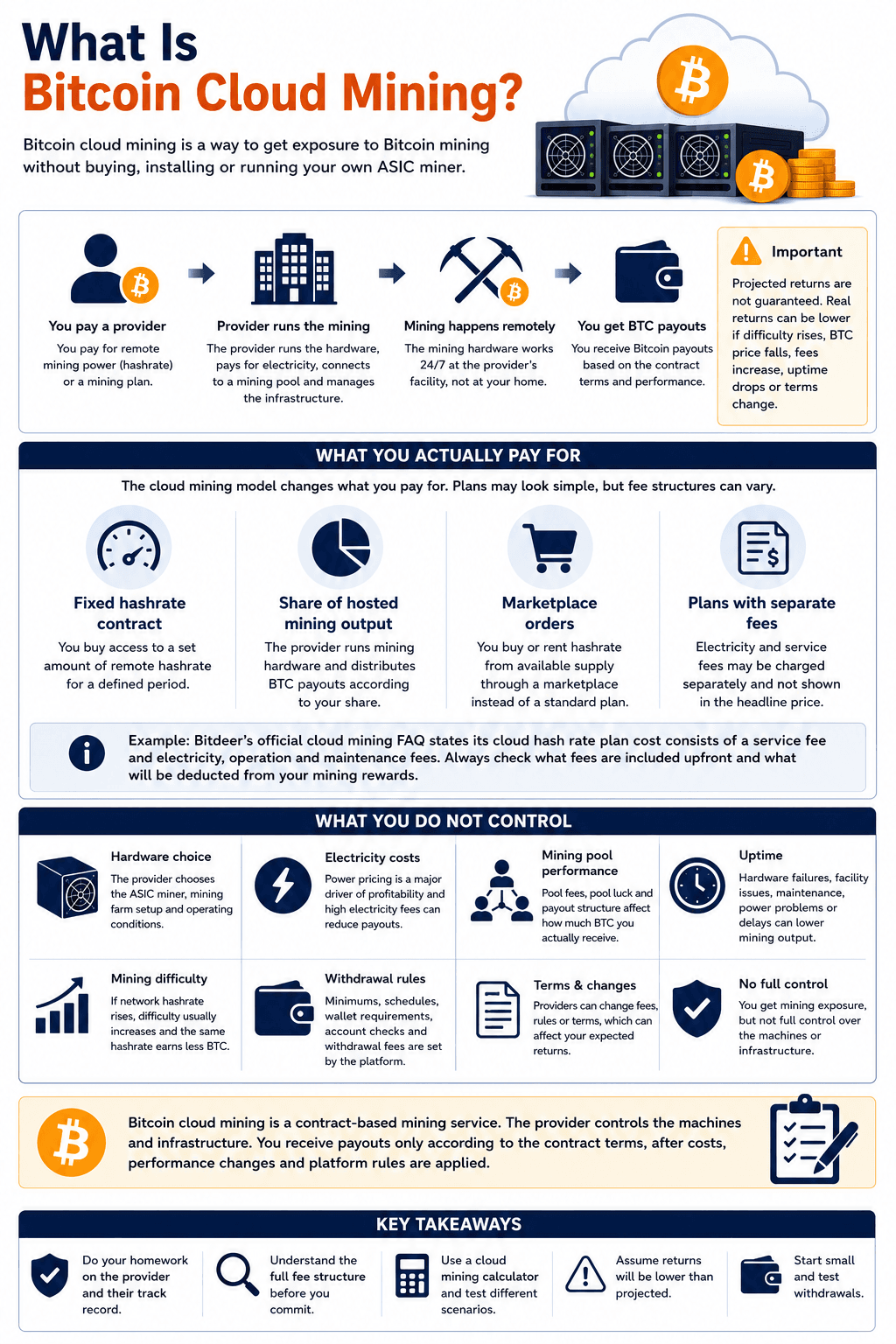 Cloud Mining Lets You Mine Bitcoin Without Running Your Own Hardware
What You Actually Pay For
What you pay for depends on the cloud mining model. A plan may look simple on the surface, but the fee structure can work in different ways.
Users may be paying for:
- A fixed hashrate contract, where they buy access to a set amount of remote hashrate for a defined period.
- A share of hosted mining output, where the provider runs mining hardware and distributes BTC payouts according to each user’s share.
- Access to a marketplace order, where users buy or rent hashrate from available supply rather than signing a standard plan directly with one provider.
- A mining plan with separate electricity and service fees, where the headline price does not show the full cost of mining.
Bitdeer's official cloud mining FAQ, for example, says its cloud hash rate plan cost consists of a service fee and electricity, operation and maintenance fees. That kind of structure is important to check because fees can reduce the final BTC payout.
Before choosing any cloud mining contract, users should check whether electricity fees, maintenance fees and service fees are included upfront or deducted from mining rewards later.
What You Do Not Control
Cloud mining gives users mining exposure, but it does not give them full control over the mining operation.
- You do not control the hardware choice. Unless the product is closer to hosted mining or miner rental, the provider chooses the ASIC miner, mining farm setup and operating conditions.
- You also do not control electricity costs. Power pricing is one of the biggest drivers of Bitcoin mining profitability, and higher electricity fees can quickly reduce payouts.
- Mining pool performance is also outside your control. Pool fees, pool luck and payout structure can affect how much BTC is distributed.
- Uptime depends on the provider. Hardware failures, facility issues, maintenance, power problems or operational delays can all reduce mining output.
- Mining difficulty is another major variable. When Bitcoin network hashrate rises, mining difficulty usually increases, which means the same amount of remote hashrate may earn less BTC over time.
- Withdrawal rules are set by the platform too. Minimum withdrawal amounts, payout schedules, wallet requirements, account checks and withdrawal fees can all affect when users actually receive their BTC.
So, Bitcoin cloud mining is best understood as a contract-based mining service. The provider controls the machines and infrastructure. The user receives payouts only according to the contract terms, after costs, performance changes and platform rules are applied.
Cloud Mining vs Hosted Mining vs Hashrate Marketplaces
Not every Bitcoin mining product works the same way. The main models are:
| Model | What it means | User owns hardware? | Complexity | Best for | Example |
|---|---|---|---|---|---|
| Cloud mining contract | Pay for remote mining output from a provider-run mining operation | Usually no | Low | Beginners who want mining exposure without managing machines | ECOS, BitFuFu |
| Hosted mining | Buy or rent machines that are hosted, powered and maintained by a provider | Sometimes yes | Medium | Serious miners who want more hardware-level exposure without running a facility | BitFuFu miner services |
| Hashrate marketplace | Buy hashing power from sellers and direct it to a mining pool | No | High | Advanced users who understand algorithms, pools, pricing and order settings | NiceHash |
| Mining pool | Connect your own mining hardware to combine hashrate and share block rewards | Yes | High | Hardware miners with ASICs | ViaBTC |
| App reward mining | App-based BTC rewards, simulated mining or trading-linked reward balances | No | Low | Casual users who understand this is not the same as ASIC Bitcoin mining | StormGain-style products |
- In a basic cloud mining contract, the provider runs the mining infrastructure and the user receives payouts based on the contract terms.
- In hosted mining, the user may have more exposure to specific machines, hosting costs and facility performance.
- In a hashrate marketplace, the user buys computing power and usually chooses where to point it.
- In a mining pool, the user already owns mining hardware and connects it to a shared reward system.
Why NiceHash Is Not Standard Cloud Mining
NiceHash is a hashrate marketplace, not standard Bitcoin cloud mining.
NiceHash connects sellers of hashing power with buyers who want to rent that power. That makes it different from a fixed cloud mining contract, where a user pays for a preset plan and receives payouts based on the provider's terms.
With NiceHash, the user is not simply buying a passive mining plan. They are buying hashing power from a marketplace and usually need to understand more variables, including SHA-256 hashrate, mining algorithms, pool selection, order pricing, order duration and profitability assumptions.
A beginner looking for a simple cloud mining contract may find NiceHash more complex than expected, while an advanced user may value the flexibility to direct rented hashrate toward specific pools or strategies.
Why Mobile "Mining" Needs Extra Caution
Mobile Bitcoin mining needs extra caution because phones do not realistically mine Bitcoin in the same way ASIC miners do.
Bitcoin mining is dominated by specialized ASIC machines built for SHA-256 hashing. A phone does not have the power, efficiency or cooling capacity to compete with industrial Bitcoin mining hardware. So when an app says users can “mine Bitcoin” from a phone, the product is often not pure Bitcoin mining in the traditional sense.
Many mobile mining products are better understood as app-based reward systems, promotional balances, simulated mining dashboards or trading-linked features. In these cases, the user may be earning a platform reward rather than directly mining Bitcoin with mobile hardware.
Platforms to Approach Carefully or Avoid
Approach carefully or avoid platforms that show these traits:
| Platform type | Why it is risky |
|---|---|
| Platforms with guaranteed profit claims | Bitcoin mining returns change with BTC price, mining difficulty, fees and uptime. Fixed daily profit promises are a major warning sign. |
| Platforms requiring extra payments before withdrawals | Demands for “tax,” “unlock,” “verification” or “release” payments before withdrawals are common fraud patterns. |
| Platforms with unclear company ownership | If users cannot verify the company, leadership, location or legal entity, accountability is weak. |
| Platforms with no verifiable mining operation | Real mining requires hardware, power, facilities, hashrate and pool activity. A dashboard alone is not proof. |
| Platforms with heavy referral-first marketing | If referral income is promoted more than mining output, the economics may depend more on new deposits than mining. |
| Legacy names with legal baggage | Older cloud mining brands with fraud cases, shutdowns or enforcement history should be treated as cautionary examples, not normal platform picks. |
If the platform cannot explain where the mining power comes from, what fees apply and how payouts are funded, do not treat the projected returns as credible.
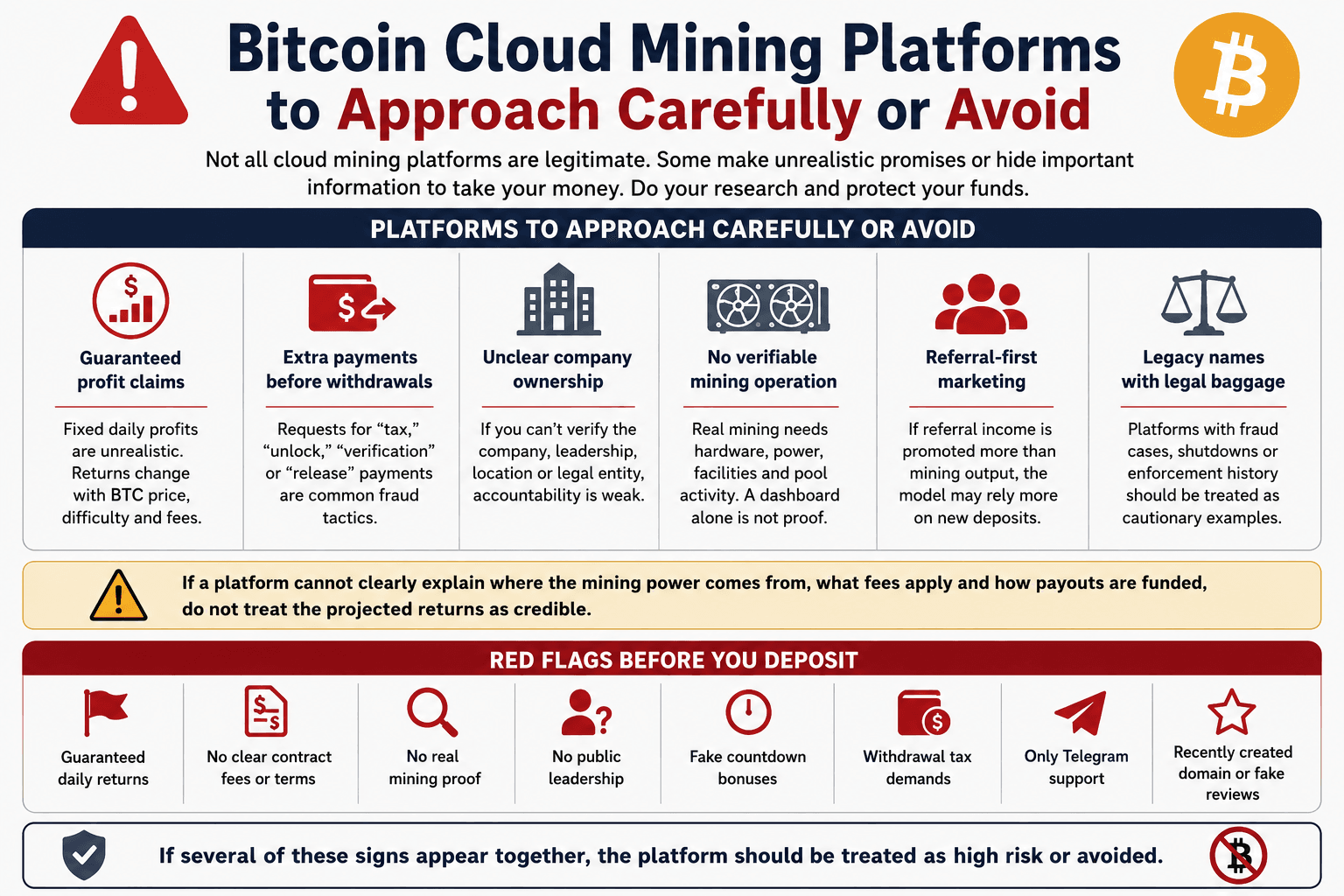 Warning Signs Before Choosing A Mining Platform
HashFlare as a Cloud Mining Warning
The FBI described HashFlare.io as a cryptocurrency cloud mining operation promoted by Ivan Turõgin and Sergei Potapenko through HashCoins OU, offering contracts for SHA-256, ETHASH, Scrypt, DASH and ZCASH mining.
The U.S. Department of Justice said victims paid more than $575 million to the defendants' companies. According to the indictment, HashFlare claimed to operate a large mining operation, but its equipment performed Bitcoin mining at less than 1% of the computing power it claimed to have. When investors tried to withdraw mining proceeds, the DOJ said the defendants could not pay with mined currency as promised and either resisted payments or used crypto bought on the open market.
In February 2025, the DOJ said Turõgin and Potapenko pleaded guilty to operating a $577 million cryptocurrency Ponzi scheme and agreed to forfeit assets valued at over $400 million.
The lesson is that cloud mining users need verifiable mining proof, clear fees, transparent ownership and realistic payout assumptions before depositing.
Red Flags Before You Deposit
Use this checklist before paying for any Bitcoin cloud mining contract:
| Red flag | Why it matters |
|---|---|
| Guaranteed daily returns | Real mining returns are variable, not guaranteed. |
| No contract fee detail | Users should see hashrate cost, electricity fee, maintenance fee and withdrawal terms. |
| No real mining proof | A dashboard, balance counter or animated miner is not evidence of hashrate. |
| No public leadership | Anonymous operators reduce accountability. |
| Fake countdown bonuses | Pressure tactics are often used to rush deposits. |
| Withdrawal tax demands | Extra payments before withdrawals are a major fraud warning. |
| Only Telegram support | Serious providers should have formal support channels and company documentation. |
| Reviews that all sound identical | Repetitive praise can indicate paid or fake review activity. |
| Recently created domain | A new domain with big profit claims deserves extra scrutiny. |
| Referral income promoted more than mining economics | Real mining platforms should lead with hashrate, costs, fees and payouts, not recruitment. |
Is Bitcoin Cloud Mining Profitable in 2026?
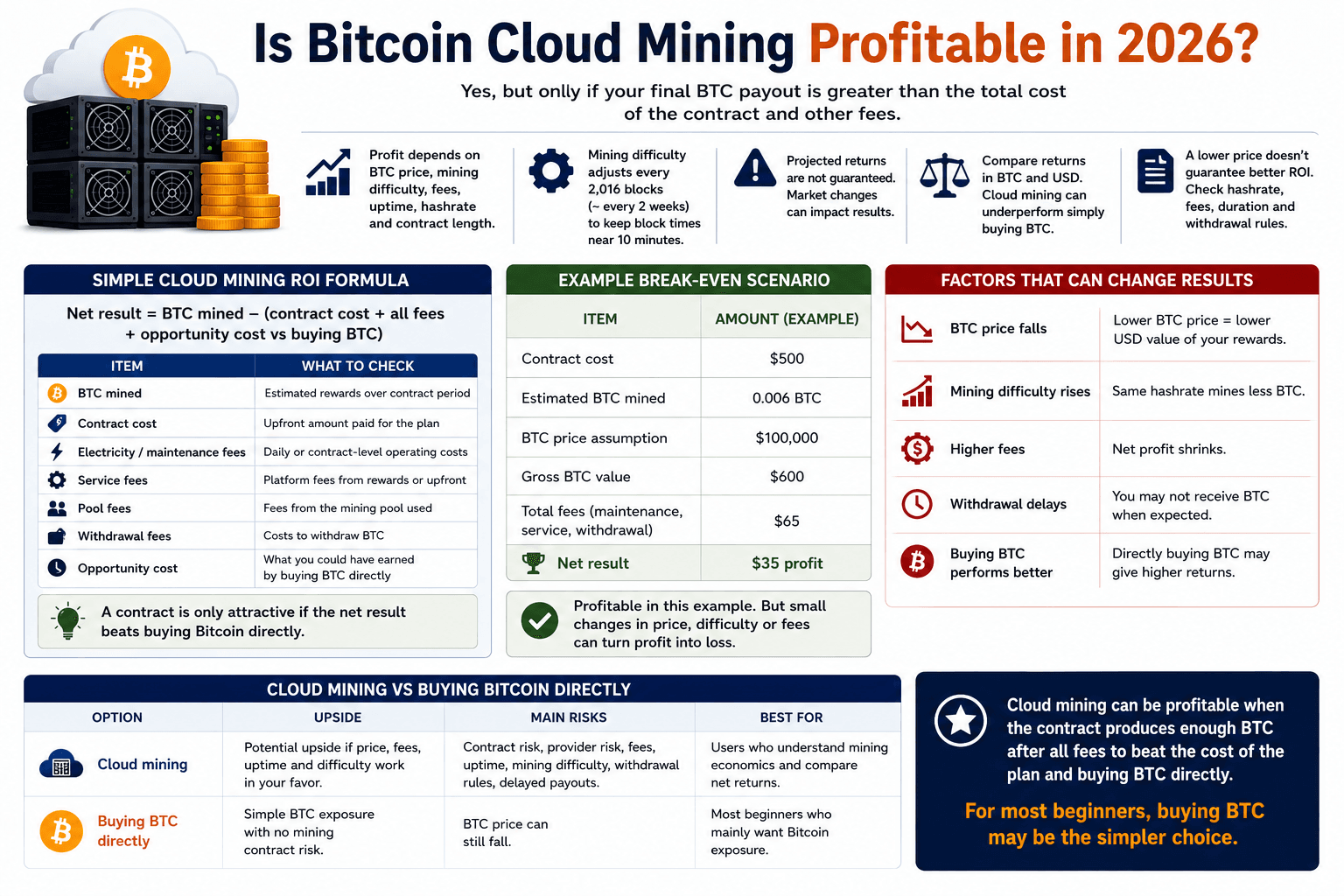
Bitcoin cloud mining can be profitable, but only when the final BTC payout is worth more than the full cost of the contract.
Profit depends on BTC price, mining difficulty, hashrate, hashprice, fees, uptime and contract length. Mining difficulty is especially important because when more hashrate competes on the Bitcoin network, the same amount of cloud hashrate can earn less BTC. Bitcoin difficulty adjusts every 2,016 blocks, roughly every two weeks, to keep block times near 10 minutes.
Projected returns are not guaranteed. A cloud mining calculator may show an estimated BTC payout, but the real result can change if BTC price falls, mining difficulty rises, uptime drops or fees reduce the payout.
Returns should be checked in both BTC terms and USD terms. A contract can mine some BTC but still underperform simply buying BTC if the fees are high or the Bitcoin price moves against the user.
A lower contract price also does not automatically mean better ROI. A cheap plan may have less hashrate, shorter duration, higher maintenance fees, stricter withdrawal rules or weaker net output.
Read: Can you Still Make Money Mining Bitcoin in 2026?
 Profit Depends On Fees, Difficulty And BTC Price
Simple Cloud Mining ROI Formula
Use this formula before buying any cloud mining contract:
Net result = BTC mined minus contract cost, electricity or maintenance fees, service fees, pool fees, withdrawal fees and opportunity cost versus buying BTC directly.
In simpler terms:
| Item | What to check |
|---|---|
| BTC mined | Estimated mining rewards over the contract period |
| Contract cost | Upfront amount paid for the mining plan |
| Electricity or maintenance fees | Daily or contract-level operating costs |
| Service fees | Platform charges deducted from rewards or paid upfront |
| Pool fees | Fees from the mining pool used by the provider |
| Withdrawal fees | Costs to move BTC out of the platform |
| Opportunity cost | What the user could have earned or held by buying BTC directly |
A cloud mining contract is only attractive if the net result beats the simpler alternative of buying Bitcoin directly.
Example Break-Even Scenario
Here is a simple educational example with imaginary numbers.
| Example item | Amount |
|---|---|
| Contract cost | $500 |
| Estimated BTC mined | 0.006 BTC |
| BTC price assumption | $100,000 |
| Gross BTC value | $600 |
| Maintenance and service fees | $60 |
| Withdrawal fee | $5 |
| Net result | $35 profit |
In this example, the contract looks profitable because the gross BTC value is $600 and total costs are $565.
But the result changes quickly:
| Scenario | What happens |
|---|---|
| BTC price falls 20% | The 0.006 BTC is now worth $480 instead of $600, turning the example into an $85 loss after costs |
| Mining difficulty rises | The contract may mine less than 0.006 BTC, reducing the final payout |
| Maintenance fees are higher | Net profit shrinks even if the BTC estimate is correct |
| Withdrawal rules delay access | The user may not receive BTC when expected |
| Buying BTC directly performs better | If $500 of BTC bought directly is worth more than the net mining payout, the mining contract underperformed |
This is why cloud mining ROI should be stress-tested before purchase. A plan that works only under perfect assumptions has very little room for error.
Cloud Mining vs Buying Bitcoin Directly
| Option | Upside | Main risks | Best for |
|---|---|---|---|
| Cloud mining | Potential mining upside if BTC price, fees, uptime and difficulty work in the user’s favor | Contract risk, provider risk, delayed payouts, fees, mining difficulty, withdrawal rules | Users who understand mining economics and can compare net returns |
| Buying BTC directly | Simple BTC exposure with no mining contract risk | BTC price can still fall | Most beginners who mainly want Bitcoin exposure |
Cloud mining can be profitable when the contract produces enough BTC after all fees to beat the cost of the plan and the alternative of buying BTC directly.
For most beginners, buying BTC may be simpler than trying to beat mining economics.
Read our guide on how to buy Bitcoin.
Free Bitcoin Cloud Mining: Real, Limited or Risky?
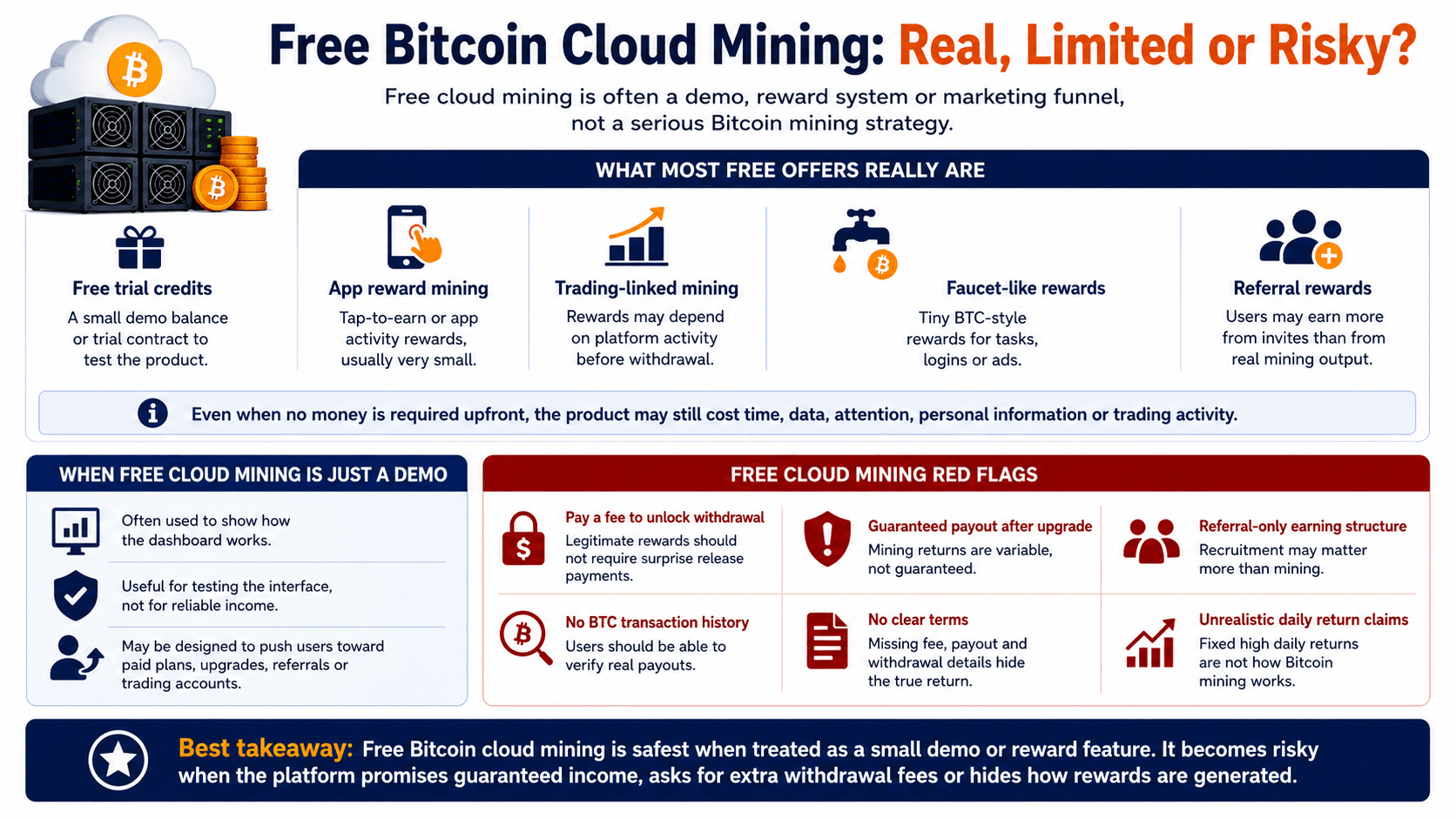
Free cloud mining is often a demo, reward system or marketing funnel, not a serious Bitcoin mining strategy.
Most free cloud mining offers fall into one of these buckets:
| Type | What it usually means |
|---|---|
| Free trial credits | A platform gives users a small demo balance or trial contract to test the product |
| App reward mining | Users tap a button or keep an app active to earn small BTC-style rewards |
| Trading-linked mining | Rewards may need to be used inside a trading platform before withdrawal |
| Faucet-like rewards | Users receive tiny Bitcoin rewards for activity, ads, logins or tasks |
| Referral rewards | Users earn more by inviting others than by actual mining output |
Even when no money is required upfront, the product may still cost users time, data, attention, personal information or trading activity. Some platforms also set withdrawal minimums so high that casual users may never reach them.
 Free Mining Offers Are Often Small Or Restrictive
When Free Cloud Mining Is Just a Demo
Free mining is often a promotional gateway.
A platform may offer a free trial contract, small app reward or simulated mining balance to show users how the dashboard works. That can be useful for testing the interface, but it should not be treated as reliable income.
In many cases, the free version exists to push users toward a paid mining contract, upgrade plan, referral program or trading account. That does not automatically make it a scam, but users should understand what they are actually getting.
Free Cloud Mining Red Flags
| Red flag | Why it is risky |
|---|---|
| Pay a fee to unlock withdrawal | Legitimate rewards should not require surprise “release” payments |
| Guaranteed payout after upgrade | Mining returns are variable, not guaranteed by upgrade tier |
| Referral-only earning structure | The product may depend more on user recruitment than mining |
| No BTC transaction history | Users should be able to verify whether real BTC payouts happen |
| No clear terms | Missing fee, payout and withdrawal details make returns impossible to judge |
| Unrealistic daily return claims | Fixed high daily returns are not how Bitcoin mining works |
Free Bitcoin cloud mining is safest when treated as a small demo or reward feature. It becomes risky when the platform promises guaranteed income, asks for extra withdrawal fees or hides how mining rewards are actually generated.
How to Choose a Bitcoin Cloud Mining Platform Safely
Choosing a Bitcoin cloud mining platform is mostly about risk control. The goal is not to find the loudest return claim. It is to find a provider with clear terms, visible operations, realistic projections and withdrawal rules that make sense.
- Verify the business model. Is the platform selling a cloud mining contract, hosted mining, rented hashrate, app rewards or access to a mining pool? These are not the same products.
- Check the company history. Look for the legal entity, leadership, operating history, mining facility information, public filings if available and third-party coverage. A platform with no clear company background should not be treated the same as a provider with visible infrastructure.
- Read the mining contract. Check the contract duration, hashrate, fee schedule, maintenance fee, electricity cost, payout method, withdrawal rules and what happens if mining becomes unprofitable.
- Check regional availability. Some cloud mining providers restrict users by country, account status or KYC rules.
- Fees need special attention. A contract can look profitable before fees and weak after them. Always calculate net returns after electricity fees, maintenance fees, service fees, pool fees and withdrawal fees.
- Test the platform with a small amount. If possible, withdraw BTC to your own wallet first. A dashboard balance is not the same as coins you control.
Use two-factor authentication, a strong password and a separate wallet for withdrawals. Do not put all funds into one platform, even if the provider looks legitimate.
The 10-Minute Due Diligence Checklist
| Check | What to look for |
|---|---|
| Product model | Cloud mining contract, hosted mining, hashrate marketplace, app reward or mining pool |
| Company identity | Legal entity, leadership, operating history and jurisdiction |
| Mining proof | Public mining facility details, hashrate data, pool links or production updates |
| Contract duration | How long the mining contract runs and whether it can end early |
| Fee schedule | Electricity fee, maintenance fee, service fee, pool fee and withdrawal fee |
| Payout rules | BTC payout frequency, minimum withdrawal and wallet support |
| Profit assumptions | BTC price, mining difficulty, uptime and projected hashrate |
| Regional access | Restricted countries, KYC rules and payment support |
| Withdrawal test | Whether a small BTC withdrawal works before larger deposits |
| Security setup | 2FA, account alerts and a safe external wallet |
If a platform fails several of these checks, skip it. Cloud mining already has enough moving parts without adding mystery operators and hidden fees to the machine room.
Questions to Ask Before Buying a Cloud Mining Contract
| Question | Why to ask it |
|---|---|
| What fees are charged? | To understand the real net BTC payout after service, maintenance, electricity, pool and withdrawal fees |
| What happens if mining becomes unprofitable? | Some contracts may keep charging fees, pause payouts or end under specific conditions |
| Can I withdraw BTC to my own wallet? | Real control starts when BTC reaches a wallet you control |
| What is the contract duration? | Longer contracts carry more BTC price and mining difficulty risk |
| Is there a maintenance fee? | Maintenance fees can reduce daily mining rewards |
| Is the provider public about its mining facilities? | Mining infrastructure visibility reduces, but does not remove, counterparty risk |
| What jurisdiction controls disputes? | Legal location affects user rights if something goes wrong |
| Is KYC required? | Verification can affect account access, withdrawals and regional eligibility |
| Are any countries restricted? | A product page may be visible even if users from some regions cannot legally use it |
| Are returns projected or guaranteed? | Real Bitcoin mining returns are variable, so guaranteed profit claims are a red flag |
The safest approach is to treat every Bitcoin cloud mining contract as a risk product. Check the provider, read the contract, calculate the fees, test withdrawals and only use money you can afford to lock up or lose.
Who Should Use Bitcoin Cloud Mining?
Bitcoin cloud mining is not a blanket recommendation. It may suit some users who want mining exposure without hardware, but it is a poor fit for anyone expecting guaranteed passive income.
Cloud Mining May Fit You If
| User fit | Why it fits |
|---|---|
| You understand returns are not guaranteed | BTC price, mining difficulty, uptime and fees can all change the final result |
| You want mining exposure without hardware | You do not need to buy ASIC miners, manage heat, noise or electricity |
| You can read contracts carefully | Contract duration, maintenance fees, payout rules and withdrawal limits are central to returns |
| You are comfortable with platform risk | You rely on the provider to operate miners and process payouts |
| You start small | A small deposit lets you test the platform before committing more funds |
Cloud mining is easier than running ASIC miners, but it still requires basic due diligence. Beginners should treat it as a risk product, not a guaranteed income stream.

Final Verdict: The Safest Way to Compare Bitcoin Cloud Mining Platforms
The safest way to compare Bitcoin cloud mining platforms is to choose by model first and platform second.
A simple cloud mining contract, hosted mining setup, hashrate marketplace, mining pool and app-based reward product are not the same thing. Each one has different fees, control levels, payout rules and risks.
The main takeaway is simple:
| Rule | Why it helps |
|---|---|
| Choose by product model first | It prevents users from comparing cloud contracts, pools and app rewards as if they were identical |
| Transparent fees beat high advertised returns | Clear electricity, maintenance, service and withdrawal fees are more useful than big ROI claims |
| ROI must include all costs | Mining difficulty, BTC price, uptime, contract length and fees can change the final result |
| Free cloud mining is usually limited | Many free products are demos, app rewards, faucet-style balances or marketing funnels |
| Compare cloud mining against buying BTC directly | Beginners may get simpler Bitcoin exposure by buying BTC instead of trying to beat mining economics |
| Avoid guaranteed return claims | Real Bitcoin mining payouts are variable, so guaranteed profit promises are a major red flag |
Bitcoin cloud mining can make sense for users who understand mining contracts, platform risk and BTC volatility. It should not be treated as guaranteed passive income.
- Beginners should only consider simple, transparent cloud mining contracts after checking fees, payout rules, withdrawal limits and regional availability.
- Advanced users may prefer hashrate marketplaces, but only if they understand mining pools, order pricing, algorithms, pool fees and profitability calculations.
- Risk-averse users may be better off buying Bitcoin directly. Buying BTC still carries price risk, but it avoids mining contract risk, provider risk and withdrawal uncertainty.
- Everyone should start small, test withdrawals and avoid putting all funds into one platform.
The best Bitcoin cloud mining platform is not the one with the biggest advertised return. It is the one with the clearest business model, verifiable mining activity, transparent fees, realistic ROI assumptions and withdrawal rules users can actually live with.