Binance and Bitget are both major crypto exchanges, but they serve different types of traders.
This Binance vs Bitget comparison breaks down fees, liquidity, markets, copy trading, security, user experience, and regional restrictions so you can decide which exchange fits your trading style.
Quick Verdict: Binance or Bitget?
Binance is best overall, while Bitget is best for copy trading.
The best choice depends on how you trade. Binance wins if you want a full-service crypto exchange with stronger liquidity, deeper spot markets, heavier futures activity, and more products under one roof. Bitget wins if you are mainly looking for a copy trading platform built around elite traders, futures copy trading, spot copy trading, bots, ROI tracking, and drawdown data.
Who Should Choose Which?
Choose Binance if you want:
- The stronger overall crypto exchange for most users
- Deeper liquidity and better market depth on major assets
- Higher spot and derivatives trading volume
- A broader product range across spot, futures, bots, earn products and education
- A better fit for high-volume traders and users who care about execution quality
Choose Bitget if you want:
- A stronger copy trading platform
- Futures copy trading and spot copy trading tools
- Elite trader rankings, ROI data and maximum drawdown metrics
- A more guided trading experience for beginner traders who do not want to build every strategy themselves
- Trading bots, copy trading settings and smaller test allocations for automated strategies
Binance vs Bitget Winner by Category
| Category | Winner | Why It Matters |
|---|---|---|
| Overall exchange | Binance | Binance has the stronger overall score because it combines liquidity, trading volume, product range and market depth. |
| Spot trading depth | Binance | Binance is better for users who trade major coins often or need stronger order book depth. |
| Futures liquidity | Binance | Binance has deeper futures activity, which helps active derivatives traders and high-volume traders. |
| Copy trading | Bitget | Bitget is more focused on elite traders, trader rankings, ROI, win rate and drawdown data. |
| Futures copy trading | Bitget | Bitget is the better fit if futures copy trading is the main reason you are signing up. |
| Trading bots | Tie | Both platforms offer trading bots, but Binance is more strategy-control focused while Bitget is stronger for copy-led automation. |
| Beginner education | Tie | Binance has stronger educational depth, while Bitget makes copy trading and trading tools easier to find. |
| Product range | Binance | Binance offers a wider set of exchange products, including spot, futures, bots, earn products, payments, academy and research. |
| Security transparency | Tie | Both exchanges publish proof-of-reserves information and maintain user protection funds, but users still carry centralized exchange risk. |
Data should be checked against live exchange pages before depositing funds, as fees, reserves, volume, restrictions and supported products can change.
Disclosure
Some links in this guide may be affiliate links. If you choose to use a service through these links, we may earn a commission at no additional cost to you.
Disclaimer
This guide is educational only and is not financial advice. The comparison below is based on platform features, public fee schedules, exchange documentation, market data, proof-of-reserves pages, and third-party exchange data.
How This Binance vs Bitget Comparison Was Built (Methodology)
This comparison checks the areas that matter before you deposit funds
- Trading fees
- Spot and futures markets
- Liquidity and market depth
- Copy trading tools
- Trading bots
- Proof of reserves
- User protection funds
- Known security incidents
- Regional restrictions
- Beginner fit
- Long-term trust signals
For market data, we used CoinGecko exchange pages for live exchange reserves, spot volume, coins, and trading pairs. CoinGecko also provides separate futures exchange data for Binance Futures. These figures change daily, so they should be treated as a dated snapshot rather than permanent numbers.
For exchange security and reserve claims, we used official Binance and Bitget pages. Binance Proof of Reserves shows user balances are backed 1:1, plus reserves. Bitget's April 2026 Proof of Reserves update reported a total reserve ratio of 130%.
For copy trading, we used Bitget’s support and academy pages. Bitget explains how ROI is calculated for copy trading and also explains how maximum drawdown is calculated for elite traders.
Binance vs Bitget at a Glance
| Metric | Binance | Bitget |
|---|---|---|
| Founded | 2017 | 2018 |
| Main strength | Overall exchange depth | Copy trading and derivatives-focused tools |
| Current leadership | Richard Teng and Yi He as co-CEOs | Gracy Chen as CEO |
| Listed coins on CoinGecko | 432 | 592 |
| Listed trading pairs on CoinGecko | 1,401 | 673 |
| 24h spot volume on CoinGecko | About $8.89B | About $1.13B |
| Exchange reserves on CoinGecko | About $160.73B | About $5.99B |
| Futures strength | Very strong | Strong, with copy trading focus |
| Copy trading | Available in some forms, but not the main strength | Core feature |
| Protection fund | SAFU | Bitget Protection Fund |
| Proof of reserves | Yes | Yes |
| Native token | BNB | BGB |
What Is Binance?
Binance is the largest crypto exchange in the world by trading activity, according to CoinGecko. It supports spot trading, futures trading, margin products, trading bots, earn products, education, payments, research and institutional tools.
Its biggest strength is liquidity. For regular users, this means tighter spreads, more active order books, and better execution on major assets. For larger traders, it can mean less slippage when entering or exiting positions.
Binance suits users who want one main exchange for:
- Spot trading
- Futures trading
- Trading bots
- Earn products
- Large-cap crypto markets
- High-volume trading
- API access
- Education through Binance Academy
Binance also has clear risks. It has faced major regulatory pressure across several regions. Users must check whether Binance.com, Binance.US, or another local Binance entity serves their country. Binance's own support-region page notes that Binance services vary by supported country and region.
Read our full Binance review.
Also Read
- How to Sign Up on Binance: A Step-by-Step Guide
- Binance App Review: Mobile Trading on the Go
- Is Binance Safe?
- BNB Review
- Binance NFT Marketplace Review
- Top Binance Alternatives
- How to Buy Bitcoin on Binance
- A Guide to Trading on Binance
- Binance Earn Review
- Binance Wallet Review
- Binance Sharia Earn
What Is Bitget?
Bitget is a centralized crypto exchange with a stronger focus on copy trading, futures trading, and automated trading tools.
Its main appeal is simple: you can follow elite traders and automatically copy their trades. This gives Bitget a different user profile from Binance. Many Bitget users are not only looking for a place to buy BTC or ETH. They are looking for trader rankings, ROI data, copy trading settings, bots, and ways to automate parts of their trading.
Bitget is not a shortcut to guaranteed income. The platform can show trader performance metrics, but users still carry the trading risk. A copied trader can lose money. A strategy can fail. A high win rate can still hide poor risk control.
Read our full Bitget review.
Also read:
- Bitget Copy Trading Review
- Bitget Wallet Review
- Bitget Trading Guide
- Is Bitget Safe?
- How To Sign Up on Bitget
- What is Bitget Stock Futures
Binance vs Bitget Fees: Which Is Cheaper?
For most small spot traders, Binance and Bitget are both low-cost exchanges.
 A Look at Binance and Bitget's Fees
Spot Trading Fees
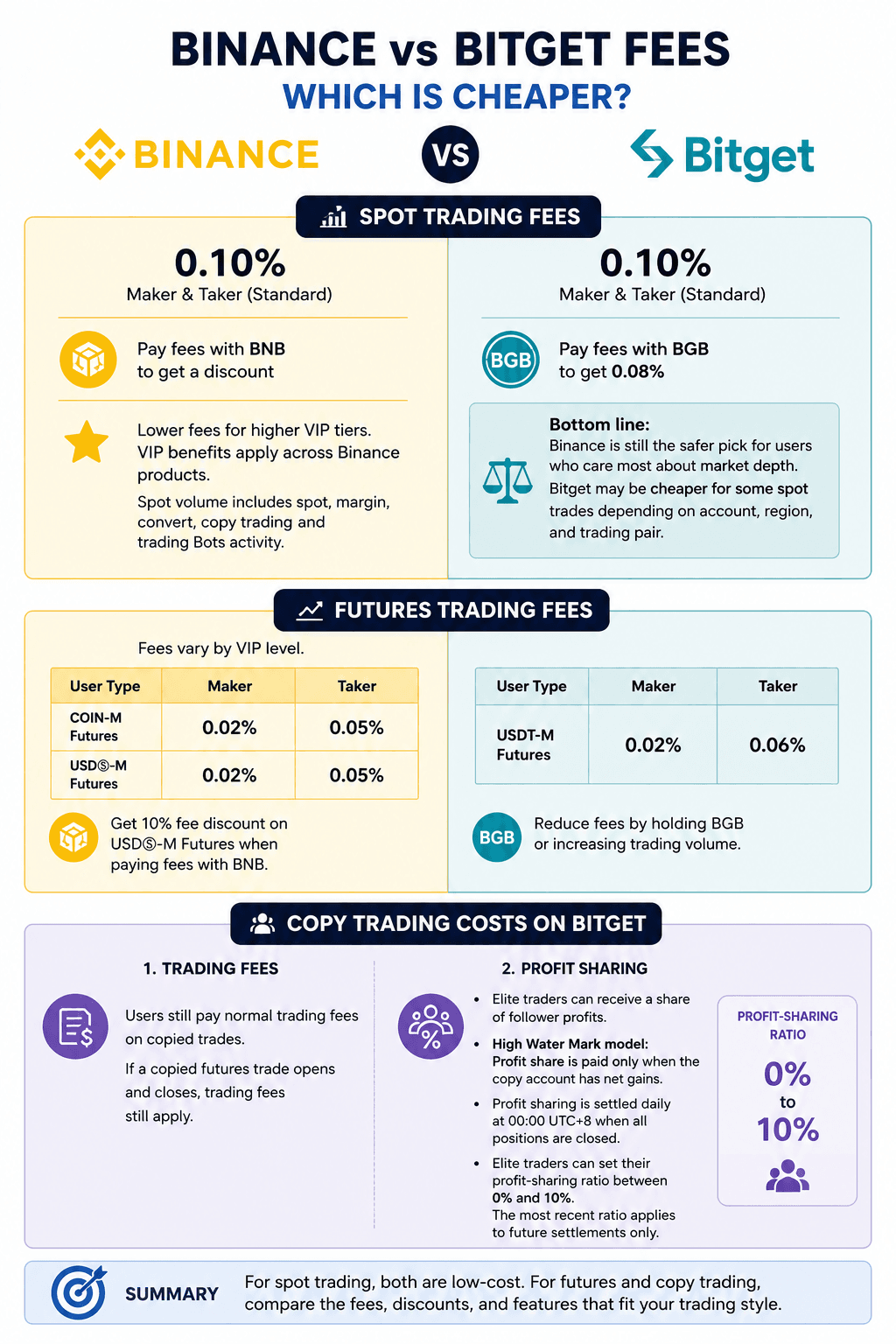
Binance lists a standard spot trading fee of 0.10% for regular users. Users can reduce this by using BNB to pay trading fees, and Binance applies lower rates for higher VIP tiers. Binance’s fee page also states that VIP benefits apply across Binance products, and that spot trading volume includes spot, margin, convert, copy trading and trading Bots activity.
Bitget also lists spot maker and taker fees at 0.10%, reduced to 0.08% when users pay fees with BGB.
Binance is still the safer pick for users who care most about market depth. Bitget may be cheaper for some spot trades if the lower published rate applies to the user’s account, region, and trading pair.
Futures Trading Fees
Futures fees are more important for Bitget users because Bitget’s strongest use case is copy trading and futures copy trading.
Binance says futures maker and taker fees vary by VIP level. Its futures fee support page gives regular-user examples of 0.02% maker and 0.05% taker fees for both COIN-Margined and USDS-Margined futures. Binance also says users can receive a 10% fee discount on USDⓈ-M Futures when they use BNB to pay trading fees.
Bitget's fee guide lists futures maker fees at 0.02% and taker fees at 0.06%. Users can reduce fees by holding BGB or increasing trading volume.
For futures trading, compare these costs before choosing an exchange:
Copy Trading Costs on Bitget
Bitget copy trading has two cost layers.
- Users still pay normal trading fees on copied trades. If a copied futures trade opens and closes, trading fees still apply.
- Elite traders can receive a share of follower profits.
Bitget’s futures copy trading guide says Bitget uses a High Water Mark model. Elite traders receive profit share only when the copy account has net gains. Bitget also says profit sharing is settled daily at 00:00 UTC+8 when all positions are closed.
Bitget’s elite trader guide says futures elite traders can set their profit-sharing ratio between 0% and 10%. The most recent ratio applies to future settlements only.
Example: Bitget copy trading profit share
| Scenario | Amount |
|---|---|
| Copied trader generates profit | $100 |
| Profit-sharing ratio | 10% |
| Amount paid to elite trader | $10 |
| Follower keeps before other costs | $90 |
The key point is simple: profit sharing only applies when the copied account makes new eligible profit. If the copied trader loses money, the follower carries the loss. The elite trader does not absorb that loss for the follower.
Withdrawal Fees and Hidden Costs
Withdrawal fees vary by asset and network. This means the cheapest exchange for trading is not always the cheapest exchange for moving funds.
For example, withdrawing USDT on one network can cost more than withdrawing USDT on another network. Users should check the live withdrawal page before moving funds because network fees can change.
The main hidden costs are:
| Cost | What It Means |
|---|---|
| Withdrawal fee | Fee charged when moving crypto off the exchange |
| Network fee | Blockchain cost tied to the selected network |
| Spread | Difference between buy and sell prices |
| Slippage | Difference between expected price and executed price |
| Funding fee | Variable payment on perpetual futures |
| Conversion spread | Cost built into instant swaps or conversions |
| Liquidation loss | Loss from forced futures position closure |
| Copy trading profit share | Share of copied profits paid to elite traders |
| Overtrading | More trades mean more fees and more execution risk |
Liquidity, Trading Volume and Market Depth
Liquidity affects the real cost of every trade because it decides how easily you can buy or sell without moving the price against yourself.
This is where Binance has a clear edge. CoinGecko lists Binance with about $8.96 billion in 24-hour spot volume, 1,401 trading pairs and about $160.73 billion in exchange reserves. Bitget is also active, but smaller on spot markets. CoinGecko lists Bitget with about $1.17 billion in 24-hour spot volume, 673 trading pairs and about $5.99 billion in exchange reserves.
The futures gap is also clear. CoinGecko lists Binance Futures with about $50.29 billion in 24-hour derivatives volume and about $26.27 billion in open interest. Bitget Futures has about $7.99 billion in 24-hour derivatives volume and about $7.85 billion in open interest. Bitget is still strong in derivatives, but Binance has deeper overall futures activity.
For small retail trades, this difference may not matter much. A $200 or $1,000 BTC or ETH trade will usually execute smoothly on both platforms. The gap becomes more important when you trade larger amounts, use futures, enter smaller altcoin pairs, or need fast execution during volatile markets.
All told, Binance is better if you care about liquidity, market depth, and large order execution. Bitget has enough depth for many retail users, especially those focused on copy trading or futures copy trading. But if execution quality is the main priority, Binance usually has the stronger order book.
Available Markets: Spot, Futures, Margin and Earn Products
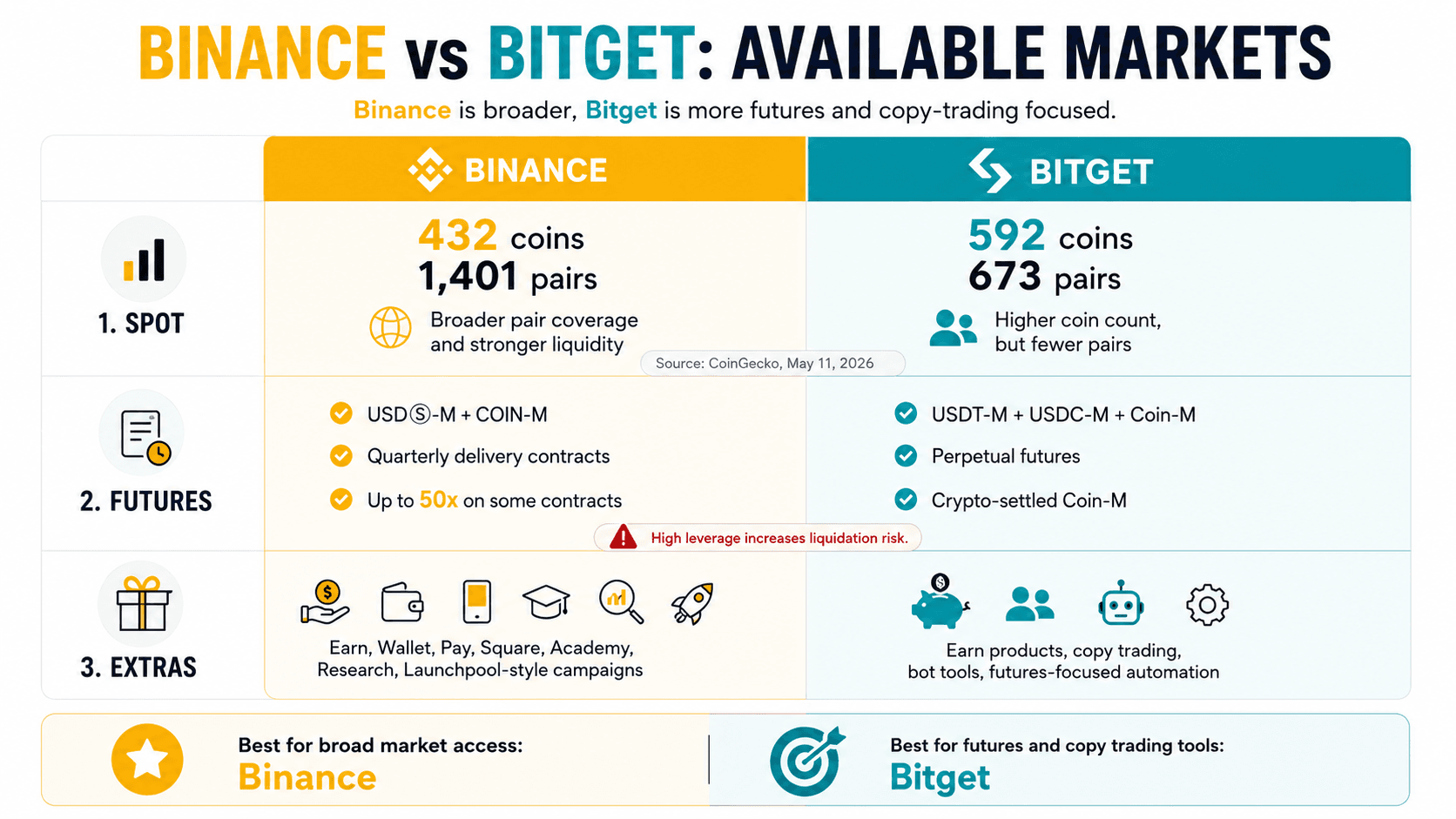
Binance is stronger if you want broad market depth across spot, futures, margin and exchange products. Bitget is stronger if you care more about futures, copy trading and automated trading tools.
 How Binance and Bitget Stack Up From a Markets' Depth Perspective
Spot Markets
Both Binance and Bitget support major crypto assets such as BTC, ETH, USDT and USDC. Binance also has BNB, while Bitget has BGB.
CoinGecko lists Binance with 432 coins and 1,401 trading pairs, as of May 11, 2026. It lists Bitget with 592 coins and 673 trading pairs at the same date. These numbers change often.
Bitget may show a larger coin count, but Binance has broader pair coverage and stronger liquidity. That's an important factor if you trade often, use limit orders, or move in and out of altcoins during volatile periods.
For broad spot access, Binance has the edge because it combines large pair coverage with deeper liquidity. Bitget is still useful if the asset you want is listed there and you also want copy trading or bot tools on the same platform.
Futures and Derivatives
Binance supports USDS-Margined futures and COIN-Margined futures. Binance also lists quarterly delivery contracts for assets such as BTC, ETH, BNB, XRP and SOL in both USDS-M and COIN-M formats, with some contracts offering up to 50x max leverage.
Bitget supports USDT-M Futures, USDC-M Futures and Coin-M Futures. Bitget explains that USDT-M and USDC-M perpetual futures are settled in stablecoins and have no expiry date. It also explains that Coin-M Futures are settled in crypto assets such as BTC or ETH.
High leverage should not be treated as a benefit for beginners. It increases liquidation risk. A 20x trade only needs a small price move against the position to cause serious losses. This is why futures copy trading can be risky even when the copied trader has a strong ROI history.
Earn, Launchpool and Passive Products
Binance has the broader set of exchange products. It offers exchange, Binance Wallet, Binance Earn, Binance Pay, Binance Square, Binance Academy and Binance Research. Binance also has Launchpool-style products that let users access new token campaigns through eligible holdings or staking activity.
Bitget also offers earn products, including savings-style products and staking options. Its stronger point of difference is still copy trading and futures-focused automation. Do not treat earn products and copy trading as the same thing.
Earn products usually depend on asset terms, platform terms and yield conditions. Copy trading depends on trader behavior, market direction, leverage, fees and drawdown. A copy trading profile with high past returns can still lose money quickly.
Binance Automation vs Bitget Copy Trading
Binance and Bitget both support automated trading, but they approach it differently.
Binance is more tool-based. You choose a bot, set the rules, and manage the strategy. Bitget is more trader-following-based. You choose an elite trader or copy trading strategy, then mirror their trades based on your settings.
This is the main difference: Binance gives you more control. Bitget gives you a more guided copy trading experience.
Binance Trading Bots and Auto-Invest
Binance offers several automation tools, including Spot Grid, Futures Grid and Arbitrage Bot.
- Spot Grid is a bot that aims to buy low and sell high within a price range.
- Futures Grid is a tool for automating long and short futures strategies.
Binance also supports DCA-style tools. Binance Convert “Recurring” also lets users automate purchases on hourly, daily, weekly, bi-weekly or monthly schedules.
Common Binance automation tools include:
| Tool | What It Does | Best For |
|---|---|---|
| Spot Grid | Buys and sells inside a set price range | Range-bound spot markets |
| Futures Grid | Automates long and short futures trades | Experienced futures traders |
| DCA Bot | Builds or exits a position over time | Users who want staged entries |
| Recurring Buy | Buys crypto on a fixed schedule | Long-term accumulation |
| Arbitrage Bot | Targets funding-fee opportunities | Advanced users |
Binance bots give you more control, but they also give you more responsibility. You must understand the settings, price range, asset pair, risk limits and market conditions. A bot can follow rules, but it cannot fix a bad strategy.
Bitget Copy Trading vs Binance Bots
Bitget copy trading is different. Futures copy trading lets users automatically replicate the trades of experienced futures traders. When you copy a trader, their positions can be mirrored in your account. Bitget also offers spot copy trading and bot copy trading.
Bitget’s model is easier to understand at the start. You select an elite trader, check metrics such as ROI and maximum drawdown, set your copy amount, then monitor performance. That does not remove risk. It only shifts part of the decision from building a strategy to choosing a trader.
| Feature | Bitget Copy Trading | Binance Bots |
|---|---|---|
| Main idea | Follow elite traders | Automate a strategy |
| Skill needed | Lower upfront, but risk knowledge is still needed | Higher strategy understanding |
| Control | Medium | Higher |
| Main risk source | Trader behavior, leverage and drawdown | Bot settings and market conditions |
| Best for | Users who want guided trading | Users who want strategy automation |
| Good fit for beginners | Easier to start, still risky | Harder to set up safely |
| Key metrics to check | ROI, win rate, drawdown, open positions | Price range, volatility, fees, funding rates |
Choose Bitget if you want to copy elite traders instead of building every strategy yourself.
Choose Binance if you want to control the rules, settings and execution logic.
Security, Proof of Reserves and User Protection
Both platforms offer account protection tools, proof-of-reserves pages and user protection funds. Still, no centralized exchange removes custody risk completely.
The practical rule is simple. Use exchange security tools, keep long-term holdings in self-custody when possible, and avoid keeping more money on any exchange than you need for trading.
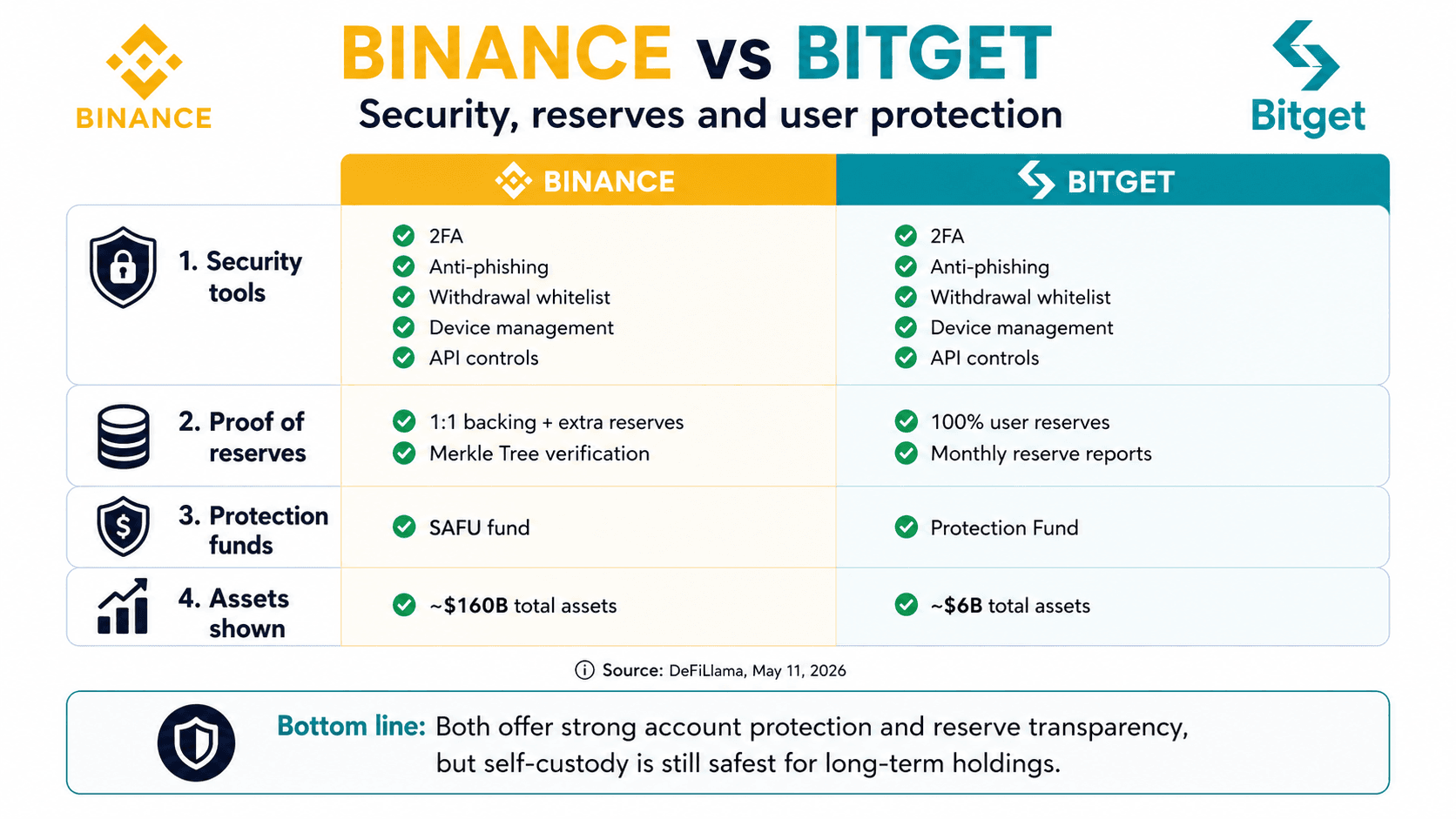 How Binance and Bitget Protect User Funds
Security Features
Binance offers standard account security tools such as two-factor authentication, anti-phishing codes, withdrawal address whitelisting and device-level account controls. Binance Academy says anti-phishing codes appear in official Binance communications once enabled. It also says withdrawal address whitelisting blocks withdrawals to addresses that are not already approved, with a 24 to 48 hour waiting period when adding a new address.
Bitget also offers account-level security tools such as two-factor authentication, withdrawal controls and account safety practices. Users should enable these before depositing funds, especially if they plan to trade futures or use copy trading.
| Security Tool | Binance | Bitget | Why It Matters |
|---|---|---|---|
| Two-factor authentication | Yes | Yes | Adds a second login and approval layer |
| Anti-phishing code | Yes | Yes | Helps identify fake emails and messages |
| Withdrawal whitelist | Yes | Yes | Limits where funds can be withdrawn |
| Device management | Yes | Yes | Helps spot unknown login devices |
| API controls | Yes | Yes | Important for bots and automated trading |
| Risk controls | Yes | Yes | Helps reduce account-level attack risk |
Proof of Reserves and Platform Assets
Proof of reserves helps users check whether an exchange claims to hold enough assets to cover user balances.
Binance says its Proof of Reserves shows that all Binance user assets are backed 1:1, plus additional reserves. Binance uses a Merkle Tree so users can verify that their assets are included in the aggregate account balance check.
Bitget says it holds 100% of user assets in reserves and publishes its Merkle tree proof, platform reserves and reserve ratio monthly.
As of May 11, 2026, DeFiLlama’s CEX transparency data listed Binance with about $160 billion in total assets and Bitget with about $6 billion in total assets. These figures change as deposits, withdrawals and asset prices move.
Protection Funds and Past Incidents
Binance has a user protection fund called SAFU. Binance says its Proof of Reserves page includes the SAFU fund as an emergency fund for extreme cases such as hacks or security breaches.
Binance also has a major security incident in its history. On May 7, 2019, Binance reported that hackers withdrew 7,000 BTC from its BTC hot wallet. Binance said the affected hot wallet held about 2% of its total BTC holdings, and that all other wallets were secure. Binance also said it would use SAFU to cover the incident in full, with no user funds affected.
Bitget has its own Protection Fund. In its April 2026 Protection Fund Valuation Report, Bitget said the fund reached a high of $511 million on April 26, 2026, a low of $434 million on April 2, 2026, and an average monthly value of $479 million. Bitget also said the fund launched in 2022 with an initial size of $300 million and that it aims to keep the valuation above $300 million.
Regulation and Geographic Availability
Binance and Bitget do not serve every country in the same way, and some products may be restricted even when the exchange itself is available.
The most important point for US users is that Binance.com and Binance.US are separate platforms. Binance.US says it supports most US states, but some states and territories remain unsupported or restricted. Binance.US keeps a current support page for state-level availability.
Bitget is more direct in its restrictions. Its Terms of Use list prohibited countries and regions, including the United States, Canada, France, Germany, Hong Kong, Singapore and several sanctioned or restricted regions. Bitget also says the list may change over time, so users should check the live Terms of Use before opening an account.
User Experience: Which Platform Is Easier to Use?
Binance and Bitget both have desktop and mobile platforms, but they feel different.
Binance has more products, more menus and more tools. That helps experienced users, but it can feel busy for beginners. Bitget is more focused on trading, futures, bots and copy trading. That makes its core use case easier to find, especially if you came for copy trading.
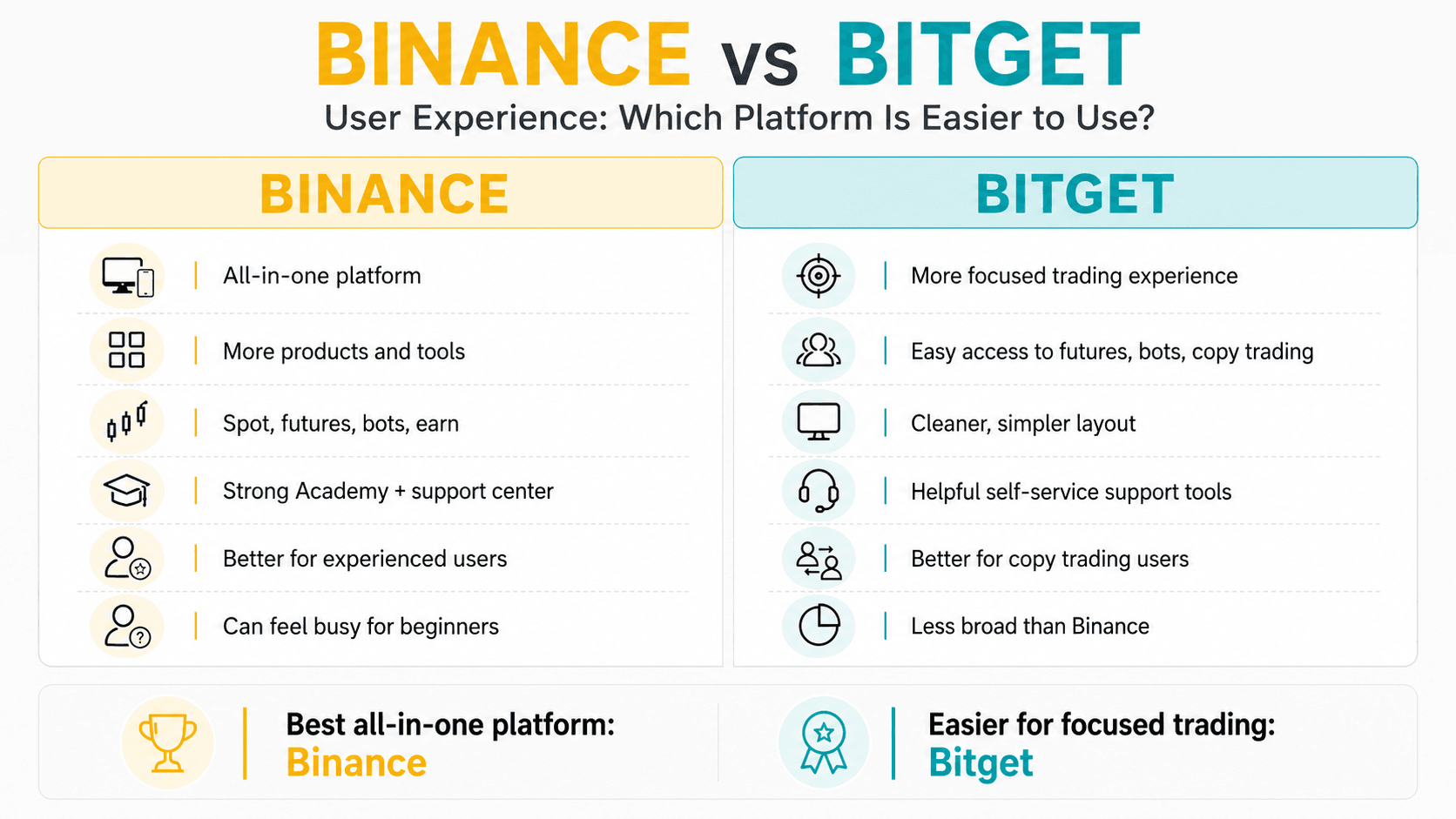 An Overview of Binance and Bitget's User Experience
Desktop and Mobile Experience
Binance works better if you want one platform for many tasks. You can trade spot, trade futures, use bots, access earn products, read Binance Academy, manage account settings and use the support center from the same broader platform. Binance also has a dedicated app and support pages for app users. Its support guide says app users can tap the support icon from the Binance app homepage.
The downside is that Binance can feel crowded. New users may need time to learn the dashboard, order forms, futures interface, wallet sections and earn products.
Bitget feels more focused. Its app download page presents the platform as a crypto trading app for iOS, Android, Google Play and Huawei App Gallery, with live market data, order execution and security features.
Customer Support and Learning Resources
Binance has stronger educational coverage. Binance Academy offers free crypto, blockchain and Web3 tutorials, videos and courses. Binance also has a large support center with categories for account functions, crypto deposits and withdrawals, spot and margin trading, trading bots, finance, API, security and other topics.
Bitget also has a full help center. Its support page includes self-service options for issues such as crypto deposits not credited, P2P order disputes, fiat deposits not credited, ticket tracking, 2FA reset and identity verification reset. Bitget’s support categories also cover account security, identity verification, spot trading, spot margin trading, futures trading, copy trading, trading bots and Bitget Earn.
User Reviews and Reputation
User reviews help show patterns, but they should not decide the whole comparison. Crypto exchange reviews often skew negative because users are more likely to post after account freezes, failed withdrawals, KYC delays or trading losses.
That said, reviews are still useful when the same complaints appear across Trustpilot, Reddit, app stores and crypto communities.
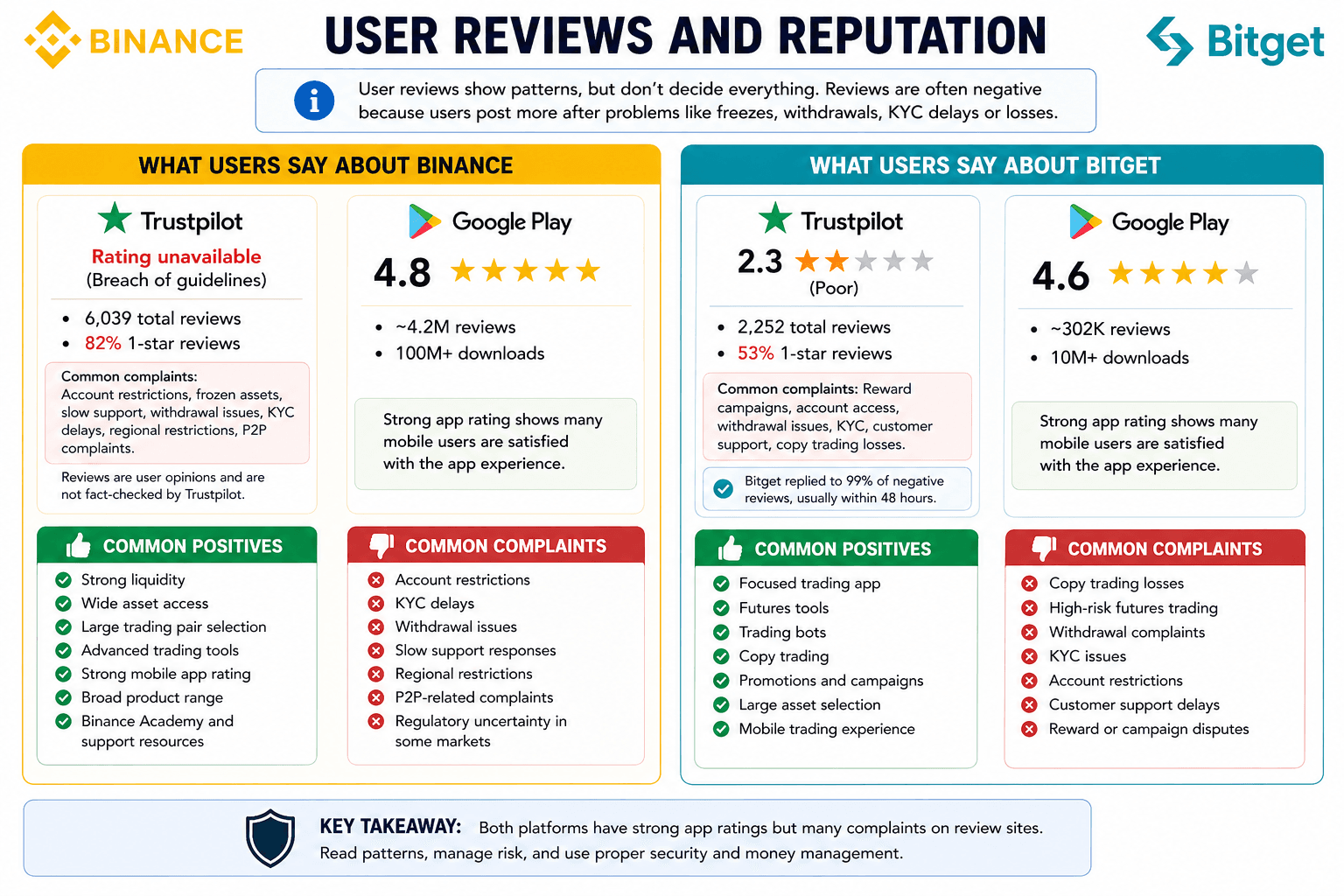 What Other User Think of Bitget and Binance
What Users Say About Binance
Binance has a mixed reputation. It is widely used and has strong app ratings, but its Trustpilot profile is heavily negative.
Trustpilot says Binance’s rating is unavailable due to a breach of its guidelines. It also says it removed a number of fake reviews for the company. The page shows 6,039 total reviews, with 82% marked as 1-star. Common complaints mention account restrictions, frozen assets, slow support and withdrawal issues. Trustpilot also notes that reviews are user opinions and that it does not fact-check specific claims.
The picture looks different on Google Play. The Binance app has a 4.8-star rating, about 4.2 million reviews and more than 100 million downloads. That suggests many mobile users are still satisfied with the app experience, even while support and account issues dominate complaint sites.
Common Binance positives:
- Strong liquidity
- Wide asset access
- Large trading pair selection
- Advanced trading tools
- Strong mobile app rating
- Broad product range
- Binance Academy and support resources
Common Binance complaints:
- Account restrictions
- KYC delays
- Withdrawal issues
- Slow support responses
- Regional restrictions
- P2P-related complaints
- Regulatory uncertainty in some markets
What Users Say About Bitget
Bitget also has a mixed reputation. Users often praise the app, trading tools, copy trading, futures features, bots and promotions. Complaints tend to focus on reward campaigns, account access, withdrawal issues, KYC, customer support and losses from risky trading.
Trustpilot lists Bitget with a 2.3 TrustScore, marked as “Poor,” based on 2,252 total reviews as of May 11, 2026. The page shows 53% 1-star reviews and also says Bitget replied to 99% of negative reviews, usually within 48 hours.
On Google Play, Bitget has a stronger app rating than its Trustpilot page suggests. The Bitget app has a 4.6-star rating, about 302,000 reviews and more than 10 million downloads.
Common Bitget positives:
- Focused trading app
- Futures tools
- Trading bots
- Copy trading
- Promotions and campaigns
- Large asset selection
- Mobile trading experience
Common Bitget complaints:
- Copy trading losses
- High-risk futures trading
- Withdrawal complaints
- KYC issues
- Account restrictions
- Customer support delays
- Reward or campaign disputes
How Much Should You Trust User Reviews?
User reviews are useful for spotting repeated issues, but they are not perfect evidence.
Trustpilot itself says it does not fact-check specific claims in reviews. It also says companies cannot pay to hide reviews, but review platforms can still contain fake, angry, incomplete or one-sided feedback.
So use reviews as warning signs, not final proof.
If many users complain about the same issue, take it seriously. But do not assume every bad review is accurate or every positive app rating proves the exchange is safe.
Binance vs Bitget: Which Should You Choose?
Binance is the stronger pick if you want a full exchange with deeper liquidity, broader markets and more products. Bitget is the better fit if you want a trading-focused platform with strong futures tools, bots and copy trading.
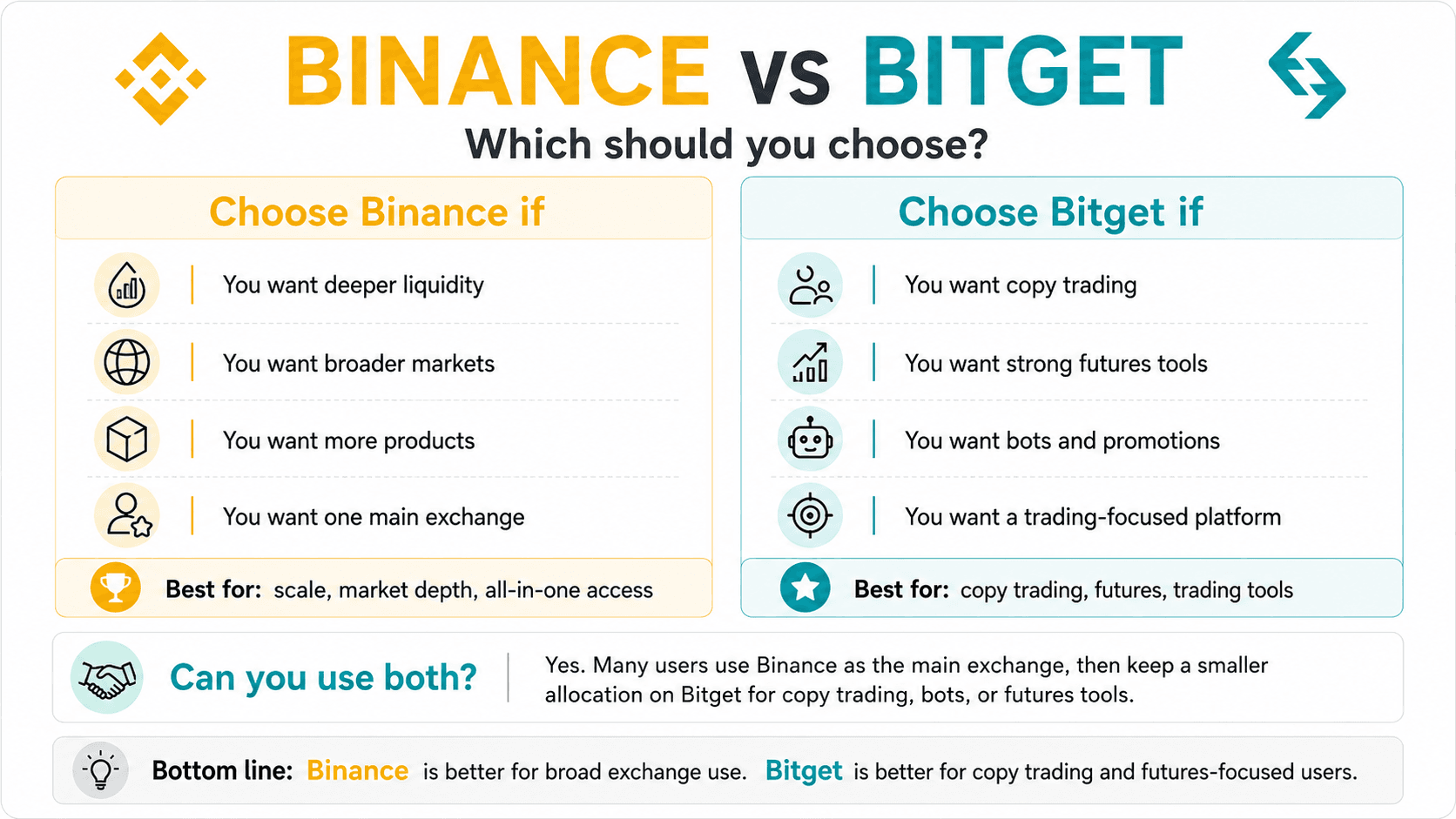 Here's What You Should Consider Before Choosing Binance or Bitget
Choose Binance If
- You care about liquidity and market depth
- You want a broader product suite
Binance makes more sense for traders who want scale. If you trade BTC, ETH or large-cap altcoins often, Binance’s stronger trading volume and market depth can help with execution. It is also the better choice if you want one main exchange for spot, futures, bots, earn products and education.
While Binance has more features, that also means more menus, more products and more rules to understand.
Choose Bitget If
- Copy trading is a major reason you are signing up
Bitget makes more sense if you want more than basic spot trading but do not want to build every strategy yourself. Its strongest appeal is its mix of futures trading, copy trading, bots and promotions.
Should You Use Both Binance and Bitget?
Yes, some users may use both Binance and Bitget, but only if there is a clear reason.
A practical setup is to use Binance as the main exchange for liquidity, spot trading and broader market access, then use Bitget with a smaller allocation for copy trading, futures tools or trading bots.
Switch from Binance to Bitget if:
- You mainly want copy trading
- You are comfortable with futures risk
- You want to follow elite traders
- You are starting with a small test allocation
Switch from Bitget to Binance if:
- You want deeper liquidity
- You trade larger amounts
- You need broader ecosystem features
- You prefer manual trading or bot strategies over copy trading
Final Verdict: Binance Is Better Overall, Bitget Wins for Copy Trading
The choice is simple. Choose Binance if you want the stronger full exchange. Choose Bitget if you want a trading-focused platform with stronger copy trading, futures tools and bots.
Binance is the better overall exchange for most users. It has stronger liquidity, deeper market depth, higher spot and derivatives volume, larger disclosed reserves and a wider product range.
For beginners, Bitget copy trading may look easier than manual trading, but it still needs risk management. Start small, avoid traders with high margin exposure, check maximum drawdown and treat copy trading as a high-risk strategy rather than guaranteed income.