Bitcoin is the better choice for most investors, while Monero is stronger for users who place transaction privacy above all else. Both are proof-of-work cryptocurrencies, yet they optimize for sharply different outcomes.
This Monero vs Bitcoin comparison examines privacy, traceability, fees, confirmation times, mining, supply, access, regulation and real-world suitability.
Editor's Note (Aug. 9, 2026): We fully updated this article in August 2026 to reflect the latest Bitcoin and Monero network data, privacy technology, fees, mining dynamics, exchange availability, regulatory restrictions and real-world use cases. We also expanded the comparison with current information on Bitcoin privacy tools, Monero’s FCMP++ development, XMR delistings, liquidity and long-term network security.
Quick Verdict: Monero or Bitcoin?
Bitcoin is the better overall choice for most investors, while Monero is the stronger option for private, fungible peer-to-peer payments.
Bitcoin wins on liquidity, exchange availability, institutional access and long-term investment infrastructure. Monero wins on transaction privacy and fungibility because ordinary transfers hide amounts and obscure sender and recipient information by default.
Who Should Choose Which?
Choose Bitcoin if you want:
- A scarce digital asset with a maximum supply of 21 million BTC
- Deep liquidity and broad exchange availability
- Regulated investment products and institutional custody options
- A larger wallet, payment and financial-services ecosystem
- Long-term savings or investment exposure rather than default transaction privacy
Choose Monero if you want:
- Transaction privacy built into ordinary payments
- Hidden amounts and obfuscated sender and recipient information
- Stronger fungibility without publicly attached coin histories
- Private peer-to-peer payments and greater commercial confidentiality
- A payment-focused cryptocurrency despite lower liquidity and more restricted exchange access
Monero vs Bitcoin Winner by Category
| Category | Winner | Why |
|---|---|---|
| Best Overall for Most Investors | Bitcoin | Bitcoin combines deeper liquidity, broader market access, fixed supply and a much larger investment and custody ecosystem. |
| Transaction Privacy | Monero | Monero hides transaction amounts and obscures sender and recipient information by default, while Bitcoin maintains a public transaction graph. |
| Liquidity and Availability | Bitcoin | Bitcoin trades across far more exchanges, fiat markets, brokers and OTC venues, with substantially deeper liquidity. |
| Fungibility | Monero | Monero does not expose a public transaction history for individual units, reducing the ability to distinguish coins by their past activity. |
| Institutional Access | Bitcoin | Bitcoin has regulated exchange-traded products, institutional custody, treasury adoption and broader professional trading infrastructure. |
| Private Peer-to-Peer Payments | Monero | Monero is designed for private digital cash, protecting payment amounts, recipient addresses and transaction relationships on-chain. |
Data and protocol information were checked in August 2026. Fees, liquidity, exchange availability, wallet support and regional restrictions can change, so verify current conditions before buying, trading or transferring BTC or XMR.
Disclosure
Some links in this guide may be affiliate links. If you choose to use a service through these links, we may earn a commission at no additional cost to you.
Disclaimer
This guide is educational only and is not financial advice. The comparison is based on technical documentation, protocol specifications, market data, exchange availability and confirmed regulatory or platform actions.

Monero vs Bitcoin at a Glance
Bitcoin and Monero use proof of work, but almost every major design choice after that reflects a different priority.
| Comparison Area | Bitcoin | Monero |
|---|---|---|
| Launch year | 2009 | 2014 |
| Native asset | BTC | XMR |
| Primary design goal | Scarce, censorship-resistant value | Private, fungible digital cash |
| Consensus | Proof of work | Proof of work |
| Mining algorithm | SHA-256 | RandomX |
| Typical block interval | Around 10 minutes | Around 2 minutes |
| Transaction amounts | Public | Hidden |
| Sender and recipient data | Visible as addresses or scripts | Obfuscated through privacy technology |
| Supply policy | Maximum 21 million BTC | Tail emission with declining percentage inflation |
| Privacy by default | No | Yes |
| Scaling approach | Base layer plus the Lightning Network | Dynamic block-size system |
| Market liquidity | Very high | Considerably lower |
| Regulated exchange access | Broad | Restricted in several regions |
| Best suited to | Savings, investment and liquid settlement | Private payments and fungibility |
| Main drawback | Public transaction history | Restricted access and regulatory pressure |
| Last checked | August 2026 | August 2026 |
Bitcoin’s advantage comes from scale. Monero’s advantage appears inside the transaction itself.
Bitcoin exposes a public transaction graph that anyone can inspect. Monero hides the amount, obscures the spent output and generates one-time destination addresses, reducing the information available to blockchain observers.
How This Monero vs Bitcoin Comparison Was Built (Methodology)
The comparison prioritizes primary technical documentation, current protocol specifications, public network data and confirmed regulatory or exchange actions.
Bitcoin claims were checked against developer documentation, Bitcoin Improvement Proposals and current network data. Monero claims were checked against official technical resources, its roadmap, source-code repositories and Monero Research Lab work.
Variable figures, including fees, market data and exchange restrictions, were checked on Aug. 9 ,2026. Privacy claims were separated into three categories:
- Live protocol features: Technology active in ordinary mainnet transactions.
- Attack models and research: Conditions under which privacy may weaken, without assuming that every theoretical attack works at scale.
- Proposed upgrades: Features under development that have not reached Monero mainnet.
This distinction is especially relevant to Full-Chain Membership Proofs. The official Monero repository still listed the FCMP++ hard-fork milestone as incomplete at press time. FCMP++ is therefore treated as development work rather than a live privacy feature.
What Bitcoin and Monero Are Designed to Do
Bitcoin is designed around publicly verifiable scarcity. Monero starts from the payment privacy problem and accepts additional complexity to conceal transaction details.
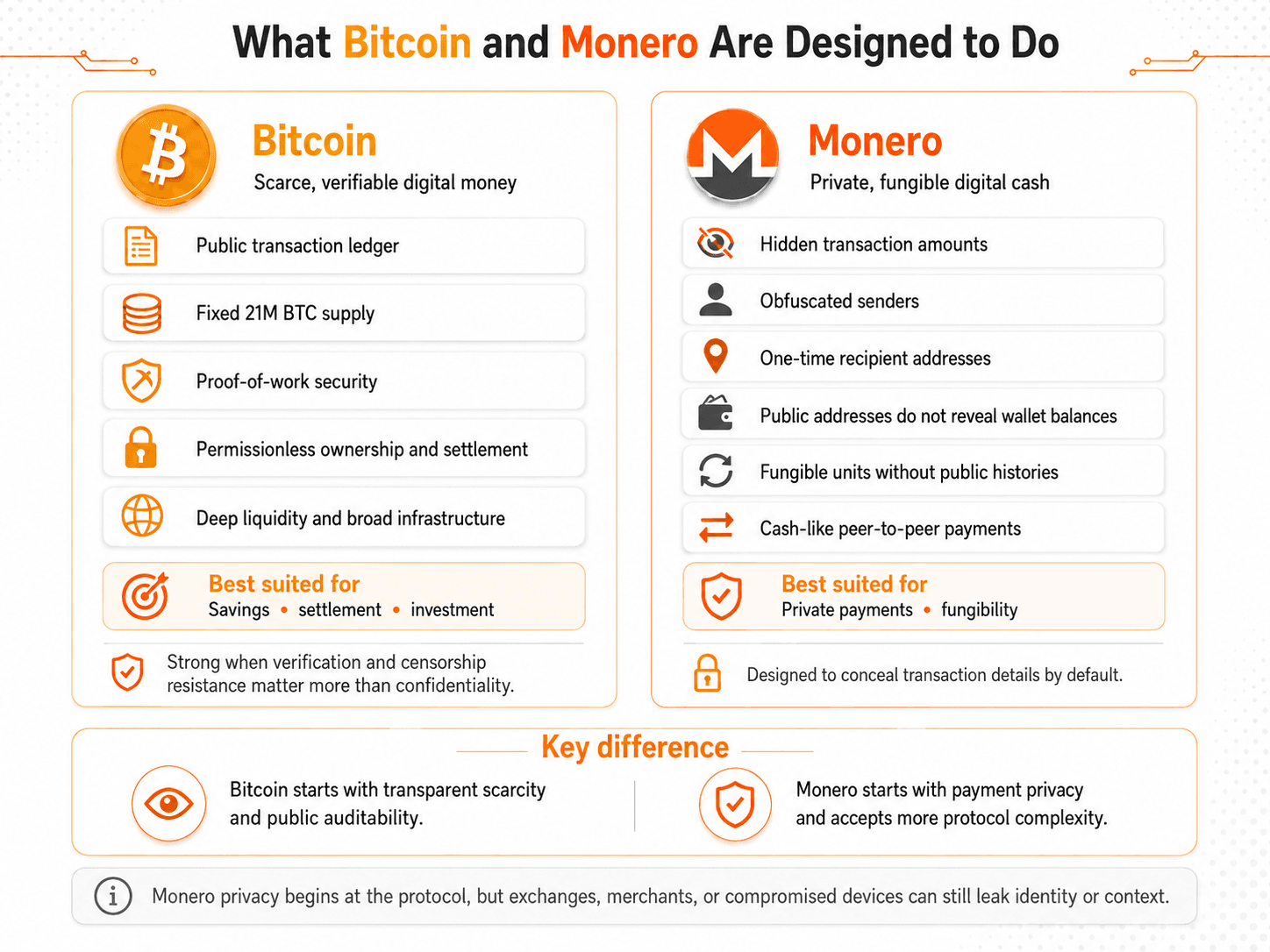 Two Proof-of-Work Networks Built for Different Monetary Roles
Bitcoin Is Designed as Scarce, Verifiable Digital Money
Satoshi Nakamoto’s Bitcoin design combines a public ledger, a predictable issuance schedule and proof-of-work security. Every validating node can independently confirm that transactions follow the same consensus rules and that the supply does not exceed the protocol’s limits.
Bitcoin’s main properties include:
- A publicly verifiable transaction ledger
- A fixed maximum supply of 21 million BTC
- Proof-of-work network security
- Permissionless ownership and settlement
- Deep liquidity and broad infrastructure support
These properties support Bitcoin’s use as a long-term savings asset, settlement network and investment. The “digital gold” comparison comes from its fixed supply and resistance to discretionary issuance, although BTC remains far more volatile than gold and lacks the price stability expected from everyday money.
Bitcoin can also handle payments. Its main-chain settlement is strongest where public verification and censorship resistance outweigh the need for confidentiality or instant retail checkout.
Monero Is Designed as Private, Fungible Digital Cash
Monero grew from the CryptoNote design and makes transaction privacy mandatory. Ordinary transactions hide the transferred amount, obscure the real spent output and prevent the recipient’s published wallet address from appearing directly on-chain.
Its privacy stack supports:
- Hidden transaction amounts
- Obfuscated senders
- One-time recipient addresses
- Wallet balances that cannot be calculated from a public address
- Fungible units without publicly attached histories
- Cash-like peer-to-peer payments
Fungibility means one unit can be exchanged for another without its past creating a different market value. Bitcoin units are technically interchangeable at the protocol level, but their public histories allow exchanges, analytics firms and counterparties to label particular outputs. Monero removes much of the information required to make those distinctions.
Monero’s design does not erase records held elsewhere. An exchange may know who bought XMR. A merchant may retain an invoice. Malware may expose a wallet. Privacy begins at the protocol, while the user’s wider operating environment can still leak identity or transaction context.
Monero vs Bitcoin Privacy and Traceability
Monero provides the stronger transaction-privacy model because privacy is built into ordinary transfers. Bitcoin users can improve confidentiality, but success depends on wallet capabilities, transaction structure and user behaviour.
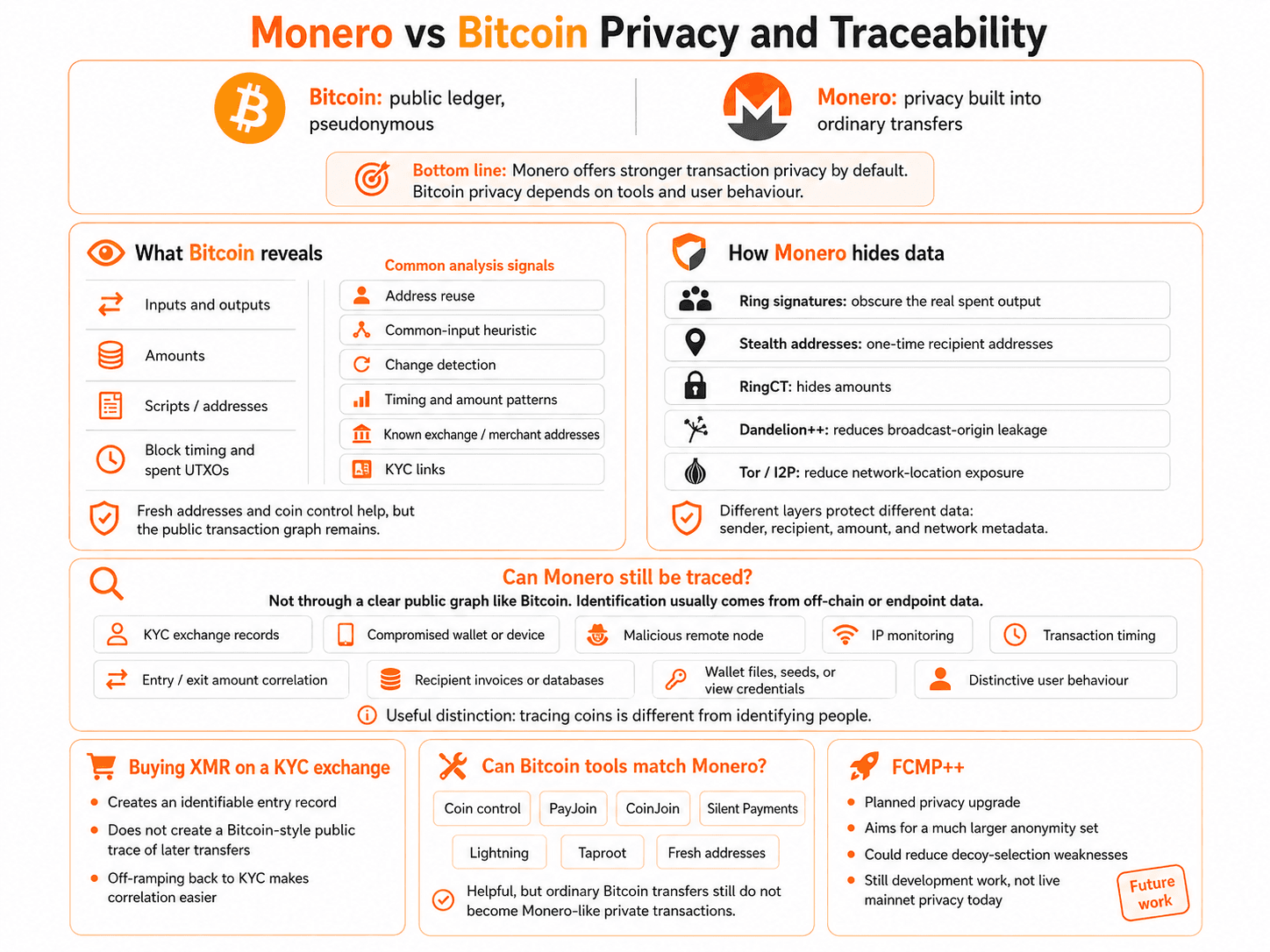 Monero Hides Transaction Data Bitcoin Leaves Publicly Traceable
What Information Bitcoin Transactions Reveal
The Bitcoin blockchain publicly records transaction inputs, outputs, transferred amounts and the scripts controlling each output. It also records when a transaction entered a block and which previous unspent transaction outputs, or UTXOs, were consumed.
An address does not automatically contain a legal name. This makes Bitcoin pseudonymous. Once an address is connected to a person, business or exchange account, however, the public ledger can reveal related activity.
Blockchain analysis commonly uses:
- Address reuse
- Common-input ownership heuristics
- Change-output identification
- Timing and amount patterns
- Known exchange or merchant addresses
- KYC exchange records
- Links between spent outputs
Suppose a user withdraws BTC from a verified exchange account and later combines that output with BTC from another wallet. The combined transaction can create evidence that both inputs share an owner. Future payments may then reveal approximate balances, counterparties or spending patterns.
Wallet hygiene can reduce these connections. Fresh addresses and coin control help, though neither hides amounts or removes the public transaction graph.
How Monero Hides Transaction Data
Monero combines several technologies rather than relying on one privacy feature.
- Ring signatures: The transaction input appears alongside decoy outputs, making the blockchain unable to identify the real spent output directly.
- Stealth addresses: The sender creates a one-time destination address for the recipient. Payments to the same published address cannot be grouped through a repeated on-chain destination.
- Ring Confidential Transactions: RingCT uses cryptographic commitments to hide the amount while proving that the transaction balances.
- Dandelion++: The broadcast protocol first relays transactions through a less visible stem phase before wider diffusion, reducing simple attempts to associate a transaction with its originating node.
- Tor and I2P: Users can route wallet or node traffic through privacy networks to reduce exposure of their network location.
These layers protect different data. Ring signatures obscure the spent output, stealth addresses protect the recipient and RingCT conceals the amount. Dandelion++, Tor and I2P address network metadata rather than the blockchain record.
The technologies also have boundaries. Tor or I2P must be configured correctly. Dandelion++ reduces broadcast-origin leakage rather than removing it. A wallet connected to an untrusted remote node may still expose its IP address or scanning behaviour.
Can Monero Transactions Be Traced?
Monero does not expose the clear transaction graph available on Bitcoin. Identifying a user can still happen through information collected outside that graph.
Privacy can weaken through:
- KYC exchange records
- Compromised wallets or devices
- Malicious remote nodes
- IP-address monitoring
- Transaction timing
- Amount correlation at entry and exit points
- Recipient invoices or databases
- Wallet files, recovery seeds or view credentials
- Distinctive user behaviour
This creates a useful distinction between tracing coins and identifying people. An investigator might know that a customer bought 10 XMR and withdrew it at a particular time. That record does not automatically reveal every later Monero transfer on a public explorer. It can still become useful when combined with device evidence, recipient records or a closely timed conversion back into a transparent asset.
Monero’s own documentation warns that public remote-node operators can associate transactions with IP addresses. Running a personal node reduces that dependency, while Tor or I2P can limit network exposure.
Our analysis of Monero privacy examines that threat-model approach in greater depth.
Does Buying Monero Through a KYC Exchange Remove Its Privacy?
Buying XMR through a KYC exchange creates an identifiable entry record. It does not convert Monero’s later blockchain activity into a Bitcoin-style public transaction graph.
A regulated exchange may retain:
- The purchaser’s verified identity
- The amount of XMR purchased
- The purchase and withdrawal time
- The withdrawal transaction record
- Account, device and payment information
- The withdrawal address or related technical details available to the exchange
That information can establish that a named customer acquired and withdrew Monero. The observer still cannot open a public explorer and follow every later transfer, amount and destination in the same way as a Bitcoin withdrawal.
The entry record becomes more revealing when combined with other data. A withdrawal followed by a closely timed payment of a known amount may allow correlation. A recipient who records the customer’s identity can create another endpoint. Returning the funds to a KYC exchange creates an identifiable off-ramp.
Can Bitcoin Privacy Tools Match Monero?
Bitcoin privacy tools improve particular parts of the transaction flow. They do not collectively turn ordinary Bitcoin transfers into Monero transactions.
- Coin control: Lets users choose which UTXOs to spend, reducing accidental links between separate balances. Amounts and selected inputs remain public.
- PayJoin: Allows the sender and receiver to contribute inputs to one payment, weakening simple common-input ownership assumptions.
- CoinJoin: Combines transactions from multiple users, making ownership analysis harder. Coordination, wallet design and later spending behaviour affect the result.
- Silent Payments: BIP 352 allows a recipient to publish a reusable payment identifier while receiving funds to unique on-chain outputs. It reduces address reuse but does not hide amounts or spent inputs.
- Lightning Network: Moves repeated payments into off-chain channels and limits what appears on Bitcoin’s base layer. Channel openings, closures, routing data and wallet architecture create separate privacy considerations.
- Taproot: Makes some complex spending conditions resemble ordinary key-path transactions. It improves script privacy without concealing the entire transaction graph.
- Fresh addresses: Prevent straightforward address reuse, though other clustering signals can remain.
Sparrow Wallet added receiving support for Silent Payments in version 2.5.0, while Nunchuk and supporting libraries expanded implementation work earlier in the year. Adoption is growing, but wallet support remains uneven.
Bitcoin privacy is usually assembled through wallet features and disciplined transaction management. Monero applies privacy to ordinary transactions without asking every user to construct a special flow.
How FCMP++ Could Change Monero Privacy
Full-Chain Membership Proofs are intended to replace limited ring selection with proofs covering a much larger set of eligible outputs across the chain. Instead of hiding the real spend among a small collection of decoys, an FCMP++ transaction could draw privacy from a full-chain anonymity set.
The proposed change aims to:
- Reduce weaknesses caused by decoy selection
- Make statistical elimination of ring members less useful
- Expand the anonymity set
- Improve the uniformity of Monero transactions
Earlier Monero architecture work discussed Seraphis and Jamtis alongside broader privacy upgrades. Current integration work has focused more directly on FCMP++ and the Carrot addressing protocol. The official roadmap still classifies Full-Chain Membership Proofs, Seraphis and Jamtis as future work, while the FCMP++ mainnet milestone remains unfinished.
Monero vs Bitcoin Fees, Speed and Scalability
Monero generally provides a faster first confirmation and lower base-layer fees under current conditions. Bitcoin offers deeper settlement infrastructure and the Lightning Network, giving it a different scaling path.
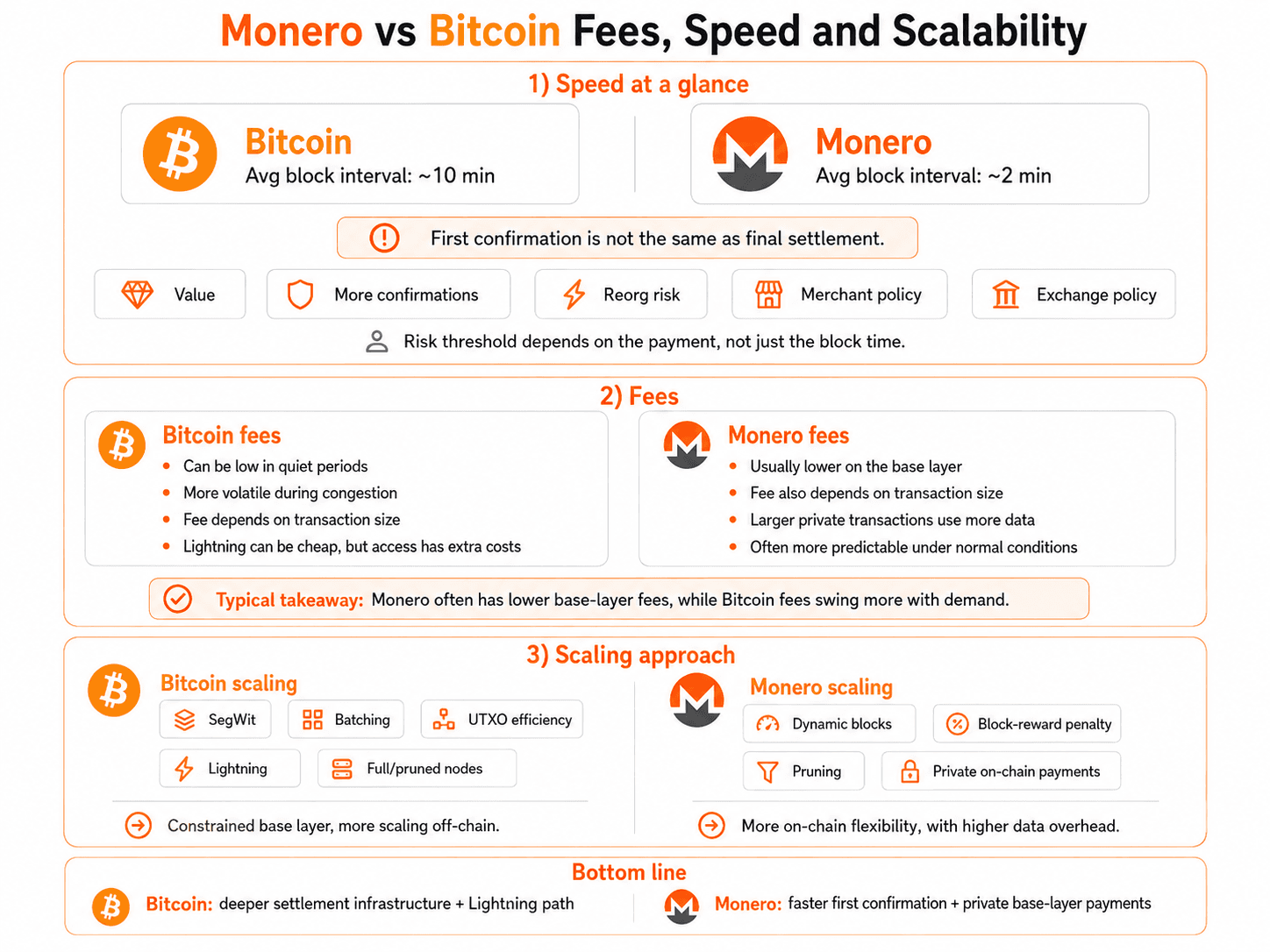 Monero Confirms Faster While Bitcoin Offers Layered Scaling
Block Time Does Not Equal Final Settlement
Bitcoin targets an average block interval of roughly ten minutes. Monero targets about two minutes. Monero therefore tends to produce the first confirmation sooner, but calling it five times faster oversimplifies settlement.
A confirmation shows that a transaction entered a block. Final confidence depends on:
- The transaction’s value
- Subsequent blocks
- Chain-reorganization risk
- Merchant risk tolerance
- Exchange deposit policies
- Wallet or payment-processor settings
Bitcoin’s 10 -minute target also describes an average. Individual blocks can arrive seconds apart or take much longer. Monero’s two-minute interval behaves similarly on a shorter schedule.
Which Has Lower Transaction Fees?
Monero has the lower representative base-layer fee. The comparison remains a snapshot because both networks respond to current demand and transaction structure.
On Aug. 9, 2026, mempool.space estimated roughly 1 sat/vB for low and medium-priority Bitcoin transactions and around 2 sat/vB for high priority. A basic native-SegWit transaction can therefore cost only a few cents during quiet periods. Bitcoin’s average transaction fee stood near $0.36 on Aug. 9, 2026.
Bitcoin fees become less predictable during congestion. Users compete for constrained block space by bidding in satoshis per virtual byte. A transaction with several inputs consumes more block space and costs more than a simple payment at the same fee rate.
A late-July 2026 Monero explorer snapshot showed a network fee rate of 0.00000002 XMR per byte. Common one-input, two-output transactions were paying around 0.000031 XMR, roughly one cent at the period’s XMR price. Larger transactions with more inputs consumed more data and paid more.
The dollar amount transferred has little direct effect on either network fee. Sending $100,000 can cost less than sending $50 when the larger payment uses a simpler transaction structure.
Lightning payments add another category. Routing fees can be tiny, but users may also encounter channel, liquidity, swap or service-provider costs. A low Lightning payment fee does not describe the full cost of opening or managing access to the network.
Our guide to transaction fees explains how transaction size, congestion and wallet selection shape the final cost.
How Bitcoin and Monero Approach Scaling
Bitcoin keeps base-layer block space constrained and moves a larger share of payment activity into more efficient transaction structures or secondary networks.
Its main tools include:
- Segregated Witness, which improves block-space efficiency
- Transaction batching
- UTXO-efficient wallet management
- The Lightning Network
- Full and pruned nodes
This strategy protects the ability to validate the chain with consumer hardware, while scarcity of block space creates fee volatility during periods of heavy demand. Lightning can support quick, low-cost payments, but channel liquidity and wallet design introduce another operating layer.
Monero allows its block size to adjust with demand. Miners can produce larger blocks, although a block-reward penalty discourages excessive expansion. Private transactions are larger than equivalent transparent transfers because their proofs and decoy data consume additional space.
Monero also supports blockchain pruning, allowing a node to discard parts of the historical data while retaining enough information to validate the network. Dynamic blocks reduce rigid capacity limits, but continued growth still increases storage, bandwidth and synchronization requirements.
Neither network has solved scalability in every dimension. Bitcoin favors a deliberately constrained settlement layer supported by Lightning. Monero accepts greater on-chain flexibility and data usage to preserve private base-layer payments.
Supply, Mining and Long-Term Network Security
Bitcoin commits to a fixed supply and gradually removes its block subsidy. Monero continues a small permanent issuance to maintain a base reward for miners.
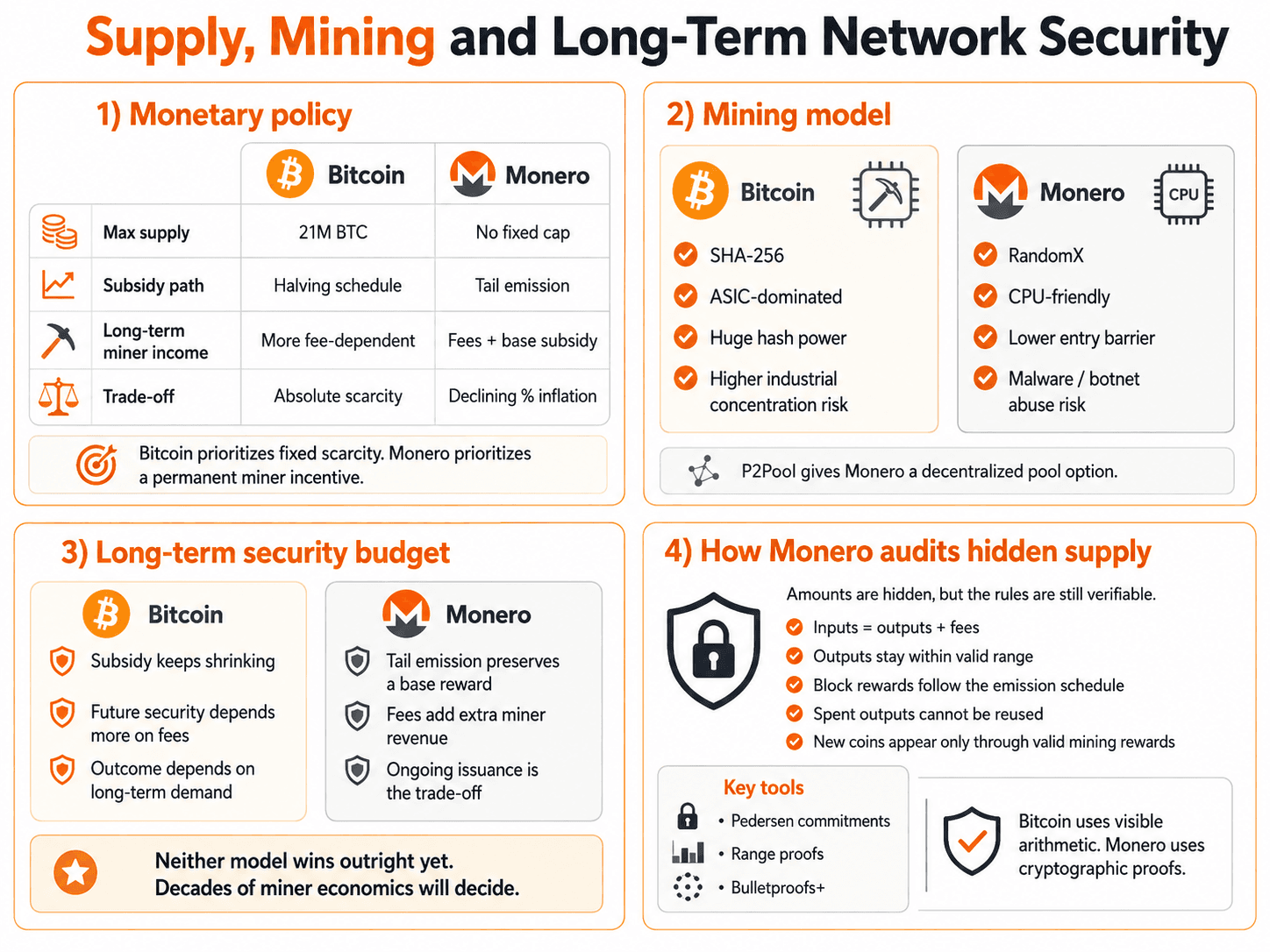 Fixed Scarcity Competes With Permanent Miner Security Incentives
Bitcoin’s Fixed Supply vs Monero’s Tail Emission
Bitcoin’s maximum supply is 21 million BTC. The block subsidy falls by half approximately every 210,000 blocks, or roughly every four years. As the subsidy declines, transaction fees are expected to represent a larger share of miner revenue.
Monero has no fixed maximum supply. Its main emission ended in 2022, after which a tail emission of up to 0.6 XMR per two-minute block began.
That does not make Monero highly inflationary. The number of newly issued XMR remains broadly constant, while the existing supply continues to grow. Annual percentage inflation therefore declines over time.
The monetary choice is direct:
| Policy | Bitcoin | Monero |
|---|---|---|
| Maximum supply | 21 million BTC | No fixed maximum |
| Subsidy path | Halves approximately every 210,000 blocks | Permanent tail emission |
| Long-term miner income | Increasing reliance on transaction fees | Fees plus continuing base subsidy |
| Monetary trade-off | Absolute scarcity | Declining percentage inflation |
Bitcoin holders receive stronger supply certainty. Monero miners receive a permanent minimum incentive. Neither choice removes the need for a healthy fee market, sufficient demand and distributed mining participation.
SHA-256 ASIC Mining vs RandomX CPU Mining
Bitcoin mining uses SHA-256 and is dominated by application-specific integrated circuits. Modern ASIC operations require specialized equipment, cheap electricity, cooling, maintenance and access to mining infrastructure.
The model produces enormous aggregate hash power, but the economics favor industrial operators. Mining pools also coordinate a substantial share of block production, creating recurring concentration concerns even when individual miners can switch pools.
Monero uses RandomX, a memory-intensive proof-of-work algorithm designed to favor general-purpose CPUs and limit the advantage of specialized hardware. The lower equipment barrier allows more users to participate with conventional computers.
RandomX does not guarantee decentralized mining. Profitability still depends on electricity, hardware efficiency and pool choice. CPU accessibility also creates a different abuse problem: malware operators and botnets can mine XMR on compromised machines.
Monero’s P2Pool gives miners a decentralized pool option without relying on a conventional custodial pool operator. It improves the available structure rather than ensuring that miners will distribute hash power evenly.
Our guide to Monero mining examines RandomX hardware economics, electricity costs and pool selection in greater detail.
Bitcoin Security Budget vs Monero Tail Emission
Bitcoin’s declining subsidy creates an unresolved long-term security-budget question. Miners secure the network in return for the block subsidy and transaction fees. As newly issued BTC approaches zero, fee revenue must carry more of the incentive.
A larger Bitcoin economy could generate enough fee demand to maintain strong security. Layer-two adoption, batching and efficient use of block space could also reduce the number of base-layer transactions paying those fees. The eventual balance between settlement demand, fee revenue and miner costs remains uncertain.
Monero takes a different position. Its permanent tail emission guarantees a base block reward, while transaction fees add further revenue. The cost is ongoing issuance.
Bitcoin accepts stronger fixed-supply scarcity and greater future dependence on fees. Monero accepts perpetual issuance to preserve a continuing subsidy. The stronger model will depend on miner economics and network demand over decades, making a definitive winner premature.
How Can Monero's Supply Be Audited if Amounts Are Hidden?
Monero can hide amounts while still proving that each transaction follows the supply rules.
Pedersen commitments allow nodes to verify that the inputs equal the outputs plus fees without learning the values. Range proofs confirm that hidden outputs represent valid non-negative amounts rather than manipulated numbers. Monero currently uses Bulletproofs+ to make these proofs more compact.
Nodes still verify that:
- Inputs balance with outputs and fees
- Outputs fall within the valid numerical range
- Block rewards follow the emission schedule
- Spent outputs cannot be reused
- New coins appear only through valid mining rewards
- Consensus rules are followed
Bitcoin’s supply audit is easier to understand because every amount is visible and can be added directly. Monero reaches a similar consensus result through cryptographic commitments and proofs.
The Monero method introduces more implementation and audit complexity. A flaw in commitment, range-proof or wallet code could create a different risk profile from Bitcoin’s public arithmetic. Strong cryptographic review therefore carries more weight in Monero’s supply model.
Buying, Selling and Storing Bitcoin and Monero
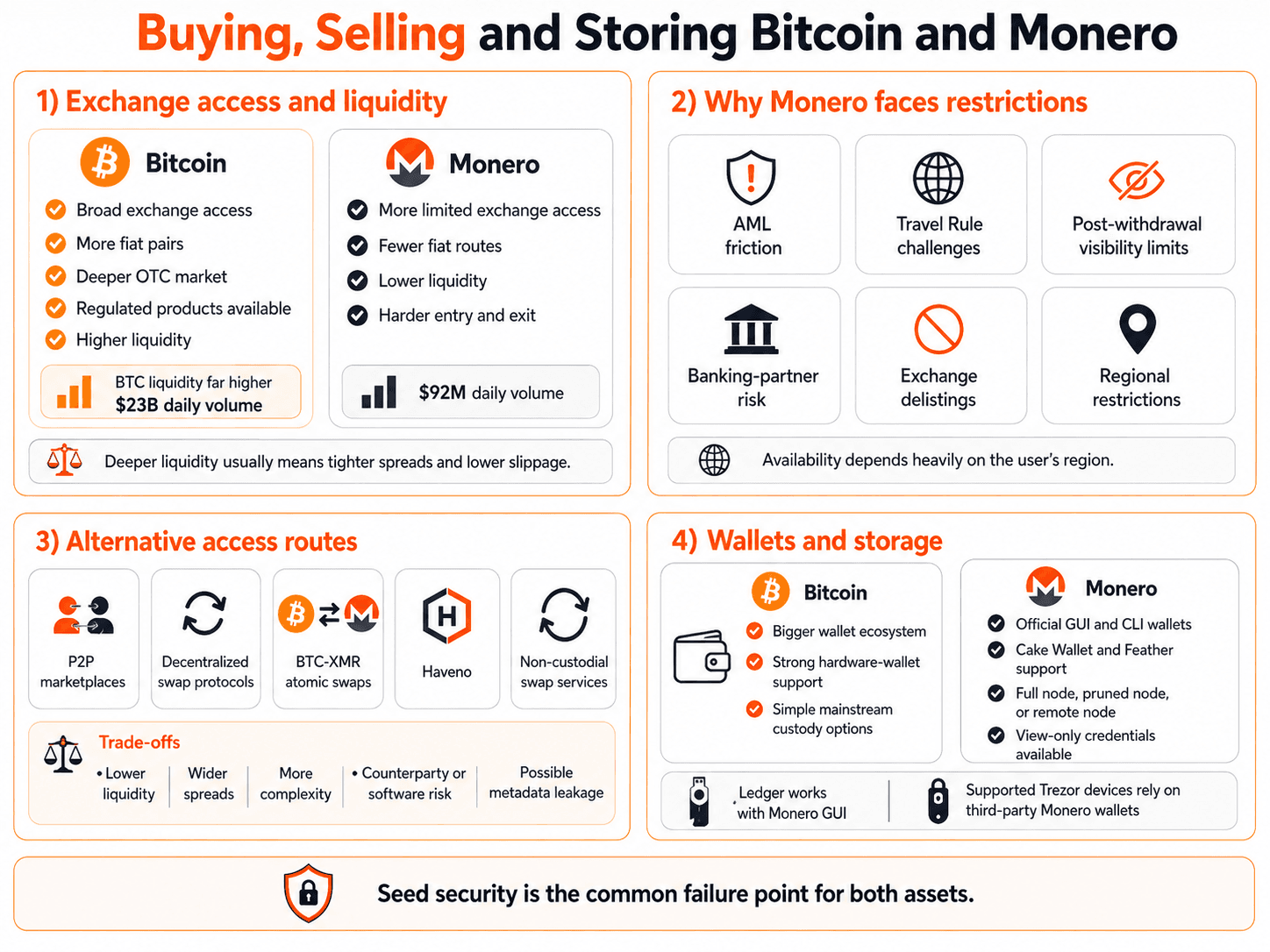
Bitcoin is much easier to buy, trade and store through mainstream services. Monero remains accessible, but the available routes depend heavily on region and user experience.
 Bitcoin Offers Easier Access While Monero Demands More Setup
Bitcoin Has Much Broader Exchange Access and Liquidity
Bitcoin is supported across major regulated exchanges, brokers, payment providers, custodians and over-the-counter desks. It also trades against a wide range of fiat currencies and stablecoins.
The liquidity gap was stark on Aug. 9, 2026. Bitcoin recorded about $12.4 billion in daily trading volume, compared with roughly $79.1 million for Monero, according to CoinGecko.
Deeper liquidity generally produces:
- Tighter bid-ask spreads
- Lower slippage on large orders
- More fiat trading pairs
- More reliable price discovery
- Greater OTC capacity
- Easier entry and exit
Bitcoin also has regulated investment infrastructure unavailable to Monero. The US Securities and Exchange Commission approved spot Bitcoin exchange-traded products on Jan. 20, 2024. Products such as the iShares Bitcoin Trust give eligible investors price exposure without managing private keys directly.
A regulated product introduces sponsor, custody, fee and market-structure risks. It still provides an access route that Monero does not currently match.
For a wider comparison of fiat access, custody and trading venues, use our best crypto exchanges guide.
Monero Exchange Delistings and Regional Restrictions
Monero’s privacy creates a compliance problem for centralized exchanges. A service may collect the customer’s identity but remain unable to observe the later on-chain flow of withdrawn XMR with the clarity available on Bitcoin.
That creates friction with:
- Anti-money-laundering controls
- Transaction monitoring
- Originator and beneficiary data requirements
- Travel Rule implementation
- Regional privacy-coin restrictions
- Banking-partner risk tolerance
- Exchange listing policies
The FATF framework expects virtual-asset service providers to collect and transmit originator and beneficiary information. Monero can support account-level compliance inside an exchange, but its private blockchain limits post-withdrawal visibility.
Several major examples illustrate the access trend. Binance removed all XMR spot pairs on Feb. 20, 2024. Kraken halted XMR trading and deposits for European Economic Area clients on Oct. 31, 2024. In 2026, Kraken also ended XMR trading and withdrawals for clients residing in India.
Restrictions reduce fiat access and concentrate liquidity on fewer platforms. Users may face wider spreads, more complicated conversions or a greater reliance on peer-to-peer markets. Availability should always be checked for the user’s exact residence rather than inferred from an exchange’s global website.
P2P Markets and Bitcoin-Monero Atomic Swaps
Peer-to-peer markets and non-custodial swaps can provide access where centralized exchange support is limited.
The main routes include:
- Peer-to-peer marketplaces
- Decentralized exchange protocols
- Bitcoin-Monero atomic swaps
- Haveno
- Non-custodial swap services
An atomic swap allows BTC and XMR to be exchanged without trusting a centralized custodian to hold both assets. The protocol coordinates the transfer so that either both sides complete or the trade can be refunded under its rules.
Haveno is a Tor-based, non-custodial marketplace built around Monero. Trades use security deposits and multisignature arrangements, with dispute handling available when counterparties disagree. The core project warns that it does not endorse individual third-party networks, so users still need to assess the distribution they choose.
These routes trade convenience for additional risks:
- Lower liquidity
- Wider spreads
- Counterparty disputes
- Longer settlement times
- Software and implementation risk
- Greater technical complexity
- Possible metadata leakage
- Local legal and tax obligations
A decentralized interface also does not make every trade private. Payment methods, chat records, bank transfers, timing and counterparties may reveal identity.
Wallets, Hardware Support and Node Requirements
Bitcoin offers a larger crypto wallet ecosystem, ranging from simple mobile applications to Bitcoin-only hardware devices, multisignature coordinators and institutional custody.
Monero users can choose the official GUI and CLI wallets, mobile applications such as Cake Wallet, and desktop options such as Feather. The practical difference appears during synchronization and node selection.
A Monero wallet may need to scan the chain to identify outputs belonging to it. Users can:
- Run a full node
- Run a pruned node
- Connect to a remote node
- Restore from a recovery seed and scan from a restore height
- Use view-only credentials for selected monitoring
Hardware wallets support both assets, though Monero integration is less universal than Bitcoin support. Ledger devices can work with the Monero GUI, while supported Trezor devices rely on third-party Monero wallets rather than native Trezor Suite management. Trezor currently lists the Safe 3, Safe 5 and Model T among its usable Monero devices.
Monero also supports multisignature, transaction proofs and view credentials. A merchant can retain payment records or provide limited wallet visibility without making every balance public.
Bitcoin vs Monero for Real-World Use Cases
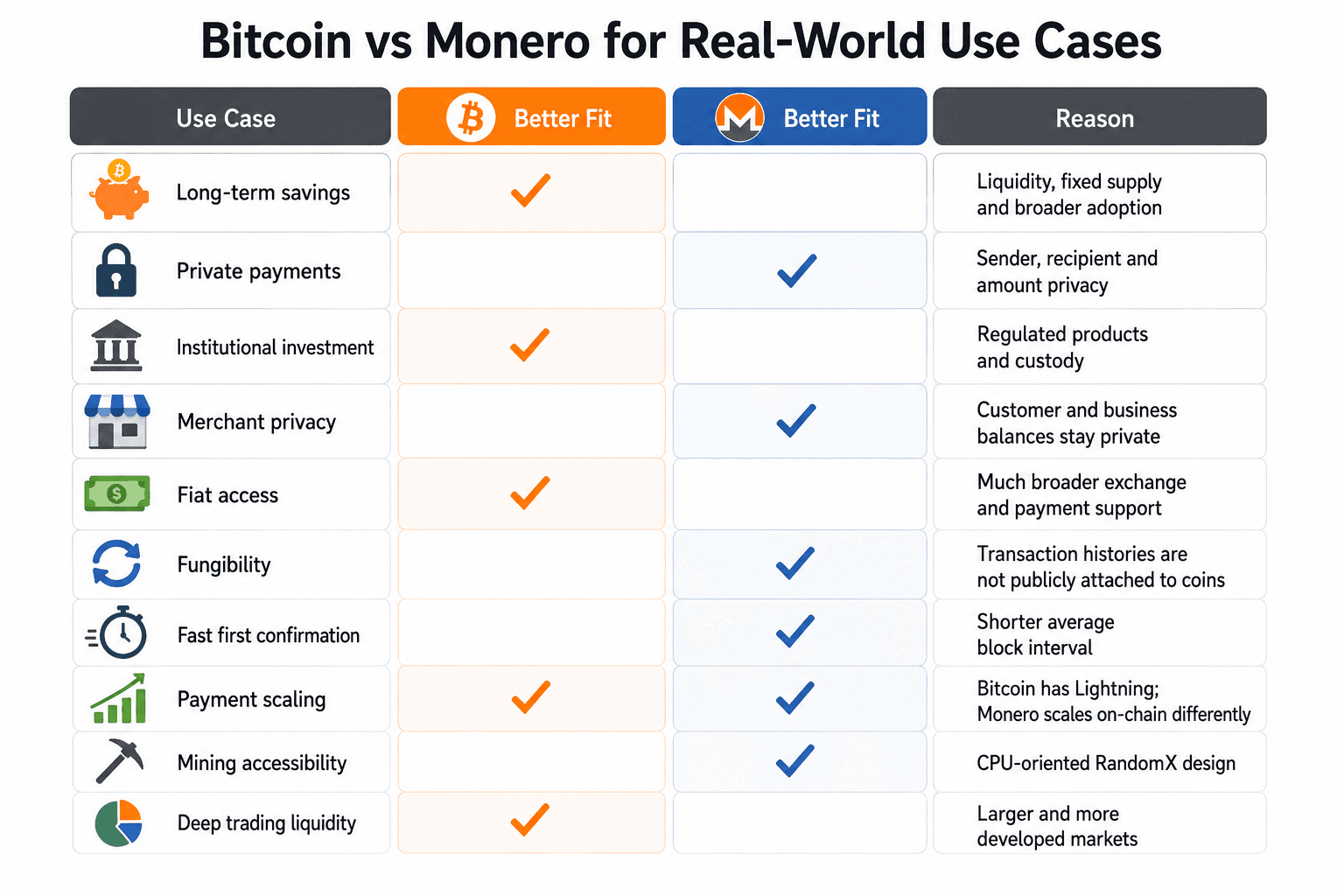
Bitcoin is the stronger savings and investment asset. Monero is the stronger private payment instrument.
 Bitcoin Fits Savings While Monero Protects Private Payments
| Use Case | Better Fit | Reason |
|---|---|---|
| Long-term savings | Bitcoin | Liquidity, fixed supply and broader adoption |
| Private payments | Monero | Sender, recipient and amount privacy |
| Institutional investment | Bitcoin | Regulated products and custody |
| Merchant privacy | Monero | Customer and business balances stay private |
| Fiat access | Bitcoin | Much broader exchange and payment support |
| Fungibility | Monero | Transaction histories are not publicly attached to coins |
| Fast first confirmation | Monero | Shorter average block interval |
| Payment scaling | Depends | Bitcoin has Lightning; Monero scales on-chain differently |
| Mining accessibility | Monero | CPU-oriented RandomX design |
| Deep trading liquidity | Bitcoin | Larger and more developed markets |
Bitcoin for Long-Term Savings and Investment Access
Bitcoin is generally the stronger fit for users who prioritize liquidity, fixed supply and mature financial infrastructure.
Its advantages include:
- Deeper market liquidity
- A maximum supply of 21 million BTC
- Regulated exchange-traded products
- Institutional custody
- Broad fiat access
- Extensive wallet support
- Greater merchant and payment integration
These strengths make Bitcoin easier to acquire, hold as a treasury asset, use as collateral and sell in size. The fixed supply also gives its long-term monetary case a simple foundation: no authority can raise the cap without gaining network acceptance for a rule change.
The investment case still carries serious risks. BTC remains volatile, self-custody can lead to irreversible losses and transaction histories are public. ASIC economics and mining-pool concentration affect the production layer. Long-term security will rely increasingly on fee revenue as the block subsidy declines.
Users choosing direct ownership should separate the asset decision from the custody decision. A sound Bitcoin thesis does not protect a weak seed backup, compromised exchange account or poorly configured wallet.
Our crypto investing guide provides a broader framework for position sizing, custody and risk.
Monero for Private and Fungible Payments
Monero is stronger where revealing the payment amount, wallet balance or transaction history could create a financial or physical risk.
Legitimate use cases include:
- Protecting salary information
- Preventing customers from viewing a merchant’s balance
- Making private charitable donations
- Reducing personal financial profiling
- Protecting commercial payment terms
- Sending peer-to-peer payments without exposing prior activity
Consider a freelancer paid in Bitcoin. Once a client knows the payment address, analysis may reveal other incoming payments or later spending. Monero prevents the client from calculating the recipient’s wallet balance or tracing unrelated transactions through the public chain.
A merchant faces a similar issue. Publishing a transparent payment address can expose revenue patterns, supplier payments and treasury activity. Monero allows customers to verify their own payments without receiving a window into the business’s wider finances.
Privacy also improves fungibility. A recipient evaluates the validity of the XMR rather than the public reputation of its previous owners. That makes Monero behave more like physical cash at the transaction-history level.
The costs are reduced exchange access, weaker institutional support, additional wallet complexity and persistent regulatory pressure.
Our guide to privacy coins compares Monero’s mandatory model with other approaches.
Merchants, Freelancers and Business Accounting
Bitcoin offers familiar payment infrastructure and easier conversion. Monero protects commercial privacy but can require more specialized accounting processes.
Both assets require a merchant workflow for:
- Creating invoices
- Detecting payments
- Setting confirmation thresholds
- Handling refunds
- Converting into fiat
- Recording exchange rates
- Calculating cost basis
- Managing volatility
- Retaining transaction evidence
Bitcoin payment processors benefit from public verification and broad integration. A merchant can monitor an address or invoice output without maintaining private wallet credentials. The trade-off is that customers and competitors may inspect the same public activity.
Monero uses wallet scanning to identify incoming funds. Merchants can generate subaddresses for separate invoices, retain transaction proofs and use view-only access for monitoring. Selective transparency supports internal controls without making the whole wallet public.
Accounting familiarity remains weaker. Some accountants and payment processors have limited experience with view-only wallets, private amounts or XMR-specific transaction proofs. Businesses may need clearer internal records linking invoices, payment times, exchange rates and refunds.
Refund procedures also deserve care. Reusing an assumed return address can create mistakes on either network. Merchants should request and verify a refund destination, preserve the related invoice record and document the exchange rate used.
Should You Hold Both Bitcoin and Monero?
Bitcoin and Monero can serve complementary roles.
A user might hold:
- Bitcoin for liquid long-term savings
- Monero for selected private payments
The structure resembles holding a widely traded reserve asset alongside a smaller transactional balance. It separates the liquidity function from the privacy function.
The disadvantages grow quickly. Two assets mean additional wallets, backups, transaction records and price exposure. Converting between BTC, XMR and fiat can create accounting or tax events. Monero’s lower liquidity and limited exchange access can complicate rebalancing or emergency sales.
Holding both therefore makes the strongest practical sense when the user has a recurring need for both functions. Buying XMR solely because it has stronger privacy, without any plan for using that privacy or managing its access limitations, produces a weaker case.
Monero vs Bitcoin Risks and Trade-Offs
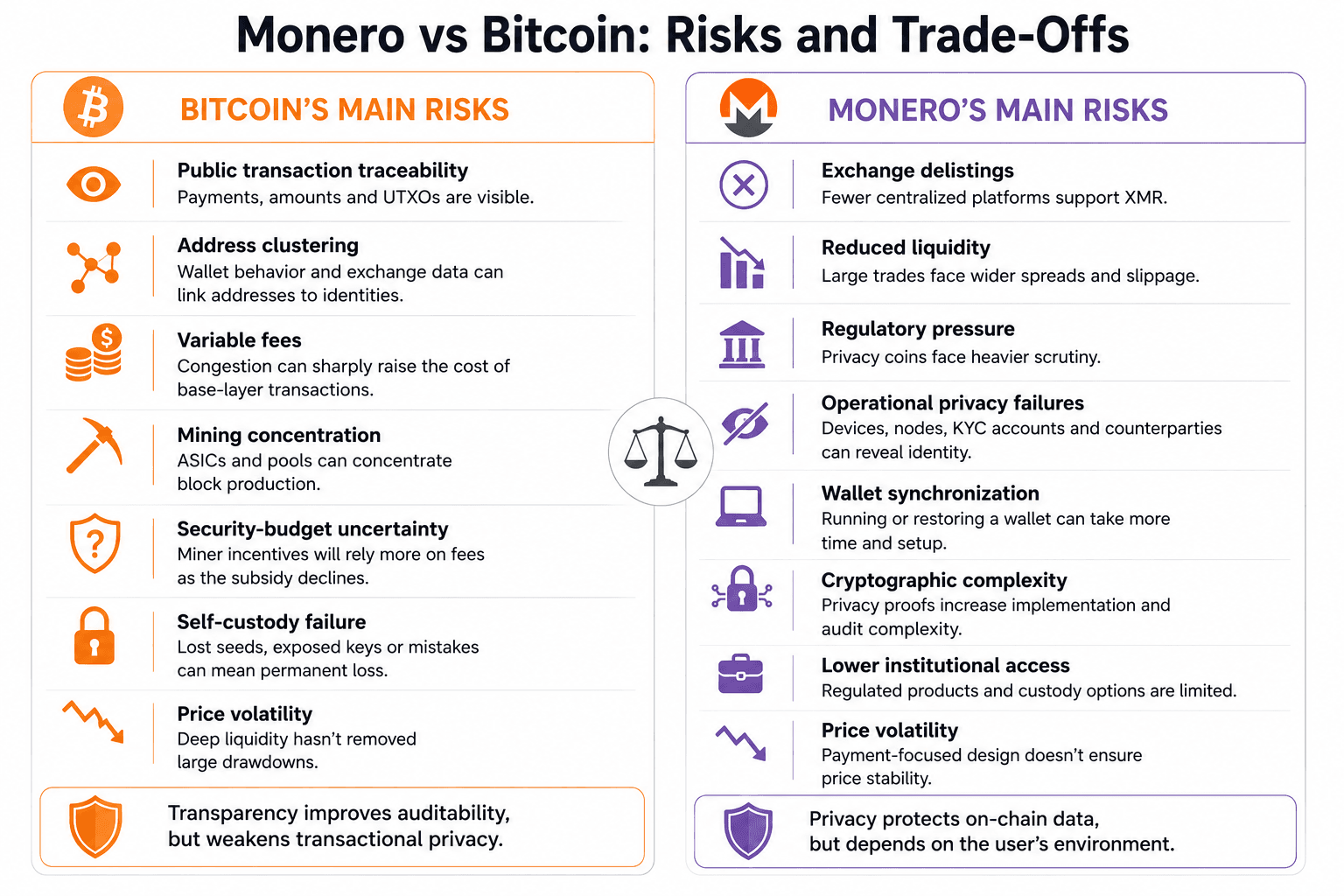
Bitcoin’s main weakness is transparency. Monero’s main weakness is the economic and operational cost attached to privacy.
 Transparency, Regulation and Liquidity Define Each Network’s Risks
Bitcoin's Main Risks
The risks most relevant to this comparison are:
- Public transaction traceability: Payments, amounts and UTXO movements remain visible.
- Address clustering: Wallet behavior and exchange data can connect pseudonymous addresses to identities.
- Variable fees: Congestion can sharply raise the price of base-layer block space.
- Mining concentration: ASIC capital requirements and pool coordination can concentrate block production.
- Security-budget uncertainty: Miner incentives will depend more heavily on fees as the subsidy declines.
- Self-custody failure: Lost seeds, exposed keys and incorrect transactions can cause permanent loss.
- Price volatility: Deep liquidity has not removed large drawdowns.
Bitcoin’s transparency improves auditability while weakening transactional confidentiality. Users can reduce exposure through coin control, fresh addresses, PayJoin, Silent Payments or Lightning, but privacy depends on the complete wallet and spending workflow.
Security should also be separated from price and product risk. A secure Bitcoin network cannot protect an investor from leverage, exchange insolvency or a poor entry price.
Our crypto safety guide covers the account, wallet and recovery failures that sit outside consensus.
Monero's Main Risks
Monero’s principal risks include:
- Exchange delistings: Fewer centralized platforms provide direct XMR markets.
- Reduced liquidity: Large trades can face wider spreads and greater slippage.
- Regulatory pressure: Privacy coins receive heavier scrutiny from exchanges and policymakers.
- Operational privacy failures: Devices, remote nodes, KYC accounts and counterparties can reveal identity.
- Wallet synchronization: Running or restoring a wallet can require more time and configuration.
- Cryptographic complexity: Privacy and hidden-amount proofs expand the implementation and audit surface.
- Lower institutional access: Regulated investment products and custody channels remain limited.
- Price volatility: A payment-focused design does not produce price stability.
Monero’s privacy protects the on-chain transaction structure. It cannot make an infected laptop private, repair a weak recovery backup or erase an exchange’s customer records.
Protocol upgrades add execution risk as well. FCMP++ could materially strengthen the anonymity set, but activation requires completed code, audits, wallet support, hardware integration and network coordination. Users should judge Monero by the protocol running today rather than assigning current value to unfinished features.

Final Verdict: Is Monero or Bitcoin Better?
Bitcoin is the better choice for most users seeking long-term savings, deep liquidity, broad exchange access and established financial infrastructure. Monero is the stronger choice when private, fungible digital payments are the primary requirement.
Bitcoin’s public ledger makes ownership and supply easy to verify, while its liquidity and regulated products give investors far more ways to enter, hold and exit. Its privacy tools can reduce address reuse and transaction clustering, though they do not currently provide Monero’s default sender, recipient and amount protection.
Monero delivers stronger payment privacy and fungibility at the protocol level. The cost appears outside the transaction: fewer exchanges, thinner liquidity, regulatory pressure and a more demanding wallet experience.
Before choosing either, verify regional access, custody requirements, current fees and the available exit route.