Crypto copy trading allows investors to automatically replicate the trades of experienced traders without manually placing every order. However, choosing the right platform requires more than comparing historical returns. Trading fees, profit sharing, execution quality, and risk controls can significantly affect results.
In this guide, we compare the six best crypto copy trading platforms in 2026, including Bitget, Bybit, Binance, OKX, BingX, and eToro. We examine their features, costs, minimum investments, and risks to help you find a platform that suits your trading goals.
Editor's Note (Oct. 14, 2026): We fully updated this guide in October 2026 to reflect the latest crypto copy trading platforms, features, fees, and risk controls. We expanded our comparison to six platforms, added updated minimum investment requirements and profit-sharing structures, and introduced detailed guidance on selecting lead traders, evaluating performance metrics, and understanding the differences between spot and futures copying. We also added practical examples of how fees and execution differences affect follower returns, alongside a new evaluation methodology and updated regional availability information.
Best Crypto Copy Trading Platforms in 2026: Quick Answer
Bitget is our overall pick for crypto copy trading in 2026. It combines spot, futures, and bot copying with detailed trader analytics and configurable risk controls. Bybit is our top choice for futures copying, Binance suits existing exchange users, and OKX stands out for automated position sizing. BingX offers flexible copying modes, while eToro is best for multi-asset investors in eligible markets.
Best Crypto Copy Trading Platforms by Use Case
-
Bitget: Best overall for copy trading variety Offers spot, futures, and automated bot copying with detailed trader performance statistics, configurable position limits, and stop-loss controls. Spot and futures copying start with a 50 USDT allocation, although trader-specific minimums may be higher.
-
Bybit: Best for futures copy trading Provides Smart Copy and Advanced Copy for eligible USDT perpetual futures, with leverage controls, Copy Stop Loss, and position management settings. Classic copying starts at 100 USDT, subject to individual trader requirements.
-
Binance: Best for existing Binance users Integrates spot and futures copying within Binance.com, with dedicated copy portfolios, portfolio stop losses, and customizable allocations. Futures copying has a default minimum of 10 USDT, while spot minimums depend on the copying mode.
-
OKX: Best for automated position sizing Uses Smart Sync to proportionally replicate lead-trader positions and align supported margin and leverage settings. Also offers conventional spot and futures copying, allocation limits, and take-profit/stop-loss controls.
-
BingX: Best for flexible copy trading modes Supports spot and perpetual futures copying, including position-ratio and fixed per-order replication. Followers can configure supported take-profit, stop-loss, and slippage settings, with minimum allocations varying by product and trader.
-
eToro: Best for multi-asset copy trading Lets eligible investors proportionally copy portfolios containing supported cryptocurrencies, stocks, and ETFs. CopyTrader starts at $200 per investor and includes Copy Stop Loss, trader risk scores, and a virtual account. Asset availability varies by jurisdiction.
Disclaimer
Crypto copy trading involves substantial financial risk, particularly when leveraged futures are used. Past trader performance does not guarantee future returns, and copied trades may execute at different prices or fail to replicate. Trading fees, funding payments, profit-sharing arrangements, and liquidation can reduce or eliminate invested capital. Product availability and restrictions vary by jurisdiction. Review all applicable costs and risk controls before allocating funds.
Disclosure
Some links in this guide may be affiliate links. If you sign up for or use a platform through these links, we may earn a commission at no additional cost to you.

Best Crypto Copy Trading Platforms at a Glance
The six platforms serve different priorities:
- Bitget: Best for copy trading variety, combining spot, futures, and bot-copying products.
- Bybit: Best for futures copy trading, with Smart Copy, Advanced Copy, and customizable risk settings.
- Binance: Best for existing Binance users seeking spot and futures copying within their exchange account.
- OKX: Best for automated position sizing through Smart Sync and proportional copying.
- BingX: Best for flexible copying modes, including position-ratio and per-order replication.
- eToro: Best for multi-asset copy trading in eligible markets, with proportional portfolio replication and a virtual account.
| Platform | Best For | Copy Trading Types | Minimum to Copy | Standard Trading Fees | Profit Sharing | Risk Controls | Availability |
|---|---|---|---|---|---|---|---|
| Bitget | Copying variety | Spot, futures, bots | 50 USDT initial allocation for spot/futures; bot and trader requirements vary | Spot 0.10%/0.10%; futures 0.02%/0.06% maker/taker | Spot trader-specific; public futures generally 10% with approved higher rates; private futures up to 50% | Position limits, slippage controls, TP/SL, separate accounts | Restricted jurisdictions include the U.S. |
| Bybit | Futures copying | Classic USDT perpetual copying; other copy products separately | 100 USDT for Classic; trader minimum may be higher | Futures 0.02%/0.055% | Classic 10%–15% by trader rank | Smart/Advanced Copy, leverage limits, Copy Stop Loss, SyncMaster | U.S., Canada, and other restricted markets |
| Binance | Existing users | Spot and futures | Spot 10 or 100 USDT depending on mode; futures default 10 USDT | Spot 0.10%/0.10%; USDⓈ-M futures 0.02%/0.04% | Spot generally 10%; futures commonly 10%–30% by eligibility | Portfolio stop loss, position limits, leverage, pause controls | Binance.com eligibility varies; unavailable on Binance.US |
| OKX | Automated sizing | Spot, futures, Smart Sync | Spot Smart Sync 100 USDT; conventional copying has order-specific minimums | Spot typically 0.08%/0.10%; futures 0.02%/0.05% | Spot up to 13%; public futures up to 30%; eligible private futures up to 50% | Smart Sync, margin alignment, TP/SL, maximum allocation | U.S., UK, Canada, and other listed restrictions |
| BingX | Flexible copying modes | Spot, perpetual futures | Depends on product, trader, and copied order | Applicable spot/futures fee tier; futures 2.0 subaccounts default to VIP 0 | Spot generally 10%; futures product- and trader-dependent | Position-ratio/per-order sizing, TP/SL, slippage controls | Restricted in the U.S., UK, Canada, and other markets |
| eToro | Multi-asset investing | Proportional copying of eligible assets | $200 per investor; $1 minimum copied position | Applicable asset fees/spreads; U.S. crypto trading generally 1% | No separate CopyTrader profit share | Copy Stop Loss, risk scores, allocation controls, virtual account | U.S. CopyTrader crypto-only; state and country restrictions |
Fee snapshot: Oct.14, 2026. Maker/taker figures are standard starting rates before applicable discounts. Account-specific minimums, lead-trader profit shares, and regional product access can change.
 Spot, Futures, And Multi-Asset Copy Trading Services Reviewed
Best Crypto Copy Trading Platforms Reviewed
The strongest platform for one follower can be unsuitable for another. Copying spot purchases requires different protections from replicating leveraged perpetual futures, while smaller accounts face execution constraints that larger allocations may avoid. We assess each platform's copying products, capital requirements, trader transparency, costs, and follower controls.
#1
Bitget: Best for Copy Trading Variety
Spot, futures, and automated bot copying with detailed trader analytics
Bitget: Best for Copy Trading Variety
Bitget offers three distinct copying products without requiring followers to move funds between separate providers. Spot Copy Trading replicates eligible cryptocurrency purchases and sales. Futures Copy Trading mirrors leveraged derivatives positions, while Bot Copy Trading lets users follow automated strategies configured by elite bot traders.
These products carry different risks. Spot followers hold cryptocurrency exposure, futures followers face margin requirements and liquidation, and bot followers rely on the performance of programmed trading rules.
Bitget introduced private futures copy trading portfolios in May 2026. Elite traders can invite selected followers through private links or codes, with profit-sharing arrangements ranging from 0% to 50%.
Product availability current as of Oct. 14, 2026.
Bitget's leaderboards display ROI, win rate, historical profit, Copiers' P&L, and trading activity across different periods. Followers can compare these statistics before allocating funds.
Spot copying supports Fixed Amount and Fixed Ratio modes. Fixed Amount assigns a specified amount to copied purchases, while Fixed Ratio scales exposure according to the lead trader's allocation.
Futures followers can use proportional sizing or fixed-margin approaches, along with supported position limits, take-profit, stop-loss, and other risk parameters.
The updated futures system uses dedicated accounts and high-water-mark profit sharing. This separates copying capital from ordinary trading balances and helps track eligible profits.
Minimums and fee information current as of Oct. 14, 2026.
These are standard starting trading fees. Futures positions may also incur funding payments, and individual elite traders can require higher minimum allocations.
- Spot Copy Trading: High-water-mark profit sharing, generally settled weekly when eligible closing conditions are satisfied.
- Futures Copy Trading: High-water-mark settlement, generally daily once linked positions close. Public portfolios commonly use 10% profit sharing, subject to approved higher rates.
- Private Futures Portfolios: Profit-sharing ratios can range from 0% to 50%.
- Bot Copy Trading: Creator-selected ratios, typically including 0%, 10%, 20%, or 30%, depending on the bot product.
High-water-mark accounting helps prevent traders from repeatedly charging profit shares simply because a follower has recovered previously settled losses.
- Users wanting spot and futures copying
- Followers interested in automated strategies
- Comparing multiple elite traders
- Customizing copy trading allocations
- Beginners wanting one simple product
- Users unfamiliar with futures liquidation
- Investors seeking guaranteed replication
- Followers avoiding profit-sharing complexity
- Spot, futures, and bot copying
- Detailed elite trader analytics
- Dedicated futures copy accounts
- Flexible position sizing
- Customizable follower risk settings
- Different profit-sharing structures
- Copied orders can fail
- Position and margin restrictions
- Leveraged strategies carry liquidation risk
- Complexity across copying products
#2
Bybit: Best for Futures Copy Trading
Smart and Advanced copying with flexible perpetual futures risk controls
Bybit: Best for Futures Copy Trading
Bybit's Copy Trading Classic product allows followers to replicate eligible USDT perpetual positions opened by Master Traders. The exchange also offers separate Pro and TradFi copying products, but Classic is the most direct alternative to futures copy trading on Bitget, Binance, and BingX.
Classic offers two principal allocation approaches. Smart Copy calculates position sizes using the relationship between the Master Trader's capital and the follower's allocated balance. It also follows the trader's leverage settings.
Advanced Copy lets followers configure fixed margin amounts and supported leverage parameters. This provides predictable per-trade allocation but can change the relative position sizing of the original strategy.
Product availability current as of Oct. 14, 2026.
Bybit provides historical ROI, drawdown, trading activity, and available follower performance statistics. These help users compare Master Traders before allocating capital, although past results cannot establish the entry prices new followers will receive.
Smart Copy attempts to preserve the trader's relative position sizes. If a trader opens one position three times larger than another, proportional copying aims to reflect that difference in the follower's account.
Advanced Copy instead allows fixed margin allocations, which can assign equal margin to transactions originally sized differently.
Followers can use supported maximum position margin, daily position limits, take-profit and stop-loss ratios, Copy Stop Loss, and trailing-stop settings.
Under SyncMaster's Forced Sync, certain margin, leverage, position-limit, and trade-level exit settings are controlled by the Master Trader. Followers retain control over their investment amount and supported Copy Stop Loss parameters.
Minimums and fee information current as of Oct. 14, 2026.
Classic generally requires a minimum allocation of 100 USDT, although Master Traders may set higher requirements. Perpetual futures positions also incur applicable funding payments.
Bybit uses Master Trader ranks to determine Classic profit-sharing percentages:
- Cadet: 10% of eligible follower profits.
- Bronze: 10% of eligible follower profits.
- Silver: 12% of eligible follower profits.
- Gold: 15% of eligible follower profits.
Actual follower returns can differ from the Master Trader's results because of entry-price differences, available margin, leverage settings, and liquidation levels.
- Experienced perpetual futures traders
- Proportional strategy replication
- Users wanting fixed-margin copying
- Followers seeking detailed risk controls
- Investors seeking spot-only copying
- Beginners unfamiliar with leverage
- Users wanting complete control under Forced Sync
- Smart and Advanced copying modes
- Detailed follower risk parameters
- Transparent profit-sharing tiers
- Proportional and fixed-margin allocation
- Detailed Master Trader statistics
- Liquidation exposure
- Forced Sync can restrict customization
- Execution differences affect returns
- Higher Master Trader minimums may apply
#3
Binance: Best for Existing Binance Users
Integrated spot and futures copying with dedicated portfolios and low starting minimums
Binance: Best for Existing Binance Users
Binance offers separate spot and futures copy trading portfolios, each with its own execution rules, minimum allocations, and risk settings.
Spot Copy Trading lets followers allocate USDT to eligible lead portfolios and replicate purchases and sales using Fixed Amount or Fixed Ratio modes.
Futures copying supports fixed or proportional position sizing, leverage configuration, position limits, and supported stop-loss controls.
Binance also allows eligible futures followers to decide whether to copy existing lead-trader positions immediately, only under more favorable entry conditions, or follow new trades exclusively.
Product availability current as of Oct. 14, 2026.
Binance lets followers compare lead portfolios using available performance records, portfolio balances, ROI calculations, profit-sharing information, and trading histories.
With Fixed Amount spot copying, users allocate a specified amount to copied purchases. Fixed Ratio instead scales the follower's trades according to how much capital the lead trader commits.
Futures copying provides additional settings for existing positions. Followers can choose immediate copying, more favorable entry conditions, or new trades only. This reduces the need to enter previously opened trades at unfavorable prices.
Binance's August 2026 spot copying documentation also describes failed-order reporting, while futures records distinguish Realized P&L from Unrealized P&L.
Followers can pause copying, adjust supported allocations, and stop following portfolios according to the product's rules.
Minimums and fee information current as of Oct. 14, 2026.
Lead traders may require higher allocations, and individual copied orders must satisfy the relevant market's minimum order size.
- Spot Copy Trading: Generally uses 10% profit sharing on eligible profits.
- Futures Copy Trading: Eligible lead traders commonly receive 10% to 30%, depending on the program and trader level.
- Order Restrictions: Copied trades may fail because of insufficient balances, minimum order sizes, or slippage limits.
- Automatic Closure: Binance's published spot rules provide for portfolio closure after five consecutive failed orders.
Small allocations may struggle to reproduce portfolios that trade numerous assets. Binance.com copying is also subject to jurisdiction and account eligibility.
- Existing Binance.com customers
- Spot and futures strategy copying
- Users seeking low starting minimums
- Followers wanting dedicated portfolios
- Users in restricted jurisdictions
- Very small diversified allocations
- Users wanting identical execution prices
- Separate spot and futures portfolios
- Flexible copying methods
- Low starting allocations
- Detailed portfolio reporting
- Existing-position copying options
- Different minimums across products
- Small copied orders can fail
- Regional access restrictions
- Futures copying carries liquidation risk
#4
OKX: Best for Automated Position Sizing
Smart Sync automatically scales follower positions to match lead-trader allocations
OKX: Best for Automated Position Sizing
OKX combines conventional spot and futures copying with Smart Sync, a proportional allocation system designed to align follower positions with the lead trader's use of capital.
Smart Sync calculates how much equity the lead trader commits to a position and applies a comparable proportion to the follower's allocated funds.
For example, if a trader commits 10% of a 10,000 USDT account to a position, a follower allocating 2,000 USDT would have approximately 200 USDT committed under a comparable proportional calculation, subject to execution rules.
Futures Smart Sync can also replicate the trader's margin mode and leverage settings. Spot Smart Sync instead synchronizes eligible spot allocations without conventional futures leverage.
Product availability current as of Oct. 14, 2026.
OKX's August 2026 product comparison distinguishes conventional copying from Smart Sync's automated proportional allocation.
Instead of applying the same fixed investment to every copied trade, Smart Sync scales the position according to the lead trader's account equity and committed margin.
Spot followers can decide whether to purchase holdings already present in the lead trader's portfolio when copying begins.
Futures followers may have margin mode and leverage synchronized automatically. This can preserve closer alignment with the original strategy, but it also means excessive leverage can be reproduced.
Followers can review historical P&L, win rates, performance records, and available exposure indicators. Supported controls include take-profit, stop-loss, allocation adjustments, and stopping copying.
Minimums and fee information current as of Oct. 14, 2026.
Conventional copying may have order-specific minimums. Followers should confirm the requirements for their selected trader and copying mode.
- Spot Copy Trading: Lead traders can generally receive up to 13% of eligible profits.
- Public Futures Copying: Eligible lead traders may receive up to 30%.
- Private Arrangements: Certain arrangements can reach 50% profit sharing.
- Settlement: Relevant trading fees and settlement-period P&L are considered. Losses may offset profits, and settlement can be postponed until linked positions close.
Smart Sync reduces manual allocation decisions but does not independently evaluate whether the lead trader's leverage, concentration, or trading strategy is appropriate for the follower.
- Automated proportional position sizing
- Spot and futures Smart Sync
- Followers wanting allocation consistency
- Users avoiding fixed sizing for every trade
- Users wanting independent trade customization
- Followers uncomfortable with synchronized leverage
- Investors seeking uniform controls across modes
- Spot and futures Smart Sync
- Proportional exposure
- Automated position sizing
- Trader analytics
- Portfolio management controls
- Synchronization can reproduce excessive leverage
- Controls vary between modes
- Profit-sharing rates vary
- Automated allocation does not eliminate losses
#5
BingX: Best for Flexible Copy Trading Modes
Position-ratio and per-order copying with dedicated futures copy subaccounts
BingX: Best for Flexible Copy Trading Modes
BingX offers spot copying alongside perpetual futures copying, with its Perpetual Futures Copy Trading 2.0 system providing dedicated subaccounts and two main position-sizing methods.
Copy by Position Ratio calculates follower positions using the proportion of available margin committed by the trader. This helps preserve the trader's relative exposure.
Copy by Per Order lets followers specify the margin amount allocated to each new transaction.
For example, a follower with a 90 USDT allocation and a 30 USDT per-order setting could support three concurrent positions requiring 30 USDT each, assuming no additional margin is needed.
Product availability current as of Oct. 14, 2026.
BingX leaderboards provide ROI, trading history, win rate, and available P&L statistics to help followers compare lead traders.
Position-ratio copying tracks how much available margin the trader commits. Per-order copying instead creates a predictable margin allocation for each copied transaction, even when the lead trader uses different position sizes.
Futures Copy Trading 2.0 supports applicable leverage and margin alignment, position-level reporting, and take-profit or stop-loss settings.
Position-based settlement associates copied transactions with their corresponding positions. This improves P&L tracking when traders partially close or adjust positions.
BingX also supports zero-slippage copying under eligible conditions. Stricter execution requirements can reject orders when the required price or liquidity is unavailable.
Minimums and fee information current as of Oct. 14, 2026.
Copied transactions incur applicable spot or futures trading fees. Futures Copy Trading 2.0 subaccounts use VIP 0 fees by default instead of automatically inheriting a follower's higher VIP tier.
Minimums vary by product and order. Followers should check both the total required allocation and the minimum amount per copied position.
- Spot Copy Trading: Generally uses a 10% profit-sharing arrangement.
- Futures Copy Trading: Profit sharing varies by selected copying product and lead trader.
- Zero-Slippage Copying: Eligible settings can impose stricter execution conditions rather than guarantee every copied order will fill.
- Execution Restrictions: Orders may fail because of insufficient margin, incompatible leverage, position limits, unsupported pairs, or unstable market conditions.
Thinly traded altcoins can produce larger differences between follower and lead-trader results. Multiple followers entering the same market may receive different execution prices, partial fills, or rejected orders.
- Flexible perpetual futures copying
- Position-ratio allocation
- Predictable per-order margin
- Detailed position-level reporting
- Beginners seeking long-term spot investing
- Users unfamiliar with margin trading
- Followers expecting identical trade execution
- Position-ratio and per-order modes
- Dedicated copy subaccounts
- Position-based settlement
- Detailed execution controls
- Flexible position sizing
- Variable minimum investments
- Order restrictions can disrupt copying
- Thin markets increase execution risk
- Futures positions carry liquidation exposure
#6
eToro: Best for Multi-Asset Copy Trading
Proportional portfolio copying across eligible crypto, stocks, and ETFs
eToro: Best for Multi-Asset Copy Trading
eToro's CopyTrader product replicates eligible investor portfolios proportionally instead of copying individual perpetual futures signals.
Followers select an investor, review their holdings and historical performance, and allocate capital. CopyTrader then attempts to reproduce the investor's eligible portfolio proportions.
If a copied investor holds 30% of their portfolio in one asset, a follower allocating $1,000 would ordinarily receive approximately $300 of corresponding exposure, subject to asset availability and minimum position requirements.
When the investor opens or closes eligible positions, the platform attempts to reproduce those transactions in the follower's portfolio.
Product availability current as of Oct. 14, 2026.
eToro provides performance histories, current portfolio holdings, trading statistics, and investor risk scores. These allow followers to evaluate the broader portfolio rather than examining individual crypto trades in isolation.
CopyTrader attempts to maintain proportional exposure across eligible holdings. When the copied investor changes their portfolio, corresponding trades are generated for followers where supported.
Followers can adjust their allocated capital or terminate copying according to the platform's rules.
eToro also provides a $100,000 virtual portfolio for practicing investment and copying decisions without risking real funds.
Small follower allocations may not reproduce every holding because individual copied positions must meet minimum trade requirements.
Minimums and fee information current as of Oct. 14, 2026.
CopyTrader does not charge a separate management fee or profit share. Followers still incur applicable trading costs on the underlying instruments.
U.S. crypto transactions generally carry a 1% fee. Spreads and other charges depend on the instrument and jurisdiction.
Multi-asset CopyTrader availability depends on the user's jurisdiction. Eligible international users may copy portfolios containing cryptocurrencies, stocks, ETFs, and other supported instruments.
U.S. CopyTrader currently supports crypto-only copying, even where other asset classes are available separately through eToro.
CopyTrader is also unavailable in certain U.S. jurisdictions, including New York, Nevada, Hawaii, Puerto Rico, and the U.S. Virgin Islands.
eToro is therefore better suited to portfolio-level copying than specialized perpetual futures strategies. Followers should verify which assets in a selected investor's portfolio are eligible for replication in their location.
- Multi-asset portfolio copying
- Investors combining crypto and traditional assets
- Proportional portfolio replication
- Users wanting virtual trading practice
- Specialized crypto derivatives traders
- Users seeking futures leverage controls
- Investors with very small allocations
- Users in unsupported regions
- Proportional portfolio replication
- Investor risk scores
- Transparent portfolio holdings
- No separate CopyTrader management fee
- $100,000 virtual portfolio
- Higher initial allocation
- Small copied positions may not execute
- Regional restrictions on supported assets
- No specialized perpetual futures copying
How Does Crypto Copy Trading Work?
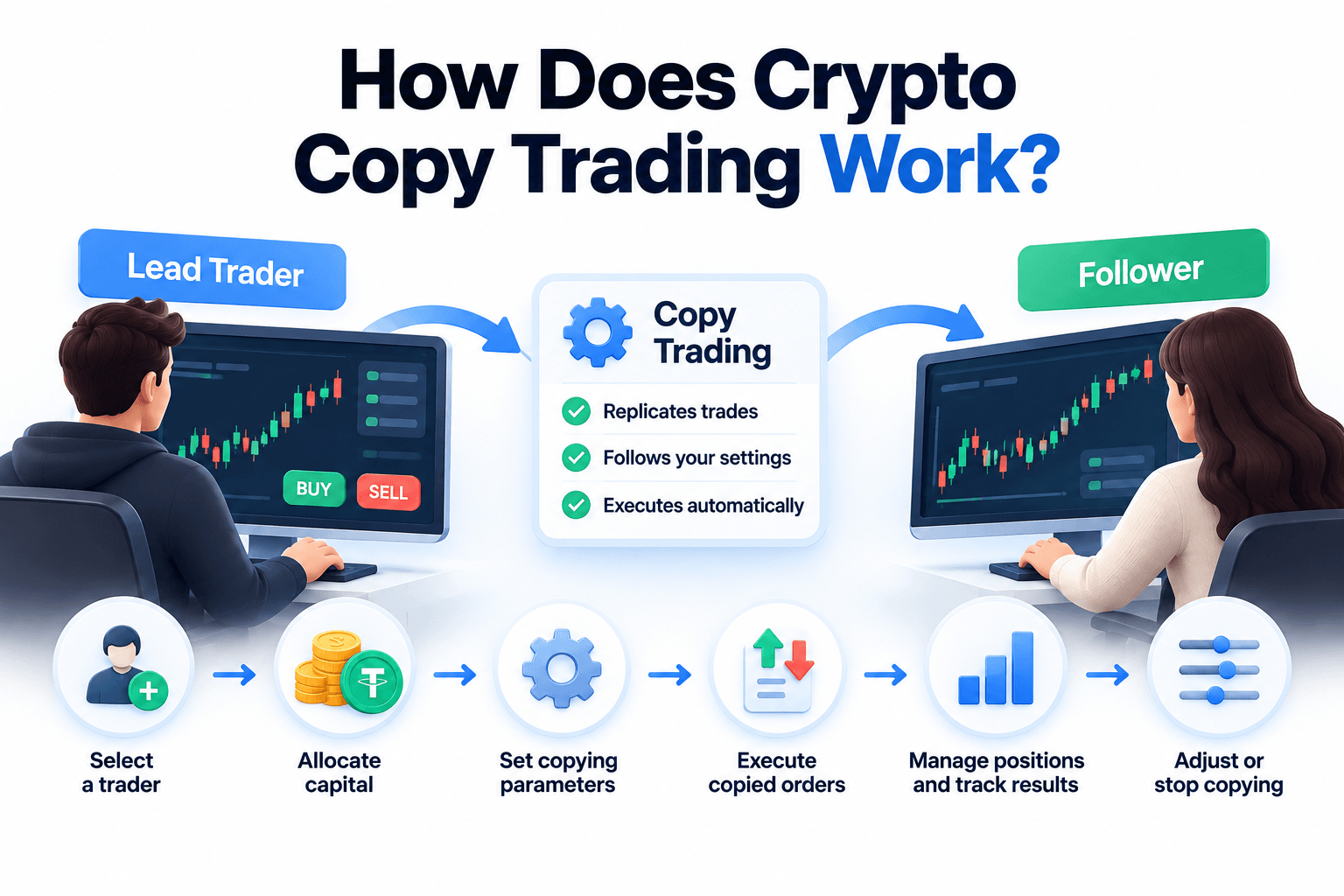 Inside The Mechanics Of Automated Crypto Trade Replication
Crypto copy trading automatically executes eligible trades from a selected lead trader in a follower's account. The follower allocates capital and chooses the supported copying settings, while the platform attempts to replicate the trader's entries and exits.
The mechanics vary between platforms because copy trading can involve direct spot purchases, leveraged derivatives, or proportional portfolio allocations.
What Happens When You Copy a Trader?
A typical copy trading relationship follows six stages:
- Select a lead trader: Review available performance records, strategy history, open positions, and profit-sharing terms.
- Allocate capital: Assign an amount to the trader or portfolio and choose the supported copying method.
- Configure trading parameters: Establish available position limits, leverage settings, stop losses, and other controls.
- Execute copied orders: The platform attempts to open corresponding positions when the lead trader executes eligible transactions.
- Manage positions and calculate results: Positions are adjusted or closed under the copying rules, with profits, losses, and applicable costs recorded in the follower's account.
- Adjust or terminate copying: The follower may change supported settings, pause copying, or end the relationship according to the platform's conditions.
Copied trades are actual transactions in the follower's account. They are subject to the same order books, market prices, and trading constraints that affect other exchange orders.
If a lead trader purchases an asset at $100, a follower might receive an execution at $100.20 because the market price changes before their order fills.
The difference can grow during volatile periods, especially when several followers copy the same trader simultaneously.
Understanding market orders and limit orders helps explain these outcomes. A market order prioritizes immediate execution, whereas a limit order specifies an acceptable price but may remain unfilled.
Automatic copying also differs from social trading and manually following signals.
Social trading allows users to observe or discuss other investors' decisions. Trade signals provide suggestions that the recipient executes independently. Copy trading automates supported execution after the follower establishes the relationship.
Spot Copy Trading vs. Futures Copy Trading
Spot and futures copying expose followers to different financial obligations.
Spot trading involves purchasing or selling the underlying cryptocurrency. Perpetual futures involve contracts that track an underlying asset's price, generally using collateral and allowing leveraged exposure.
| Comparison | Spot Copy Trading | Futures Copy Trading |
|---|---|---|
| Underlying activity | Buying and selling cryptocurrencies | Opening and closing derivatives positions |
| Leverage | Generally absent in conventional spot copying | Commonly available |
| Liquidation risk | No conventional margin liquidation for unleveraged positions | Yes |
| Funding payments | Generally none | May apply to perpetual contracts |
| Primary losses | Decline in held asset values | Contract losses amplified by leverage |
| Suitable for | Followers seeking unleveraged exposure | Experienced users familiar with derivatives |
The practical difference appears when a trade moves against the follower.
A spot portfolio holding a cryptocurrency that loses 20% of its value generally experiences a corresponding decline in that holding, before fees and portfolio adjustments.
A futures trader using 5x leverage on the same adverse price movement can suffer an approximately 100% loss relative to initial margin, before trading costs and liquidation mechanics.
Actual liquidation may occur before that point because exchanges impose maintenance margin requirements.
The margin trading system also determines how collateral is shared across positions. Isolated margin generally confines collateral exposure to one position, while cross margin can make additional account equity available.
A follower therefore needs to understand both the asset being traded and the contract structure being copied.
Fixed Amount, Fixed Ratio, and Smart Copying
Copying modes determine how the lead trader's position size is translated into a follower's account.
- Fixed Amount: Allocates a specified amount of capital or margin to each eligible copied trade.
- Fixed Ratio: Scales orders according to the trader's position size, balance, or proportional capital commitment.
- Smart Copying: Uses platform-defined synchronization rules to calculate allocations and may align margin mode, leverage, or existing portfolio holdings.
Consider a trader with a $10,000 account who commits $1,000 to a position. This represents 10% of their account balance.
A follower allocating $2,000 under a proportional method would ordinarily commit approximately $200 to the corresponding trade, subject to the product's rules.
Under Fixed Amount mode, the same follower might allocate only $50 if that is the amount configured per transaction.
Neither approach guarantees identical returns. The proportional follower may preserve more of the original strategy's relative exposure, while the fixed-amount follower maintains a more predictable margin requirement.
The choice becomes particularly consequential when the lead trader varies position sizes substantially or uses leverage.
How to Choose a Crypto Trader to Copy
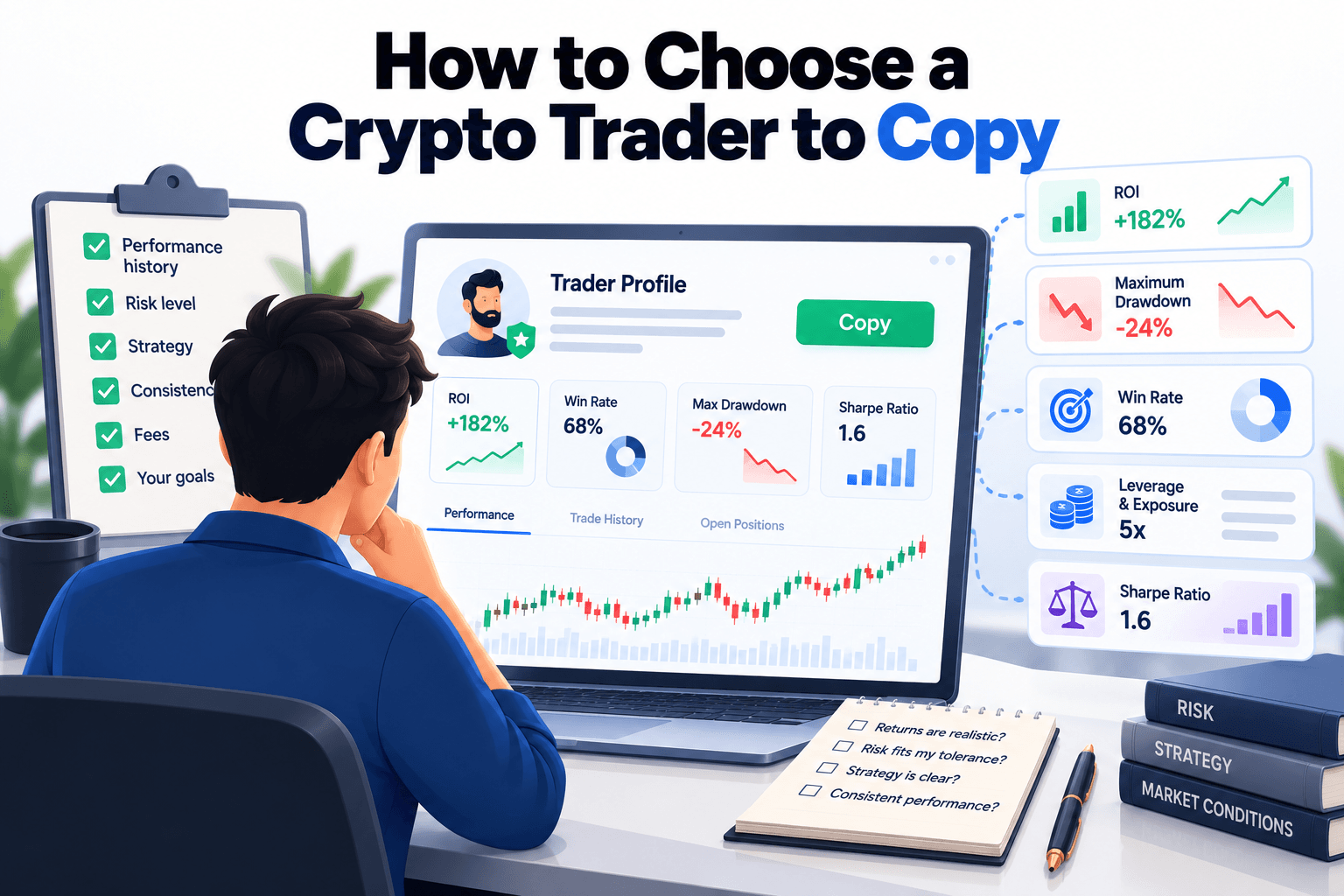 Evaluating Trader Performance Beyond Returns And Win Rates
Selecting a lead trader involves assessing how returns were generated, how much capital was exposed, and whether the trader's strategy has performed consistently across different market conditions.
The highest-ranked trader on a leaderboard may have produced exceptional returns through concentrated positions, aggressive leverage, or a brief favorable market trend.
Followers need enough performance history to separate repeatable behavior from short-term gains.
The Performance Metrics Worth Checking
Most crypto copy trading platforms publish historical returns, trading activity, and some measure of risk. These indicators should be considered together rather than ranked independently.
| Metric | What It Measures | What to Examine |
|---|---|---|
| ROI | Percentage return over a stated period | Observation period and calculation methodology |
| Maximum Drawdown | Largest recorded peak-to-trough decline | Whether the decline exceeds personal risk tolerance |
| Win Rate | Percentage of profitable trades | Average size of winning and losing transactions |
| Realized P&L | Gains or losses recognized from closed trades | Whether the closed-trade record supports reported returns |
| Unrealized P&L | Gains or losses on open positions | Whether large open losses distort the performance picture |
| Trading History | Duration and consistency of activity | Strategy changes, inactivity, and market conditions covered |
| Sharpe Ratio | Risk-adjusted return relative to volatility, where provided | Calculation period and consistency with other performance data |
| Leverage and Exposure | Aggressiveness and concentration of positions | Position sizes, collateral use, and liquidation exposure |
ROI is easier to interpret when the measurement period is known. A trader reporting 80% over one month and another reporting 80% over two years have experienced different market conditions and exposure periods.
Maximum Drawdown helps reveal the losses investors may have faced along the way. However, recorded drawdown is historical. A future decline can exceed the largest loss in the displayed record.
Win Rate requires similar scrutiny. A trader can win 90% of transactions while remaining unprofitable if the occasional loss substantially exceeds the average gain.
Realized and Unrealized P&L help determine whether the strategy depends on keeping losing positions open. If closed transactions show consistent profits while open positions carry heavy losses, the reported win rate provides an incomplete assessment.
The Sharpe Ratio, when available, offers another perspective by relating returns to volatility. It can help compare strategies with different patterns of returns, but its usefulness depends on the calculation period, quality of data, and suitability of the measure for the strategy.
A trader's use of leverage and concentration completes the picture. Two portfolios can produce similar returns while exposing followers to very different liquidation and downside risks.
Red Flags in Copy Trading Leaderboards
A strong historical record becomes less convincing when it depends on extreme position sizes or unusual trading behavior.
Some warning signs appear directly in performance statistics. Others require examining the trader's transaction history and current positions.
- Exceptional short-term returns: A brief record may reflect favorable market conditions or excessive leverage.
- High win rates with occasional large losses: Small frequent gains can be outweighed by rare severe drawdowns.
- Large unrealized losses: Open positions may conceal losses that have not yet been recognized.
- Martingale strategies: Increasing exposure after losses can exhaust margin when prices continue moving against the trader.
- Concentrated leveraged positions: Multiple trades can effectively represent one directional market bet.
- Sudden strategy changes: A trader may begin using different assets, leverage levels, or holding periods after establishing a strong leaderboard record.
- Excessive turnover: Frequent entries and exits can reduce follower performance through repeated fees and execution costs.
Consider two hypothetical traders:
| Metric | Trader A | Trader B |
|---|---|---|
| Historical ROI | 180% | 45% |
| Maximum Drawdown | 65% | 15% |
| Win Rate | 90% | 62% |
| Strategy | Highly leveraged averaging down | Moderate exposure with defined exits |
| Trading History | Two months | Eighteen months |
Trader A has the stronger headline ROI and win rate, but their strategy has already experienced a substantial decline over a short observation period.
Trader B has lower historical returns but a longer record and more controlled observed exposure. A follower who prioritizes capital preservation may find Trader B's strategy more compatible with their objectives.
Neither profile guarantees future performance.
Trader selection also has a behavioral component. Our crypto trading psychology guide examines how recent gains, loss aversion, and overconfidence influence trading decisions.
Copying a trader removes some manual execution decisions, but followers can still make costly choices when selecting, abandoning, or increasing allocations to strategies.
A Practical Trader Selection Checklist
Before following a trader, check whether the available evidence supports the investment.
- The trader has a meaningful trading history covering different conditions.
- The strategy is understandable, including its typical assets, holding periods, and leverage.
- Historical Maximum Drawdown fits the follower's risk tolerance.
- ROI, Realized P&L, Unrealized P&L, and transaction records are consistent.
- Open positions and concentration are sufficiently transparent.
- Minimum allocations, trading frequency, and profit-sharing costs suit the follower's available capital.
Following several traders does not automatically create diversification. Three portfolios holding similar leveraged Bitcoin positions can lose money together during the same market move.
A better assessment considers the relationship between positions, trading strategies, and asset exposures. Our guide to cryptocurrency portfolio risk covers diversification and position concentration in more detail.
Crypto Copy Trading Fees and Real Follower Returns
Crypto copy trading fees can materially reduce the amount a follower retains, particularly when a strategy trades frequently or pays a high percentage of profits to its lead trader.
Total costs include trading commissions, applicable funding payments, execution differences, and profit sharing. The follower's net P&L is therefore a more useful measure than the lead trader's advertised gross performance.
What Fees Do Crypto Copy Trading Platforms Charge?
Crypto copying products generally expose followers to five cost categories:
- Maker and Taker Fees: Charged whenever copied orders execute, based on the exchange's applicable fee schedule.
- Lead-Trader Profit Sharing: A percentage of eligible profits transferred to the trader or strategy provider.
- Perpetual Futures Funding: Periodic payments between long and short contract holders, depending on market conditions.
- Spreads and Slippage: Differences between quoted or expected prices and actual execution prices.
- Additional Platform Charges: Product-specific transaction, conversion, or other applicable fees where supported.
Trading commissions are generally charged on executed trading volume, while profit sharing is calculated using the product's eligible profit rules.
A strategy making frequent small trades can incur substantial commissions even if the advertised maker/taker rate appears low.
Funding payments introduce another variable. Perpetual contracts have no conventional expiration date, so funding mechanisms help align their prices with the underlying market. Depending on the funding rate and position direction, a follower may pay or receive funding.
The calculation also depends on how long the position remains open and its notional value.
Execution costs can be harder to anticipate. Slippage arises when the actual fill differs from the expected price, often because of volatility, insufficient liquidity, or order-book depth.
Followers copying popular traders may face additional competition for the same available liquidity.
The profit-sharing arrangements across the six services are summarized below.
| Platform | Copy Trading Profit Sharing | Trading and Execution Costs |
|---|---|---|
| Bitget | High-water-mark settlement for spot and futures; product-specific ratios, with private futures up to 50% | Spot/futures trading fees, funding where applicable, spreads and slippage |
| Bybit | Classic 10%–15% based on Master Trader rank | Futures trading fees, funding, execution differences |
| Binance | Spot generally 10%; futures commonly 10%–30% for eligible lead-trader tiers | Spot/futures fees, funding, order-size limitations |
| OKX | Spot up to 13%; public futures up to 30%; eligible private futures up to 50% | Standard applicable fee tier, funding, slippage |
| BingX | Spot generally 10%; futures depends on trader and product | Applicable trading fees, funding, execution restrictions |
| eToro | No separate CopyTrader profit share | Asset-specific trading fees and spreads |
High-water-mark and loss-recovery rules also affect settlement.
Under Bitget's high-water-mark system, previously settled profits are excluded from subsequent profit-sharing calculations. A follower who loses money after an earlier profitable period must first recover the relevant losses before new profit sharing becomes payable under those rules.
Other services may offset profits and losses within a defined settlement cycle.
These mechanisms should be examined before comparing headline profit-sharing percentages. A lower percentage does not necessarily produce a lower total cost if the strategy trades more frequently or receives worse executions.
For a wider comparison of maker/taker pricing, our lowest-fee crypto exchanges guide examines how trading frequency, spreads, and other charges affect actual costs.
How Fees Affect Actual Copy Trading Profits
Consider a hypothetical follower allocating $1,000 to a copy trading strategy.
Suppose the copied trades generate $120 in gross profit before trading fees and funding costs.
The follower then incurs $8 in trading fees, $4 in net funding costs, and $6 in execution costs.
| Calculation | Amount |
|---|---|
| Initial allocation | $1,000 |
| Gross Trading P&L | +$120 |
| Trading fees | -$8 |
| Funding costs | -$4 |
| Execution costs | -$6 |
| Profit before sharing | $102 |
| Illustrative 10% profit share | -$10.20 |
| Net Follower Profit | $91.80 |
| Net Return on Allocation | 9.18% |
The calculation is:
Gross Trading P&L − Trading Fees − Funding Costs − Execution Costs − Applicable Profit Share = Net Follower P&L
The strategy generated a 12% gross return on the initial allocation. After costs, the follower retained 9.18%.
That leaves $28.20 of the original gross profit consumed by fees and execution costs.
This example assumes a 10% share of eligible profits after the listed costs. Individual platforms calculate eligible P&L and settlement deductions differently.
The effect can be more pronounced for high-turnover strategies. A trader who repeatedly enters and exits positions may generate impressive gross gains while losing a substantial portion to trading commissions, spread costs, and funding.
Why Your Copy Trading Returns May Differ From the Lead Trader's
Follower and lead-trader returns can differ even when both accounts trade the same asset in the same direction.
Suppose a lead trader purchases Bitcoin at $90,000 and sells at $94,500.
The underlying price movement produces a 5% gain.
A follower's purchase might execute at $90,450, while their exit occurs at $94,300.
The follower's gross price gain is approximately 4.26%, before additional applicable fees and profit sharing.
On a $1,000 unleveraged exposure, that represents roughly $42.56 in gross profit.
After $2 in trading fees and a hypothetical 10% share of the remaining eligible profit, the follower retains approximately $36.50, equivalent to a 3.65% return.
The lead trader obtained a 5% gross price gain from the underlying movement. The follower retained 3.65% after the assumed costs.
Several mechanisms can create this gap:
- Different entry and exit prices.
- Slippage during fast-moving or thin markets.
- Missed, delayed, or partially executed copied orders.
- Different position sizes and leverage settings.
- Orders falling below minimum contract or trading sizes.
- Joining a trader after existing positions have already been opened.
- Different funding payments, fee tiers, and profit-sharing arrangements.
Execution divergence can become larger when followers have small balances or when the lead trader trades illiquid contracts.
For this reason, lead-trader ROI is useful for reviewing historical strategy behavior, while follower ROI records the outcome actually achieved in the follower's account.
Crypto Copy Trading Risks and How to Manage Them
Crypto copy trading carries market, execution, custody, and platform risks. Automation allows followers to replicate trading decisions without manually entering each order, but it also means those decisions can affect the follower's capital immediately.
Loss controls should be configured before copying starts, particularly when leveraged futures are involved.
The Biggest Risks of Copy Trading
The following risks have different causes and require different responses.
| Risk | Possible Consequence | Available Mitigation |
|---|---|---|
| Leverage and liquidation | A small adverse market move can consume margin and trigger forced position closure | Limit leverage, exposure, and collateral at risk |
| Lead-trader losses or strategy changes | A previously profitable strategy begins generating losses | Monitor current positions, behavior, and performance |
| Slippage and failed orders | Follower positions differ from the trader's intended execution | Review fill records and configure supported slippage limits |
| Correlated strategies | Several copied portfolios lose money simultaneously | Diversify by strategy and underlying exposure |
| Exchange outages or custody failure | Trading or withdrawals become unavailable | Limit exchange-held balances and evaluate operational safeguards |
| Misleading performance histories | Followers underestimate drawdown or exposure | Examine open positions and long-term records |
| Product or pair restrictions | Orders cannot be copied or managed under the original setup | Confirm supported markets and current contract rules |
Leverage deserves particular scrutiny because its effect depends on position exposure relative to margin. A trader using 10x leverage can experience an approximately 10% margin loss from a 1% adverse price movement, before fees and other adjustments.
Liquidation risk increases as remaining margin approaches maintenance requirements.
Followers also face strategy risk. A trader may begin increasing leverage, averaging down, or concentrating positions after establishing an attractive historical record.
The platform will generally continue attempting eligible copies according to the selected settings, even if the trader's behavior changes.
Execution risk operates separately. A follower may be unable to open a position because of minimum order requirements or may close at a worse price during a volatile market.
The same order-handling concerns affect conventional derivatives exchanges, particularly when leverage and thin order books combine.
A platform can maintain strong account controls and publish Proof of Reserves while still allowing users to lose funds through unsuccessful copied trades. Reserve disclosures concern certain aspects of the exchange's asset position, while liquidation is determined by trading exposure and margin.
Risk Controls to Check Before Copying
Followers should establish limits around total capital, individual positions, and acceptable losses before activating copying.
The first decision is how much money to allocate.
Someone with $10,000 in total trading capital might assign only $500 to one copied strategy, rather than making the entire balance available to that trader.
Position controls then determine how the allocated funds can be used.
- Maximum Allocated Capital: Establishes the total amount assigned to the copied strategy.
- Maximum Position Size: Restricts how much margin or exposure one position can consume.
- Portfolio Stop Loss: Sets a portfolio-level loss condition that can trigger copying termination or position closure according to the platform's rules.
- Take-Profit and Stop-Loss Orders: Define exit conditions for individual supported positions.
- Leverage Limits: Restrict the amount of market exposure generated from available margin.
- Margin Mode: Determines whether positions use dedicated collateral or a shared margin balance.
- Slippage Tolerance: Restricts acceptable execution-price differences, potentially resulting in rejected orders.
- Pause and Stop-Copy Controls: Allow followers to suspend new copying or end the relationship under applicable rules.
- Strategy Diversification: Reduces concentration across traders employing similar market exposures.
A stop-loss setting does not guarantee execution at the selected price. During sudden price movements, available liquidity may produce a worse fill.
Likewise, tighter slippage limits may prevent unfavorable entries while causing more copied orders to fail.
The follower needs to balance execution reliability against acceptable pricing.
Our guide to crypto technical analysis explains how position sizing, price invalidation, and stop placement can be incorporated into a trading plan.
Before You Start Copying
- Set a maximum capital allocation.
- Review the trader's leverage and open positions.
- Configure available portfolio and trade-level loss controls.
- Confirm whether existing positions are copied.
- Calculate trading fees, funding, and profit sharing.
- Understand what happens when copying is paused or terminated.
Security and Regional Availability
Most centralized copy trading platforms keep follower funds within exchange-controlled accounts or designated copy trading subaccounts.
Lead traders typically control which transactions their followers copy rather than receiving direct permission to withdraw follower balances.
However, keeping funds on a centralized exchange introduces custody, account-access, and operational risks.
The distinction between an exchange account and a self-custody wallet is relevant here. Exchange balances depend on the exchange's custody system, whereas self-custody gives users direct control over their private keys.
Followers should enable supported two-factor authentication, withdrawal restrictions, device controls, and other available account security protections.
Long-term holdings that are not needed for copying can be stored separately. Hardware wallets are one option for keeping signing keys outside an internet-connected trading account.
Regional restrictions also affect which products followers can use.
| Platform | Key Eligibility Consideration |
|---|---|
| Bitget | Excludes certain jurisdictions, including the U.S.; copy products may have separate restrictions |
| Bybit | Global restrictions include the U.S., Canada, and other excluded regions |
| Binance | Binance.com copying is region-dependent and is unavailable through Binance.US |
| OKX | Published copy trading exclusions include the U.S., UK, Canada, and several other markets |
| BingX | Restricts users in several jurisdictions, including the U.S., UK, and Canada |
| eToro | CopyTrader has country-specific availability; U.S. copying is crypto-only and excludes certain states |
Users in the UK, EU, and other regulated markets should examine the specific exchange entity and product available to them.
Access to an exchange's ordinary spot market does not automatically establish permission to copy leveraged perpetual futures.
Identity verification may also be required before a user can access supported copying features.
Finally, users should verify that they are accessing the exchange through an authentic domain or application. Impersonation websites and fraudulent investment managers are common patterns covered in our crypto scams guide.

How We Evaluated the Best Crypto Copy Trading Platforms
We evaluated these platforms using their actual copy trading products rather than their overall exchange popularity, general trading volumes, or unrelated financial services.
The comparison examines product documentation, fee schedules, copying mechanisms, available trader analytics, and published follower controls as of Oct. 14, 2026.
Our Evaluation Criteria
Our framework assigns 80% of the evaluation to four areas directly affecting the copying experience: trader transparency, execution controls, costs, and risk management.
| Criterion | Weight | What We Evaluated |
|---|---|---|
| Trader Transparency and Analytics | 20% | Historical returns, drawdown, position visibility, and trading records |
| Copying Mechanisms and Execution Controls | 20% | Copy modes, allocation methods, order handling, and follower settings |
| Fees and Total Copying Costs | 20% | Trading commissions, funding payments, profit sharing, and execution costs |
| Risk Management | 20% | Leverage restrictions, position limits, stop losses, and allocation controls |
| Security and Reliability | 10% | Account protection, custody arrangements, and operational transparency |
| Ease of Use | 10% | Trader discovery, setup requirements, and portfolio management |
| Total | 100% |
The assessment distinguishes three forms of information:
- Officially Documented Features: Published copying modes, fee structures, minimums, settlement rules, and available account controls.
- Platform-Reported Performance: Leaderboard ROI, drawdown, P&L, and other statistics generated within each service.
- Live Execution Results: Actual copied fills, measured slippage, platform uptime, and follower net returns observed through controlled testing.
This comparison relies on the first two categories. We did not carry out a standardized funded copy trading experiment across all six platforms.
Consequently, the recommendations reflect a transparent, criteria-based editorial assessment rather than numerical scores derived from independently measured execution performance.
For readers evaluating the behavior of individual strategies, our guide to common copy trading mistakes covers errors involving trader selection, allocation, and performance monitoring.
Which Crypto Copy Trading Platform Should You Choose?
 Matching Copy Trading Platforms To Different Investor Needs
Bitget is our strongest overall recommendation for users who want several copy trading products in one place. Its spot, futures, and bot-copying options provide a wider choice of strategies, while the separate product rules allow followers to select the type of exposure they want.
Bybit is the stronger specialist choice for futures-focused users who understand leverage, funding, and liquidation. Its Smart Copy and Advanced Copy methods offer useful alternatives for managing copied positions.
Binance on the other hand, remains convenient for eligible existing users who want copying integrated into their exchange account. OKX is well suited to followers who prefer automated proportional allocations, while BingX offers more flexibility between position-ratio and fixed per-order copying.
For unleveraged spot copying, Bitget and Binance are sensible candidates to compare. Their spot products avoid conventional leveraged futures liquidation while retaining exposure to cryptocurrency price declines.
eToro is the better fit for eligible investors interested in multi-asset portfolio replication. Its virtual portfolio also provides a way to practice before committing real funds, although product access differs between jurisdictions.