



ROI / Return History
Check multiple time windows, not a single spike. One great month can be luck.
Bybit’s copy trading is no longer a single switch you flip and forget. In 2026, it’s a small lineup of products that can help you mirror crypto traders, allocate to managed strategy-style products, or copy traders in traditional markets through an MT5-style setup. That variety is useful, but it also makes it easier to pick the wrong mode or misunderstand the risks.
This guide is here to do the sorting for you. It will break down Classic vs Pro vs TradFi, explain what you’re actually copying in each mode, and walk through the fees, minimums, and the key settings that matter before you follow anyone.
Editor's Note (March 11, 2026): We fully updated this review in March 2026 to reflect how Bybit Copy Trading works today, including the addition of Classic, Pro, and TradFi copy trading modes, updated minimums, current fee structure, risk considerations, and clearer guidance on how followers should evaluate traders, drawdowns, and execution differences before copying.
Bybit copy trading is a set of tools that lets you follow traders across multiple modes, including Classic, Pro, and TradFi copy trading. It is best suited to users who want structured copy trading inside a major centralized exchange, with built-in trader discovery and execution in one place. For most followers, the practical starting point is Classic, where Bybit states a general minimum copy amount of 100 USDT (a Master Trader may set a higher minimum). The key tradeoff is convenience and selection versus platform and product complexity, plus follower risk from execution differences, fees, and the possibility of losses.

Bybit copy trading is a set of tools that lets you follow traders in different ways. Some modes mirror positions directly. Others work more like allocating capital to a strategy product.
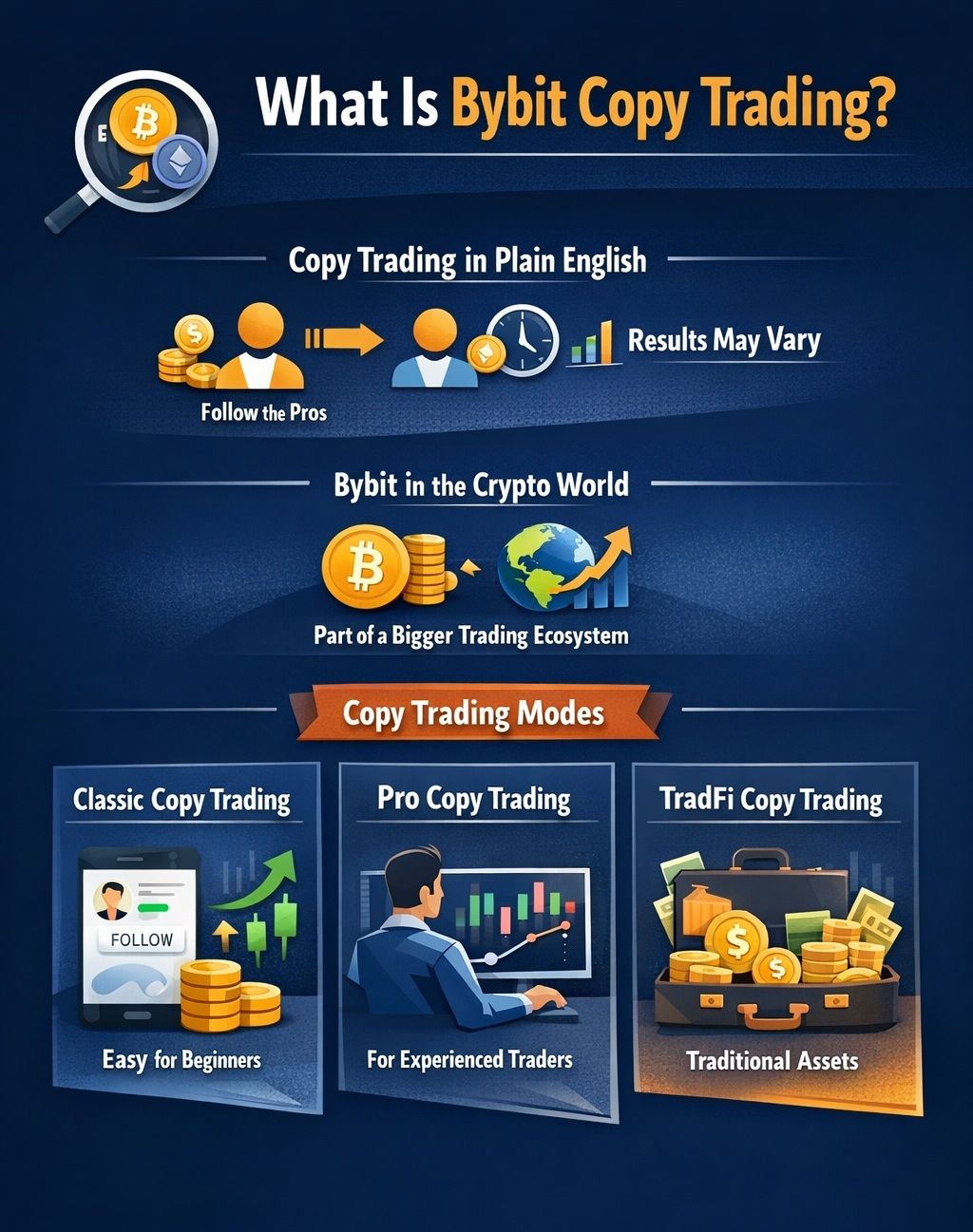 Bybit Copy Trading is a Set of Tools That Lets You Follow Traders in Different Ways
Copy trading means your account replicates another trader’s actions. The trader you follow is the Master Trader, and you are the Follower.
A key detail is that results are rarely identical, even when you copy the same trader, because timing, liquidity, slippage, and position sizing can all change what actually gets filled in your account. In the Copy Trading Classic FAQ, Bybit notes that followers can see different entry prices, partial fills, or failed copies in fast markets, which can create a gap between the Master’s displayed stats and a follower’s realized performance.
If you want a broader picture on copy trading, take a look at our guide on Top Crypto Copy Trading Platforms.
Bybit is a large centralized exchange where copy trading is only one feature among spot, derivatives, and other trading tools.
If you want the broader exchange assessment, head over to our full Bybit review.
Bybit copy trading is not a single product. It’s three main modes, with different use cases:
Classic Copy Trading: The most direct “mirror positions” experience.
Pro Copy Trading: A share-based managed strategy structure that looks closer to allocating to a strategy product.
TradFi Copy Trading: Copy trading for traditional markets like forex, commodities, and indices in an MT5 environment.
This is the most important section in the article, because many “copy trading reviews” talk as if there’s only one Bybit product. There isn’t.
| Product Type | What You’re Copying | Best For | Key Risk/Tradeoff | Platform/Execution Environment | Profit Share / Fee Notes |
| Classic Copy Trading | A Master Trader’s positions mirrored into your account | Most crypto-native users who want the simplest start | Execution mismatch can cause different fills and results | Bybit crypto environment | Fees follow the underlying trading product; profit sharing depends on Master tier. |
| Pro Copy Trading | Shares in a strategy run by a Pro Master | Users who prefer a packaged strategy format | More product rules, less “trade-by-trade” transparency | Share/NAV-based strategy product | Profit sharing uses a high-water mark concept; Pro Masters set the profit share rate. |
| TradFi Copy Trading | TradFi strategies (forex, commodities, indices) | Users comfortable with a TradFi workflow and broader markets | Different market hours, platform UX, and risk profile | MT5 environment | Profit share uses high-water mark logic; minimum is stated in USDx. |
Classic is the “standard” copy product. You pick a Master Trader, set your investment amount and risk controls, and the system copies the Master’s positions into your account.
In practice, Classic also intersects with Bybit’s automation ecosystem. Depending on what a Master Trader is running, you may be copying a discretionary trader, a systematic approach, or an approach that leans on bots for execution and position management. The takeaway is not that bots are “good” or “bad,” but that automation can increase trade frequency, which can make fees and slippage matter more.
The Classic mode is the easiest to understand, but it can also be the easiest to overtrust. Bybit stresses that follower outcomes can differ due to slippage and execution limits, especially during volatility.
Classic is also the mode where leverage risk can quietly dominate outcomes. If a Master is trading USDT perpetuals aggressively, a follower can experience sharp drawdowns even if the strategy eventually recovers.
Pro Copy Trading is a different idea. Instead of mirroring every position, you allocate to a strategy product where you hold shares and the strategy has a net asset value.
Bybit’s Key Rules for Copy Trading Pro lays out how Pro strategies work, including subscription and redemption windows, lock-up phases, and termination rules. If Classic feels like “I’m following trades,” Pro feels more like “I’m investing into a strategy with rules.”
This can be appealing if you want a cleaner mental model of “allocation” rather than watching a stream of copied trades. It can also be a downside if you prefer transparency and immediate control.
TradFi Copy Trading is aimed at users who want exposure to traditional markets like forex and commodities through a MetaTrader workflow, then layer copy trading on top.
This isn’t the default path for most crypto-native beginners, but it can suit users who want broader market exposure and are comfortable using a TradFi-style terminal.
The biggest practical difference is that TradFi markets have market hours. You are no longer in a 24/7 crypto-only environment, and that changes how risk shows up. Weekend gaps and session opens become part of the story.
Bybit’s setup process is not complicated, but you can make it safer or riskier depending on how you configure it.
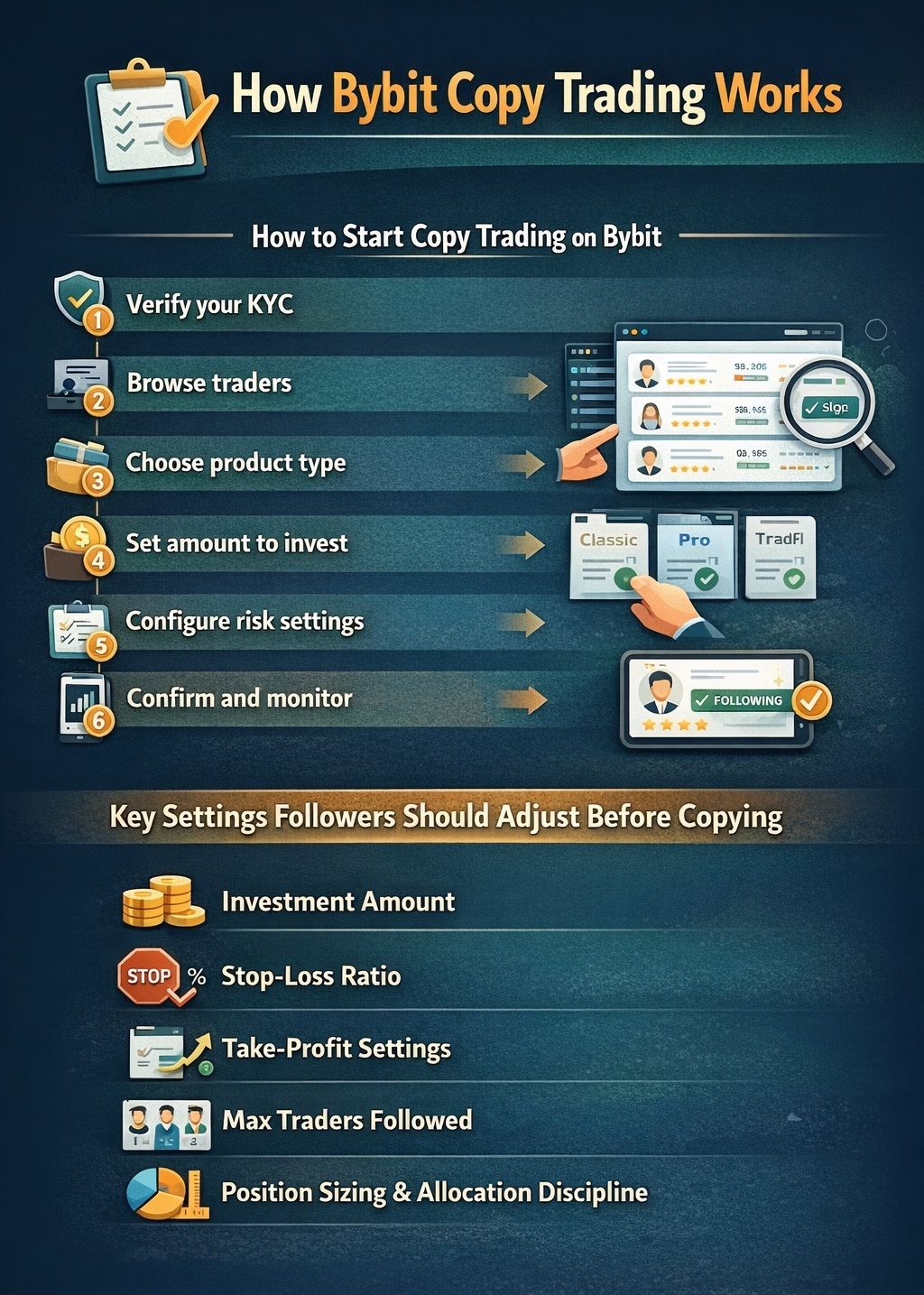 Bybit’s Setup Process is Not Complicated, but You Can Make It Safer or Riskier
Here’s the practical flow, compressed:
Complete KYC if required. Copy Trading Classic FAQ states Classic copy trading requires KYC.
Browse traders and open profiles to view the stats that matter, not only ROI.
Choose the mode (Classic vs Pro vs TradFi) before choosing the trader.
Set an investment amount and confirm it meets the product minimum.
Configure risk settings before you start copying.
Monitor and review whether the trader still matches your risk tolerance.
This is where followers can add discipline without becoming full-time traders.
Investment amount: Decide your copy trading budget up front. If you’re unsure, start small and scale slowly.
Stop-loss ratio or equity stop: Treat this as a circuit breaker for your copy allocation.
Take-profit settings: Useful if you want to lock in gains and avoid giving everything back during a bad regime.
Maximum number of traders followed: More traders can reduce single-trader risk, but too many can create a messy, correlated portfolio.
Position sizing discipline: Avoid allocating in a way that forces you into constant emotional decisions.
If you’re new to copy trading conceptually, Coin Bureau’s What Is Copy Trading is a solid primer on the benefits, limitations and common traps.
This section is deliberately specific. Copy trading is often marketed on returns, but follower outcomes are usually decided by a smaller set of boring realities: fee drag, funding, execution quality, and risk controls.
Follower returns are net of fees and can also differ due to execution. The most common mistake is to assume a Master’s displayed stats will map 1:1 to your account.
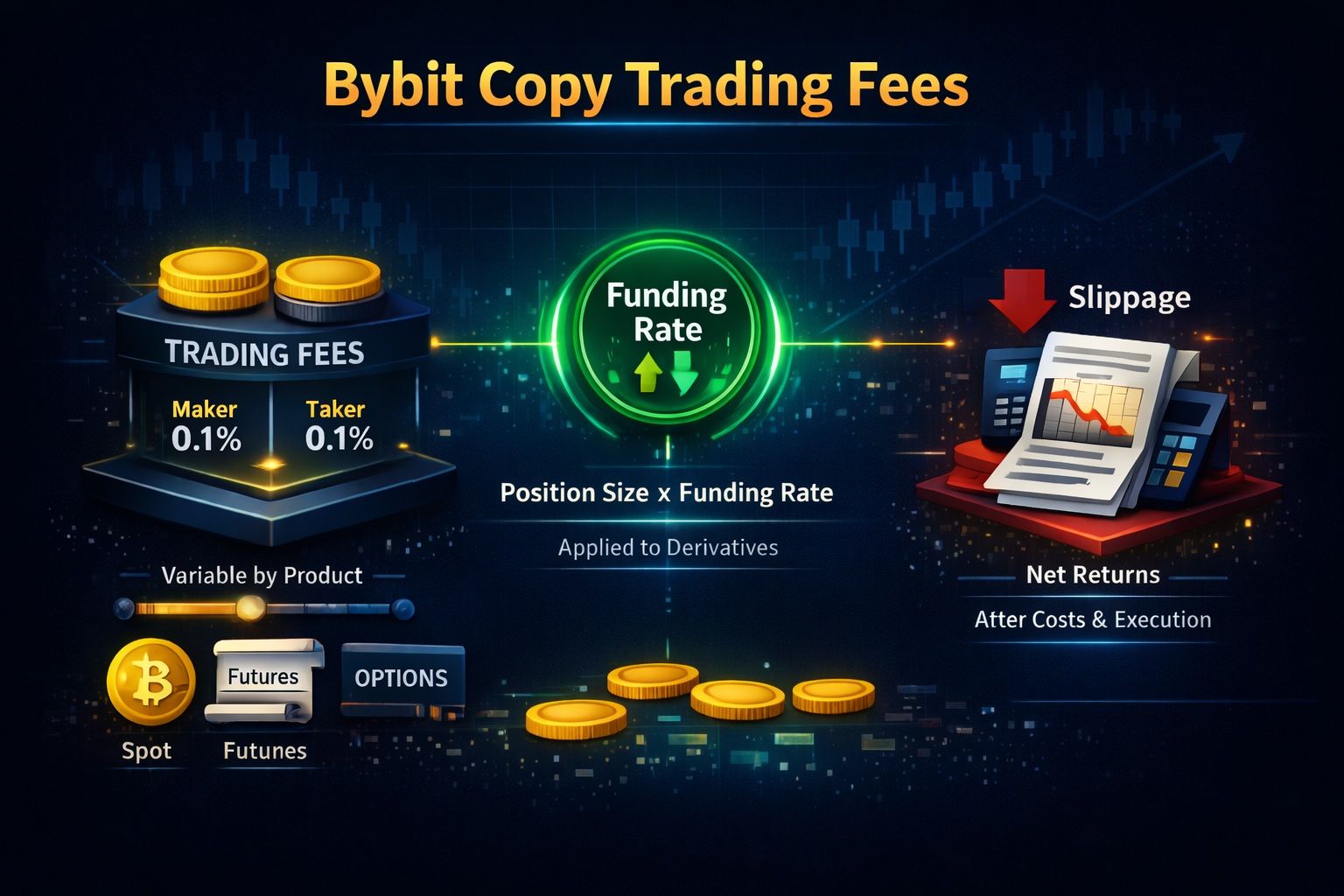 Copy Trading Fees, Funding, and Slippage at a Glance
Trading fees
Bybit publishes non-VIP fee rates in its fees section. The key reference rates listed there include:
Spot trading: 0.1% maker, 0.1% taker
Perpetual and futures trading: 0.02% maker, 0.055% taker
Options trading: 0.02% maker, 0.03% taker
Those are reference VIP 0 rates. Your actual rate can change with VIP tier and product category.
Fee rates vary by product and tier
Bybit maintains a more granular matrix of product-by-product fees in its Trading Fee Structure.
Funding fees for derivatives (formula is fixed, rate varies)
Funding is not a single fixed percentage. The funding rate changes by contract and market conditions. What is consistent is how funding is calculated. Bybit defines this in Funding Fee Calculation as position value multiplied by the funding rate.
A practical caution about “net” results
Even when you mirror the same Master, follower P&L can diverge because of slippage and timing differences. Copy Trading Classic FAQ highlights this as a real issue during fast markets, which is why follower performance should be interpreted as “net outcome after execution,” not as “the Master’s chart pasted onto my account.”
Profit sharing is the core incentive for Masters. If followers profit, Masters receive a percentage share. If followers don’t profit, there’s no “profit share” taken on a loss. Bybit explains the mechanics in Copy Trading: Profit Sharing Explained, including the idea that the profit-sharing ratio varies by Master tier.
For Pro strategies, the profit-sharing model is described separately in Copy Trading Pro: Profit Sharing Explained, including the high-water mark concept, which is meant to avoid charging profit share again until the strategy exceeds its prior NAV peak.
Bybit publishes a tier structure for Classic Master Traders.
| Tier | Profit Share | Min Assets | Follower Profit Requirement | Max Drawdown Requirement |
| Cadet | 10% | 100 USDT | None listed | None listed |
| Bronze | 10% | 200 USDT | 50 USDT (7-day cumulative follower profits) | None listed |
| Silver | 12% | 1,000 USDT | 1,000 USDT (7-day cumulative follower profits) | 30% (7-day max drawdown) |
| Gold | 15% | 10,000 USDT | 10,000 USDT (7-day cumulative follower profits) | 15% (7-day max drawdown) |
Copy trading minimums vary by mode and can be increased by the Master you follow.
Classic: Bybit states a general follower minimum of 100 USDT in the Classic follower guide.
TradFi: Bybit states that TradFi follower investment minimum is 100 USDx, and also lists the maximum as 1,000,000 USDx.
Pro: Minimums are strategy-defined and are tied to the rules and constraints in Key Rules for Copy Trading Pro, so treat any “minimum” you see as a strategy setting rather than a universal rule.
Picking a Master Trader is the most important decision you’ll make in copy trading. The goal is not to find the highest ROI on the leaderboard. It’s to find a risk profile and trading style you can stick with through drawdowns.
Copy trading has real utility, but it also has real failure modes. Treating it as a shortcut to profit is the fastest way to use it badly.
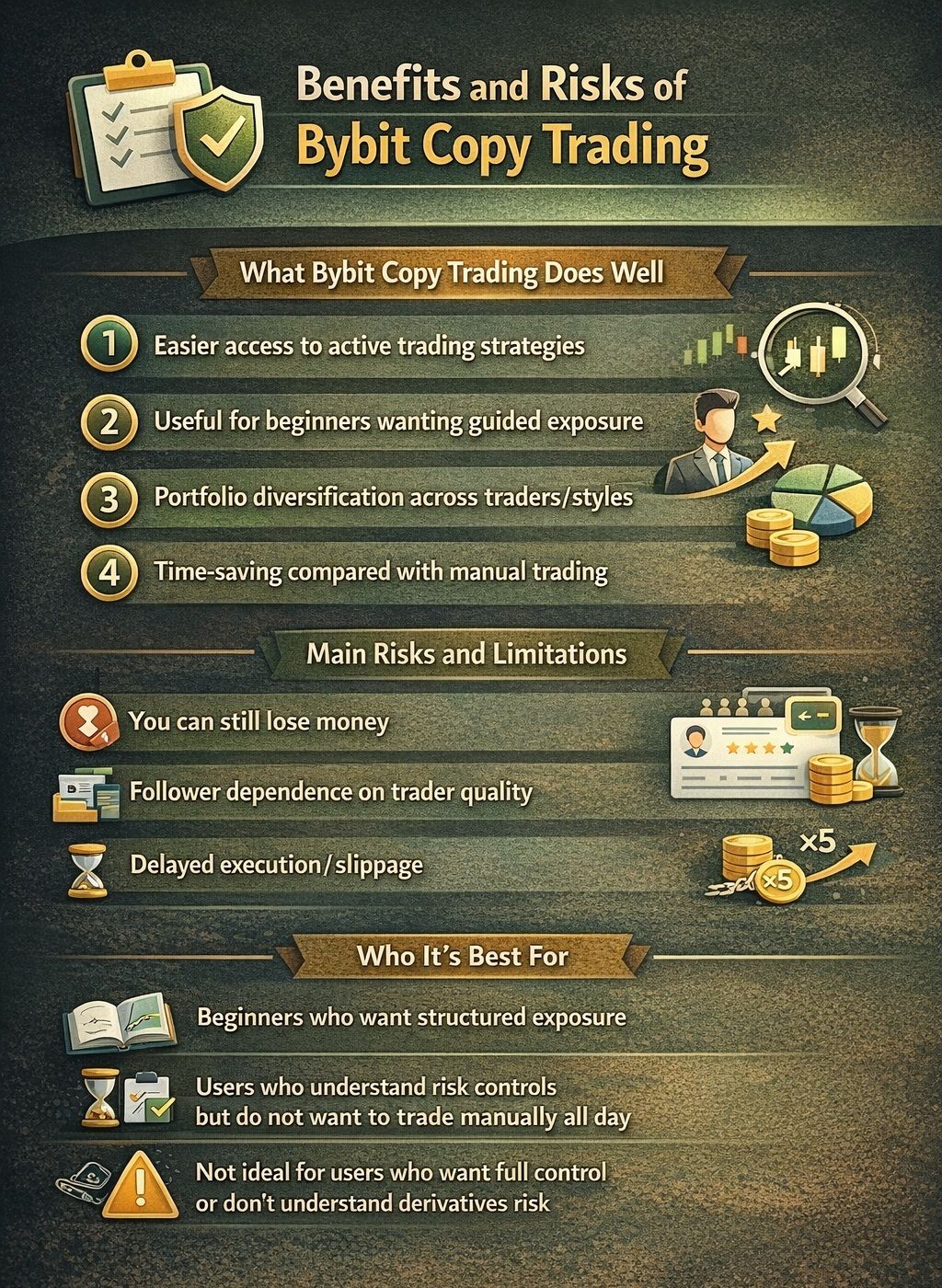 Copy Trading Has Real Utility, but It Also Has Real Failure Modes
Keep it practical and platform-relevant:
Easier access to active strategies without building a full trading workflow.
Useful for beginners who want guided exposure and a way to observe strategy behavior.
Diversification across traders and styles when used intentionally.
Time-saving compared with manual trading and constant monitoring.
Copy trading risk does not disappear. It changes shape.
You can still lose money. Copying does not protect you from market moves.
Follower dependence on trader quality. Strategy edges can decay.
Execution gaps and slippage. Copy Trading Classic FAQ explains followers can get different results due to execution.
Leverage risk. High leverage can lead to liquidation and fast drawdowns.
Limited control. You can stop copying, but you are outsourcing decisions.
Strategy mismatch. A trader’s temperament may not match yours.
Overexposure to one trader or style. Concentration risk is still concentration risk.
If you do not understand derivatives and liquidation mechanics, avoid copying strategies that use high leverage. That one choice is responsible for most copy trading blowups.
Bybit copy trading tends to fit:
Beginners who want structured exposure and are willing to use risk controls.
Users who understand basic risk management but don’t want to trade manually all day.
Not ideal for users who want full control, or who don’t understand derivatives risk.
If you want a deeper foundation on position sizing, stop-loss discipline, and diversification, Coin Bureau’s risk management guide maps well to how followers should think about copy trading.
“Safe” needs two separate answers, and confusing them is where many users go wrong.
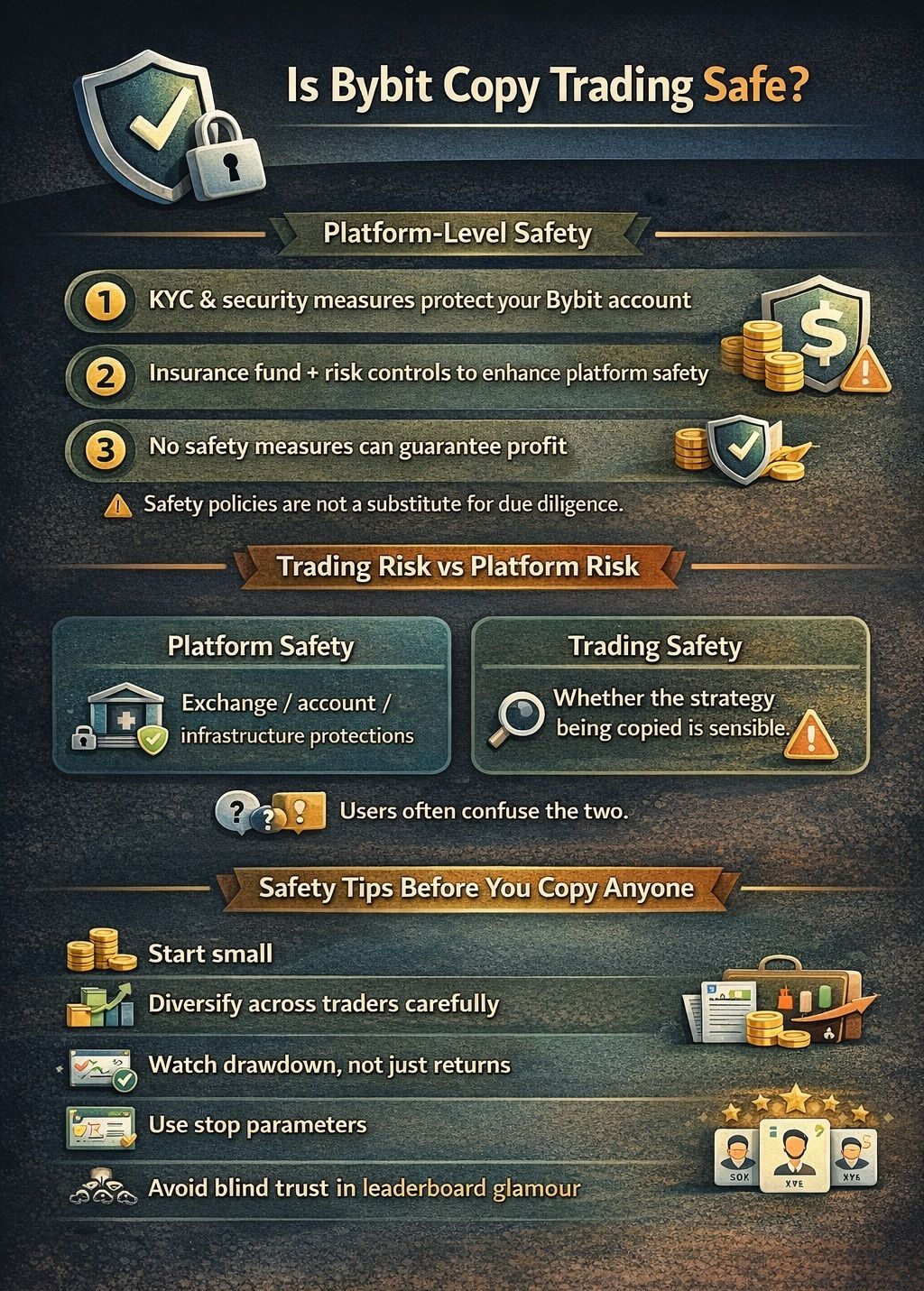 Copy Trading is Safe, but It Can Still Lose Money Fast, Especially With Leverage
Platform-level safety is about the exchange, your account protections, and the guardrails around trading. On the compliance side, Bybit’s Copy Trading Classic FAQ states that Classic copy trading requires KYC, which means you may need to complete verification before you can follow traders.
On the risk-control side, Bybit also operates an insurance fund for certain derivatives products, designed to help manage specific loss scenarios during liquidations. This is a platform mechanism, not a profit guarantee, and it does not make copied strategies “safe” by default.
It’s also important to acknowledge that centralized exchanges can be targeted. The FBI’s public service announcement on the Bybit theft is a reminder that custody and counterparty risk are real considerations when funds are held on an exchange. If you want a broader exchange-level safety discussion beyond copy trading, the Coin Bureau piece Is Bybit Safe In 2026 covers that bigger picture.
If you want a Coin Bureau-style exchange safety discussion rather than a product-only view, Is Bybit Safe In 2026 covers the broader security framing.
This is the distinction most followers miss:
Platform safety means the exchange, your account, and operational safeguards.
Trading safety means whether the strategy you’re copying is sensible for your goals and risk tolerance.
Users often confuse the two. A secure platform can host dangerous strategies. A sensible strategy can still lose money.
These steps improve safety without turning copy trading into a second job:
Start small and treat the first month as research.
Diversify carefully across different styles, not just different names.
Watch drawdown, not just ROI.
Use stop parameters as a hard circuit breaker.
Avoid leaderboard glamour. High short-term ROI often equals high short-term risk.
Not financial advice. Copy trading involves significant risk, including the risk of total loss, especially with leverage. Holding funds on a centralized exchange can also involve counterparty and custody risk.
This is intentionally compact. It’s meant to satisfy comparison intent without becoming a separate universe.
| Platform | Product Types | Minimum Copy Amount | Best For | KYC | Notable Limitation |
| Bybit | Classic, Pro, TradFi | Classic generally 100 USDT | Users who want multiple copy modes inside a major exchange | Required for Classic | Execution differences can cause follower outcomes to diverge from Master stats. |
| Bitget | Futures copy trading | 50 USDT | Users who want a lower minimum to test | Identity verification framework | Small allocations can make fees and slippage matter more. |
| Binance | Futures copy trading | 10 USDT default | Users who want a large copy marketplace | Identity verification applies for full access | Portfolio rules and minimum order sizes can cause partial closes to fail for small followers. |
Bitget states a 50 USDT minimum in its futures copy trading guide, and Binance states a default 10 USDT minimum in its Binance Futures copy trading FAQ.

Bybit copy trading is strongest if you want copy trading inside a large exchange ecosystem and you value trader discovery plus multiple modes. It gives you a clear path to start with a straightforward “mirror trades” setup, while still offering alternatives for users who prefer a more strategy-allocation format or want access to traditional markets through an MT5-style workflow.
The biggest improvement over older reviews is recognizing that “Bybit copy trading” is broader than one Classic-style product. Choosing the right mode first is not a detail, it’s the foundation, because it determines what you’re actually copying, how fees apply, and how much control you have.
After that, your results will be driven less by the platform’s branding and more by your trader selection and risk controls. In copy trading, survivability beats headline ROI, and the followers who do best are usually the ones who start small, watch drawdowns closely, and scale only when a strategy proves it can hold up over time.

With 13 years of experience as a writer and editor, I’m bringing my storytelling instincts into the fast-moving world of crypto. I’m actively expanding my knowledge in this space, translating complex ideas into clear, engaging narratives that resonate with readers. When I’m not shaping content, you’ll likely find me on the cricket pitch or the football field.
Get exclusive access to premium content, member-only tools, and the inside track on everything crypto.