



Blockchain interoperability is the infrastructure that lets separate blockchain networks exchange assets, data, and instructions instead of operating like sealed systems.
Wrapped Bitcoin is one of the most practical examples of crypto interoperability. It lets Bitcoin holders put their BTC to work in Ethereum’s DeFi ecosystem without selling it. That simple mechanism shows why interoperability is so important in Web3: value exists across many blockchains, but users and applications still need those networks to function as one connected system.
In this guide, we’ll explain what blockchain interoperability actually means, how cross-chain communication works, which trust models different systems rely on, and where liquidity fragmentation and execution risk become serious concerns. Cross-chain systems can expose users to volatility, leverage risk, counterparty and custody risk, smart contract risk, and settlement risk.
Editor's Note (April 30, 2026): We fully updated this article in April 2026 to reflect how blockchain interoperability has evolved beyond basic token bridges. The refresh includes a clearer definition-first structure, updated examples such as WBTC, Cosmos IBC, Polkadot XCM, Chainlink CCIP, Optimism Superchain, and Polygon AggLayer, plus expanded coverage of cross-chain messaging, trust models, solver networks, shared security, wallet abstraction, and chain abstraction. We also added a stronger risk framework covering bridge exploits, smart contract vulnerabilities, liquidity fragmentation, MEV, settlement delays, and execution risk, along with a cleaner comparison of blockchain interoperability, cross-chain systems, and multi-chain deployments.
What Is Blockchain Interoperability?
Blockchain interoperability is the framework that helps independent blockchains communicate, transfer value, share data, and coordinate actions across Web3. It supports cross-chain transfers, messaging, smart contract interactions, shared security, and chain abstraction without requiring every network to operate as one chain.
Key Takeaways on Blockchain Interoperability
-
Interoperability connects separate blockchains It allows different networks to share assets, data, messages, and instructions without forcing every chain into one unified system.
-
WBTC is a simple real-world example Wrapped Bitcoin lets BTC holders use Bitcoin value inside Ethereum DeFi, although it relies on a wrapped-asset and custody model rather than native Bitcoin movement.
-
Interoperability is more than bridging Modern systems include cross-chain messaging, smart contract calls, shared security, liquidity routing, token standards, and wallet abstraction.
-
Trust models vary widely Custodial bridges, MPC bridges, optimistic bridges, ZK bridges, light-client systems, and solver-based models all make different security trade-offs.
-
Verification is the hard part The key question is not only whether a message moves between chains, but how the destination chain verifies that the source-chain event really happened.
-
Liquidity fragmentation remains a major issue The same asset can exist in several native, wrapped, or bridged forms across different chains, creating slippage, routing, and redemption problems.
-
Cross-chain UX is improving Chain abstraction, account abstraction, smart wallets, and solver networks aim to hide gas tokens, manual bridges, route selection, and network switching from users.
-
Risk does not disappear Bridge exploits, smart contract bugs, MEV, settlement delays, failed messages, weak liquidity, and opaque solver execution can still affect users.
Disclaimer
This guide is for educational purposes only and is not financial advice. Cross-chain systems can involve smart contract risk, bridge risk, liquidity risk, custody risk, settlement delays, and execution risk. Always understand how a bridge, messaging protocol, or cross-chain route works before moving funds.
Disclosure
Some links in this guide may be affiliate links. If you choose to use a service through these links, we may earn a commission at no additional cost to you.

Real-World Examples of Blockchain Interoperability
The most common examples of blockchain interoperability include WBTC on Ethereum, Cosmos IBC transfers, Polkadot XCM, cross-chain DEXs such as THORChain, and cross-rollup systems such as the Optimism Superchain and Polygon AggLayer.
If you want a refresher on the underlying mechanics before going deeper, our beginner’s guide to blockchain technology covers the basics in plain English.
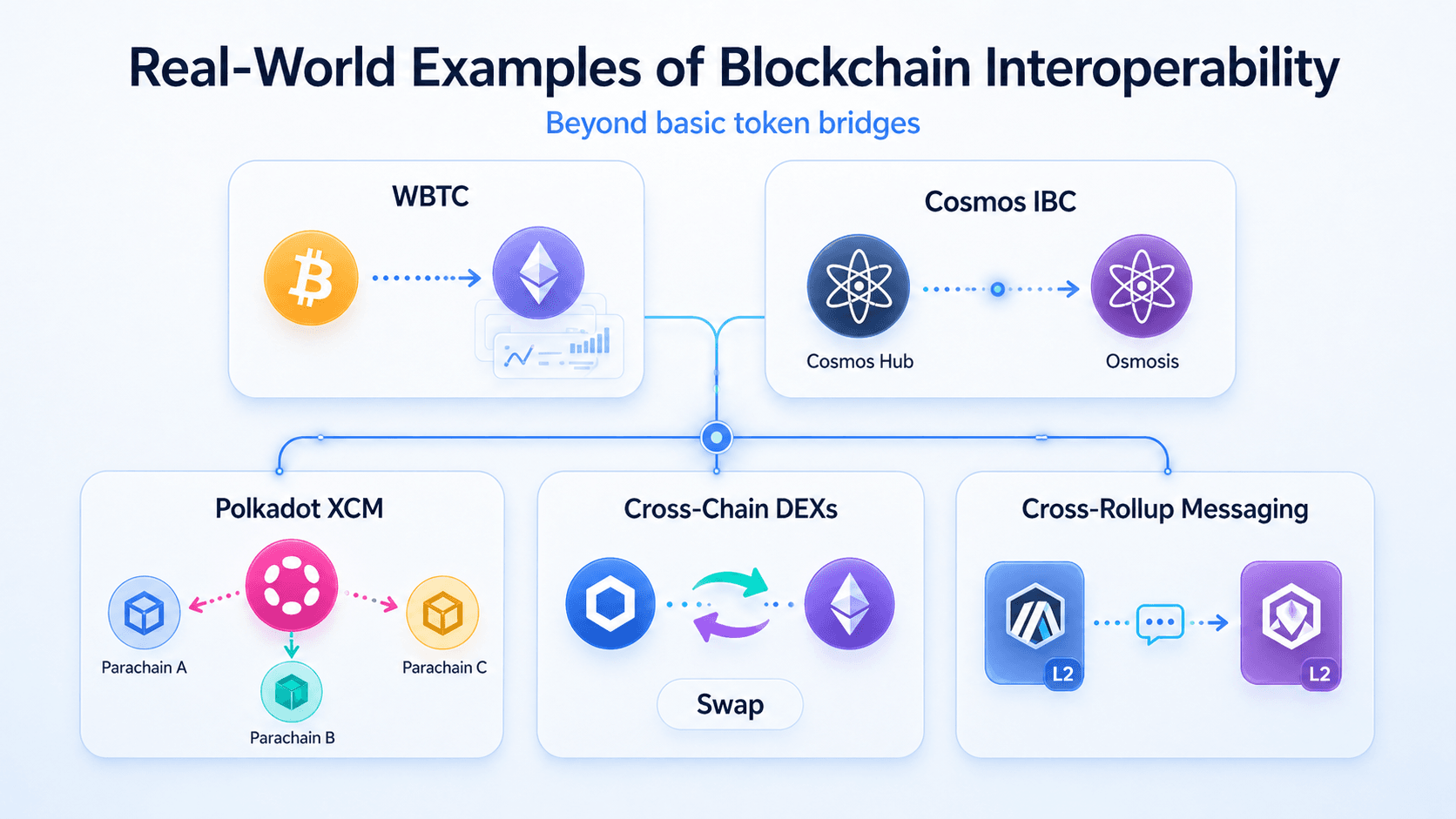 Real-World Blockchain Interoperability Examples Connecting Assets, Messages, Liquidity, And Rollups Across Crypto Networks
- WBTC: BTC can be represented on Ethereum so users can access Ethereum DeFi without selling BTC.
- Cosmos IBC: Tokens and data can move between Cosmos-based chains such as Cosmos Hub and Osmosis through IBC.
- Polkadot XCM: Parachains can transfer assets and messages within the Polkadot ecosystem through Polkadot interoperability architecture.
- Cross-chain DEXs: A user can swap assets across networks without manually bridging first through systems such as THORChain.
- Cross-rollup messaging: Ethereum Layer 2s can communicate through systems such as the Optimism Superchain or Polygon AggLayer.
The point is that interoperability now covers a lot more than basic token bridges. It now includes cross-chain messaging, shared security, liquidity routing, chain abstraction, and verification systems that try to make fragmented blockchain networks behave more like a connected environment.
Types of Blockchain Interoperability
The main types of blockchain interoperability are asset interoperability, data interoperability, smart contract interoperability, cross-chain messaging interoperability, and shared security interoperability. Together, they explain how blockchains move value, exchange information, coordinate applications, and build trust across otherwise separate networks.
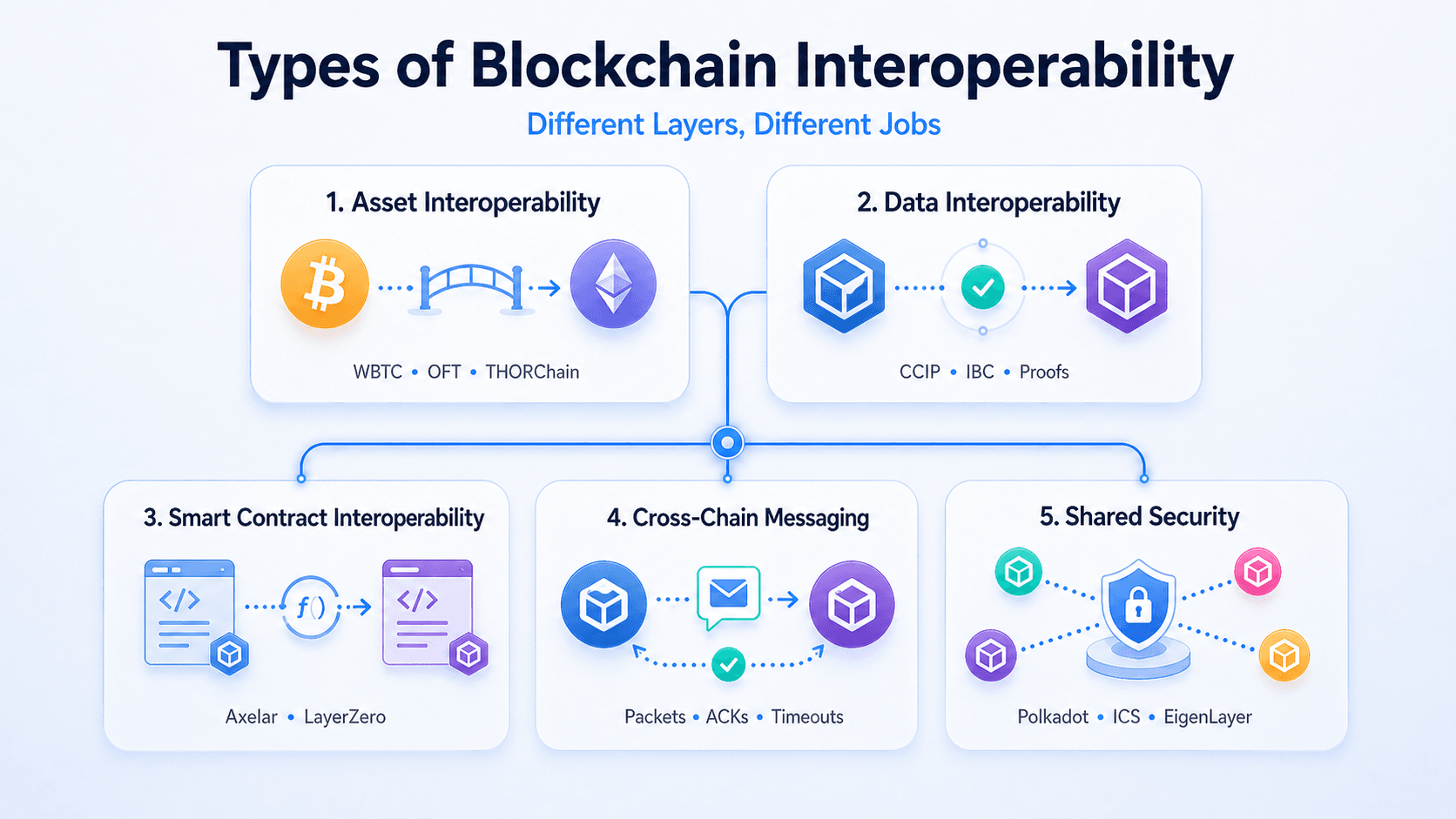 Key Types Of Blockchain Interoperability Across Assets, Data, Smart Contracts, Messaging, And Shared Security Models
Asset Interoperability
Asset interoperability covers the movement or representation of tokens across chains. This includes token bridging, wrapped assets, native bridges, omnichain token standards, and liquidity-pool-based systems.
The usual example is WBTC. Bitcoin cannot be used directly in Ethereum smart contracts, so the market came up with a wrapped version that lets BTC move into Ethereum’s DeFi world. That was useful, but it was not native interoperability. It was a proxy version of Bitcoin on Ethereum, backed by custodians and a system for issuing and redeeming the token.
Other systems take different routes. Stargate focuses on liquidity pools and cross-chain asset routing. THORChain focuses on native asset swaps across networks. LayerZero’s OFT standard is designed to let one fungible token operate across multiple connected chains while preserving a coordinated supply model.
Each design counts as asset interoperability, but each exposes the user to a different mix of trust assumptions, liquidity risk, and redemption risk.
Data Interoperability
Data interoperability means one chain can use verified information from another chain. That may involve oracles, oracle networks, the oracle problem, light-client verification, relayers, Merkle proofs, or other forms of cross-chain verification.
This is where things get more complicated. A blockchain cannot just accept outside information because it looks valid. If another chain claims that funds were locked, a transfer took place, or a contract was executed, the receiving chain still needs a dependable way to confirm it. Otherwise, it is relying on someone else’s word instead of its own rules.
This is the oracle problem in a cross-chain setting. The issue is not only off-chain price feeds. The issue is any external claim a chain cannot verify natively. Chainlink CCIP is one well-known system for cross-chain messaging, token transfer, and data transfer. Cosmos IBC takes a more trust-minimized path through light clients and packet verification. In both cases, the destination chain needs more than a message. It needs a basis for belief.
Here's a simple analogy: if someone tells you money has arrived in your account, you do not act on the claim just because the message sounds credible. You check the ledger. Data interoperability is the process of bringing some version of that ledger check into cross-chain systems.
Smart Contract Interoperability
Smart contract interoperability means a smart contract on one chain can trigger logic on another chain. This is more advanced than moving tokens because the destination chain is not only receiving value. It is receiving instructions.
Axelar GMP is a good example of this model. LayerZero messaging, Hyperlane, and Wormhole Messaging also support arbitrary messaging and cross-chain smart contracts. In practice, a contract on one blockchain can ask a contract on another blockchain to perform an action, pass parameters, and return a result or confirmation.
That makes cross-chain lending, treasury management, multichain governance, and coordinated settlement far more practical. A protocol can source liquidity from one chain, manage collateral on another, and settle a position somewhere else. A treasury can rebalance without treating every chain as an isolated balance sheet. This is one reason cross-chain smart contracts matter more now than they did a few years ago. The industry is moving from isolated deployments to systems that expect smart contracts to coordinate across multiple networks.
Cross-Chain Messaging Interoperability
Cross-chain messaging interoperability covers generalized message passing between chains. Instead of only moving tokens, networks send instructions, proofs, packet data, acknowledgements, and arbitrary data.
In the Cosmos ecosystem, IBC packets are the basic message unit. They are paired with packet commitments, acknowledgements, and timeouts so the system can track what was sent, what was received, and what should happen if delivery fails or stalls. In other systems, CCIP messages, Wormhole messages, and Hyperlane mailboxes serve related roles under different verification models. Different systems package it differently, but they are all trying to solve the same problem: how to pass verified messages between chains.
Token movement alone does not solve the broader problem. In serious cross-chain applications, a transfer is often just one step. The application still needs confirmation that the transfer was verified, visibility into whether a timeout occurred, awareness of whether a proof arrived, and a signal for whether a contract on the destination chain should proceed. Cross-chain messaging provides that coordination layer, allowing decentralized applications to operate as applications rather than disconnected token rails.
Shared Security Interoperability
Shared security interoperability connects chains through a shared validator or security model rather than relying only on one-off bridges. In some ecosystems, the security relationship between chains is part of the interoperability design itself.
Polkadot is the clearest example. The relay chain underpins the security model for parachains and provides a framework for coordination between them. Cosmos Interchain Security allows Cosmos Hub validators to help secure consumer chains. On Ethereum, EigenLayer expands the discussion through restaking and AVSs, or Actively Validated Services, which let services draw on shared validator assumptions linked to restaked ETH.
That changes the design trade-offs. Instead of connecting isolated chains after the fact, shared security tries to make communication and trust more native inside an ecosystem. That can lower bootstrap costs for new chains and strengthen coordination. It can also concentrate risk if too much depends on one shared validator or restaking layer.
Read our full EigenLayer review.
How Blockchain Interoperability Works
Most cross-chain systems follow a similar sequence even when their trust models differ. A user starts an action on a source chain, that event gets recorded there, some verification method proves it, and a destination chain responds by minting, releasing, swapping, or executing logic.
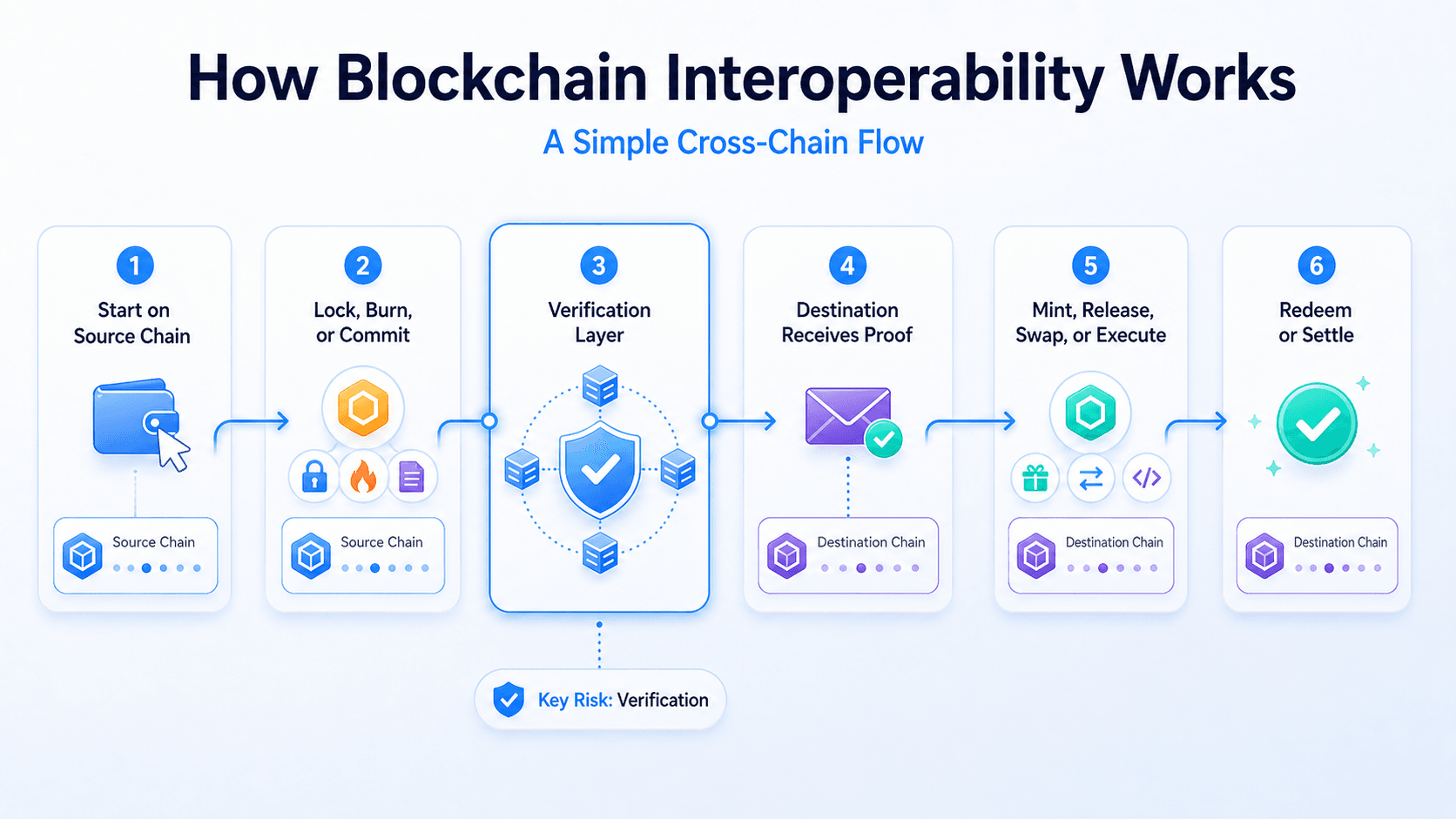 How Blockchain Interoperability Works Across Chains Through Verification, Messaging, Settlement, And Destination-Side Execution Steps Safely
Step-by-Step: How a Cross-Chain Transaction Works
- A user starts an action on the source chain.
The user might bridge USDC from Ethereum to Arbitrum, move tokens from Cosmos Hub to Osmosis, or swap ETH on one chain for SOL on another. - Assets or data are locked, burned, or committed.
In a lock-and-mint model, assets are locked on the source chain. In a burn-and-mint model, supply is destroyed on the source chain and recreated on the destination chain. In message-based systems, the key event may be committed to source-chain state without moving the asset itself. - A relayer, oracle, validator set, light client, or proof system verifies the event.
How that event is verified determines the trust model. A light-client bridge may verify block headers and Merkle proofs directly. A federated or MPC bridge may rely on a validator committee. A messaging layer may depend on oracle and relayer roles. An optimistic bridge may rely on a challenge period and fraud proofs. - The destination chain receives the message or proof.
The destination chain checks whether the request is valid under its own rules. Depending on the design, that can involve signatures, packet verification, challenge windows, or validity proofs. - Assets are minted, released, swapped, or smart contract logic executes.
The user receives the destination-side asset, the route completes, or a contract on the destination chain performs the requested action. - A redemption or settlement path remains available.
This becomes especially important with wrapped assets and bridge-backed tokens. If the system depends on custody, users need to understand redemption. If it depends on liquidity routing, users need to understand settlement guarantees and finality.
The flow sounds simple, but the hard part is verification. Most of the real risk sits in step three. Who verifies the event, how they verify it, and what happens when they fail are the questions that decide whether a cross-chain system is robust or brittle.
Interoperability Approaches Compared
| Approach | Example | Trust Model | Smart Contract Support | Best For |
|---|---|---|---|---|
| Atomic swaps | HTLCs | Mostly trustless | Limited | Peer-to-peer swaps |
| Custodial bridges | WBTC | Trusted custodian | Limited | Bringing BTC into DeFi |
| Federated / MPC bridges | Multisig bridge networks | Committee-based | Moderate | Faster asset bridging |
| Light-client bridges | Cosmos IBC | Trust-minimized | Yes | Secure ecosystem-level messaging |
| Messaging protocols | LayerZero, Axelar, Hyperlane | Oracle, relayer, or validator-based | Yes | Cross-chain apps |
| ZK bridges | Polyhedra, Succinct-style proof systems | ZK-verified | Yes | Proof-based verification |
| Optimistic bridges | Across-style systems | Fraud-proof or challenge-based | Yes | Fast transfers with dispute windows |
| Intent-based systems | Anoma, UniswapX-style solvers | Solver-based | Yes | UX-friendly execution |
HTLCs, or hashed timelock contracts, were an early answer to atomic swaps without a custodian. They remain elegant, but narrow. At the other end of the spectrum sit intent-based systems, where the user states the desired outcome and solver networks compete to fulfill it. This is the gap ERC-7683 is trying to fill: a standard way to express cross-chain intents and order flow, instead of forcing each protocol to invent its own format.
Why Can’t Blockchains Interoperate Naturally?
Blockchains are not naturally interoperable because each one is built to verify its own ledger, not somebody else’s. Isolation is part of how blockchain systems preserve trust.
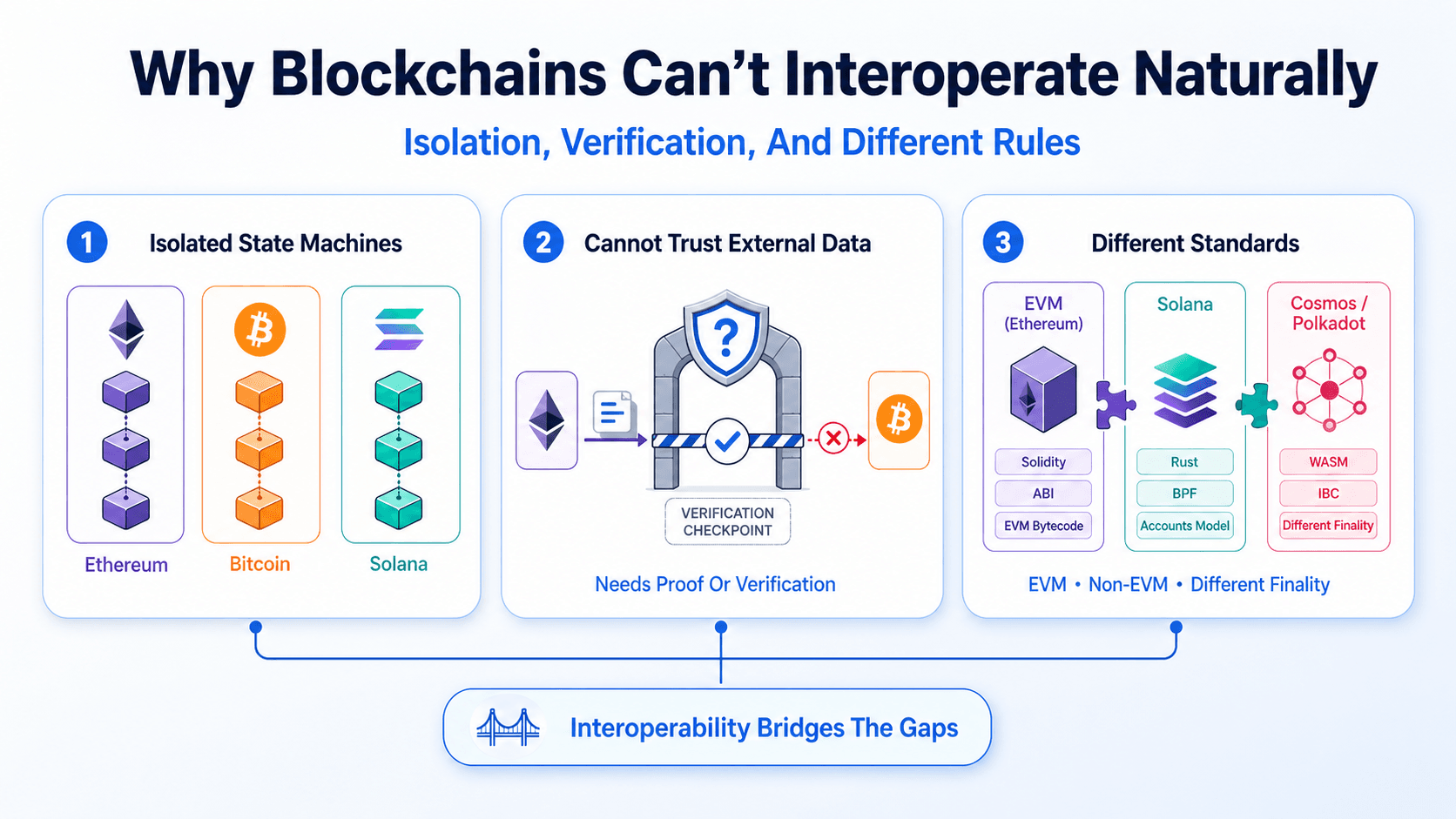 Why Blockchains Cannot Interoperate Naturally Due To Isolation, Verification Limits, And Different Standards Across Networks
Blockchains Are Isolated State Machines
Each blockchain is an isolated state machine. It maintains its own blockchain state, validators, consensus mechanism, nodes, accounts, and transaction history. Ethereum tracks Ethereum state. Bitcoin tracks Bitcoin state. Solana tracks Solana state. These are isolated networks, not automatically shared ledgers.
Everything comes back to state, which is what a blockchain recognizes as true. If a network cannot verify a state transition under its own rules, it cannot treat that event as native. Interoperability is the machinery that allows one state machine to make controlled, limited use of information from another.
Blockchains Cannot Trust External Data by Default
A blockchain cannot trust external data by default, even when that data comes from another blockchain. This is the oracle problem in a stricter cross-chain form. If chain A says something happened, chain B still needs a verification method before it can treat that claim as valid inside a trustless system.
That method might be a relayer, an oracle, a validator committee, a light client, a cross-chain proof, or a challenge-based dispute mechanism. Every system sits somewhere on the spectrum between convenience and trust minimization. None escapes the same blunt question: why should the destination chain believe this message?
Different Chains Use Different Standards
Even when chains want to communicate, they often use different technical standards. Ethereum and other EVM chains share one execution style. Solana does not. Cosmos SDK chains, Polkadot parachains, Bitcoin, and appchains bring different token standards, finality assumptions, and execution environments. Some are EVM. Some are non-EVM chains. Some support broad smart contract execution. Some do not.
That variety is one reason interoperability remains fragmented. Cross-chain communication has to bridge more than distance. It has to bridge architectural differences between systems that were not designed to understand each other automatically.
Core Components of Blockchain Interoperability
The core components of blockchain interoperability include bridges, liquidity networks, messaging protocols, verification systems, token standards, cross-chain message formats, solver networks, and wallet abstraction tools.
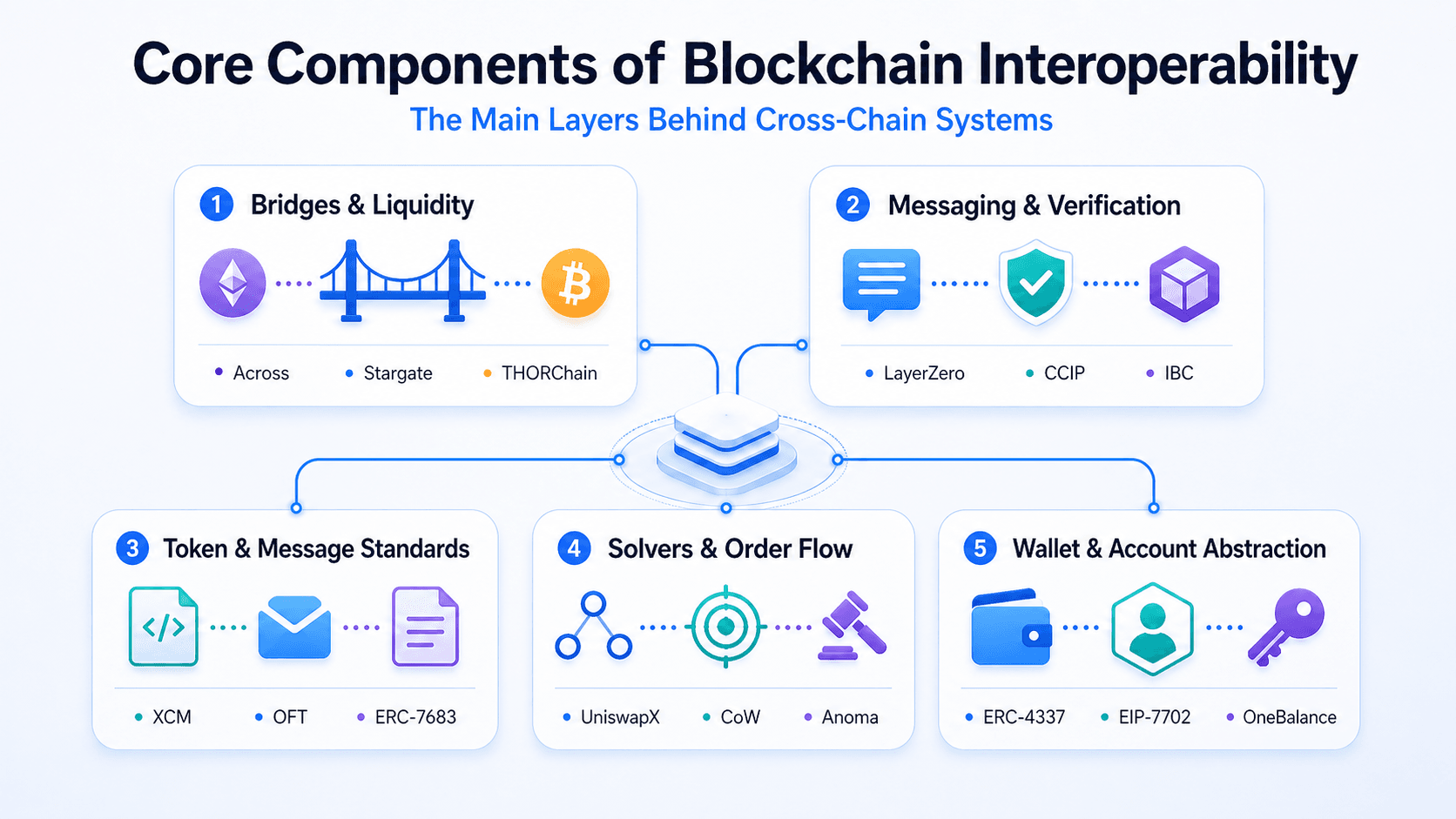 Core Components Of Blockchain Interoperability Across Bridges, Messaging, Standards, Solvers, And Wallet Abstraction Layers Today
Bridges and Liquidity Layers
Bridges are the most visible part of interoperability because they move assets from one environment to another. Liquidity layers decide how that movement happens and where the destination-side asset comes from.
Across Protocol, deBridge, and Router Protocol are useful examples of how different bridge and routing systems approach the same broad problem from different angles. Across uses a faster transfer model tied to optimistic settlement and solver-style execution. deBridge and Router Protocol push further into programmable cross-chain execution and liquidity routing.
The core distinction is native assets versus wrapped assets. A native swap gives the user the destination-side asset directly. A wrapped bridge gives the user a representation backed by some other holding model. Both can work. They simply expose the user to different forms of trust, liquidity risk, slippage, and settlement risk.
For readers who want background on how liquidity design shapes market behavior, our beginner-friendly guide to stablecoins is a useful companion read.
Messaging and Verification Layers
Messaging layers move instructions or proofs between chains. Verification layers decide whether those messages should be trusted.
LayerZero, Axelar GMP, Hyperlane, Wormhole, Chainlink CCIP, and Cosmos IBC all belong in this conversation. They do not share one trust model, but they all address the same underlying question: how should a blockchain verify message passing across networks it does not natively control? Some emphasize generalized messaging. Some emphasize ecosystem-level verification. Some are broad middleware for decentralized applications.
Many users underestimate this layer. The bridge interface may look polished. The real risk often sits deeper, in the message verification design under the hood.
Token and Message Standards
Interoperability does not scale without standards. In Cosmos, IBC packets rely on packet commitments, acknowledgements, and timeouts to structure message delivery and failure handling. XCM is Polkadot’s cross-consensus message format. OFT is LayerZero’s Omnichain Fungible Token standard. Axelar GMP standardizes general message passing across connected chains.
Newer wallet and order-flow standards matter too. ERC-7683 deals with cross-chain intents and order flow. ERC-4337 brought account abstraction through smart contract wallets without requiring a base-layer consensus change on Ethereum. EIP-7702 expands what externally owned accounts can delegate, which improves wallet UX and supports smoother multistep transaction flows.
These are not all bridge standards in the narrow sense, but they are part of the same interoperability story. Poor standards create brittle integrations, fragmented interfaces, and inconsistent behavior for developers and users alike.
Solvers and Order Flow Networks
Solvers have become central to the newer wave of cross-chain design. Instead of forcing the user to choose a bridge, DEX, and route manually, intent-based systems let the user state the desired outcome and leave execution to competing solver networks.
UniswapX, Anoma, CoW Protocol, Enso, and Khalani all sit somewhere in this wider discussion. So do large liquidity and market-making firms such as Wintermute and Amber when they participate in the broader order-flow environment that overlaps with solver execution.
The attraction is obvious. A cleaner interface can hide route complexity and reduce user friction. The harder question is what sits underneath. Who receives the order flow? How are auctions designed? What are the settlement guarantees if a solver fails halfway through? How much MEV is embedded in the route? The convenience is real. So are the new incentives.
Wallet and Account Abstraction Layers
Wallet abstraction and account abstraction are where interoperability becomes tangible for ordinary users. A weak wallet experience forces the user to think through networks, gas tokens, routes, signatures, and retries. A strong one hides most of that complexity.
Particle Network, OneBalance, Arcana Network, Turnkey, and Avocado all belong in this discussion. Their approaches differ, but the basic goal is the same: reduce chain-specific friction and make multichain activity feel less error-prone.
In crypto, usability has real security consequences. Every extra network switch, signature request, and gas-token requirement creates another chance for the user to make a mistake. Better wallets cannot eliminate trust assumptions, but they can reduce the operational burden.
For readers thinking about the custody side of the equation, our comparison of hardware wallets and software wallets gives useful context.
Trust Models in Blockchain Interoperability
The main trust models in blockchain interoperability include trusted or custodial bridges, federated and MPC bridges, optimistic bridges, ZK bridges, light-client bridges, and intent-based solver models. These designs sit on a spectrum from more trust-dependent to more trust-minimized.
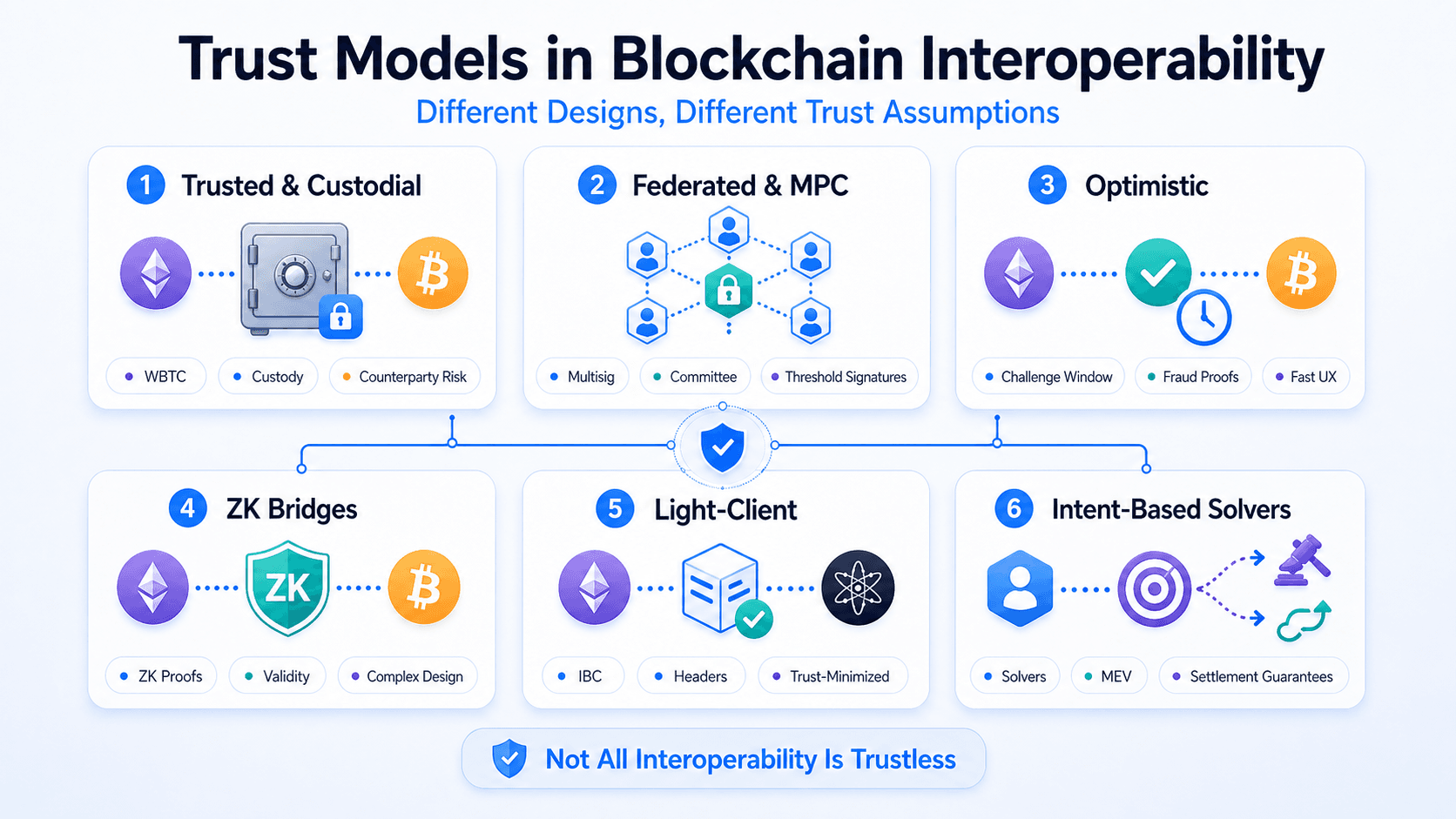 Trust Models In Blockchain Interoperability Across Custodial, MPC, Optimistic, ZK, Light-Client, And Solver Designs Today
Trusted and Custodial Bridges
A trusted or custodial bridge relies on a third party to hold or control the underlying asset. WBTC is the standard example. It opened Bitcoin to Ethereum DeFi, but it did so through a custody structure rather than a native trustless bridge.
That introduces counterparty risk. If the custodian fails, governance changes, or redemption assumptions break, the wrapped asset becomes exposed.
Federated and MPC Bridges
Federated bridges rely on a multisig, validator committee, or MPC system to confirm cross-chain events. MPC, or multi-party computation, can improve threshold signatures and key management, but the basic model still depends on a defined group of bridge validators.
This sits between one-custodian trust and direct cryptographic verification. It can be fast and practical. It can also fail if the committee is badly designed, too concentrated, or compromised.
Optimistic Bridges
Optimistic bridges accept transactions unless someone challenges them during a dispute window. They rely on fraud proofs and a challenge mechanism rather than immediate final verification.
Across-style systems sit close to this design space. The benefit is faster user-facing transfers. The tradeoff is that full assurance may depend on a challenge period functioning as intended.
ZK Bridges
ZK bridges use zero-knowledge proofs to verify source-chain state or transaction validity. This is where Polyhedra and Succinct-style proof systems enter the discussion. The appeal is obvious: stronger cryptographic verification with less reliance on committees or custody. Depending on the design, that can involve validity proofs such as zkSNARKs or related proof systems that let a destination chain verify claims without replaying the full computation itself.
The catch is equally obvious. Proof systems are complex, expensive to implement, and still evolving. ZK verification is powerful, but it still has to be engineered correctly.
Light-Client Bridges
Light-client bridges let a destination chain verify source-chain block headers or state proofs directly. Cosmos IBC remains the clearest live example of a trust-minimized bridge and message-passing framework built on this model.
The upside is stronger verification. The downside is that light-client integration is easier inside ecosystems designed for it than across every possible chain combination.
Intent-Based Solver Models
Intent-based systems add another trust layer. Users trust solvers to optimize execution, but they still need to understand solver incentives, MEV exposure, settlement guarantees, and order-flow auctions.
A smoother interface can hide these assumptions without removing them. That makes education more important, not less.
Benefits of Blockchain Interoperability
The main benefits of blockchain interoperability include better liquidity across chains, easier user experience, more powerful cross-chain applications, improved scalability across Layer 2s and appchains, and stronger connectivity for institutional and enterprise use cases.
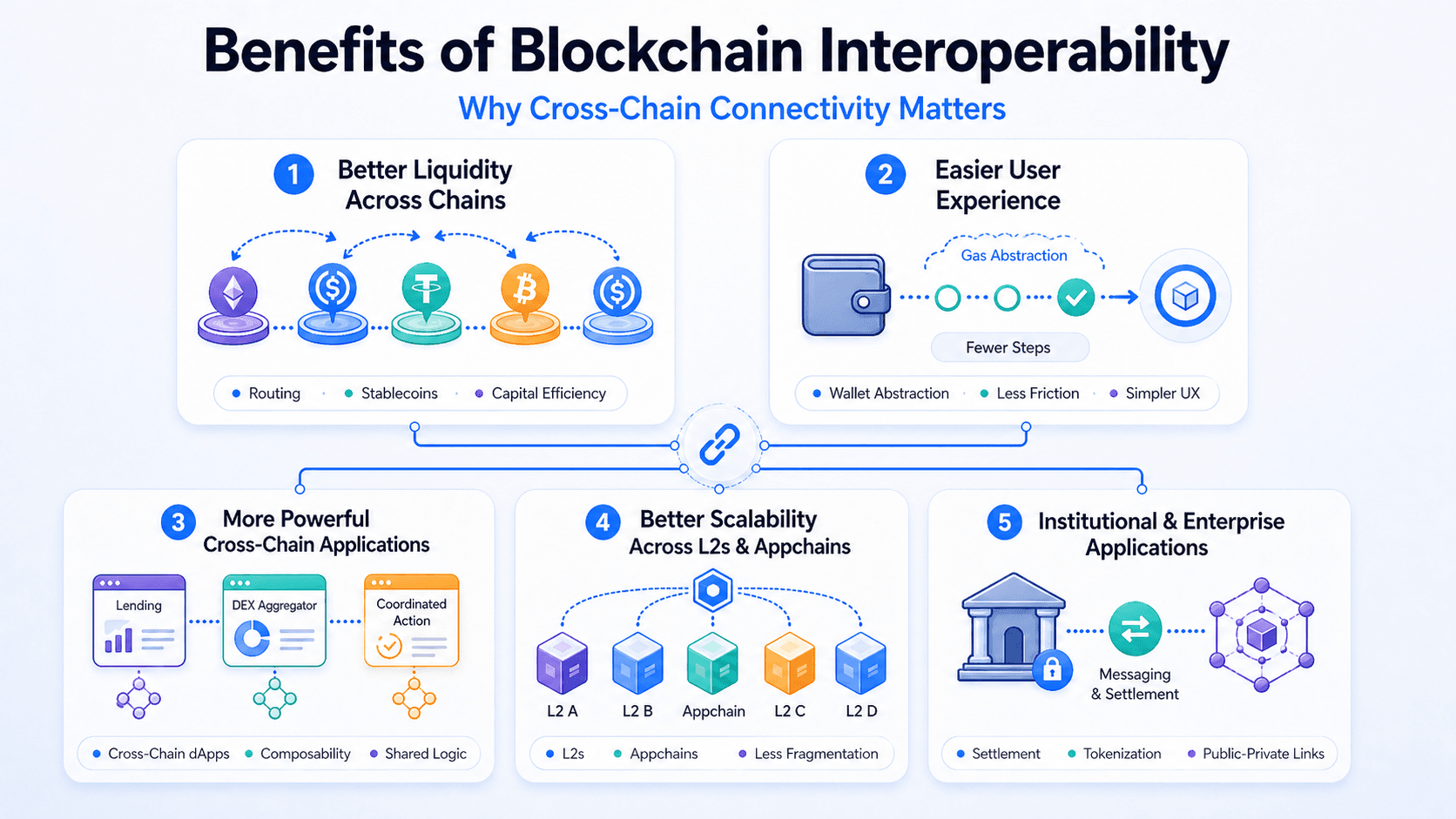 Benefits Of Blockchain Interoperability Across Liquidity, User Experience, Cross-Chain Apps, Scalability, And Enterprise Connectivity in 2026
Better Liquidity Across Chains
Liquidity fragmentation is one of DeFi’s deepest inefficiencies. The same asset can trade in separate pools across different chains, rollups, and bridge representations. Interoperability helps with liquidity routing and omnichain liquidity by allowing value to move or settle across those pools more efficiently.
That can improve capital efficiency, reduce trapped liquidity, and make cross-chain markets less brittle. Stablecoins are central here, since they often sit at the heart of cross-chain trading and settlement.
Easier User Experience
Interoperability can make Web3 easier to use by reducing manual bridges, gas-token friction, wallet switching, and chain-specific complexity. Chain abstraction, gas abstraction, wallet abstraction, account abstraction, and smart wallets all point toward the same goal: let the user focus on the action, not the route.
This is not a small improvement. Poor cross-chain UX is one of the main reasons new users make avoidable errors.
More Powerful Cross-Chain Applications
Cross-chain DApps can combine liquidity, users, and logic from multiple ecosystems. That improves smart contract composability across networks and allows for cross-chain lending, broader DEX aggregation, shared balances, coordinated treasury operations, and omnichain applications that behave like one product instead of separate deployments.
This is where interoperability stops being a utility layer and becomes an application layer.
Better Scalability Across Layer 2s and Appchains
Interoperability is also part of the scalability story. Ethereum’s Layer 2 ecosystem keeps expanding, and appchains continue to attract projects that want custom execution environments. Without interoperability, that growth can turn into permanent fragmentation.
Systems such as the Optimism Superchain and Polygon AggLayer are direct responses to that problem. They try to let activity spread across rollups and appchains without forcing users to rebuild the same market from scratch on each network.
Institutional and Enterprise Applications
Interoperability also has an institutional and enterprise dimension, though it should be kept in proportion. Public and private networks need ways to exchange data, coordinate settlement, and move tokenized assets.
This is particularly relevant for enterprise interoperability, where systems such as private ledgers, public blockchains, Ethereum-based settlement layers, messaging rails like CCIP, and tokenized real-world assets may all need to interact. Swift has already explored tokenization experiments that depend on blockchain messaging rails, and Hyperledger Fabric remains one of the clearest reference points on the private-network side. As tokenization grows, public-private interoperability is likely to become more important, not less.
Challenges and Risks of Blockchain Interoperability
The main challenges of blockchain interoperability include bridge exploits, smart contract vulnerabilities, fragmented standards, liquidity fragmentation, MEV, execution risk, and the difficulty of scaling across many chains.
These risks do not make interoperability useless. They mean users and developers need to understand how each route works, what trust assumptions it depends on, how liquidity is sourced, and what can happen if a message, proof, bridge or solver fails mid-transaction.
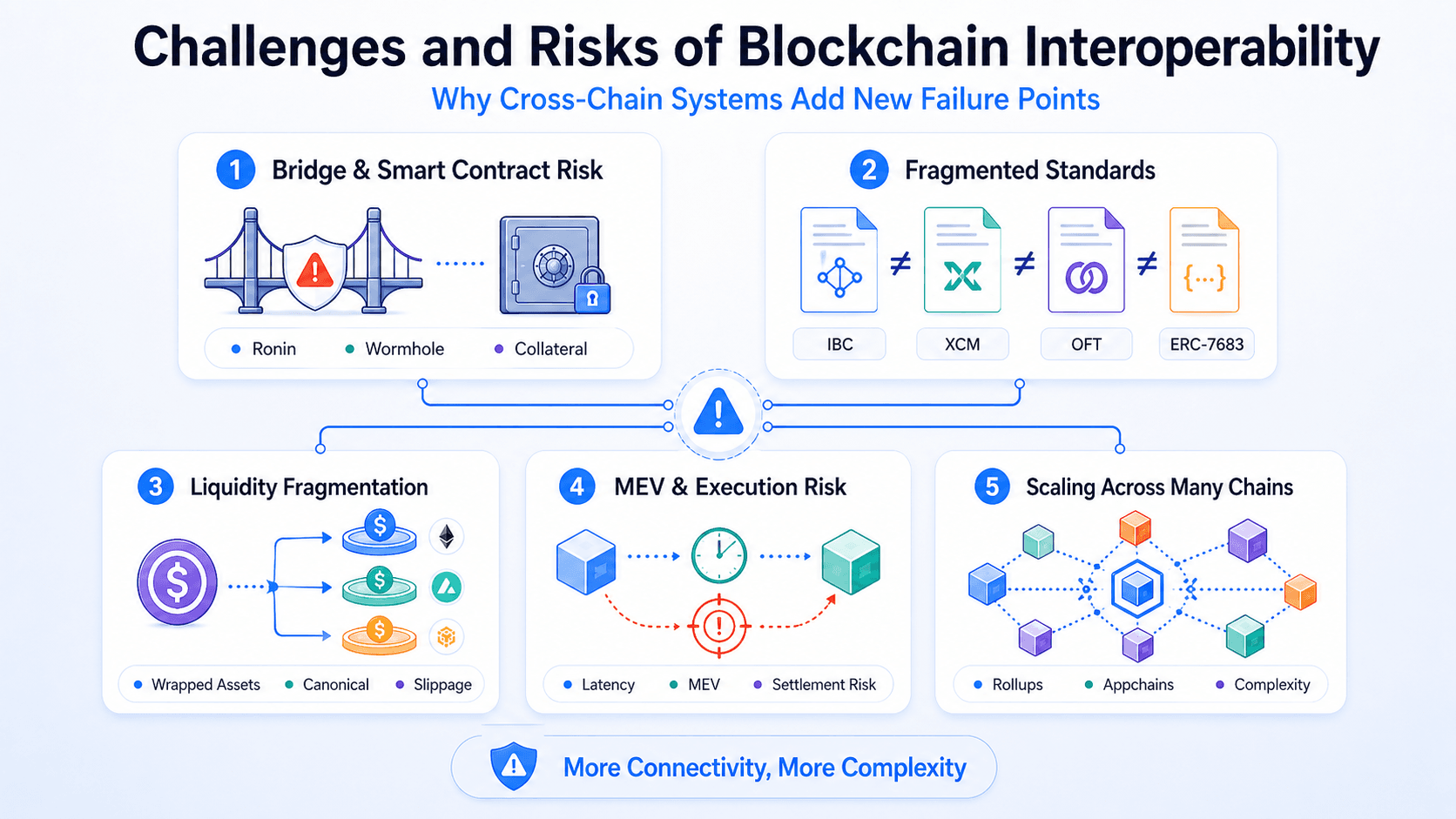 Challenges And Risks Of Blockchain Interoperability Across Bridges, Standards, Liquidity, Execution, And Multichain Complexity
Bridge and Smart Contract Risk
Bridges are high-value targets because they often control locked collateral, privileged verification logic, or both. Smart contract vulnerabilities in these systems can cause enormous losses.
The Ronin Bridge exploit remains the clearest warning. Sky Mavis said the attacker stole exactly 173,600 ETH and 25.5 million USDC in the March 2022 attack. The Wormhole hack was another reminder that bridge and messaging infrastructure can fail in ways that affect the wider market, not just one application.
Audits, bug bounties, staged rollouts, and tighter permissions all help. None of them guarantee safety.
Fragmented Standards
Fragmentation remains a serious problem. Different bridge designs, messaging standards, token formats, and solver systems do not always compose cleanly. LayerZero OFT, Axelar GMP, XCM, IBC, and ERC-7683 solve related problems from different angles, not through one universal standard.
That increases integration complexity for developers and makes it harder for users to know what assumptions sit behind a given cross-chain route.
Liquidity Fragmentation
Interoperability does not always remove liquidity fragmentation. In some cases, it multiplies it. The same asset can exist in several wrapped or bridged forms across different chains and bridge providers, which creates competing liquidity pools and confusion over which token is canonical.
Stablecoins make this especially obvious. One network may have a canonical version, another a bridged version, and another several competing wrapped forms. Slippage, liquidity depth, and redemption quality can vary sharply between them.
MEV and Execution Risk
Cross-chain execution creates more room for routing errors, latency, and MEV. A transaction may fill on one chain and fail on another. A solver may choose a route that is efficient for the system but opaque to the user. Price movement during a delay can change the economics of the final result, and in thinner markets that can leave users more exposed to slippage, sandwich attacks, and other forms of cross-chain execution risk.
Leverage makes the problem more dangerous. In cross-chain markets, it layers settlement risk on top of market risk. That combination can damage both capital and judgment. The psychological side should not be ignored, either. People often make worse decisions when they feel trapped in delayed, fragmented positions.
Scaling Across Many Chains
More chains means more integrations, more standards, and more attack surfaces. Rollups, appchains, Solana, Cosmos, Bitcoin-linked systems, and Move-based chains such as Aptos and Sui all expand the design space. They also expand complexity.
That complexity is technical, operational, and human. The more routes a system supports, the more assumptions it has to manage.
Blockchain Interoperability vs. Cross-Chain vs. Multi-Chain
These terms overlap, but they are not interchangeable. The distinction is small and worth getting right.
| Term | What It Means | Main Focus | Does It Require Chains To Interact? | Typical Example |
|---|---|---|---|---|
| Multi-chain | An application, asset, or protocol exists on more than one blockchain. These are often separate deployments on each chain. | Presence across multiple chains | No. A product can be multi-chain even if each deployment operates mostly independently. | A DEX or wallet that runs on Ethereum, BNB Chain, and Solana, but treats each network as a separate environment. |
| Cross-chain | Assets, messages, or actions move between different blockchains. | Movement and coordination between chains | Yes. Cross-chain activity involves interaction across networks. | Bridging USDC from Ethereum to Arbitrum, or sending a message from one chain to trigger a contract on another. |
| Blockchain interoperability | The broader ability of different blockchains to exchange assets, data, or instructions and work together. It is the infrastructure and design framework that makes cross-chain communication possible. | Compatibility and communication between chains | Usually yes, because interoperability is about enabling interaction, but it is broader than a single transfer or bridge event. | Cosmos IBC, Chainlink CCIP, Polkadot XCM, or other systems that let separate chains communicate in a structured way. |
A multi-chain deployment can still feel disjointed because each chain behaves like a separate product instance. A cross-chain design tries to connect those deployments. Interoperability is the infrastructure underneath both.

Conclusion
Blockchain interoperability has moved far beyond simple token transfers. It now includes cross-chain messaging, smart contract interoperability, solver networks, shared security, proof-based verification, and chain abstraction. The end goal is not only to move assets between blockchain networks. It is to make Web3 feel coherent even when many different chains are working underneath.
None of that makes the hard questions disappear. Trust models still count. Liquidity still counts. Smart contract risk still counts. Verification still counts. The strongest interoperability systems will reduce friction without asking users to ignore the machinery underneath.