



Crypto futures are derivative contracts that give traders long or short exposure to cryptocurrency prices without requiring direct ownership of the underlying asset. A spot purchase typically gives the buyer Bitcoin, Ethereum or another cryptocurrency, while a futures position gives contractual exposure to price movements.
Leverage is common in crypto futures. It reduces the collateral required for a given position size and increases gains and losses relative to that collateral. A sufficiently adverse move can push a leveraged position toward liquidation. Perpetual futures are the form many retail crypto traders encounter most often in 2026. The market now spans centralized crypto exchanges, regulated derivatives venues and decentralized perpetual platforms. Product access, leverage limits and regulation vary substantially by jurisdiction.
This guide explains the mechanics of crypto futures, including margin, leverage, funding, mark prices, profit and loss, trading costs and liquidation.
Editor's Note (Sept. 24, 2026): We fully updated this guide in September 2026 to reflect the current crypto futures market and make the mechanics easier to follow. The refresh adds clearer coverage of perpetual futures, margin and leverage, mark and index prices, funding, liquidation, PnL, contract types and platform selection, alongside updated 2026 regulatory developments and stronger risk explanations. We also added worked examples, improved comparisons with spot trading, and expanded coverage of centralized, decentralized and regulated futures venues.
Crypto Futures Trading: Quick Verdict
Crypto futures provide long or short exposure to cryptocurrency prices through derivative contracts rather than direct ownership of the underlying asset. They can be used for speculation, hedging and capital-efficient exposure, but leverage, funding, liquidation and execution mechanics make them more complex than ordinary unleveraged spot trading.
Crypto Futures Trading Key Points
-
You trade price exposure, not the underlying crypto A futures position creates contractual exposure to an asset such as Bitcoin or Ethereum without normally giving the trader ownership of the cryptocurrency itself.
-
Futures make long and short exposure straightforward Long positions generally benefit from rising futures prices, while short positions generally benefit when prices fall.
-
Leverage reduces required margin, not market exposure A $5,000 position still carries roughly $5,000 of price exposure whether it is supported by $1,000 at 5x leverage or $500 at 10x leverage.
-
Perpetual futures do not expire Perpetual contracts can remain open while margin requirements are met and use funding payments to help keep their price aligned with the underlying reference market.
-
Mark price and maintenance margin influence liquidation Liquidation can begin when available equity falls below the venue's required margin level, with the threshold also affected by position size, margin mode, fees, funding and contract rules.
-
Net PnL includes more than the market move Trading fees, funding payments and slippage can reduce returns, while leverage increases gains and losses relative to the collateral posted.
Disclaimer
This guide is for educational purposes only and is not financial advice. Crypto futures involve substantial risk, including leverage, liquidation, volatility, funding, liquidity, execution, platform and counterparty risk. Losses can occur rapidly when trading leveraged positions.
Disclosure
Some links in this guide may be affiliate links. If you choose to use a service through these links, we may earn a commission at no additional cost to you.

What Is Crypto Futures Trading?
Crypto futures trading involves buying or selling a derivative contract whose value is linked to an underlying cryptocurrency such as Bitcoin or Ethereum. Traders use these contracts to speculate on price movements or hedge existing crypto exposure.
A long position generally gains value as the relevant futures price rises. A short position generally gains value as the futures price falls. Both represent contractual exposure to the market price rather than a spot holding of the underlying cryptocurrency.
Perpetual futures have become a major part of crypto derivatives markets. Perpetual futures are margin-based derivatives with open-ended exposure and a funding mechanism that helps align their price with the underlying market.
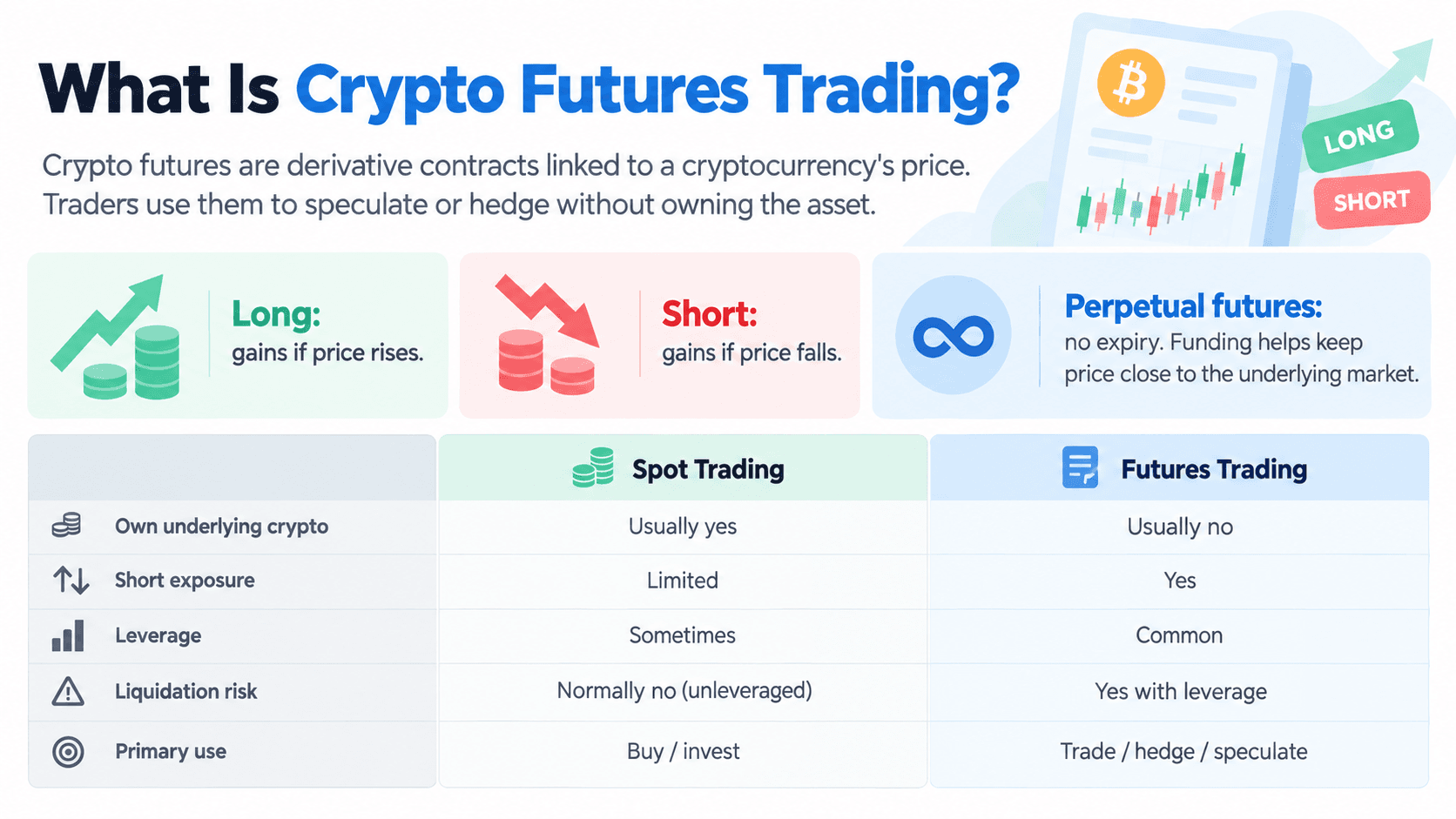 Crypto Futures Provide Long and Short Market Exposure Without Requiring Direct Ownership of the Underlying Cryptocurrency
Crypto Futures vs Spot Trading
Spot and futures markets can track the same cryptocurrency while producing very different ownership, cost and risk profiles.
| Feature | Spot Trading | Futures Trading |
|---|---|---|
| Own underlying crypto | Usually yes | Usually no |
| Long exposure | Yes | Yes |
| Short exposure | More limited | Yes |
| Leverage | Sometimes | Common |
| Liquidation risk | Normally absent in unleveraged spot | Present with leveraged positions |
| Funding payments | None | Perpetuals may include them |
| Expiration | None | Depends on contract |
| Primary uses | Buying, selling, investing | Speculation, hedging, trading |
Buying BTC on a spot market normally results in Bitcoin being credited to an exchange account or self-custody wallet. Opening a BTC futures position creates price exposure through a derivatives contract.
Spot margin trading sits in a separate category. A margin account can involve borrowed funds or cryptocurrency used for a leveraged spot trade. Futures use derivative contracts with their own margin, settlement and liquidation rules.
Check our Coin Bureau's top picks for the best crypto futures exchanges.
How Does Crypto Futures Trading Work?
A crypto futures position combines market direction, collateral, notional exposure and contract rules. These elements determine how PnL, fees, funding and liquidation behave.
Going Long and Short
A trader expecting Bitcoin to rise can open a long BTC futures position. A rising futures price generally increases the value of the long. A falling futures price creates a loss.
A trader expecting Bitcoin to fall can open a short BTC futures position. Falling prices benefit the short, while rising prices produce losses.
Futures contracts create short exposure directly through the derivative. Traditional short selling can involve borrowing the underlying asset first, while a futures short uses the contract itself.
Notional Value, Margin and Exposure
Margin is collateral committed to support a futures position. Notional value is the total market exposure represented by that position.
A simplified relationship is: Notional position = margin × leverage
For example: $1,000 margin × 5x leverage = $5,000 notional exposure
The trader therefore has approximately $5,000 of BTC price exposure supported by $1,000 of initial margin.
Futures margin operates differently from the down payment on an owned asset. A margin is funds deposited and maintained to support a futures position.
A Crypto Futures Trade From Entry to Exit
Consider a simplified linear BTC perpetual-futures trade. The fee and funding figures are hypothetical and are used only to show how the components interact. All fee and funding figures below are hypothetical and exist solely to show how the components connect.
| Trade Component | Example |
|---|---|
| Account balance | $5,000 |
| Margin committed | $1,000 |
| Selected leverage | 5x |
| Position notional | $5,000 |
| BTC entry price | $80,000 |
| Position size | 0.0625 BTC |
| Direction | Long |
| BTC exit price | $81,600 |
| Market move | +2% |
Gross PnL: ($81,600 - $80,000) × 0.0625 BTC = $100
Assume a hypothetical taker fee of 0.05% on entry and exit.
Opening fee: $5,000 × 0.05% = $2.50
At an exit price of $81,600, the position carries approximately $5,100 of notional value.
Closing fee: $5,100 × 0.05% = $2.55
Assume the position has approximately $5,000 of notional exposure at the funding timestamp and incurs a hypothetical funding payment of 0.01%: $5,000 × 0.01% = $0.50
Net PnL: $100 - $2.50 - $2.55 - $0.50 = $94.45
Bitcoin moved 2%, while the $94.45 net gain equals approximately 9.45% of the $1,000 margin committed. A 2% BTC move in the opposite direction would create a $100 gross loss before trading costs and funding.
The calculation shows why market movement and return on posted margin can look very different in a leveraged futures position.
Types of Crypto Futures Contracts
Crypto futures can be classified by expiration structure and by collateral or settlement structure. These classifications overlap, so a perpetual contract can also be stablecoin-margined, coin-margined, linear or inverse.
Traditional Futures vs Perpetual Futures
Traditional futures, also called dated futures, have a defined expiration and settlement date. Settlement can occur in cash or through delivery of the underlying asset, depending on the product. Before expiry, the futures price can trade above or below the corresponding spot price as expectations, financing costs and market conditions change.
Those price relationships are commonly described using contango and backwardation.
- Contango is a market structure where futures prices trade above the spot price, producing an upward-sloping forward curve.
- Backwardation describes the reverse structure, where futures prices trade below spot and the forward curve slopes downward.
Futures prices generally converge toward the spot price as expiration approaches.
Perpetual futures use a different structure. They have no fixed expiration date, allowing positions to remain open while margin requirements continue to be met. Perpetual contracts use periodic funding payments to encourage the contract price to remain close to the underlying spot market. When the perpetual trades above its reference market, the funding mechanism generally creates an incentive for longs to pay shorts; when it trades below the reference market, the payment direction generally reverses.
Perpetual futures have become particularly prominent in crypto derivatives. They now trade across offshore centralized exchanges, decentralized perpetual venues and regulated market structures.
The U.S. regulated market expanded in 2026. On May 29, the Commodity Futures Trading Commission published a policy statement on perpetual contracts, setting out a case-by-case review framework for perpetual products. On the same date, the Commission approved KalshiEX's BTCPERP contract, a perpetual futures contract referencing the spot price of Bitcoin, for listing on a designated contract market.
Stablecoin-Margined vs Coin-Margined Futures
Stablecoin-margined futures commonly use USDT or USDC as collateral and settlement currency. They are often structured as linear contracts, with profit and loss expressed in the stablecoin. Binance, for example, describes its USDⓈ-margined futures as contracts settled in USDT or USDC.
This structure is generally easier to follow because collateral and PnL are expressed in the same stablecoin.
Coin-margined futures use cryptocurrency such as BTC as collateral and can also denominate PnL in that cryptocurrency.
Coin collateral can move in value alongside the futures position. For example, a trader using BTC as collateral for a BTC long can see the dollar value of the collateral decline at the same time as the position records a loss.
Linear vs Inverse Futures
A linear contract calculates PnL using a direct quote-currency relationship. Stablecoin-margined futures commonly use this structure. An inverse contract uses a reciprocal payout structure and is often associated with coin-margined futures.
Stablecoin-margined contracts are commonly linear, while coin-margined contracts may use inverse structures. Contract specifications vary by venue.
How Margin and Leverage Work in Crypto Futures
Margin supplies collateral for a futures position. Leverage determines how much notional exposure that collateral can support.
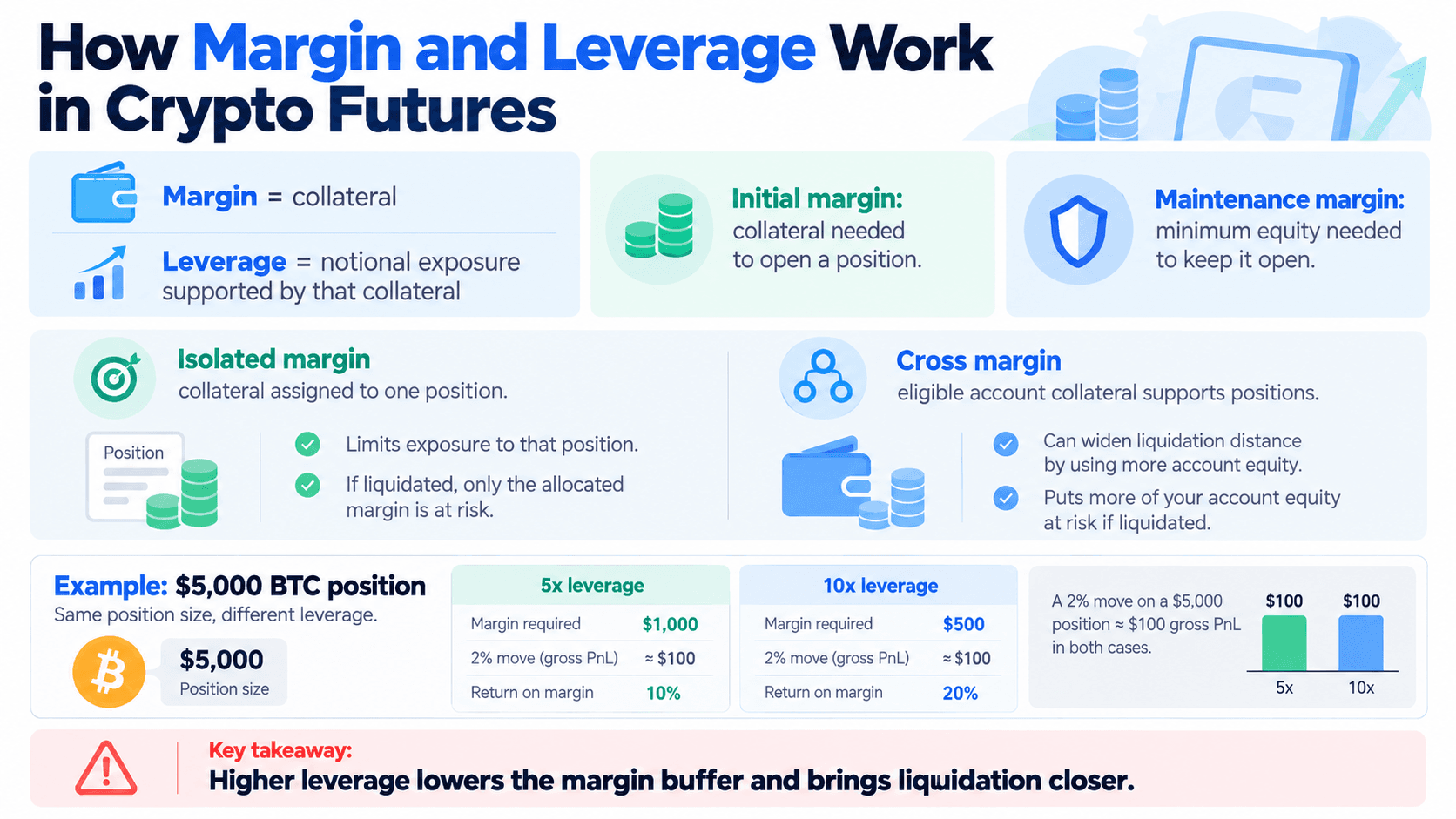 Margin Provides Collateral While Leverage Expands Market Exposure and Changes How Much Capital Supports a Futures Position
Initial Margin vs Maintenance Margin
Initial margin is the amount of collateral required to establish a futures position. Whereas, maintenance margin is the minimum level of equity required to keep the position open.
When equity falls far enough, liquidation or another risk-management process can begin.
The liquidation threshold for a 10x position depends on more than a simple 10% price move. Relevant inputs can include:
- Maintenance-margin rate
- Position size
- Margin mode
- Trading and liquidation fees
- Funding adjustments
- Risk tiers
- Other positions sharing collateral
- Contract specifications
Cross Margin vs Isolated Margin
Margin mode determines how much collateral can support a losing position.
| Margin Mode | How It Works | Main Trade-Off |
|---|---|---|
| Isolated margin | Margin is assigned to a specific position | Limits the collateral directly allocated to the position |
| Cross margin | Eligible account collateral can support positions | Can increase liquidation distance while exposing more account collateral |
With isolated margin, the venue allocates a defined amount of collateral to one position. Losses are managed against that assigned margin according to the platform's rules.
With cross margin, eligible funds elsewhere in the relevant derivatives account can support a losing position. Additional collateral can move the liquidation threshold farther from entry while increasing the amount of account equity exposed.
Does Higher Leverage Mean Higher Profit?
No. Selected leverage changes how much margin is required for a given notional position.
Consider a $5,000 BTC position.
At 5x leverage: $5,000 ÷ 5 = $1,000 margin
At 10x leverage: $5,000 ÷ 10 = $500 margin
A 2% BTC move produces approximately $100 of gross PnL in both cases because both positions carry $5,000 of notional exposure.
Return relative to margin changes:
- $100 on $1,000 margin = 10%
- $100 on $500 margin = 20%
Now keep margin fixed at $1,000 and increase leverage.
At 5x, notional exposure is $5,000.
At 10x, notional exposure is $10,000. A 2% price movement then produces approximately $200 of gross profit or loss on the $10,000 position.
Selected leverage changes collateral requirements. Increasing notional position size increases the dollar sensitivity to price movement. Higher leverage also reduces the margin buffer available relative to the position, which can move liquidation closer.
Mark Price, Index Price and PnL Explained
Futures interfaces commonly display several prices at once. Index price, mark price and last traded price serve different purposes.
Index Price vs Mark Price vs Last Price
Index price is a reference derived from underlying spot markets or another defined benchmark. A venue may combine prices from several liquid spot exchanges to produce its index.
Mark price is a calculated reference used by many futures platforms for unrealized PnL and liquidation calculations.
Last price is the price of the most recent trade in the futures market.
A simplified relationship looks like this:
Spot markets → Index price → Mark price → Unrealized PnL / liquidation
while:
Futures order book → Last traded price → Trade execution
Platforms use their own formulas and reference inputs. A trader can therefore see a last traded price that differs from the mark price influencing the liquidation engine.
Exact index and mark-price methodologies vary between venues. The contract specification explains which price sources, premiums, smoothing mechanisms or safeguards feed into the calculation.
Realized vs Unrealized PnL
Unrealized PnL represents the current gain or loss on a position that remains open. If the BTC position from the earlier example moves from $80,000 to $81,600 while remaining open, its approximate $100 gross gain remains unrealized.
Realized PnL represents profit or loss recognized after exposure is closed or settled. Trading fees, funding and other adjustments affect the amount remaining after settlement.
Some platforms calculate unrealized PnL from mark price while trade execution occurs against the order book. The number shown as unrealized PnL can therefore differ slightly from the amount available through an immediate market exit.
How Futures PnL and ROE Are Calculated
For a simple linear long: PnL = (exit price - entry price) × position quantity
For a simple linear short: PnL = (entry price - exit price) × position quantity
A simplified return-on-equity calculation is: ROE = PnL ÷ margin × 100
Using the earlier example:
$100 ÷ $1,000 × 100 = 10% gross ROE
Bitcoin's market price moved 2%.
ROE measures the result relative to margin committed to the position. The underlying asset return measures Bitcoin's own percentage movement.
Venues can use different display conventions for ROE, particularly where fees, funding and changing margin balances enter the calculation.
Break-Even Price
The economic break-even point includes the costs of opening, holding and closing a futures position.
Relevant costs include:
- Opening fee
- Closing fee
- Funding
- Slippage
A BTC long entered at $80,000 requires enough favorable price movement to cover those costs before producing positive net PnL.
The precise break-even level changes as funding accumulates or execution costs change.
Funding Rates, Fees and the Cost of Holding a Futures Position
Perpetual futures use funding to help keep contract prices aligned with their reference markets. Trading fees and slippage add further costs, so the final result of a futures position can differ from the raw price move alone.
How Perpetual Futures Funding Works
Funding payments move between long and short positions according to the contract's methodology. When funding is positive, longs generally pay shorts; when funding is negative, shorts generally pay longs. The mechanism creates an incentive that helps pull the perpetual price back toward its reference market.
Funding schedules vary by venue and contract. Coinbase's U.S. perpetual-style products, for example, use hourly funding. Funding frequency therefore comes from the individual contract specification rather than a single market-wide standard.
How Funding Affects PnL and Margin
Return to the earlier $5,000 BTC position. At a hypothetical funding rate of 0.01%, one funding payment would equal:
$5,000 × 0.01% = $0.50
Ten identical payments would total $5. Funding paid by the position reduces net PnL, while funding received adds to it. Repeated payments can become significant when a position remains open for an extended period.
Funding can also reduce available margin depending on the venue's accounting rules. A position can therefore move closer to its maintenance requirement as funding costs accumulate, even when the underlying market has moved in the expected direction.
Trading Fees and Slippage
Futures venues commonly charge separate maker and taker fees. Maker orders add liquidity to the order book, while taker orders execute against existing liquidity. A complete trade can incur fees on both entry and exit, and those fees are often calculated from notional trade value rather than only the margin posted.
Slippage is the difference between the expected execution price and the price actually received. It can increase during sharp volatility, when order-book depth is limited or when a large order consumes several price levels. These costs reduce net PnL alongside funding charges.
Coin Bureau's guide to the best crypto derivatives exchanges covers venue-specific fees and trading conditions separately.
What Is Liquidation in Crypto Futures?
Liquidation is a venue-enforced reduction or closure of a leveraged futures position after available equity falls below the relevant margin requirement. It forms part of the venue's risk-management process and can occur before all posted collateral has been consumed, depending on maintenance requirements and platform mechanics.
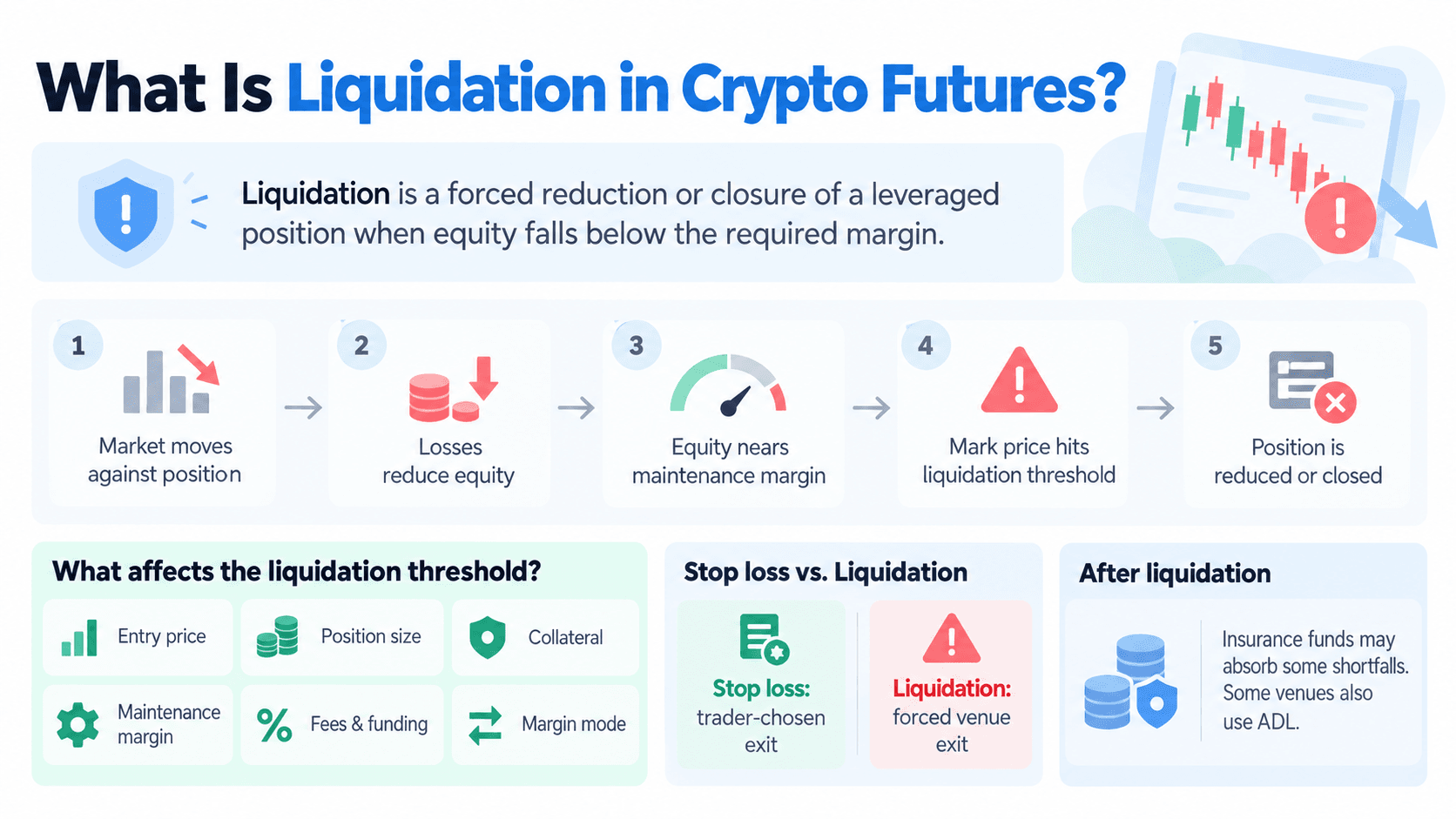 Liquidation Occurs When Available Equity Falls Below Margin Requirements and the Trading Venue Forces Position Reduction or Closure
How Futures Liquidation Happens
A typical sequence looks like this:
- The market moves against the position.
- Unrealized losses reduce position or account equity.
- Available equity approaches the maintenance-margin requirement.
- Mark price reaches the venue's liquidation threshold.
- The liquidation system reduces or closes exposure.
The exact liquidation price can depend on:
- Entry price
- Position quantity
- Collateral
- Maintenance-margin rate
- Margin mode
- Fees
- Funding
- Risk tier
- Other positions sharing collateral
- Contract rules
What Happens After a Position Is Liquidated?
After liquidation begins, the venue's liquidation engine reduces or closes the position according to its risk rules. The bankruptcy price generally refers to the level where the position's remaining collateral would be exhausted under the platform's accounting model.
Many venues use an insurance fund to absorb certain liquidation shortfalls. Some also use auto-deleveraging (ADL) as a last-resort mechanism, which can reduce profitable positions on the opposite side when liquidation resources are insufficient.
Liquidation vs Stop Loss
A stop-loss order is a trader-defined exit triggered at a chosen price, while liquidation is enforced by the venue when margin becomes insufficient.
Planned risk exit → stop loss
Forced margin exit → liquidation
A planned stop generally sits before the liquidation threshold, although fast markets can still create slippage or execution gaps.
Crypto futures are commonly used for directional trading, hedging and capital-efficient exposure. Each use introduces additional risks through leverage, funding, execution and liquidation.
Speculating on Rising and Falling Prices
Futures allow traders to take either side of the market. A long position gains when the futures price rises, while a short position gains when it falls.
This two-sided structure makes it straightforward to express bullish or bearish views. Leverage increases the gain or loss relative to posted margin, so larger exposure also increases the impact of an incorrect market view.
Hedging Crypto Exposure
Futures can offset part of an existing spot position. Someone holding 1 BTC, for example, could short futures representing 0.5 BTC to reduce short-term directional exposure.
Ignoring basis, funding and execution differences, the combined position would have roughly 0.5 BTC of remaining net exposure. The hedge can therefore offset part of a spot loss during a decline, while also reducing some of the upside during a rally.
Hedging still involves basis risk, funding, execution and sizing considerations.
Capital Efficiency
Leverage reduces the collateral required for a given amount of notional exposure. A $5,000 futures position, for example, requires about $1,000 of margin at 5x leverage.
The market exposure remains $5,000, so gains and losses are measured against the full position while the posted collateral is smaller. This increases return sensitivity relative to margin and generally brings the liquidation threshold closer.
Main Risks of Crypto Futures Trading
| Risk | What to Know |
|---|---|
| Leverage risk | Gains and losses become larger relative to posted collateral |
| Liquidation risk | The venue can forcibly reduce or close exposure |
| Volatility | Crypto markets can move sharply over short periods |
| Funding risk | Repeated payments can erode net PnL |
| Execution risk | Stops and market orders can fill away from expected prices |
| Liquidity risk | Thin markets can widen spreads and increase slippage |
| Counterparty risk | Centralized venues control custody and trading infrastructure |
| Smart-contract risk | Decentralized venues rely on software and protocol logic |
| Oracle risk | Price feeds can affect collateral and liquidation calculations |
| Bridge risk | Cross-chain collateral flows can introduce additional smart-contract and custody exposure |
| Governance risk | Protocol rule changes can affect decentralized venues |
| Regulatory risk | Access and product rules vary across jurisdictions |
| Psychological risk | Rapid PnL swings can encourage excessive trading and constant monitoring |
Decentralized perpetual markets have grown substantially. CoinGecko's 2026 CEX and DEX trading report found that perpetual DEXs accounted for 10.2% of perpetual trading volume in January 2026, up from 2.0% in January 2024.
A separate CoinGecko report on crypto perpetuals calculated average monthly volume of $611.57 billion across the top 12 perpetual DEXs during the first four months of 2026.
Those historical figures show the growing role of decentralized venues while leaving centralized exchanges responsible for the larger share of perpetual trading during that period.
How to Manage Risk When Trading Crypto Futures
Futures risk management centers on position size, defined exits and sufficient distance between a planned exit and forced liquidation.
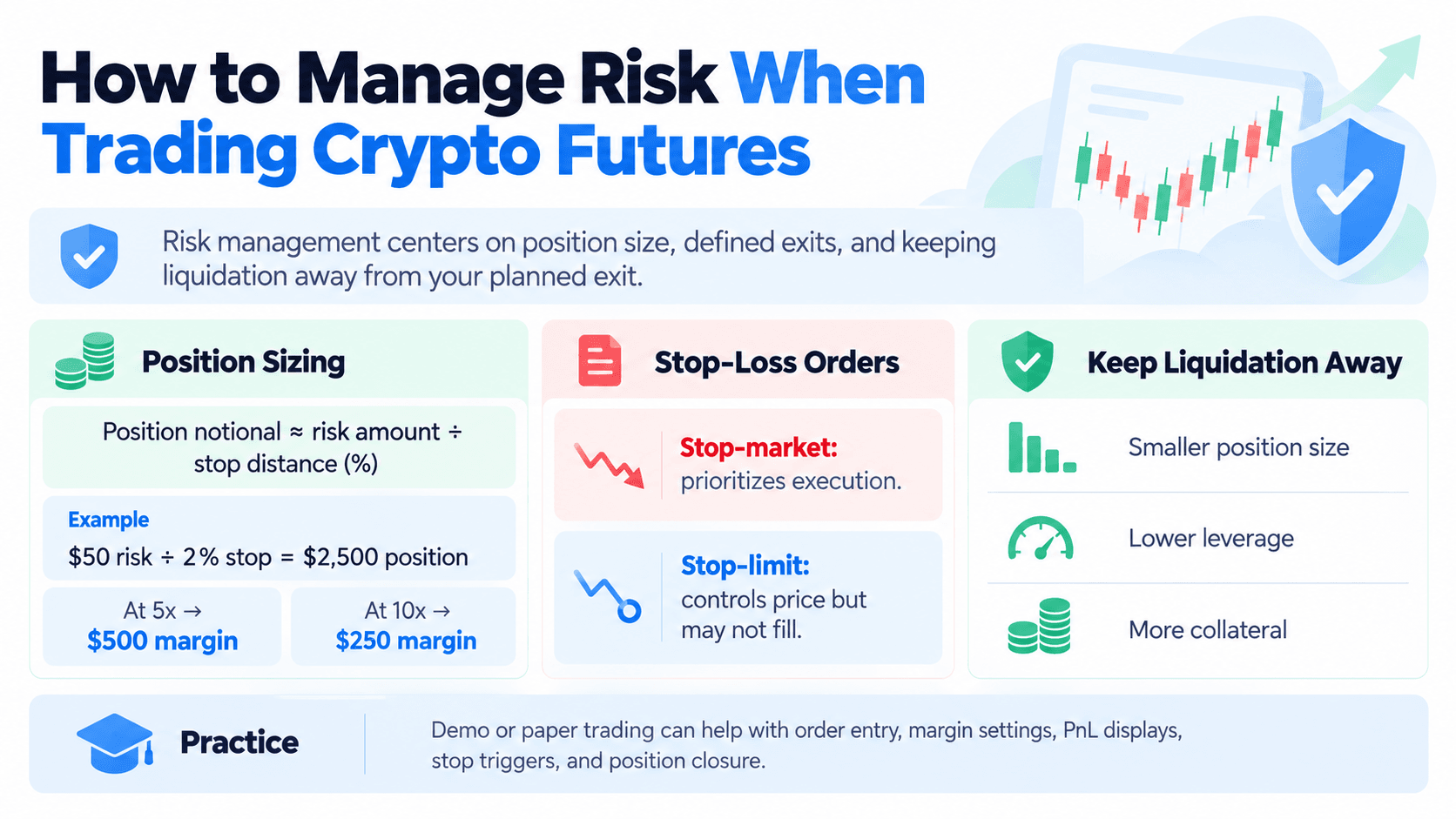 Position Sizing, Planned Exits, Lower Leverage and Adequate Collateral Help Control Risk in Crypto Futures Trading
Position Sizing
Position size can be derived from four inputs:
- Account capital
- Entry price
- Planned stop level
- Amount allocated to loss on the trade
A simplified relationship is: Position notional ≈ risk amount ÷ stop distance (%)
Assume $50 is allocated to potential loss and the planned stop sits 2% from entry.
$50 ÷ 2% = $2,500
The simplified position size is therefore approximately $2,500 before fees and slippage.
Leverage then determines the amount of margin required.
At 5x: $2,500 ÷ 5 = $500 margin
At 10x: $2,500 ÷ 10 = $250 margin
The notional market exposure remains $2,500 in both examples. Sizing from the planned loss keeps the risk decision connected to account capital and exit level rather than the maximum leverage displayed by the venue.
Stop-Loss Orders
A stop-market order triggers a market order when its stop condition is reached. Its design prioritizes execution. The final fill price depends on liquidity available after the trigger.
A stop-limit order creates a limit order after the stop trigger. The trader defines the acceptable execution price, while a fast market can move through the limit before the order fills.
During sharp volatility, stop-market orders can experience substantial slippage. Stop-limit orders can remain unfilled if available prices move beyond the limit. Order type therefore changes execution risk rather than eliminating it.
Keep Liquidation Away From Your Planned Exit
The planned stop represents a chosen risk exit. The liquidation threshold represents the point where the venue's margin system begins forced action. Greater distance between the two provides more room for the trader-defined exit to operate.
Liquidation distance can change through:
- Smaller position size
- Lower leverage
- Additional isolated collateral
- Greater eligible cross-margin collateral
Each adjustment changes the amount of capital exposed and the position's sensitivity to adverse price movement.
Start With Demo or Low-Risk Practice Where Available
Some futures venues offer demo trading or paper trading.
A simulation can help users learn:
- Order entry
- Margin settings
- Leverage controls
- PnL displays
- Funding information
- Stop triggers
- Position closure
Live markets add real liquidity constraints, slippage, fees, emotional pressure and counterparty exposure. Demo environments therefore provide practice with platform mechanics, while live execution introduces conditions a simulation may reproduce only imperfectly.
How to Choose a Crypto Futures Trading Platform
Crypto futures platforms differ in custody, liquidity, contract design, margin rules, liquidation systems and regulation. Maximum leverage provides only one part of the comparison.
Centralized vs Decentralized Futures Platforms
A centralized futures exchange typically controls customer margin accounts, maintains the trading infrastructure and runs a centralized risk engine.
Relevant characteristics include:
- Custody model
- Order-book depth
- Trading volume
- KYC requirements
- Jurisdiction
- Margin system
- Liquidation process
- Insurance fund
- Available collateral
- Supported contracts
A decentralized perpetual platform, or perpetual DEX, commonly combines wallet-based access with smart contracts and on-chain or hybrid trading infrastructure.
Its risk profile can include:
- Smart-contract vulnerabilities
- Oracle design
- Protocol liquidity
- Bridge exposure
- Front-end restrictions
- Sequencer or matching-engine dependencies
- Governance changes
- Protocol-specific liquidation rules
CoinGecko's 2026 research found that decentralized perpetual venues had expanded their share of crypto derivatives activity considerably since early 2024. That growth gives traders more venue structures to evaluate, while the technology and risk models can differ substantially from centralized exchanges.
Coin Bureau's CEX vs DEX guide covers the wider differences in custody, execution, KYC, wallet access and smart-contract risk.
What to Check Before Choosing a Futures Platform
| Check | Why |
|---|---|
| Availability in your jurisdiction | Determines local product access |
| Regulatory status | Identifies the legal and supervisory framework |
| Contract liquidity | Influences spreads and execution quality |
| Order-book depth | Affects slippage on larger trades |
| Supported contracts | Determines available assets and expiries |
| Collateral options | Changes collateral and currency exposure |
| Margin modes | Determines how collateral supports positions |
| Maximum leverage | Defines the venue's available leverage ceiling |
| Maintenance-margin structure | Influences liquidation thresholds |
| Funding methodology | Determines perpetual funding calculations |
| Mark/index methodology | Affects valuation and liquidation references |
| Maker/taker fees | Reduce net PnL |
| Insurance fund | Supports the venue's liquidation framework |
| ADL rules | Define possible last-resort position reductions |
| Order types | Affect execution and risk control |
| Demo trading | Provides platform-mechanics practice |
| Security record | Adds context around operational and custody risk |
The product's legal status also deserves separate attention from the exchange brand. A platform may offer different products in different countries or operate through different regulated entities.

Crypto Futures Trading: Closing Thoughts
Crypto futures provide long or short cryptocurrency price exposure through derivative contracts.
Dated futures use scheduled expiration and settlement. Perpetual futures use open-ended exposure combined with a funding mechanism designed to keep prices aligned with the reference market.
Leverage reduces the collateral required for a given notional position and magnifies gains and losses relative to posted margin. Mark price, maintenance margin, position size and margin mode influence liquidation. Funding, maker and taker fees, and slippage affect net PnL.
Those mechanics make futures materially more complex than ordinary unleveraged spot trading.