Crypto can be secure, but only when the technology and the user’s security habits work together. Blockchains may be resilient, yet wallets, exchanges, DApps, devices and recovery methods can still expose funds to theft or permanent loss.
This guide explains how to protect your crypto, secure wallets and exchange accounts, avoid malicious transactions and scams, manage DApp risk and prepare for recovery if something goes wrong.
Editor's Note (Aug. 7, 2026): We fully updated this guide to reflect today’s crypto-security threats and account-protection tools. The refresh adds wallet segmentation, passkeys and security keys, safer transaction-signing practices, address-poisoning protection, malicious approval and wallet-drainer risks, DApp and bridge checks, emergency response steps and crypto inheritance planning, supported by current theft data and security research.
How to Protect Your Crypto: Quick Answer
Protecting crypto requires layered security. Keep long-term holdings separate from everyday funds, protect recovery information offline, secure exchange accounts with phishing-resistant authentication, verify every transaction before signing and maintain a recovery plan for compromised wallets or accounts.
Crypto Security Best Practices
-
Separate long-term holdings from everyday funds Keep financially significant holdings in a vault or appropriately configured hardware or multisig wallet rather than an everyday transaction wallet.
-
Protect seed phrases and private keys offline Keep accurate, tested recovery backups in secure offline locations and never upload, photograph or share recovery information.
-
Use phishing-resistant authentication Protect exchange accounts with passkeys or hardware security keys where supported, along with withdrawal restrictions and session controls.
-
Verify every transaction before signing Check the full destination address, blockchain network, asset, amount, fees, permissions and expected balance changes before approving a transaction.
-
Use separate wallets for different activities Keep storage funds in a vault wallet, routine DeFi activity in an active wallet and unknown or higher-risk interactions in a burner wallet.
-
Maintain an emergency response and recovery plan Know how to migrate funds, revoke malicious permissions, lock exchange accounts, restore wallets and recover access before an incident occurs.
Crypto Security Actions by Goal
| Security Goal | Primary Action |
|---|---|
| Protect long-term holdings | Use an appropriately configured hardware or multisig wallet. |
| Limit DApp exposure | Use a separate active or burner wallet. |
| Protect exchange accounts | Use passkeys or hardware security keys where supported. |
| Protect recovery information | Keep tested offline backups in secure locations. |
| Avoid malicious transactions | Review addresses, permissions and expected balance changes. |
| Limit damage after compromise | Move unaffected assets and revoke permissions quickly. |
Security Warning
No wallet, authenticator, VPN or antivirus program can compensate for approving the wrong transaction or exposing a recovery phrase.
Disclaimer
This guide is for educational purposes only and is not financial advice.
Disclosure
Some links in this guide may be affiliate links. If you choose to use a service through these links, we may earn a commission at no additional cost to you.

Is Cryptocurrency Safe?
Cryptocurrency networks can be technically resilient while individual users, wallets, exchanges and applications remain vulnerable.
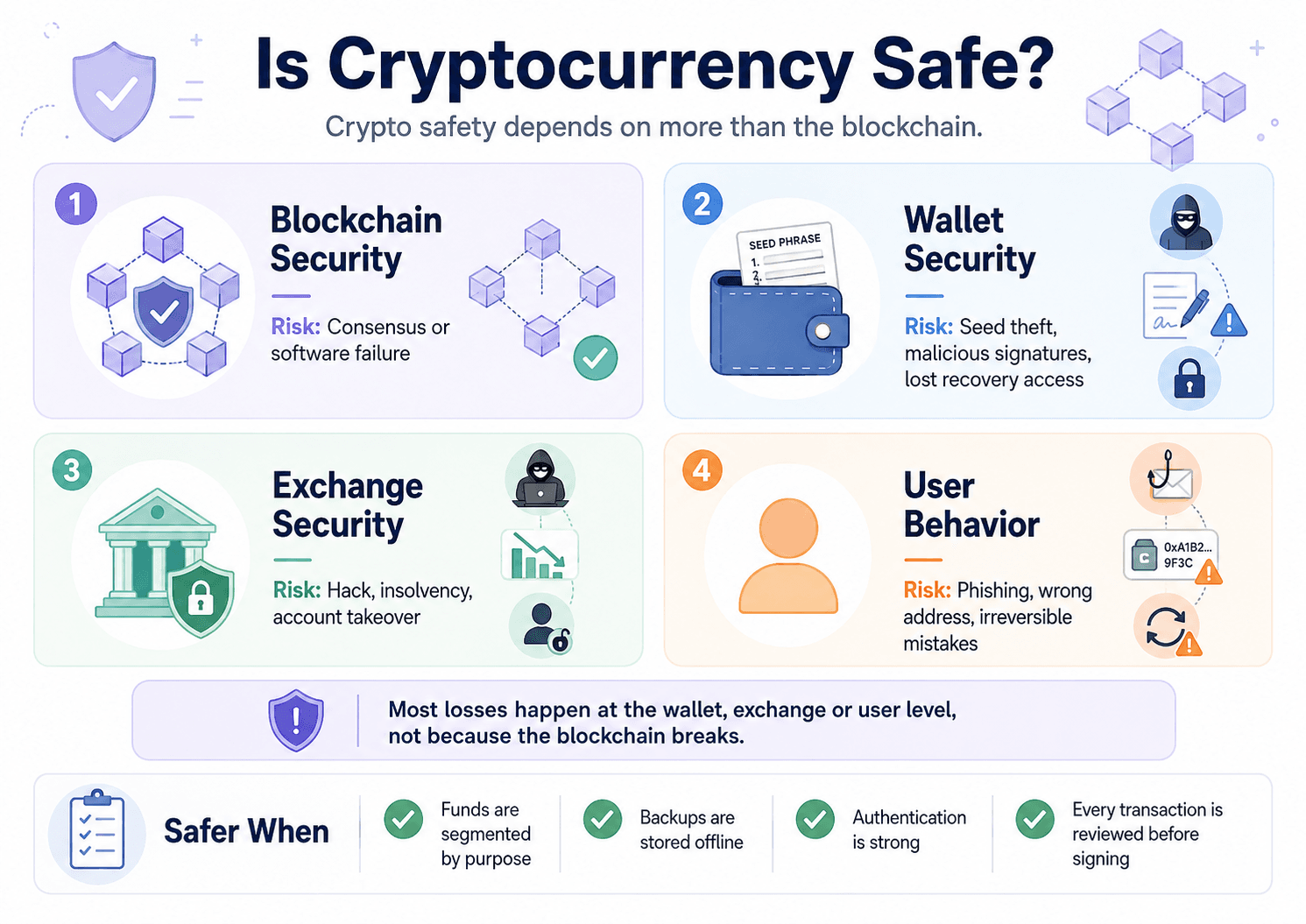 Crypto Safety Depends on Secure Wallets, Reliable Exchanges, Strong Authentication, and Careful User Decisions at Every Step
| Question | Main Risk |
|---|---|
| Is the blockchain secure? | A consensus mechanism or implementation failure |
| Is the wallet secure? | Private key theft, malicious signatures or recovery failure |
| Is the exchange or custodian secure? | Exchange hack, insolvency, account takeover or custody risk |
| Is the user’s behavior secure? | Phishing, user error and irreversible transaction mistakes |
Most personal crypto losses do not require a cyberattack against blockchain security. They more commonly follow a revealed seed phrase, malicious signature, fake app or website, wrong address, lost recovery information, exchange-account takeover or vulnerable smart contract or bridge.
Crypto is safer when: Funds are segmented, keys and backups are protected, authentication resists phishing, software is verified and every transaction is reviewed.
Crypto becomes riskier when: One wallet interacts with unknown DApps, long-term funds remain on one exchange, backups are untested or urgency replaces verification.
The Feb. 21, 2025, Bybit theft showed that institutional signing systems can fail without breaking a blockchain. Personal wallet compromises also show how technically valid transactions can transfer funds to attackers when a user signs a malicious request.
Choose a Crypto Security Setup That Fits How You Use Crypto
A suitable setup follows from a risk assessment and threat model, not a universal threshold. Consider portfolio size, transaction frequency, DeFi and NFT use, exchange activity, travel, technical confidence, public exposure and recovery needs.
| User Profile | Appropriate Starting Setup |
|---|---|
| Beginner with a small balance | Reputable exchange or wallet, strong authentication and a tested withdrawal |
| Long-term holder | Hardware wallet, offline backup and limited transaction frequency |
| Active trader | Separate trading balance, security key and withdrawal allowlist |
| DeFi user or NFT user | Vault wallet, active wallet and disposable burner wallet |
| High-value holder | Multisig, separated signers, documented recovery and inheritance plan |
| Frequent traveller | Minimal travel balance, remote account controls and secure backup separation |
Portfolio thresholds are personal. The same balance can be trivial to one person and financially critical to another high-net-worth holder.
The central wallet-role model is:
- Vault wallet: Long-term holdings and very few signatures
- Active wallet: Routine swaps, staking and established DApps
- Burner wallet: Unknown mints, airdrops and short-lived interactions
- Exchange trading balance: Only the capital required for current trades or near-term selling
Readers comparing storage products can start with our best crypto wallets piece.
Build a Safer Crypto Wallet System
A safer wallet system limits one mistake. Match custody and connectivity to each balance’s job.
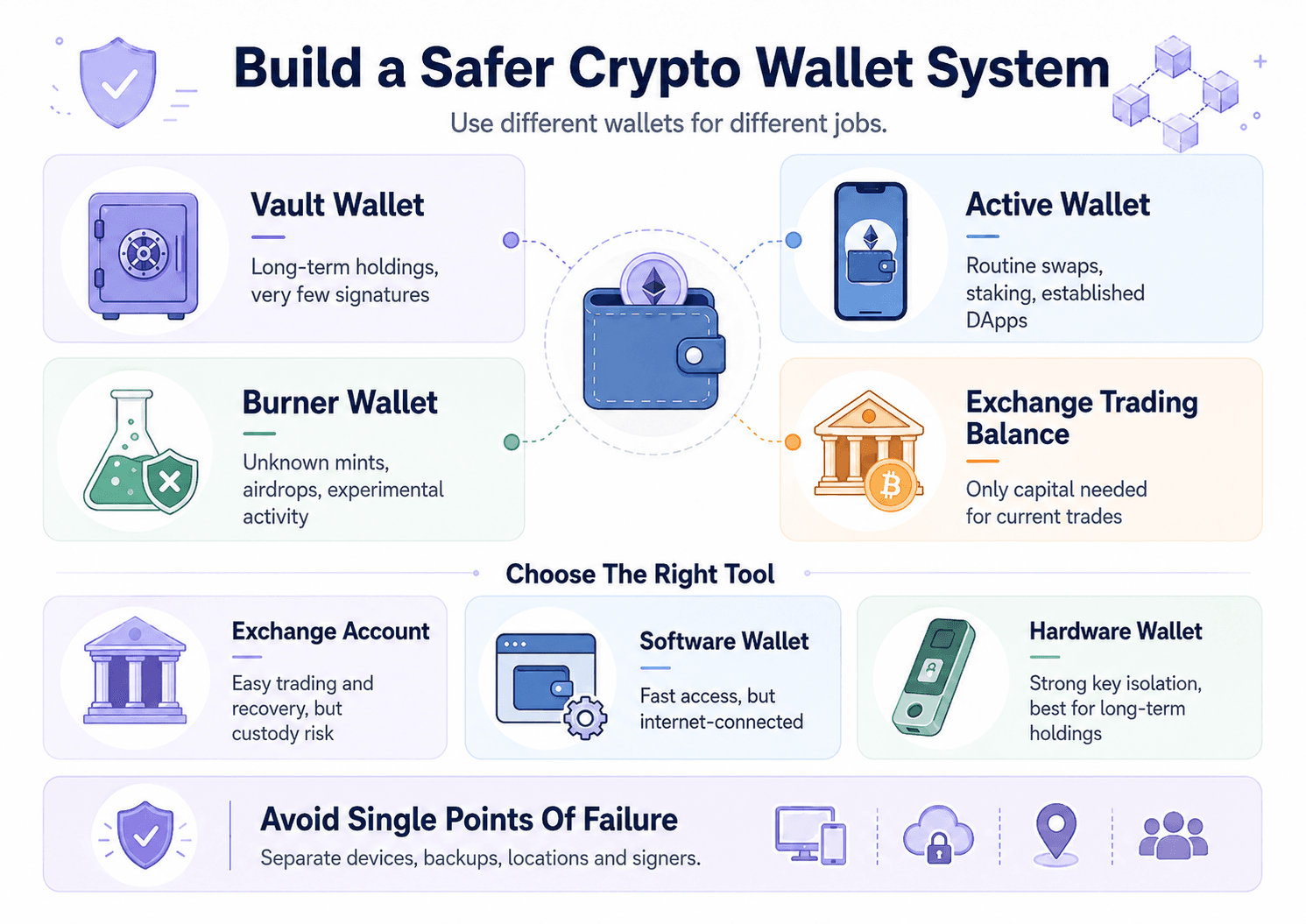 Separate Vault, Active, Burner, and Exchange Wallets to Limit Exposure and Reduce the Impact of one Compromise
Exchange, Software Wallet or Hardware Wallet?
A wallet does not physically store cryptocurrency. It manages the keys used to authorize blockchain transactions to and from a public address.
| Model | Who Controls Keys? | Main Advantage | Main Weakness | Best Use | Provider Fails | Device Is Lost |
|---|---|---|---|---|---|---|
| Custodial exchange account | Exchange or custodian | Trading, cash access and account recovery | Custody risk and account controls | Trading balance | Withdrawals or access may fail | Account can usually be recovered |
| Software wallet or hot wallet | User or recovery provider, depending on design | Fast DApp and payment access | Internet-connected attack surface | Active funds | Phrase-based accounts can use another interface | Restore from the correct recovery method |
| Hardware wallet or cold wallet | User; signing keys remain on the device | Strong private-key isolation | Recovery and transaction-verification responsibility | Long-term holdings | Assets remain recoverable with compatible tools | Restore to replacement hardware with the backup |
Modern hardware wallets use USB, NFC, QR codes or secure mobile links. Seedless recovery, social recovery and smart accounts change recovery risk rather than removing it.
Exchanges increasingly support passkeys, allowlists and device controls, but these do not remove legal-entity, solvency or withdrawal risk. Our custodial vs non-custodial wallet guide explains the trade-off.
Paper wallets are a legacy form of cold storage. They can keep a key offline, but printing, generation, change handling, damage and recovery mistakes make them operationally risky rather than an automatic security winner.
Use Different Wallets for Different Jobs
Wallet segregation reduces the blast radius of a compromise. It does not make risky activity safe.
A practical setup keeps most holdings in a vault, a limited balance in an active or operational wallet, a minimal burner balance and only required trading capital on an exchange.
Keep a DeFi wallet separate from the vault. Unknown mints, airdrops and experimental contracts belong in a burner holding nothing valuable. Segmentation limits likely loss but not attacks on linked identities or devices.
Our best DeFi wallets comparison covers active-wallet and multisig options.
Avoid Single Points of Failure
A single point of failure can be one seed copy, location, device, signer, exchange or person who understands recovery.
A multisignature wallet requires a quorum, such as two of three signers, before funds move. It can improve resilience against one key compromise or lost device. Poorly documented multisig can increase recovery risk when signers, wallet descriptors or software details disappear.
Geographic separation protects against fire, theft and regional disruption, but should not place every copy under one person or jurisdiction.
Multiple devices do not remove single-key risk when all restore from one seed. Wallet redundancy requires tested keys, signers, locations and recovery.
Protect Your Seed Phrase, Private Keys and Recovery Access
Recovery information can control funds or determine whether wallet recovery survives device loss.
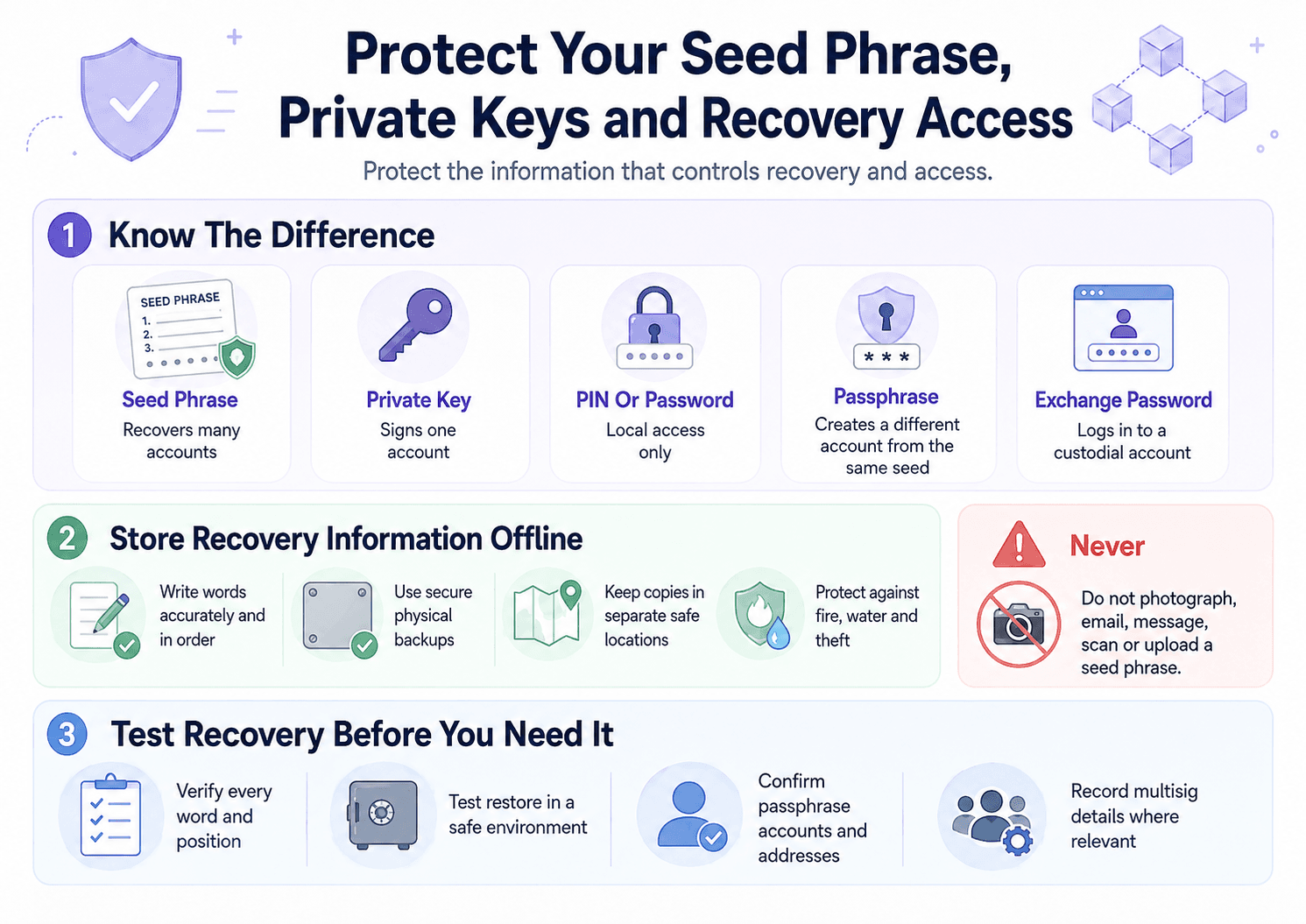 Offline Backups, Clear Recovery Roles, and Tested Access Methods Help Protect Seed Phrases and Private Keys
Seed Phrase vs Private Key vs Passphrase
- Seed phrase or recovery phrase: Usually a BIP39 mnemonic phrase that uses key derivation to generate many private keys and accounts.
- Private key: The secret value that signs transactions for a particular account.
- Wallet password or PIN: Local access control for a device or application. It normally cannot restore funds elsewhere.
- Optional wallet passphrase: Extra input that creates a different passphrase account from the same mnemonic phrase.
- Exchange password: Login credential for a custodial account, not a blockchain key.
A recovery phrase or private key can directly control funds. A wallet password or PIN usually protects one local installation. An exchange password controls account access but does not reveal exchange custody keys.
An optional passphrase is not a stronger PIN. Passphrase loss can permanently block recovery even with the correct seed. Test the model before funding it.
Store Recovery Information Offline
Record recovery words accurately, in order and offline. Protect backups from fire, water, theft and unauthorized access, using more than one location where appropriate.
Do not photograph, email, message, scan or upload a seed phrase. Never type it into a website, support chat or remote-access session. Avoid improvised word splitting unless the method has been designed and tested for that wallet.
A paper backup is cheap but vulnerable to fire, water and disposal. A metal seed backup improves fire resistance and water resistance but still needs theft protection. Our seed phrase storage guide compares physical options.
A safe deposit box may reduce household theft or fire risk while adding bank-access, jurisdiction, privacy and inheritance concerns. Do not keep every copy together.
Test Recovery Before Depending on It
An untested backup is an assumption.
- Confirm every word, spelling and position.
- Use the wallet’s seed verification or recovery-check feature where available.
- Test a wallet restore with a spare hardware wallet or isolated environment.
- Verify every expected passphrase account and address.
- Record multisig quorum, signer and wallet descriptor information.
- Avoid entering a seed on an everyday computer.
- Run a periodic recovery drill after material wallet or family changes.
Do not reset your only working wallet before verifying the backup. A recovery test must reproduce the expected addresses, not merely accept the words.
Secure Crypto Exchange Accounts, Devices and Apps
Exchange security depends on login controls, withdrawal restrictions, recovery channels and the device used to access the account.
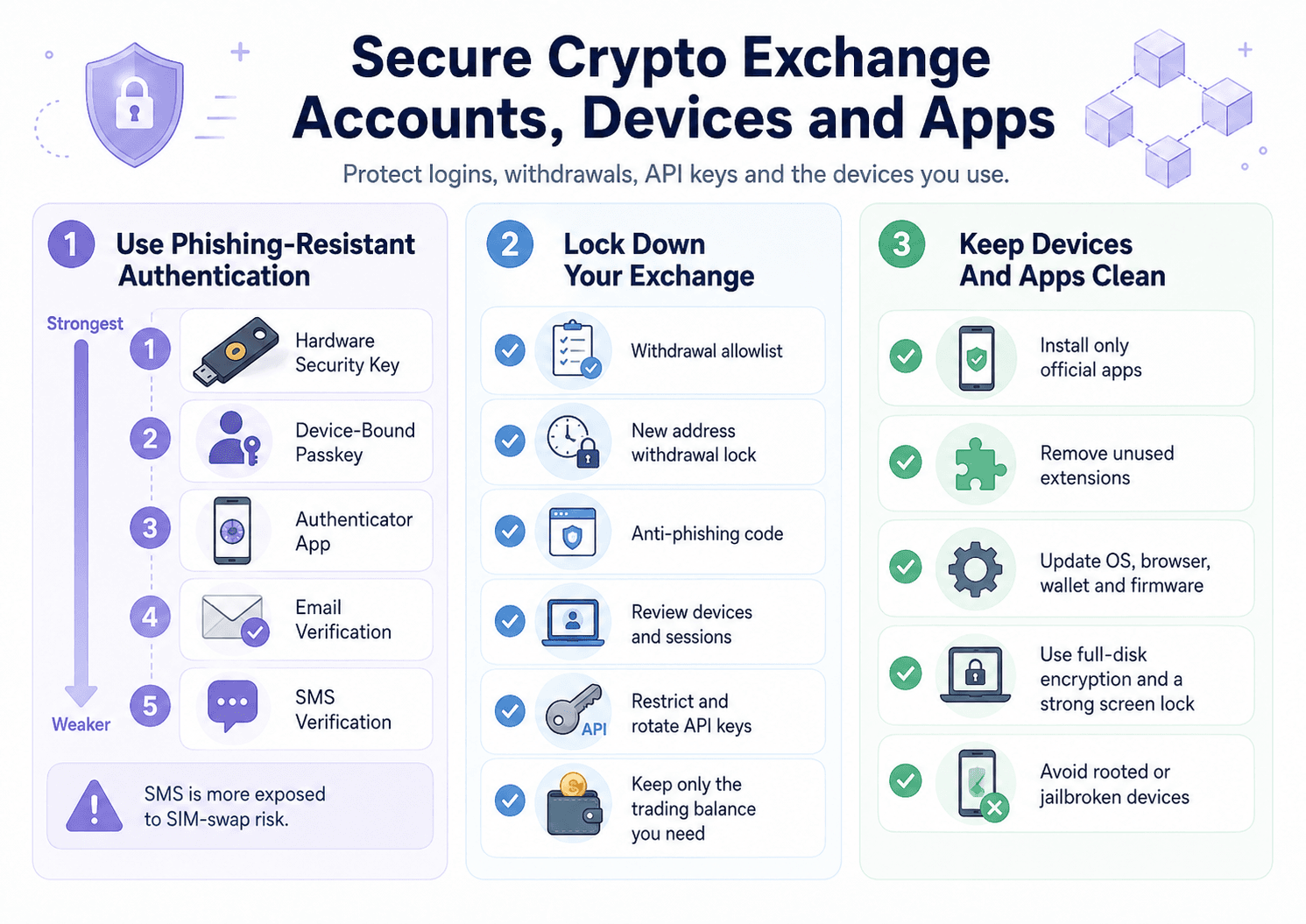 Phishing-Resistant Authentication, Withdrawal Controls, Restricted api Keys, and Clean Devices Strengthen Crypto Account Security Across Exchanges
Use Phishing-Resistant Authentication
A broad ranking from stronger to weaker is:
- Hardware security key
- Device-bound passkey
- Authenticator application using TOTP
- Email verification
- SMS verification
Availability and recovery vary by exchange. CISA recommends phishing-resistant multifactor authentication, including FIDO2 keys. Coinbase, Kraken and other large exchanges now support passkeys.
SMS is exposed to SIM-swap attacks and number-porting fraud. Email security affects exchange security because reset links and alerts often arrive there. Store each backup code offline, away from the logged-in device.
Recovery channels can bypass two-factor authentication when attackers control email, phone records or identity documents. Biometric authentication protects a device or passkey, not the full account-recovery process.
Lock Down Withdrawals, Sessions and API Keys
Enable the controls your exchange supports:
- Withdrawal address allowlist
- New-address withdrawal lock
- Anti-phishing code
- Device and login session review
- Login alerts
- Separate subaccounts
- Account-recovery protections
- IP whitelist for an API key
- Least-privilege trading permission
- Disabled withdrawal permission on trading-only keys
Delete old API keys and revoke unfamiliar sessions. A leaked key with trading access can still create losses through harmful trades even when it cannot withdraw.
Proof of reserves, insurance funds and controls do not eliminate insolvency, legal-entity or custody risk. Keep only the required trading balance and test withdrawals.
Our safest crypto exchanges comparison covers account and custody controls and give you our top picks.
Keep Wallet Apps and Devices Clean
Install wallets through official websites or verified publishers. Confirm the developer, domain and application signature where possible.
Remove unused browser extensions. Update the operating system, browser, wallet application and firmware from official sources. Avoid rooted or jailbroken devices. Enable full-disk encryption and a strong screen lock. Separate risky downloads and experimental browsing from crypto activity.
Trust Wallet reported that an unauthorized and malicious version of its browser extension v2.68 was published on Dec. 24, 2025. The incident showed that a compromised release channel can expose users even when they install an apparently genuine extension. Maintain an emergency migration option rather than assuming official software is infallible.
A dedicated crypto device protects against some exposure to malware, clipboard hijackers and hostile extensions, but it does not protect against approving a malicious transaction, excessive wallet permissions or an incorrect destination address. Public Wi-Fi adds risk. A VPN protects traffic but cannot legitimize a fake DApp; antivirus cannot stop an authorized malicious transaction.
Check Every Crypto Transaction Before You Sign
Transaction verification is the final chance to stop many irreversible losses. Use the same checklist for familiar destinations.
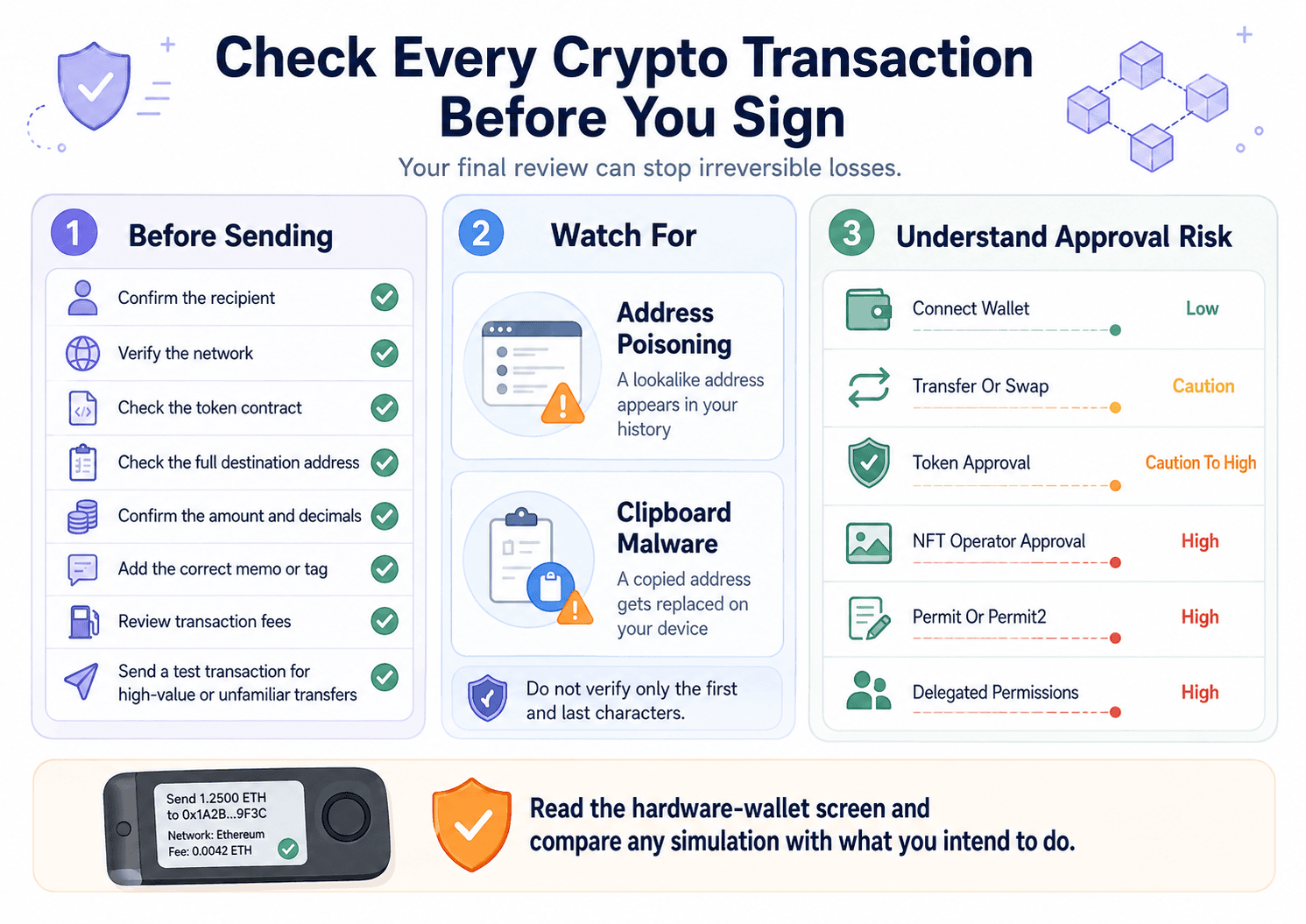 Verify the Full Address, Network, Asset, Amount, Fees, and Permissions Before Approving any Crypto Transaction
Verify the Address, Network, Asset and Amount
Before sending:
- Confirm the recipient through a trusted channel.
- Verify the blockchain network.
- Confirm the token contract where relevant.
- Check the complete destination address.
- Confirm the amount and decimal placement.
- Add the correct memo or destination tag.
- Review every transaction fee.
- Send a test transaction for a high-value or unfamiliar transfer.
- Save verified destinations in an address book where appropriate.
A test transaction reduces address and network mistakes but does not secure later transfers. Recheck the wallet address before every irreversible transaction.
Protect Against Address Poisoning and Clipboard Malware
Address poisoning occurs when an attacker creates a vanity address that resembles a real destination and inserts the lookalike address into the victim’s transaction history. The attacker hopes the victim copies it later.
The Jan. 28, 2025, study Blockchain Address Poisoning identified 270 million address-poisoning attempts targeting 17 million addresses across Ethereum and BNB Smart Chain. The researchers attributed at least $83.8 million in losses to 6,633 incidents.
Never copy from transaction history or verify only the first and last characters. Use saved contacts, confirm high-value destinations through a second channel and read the full hardware-wallet display. Treat dust transactions as untrusted.
Clipboard hijacking replaces a copied address on the device; address poisoning contaminates transaction history. Both require full-address checks.
Understand What a DApp Is Asking You to Approve
A wallet request may perform very different actions:
| Request | Typical Risk Level | What It Can Do |
|---|---|---|
| Connect a wallet | Low | Reveals selected addresses and starts a wallet connection |
| Sign a login message | Low to caution | Proves account control; wording still needs review |
| Submit a transfer or swap | Caution | Executes an on-chain transaction |
| Approve token spending | Caution to high | Creates an ERC-20 allowance for a spender contract |
| Approve an NFT operator | High | An operator approval may cover an entire collection |
| Sign Permit or Permit2 | High | An off-chain signature can authorize later token movement |
| Delegate account or session permissions | High | Grants continuing actions within defined or broad limits |
A gasless wallet signature can still be dangerous. A wallet drainer may abuse Permit, Permit2 or an unlimited token approval without stealing a key.
Inspect the contract, spender, asset, approval amount, expiry, operator permissions and expected balance changes. Reject requests whose scope exceeds the action.
Our blind-signing guide explains common wallet-signature traps.
Use Hardware-Wallet Screens and Transaction Simulation Carefully
A trusted display helps only when it shows enough information, the user reads it, blind signing hides nothing critical and decoding is accurate.
Transaction simulation may show expected asset movements, approvals, contract interactions and warnings before smart contract execution. It is a useful signal, not proof of safety.
In the July 30, 2026, preprint Blockchain Transaction Simulation Phishing, Xiaocan Wang and co-authors described dynamic contracts that could appear benign during simulation but redirect funds during live execution. The study identified more than 4,000 phishing contracts, more than 5,700 victims and approximately $3.48 million in losses.
Simulations can be incomplete, dynamic contracts can react to state and new types may not decode. Compare the decoded transaction and balance change with the intended action.
Use DApps, DeFi, NFTs and Bridges More Safely
DApp safety requires pre-connection verification and strict limits on exposed assets and permissions.
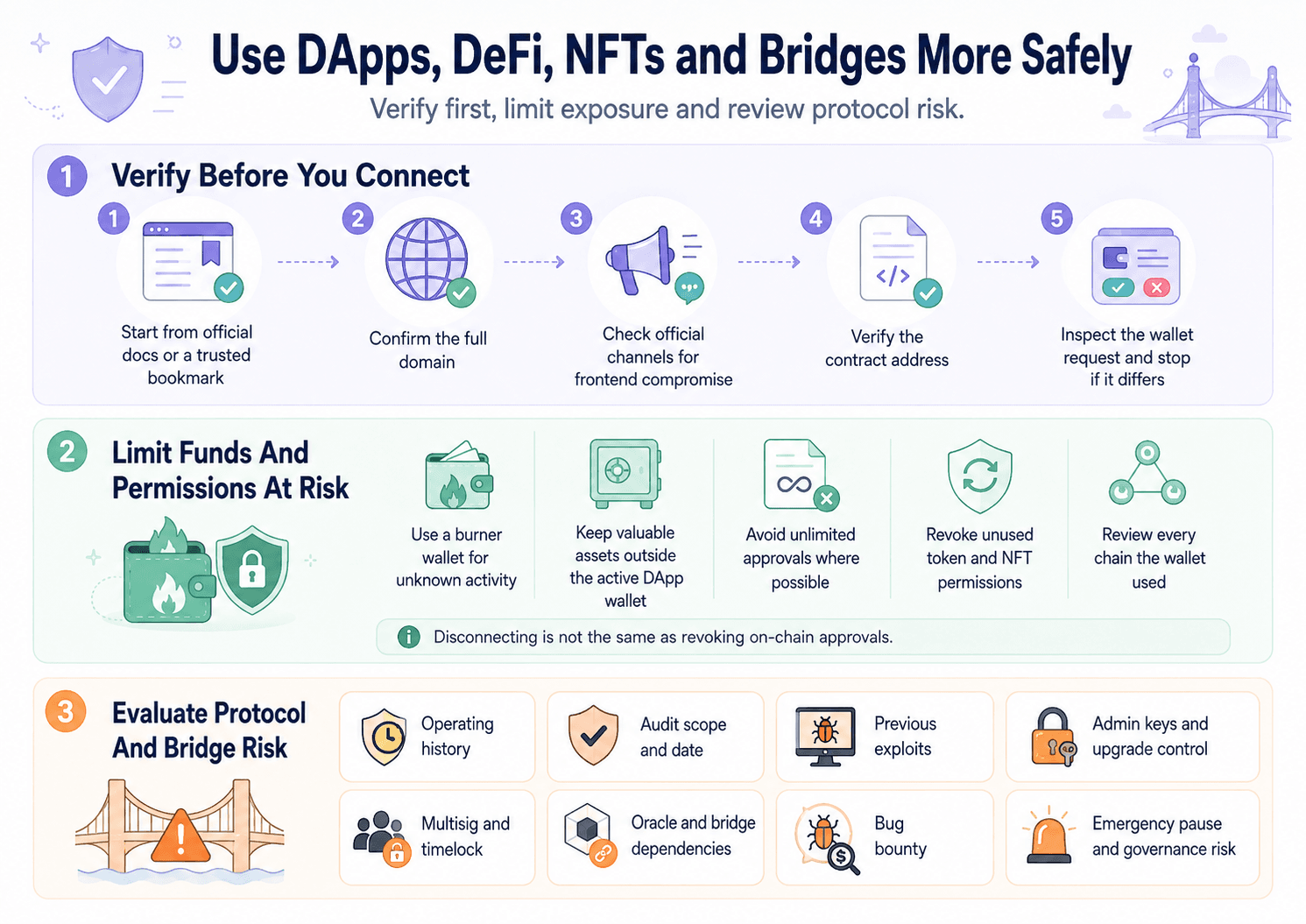 Verify DApp Domains, Contracts, Permissions, and Bridge Controls Before Exposing Funds to any Decentralized Protocol
Verify the Website, Contract and Communication Channel
Use this workflow:
- Start from official documentation or a previously verified bookmark.
- Confirm the full domain.
- Check whether official channels report a frontend compromise.
- Verify the smart contract address against documentation and a block explorer.
- Inspect the wallet request.
- Stop when the request differs from the expected action.
Search advertisements can lead to a phishing domain or domain spoofing. A familiar interface proves neither contract legitimacy nor frontend safety; QR-code phishing can redirect a phone.
Official social accounts can also be compromised. On July 23, 2026, Robinhood CEO Vlad Tenev’s X account was hijacked and used to promote a fake token, according to Reuters. Verify critical instructions through a second official channel.
Limit the Funds and Permissions at Risk
Use a burner wallet for unknown or short-lived interactions, and keep valuable assets outside the active DApp wallet. Avoid an unlimited approval where a spending cap or expiry is available. Revoke each token allowance or operator approval that is no longer needed. Review every chain the wallet used.
Disconnect vs revoke: Disconnecting removes a visible wallet connection or session. Approval revocation changes an on-chain DApp permission. Disconnecting alone does not cancel an ERC-20 allowance or NFT operator approval.
Our crypto scams and malicious approvals guide covers wallet drainers, fake revoke sites and approval abuse.
Evaluate Protocol, Bridge and Smart-Contract Risk
Before using a protocol or bridge, review:
- Operating history
- Total value locked and concentration
- Smart contract audit scope and date
- Previous protocol exploits
- Upgrade authority and admin key control
- Multisig signers and quorum
- Timelock duration
- Oracle dependencies
- Bridge dependencies
- Public bug bounty
- Emergency pause controls
- Governance risk
Audits do not remove economic, oracle or governance risk. An established protocol can fail after an upgrade key or admin key compromise. A bridge adds contracts, validators, custodians or messaging dependencies.
Use our blockchain security audit guide for audit interpretation and common smart-contract attacks guide for deeper protocol risk.
Avoid Crypto Scams and Social Engineering
Crypto scams succeed by manipulating attention, trust and urgency. Technical controls help only when the user stops before signing, transferring or installing software.
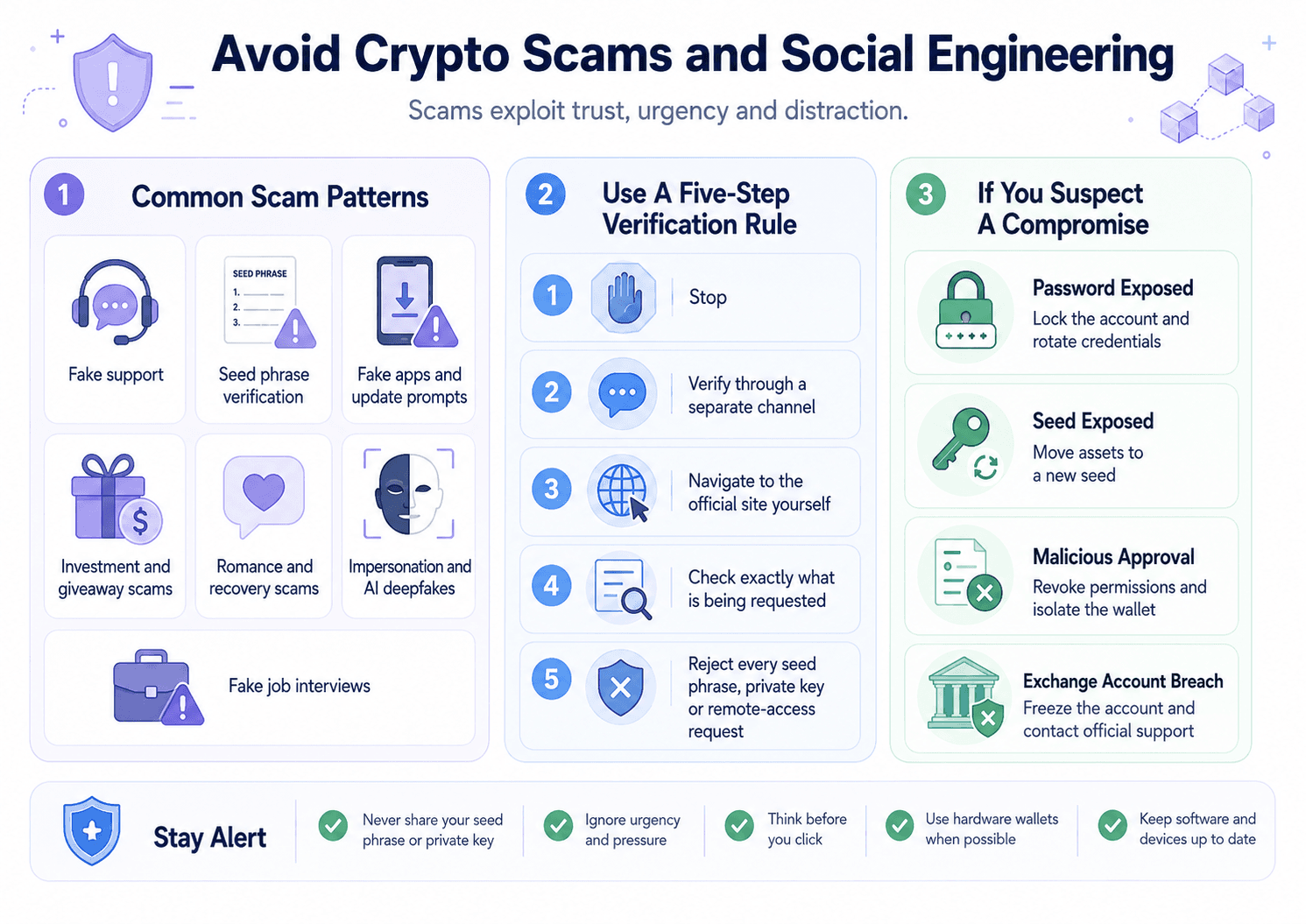 Recognize Fake Support, Deepfakes, Malicious Apps, and Urgent Requests Before Signing, Sharing Credentials, or Sending Funds
Recognize the Main Crypto Scam Patterns
High-impact patterns include:
- Fake wallet or exchange support
- Seed phrase “verification”
- Fake wallet applications, extensions and update prompts
- Investment and giveaway scams
- Romance scams
- Recovery scams
- Fake job interviews and malicious attachments
- Social-media impersonation
- AI voice cloning and deepfake video
- Urgent requests from apparently trusted contacts
In 2025, impersonation scams grew more than 1,400%, while Chainalysis found AI-enabled operations 4.5 times more profitable. The report also documents deepfakes and industrialized phishing.
A Sept. 4, 2025, Reuters investigation documented fake recruiters using technical interviews to deliver malware or steal credentials.
Use a Five-Step Verification Rule
Before acting on an unexpected request:
- Stop. Do not sign or transfer immediately.
- Verify the person or company through a separate verification channel.
- Navigate independently to the official website.
- Check exactly what the wallet or exchange is requesting.
- Reject every seed phrase request, private-key request or demand for remote-access software.
Urgency tactics, secrecy, authority claims and a guaranteed return are manipulation signals. A phishing message may include accurate personal or account information.
Genuine wallet customer support does not need your recovery phrase to diagnose a problem. Anyone requesting it gains direct control of the wallet.
What to Do If Your Crypto Wallet or Account Is Compromised
The correct incident response depends on what was exposed. Do not use the same remedy for a leaked password, compromised seed or malicious approval.
| Suspected Problem | First Priority |
|---|---|
| Password exposed | Lock the account and rotate credentials |
| Seed phrase exposed | Move assets to a completely new seed |
| Malicious approval signed | Revoke permissions and isolate the wallet |
| Wallet actively draining | Move recoverable assets using an appropriate emergency method |
| Exchange account breached | Lock the account and contact official support |
| Device stolen | Disable linked accounts and assess whether keys were exposed |
If Your Seed Phrase or Private Key Is Exposed
Assume a compromised seed phrase or private key makes the entire wallet permanently unsafe.
- Create a new wallet with a new seed.
- Verify the new backup.
- Complete an asset transfer for coins, tokens and NFTs.
- Check every chain and derived account.
- Stop using every compromised address generated from the exposed seed.
Changing a password or device does not repair private key exposure. Restoring the compromised seed recreates the same accounts.
Do not enter the old seed into an unverified rescue tool. Prioritize wallet migration when an attacker monitors the addresses.
If You Signed a Malicious Approval or Connected to a Suspicious DApp
- Stop interacting with the compromised DApp.
- Review the transaction or wallet signature.
- Revoke the relevant token allowance or operator approval.
- Move valuable assets when broader compromise is possible.
- Check every chain used by the wallet.
- Remove suspicious extensions.
- Preserve each transaction hash and screenshot.
Disconnecting the wallet does not cancel blockchain permissions. An automated sweeper may steal gas added to a monitored wallet immediately, so advanced rescue cases can require specialized help and private transaction methods.
If Your Exchange Account Is Hacked
- Start a withdrawal freeze or account lock through the official app or website.
- Contact verified exchange support.
- Complete session revocation and API-key revocation.
- Change exchange and email passwords after possible email compromise.
- Secure the phone number after a possible SIM swap.
- Review withdrawal addresses and account activity.
- Notify a receiving exchange when the unauthorized withdrawal destination is known.
- Preserve records.
Do not reply to an “exchange support” account that contacts you through social media. Navigate independently to the official support channel.
Preserve Evidence and Report the Theft
Preserve:
- Transaction hashes
- Wallet addresses
- Token contract addresses
- Screenshots
- Email headers
- Social-media handles
- Website URLs
- Chat logs
- Dates and times
- Device and browser details
Use a blockchain explorer to record movements. Submit an incident report or fraud report to the exchange, wallet, protocol, cybercrime unit or national service. Stolen-fund tracing databases may also accept reports.
Recovery is uncertain. Anyone guaranteeing stolen-fund recovery for an upfront payment may be running a recovery scam.
Our crypto recovery guide explains evidence preservation and realistic recovery limits.
Plan for Device Loss, Recovery and Crypto Inheritance
Security includes access after device failure, emergency or death. An unrecoverable wallet has an availability failure even when it resists theft.
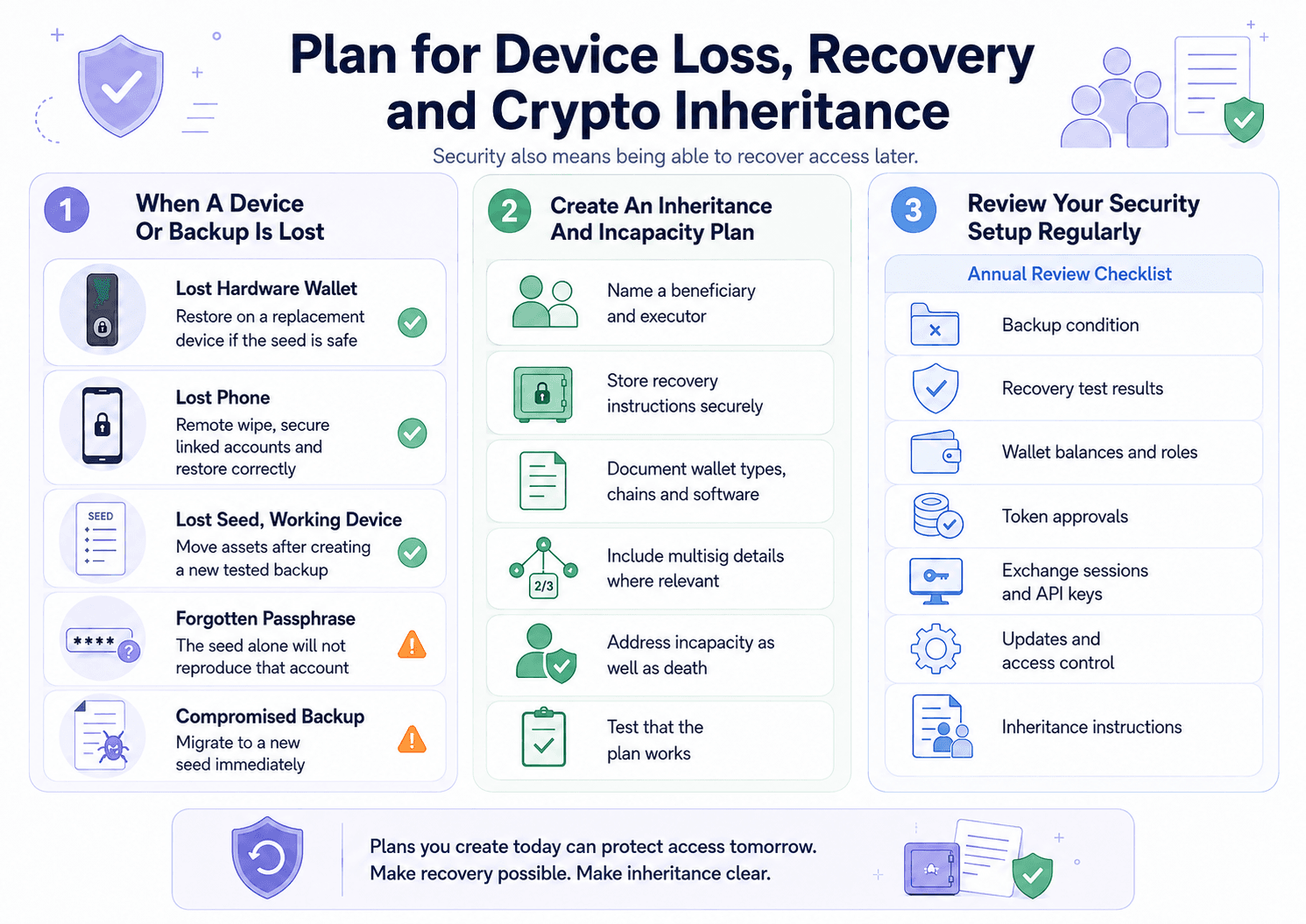 Document Recovery Steps, Device-Loss Procedures, Beneficiaries, and Access Controls so Crypto Remains Recoverable During Emergencies
Know What Happens When a Device Is Lost or Broken
- Lost hardware wallet, safe seed: Restore on a replacement hardware wallet or compatible wallet.
- Lost phone, software wallet: Use remote wipe where available, secure linked accounts and restore with the correct recovery method.
- Lost seed, working device: Move assets to a new wallet after creating and testing a fresh backup.
- Forgotten passphrase: Passphrase loss means the seed alone will not reproduce the account.
- Compromised backup: Migrate to a new seed immediately.
- Deceased or incapacitated owner: Follow the documented inheritance and recovery process.
Losing hardware does not normally destroy assets when the recovery phrase remains safe. Move funds immediately when a stolen device has weak PIN protection, the backup may also be exposed or the wallet was left unlocked.
Create an Inheritance and Incapacity Plan
A digital asset inheritance and estate planning framework should:
- Identify the intended beneficiary and executor.
- Explain where recovery instructions are stored.
- Keep complete access information out of ordinary public legal documents.
- Document wallet types, chains and required software.
- Include each multisig policy, signer and wallet descriptor.
- Address incapacity as well as death.
- Use professional legal advice where appropriate.
- Test that the plan works without exposing assets prematurely.
- Review it after wallet, address or family changes.
Do not place a complete seed phrase directly in an ordinary will. Legal filings may become public or reach more people than intended.
Review Your Security Setup Regularly
Run a security audit and wallet review at least annually and after major changes.
Review:
- Seed backup condition
- Recovery test results
- Wallet balances and roles
- Token approval review
- Exchange sessions
- API keys
- Withdrawal allowlists
- Unused wallet applications
- Operating-system and firmware updates
- Access control
- Inheritance instructions and inheritance review
- Newly disclosed security incidents
Security plans become stale as accounts, passphrases, smart wallets and multisig signers change.

Crypto Safety Checklist
Save, print or reuse this crypto security checklist as a periodic security assessment.
- Use separate wallets for storage and active transactions.
- Keep only necessary funds on exchanges.
- Use a hardware wallet for financially significant long-term holdings.
- Store every seed phrase offline.
- Test backups before relying on them.
- Use a passkey or hardware security key where supported.
- Enable a withdrawal allowlist.
- Remove unnecessary exchange sessions and API permissions.
- Download wallets through verified official sources.
- Verify the full address, network, amount and memo.
- Never copy an address from transaction history.
- Read every token approval and signature before accepting.
- Use a burner wallet for unknown DApps.
- Revoke permissions that are no longer needed.
- Maintain an emergency migration and incident response plan.
- Preserve evidence after suspicious activity.
- Prepare an inheritance plan and incapacity instructions.
- Review the setup periodically.
For a broader review, use our crypto risk-management guide as a supporting security assessment.
Is Crypto Safe? Final Verdict
Crypto can be used with a high degree of safety, but cryptocurrency safety depends on more than choosing a reputable wallet. Users must separate funds by purpose, protect recovery information, secure exchange accounts, perform transaction verification and know how to respond when something goes wrong.
- Hardware wallets protect keys, not poor decisions.
- Self-custody removes custodian risk but increases personal responsibility.
- The safest setup is one the user can operate, test and recover correctly.
Implement the checklist in stages, beginning with the highest-impact security controls: move long-term funds out of everyday wallets, secure recovery data offline, strengthen exchange authentication and verify every signature.