



Smart contract attacks rarely come down to one isolated coding mistake. Many combine weaknesses in permissions, pricing, accounting, upgrade systems and external integrations, turning several small assumptions into one exploitable path.
A vulnerability is the underlying weakness. An exploit mechanism is the method used to abuse it, while an amplifier, such as a flash loan, increases the attacker's available resources. The resulting theft, frozen funds or disruption is the security incident.
These distinctions apply across DeFi, including Solidity contracts on Ethereum and other EVM blockchains. They also help separate smart contract exploits from stolen private keys, malicious frontends, phishing and software compromises, which can cause losses without exploiting the contract itself.
Editor’s Note (Sept. 30, 2026): We have substantially expanded and restructured this guide to reflect how smart contract attacks have evolved. The update adds deeper coverage of proxy and upgradeability risks, business logic and accounting attacks, read-only reentrancy, cross-chain messaging, signature replay and EIP-7702 account delegation. We have also clarified the difference between underlying vulnerabilities and exploit mechanisms such as flash loans, while adding a more practical security lifecycle for developers and an updated risk checklist for users.
Most Common Smart Contract Attacks: Quick Verdict
Smart contract attacks usually exploit unsafe assumptions across permissions, accounting, external calls, pricing, signatures or upgrade systems rather than one isolated coding error. Modern exploits often combine several weaknesses, while mechanisms such as flash loans, callbacks or transaction ordering increase the scale or feasibility of the attack.
Smart Contract Attack Key Points
-
A vulnerability is not the same as an exploit mechanism The vulnerability is the underlying weakness, while the exploit is the method used to abuse it. A flash loan, for example, often supplies capital without being the root vulnerability itself.
-
Access control and upgrade systems can expose the entire protocol Missing permission checks, unsafe initialization, compromised administrators and incorrectly protected upgrade functions can give attackers control over critical contract behavior.
-
Correct code can still implement unsafe economics Business logic, accounting, governance and collateral rules can produce exploitable outcomes even when the contract executes exactly as designed.
-
External dependencies expand the attack surface Oracles, token callbacks, bridges, cross-chain messages and other protocols introduce assumptions about liquidity, pricing, execution order and external state.
-
Signatures need context and replay protection Nonces, expiry, chain binding, verifying-contract checks and consumed-authorisation records help prevent valid signatures from being reused in unintended ways.
-
Audits are one security layer, not a guarantee Strong security combines secure design, adversarial testing, audits, careful deployment, monitoring, controlled upgrades, bug bounties and an incident-response process.
Disclaimer
This guide is for educational purposes only.
Disclosure
Some links in this guide may be affiliate links. If you choose to use a service through these links, we may earn a commission at no additional cost to you.

Most Common Smart Contract Attacks at a Glance
Common smart contract threats include access control failures, unsafe business logic, accounting errors, reentrancy and oracle manipulation. Signature handling, cross-chain messages and upgrade systems introduce additional paths to unauthorized execution.
| Attack / Vulnerability | What Goes Wrong | Typical Impact | Common Trigger or Amplifier | Main Defense |
|---|---|---|---|---|
| Access control | Unauthorized callers obtain privileged powers | Theft, unauthorized minting or configuration changes | Missing checks or compromised administrators | Least privilege, role separation and multisig |
| Business logic | Protocol rules permit economically unsafe behavior | Fund extraction, unfair rewards or insolvency | Manipulated incentives or temporary voting power | Invariant testing and economic simulations |
| Arithmetic and precision | Calculations create exploitable accounting differences | Excess withdrawals or incorrect balances | Repeated rounding or decimal mismatches | Consistent units and deliberate rounding |
| Input validation | Unsafe parameters reach sensitive operations | Invalid state or unauthorized execution | Malformed amounts, addresses or messages | Explicit validation before execution |
| Reentrancy | Callbacks reach unfinished contract state | Repeated withdrawals or distorted valuations | External calls and token hooks | Checks-effects-interactions and reentrancy guards |
| Oracle manipulation | A protocol accepts misleading prices or data | Excess borrowing or wrongful liquidation | Thin liquidity, stale feeds or flash loans | Resilient sources and integration checks |
| Upgradeability | Initialization or upgrade controls are abused | Contract takeover or corrupted storage | Exposed initializers or admin compromise | Protected initialization and upgrade authority |
| Signature/replay | Authorization is reused or interpreted incorrectly | Unauthorized transfers or execution | Missing nonces, expiry or domain binding | Domain separation and consumed authorizations |
| Cross-chain messaging | An invalid source or message is accepted | Unbacked minting or unauthorized withdrawals | Replay or verification failure | Source authentication and state verification |
| Transaction ordering / MEV | Execution order exposes users to extraction | Worse prices or lost opportunities | Visible pending transactions | Batch auctions, RFQs and protected execution |
Denial-of-service attacks can block withdrawals or other operations through reverting dependencies, excessive computation or unbounded loops. Weak randomness can expose games and allocations to prediction or manipulation when outcomes depend on information participants can anticipate or influence.
How Smart Contract Attacks Actually Work
An attacker looks for a route from an unsafe assumption to a profitable or disruptive outcome. That route can cross several contracts before a transaction finishes.
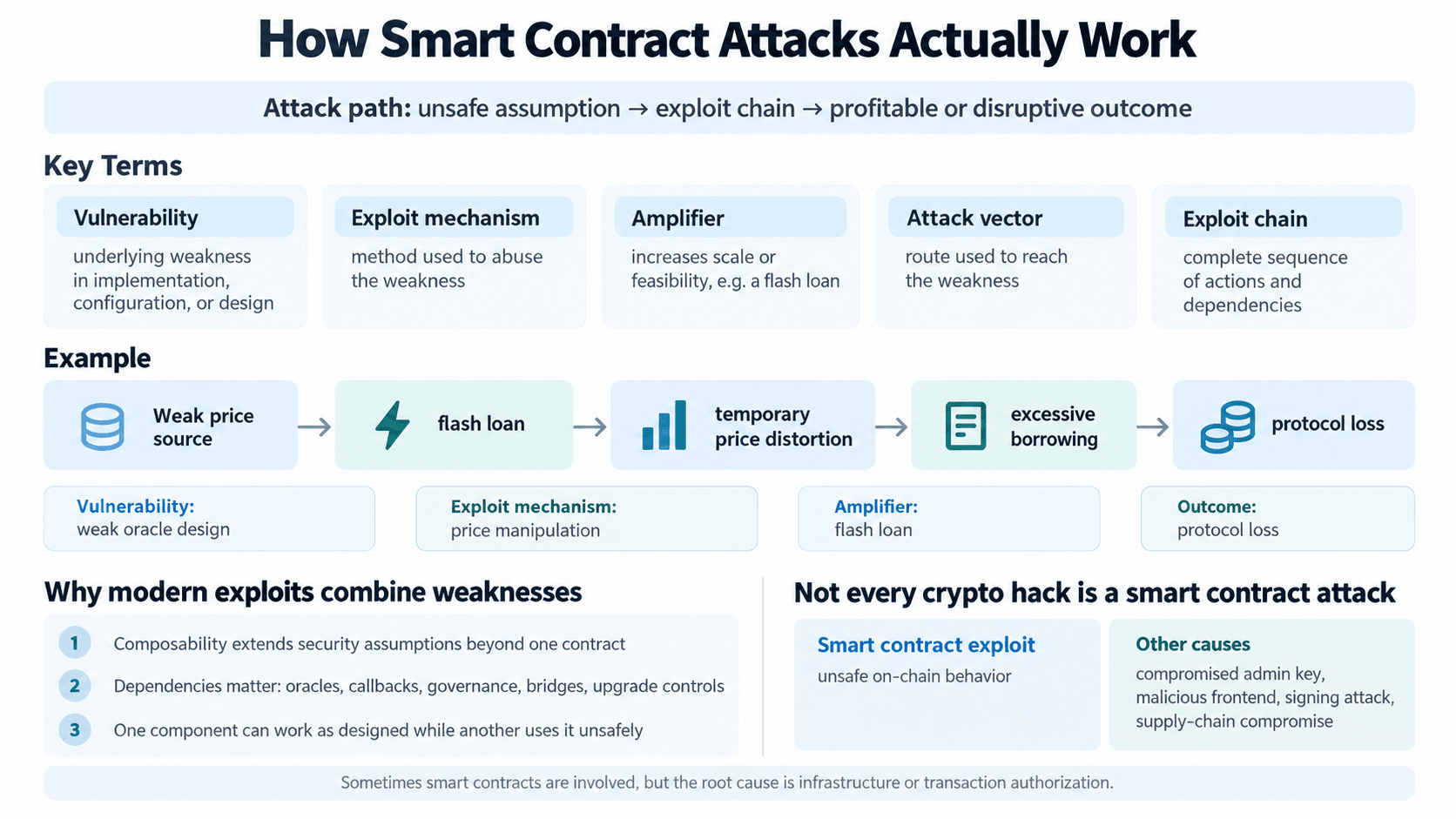 Smart Contract Exploits Turn Unsafe Assumptions Into Attack Paths That Combine Vulnerabilities, Amplifiers, Dependencies and on-chain Actions
Root Vulnerability vs Exploit Mechanism
A vulnerability is a weakness in implementation, configuration or design. An attack is an attempt to abuse the system, while an exploit is the concrete method that takes advantage of the weakness. An amplifier increases the scale or feasibility of that method.
A lending protocol that accepts the current price from a shallow liquidity pool could face this sequence:
Weak price source → flash loan → temporary price distortion → excessive borrowing → protocol loss
The weak oracle design is the vulnerability, price manipulation is the exploit mechanism, and excessive borrowing extracts value. The flash loan supplies capital, but removing that loan source would leave the pricing weakness available to a sufficiently funded attacker.
An attack vector is the route used to reach the weakness, such as a public borrowing function or an exposed initializer. The complete sequence of actions and dependencies forms the exploit chain.
Why Modern Exploits Often Combine Several Weaknesses
Composability allows smart contracts to use other protocols' liquidity, prices and services. It also extends their security assumptions beyond their own code.
A vault can calculate its exchange rate correctly while a lending market wrongly assumes that rate remains stable during a callback. Governance can approve a bridge upgrade whose message verification is incomplete. An oracle integration can continue accepting a price after liquidity has moved elsewhere.
Not Every Crypto Hack Is a Smart Contract Attack
A contract exploit abuses unsafe on-chain behavior. A compromised admin key uses existing authority, a malicious frontend changes what users see, and a signing attack obtains authorization for an unwanted action. A supply-chain compromise corrupts trusted software or infrastructure.
The Feb. 21, 2025, Bybit incident involved a targeted attack on its Safe wallet transaction workflow. The subsequent forensic findings identified compromised Safe developer credentials.
Smart contracts were involved in the outcome, but the root cause concerned infrastructure and transaction authorization.
Access Control and Upgradeability Attacks
Permissions determine who can change a protocol, while upgradeability determines how extensively its behavior can change. Failures in either can expose assets throughout the affected system.
Access Control Failures
Access control failures include missing permission checks, excessive privileges and incorrect role configuration. Functions that mint tokens, withdraw reserves, pause operations or change implementations must enforce the intended authority on every available execution path.
In Solidity, msg.sender identifies the immediate caller, while tx.origin identifies the transaction's originating account. Authorization through tx.origin can allow an intermediary contract to act using an unsuspecting user's identity. Checking msg.sender still requires correctly assigned roles and permissions.
The July 19, 2017, Parity multisig exploit exposed initialization functionality that allowed wallet ownership to be reset. Once the attacker could replace the owners, the normal multisignature withdrawal requirements no longer protected the funds.
Compromised privileged roles create a related operational risk. A permission check can execute correctly while accepting instructions signed with a stolen administrator key.
Proxy and Upgradeability Vulnerabilities
A proxy contract holds state and delegates execution to an implementation contract, which supplies the logic. An initializer performs setup in the proxy's storage context, including assigning ownership and configuring dependencies.
A forgotten initializer call can let someone else initialize the proxy first. Unprotected reinitialization can overwrite established settings. An uninitialized implementation creates additional exposure, although taking over its separate storage does not automatically grant ownership of every proxy using it.
A storage collision occurs when incompatible layouts cause code to interpret a storage location incorrectly. Reordering variables or changing their types can turn an existing value into an unintended balance, address or permission.
Transparent proxy systems commonly use a ProxyAdmin to manage upgrades. UUPS proxy systems place upgrade authorization in the implementation logic. Both can fail through compromised authority or incorrectly restricted upgrade functions, as reflected in the 2026 proxy and upgradeability risk category.
How Safer Permission Systems Are Designed
Least privilege limits each role to necessary operations. OpenZeppelin's access control components, including Ownable and AccessControl, support ownership and role-based access control, but their configuration determines who actually holds power.
Routine operations, emergency pausing and upgrades benefit from separate roles. A multisig reduces dependence on one key, while a timelock creates a review period before sensitive changes execute. Signer independence is essential because several keys controlled through one compromised workflow can fail together.
A timelock provides little protection if another administrator can upgrade the contract immediately and remove it. The full authority chain includes whoever can replace implementations, grant roles or change the delay itself.
Deployment and migration checks address a different risk. Atomic initialization prevents an exposed setup window, while initializer and storage-layout validation helps preserve existing state. Migration tests must also confirm that balances, ownership and withdrawals still behave correctly after the upgrade.
Business Logic and Economic Design Attacks
Business logic vulnerabilities arise when a protocol's rules permit outcomes that undermine its intended operation. Financial correctness requires more than code that compiles and executes successfully.
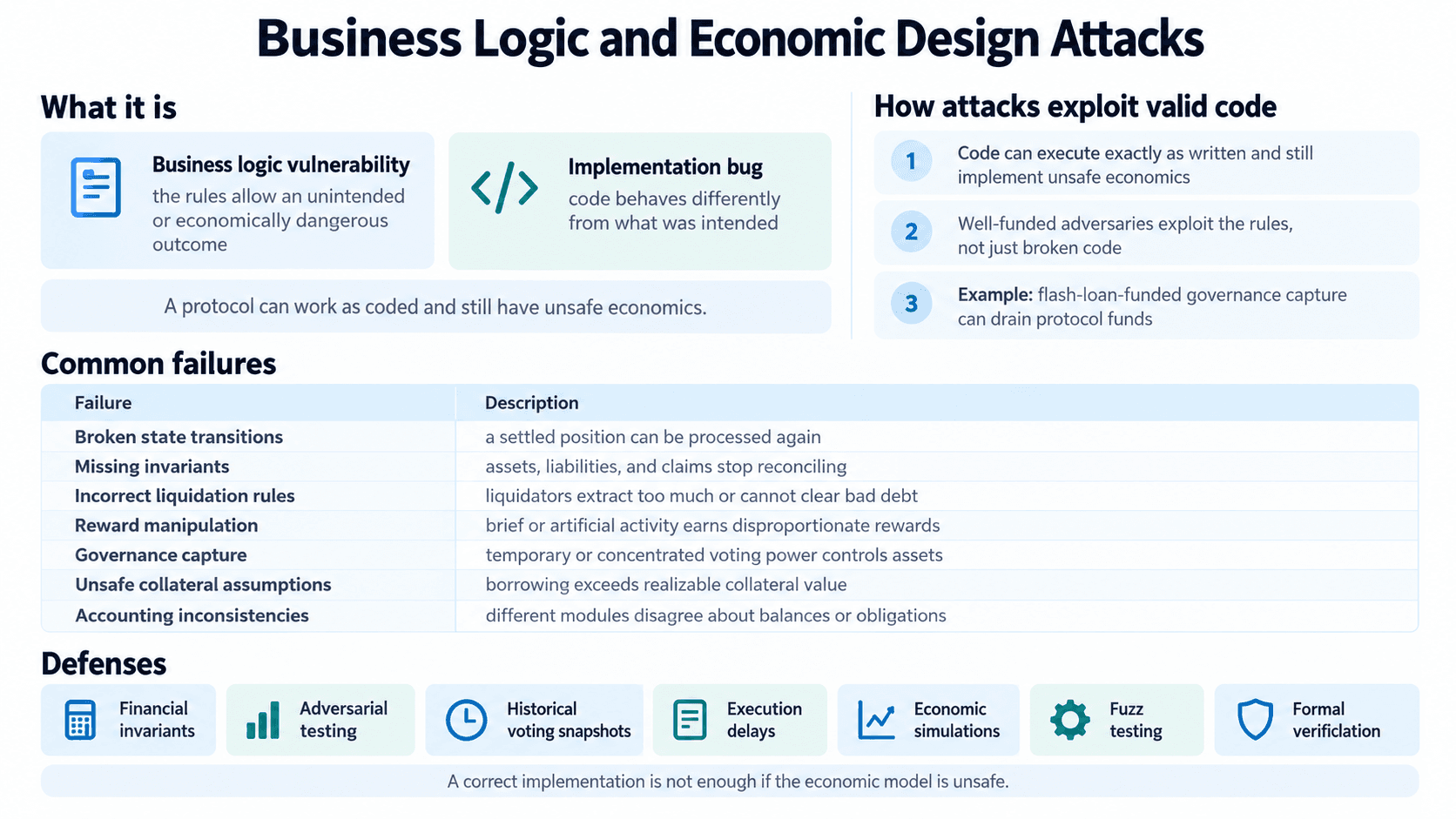 Business Logic Attacks Exploit Economically Unsafe Rules, Allowing Valid Code to Produce Unintended Outcomes, Losses or Insolvency
What Business Logic Vulnerabilities Are
A business logic vulnerability occurs when the contract works as coded, but the rules themselves allow an unintended or economically dangerous outcome.
An implementation bug causes code to differ from intended behavior. A design-level business logic bug leaves the intended rules unsafe, although the categories overlap when an implementation omits a necessary financial condition.
A lending system can calculate a borrowing limit exactly as specified while accepting collateral whose quoted value cannot be realized through liquidation. Correct arithmetic does not repair that collateral assumption.
Common Business Logic Failures
| Failure | Unsafe Outcome |
|---|---|
| Broken state transitions | A settled position can be processed again |
| Missing invariants | Assets, liabilities and claims stop reconciling |
| Incorrect liquidation rules | Liquidators extract too much or cannot clear bad debt |
| Reward manipulation | Brief or artificial activity earns disproportionate rewards |
| Governance capture | Temporary or concentrated voting power controls assets |
| Unsafe collateral assumptions | Borrowing exceeds realizable collateral value |
| Accounting inconsistencies | Different modules disagree about balances or obligations |
An invariant is a property that should remain true across permitted operations. A state machine defines allowed transitions, such as moving a loan from active to liquidated without permitting another withdrawal afterward.
These properties connect contract behavior with economic security. Voting rights, reward schedules and other tokenomics mechanisms require the same scrutiny as transfers and balances.
How Economic Attacks Exploit Valid Code
The Beanstalk governance exploit on April 17, 2022, used flash-loan-funded voting power to compromise governance and remove deposited assets. The dangerous assumption concerned how governance authority could be acquired and exercised; the loan financed the takeover.
Automated scanners struggle with this class because valid arithmetic and correctly enforced permissions can still implement unsafe economics. A scanner cannot reliably infer an appropriate voting-power holding period or whether liquidation incentives remain workable during stressed markets.
Economic review examines what a well-funded adversary can achieve under the rules, including actions that ordinary participants have little reason to attempt.
Defenses
Financial invariants provide testable requirements, such as preventing duplicate claims and reconciling assets with outstanding obligations. Adversarial testing then challenges those requirements through unusual sequences of deposits, withdrawals, claims and liquidations.
Historical voting snapshots and execution delays address different governance weaknesses. Snapshots can prevent newly borrowed voting power from affecting an already established vote, while delays create time to inspect an approved action before execution. Neither removes the risk of longer-term voting concentration.
Economic simulations examine liquidity collapse, collateral depegs and changing incentives. Fuzz testing searches unexpected input sequences, while formal verification checks critical properties against explicit assumptions. A proof of correct implementation remains limited if the underlying model assumes unrealistic liquidity or permanently honest administrators.
Arithmetic, Precision and Input Validation Vulnerabilities
Financial contracts must preserve value across calculations and reject inputs that violate their assumptions. Checked arithmetic alone cannot ensure either outcome.
Precision, Rounding and Decimal Errors
Precision loss occurs when a representation or calculation discards detail. A rounding error is the difference introduced when a result must fit that representation, while a decimal mismatch applies the wrong scale to a quantity.
Solidity applications commonly implement fixed-point arithmetic using scaled integers. Under the language's integer division rules, the illustrative unsigned calculation 7 / 3 returns 2. Dividing too early can discard information that later multiplication cannot restore.
In a hypothetical integration, confusing six-decimal and eighteen-decimal units introduces a scale difference of 10¹², or 1,000,000,000,000. Smaller discrepancies can also become profitable when repeated.
Share-to-asset conversions require deliberate rounding directions. If a withdrawal removes too few shares or a deposit awards too many, repeated operations can gradually transfer value from existing depositors to the caller.
Vault and Share Accounting Attacks
ERC-4626 standardizes an interface for tokenized vaults, where users deposit assets and receive shares. Vulnerable implementations can expose donation or inflation attacks: an attacker changes the assets-per-share relationship, causing later deposits to receive too few shares.
A donation increases assets without necessarily issuing new shares. In a poorly protected vault with very little initial supply, the resulting exchange rate can make rounding losses severe. Another protocol accepting those shares as collateral can inherit the distorted valuation.
Defenses include appropriate virtual assets and shares, additional share precision and minimum-output protection.
Integer Overflow and Underflow
An overflow exceeds a type's maximum value, while an underflow falls below its minimum. Historically, wrapping arithmetic could turn an excessive subtraction into a large balance.
Solidity 0.8.0 and later check ordinary arithmetic by default and revert on overflow or underflow. Legacy contracts, unchecked blocks and low-level code still require scrutiny, as covered in the language's security considerations.
A revert can also disable a necessary operation. Preventing arithmetic corruption does not guarantee that legitimate withdrawals remain available when an extreme value reaches the calculation.
Missing or Incorrect Input Validation
Input-validation failures allow values through that a protocol cannot safely process. Checks using require, custom errors or equivalent logic address:
- Zero addresses where a valid recipient or administrator is required.
- Amounts outside supported ranges.
- Expired deadlines and unacceptable slippage.
- Inconsistent array lengths or duplicate inputs.
- Incorrect chain IDs or unauthorized external contract addresses.
Validation concerns meaning as well as format. A valid address can identify a malicious contract, and duplicated entries can cause the same claim to be counted twice.
Administration and cross-chain interfaces need equivalent scrutiny. Privileged callers can make mistakes, while a correctly delivered message can still contain parameters that violate the receiving contract's rules.
Reentrancy and Unsafe External Calls
External calls hand execution to code outside the current function's control. Security depends on what that code can observe or invoke before execution returns.
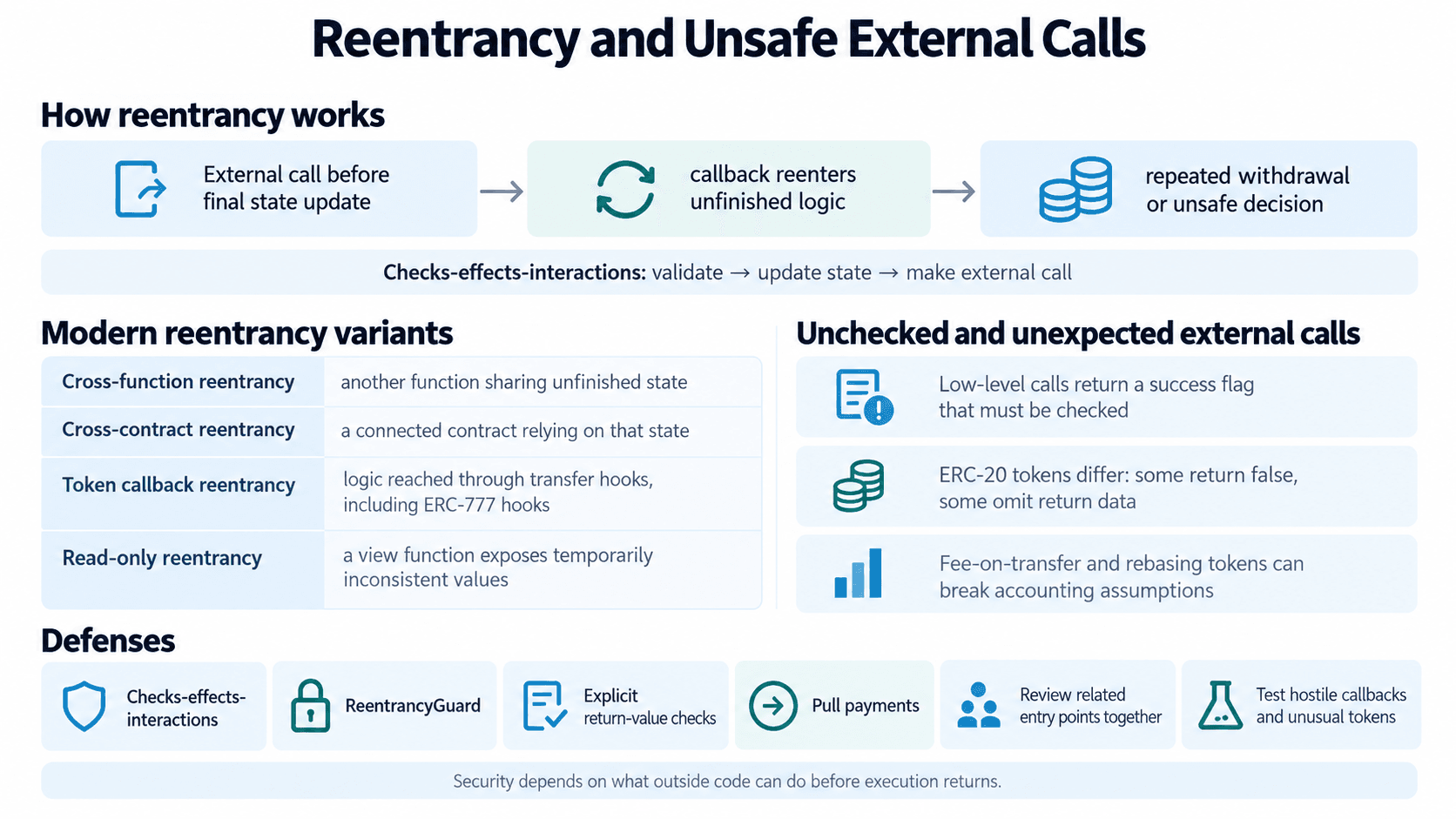 Reentrancy Exploits Unfinished Contract State Through Callbacks, While Unsafe External Calls Can Break Accounting and Execution Assumptions
How Reentrancy Works
Reentrancy occurs when an external call allows execution to return to unfinished contract logic. The classic example sends funds before reducing the recipient's recorded balance, allowing a callback to request another withdrawal.
Checks-effects-interactions means validating the request, updating relevant state and then making the external call. Accounting must already be consistent when control leaves the contract.
The DAO's 2016 exploit remains the historical example. A recipient's fallback or receive function can execute during an ETH transfer, while token transfers can create their own callbacks.
Modern Reentrancy Variants
| Variant | What Gets Reentered |
|---|---|
| Cross-function reentrancy | Another function sharing unfinished state |
| Cross-contract reentrancy | A connected contract relying on that state |
| Token callback reentrancy | Logic reached through transfer hooks, including ERC-777 hooks |
| Read-only reentrancy | A view function exposing temporarily inconsistent values |
Read-only reentrancy occurs when unfinished state is observed through a read operation and used elsewhere to make an unsafe decision. The reentered function does not need to modify storage.
A callback might expose a vault valuation between accounting updates. Another protocol could accept that temporary valuation when calculating borrowing capacity, even though the original withdrawal function rejects recursive withdrawals.
Unchecked and Unexpected External Calls
Low-level calls return a success indicator that must be handled. Ignoring failure can leave records showing a payment that never occurred, while an unexpected revert can prevent an entire operation from completing.
ERC-20 implementations also differ. Some return false, some omit return data, and fee-on-transfer tokens can deliver less than requested. Rebasing tokens can change balances outside conventional transfers.
SafeERC20 handles common return-value differences. It does not automatically make unusual tokens compatible with a protocol's accounting, particularly when the recorded deposit differs from the amount actually received.
Reentrancy and External Call Defenses
Checks-effects-interactions, a correctly scoped ReentrancyGuard and explicit return-value checks address different failure paths. Related entry points and externally visible valuations need review together, with state consistent before callbacks occur.
Pull payments let recipients withdraw their own funds, reducing dependence on successful transfers during unrelated operations. An uncooperative recipient then need not block payments to everyone else.
Trusted interfaces reduce integration uncertainty but do not guarantee safe behavior. Tests involving reverting recipients, hostile callbacks and unusual tokens expose assumptions that ordinary transfers leave untouched.
Oracle Manipulation and Flash Loan Exploits
Oracle weaknesses allow contracts to act on misleading data. Flash loans can provide enough temporary capital to turn those weaknesses into profitable transactions.
How Oracle Manipulation Works
A price oracle supplies values used for borrowing, liquidation or settlement. Manipulation becomes possible when an accepted value can be moved cheaply relative to the assets exposed.
Common weaknesses include spot prices from thin liquidity pools, stale feeds, incorrect decimal handling, single-source dependence and inadequate rejection of outliers. An inflated collateral price increases borrowing capacity without increasing recoverable collateral value.
A technically accurate report of a manipulated market price can still be unsafe for lending. The protocol needs to consider how that price was formed and whether sufficient liquidity exists to support it.
How Flash Loans Amplify Vulnerabilities
Flash loans usually amplify an existing weakness rather than create one. They provide temporary liquidity subject to repayment requirements within the same transaction.
A typical exploit proceeds as follows:
- Borrow temporary capital.
- Move a market price or protocol state.
- Trigger a calculation that trusts the manipulated state.
- Extract assets through borrowing, redemption or another operation.
- Repay the loan and any required premium.
Why Oracle Attacks Are Becoming More Complex
A valuation can combine a market price, a vault exchange rate and cross-chain data. Each component introduces assumptions about freshness, liquidity, finality and availability.
Layer 2 protocols also face sequencer outages and recovery conditions. A published price does not establish that every user had an opportunity to transact during downtime. Sequencer uptime checks and recovery grace periods help integrations manage these conditions before resuming sensitive actions.
Protocol-derived exchange rates require separate analysis. A current underlying-token price cannot correct a manipulated vault share price, while a sound source-chain calculation can become unsuitable if its delivery is delayed.
Defenses Against Oracle Manipulation
Defenses include independent sources, liquidity requirements, freshness checks, deviation checks and application-specific sanity bounds. Several feeds can still share upstream exchanges or data providers, leaving correlated weaknesses beneath apparently diverse sources.
A feed's deviation threshold determines when a price update is triggered. An application's deviation check decides whether a received value is acceptable. These controls serve different purposes, and freshness limits must reflect the feed's expected update behavior.
A TWAP averages prices over time. The Uniswap oracle design resists brief distortion, but sustained manipulation remains possible under unfavorable liquidity and window settings.
Circuit breakers can restrict borrowing or liquidation when values fail validation. Their recovery conditions must avoid restarting operations while the same unreliable data remains in use.
Cross-Chain, Signature and Smart-Account Attacks
Authorization travels through messages, off-chain signatures and programmable accounts. Receiving systems must verify both the authority and the context in which it applies.
Cross-Chain Message Validation Failures
A bridge must authenticate the source chain, source sender and message contents, then verify the source state according to its security model. An approved messaging endpoint does not make every remote application's instructions trustworthy.
Cross-chain replay means processing a message again or accepting it in an unintended context. Unique message identifiers and recorded consumption help prevent duplicate execution, including when delivery retries occur.
Mint/burn or lock/mint accounting must reconcile across chains. A forged message can create unbacked assets or release reserves, exposing connected lending markets and liquidity pools. Cross-chain message validation includes both source authentication and restrictions on the instructions a receiver will execute.
Signature Replay and Authorization Bugs
Signature replay occurs when valid authorization is accepted more times, or in more contexts, than the signer intended.
A robust authorization binds the action, amount, recipient, verifying contract and relevant chain. A nonce or consumed-message record prevents repeated execution, while an enforced expiry limits the authorization's lifetime.
EIP-712 domain separation distinguishes signed structured data by application context, commonly including the chain ID and verifying contract. It does not provide replay protection by itself.
An application can correctly recover the signer and still execute the same authorization repeatedly. Signature validity and permission to execute a particular action are separate checks.
ERC-1271 and Smart-Contract Signatures
An externally owned account, or EOA, traditionally authorizes actions through a private-key signature. A smart account can apply programmable rules, including multisignature approval and restricted permissions.
ERC-1271 defines an interface for asking a contract whether a signature is valid. Integrations need contract-based validation rather than assuming every signer can be checked through ordinary address recovery.
Validity can depend on current account state. An owner change or revoked permission can invalidate an authorization that previously passed, so cached validation is not necessarily sufficient for later execution.
EIP-7702 and Account Abstraction Security
EIP-7702 lets an EOA delegate execution to smart contract code. It went live with Ethereum's Pectra upgrade on May 7, 2025, making delegated-account behavior an established security consideration.
Delegation persists until changed or cleared. Authorization to install that delegation does not independently authorize every subsequent action: the delegated code must enforce execution permissions.
Unsafe initialization can allow an observer to establish unwanted settings first. Malicious delegation can expose assets even when the account's private key remains undisclosed.
The EIP-7702 specification permits authorization with chain ID 0, allowing cross-chain applicability subject to other validation conditions. It also identifies broken assumptions in protections based on tx.origin == msg.sender. Treating EOAs as incapable of programmable behavior is no longer a sound boundary.
ERC-4337 supplies account-abstraction infrastructure through user operations, bundlers and an EntryPoint contract. Paymasters can sponsor execution costs, adding permission and resource-consumption rules that require protection against abuse.
MEV, Front-Running and Transaction-Ordering Attacks
Transaction ordering can expose users to losses even when a contract executes its rules correctly. The design determines how much influence earlier transactions have over later ones.
What MEV Is
Maximal extractable value, or MEV, is value obtainable through transaction inclusion, exclusion or ordering beyond standard block rewards and gas fees.
Validators, block builders and competing searchers participate in this process. Arbitrage between inconsistent prices can improve market alignment, while other strategies extract value directly from users' execution.
Front-Running and Sandwich Attacks
Front-running uses advance knowledge of a transaction to obtain a favorable earlier position. Related strategies include:
- Insertion: adding a transaction before another to influence its outcome.
- Displacement: executing first to capture an opportunity before the original transaction.
- Suppression: delaying or obstructing competing execution.
- Sandwiching: placing transactions before and after a victim's trade.
In a sandwich attack, the attacker moves the pool price against a pending swap, allows the victim to execute at the worsened price, then reverses the attacker's position. Profitability depends on fees, liquidity, trade size and execution limits.
Public mempool visibility exposes pending intentions, while a wide slippage allowance can provide room for extraction.
When Smart Contract Design Makes MEV Worse
Predictable state transitions, public auctions and deterministic liquidation mechanics reveal opportunities before execution. Spot-price dependence lets an earlier transaction alter conditions received by a later one.
Missing minimum-output checks leave swaps especially exposed. A deadline limits when a trade remains executable, but does not independently ensure an acceptable price.
Liquidation competition can support solvency while producing congestion or unnecessary penalties. Its design needs to account for who benefits from acting first and whether ordering can unfairly worsen another participant's outcome.
MEV Mitigations
Batch auctions group orders and determine execution under shared rules, reducing advantages from small ordering differences. Commit-reveal schemes conceal intentions until a later phase, but add latency and require handling for participants who never reveal.
Request-for-quote systems obtain a defined offer from a liquidity provider. They can reduce exposure to public-pool ordering while introducing quote-expiry, availability and counterparty considerations. MEV-aware pricing can limit the value available from predictable state changes.
For users, deeper liquidity and appropriate slippage limits reduce particular exposures. Protected or private routes restrict pre-inclusion visibility, although their protection depends on disclosure and execution policies.
Excessively tight limits can cause failed trades. Private submission also shifts trust toward the infrastructure receiving the transaction and does not eliminate every ordering strategy.
How Developers Reduce Smart Contract Attack Risk
Security follows a lifecycle that continues after launch:
Design → Test → Audit → Deploy → Monitor → Respond.
Each stage addresses failures that earlier checks may leave unresolved.
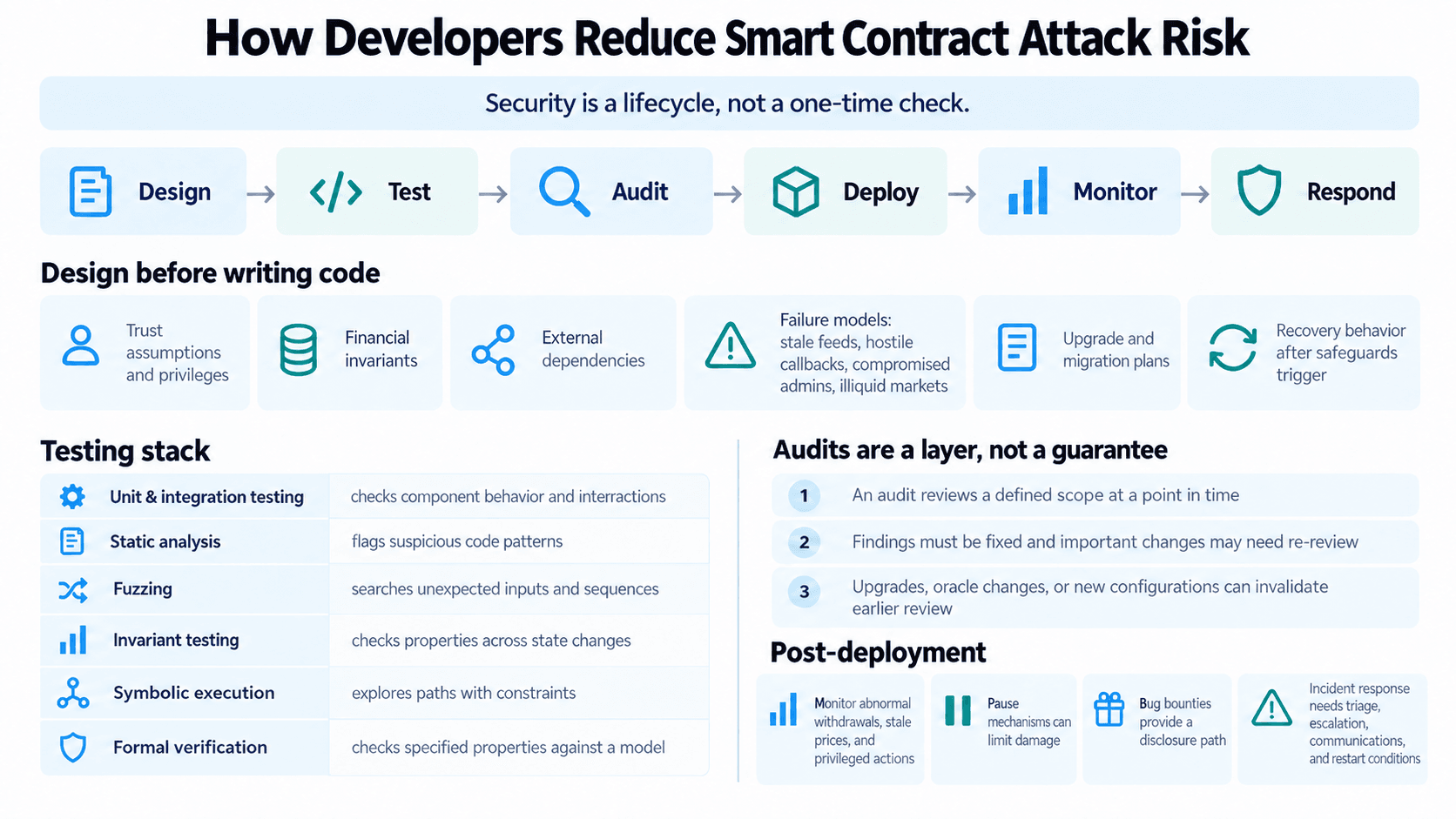 Developers Reduce Attack Risk Through Secure Design, Adversarial Testing, Audits, Careful Deployment, Monitoring and Incident Response
Design Security Before Writing Code
A security design records trust assumptions, privileges, financial invariants and external dependencies. It identifies who can upgrade contracts, replace oracles, move funds or interrupt withdrawals.
Failure models include unavailable feeds, hostile callbacks, compromised administrators and market illiquidity. Upgrade paths need migration plans covering storage, balances, permissions and dependencies.
The design also establishes what happens after a safeguard triggers. Rejecting stale data can prevent incorrect borrowing, but the protocol still needs defined behavior for repayments, withdrawals and eventual recovery.
Test Different Failure Modes
| Technique | Main Contribution | Example Tools |
|---|---|---|
| Unit and integration testing | Checks individual behavior and component interactions | Foundry |
| Static analysis | Flags suspicious code patterns without executing transactions | Slither |
| Fuzzing | Searches unexpected inputs and operation sequences | Foundry, Echidna |
| Invariant testing | Checks properties across generated state changes | Foundry, Echidna |
| Symbolic execution | Explores paths using symbolic inputs and constraints | Mythril |
| Formal verification | Checks specified properties against a formal model | Certora |
These techniques answer different questions. Static analysis can identify recognizable hazards, while invariant testing can expose failures that emerge only after a sequence of otherwise valid operations.
Formal verification is limited by the specification and modeled assumptions. A property proving that only an administrator can withdraw funds does not establish that the administrator is trustworthy.
Tests involving hostile dependencies, unusual tokens and upgrade migrations examine behavior that normal user journeys may never reach.
Audits Are a Layer, Not a Guarantee
An audit reviews a defined scope at a particular point in development. Findings need remediation, and consequential fixes or later changes may require another independent review.
The report's code version, assumptions and exclusions must match the deployed system. A reviewed implementation can become unsafe through an unaudited upgrade, changed oracle or altered configuration.
Our guide to smart contract audits explains how manual review and automated analysis contribute. Public findings and remediation records provide more useful evidence than an audit badge alone.
Post-Deployment Monitoring and Incident Response
Monitoring can detect abnormal withdrawals, accounting divergence, stale prices and unexpected privileged actions. Meaningful thresholds and named responders reduce the risk that excessive alerts conceal a genuine incident.
Pause mechanisms, including appropriately applied Pausable controls, can restrict damage while responders investigate. Their scope determines whether all operations stop or only vulnerable functions, and they cannot recover assets already removed.
An active bug bounty provides a reporting route for researchers. Programs listed through Immunefi publish scopes and reporting requirements, although their existence does not guarantee that every vulnerability will be discovered.
Response procedures define triage, escalation, emergency authority, communications and restart conditions. A monitoring system offers limited protection when responders cannot interpret an alert or execute the agreed action.
How Users Can Spot Smart Contract Risk Before Using a Protocol
Public evidence about permissions, deployments and security processes helps users assess risk without auditing Solidity. Missing information leaves uncertainty about who controls the assets and what protections actually apply.
- Is the source verified? Published source matching deployed bytecode enables inspection, but does not establish security.
- Is the contract upgradeable? A proxy can continue using the same address after its implementation changes.
- Who controls upgrades? The documented authority needs to match the on-chain configuration.
- Is administration controlled by one wallet or a multisig? The signing threshold and signer independence affect compromise risk.
- Is there a timelock? Its usefulness depends on which actions it delays and whether another route bypasses it.
- Which oracle does the protocol use? Named feeds and documented failure handling provide clearer evidence than general security claims.
- Does it depend on thin liquidity? Shallow collateral or pricing markets increase manipulation and liquidation exposure.
- Has anything changed since the audit? Upgrades and material configuration changes can alter the reviewed assumptions.
- Does the audit cover the current deployment? Addresses, code commits, exclusions and remediation status establish its relevance.
- Is the bug bounty active? The deployed contracts and relevant vulnerability types need to remain within scope.
- Are critical admin actions documented? Unexplained changes or unclear ownership weaken accountability.
- Can administrators mint, freeze, pause or withdraw assets? Upgrade authority may permit additional powers beyond existing functions.
- Is there an emergency-response process? Reporting channels and documented responsibilities indicate how incidents would be handled.
Red Flags You Can Spot in 60 Seconds
An audit badge without a report, unverified implementation code, unexplained upgrades and unrestricted authority held by one wallet are warning signs. Missing contract addresses and claims that an audit makes losses impossible also undermine confidence.
A verified contract with a familiar name can still have unsafe permissions. Evidence about the actual deployment is stronger than branding, and users remain exposed to collateral failure and market volatility even when the code behaves correctly.

Final Thoughts
Smart contract attacks are increasingly less about one obvious coding flaw and more about how permissions, accounting, external data, upgrades, cross-chain messages and other contracts interact. A flash loan, callback or transaction-ordering strategy may make an exploit possible, but the underlying loss usually starts with an unsafe assumption somewhere in the system.
For users, the practical takeaway is to look beyond audit badges and ask what assumptions a protocol depends on, who controls critical functions and what happens when those assumptions fail. For developers, the same principle works in reverse: define those assumptions clearly, test them and design for the edge cases an attacker is most likely to probe.