Polymarket is a blockchain-based prediction market built on Polygon where users trade event outcomes by buying and selling “Yes” or “No” shares tied to real-world questions. It uses USDC as collateral, and winning shares settle at $1 once the market resolves, making it a platform for trading probabilities rather than owning traditional assets.
- Prices function like live probabilities: A share trading at $0.65 implies the market currently assigns roughly a 65% chance to that outcome.
- Positions can be closed before resolution: Traders do not need to wait for the final result and can sell early if changing sentiment moves the price in their favor.
- Order execution matters: Market orders prioritize speed, while limit orders give traders more control over entry and exit prices in thinner markets.
- Liquidity shapes market quality: Active markets usually have tighter spreads and smoother price discovery, while thin markets can be more volatile and harder to exit.
- Core trading is often low cost, but not always free: Some markets include taker fees, and traders may also face Polygon gas costs plus fiat-to-USDC conversion fees.
- Resolution depends on predefined rules and oracles: Market outcomes are settled using external data sources and the criteria written into each market’s description.
- Access is not universal: Polymarket’s availability depends on jurisdiction, and regulatory restrictions remain an important consideration for potential users.
- Best suited to event-driven, crypto-comfortable traders: The platform is more appropriate for users who understand wallets, order books, and speculative risk than for complete beginners.
What Is Polymarket And How Do Prediction Markets Work?
Polymarket is a blockchain-based prediction market where users trade shares tied to the outcome of real-world events. Participants buy “Yes” or “No” shares on questions about politics, economics, and global developments, and the price of those shares reflects the market’s current estimate of the likelihood of the event occurring. The platform runs on the Polygon network and uses USD Coin (USDC) as trading collateral, with each winning share settling at $1 upon the event's resolution.
This structure places Polymarket within the larger category of prediction markets, where traders collectively price probabilities through buying and selling. Instead of owning assets like stocks or commodities, participants trade expectations about future outcomes, and those expectations adjust continuously as new information enters the market.
Understanding how that works begins with the underlying concept behind prediction markets.
What Is a Prediction Market?
Before examining Polymarket in detail, it helps to understand what a prediction market actually is.
A prediction market is a trading platform where participants buy and sell contracts tied to the outcome of future events. Each contract represents a specific question, such as whether a candidate will win an election, whether inflation will exceed a target level, or whether a policy decision will be announced within a certain timeframe.
Instead of giving a yes-or-no answer in a survey, participants express their view by buying shares that gain or lose value depending on what eventually happens.
Prices in these markets function as implied probabilities. When a contract trades at $0.65, the market is effectively suggesting that traders collectively estimate a 65% chance of that outcome occurring. If new information changes expectations, traders adjust their positions, and the price moves accordingly.
This dynamic is one of the core reasons prediction markets attract attention. Prices continuously absorb information from multiple sources, including:
- News developments
- Economic data
- Political polling
- Expert analysis
- Market sentiment
The result is a market-driven estimate of probability rather than a single forecast produced by a polling organization or analyst.
Economists often describe this process as crowd aggregation. Individuals may possess partial information, but when their views interact through trading, prices can reflect the combined knowledge of many participants. Because traders have financial incentives attached to their positions, they tend to update their expectations quickly as new information appears.
Even so, prediction markets should not be treated as perfect forecasting tools. Their accuracy depends heavily on liquidity and participation. A highly active market with many traders often produces stable probability signals, while a thin market can move sharply when only a few participants adjust positions.
It is also important to understand how prediction markets differ from traditional asset markets.
| Market Type | What Traders Hold |
|---|---|
| Stocks | Ownership in a company |
| Commodities | Exposure to physical goods |
| Bonds | Lending contracts |
| Prediction markets | Probabilities tied to event outcomes |
This difference changes how traders interpret price movements. In equity markets, a rising price often reflects business growth or improving financial performance. In prediction markets, a rising price simply means the event has become more likely, as judged by participants trading that contract.
Another key distinction involves how odds are formed. In traditional sportsbooks, the bookmaker sets odds and manages risk against bettors. Prediction markets instead allow participants to trade directly with one another, meaning prices emerge from market activity rather than being imposed by a central operator.
That structure is the foundation on which Polymarket operates.
How Polymarket Works In Practice
Once the basic concept of prediction markets is clear, Polymarket’s trading model becomes easier to understand.
Most markets on the platform use binary outcomes, meaning users choose between two possible results: “Yes” or “No.” Each market asks a clearly defined question about a real-world event and allows participants to buy shares that reflect their views.
For example, a market might ask whether a central bank will cut interest rates by a specific date. Traders who believe the event will occur can purchase “Yes” shares, while those who disagree can buy “No” shares or sell the opposing side.
Polymarket prices these shares between $0.01 and $0.99, which effectively represents the market’s estimate of probability.
The payoff structure follows a simple rule:
- Winning shares settle at $1
- Losing shares settle at $0
Because of this design, traders immediately know their potential risk and reward. Buying a share at $0.30 means the maximum possible gain is $0.70 if the event occurs, while the maximum loss is $0.30.
What makes Polymarket behave more like a trading venue than a betting platform is its ability to allow traders to exit positions before the event resolves. Traders can sell their shares whenever market sentiment changes, capturing gains or cutting losses without waiting for the outcome.
This feature turns probability shifts into tradable opportunities. Prices often move quickly when new information appears, such as:
- Economic announcements
- Election polling changes
- Regulatory decisions
- Corporate news
- Geopolitical developments
Because markets react continuously, traders frequently focus on how probabilities evolve over time rather than simply waiting for the event’s final result.
Behind the scenes, positions are represented as tokenized outcomes backed by collateral. According to Polymarket’s documentation, each market is funded with stablecoin collateral, ensuring that winning shares can be redeemed for the full $1 payout once the event outcome is verified.
What Makes Polymarket Different
Prediction markets have existed long before blockchain technology, but Polymarket introduces several structural changes that distinguish it from earlier platforms.
The most visible difference is its underlying infrastructure. Polymarket operates on the Polygon network, which allows trades to settle on-chain with relatively low transaction costs. Lower fees matter because prediction markets rely on frequent trading and constant repricing as information changes.
Another defining feature is the platform’s use of USD Coin as collateral. Using a stablecoin linked to the U.S. dollar keeps trading denominated in a familiar unit of value, reducing the complexity that would arise if traders had to manage both event risk and cryptocurrency price volatility simultaneously.
Polymarket also follows a non-custodial model, meaning users interact with the platform through their own wallets rather than depositing funds into a traditional account balance. Trades are signed by the user’s wallet and settled through smart contracts, which changes the trust model compared with conventional betting platforms.
The marketplace's structure also differs from that of traditional sportsbooks. Instead of a bookmaker setting odds and managing risk, Polymarket uses an order-book trading system where participants submit bids and asks. Prices, therefore, emerge directly from the interaction of buyers and sellers.
This approach produces several practical differences:
- Traders set prices collectively rather than accepting bookmaker odds
- Markets reflect real-time information updates
- The platform does not limit winning users in the typical sportsbook sense
Because of these characteristics, Polymarket often behaves more like a financial exchange than a betting platform. Traders monitor liquidity, spreads, and order flow in much the same way they would analyze price formation in traditional markets.
Taken together, these elements explain why the platform has attracted attention from economists, analysts, journalists, and traders. By combining blockchain infrastructure, stablecoin collateral, and a peer-to-peer order book, Polymarket creates a system where event probabilities become tradable instruments that update continuously as information changes.
How To Use Polymarket
Once the mechanics of prediction markets are clear, the next practical question is how someone actually interacts with Polymarket. The platform is designed to function like a trading venue rather than a traditional betting interface, which means users move through a sequence of steps similar to placing trades on an exchange. Markets are browsed, positions are evaluated, orders are placed, and positions can be adjusted as probabilities shift over time.
Because Polymarket operates on the Polygon network and uses USD Coin as collateral, the workflow also includes connecting a wallet and funding it with USDC before trading can begin. Once those pieces are in place, interacting with markets becomes relatively straightforward.
Step-By-Step: Placing A Trade
Before a trade is made, users typically browse the available markets. Polymarket organizes questions around real-world developments such as elections, macroeconomic decisions, corporate events, and geopolitical outcomes. Each market displays the current Yes and No prices, which reflect the implied probability of the event occurring.
After identifying a market of interest, the process of placing a trade usually follows a consistent sequence.
- Step 1: Connect a crypto wallet to Polymarket.
- Step 2: Fund the wallet with USDC, which is used as trading collateral.
- Step 3: Choose how many shares you want to buy, confirm the price, and submit the order.
From there, two outcomes are possible:
- The trader can hold the position until the market resolves.
- The trader can sell the shares earlier if the price moves in their favor.
This flexibility is one reason prediction markets behave more like trading environments than simple wagers. Participants often adjust positions multiple times as news developments shift the perceived probability of the event.
Market Orders Vs Limit Orders
Trading on Polymarket relies on an order-book system, which means users can choose how their orders are executed. The two most common methods are market orders and limit orders, and understanding the difference between them can significantly affect execution quality.
A market order is the simplest option. It instructs the platform to fill the trade immediately at the best available price in the order book. Traders who prioritize speed often use market orders because they guarantee execution as long as liquidity exists.
However, market orders can sometimes result in unfavorable fills when liquidity is limited. In thin markets, the best available price may move quickly once the order begins executing.
A limit order offers more control. Instead of accepting the current market price, the trader specifies the exact price they are willing to pay or receive. The order then waits in the order book until another participant agrees to trade at that price.
Limit orders, therefore, introduce a trade-off:
- Market orders prioritize speed
- Limit orders prioritize price control
In highly liquid markets, the difference may be small, but in thinner markets, limit orders can prevent traders from paying a wide spread or accepting a poor execution.
For participants who trade frequently, understanding this distinction becomes important because order execution can influence profitability just as much as the prediction itself.
How Prices Are Set
The pricing mechanism behind Polymarket resembles that of a traditional financial exchange. Instead of relying on automated pricing formulas, the platform primarily uses an order-book system where buyers and sellers submit bids and asks.
A bid represents the price a buyer is willing to pay for shares. An ask represents the price at which a seller is willing to sell. When the highest bid matches the lowest ask, a trade occurs, and the market price updates accordingly.
Several factors shape how these prices evolve.
The first is liquidity. Markets with many active participants tend to have narrow spreads between bids and asks, which allows trades to execute smoothly. In contrast, markets with fewer participants may have wider spreads and slower price discovery.
Another factor is information flow. Prediction markets respond quickly to new data, especially when developments directly affect the event being traded. Political announcements, economic reports, regulatory decisions, and breaking news can all cause prices to shift as traders update their expectations.
Because of this dynamic, price movements often reflect changes in perceived probability rather than changes in economic value. A sudden increase in the price of a Yes share simply indicates that traders now believe the event is more likely to occur.
It is also worth noting that Polymarket’s pricing model differs from earlier decentralized prediction platforms that relied heavily on automated market makers. The current system centers on an order book where traders interact directly, allowing price discovery to emerge from real trading activity rather than algorithmic liquidity pools.
This exchange-style structure is one reason the platform has gained attention among analysts and journalists who track event probabilities in real time.
A Simple Polymarket Example
Understanding the mechanics of prediction markets becomes much easier when the numbers are placed into a concrete scenario. Rather than thinking only in probabilities, traders can see how price changes translate directly into profit or loss. Polymarket works by allowing participants to trade these probability shifts, meaning positions can gain value even before the event itself is resolved.
The example below illustrates how this process works in practice and why many users treat Polymarket more like a trading venue than a simple betting platform.
Worked Profit-And-Loss Example
To see how trading unfolds, imagine a market asking whether a specific event will occur. At the moment the trader enters the market, the Yes shares trade at $0.30, implying roughly a 30% probability based on current market sentiment.
A trader who believes the market is underestimating the likelihood of the event might decide to buy shares at that price.
Suppose the trader purchases 500 Yes shares.
| Trade Detail | Value |
|---|---|
| Price per share | $0.30 |
| Shares purchased | 500 |
| Total cost | $150 |
On Polymarket, each winning share eventually settles at $1 once the event outcome is confirmed. That means the maximum payout for this position would be:
500 shares × $1 = $500
However, traders rarely need to wait for the final resolution. One of the defining characteristics of prediction markets is that positions can be sold earlier if market expectations shift.
Now, assume new information enters the market, and participants begin to believe the event is significantly more likely. As trading activity increases, the price of Yes shares rises from $0.30 to $0.60.
The trader decides to exit the position.
| Exit Detail | Value |
|---|---|
| Shares sold | 500 |
| Exit price | $0.60 |
| Total proceeds | $300 |
Because the original position cost $150, the trader captures a $150 gain before fees and execution costs.
The key takeaway from this example is that prediction markets allow users to trade changes in probability, not just final outcomes. Traders who correctly anticipate how expectations will evolve can close positions early and realize gains without waiting for the event itself to occur.
Polymarket Fees And Hidden Costs
At first glance, trading on Polymarket appears extremely cheap compared with many other crypto trading platforms. In many cases, it actually is. However, while the platform keeps its core trading fees low, several different cost layers can still influence the final profitability of a trade.
Platform Trading Fees
One of Polymarket’s defining features is that most markets do not charge any trading fees at all. Traders can buy or sell outcome shares without paying a standard commission, and winning shares settle at the full $1 per share payout once a market resolves.
Depositing or withdrawing USDC from the platform also does not involve a Polymarket fee. However, intermediaries used to acquire or move USDC, such as exchanges or payment processors, may apply their own charges.
Markets With Taker Fees
Although the majority of markets remain fee-free, some markets do include a taker fee. These are typically markets where additional liquidity incentives are required.
Examples include:
- Crypto markets
- Certain sports markets, such as NCAAB and Serie A
In these cases, only taker orders orders that remove liquidity from the order book are charged a fee. Maker orders that add liquidity are not charged and instead help support tighter spreads.
The collected fees are redistributed through Polymarket’s Maker Rebates Program, which rewards liquidity providers who help maintain active markets.
Unlike typical trading platforms that charge a flat percentage fee, Polymarket’s fee is calculated using a probability-based formula that depends on the share price and trade size. Because of this structure, the effective fee varies across trades.
For example:
- In crypto markets, the maximum effective fee rate peaks at about 1.56% when a share price is near 50% probability.
- In sports markets, the maximum effective fee rate peaks around 0.44% at the same probability level.
Fees decrease as prices move toward the extremes of the probability range (close to $0.01 or $0.99), and very small trades may incur no fee at all due to rounding precision.
Blockchain Transaction Costs
Another cost layer comes from blockchain transactions. Because Polymarket operates on the Polygon network, each trade involves a small gas fee paid to the network.
Polygon gas fees are typically very low compared with Ethereum mainnet. In most cases, they range from only a few cents per transaction, depending on network congestion.
While these costs are small individually, frequent traders should still account for them when calculating overall trading profitability.
Fiat Conversion and On-Ramp Fees
A final hidden cost often occurs earlier in the process when users convert traditional currency into USD Coin (USDC) to fund their trading wallet.
Most traders acquire USDC through exchanges or payment providers such as Coinbase, MoonPay, or similar on-ramp services. These platforms typically charge conversion or payment processing fees, which can vary depending on the payment method used.
These fees commonly range from roughly 0.5% to 3%, meaning the cost of funding an account can sometimes exceed the trading fees on Polymarket itself.
The Bottom Line
Polymarket’s fee model is designed to keep trading costs relatively low, particularly compared with centralized crypto exchanges or derivatives platforms.
However, the true cost of a trade can still include several components:
- Market-specific taker fees
- Polygon network transaction fees
- Fiat-to-crypto conversion fees
Understanding these layers helps traders better estimate their real execution cost and net returns when participating in prediction markets.
Why Polymarket Became Popular
Prediction markets have existed for decades in academic research and specialized forecasting platforms. What changed in recent years is how widely accessible they became. Polymarket managed to bring prediction trading to a much larger audience by combining a familiar market structure with crypto infrastructure and global participation.
The result is a platform where real-time expectations about major events become visible through price movements. That visibility has turned Polymarket into a reference point not only for traders but also for journalists, analysts, and researchers who track how public sentiment evolves.
Elections, Macro Events, And Real-Time Odds
One of the biggest drivers behind Polymarket’s growth has been the surge in interest around political and macroeconomic events. Major elections, central bank decisions, and geopolitical developments naturally generate uncertainty, and prediction markets provide a direct way to quantify that uncertainty.
During major election cycles, Polymarket often becomes widely watched because it translates political expectations into tradable prices. Instead of reading polling summaries alone, observers can see how traders are pricing the probability of outcomes in real time.
For example, during the 2024 U.S. presidential election cycle, trading activity on Polymarket increased dramatically as participants placed positions on questions related to candidate victories, party control of Congress, and policy outcomes.
Media outlets frequently cited Polymarket prices alongside polling data to illustrate how market expectations were evolving.
This attention highlighted an important difference between polls and prediction markets. Polls measure voter intentions at a particular moment, whereas prediction markets measure what traders believe will ultimately happen after considering polling data, campaign developments, and other factors.
Outside politics, Polymarket also covers macroeconomic developments and global events. Traders regularly speculate on questions such as:
- Whether central banks will adjust interest rates
- Whether inflation will exceed certain thresholds
- Whether major geopolitical events will occur
Because these questions influence financial markets, analysts sometimes monitor prediction markets as an additional signal of expectations forming within the trading community.
This combination of politics, macroeconomics, and global events has helped Polymarket evolve into a real-time dashboard of probabilistic forecasts.
Can Prediction Markets Beat Polls?
The growing attention around Polymarket naturally raises a question: can prediction markets forecast events more accurately than traditional polling or expert analysis?
In some cases, prediction markets have produced forecasts that closely match eventual outcomes. The reason is tied to incentives. When participants risk money on their predictions, they often pay closer attention to information and adjust their views quickly as circumstances change.
Markets also aggregate diverse perspectives. Participants may include political analysts, economists, journalists, and ordinary observers, each bringing different information into the system. When those perspectives interact through trading, the resulting price can reflect a wide range of insights rather than a single methodology.
However, prediction markets are not immune to errors. Their accuracy depends on several factors, including market liquidity, participant diversity, and the clarity of the underlying question. A thin market with few traders may produce unstable signals, while a poorly defined question can lead to confusion about how the outcome should resolve.
For this reason, many analysts treat prediction markets as a complementary forecasting signal rather than a replacement for traditional methods. Polling data, expert analysis, and market-based forecasts all provide different perspectives on uncertain events.
In practice, observers often look at all three sources together. Polls reveal current voter preferences, expert models analyze structural factors, and prediction markets reveal how traders synthesize that information into a probability estimate.
This combination helps explain why Polymarket has gained attention beyond the crypto community. It functions not only as a trading platform but also as a public signal of collective expectations surrounding major global events.
Is Polymarket Legal And Safe?
As prediction markets attract more attention, questions about legality and safety inevitably follow. Platforms that allow users to trade on real-world events often operate at the intersection of financial markets, gambling regulations, and derivatives law. Polymarket sits in that intersection, which is why understanding the regulatory environment and the platform’s risk profile is important before participating.
The legal status of prediction markets varies widely by jurisdiction, and even when a platform operates globally, regulatory restrictions may still apply in specific countries or to certain user groups.
Legal Status And The CFTC Issue
The regulatory discussion surrounding Polymarket became more visible in 2022 after an enforcement action by the Commodity Futures Trading Commission (CFTC). The agency determined that the platform had offered event-based contracts that qualified as swaps but had not registered as a designated contract market or swap execution facility under U.S. derivatives law.
As part of the settlement announced in January 2022, Polymarket’s operator agreed to pay a $1.4 million civil monetary penalty and to unwind markets that were available to U.S. users at the time. The settlement also required the platform to restrict access for users located in the United States.
Since then, Polymarket has limited participation from U.S. residents and implemented geographic restrictions to comply with the settlement terms. The platform continues to operate globally, but users must ensure that accessing it is permitted in their jurisdiction.
The regulatory environment around event-based trading is still evolving. In the United States, the closest regulated equivalent to a prediction market is Kalshi, a CFTC-approved exchange that offers event contracts tied to economic and financial indicators.
This distinction highlights an important point: prediction markets are not uniformly regulated worldwide. Some jurisdictions treat them as derivatives markets, others treat them as gambling products, and some have not yet established clear frameworks.
Key Risks To Understand
Even when access is permitted, prediction markets involve several categories of risk that users should consider before trading. These risks are not unique to Polymarket, but the platform’s structure makes them particularly relevant.
- Regulatory risk: Because prediction markets intersect with financial regulation, legal rules can change quickly. A jurisdiction that currently allows access could introduce restrictions or licensing requirements in the future.
- Smart contract and platform risk: Polymarket relies on blockchain infrastructure and smart contracts to manage trading and settlement. Although these systems are designed to operate transparently, any software-based system can have technical bugs or vulnerabilities.
- Liquidity risk: Some markets attract large trading volumes, while others remain thinly traded. In markets with limited liquidity, traders may encounter wide bid–ask spreads or difficulty exiting positions at the desired price.
- Market Manipulation: Because prediction markets rely on trading activity to determine prices, participants with large capital positions could attempt to influence market perception by placing sizable orders. While other traders can counteract such behavior, temporary distortions may still occur.
- Resolution disputes: Event markets depend on a clear determination of whether an outcome occurred. If a question's wording leaves room for interpretation, disagreements may arise over how the market should settle.
These risks do not necessarily make prediction markets unsafe, but they highlight why traders should treat them as speculative instruments rather than guaranteed forecasting tools.
Participants entering prediction markets should remember that speculation carries real financial risk. Read our guide on the top mistakes to avoid when using crypto wallets before trading.
Who Resolves Markets?
For prediction markets to function properly, each event must eventually be resolved with a definitive outcome. This process relies on data sources known as "Oracles", which connect real-world information to blockchain-based contracts.
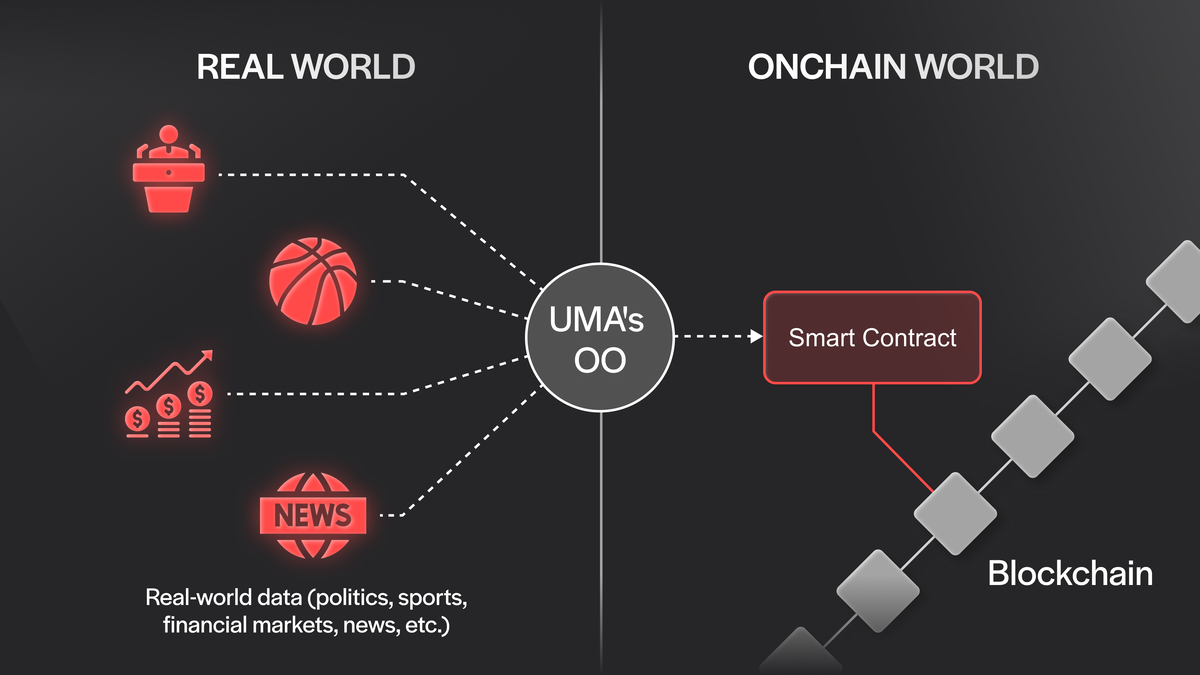
An oracle’s role is to confirm whether the event described in a market has occurred according to predefined criteria. Once the outcome is verified, the system distributes payouts to the winning side.
Polymarket has historically relied on Oracle systems connected to decentralized infrastructure providers such as UMA Protocol and Chainlink to help verify event outcomes and feed that information into smart contracts.
When a market is clearly resolved, for example, when official election results are announced, the settlement process is straightforward. The oracle records the outcome, and the system redeems winning shares for their $1 payout.
More complex situations can arise when the outcome is ambiguous or contested. In such cases, resolution rules written into the market description determine which sources or authorities provide the final determination.
These safeguards are designed to ensure that markets resolve consistently, though traders should always review the resolution criteria before entering a position.
Anyone interacting with blockchain trading platforms should also understand custody security. Read our guide on the best cold storage wallets for protecting long-term crypto holdings.
Polymarket Vs Other Prediction Platforms
Once the basic mechanics of prediction markets are clear, it becomes easier to place Polymarket within the ecosystem of forecasting platforms. While the core idea of trading event probabilities is shared across several services, the structure, regulation, and intended user base can differ significantly from one platform to another.
Some prediction markets operate within strict regulatory frameworks, while others prioritize open global participation. Some focus on financial or economic indicators, while others allow users to create markets for a wide range of events. Comparing these platforms helps clarify what makes Polymarket distinct and which type of user each system serves best.
Comparison Of Major Prediction Platforms
Several platforms offer prediction-style markets, but they differ in how contracts are structured, how outcomes are resolved, and who can legally participate. The table below highlights some of the most widely discussed platforms.
| Platform | Type | Regulated | Settlement Method | Best For | Main Drawback |
|---|---|---|---|---|---|
| Polymarket | Blockchain prediction market | No formal U.S. exchange license | Smart contracts and oracle resolution | Global crypto-native traders | Regulatory restrictions in some jurisdictions |
| Kalshi | Event contracts exchange | Yes (CFTC regulated) | Centralized exchange settlement | U.S. users seeking regulated markets | Limited event categories |
| PredictIt | Academic research prediction market | Operates under regulatory exemptions | Platform-administered resolution | Political forecasting participants | Low position limits |
| Manifold Markets | Play-money prediction market | Not regulated (no real money) | Platform resolution | Forecasting enthusiasts and communities | No real financial stakes |
| Sportsbooks | Traditional betting platforms | Regulated gambling operators | House-settlement rules | Sports betting users | Odds controlled by bookmaker |
This comparison shows how prediction platforms occupy a spectrum between financial markets, research tools, and entertainment platforms. Polymarket sits closer to the financial market end of that spectrum because prices emerge directly from trading activity rather than being set by a central operator.
Another notable difference involves market flexibility. Blockchain-based systems like Polymarket can launch markets on a wide range of topics relatively quickly, whereas regulated exchanges must follow stricter approval processes for new contracts.
Which Type Of User Each Platform Fits Best
Each prediction platform tends to attract a slightly different audience depending on its structure.
Polymarket appeals primarily to users who are already comfortable interacting with crypto infrastructure. Because the platform relies on blockchain wallets, stablecoin funding, and decentralized settlement mechanisms, it naturally attracts traders who want to speculate on global events using a permissionless financial system.
By contrast, Kalshi focuses on compliance with U.S. financial regulation. Its markets revolve largely around economic indicators and policy events, and participation requires users to complete identity verification similar to other regulated exchanges.
Platforms such as Manifold Markets serve a different purpose entirely. Instead of facilitating real-money trading, they allow participants to forecast outcomes using virtual currency. These systems are often used for research, community forecasting, or entertainment rather than financial speculation.
Academic platforms like PredictIt occupy a middle ground. PredictIt historically operated under a regulatory exemption that allowed limited political forecasting markets, though position limits and compliance requirements restrict how traders interact with the system.
Traditional sportsbooks represent yet another category. While they allow users to wager on outcomes, odds are set by the bookmaker and adjusted to manage the operator's risk. This structure differs from prediction markets, in which prices are determined directly by trading activity among participants.
Looking across these platforms, it's clear that Polymarket functions as a global, crypto-native event-trading venue, whereas other regulated exchanges focus on compliance, and traditional betting platforms focus on entertainment.
The Bottom Line On Polymarket
Polymarket is best understood as a market for trading probabilities. Users buy and sell outcome shares tied to real-world events, and prices range from $0.01 to $0.99, reflecting how likely traders believe the event is. What sets it apart is its structure: markets run on the Polygon network, trades use USD Coin, and prices are set by a peer-to-peer order book rather than by bookmaker odds. The platform effectively turns news, political developments, and macro events into tradable probability signals.
The platform suits users who are comfortable with crypto wallets and event-driven speculation, especially those who closely follow global news or economic developments. Beginners, however, should approach it with care. Understanding spreads, small network fees, and order execution matters just as much as predicting the event itself, and access can depend on local regulations. Learning these mechanics first helps traders avoid costly mistakes in markets where probabilities shift quickly.