Stable is a Layer 1 stablechain Tether built around USDT that is backed by Bitfinex, Franklin Templeton and KuCoin Ventures. It is a stablecoin-focused chain designed primarily for moving value quickly and predictably.
- Focused stablecoin design: Stable is purpose-built for stable value transfers, with USDT at the center of the network’s payment and settlement model.
- Live mainnet already launched: Stable’s mainnet went live in December 2025 after a pre-deposit campaign that drew more than $2 billion from 24,000 wallets.
- Early lead among stablechains: It is one of the first stablecoin-focused Layer 1 networks to launch a live mainnet while projects such as Circle’s Arc and Stripe’s Tempo are still in testnet stages.
- Dual-token structure: USDT0 is used for transfers and gas, while the STABLE token is used for staking and governance.
- Built for fast settlement: Stable targets sub-second finality, making it well suited for payments and predictable value movement.
- EVM compatibility: Developers can build on Stable using familiar Ethereum-style tooling.
This article does three things:
- Explain what Stable is and why it exists.
- Break down how USDT0 and STABLE work together.
- Assess what this means for payments, developers, and institutions, including fast settlement targets like sub second finality and EVM compatibility.
What Is Stable and Why Was It Built?
Stable is a Layer 1 blockchain designed to make stablecoins feel more like everyday money transfers. Rather than treating stablecoins as just another token on a general network, Stable is built around the idea that USD₮ can be a primary settlement asset, with a simpler, more predictable experience for sending and settling value.
 Stable is a Layer 1 Blockchain Designed to Make Stablecoins Feel more like Everyday Money Transfers. Image via Stable
A practical analogy is a transit system. Many blockchains function like a busy city network carrying everything at once, so congestion changes travel time and the “ticket price” changes with demand. Stable is closer to a dedicated rail line for stablecoin settlement, optimized for consistent throughput and costs that stay easier to anticipate.
Tether’s Role
Stable connects Tether and USDT. Today, USDT is issued across multiple blockchain networks, which helps it reach more users and platforms but also spreads activity across different ecosystems. In practice, that means USDT can exist in several technical formats depending on the underlying protocols, each with its own wallet support, transfer speeds, and fee dynamics.
Why Existing Chains Are Imperfect For Stablecoin Settlement
Stable is built around a straightforward problem: stablecoins are widely used for payments and settlement, but the underlying rails were not designed with stablecoin transfers as the main priority.
Three pain points show up often:
- Fragmentation: When a stablecoin exists across multiple networks, users and businesses end up choosing between different transfer experiences, fee markets, and tooling. This multi network setup is part of how USDT operates across several chains today.
- Fee Unpredictability: Many networks require a separate volatile asset to pay gas, so the cost to move stablecoins can shift with congestion and token price swings. As per its whitepaper referenced above, Stable aims to make fees more stable and more payment like by reducing reliance on volatile gas tokens.
- Payment Infrastructure Not Optimized for Stablecoins: Stablecoin heavy usage often looks like settlement traffic, meaning frequent transfers and operational flows. Stable’s design prioritizes those patterns at the base layer so stablecoin transfers are not just one activity competing for blockspace.
Is Stable Just Another Blockchain?
Stable is a blockchain, but it is purpose built for stablecoin payments rather than a broad general purpose network. Its design centers on moving stable value efficiently, with USDT treated as a core settlement asset in the architecture.
Who Is It For?
Stable maps neatly to three groups:
- Users: People who want to send stablecoins quickly with fewer surprises around fees and confirmation time. This matters because slow finality or volatile costs can turn simple payments into a waiting game.
- Fintechs and Institutions: Teams that need reliable settlement rails, meaning consistent performance and predictable costs for high frequency operational transfers.
- Developers: Builders creating payment apps and settlement tooling who prefer a stablecoin centric environment, especially when cross chain complexity creates multiple versions of the same asset across ecosystems.
Stable is essentially an attempt to give stablecoins a settlement network that feels purpose-built for how people and businesses already use them, with USD₮ at the center. If it delivers on predictable fees, fast settlement, and smoother stablecoin-native infrastructure, it could make stablecoin payments feel less like “crypto rails” and more like a straightforward digital cash system.
How Does Stable Work?
Stable is designed like a payments focused blockchain, pairing fast agreement between validators with a fee model that stays tied to a stable unit of account. A user signs a transfer, the transaction spreads across the network, validators agree on the next block, and the result becomes final quickly enough to feel close to instant for everyday payments. Stable’s design targets sub-second finality, which is a key difference between a payments rail and a general purpose chain where users sometimes wait for extra confirmations for peace of mind.
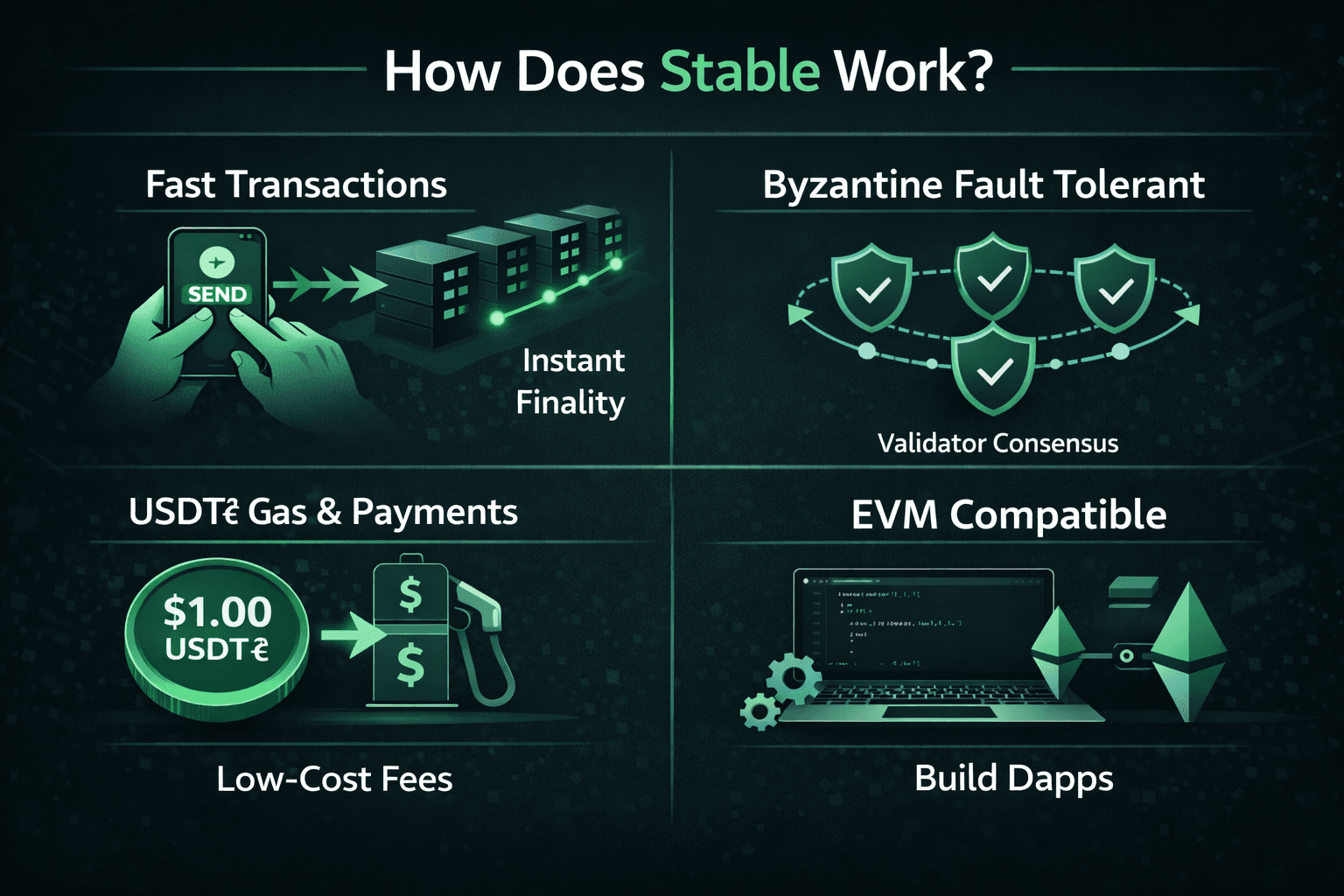 Stable is Designed like a Payments Focused Blockchain, Pairing Fast Agreement between Validators with a Fee Model that Stays Tied to a Stable Unit of Account
Consensus and Finality
Stable uses StableBFT, a Byzantine Fault Tolerant consensus approach designed to reach deterministic finality through validator coordination. For beginners, it helps to think of this as a group agreement process. Once enough validators agree on the same outcome, the network can treat that result as final, rather than relying on probability over many blocks.
Under the hood, Stable’s first phase is built as a customized proof of stake protocol based on CometBFT. In practice, that places it in the broader family of proof of stake systems that use a defined validator set to produce blocks and finalize transactions, which is why it often gets described in the same neighborhood as delegated proof of stake. For payments, the appeal is straightforward. A smaller coordinating set can optimize for low latency and strong finality, which supports the “tap to pay” feel stablecoin users expect.
StableBFT is designed to remain safe even if up to one third of validators are faulty or malicious, a standard property in BFT style systems and a useful fit for settlement where reversing payments would be unacceptable. That deterministic settlement concept is closely related to how finality works in different blockchain designs.
Gas, Transfers, and Cross Chain Movement
Stable uses USDT0 as the network’s native gas and transfer asset. That means the same stablecoin unit can pay transaction fees and move value, reducing the common friction where users must keep a separate volatile coin just to pay gas. Stable’s fee market follows an EIP 1559 style model, with fees denominated in USDT0, so costs stay expressed in a dollar adjacent unit rather than a fluctuating token.
Earlier in the rollout, some users may encounter gUSDT references. Stable’s current design moves away from that wrapper model, shifting gas payments to USDT0 and automatically converting existing gUSDT balances to simplify the user experience.
For cross chain movement, Stable integrates LayerZero as an interoperability layer. LayerZero’s architecture uses immutable endpoints on each supported chain to pass verified messages between source and destination environments, which is the plumbing that can support cross chain transfers without relying on a single custodial bridge. This sits within the broader category of cross chain communication, where the core challenge is moving assets and instructions between different networks safely.
Can Developers Build on It?
Yes. Stable is EVM compatible, so developers can use familiar Ethereum tooling, wallets, and Solidity smart contracts. Most of the day to day workflow looks similar to other EVM chains, with the main difference being the gas and balance semantics that come from using USDT0 as the native fee asset. Stable also provides developer support resources and integration guidance through its developer assistance materials, covering expected patterns for contracts and applications on the network.
For readers who want a broader primer on what EVM compatibility really means in practice, Coin Bureau has a useful breakdown of EVM concepts and how different execution environments affect developer experience.
The STABLE Token and Stable’s Dual Token Model
Stable uses a dual token setup to separate how people pay on the network from how the network is run. The goal is practical. Everyday transfers and fees stay tied to a stable unit, while the network still has a dedicated asset for coordination, incentives, and decision making.
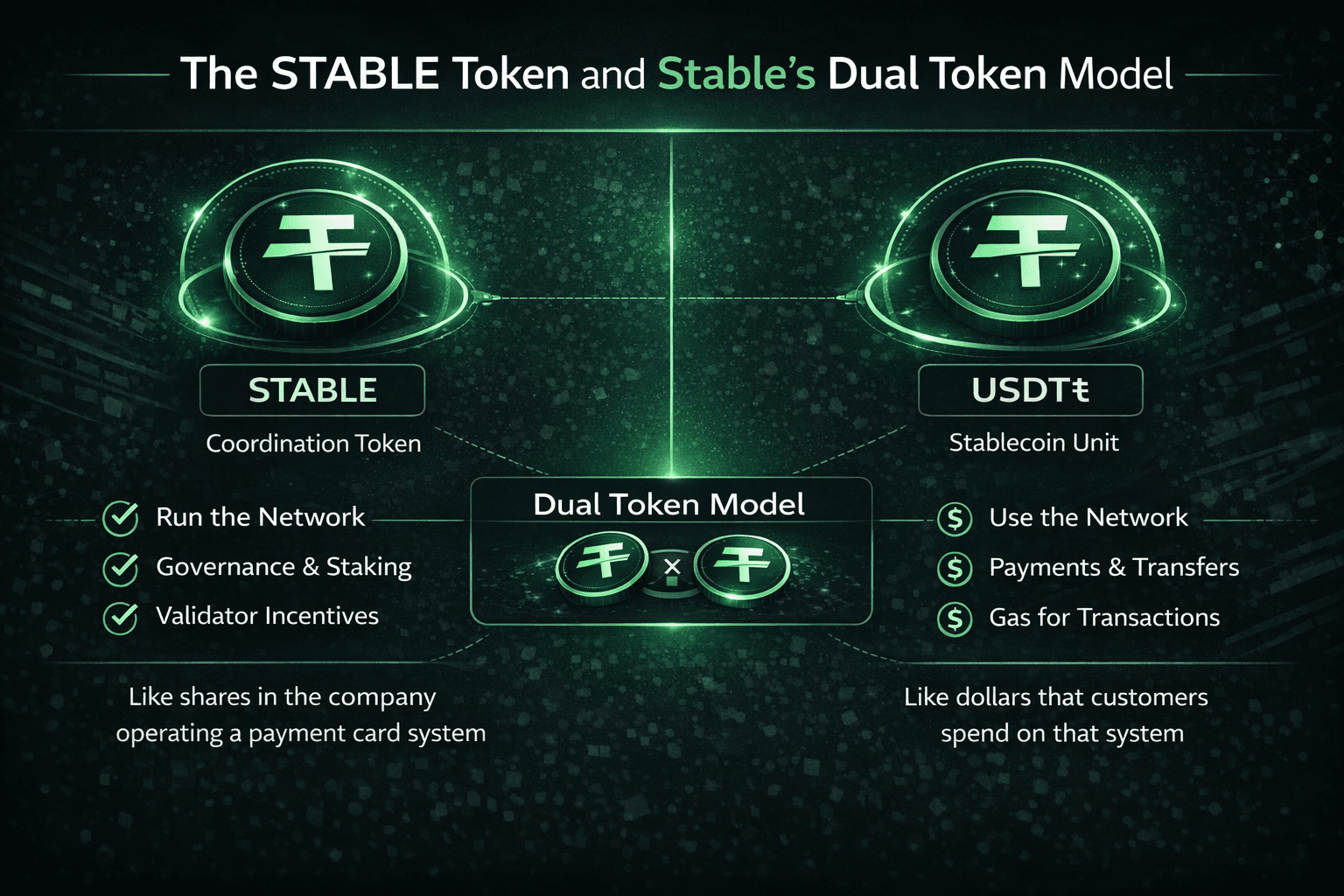 Stable Uses a Dual Token Setup to Separate How People Pay on the Network from How the Network is Run
At a high level:
- STABLE is the coordination token used for governance, staking, and validator incentives.
- USDT0 is the stablecoin unit used for user payments and gas, so users can transact without needing a separate volatile token just to cover fees.
Imagine a payment card system. Customers spend dollars, not shares in the company operating the rails. But the company still needs ownership and governance mechanisms to make long term decisions. Stable applies a similar separation. USDT0 focuses on moving value, while STABLE focuses on coordinating the network.
What Is the Difference Between STABLE and USDT?
Simply put, the two tokens have different jobs:
STABLE is for running the network
- It gives holders a say in network decisions through governance.
- It connects to network security through staking, where participation ties into validator selection and incentives.
- It is used to align validators and delegators so the network keeps operating reliably.
USDT0 is for using the network
- It is the unit used for transfers and gas, so fees stay expressed in a stable, dollar adjacent amount through USDT0.
- It supports EVM style token behavior while also acting as the gas balance users spend for transactions.
This split is the core of Stable’s dual token architecture. Payment users mainly interact with USDT0. Network participants who want influence and rewards interact with STABLE.
STABLE Tokenomics and Governance
Stable sets STABLE’s total supply at 100,000,000,000 tokens. The distribution is split into broad buckets that reflect how the project plans to fund development, bootstrap adoption, and align long term incentives. In simple terms, the categories cover:
- Team, Investors, and Advisors: Typically represent people and entities funding and building the project.
- Ecosystem and Community: Usually supports grants, integrations, liquidity, incentives, and adoption programs.
- Genesis Distribution: Generally refers to initial allocations tied to launch conditions and early network formation.
Those buckets matter because they shape how quickly tokens enter circulation, who holds influence early on, and how incentives are funded, which is why readers often evaluate a project’s tokenomics before thinking about participation.
A few mechanics are especially relevant for understanding how STABLE is intended to function:
- Staking and Validator Incentives: STABLE participation ties into the network’s staking system via the staking module. That relationship is central to how validators are incentivized and how delegators can support them.
- Governance Rights: Governance power sits on the STABLE side of the model, concentrating decision making in the coordination token rather than the payment token through STABLE utility.
- Vesting and Alignment: Parts of the distribution follow release schedules over time, which can reduce sudden supply shocks and help align long term incentives. That concept maps to broader crypto vesting practices seen across many token launches, with Stable applying time based release mechanics across portions of the STABLE allocation.
The takeaway is that the split is intentional. Stable keeps the day to day payment experience anchored to a stable unit through USDT0, while STABLE concentrates the levers needed to coordinate upgrades, align validator behavior, and govern the network over time.
What Makes Stable Different From Ethereum, Tron and Solana?
Stable is built around a narrow goal: Stablecoin settlement as a first class use case. That is a different starting point from general purpose smart contract platforms, where stablecoin transfers share blockspace with everything else. The practical result is a design that aims to keep fees predictable in a stable unit and confirmations fast enough to feel native to payments, with USDT0 as the gas and transfer asset and a target of sub second finality as per the whitepaper.
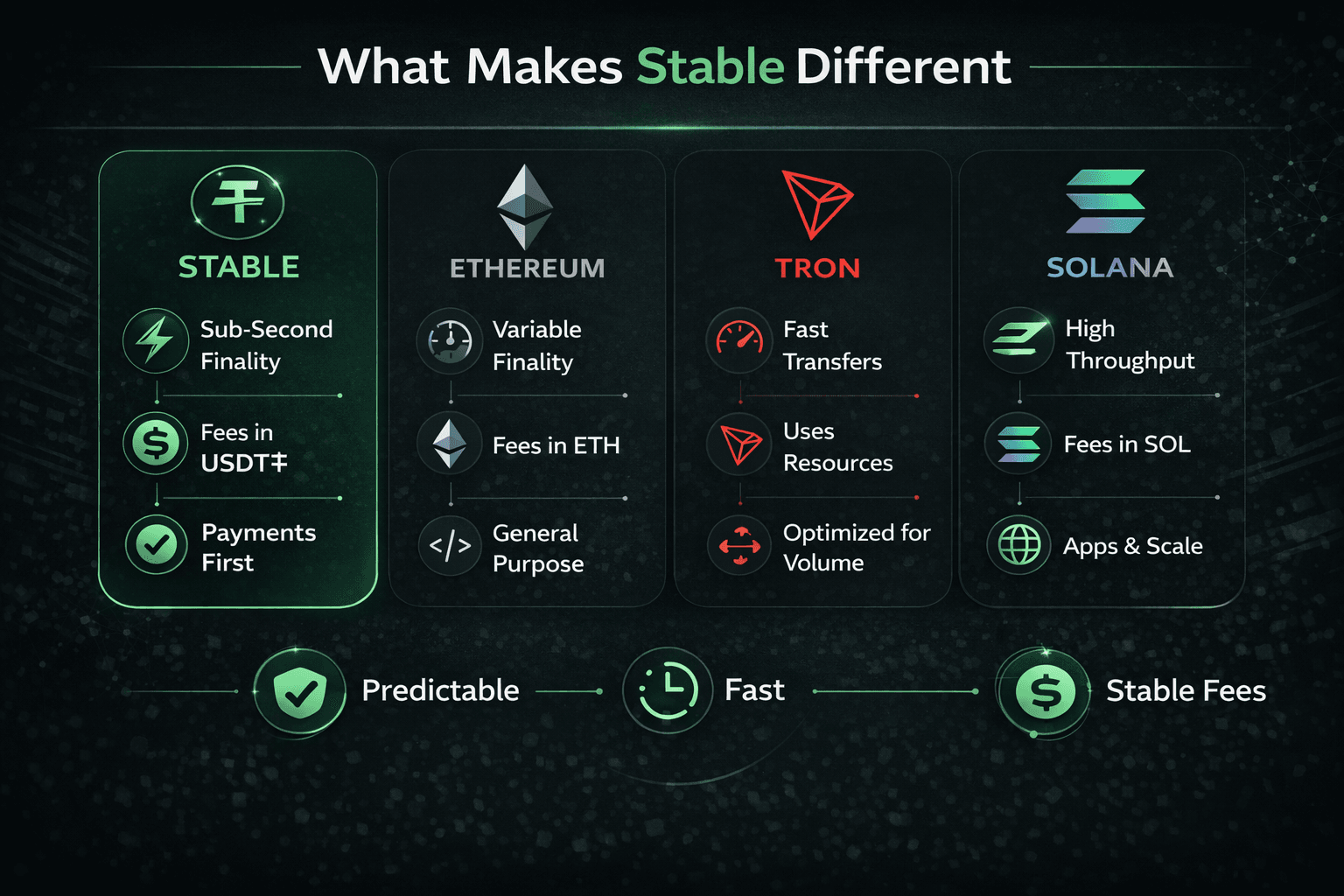 Stable is Built Around a Narrow Goal: Stablecoin Settlement as a First Class Use Case
Network | Primary Design Goal | Fees and Fee Unit | Speed and Finality Style | USDT Role |
|---|---|---|---|---|
Stable | Stablecoin settlement and payments first | Gas fees paid in USDT0 | Targets sub second finality using StableBFT | USDT0 is both the primary settlement asset and the gas asset |
| General purpose smart contracts and decentralized apps | Gas fees are paid in ETH and quoted in gwei (a small unit of ETH). Total fee is gas used × (base fee + optional priority fee), where the base fee is protocol-set and burned and the priority fee is a user-set tip. | Finality expectations vary by application and network conditions | USDT is widely used as a token on Ethereum, while fees are paid in ETH | |
| Transfers optimized around a delegated validator model | Uses bandwidth and energy. If resources are insufficient, TRX can be burned based on resource usage, such as Energy quantity × unit price | Block production and confirmations optimized for fast transfers | USDT is a dominant payment token on Tron, while resources and fees tie back to TRX | |
| High throughput execution for consumer scale apps | Fee paid in SOL. Base fee is 5,000 lamports per signature plus an optional priority fee | Fast confirmations designed for high throughput execution | USDT is a supported token on Solana, while fees are paid in SOL |
Payments Angle
For everyday users, the difference often shows up as friction. Stable aims to let people transact and pay fees in the same stable unit through USDT0. On Ethereum and Solana, transaction fees are paid in native assets such as ETH or SOL, which can add extra steps for someone who only wants to send stablecoins and wants costs to stay easy to interpret in dollar terms. Tron uses a resource model where transactions consume bandwidth and energy, with TRX burned when free or staked resources are insufficient.
Institutional Angle
Institutions tend to care less about novelty and more about operational certainty. Stable includes a concept called guaranteed blockspace, which is meant to reserve a fixed share of capacity for enterprise style flows such as settlement or supplier payments, even during congestion. Paired with fast finality targets, this is closer to how payment infrastructure is usually evaluated: predictable access, predictable latency, predictable cost.
PYUSD and PayPal Ventures
Stable also signals ambitions beyond being another place to transfer USDT. PayPal Ventures has discussed backing Stable in the context of expanding the distribution and utility of PayPal USD. PYUSD is issued by Paxos and is designed for payments, which fits the broader pattern of large payments brands exploring stablecoins as part of mainstream commerce rails.
Stable’s main differentiator is its starting point: it treats stablecoin settlement as the default use case, not one activity competing with everything else on a general-purpose chain. In practice, that shows up in how fees are handled, how quickly transactions are meant to feel final, and why payments and institutional-style flows sit closer to the center of the design.
Risks, Adoption Challenges, and What Comes Next
Stable’s payments first design brings clear tradeoffs. The same choices that can make stablecoin settlement feel faster and more predictable can also concentrate decision making, increase regulatory sensitivity, and slow adoption if integrations do not arrive quickly. None of these risks guarantee failure, but they are the variables that will largely determine whether Stable becomes widely used infrastructure or remains a niche network.
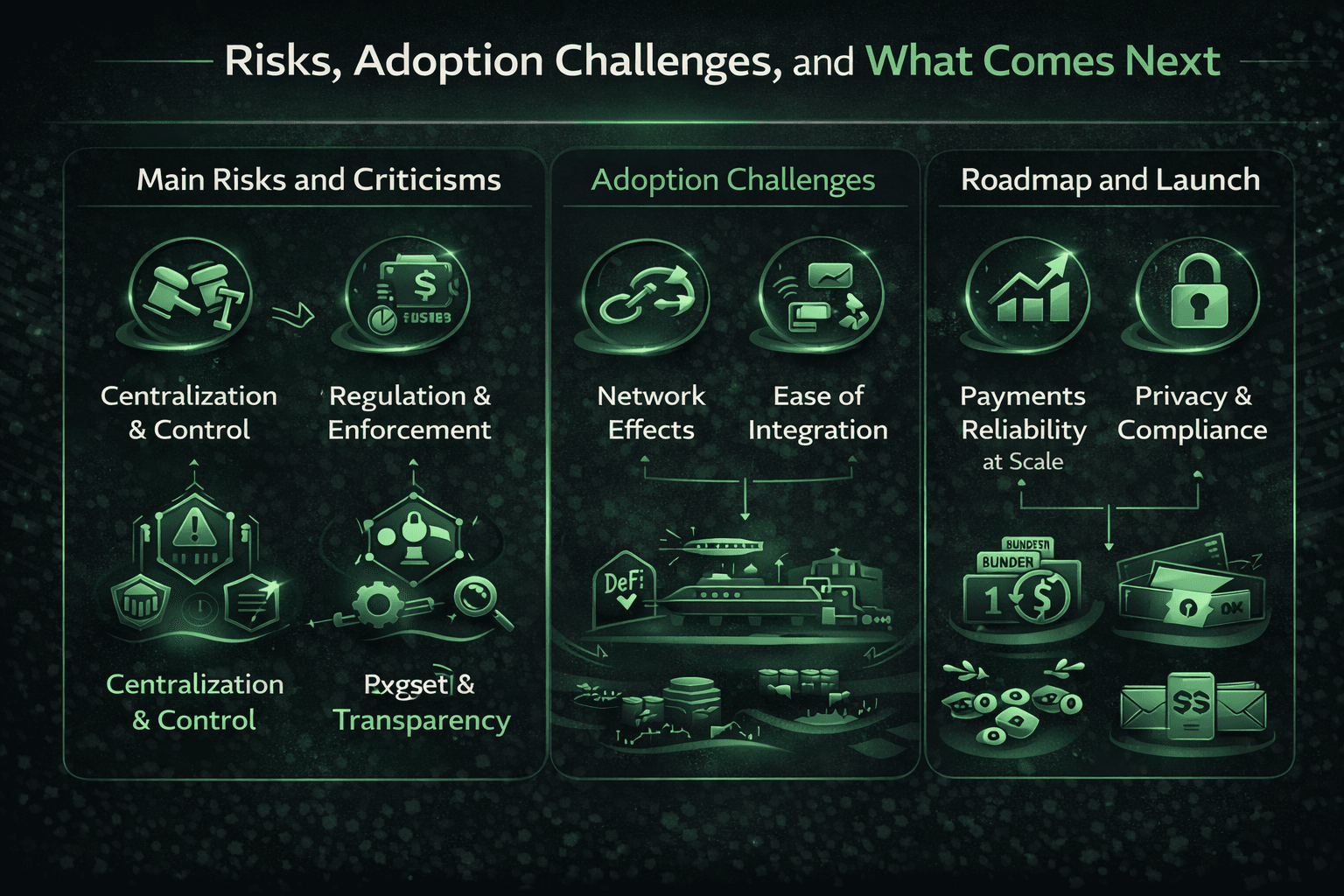 None of these Risks Guarantee Failure, but they are the Variables that will Largely Determine whether Stable becomes a Widely Used Infrastructure or Remains a Niche Network
Main Risks and Criticisms
A few concerns tend to come up repeatedly:
- Centralization and Control: When a network’s identity is closely tied to a single stablecoin issuer, users may worry about who ultimately influences upgrades, validator participation, and policy decisions. Stable also centers USDT0 as both the settlement asset and gas asset, which can simplify payments but increases reliance on the USDT stack.
- Regulation and Enforcement Risk: Stablecoin rails tend to attract more attention than general crypto apps, especially when they touch cross border transfers or institutional settlement. Tether publishes reserve and reporting materials through its Transparency disclosures, and it also sets out restrictions and enforcement terms in its Legal documentation.
- Trust and Transparency Expectations: Payment systems depend on confidence that redemption, reserves, and operational controls are reliable. Tether periodically releases reserve and attestation updates, but institutional perceptions can still differ based on jurisdiction, compliance posture, and internal risk policy.
- Adoption Friction: Even if the chain is technically strong, users often stick with whatever rail their exchange, wallet, or counterparty already supports. Stable still has to overcome existing network effects on Ethereum, Tron, and Solana, plus growing competition from Ethereum Layer 2s.
- Wallet, Exchange, and DeFi Integration: A payments chain only feels real when deposits, withdrawals, signing flows, and liquidity are supported broadly. Until then, the user experience can resemble a new airport with great runways but few flights.
Roadmap and Launch Status
Stable already supports both testnet and mainnet environments, with published network configuration and endpoints for mainnet and testnet. The current phase framing is oriented around tightening the core payments experience, then expanding capacity and reliability features that matter for higher stakes flows.
A few roadmap themes are especially relevant:
- Payments Reliability at Scale: Stable includes an enterprise focused capacity model called guaranteed blockspace, designed to reserve a fixed share of block capacity for mission critical transfers such as settlement, payroll, or supplier payments.
- Throughput and Efficiency: Stable’s roadmap includes features like a USDT transfer aggregator to bundle transfers and reduce overhead during high volume activity.
- Privacy and Compliance Balance: The roadmap also references capabilities such as confidential transfers, which aim to protect transaction amount privacy while still aligning with compliance requirements.
Stable’s path forward is less about whether stablecoins are useful and more about whether Stable can earn trust, navigate regulatory expectations, and win integrations quickly enough to compete with deeply entrenched rails. If those pieces land, a stablecoin native settlement chain could feel closer to financial infrastructure than general purpose crypto.

Final Thoughts
Stable’s path forward is less about whether stablecoins are useful and more about whether Stable can earn trust, navigate regulatory expectations, and win integrations quickly enough to compete with deeply entrenched rails. If those pieces land, a stablecoin native settlement chain could feel closer to financial infrastructure than general purpose crypto.
Stable is an interesting signal of where stablecoins might be headed next: away from being “just another token” on general-purpose chains and toward becoming the centerpiece of dedicated payment rails. By putting USDT0 at the heart of fees and transfers and pushing for sub-second finality, Stable is clearly aiming for the kind of speed and predictability that everyday users and businesses expect. The real test, though, won’t be in the whitepaper. It’ll be in integrations, liquidity, and trust. If wallets, exchanges, and builders show up, Stable could feel less like “crypto infra” and more like digital cash plumbing.