Crypto market structure describes where trades happen and how they execute, not what a chart pattern looks like. It covers the venues traders use, the instruments they trade, and the paths liquidity takes between spot markets, derivatives, and private execution channels.
Every crypto trade sits inside this structure. Whether someone buys Bitcoin outright, trades a leveraged perpetual, or executes a private block trade, the market type determines pricing accuracy, execution risk, and regulatory exposure. Understanding structure explains why the same asset can trade differently across venues, why liquidity disappears under stress, and why some trades move the market while others don’t.
At a high level, crypto trading is organized into three interconnected markets: Spot markets for ownership, derivatives markets for leverage and hedging, and OTC markets for large, private execution.
This guide covers trading venues and market types, not technical analysis concepts like Break of Structure (BoS). Market structure here refers to how crypto markets are built and accessed, not chart patterns or price-action terminology.
Why Market Structure Matters
Market structure is not academic. It directly affects outcomes.
- Liquidity access: Determines whether size can be executed without slippage.
- Pricing accuracy: Spot depth anchors derivatives, indices, and ETFs.
- Risk exposure: Leverage, liquidation mechanics, and counterparty risk vary by venue.
- Regulatory consequences: Asset classification and venue type dictate compliance and access.
Understanding structure explains why markets behave the way they do when volatility spikes.

Crypto Market Types at a Glance
Before diving into mechanics, it helps to anchor everything in one frame. Crypto trading is not one market with different strategies layered on top. It is three structurally different markets, each built for a different purpose, risk profile, and participant type.
| Market Type | Best For | Typical Risk | Liquidity | Typical Fees | Minimum Size | Who Should Avoid It |
|---|---|---|---|---|---|---|
| Spot Markets | Direct ownership, long-term exposure | Price volatility, custody risk | High for majors, uneven for alts | Low to moderate | Very low | Traders seeking leverage or short-term hedges |
| Derivatives Markets | Leverage, hedging, short-term speculation | Liquidation risk, funding costs | Very high on majors | Low headline fees, high embedded risk | Low | Long-term holders, low-risk participants |
| OTC Markets | Large institutional trades | Counterparty risk | Deep but relationship-based | Negotiated | High ($100k+) | Retail traders, small orders |
Decision Shortcuts
- If you want ownership → Spot
- If you want to leverage → Derivatives
- If size moves the market → OTC
With this map in place, the mechanics of each market become much easier to interpret. Everything else in crypto trading flows outward from the spot layer.
Spot Markets: The Foundation of Crypto Trading
 Direct Ownership Through Simple Buy And Sell Trades
Spot markets form the base layer of crypto market structure because they handle the simplest and most final transaction in the system: exchanging money for ownership. Every other market type, from futures to options, ultimately references prices formed here.
When spot markets are deep and orderly, the rest of the ecosystem functions smoothly. When they thin out or fragment, stress propagates upward into derivatives, liquidations, and volatility.
For context on choosing a derivatives venue, read our guide to the leading crypto derivatives exchanges.
What Spot Trading Actually Means
Spot trading means buying or selling a cryptocurrency for immediate delivery at the current market price. Once the trade executes, ownership changes hands. There is no contract, no future obligation, and no leverage baked into the transaction.
Settlement in crypto is effectively immediate. On centralized exchanges, balances update almost instantly on internal ledgers. On-chain transfers typically confirm within minutes, depending on network conditions. Compared with traditional markets, where equity trades settle on a T+2 basis, crypto operates on a near T+0 model.
For a clear explanation of the difference between platforms, read our guide on centralized vs. decentralized crypto exchanges.
The key distinction is ownership. Spot traders hold the asset itself. By contrast, derivatives traders hold exposure to price movement without owning the underlying coin.
How Spot Markets Work (Step-by-Step)
Step 1: Choose the execution path
On a centralized exchange, trades run through an order book. On a decentralized exchange, trades usually run through an AMM liquidity pool. The path you pick determines how your order finds a price and how slippage shows up.
Step 2: Order book flow (CEX)
You place a buy or sell order that either:
- Takes liquidity (market order) by matching instantly with existing orders, or
- Makes liquidity (limit order) by sitting on the book until someone matches it.
The exchange’s matching engine pairs your order with the best available opposite orders and fills it in real time.
Step 3: AMM flow (DEX)
You swap directly against a liquidity pool. There is no matching engine. Your trade changes the pool’s token balance, and the price adjusts along a curve. If the pool is shallow, your trade pushes the price more, and slippage increases.
Step 4: Market vs limit order example using BTC/USDT
If BTC is trading around 60,000 USDT:
A market buy: You click buy, and the trade fills immediately at the best available asks. If the order book is thin, you may fill across multiple price levels, raising your average entry.
A limit buy: You set a price, for example, 59,500 USDT. Your order sits in the book. It fills only if sellers hit that price. You control the entry price, but you may not get filled.
Step 5: Settlement, crypto T+0 vs TradFi T+2
In traditional equities, settlement is usually T+2, meaning the final transfer completes two business days later. In crypto spot markets, balances update almost instantly on an exchange ledger after execution. If you withdraw on-chain, final settlement depends on block confirmations and typically completes within minutes.
That near T+0 settlement is why capital rotates faster in crypto, and why custody decisions matter immediately after execution.
Where Spot Trading Happens
Spot liquidity concentrates across two venue types.
Centralized exchanges dominate global volume and price discovery. Platforms such as Binance, Coinbase, Kraken, and Bybit custody user funds, operate high-speed matching engines, and offer deep order books for major assets. Their scale attracts professional market makers, which tightens spreads and improves execution.
Decentralized exchanges run without custodial intermediaries. Protocols such as Uniswap and PancakeSwap allow users to trade directly from their wallets. This removes platform custody risk but introduces smart contract exposure, price curve dynamics, and variable slippage depending on pool depth.
Most traders use both. Centralized venues for liquidity and speed, decentralized venues for on-chain access and self-custody.
Liquidity, Price Discovery, and Market Makers
Spot markets are the primary source of price discovery in crypto. Prices formed here anchor derivatives, indices, and structured products across the ecosystem.
Professional market makers stabilize this process. On centralized exchanges, they continuously post bids and offers, narrowing spreads and absorbing short-term imbalances. On AMM-based DEXs, liquidity providers perform a similar function by supplying token inventory across price ranges.
Liquidity depth matters. In deep markets like BTC and ETH, large orders execute with minimal slippage. In thinner markets, even moderate trades can move prices sharply. This uneven liquidity distribution explains why smaller assets experience more volatile spot moves and less reliable pricing.
Custody and Risk Considerations
Because spot trades transfer real ownership, custody choices matter.
On centralized exchanges, users leave assets in exchange-controlled wallets for convenience and access to liquidity. This introduces platform and withdrawal risk, especially during periods of stress. Many participants mitigate this by withdrawing assets to self-custody once trades are complete.
On decentralized exchanges, custody remains with the user throughout the transaction. This removes exchange solvency risk but shifts responsibility to key management and smart contract security.
The practical takeaway is not ideological. Custody risk simply moves. Spot traders must decide which risks they prefer to manage directly.
To understand how custody models differ, see our comparison of custodial vs. non-custodial wallets.
When Spot Markets Make Sense
Spot markets are best suited for participants who value ownership and flexibility.
They fit long-term holders building positions without leverage, treasuries allocating capital to crypto assets, and users who need coins for on-chain activity such as DeFi, NFTs, or payments. Spot trading avoids liquidation risk and funding costs, making it structurally simpler even if capital efficiency is lower.
For traders seeking leverage, short exposure, or capital efficiency, spot markets become a reference layer rather than the execution layer. That is where derivatives take over.
Derivatives Markets – Leverage, Hedging, and Speculation
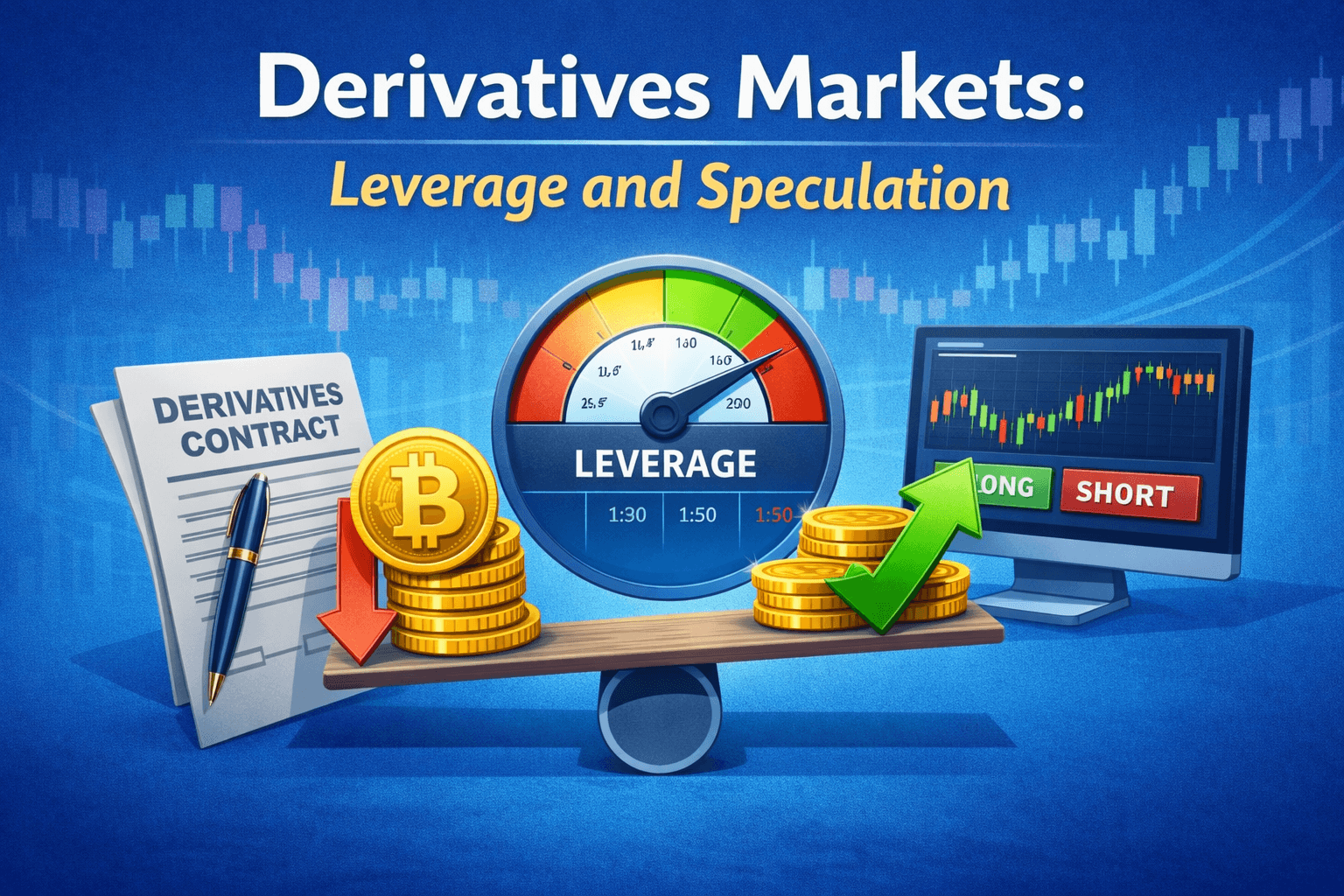 How Traders Use Leverage To Amplify Market Bets
Once spot ownership is established, traders often want exposure without moving assets again. Derivatives markets exist to solve that problem. They allow participants to trade price movements instead of coins, introducing leverage, hedging, and time-based risk without requiring direct custody of the underlying asset.
This layer sits directly on top of spot markets. Every derivatives contract ultimately references a spot price. When spot liquidity is strong, derivatives behave predictably. When spot markets thin out, derivatives amplify stress through leverage and forced unwinds.
Futures and Perpetual Contracts Explained
Crypto derivatives are dominated by futures-style instruments.
- Fixed-expiry futures: lock in a price today for settlement at a specific future date. Traders use them to hedge holdings or speculate on where prices will be at expiry. Settlement can be cash-based, where profits and losses are paid in fiat or stablecoins, or physically settled, where the underlying crypto is delivered. In practice, cash settlement dominates crypto futures because it simplifies custody and operations.
- Perpetual contracts, or perps, remove the expiration date entirely. Positions can remain open indefinitely, which makes them structurally different from traditional futures. Instead of converging at expiry, perpetuals rely on funding payments to stay aligned with spot prices.
Perpetuals are a crypto-native design. Their simplicity, continuous exposure, and leverage flexibility explain why they account for the majority of derivatives volume across crypto markets.
Check out our top picks for the best crypto futures exchanges.
Funding Rates
Funding rates are the mechanism that keeps perpetual prices anchored to spot markets.
At regular intervals, usually every eight hours, payments flow between long and short traders. If a perpetual contract trades above the spot price, long positions pay shorts. If it trades below spot, shorts pay longs. These payments create an economic incentive to push the perpetual price back toward spot.
For example, if BTC perpetuals trade consistently above spot, it signals aggressive long positioning. Funding turns positive, making long exposure increasingly expensive to maintain. Over time, this discourages crowding on one side of the trade.
Funding is not just a cost. It is also a positioning signal. Persistently high positive funding reflects speculative excess, while negative funding points to heavy short interest. During stressed markets, funding can spike sharply, accelerating position closures.
Leverage in Practice
Leverage is what drives participation in derivatives markets, but it is also their main structural weakness.
In practice, leverage ranges are wide. Conservative traders may use 2x or 3x exposure to hedge spot holdings. On many crypto-native platforms, leverage can exceed 100x on major assets. At these levels, even small price moves can trigger liquidations.
Liquidation mechanics are automatic. When losses reduce the margin below maintenance thresholds, positions are forcibly closed by the exchange. During fast markets, liquidations tend to cluster. One forced close pushes the price further, triggering the next, creating a cascade.
This is why high leverage is structurally fragile. It compresses risk into narrow bands and turns ordinary volatility into disorderly price moves, especially when liquidity thins.
To learn the risks and rules of trading with borrowed funds, read our cryptocurrency margin trading education piece.
Major Derivatives Venues
Derivatives liquidity concentrates heavily on a small number of platforms.
On the regulated side, CME offers cash-settled Bitcoin and Ethereum futures. These contracts appeal to institutions that require regulated clearing, standardized margining, and no direct crypto custody.
Crypto-native venues dominate global activity. Binance Futures offers deep liquidity, high leverage, and a wide range of perpetual and futures contracts. Deribit specializes in options and advanced derivatives, serving institutional traders and structured product desks. OKX combines spot and derivatives trading, attracting both retail and professional flows.
Liquidity remains highly concentrated in Bitcoin and Ethereum. Altcoin derivatives are thinner, more volatile, and more sensitive to liquidation cascades.
Options, Structured Products, and Volatility Trades
Beyond futures, derivatives markets expand into instruments designed to shape risk more precisely.
Crypto options give traders the right, but not the obligation, to buy or sell an asset at a predefined price. Calls benefit from upside moves, and puts gain value as prices fall. Losses are capped at the premium paid, while upside remains open-ended. This asymmetry makes options useful for hedging and defined-risk strategies.
Structured products combine options, futures, and swaps into tailored exposures. These products are commonly used to generate yield, limit downside within a range, or express views on volatility rather than direction. They are less liquid than futures and require careful structuring, which confines their use primarily to institutional desks.
Liquidity is the main constraint. Options markets exhibit wider spreads, uneven depth across strikes, and limited participation outside major assets.
Who Should (and Shouldn’t) Use Derivatives
Derivatives are best suited for traders who actively manage positions and understand leverage mechanics.
Best suited for
- Active traders managing risk continuously
- Institutions hedging spot exposure
- Funds executing basis or volatility strategies
Should avoid if
- Long-term holder with no hedging need
- User requiring on-chain assets
- Trader unable to monitor positions actively
For traders moving very large amounts, even derivatives markets can introduce a visible impact. That is where execution shifts away from public venues altogether.
To grasp the basics and mechanics of options trading, read our cryptocurrency options article.
OTC (Over-the-Counter) Markets: Institutional Trading Infrastructure
 Private Large Scale Trades Outside Public Orderbooks
As trade size increases, public crypto markets become structurally inefficient. Order books are designed for continuous price discovery, not discretion. Large orders leak intent, thin liquidity, and move prices before execution is complete. OTC markets exist to bypass those limits.
OTC trading allows institutions to execute size away from visible liquidity, replacing fragmented fills with negotiated certainty. It is not an alternative to exchanges. It is a parallel execution layer built specifically for scale.
What OTC Trading Is
OTC trading refers to bilateral execution negotiated off public order books, typically intermediated by a broker or desk that manages pricing, inventory risk, and settlement.
OTC execution is private, relationship-driven, and size-first. It is not designed for price discovery or speed, and it is not accessible to retail traders. Unlike equity dark pools, OTC crypto trades do not rely on internal matching engines. Each trade is priced explicitly, filled deliberately, and settled through agreed custody channels.
The defining feature is control. Price, size, timing, and settlement are all agreed upon before execution begins.
Why Institutions Use OTC Desks
Institutions use OTC desks because exchange mechanics penalize size.
In public venues, large orders consume resting liquidity and move prices as they execute. Even limit orders expose intent, inviting front-running and reactive positioning. OTC execution avoids this by locking in a price for the full notional upfront.
OTC also removes execution uncertainty during volatility. When order books thin or spreads widen, exchange execution quality degrades. OTC desks quote firm prices that remain valid for the entire trade size, even in fast markets.
For funds, miners, corporates, and treasuries, predictability matters more than immediacy.
How an OTC Trade Works
OTC execution follows a structured workflow built around risk control rather than speed.
- A client requests a quote specifying asset, size, direction, and settlement preferences.
- The desk evaluates spot pricing, derivatives markets, internal inventory, and hedging costs
- Then returns a firm bid or offer, usually with a short validity window.
- Once accepted, the trade is confirmed in full. There is no partial fill risk.
Settlement follows via agreed custody arrangements, often using segregated wallets or third-party custodians for the crypto leg and traditional banking rails for fiat. Timelines are typically same-day or T+1.
The result is a single-price execution with controlled settlement rather than a sequence of market interactions.
Exchange-Run vs Independent OTC Desks
OTC liquidity is sourced through two structurally different desk models.
Exchange-run OTC desks are operated directly by large trading platforms such as Binance and Coinbase Prime. These desks internalize flow and price trades using exchange liquidity, internal inventory, or affiliated market-making operations.
Pros:
- Faster settlement through integrated custody and infrastructure
- Direct access to deep exchange liquidity
- Simplified operational setup for existing exchange clients
Cons:
- Execution tied to exchange policy and platform risk
- Limited flexibility during regulatory or operational disruptions
- Potential exposure to venue-specific concentration risk
Independent OTC desks operate separately from exchanges and manage execution on their own balance sheets. Firms such as Cumberland and Galaxy Digital source liquidity across multiple venues and hedge exposure dynamically.
Pros:
- Multi-venue pricing and execution flexibility
- Reduced dependency on a single exchange
- Bespoke trade structuring and relationship-driven liquidity
Cons:
- Higher minimum trade sizes
- Longer onboarding and compliance processes
- Pricing and access depend heavily on relationship history
Large institutions typically maintain relationships with both models to diversify execution and counterparty risk.
Risks and Trade-Offs
OTC trading reduces visible market impact, but it does not remove risk.
Counterparty exposure replaces exchange clearing, making trust and credit assessment essential. Minimum trade sizes remain high by design. Transparency is limited, with no public order book or post-trade reporting to anchor prices.
Operational complexity is also higher. Custody coordination, compliance checks, and settlement logistics require institutional infrastructure and experienced counterparties.
OTC optimizes execution quality, not simplicity.
Real-World Scenario: Buying $50M BTC
Executed through spot exchanges, a $50M BTC buy would fragment across order books, move the price upward during execution, and attract reactive trading. The final average price would likely be materially worse than the initial quote.
Executed via an OTC desk, the same trade would settle at a single negotiated price with no public signal, no slippage, and predictable settlement. The difference is not marginal. It is structural.
For trades of this size, OTC execution is not a preference. It is the only mechanism designed to absorb the order without distorting the market.
Market Concentration and Structural Risks
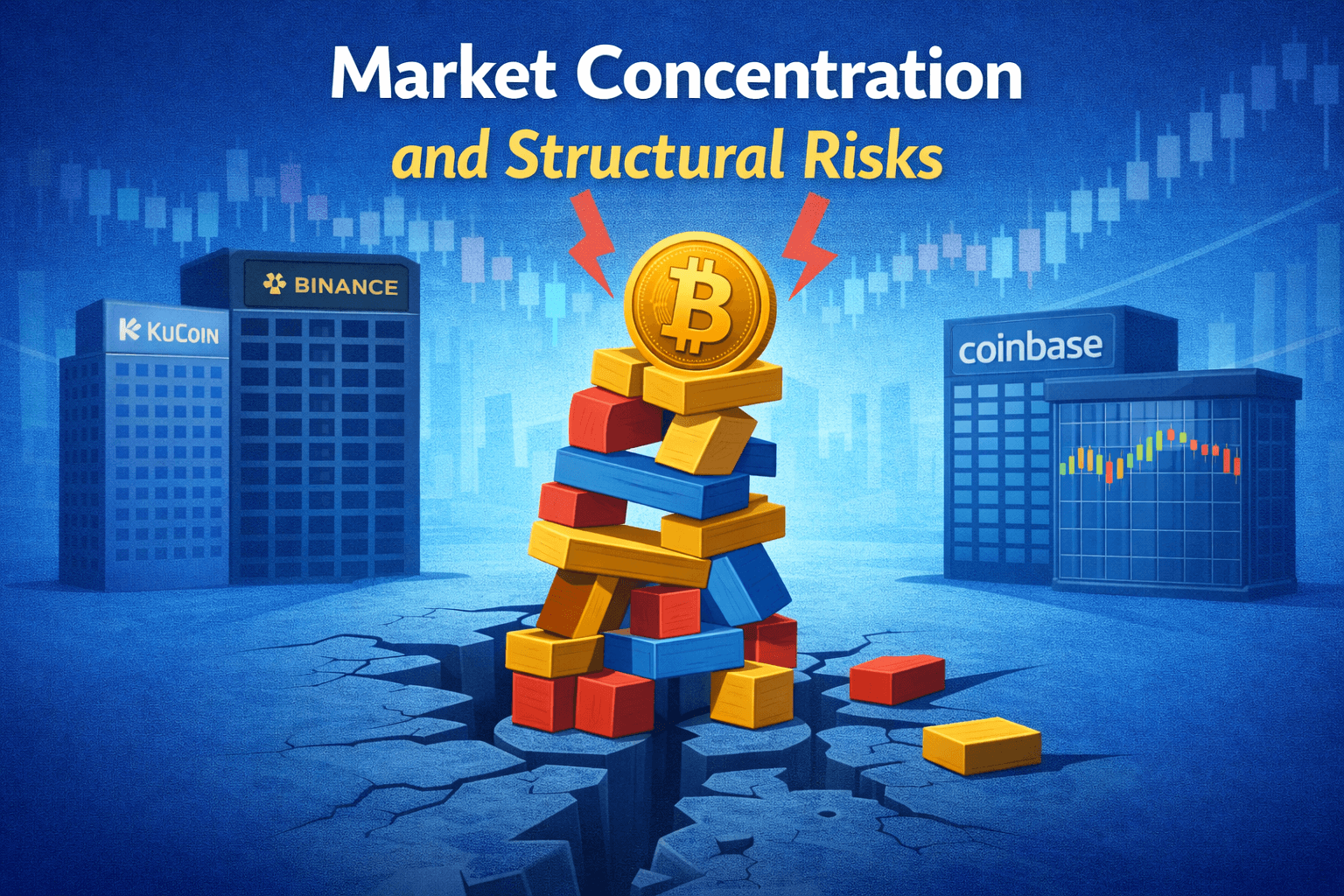 How Liquidity Concentration Creates Systemic Market Risks
Crypto markets present themselves as global and distributed, but liquidity is anything but evenly spread. Trading activity concentrates heavily on a small number of venues, creating efficiency in normal conditions and fragility under stress. Market structure determines whether liquidity absorbs shocks or amplifies them.
This section focuses on how concentration forms, why it matters systemically, and where the real fault lines sit.
Exchange Concentration Reality
A small group of exchanges controls the overwhelming majority of global crypto trading volume across spot and derivatives.
In practice, most activity concentrates around roughly ten venues: Binance, Coinbase, OKX, Bybit, Kraken, Bitfinex, KuCoin, Deribit, HTX, and Gate.
Liquidity concentrates even further when narrowed to Bitcoin and Ethereum, where derivatives activity on a handful of platforms dominates global price formation.
This concentration forms for structural reasons. Deep order books attract professional market makers. Market makers tighten spreads and improve execution. Better execution pulls in more volume. The feedback loop reinforces itself, raising barriers to entry and pushing liquidity toward incumbents.
The result is a market that appears competitive at the surface level but behaves like an oligopoly underneath.
Why this matters is straightforward. When liquidity concentrates, failure risk concentrates with it.
Single-Venue Failure Risk
When a dominant venue experiences stress, the impact propagates across the entire market.
Outages freeze withdrawals. Compliance actions disrupt access. Risk controls trigger mass liquidations. Because derivatives reference spot prices and rely on continuous liquidity, stress at one venue spills rapidly into others.
The collapse of FTX was not just a firm failure. It was a structural failure. As confidence vanished, liquidity evaporated, prices gapped, and counterparties de-risked simultaneously. Assets closely tied to the exchange suffered prolonged damage, while even unrelated markets absorbed volatility through forced deleveraging.
The lesson is structural, not historical. Markets built around a small number of dominant hubs inherit their failure modes.
Fragmentation and Arbitrage
Concentration at the top coexists with fragmentation everywhere else.
Outside the largest venues and assets, liquidity spreads thinly across dozens of exchanges and decentralized protocols. The same asset can trade at different prices depending on venue, region, and execution path.
These discrepancies persist because capital is not frictionless. Moving funds between exchanges takes time. Banking rails impose delays. On-chain transfers introduce confirmation risk. During volatility, these frictions widen gaps faster than arbitrageurs can close them.
Arbitrage still functions, but unevenly. Price convergence slows precisely when markets are under stress, which is when reliable pricing matters most.
The Centralization Paradox
Crypto assets are issued and transferred on decentralized networks, but most trading and custody still flow through centralized intermediaries.
This is not an ideological failure. It is an economic reality. Centralized venues offer speed, depth, and integrated fiat access that decentralized systems struggle to replicate at scale. Users accept custody risk in exchange for execution quality.
The paradox persists because market structure rewards efficiency before resilience. Until decentralized liquidity can reliably match centralized depth without introducing new risks, centralized rails will remain dominant choke points.
Understanding this paradox explains why “decentralized” assets continue to experience centralized failures, and why regulatory or operational shocks still carry outsized market impact.
Fiat On-Ramps and Currency Dynamics
 How Fiat Access Impacts Crypto Liquidity And Flows
Crypto markets may trade continuously, but access to them still depends on traditional money rails. Fiat on-ramps, stablecoins, and currency choice determine who can enter the market, how quickly capital moves, and where liquidity concentrates. This plumbing layer is less visible than exchanges or derivatives, but it impacts execution quality and systemic risk just as much.
Why the US Dollar Dominates Crypto
The US dollar anchors global crypto liquidity.
Most spot and derivatives markets are quoted against USD or dollar-equivalent instruments because the dollar offers the deepest banking infrastructure, the widest institutional participation, and the most reliable settlement rails. For exchanges, quoting in dollars simplifies risk management. For traders, it provides tighter spreads and better execution.
As a result, the majority of global crypto trading volume is effectively dollar-based, even when users never touch a US bank account. Dollar dominance is not ideological. It is structural. Liquidity pools are where capital is cheapest, fastest, and most transferable.
This also means crypto markets are indirectly exposed to US monetary conditions. Interest rate changes, liquidity tightening, or regulatory shifts in the dollar system ripple into crypto through funding costs, stablecoin supply, and risk appetite.
Stablecoins as Synthetic Fiat
Stablecoins act as functional dollars inside crypto markets, replacing most direct fiat rails for active trading. Instead of waiting on bank settlements, traders move value instantly using dollar-pegged tokens that clear on-chain and trade 24/7. Over time, this has shifted the market away from fiat pairs and toward stablecoin-denominated liquidity.
- USDT: USDT is the dominant trading stablecoin by volume. Its strength is scale. It is listed on almost every exchange, deeply integrated into spot and derivatives markets, and widely used as collateral. For traders, USDT offers the tightest spreads and fastest execution simply because most liquidity already sits there. The trade-off is trust-based. Confidence depends on reserve disclosures, issuer governance, and continued market acceptance rather than direct regulatory backing.
- USD: USDC positions itself as a compliance-forward alternative. Issued by Circle, it emphasizes transparency, regulated banking relationships, and reserve attestations. USDC is heavily used by institutions, US-based platforms, and payment-focused applications. Liquidity is slightly thinner than USDT in some markets, but counterparty and regulatory risk are perceived as lower.
Why most “fiat pairs” are now stablecoin pairs
Stablecoins solve problems that fiat rails cannot. Bank transfers settle slowly, operate on business hours, and cross borders. Stablecoins settle continuously, move globally, and integrate directly with exchange infrastructure. As a result, BTC/USD trading increasingly means BTC/USDT or BTC/USDC in practice. What looks like fiat pricing is actually stablecoin liquidity underneath.
This shift has made crypto markets faster and more accessible, but it has also concentrated risk. Liquidity now depends less on banks and more on a small number of stablecoin issuers. When confidence in those issuers wavers, the effects ripple across every market that relies on them
Regional Currency Dynamics
While the dollar dominates globally, regional currencies are still important to the local market structure.
European users often access crypto through EUR rails, while markets in Japan and South Korea rely heavily on JPY and KRW pairs offered by licensed domestic exchanges. These local pairs support regional participation and compliance, but their volumes remain far smaller than dollar-based markets.
In regions where banking access is limited or unstable, stablecoins often become the primary on-ramp by default. This bypasses local currency constraints but increases dependence on offshore infrastructure and foreign regulatory decisions.
As a result, liquidity geography does not always match user geography. Capital flows toward where rails are strongest, not where demand originates.
Practical Costs Traders Overlook
Fiat access introduces frictions that are easy to underestimate.
Foreign exchange spreads tax cross-currency participation. A trader converting local currency into dollars and back absorbs costs that never appear on an exchange fee schedule. Withdrawal delays add another layer. Bank transfers can take days, and access can disappear abruptly when relationships change.
Banking cutoffs are the most disruptive risk. Exchanges can lose fiat rails with little notice, freezing deposits or withdrawals and forcing users to reroute through stablecoins or alternative jurisdictions. These disruptions re-arrange liquidity in real time and often coincide with periods of heightened volatility.
Stablecoins reduce many of these costs, but they do not eliminate dependency. They shift it. Confidence in issuers, redemption channels, and regulatory treatment becomes the new bottleneck.
Regulatory Classification Debate: Securities vs. Commodities
 The Impact of Regulation on Crypto Asset Classification
Regulation impacts the crypto market structure by deciding what assets are allowed to trade, where they can trade, and who is permitted to access them. In the United States, this hinges on a long-running classification dispute. Whether a crypto asset is treated as a security or a commodity determines disclosure rules, exchange obligations, and which market products can legally exist.
This is not an abstract legal debate. It directly affects liquidity depth, product availability, and institutional participation.
The SEC’s Securities Framework
The Securities and Exchange Commission evaluates crypto assets through the Howey Test, a four-part standard that asks whether an asset involves an investment of money in a common enterprise with an expectation of profits derived from the efforts of others.
Applied to crypto, this framework has led the SEC to argue that many tokens issued by identifiable teams qualify as securities. In its view, buyers often rely on ongoing development, marketing, or managerial effort to generate returns, even when tokens are described as utilities.
This classification carries heavy implications. Tokens deemed securities require registration or exemption, along with ongoing disclosures around governance, financial condition, and risk. These obligations mirror public equity markets and impose high legal and operational costs on issuers.
For exchanges, the burden is structural. Platforms listing securities must register as national securities exchanges or operate as alternative trading systems, comply with surveillance requirements, and meet investor protection standards. Most crypto exchanges were not designed for this regime, making compliance expensive and, in some cases, incompatible with their existing infrastructure.
As a result, many tokens have been delisted or geo-fenced for US users, reducing liquidity and fragmenting markets.
The CFTC’s Commodities View
The Commodity Futures Trading Commission approaches crypto through a different lens. Under the Commodity Exchange Act, commodities include broadly defined goods and articles of commerce. The CFTC has consistently treated Bitcoin and Ethereum as commodities.
This classification places crypto primarily within the CFTC’s derivatives jurisdiction. Futures, options, and swaps tied to commodities fall squarely under its oversight, while spot markets receive lighter treatment focused on fraud and manipulation rather than venue regulation.
The practical outcome is asymmetry. Regulated crypto derivatives can exist under established frameworks, while spot markets remain largely unregulated at the federal level. This has enabled the growth of compliant futures products, particularly on regulated venues, without resolving oversight of the underlying spot markets that anchor pricing.
The CFTC’s approach has been critical for institutional adoption. Commodity classification allowed traditional futures infrastructure to support crypto exposure without requiring direct custody or securities-style disclosures.
Why Regulatory Overlap Matters
The coexistence of these two frameworks creates structural uncertainty.
For exchanges, overlapping claims of authority make compliance planning difficult. A token may be treated as a security on spot markets while derivatives tied to the same asset trade under commodities regulation. This forces platforms to make conservative listing decisions, often reducing asset availability.
Product availability is directly affected. Regulatory ambiguity limits which derivatives, lending products, and structured instruments can be offered to certain users or jurisdictions. In practice, this fragments liquidity and pushes activity offshore or into less transparent venues.
This divide also shapes institutional access. The approval of regulated futures and exchange-traded products has expanded access for traditional investors, but uncertainty around spot market regulation continues to constrain broader participation. Until classification questions are resolved legislatively, capital will continue to flow through the narrowest compliant channels rather than the deepest possible markets.
In short, regulatory overlap does not just slow innovation. It deters market structure by determining where liquidity can safely concentrate and where it cannot.
Market Structure in Different Jurisdictions
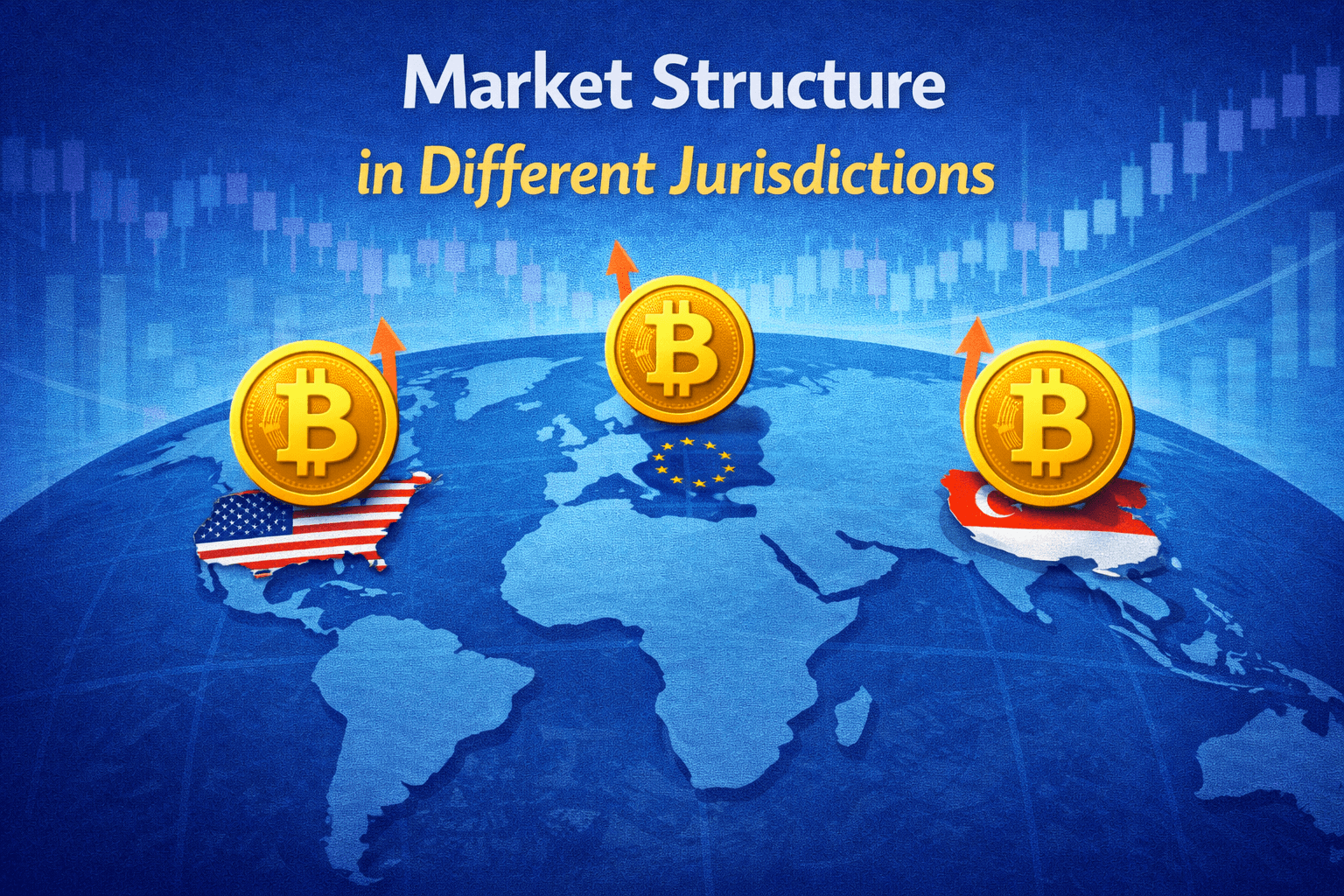 How Crypto Trading Rules Vary Across Regions
Crypto market structure changes materially once borders enter the picture. Licensing regimes determine which venues can operate, which products are permitted, and where liquidity can concentrate. The result is not a single global market, but a patchwork of regional hubs connected by imperfect bridges.
European Union – MiCA
The European Union has moved toward a unified framework through the Markets in Crypto-Assets regulation. Instead of country-by-country rules, MiCA introduces passportable licensing across member states, allowing authorized firms to operate throughout the bloc under a single approval.
Unified licensing reduces regulatory fragmentation. Exchanges, custodians, and brokers face one set of requirements rather than navigating separate national regimes. This clarity encourages compliant platforms to concentrate European liquidity under common standards rather than splitting volume across jurisdictions.
Stablecoin oversight is a central pillar. Issuers of euro- and dollar-pegged tokens face reserve, disclosure, and governance requirements once issuance crosses defined thresholds. Large stablecoins can be capped or subject to additional supervision if they become systemically relevant. This, in turn, affects liquidity by favoring compliant issuers and discouraging lightly regulated alternatives within the EU market.
The net effect is controlled liquidity concentration. MiCA trades flexibility for predictability, pulling activity toward regulated venues while raising entry costs for smaller or offshore platforms.
United States – Fragmented Oversight
U.S. lawmakers have moved forward with long-awaited legislation aimed at defining clear federal rules for digital assets. In January, a bipartisan group of senators unveiled draft legislation that would create a comprehensive crypto market structure framework, defining when tokens qualify as securities, commodities, or other asset types. It would also assign primary regulatory authority over spot crypto markets to the U.S. Commodity Futures Trading Commission (CFTC), which the industry prefers over the Securities and Exchange Commission (SEC) for many digital assets. This clarity has been a central demand from crypto firms and proponents who argue that uncertain jurisdiction has hindered growth and innovation.
However, the passage has hit procedural and political snags. One flashpoint is how the bill treats stablecoin rewards: the current draft would prohibit paying interest on stablecoins solely for holding them, a concession to banking concerns about deposit flight, while still allowing activity-based rewards. That provision and others have drawn pushback from both crypto advocates and banking lobbyists, slowing progress in the Senate — even as the House had already passed its version of similar legislation.
To break the deadlock, the White House is hosting talks between banking and crypto leaders, focusing especially on stablecoin rules and other unresolved issues. This mediation effort underscores how high the stakes are: regulatory clarity could unlock broader adoption and investment, while stalemate risks leaving the industry reliant on shifting agency guidance rather than a lasting statutory framework.
Asia and Offshore Hubs
Asia presents a mixed picture, which is clearly by national priorities. Japan operates one of the most conservative regimes, requiring exchange licensing, asset segregation, and strict custody standards. Liquidity is smaller but resilient, with fewer abrupt disruptions. Singapore has positioned itself as a regulated innovation hub, licensing digital asset firms under a tiered framework that scales oversight with risk.
Offshore jurisdictions add another layer. Venues incorporated in locations such as the Cayman Islands or British Virgin Islands serve global users under lighter regulatory requirements while maintaining compliant entities elsewhere. This regulatory arbitrage allows platforms to concentrate liquidity offshore while selectively accessing stricter markets through ring-fenced operations.
The trade-off is complexity. Liquidity pools are split across legal entities, and users experience different rules, products, and protections depending on where they are routed.
Cross-Border Trading Friction
Divergent regimes introduce real execution costs.
Access restrictions prevent users from reaching the deepest pools directly. KYC rules, geo-blocking, and product bans force traders into secondary venues with thinner liquidity. Capital movement adds friction, as funds must pass through banking rails, on-chain transfers, or internal platform bridges to move between regions.
Market Microstructure and Trading Mechanics
 How Orders Match Prices Form And Trades Execute
Market microstructure explains how prices actually form, and trades actually execute once an order hits the market. It covers order types, fee incentives, latency effects, and the behaviors that emerge from them. In crypto, these mechanics resemble traditional markets on the surface, but 24/7 trading, fragmented liquidity, and on-chain visibility introduce distinct dynamics.
Order Types and Fee Models
Most crypto venues support familiar order types, but how they interact with fees matters more than the mechanics themselves.
Market orders prioritize immediacy. They cross the spread and fill at the best available prices, which makes them reliable but costly during volatility or in thin books. Limit orders prioritize price. If they do not immediately execute, they add liquidity and shape the visible order book.
The maker–taker fee model sits underneath this behavior. Makers, who place resting limit orders, pay lower fees or earn rebates because they supply liquidity. Takers, who remove liquidity by executing immediately, pay higher fees.
This structure shapes behavior. Traders who want low fees are incentivized to provide liquidity. Market makers continuously quote both sides to earn rebates and capture the spread. During stress, when takers dominate and makers pull back, spreads widen, and liquidity degrades quickly. Fees do not just reflect costs. They actively steer how markets behave under pressure.
High-Frequency Trading and Latency
High-frequency trading firms play a central role in crypto liquidity, particularly on large centralized exchanges.
These firms exploit small price differences across venues through cross-exchange arbitrage, buying on one platform while selling on another within milliseconds. This activity tightens spreads and helps align prices over time, especially for highly liquid assets.
Speed is the edge. Firms invest heavily in low-latency infrastructure, direct exchange connections, and optimized execution logic. However, speed advantages are not absolute. During sharp volatility, transfer delays, exchange throttling, and risk limits cap how quickly positions can be adjusted. When markets move faster than capital can be repositioned, even automated liquidity retreats.
The result is a paradox. High-frequency trading improves liquidity in calm markets but can amplify gaps when conditions deteriorate. For our curated list of top platforms for high-frequency traders, see our review of the best crypto exchanges.
Manipulation Risks
Thin liquidity and fragmented oversight create openings for manipulation, especially outside major assets.
Wash trading inflates volume by having entities trade against themselves, creating the illusion of liquidity where little exists. Spoofing places large, non-genuine orders to mislead other participants about supply or demand, then cancels them before execution. Pump-and-dump schemes exploit low-cap markets by coordinating buying to drive prices up, then selling into the resulting surge.
These behaviors distort price signals and execution quality. While major exchanges deploy surveillance systems to detect them, enforcement is uneven across jurisdictions and platforms. The risk concentrates most heavily in illiquid markets, where fewer participants and weaker monitoring allow manipulation to persist longer.
On-Chain Transparency vs Exchange Opacity
Crypto introduces a unique split between transparency and opacity.
On-chain activity is observable. Transfers, liquidity movements, and certain forms of extraction can be measured in real time. This visibility has made phenomena such as MEV easier to study, revealing how transaction ordering and block construction influence execution outcomes.
Centralized exchanges operate differently. Their matching engines, internal order flow, and volume reporting are not publicly verifiable. Users rely on platform disclosures rather than direct observation. This opacity makes some forms of manipulation and preferential treatment harder to detect, even as execution appears seamless.
Decentralized venues expose more data but introduce new attack surfaces. Centralized venues hide internal mechanics but offer speed and depth. Microstructure choices determine which risks traders face and which ones remain invisible.
Crypto vs Traditional Market Structure
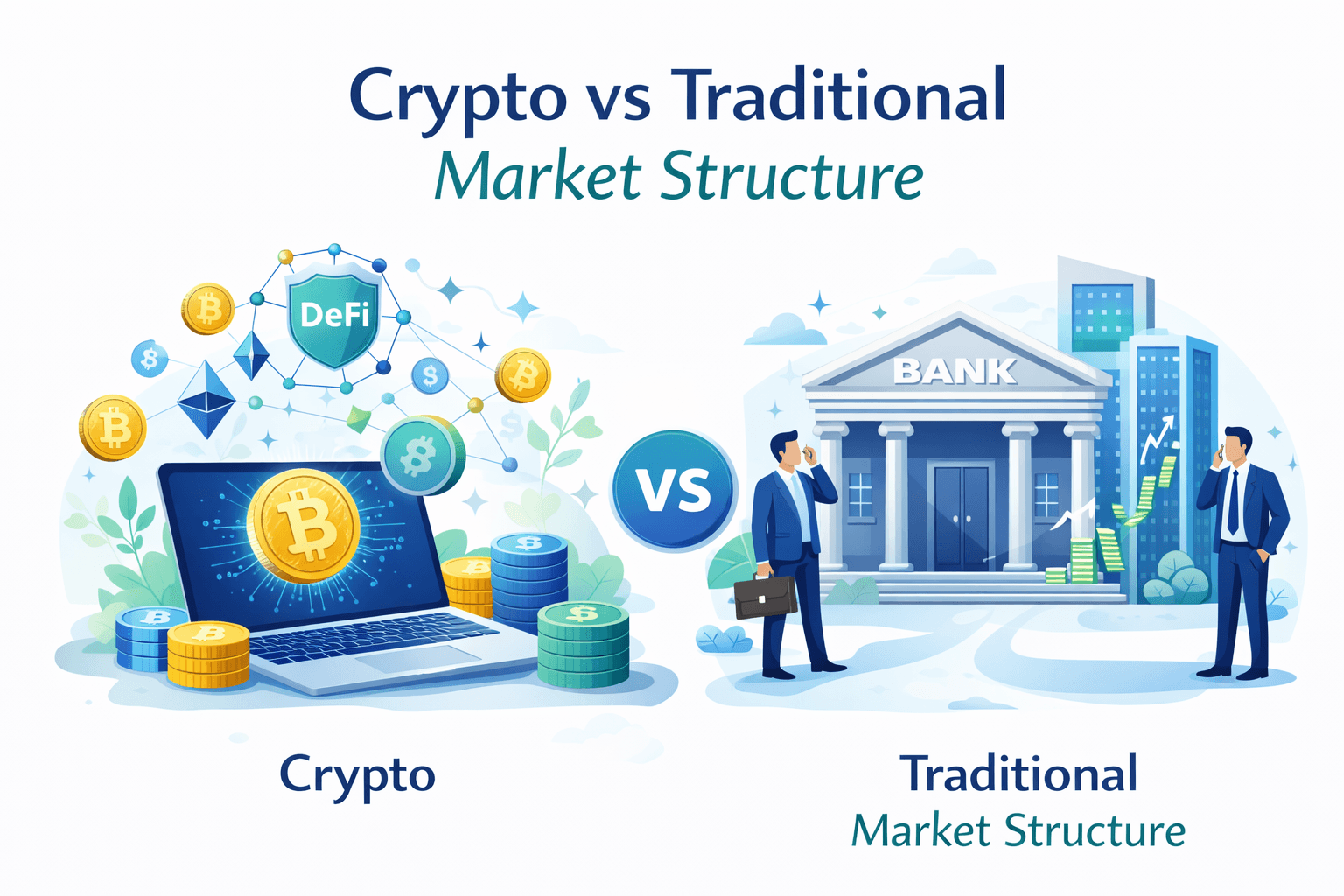 Key Differences Between Crypto And Traditional Market Systems
Crypto markets often get compared to equities or foreign exchange, but the similarities are mostly superficial. Underneath, the structural rules are different. These differences explain why crypto behaves more violently during stress, why retail and institutions interact directly, and why correlations shift depending on macro conditions.
Structural Differences from Equities and FX
The most obvious distinction is trading hours. Crypto markets operate continuously. There is no open, no close, and no circuit breaker that pauses price discovery. Volatility accumulates rather than resets, and risk transfers across time zones without interruption.
Clearing structure is another fault line. Equities and FX rely on central clearinghouses that mutualize counterparty risk and enforce margin discipline. Crypto markets largely do not. Risk is managed at the venue level through margin rules and liquidation engines, which means stress is absorbed locally rather than systemically smoothed.
Retail–institution overlap is also structural. In traditional markets, access tiers separate retail flow from institutional execution. In crypto, both trade on the same venues, often using the same order books and instruments. This compresses market hierarchy and amplifies feedback loops when sentiment shifts.
Together, these features create faster price discovery but also sharper dislocations.
Correlation With Traditional Markets
Crypto’s relationship with traditional assets has changed.
During periods of abundant liquidity, Bitcoin has tended to trade alongside risk assets, showing strong correlation with technology equities and growth indices. This behavior reflects shared sensitivity to interest rates, dollar liquidity, and macro risk appetite.
When monetary conditions tighten, correlations often increase rather than fall. Deleveraging in equities spills into crypto through funding costs, risk-off positioning, and forced liquidations. Crypto becomes part of the broader risk complex rather than a hedge against it.
At the same time, correlations are not static. In localized crypto-specific events, such as exchange failures or protocol shocks, crypto can decouple sharply from equities, moving on internal structure rather than macro signals.
The “Digital Gold” Narrative Tested
The idea of Bitcoin as digital gold rests on scarcity, neutrality, and resistance to debasement. Structurally, some elements hold. Supply is fixed, issuance is predictable, and custody does not rely on sovereign infrastructure.
But market behavior complicates the narrative. In practice, Bitcoin often trades like a high-beta macro asset, rising with liquidity and falling when conditions tighten. Its price is influenced by leverage, derivatives positioning, and exchange structure in ways physical gold is not.
Where the narrative holds is over long horizons. Bitcoin has shown resilience as a non-sovereign asset during periods of currency debasement and capital controls. Where it breaks is in short-term stress, when leverage and market structure dominate price action.
Understanding this distinction matters. Bitcoin’s structural properties may resemble digital gold, but its market mechanics still tie it closely to modern financial cycles.
How to Choose the Right Market Type
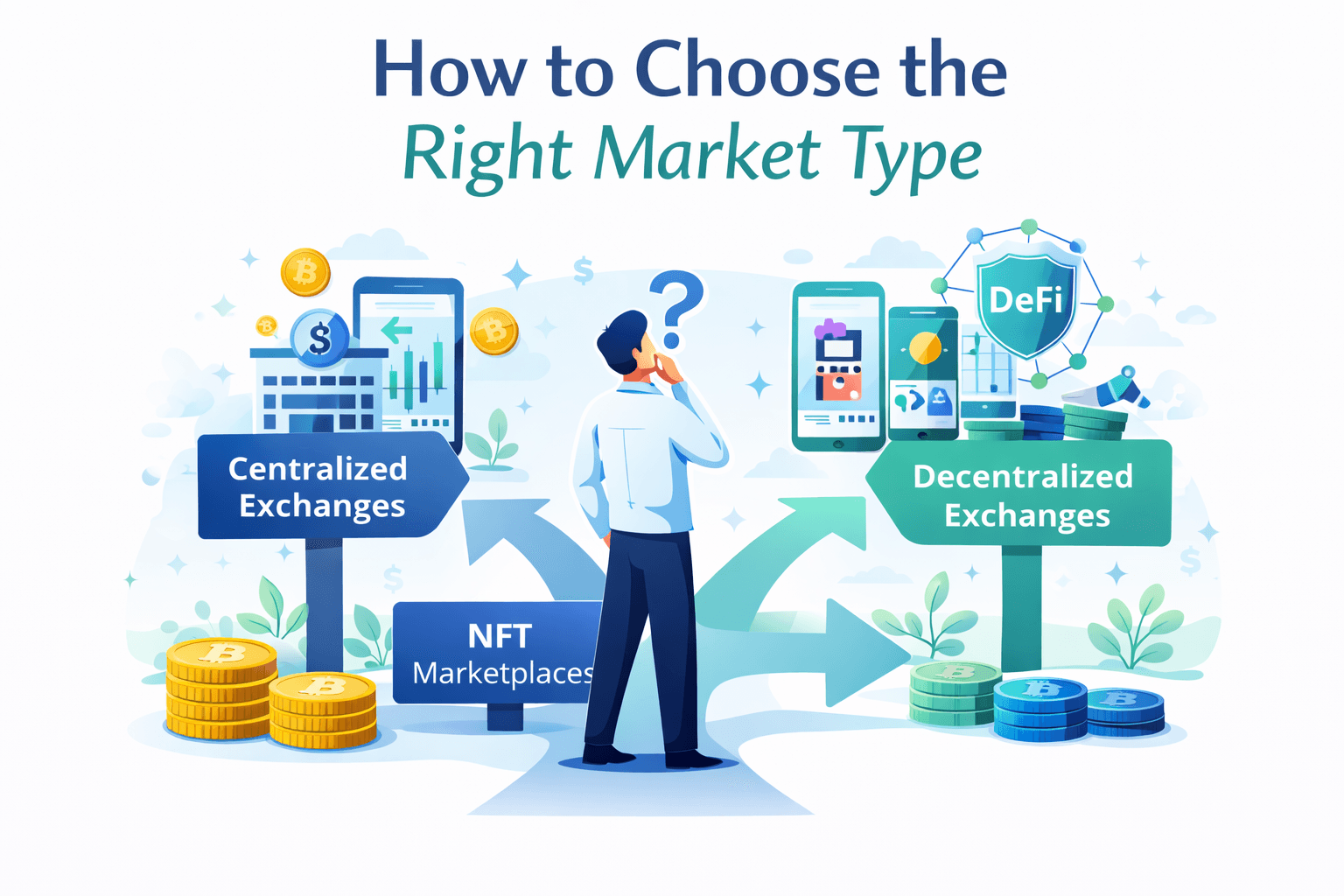 Choosing The Right Crypto Market For Your Strategy
Choosing the right market is less about conviction and more about constraints. What you trade, how you trade, and where you trade should follow from risk tolerance, regulatory access, and execution needs, not habit or hype.
This framework keeps the decision practical.
Simple Decision Tree
Start with intent.
- If you want direct ownership and the ability to move assets on-chain, spot markets are the default.
- If you want leverage, short exposure, or hedging without selling, derivatives are the tool.
- If your trade size would move the market, OTC execution becomes necessary.
If more than one applies, structure the trade across layers rather than forcing everything into a single venue.
Risk Tolerance Alignment
Risk is not just price volatility. It is structural.
Spot markets expose you to price movement and custody decisions, but avoid forced liquidation risk. Losses are unrealized until you sell.
Derivatives introduce additional layers of risk: leverage, funding costs, and liquidation mechanics. Even correct market views can fail if timing or margin is misjudged.
OTC trading reduces market impact risk but adds counterparty and settlement risk. The trade-off is control versus transparency.
If you cannot monitor positions actively, derivatives are usually the wrong choice. If capital preservation matters more than speed, spot or OTC execution dominates.
Regulatory Access Check
Before execution, check what you are legally allowed to access.
Product availability varies sharply by jurisdiction. Some users can access high-leverage derivatives; others cannot. Certain assets may be tradable on spot but unavailable for derivatives, or restricted entirely.
Institutional access often routes through regulated venues with narrower product sets. Retail access may be broader but comes with fewer protections.
If access depends on offshore routing or workarounds, factor that risk into the decision. Regulatory fragility is part of market structure.
Cost vs Control Trade-Offs
Every market type's prices are controlled differently.
Spot markets are simple but may cost more in slippage during volatile periods. Derivatives offer capital efficiency but introduce ongoing funding costs and liquidation risk. OTC trades minimize slippage and signaling but demand higher minimums and relationship management.
Lower visible fees do not always mean lower total cost. Execution quality, funding drag, and operational friction matter more than headline commissions.
The right choice is rarely absolute. It is contextual.

Final Verdict
Crypto market structure is not accidental. It has grown layer by layer in response to liquidity needs, leverage demand, institutional constraints, and regulatory pressure. Spot markets anchor ownership and price discovery, derivatives amplify risk and capital efficiency, and OTC desks quietly absorb size that public venues cannot handle without distortion. Around these layers sit fiat rails, stablecoins, and jurisdictional rules that decide who can access liquidity, at what speed, and at what cost. Together, they form a system that looks decentralized on-chain but remains structurally centralized at its choke points.
What this means in practice is that crypto behaves less like a single market and more like a network of interlinked venues, each with its own failure modes. Liquidity concentration improves execution until it doesn’t. Leverage deepens markets until it accelerates drawdowns. Stablecoins unlock global access while tying crypto tighter to dollar policy and regulatory decisions. These trade-offs are not flaws unique to crypto, but they are magnified by 24/7 trading, higher leverage ceilings, and fragmented oversight.
For participants, understanding market structure is no longer optional. It determines whether price signals are reliable, whether liquidity will hold under stress, and where risk actually sits when volatility spikes. As crypto continues to absorb institutional capital and regulatory clarity slowly improves, the edge will belong to those who understand not just what they are trading, but where and how the market itself is built.