


Reporting crypto taxes in 2027 comes with new requirements, particularly the expansion of Form 1099-DA cost-basis reporting. U.S. taxpayers must account for taxable crypto transactions completed in 2026, including trading, staking, mining, and certain DeFi activities.
This guide explains which crypto transactions are taxable, how to calculate gains and losses, which IRS forms to file, and how to handle missing cost basis or incorrect broker statements. It also covers key deadlines and recordkeeping requirements to help you prepare an accurate federal tax return.
The Coin Bureau also interviewed Berken Menges, chief marketing officer at CoinTracking, for this guide, touching on common reporting mistakes, missing cost basis, and practical steps investors can take to prepare accurate tax returns.
2027 Crypto Tax Reporting: Quick Answer
U.S. taxpayers generally must report taxable cryptocurrency transactions completed in 2026 on their federal income tax returns filed in 2027. Selling, swapping, or spending crypto can create capital gains or losses, while staking, mining, and crypto compensation can generate ordinary income. New Form 1099-DA cost-basis reporting applies to certain covered assets, but taxpayers remain responsible for accurate records, calculations, and reporting, including activity outside centralized exchanges.
2027 Crypto Tax Reporting Key Points
-
Crypto sales, swaps, and spending can trigger capital gains or losses Exchanging crypto for dollars, another token, or goods and services generally creates a reportable disposal. Buying with dollars, holding, and transferring assets between your own wallets are generally not taxable events.
-
Form 1099-DA expands cost-basis reporting for 2026 transactions Brokers must report basis for qualifying covered digital assets disposed of from Jan. 1, 2026. Assets purchased before 2026 or transferred between platforms may still have missing basis. Reported proceeds are not automatically taxable profit.
-
Staking, mining, and crypto compensation can generate ordinary income Rewards and payments are generally valued in U.S. dollars when recognized. That amount typically establishes the assets' starting cost basis, with a separate gain or loss possible when they are later sold.
-
Cost basis and tax-lot identification affect your taxable gains Gains generally equal adjusted proceeds minus adjusted cost basis. FIFO and valid specific identification determine which units were sold. Wallet-by-wallet accounting applies, and Notice 2026-20 provides temporary identification relief for qualifying 2026 custodial transactions.
-
DeFi and self-custody transactions still require tax reporting DEX swaps, taxable rewards, NFT sales, and certain DeFi transactions can create reporting obligations even without Form 1099-DA. Bridging, wrapping, lending, and liquidity pool activity require transaction-specific analysis.
-
Reconcile your records before the 2027 filing deadline Use Form 8949 and Schedule D for applicable capital transactions, and the relevant income schedules for rewards or business activity. The expected regular federal filing deadline is April 15, 2027. Extensions generally do not extend the payment deadline.
Disclaimer
Cryptocurrency tax treatment depends on individual circumstances, transaction details, and applicable federal and state laws. IRS forms, instructions, and reporting requirements may change before the 2027 filing season. This guide is for educational purposes only and does not constitute tax, legal, financial, or investment advice. Consult a qualified U.S. tax professional for personalized guidance.
Disclosure
Some links in this guide may be affiliate links. If you choose to use a service through these links, we may earn a commission at no additional cost to you.

What Changed for Crypto Tax Reporting in 2027?
Broker reporting for 2026 transactions adds cost basis for certain covered digital assets. Taxpayers must still account for transactions and acquisition records that their brokers cannot report completely.
Form 1099-DA and the Expansion of Cost-Basis Reporting
The Internal Revenue Service phased in digital asset broker reporting under Internal Revenue Code Section 6045. Reporting of gross proceeds began with qualifying transactions completed from Jan. 1, 2025. Mandatory basis reporting begins with certain covered digital asset disposals from Jan. 1, 2026.
For ordinary cryptocurrency purchases, covered securities generally include digital assets acquired after 2025 in the reporting broker's custodial account and held there until disposal. Noncovered securities include assets acquired before 2026, acquired outside that broker's custody or transferred into its account.
| Reporting requirement | Tax year 2025, filed in 2026 | Tax year 2026, filed in 2027 | What it means for taxpayers |
|---|---|---|---|
| Gross proceeds | Reporting begins for qualifying broker transactions. | Reporting continues. | Reconcile reported sales with transaction records. |
| Covered cost basis | Generally not mandatory. | Required for qualifying covered assets, subject to exceptions. | Some statements contain more acquisition information. |
| Noncovered assets | Basis may be absent. | Basis may still be absent. | Preserve older purchases and transfer histories. |
| Self-custody activity | Taxpayer reporting obligations continue. | Obligations continue. | Include applicable transactions outside exchanges. |
Three figures need attention: proceeds reflect the disposal amount, cost basis generally reflects the investment in the units sold, and capital gain or loss reflects the difference after applicable adjustments. You remain responsible for accurate reporting when the form is incomplete.
Berken Menges, chief marketing officer at CoinTracking, told The Coin Bureau that many investors will still receive Forms 1099-DA without cost basis because covered assets are narrowly defined. Generally, the new basis-reporting requirement applies to qualifying digital assets acquired from Jan. 1, 2026, and held with the same broker until disposal. Assets purchased earlier or transferred from another exchange or self-custody wallet typically remain noncovered.
"For most long-term holders, that describes the majority of what they sell," Menges said.
The resulting discrepancy can complicate filing. The IRS receives the reported proceeds, but investors must establish the original acquisition cost themselves. Without supporting basis information, proceeds could be mistaken for taxable gains. Taxpayers must therefore reconcile noncovered transactions and report their substantiated basis in the appropriate Form 8949 category.
What Changed for DeFi and Self-Custody Reporting?
The expanded rule targeting certain noncustodial DeFi brokers was repealed in 2025. The formal revocation took effect July 11, 2025.
The surviving custodial broker rules cover intermediaries such as centralized exchanges that take possession of customer assets. Noncustodial decentralized finance platforms operate differently, but trades conducted through them can still create taxable events.
Notice 2024-57 also provides temporary broker-reporting exceptions for certain wrapping, staking, liquidity provider and lending transactions pending further guidance. Those exceptions address information reporting rather than settling the underlying tax treatment of every transaction.
Outside the U.S., two related frameworks apply. The EU's DAC8 directive and the OECD's Crypto-Asset Reporting Framework (CARF) require crypto platforms to collect customer transaction data from Jan. 1, 2026. The first exchanges of that data between tax authorities take place in 2027, within the EU by Sept. 30, 2027. The U.S. has not joined the CARF exchange yet; its participation is expected from 2029. For U.S. filers, Form 1099-DA remains the relevant broker statement.
Menges pointed out that Form 1099-DA, DAC8 and CARF share a fundamental objective: giving tax authorities transaction data directly from reporting crypto platforms, allowing them to compare that information against taxpayers' returns.
However, these frameworks do not necessarily capture a taxpayer's complete transaction history. Self-custody activity, decentralized exchange transactions, transfers between platforms and historical acquisitions can leave substantial gaps.
"And none of them calculates the taxable gain under each country's rules. That remains the investor's job," he told The Coin Bureau.
Which Crypto Transactions Must You Report to the IRS?
Start by separating disposals, income and transfers. Your transaction history may contain all three, and each requires different treatment.
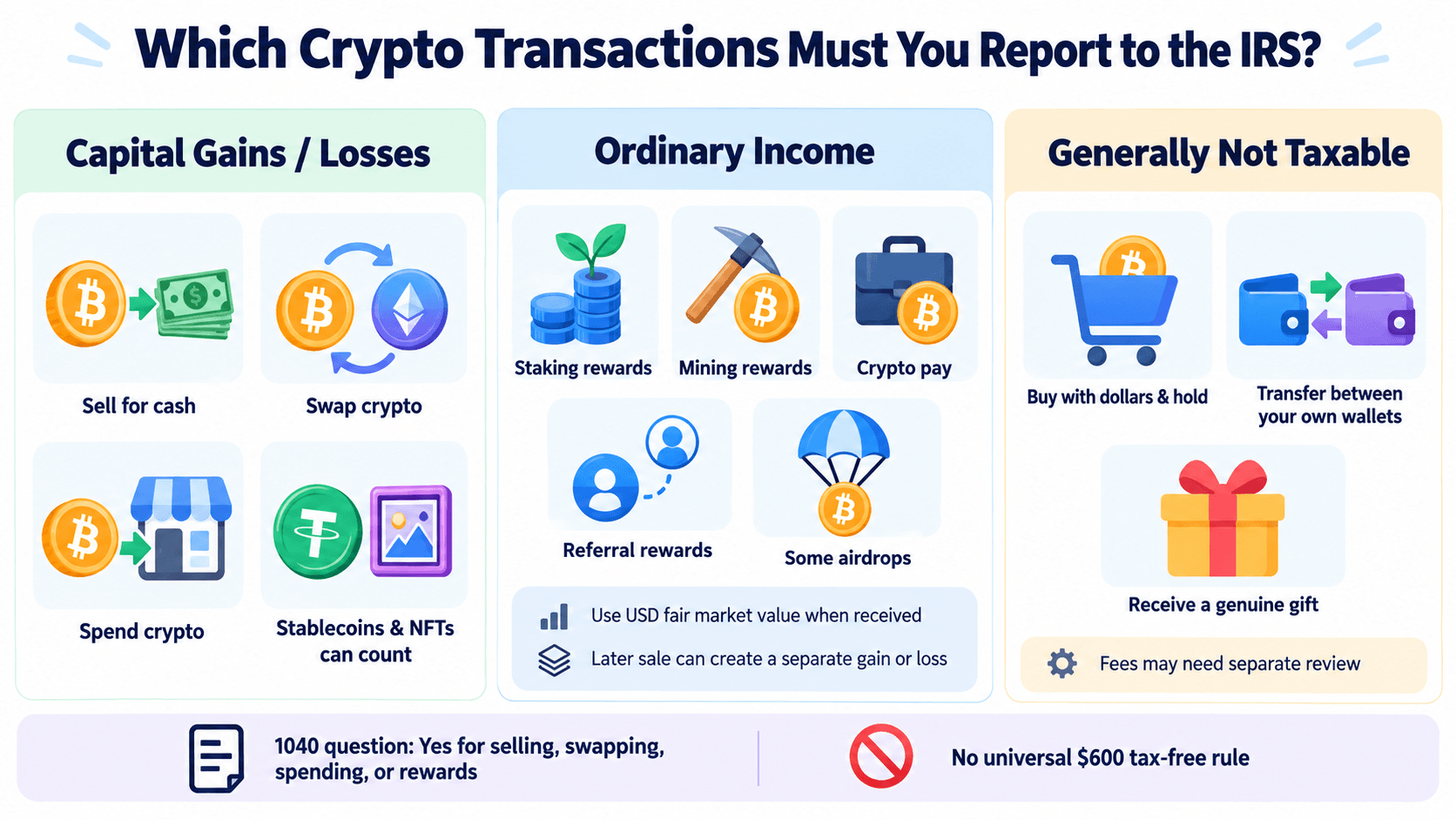 Crypto Transactions Can Trigger Capital Gains, Ordinary Income, or No Immediate Tax, Depending on the Activity
Crypto Transactions That Trigger Capital Gains or Losses
A disposal generally creates a gain or loss when cryptocurrency is held as a capital asset. Common examples include selling Bitcoin for dollars, exchanging it for another token or spending it on goods or services.
Swapping BTC for ETH can require reporting even if no money reaches your bank account. Stablecoin and NFT disposals can also be reportable, including sales producing a loss, negligible gain or no gain at all.
Menges identified three frequently overlooked activities based on CoinTracking's customer support experience:
- Crypto-to-crypto swaps
- Purchases made using cryptocurrency
- Automatically credited staking rewards
Token swaps are often overlooked because no fiat currency changes hands, even though exchanging one cryptocurrency for another generally constitutes a taxable disposal. Spending crypto through a payment card can similarly trigger capital gains or losses.
Small staking rewards present another reporting challenge. Even when credited automatically, rewards generally constitute income once the recipient gains control of them. Their value at recognition typically establishes the cost basis for calculating gains or losses upon a subsequent sale.
The holding period determines whether a capital gain or loss is short-term, generally one year or less, or long-term, generally more than one year.
| Transaction | General tax treatment | Reporting requirement |
|---|---|---|
| Sell investment crypto for dollars | Capital gain or loss. | Form 8949 and Schedule D, unless an exception applies. |
| Swap one crypto asset for another | Disposal of the asset surrendered. | Calculate and report the resulting gain or loss. |
| Spend crypto | Disposal of the crypto spent. | Compare the disposal value with its basis. |
| Receive staking, mining or compensation income | Ordinary income when recognized. | Use the appropriate income form or schedule. |
| Buy with dollars and hold | Generally no immediate taxable event. | Retain acquisition records. |
| Transfer between your own wallets | Generally nontaxable transfer. | Preserve the transfer trail; review fees separately. |
| Receive a genuine gift | Generally no income upon receipt. | Retain gift and basis documentation. |
Crypto Transactions That Generate Ordinary Income
Staking rewards, mining rewards, cryptocurrency wages, freelance payments and referral compensation can generate ordinary income. Airdrops may also create income when the applicable recognition requirements are met.
Income is generally measured at fair market value in U.S. dollars when recognized. Record crypto compensation when received, even if you do not convert it to cash.
The amount included in income generally establishes the asset's starting basis. A later sale can then create a separate gain or loss.
Crypto Transactions That Are Generally Not Taxable
Buying cryptocurrency with fit currency, holding it and transferring it between wallets you own do not create immediate taxable income.
Receiving a genuine gift is also excluded from income. However, the recipient needs the donor's basis information and the value at the gift date because the rules for calculating a later gain or loss can differ. Separate gift-reporting requirements may apply, particularly to the donor. Under the IRS rules for assets received as gifts, gain and loss basis can differ; the gift-date market value does not automatically replace the donor's basis.
On Form 1040, the digital asset question generally calls for "No" when activity consisted solely of buying with real currency, holding or qualifying transfers between your own accounts. Receiving rewards, selling, swapping or spending generally calls for "Yes." Follow the applicable year's instructions and account for any crypto spent on fees.
There is no universal $600 tax-free allowance for crypto disposals. Congress is considering changes. The House Ways and Means Committee approved the Digital Asset Tax Certainty Act (H.R. 10357) on Sept. 16, 2026, including a de minimis rule for small network fees, but it has not become law, so current rules apply to 2026 returns.
Broker reporting thresholds do not erase a taxpayer's underlying reporting obligations.
Which IRS Forms Do You Need to Report Crypto Taxes in 2027?
Broker statements provide information for your return. The forms you file depend on whether the activity produced capital gains, ordinary income or business income.
Form 1099-DA: Understanding What Your Broker Reports
U.S. digital asset brokers generally issue Form 1099-DA to customers with reportable sales, exchanges or other dispositions.
The 2026 Form 1099-DA contains several fields worth checking together:
| Field | What it shows |
|---|---|
| Box 1d | Date acquired |
| Box 1e | Date sold or disposed |
| Box 1f | Proceeds |
| Box 1g | Cost or other basis |
| Box 2 | Whether basis was reported to the IRS |
| Box 8 | Whether the broker relied on customer-provided acquisition information |
| Box 9 | Whether the asset is identified as a noncovered security |
Check Box 2 to establish whether the displayed basis was also reported to the IRS, and Box 9 to identify a security that the broker classifies as noncovered. Missing dates or basis may reflect assets acquired before 2026 or transferred from elsewhere.
Optional aggregate reporting for qualifying stablecoins and specified NFTs can omit individual acquisition dates and basis. Compare the statement with your own transaction history before treating it as a complete calculation of taxable gains.
Form 8949 and Schedule D: Reporting Crypto Capital Gains
Form 8949 records capital asset disposals. Its columns identify the property, acquisition date, disposal date, proceeds, basis, adjustment codes, adjustment amounts and resulting gain or loss. Totals flow into Schedule D, which combines capital gains and losses.
The published Form 8949 introduced dedicated digital asset checkboxes in 2025:
| Reporting category | Short-term, Part I | Long-term, Part II |
|---|---|---|
| Broker-reported, basis reported to the IRS | G | J |
| Broker-reported, basis not reported to the IRS | H | K |
| Not reported on a broker form or substitute statement | I | L |
As of Oct. 15, 2026, the published Form 8949 instructions remain labeled 2025. The final tax-year 2026 instructions will determine which reporting categories apply to returns filed in 2027.
Certain transactions with basis reported to the IRS and no required adjustments may qualify for direct summary reporting on Schedule D. Collectibles and other excluded transactions do not qualify merely because basis appears on a statement.
An incorrect basis reported to the IRS generally requires Form 8949 adjustment code B and an amount in column (g). A basis figure shown on the form but not reported to the IRS is handled differently, as explained below.
Schedule 1, Schedule C and Other Crypto Income Forms
Crypto received as income follows the rules for the activity that produced it. Nonbusiness income may belong on Schedule 1. A qualifying trade or business generally uses Schedule C, with Schedule SE where self-employment tax applies.
| Form | Purpose | When used | Received or filed |
|---|---|---|---|
| Form 1099-DA | Broker disposal information | A broker reports qualifying digital asset sales | Received |
| Form 8949 | Details of capital gains and losses | To report individual capital asset disposals and adjustments | Filed when required |
| Schedule D | Capital gain and loss totals | To summarize capital asset sales and carryovers | Filed when required |
| Schedule 1 | Additional individual income | For applicable nonbusiness rewards and other income | Filed when required |
| Schedule C | Business profit or loss | For qualifying crypto mining, trading or service businesses | Filed when required |
| Schedule SE | Self-employment tax | When applicable to net earnings from self-employment | Filed when required |
| Form W-2 | Employment compensation | When crypto is paid as employee wages | Received |
| Forms 1099-MISC and 1099-NEC | Other income and contractor payments | When relevant income is reported by a payer | Received when issued |
| Form 1099-K | Payment settlement information | For applicable payment network transactions | Received when issued |
| Form 1040 | Individual federal income tax return | To report overall taxable income and tax | Filed |
Classify Form 1099-K payment totals using the underlying transactions; they are not automatically taxable profit.
Multiple forms can apply: staking rewards create income and may generate capital gains or losses when sold.
How Do You Calculate Crypto Gains, Losses and Cost Basis?
Calculate each disposal using the units actually sold and their documented basis. Wallet movements, fees and tax-lot selections can affect the result even when a broker reports the correct sale proceeds.
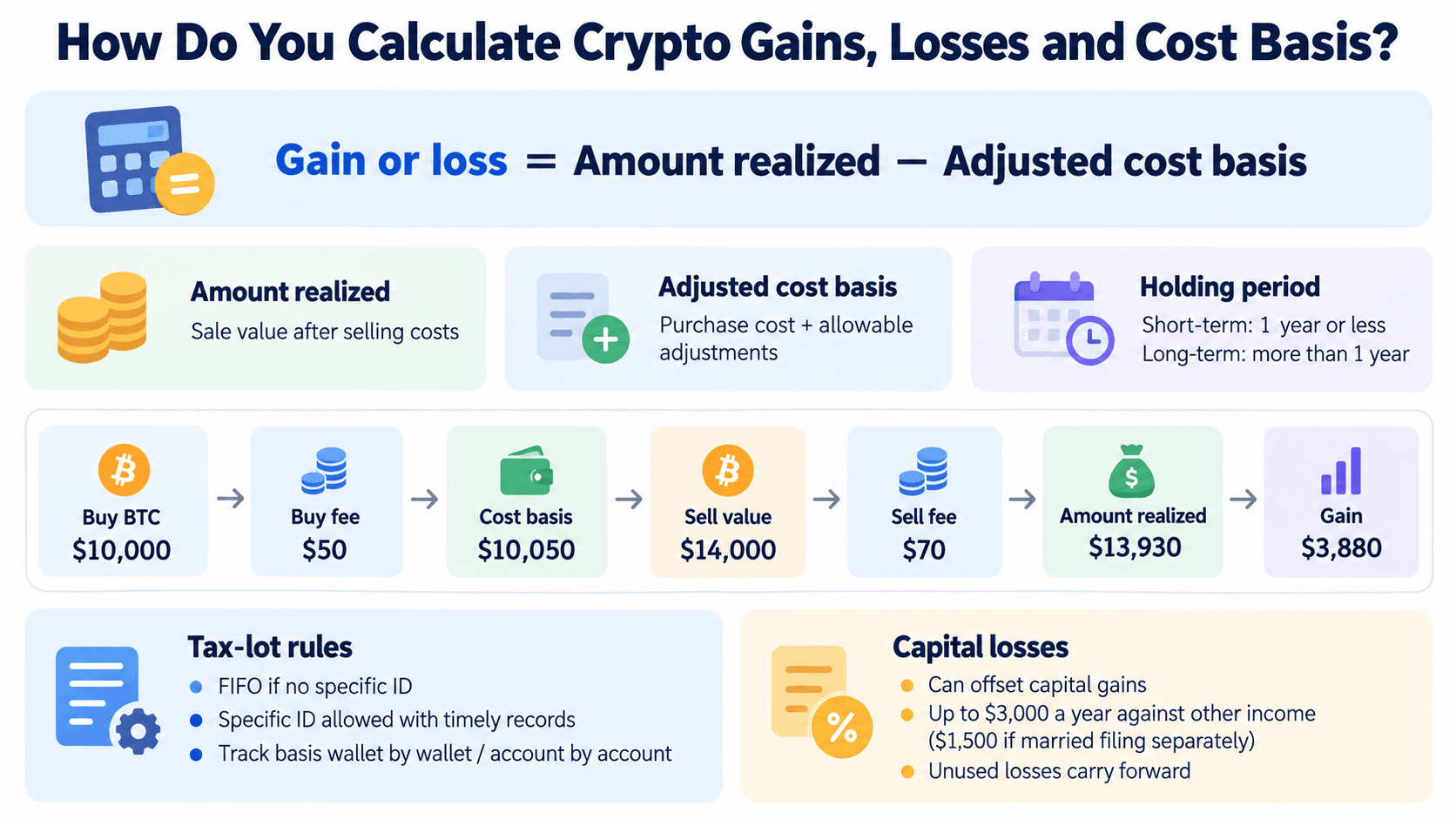 Crypto Capital Gains and Losses Are Calculated Using Adjusted Proceeds, Cost Basis, Transaction Fees, and Holding Periods
How to Calculate Crypto Capital Gains and Losses
The basic formula is: Capital gain or loss = Amount realized − Adjusted cost basis
The amount realized generally reflects the disposal value after applicable selling costs. Adjusted cost basis begins with acquisition cost and incorporates allowable costs or other adjustments.
Consider this hypothetical Bitcoin purchase and sale:
| Item | Amount |
|---|---|
| Purchase price | $10,000 |
| Qualifying purchase fee paid in dollars | $50 |
| Adjusted cost basis | $10,050 |
| Gross sale value | $14,000 |
| Qualifying selling fee paid in dollars | $70 |
| Amount realized | $13,930 |
| Capital gain | $3,880 |
The holding period classifies the $3,880 gain as short-term or long-term.
Fees must follow the rules for the transaction. Under the current digital asset rules, qualifying costs of a crypto-for-crypto exchange generally reduce the amount realized on the disposed asset. They are not also added to the acquired asset's basis.
Fees for a simple transfer between your own wallets receive different treatment. Do not automatically capitalize every network fee or deduct a cost twice when it is already included in reported proceeds or basis.
FIFO, Specific Identification and Wallet-by-Wallet Accounting
A tax lot is an acquisition with its own quantity, date and basis. Identifying the units sold determines their cost and holding period.
First In, First Out, or FIFO, generally treats the earliest acquired units in the relevant wallet or account as disposed of first when adequate identification is absent. Specific identification allows particular units to be identified, subject to the applicable timing and recordkeeping requirements. Supporting records should establish acquisition dates and times, quantities, costs and which units left the account.
Under Internal Revenue Code Section 1012 and the related regulations, basis tracking operates wallet by wallet or account by account. A software setting that selects the highest-cost units anywhere in your portfolio cannot substitute for valid identification within the relevant account.
Revenue Procedure 2024-28 provided a conditional safe harbor for allocating historical unattached basis when transitioning from universal accounting. Preserve the allocation records if you relied on that transition.
For example, buying 0.1 BTC for $6,000, transferring it to another wallet and later selling it for $7,500 produces a $1,500 gain before fees. The transfer generally carries forward the original $6,000 basis and acquisition date.
One of the biggest challenges with wallet-by-wallet accounting is maintaining the acquisition history as assets move between platforms.
CoinTracking's Menges told The Coin Bureau that cost basis typically becomes difficult to trace when cryptocurrency moves from an exchange to a hardware wallet and later to another exchange. The receiving platform can identify the deposit but generally cannot determine the original purchase price or acquisition date.
Common causes include unmatched transfers, network fees deducted during transfers and missing transaction histories from closed exchanges.
Reconstructing the basis requires transaction exports from all relevant exchanges and wallets, including older accounts. Investors must then match outgoing and incoming transfers, preserve the original acquisition information and trace each disposed lot back to its purchase.
"That matching step is where most of the time goes," Menges says.
CoinTracking addresses this issue through its Missing Transactions Report, which identifies deposits and withdrawals without corresponding entries, helping users locate gaps before calculating their tax liabilities.
How Notice 2026-20 Affects Tax-Lot Identification
Notice 2025-7 temporarily allowed eligible taxpayers to identify units held with custodial brokers through their own books and records. Notice 2026-20 extended that relief through Dec. 31, 2026.
Eligible taxpayers may identify particular units no later than the date and time of the sale, disposal or transfer. Alternatively, they may record a sufficiently specific standing order before the affected transactions occur. Assets held outside broker custody follow separate identification rules.
The notice recognizes that a broker's reported acquisition date or basis may differ from a taxpayer's valid identification. Retain timely supporting records and satisfy any applicable Revenue Procedure 2024-28 requirements.
Changing a software setting while preparing the return does not, by itself, establish that units were identified on time. The relief covers qualifying transactions through 2026 and should not be assumed to extend to transactions occurring in 2027.
How Crypto Capital Losses Affect Your Tax Return
Capital losses generally offset capital gains through the applicable netting rules. If eligible losses exceed gains, individuals can generally deduct up to $3,000 against other income annually, or $1,500 if married filing separately. Unused losses can carry forward. These capital loss limits apply across the relevant capital transactions rather than separately to each coin.
A falling token price does not normally create a deduction while you continue holding the asset. Worthlessness, theft and insolvency claims require separate analysis; personal-use losses also face different rules.
Tax-loss harvesting also needs care. Wash-sale rules concern stock or securities, and some tokenized assets can fall within that scope. Avoid assuming every asset described as "crypto" receives identical treatment.
How Do You Report Staking, Mining, DeFi and NFT Transactions?
Rewards and onchain activity often require more classification than an exchange sale. Record what you received, what you surrendered and when you gained control of the resulting assets.
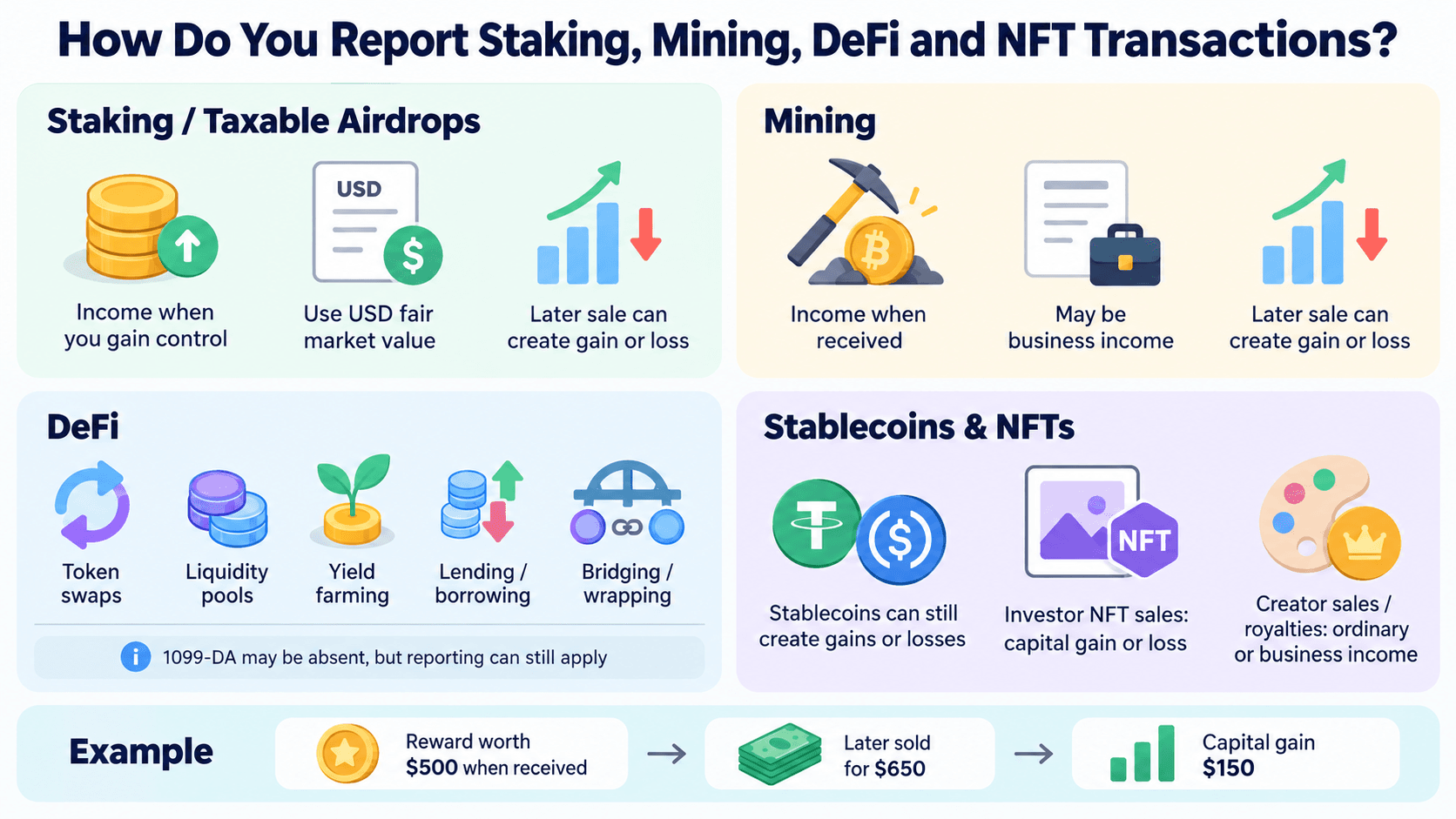 Staking, Mining, Defi, and Nft Transactions Can Generate Ordinary Income or Capital Gains Depending on the Activity
Reporting Staking, Mining and Airdrop Income
For cash-method taxpayers, Proof-of-Stake validation rewards generally create income when the taxpayer gains dominion and control, meaning the ability to sell, transfer or otherwise dispose of the rewards. Revenue Ruling 2023-14 addresses that staking treatment, including rewards received through an exchange. Use their U.S. dollar fair market value when control arises.
Mining rewards generally enter gross income at their fair market value when received. Whether mining constitutes a business affects expense reporting and self-employment tax. Coin Bureau's mining tax guide covers that classification in more detail.
Airdrops require attention to receipt and control. Revenue Ruling 2019-24 specifically addresses cryptocurrency received following a hard fork. An inaccessible or unusable balance should not automatically be treated as equivalent to freely disposable rewards.
Suppose staking rewards are worth $500 when recognized as income. Their starting basis is generally $500. Selling them later for $650 creates a potential $150 capital gain, before fees or other adjustments. If their price falls instead, the original income generally remains recognized, while a later investment loss follows the capital loss rules.
| Crypto activity | Potential income on receipt | Potential gain or loss on disposal | Applicable forms |
|---|---|---|---|
| Staking rewards | Generally yes when control arises. | Yes, for a later capital asset disposal. | Schedule 1 or business schedules; Form 8949 and Schedule D. |
| Mining rewards | Generally yes when received. | Yes, depending on asset classification. | Schedule 1 or Schedule C and possibly Schedule SE; disposal forms. |
| Taxable airdrop | Yes when recognition requirements are met. | Generally yes on later disposal. | Appropriate income schedule; Form 8949 and Schedule D. |
| DEX token swap | A straightforward exchange is generally a disposal. | Generally yes. | Form 8949 and Schedule D for capital assets. |
| Stablecoin or investment NFT sale | Usually no separate receipt income from the sale itself. | Potentially yes. | Form 8949 and Schedule D, subject to classification. |
| NFT creation and royalties | Generally income where applicable. | Depends on subsequent transactions. | Appropriate income or business schedules. |
Reporting DeFi Transactions and Wallet Activity
A decentralized exchange, or DEX, can execute a taxable token swap without issuing a tax statement. Tax treatment follows the transaction's legal and economic characteristics.
Common DeFi activities have different tax implications:
- Token swaps: Identify the asset surrendered, proceeds and basis.
- Liquidity pool deposits and withdrawals: Examine whether ownership or rights changed and whether a receipt token represents different property.
- Yield farming rewards: Separate newly earned rewards from returned principal.
- Crypto lending and borrowing: Distinguish a genuine loan from a transfer that changes beneficial ownership. Loan proceeds generally do not create income merely because they are borrowed, but rewards, liquidations and debt cancellation can have separate consequences.
- Bridging and wrapping: Check the assets and rights before and after the transaction. Wrapped tokens and bridge receipts should not automatically be labeled taxable or nontaxable.
A transfer between self-owned wallets is different from exchanging an asset for a new contractual claim. Preserve transaction hashes, protocol records and the terms governing the position. The absence of Form 1099-DA does not remove an applicable filing obligation.
Reporting Stablecoin and NFT Transactions
Stablecoins can generate reportable gains or losses despite trading close to $1. Fees, acquisition prices and deviations from the peg can affect the result.
The 2026 instructions permit certain optional broker-reporting methods:
- Qualifying stablecoins: Certain designated sales may be omitted when annual aggregate proceeds through that broker, after applicable transaction costs, do not exceed $10,000.
- Specified NFTs: Qualifying sales may be omitted under the optional method when the corresponding annual total does not exceed $600.
These exceptions have specific definitions and conditions. They are not general tax exemptions. Aggregate reporting can also combine transactions without supplying individual basis information, leaving taxpayers to calculate their own gains or losses.
An investor's NFT sale may produce capital gain or loss, while creator sales and royalties can produce ordinary or business income. Classification also affects treatment: Notice 2023-27 explains the IRS's interim look-through approach for determining whether an NFT represents a collectible based on its associated asset or right. The agency described this approach pending further guidance, rather than as a comprehensive final NFT classification rule.
How to File Crypto Taxes in 2027: Step-by-Step Guide
Accurate crypto tax reporting starts with a complete transaction history, including broker forms, acquisition records, wallet activity and income documentation.
The Six Steps to Reporting Crypto Taxes
- Collect your crypto tax records. Download exchange statements, Forms 1099-DA and income documents. Obtain each platform's CSV export, wallet address history and blockchain explorer records. Include historical purchase confirmations needed to establish basis for 2026 sales.
- Reconcile exchanges and wallet transfers. Match withdrawals and deposits by quantities, timestamps and transaction IDs. Restore missing acquisition records, remove duplicate imports and check fees. Resolve unexplained balances before tax reconciliation.
- Identify and categorize taxable transactions. Separate capital asset disposals from ordinary income. Identify business activity, genuine self-transfers and transactions requiring further review. Do not assume every deposit is income or every withdrawal is a sale.
- Calculate gains, losses and income. Apply valid tax-lot identification and complete the capital gains calculation using adjusted proceeds and basis. Determine holding periods and record taxable income at its U.S. dollar value when recognized, retaining valuation evidence.
- Complete and reconcile IRS forms. Compare your results with Form 1099-DA. Complete Form 8949, transfer totals to Schedule D and prepare income schedules where required. Document adjustments, avoiding double-counted rewards and sales.
- Review and file your return. Confirm every relevant exchange and wallet, review discrepancies and answer the Form 1040 digital asset question. File through an appropriate method, including IRS e-file, and retain the submitted return and supporting records.
Crypto tax software can make the whole process easy. Check out our top picks here.
Worked Example: From Crypto Purchase to Form 8949
This hypothetical history assumes that the entire 0.5 BTC lot was sold, that the assets were never mixed with other BTC and that no fees or adjustments apply:
| Event | Transaction |
|---|---|
| Jan. 15, 2024 | Purchase 0.5 BTC on Exchange A for $20,000. |
| June 10, 2025 | Transfer the 0.5 BTC to a self-custody wallet. |
| May 12, 2026 | Transfer the 0.5 BTC to Exchange B. |
| Sept. 15, 2026 | Sell the 0.5 BTC for $35,000. |
| Early 2027 | Receive Form 1099-DA reporting $35,000 in proceeds without basis. |
The documented basis remains $20,000. Neither transfer establishes a new purchase price. The $15,000 gain is long-term because January 15, 2024, precedes the September 15, 2026, sale by more than one year.
Report the transaction as follows:
| Record or form entry | Treatment |
|---|---|
| Exchange A purchase confirmation | Establishes the $20,000 acquisition cost and original date. |
| Wallet and exchange transfer records | Connect the purchased units to the units sold. |
| Exchange B sale confirmation | Establishes the actual disposal date and $35,000 proceeds. |
| Form 8949 category | Long-term, broker-reported, basis not reported to the IRS. |
| Current checkbox framework | Part II, Box K, subject to final 2026 instructions. |
| Column (a) | 0.5 BTC. |
| Column (b) | Jan. 15, 2024. |
| Column (c) | Sept. 15, 2026. |
| Column (d), proceeds | $35,000. |
| Column (e), basis | $20,000. |
| Columns (f) and (g) | No adjustment code or amount needed on these facts. |
| Column (h) | Report $15,000 gain. |
| Schedule D | Include the result in the appropriate long-term totals. |
The original purchase confirmation and matching transfer trail establish a substantiated $20,000 basis despite the blank broker field. A missing basis is not automatically zero, and no incorrect-basis adjustment code is needed on these facts.
What If Your Crypto Tax Forms Are Missing or Incorrect?
Investigate the underlying records before changing a tax calculation. Missing information, incorrect broker data and valid differences in tax-lot identification require different responses.
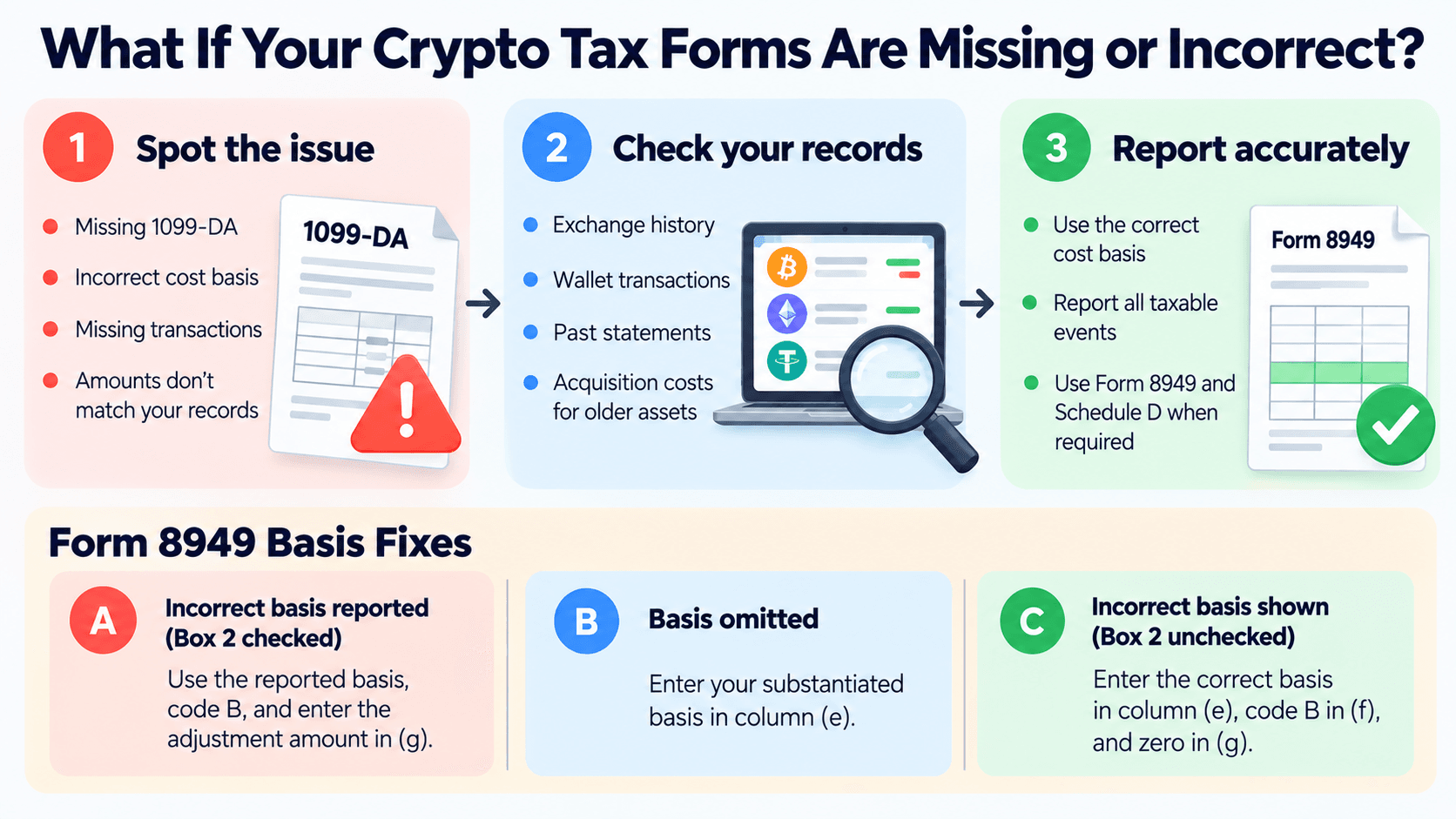 Missing or Incorrect Crypto Tax Forms Require Transaction Reconciliation, Cost Basis Verification, and Accurate IRS Reporting
What to Do If You Don't Receive Form 1099-DA or Have Missing Cost Basis
You may receive no Form 1099-DA after using a nonreporting platform, transacting outside broker custody or qualifying for a reporting exception. Applicable taxpayer reporting obligations continue.
Missing basis on a received form is a separate issue. The broker may be reporting noncovered assets without being required to supply their acquisition cost. Start with the original purchase confirmation, then add payment records, exchange trade histories and wallet transfers connecting those units to the disposal. Historical acquisitions and transferred-in cryptocurrency deserve particular attention.
A blockchain explorer can confirm quantities, wallet addresses and transaction timing. It may not establish the dollar purchase price. Combine onchain evidence with purchase documentation rather than treating either source as complete.
Menges argued that exchanges can make tax reporting easier by providing comprehensive transaction exports, including transfer records and transaction IDs, and clearly identifying noncovered assets that require additional basis documentation.
Platforms can also allow users to enter acquisition information for transferred assets. Under the applicable IRS rules, that information may help brokers identify disposed units without making the transferred assets covered for mandatory basis reporting.
Other useful improvements include reliable API access for crypto tax software and continued access to transaction histories after accounts close.
According to Menges, exchanges that provide these capabilities can reduce reporting difficulties for customers while also lowering their own tax-season support workload.
Missing cost basis does not automatically mean zero basis. If records cannot substantiate a figure, seek help before relying on an estimate.
How to Reconcile Incorrect Proceeds, Basis and Duplicate Transactions
Compare identical transactions and reporting periods. A platform export and a tax statement can differ because one uses another time zone, includes additional transaction types or treats fees differently. Review tax-lot identification before assuming a basis mismatch is an error: Notice 2026-20 permits valid taxpayer records to differ from broker reporting in qualifying cases.
| Problem | Likely cause | What to check | Next step |
|---|---|---|---|
| Missing Form 1099-DA | No reporting obligation, exception or delivery issue. | Platform documents and account details. | Obtain records and report applicable activity. |
| Missing basis | Noncovered assets or incomplete purchase history. | Original acquisitions and transfer trail. | Establish documented basis. |
| Incorrect covered basis | Wrong lot, missing adjustment or data error. | Box 2 and valid identification records. | Resolve the discrepancy and apply the required correction. |
| Proceeds mismatch | Fees, timing or missing transactions. | Individual trades and statement scope. | Reconcile transaction by transaction. |
| Duplicated transactions | Both API and CSV imports. | Matching identifiers and timestamps. | Remove duplicate entries from the calculation. |
| Wallet transfer treated as sale | Unmatched withdrawal and deposit. | Ownership of both accounts. | Reclassify the principal transfer and review fees separately. |
Unmatched deposits can conceal missing purchases. Correcting the deposit label without restoring the acquisition history may leave the eventual sale with an unsupported basis. Document each correction and its supporting evidence.
Before filing, Menges recommends checking whether calculated holdings match actual year-end balances across every exchange and wallet. Discrepancies can indicate missing transactions, while negative balances or sales without corresponding purchases often point to incomplete acquisition records.
He also recommends verifying that transfers are recorded on both sides, reconciling proceeds against each broker's Form 1099-DA and confirming that staking rewards and airdrops have been included as income using their appropriate U.S. dollar values.
"In our experience, most reporting errors come from incomplete data, not from the calculation itself," he said.
How to Correct a Form 1099-DA and Report Accurate Figures
If the broker has reported incorrect information, ask the issuer for a corrected Form 1099-DA. Retain the original statement, correspondence, supporting transactions and any corrected version. The issuer handles corrections to its form.
A lawful difference arising from taxpayer lot identification may require return reconciliation rather than a broker correction. Document why the figures differ.
The published Form 8949 correction instructions distinguish these cases:
- Incorrect basis reported to the IRS (Box 2 checked): Enter the basis shown on Form 1099-DA in column (e), place code B in column (f), and enter the adjustment needed to reach the correct gain or loss in column (g).
- Incorrect basis shown but not reported to the IRS (Box 2 not checked): Enter the correct basis in column (e), code B in column (f) and zero in column (g) for the basis correction. Any separate adjustment follows its own instructions.
- Basis omitted for a noncovered transaction: Enter substantiated basis in column (e). A blank basis field is not, by itself, a numerical error requiring code B.
Use the final applicable instructions for the return you file. Other discrepancies may require different codes or treatment. Do not automatically delay filing because a correction is pending. If the issue remains unresolved near the deadline, consider a timely extension and professional help while meeting payment obligations.
Crypto Tax Filing Deadlines and Recordkeeping Requirements for 2027
Plan around the filing deadline while keeping records that support both current disposals and assets still held. An extension can provide preparation time, but it generally does not postpone payment.
When Are Crypto Taxes Due in 2027?
April 15, 2027, is the expected regular federal filing deadline for most calendar-year individual returns covering 2026.
| Filing or payment item | Planning point |
|---|---|
| Regular federal return | Expected April 15, 2027 deadline for most calendar-year individuals. |
| Filing extension | Request by the applicable deadline; generally provides six additional months. |
| Tax payment | Generally remains due by the original payment deadline. |
| Estimated payments | May be required during the year, depending on income and withholding. |
A filing extension can be requested using Form 4868 or another permitted method. Calculate the expected liability, subtract payments already made and pay the remaining amount due by the applicable deadline.
Significant trading gains or crypto income without withholding may create estimated tax obligations. Waiting until the annual return is due can leave an underpayment issue even if the return itself is timely.
If reconciliation is incomplete, an extension provides time to resolve records. Disaster relief, overseas taxpayer rules and other exceptions can change individual deadlines.

What Crypto Tax Records Should You Keep?
Keep enough evidence to reproduce the return and explain differences from broker statements. A year-end portfolio balance cannot establish every acquisition, sale or income receipt.
2027 crypto tax filing and recordkeeping checklist:
- Original acquisition and disposal dates, quantities and prices.
- Purchase costs, proceeds and relevant transaction fees.
- Selected tax lots, standing orders and holding-period documentation.
- Exchange statements, CSV exports and Forms 1099-DA.
- Wallet addresses, blockchain transaction IDs and transfer matches.
- Ordinary income records and supporting dollar valuations.
- Calculations supporting basis corrections and other adjustments.
- Capital loss carryforward schedules and previously filed returns.
Record retention depends on the circumstances. Keep property records until the relevant limitation period expires for the year of disposal. Basis records for assets still held may therefore need to survive much longer than a recent return's paperwork.
If you discover unreported income, omitted sales or an incorrect basis after filing, assess whether an amended return using Form 1040-X is necessary. Complex histories, unresolved basis disputes, a tax audit and IRS notices warrant professional assistance.