

Bybit Card is a crypto-linked payment card that lets eligible customers use fiat and supported cryptocurrencies at merchants accepting its Visa or Mastercard network. Its value depends on where the card is issued, the currency being spent, and which transactions qualify for cashback. Bybit EU and the regional programs operated through Bybit.com have different fees, card types, and rewards.
This review evaluates where Bybit Card is available, how much everyday transactions cost, and whether its rewards justify the fees and custodial risks. It also covers card applications, daily use, fraud protection, and competing crypto debit cards.
Editor's Note (Nov. 12, 2026): We fully updated this review in November 2026 to reflect the latest Bybit Card fees, supported countries, and rewards programs. The refresh distinguishes Bybit EU from Bybit's global card offerings, incorporates the October 2026 cashback changes, and adds updated regional fee and spending-limit comparisons with real transaction-cost examples. We have also expanded the application and card-management guides, strengthened the security assessment to address Bybit's 2025 hack, added troubleshooting guidance for declined payments and refunds, and updated comparisons with Crypto.com and OKX.
Bybit Card Review: Quick Verdict
Bybit Card is a convenient way for eligible users to spend fiat and cryptocurrency, but its cashback benefits depend heavily on regional rules, conversion costs, and spending eligibility. Bybit EU offers 1% uncapped cashback on eligible non-VIP purchases, while global card programs use tiered rewards with crypto-funding requirements. There is generally no annual fee, but crypto conversion usually costs 0.9%, foreign-currency charges vary by region, and ATM fees apply beyond monthly allowances. The card is best suited to existing Bybit customers who keep modest spending balances rather than large crypto holdings on the exchange.
Bybit Card Key Points
-
Availability and card features vary by region Bybit EU serves eligible EEA residents, while separate Bybit.com programs cover Australia and selected Asia-Pacific, Latin American, and other markets. Cards use Mastercard or Visa depending on the program. Virtual and physical availability, supported currencies, and eligibility requirements differ. General issuance is not verified for U.S. or U.K. residents.
-
Crypto spending usually incurs a 0.9% conversion fee Bybit spends eligible fiat first, then converts supported crypto when needed. The standard conversion fee is 0.9% in the EU and most global programs, with a 0.5% rate in Argentina. One-Click Sell rates may add costs, while foreign-currency fees range from 0.5% in the EU to 2% in Australia and higher in certain markets.
-
Cashback ranges from 1% to an advertised 10% Bybit EU offers uncapped 1% cashback on eligible non-VIP purchases, with higher VIP rates subject to monthly caps. Global cards advertise 2% base cashback and up to 10% at the highest tiers, but qualifying purchases generally must be crypto-funded under the October 2026 rules. Cashback caps and merchant exclusions can significantly reduce actual rewards.
-
No annual fee, but ATM and issuance charges apply Published EU and global programs have no annual or inactivity fees. EU virtual and first physical cards are free, while Australia's physical issuance costs $29.99. ATM withdrawals typically incur a 2% fee after regional monthly allowances. Spending and withdrawal limits depend on the card program and verification tier.
-
Security features do not eliminate exchange custody risk Bybit Card offers EMV 3-D Secure, two-factor authentication, card freezing, PIN controls, and transaction monitoring. However, crypto held in the Funding Account remains exposed to centralized exchange risks. Bybit's approximately $1.4 billion February 2025 hack demonstrates why card balances should not double as long-term crypto storage.
-
Bybit is convenient, but competitors can offer better value Bybit EU works well for existing customers spending EUR and earning 1% eligible cashback without crypto conversion. Crypto.com offers higher paid-tier benefits, while OKX Card provides 2% eligible USDG cashback with a lower published 0.1% conversion spread. The best choice depends on funding currency, actual fees, regional eligibility, and card usage.
Disclaimer
Cryptocurrency spending involves financial risks, including price volatility, conversion costs, custody exposure, and possible loss of funds. This review is for educational purposes only and does not constitute financial, investment, legal, or tax advice. Review the applicable issuer terms and current fee schedule before applying.
Disclosure
Some links in this guide may be affiliate links. If you choose to use a service through these links, we may earn a commission at no additional cost to you.

Bybit Card at a Glance
Bybit Card's fees, cashback, supported currencies, and availability vary by region. The table below summarizes its main features as of Nov. 12, 2026.
| Feature | Details |
|---|---|
| Card type | EU debit; prepaid or credit designations in selected global regions |
| Network | Mastercard or Visa, by program |
| Issuing regions | Eligible EEA markets; Australia; selected Asia-Pacific and Latin American markets; Georgia and Kazakhstan (AIFC) |
| Virtual card | Offered in supported programs, subject to verification |
| Physical card | Select programs; not currently supported in Peru |
| Regular cashback | Bybit EU: 1% on eligible non-VIP purchases; global: tier and crypto-funding conditions |
| Maximum advertised cashback | Up to 10%, with VIP/tier requirements and caps |
| Annual and inactivity fees | None on published EU and global schedules |
| Crypto conversion fee | Usually 0.9%; Argentina 0.5%; Peru does not support crypto conversion |
| Foreign-currency fee | EU: 0.5%; global: region-specific, including 2% in Australia |
| ATM withdrawals | Eligible physical cards; usually 2% beyond a region-specific monthly allowance |
| Funding | Eligible fiat and cryptocurrencies in the Bybit Funding Account; fiat first |
What Is the Bybit Card and How Does It Work?
Bybit Card lets eligible users spend fiat and cryptocurrency through Mastercard or Visa. It draws from the Funding Account and automatically converts supported crypto when needed.
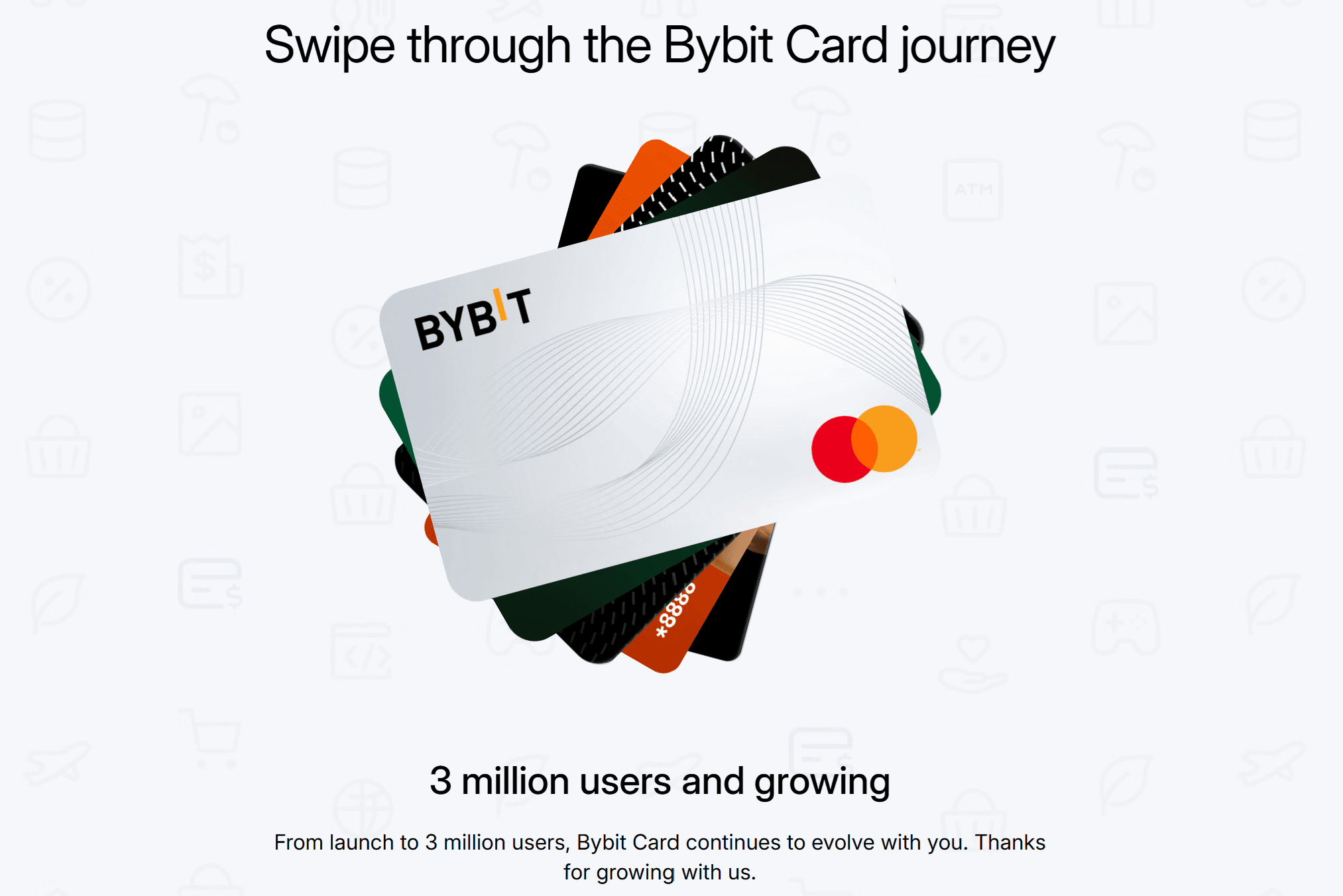 Bybit Card lets eligible users spend fiat and cryptocurrency through Mastercard or Visa. Image via Bybit
How Bybit Card Converts Crypto Into Everyday Payments
Card spending follows four steps:
- The merchant requests payment through the applicable Mastercard or Visa network.
- Bybit checks eligible fiat in the Funding Account first.
- If the fiat balance is short, it sells selected payment crypto, following the card's priority settings, using its One-Click Sell rate and applicable crypto conversion fee.
- The payment is authorized and the required funds are held until merchant settlement. Insufficient eligible balances or a conversion below the program minimum can result in a decline.
On a €50 EU purchase with €20 available, the card uses EUR first, then converts crypto to cover the remaining €30 and fees. The 0.9% applies only to crypto converted.
The EU card's current payment-currency list includes EUR, USDC, BTC, ETH, MNT, GRAM, XRP, and EURC. Global cards support USDT and other assets according to the region. Bybit Pay is a separate payment service; a normal bank debit card draws from a bank account.
Bybit Virtual Card vs. Physical Card: What Is the Difference?
Virtual cards cover online/wallet payments; physical cards add chip-and-PIN and ATM access. Some global virtual cards work at NFC ATMs.
| Feature | Virtual card | Physical card |
|---|---|---|
| Application | Digital issuance after approval | Generally requires an approved virtual card first |
| Online payments | Yes | Yes |
| Stores | Through eligible digital wallets | Contactless or chip-and-PIN |
| ATM cash | Possible via supported NFC ATMs in some global programs | Standard physical-card ATM access |
| Issuance cost | Currently free on published programs | EU first issuance free; Australia $29.99; other regions vary |
| Activation | Usually active after approval | Activate on receipt and set/confirm PIN |
Virtual Card Lite has a €150 lifetime limit and no physical option. Regional credit-card labels do not necessarily imply revolving credit. EU standard cards share spending limits; some global cards do not.
Where Is the Bybit Card Available?
Bybit Card is available through separate EU and global programs, each with its own eligibility requirements. Supported countries, card types, and application rules vary by region.
Bybit EU Card vs. Bybit Global Card: What Is Different?
Bybit EU requires separate onboarding and cardholder terms; a Bybit.com account does not establish EU card eligibility.
| Consideration | Bybit EU Card | Bybit.com regional cards |
|---|---|---|
| Account route | Bybit.eu | Bybit.com, eligible card program |
| Typical payment currency | EUR | USD, ARS, BRL, MXN, PEN, or regional currency |
| Network | Mastercard | Mastercard or Visa |
| Standard crypto fee | 0.9% | 0.9% generally; 0.5% Argentina; none in Peru because crypto funding unsupported |
| Standard rewards | 1% uncapped eligible non-VIP purchases | Crypto-funded cashback only from Oct. 5, 2026 |
| Card and ATM limits | EU tiers | Country-specific schedules |
EEA holders of legacy Bybit.com EUR cards were directed to register and apply separately at Bybit EU. For the current EU Mastercard, Bybit's card page names Harmoniie SAS, authorized by France's ACPR, as issuer, working with Moorwand Ltd, holder of the Mastercard license.
Bybit EU GmbH separately provides MiCA-authorized crypto services. The August 2026 EMI authorization for Bybit Payments GmbH supports future payment capabilities; it does not prove that entity replaced the current card issuer.
Supported Countries, Residency Requirements and Card Restrictions
The global fee schedule lists different regional programs, but a published fee table does not guarantee that applications are open to all residents. Eligibility still depends on the live application process and issuer approval.
| Region | Program evidence | Virtual | Physical | Eligibility caution |
|---|---|---|---|---|
| EEA except Malta, under EU general FAQ | Bybit EU | Conditional | Conditional | Residency and program-specific requirements |
| Australia | Published global card program | Yes, if approved | Offered, $29.99 issuance | Australian card eligibility and issuer terms |
| Selected Asia-Pacific markets | Global program, tiered schedule | Country-dependent | Country-dependent | Not every APAC country is eligible |
| Argentina, Brazil, Mexico | Country-specific card programs and fees | Program-dependent | Listed for eligible applicants | Local verification and card type differ |
| Peru | Global virtual-card fee program | Listed, subject to approval | Not supported | Crypto conversion unavailable |
| Georgia and Kazakhstan (AIFC) | Separate global programs | Listed, subject to approval | Listed, subject to approval | Local residency and issuer requirements |
| United States and United Kingdom | No generally available new Bybit Card issuance verified | No general application | No general application | Do not use exchange access as proof of card eligibility |
The EU eligibility FAQ lists 29 EEA jurisdictions, excluding Malta, including France, Croatia, Ireland, Iceland, Liechtenstein, Romania, and Norway, as of Nov. 12, 2026.
Bybit Card Fees and Limits: How Much Does It Really Cost?
Bybit Card has no published annual fee, but crypto conversion, foreign exchange, and ATM charges can increase spending costs. Fees and transaction limits vary by region.
Bybit Card Fees Explained: Conversion, FX and Card Charges
Bybit EU's fee schedule lists a 0.9% fee when crypto is sold to fund a payment, plus 0.5% on purchases outside the card's EUR denomination. Global fees follow a separate regional schedule. Mastercard supplies the foreign-exchange rate, and the separate Bybit fee is added on top. Some global programs charge an international fee instead.
| Charge | EU | Australia | Argentina | Brazil |
|---|---|---|---|---|
| Annual/inactivity | None | None | None | None |
| Virtual issuance | Free | Free | Free | Free |
| First physical issuance | Free | $29.99 | $5 equivalent | Free |
| Physical replacement | €5 | Region schedule | Region schedule | Region schedule |
| Crypto conversion | 0.9% | 0.9% | 0.5% | 0.9% |
| Foreign-currency charge | 0.5% | 2% | 7% fee; 5% FX authorization padding | 1.5% fee; 1% authorization padding |
| ATM charge after allowance | 2% after €100/month | 2% after $100/month | 2% after 95,000 ARS/month | 2% after 550 BRL/month |
Mexico lists 2% FX; Kazakhstan (AIFC) a 2% international fee; Peru 1% FX without crypto funding. EU cancellation and inactivity are free.
One-Click Sell rates can differ from reference markets. FX authorization padding is a temporary hold, not a final fee. ATM operators may charge extra; avoid unfavorable dynamic currency conversion (DCC).
Real Bybit Card Transaction Costs: Fiat vs. Crypto Spending
Consider three Bybit EU purchases, each worth €100 at a reference market rate. For illustration, suppose One-Click Sell is 0.2% less favorable than the reference, and the Mastercard rate matches the reference conversion. That 0.2% difference is a modeling assumption, not a measured Bybit spread.
| Purchase and source | Listed card fees | Assumed rate difference | Estimated total cost | Eligible 1% EU cashback | Net cost versus reference |
|---|---|---|---|---|---|
| €100 domestic, EUR balance | €0 | €0 | €100.00 | €1.00 | €1.00 benefit |
| €100 domestic, USDC-funded | ≈€0.90 crypto | ≈€0.20 | ≈€101.10 | €1.00 | €0.10 cost |
| €100 foreign-currency, crypto-funded | ≈€0.90 crypto + €0.50 FX | ≈€0.20 | ≈€101.60 | €1.00 | €0.60 cost |
Totals are rounded; cashback arrives as points after eligibility checks.
EUR-funded domestic purchases avoid both fees. USDC spending incurs crypto conversion and possible rate differences; foreign purchases can add 0.5% FX. Global rewards have different eligibility.
Bybit Card Spending Limits and ATM Withdrawal Limits
Limits apply independently of the available balance. Bybit EU uses per-transaction, daily, monthly, and annual tiers; virtual and physical standard EU cards share one limit.
| Program/tier | Card spending, daily | Card spending, monthly | ATM limit, monthly |
|---|---|---|---|
| EU Tier 1 | €5,000 | €10,000 | €2,000 |
| EU Tier 2 | €10,000 | €25,000 | €5,000 |
| EU Tier 3 | €15,000 | €50,000 | €10,000 |
| Australia, published base | $50,000 | $150,000 | Tier-dependent |
| Asia Pacific, Tier 1 | $10,000 | $50,000 | No Tier 1 ATM availability listed |
| Asia Pacific, Tier 2 | $50,000 | $150,000 | $10,000 |
EU annual limits are €60,000, €125,000, and €250,000 by tier, with €2,000 daily ATM cap. Australia separates card limits; Argentina and Brazil share them.
EU limits may be upgraded through Check Limit → Request an Upgrade; local ATM caps also apply.
Bybit Card Cashback and Rewards: How Much Can You Really Earn?
Bybit Card advertises up to 10% cashback, but actual rewards depend on the card program, eligibility, and spending tier. Conversion costs and monthly caps can reduce the benefit.
Bybit EU Card Cashback: 1% for Regular Users and VIP Rewards
Bybit EU has an uncapped 1% cashback on eligible purchases for ordinary non-VIP users. It does not require a monthly spend threshold. VIP tiers offer higher rates with caps.
| EU cardholder tier | Rate | Monthly cashback cap | Qualification |
|---|---|---|---|
| Non-VIP | 1% | No monthly cap | Eligible purchases |
| VIP 1–2 | 2% | €50 | VIP status or qualifying higher tier |
| VIP 3 | 4% | €150 | VIP 3 / tier rules |
| VIP 4 or PRO 1 | 6% | €250 | VIP qualification |
| VIP 5 or PRO 2 | 8% | €400 | VIP qualification |
| VIP 6 or PRO 3–5 | 10% | €600 | Highest qualifying status |
VIP rates can require spending thresholds. Refunds, excluded merchant categories, and promotions follow separate rules.
Bybit Global Card Cashback: Crypto-Funded Purchases and VIP Benefits
Bybit says eligible cashback requires a crypto-funded card transaction. Someone spending sufficient fiat from the Funding Account may pay no crypto-conversion fee but will generally not receive this global-program cashback.
| Global rewards tier | Advertised cashback | Monthly equivalent cap | Typical qualifying route |
|---|---|---|---|
| Base | 2% | 5 USDT | Eligible crypto-funded spending |
| Beta | 2% | 50 USDT | VIP 1–2 or qualifying monthly spend |
| Alpha | 4% | 150 USDT | VIP 3 or threshold |
| Apex | 6% | 250 USDT | VIP 4/PRO 1 or threshold |
| Omega | 8% | 400 USDT | VIP 5/PRO 2 or threshold |
| Infinite | 10% | 600 USDT | Highest VIP/spend qualification |
The global reward tiers set the base 5 USDT cap, reached after 250 USDT eligible spending at 2%. October also ended 100% eligible subscription cashback for non-VIP Beta users, but retained it for qualifying VIP Beta users. EU rules differ.
How to Earn, Redeem and Maximize Bybit Card Rewards
Qualifying purchases generate Rewards Points. Under EU rules, points remain pending for four calendar days after completion before becoming available for redemption. Check the Rewards area for the pending balance and available points.
Auto Cashback can convert eligible points into cryptocurrency and credit it to the Funding Account. Other redemptions, including trading bonuses and fee savers, have different restrictions and should not be valued as readily withdrawable cash.
Refunds, reversals, and excluded merchant category codes (MCCs), including many financial transfers and ATM transactions, can void rewards. A merchant may also be assigned an unexpected MCC. In our €100 EU crypto example, €1 cashback falls €0.10 short of the modeled conversion-related costs. The advertised rate is only useful after accounting for the transaction cost and actual reward eligibility.
How to Apply for and Use the Bybit Card
Eligible users must complete regional verification before receiving a virtual or physical card. Once approved, they can manage funding, payment priorities, and card settings through Bybit.
Bybit Card Application: Eligibility, KYC and Verification
- Open the right service. EU residents use Bybit.eu; eligible global applicants use Bybit.com or its app.
- Open the Card application. On the Bybit EU app, tap More → Card → Activate Card. On the website, use Finance → Card, then follow the application prompts. Select your country of residence.
- Complete identity checks using a supported passport, national ID, residence permit, or driver's license. Additional verification may be requested.
- Verify your residential address with a recent supporting document where required. Bybit EU generally requests documents issued within the previous three months.
- Confirm email and two-factor authentication, submit the application, and monitor the decision in the Card dashboard.
Bybit EU reviews some applications for up to seven working days. Do not circumvent residency checks. The application walkthrough shows the current EU app steps and identity checks. Desktop and mobile menus can differ, and older screenshots should not override live eligibility requirements.
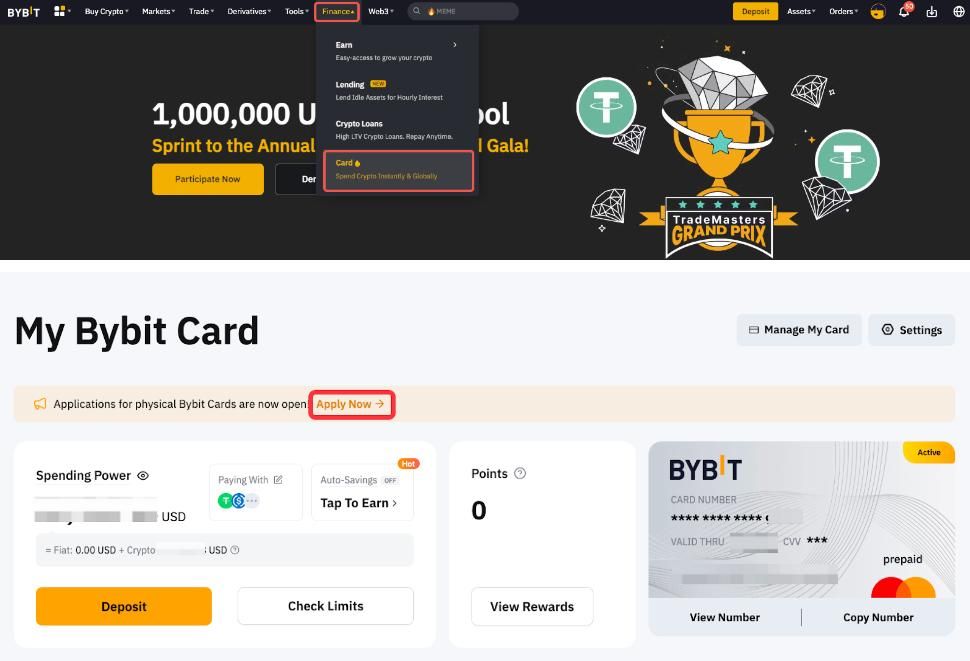 Bybit Card Application Dashboard. Source: Bybit Global
How to Get a Virtual or Physical Bybit Card
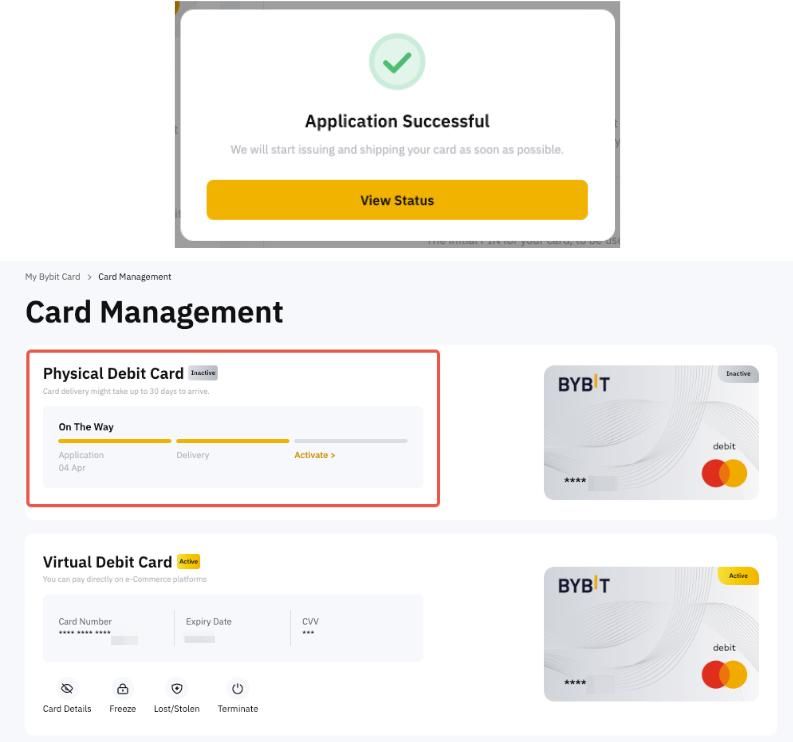
An approved virtual card generally becomes available on the Card dashboard for online shopping or supported wallets. EU users can then select Physical Card, confirm the verified delivery address and card name, create a PIN, and submit the request. The first EU physical issuance is listed as free; other programs can charge issuance and replacement fees.
EU delivery can take up to 30 days. Activate through Manage My Card → Activate, verifying the card details. The physical-card activation guide shows the required screens. Lite users need standard verification to upgrade.
Funding, Digital Wallets and Everyday Card Management
Transfer eligible fiat or crypto into the Funding Account, then review Spending Power on the Card dashboard. Paying With changes crypto priority, while fiat remains first. Locked funds cannot cover purchases.
| Card program | Apple Pay | Google Pay | Samsung Pay |
|---|---|---|---|
| Bybit EU | Supported where eligible | Supported | Supported where eligible |
| Australia | Supported | Supported | Supported |
| Asia Pacific regional card | Not generally listed | Supported | Not generally listed |
| Argentina/Brazil | Supported | Supported | Not generally listed |
| Mexico | Not generally listed | Supported | Not generally listed |
Wallet compatibility varies. The EU card management guide illustrates freeze controls and PIN settings. Bybit also documents Spending Power and payment priority, including transaction history.
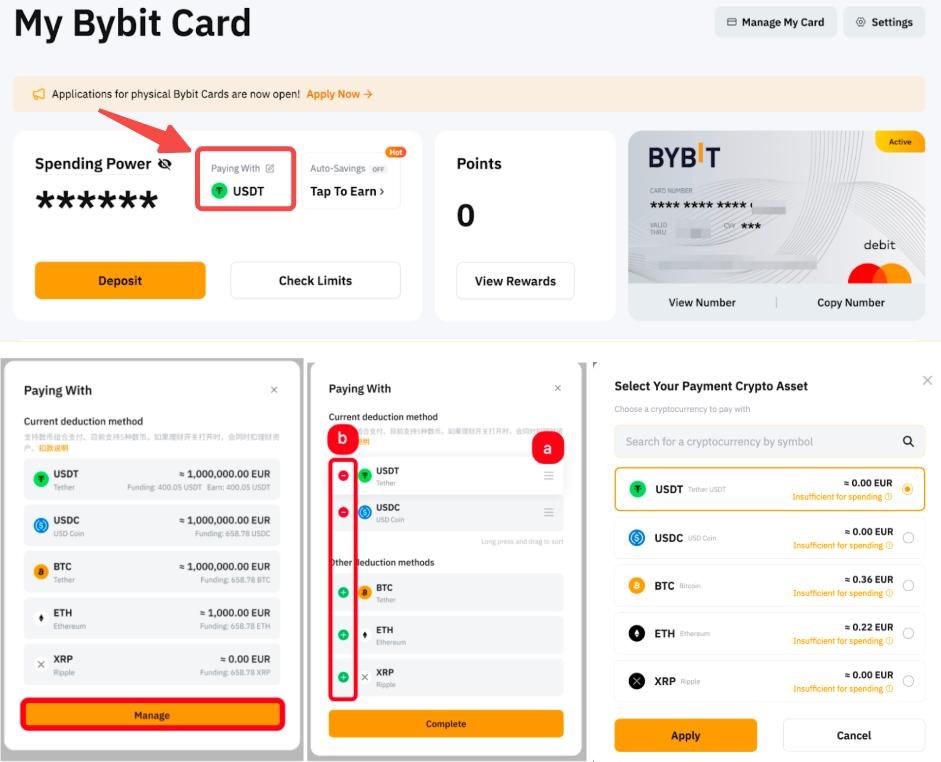 Bybit Global Card Payment Currency Priority Settings. Source: Bybit Global
Some global cards permit Flexible Easy Earn Auto-Earn/Auto-Deduction, subject to redemption and yield risks. An authorization holds funds before final merchant settlement.
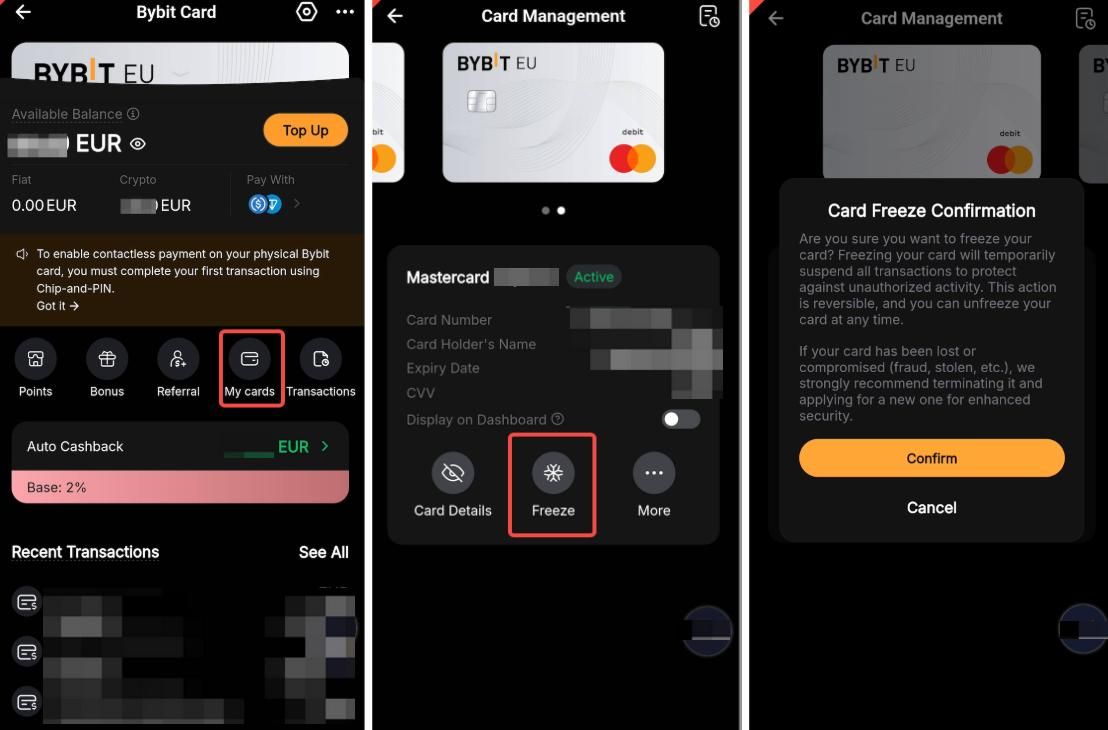 Bybit Global Card Freeze and Management Controls. Source: Bybit
Transaction History separates pending authorizations from completed charges.
Is Bybit Card Safe? Security, Custody and Consumer Protection
Bybit Card offers payment security controls, but funds held on the exchange remain exposed to custody and operational risks. The 2025 Bybit hack highlights those limitations.
Bybit Card Security Features and Fraud Protection
| Protection | Helps With | Limitation |
|---|---|---|
| EMV 3-D Secure | Authentication at participating online checkouts | Not every merchant or transaction requests it |
| 2FA and biometrics | Account access and sensitive changes | Cannot prevent all phishing or account compromise |
| Card freeze | Blocks new card activity when lost or suspicious | Does not freeze the underlying exchange wallet |
| PIN and spending limits | ATM/in-person access and overspending | Card details can still be misused elsewhere |
| Notifications/history | Early detection of unknown charges | Alerts can arrive after authorization |
| Dispute process | Eligible card-payment errors and fraud | Issuer rules, evidence, deadlines, and fees apply |
If compromised, freeze the card, review charges, and secure the exchange account separately. Issuer terms govern chargebacks.
Bybit's 2025 Hack and the Risks of Holding Card Funds on an Exchange
On Feb. 21, 2025, attackers stole approximately $1.4 billion in ETH-related assets through a compromised Safe multisig transaction-signing workflow. A malicious interface presented misleading transaction information to authorized signers. Bybit's incident timeline describes its response, including liquidity replenishment and withdrawal processing; independent Chainalysis reporting corroborates the scale.
So, who safeguards the funds?
In the EEA, Harmoniie SAS issues the existing card with Moorwand Ltd as its Mastercard partner. Its payment-card and e-money obligations are distinct from Bybit EU GmbH's crypto custody service. Applicable e-money safeguarding protects qualifying funds handled by the issuer under its rules; it does not convert cryptocurrency in the Bybit Funding Account into a bank deposit or insure it against exchange failure.
Neither EU deposit insurance nor Mastercard chargeback rules guarantee recovery of custodial crypto. Bybit Payments GmbH's separate Austrian EMI authorization does not automatically extend protection to every balance or replace the current card issuer. Outside the EU, issuer and safeguarding arrangements vary by program, so the cardholder agreement controls.
Our Bybit safety review examines custody and security in more detail. A card spending balance should not double as long-term crypto storage.
Common Bybit Card Problems: Declined Payments, Refunds and Disputes
A payment can fail despite funds appearing in the overall exchange balance. Most declines trace back to eligible spending funds, verification, merchant controls, or the card's transaction limits.
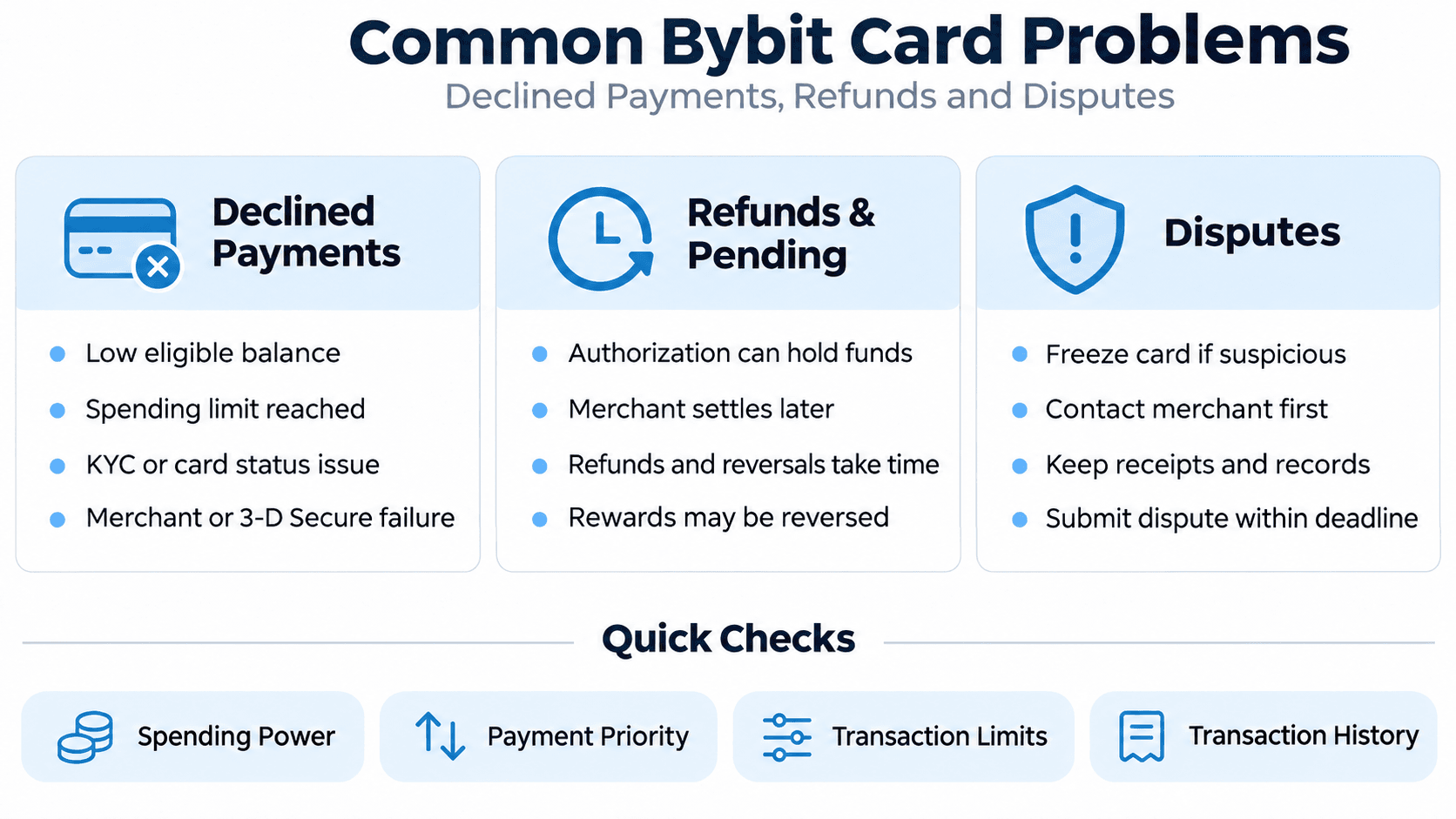 Common Bybit Card Problems: Declined Payments, Refunds, Disputes, and Troubleshooting Checks
Why Is My Bybit Card Declined or Not Working?
| Problem | Likely cause | First action |
|---|---|---|
| Purchase declined | Insufficient eligible fiat/crypto; minimum conversion | Check Spending Power and payment priority |
| Online purchase fails | 3-D Secure failure or blocked merchant | Retry authentication and review merchant category |
| Exceeds limit | Card/tier or ATM cap | Check current limits |
| Card unavailable | Manual freeze, risk review, KYC issue | Check status and verification |
| Subscription fails | Merchant or billing-address mismatch | Review card details and merchant acceptance |
| Overseas payment fails | Currency conversion or security check | Confirm available funds and network support |
Locked funds cannot be spent. Review limits, KYC, currency, and card status before contacting support.
Pending Transactions, Refunds and Chargebacks
A pending authorization reserves funds before the merchant settles the charge. Bybit says some authorizations can stay pending for up to 30 days. A reversal releases the hold; a refund follows a completed transaction and is separately credited back according to program rules. Reversals and refunds can claw back Rewards Points.
Check Card → Transaction History. Contact merchants for ordinary refunds and Bybit immediately for fraud. Bybit.com's self-service dispute guide lists a 120-day eligibility window for some successful transactions and a possible $50 administrative charge for denied, poorly documented submissions; another transaction-security notice instructs reporting unauthorized activity within 60 days. The shorter deadline is the safer action point. Do not assume either rule applies unchanged to the EU issuer.
Retain receipts, messages, and transaction references.
Bybit Card vs. Other Crypto Debit Cards: Which Offers Better Value?
Crypto.com and OKX are the clearest alternatives for eligible European users. The comparison below uses ordinary entry-level terms rather than premium reward ceilings. Fees and benefits apply to the specific European programs shown.
| Criterion | Bybit EU Card | Crypto.com Prepaid Visa, Europe | OKX Card, EEA |
|---|---|---|---|
| Type / network | Debit / Mastercard | Prepaid / Visa | Debit / Mastercard |
| Funding | EUR and supported crypto | Preloaded fiat and crypto top-ups | USDC or USDG |
| Standard cashback | 1% eligible, uncapped for non-VIP | Basic: 0% | 2% on eligible USDG; €50 monthly cap |
| Higher rewards | Up to 10% VIP, capped | Plus 1.5%, Pro 2.5%, Private up to 4.5% | VIP tiers up to 10%, capped |
| Crypto conversion | 0.9% plus One-Click Sell rate when crypto-funded | Crypto top-up conversion quote applies | 0.1% published conversion spread |
| Foreign currency | 0.5% plus Mastercard rate | Tier- and destination-dependent, 0% to 2% | 0% OKX FX fee; Mastercard rate applies |
| Physical card | Yes, if eligible | Yes, with tier-based charges | No, virtual only |
| ATM withdrawals | Yes, subject to limits and charges | Yes; 2% beyond monthly free allowance | No physical-card ATM facility |
| Other charges | No annual/inactivity fee published | 1% debit/credit card top-up; €6 monthly inactivity after 12 months | No issuance, annual, or inactivity fee |
| Best for | Existing Bybit EUR spenders | Customers using paid-tier perks and a physical card | Eligible USDG stablecoin spenders |
Bybit Card vs. Crypto.com Card: Which Has Better Rewards and Benefits?
Bybit EU is stronger for uncomplicated, entry-level cashback. Its qualifying non-VIP purchases earn 1%, while Crypto.com's Basic prepaid card offers no standard spending rewards.
Crypto.com's rewards schedule lists higher rates under its Level Up program:
| Crypto.com Level Up Plan | Eligible Spending Rewards | Monthly Purchase Amount Eligible at Full Rate |
|---|---|---|
| Basic | 0% | Not applicable |
| Plus | 1.5% | First $750 or equivalent |
| Pro | 2.5% | First $1,500 or equivalent |
| Private, Icy/Rose | 3.5% | First $3,000; 0.5% beyond |
| Private, Obsidian | 4.5% | First $5,000; 1% beyond |
Higher-tier rewards require an active eligible Level Up subscription or CRO lockup/stake, and rates do not apply to all merchant categories. Rewards are generally credited in CRO, so their dollar value can change with the token price. Selected subscription rebates and airport lounge access depend on the plan and qualifying conditions.
Crypto.com's European fees create other costs to check:
- Card top-ups: 1% for debit or credit card funding; crypto conversion quotes can also differ from reference market rates.
- ATM withdrawals: A 2% fee applies above the monthly allowance. Basic includes €200, Plus €400, Pro €800, and the highest physical tier up to €1,000.
- Inactivity: €6 per month after 12 months without cardholder-initiated financial activity, effective Oct. 1, 2026.
- Foreign transactions: Basic charges 0.2% on qualifying non-EUR purchases within the EU or UK, and 2% outside. From Oct. 1, Plus has a €400 monthly fee-free allowance for qualifying non-EU/UK overseas payments and Pro has €800, with 2% thereafter. Both list 0.2% on relevant non-EUR EU/UK transactions; Private tiers list no additional FX fee.
- Physical issuance: The Basic card costs €4.99, while Plus physical issuance may cost €24.99 for qualifying shorter-term monthly subscribers. Other eligible Plus customers may receive free issuance.
The cashback, monthly eligible spending thresholds, card issuance charges, and FX allowances are separate rules. A higher cashback percentage does not automatically mean a cheaper overall card.
Verdict: Bybit EU provides a simpler 1% program for eligible existing customers. Crypto.com can deliver more value when a customer uses enough paid-tier benefits to justify subscription or CRO requirements, and accepts CRO reward exposure.
Bybit Card vs. OKX Card: Which Is Better for Spending Crypto?
OKX Card is a strong stablecoin-focused alternative in the EEA. It is a virtual Mastercard funded through eligible USDC or USDG balances, with crypto converted into EUR when the user pays.
OKX's EEA card fees list a 0.1% USDC/USDG-to-EUR conversion spread, no extra OKX foreign-exchange fee beyond the Mastercard rate, and no card issuance, annual, or inactivity fee. The program does not provide a physical card or standard physical-card ATM access.
Its rewards terms provide 2% cashback for eligible non-VIP USDG-funded purchases, capped at €50 per month. That cap is reached after €2,500 in qualifying monthly purchases. USDC-funded spending does not receive this cashback. Refunded payments, excluded merchant categories, and program limits can also reduce rewards. A temporary September cap increase is not part of the ongoing terms.
For users choosing how to fund daily purchases, that gap can change the overall cost. An eligible customer already spending USDG can earn a higher ordinary cashback rate with a lower published conversion spread than Bybit EU's standard crypto-funded payment cost. However, OKX's cashback is capped, and the card is less suitable for users who need physical-card ATM withdrawals or want to spend BTC and ETH directly from card payment balances.
Verdict: OKX offers stronger published economics for eligible EEA USDG spending. Bybit EU is more flexible for EUR, multiple cryptocurrencies, and physical card use. Our crypto debit card comparison discusses additional options such as Nexo and Wirex.

Final Verdict: Is Bybit Card Worth Using in 2026?
Bybit Card is worth using for eligible customers who already maintain a modest spending balance on the applicable Bybit platform. EU customers can use EUR with no card crypto-conversion charge while collecting 1% on eligible non-VIP purchases. Regional global customers must account for October's crypto-funded cashback rule, regional fees, and reward caps.
It is less compelling for frequent foreign-currency spending, unsupported residents, or anyone unwilling to leave assets with a centralized exchange. Cashback may fail to offset the One-Click Sell rate, 0.9% conversion fee, and FX charges. The 2025 hack reinforces the case against keeping large long-term holdings in the Funding Account.
Choose Crypto.com when an eligible card tier's paid perks and physical-card benefits justify its conditions. Choose OKX when eligible EU stablecoin spending, especially USDG, offers better net economics. Bybit Card's strongest feature remains direct access to existing Bybit funds, not a guaranteed financial advantage from its maximum cashback headline.