Bybit Earn brings flexible savings, staking, yield-bearing collateral, structured products and tokenized real-world assets into one platform. Its range is broad, but the risks vary sharply between products.
This Bybit Earn review examines rates, liquidity, safety, principal protection and who each option is best suited to.
Editor's Note (July 24, 2026): We fully updated this article in July 2026 to reflect Bybit Earn’s current product range, rates, eligibility rules and risk disclosures. The revised review adds BYUSDT, RWA Earn, Advanced Earn products, updated safety analysis, return examples and clearer guidance on principal protection, liquidity and potential losses.
Bybit Earn Review: Quick Verdict
Bybit Earn is a broad crypto yield platform. It combines flexible savings, fixed products, staking, yield-bearing trading collateral, structured investments, liquidity strategies and tokenized real-world assets. Easy Earn and On-Chain Earn provide relatively accessible ways to generate returns, while BYUSDT offers a useful capital-efficiency tool for active derivatives traders.
Our take: Bybit Earn earns a strong rating for product range, trading integration and ease of use, but a lower safety score reflects centralized custody, the February 2025 security incident and the complexity of its advanced products. Beginners should generally stay with Flexible Easy Earn or straightforward On-Chain Earn options, while speculative products should be treated as trades rather than savings.
Scorecard
-
1Product Range 4.8/5 Easy Earn, On-Chain Earn, BYUSDT, structured products, Liquidity Mining, RWA Earn and Private Wealth Management cover a wide range of user profiles.
-
2Returns and Value 4.1/5 Rates can be competitive, but promotional caps, changing APRs, settlement outcomes and NAV performance can make headline figures unrepresentative of realized returns.
-
3Transparency 3.9/5 Bybit publishes product terms, rate structures and risk disclosures, although yield sources, third-party strategies and structured settlement rules can require careful reading.
-
4Liquidity and Redemption 4.0/5 Flexible products provide relatively quick access, but fixed terms, staking unbonding, RWA processing and structured-product settlement can delay or prevent early exits.
-
5Safety and Risk Controls 3.6/5 Proof of Reserves and account protections are useful, but users retain centralized custody, counterparty, compliance and product-specific loss exposure.
-
6User Experience 4.5/5 Product discovery, subscription, monitoring, automation and redemption are well integrated, although the interface can make simple and highly speculative products appear deceptively similar.
-
7Overall Score 4.2/5 Bybit Earn offers excellent breadth and strong convenience for existing customers, but users must evaluate each product separately rather than treating the Earn catalogue as one risk category.
Best For
- Existing Bybit users with idle crypto balances
- Beginners using Flexible or Fixed Easy Earn
- Users seeking simplified exchange-based staking
- Active traders who can use BYUSDT responsibly
- Experienced users who understand structured settlement
Not Ideal For
- Users requiring self-custody or deposit insurance
- Anyone who may need fixed funds at short notice
- Beginners selecting products solely by headline APR
- Users unable to explain every possible settlement outcome
- Traders without strict leverage and liquidation controls
Bybit Earn Risk Spectrum
Relatively Simple
Flexible and Fixed Easy Earn. Main exposure includes custody, access, token-price and stablecoin risk.
Moderate Risk
On-Chain Earn, Discount Buy and unleveraged Liquidity Mining. Protocol, market and liquidity risks increase.
High Risk
Dual Asset, Double-Win, Smart Leverage and leveraged Liquidity Mining. Principal may be reduced or lost.
Specialist Products
BYUSDT, RWA Earn and Private Wealth Management. Risks depend on margin use, NAV performance and external managers.
This spectrum compares products within Bybit Earn. Even the simplest option remains exposed to centralized custody, counterparty risk and the market value of the subscribed asset.
Disclosure
Some links in this article may be affiliate links. If you choose to use a service through these links, we may earn a commission at no additional cost to you.
Bybit Earn At a Glance
| Field | Information |
|---|---|
| Main product categories | Easy Earn, On-Chain Earn, Advanced Earn and RWA Earn |
| Beginner option | Flexible or Fixed Easy Earn |
| Staking option | On-Chain Earn |
| Yield-bearing collateral | BYUSDT |
| Advanced products | Dual Asset, Double-Win, Discount Buy, Smart Leverage and Liquidity Mining |
| High-net-worth offering | Private Wealth Management |
| Principal protection | Product dependent |
| KYC | Required for Earn access |
| Main platform risk | Centralized custody and counterparty exposure |
| Main product risk | Market, liquidity, settlement, protocol or leverage risk |
| Best for | Existing Bybit users seeking multiple yield strategies |
| Not ideal for | Users requiring deposit insurance or self-custody |
How We Assessed Bybit Earn (Methodology)
Bybit Earn was assessed as a collection of financial products rather than one feature. A positive verdict on Flexible Easy Earn cannot automatically extend to Smart Leverage, just as a strong staking service does not prove that a structured product offers a sensible risk-adjusted return.
The assessment reviewed the live product catalogue, current Help Center documentation, product agreements, rate displays, promotional structures, subscription conditions, redemption processes and risk disclosures. Platform-level analysis covered custody, Proof of Reserves, account protections and the February 2025 security incident. Binance Earn, OKX Earn and native staking were checked separately to identify practical differences rather than count features.
| Category | What We Assessed |
|---|---|
| Product Range | Breadth, differentiation and whether more products create genuine user value |
| Returns | Base APR, promotional APR, balance caps and reward calculation |
| Transparency | Yield sources, third-party involvement, fees and settlement terms |
| Liquidity | Lock periods, early redemption, unbonding and processing times |
| Safety | Custody, reserves, security history and account controls |
| Product Risk | Principal, market, protocol, leverage, counterparty and settlement exposure |
| User Experience | Product discovery, subscription, monitoring and redemption |
| Suitability | Beginner, HODLer, trader and higher-capital use cases |
The live discovery and subscription workflows were inspected, and return examples were calculated using current displayed rates and published product terms. No funded subscription was placed for every product in this draft. Reward, redemption and structured-settlement conclusions therefore rely on the current agreements and mechanics rather than one anecdotal order.
This limitation is most relevant to RWA Earn and Advanced Earn. A single funded transaction would only demonstrate one settlement path, not validate every possible outcome or future redemption condition.
What Is Bybit Earn and How Does It Work?
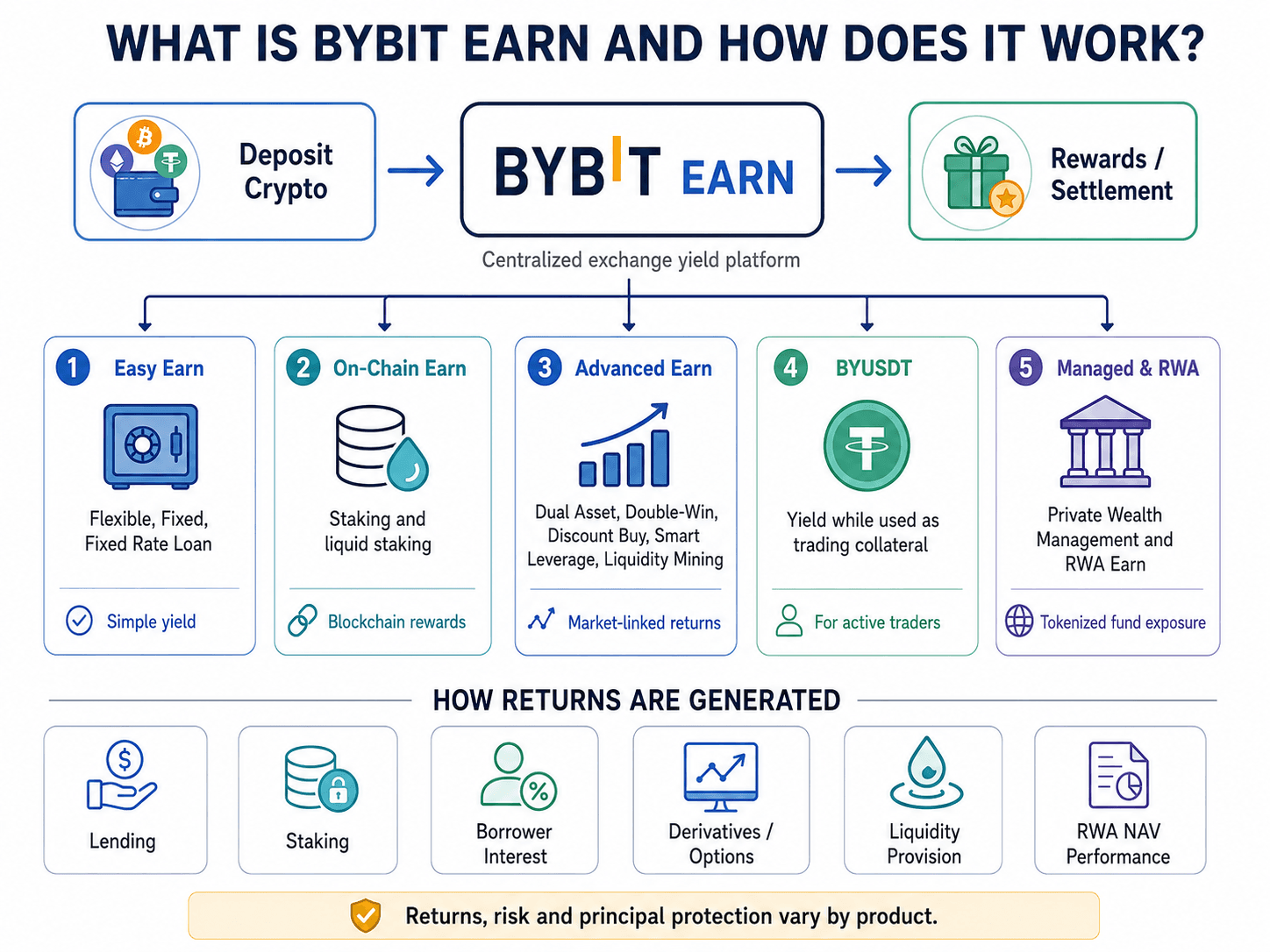
Bybit Earn is a yield platform operated through Bybit exchange. Users commit crypto to savings, lending, staking, liquidity, structured investment and managed-product arrangements. Bybit holds the assets, operates the interface and distributes the resulting rewards or settlement proceeds.
The return source changes by product. Flexible Easy Earn and fixed savings products can generate returns through lending activity or third-party wealth-management strategies. On-Chain Earn passes through rewards generated by network issuance and transaction fees. Advanced Earn uses derivatives, liquidity or directional trading structures, while RWA Earn reflects changes in the net asset value of tokenized investment products.
Read our full Bybit review.
Also Read
- Is Bybit Safe?
- Bybit Card Review
- Bybit's Products and Features
- Bybit Copy Trading Review
- Bybit Trading Guide
- How Sign up on Bybit
 Inside Bybit Earn’s Savings, Staking and Investment Products
Bybit Earn Product Structure
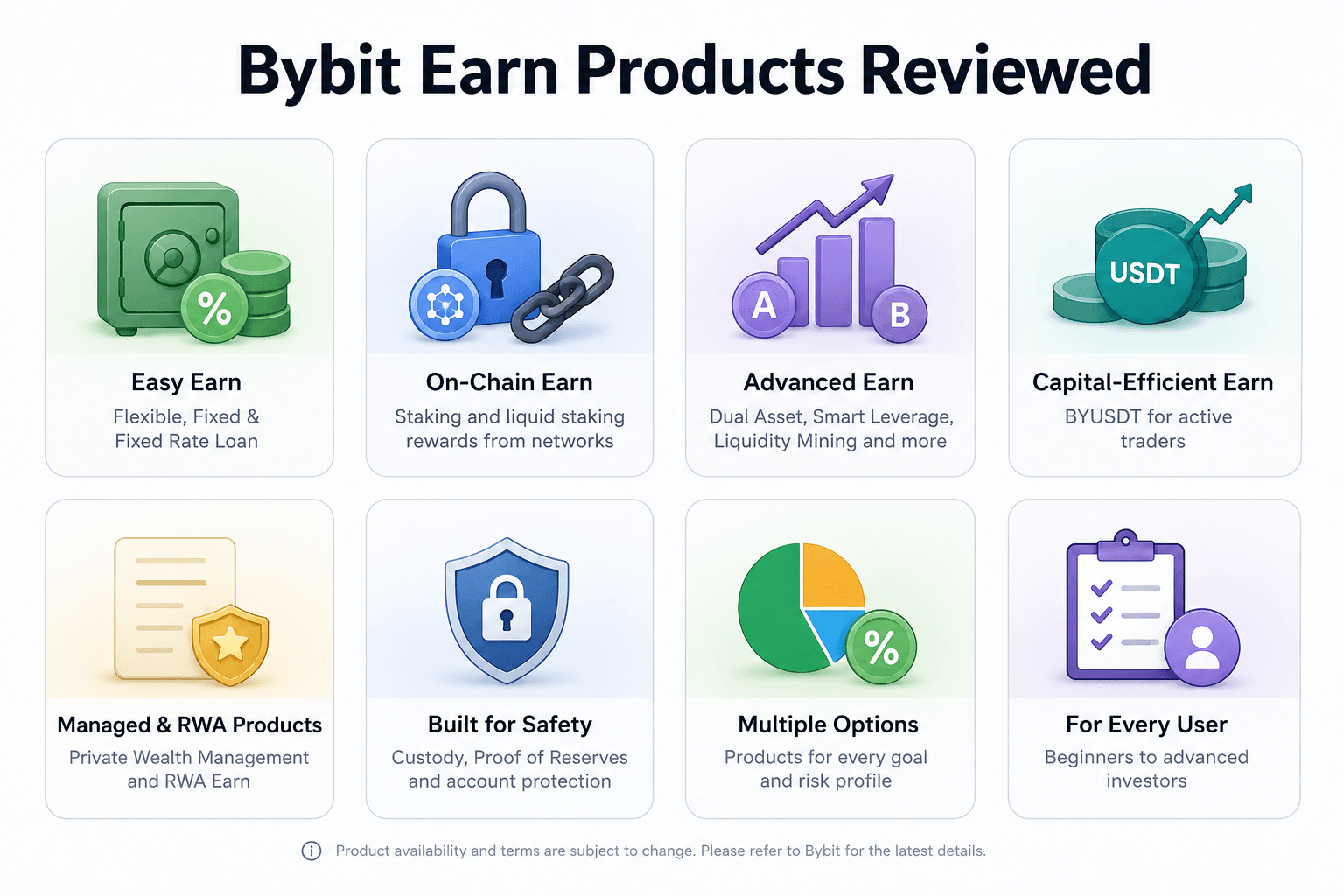
Bybit currently organizes most products around Easy Earn, On-Chain Earn and Advanced Earn, with BYUSDT, RWA Earn and Private Wealth Management serving more specialized needs.
| Product Group | Products | General User Profile |
|---|---|---|
| Easy Earn | Flexible, Fixed and Fixed Rate Loan | Beginners and users seeking comparatively simple yield |
| On-Chain Earn | Proof-of-Stake and liquid staking opportunities | Users seeking blockchain-generated rewards |
| Advanced Earn | Dual Asset, Double-Win, Discount Buy, Smart Leverage and Liquidity Mining | Experienced users accepting market or principal risk |
| Capital-Efficient Earn | BYUSDT | Active derivatives traders |
| Managed and RWA Products | Private Wealth Management and RWA Earn | Sophisticated or higher-capital users |
These categories do not share a common risk level. Rates for USDT ranged from 3.20% to 777.00% on the current product page as of July 24, 2026, while BYUSDT displayed 2.62%. That range does not mean an ordinary USDT balance earns 777%. The applicable product, balance cap, campaign period, settlement structure and eligibility conditions determine the actual return.
Principal protection also needs precise language. Easy Earn describes protection in terms of token quantity. A user subscribing 1,000 USDT should receive at least 1,000 USDT under the product terms, but that does not insure the dollar value against a stablecoin depeg, platform failure or loss of account access.
Users comparing exchange staking with direct validator participation can start with our guide to staking.
How Subscriptions Generate Returns
The clearest way to understand Bybit Earn is to follow the yield.
- Flexible Easy Earn: Generates returns through lending activity conducted by Bybit, with variable APRs that can change alongside market conditions.
- Fixed savings products: May use lending activity or third-party wealth-management strategies in exchange for a defined term.
- Fixed Rate Loan: Connects suppliers of crypto capital with borrowing demand, producing returns from borrower interest.
- On-Chain Earn: Generates rewards from blockchain issuance, network transaction fees and protocol-specific staking mechanisms.
- Advanced Earn: Uses derivatives, options, liquidity provision or leveraged directional strategies.
- RWA Earn: Reflects the NAV performance of tokenized bond funds or credit portfolios.
- BYUSDT: Passes through the applicable USDT Flexible Easy Earn return while the token is used as eligible trading collateral.
Bybit Earn Products Reviewed
Bybit Earn products should be selected by return source, liquidity and settlement risk. The product name and headline APR tell only part of the story.
 Comparing Bybit Earn Products Across Risk and Liquidity
Easy Earn: Flexible, Fixed and Fixed Rate Loan
Easy Earn is the most accessible part of the platform. It offers variable-rate flexible products, term-based fixed products and Fixed Rate Loan arrangements, but those three options serve different liquidity needs.
| Feature | Flexible Easy Earn | Fixed Easy Earn | Fixed Rate Loan |
|---|---|---|---|
| Rate | Variable | Set when subscribed | Determined by lending conditions |
| Access | Normally redeemable | Usually locked or subject to early-redemption terms | Funds committed after the loan is filled |
| Yield Source | Lending activity | Lending or third-party strategies | Borrower interest |
| Best For | Idle assets that may be needed | Users accepting a defined lock period | Users comfortable supplying crypto loans |
| Main Drawback | APR can fall | Lower liquidity | Lending and settlement conditions |
Flexible products allow users to redeem without waiting for a fixed maturity, although reward timing, pool capacity and account status can still affect the experience. Fixed products exchange liquidity for a defined term and rate. Some permit early redemption with reduced or forfeited rewards, while filled Fixed Rate Loan orders cannot normally be redeemed before settlement.
Bybit describes Flexible and Fixed Easy Earn as principal protected in token amount. That protects the number of subscribed tokens under the product arrangement. It does not protect their purchasing power or cover stablecoin issuer failure, exchange insolvency, account restrictions or unauthorized access.
Two automation tools support recurring use:
- Auto-Earn: Moves eligible idle assets from the Funding Account into Flexible Easy Earn during the daily subscription cycle.
- Auto Reinvest: Reinvests eligible rewards or matured balances, depending on the product configuration.
These controls reduce manual work but can also keep more capital inside Bybit than the user intended. Anyone using automation should still maintain an exchange-balance limit.
Standard and promotional APRs also need separation. A Bonus APR may apply only to the first portion of an eligible balance, while the remainder earns the base rate. Pool capacity, first-come availability and campaign expiry can reduce the realized return.
Management charges for standard Easy Earn are reflected in the displayed APR. Fixed Rate Loan arrangements may follow separate fee terms, so suppliers should review the order page rather than assume the standard Easy Earn treatment applies.
On-Chain Earn: Staking Through Bybit
Bybit On-Chain Earn is not the same as native staking. Bybit manages node operations, gas fees, reward collection and the subscription interface, while the user gives up direct custody and accepts Bybit as an additional operational layer.
Current product documentation references assets such as ETH and SOL, alongside liquid staking tokens including stETH, mETH and bbSOL. Bonding periods, unbonding periods, payout assets, reward schedules and service fees vary by protocol.
That arrangement is useful for users who want staking exposure without maintaining validator infrastructure or navigating several on-chain interfaces. It also changes the risk model:
- Crypto price risk: Staking rewards can be outweighed by a fall in the token’s market value.
- Custody risk: Bybit controls the subscribed assets.
- Validator risk: Poor validator performance or slashing may reduce returns where applicable.
- Protocol risk: Network bugs, governance failures or staking interruptions can affect access and rewards.
- Smart contract risk: Liquid staking structures may rely on contracts outside Bybit’s direct control.
- LST depeg risk: A liquid staking token can trade below the value of its underlying asset.
- Unbonding risk: Users may be unable to sell or withdraw during the protocol’s exit period.
- Network disruption: Congestion or technical interruptions can delay redemption.
Direct staking offers greater transparency and, depending on the method, more custody control. Bybit offers a cleaner interface and absorbs more operational work. The trade-off is convenience in exchange for another counterparty.
BYUSDT: Earning Yield While Trading
BYUSDT is a specialist collateral product for active traders, not a beginner savings account. It represents tokenized USDT Flexible Easy Earn holdings and continues receiving the applicable yield while supporting eligible positions inside a Unified Trading Account.
BYUSDT is 100% backed by corresponding USDT Flexible Easy Earn balances. It carries a 100% collateral value ratio and can be used in Cross Margin or Portfolio Margin. It is not supported in UTA Isolated Margin.
BYUSDT also has strict functional limits:
- It cannot be withdrawn to an external wallet.
- It cannot be deposited from outside Bybit.
- It is not available for Spot trading.
- It cannot be used for every Bybit service.
- Redemption may be blocked while the balance supports liabilities or margin.
- It can be converted into USDT during repayment or liquidation settlement.
Under the current mechanism, yield is calculated hourly and distributed daily. BYUSDT generally follows the underlying Flexible Easy Earn APR, although promotional treatment and caps can differ. Swap or redemption charges may also apply in some circumstances.
The central trade-off is capital efficiency. A trader can earn on collateral that would otherwise sit idle. The yield does nothing to reduce the market risk of the position it supports. A 2% to 4% annualized return is trivial beside a leveraged loss or liquidation.
Advanced Earn: Higher Returns With Structured Risk
Advanced Earn products convert a market view into a defined settlement formula. They are not substitutes for savings, even when the interface expresses the projected return as an APR.
| Product | Basic Objective | Settlement Variable | Can Principal Be Lost? | Best Suited To |
|---|---|---|---|---|
| Dual Asset | Buy low or sell high while earning yield | Target Price and Settlement Price | Economic value can underperform the alternative | Users comfortable receiving either settlement asset |
| Double-Win | Profit from a large move outside a range | Upper and lower range | Yes, potentially the full amount | Traders expecting strong volatility |
| Discount Buy | Buy an asset at a preset price or receive USDT plus yield | Purchase, Knockout and Settlement Prices | Yes, through adverse market value | Users already willing to own the asset |
| Smart Leverage | Take a leveraged direction until settlement | Breakeven and Settlement Prices | Yes, potentially the full amount | Experienced directional traders |
| Liquidity Mining | Earn from liquidity and trading activity | Pool composition and performance | Yes | Users who understand impermanent loss and leverage |
Dual Asset
Dual Asset allows users to select a Buy Low or Sell High strategy around a Target Price. At settlement, the market price determines which asset the user receives.
A USDT holder might choose Buy Low because they would be comfortable receiving BTC at a chosen Target Price. If the settlement condition triggers, the USDT converts into BTC. If it does not, the user keeps USDT plus yield. The cost appears when the market moves beyond the intended outcome. BTC could continue falling below the effective purchase level, or it could rally while the user remains settled in USDT.
Subscriptions are normally locked until settlement. Dual Asset is non-principal protected, and subscribed assets may be deployed through derivatives strategies managed by third parties.
A high annualized APR can be misleading here because the product may last only a few days and settle in a different asset. The portfolio outcome depends more on the conversion than the small yield earned during the term.
Double-Win
Double-Win is an all-or-nothing volatility product. The user selects a price range and earns if the Settlement Price finishes above the upper boundary or below the lower boundary.
If the asset remains inside the range, the investment can be lost. That makes Double-Win closer to a short-dated options-style wager than passive income. The payoff structure depends on the selected range, leverage and final price, while early-redemption proceeds may differ from the original principal.
It may suit a trader who expects a sharp move around a defined event but has no strong directional view. It does not suit a holder looking for predictable yield.
Discount Buy
Discount Buy lets users set a Purchase Price below the current market and receive either crypto or USDT at settlement, depending on whether the price falls below the Knockout Price.
The apparent discount does not guarantee a profitable purchase. If an asset falls sharply, the preset Purchase Price can remain above its market value at settlement. The user then receives an asset already worth less than the amount effectively paid.
The Discount Buy settlement rules also distinguish MNT plans. These have no Knockout Price and always settle into MNT at the preset Purchase Price. Standard subscriptions cannot be cancelled or redeemed early after creation.
Discount Buy makes sense only when the user already wants to own the asset and accepts the possibility of buying above the settlement market price.
Smart Leverage
Smart Leverage creates a leveraged long or short position whose outcome is determined at settlement. The product avoids liquidation before settlement, but that protection should not be confused with principal protection.
Selected products support leverage of up to 200x. If the Settlement Price finishes on the wrong side of the Breakeven Price, the payoff can fall to zero. Early redemption is available under certain conditions, although it is disabled when the calculated payoff is zero or negative and during the final hour before settlement.
Smart Leverage can prevent a short-lived price spike from liquidating a conventional position before expiry. The loss is merely deferred to the settlement calculation. A wrong directional call can still erase the entire investment.
Liquidity Mining
Liquidity Mining allows users to supply assets to an automated market maker and receive a share of fees and other pool-related rewards. Bybit also permits leveraged liquidity on eligible pools.
The product introduces impermanent loss, which occurs when the value of the deposited asset pair diverges from the value of simply holding both assets. A quoted yield can therefore coexist with a negative total return.
Eligible Bybit Liquidity Mining pools support leverage of up to 10x. Leverage raises fee exposure but also introduces liquidation risk. Pool rebalancing and slippage can further affect realized value.
Unleveraged liquidity provision already requires monitoring. Leveraged liquidity mining belongs with speculative trading strategies.
RWA Earn and Private Wealth Management
RWA Earn and Private Wealth Management extend Bybit Earn beyond standard crypto savings, but both introduce external strategy and manager exposure.
RWA Earn uses USDC subscriptions to provide exposure to tokenized bond funds and credit portfolios. Returns appear through changes in the Net Asset Value rather than a fixed crypto interest payment. Subscription orders are processed in batches, and redemptions typically return USDC within one to seven business days.
Current structures reference DigiFT as the tokenization and issuing layer, PIMCO and CMB International as investment managers, and State Street Bank or CMB Wing Lung Trustee for custody arrangements. DigiFT is licensed by the Monetary Authority of Singapore. These institutional names do not remove investment risk.
The displayed RWA Earn APR uses recent NAV performance. It is historical, variable and not calculated like a fixed savings rate. Investors face interest-rate, credit, liquidity, manager, issuer and structural risk. The products are investments rather than bank deposits and are not principal protected.
Private Wealth Management provides portfolios or strategies for sophisticated and higher-capital users. The arrangements may involve third-party management, Spot and derivatives exposure, fixed subscription terms and lock periods.
Portfolio allocation is disclosed before subscription, but users do not receive full visibility into every execution decision made inside a managed strategy. The practical question is whether the manager, liquidity terms and risk controls justify that loss of control, not whether the product carries a premium label.
Bybit Earn Rates: Where the Yield Comes From
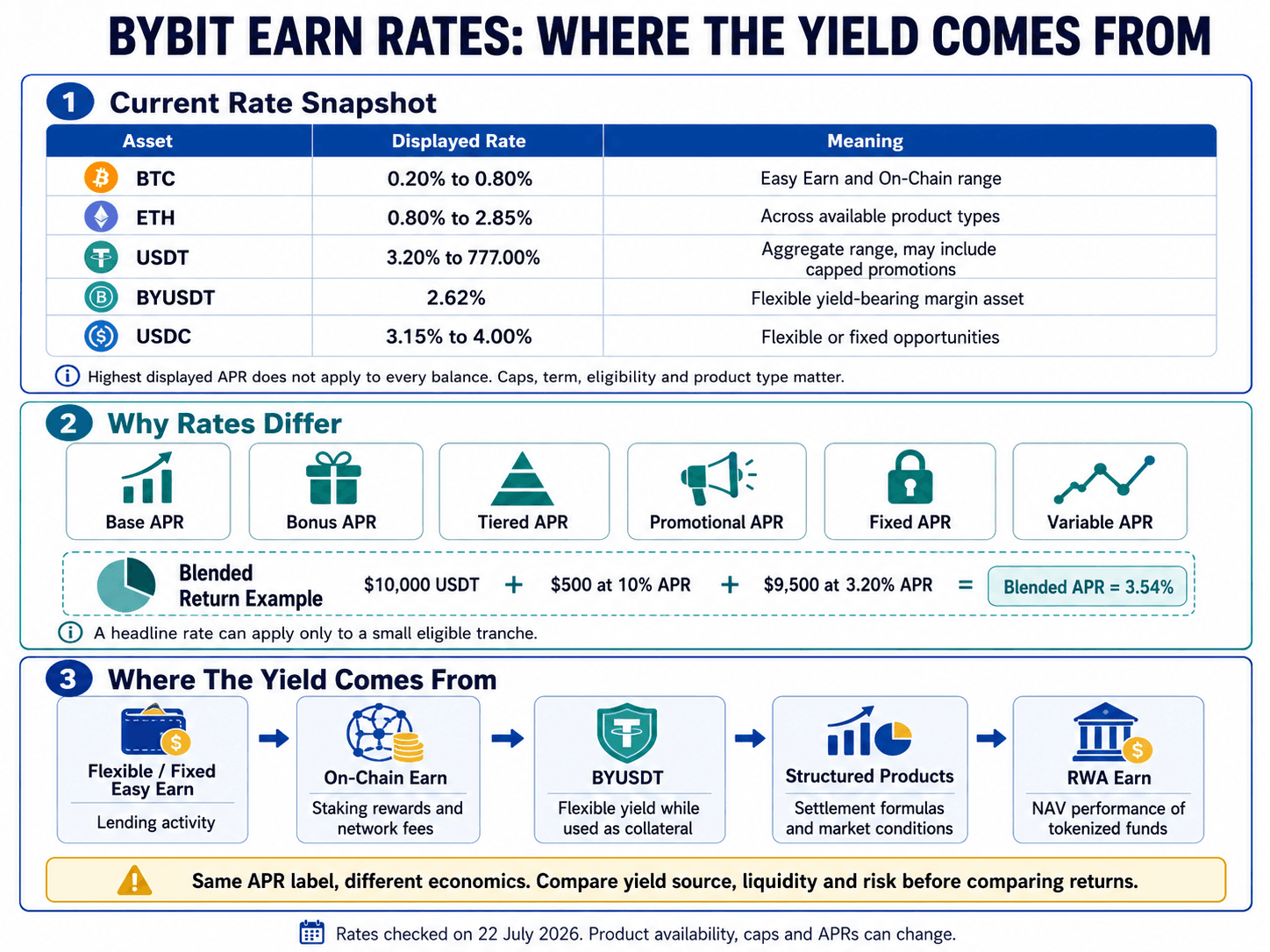
Bybit Earn rates cannot be compared without identifying the product behind each number. A savings APR, staking reward, structured-product APR and fund’s historical NAV return describe different economic outcomes.
 Tracing Bybit Earn Returns Back to Their Sources
Current Bybit Earn Rate Snapshot
Rates checked on July 24, 2026. Product availability, caps and APRs can change.
| Asset | Displayed Range or Rate | What the Figure Represents |
|---|---|---|
| BTC | 0.20% to 0.80% | Range across displayed Easy Earn and On-Chain Earn offers |
| ETH | 0.80% to 2.85% | Range across available product types |
| USDT | 3.20% to 777.00% | Aggregate range that may include capped or promotional products |
| BYUSDT | 2.62% | Flexible yield-bearing margin asset |
| USDC | 3.15% to 4.00% | Range across displayed flexible or fixed opportunities |
The live Bybit Earn page grouped several products into these ranges. It did not imply that every balance qualified for the highest figure. A user must open the offer and confirm its product type, maximum eligible balance, duration, redemption terms and settlement risk.
For readers holding stablecoins, the yield decision still includes issuer and depeg exposure. An exchange APR does not transform USDT or USDC into an insured cash deposit.
Understanding Base APR, Bonus APR and Promotional Caps
APR expresses a simple annualized rate. APY assumes compounding over the year. Bybit commonly displays APR, so users cannot assume the headline already includes the effect of reinvesting rewards.
A product can contain several rate layers:
- Base APR: The ordinary variable or fixed rate.
- Bonus APR: An additional rate applied to an eligible portion of the balance.
- Tiered APR: Different balance bands receive different rates.
- Promotional APR: A temporary campaign rate that may have a small cap.
- Fixed APR: A rate locked when the subscription is confirmed.
- Variable APR: A rate that can rise or fall after subscription.
The highest advertised figure may apply only to the first few hundred dollars. The rest of the balance can earn the standard rate.
Consider a hypothetical $10,000 USDT subscription:
- First $500 earns a 10% promotional APR.
- Remaining $9,500 earns a 3.20% base APR.
- Annualized promotional reward: $50.
- Annualized base reward: $304.
- Total annualized reward: $354.
- Blended APR: 3.54%, not 10%.
If those rates remained unchanged, the estimated reward would be roughly $6.79 over seven days or $29.10 over 30 days. The 10% headline is accurate for the eligible tranche, but unrepresentative of the whole deposit.
What Could $1,000 Earn?
The table below uses current reference rates where a simple calculation is possible. It does not predict future returns.
| Product Type | Starting Amount | Holding Period | Illustrative Reward | Possible Non-Yield Outcome |
|---|---|---|---|---|
| Flexible Easy Earn | $1,000 at 3.20% APR | 30 days | About $2.63 in token terms | APR can change |
| Fixed Easy Earn | $1,000 at 4.00% APR | 30 days | About $3.29 in token terms | Capital may remain locked |
| On-Chain Earn | $1,000 equivalent at 2.85% APR | 30 days | About $2.34 in the reward asset | Token price, validator or protocol loss |
| Dual Asset | $1,000 | Until settlement | Depends on APR and settlement | User may receive another asset |
| RWA Earn | $1,000 or eligible minimum | NAV dependent | Cannot be fixed in advance | NAV can decline |
The first three estimates use principal × APR × days ÷ 365. Actual accrual can differ because rates change, reward calculation may start after subscription, product caps may apply and the token’s dollar value can move.
Dual Asset cannot be evaluated from APR alone. A small yield received alongside an unwanted conversion can produce a worse result than simply holding the original asset. RWA Earn is also unsuitable for a fixed-interest calculation because performance is reflected through NAV.
Compounding, Fees and Realized Returns
Compounding depends on whether rewards are reinvested. Auto Reinvest can return eligible proceeds to another subscription, while Auto-Earn moves idle eligible assets into Flexible Easy Earn. Neither feature guarantees a stable compounding rate because the future APR may differ.
Reward timing also varies:
- Flexible Easy Earn: Uses recurring accrual and distribution cycles.
- Fixed products: Pay according to the selected term.
- On-Chain Earn: Follows the network’s payout and unbonding schedule.
- BYUSDT: Calculates yield hourly and distributes it daily.
- Structured products: Settle after their defined expiry or early-redemption calculation.
- RWA Earn: Reflects returns through NAV changes, which are realized when the position is redeemed.
Standard Easy Earn management charges are already included in the displayed APR. Other products may include manager expenses, transaction costs, conversion spreads or product-specific charges. RWA fund expenses, for example, reduce NAV rather than appearing as a separate daily deduction.
Realized return should be measured in both token and fiat terms. Earning 3% more ETH does not create a positive dollar return if ETH falls 30%. Stablecoin yield can also be overwhelmed by a depeg, issuer failure or blocked redemption.
Is Bybit Earn Safe?
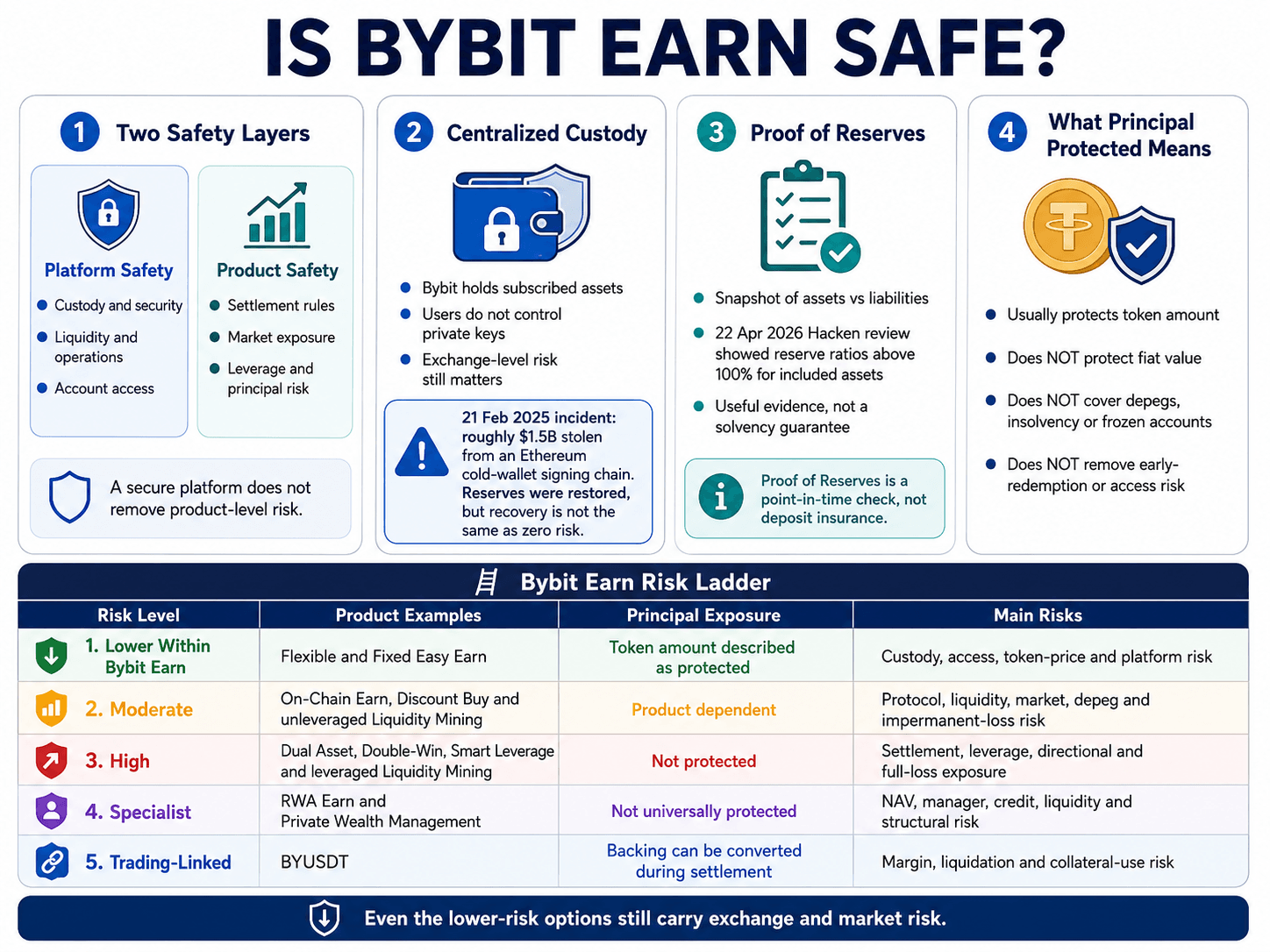
Bybit Earn safety depends on two separate layers: whether Bybit remains secure, liquid and operational, and whether the selected product behaves as the user expects. A platform can survive an attack while a user still loses money through leverage, settlement or market exposure.
 Bybit Earn Safety Depends on Platform and Product Risk
Centralized Custody and Bybit’s Security Record
Bybit holds custody of assets subscribed to Earn. Users do not control the private keys while their funds remain on the exchange.
The custody model became impossible to ignore after the Feb. 21, 2025, theft, when attackers manipulated a transaction-signing process involving Bybit’s Ethereum cold wallet and Safe{Wallet} infrastructure. Roughly $1.5 billion in assets was stolen. The incident was an exchange-level custody and signing-chain failure.
Bybit continued processing withdrawals and restored reserve coverage using a combination of bridge loans, deposits and OTC purchases. The ETH deficit was covered within two days. That response prevented a customer haircut, but replenishing reserves is different from recovering every stolen asset.
The recovery demonstrated operational capacity and industry access during a crisis. It cannot prove that a future custody event, liquidity shock or compliance restriction would resolve the same way.
Proof of Reserves and Its Limits
Bybit publishes Proof of Reserves to show that wallets controlled by the exchange contain enough in-scope assets to cover corresponding user liabilities at a specific point in time.
The April 22, 2026, Hacken assessment reviewed wallet ownership, user liabilities and Merkle-tree data covering more than 65 million liability holders. Every asset included in the assessment showed a reserve ratio above 100%.
The process gives users three useful checks:
- Wallet ownership: The assessor verifies that Bybit controls the disclosed addresses.
- Liability inclusion: Customer balances are aggregated into the liability calculation.
- Merkle verification: Individual users can test whether their balances were included without exposing the full database.
The assessment was not a comprehensive audit of Bybit’s complete assets, liabilities or financial condition. Proof of Reserves remains a snapshot. It does not reveal every corporate obligation, guarantee future liquidity or provide deposit insurance.
A fully backed snapshot can coexist with legal liabilities, operational risk or losses that emerge after the assessment date. Proof of Reserves is useful evidence, not a solvency guarantee.
What "Principal Protected" Actually Means
On Bybit, principal protection generally refers to the amount of the subscribed token, not its market value in dollars and not protection against every form of platform loss.
A subscription of 1 ETH into a principal-protected Easy Earn product is intended to return at least 1 ETH. If ETH loses half its dollar value, the product can still satisfy that promise while the investor records a large fiat loss.
The term also does not protect against:
- A stablecoin losing its peg.
- Bybit becoming insolvent.
- An account being frozen during a security or compliance review.
- An attacker compromising the user’s account.
- Early-redemption penalties or forfeited rewards.
- Withdrawal delays or regional restrictions.
Users seeking direct key control need a hardware wallet or another carefully managed self-custody setup. That reduces exchange custody exposure but introduces seed-phrase and user-error risk.
Bybit Earn Risk Ladder
| Risk Level | Product Examples | Principal Exposure | Main Risks |
|---|---|---|---|
| Lower Within Bybit Earn | Flexible and Fixed Easy Earn | Token amount described as protected | Custody, access, token-price and platform risk |
| Moderate | On-Chain Earn, Discount Buy and unleveraged Liquidity Mining | Product dependent | Protocol, liquidity, market, depeg and impermanent-loss risk |
| High | Dual Asset, Double-Win, Smart Leverage and leveraged Liquidity Mining | Not protected | Settlement, leverage, directional and full-loss exposure |
| Specialist | RWA Earn and Private Wealth Management | Not universally protected | NAV, manager, credit, liquidity and structural risk |
| Trading-Linked | BYUSDT | Backing can be converted during settlement | Margin, liquidation and collateral-use risk |
The ladder ranks products relative to one another. Flexible Easy Earn is simpler than Smart Leverage, but neither carries bank deposit protection.
How to Use Bybit Earn
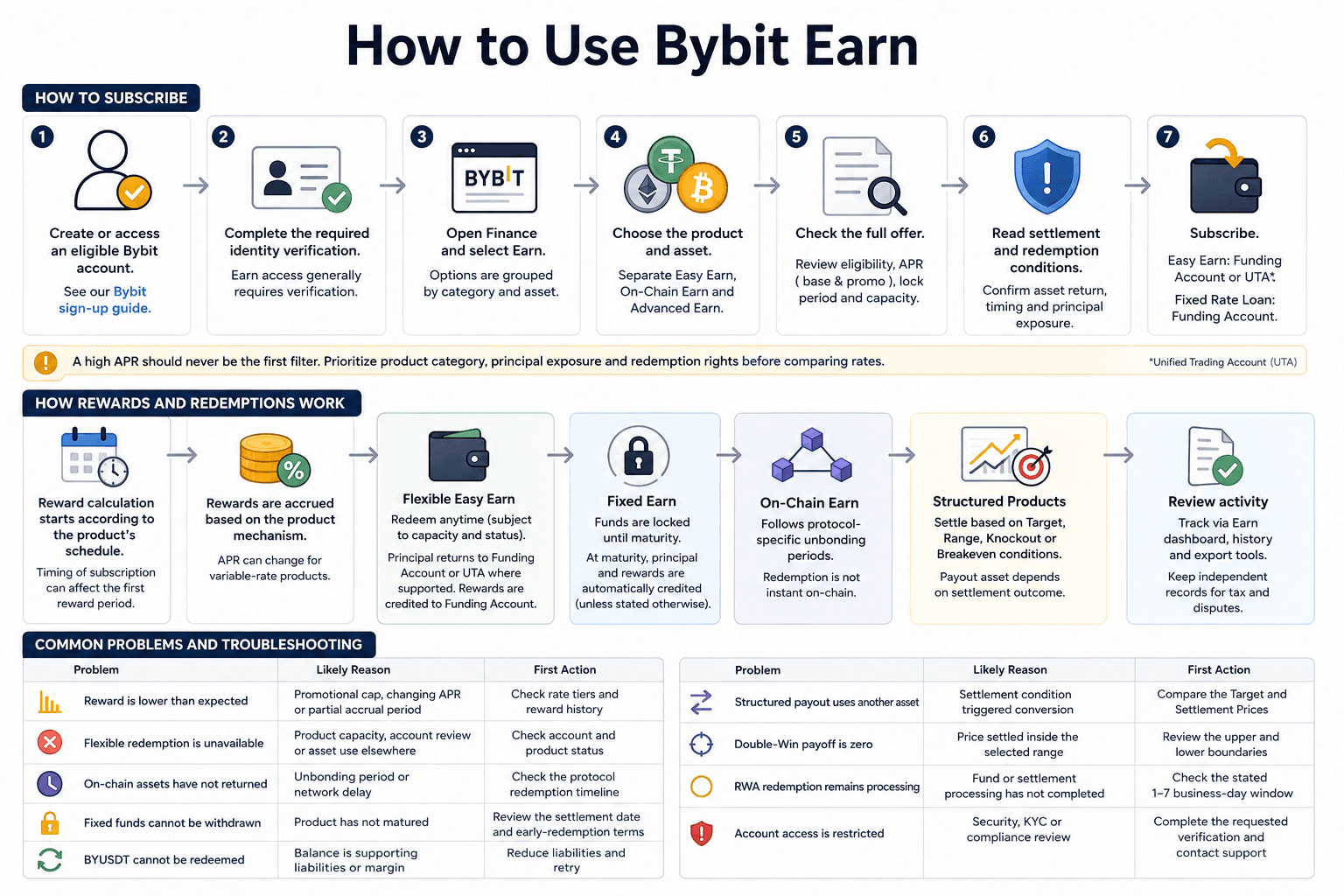
Using Bybit Earn is straightforward at interface level. The difficult part is choosing a product whose liquidity and loss mechanics match the user’s intent.
 Subscribing, Earning and Redeeming Funds Through Bybit Earn
How to Subscribe
- Create or access an eligible Bybit account.
- Complete the required identity verification. Earn access generally requires individual or business verification, subject to product-specific rules.
- Open Finance and select Earn. Bybit groups the available options by category, asset, term and displayed APR.
- Choose the product and asset. Separate Easy Earn, On-Chain Earn and Advanced Earn before comparing rates.
- Check the full offer. Review the eligible balance, base and promotional APR, lock period, pool capacity and risk disclosure.
- Read settlement and redemption conditions. Confirm which asset will be returned, when it becomes available and whether principal can be lost.
The Easy Earn subscription flow supports investment from the Funding Account and, for eligible products, the Unified Trading Account. Fixed Rate Loan products use the Funding Account.
A high APR should never be the first selection filter. Product category, principal exposure and redemption rights narrow the field before rate comparison begins.
How Rewards and Redemptions Work
Reward calculation begins according to the product’s own schedule. A subscription confirmed moments before a daily calculation cut-off may produce a different first reward period from one placed moments after it.
Flexible Easy Earn normally allows redemption before a fixed maturity. Principal can return to the Funding Account or UTA where supported, while rewards are credited to the Funding Account. At maturity, fixed-product principal and rewards are automatically credited unless the specific product follows different settlement rules.
On-Chain Earn redemptions follow protocol-specific unbonding. An interface confirmation does not make a blockchain exit instantaneous. Structured products settle according to Target Prices, ranges, Knockout Prices or Breakeven Prices. RWA redemptions enter a processing flow that can take several business days.
Users can review activity through the Earn dashboard, transaction history and account export tools. Keeping independent records remains useful for tax calculations and dispute resolution.
Common Problems and Troubleshooting
| Problem | Likely Reason | First Action |
|---|---|---|
| Reward is lower than expected | Promotional cap, changing APR or partial accrual period | Check rate tiers and reward history |
| Flexible redemption is unavailable | Product capacity, account review or asset use elsewhere | Check account and product status |
| On-chain assets have not returned | Unbonding period or network delay | Check the protocol redemption timeline |
| Fixed funds cannot be withdrawn | Product has not matured | Review the settlement date and early-redemption terms |
| BYUSDT cannot be redeemed | Balance is supporting liabilities or margin | Reduce liabilities and retry |
| Structured payout uses another asset | Settlement condition triggered conversion | Compare the Target and Settlement Prices |
| Double-Win payoff is zero | Price settled inside the selected range | Review the upper and lower boundaries |
| RWA redemption remains processing | Fund or settlement processing has not completed | Check the stated one-to-seven-business-day window |
| Account access is restricted | Security, KYC or compliance review | Complete the requested verification and contact support |
Bybit Earn Eligibility, KYC and Regional Availability
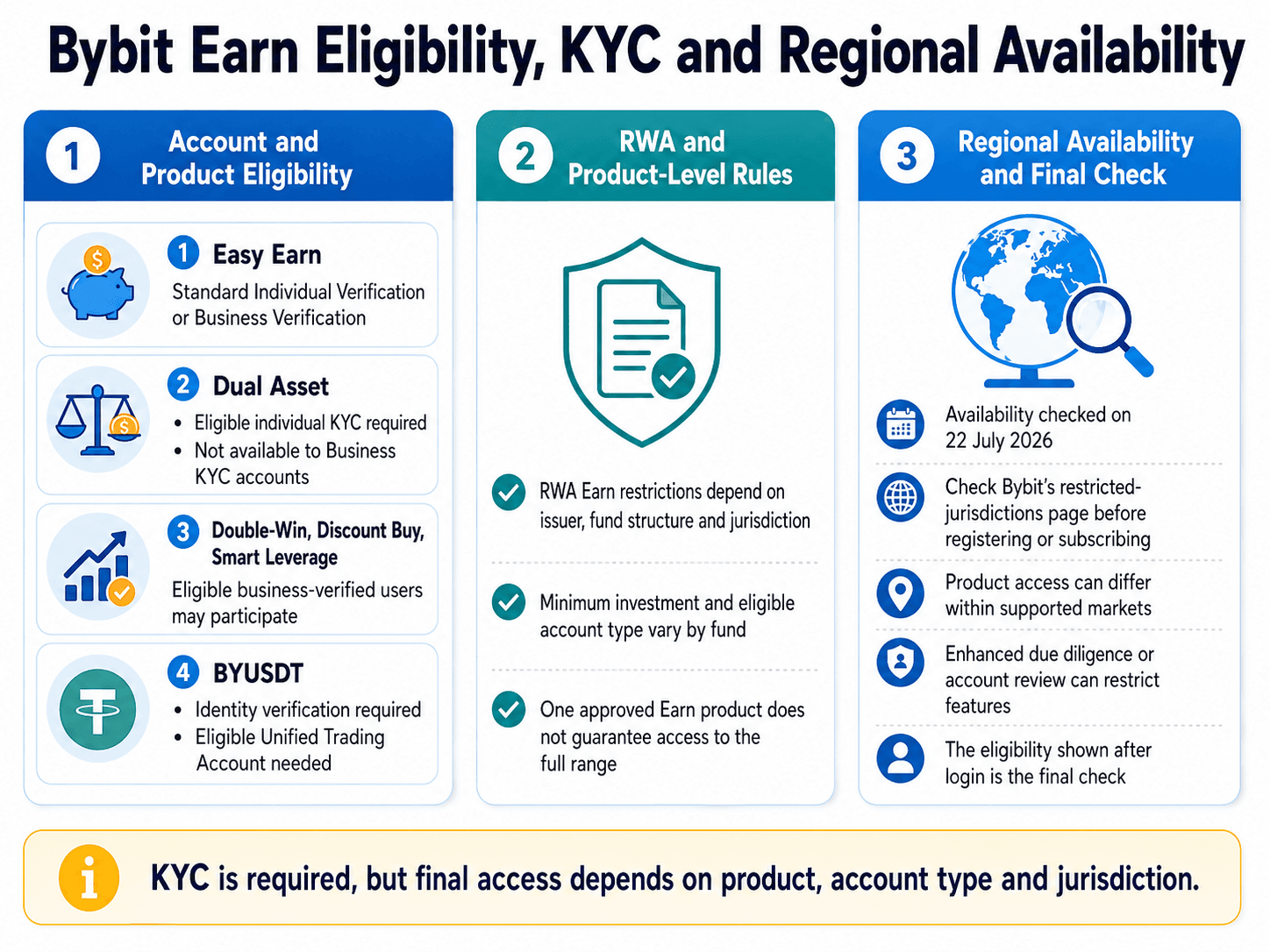
Bybit Earn requires identity verification, while eligibility can differ by account type, product and jurisdiction.
 Bybit Earn Access Depends on KYC and Location
Easy Earn supports Standard Individual Verification or Business Verification. Dual Asset requires eligible individual KYC and is unavailable to Business KYC accounts. Double-Win, Discount Buy and Smart Leverage currently state that eligible business-verified users may participate. These account requirements vary by product, so one approved Earn subscription does not guarantee access to the entire range.
BYUSDT requires identity verification and an eligible Unified Trading Account. Its functionality also depends on the user’s margin mode, account configuration and regional access.
RWA Earn applies product and jurisdiction restrictions linked to the issuer, fund structure and investor requirements. Minimum investment amounts and eligible account types can vary between funds.
For context on why exchanges collect identity and source-of-funds information, our guide to KYC and AML explains the compliance framework and its effect on account access.
A static country list would age quickly and may obscure product-level restrictions. The eligibility shown after login is the relevant final check.
Bybit Earn vs Binance Earn, OKX Earn and Native Staking
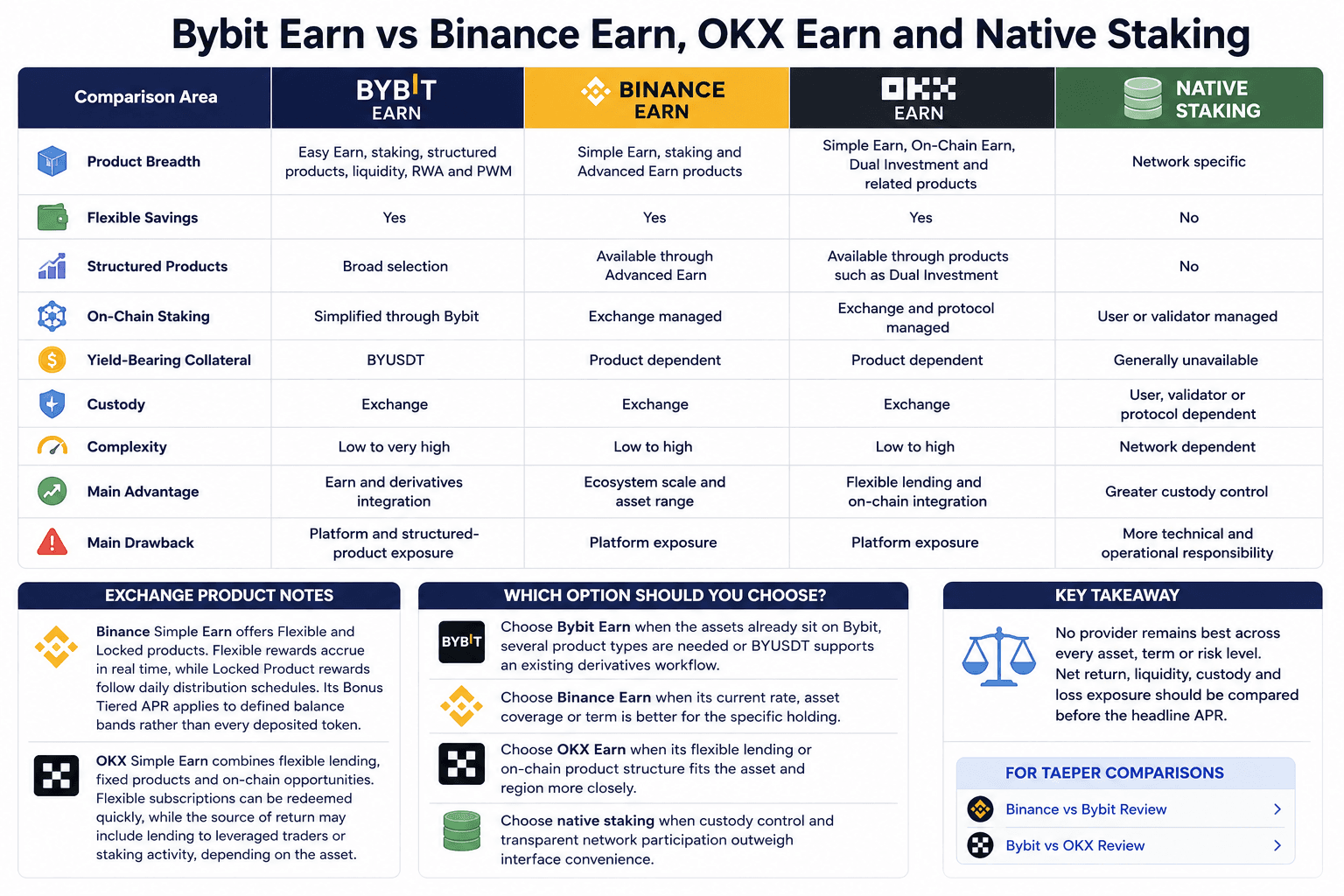
Bybit Earn compares well on product breadth and trading integration. It does not consistently offer the best rate for every asset, term or risk level.
 Comparing Bybit, Binance, OKX and Native Staking Options
| Comparison Area | Bybit Earn | Binance Earn | OKX Earn | Native Staking |
|---|---|---|---|---|
| Product Breadth | Easy Earn, staking, structured products, liquidity, RWA and PWM | Simple Earn, staking and Advanced Earn products | Simple Earn, On-Chain Earn, Dual Investment and related products | Network specific |
| Flexible Savings | Yes | Yes | Yes | No |
| Structured Products | Broad selection | Available through Advanced Earn | Available through products such as Dual Investment | No |
| On-Chain Staking | Simplified through Bybit | Exchange managed | Exchange and protocol managed | User or validator managed |
| Yield-Bearing Collateral | BYUSDT | Product dependent | Product dependent | Generally unavailable |
| Custody | Exchange | Exchange | Exchange | User, validator or protocol dependent |
| Complexity | Low to very high | Low to high | Low to high | Network dependent |
| Main Advantage | Earn and derivatives integration | Ecosystem scale and asset range | Flexible lending and on-chain integration | Greater custody control |
| Main Drawback | Platform and structured-product exposure | Platform exposure | Platform exposure | More technical and operational responsibility |
Binance Simple Earn offers Flexible and Locked products. Flexible rewards currently accrue in real time, while Locked Product rewards follow daily distribution schedules. Its Bonus Tiered APR applies to defined balance bands rather than every deposited token.
OKX Simple Earn combines flexible lending, fixed products and on-chain opportunities. Flexible subscriptions can be redeemed quickly, while the source of return may include lending to leveraged traders or staking activity, depending on the asset.
The practical choices are:
- Choose Bybit Earn when the assets already sit on Bybit, several product types are needed or BYUSDT supports an existing derivatives workflow.
- Choose Binance Earn when its current rate, asset coverage or term is better for the specific holding.
- Choose OKX Earn when its flexible lending or on-chain product structure fits the asset and region more closely.
- Choose native staking when custody control and transparent network participation outweigh interface convenience.
For deeper exchange-level comparisons, see our Binance vs Bybit and Bybit vs OKX reviews.
No provider remains best across every asset. Net return, liquidity, custody and loss exposure should be compared before the headline APR.
Who Is Bybit Earn Best For?
Bybit Earn is best suited to users who already have a reason to hold an operating balance on Bybit and can separate simple yield products from speculative ones.
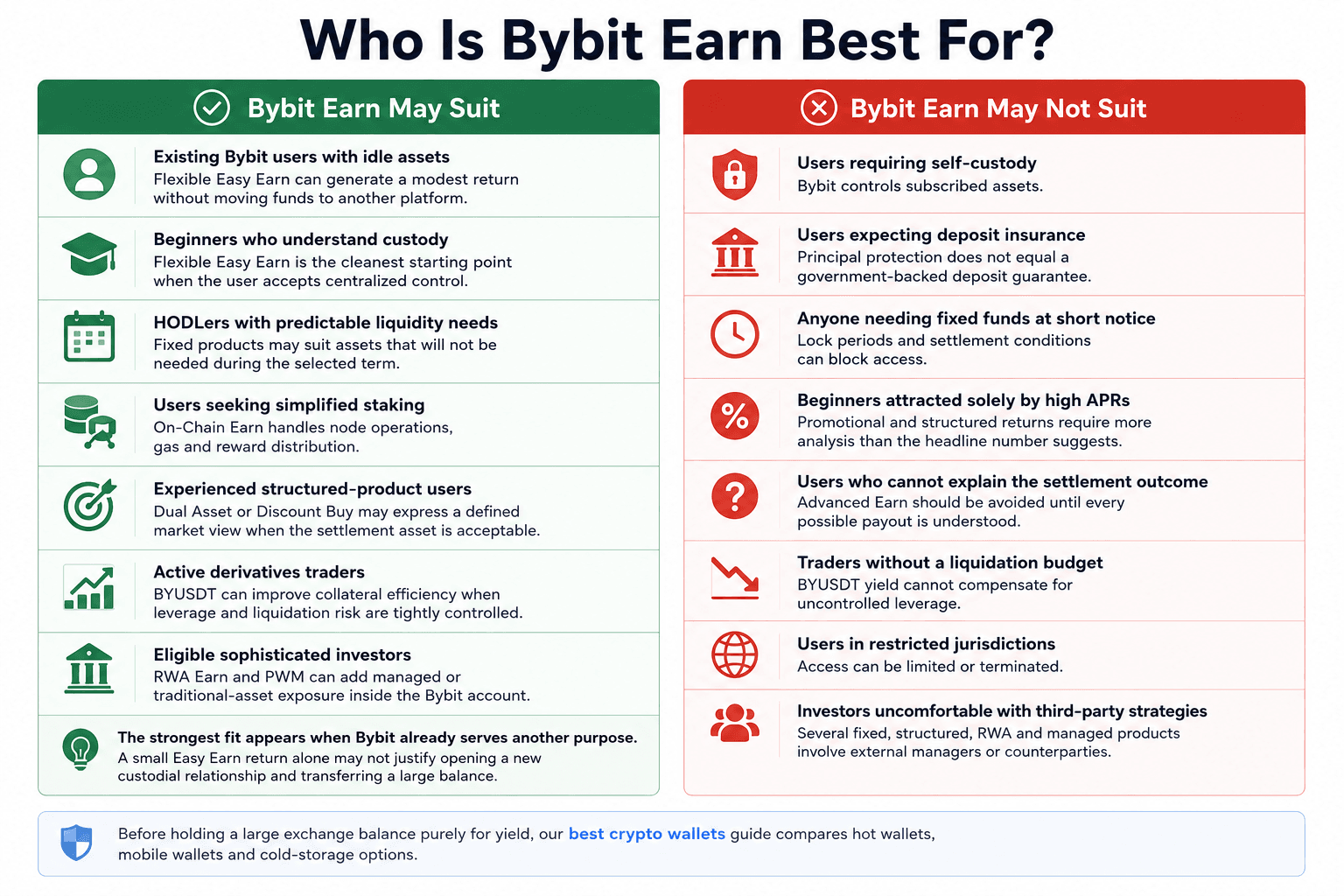 Matching Bybit Earn Products to Different Investor Profiles
Bybit Earn May Suit
- Existing Bybit users with idle assets: Flexible Easy Earn can generate a modest return without moving funds to another platform.
- Beginners who understand custody: Flexible Easy Earn is the cleanest starting point when the user accepts centralized control.
- HODLers with predictable liquidity needs: Fixed products may suit assets that will not be needed during the selected term.
- Users seeking simplified staking: On-Chain Earn handles node operations, gas and reward distribution.
- Experienced structured-product users: Dual Asset or Discount Buy may express a defined market view when the settlement asset is acceptable.
- Active derivatives traders: BYUSDT can improve collateral efficiency when leverage and liquidation risk are tightly controlled.
- Eligible sophisticated investors: RWA Earn and PWM can add managed or traditional-asset exposure inside the Bybit account.
The strongest fit appears when Bybit already serves another purpose. A small Easy Earn return alone may not justify opening a new custodial relationship and transferring a large balance.
Bybit Earn May Not Suit
- Users requiring self-custody: Bybit controls subscribed assets.
- Users expecting deposit insurance: Principal protection does not equal a government-backed deposit guarantee.
- Anyone needing fixed funds at short notice: Lock periods and settlement conditions can block access.
- Beginners attracted solely by high APRs: Promotional and structured returns require more analysis than the headline number suggests.
- Users who cannot explain the settlement outcome: Advanced Earn should be avoided until every possible payout is understood.
- Traders without a liquidation budget: BYUSDT yield cannot compensate for uncontrolled leverage.
- Users in restricted jurisdictions: Access can be limited or terminated.
- Investors uncomfortable with third-party strategies: Several fixed, structured, RWA and managed products involve external managers or counterparties.

Final Verdict: Is Bybit Earn Worth It?
Bybit Earn is worthwhile when the user chooses a product by its actual return source and loss mechanics rather than its advertised APR.
- For simple yield, Easy Earn can be useful for existing Bybit users, provided the rate justifies centralized custody. Flexible plans preserve more access, while fixed plans suit balances that can remain locked. Principal protection refers to token quantity and does not remove market, stablecoin or platform risk.
- For staking, On-Chain Earn reduces technical friction. Bybit manages nodes, gas and reward distribution, but users add exchange custody to the normal validator, protocol and token risks.
- For traders, BYUSDT is the most distinctive product in the range. Earning on margin collateral improves capital efficiency, although the underlying yield is small beside the possible loss from leveraged positions.
- Dual Asset, Double-Win, Discount Buy and Smart Leverage should be judged as structured trades. They can serve specific market views, but their annualized APRs do not make them passive savings. Double-Win and Smart Leverage can lose the entire investment.
- RWA Earn broadens the platform’s investment range through tokenized bond funds and credit strategies. Its returns remain NAV based, historical and exposed to asset-manager, credit, liquidity and structural risk.
Bybit Earn offers impressive range and strong convenience for existing customers. Its main weakness is architectural: one Earn dashboard contains products ranging from comparatively simple flexible yield to full-loss structured exposure.