Cosmos helped pioneer the application-specific blockchain model and remains one of crypto’s most established interoperability stacks.
Evaluating Cosmos technology today is not the same as evaluating ATOM. The Cosmos Stack can gain adoption without driving equivalent activity to Cosmos Hub, and Cosmos Hub growth does not automatically translate into stronger value capture for ATOM.
This review examines how Cosmos works today, what gives ATOM value and whether wider Cosmos adoption actually translates into stronger demand for the token.
Editor's Note (Sept. 22, 2026): We fully updated this Cosmos review in September 2026 to reflect major changes across Cosmos Hub and the wider ecosystem. The update includes the removal of Interchain Security, the latest ATOM supply, inflation and staking data, ongoing tokenomics research, Cosmos EVM, IBC v2 and Eureka, and a clearer assessment of whether growth across the Cosmos Stack translates into value for ATOM.
Cosmos Review 2026: Quick Verdict
Cosmos remains one of crypto's most established stacks for building sovereign, interoperable blockchains. That adoption of the Cosmos Stack and IBC does not automatically translate into demand for ATOM, making Cosmos Hub usage, tokenomics and value capture central to the investment thesis.
Key Takeaways on Cosmos
-
Cosmos and ATOM are not the same investment thesis Cosmos is the wider blockchain technology ecosystem, while ATOM is the native asset of Cosmos Hub. A chain can use Cosmos technology without using ATOM.
-
The Cosmos Stack remains widely adopted Cosmos SDK, CometBFT, IBC, and newer Cosmos EVM tooling give developers a mature framework for building application-specific blockchains with their own execution and economics.
-
IBC is expanding beyond Cosmos-native chains IBC v2 and IBC Eureka are extending interoperability toward Ethereum, while current development is also targeting Solana and broader EVM and Layer 2 environments.
-
ATOM's clearest utility is still on Cosmos Hub ATOM secures the Hub through staking, carries governance rights, and is used for transaction fees. DeFi uses outside the Hub depend on third-party applications.
-
ATOM remains inflationary ATOM has no fixed maximum supply. Inflation currently operates within a 7% to 10% range, with the rate responding to how much supply is bonded.
-
Staking rewards come with real tradeoffs Delegators can earn rewards and participate in governance, but staking involves validator risk, slashing exposure, and a 21-day unbonding period.
-
Interchain Security is no longer the Hub's growth thesis Cosmos Hub removed the ICS provider module in 2026 after consumer-chain adoption and economics failed to justify its operational complexity.
-
ATOM tokenomics are being reconsidered Gauntlet is researching possible changes to issuance and staking incentives, but no replacement monetary model has been approved as of September 2026.
-
Value capture remains the central risk Cosmos technology can keep growing without creating equivalent demand for ATOM. Future Hub products therefore need to produce measurable usage, fees, or token demand to strengthen the thesis.
Disclaimer
This guide is for educational purposes only and is not financial advice. Cosmos, ATOM, staking, validators, bridges, wallets, DeFi applications and future tokenomics changes can involve risks. Always understand asset risks before using or investing in crypto.
Disclosure
Some links in this guide may be affiliate links. If you choose to use a service through these links, we may earn a commission at no additional cost to you.
Cosmos (ATOM) at a Glance
| Field | Cosmos |
|---|---|
| Project | Cosmos |
| Native asset | ATOM |
| Primary network | Cosmos Hub |
| Blockchain framework | Cosmos SDK |
| Consensus | Proof of Stake with CometBFT Byzantine Fault Tolerant consensus |
| Interoperability protocol | Inter-Blockchain Communication protocol (IBC) |
| ATOM primary uses | Staking, securing Cosmos Hub, governance and transaction fees |
| Supply model | Inflationary with no fixed maximum supply |
| Current inflation | 10% as of Sept. 22, 2026; protocol parameters currently allow a 7% minimum and 10% maximum, targeting a 67% bonded ratio (Valopers Explorer) |
| Staking | Yes; latest available network snapshot showed approximately 15.51% staking APR and 63.17% of supply bonded on Sept. 22, 2026 (Valopers Explorer) |
| Unbonding period | 21 days |
| Governance | On-chain governance in which staked ATOM holders can vote on proposals and protocol changes |
| Current validator set | 180 active validators as of Sept. 22, 2026 (Cosmos Hub Forum) |
| Key strength | Mature application-specific blockchain stack with established cross-chain interoperability through IBC |
| Main risk | Adoption of the Cosmos Stack and IBC does not automatically create demand or value capture for ATOM |
What Is Cosmos and What Is ATOM?
Cosmos is a family of blockchain technologies designed around sovereign, application-specific chains that can communicate with one another. ATOM, meanwhile, is not the token of every Cosmos-based blockchain. It is the native asset of Cosmos Hub, one chain within the wider Cosmos ecosystem.
Cosmos vs Cosmos Hub vs ATOM
| Term | What It Is |
|---|---|
| Cosmos | The broader ecosystem and technology family built around interoperable, application-specific blockchains |
| Cosmos Stack | The software stack used to build sovereign blockchains, including the Cosmos SDK, CometBFT and IBC |
| Cosmos Hub | A Proof-of-Stake blockchain built using the Cosmos Stack |
| ATOM | The native asset of Cosmos Hub, used for staking, governance and transaction fees |
A blockchain can use the Cosmos SDK or connect through IBC without using ATOM. Growth across the wider Cosmos ecosystem therefore does not automatically translate into greater demand for ATOM.
How the Cosmos Stack Works
The Cosmos Stack gives developers the components needed to build an application-specific blockchain rather than deploying applications directly on a shared general-purpose network.
Its main components are:
- Cosmos SDK: A modular framework for building application-specific blockchains.
- CometBFT: The consensus and networking engine that succeeded Tendermint Core terminology and provides Byzantine Fault Tolerant consensus.
- IBC: The interoperability protocol that allows compatible blockchains to exchange assets and data.
- ABCI: The interface separating CometBFT's consensus engine from the blockchain's application logic.
This architecture allows each Cosmos-based appchain to control areas such as execution, governance, validator economics and fees instead of inheriting all of those rules from a single underlying chain.
Cosmos EVM and the Evolution of the Stack
Cosmos EVM adds Ethereum Virtual Machine compatibility to the Cosmos Stack, allowing developers to build EVM-based applications while retaining the customization of a Cosmos chain. Cosmos says more than 200 chains have been built using its technology, with current development focused on higher performance, broader interoperability and enterprise functionality.
The 2026 roadmap is also pushing IBC beyond traditional Cosmos chains. Current work includes connectivity with Solana and broader EVM/L2 environments, alongside performance targets and improvements to Cosmos EVM itself.
What Gives ATOM Value?
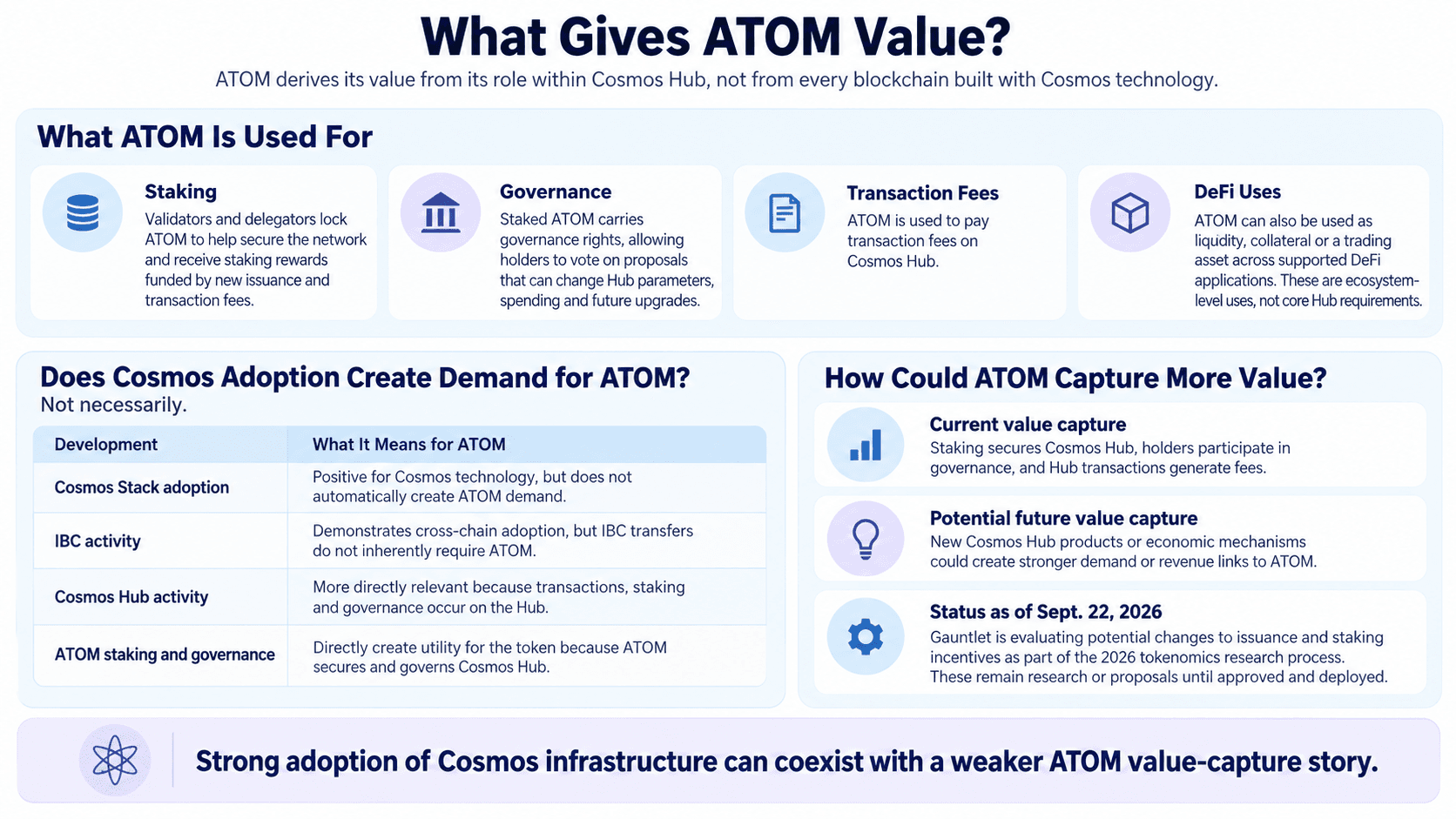
ATOM derives its value from its role within Cosmos Hub, not from every blockchain built with Cosmos technology. Its strongest existing utilities are staking, governance and paying transaction fees on the Hub, while broader uses in DeFi depend on third-party applications rather than the Cosmos protocol itself.
 ATOM Utility Comes From Staking, Governance, Hub Fees And Direct Cosmos Hub Activity
What ATOM Is Used For
ATOM is the staking asset of Cosmos Hub. Validators and delegators lock ATOM to help secure the network and receive staking rewards funded by new issuance and transaction fees. Staked ATOM also carries governance rights, allowing holders to vote on proposals that can change Hub parameters, spending and future upgrades.
ATOM can also be used as liquidity, collateral or a trading asset across supported DeFi applications. These are ecosystem-level uses, however, rather than core requirements of Cosmos Hub.
Does Cosmos Adoption Create Demand for ATOM?
Not necessarily.
A blockchain can use the Cosmos SDK, CometBFT or IBC without making ATOM part of its economy. That means different kinds of Cosmos adoption have very different implications for the token:
- Cosmos Stack adoption: Positive for Cosmos technology, but does not automatically create ATOM demand.
- IBC activity: Demonstrates cross-chain adoption, but IBC transfers do not inherently require ATOM.
- Cosmos Hub activity: More directly relevant because transactions, staking and governance occur on the Hub.
- ATOM staking and governance: Directly create utility for the token because ATOM secures and governs Cosmos Hub.
This is why strong adoption of Cosmos infrastructure can coexist with a weaker ATOM value-capture story.
How Could ATOM Capture More Value?
ATOM's current value-capture mechanisms are straightforward: staking secures Cosmos Hub, holders participate in governance, and Hub transactions generate fees distributed through the network's economic model.
Beyond that, the picture is still evolving. Cosmos Hub is exploring new products and economic mechanisms that could create stronger demand or revenue links to ATOM, while Gauntlet is evaluating potential changes to issuance and staking incentives as part of the 2026 tokenomics research process. As of Sept. 22, 2026, these remain research or proposals until approved and deployed.
ATOM Tokenomics: Supply, Inflation and the 2026 Redesign
ATOM does not have a fixed maximum supply. New ATOM is issued to help fund staking rewards and maintain Cosmos Hub security, with inflation adjusting according to the share of supply that is bonded within governance-set parameters.
Proposal 848 changed those parameters in November 2023 by reducing ATOM's maximum inflation rate from 20% to 10%. The current protocol range is 7% to 10%, with inflation adjusting toward a target bonded ratio of 67%.
ATOM Supply and Inflation
As of Sept. 22, 2026, ATOM's circulating supply was approximately 532.02 million, with total supply at roughly 532.02 million, according to CoinGecko. There is no hard maximum supply.
| Metric | Sept. 22, 2026 |
|---|---|
| Circulating supply | ~532.02 million ATOM |
| Total supply | ~532.02 million ATOM |
| Inflation | 10.00% |
| Staking APR | 15.51%* |
| Bonded ratio | 63.17%* |
| Active validators | 180 |
| Inflation floor | 7% |
| Inflation ceiling | 10% |
| Target bonded ratio | 67% |
*Latest available Cosmos Hub network snapshot was Sept. 22, 2026 via Valopers. It recorded 336.01 million bonded ATOM from a supply of 531.88 million. Because the bonded ratio remains below the 67% target, inflation is currently at its 10% ceiling.
Staking APR vs Inflation
ATOM's staking APR and inflation rate are not the same thing. Inflation measures how quickly the overall ATOM supply grows, while staking APR estimates the rewards distributed to the portion of ATOM that is actually staked.
With around 63% of supply bonded, staking rewards are concentrated among that smaller pool, which is why the nominal staking APR can exceed the 10% inflation rate. Validator commission also reduces the amount ultimately received by individual delegators.
For example, at a 15.51% headline APR, a validator charging 5% commission would leave a delegator with roughly 14.73% before other considerations. But because the ATOM supply is simultaneously expanding at 10%, that does not mean the holder's share of the overall network has increased by 14.73%.
The other side of this mechanism is dilution. ATOM holders who remain unstaked receive no staking rewards while the total supply continues increasing.
What Is Changing About ATOM Tokenomics?
Cosmos Hub is researching another redesign of ATOM's economics, but no replacement monetary model has been approved.
The work is being conducted with Gauntlet. Phase 1 examined ATOM holder and staking behavior, while Phase 2 is testing potential issuance and reward mechanisms against that data. Ideas evaluated during the process have included usage-linked issuance, longer-duration staking incentives and mechanisms aimed at reducing validator concentration.
As of the Sept. 10, 2026, update, the Phase 2 mechanism-design report was nearing completion. Cosmos Hub said any recommendation that turns into an actual parameter change would still need to pass through governance.
What Is Live vs What Is Proposed?
| Tokenomics Component | Status |
|---|---|
| Current dynamic inflation model | Live |
| Proposal 848 10% inflation ceiling | Live |
| ATOM 2.0 issuance model | Rejected, never implemented |
| Gauntlet Phase 2 mechanism design | Under research |
| Future issuance or reward changes | Possible, subject to governance |
ATOM Staking: Rewards, Unbonding and Risks
Staking is one of ATOM's clearest existing utilities. Holders can delegate ATOM to Cosmos Hub validators, helping secure the network while earning rewards and retaining governance rights. As of Sept. 22, 2026, the network's nominal staking APR was about 15.51%, with roughly 63.17% of ATOM bonded.
How ATOM Staking Works
ATOM holders do not need to run a validator themselves. They can delegate tokens to one of Cosmos Hub's active validators, which participates in block production and consensus on their behalf.
Rewards come from ATOM issuance and network fees, with the validator taking its stated commission before rewards reach delegators. Staked ATOM also carries governance rights, and delegators can vote directly rather than relying on their validator's vote.
Unstaking is not immediate. Cosmos Hub currently has a 21-day unbonding period, during which the ATOM cannot be transferred or redeployed. The network also permits redelegation between validators, subject to protocol restrictions.
Choosing an ATOM Validator
Validator selection affects both rewards and network decentralization. Useful factors to check include:
- Commission: Higher commission reduces the delegator's net reward.
- Uptime: Frequent downtime can reduce rewards and expose the validator to penalties.
- Governance record: Validators can vote on Hub proposals using delegated voting power.
- Voting power: Automatically delegating to the largest validators can increase concentration.
- Slashing history: Past operational or signing failures can indicate additional risk.
Cosmos Hub currently supports up to 180 active validators. As of Sept. 22, 2026, Coinbase alone controlled about 20% of bonded voting power, according to Valopers data, illustrating why validator concentration is worth checking before delegating.
Wallets such as Keplr, Cosmostation and Leap provide interfaces for choosing and delegating to validators. For wallet options, see our best Cosmos wallets guide.
ATOM Staking Risks
Staking is not risk-free. Validators can be penalized for misbehavior or poor performance. Cosmos Hub parameters currently specify a 5% slash for double-signing and 0.01% for downtime, alongside temporary validator jailing for downtime.
There is also liquidity risk from the 21-day unbonding period, ATOM price risk, and dilution for holders who remain unstaked while supply expands. Liquid staking can improve liquidity but introduces smart-contract and protocol risk, while exchange staking adds custodial and counterparty risk.
| Staking Method | Main Benefit | Main Tradeoff |
|---|---|---|
| Native self-custody staking | Direct validator choice and governance participation | 21-day unbonding and validator risk |
| Exchange staking | Simpler user experience | Custodial risk and less direct control |
| Liquid staking | Keeps capital more liquid | Additional smart-contract and protocol risk |
What Happened to ATOM 2.0 and Interchain Security?
ATOM 2.0 was never an implemented Cosmos Hub upgrade. It was a 2022 proposal for a broader redesign of the Hub and ATOM's economics, while Interchain Security was a separate initiative that did launch before being removed from Cosmos Hub in 2026.
ATOM 2.0 Was a Proposal, Not an Upgrade
Proposal 82 outlined a new vision for Cosmos Hub built around the Interchain Scheduler, Interchain Allocator, expanded treasury structures and a redesigned ATOM issuance model. The proposal also envisioned a 36-month transition before issuance eventually settled at 300,000 ATOM per month.
However, Proposal 82 was rejected.
Interchain Security Launched, Then Cosmos Hub Removed It
Interchain Security, or ICS, launched in 2023 with a different objective. Cosmos Hub validators could extend the Hub's economic security to consumer chains, while those chains returned rewards to participating validators and delegators.
The model struggled to gain sufficient adoption. Cosmos Hub concluded that consumer-chain revenues did not justify the additional infrastructure, operational risk and technical complexity required from validators.
In 2026, the Hub began winding ICS down. Proposal 1052 introduced Gaia v28, which removed the ICS provider module from Cosmos Hub after the remaining consumer chains had offboarded. Voting on the upgrade closed on Sept. 1, 2026.
What the End of ICS Changes for ATOM
ICS had been one of the clearest attempts to extend ATOM's economic role beyond Cosmos Hub by using the Hub's validator set to secure other chains. Its removal eliminates that particular value-capture mechanism.
That does not mean the Cosmos Stack or IBC failed. Both operate independently of ICS and continue to develop. But for ATOM investors, the focus now shifts toward whether Cosmos Hub can create new sources of usage, fees and token demand through its next product strategy rather than relying on shared security as a growth engine.
The Cosmos Ecosystem: Adoption Without Assuming ATOM Value Capture
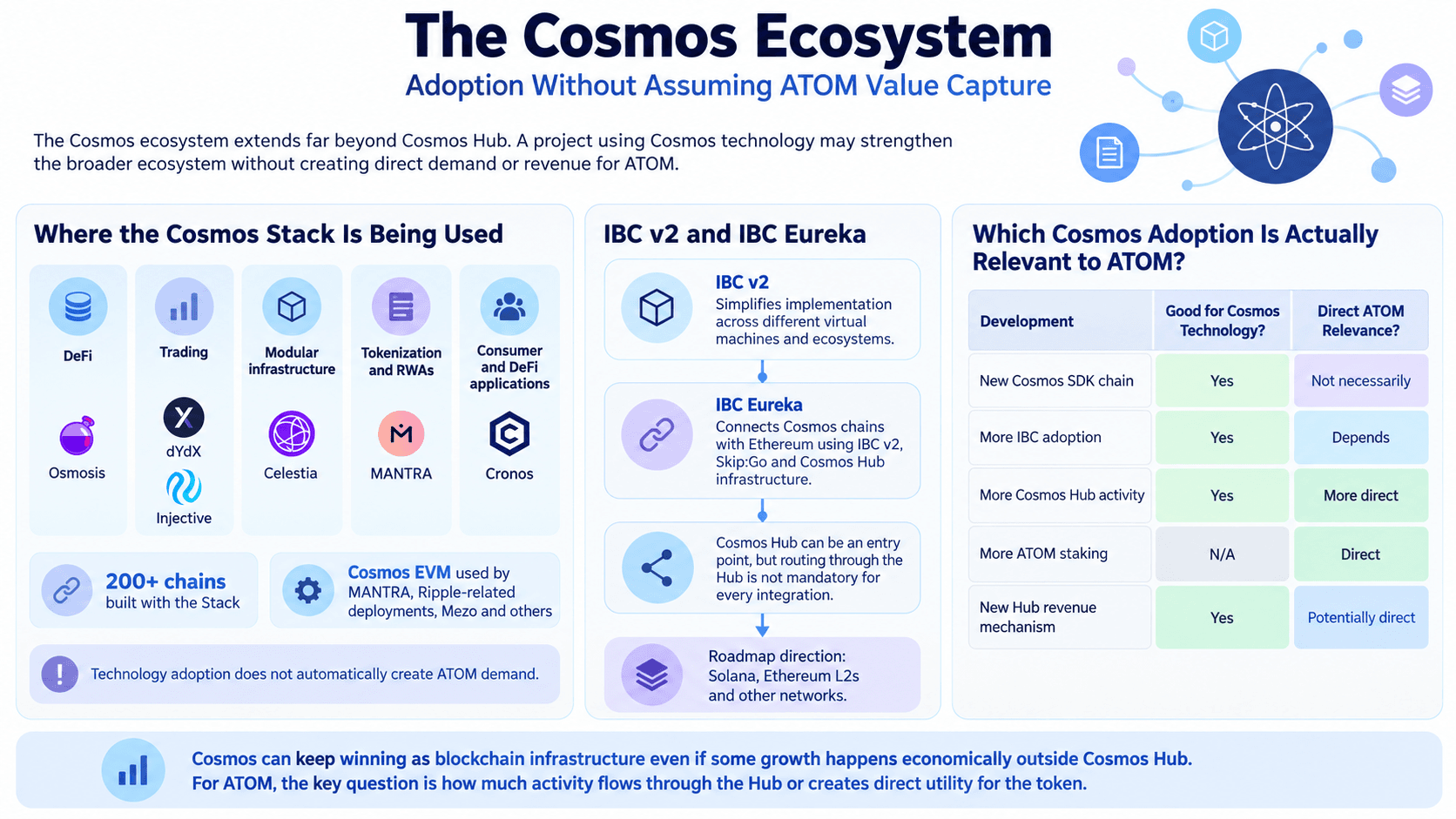
The Cosmos ecosystem extends far beyond Cosmos Hub. Hundreds of applications and chains use parts of the Cosmos Stack, but that adoption needs to be interpreted carefully. A project using Cosmos technology may strengthen the broader ecosystem without creating direct demand or revenue for ATOM.
 Cosmos Adoption Can Grow Across Chains Without Automatically Creating Direct Demand For ATOM
Where the Cosmos Stack Is Being Used
Cosmos technology is used across several major crypto verticals. Examples include Osmosis in DeFi, dYdX and Injective in trading, Celestia in modular blockchain infrastructure, MANTRA in tokenization and real-world assets, and Cronos across consumer and DeFi applications.
The Cosmos 2026 roadmap says more than 200 chains have been built using the Stack, while Cosmos EVM is already being used by networks including MANTRA, Ripple-related deployments, Mezo and others.
That demonstrates meaningful adoption of Cosmos technology. It does not, however, mean those chains generate revenue for Cosmos Hub or create direct demand for ATOM.
IBC v2 and IBC Eureka
IBC is also expanding beyond traditional Cosmos-native chains.
- IBC v2 simplifies the protocol by removing some of the connection and channel handshakes used by earlier versions, making it easier to implement across different virtual machines and ecosystems.
- IBC Eureka is the first major implementation of that model. It combines IBC v2, Skip:Go and Cosmos Hub infrastructure to connect Cosmos chains with Ethereum using light-client verification and one-click routing. Cosmos Hub can act as the entry point into the wider IBC network, although routing through the Hub is not mandatory for every integration.
The current roadmap extends that interoperability push toward Solana, Ethereum L2s and other networks.
Which Cosmos Adoption Is Actually Relevant to ATOM?
| Development | Good for Cosmos Technology? | Direct ATOM Relevance? | Why |
|---|---|---|---|
| New Cosmos SDK chain | Yes | Not necessarily | The chain can have independent tokens, fees and economics |
| More IBC adoption | Yes | Depends | IBC does not inherently require ATOM |
| More Cosmos Hub activity | Yes | More direct | Hub usage can generate fees and demand for Hub resources |
| More ATOM staking | N/A | Direct | ATOM secures Cosmos Hub and carries governance rights |
| New Hub revenue mechanism | Yes | Potentially direct | Depends on whether the design creates demand, fees or other value linked to ATOM |
Cosmos can continue winning as blockchain infrastructure even if some of that growth happens economically outside Cosmos Hub. For ATOM holders, the more important question is how much of that activity eventually flows through the Hub or creates direct utility for the token.
Cosmos vs Ethereum L2s and Polkadot
Cosmos, Ethereum L2s and Polkadot all support applications that need more flexibility and scale than a single general-purpose blockchain can provide, but they organize security, settlement and interoperability differently.
| Feature | Cosmos | Ethereum L2 Ecosystem | Polkadot |
|---|---|---|---|
| Core model | Sovereign appchains | Rollups settling to Ethereum | Parachains connected to Polkadot |
| Consensus/security | Typically chain-specific | Usually derive settlement/security from Ethereum | Shared security from Polkadot |
| Interoperability | IBC | Bridges and native rollup messaging vary | XCM |
| Customization | High | Moderate to high | High |
| Native token dependency | Cosmos chains do not need ATOM | ETH is commonly central to settlement and gas | DOT is central to Polkadot security, governance and coretime |
| Main tradeoff | Sovereignty with more fragmented economics | Shared settlement with added architectural complexity | Shared security within a more integrated ecosystem |
Ethereum rollups process transactions away from the base layer while relying on Ethereum for functions such as settlement and data availability.
Polkadot parachains instead connect to Polkadot's shared security model and communicate using XCM. Cosmos takes a more sovereign approach, allowing appchains to maintain their own economics and security while connecting through IBC.
Where Cosmos Is Strongest
Cosmos gives developers a high degree of sovereignty. Appchains can customize execution, fees, governance and economic design rather than inheriting a single shared set of rules.
The Cosmos Stack is also mature, with the Cosmos SDK, CometBFT and IBC providing modular components for building and connecting application-specific chains. IBC allows sovereign networks to exchange messages, assets and data without requiring them to share one execution environment.
Where the Tradeoffs Appear
That sovereignty also creates fragmentation. Separate Cosmos chains can have their own validators, tokens, liquidity and governance, making the ecosystem less economically unified than architectures built around a shared settlement or security layer.
This also feeds directly into ATOM's value-capture problem. A successful Cosmos appchain can use the Stack and IBC while remaining economically independent of Cosmos Hub and ATOM. Users and developers may also need to navigate multiple chains, wallets and liquidity venues rather than interacting with one unified network.
Cosmos therefore offers strong customization and sovereignty, while Ethereum L2s place greater emphasis on Ethereum settlement and Polkadot provides a more integrated shared-security model. The tradeoff depends on how much independence a project wants versus how much shared infrastructure it prefers.
Cosmos ATOM Investment Thesis: Strengths, Risks and What to Watch
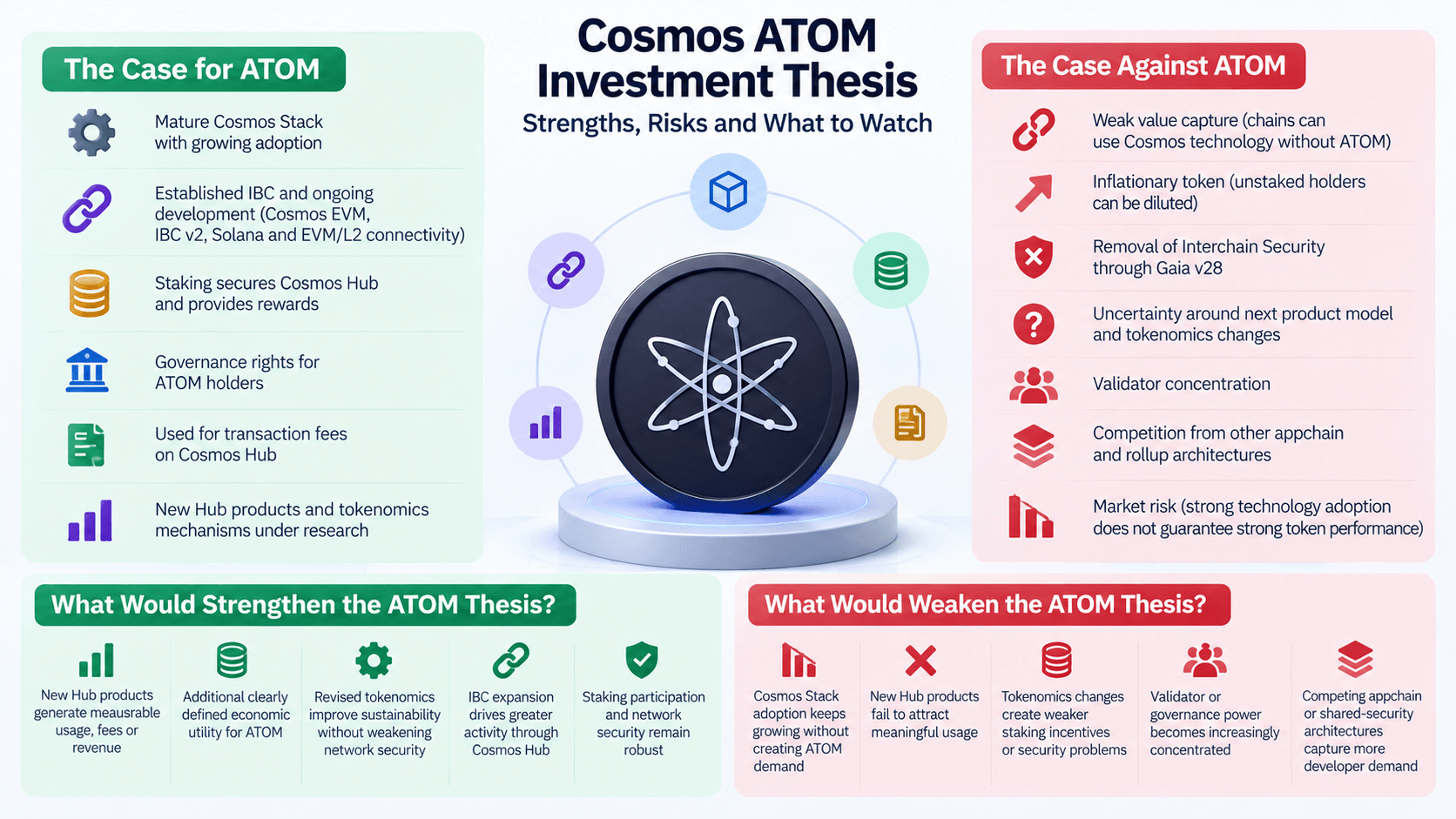
ATOM's investment thesis rests on a tension that runs through the entire Cosmos ecosystem: the underlying technology has achieved substantial adoption, but that success does not automatically create demand for ATOM. Investors therefore need to evaluate Cosmos Hub and its token economics separately from the broader success of the Cosmos Stack.
 ATOM’s Investment Case Depends On Stronger Value Capture, Sustainable Tokenomics And Continued Hub Adoption
The Case for ATOM
The strongest argument for ATOM starts with the infrastructure beneath it. The Cosmos Stack is mature, IBC is an established interoperability protocol, and development continues around Cosmos EVM, IBC v2 and connectivity with additional ecosystems such as Solana and EVM/L2 networks.
ATOM also has clear existing utility within Cosmos Hub. It secures the network through staking, gives holders governance rights and is used for transaction fees. Meanwhile, the Hub is researching new tokenomics mechanisms and potential products that could create stronger economic links between Hub activity and ATOM. Those initiatives remain under development rather than established sources of value.
The Case Against ATOM
The central risk is weak value capture. A chain can use the Cosmos SDK, CometBFT or IBC without using ATOM, so greater Cosmos adoption can occur without equivalent growth in ATOM demand.
ATOM is also inflationary, meaning unstaked holders can be diluted by new issuance. The removal of Interchain Security through Gaia v28 eliminated one previous mechanism intended to extend Cosmos Hub's economic security to other chains.
Other risks include uncertainty around the Hub's next product model, governance changes to token economics, validator concentration, competition from other appchain and rollup architectures, and simple market risk. Strong technology adoption does not guarantee strong token performance.
What Would Strengthen or Weaken the ATOM Thesis?
The ATOM thesis would become stronger if:
- New Cosmos Hub products generate measurable usage, fees or revenue.
- ATOM gains additional clearly defined economic utility.
- Revised tokenomics improve sustainability without weakening network security.
- IBC expansion drives greater activity through Cosmos Hub.
- Staking participation and network security remain robust.
It would weaken if:
- Cosmos Stack adoption keeps growing without creating ATOM demand.
- New Hub products fail to attract meaningful usage.
- Tokenomics changes create weaker staking incentives or unintended security problems.
- Validator or governance power becomes increasingly concentrated.
- Competing appchain or shared-security architectures capture more developer demand.
As of Sept. 22, 2026, the Hub's next product strategy is still being validated. Current areas under consideration include interoperability, payments and products connecting traditional finance with on-chain markets, but Cosmos Hub has explicitly cautioned that these remain working product hypotheses rather than roadmap commitments.
For investors comfortable with staking, governance exposure and an evolving economic thesis, ATOM offers direct exposure to Cosmos Hub. It may be less suitable for those looking for a fixed-supply asset, straightforward fee-based value capture or token economics that are already settled.

Cosmos Review: Closing Thoughts
Cosmos has already shown that its technology can extend far beyond a single blockchain, with the Cosmos Stack and IBC supporting a broad network of independent chains. The harder question is how much of that adoption can translate into lasting economic value for ATOM.
That makes 2026 a key transition year. Interchain Security is no longer part of the Hub's strategy, while ATOM tokenomics and the Hub's next product direction are still being reworked. The next phase of the thesis should therefore be judged by measurable Cosmos Hub usage, sustainable ATOM demand and clearer value capture, not by roadmap ambition alone.