Edge Wallet takes a different approach to self-custody by combining user-controlled private keys with familiar username-and-password access, encrypted backups and built-in recovery tools.
In this Edge Wallet review, we examine its security, recovery system, supported assets, privacy features, fees, swaps and everyday usability to see who it is best suited for in 2026.
Editor's Note (Sept. 19, 2026): We fully updated this Edge Wallet review in September 2026 to reflect the wallet’s current security features, recovery system, supported assets, privacy tools, fees, swaps, fiat integrations and DApp support. The update also incorporates Edge’s 2023 security incident, Duress Mode, Nym Mixnet integration, recent Monero and Zcash upgrades, and current comparisons with competing wallets.
Edge Wallet Review 2026: Quick Verdict
Edge Wallet is a mobile self-custody wallet built around username-and-password access, encrypted backups and user-controlled private keys. It supports 130+ assets, integrated swaps, fiat purchases, WalletConnect and several privacy-focused features, but it remains a hot wallet and its recovery model requires users to understand how passwords, recovery tools and account protections work together.
Our take: Edge Wallet is best for users who want mobile self-custody without relying entirely on a seed phrase for everyday recovery. Its combination of encrypted backups, accessible private keys, multi-asset support and privacy tools such as Nym, Monero, Zcash and Zano gives it a distinctive position among mobile wallets. The main trade-off is hot-wallet exposure, while large long-term holdings are generally better suited to offline hardware storage.
Scorecard
-
1Security 4.2/5 Edge uses client-side encryption, encrypted backups, IP Validation, 2FA, PIN and biometric access, spending controls and Duress Mode. Users retain their private keys, but Edge remains a hot wallet and its 2023 private-key exposure shows that software-level vulnerabilities can still create risk.
-
2Ease of Use 4.6/5 Username-and-password setup makes Edge more familiar than many seed-first wallets, while automatic encrypted backups simplify moving between devices. The main learning curve comes from understanding password recovery, IP Validation, 2FA backup codes and how those protections interact.
-
3Assets & Networks 4.5/5 Edge advertises support for 130+ assets, including Bitcoin, Ethereum, Solana, XRP, Monero, Zcash, Sui, Polygon, Avalanche and Zano. It also supports ERC-20 and other compatible tokens, although users should verify the exact network used for each asset before depositing.
-
4Wallet Features 4.4/5 Integrated swaps, fiat purchases, WalletConnect, custom tokens, key exports and multi-device access cover most everyday wallet needs. DApp access is less extensive than browser-first wallets such as MetaMask or Trust Wallet, and Edge does not offer a comparable full desktop wallet experience.
-
5Fees 4.0/5 Edge does not charge a subscription or standard fee simply for creating and holding a wallet. Costs come from blockchain network fees and integrated swap or fiat providers, where spreads, provider charges, payment methods, slippage and network costs can change the final price.
-
6Privacy 4.8/5 Edge stands out for combining no-KYC wallet creation with Nym Mixnet support, native Monero, shielded Zcash functionality and Zano confidential assets. These tools address different privacy layers, although integrated fiat providers can still require identity verification and public-chain transactions remain visible on-chain.
-
7Overall Score 4.4/5 Edge combines approachable account-based access with genuine self-custody, broad asset support and unusually strong privacy functionality. It is particularly compelling for mobile users, but hot-wallet exposure, third-party dependencies and a recovery system that requires careful setup keep it from replacing hardware storage for larger long-term holdings.
Best For
- Mobile self-custody users
- Privacy-conscious crypto holders
- Users managing multiple native assets
- Users who prefer account-based recovery
- People who want swaps and fiat access inside their wallet
Not Ideal For
- Large long-term holdings requiring offline storage
- Users who want a full desktop wallet
- Browser-first DeFi and DApp users
- Users who want a simple seed-only recovery model
- Users who want to avoid third-party swap or fiat providers
Disclosure and Methodology
Some links in this article may be affiliate links. If you choose to use a service through these links, we may earn a commission at no additional cost to you.
For this Edge Wallet review, we evaluated the wallet across six main categories: security, ease of use, asset and network support, wallet functionality, fees, and privacy.
Research was conducted in September 2026 using current Edge documentation and product information covering account security, recovery, supported assets, WalletConnect, swaps, fiat integrations, privacy tools and recent wallet updates.
We assessed Edge's username-and-password account model, encrypted backups, private-key access, IP Validation, 2FA, password recovery, Duress Mode, mobile experience and support for assets including Bitcoin, Ethereum, Solana, Monero, Zcash and Zano.
We also considered the wallet's principal risks and limitations, including the 2023 private-key vulnerability, hot-wallet exposure, network synchronization issues and reliance on third-party providers for some swaps and fiat transactions.
Edge Wallet At A Glance
| Field | Edge Wallet |
|---|---|
| Wallet type | Mobile software wallet |
| Custody | Self-custody |
| Platforms | iOS, Android and direct Android APK |
| Recovery model | Username and password, optional password recovery, IP Validation and 2FA; seed/master private key can also be viewed |
| Supported crypto | 130+ assets as of Sept. 19, 2026 |
| Swaps | Yes, through integrated exchange and liquidity providers |
| Fiat purchases | Yes, through third-party providers |
| DApps | WalletConnect support on compatible networks |
| Privacy features | Nym Mixnet, Monero, shielded Zcash functionality and Zano confidential assets |
| KYC | No identity verification to create the wallet; integrated fiat providers may require KYC |
| Best for | Mobile self-custody, multi-asset users and privacy-conscious users |
| Main drawback | Hot-wallet exposure and a recovery system that users need to understand and configure properly |
What Is Edge Wallet and How Does It Work?
Edge Wallet is a self-custody cryptocurrency wallet that stores encrypted wallet data while leaving control of the cryptographic keys with the user. The account login makes Edge look more conventional than many crypto wallets, but the username and password authenticate access to encrypted data. They do not give Edge custody of the assets.
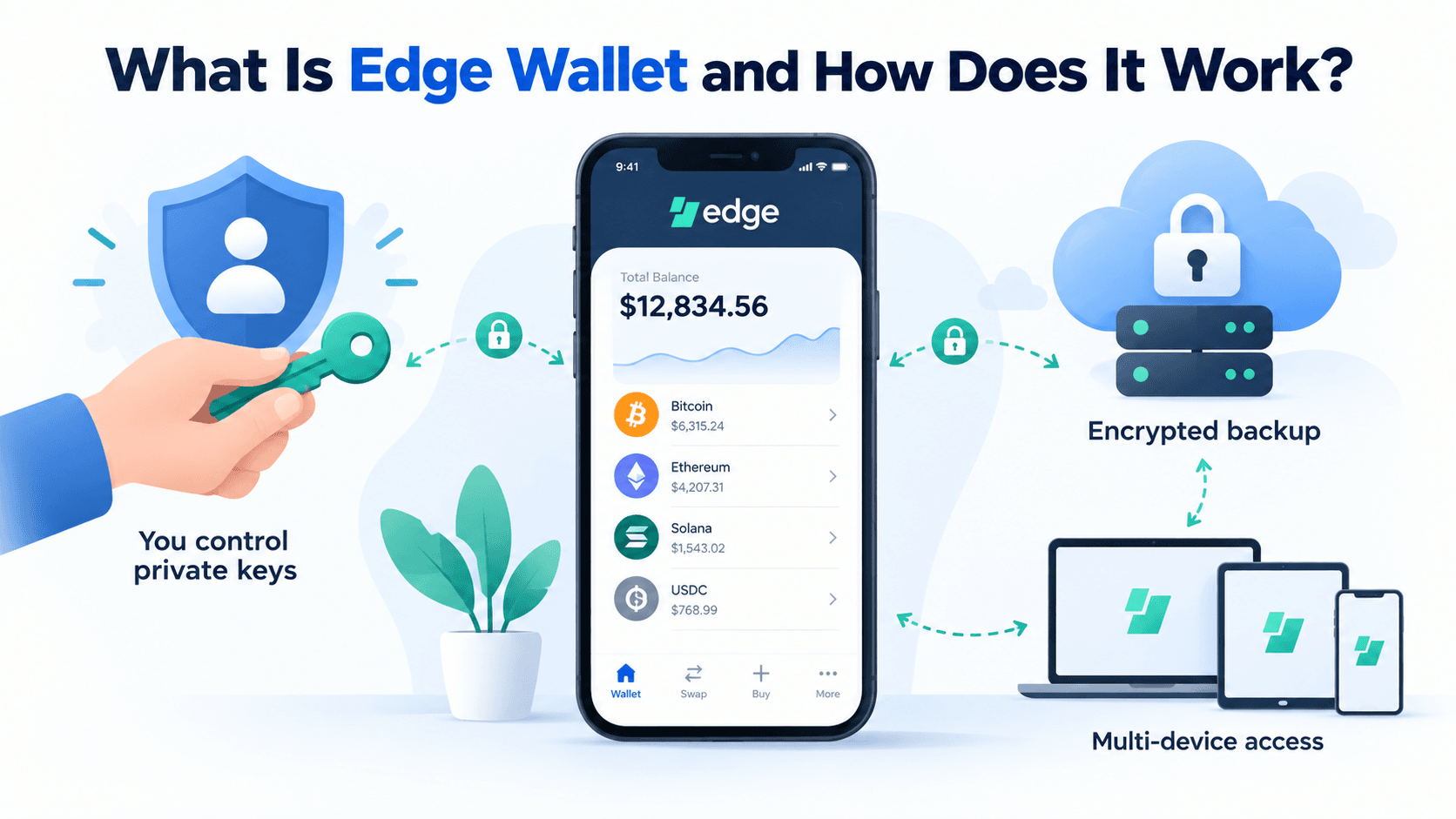 How Edge Combines Self-Custody With Account-Based Access
Edge's Self-Custody Model
Edge generates and encrypts wallet information on the user's device. Its current architecture uses client-side encryption before wallet data reaches Edge's servers, so server-side backups contain encrypted information rather than readable private keys.
That separation is central to understanding Edge. The servers help with encrypted backup, synchronization and account access across devices, while the credentials needed to decrypt the wallet remain with the user. Edge's terms explicitly state that it cannot retrieve a user's private keys or passwords.
A username and password do not turn Edge into an exchange-style account. Edge can help deliver encrypted backups and enforce login protections, but it cannot sign a blockchain transaction on the user's behalf simply because it operates the account infrastructure.
Username and Password vs Traditional Seed-First Wallets
Edge moves the seed phrase away from the first few minutes of wallet setup. New users create a username and password, choose a PIN and can start adding wallets without immediately copying 12 or 24 words onto paper.
The password is used as part of the system that encrypts the account and wallet information. Edge then backs up the encrypted data, which is why a user can restore the account on another device without manually importing every wallet one by one.
Users can view the Seed Phrase or Master Private Key for a wallet after entering their account password. Edge also supports importing existing seeds and private keys, while its migration tools can move funds into newly generated Edge wallets. Imported wallets retain their existing seed and keys.
The practical difference appears during setup and recovery. A conventional seed-first wallet asks the user to secure recovery words from day one. Edge lets the user rely on encrypted backups, account credentials and optional recovery tools for the normal login flow, while still giving access to key material when needed.
Edge Wallet Background
Edge traces its roots to Airbitz, a Bitcoin wallet launched in 2014. The company rebranded from Airbitz to Edge in 2017 as its key-management technology expanded beyond a Bitcoin-only product.
The multi-asset Edge Wallet then launched publicly for iOS and Android on February 15, 2018. The current product remains mobile-first, but it now combines self-custody with asset management, swaps, fiat integrations, WalletConnect and a growing set of privacy tools.
Is Edge Wallet Safe?
Yes. Edge has a well-designed self-custody architecture with several useful account protections, but its safety still depends on the phone, the user's credentials and the wallet software itself. The 2023 private-key exposure is the clearest example of why those layers need to be assessed separately.
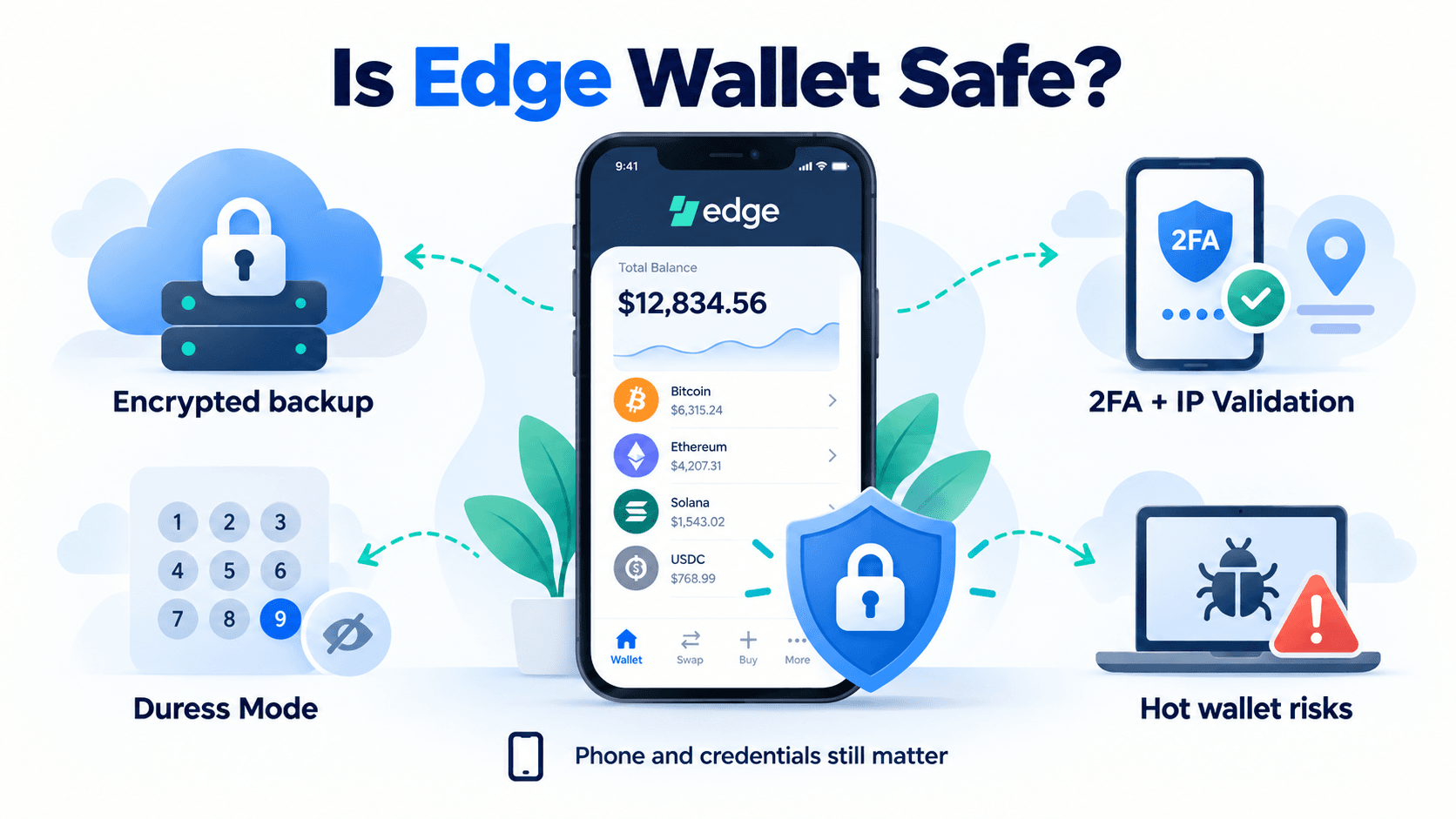 Edge Security Depends On Encryption, Devices And Recovery
How Edge Protects Private Keys
Edge combines encryption with several account-level controls, each addressing a different attack route.
- Client-side encryption: Wallet data is encrypted on the device before reaching Edge's servers. A compromise of stored server data therefore does not automatically provide readable wallet keys.
- Encrypted backups: Edge automatically backs up encrypted account data, allowing a wallet to survive the loss or replacement of a phone without Edge holding the unencrypted keys.
- Password protection: The password is required to decrypt the account. Edge cannot simply issue a conventional password reset because it does not know the password.
- PIN and biometrics: These make routine access faster on an already authorized device. Users can configure stronger requirements for spending and logout behavior.
- IP Validation: A login from an unfamiliar device and location can trigger a lockout and require additional authorization. IP Validation is enabled by default.
- 2FA: Edge's 2FA is tied to an account-generated code instead of an SMS message. A saved 2FA backup code can authorize an unfamiliar device without waiting for the standard lockout period.
- Spending limits and auto logout: Edge also provides controls that can require the full password before sending and automatically lock the account after inactivity. Both are included in Edge's current account-security guidance.
These controls can reduce account-takeover risk. They cannot make a compromised phone harmless. Once malicious software gains sufficient access to a device that stores and uses keys, the attack is occurring at the same endpoint where transactions are signed.
Edge Wallet's 2023 Security Incident
Edge disclosed a private-key vulnerability in February 2023 after a user reported that Bitcoin had been swept from an Edge wallet. The incident did not expose every Edge account. It involved a narrower combination of app behavior that could cause a selected wallet's private key to enter application logs.
For a key to reach Edge's log server, two conditions had to occur. A user first had to enter one of several specific Buy/Sell partner interfaces that caused the selected wallet's private key to be written unencrypted to the device's disk. The user then had to use Edge's "Upload Logs" feature while that information remained in the logs. Edge reported that approximately 600 private keys had been uploaded, representing less than 0.02% of the keys created through Edge.
The company said at the time that losses reported were in the low five figures in US dollars.
| Date | What Happened |
|---|---|
| Feb. 20, 2023 | Edge investigated a reported Bitcoin theft, identified the log-related vulnerability and shut down its log servers |
| Feb. 20, 2023 | A code fix was submitted and prior application logs were removed from device storage |
| Feb. 21, 2023 | The patched iOS version received approval |
| Feb. 22, 2023 | Edge published its disclosure and instructed users to update and move funds into newly created wallets |
The vulnerability was patched in version 3.3.1. Edge also removed the affected logging behavior and recommended that potentially exposed users create new wallets and transfer their funds.
The incident is relevant for a broader reason. Strong encryption and self-custody architecture protect against several forms of compromise, but wallet software still handles decrypted keys at some point. A software bug that mishandles those keys can bypass protections elsewhere in the system.
Duress Mode and Current Security Features
Edge added Duress Mode in May 2025 for a different type of threat: someone physically forcing a user to unlock the wallet.
Users can configure a separate Duress PIN linked to a decoy account. Entering that PIN opens the decoy while keeping the main account hidden. Transactions made from the decoy account are real, which gives the user a functional wallet rather than an obvious fake screen.
Duress Mode does not protect against malware or somebody who already has the main password. It is specifically designed for coercion scenarios.
Edge's 2FA and IP Validation address remote login attempts. If somebody tries to sign in from an unrecognized device, Edge can require authorization from a device already logged in or the account's saved 2FA code. Without either, a user with valid credentials may have to wait seven days before the unfamiliar device is allowed through the IP Validation lockout.
Edge Is Still a Hot Wallet
Edge runs on an internet-connected phone, so malware, phishing, malicious applications and a compromised operating system remain relevant risks. Account protections can make unauthorized login harder, but the phone still needs access to signing keys when the user sends crypto.
Self-custody removes the exchange custody problem. A failure at a centralized exchange cannot directly seize assets held under an Edge key. The user instead assumes responsibility for device security, credentials, recovery information and every transaction they authorize.
For money intended for frequent sending, swapping or interacting with mobile services, that accessibility is useful. Large holdings intended to sit untouched for months or years have a different security requirement. A dedicated hardware wallet can keep signing keys isolated from an everyday internet-connected phone.
How Edge Wallet Recovery Works
Edge gives users several recovery paths, but those paths need to be configured before access is lost. A replacement phone, a forgotten password and the loss of every recovery method produce very different outcomes.
What Happens If You Lose Your Phone?
Losing the phone does not automatically mean losing the wallet because Edge stores an encrypted backup of the account data.
On a replacement device, the user can reinstall Edge and enter the same username and password. The new device can then retrieve and decrypt the backed-up account.
The extra hurdle is IP Validation. Since the replacement phone is unfamiliar, Edge can require authorization before granting access.
| Situation | Recovery Route |
|---|---|
| Lost phone, username and password known | Sign in on the replacement device |
| Another authorized device is still logged in | Approve the new device from the existing device |
| 2FA backup code was saved | Use the code to clear the new-device lock |
| No authorized device or 2FA code | Valid credentials may still require the seven-day IP Validation wait |
| Password also forgotten | Use configured password recovery or remaining PIN/biometric access |
| No credentials, device access or recovery setup | Edge cannot restore access |
For anyone using Edge as a primary wallet, the useful preparation is simple: know the username, store the password securely, configure password recovery and save the 2FA backup code separately from the phone.
What Happens If You Forget Your Password?
Edge cannot look up or reset a forgotten password from its own systems because it does not hold the information required to decrypt the user's wallet.
There are two main escape routes.
If the original installation is still accessible through a PIN or biometrics, Edge allows the user to initiate a password reset from that device. If access to the device is gone, users who previously configured Password Recovery can use their saved recovery token and answer the two recovery questions.
The recovery system uses a split key. One part is included with the recovery token stored by the user, while another encrypted component is held by Edge. The two pieces can be combined after the correct recovery answers are supplied, allowing the account to be decrypted without Edge learning the password or recovery answers. Edge's recovery setup requires two questions, a recovery token and the account username.
If the user has forgotten the credentials, no longer has PIN or biometric access and never configured recovery, Edge cannot restore the account. Its terms explicitly warn that crypto can become inaccessible under those circumstances.
Can You Export Your Seed Phrase or Private Keys?
Yes. Edge allows users to view a wallet's Seed Phrase or Master Private Key from inside the app after entering the account password. The option sits inside the individual wallet's settings.
That portability becomes useful if Edge stops supporting a network, the user wants to move to another compatible wallet, or they simply want a recovery method that does not depend on Edge's account system.
Users can also bring existing wallets into Edge. Edge recommends migration when users want to separate the new wallet from previously exposed seed material.
Which Cryptocurrencies and Networks Does Edge Wallet Support?
Edge supports major chains, privacy-focused assets and tokens across several ecosystems, with more than 130 assets advertised as of Sept. 19, 2026.
Native Networks and Tokens
Edge supports native wallets for networks including Bitcoin, Ethereum, Solana, Monero, Zcash, XRP, Litecoin, Avalanche, Polygon, Stellar, Sui, Zano and several others.
Tokens work differently from native coins. An ETH wallet, for example, provides access to assets issued on Ethereum rather than requiring each ERC-20 token to operate as its own blockchain. Edge currently allows users to add custom ERC-20 tokens, and supported EVM networks can automatically detect tokens included in Edge's default lists. Other compatible tokens can be added manually.
| Ecosystem | Edge Support |
|---|---|
| Bitcoin | Native BTC wallet |
| Ethereum | Native ETH plus ERC-20 token support |
| Solana | Native SOL and supported Solana tokens |
| Polygon / EVM networks | Native network support with compatible tokens |
| XRP | Native XRP wallet |
| Monero | Native XMR wallet with Fast Sync and Full Sync options |
| Zcash | ZEC wallet with shielded-payment functionality |
| Zano | ZANO plus confidential asset functionality |
| Sui | Native SUI wallet |
Asset totals can look inconsistent across wallet directories because one source may count blockchains, another native coins and another every supported token. For users, the network is the first thing to verify. Holding USDT on Ethereum and holding USDT on another chain are technically different routes even though the ticker is identical.
Monero, Zcash and Other Privacy-Focused Assets
Edge supports Monero directly, and its XMR implementation received a substantial upgrade on July 8, 2026. Users can now choose Full Sync, which downloads and validates Monero blockchain data locally, and import existing Monero private keys. Fast Sync remains available for users who prioritize speed.
Zcash is also supported, including shielded functionality. Edge added human-readable Zcash Names in June 2026, allowing supported names to resolve to shielded ZEC addresses instead of requiring users to work directly with the full address.
Zano has moved beyond basic coin support inside Edge. A September 3, 2026 integration lets users move several supported assets into confidential representations on Zano, which we cover in more detail in the privacy section.
DApps, WalletConnect and NFTs
Edge supports WalletConnect for connecting the mobile wallet to compatible decentralized applications. The flow keeps transaction approval inside Edge: a DApp initiates the request, the user chooses the relevant wallet and Edge presents the transaction for authorization. WalletConnect support has also been extended to Cosmos-based chains.
That gives Edge access to DApps without trying to replicate a full browser wallet inside the app. Users should still inspect transaction details before signing. WalletConnect transports the connection between the wallet and DApp; it does not make the smart contract being used safe.
NFT use is less central to Edge's current product positioning. WalletConnect can be used with compatible NFT applications, but Edge's current product pages focus much more heavily on currencies, tokens, swaps and privacy than on providing the type of dedicated NFT gallery experience found in some Web3 wallets.
How Private Is Edge Wallet?
Edge offers several forms of privacy, but they operate at different layers. Account privacy limits the identity information Edge receives, Nym can obscure network metadata, and assets such as Monero, Zcash and Zano can alter what is visible on-chain.
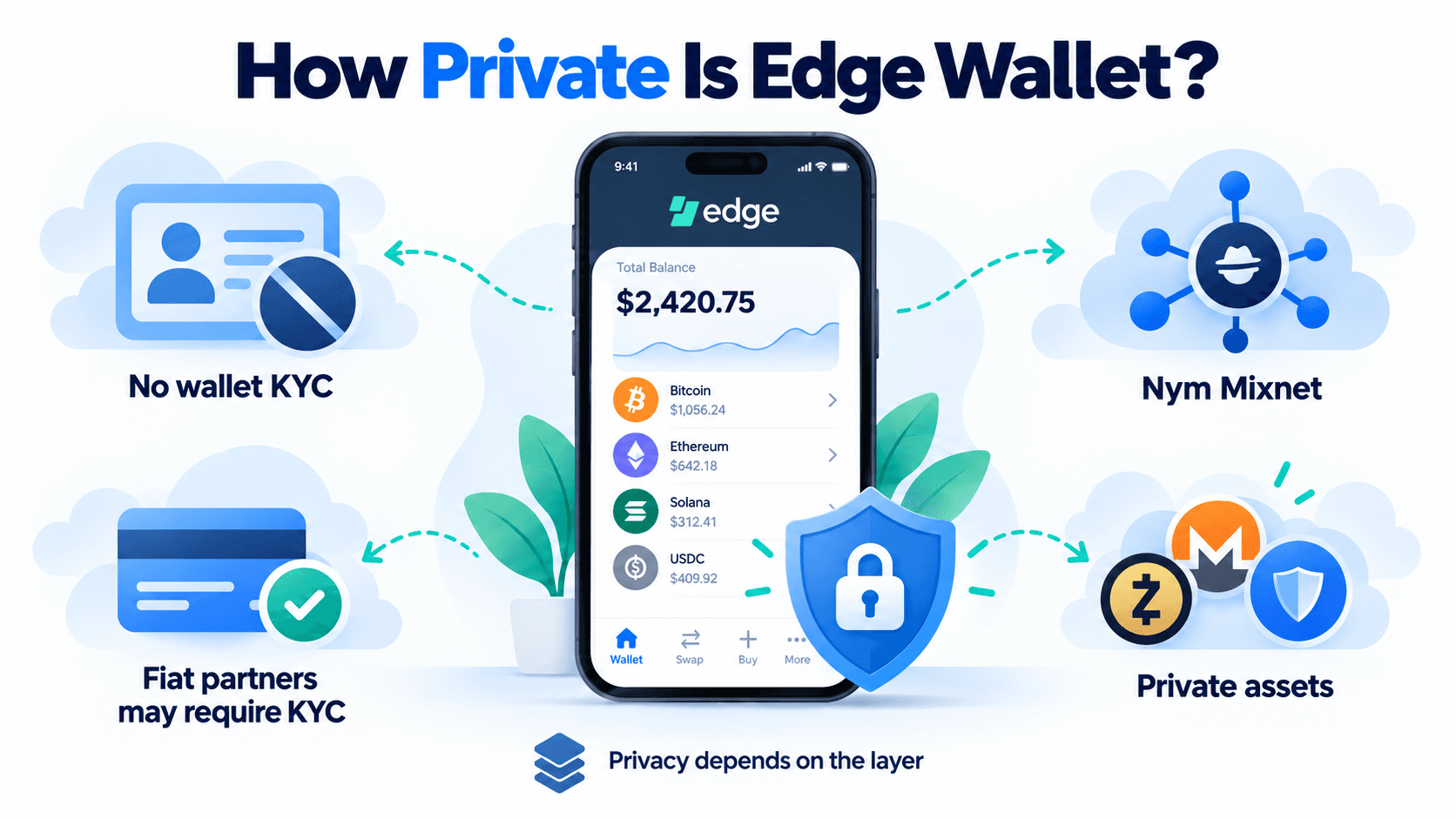 Edge Adds Network Privacy And Private Asset Support
Does Edge Wallet Require KYC?
Creating and using the Edge self-custody wallet does not require conventional KYC. Edge's current account documentation says it does not ask for a user's name, phone number or other identifying information when the account is created. The username and password are not tied to an identity record held by Edge.
That does not make every service accessible through Edge KYC-free.
Fiat purchases and sales are handled by external providers. Edge currently routes users to available partners based on location, and those companies can require identity verification under their own rules. Support material for providers including Banxa, MoonPay, Paybis and Simplex specifically references KYC as part of their purchase flows.
The distinction is straightforward: using the wallet itself does not require handing Edge an identity document. Buying $2,000 of crypto with a bank card through an integrated provider may require exactly that information from the provider.
Nym Mixnet and Network Privacy
Edge integrated the Nym Mixnet in March 2026 to address information that exists outside the blockchain itself.
A normal wallet connection can expose metadata such as an IP address and timing information to network infrastructure. Nym routes traffic through multiple nodes, adds layered encryption, mixes packets and introduces timing noise. The goal is to make it harder to link wallet traffic to the user's network identity.
Nym does not erase information already visible on a public blockchain. If a Bitcoin transaction publicly connects Address A to Address B, routing the wallet's internet traffic through a mixnet does not remove that transaction from Bitcoin.
There is also a performance cost. Edge warns that routing more wallet traffic through Nym can slow the application, and connectivity can vary by region. Users are therefore choosing stronger network-level privacy at the expense of some speed.
Monero, Zcash and Confidential Transactions
Edge's privacy tools solve different problems.
| Feature | Privacy Layer | What It Does |
|---|---|---|
| Nym Mixnet | Network metadata | Obscures IP, timing and connection patterns between the wallet and network infrastructure |
| Monero | On-chain transaction privacy | Uses Monero's transaction design to obscure sender, receiver and transaction amounts |
| Zcash | Shielded transaction privacy | Allows transfers through Zcash's shielded ecosystem |
| Zano confidential assets | Confidential asset layer | Extends confidential transfers to supported assets represented within the Zano ecosystem |
Edge's July 2026 Monero update is especially relevant for users who do not want to rely entirely on remote infrastructure for their wallet history. Full Sync allows the device to download and validate Monero blockchain data locally.
For Zcash, Edge supports privacy-focused workflows including shielded payments and private swaps. An integration with Maya Protocol added decentralized ZEC swaps without a conventional KYC account in December 2025.
Zano adds another model. On Sept. 3, 2026, Edge announced an integration allowing users to move assets including BTC, BCH, ETH, DAI, BNB, FUSD, SOL and TON into confidential representations on Zano. The resulting confidential assets are designed to obscure transaction amounts, senders and recipients.
For privacy-conscious users, the combination is more useful than any single checkbox. Someone concerned about network metadata can use Nym, while someone concerned about public transaction history needs an on-chain privacy mechanism as well.
Edge Wallet Fees, Swaps and Buying Crypto
The Edge app itself is free, while the cost of using it depends on blockchain fees and the pricing of integrated swap or fiat providers.
Does Edge Charge Wallet Fees?
Edge is distributed as a free, open-source crypto management platform. Creating an account and holding assets inside the wallet does not require a subscription.
Sending crypto still costs money when the relevant blockchain charges a transaction fee. That fee goes toward the network's miners, validators or other transaction-processing mechanism rather than paying for the Edge account itself.
Edge estimates those network costs and provides fee controls on supported networks. Bitcoin users, for example, can adjust the mining fee depending on how quickly they want a transaction confirmed.
Network conditions can make the same transfer cheap one day and expensive the next. Ethereum gas, Bitcoin block-space demand and congestion on other networks are external to the wallet.
In-App Crypto Swaps
Edge's Exchange feature lets users choose the asset they are sending and the asset they want to receive, then routes the trade through an integrated provider. Before confirmation, the app identifies the selected service as "Powered by ProviderProvider" and allows users to enable, disable or prioritize exchange providers.
The amount received can be affected by several components: the provider's quoted exchange rate, any explicit provider fee, the spread between buy and sell prices, network costs and price movement before execution.
For routed decentralized swaps, liquidity can also affect slippage. A quote for a large swap through a thin liquidity pool can move further from the market price than a small trade in a liquid pair.
Edge has integrated decentralized routes such as LI.FI, Maya Protocol and THORChain alongside other exchange services. Some decentralized routes can execute without a centralized account, while other providers may stop a transaction or request additional information under their own AML policies.
The number displayed before confirmation is therefore more useful than any generic percentage fee. Users should compare the amount they are spending with the amount they are actually receiving before approving a swap.
Buying and Selling Crypto
Edge also integrates fiat on-ramps and off-ramps. The currently available options depend on the user's country, and Edge sends the user to the selected partner to complete the transaction. The provider handles the purchase or sale rather than Edge itself.
Current Edge support material references providers including MoonPay, Banxa, Paybis and Simplex. Payment methods can include cards, bank options and mobile payment services depending on the provider and region.
One recent addition is Cash App Pay. On Aug. 20, 2026, Edge added Cash App Pay through MoonPay for eligible users in the United States, allowing qualifying purchases to be funded from Cash App while the purchased crypto is delivered to the user's Edge wallet.
Pricing varies because Edge does not control every component of the purchase. Provider fees, payment method, asset, country, spread and network costs can all alter the final price. KYC also belongs to the provider's transaction flow, which is why a wallet account that requires no identity verification can still contain a buy button that does.
What Is Edge Wallet Like to Use?
Edge's biggest usability difference appears before the first transaction: account setup feels like creating a normal mobile login. From there, sending, receiving and swapping work through a familiar asset-based interface without requiring users to manage raw keys during ordinary use.
Setup and Everyday Use
Edge is available for iOS and Android, with a direct Android APK also offered. Setup starts with a username and password, followed by a PIN. Users then create or add the wallets and tokens they want to manage.
The Exchange interface handles swaps without requiring users to manually transfer funds to an external exchange first. Fiat purchases follow a similar front-end flow but hand the transaction to the chosen payment provider.
Adding assets is also relatively straightforward. Edge can recognize supported tokens on several networks, while custom ERC-20 assets can be entered manually using their contract information.
WalletConnect adds a second mode of use. Instead of navigating entirely inside Edge, users can connect to a compatible DApp and return to the wallet when a transaction needs to be signed. That keeps the private key inside Edge while the DApp supplies the transaction request.
For readers comparing this workflow with other crypto wallets, the defining difference remains the account layer. Edge puts username/password access and automatic encrypted backups in front of the key-management system.
Syncing, Network Issues and Transaction Problems
A wallet balance shown on a phone is a view of blockchain data, so an incorrect or stale display does not automatically mean the underlying crypto has disappeared.
Edge has previously issued in-app notices for Solana congestion, Monero sync problems, Avalanche sync issues, Zcash upgrades and other network-specific disruptions. These problems can affect how quickly balances or transactions appear even when the blockchain itself still records the funds.
| Common Issue | Likely Cause | First Step |
|---|---|---|
| Balance has not updated | Wallet or node has not fully synchronized | Check network status and refresh/reopen the wallet |
| Incoming transfer is missing | Transaction is still unconfirmed or wallet data is stale | Check the transaction hash on a block explorer |
| Transaction remains pending | Congestion or fee was too low | Check network conditions and available acceleration options |
| One asset will not sync | Asset-specific node, wallet or network issue | Check Edge's support notices |
| Problems start after a network upgrade | Wallet integration may need an update | Update Edge and review the relevant network notice |
| Swap or purchase is stuck | Third-party provider issue | Identify the provider and contact its support team |
A block explorer is useful when the app and blockchain appear to disagree. If the correct address still holds the funds on-chain, the problem is usually with synchronization, indexing or the wallet's display rather than ownership of the assets.
Customer Support
Edge currently provides a support center, ticket/email support, phone contact and Signal. Its download page lists a standard support target of 48 hours.
The useful boundary is what support can actually change. Edge can help with the app, account setup, synchronization, wallet configuration and diagnosing transactions. It cannot reverse a confirmed blockchain payment, recreate private keys it does not possess or override the rules of an external network.
Fiat and third-party swap problems can also leave Edge with limited control. For buy and sell transactions, Edge explicitly directs users to contact the selected provider for transaction-specific issues. A MoonPay verification problem, for example, ultimately sits with MoonPay rather than Edge support.
Edge Wallet vs Other Crypto Wallets
Edge makes the most sense when mobile self-custody, account-based recovery and privacy features are priorities. Other wallets have stronger setups for browser DApps, desktop use, alternative recovery systems or offline storage.
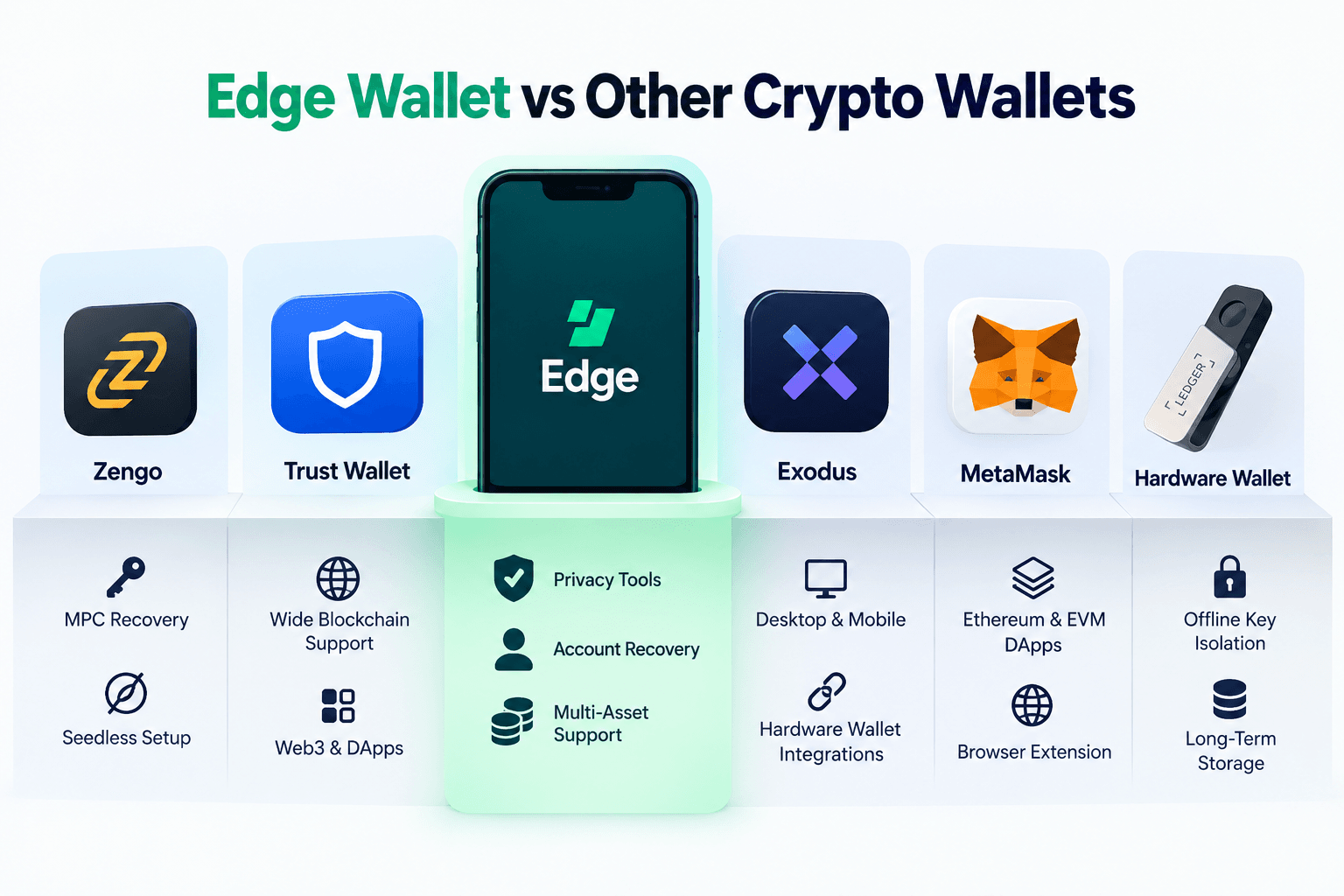 Edge Competes On Recovery, Privacy And Mobile Convenience
| Wallet | Better Than Edge For | Edge Is Better For |
|---|---|---|
| Zengo | Users who want an MPC-based recovery system without a conventional seed phrase | Native privacy-focused assets and users who want access to conventional seed/private-key material |
| Trust Wallet | 100+ blockchain support, browser extension access and a larger Web3/DApp environment | Account-style recovery and Edge's current privacy tools |
| Exodus | Desktop and mobile use plus current Ledger and Trezor integrations | Nym, Monero Full Sync and Edge's account recovery system |
| MetaMask | Ethereum/EVM DApps, browser use and hardware-wallet connections | Managing a mixed portfolio that includes assets such as Bitcoin, Monero, Zcash and XRP in one mobile account |
| Hardware wallet | Offline key isolation and long-term storage | Frequent mobile spending, swaps and day-to-day access |
Zengo also tries to reduce the risks associated with conventional seed phrases, but it uses multi-party computation instead of Edge's encrypted username/password account model. Its current recovery system uses a recovery file and email, with additional authentication available for some features.
Trust Wallet suits users who spend more time moving between Web3 applications and chains. Edge has a narrower DApp role, with WalletConnect providing the connection layer while its stronger identity remains mobile asset management and privacy.
Exodus works across desktop and mobile and now supports hardware-wallet combinations including current Ledger and Trezor integrations. Edge is more focused on account-based mobile access and privacy functionality such as Nym and local Monero Full Sync.
MetaMask remains centered on Web3 applications, even as it expands beyond its original Ethereum focus. Edge is easier to treat as a single mobile home for unrelated native assets rather than primarily as an interface for DApps.
Hardware wallets: A hardware wallet serves a different purpose. It keeps signing keys in dedicated hardware, which is better suited to holdings that rarely need to move. Our guide to how hardware wallets work explains why that isolation changes the security model.

Edge Wallet Review: Final Verdict
Edge Wallet is best suited to people who want self-custody on a phone without building their everyday recovery workflow entirely around a handwritten seed phrase.
Its strongest feature is the way it combines familiar account access with genuine key ownership. The user can log in with a username and password, restore encrypted wallet data, configure recovery and still access the seed or master private key when portability is required.
For everyday mobile self-custody, particularly for users who value Edge's growing privacy functionality, Edge remains a credible option in 2026.