KuCoin leans more into altcoins and bots, while Bybit is more focused on futures and copy trading.
In this comparison, we break down where each platform stands on fees, safety, regulation, trading tools, and everyday usability so you can decide which exchange fits you best.
Editor's Note (July 5, 2026): We fully updated this article in July 2026 to reflect the latest KuCoin and Bybit fee structures, product lineups, regional restrictions, proof-of-reserves information, security history, regulatory updates and user-fit analysis. We also refreshed the comparison to account for Bybit’s 2025 security incident, KuCoin’s 2025 U.S. legal case, Bybit EU's MiCAR authorization, and newer products such as tokenized stock-style access.
Quick Verdict: KuCoin or Bybit?
KuCoin is best for altcoin hunters and bot users, while Bybit is best for futures, copy trading and cleaner fiat access.
The better exchange depends on how you trade. KuCoin wins if you want broader altcoin access, KCS fee rebates, built-in trading bots and more discovery across smaller listings. Bybit wins if you mainly trade perpetual futures, want stronger copy trading tools, prefer a cleaner interface, or need stronger fiat and card access in supported regions.
Who Should Choose Which?
Choose KuCoin if you want:
- Broader access to altcoins and smaller-cap listings
- KCS fee rebates for eligible trading fees
- A stronger native trading bot suite, including Spot Grid and DCA tools
- More token discovery across spot markets and early-access products
- A feature-rich exchange and you are comfortable checking liquidity, withdrawals and regional access
Choose Bybit if you want:
- A stronger futures and perpetuals-focused trading experience
- More developed copy trading tools with lead traders and follower controls
- A cleaner interface for active traders
- Stronger fiat withdrawal and card access in supported regions
- Clearer EU regulatory footing through Bybit EU's MiCAR authorization
KuCoin vs Bybit Winner by Category
| Category | Winner | Why It Counts |
|---|---|---|
| Overall exchange fit | Tie | KuCoin is stronger for altcoin variety and bots, while Bybit is stronger for futures, copy trading, fiat access and cleaner trading flow. |
| Altcoin selection | KuCoin | KuCoin is usually the better choice for users hunting less common altcoins, newer listings and smaller-cap markets. |
| Spot trading fees | KuCoin | Both platforms start near 0.1% maker and taker for standard spot users, but KuCoin can be cheaper for eligible users paying fees with KCS rebates. |
| Futures trading | Bybit | Bybit has the cleaner futures-first experience, stronger derivatives flow and a more complete setup for perpetual traders. |
| Futures taker fees | Bybit | Bybit's non-VIP futures taker fee is slightly lower at 0.055%, compared with KuCoin's base futures taker rate of about 0.06%. |
| Copy trading | Bybit | Bybit has a stronger copy trading product built around lead traders, follower controls, performance metrics and risk filters. |
| Trading bots | KuCoin | KuCoin has the stronger native bot identity, with tools such as Spot Grid, DCA and futures bot strategies built into the platform. |
| Fiat access | Bybit | Bybit generally has stronger fiat deposit, withdrawal, P2P and card access, though availability still depends on country and KYC status. |
| Crypto card | Bybit | Both offer card products in supported regions, but Bybit's card program has broader payment-wallet support in some regions. |
| EU regulatory clarity | Bybit | Bybit EU has clearer footing through MiCAR authorization, while KuCoin EU access needs closer checking before signup. |
| Proof of Reserves | Tie | Both publish reserve information, but proof of reserves is only a trust signal. It does not fully prove future solvency, liabilities or uninterrupted withdrawals. |
| Recent security and legal risk | Neither | Bybit carries post-2025 hack risk, while KuCoin's trust profile is shaped by its 2025 U.S. legal case and past security history. |
| Launchpads and new token access | KuCoin | KuCoin has the stronger altcoin-discovery identity through Spotlight and GemPool, while Bybit also offers Launchpad and Launchpool products. |
| Tokenized stocks and IPO-style products | Bybit | Bybit is more active in tokenized stock and IPO-style access through products such as xStocks and IPO Express, subject to eligibility. |
| Mobile app simplicity | Bybit | Bybit feels cleaner and more focused, while KuCoin has more menus because it packs in more products and discovery tools. |
| Long-term storage | Neither | Neither platform is ideal for long-term storage. Larger balances are usually better kept in self-custody or cold storage. |
Data should be checked against live exchange pages before depositing funds, as fees, leverage limits, supported products, proof-of-reserves data, withdrawal fees, KYC rules, fiat rails and country access can change.
Disclosure
Some links in this guide may be affiliate links. If you choose to use a service through these links, we may earn a commission at no additional cost to you.
Disclaimer
This guide is educational only and is not financial advice. The comparison is based on platform features, public fee schedules, exchange documentation, security information, proof-of-reserves pages, regulatory notices and product availability at the time of writing.

How This KuCoin vs Bybit Comparison Was Built (Methodology)
This comparison checks the areas users should review before choosing an exchange:
- Trading fees
- Spot and futures markets
- Altcoin selection
- Copy trading tools
- Trading bots
- Fiat deposits and withdrawals
- P2P access
- Crypto cards
- Earn products
- Launchpads
- Proof of reserves
- Known security incidents
- Legal and regulatory history
- KYC requirements
- Regional restrictions
- Mobile app experience
- Beginner fit
- Long-term custody risk
For fees, we used official KuCoin and Bybit fee pages for spot and futures pricing.
For security and reserves, we checked official KuCoin and Bybit proof-of-reserves pages, account security resources, public incident reports and regulatory notices.
For regulation and availability, we reviewed official restricted-country pages, terms, compliance notices and public regulatory updates.
For product comparisons, we checked official exchange pages for copy trading, trading bots, Earn, launchpads, cards, fiat services, P2P access and tokenized stock-style products.
KuCoin vs Bybit at a Glance
Category | KuCoin | Bybit |
|---|---|---|
Best For | Futures, Copy Trading, Fiat/Card access | |
Spot Trading | Yes | Yes |
Futures Trading | Yes | Yes |
Copy Trading | Limited Compared with Bybit | Stronger Product Focus |
Trading Bots | Strong Native Bot Suite | Available, But Less Central |
Native Token | KCS | No Equivalent Exchange-Token Discount Like KCS |
Fiat Access | Region-Dependent | Generally Stronger |
Crypto Card | KuCard in Supported Regions | Bybit Card in Supported Regions |
Regulation | Region-Dependent | Stronger EU Clarity Through Bybit EU |
Long-Term Storage | Not Ideal | Not Ideal |
Who Should Use KuCoin?
KuCoin is best for traders who want broader access to altcoins, including smaller-cap tokens that do not always show up on more selective platforms. KuCoin supports a large range of assets and market listings, which makes it more useful for discovery than for simplicity. It also suits frequent spot traders who want to use KCS to reduce trading costs, and enabling fee payment with KCS can return a 20% fee discount in rebate.
 KuCoin is Best for Traders Who want Broader Access to Altcoins, including Smaller-Cap Tokens. Image via KuCoin
KuCoin also makes sense for users who want built-in trading bots, including Spot Grid and DCA strategies, and for traders who are comfortable checking liquidity before buying thinner markets. More listings can create more opportunity, but they can also increase token-quality and exit-risk.
KuCoin is not ideal for users who want the cleanest beginner experience, simple bank-based off-ramps, the strongest copy trading product, or a futures-first platform. It is also a weaker fit in jurisdictions where access or product availability may be restricted under KuCoin’s terms.
Read our full KuCoin review.
Also Read
Who Should Use Bybit?
Bybit is best for users who mainly trade perpetual futures, want structured copy trading, and prefer a cleaner, more trading-focused interface.
 Bybit is Best for Users Who Focus on Perpetual Futures, Structured Copy Trading, and a Cleaner Trading-Focused Interface. Image via Bybit
Bybit has a strong emphasis on derivatives, including perpetual and expiry contracts, while its copy trading tools are built around lead traders and follower controls. It also has stronger fiat withdrawal and card options in supported regions, and EU users have a clearer regulatory path through Bybit EU’s MiCAR authorization.
Bybit is not ideal for users who mainly want obscure altcoins, want KCS-style exchange-token discounts, live in a restricted country, or just want a simple beginner buy-and-hold app.
Read our full Bybit review.
Also Read
- Is Bybit Safe?
- Bybit Earn Review
- Bybit Card Review
- Bybit's Products and Features
- Bybit Copy Trading Review
- Bybit Trading Guide
- How To Sign up on Bybit
Fees and Real Trading Costs
Headline fees are a good starting point, but they are not the full cost of trading. The real difference between KuCoin and Bybit depends on whether you trade spot or crypto futures, whether you use discounts, and how much slippage or funding you absorb over time.
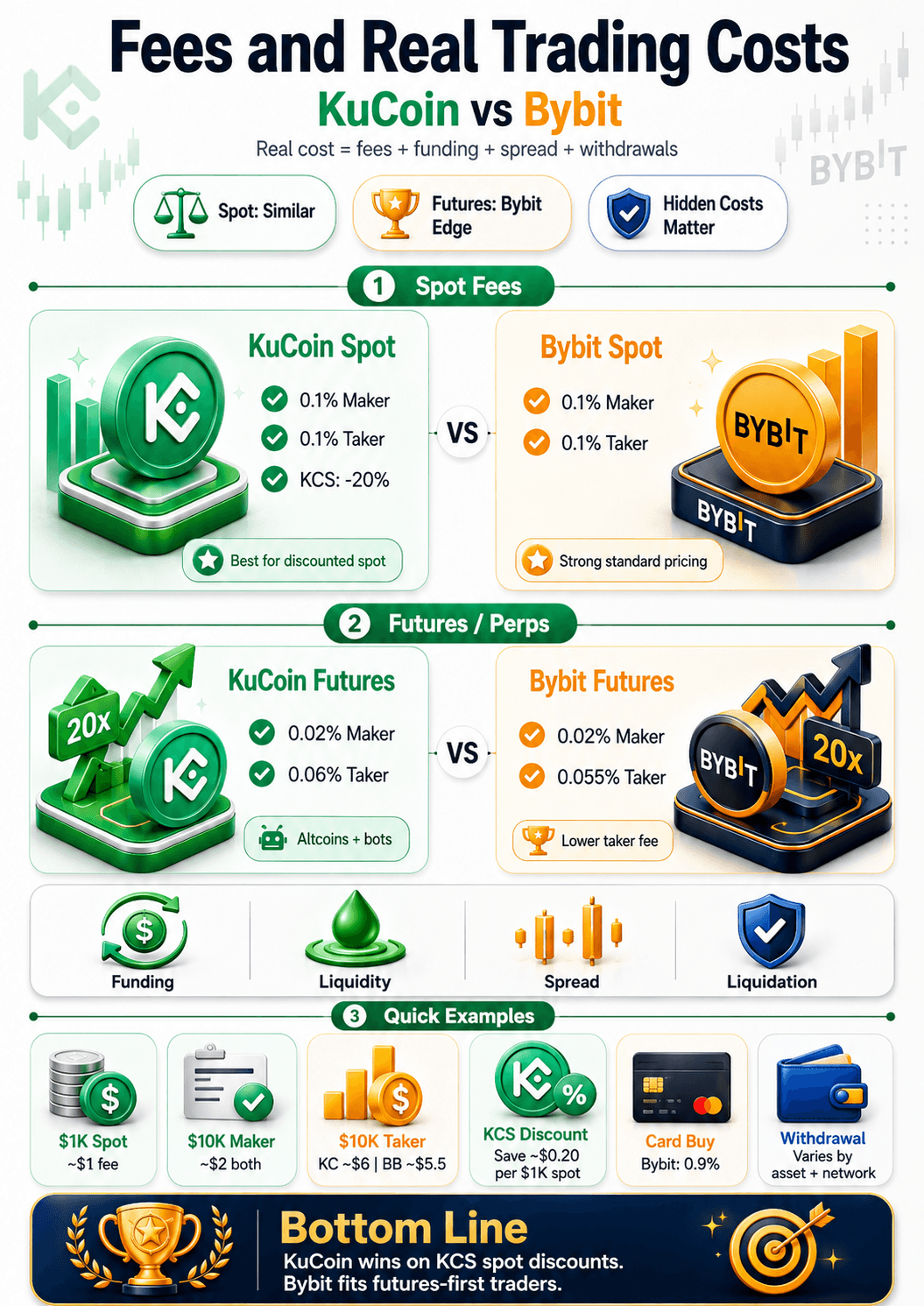 Headline Fees are a Good Starting Point, but they are not the Full Cost of Trading
Spot Trading Fees
For standard spot users, the two platforms look very similar on paper:
- KuCoin Spot: Many pairs start at 0.1% Maker and 0.1% Taker, though KuCoin notes that some pairs can differ.
- Bybit Spot: 0.1% Maker and 0.1% Taker for VIP 0 crypto-to-crypto spot trading.
- KuCoin Discount: KuCoin users who pay eligible fees with KCS can get a 20% discount in rebate.
So who pays less? KuCoin is usually the better pick for spot traders who can use KCS discounts, while Bybit remains competitive for standard spot users. Users should still check the exact trading pair, because fees can vary by token class, VIP tier, market type, and promotions.
Futures and Perpetual Fees
In derivatives, Bybit has a small edge on standard taker pricing, but fees are only one part of the bill:
- KuCoin Futures: Base rates are about 0.02% Maker and 0.06% Taker.
- Bybit Perpetuals/Futures: Non-VIP rates are 0.02% Maker and 0.055% Taker.
- What Else Matters: Funding rates, spread, liquidity, and liquidation rules can be more than a tiny fee gap.
Note: Fee data is current as of July 5, 2026.
Bybit is the stronger futures-first exchange, but traders should compare funding, liquidity and liquidation rules, not just maker and taker fees. KuCoin still works well for users who want futures alongside altcoins and bots.
Fee Examples by Trade Size
Scenario | What It Means In Practice |
|---|---|
$1,000 Spot Taker Trade | At 0.1%, the Fee is about $1 on Either Platform before discounts |
$10,000 Futures Maker Trade | At 0.02%, the Fee is about $2 on both exchanges |
$10,000 Futures Taker Trade | KuCoin is about $6 at 0.06%; Bybit is about $5.50 at 0.055% |
KCS Discount Example | On a $1,000 KuCoin Spot Trade, a 20% KCS Rebate can trim a $1 Fee by about $0.20 |
Card Buy Example | Bybit's Card Crypto Conversion Fee is 0.9%, which can be much higher than a Normal Trade Fee |
Withdrawal Example | Exit Cost depends on the Asset and Network, so a USDT Withdrawal on one chain may cost more or less than BTC, ETH, or SOL on another |
Safety, Hacks and Proof of Reserves
Safety is about understanding custody risk. Both platforms publish reserve data and security information, but both still require users to trust a centralized venue with account access, withdrawals, and operational controls.
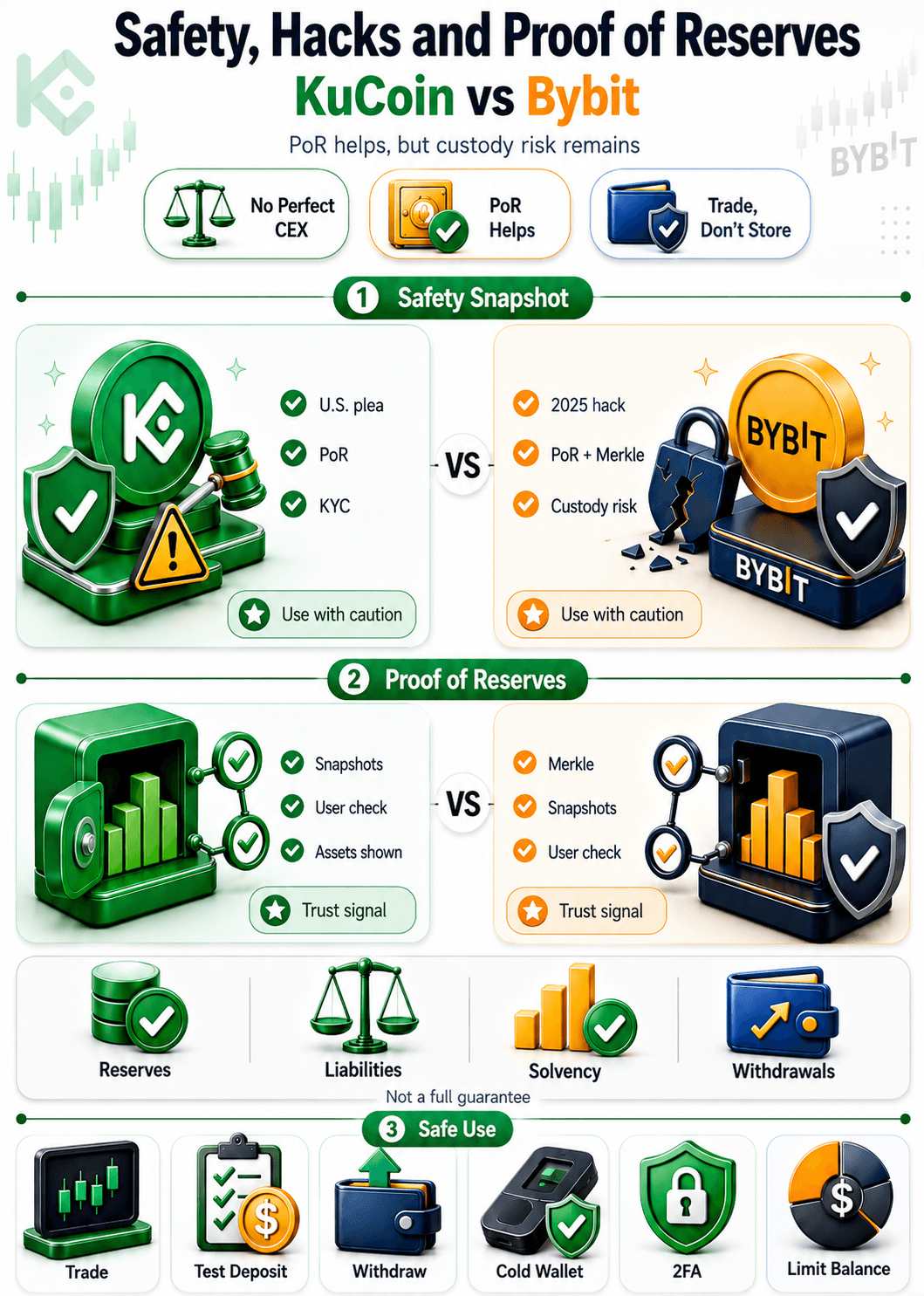 Safety is Less about Finding a “Perfect” Exchange and More about Understanding Custody Risk
Bybit Safety
Bybit can still be used as a trading venue, but the 2025 hack means users should treat custody, withdrawal access and reserve transparency as core parts of the decision. The FBI said about $1.5 billion in virtual assets was stolen from Bybit in February 2025, making it the largest exchange breaches on record.
Bybit remains a major exchange and offers Proof of Reserves with Merkle tree verification, but the hack is still a reminder that cold-wallet design, transaction-signing controls, and withdrawal processes require attention. For that reason, large long-term balances are usually better kept in cold storage wallets.
KuCoin Safety
KuCoin is useful for trading and altcoin access, but its legal and security history means users should be careful with account access, withdrawals and custody. KuCoin has its own Proof of Reserves page, but its trust profile is also shaped by past hack history and its 2025 U.S. case.
The U.S. Department of Justice said KuCoin pleaded guilty to operating an unlicensed money transmitting business and agreed to penalties totaling nearly $300 million; Reuters reported the plea required KuCoin to cease U.S. market operations for at least two years. KuCoin requires identity verification as a part of its compliance and withdrawal framework.
Proof of Reserves and What It Does Not Prove
Proof of Reserves can help show whether an exchange reports enough on-chain assets for selected balances, often using reserve ratios, supported-asset snapshots, and a Merkle tree to let users verify inclusion. But it does not fully prove liabilities outside the report, future solvency, legal resilience, or uninterrupted withdrawals. It is a useful trust signal, not a guarantee.
Use exchanges for trading, not as permanent vaults, and always test deposits and withdrawals before moving meaningful size.
Supported Countries, KYC and Regulation
Before comparing features, users should first check whether the exchange is actually available to them. In crypto, “available” can mean different things for registration, KYC and AML, fiat rails, derivatives, cards, and withdrawals.
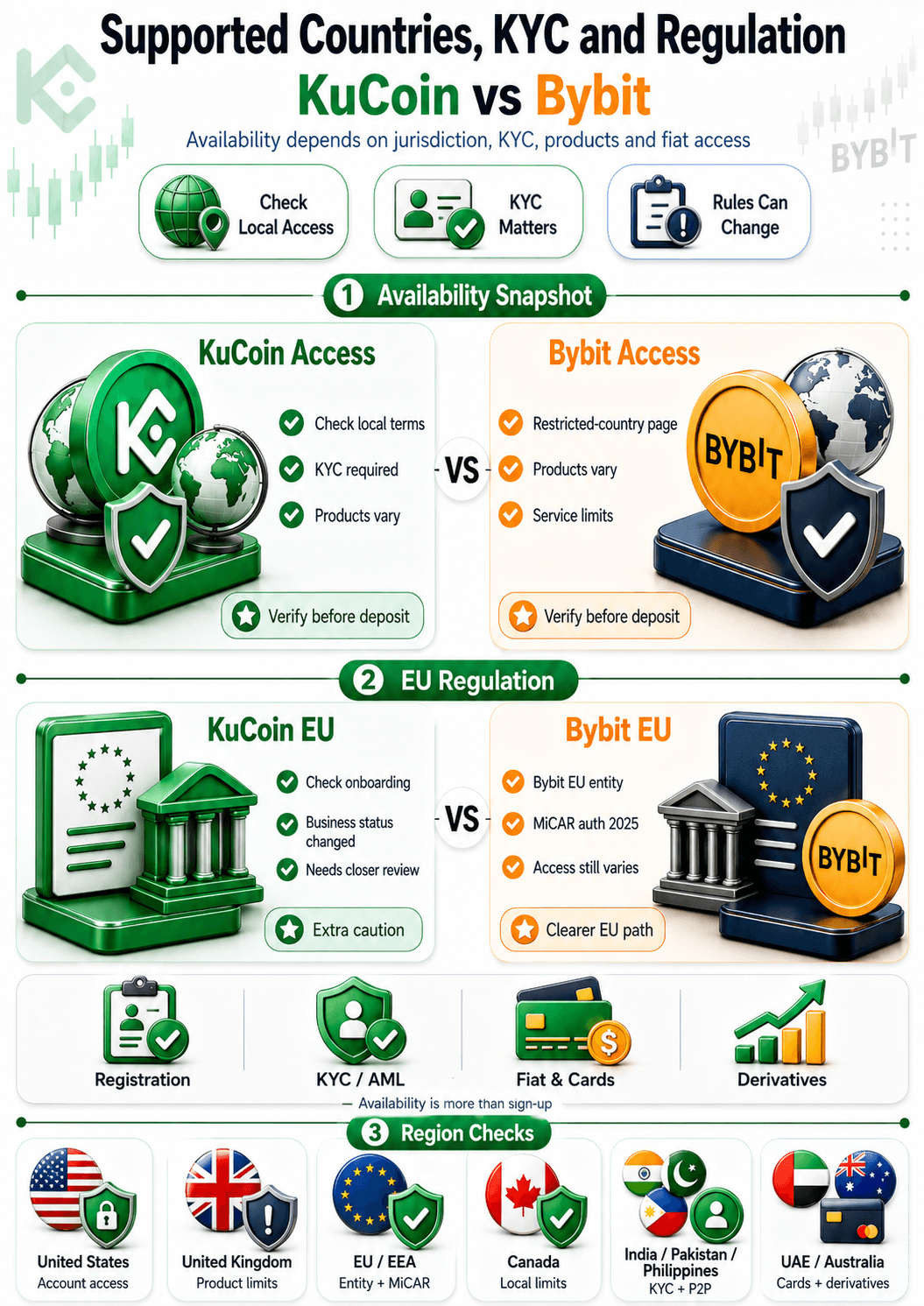 Users should First Check whether the Exchange is Actually Available to Them
Country Availability
Neither exchange should be treated as universally available. Bybit’s restricted-country page and KuCoin’s terms both make clear that access depends on jurisdiction and can change. Check this before depositing.
Region | What Users Should Check |
|---|---|
United States | Whether Either Exchange Supports Your Account Type At All |
United Kingdom | Spot, Derivatives, Earn and Promotional Restrictions |
EU/EEA | Local Entity, MiCAR Status, Onboarding and Product Access |
Canada | Account Access, Derivatives Limits and Local Restrictions |
Hong Kong and Singapore | Whether Access Is Restricted or Limited |
UAE | Which Entity Serves You and Whether Derivatives or Cards Apply |
Australia | Derivatives, Fiat and Card Availability |
India, Pakistan, Philippines | KYC, Fiat Rails, P2P Access and Withdrawal Methods |
EU Users
For EU users, Bybit currently has the clearer regulatory story, while KuCoin EU access needs closer checking before signup.
Austria’s FMA authorized Bybit EU as a crypto-asset service provider under MiCAR in May 2025. KuCoin EU later said it had voluntarily suspended new customer onboarding and certain new business activities, and the FMA said in May 2026 that although the new-business ban had been lifted, commencement of business operations still remained prohibited.
The practical rule is simple: always verify the local entity, supported services, and current terms before sending funds.
Spot Trading, Futures and Leverage
This is where the platforms start to separate more clearly. KuCoin offers more market variety, while Bybit feels more streamlined for users who care most about execution and derivatives tools.
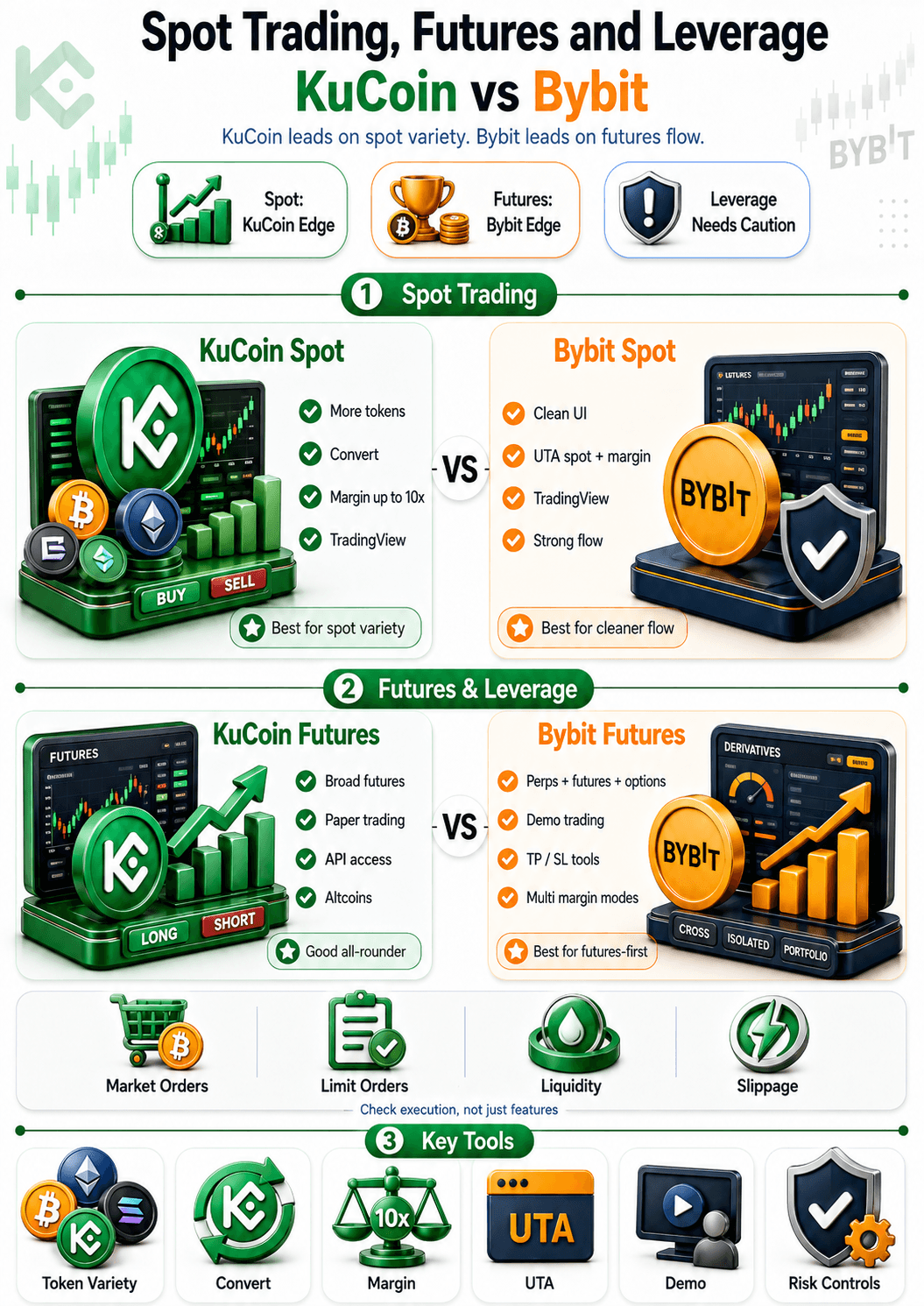 KuCoin Offers more Market Variety, while Bybit Feels more Streamlined for Users Who Care most about Execution and Derivatives Tools
Spot Trading
For spot trading, both exchanges support standard tools like market orders, limit orders, and chart-based trading. KuCoin also offers Convert with zero quoted conversion fees and supports margin trading up to 10x on eligible pairs, while Bybit folds spot and spot margin into its Unified Trading Account.
KuCoin’s bigger advantage is token variety and smaller listings, but users should still check liquidity and slippage before trading size. KuCoin also supports market data on TradingView, while Bybit offers its own TradingView integration. KuCoin is better for spot traders who want more token variety, while Bybit is better for users who prefer a cleaner trading interface.
Futures and Leverage
Bybit is the better pick for users who mainly trade futures and perpetuals. Its Unified Trading Account supports perpetuals, futures, options, and multiple margin modes, while Demo Trading and built-in take profit/stop loss tools make it easier to practice and manage risk. KuCoin also supports paper trading, API access, and broad futures coverage, but Bybit’s derivatives stack feels more complete for futures-first users.
For most users, KuCoin is stronger for broad spot access, while Bybit wins on futures, leverage, and trading flow.
Coins, Listings and Liquidity
For many readers, this is where the real choice appears: breadth versus selectivity. More listed assets can create more opportunities, but it can also create more noise and more risk.
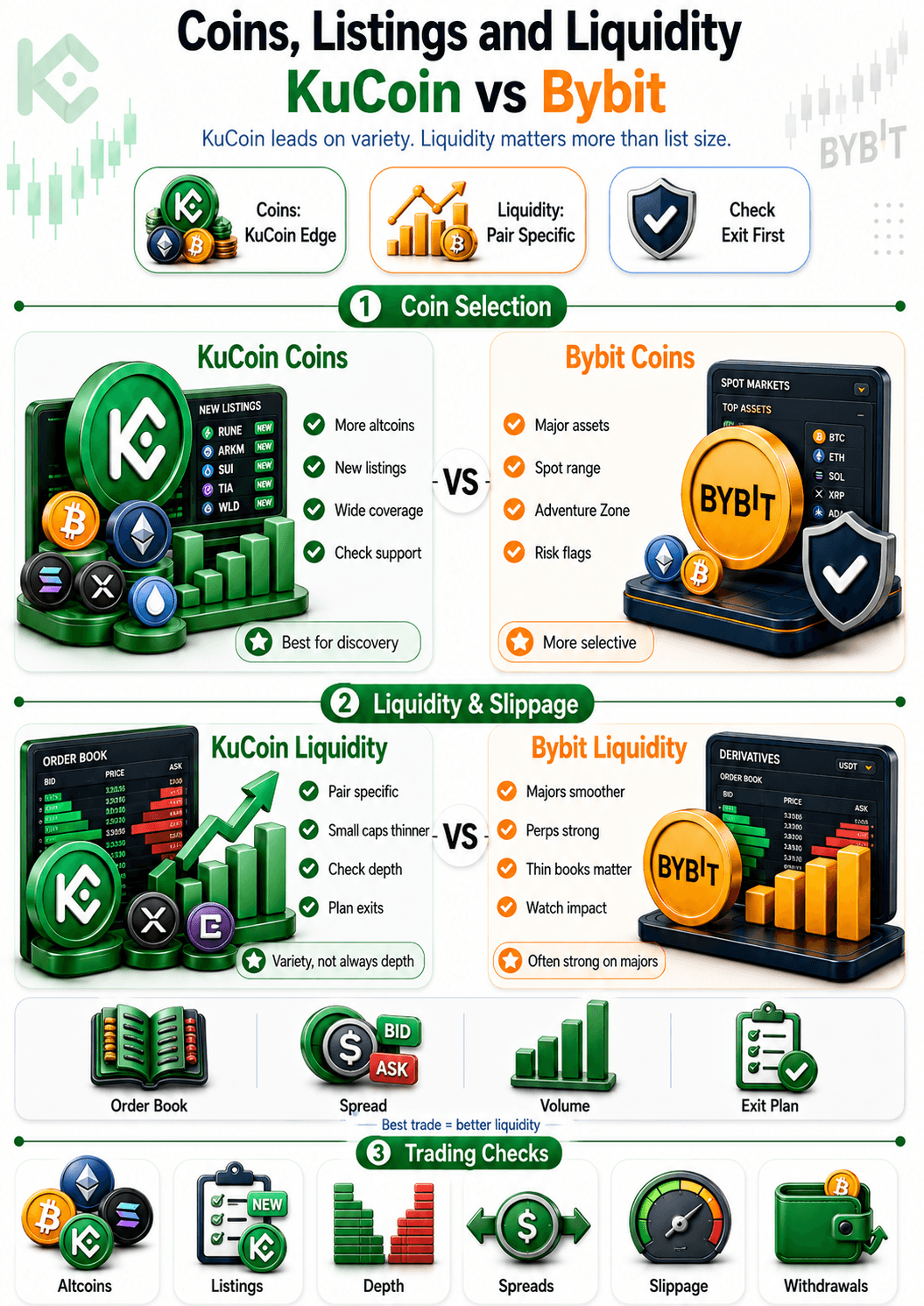 More Listed Assets can Create More Opportunities, but It can also Create More Noise and More Risk
Coin Selection
- KuCoin is usually the stronger choice for users hunting less common altcoins and newer listings. Its market pages emphasize broad asset coverage, while its special treatment and delisting rules also show that not every listing keeps its place forever.
- Bybit supports major assets and a solid range of spot markets too, but its own Spot Trading Rules explicitly flag some higher-risk assets in its Adventure Zone.
KuCoin is usually better for altcoin discovery, but users should check liquidity, spreads and withdrawal support before buying smaller tokens. More coins do not automatically mean better choices; sometimes it just means a bigger junk drawer.
Liquidity and Slippage
Liquidity is pair-specific. BTC/USDT, ETH/USDT, and major perpetual markets usually trade more smoothly than small-cap spot pairs or fresh listings.
Bybit’s futures trading rules even note that thin order books can affect price calculations when liquidity is limited. That is why traders should always inspect order book depth before placing size and build a simple exit plan before entering thinner markets. The better liquidity venue depends on the pair, product and trade size.
KuCoin often wins on variety, but the safer trade is usually the one with better liquidity and clearer exit options.
Copy Trading, Bots and Automation
Some users want to follow experienced traders, while others would rather automate their own rules. Bybit is stronger in the first category, while KuCoin stands out more in the second.
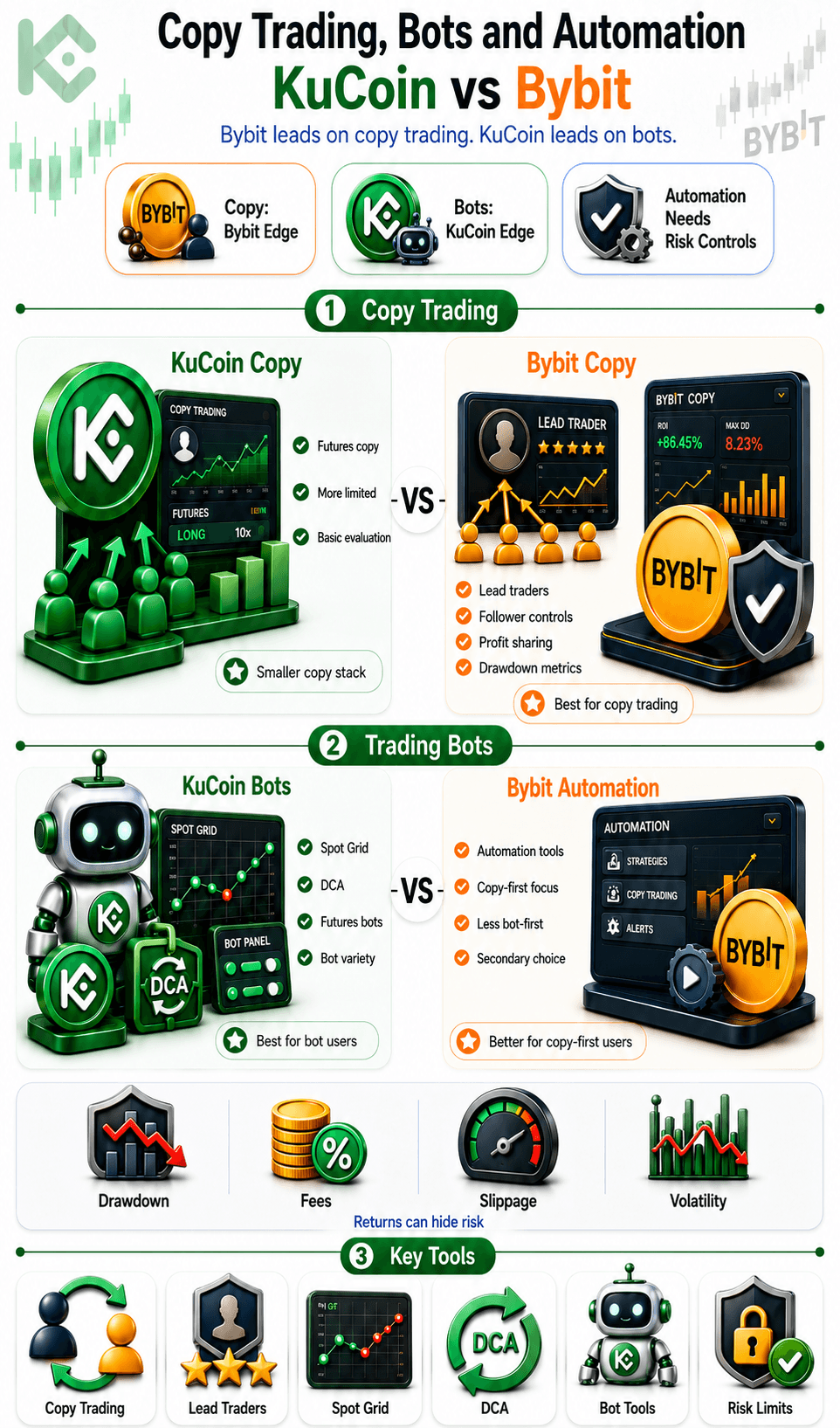 Bybit is Stronger in Copy Trading, while KuCoin Stands Out More when it comes to Bots
Copy Trading
Bybit is the better pick for copy trading. Its copy trading product is built around lead traders, follower controls, and profit sharing, and its help center explains metrics like maximum drawdown so users can look beyond headline PnL. Historical returns can look strong even when a trader is taking heavy leverage or sitting through deep losses.
KuCoin does offer futures copy trading, but Bybit’s copy-trading stack is more developed and easier to evaluate.
Trading Bots
KuCoin is the better pick for users who want built-in trading bots. Its bot suite includes Spot Grid, DCA, and Futures Bot Tools, with clear bot fees and strategy coverage guides. Bots tend to work best in structured or sideways markets, but they can still struggle in strong trends, sudden volatility, or thin-liquidity conditions where fees and slippage eat into results.
Choose Bybit for copy trading, and choose KuCoin for native bot variety and bot-first discoverability.
Fiat Deposits, P2P and Cards
For many users, the real test of an exchange is not the trading screen but how easily money moves in and out. This is where local rules, payment partners, and verification requirements come into play just as much as the exchange itself.
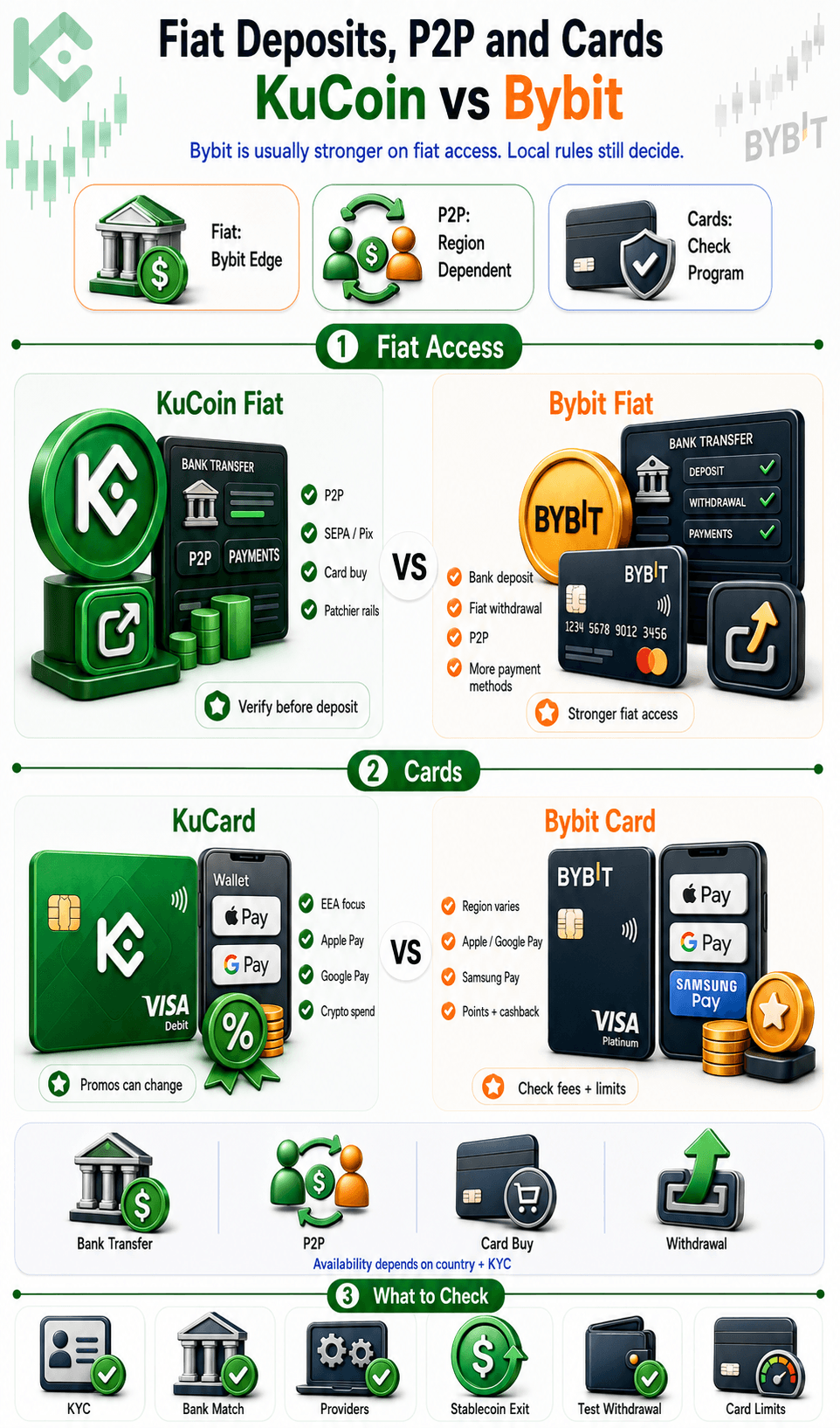 Local Rules, Payment Partners, and Verification Requirements are as Critical as the Exchange Itself
Fiat Deposits and Withdrawals
- Bybit is usually stronger for fiat access, while KuCoin users may need more external rails depending on their country. Bybit’s direct support for fiat deposits, bank-transfer options, fiat withdrawals, and P2P trading across many payment methods and currencies, though availability still depends on region and KYC status.
- KuCoin supports fiat services too, including P2P rules, SEPA and Pix withdrawal support, and card-based buy flows, but the setup can feel more patchy depending on where you live.
Users should check bank transfers, card buys, third-party providers, stablecoin off-ramp options, and whether a first deposit is required before withdrawal. Testing a small withdrawal first is the safest approach, especially when names, bank details, and KYC records must match exactly.
KuCard vs Bybit Card
Feature | ||
|---|---|---|
Regional Focus | Varies by Card Program and Region | |
Mobile Wallets | Supports Apple Pay and Google Pay | Supports Apple Pay, Google Pay, and Samsung Pay, Depending on Program |
Rewards | KuCoin Markets Cashback, But Promos Can Change | Bybit Runs a Points and Cashback-Style Rewards Program |
Spending Mechanics | Converts Supported Crypto for Card Spending | Fees, Limits, and Conversion Depend on the Card Program |
Earn, Launchpads and Tokenized Stocks
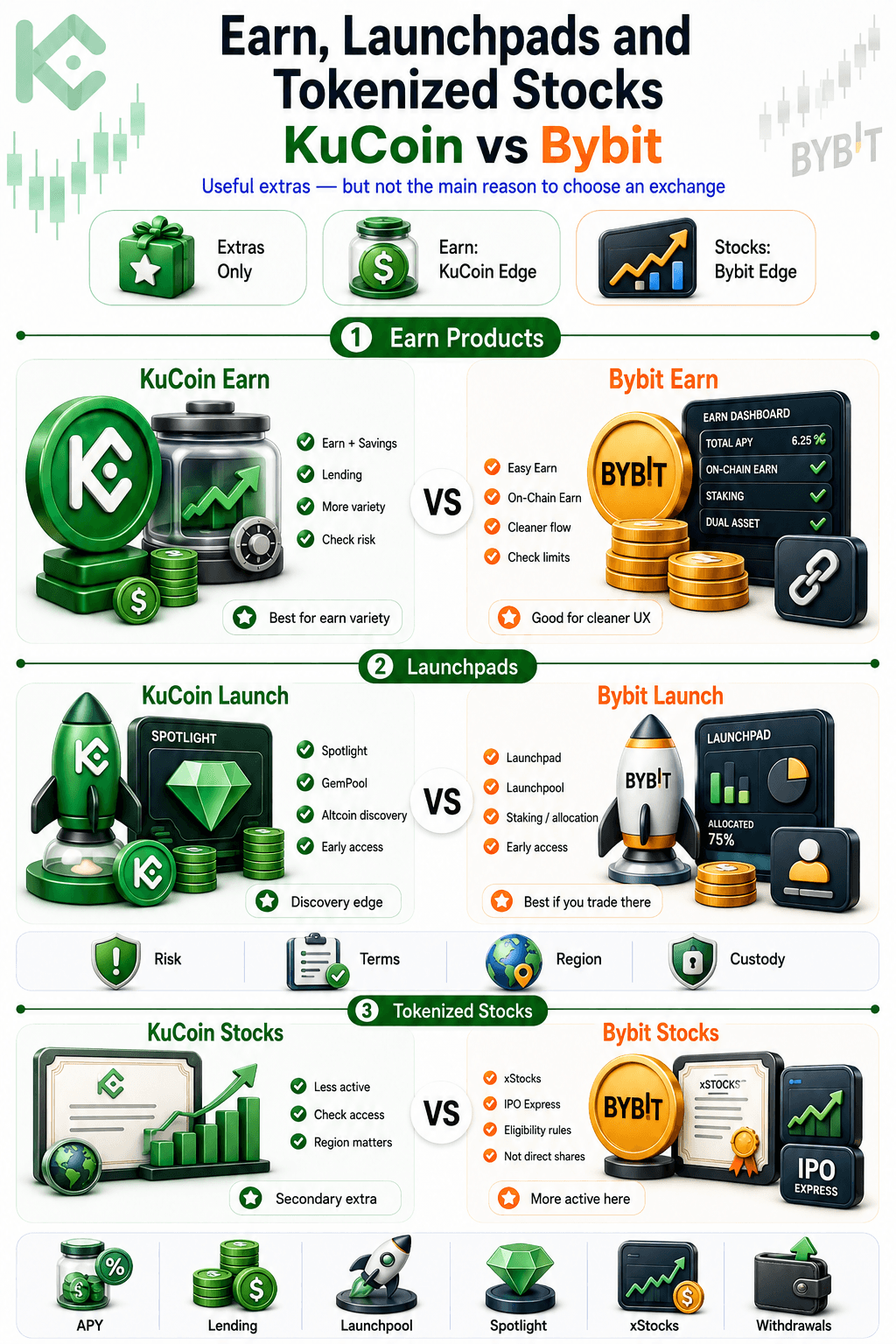 These Extras should Sit Behind the Core Exchange Decision, not Drive It
Earn Products
Compare Earn products by risk bucket, not just APY.
- KuCoin’s Earn, Savings, and Crypto Lending give a broader mix across lower-risk flexible/fixed products, lending, and other yield tools.
- Bybit’s Earn, Easy Earn, and On-Chain Earn feel cleaner, but users still need to watch redemption limits, principal risk, counterparty risk, and regional restrictions.
KuCoin may appeal to users who want more Earn variety, while Bybit can suit users who already trade there and want a cleaner experience.
Launchpads and New Token Access
A launchpad gives exchange users early access to selected token launches, but early access does not guarantee profit.
Bybit’s Launchpad and Launchpool use allocation and staking mechanics, while KuCoin’s Spotlight and GemPool are its early-access routes. KuCoin has the stronger altcoin-discovery identity, while Bybit’s launch products are worth checking if you already trade there.
Tokenized Stocks and IPO-Style Products
Bybit is more active here. Its xStocks and IPO Express provide tokenized stock and IPO-style access, subject to eligibility and product terms. Tokenized stocks can offer price exposure, but they are not the same as directly owning shares in a brokerage account.
For most users, these products are optional extras. They can be useful, but they should never outweigh basics like exchange access, withdrawals, and custody risk.
Mobile App, Interface and Support
A platform can have every feature in the world, but if the layout feels cluttered or support is hard to reach, the experience can still feel frustrating.
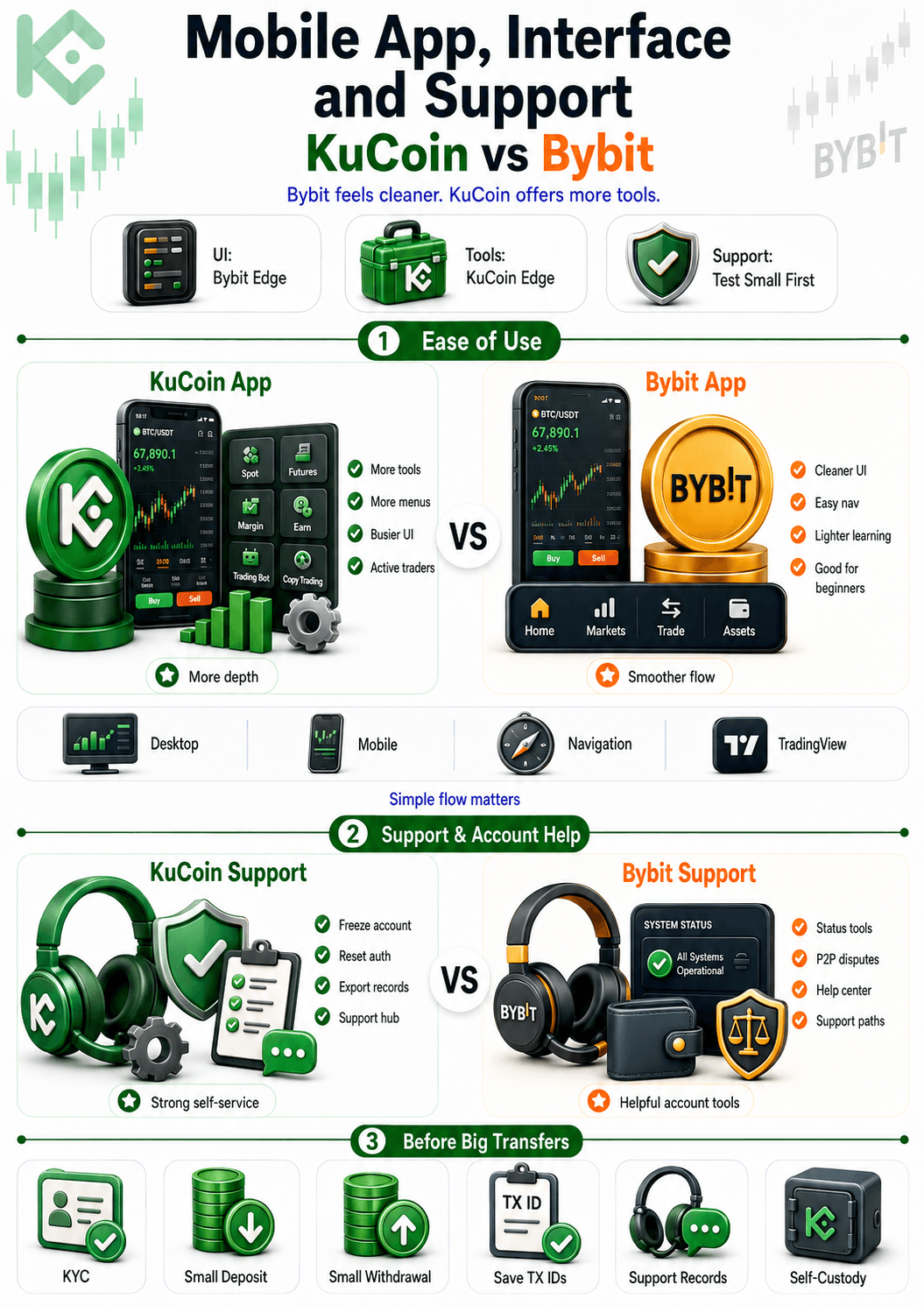 Even the Best Platform Feels Frustrating if it is Cluttered or Hard to Get Help On
Ease of Use
Bybit is easier to navigate, while KuCoin gives users more tools and more menus.
Bybit’s help center and asset-page guides point to a cleaner desktop and mobile flow, which makes the learning curve lighter for less advanced users. KuCoin’s support hub has a much broader spread of products across spot, margin, futures, bots, Earn, P2P, and cards, which is useful for active traders but can make the interface feel busier.
Customer Support and Account Issues
Both exchanges offer self-service tools, help-center articles, and support paths for common account problems.
Bybit’s support pages include deposit and withdrawal status tools, and P2P dispute options, while KuCoin highlights self-service actions such as freezing an account, resetting authentication, and exporting records. Public complaints can reveal real pain points, but they are not always representative. The safer rule is practical: before sending large sums to either exchange, complete KYC, test a small deposit, test a small withdrawal, and save transaction IDs and support records.
Bybit has the smoother interface, while KuCoin offers more depth at the cost of a steeper learning curve. For readers who want stronger control over storage, our primer on Self-Custody Wallets is a useful next step.

Final Verdict: Which Exchange Should You Choose?
Choose KuCoin if you want more altcoins, use KCS for fee discounts, want built-in trading bots, and mostly trade spot markets. It is the better fit for users who are comfortable checking withdrawal support, liquidity, and smaller listings before trading.
Choose Bybit if you mainly trade futures or perpetuals, want copy trading, prefer a cleaner interface, need stronger fiat access, or care about card features where available. It also makes more sense for EU users who value the clearer regulatory footing created by Bybit EU’s MiCAR authorization.
Use neither if you live in a restricted country, want long-term Cold Storage, are a complete beginner who only wants simple buy-and-hold, cannot tolerate exchange custody risk, or are not comfortable with KYC, withdrawal delays, and product restrictions.