OKX offers one of the broadest built-in trading bot suites among major crypto exchanges, covering Grid trading, DCA, arbitrage, TradingView signals, portfolio rebalancing and AI-assisted strategies.
This OKX Trading Bots review explains how the main bots work, which strategies they suit, what they cost and the risks to understand before automating trades.
Editor's Note (Aug. 29, 2026): We fully updated this article in August 2026 to reflect OKX's current trading bot lineup, including Spot and Futures Grid, DCA Martingale, Smart Arbitrage, Signal Bot, Smart Portfolio, execution bots and the newer AI Trading Bot. The refresh also adds updated fees, bot-selection guidance, Grid and DCA mechanics, profitability metrics, marketplace analysis and a deeper look at leverage, liquidation and automation risks.
OKX Trading Bots Review: Quick Verdict
OKX is one of the stronger major exchanges for native trading automation, with bots covering recurring purchases, Spot and Futures Grid trading, DCA Martingale, Smart Arbitrage, TradingView signals, portfolio rebalancing, large-order execution and AI-assisted strategies. It is best suited to traders who already understand the strategy they want to automate. Beginners should be especially cautious with Futures Grid and DCA Martingale because automation does not remove leverage, liquidation or capital-escalation risk.
| Goal / Market Condition | Best-Fit OKX Bot | Risk Level |
|---|---|---|
| Sideways spot market | Spot Grid | Moderate |
| Long-term accumulation | Recurring Buy | Lower |
| Averaging into short-term trades | Spot DCA Martingale | High |
| Leveraged range trading | Futures Grid | Very high |
| Leveraged averaging strategy | Futures DCA Martingale | Very high |
| Funding-rate opportunities | Smart Arbitrage | Moderate to high |
| Automated TradingView strategy | Signal Bot | Depends on strategy |
| Portfolio allocation | Smart Portfolio | Moderate |
| Large order execution | TWAP / Iceberg | Execution-dependent |
| Custom AI-assisted rules | AI Trading Bot | Depends on strategy |
Disclaimer
This guide is for educational purposes only and is not financial advice.
Disclosure
Some links in this guide may be affiliate links. If you choose to use a service through these links, we may earn a commission at no additional cost to you.

What Are OKX Trading Bots?
OKX Trading Bots are native automated strategies that place and manage orders through an OKX account according to predetermined rules. Unlike many third-party bot services, they run directly through the crypto exchange rather than requiring another trading platform between the user and OKX.
Once launched, the bot handles execution through the exchange, so the browser or mobile app does not have to remain open for every trade. Some bots are almost entirely parameter-driven, while others offer presets, signal integration or AI-assisted configuration.
A Spot Grid user, for example, chooses a range, grid quantity and capital allocation. Other products offer backtested presets or AI-assisted settings. Signal Bot takes external TradingView alerts and turns them into orders, while the newer AI Trading Bot can translate natural-language strategy instructions and selected market data into executable logic.
Read our full OKX exchange review. Readers new to this type of automation can read Coin Bureau's guide on how crypto trading bots connect strategy rules, exchange execution and risk controls.
OKX Trading Bots Available in 2026
The current lineup spans investment automation, active trading, arbitrage, signal execution, portfolio management and order execution.
| Bot | What It Automates | Best Market / Use | Key Risk |
|---|---|---|---|
| Spot Grid | Repeated spot buys and sells across a price grid | Sideways or oscillating liquid markets | Price trends outside the range |
| Futures Grid | Grid trading with futures positions | Leveraged range trading | Liquidation and funding |
| Spot DCA Martingale | Initial order plus price-triggered safety orders | Averaging into active trades | Capital exposure can escalate |
| Futures DCA Martingale | Leveraged DCA cycles with safety orders | Advanced long or short averaging | Liquidation plus capital escalation |
| Recurring Buy | Scheduled fixed-amount purchases | Long-term accumulation | Underlying asset can continue falling |
| Smart Arbitrage | Hedged spot and perpetual positions | Funding-rate strategies | Funding and basis can change |
| Smart Portfolio | Portfolio rebalancing | Maintaining target allocations | Rebalancing into declining assets |
| Signal Bot | TradingView signal execution | Traders with existing technical strategies | Bad, delayed or misconfigured signals |
| AI Trading Bot | AI-generated decisions from user instructions and data | Custom rule creation | Weak instructions or generated logic |
| TWAP | Large orders divided across time | Reducing market impact | Price moves during execution |
| Iceberg | Large orders split into smaller visible orders | Large execution in thinner markets | Slippage and incomplete execution |
OKX's Smart Portfolio, for example, can rebalance a portfolio either on a schedule or when allocations deviate by a specified proportion.
TWAP instead divides execution across time, while Iceberg hides much of a large order by exposing smaller pieces. Those tools solve completely different problems despite living under the same bot menu.
Which OKX Trading Bot Should You Use?
The right OKX bot depends first on the market behavior or task you are trying to automate. Choosing from a leaderboard before defining the strategy reverses that process.
Anyone still unclear on spot trading, trading pairs, long and short positions or basic order execution should understand those mechanics before automating them.
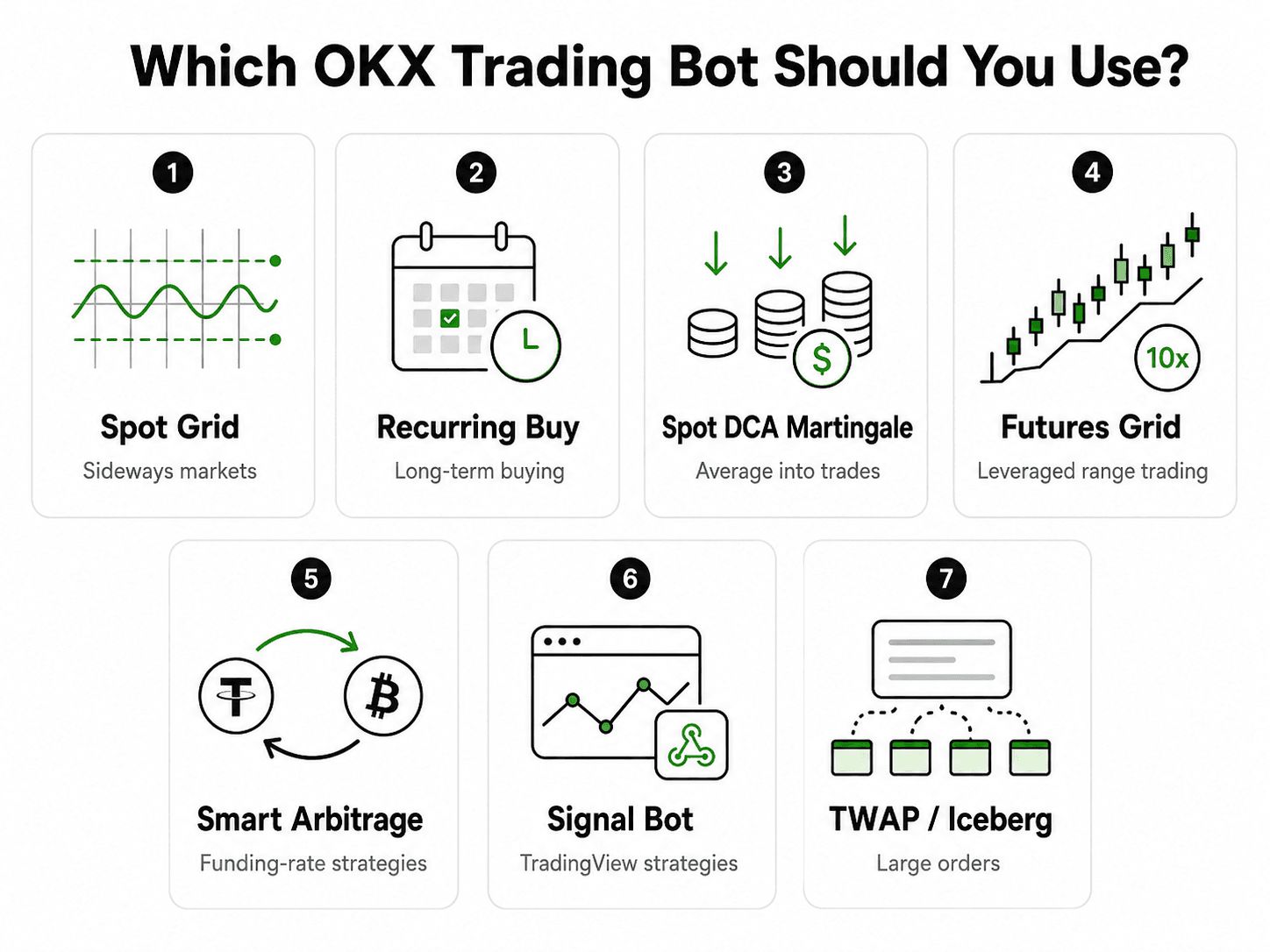 Matching Each OKX Bot to Its Best Trading Environment
Best OKX Bot for Sideways Markets: Spot Grid
Spot Grid is best suited to liquid markets moving repeatedly within a defined price range.
The bot divides that range into levels, buys at lower levels and sells at higher ones. Repeated oscillations give it multiple chances to complete buy-and-sell cycles instead of relying on one large directional move.
A persistent trend changes the equation. A sharp decline can leave the bot accumulating more of the base asset as successive buy orders fill. A strong rally can sell down that base asset and leave the trader with less exposure to further upside.
Best OKX Bot for Long-Term Buying: Recurring Buy
Recurring Buy is the OKX bot for traditional dollar-cost averaging.
The user chooses the cryptocurrency, amount and purchase frequency, and the bot makes scheduled purchases over time. OKX currently allows recurring purchases across multiple cryptocurrencies and supports several purchase frequencies.
This is materially different from OKX's DCA Martingale products. Recurring Buy reacts to time. DCA Martingale reacts to price movement and adds safety orders to an active trading cycle.
Best OKX Bot for Averaging Into Trades: Spot DCA Martingale
Spot DCA Martingale fits traders who deliberately want to add more capital when price moves against the initial entry.
A cycle starts with an initial order. If the price moves by predefined deviations, the bot places safety orders. Those purchases lower the average entry price for a long strategy, allowing a smaller rebound to reach the take-profit target. Once that target is hit, the cycle can close and restart.
The cost is growing exposure. OKX allows an amount multiplier for subsequent safety orders, so a configuration can increase position sizes as the sequence progresses.
A 100 USDT safety order with a 2x multiplier becomes 100, 200, 400 USDT and so on. The strategy can therefore consume capital much faster than the word DCA suggests.
Best OKX Bot for Leveraged Range Trading: Futures Grid
Futures Grid is designed for traders who want Grid mechanics with perpetual futures exposure.
The structure adds long, short or neutral futures positioning to the familiar grid range. It also introduces margin and leverage. That gives the strategy more flexibility, including the ability to build a bearish grid, but losses can now reach a liquidation threshold rather than simply leaving the trader holding a depreciated spot asset.
Futures Grid therefore requires two correct calls: the range has to remain useful, and the position must survive the leverage structure while it does so.
Best OKX Bot for Funding-Rate Strategies: Smart Arbitrage
Smart Arbitrage is designed around hedged spot and perpetual positions rather than directional price prediction.
A typical positive-funding structure buys the asset in the spot market and shorts an equivalent perpetual position. The two legs target a roughly delta-neutral exposure, while the short can collect funding when longs are paying shorts.
Delta neutral reduces directional exposure. Funding changes, basis movement, trading costs and execution still affect the return.
Best OKX Bot for TradingView Strategies: Signal Bot
Signal Bot is the best fit for traders who already have strategy logic in TradingView.
TradingView creates the signal; OKX handles execution. The integration uses alerts and webhooks, while Pine Script users can pass strategy signals through OKX's supported alert-message format.
That makes Signal Bot an execution layer rather than a strategy generator. The trader still owns the logic and the mistakes inside it.
Best OKX Bot for Large Orders: TWAP and Iceberg
TWAP and Iceberg are execution tools rather than speculative strategies.
TWAP breaks a large trade into smaller orders submitted periodically over a chosen period.
Iceberg also splits a large order, but its purpose is to prevent the full size from sitting visibly in the order book.
Both can reduce market impact when a single large order would create excessive slippage.
How OKX Grid Bots Work
OKX Grid Bots automate a simple trading idea: define a range, divide it into levels and repeatedly trade price movements between those levels.
Grid trading works best when price repeatedly crosses the same zones. Once price starts trending cleanly, the same mechanism can begin working against the trader.
Spot Grid Explained
Spot Grid uses an upper price, lower price and selected number of grid levels to create a ladder of buy and sell orders.
The two assets in a trading pair play different roles. In BTC/USDT, Bitcoin is the base asset and USDT is the quote asset. The bot uses quote currency for lower buy orders and holds base currency for sell orders above the current market price.
Consider a hypothetical asset trading at $100. You create an arithmetic Spot Grid from $90 to $110 with four equal intervals:
- $90
- $95
- $100
- $105
- $110
If price falls from $100 to $95, a buy order can execute. The bot then places the corresponding sell order one level higher, around $100.
If the market rebounds and that sell completes, the grid has captured the difference between those two levels before trading fees.
The cycle can repeat whenever price moves back and forth through the grid. That repeated movement is the engine of Grid Profit.
Arithmetic vs Geometric Grid
- Arithmetic Grid places levels at equal price differences. A range from $100 to $200 divided into four equal intervals would move in fixed dollar increments.
- Geometric Grid places levels at equal percentage differences. The absolute dollar gap therefore becomes larger as the price increases.
Arithmetic spacing is easier to reason about when a relatively narrow range has a stable dollar width. Geometric spacing can be more useful across wider ranges where percentage movement gives a more consistent measure of volatility.
AI Strategy vs Manual Grid Settings
OKX gives Grid users both manual control and backtest-based parameter assistance.
Manual configuration lets the trader choose the range, grid quantity, investment and other settings directly. Current Spot Grid Smart Strategies use historical backtests across different windows for short, medium and longer-term configurations.
The resulting parameters can include the proposed range, grid density and expected profit per grid.
This "AI Strategy" feature is separate from the newer AI Trading Bot discussed later. Grid AI presets recommend parameters within an existing Grid framework. The AI Trading Bot accepts natural-language strategy logic and has a broader decision engine.
Neither feature predicts future profits. A range that performed well during the historical test can become irrelevant after a volatility shift or breakout.
How to Choose a Grid Range and Number of Grids
A useful Grid range should reflect expected volatility rather than simply surround the current price by an arbitrary percentage.
Start with four variables:
- Range width: A wider range survives larger price moves but spreads capital across more territory.
- Expected volatility: Tight ranges can generate more crossings in quiet markets but break more easily when volatility expands.
- Pair liquidity: Deeper markets generally offer tighter spreads and cleaner execution.
- Grid quantity: More grids create smaller gaps and potentially more trades; fewer grids create wider gaps and larger gross profit per completed cycle.
Increasing the number of grids reduces the distance between orders. That can increase trading frequency while lowering the gross profit available from each grid before fees.
Fees set a practical floor. If the gross spread between two levels is barely larger than the round-trip trading cost, extra activity can create impressive trade counts without much economic return.
OKX has expanded the product considerably. Current Spot Grid documentation allows up to 500 grids, giving traders room for very dense configurations.
The existence of 500 available grids is hardly a reason to use all 500. Grid density still needs to leave enough expected profit per cycle to clear fees and execution costs.
What Happens When Price Leaves the Grid?
When price falls below a standard Spot Grid's lower limit, the bot stops placing normal orders beneath that boundary.
Because lower buy orders may already have filled on the way down, the portfolio can end up holding more of the base asset precisely while that asset is losing value.
Trailing Down can extend the grid lower where available, but each extension may require additional capital. If sufficient capital is unavailable, the grid cannot keep extending.
When price moves above the upper range, sell orders executed on the way up can leave the bot increasingly concentrated in quote currency.
A trader who simply held the base asset would retain full upside exposure, while the Grid trader has systematically sold portions of it.
Trailing Up can shift the grid higher as price advances. That keeps the strategy active, though it changes the original range assumption and should be considered when setting take-profit and stop-loss levels.
Editing and Stopping an OKX Grid Bot
Current Spot Grid bots are more flexible. Users can edit the upper and lower range and grid quantity without first closing the bot.
Changing the range or grid count alters the order structure and capital allocation of the strategy. Review the new grid spacing and expected profit per grid again rather than assuming the previous economics survive.
Take-profit and stop-loss controls can close the strategy at predefined levels.
Where available, users can also withdraw eligible Grid Profit without stopping the bot, although the maximum withdrawable amount can be lower than cumulative Grid Profit because funds may still be needed to support open orders.
When a Spot Grid bot is stopped, pending orders are canceled. OKX lets the user either sell the remaining base asset at market or keep the crypto, after which the assets return to the trading account.
OKX DCA Bot vs Recurring Buy
OKX Recurring Buy is traditional time-based DCA, while OKX DCA Martingale bots average into active trades through additional orders triggered by adverse price movement.
| Feature | Recurring Buy | Spot DCA Martingale | Futures DCA Martingale |
|---|---|---|---|
| Primary goal | Long-term accumulation | Trading | Leveraged trading |
| Order trigger | Time | Price movement | Price movement |
| Safety orders | No | Yes | Yes |
| Leverage | No | No | Yes |
| Liquidation risk | No | No | Yes |
| Capital escalation | No | Yes | Yes |
Recurring Buy can purchase the same fixed amount every week regardless of price. Martingale deliberately changes exposure as the trade moves against the initial position.
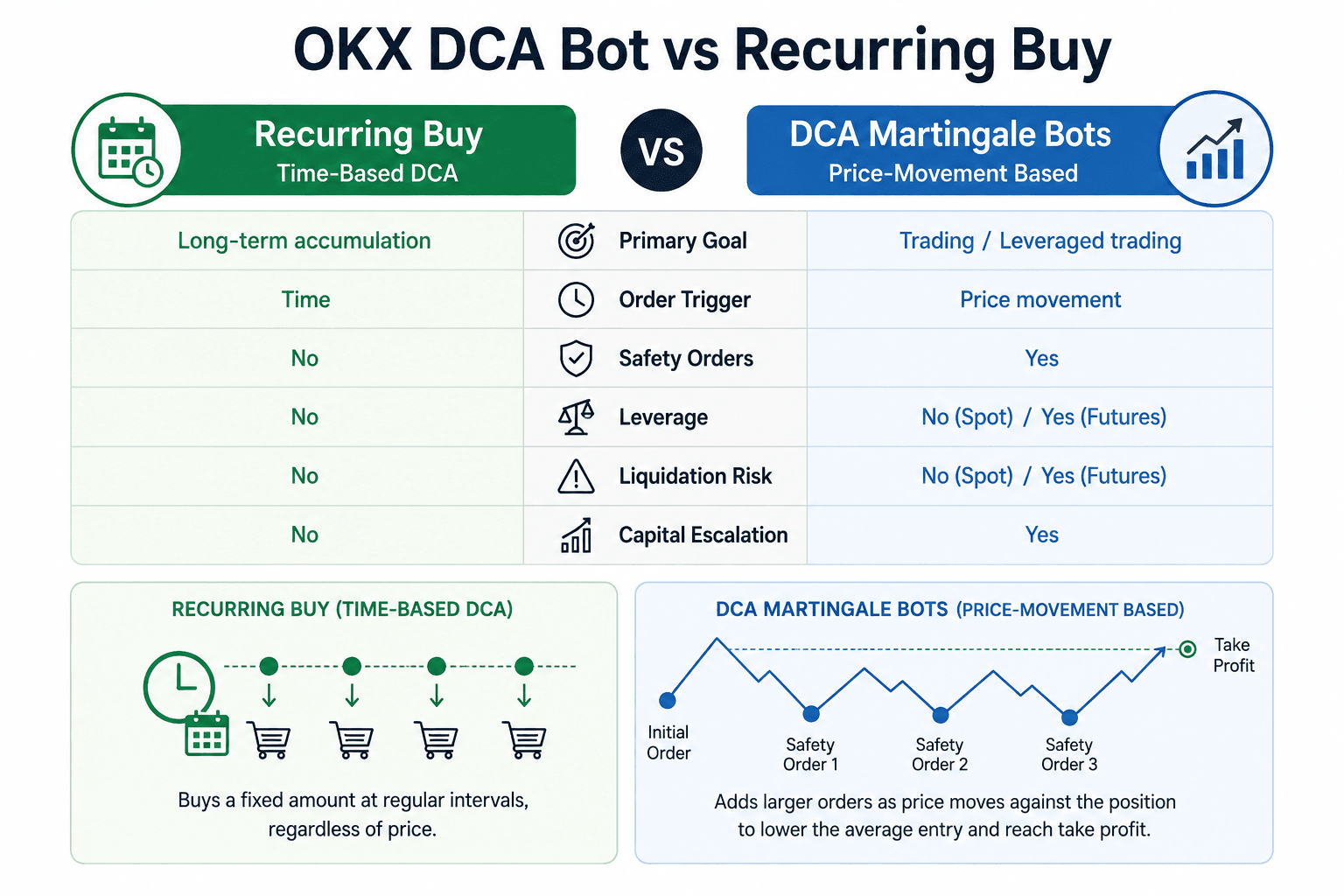 Comparing OKX DCA Martingale With Traditional Recurring Purchases
How Spot DCA Martingale Works
Spot DCA starts each cycle with an initial order.
The trader then defines the price deviation that activates each safety order, the number of safety orders available and, optionally, an order-size multiplier.
As lower orders execute, the average entry price moves closer to the current market.
Suppose the first order buys $100 of an asset. A trader configures safety orders after specified declines, with each later order larger than the previous one.
If those orders buy $100, $200 and $400, the position grows to $800 including the initial purchase.
The take-profit target is then calculated around the averaged position rather than the first entry alone. A rebound may therefore close the cycle even if the asset never returns to the original purchase price.
Why Martingale Can Become Dangerous
The same mechanism that pulls the average entry downward also increases the amount of capital exposed to the trade.
A persistent one-way market can trigger safety order after safety order. As the sequence continues, the trader can eventually use all capital allocated to the strategy. A configuration with aggressive multipliers accelerates that process.
This creates an asymmetric return profile that a high win rate can disguise. Many small profitable cycles can be interrupted by one prolonged trend that builds a much larger losing position.
A 90% winning history, for example, says little without knowing whether the losing 10% was small or large enough to erase the preceding gains. Maximum drawdown and capital required across a full safety-order sequence are more revealing.
Futures DCA Adds Liquidation Risk
Futures DCA combines Martingale-style averaging with leverage.
The bot can run long or short and uses margin to support a derivatives position. Each additional safety order changes position size, average entry and effective leverage.
If losses push the position below the exchange's maintenance requirements, liquidation can occur.
Averaging into a leveraged loss is structurally more dangerous than averaging into spot. Spot can leave the trader holding a deeply depreciated asset. Futures can close the position before a later recovery ever arrives.
OKX Smart Arbitrage: How It Works and Where the Risk Comes From
OKX Smart Arbitrage targets funding income using hedged spot and perpetual positions. The aim is to reduce directional exposure and earn from the relationship between the two markets.
Readers exploring the strategy can compare the broader category of in Coin Bureau's guide on crypto arbitrage bots.
Funding-Rate Arbitrage
A common Smart Arbitrage structure holds a long spot position and an equivalent short perpetual swap.
If an investor buys $10,000 of ETH spot and shorts roughly $10,000 of an ETH perpetual, a rise in ETH should create a spot gain and a derivatives loss of similar magnitude. A decline should do the reverse.
The target is a near delta-neutral position whose result depends less on outright ETH direction.
The remaining return can come from funding. When the perpetual funding rate is positive, long positions pay shorts. The Smart Arbitrage short can therefore receive funding while the spot leg hedges much of the directional exposure.
Delta neutral does not mean risk free. The hedge can drift, execution prices can differ and funding economics can change while the strategy is running.
What Happens When Funding Rates Change?
Funding determines whether the core cash-and-carry structure remains attractive.
- Positive funding: Shorts receive funding from longs, supporting the standard long-spot/short-perpetual structure.
- Declining positive funding: The strategy may remain profitable, but its forward yield falls.
- Negative funding: Shorts pay longs, turning the funding component from income into a cost.
A projected annualized yield at entry therefore cannot be treated like a fixed-interest rate. Funding is a market price and can change between settlement periods.
Smart Arbitrage With Staking
OKX has extended Smart Arbitrage to combine funding-rate strategies with staking income for supported ETH and SOL configurations.
For Ethereum, ETH can be represented by BETH, which earns staking rewards. For Solana, OKSOL performs a similar role.
OKX's current structure can pair BETH with an ETH perpetual hedge or OKSOL with a SOL perpetual hedge, combining staking rewards with the funding component.
The displayed combined APY remains a reference yield. Funding rates, staking rewards, fees and exit conditions can all change after entry.
Main Smart Arbitrage Risks
The major failure points are fairly specific:
- Funding-rate reversal: The short perpetual can move from receiving funding to paying it.
- Basis risk: Spot and perpetual prices may not remain perfectly aligned.
- Execution risk: Two legs need to be opened, adjusted and eventually closed.
- Trading fees: Entry, adjustment and exit costs reduce the captured yield.
- Derivatives risk: The perpetual leg still sits inside a derivatives market with margin mechanics.
- Staking-token exposure: BETH and OKSOL add staking and exit mechanics to the structure.
For this strategy, "market neutral" is better understood as reduced directional sensitivity rather than capital protection.
OKX Signal Bot and AI Trading Bot
Signal Bot and AI Trading Bot both automate custom strategies, but the source of the trading logic is different. Signal Bot executes logic already built by the trader or signal provider. AI Trading Bot helps convert instructions and selected data into that logic.
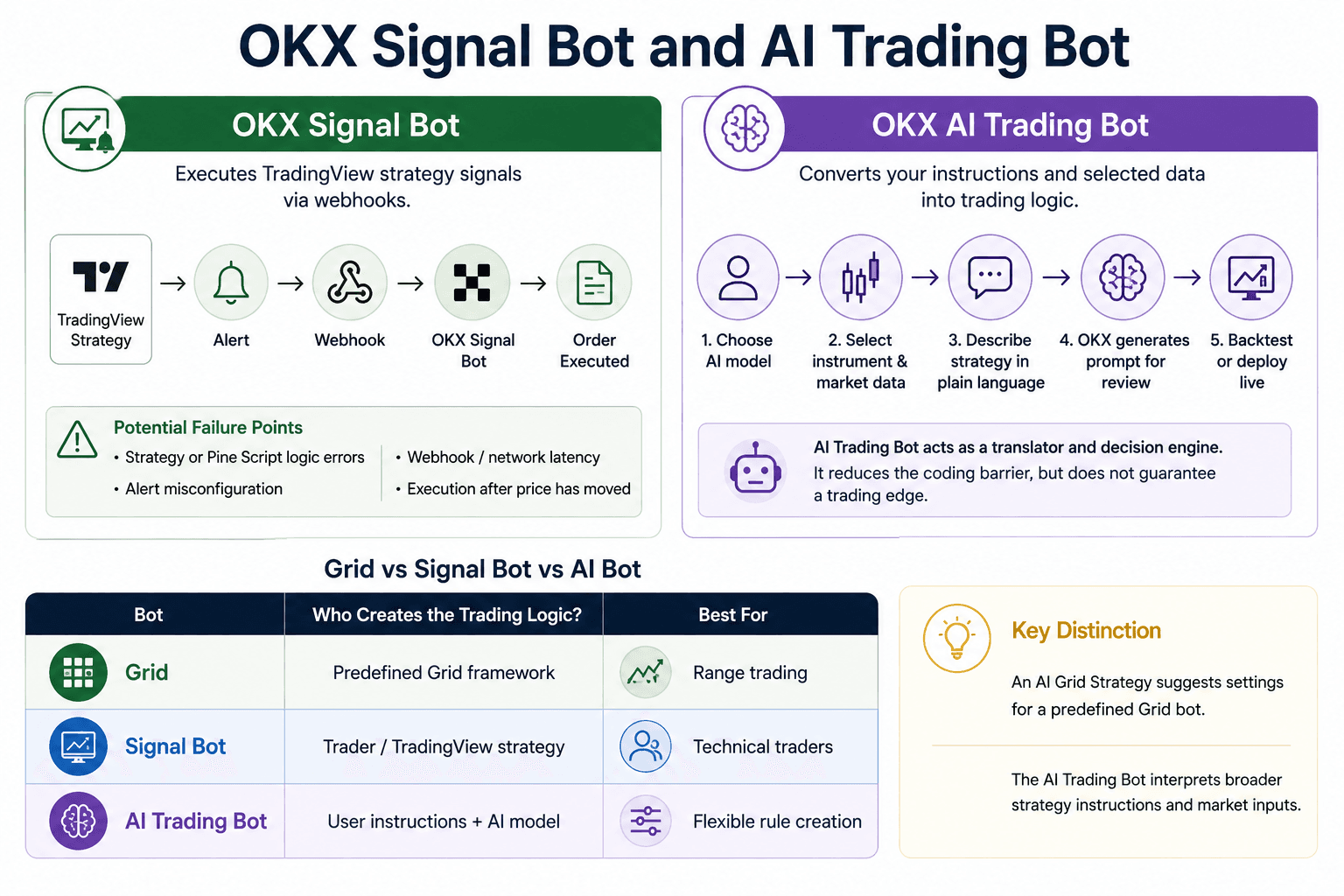 Custom Automation Through TradingView Signals and AI Strategies
OKX Signal Bot
OKX Signal Bot connects TradingView strategy signals to OKX execution.
A trader can create strategy logic using Pine Script, configure TradingView alerts and send those alerts through an OKX-generated webhook URL. The webhook carries the alert message to OKX, where the corresponding order is executed.
The flow is essentially:
TradingView strategy → alert → webhook → OKX Signal Bot → order
That separation creates several failure points. A Pine Script condition can be wrong. An alert can be configured incorrectly. Network or processing latency can leave the live order arriving after the price seen by the strategy.
Backtesting has another limitation. Historical tests work with past market data and simulated execution assumptions. Live trading adds spread, slippage, order-book depth, latency and partial fills.
A strategy that looks clean inside TradingView can behave differently once real orders hit the market.
OKX AI Trading Bot
OKX's AI Trading Bot is a newer form of automation built around natural-language strategy instructions.
The current workflow begins by choosing an AI model, then selecting a trading instrument and the market data the model should use. The trader describes the trading logic in plain language, including entries, exits and position-management rules.
OKX then generates a prompt for the user to review before backtesting or live deployment.
Users can also select market data and technical indicators for the model to evaluate, alongside configurable decision intervals where supported.
The AI Trading Bot therefore acts as a translator and decision engine. The user supplies the objective, constraints and market inputs; the model turns them into executable decisions.
That can reduce the coding barrier. It does not supply a durable trading edge automatically. Poor instructions, contradictory indicators or an unsuitable market regime can still produce poor trades, only with faster execution.
For a wider comparison, Coin Bureau has separately reviewed best crypto-AI trading bots.
Grid vs Signal Bot vs AI Bot
| Bot | Who Creates the Trading Logic? | Best For |
|---|---|---|
| Grid | Predefined Grid framework | Range trading |
| Signal Bot | Trader / TradingView strategy | Technical traders |
| AI Trading Bot | User instructions + AI model | Flexible rule creation |
The distinction also helps separate two features with similar language. An AI Grid Strategy suggests settings for a predefined Grid bot. The AI Trading Bot interprets broader strategy instructions and market inputs.
OKX Trading Bot Fees and the Real Cost of Automation
OKX does not generally charge a separate subscription price for its native bots. The bots themselves can be created without a separate bot subscription, while each underlying transaction remains subject to the applicable trading fee.
As of Aug. 29, 2026, OKX's regular tier for standard Group 1 pairs lists the following base rates:
| Market | Maker Fee | Taker Fee |
|---|---|---|
| Spot | 0.08% | 0.10% |
| Futures | 0.02% | 0.05% |
These are standard rates, not universal rates for every account or trading pair. Fee tiers depend on factors such as assets and 30-day trading volume, while stablecoin, fiat and jurisdiction-specific schedules can differ.
A maker fee applies when an order adds liquidity to the book. A taker fee applies when an order immediately consumes existing liquidity. The actual fee on a Grid fill can therefore depend on how that individual order executes.
How Trading Fees Affect Grid Profit
Grid profitability should be evaluated after both sides of the trade.
Take a simplified Spot Grid cycle:
- Buy price: $100
- Sell price: $100.50
- Gross price spread: 0.50%
- Regular maker fee on the buy: 0.08%
- Regular maker fee on the sell: roughly 0.08%
A $100 buy followed by a $100.50 sell generates $0.50 gross profit.
The approximate fees are:
Buy fee: $100 × 0.08% = $0.08
Sell fee: $100.50 × 0.08% ≈ $0.0804
That leaves approximately:
$0.50 - $0.08 - $0.0804 = $0.3396
So a 0.50% gross move has fallen to roughly 0.34% before slippage and any other costs.
This is why more grids do not automatically produce more profit. Smaller spacing creates more possible cycles but leaves less gross spread for each one.
Other Costs Traders Can Overlook
Trading commission is only the most visible expense.
- Funding fee: Perpetual futures exchange payments between long and short holders. It affects Futures Grid, Futures DCA and arbitrage economics.
- Spread: The gap between the highest bid and lowest ask. Wider spreads make entry and exit less efficient.
- Slippage: The difference between the expected execution price and the actual fill. Liquidity and order size can make this materially worse.
- Opportunity cost: Capital tied inside a bot cannot simultaneously capture another trade or full buy-and-hold upside.
- Borrowing or margin costs: These can apply where a strategy uses borrowed capital or relevant margin products.
A bot that completes hundreds of small trades can therefore lose far more to friction than a low headline fee initially suggests.
Are OKX Trading Bots Profitable?
OKX Trading Bots can generate profits when the strategy fits the market, but profitability varies with the bot, asset, volatility, range, leverage, fees, settings and exit timing.
A profitable Grid cycle does not automatically mean the entire position is profitable. That difference is central to evaluating bot performance.
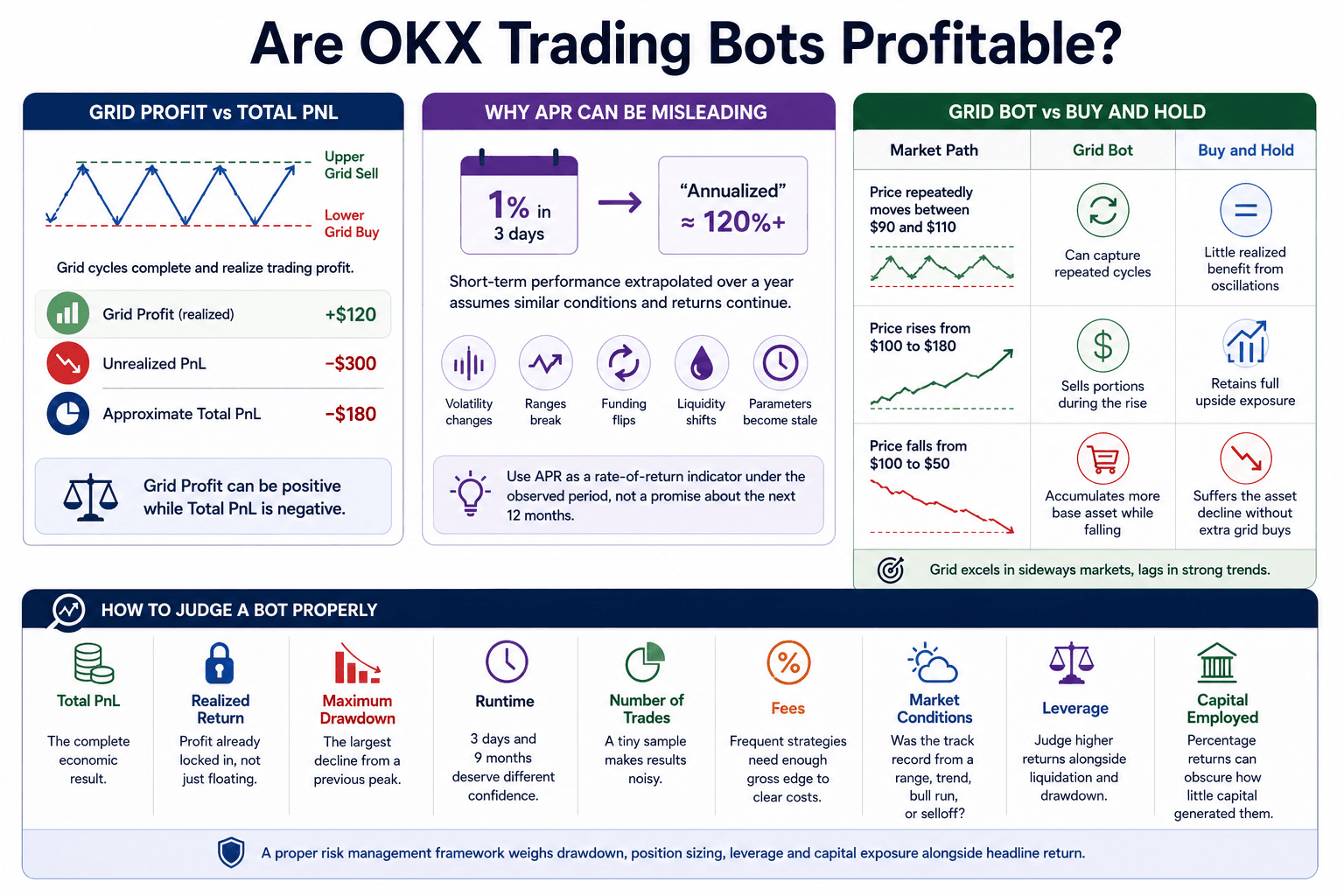 Bot Profitability Depends on Strategy, Costs and Market Conditions
Grid Profit vs Total PnL
Grid Profit estimates the realized profit generated by completed Grid cycles.
Unrealized PnL reflects gains or losses sitting in assets or positions that remain open.
Total PnL captures the broader result of the bot, including realized and unrealized components.
Imagine a Spot Grid has completed enough small cycles to show:
- Grid Profit: +$120
- Unrealized loss on the base asset: -$300
- Approximate Total PnL: -$180
The Grid mechanism worked exactly as designed and generated realized trading profit. The overall position still lost money because the asset declined.
That is why Grid Profit can be positive while Total PnL is negative. Looking at the larger Grid Profit number alone gives an incomplete picture.
Why APR Can Be Misleading
Annualized returns become especially fragile when the bot has only been running for a short period.
A bot that earns 1% over several days can display an eye-catching annualized figure if that short-term performance is extrapolated across an entire year. The calculation quietly assumes that similar conditions and returns can continue.
Crypto market regimes rarely cooperate with that assumption for long. Volatility changes, ranges break, funding flips, liquidity shifts and profitable parameters become stale.
Reinvestment can further change the result where returns are compounded or added back into capital.
Use APR as a rate-of-return indicator under the observed period, not a promise about the next 12 months.
OKX Grid Bot vs Buy and Hold
Grid and buy-and-hold can outperform each other under very different price paths.
Consider three simplified scenarios:
| Market Path | Grid | Buy and Hold |
|---|---|---|
| Price repeatedly moves between $90 and $110 | Can capture repeated cycles | Little realized benefit from oscillations |
| Price rises from $100 to $180 | Sells portions during the rise | Retains full upside exposure |
| Price falls from $100 to $50 | Accumulates more base asset while falling | Suffers the asset decline without extra grid purchases |
The sideways case is where Grid has its cleanest structural advantage. It converts oscillation into repeated trades.
During a powerful bull trend, that discipline can become an opportunity cost because each upper sell reduces exposure to the asset. During a prolonged decline, the opposite happens: lower Grid buys can steadily increase inventory in a falling market.
How to Judge a Bot Properly
A useful bot review needs more than ROI.
Look at:
- Total PnL: The complete economic result.
- Realized return: Profit already locked in rather than floating on open positions.
- Maximum drawdown: The largest decline from a previous performance peak.
- Runtime: A three-day track record and a nine-month track record deserve different confidence.
- Number of trades: A tiny sample can make win rates and returns noisy.
- Fees: Frequent strategies need enough gross edge to clear trading costs.
- Market conditions: Identify whether the track record came from a range, trend, bull market or selloff.
- Leverage: Higher returns produced with leverage should be judged alongside liquidation and drawdown.
- Capital employed: Percentage returns can obscure how little capital generated them.
A proper crypto risk management framework weighs drawdown, position sizing, leverage and capital exposure alongside headline return.
OKX Bot Marketplace: How to Choose a Bot Without Chasing ROI
The OKX Bot Marketplace makes it easy to copy another user's bot parameters. The hard part is deciding whether the track record says anything useful about the strategy going forward.
Metrics to Check Before Copying a Bot
Use the marketplace as a due-diligence screen rather than a return ranking.
Prioritize:
- Runtime: Longer operation provides more evidence across changing conditions.
- Total return: Check what the strategy actually produced.
- Maximum drawdown: A 40% return accompanied by a 35% drawdown has a different risk profile from a 20% return with a 5% drawdown.
- Number of trades: More completed trades provide a larger behavioral sample.
- Trading pair: Volatile small-cap assets can make an otherwise ordinary strategy look spectacular.
- Leverage: Leveraged results should never be compared directly with unleveraged returns.
- Capital: Performance on a very small allocation may not scale cleanly.
- Market regime: Ask what BTC and the selected pair were doing during the bot's lifetime.
- Copier count: Popularity can show interest, though it says little about future profitability.
Why the Highest-ROI Bot Is Rarely the Obvious Choice
Marketplace rankings naturally favor strategies that have recently worked.
A bot can reach the top because it has a short track record, uses high leverage or trades a token that just experienced an unusually strong move. Annualization can make short successful periods appear even more dramatic.
There is also survivorship bias. Strategies that fail spectacularly attract less attention than the surviving bots currently sitting near the top of the marketplace.
The market regime adds another layer. A Grid strategy built during months of clean sideways price action can carry a superb history right up until the asset begins trending sharply.
Bot Creator Incentives
Marketplace creators also have an economic incentive to attract copiers.
OKX allows eligible bot creators to receive a share of copier profits under its current Marketplace structure.
There is nothing inherently wrong with profit sharing. It simply belongs in the due-diligence process. A creator benefits when a strategy attracts users, while the copier carries the capital risk.
That makes drawdown, runtime and strategy logic more informative than popularity or promotional performance screenshots.
OKX Trading Bot Risks
| Bot | Primary Risk |
|---|---|
| Spot Grid | Persistent trend outside the range |
| Futures Grid | Leverage and liquidation |
| Spot DCA Martingale | Capital exhaustion during a sustained decline |
| Futures DCA | Capital escalation plus liquidation |
| Smart Arbitrage | Funding, basis and execution risk |
| Signal Bot | Poor strategy or failed/late signal |
| AI Bot | Poor instructions or ineffective generated strategy |
| Recurring Buy | Underlying asset declines |
| TWAP / Iceberg | Market moves during execution |
Automation Does Not Remove Strategy Risk
A trading bot executes a strategy more consistently. Strategy quality still determines what gets executed.
That principle applies across the entire range. A Grid bot cannot keep a broken price range relevant. A Signal Bot faithfully executes a weak TradingView system. An AI Trading Bot can turn flawed instructions into live positions. A Recurring Buy bot can keep purchasing an asset whose investment thesis has deteriorated.
Automation therefore removes some manual friction. It also makes errors repeatable.
Leverage and Liquidation Risk
Futures Grid and Futures DCA carry the highest structural risk in the lineup because both can use leverage.
Crypto margin trading introduces borrowed exposure, maintenance requirements and liquidation mechanics that spot-only traders do not face in the same way.
Leverage increases the position controlled by a given amount of margin. Losses therefore consume the trader's margin faster, and an adverse move can trigger forced liquidation before the market eventually reverses.
Futures DCA deserves particular caution because two risk mechanisms can work together. Safety orders increase exposure as the trade moves against the initial position, while leverage reduces the distance between the position and a potentially destructive margin event.
API and Third-Party Bot Security
Native OKX bots do not require traders to hand exchange API credentials to a separate external bot provider.
Third-party automation changes that risk model. API keys can give bot software account-level read or trading capabilities, so permissions deserve the same attention as the strategy itself.
For an external trading bot, grant only the permissions the strategy actually requires. Withdrawal permission should normally remain disabled unless there is a compelling operational reason for the application to move funds. IP whitelisting can further limit where valid API requests originate.
Native OKX bots and random externally hosted bots therefore should not be placed in the same security bucket. One runs inside the exchange's own trading infrastructure; the other expands the trust boundary to another provider and credential set.
When to Stop a Trading Bot
A bot should have an exit condition before it has a profit figure.
Common reasons to stop or reassess include:
- The market regime changed: A sideways market became strongly directional.
- Price broke the structural range: The original Grid thesis no longer describes the market.
- Drawdown exceeded the plan: Continuing would violate the predefined risk budget.
- Funding economics disappeared: Smart Arbitrage no longer earns enough funding to justify fees and execution risk.
- Strategy assumptions failed: The signal, indicator relationship or volatility behavior that justified the bot has broken down.
Profit or loss at that exact moment is secondary. A strategy can be temporarily profitable while its underlying thesis has already disappeared.
How to Start an OKX Trading Bot
Starting an OKX bot is mechanically simple. Most of the work should happen before the final Create button.
If order types, trading pairs, position sizing and risk controls are still unfamiliar, our beginner crypto trading guide is the right starting point.
Choose the Bot and Trading Pair
Start with the trading objective.
A long-term investor building BTC exposure has little reason to choose Futures DCA merely because its marketplace return looks higher. A trader expecting repeated ETH oscillation has a clearer reason to consider Spot Grid.
Then evaluate the pair itself. Liquidity affects spreads and execution, while volatility determines whether a proposed range or strategy makes sense.
Choose AI or Manual Parameters
Where OKX offers presets or AI-assisted settings, review them rather than treating the generated configuration as a default recommendation.
For Grid, inspect the proposed:
- Price range
- Number of grids
- Profit per grid
- Historical backtest window
- Investment requirement
For the AI Trading Bot, review the generated prompt, trading instrument, market-data inputs, indicators, position-sizing rules and decision interval before enabling live execution.
Manual settings make more sense when you already have a specific market thesis. AI assistance can reduce setup friction when you understand enough to judge the output.
Set Risk Controls
Capital limits should be decided before projected returns.
Review:
- Investment amount
- Take-profit level
- Stop-loss level
- Leverage, where applicable
- Maximum capital commitment
The final item becomes especially relevant for DCA Martingale. The initial order size alone does not describe the actual capital at risk if multiple safety orders are triggered.
For leveraged bots, calculate how the position behaves during an adverse move rather than looking only at the profit target.
Monitor Performance and Know Your Exit
Once the bot is active, monitor the metrics that can invalidate the strategy:
- Total PnL
- Maximum drawdown
- Fees
- Market regime
- Funding where applicable
- Leverage
- Remaining capital
- Original strategy thesis
Monitoring does not require staring at every trade. The purpose is to notice when the economic logic behind the automation has changed.

OKX Trading Bots Review: Final Verdict
OKX is one of the better major exchanges for native bot trading in 2026. The suite stretches from simple Recurring Buy through Spot and Futures Grid, DCA Martingale, Smart Arbitrage, Signal Bot, large-order execution and natural-language AI automation.
Its strongest audience is traders who already understand the strategy they want the software to execute.
The selection rule is simple: choose the bot from the market condition and trading objective, then judge the parameters and risks. A marketplace return should never choose the strategy for you.