OKX targets advanced traders, while Bitget focuses on copy trading, AI tools and traditional-market products.
OKX stands out for advanced trading, crypto options, portfolio margin and regulated regional access, while Bitget focuses more heavily on copy trading, AI-assisted tools and traditional-market products.
This comparison examines fees, liquidity, security, country availability, trading tools, wallets and product access to help you decide which platform better fits your needs.
Editor’s Note (July 30, 2026): We fully updated this OKX vs Bitget comparison to reflect the platforms’ current products, fees, regional availability and regulatory position. The refresh adds a clearer verdict, expanded country-eligibility guidance, updated trading-cost examples, liquidity and execution analysis, and deeper coverage of copy trading, AI tools, tokenized stocks, Proof of Reserves and withdrawal risks. We also revised the methodology, strengthened the security and custody discussion, and clarified where features differ by jurisdiction.
Quick Verdict: OKX or Bitget?
OKX is best overall, while Bitget is best for copy trading, guided AI workflows and integrated traditional-market products.
OKX is the stronger choice for eligible users who want advanced spot and derivatives trading, crypto options, portfolio margin, regulated regional services and close integration with a self-custodial wallet. Bitget is better suited to users who prioritize copy trading, lead-trader analytics, GetAgent Playbooks and access to products such as Stock+, rTokens and selected traditional-market derivatives. Country eligibility should be checked before comparing features because each platform offers different products through different regional entities.
Who Should Choose Which?
Choose OKX if you want:
- The stronger overall exchange for eligible advanced traders
- Spot, futures, margin and crypto options within one trading account
- Portfolio-margin tools and more advanced position controls
- Stronger BTC and ETH liquidity under the checked market snapshot
- Regulated regional services in the United States and EEA
- An open-source Agent Trade Kit that runs locally
- Closer integration between the exchange and OKX Wallet
Choose Bitget if you want:
- A stronger spot and futures copy-trading suite
- Lead-trader rankings, follower controls and High Water Mark profit sharing
- GetAgent research, strategy tools and automated Playbooks
- Access to Stock+, rTokens and selected traditional-market derivatives
- A higher listed altcoin count under the checked market snapshot
- A trading interface that gives copying, bots and strategies greater prominence
- The Protection Fund as an additional non-insurance arrangement
OKX vs Bitget Winner by Category
| Category | Winner | Why |
|---|---|---|
| Best overall | OKX | OKX combines advanced spot and derivatives trading, crypto options, portfolio margin, strong major-pair liquidity, regional regulation and closer onchain integration. |
| Best for copy trading | Bitget | Bitget places greater emphasis on spot and futures copying, follower controls, lead-trader statistics, profit sharing and strategy discovery. |
| Best for options and advanced derivatives | OKX | OKX offers the stronger combination of crypto options, expiry futures, perpetuals, margin modes and portfolio-margin tools where available. |
| Best for integrated traditional-market products | Bitget | Bitget UEX includes Stock+, rTokens, stock derivatives, forex, gold, commodities and indices under several different ownership and counterparty structures. |
| Best for regulated EEA access | OKX | OKX Europe Limited received MiCA authorization in Malta and operates across eligible EEA markets through passporting, although product-level restrictions still apply. |
| Best for US residents | OKX | OKX operates a separate US centralized exchange with a region-specific product set. Bitget prohibits users from the United States and US territories. |
| Best for self-custodial Web3 access | OKX | Both offer self-custodial wallets, DApp access, swaps and cross-chain routes, but OKX provides the closer connection between its centralized exchange, wallet and advanced trading ecosystem. |
| Best for fees and major-pair execution | OKX | OKX has a lower standard spot maker rate and lower standard futures taker rate in the global examples, while the checked BTC and ETH markets also showed stronger depth. |
| Best for guided AI and automation | Bitget | Bitget GetAgent provides integrated research, signals, strategy generation and Playbooks. OKX Agent Trade Kit is more flexible for developers but requires a local technical setup. |
Availability was last checked on July 30, 2026. Country access, legal entities, trading fees, leverage, supported assets, fiat routes, withdrawal charges, proof-of-reserves figures and product eligibility can change. Confirm all details on the live platform before depositing funds.
Disclosure
Some links in this guide may be affiliate links. If you choose to use a service through these links, we may earn a commission at no additional cost to you.
Disclaimer
This guide is educational only and is not financial advice. The comparison is based on public fee schedules, exchange documentation, market data, regulatory notices, security information, proof-of-reserves reports and product availability at the time of writing. Crypto exchanges, leverage, copy trading, tokenized assets and automated strategies can expose users to substantial losses.
OKX vs Bitget at a Glance
| Comparison factor | OKX | Bitget |
|---|---|---|
| Best for | Advanced, multi-product crypto trading | Copy trading and Universal Exchange, UEX, products |
| Main strength | Crypto options, portfolio margin, trading infrastructure and regulated regional entities | Copy trading, AI-assisted workflows and expansion into stocks, tokenized assets and traditional-market derivatives |
| Main limitation | The interface can feel complex, and available products vary significantly by legal entity and region | Significant country restrictions, with several major markets explicitly prohibited |
| Standard spot fees | 0.08% maker and 0.10% taker | 0.10% maker and 0.10% taker. Eligible BGB fee payments may reduce this to 0.08% |
| Futures fees | 0.02% maker and 0.05% taker | 0.02% maker and 0.06% taker, before VIP adjustments |
| Spot trading | Yes, subject to regional asset availability | Yes, subject to regional asset availability |
| Futures and perpetuals | Yes, where the account and region are eligible | Yes, where the account and region are eligible |
| Options | Crypto options and related advanced derivatives are available to eligible accounts | U.S. stock options are available in eligible regions. This is not directly equivalent to OKX's crypto-options market |
| Copy trading | Spot and futures copy trading, where supported | Major platform focus, including spot, futures and bot copy trading |
| Trading bots | Yes, including grid, DCA and other automated strategies | Yes, including grid, trend-following, Martingale, auto-invest and copied bots |
| AI trading | Agent Trade Kit, an open-source MCP toolkit that runs locally and stores credentials in a local configuration file | GetAgent and Playbooks, with integrated research, strategy workflows and user-authorized automated execution |
| Stocks and tokenized assets | Unified Tokenized Stocks in eligible regions. Products are issued by third parties and do not provide direct ownership of the underlying company | UEX products include Stock+, rTokens, stock derivatives, stock options and other traditional-market exposure in eligible regions |
| Self-custodial wallet | OKX Wallet, a non-custodial, multichain Web3 wallet | Bitget Wallet, a non-custodial, multichain Web3 wallet |
| Proof of Reserves | Regular reports with wallet balances, zk-STARK verification and downloadable liability files | Monthly reports with wallet addresses, reserve balances, cryptographic attestations and Merkle-tree account verification |
| Protection arrangement | The Security Fund covers shortfalls from bankrupt leveraged positions and supports platform stability. It is not insurance, a custodial protection fund or guaranteed customer compensation | The Protection Fund is an additional reserve intended for extreme events and platform risks. It is not deposit insurance or an unconditional reimbursement guarantee |
| US availability | Yes, through a separate US exchange and product set, subject to state and product restrictions | Prohibited for residents of the United States and its listed territories |
| EEA position | Serves eligible EEA users through a MiCA-authorized entity licensed by the Malta Financial Services Authority | Bitget EU has applied for MiCAR authorization through Austria's FMA, but approval was still pending. Bitget Global's Terms list Austria, France and Germany as prohibited countries |
| KYC | Required to use the centralized exchange account for trading, deposits and withdrawals | Required for core centralized services, including deposits, trading and withdrawals |
* Last checked: July 30, 2026
How This OKX vs Bitget Comparison Was Built (Methodology)
This comparison reviews the areas users should check before choosing between OKX and Bitget:
- Trading fees, spreads and slippage
- Spot, futures, perpetuals and options access
- Copy trading tools and profit-sharing structures
- Trading bots, AI tools and automation
- Web3 wallet access
- DApps, DeFi and cross-chain tools
- Earn, staking and structured yield products
- Fiat deposits, withdrawals and payment routes
- Stocks, tokenized assets and traditional-market products
- Supported countries and regional restrictions
- KYC and product eligibility
- Proof of Reserves and protection arrangements
- Known security incidents and regulatory actions
- Beginner and advanced trader suitability
For fees, we reviewed the official OKX and Bitget spot and derivatives fee schedules, including maker and taker rates, VIP tiers, BGB discounts, funding costs and withdrawal charges.
For safety and trust, we reviewed official Proof of Reserves reports, wallet-address disclosures, account security controls, withdrawal protections, protection arrangements and public reporting on security or regulatory incidents.
For product comparisons, we reviewed official information covering OKX options, portfolio margin, copy trading, trading bots, Agent Trade Kit, tokenized stocks and OKX Wallet. We also reviewed Bitget Copy Trading, trading bots, GetAgent, Playbooks, UEX, Stock+, rTokens, Bitget Wallet and the Bitget Protection Fund.
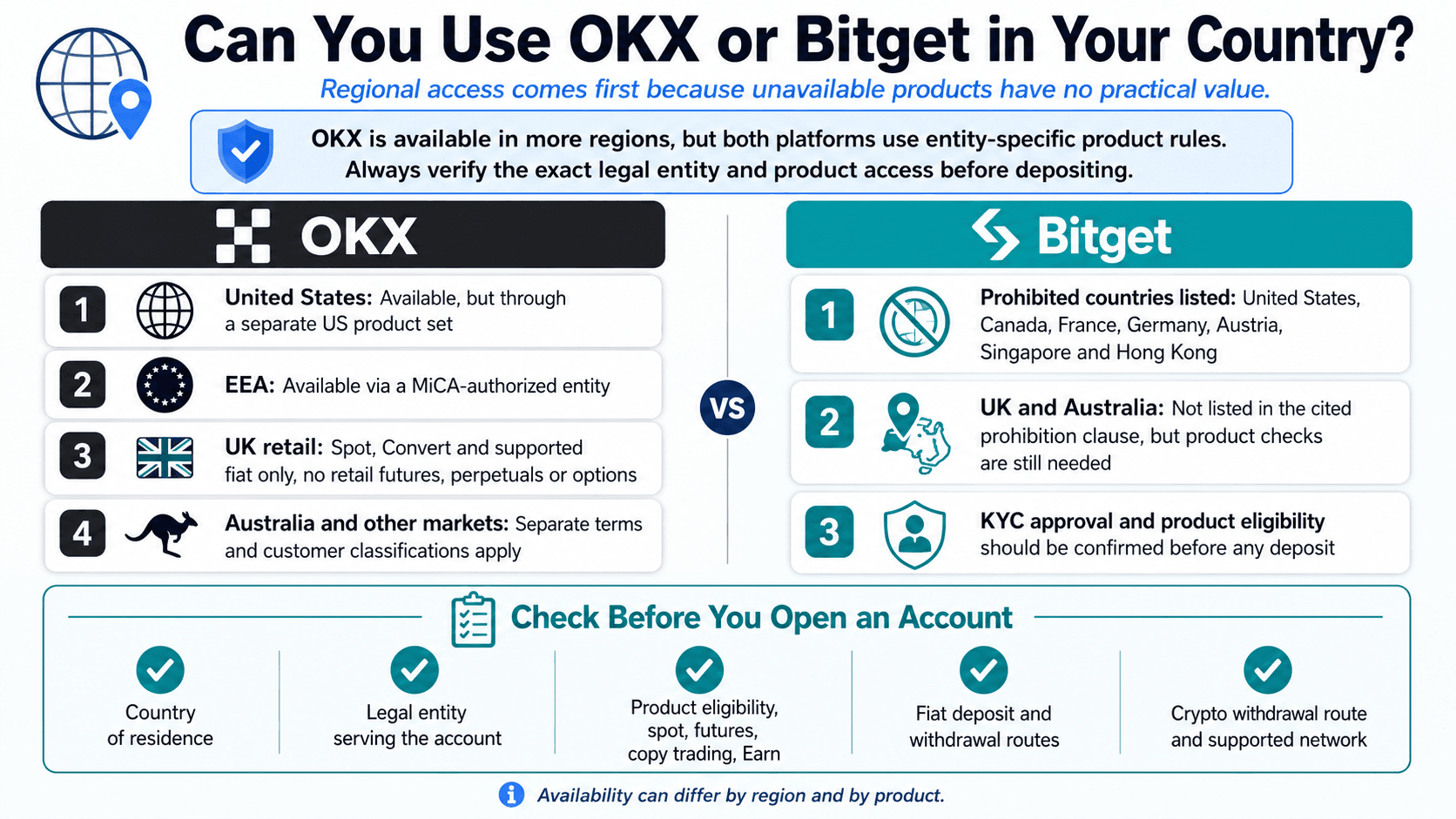
Can You Use OKX or Bitget in Your Country?
 OKX and Bitget Country Availability, Regional Restrictions, Product Access, and Account Eligibility Explained
Where Is OKX Available?
OKX serves the United States, EEA, UK, Australia and other markets through separate entities. Asset lists, derivatives, Earn products and fiat routes can differ.
OKX launched its US centralized exchange on April 15, 2025. American users receive a separate product set and should not assume access to international derivatives, options or Earn. OKX Europe Limited received MiCA authorization from the Malta Financial Services Authority in January 2025 and operates across the EEA through passporting. Its European licensing notice does not remove product-level checks.
UK retail customers can use spot, convert and supported fiat services, while the UK product guide says futures, perpetuals and options are unavailable to retail users. Australia and other regions also use separate account terms and customer classifications.
Read our full OKX review.
Also Read
Where Is Bitget Restricted?
| Market | Current position |
|---|---|
| United States and US territories | Prohibited |
| Canada | Prohibited |
| France | Prohibited |
| Germany | Prohibited |
| Austria | Prohibited |
| Singapore | Prohibited |
| Hong Kong | Prohibited |
| United Kingdom | Not listed in the cited prohibition clause |
| Australia | Not listed in the cited prohibition clause |
| Other selected markets | Additional country and sanctions restrictions apply |
* Last checked: July 30, 2026
Bitget’s Terms of Use dated June 16, 2026 list the United States, Canada, France, Germany, Austria, Hong Kong and Singapore among prohibited countries. KYC approval and product eligibility should be confirmed before any deposit.
Read our full Bitget review.
Also Read
- Bitget Copy Trading Review
- Bitget Wallet Review
- Bitget Trading Guide
- Is Bitget Safe?
- How To Sign Up on Bitget
- What is Bitget Stock Futures
Why Available Products Differ by Region
Crypto regulation can separate spot trading from futures, leverage, copy trading, Earn, cards and stablecoins. Securities rules can also restrict stocks, tokenized assets, forex, commodities and CFDs.
A customer may receive BTC spot access while perpetuals or copy trading remain blocked. Before opening an account, confirm residence, legal entity, product eligibility and the complete fiat and crypto withdrawal route.
OKX vs Bitget Fees: Which Is Cheaper?
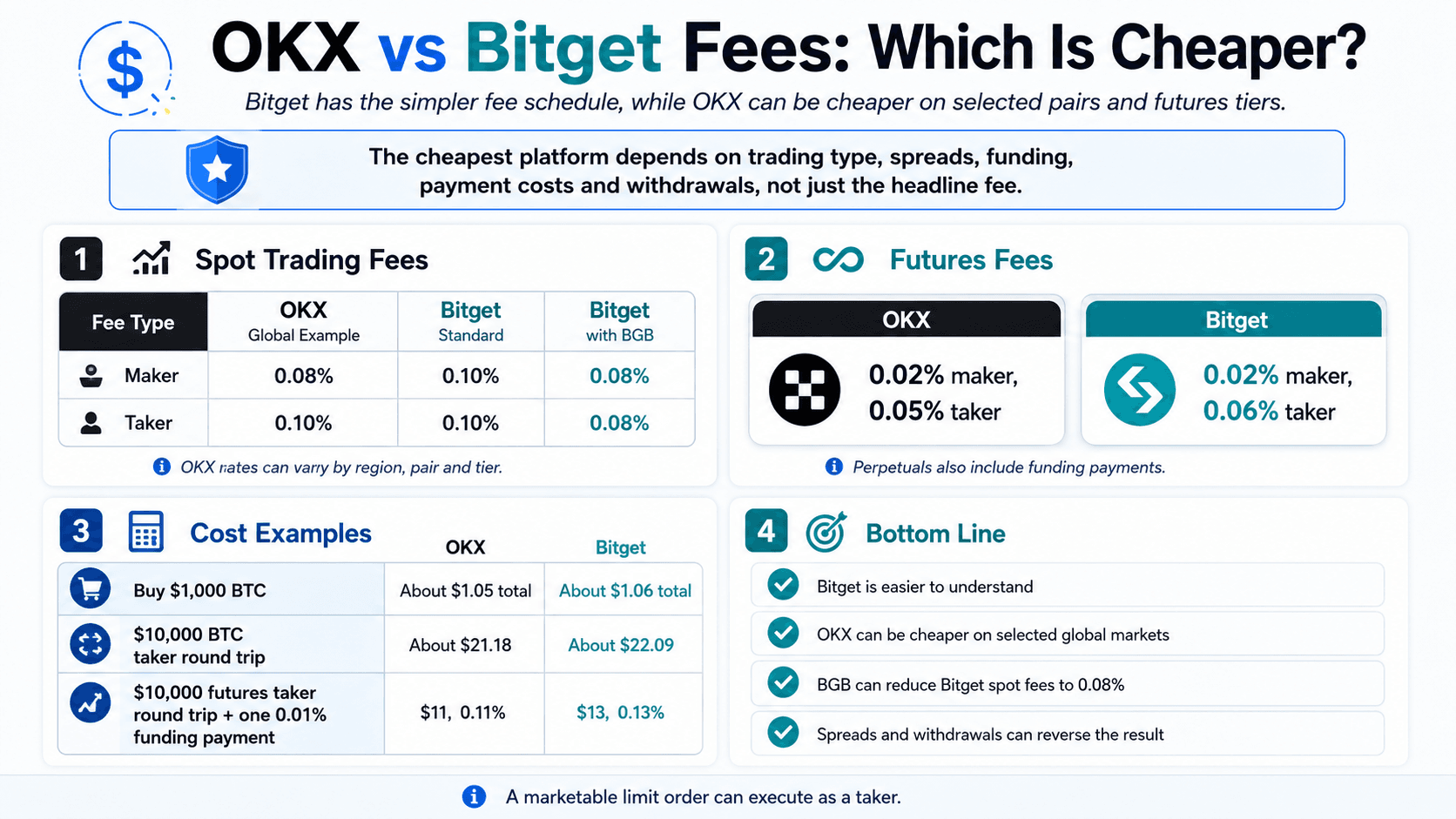
Bitget has the simpler standard fee schedule, while OKX can cost less on selected global pairs and derivatives tiers. Spreads, funding, payment charges and withdrawals can reverse the result.
 OKX vs Bitget Trading Fees, Spot Costs, Futures Rates, Funding, and Withdrawal Charges Compared
Spot Trading Fees
OKX’s global fee framework lists 0.08% maker and 0.10% taker fees for several regular-user spot groups.
Bitget’s standard rate is 0.10% for spot makers and takers. Paying an eligible transaction fee with BGB reduces the rate to 0.08%, but acquiring and holding BGB creates separate exchange-token exposure.
| Order | OKX global example | Bitget standard | Bitget with BGB |
|---|---|---|---|
| $1,000 maker order | $0.80 | $1.00 | $0.80 |
| $1,000 taker order | $1.00 | $1.00 | $0.80 |
| $10,000 maker order | $8.00 | $10.00 | $8.00 |
| $10,000 taker order | $10.00 | $10.00 | $8.00 |
VIP, stablecoin and promotional rates can differ. A marketable limit order can execute as a taker.
Futures Fees, Funding and Leverage Costs
A representative OKX global regular-user futures rate is 0.02% maker and 0.05% taker. Bitget’s standard rate is 0.02% maker and 0.06% taker.
Perpetual futures add funding. Positive funding normally moves from long positions to short positions, while negative funding reverses the transfer. Funding is exchanged between market participants rather than retained as an ordinary trading fee.
For a $10,000 perpetual position with a taker entry, one illustrative 0.01% funding payment and a taker exit:
| Cost component | OKX example | Bitget example |
|---|---|---|
| Taker entry | $5.00 | $6.00 |
| One 0.01% funding payment | $1.00 | $1.00 |
| Taker exit | $5.00 | $6.00 |
| Total | $11.00 | $13.00 |
| Effective cost on notional value | 0.11% | 0.13% |
The funding rate is illustrative. Intervals, margin interest, liquidation costs and leverage vary by contract and entity.
Deposit, Conversion and Withdrawal Costs
Crypto deposits generally carry no receiving-exchange fee, while the sender pays its network or withdrawal charge. Bank deposits, cards and payment processors can add service or foreign-exchange costs.
BTC, ETH and USDT support different networks, and the destination must support the selected chain. Convert tools can embed a spread without showing a separate fee.
Total-Cost Examples
The figures use regular rates and the July 30 BTC/USDT snapshot. Variable payment and withdrawal charges remain outside the fixed floor.
| Scenario | Deposit | Entry fee | Estimated spread and slippage | Funding | Exit fee | Withdrawal | Total cost |
|---|---|---|---|---|---|---|---|
| Buy $1,000 BTC on OKX | $0 crypto deposit | $1.00 | About $0.05 | $0 | $0 | None | About $1.05, or 0.105% |
| Buy $1,000 BTC on Bitget | $0 crypto deposit | $1.00 | About $0.06 | $0 | $0 | None | About $1.06, or 0.106% |
| $10,000 BTC taker round trip on OKX | $0 | $10.00 | About $1.18 | $0 | $10.00 | None | About $21.18, or 0.212% |
| $10,000 BTC taker round trip on Bitget | $0 | $10.00 | About $2.09 | $0 | $10.00 | None | About $22.09, or 0.221% |
| $10,000 futures taker round trip on OKX | Route-specific | $5.00 | Contract-specific | $1.00 example | $5.00 | None | $11.00 plus execution, or 0.11% plus execution |
| $10,000 futures taker round trip on Bitget | Route-specific | $6.00 | Contract-specific | $1.00 example | $6.00 | None | $13.00 plus execution, or 0.13% plus execution |
| Buy $1,000 and withdraw to self-custody | Payment-route cost | $0.80 to $1.00 | Live market cost | $0 | $0 | Network-specific | Trading floor plus the displayed withdrawal fee |
The spot estimates use displayed spreads and a linear depth model; actual fills can differ.
Trading Markets, Liquidity and Order Execution
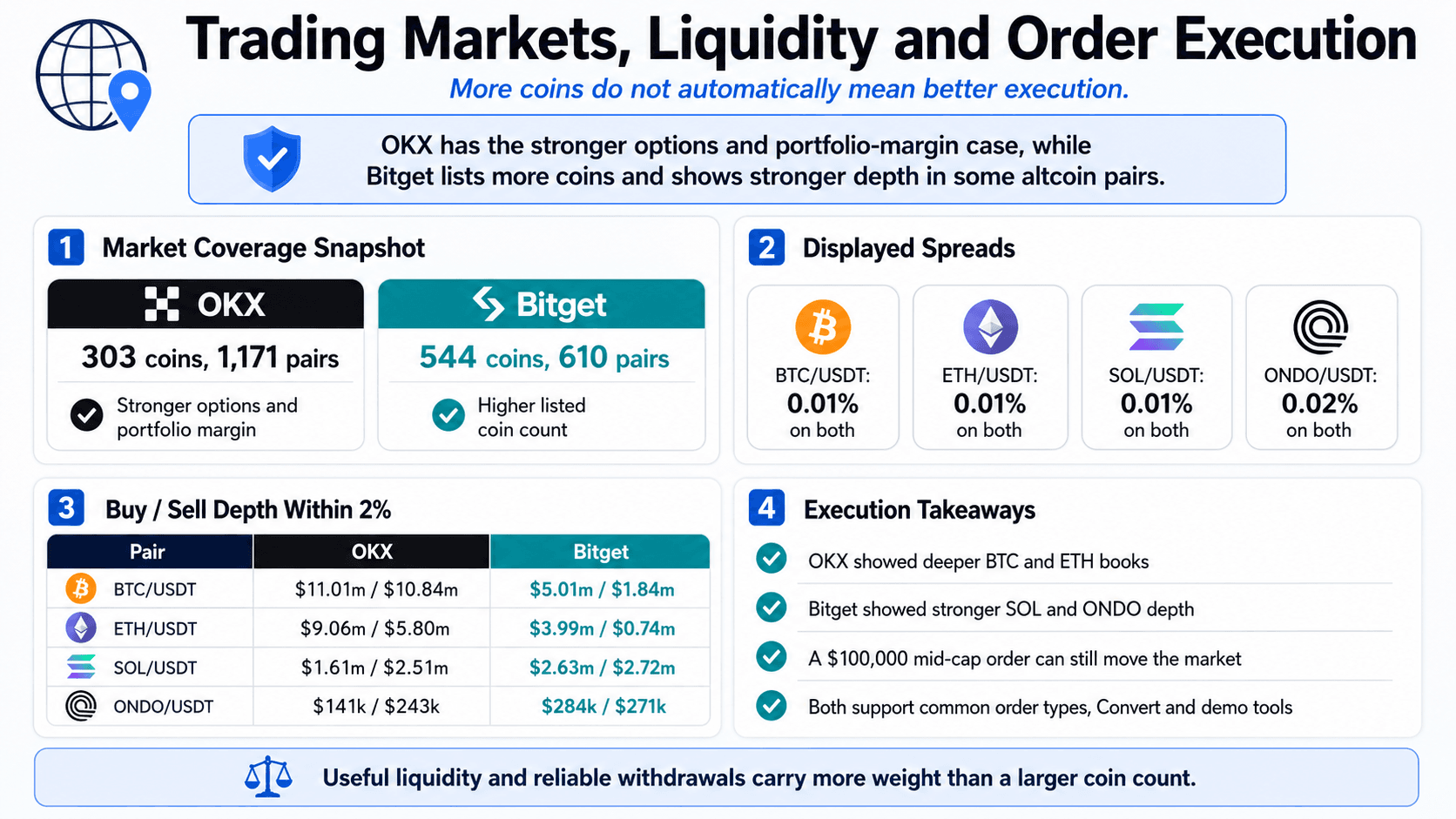
Both exchanges cover spot and derivatives, although useful liquidity and reliable withdrawals carry more weight than a larger coin count.
 OKX and Bitget Markets, Liquidity Depth, Spreads, and Order Execution Across Major Trading Pairs
Spot Markets and Altcoin Selection
As of July 30, 2026, CoinGecko listed OKX with 303 coins and 1,171 pairs. Its Bitget market page listed 544 coins and 610 pairs. Regional accounts can contain fewer assets. Both support USDT and selected USDC markets, common order types and Convert. Bitget’s higher coin count counts only when liquidity and withdrawals work.
Futures, Margin and Options
Eligible OKX accounts combine stablecoin- and coin-margined futures, expiry contracts, perpetuals, spot margin and crypto options across isolated, cross and portfolio margin. Bitget offers stablecoin- and coin-margined derivatives, spot margin and unified-account tools. OKX has the stronger options and portfolio-margin case.
Cross margin can expose more account equity than isolated margin, while portfolio offsets can weaken when correlated positions move together.
Liquidity, Spreads and Slippage
The July 30 snapshot showed a 0.01% displayed spread for BTC/USDT, ETH/USDT and SOL/USDT on both platforms. ONDO/USDT showed 0.02%.
| Pair | OKX buy / sell depth within 2% | Bitget buy / sell depth within 2% |
|---|---|---|
| BTC/USDT | $11.01m / $10.84m | $5.01m / $1.84m |
| ETH/USDT | $9.06m / $5.80m | $3.99m / $0.74m |
| SOL/USDT | $1.61m / $2.51m | $2.63m / $2.72m |
| ONDO/USDT | $141,020 / $243,003 | $284,130 / $270,919 |
The next table scales the smaller 2% side to estimate 10- and 25-basis-point depth. Real order books are not evenly distributed.
| Pair | Platform | Modelled depth at 10 bp | Modelled depth at 25 bp | Est. slippage at $1k / $10k / $100k |
|---|---|---|---|---|
| BTC/USDT | OKX | $541,770 | $1,354,426 | 0.01 / 0.09 / 0.92 bp |
| BTC/USDT | Bitget | $91,892 | $229,730 | 0.05 / 0.54 / 5.44 bp |
| ETH/USDT | OKX | $290,113 | $725,282 | 0.02 / 0.17 / 1.72 bp |
| ETH/USDT | Bitget | $37,229 | $93,072 | 0.13 / 1.34 / 13.43 bp |
| SOL/USDT | OKX | $80,410 | $201,026 | 0.06 / 0.62 / 6.22 bp |
| SOL/USDT | Bitget | $131,578 | $328,944 | 0.04 / 0.38 / 3.80 bp |
| ONDO/USDT | OKX | $7,051 | $17,628 | 0.71 / 7.09 / 70.91 bp |
| ONDO/USDT | Bitget | $13,546 | $33,865 | 0.37 / 3.69 / 36.91 bp |
OKX showed stronger BTC and ETH depth; Bitget showed stronger SOL and ONDO depth. No universal winner is assigned because tighter depth is modelled. A $100,000 mid-cap order carries material impact and partial-fill risk.
Trading Interface and Demo Tools
Both platforms let users find a pair, switch between spot and futures, place a stop-loss or take-profit, change margin mode, review fees, access demo trading and view position PnL. OKX exposes more options and portfolio-margin controls, while Bitget gives copy trading and automation greater prominence.
Users should verify the pair, account mode, leverage, notional value, fee and closing plan before submission.
Copy Trading, Bots and AI Tools
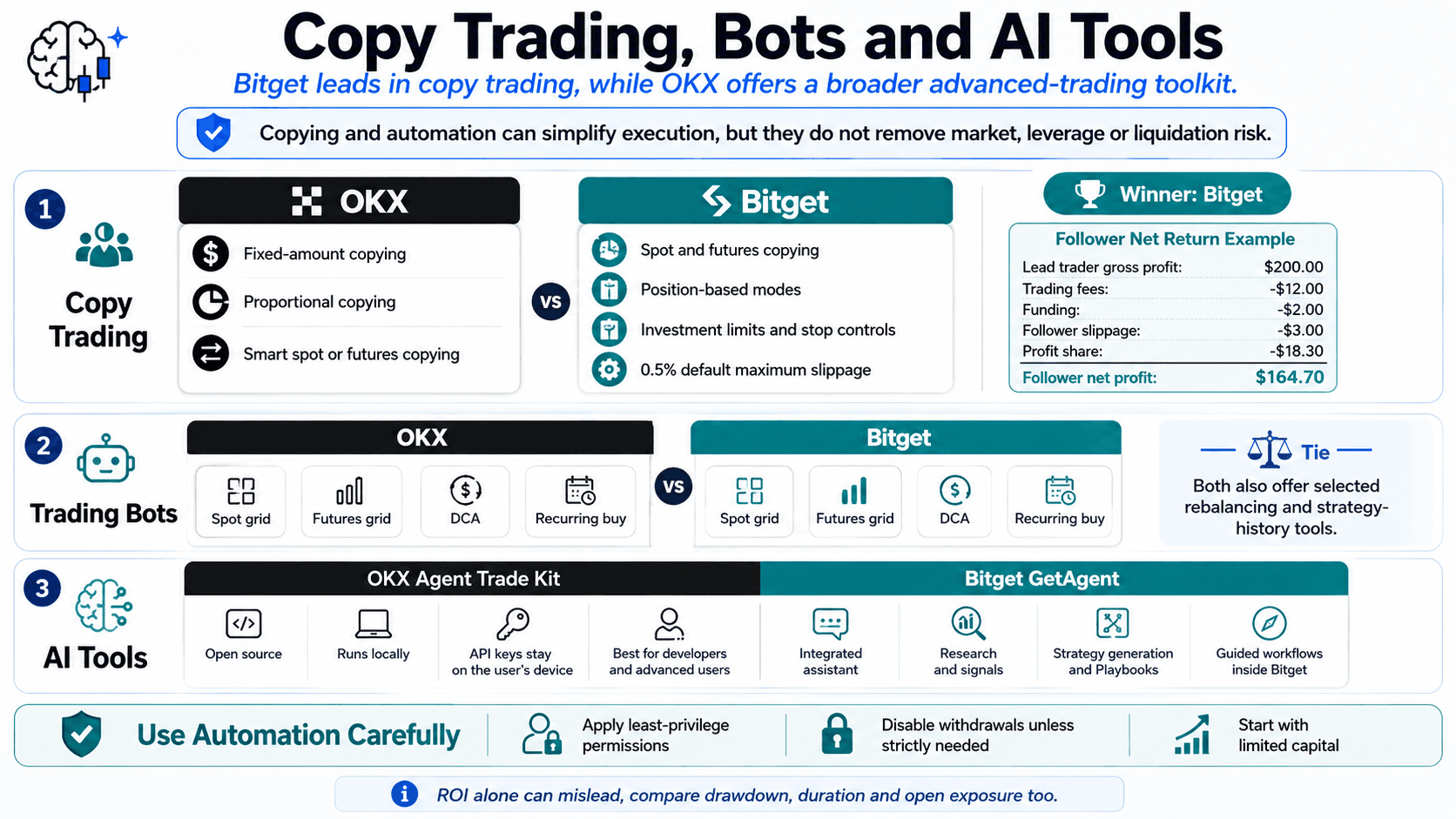
Copy trading is Bitget’s strongest product-level advantage. OKX includes copying within a wider advanced-trading suite.
 OKX and Bitget Copy Trading, Bots, AI Tools, Automation Features, and Risk Controls Compared
OKX vs Bitget Copy Trading
OKX supports fixed-amount, proportional and Smart spot or futures copying where eligible. Its mode guide explains Smart allocation and position settings.
Bitget supports spot and futures copying, position-based modes, investment limits and stop controls. Its futures copier guide lists a 0.5% default maximum slippage setting and order-failure reasons.
Bitget uses High Water Mark profit sharing, charging eligible profit share above the previous peak. Stopping futures copying can close current copy-account positions at market, depending on the selected exit treatment.
| Net-return component | Example |
|---|---|
| Lead trader’s gross profit | $200.00 |
| Trading fees | -$12.00 |
| Funding | -$2.00 |
| Follower slippage | -$3.00 |
| Profit share at 10% of eligible $183 profit | -$18.30 |
| Follower’s net profit | $164.70 |
Bitget changed its leaderboard ROI methodology in June 2026 after finding a way rankings could be inflated. Followers should compare drawdown, duration, open exposure and follower profit alongside ROI.
Trading Bots
Both platforms offer spot grid, futures grid, DCA and recurring-buy tools, plus selected arbitrage, rebalancing and strategy-history features. OKX’s trading-bot overview covers grid, DCA, recurring-buy and portfolio tools. Bitget provides strategy history and copying through its bot marketplace.
Automation retains market and liquidation risk. Review fees, stops, margin mode and maximum capital because backtests cannot reproduce future execution.
Bitget GetAgent vs OKX Agent Trade Kit
OKX Agent Trade Kit is a local developer toolkit, while Bitget GetAgent is an integrated assistant.
The OKX Agent Trade Kit is an open-source Model Context Protocol toolkit that runs locally, with API keys stored on the user’s device. Supported skills can interact with spot, futures, margin, options and bots where the account permits them. Bitget GetAgent combines natural-language research, signals, strategy generation and trading actions inside the platform. GetAgent Playbooks add prebuilt workflows and isolated subaccounts for supported automated strategies.
| Factor | OKX Agent Trade Kit | Bitget GetAgent |
|---|---|---|
| Primary user | Developers and advanced users | Users seeking guided workflows |
| Open source | Yes | Not presented under the same open-source model |
| Credential control | API keys remain on the local device | Permissions are granted within Bitget |
| Execution model | Local MCP process | Integrated assistant and Playbooks |
| Risk boundary | Dedicated keys and API permissions | Authorized isolated subaccounts |
| Withdrawal access | Should remain disabled unless strictly required | Permissions should be reviewed and restricted |
| Product scope | Spot, margin, futures, options and bots where eligible | Research, strategies and supported trading products |
Natural-language execution can misunderstand intent. Apply least-privilege permissions, disable withdrawals and begin with limited capital.
Which Offers More Beyond Crypto?
Bitget offers the broader traditional-market menu, while OKX now offers tokenized stocks in selected regions. The ownership and counterparty structure must be checked product by product.
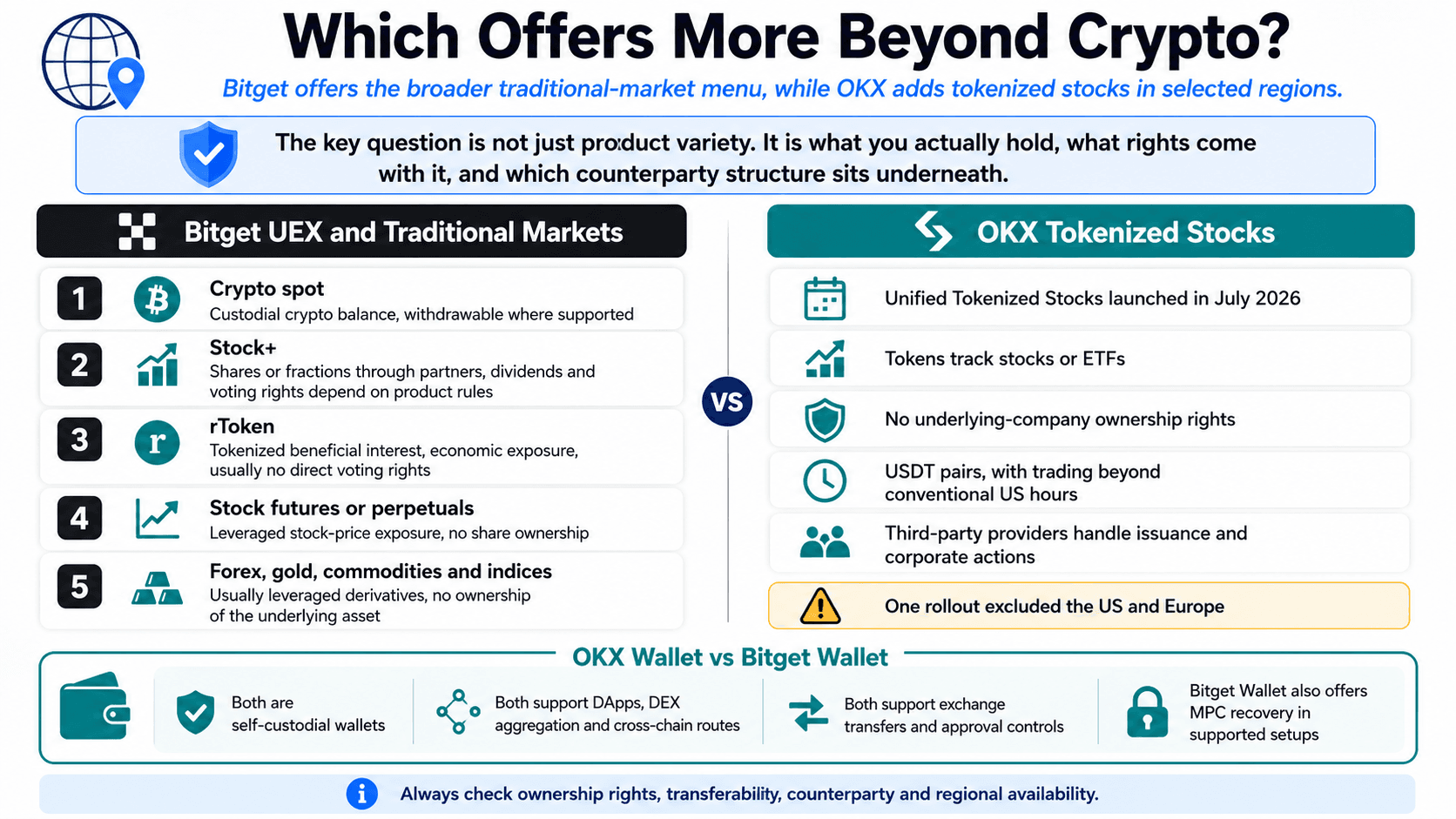 OKX and Bitget Beyond Crypto, Traditional Markets, Tokenized Stocks, Wallets, and Ownership Structures
Bitget UEX, Stocks and Traditional Markets
Bitget UEX combines crypto with Stock+, rTokens, stock derivatives, forex, gold, commodities and indices under different legal structures.
| Product | What the user holds | Leverage and hours | Rights and main risk |
|---|---|---|---|
| Crypto spot | Custodial balance in the crypto asset | Usually unleveraged; continuous market | Withdrawable where supported; exchange custody applies |
| Stock+ | Shares or fractions through securities partners | Generally unleveraged; extended sessions can apply | Dividends and voting rights follow product rules |
| rToken | Tokenized beneficial interest linked to custodied shares | Spot-style market; hours and transferability vary | Usually no direct shareholder registration or voting rights |
| Stock futures or perpetuals | Derivative exposure to a stock price | Leveraged; contract hours apply | No share ownership; funding and liquidation risk |
| Forex, gold, commodities and indices | Usually CFDs or other derivatives | Often leveraged; weekday schedules apply | Counterparty exposure; no ownership of the underlying asset |
Bitget’s Stock+ FAQ says eligible holders can receive dividends and voting rights. rTokens provide tokenized economic exposure rather than direct registration. The Futures Services Agreement says stock futures provide no dividends, voting rights or shareholder privileges. Verify the issuer, counterparty, hours, transferability and regional eligibility.
OKX Tokenized Stocks
OKX began listing Unified Tokenized Stocks in July 2026. Its tokenized-stock FAQ describes tokens tracking stocks or ETFs without underlying-company ownership rights. Eligible products use USDT pairs and can trade outside conventional US hours. Third-party providers manage issuance and corporate actions.
Deposits and withdrawals apply only to supported tokens and networks. One rollout excluded the United States and Europe. Direct registration, voting, custody and investor protections differ from a conventional broker.
OKX Wallet vs Bitget Wallet
A centralized exchange account is custodial, while OKX Wallet and Bitget Wallet are self-custodial products. The wallet user controls the private key, seed phrase or supported recovery credentials needed to authorize transactions.
Both wallets provide DApps, DEX aggregation, cross-chain routes, approval controls and exchange transfers. Bitget Wallet also offers MPC recovery in supported setups.
Chain and DApp counts do not decide the result. Compare the same route, including gas, price impact, bridge provider, approvals and final output. No transaction was signed here, so the linked wallet reviews remain the hands-on source.
Which is Safer: OKX or Bitget?
One reserve ratio cannot settle the safety comparison. Account controls, custody, liabilities, regulation and withdrawal access all count.
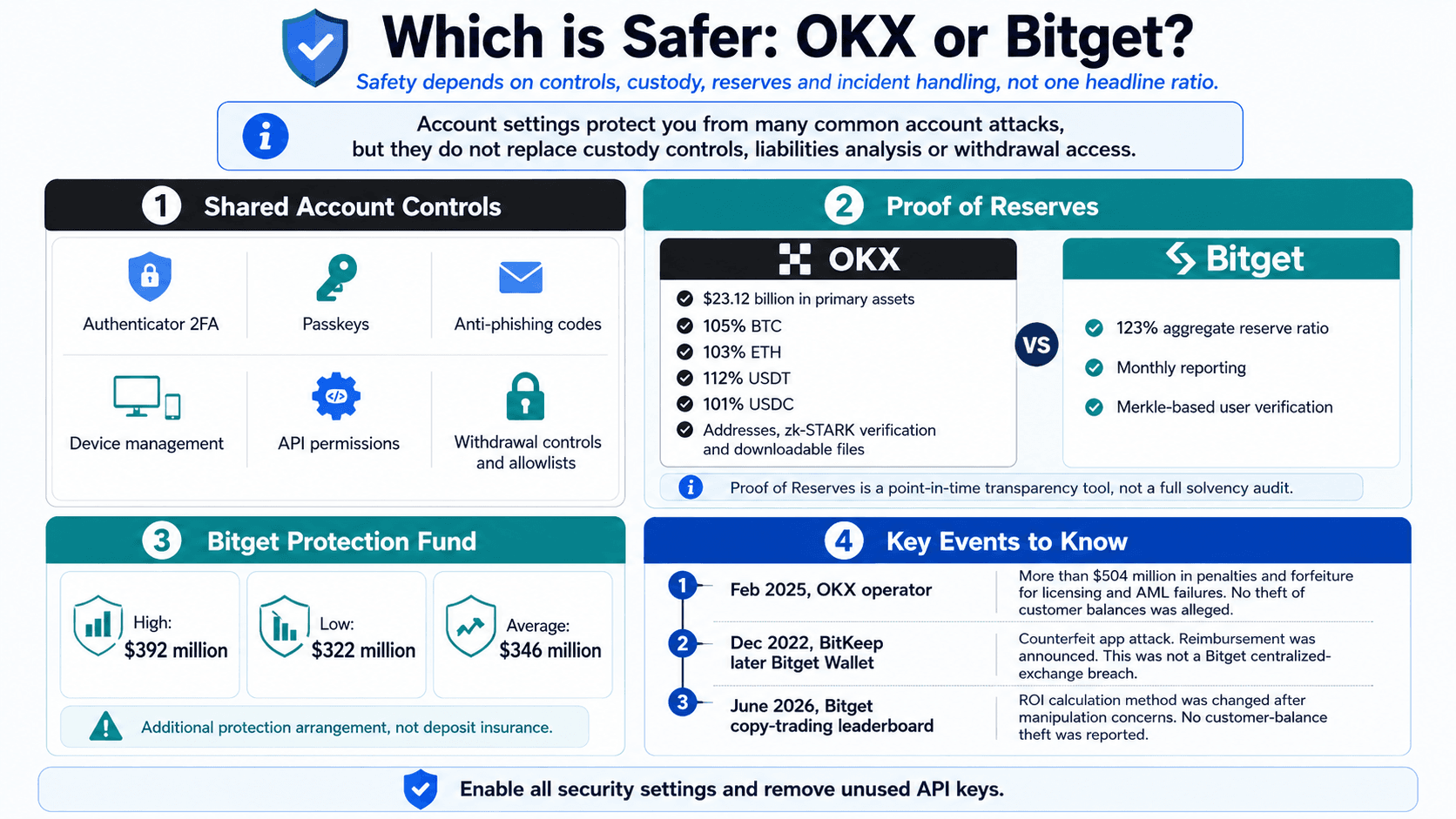 OKX and Bitget Safety Compared Through Account Controls, Proof of Reserves, Protection Funds, and Incidents
Account Security and Custody Controls
Both support authenticator 2FA, passkeys, anti-phishing codes, device management, API permissions and withdrawal controls. Enable an allowlist and remove unused keys. OKX’s security guidance covers 2FA, withdrawal whitelists and anti-phishing codes. Bitget’s security-settings guide covers authentication and trusted-device controls.
These settings protect the account. Company custody still relies on cold storage, multisignature controls and internal access. Security changes can trigger withdrawal holds.
Proof of Reserves and Protection Arrangements
OKX’s 45th Proof of Reserves displayed $23.12 billion in primary assets, with 105% BTC, 103% ETH, 112% USDT and 101% USDC ratios. It publishes addresses, zk-STARK verification and downloadable files.
Bitget’s June 2026 Proof of Reserves was issue 43 and reported a 123% aggregate reserve ratio. It uses monthly reporting and Merkle-based user verification. The June Bitget Protection Fund report recorded a $392 million high, a $322 million low and a $346 million monthly average. The Protection Fund is an additional arrangement, not deposit insurance or an unconditional reimbursement promise.
Proof of Reserves does not disclose every liability, legal claim or operational risk. It is a point-in-time transparency tool, not a complete solvency audit.
Security Incidents, Enforcement and Remediation
The table separates centralized-exchange enforcement from incidents involving a related wallet and from integrity issues affecting product statistics.
| Date | Platform or related product | Event | Customer funds affected | Response and current status |
|---|---|---|---|---|
| Feb. 24, 2025 | OKX centralized exchange operator | Guilty plea for operating an unlicensed money-transmitting business and AML failures | No theft of customer balances was alleged | More than $504 million in penalties and forfeiture; compliance consultant requirement continues through February 2027 |
| April 2025 onward | OKX regional services | Separate US launch and European regulatory expansion | Not a security incident | Regional services operate under separate entities |
| Dec. 2022 | BitKeep, later Bitget Wallet | Counterfeit app distributed malicious code before Bitget’s later acquisition and rebrand | Wallet users lost funds | Reimbursement was announced; the event was not a Bitget centralized-exchange breach |
| June 2026 | Bitget copy-trading leaderboard | ROI calculations could be manipulated through capital movements | No customer-balance theft reported | The calculation method was changed |
The US Department of Justice’s OKX enforcement release states that the operator agreed to more than $504 million in penalties and forfeiture. The case concerned licensing and anti-money-laundering failures rather than an exchange hack.
Account Setup, Deposits, Withdrawals and Support
KYC, payment rails, network selection and compliance reviews determine whether an account can be funded and exited without avoidable friction.
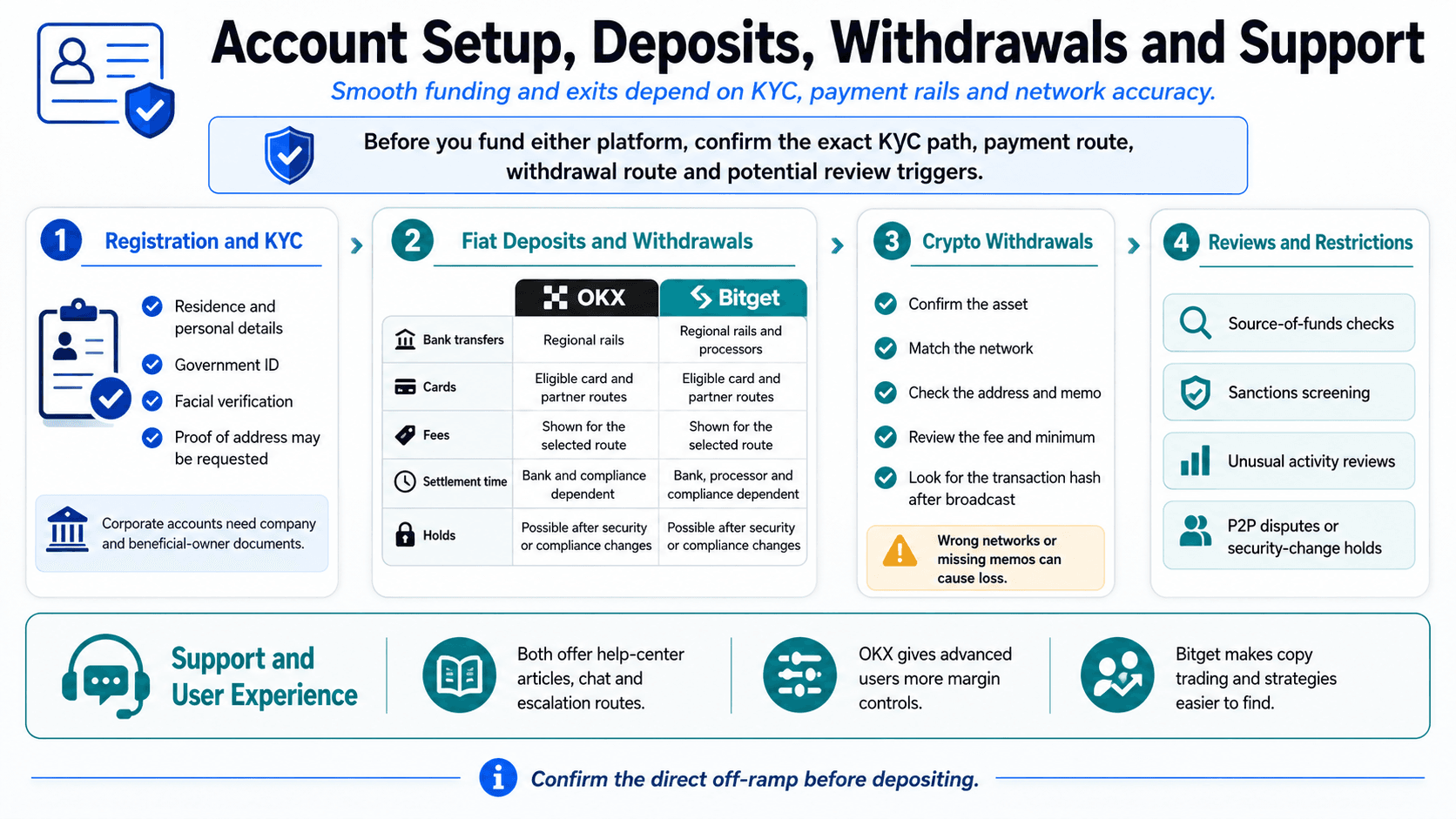 OKX and Bitget Account Setup, KYC, Deposits, Withdrawals, Compliance Reviews, and Customer Support
Registration and KYC
Both exchanges require identity verification for centralized services, including residence, personal details, government ID and facial verification. Proof of address can also be requested.
OKX’s individual verification guide explains the document and selfie process. Bitget’s identity-verification guide covers the corresponding KYC workflow.
Corporate accounts require company, director, beneficial-owner and authorization records. Limits can change after source-of-funds or suitability checks. KYC aids compliance and recovery but requires sensitive personal data.
Fiat Deposits and Withdrawals
Fiat access must be checked inside the customer’s region because banking methods, currencies, fees and settlement times differ.
| Item | OKX | Bitget |
|---|---|---|
| Bank transfers | Regional rails, including eligible local and international routes | Regional bank rails and payment processors |
| Supported currencies | Entity-specific | Country and processor-specific |
| Cards | Available through eligible card and partner routes | Available through eligible card and partner routes |
| Deposit fee | Shown for the selected route | Shown for the selected route |
| Withdrawal fee | Shown for the selected route | Shown for the selected route |
| Settlement time | Bank, cutoff and compliance dependent | Bank, processor and compliance dependent |
| Holds | Possible after security or compliance changes | Possible after security or compliance changes |
| Direct off-ramp | Confirm before depositing | Confirm before depositing |
Bitget’s bank deposit and withdrawal table records limits, fees and processing by supported currency rather than one global rule. Card purchases can add processor charges and foreign-exchange spreads on either platform.
No funded fiat deposit or withdrawal was completed for this comparison, so neither platform receives a settlement-speed award.
Crypto Withdrawals and Account Reviews
A crypto withdrawal requires the asset, network, address, security checks, current fee and minimum. History should show a transaction hash after broadcast.
The network must match the destination. Unsupported deposits, missing memos and wrong addresses can cause loss.
Source-of-funds checks, sanctions screening, unusual activity and P2P disputes can trigger restrictions. Security changes can also create holds, and no standard appeal time should be assumed without a contractual promise.
Customer Support and User Experience
The support check used the same three questions on both platforms: spot fees, live withdrawal-fee location, and country or product eligibility. Help-center search returned relevant documents, while chatbot output was not counted as human resolution.
OKX and the Bitget Support Center provide searchable articles, chat and escalation routes. Human-agent availability, first-response time and ticket accuracy were not scored without synchronized authenticated sessions. Both support deposits, spot orders, stop-losses, withdrawals and history exports. OKX adds margin controls, while Bitget foregrounds copying and strategies.
Who Should Choose OKX or Bitget?
The recommendations below summarize the regional, product, cost and security evidence without introducing new features.
Choose OKX If
- You live in a supported US or EEA market and accept the regional product set.
- You want crypto options where they are available.
- You need spot, futures, margin and options under one advanced account.
- You use portfolio margin and understand cross-position risk.
- You prefer an open-source, locally running AI-agent toolkit.
- You use OKX Wallet or want closer centralized and onchain integration.
- You value downloadable reserve and liability verification files.
Choose Bitget If
- You live in an eligible jurisdiction.
- You prioritize spot or futures copy trading.
- You want extensive lead-trader metrics and follower controls.
- You understand High Water Mark profit sharing and follower slippage.
- You want eligible UEX, Stock+ or rToken access.
- You prefer GetAgent’s guided Playbook model.
- You value the Protection Fund as an additional, non-insurance layer.
Consider Another Exchange If
- You live in an unsupported jurisdiction.
- You want the simplest possible beginner purchase flow.
- You require conventional brokerage ownership and stock transferability.
- You expect identical products in every country.
- You require full self-custody.
- You do not understand leverage, tokenized assets or copy-trading risk.
- You need deposit insurance or bank-like protection.

OKX vs Bitget Final Verdict
OKX is stronger overall for eligible users seeking advanced spot and derivatives, crypto options, major-market regulation and onchain integration. Bitget wins for eligible copy traders and users interested in UEX, Stock+ and GetAgent.
Regional eligibility comes first. US residents can use the separate OKX service but are prohibited from Bitget, while product access also differs across the EEA, UK and Australia.
Headline fees do not show total cost. Add spreads, slippage, funding, payment fees and withdrawals. Reserve reports and protection funds do not remove custody, solvency or compliance risk.
Verify the legal entity, available products and exit route before funding either account. Keep only necessary trading capital on a centralized platform, and move longer-term holdings to an appropriate self-custodial setup after confirming the correct network and recovery process.