

Phemex is a centralized cryptocurrency exchange focused on active trading, particularly perpetual futures. Founded in 2019, it combines spot markets, derivatives, trading bots, copy trading and selected earning products. Its standout price is a 0.01% standard futures maker fee, although taker orders cost more than on several larger exchanges.
Phemex is best for eligible, experienced derivatives traders who use limit orders and understand leverage. It is less suitable for beginners seeking straightforward fiat purchases, residents of restricted countries and investors uncomfortable with exchange custody. The January 2025 hot-wallet breach remains an important part of that assessment.
This review examines actual trading costs, liquidity, security disclosures, geographic access, KYC, usability and Phemex's additional products. It also compares the exchange with Binance, Bybit and OKX.
Editor's Note (Oct. 17, 2026): We fully updated this review in October 2026 with the latest trading fees, supported markets, leverage limits, and recent product developments. We've expanded our assessment of the January 2025 security breach, updated Proof-of-Reserves disclosures, KYC requirements, and geographic restrictions. The review now includes independent liquidity and order-book data, real-world trading cost scenarios, and a detailed comparison with Binance, Bybit, and OKX. We've also revisited Phemex's trading bots, copy trading, Earn products, and PT benefits to reflect their current availability and limitations.
Phemex Review 2026: Quick Verdict
Phemex is a derivatives-focused cryptocurrency exchange offering competitive maker fees, perpetual futures with leverage up to 150x on selected contracts, and integrated trading automation. Its 0.01% standard futures maker fee is lower than Binance, Bybit and OKX, but its 0.06% taker fee, concentrated liquidity, geographic restrictions and January 2025 security breach limit its appeal.
Our take: Phemex is best suited to eligible, experienced futures traders who regularly use maker orders and understand leverage. Its low maker fees and trading tools are appealing, but Binance, Bybit and OKX offer broader ecosystems and lower standard futures taker fees. Phemex is less compelling for beginners, large passive holdings or users seeking stronger independently verified custody and regulatory protections.
Category Assessment
-
1Security & Custody Significant Custody Risk Phemex reports cold storage, Fireblocks MPC infrastructure, account-level security controls and recurring Proof-of-Reserves disclosures. However, the January 2025 hot-wallet breach resulted in reported losses ranging from approximately $69 million to more than $85 million. A comprehensive independent post-breach infrastructure audit was not established.
-
2Trading Fees & Costs Competitive for Futures Makers Standard spot fees are 0.10% maker and taker, while futures fees are 0.01% maker and 0.06% taker. The maker rate beats comparable standard Binance, Bybit and OKX rates, but the taker rate is higher. Funding, spread, slippage and withdrawal costs can change the actual trading expense.
-
3Markets & Trading Products Derivatives-Focused Offering CoinGecko tracked 147 coins, 166 spot pairs and 146 derivatives pairs on Oct. 17, 2026. Phemex supports USDT-margined, USDC-denominated and inverse perpetual contracts, with up to 150x leverage on selected BTC and ETH instruments. Bots, copy trading and eligible TradFi-linked products broaden its offering.
-
4Liquidity & Execution Stronger in Major Markets CoinGecko reported approximately $1.07 billion in daily futures volume and $2.25 billion in open interest on Oct. 17, 2026. BTC and ETH markets show stronger activity and deeper spot order books than smaller assets such as HYPE. Actual execution quality, latency and slippage were not independently tested.
-
5Trading Tools & Usability Designed for Active Traders Phemex documents TradingView charts, advanced order types, cross and isolated margin, sub-accounts, grid bots, Martingale strategies and copy trading. Desktop and mobile applications are available. However, no funded trading workflow or mobile device test was conducted, and the feature set is relatively complex for beginners.
-
6Regulation & Accessibility Restricted Access and Limited Assurance Phemex restricts users in the United States, United Kingdom, Australia and other jurisdictions. Full trading and withdrawals require identity verification, and the published unverified withdrawal limit is zero. Comprehensive regulatory authorization across its products and jurisdictions was not established.
-
7Overall Verdict Best for Eligible, Maker-Heavy Futures Traders Phemex offers a genuine pricing advantage for futures traders who consistently receive maker execution. Its integrated trading tools and derivatives activity make it a plausible specialized venue. However, higher taker fees, uneven smaller-market liquidity, regulatory limitations and its 2025 custody incident make a broader recommendation difficult. Binance, Bybit and OKX are stronger alternatives for users prioritizing larger markets or broader services.
Best For
- Eligible, experienced perpetual futures traders
- Traders who consistently qualify for maker pricing
- Users comfortable managing leverage and liquidation risk
- Active traders seeking integrated bots and advanced order types
- Copy traders who understand drawdowns, fees and execution differences
Not Ideal For
- Residents of restricted jurisdictions, including the US, UK and Australia
- Beginners seeking simple fiat purchases and withdrawals
- Frequent market-order traders seeking the lowest futures taker fees
- Investors uncomfortable with Phemex's January 2025 security breach
- Users seeking stronger verified regulatory and custody protections
- Traders requiring deep liquidity across smaller markets
- Long-term investors storing substantial balances on an exchange
Disclosure and Methodology
Some links in this article may be affiliate links. If you choose to use a product or service through these links, we may earn a commission at no additional cost to you.
For this Phemex review, we evaluated six main categories: security and custody, trading fees and costs, markets and products, liquidity and execution, trading tools and usability, and regulation and accessibility.
Our research examined official Phemex fee schedules, account rules, KYC requirements, security disclosures, Proof-of-Reserves reports, withdrawal documentation and product announcements through Oct. 17, 2026. Independent breach reporting and CoinGecko market data informed our assessment of security and liquidity.
We also compared Phemex against the published standard trading fees and documented offerings of Binance, Bybit and OKX. Trading-cost examples use stated assumptions and do not represent observed execution results.
This is a documentation-led review, not a hands-on trading test. We did not fund an account, submit KYC documents, execute trades, deposit or withdraw funds, test the mobile applications or contact customer support. Consequently, actual slippage, execution speed, withdrawal processing times and support responsiveness were not independently verified.
No numerical rating is assigned because a standardized hands-on scoring process was not conducted. The assessments reflect documented features, independent market data, published restrictions and the limitations of available security and regulatory evidence.

Phemex at a Glance
| Field | Phemex |
|---|---|
| Founded / type | 2019 / centralized exchange |
| Main strength | Perpetual futures and active trading |
| Standard spot fees | 0.10% maker / 0.10% taker |
| Standard futures fees | 0.01% maker / 0.06% taker |
| Products | Spot, perpetuals, bots, copy trading, eligible Earn products, TradFi derivatives |
| Maximum leverage | Up to 150x on selected BTC and ETH contracts; risk-tier limits apply |
| KYC | Required for full trading and withdrawals |
| Main restrictions | United States, United Kingdom, Australia, four named Canadian provinces and others |
| Proof-of-Reserves | Latest verified report: Oct. 5, 2026; 131.36% average across eight asset categories |
| Security history | January 2025 hot-wallet breach |
| Mobile / token | iOS and Android / Phemex Token (PT) |
Information checked Oct. 17, 2026. Market availability, fees and reserve ratios can change.
How We Evaluated Phemex
We checked official fee schedules, account rules, security and custody disclosures, withdrawal instructions and product announcements through Oct. 17, 2026. Independent breach reporting and CoinGecko market data informed the security and liquidity assessments. Representative markets included BTC/USDT, ETH/USDT, SOL/USDT and HYPE/USDT; competitor figures use published standard account tiers.
This is a documentation-led review, not a firsthand trading test. No funded account, live order, KYC submission, deposit, withdrawal or support ticket was completed. No Windows, macOS, Android or iOS device workflow was tested. Consequently, execution times, actual slippage, withdrawal speeds and support responses are not claimed as observed results. Calculated examples state their assumptions.
Is Phemex Safe? Security, the 2025 Hack and Proof-of-Reserves
Phemex offers cold storage, institutional wallet infrastructure and account safeguards, but the January 2025 breach establishes a significant custody risk. Its reserve disclosures are useful evidence of reported backing, not proof that another loss or insolvency is impossible.
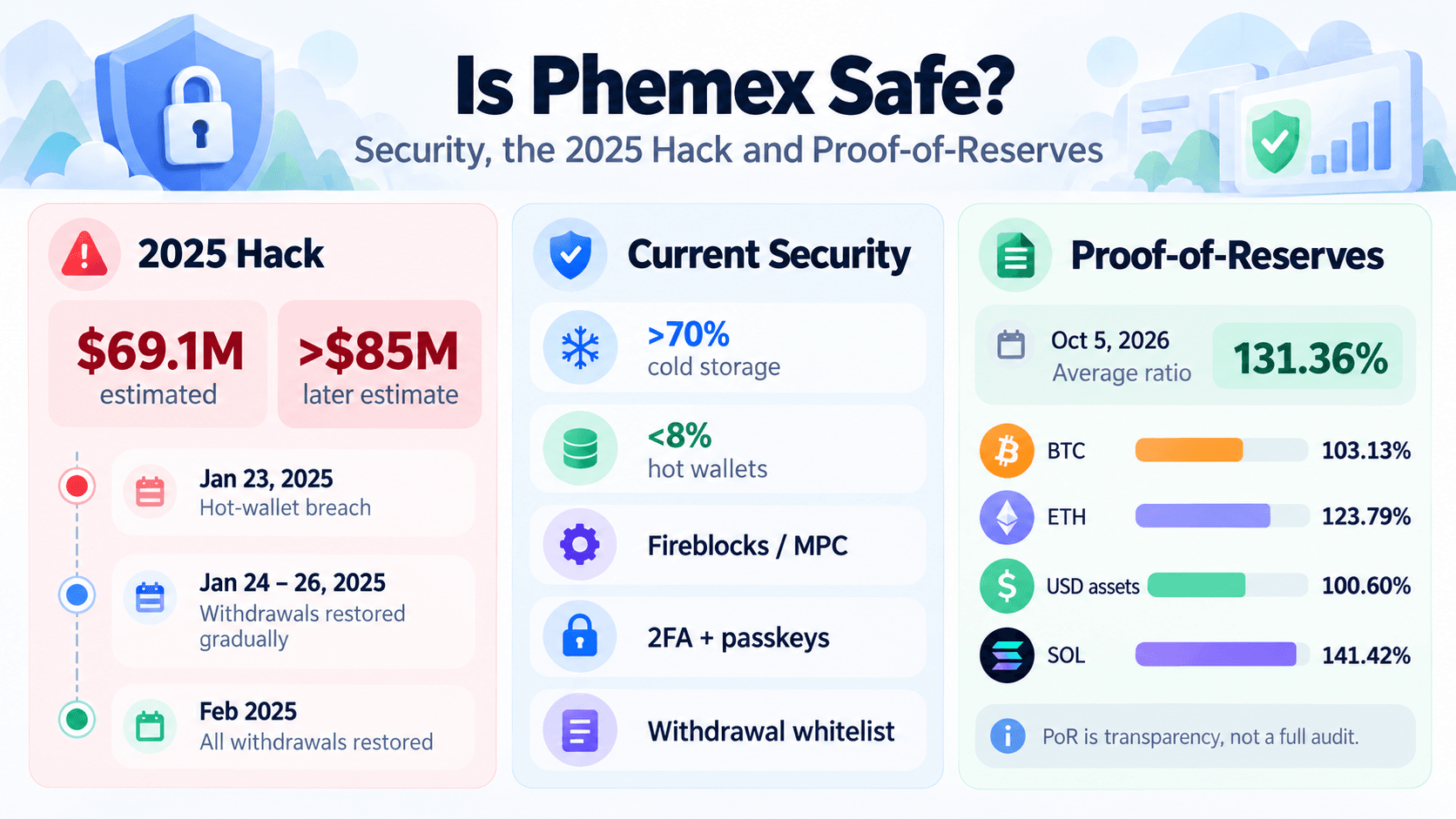 Phemex's 2025 Hot-Wallet Breach, Security Measures and Proof-of-Reserves Ratios
What Happened During the January 2025 Phemex Hack?
On Jan. 23, 2025, attackers compromised Phemex-controlled hot wallets and transferred assets across multiple blockchains. Immunefi's January assessment, reported by The Block, estimated losses at approximately $69.1 million. Later SecurityWeek reporting placed losses above $85 million. These are different estimates of the same incident.
| Date | Development |
|---|---|
| Jan. 23, 2025 | Suspicious hot-wallet activity detected; deposits and withdrawals suspended |
| Jan. 24–26 | Withdrawals gradually restored across supported networks |
| February 2025 | Phemex reported restoration of all withdrawal services |
Phemex's incident timeline says affected devices were isolated and outside investigators and law enforcement were contacted. It also promised customer balance protection. However, a full independent reconciliation confirming compensation of every affected customer was not established publicly. Nor is there sufficient public technical evidence to verify the complete root cause and every subsequent remediation step.
What Security Measures Does Phemex Use Today?
Phemex describes a three-tier custody system: offline cold wallets, intermediate warm wallets and internet-connected hot wallets for daily operations. Its 2026 security disclosures claim more than 70% of customer assets are in cold storage and less than 8% in hot wallets. Those percentages are company-reported.
Phemex also reports using Fireblocks infrastructure with multi-party computation (MPC), which distributes signing operations instead of exposing a single conventional private key. The published architecture includes multisignature approvals and restricted wallet access.
| Protection | Purpose | Evidence or limitation |
|---|---|---|
| Cold storage | Reduces online exposure | Allocation is exchange-reported |
| Fireblocks / MPC | Distributes signing authority | Provider use is not an exchange-wide audit |
| 2FA and passkeys | Protect account access | User configuration remains important |
| Anti-phishing codes | Help identify genuine communications | Must be enabled and checked |
| Withdrawal whitelist / address locks | Limit destinations and sensitive changes | Can delay legitimate withdrawals |
| Proof-of-Reserves | Verifies reported balance inclusion and backing | Not a full financial audit |
The account security documentation describes these user controls. An external Hacken audit dated September 2023 covers PT and governance smart contracts. It does not certify Phemex's entire post-breach wallet infrastructure, cloud systems or operational procedures. A comparable public audit covering those systems was not independently established.
Does Phemex's Proof-of-Reserves Prove Customer Funds Are Safe?
No. A Merkle-tree Proof-of-Reserves allows customers to check whether their balances appear in a cryptographically committed liability dataset. Reserve ratios compare disclosed assets with reported customer liabilities at a given snapshot.
Phemex reported approximately 131% average coverage in April 2026. Its latest verified Oct. 5 report disclosed the following company-reported ratios:
| Asset category | Reported reserves / liabilities |
|---|---|
| BTC | 103.13% |
| ETH | 123.79% |
| USD-denominated assets | 100.60% |
| SOL | 141.42% |
| AVAX | 143.43% |
| TRX | 123.86% |
| XRP | 157.03% |
| SUI | 157.58% |
| Reported average | 131.36% |
The average is not an independently audited, asset-weighted corporate solvency ratio. A snapshot can omit undisclosed liabilities, asset encumbrances or obligations outside the covered categories. It cannot prevent compromised keys, operational failure or withdrawal interruptions. Phemex also says it does not rehypothecate customer funds, but that remains a company assertion without a comprehensive independent financial audit.
Security assessment: Reserve transparency and account controls improve visibility, but the previous breach and limits of post-incident external assurance warrant caution. Phemex is more defensible as a trading venue than as long-term storage for substantial holdings.
Where Is Phemex Available, and Is KYC Required?
Access depends on residency, physical location, identity verification and the specific service. A working website or app does not establish permission to trade.
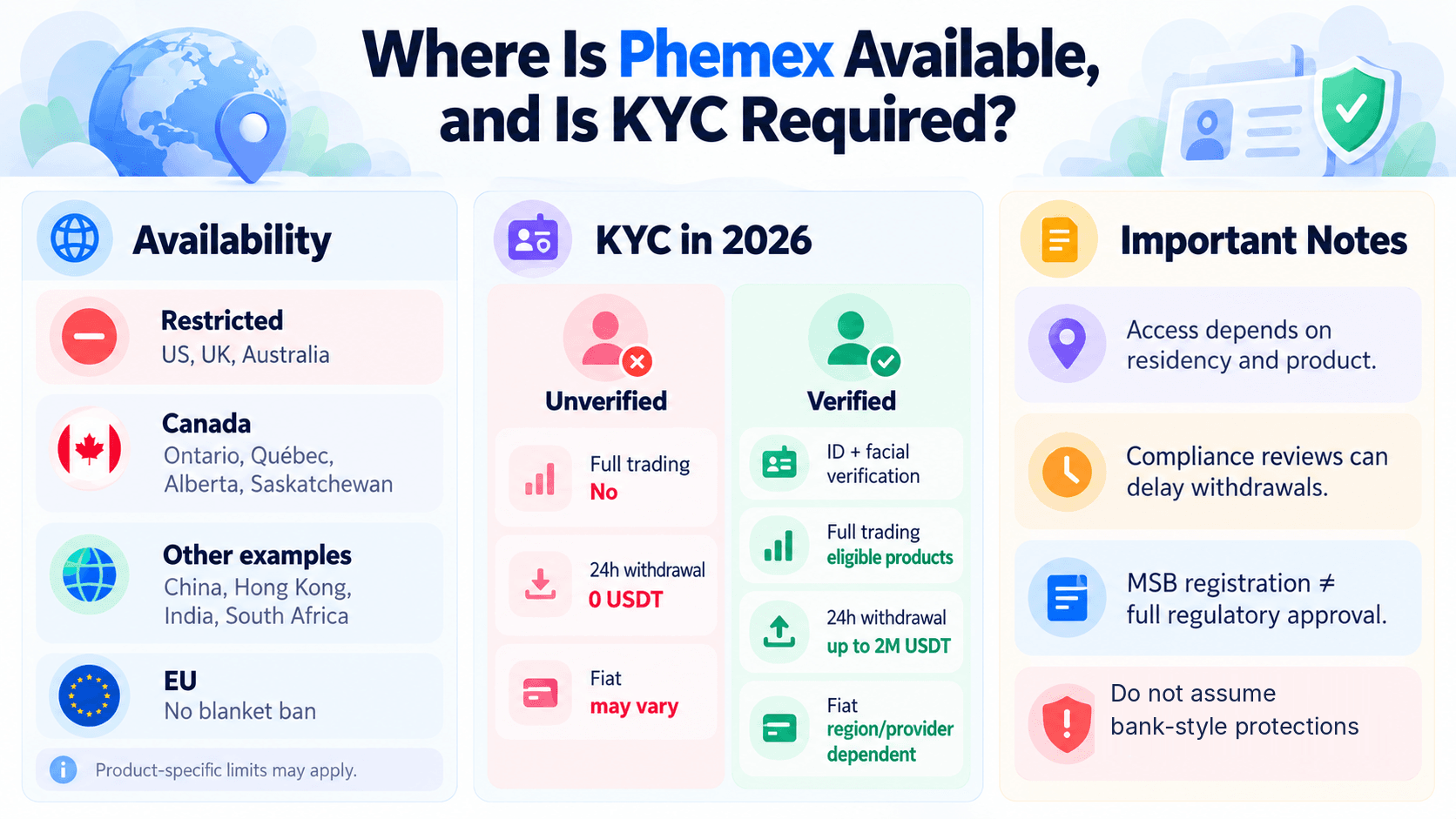 Phemex's Geographic Restrictions, KYC Requirements and Withdrawal Limits for Verified and Unverified Users
Which Countries Are Restricted From Using Phemex?
The exchange's Terms of Use list substantial geographic restrictions.
| Jurisdiction | Published status, Oct. 17, 2026 |
|---|---|
| United States, United Kingdom, Australia | Restricted generally |
| Canada | Ontario, Québec, Alberta and Saskatchewan specifically restricted |
| European Union | No uniform EU-wide ban in the general list; product- and country-specific limits apply |
| Other examples | China, Hong Kong, India, South Africa and sanctioned territories |
Spot access, derivatives eligibility and third-party fiat services may differ. For instance, Phemex's prediction-market policy separately blocks Germany, France, Belgium and Italy, among others. The more restrictive applicable policy governs. Changes in eligibility can prevent new trades, force position closure or require additional checks before withdrawal. Customers should confirm the exact product's availability before depositing.
Is Phemex KYC Mandatory in 2026?
Yes, for full trading and withdrawals. Phemex's KYC guide calls for government identification and facial verification under know your customer and anti-money laundering (AML) rules.
| Feature | Unverified | Verified |
|---|---|---|
| Identity check | Incomplete | ID and facial verification |
| Full spot / futures access | Unavailable | Eligible products enabled |
| Published 24-hour withdrawal limit | 0 USDT | Up to 2 million USDT |
| Fiat services | May vary by payment method | Still region- and provider-dependent |
The maximum withdrawal allowance is not guaranteed instant access. Compliance reviews, risk holds and source-of-funds requests can apply after initial verification. Describing today's Phemex as a no-KYC trading exchange is misleading.
Is Phemex Regulated?
The Phemex brand references associated entities including Phemex Limited and a Polish company in its terms; CoinGecko lists Samoa as its incorporation jurisdiction. The contracting entity and protections can vary by service.
Phemex has cited a historical U.S. Financial Crimes Enforcement Network (FinCEN) Money Services Business (MSB) registration. An MSB registration concerns financial-crime compliance; it is not Securities and Exchange Commission (SEC) or Commodity Futures Trading Commission (CFTC) authorization for U.S. retail derivatives. A Polish company registration likewise does not establish EU Markets in Crypto-Assets Regulation (MiCA) licensing for the entire offering.
Comprehensive current authorization for every Phemex product and jurisdiction was not established. Users should not assume bank deposit insurance, investor compensation or a particular regulator-backed complaints process.
What Can You Trade on Phemex? Spot, Futures and Liquidity
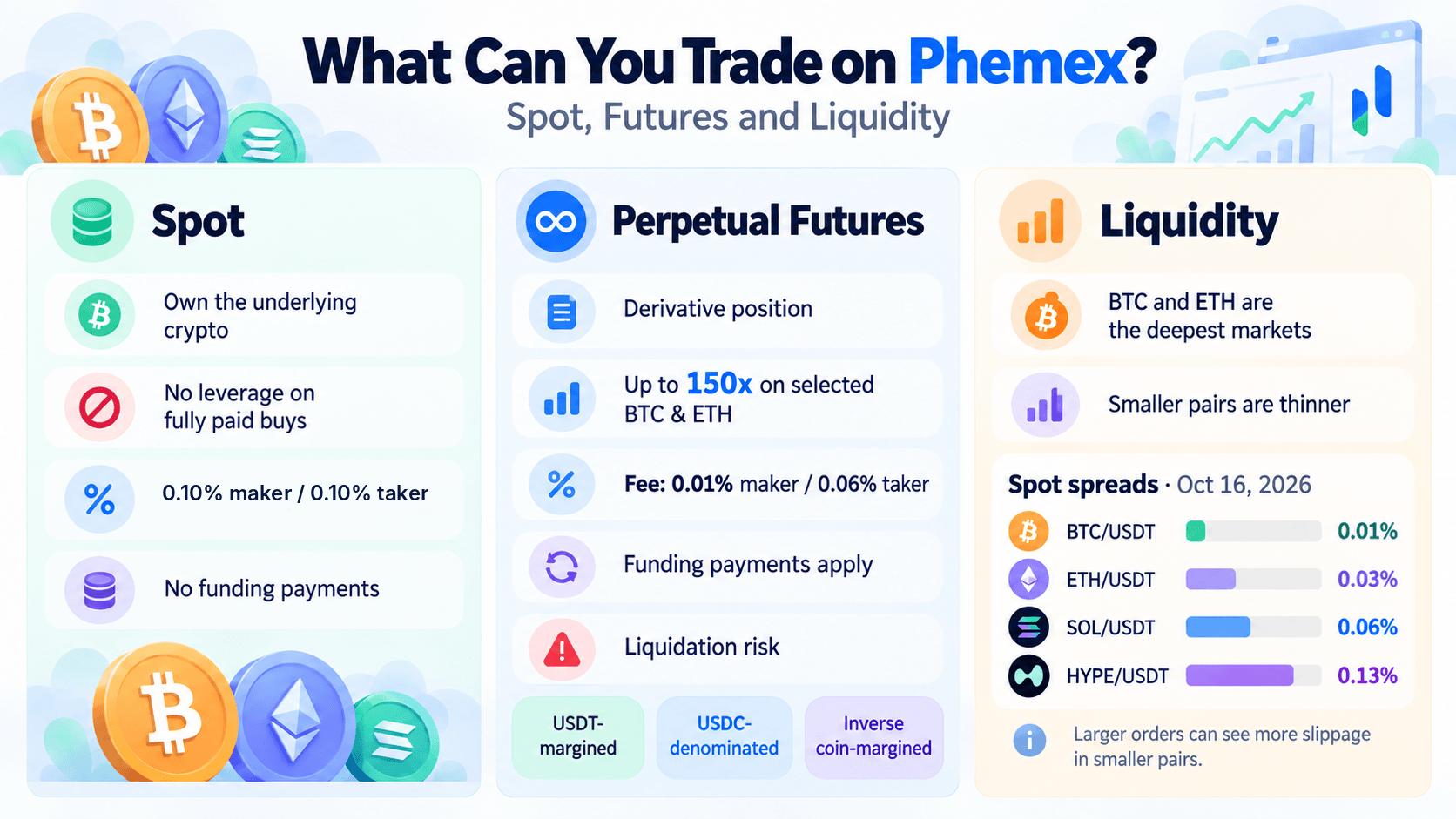
Phemex offers spot trading and perpetual futures, alongside selected tokenized assets and contracts linked to traditional markets. Derivatives are its larger business, but trading activity is concentrated in major assets.
 What Can You Trade on Phemex? Spot, Futures and Liquidity
Spot vs. Futures Trading on Phemex
CoinGecko tracked 147 coins and 166 spot pairs on Oct. 17, 2026; its futures tracker showed 146 derivatives pairs. Counts change with listings and tracking coverage. Bitcoin (BTC), Ethereum (ETH) and Solana (SOL) feature across products.
| Factor | Spot | Perpetual futures |
|---|---|---|
| Holding | Underlying cryptocurrency | Derivative position, no underlying ownership |
| Leverage | None for fully paid purchases | Up to 150x on selected contracts |
| Standard maker / taker | 0.10% / 0.10% | 0.01% / 0.06% |
| Funding | None | Periodic positive or negative transfers |
| Liquidation | No liquidation of fully paid holdings | Possible when margin falls below maintenance requirements |
Perpetuals include USDT-margined, USDC-denominated and inverse coin-margined contracts, with collateral and settlement differing by instrument. In September 2026, Phemex increased leverage for select BTCUSDT, BTCUSDC, ETHUSDT and ETHUSDC contracts to 150x at eligible risk tiers. Larger positions generally have stricter limits.
Cross margin can draw on eligible shared collateral; isolated margin allocates a defined amount to one position. Mark price and maintenance margin determine liquidation conditions. The interface provides market and limit orders, conditional orders, TradingView charts, stop-loss/take-profit tools and sub-accounts. These controls cannot guarantee fills at requested prices.
Phemex launched TradFi futures linked to stock and precious-metal prices. Such contracts do not confer share ownership. It also lists tokenized asset markets and Polymarket-powered prediction markets, each with distinct rights and access restrictions.
How Good Is Phemex's Liquidity and Trade Execution?
Independent research shows derivatives-heavy activity, but no single volume number establishes execution quality. CoinGecko's July 2026 study measured average daily perpetual volume of $1.69 billion from January through June, versus $700 million in spot volume. On May 31, BTC contracts represented 73.3% of Phemex's perpetual open interest and ETH another 14.1%.
The Oct. 17 CoinGecko derivatives snapshot showed approximately $1.07 billion in 24-hour futures volume, $2.25 billion in open interest and 146 tracked pairs. Contract spreads and activity differed:
| Perpetual | Indicative spread | Open interest | 24-hour volume |
|---|---|---|---|
| BTC/USDT | Rounded to 0.0% | ~$189M | ~$310M |
| ETH/USDT | Rounded to 0.0% | ~$254M | ~$78M |
| SOL/USDT | 0.01% | ~$41M | ~$56M |
| HYPE/USDT | 0.02 | ~$11M | ~$2M |
CoinGecko snapshot accessed Oct. 17, 2026. A displayed 0.0% is a rounded quote, not a guaranteed zero spread. Values move continuously.
CoinGecko reported the following spot depth on Oct. 17, which should not be confused with futures liquidity:
| Spot pair | Spread | Buy depth within 2% | Sell depth within 2% |
|---|---|---|---|
| BTC/USDT | 0.01% | ~$19.1M | ~$19.8M |
| ETH/USDT | 0.03% | ~$11.9M | ~$12.4M |
| SOL/USDT | 0.06% | ~$2.7M | ~$2.8M |
| HYPE/USDT | 0.13% | ~$222K | ~$273K |
BTC and ETH displayed considerably tighter spreads and deeper spot books than HYPE. For a $1,000 order, the difference may be manageable; a $100,000 market order can consume a meaningful portion of a smaller market's available liquidity and incur slippage.
Cumulative depth within 2% does not show the quantity at each price level. Thus, an exact expected fill or slippage percentage cannot be calculated from these summaries. Executable futures depth for standardized $10,000 and $100,000 trades was not independently measured, and no orders were placed during either normal or volatile conditions.
Liquidity assessment: Phemex's BTC and ETH markets have stronger activity than smaller pairs, but neither reported volume nor open interest proves low latency or favorable execution. Check the live spread and order book for the precise contract and size before trading.
How Much Does Phemex Cost? Trading Fees, Funding and Withdrawals
Phemex's maker fees compare favorably with major competitors, but taker orders, funding, spreads, slippage and transfers affect the actual amount paid.
Phemex Spot and Futures Trading Fees
A maker adds liquidity with an order that rests on the book; a taker executes against available orders. The standard fee schedule is:
| Product | Maker | Taker |
|---|---|---|
| Spot | 0.10% | 0.10% |
| Futures | 0.01% | 0.06% |
VIP reductions require qualifying 30-day volume, eligible balances or vote-escrowed PT (vePT). API-heavy trading is assessed under different professional criteria, and eligible market makers can obtain separate incentives.
Phemex's PT payment rules offer a further 20% discount on eligible spot fees and 10% on eligible USDT futures fees. These can combine with VIP rates but not simultaneously with another fee-payment voucher or bonus. Sufficient PT is required; API orders, copy trading, grid bots and margin trading are excluded. Buying PT to save fees also exposes users to token-price risk.
What Does Trading on Phemex Actually Cost?
The fee is calculated on the position's notional value, not the initial margin. The examples assume identical entry and exit notionals, standard rates and unchanged prices.
| Scenario | Entry | Exit | Trading fees | Funding | Assumed spread and slippage | Estimated total |
|---|---|---|---|---|---|---|
| $1,000 spot buy and sell, taker | $1 | $1 | $2 | $0 | $0.30 | $2.30 |
| $10,000 perpetual round trip, taker | $6 | $6 | $12 | $1 paid | $3 | $16 |
| $10,000 perpetual round trip, maker | $1 | $1 | $2 | $1 paid | $0 assumed | $3 |
The spot and futures taker examples assume a 0.01% round-trip spread and 0.01% additional slippage on each side. These are modeling assumptions, not measured fills. The maker example assumes both orders execute without additional adverse price movement. An unfilled maker order can prevent the strategy entirely.
The hypothetical 0.01% funding payment on $10,000 equals $1. Funding may instead be a credit, or zero if no funding settlement occurs while the position is open. A 10x leveraged $10,000 position might use around $1,000 initial margin, yet still incurs fees on the $10,000 notional.
Deposit, Withdrawal and Fiat Conversion Fees
Phemex charges no platform fee for incoming on-chain deposits, although the sending service or blockchain may charge. Its withdrawal guidance states that fees and minimum amounts vary by coin and network, with a fixed charge for each withdrawal. The exact BTC, ETH/ERC-20 or USDT/TRC-20 fee and minimum are shown in the withdrawal screen; no verified current amounts from that screen were available for this review. Internal Phemex transfers are generally free.
Third-party cards and fiat gateways may charge processing fees and conversion spreads, with availability differing by country and method. Bank transfers may be free on Phemex's side while an intermediary or receiving bank still charges. Fiat withdrawal costs are quoted for the selected payment route rather than applying one universal rate.
Cost assessment: Maker-heavy futures users stand to benefit most. Frequent market-order traders pay a higher standard futures taker fee than on Binance, Bybit or OKX, before considering funding and execution.
How Easy Is It to Deposit, Withdraw and Use Phemex?
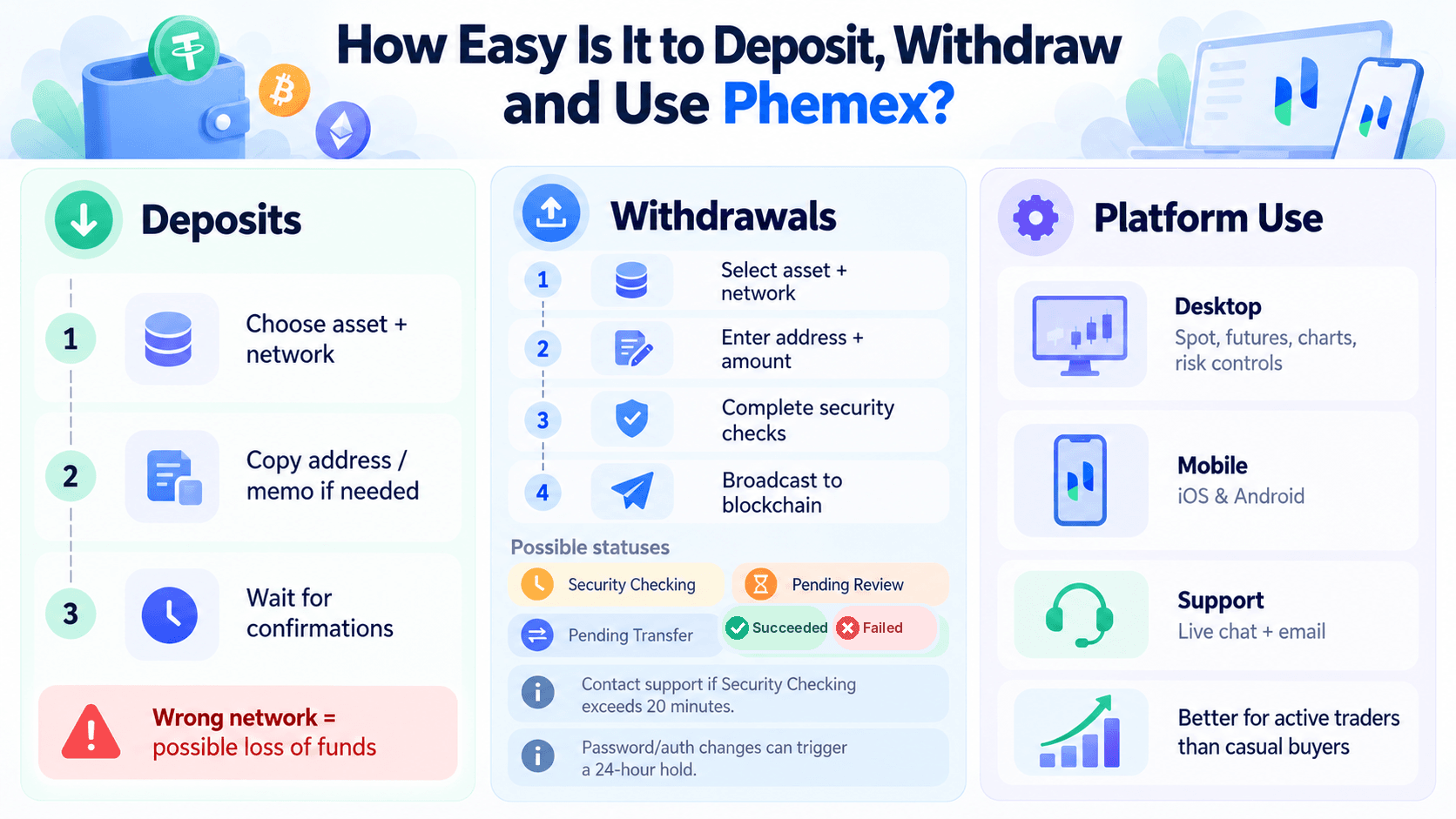
Phemex documents conventional exchange funding and trading workflows on desktop and mobile. Actual service quality cannot be established from feature lists alone.
 Phemex Deposit and Withdrawal Processes, Security Checks and Desktop and Mobile Trading Features
Deposits and Withdrawals: What Is the Actual Experience?
For crypto deposits, users select an asset and supported blockchain, copy the receiving address and wait for the required network confirmations. A memo or destination tag may also be needed. Sending over an incompatible network can lead to loss of funds.
For external withdrawals, users specify the cryptocurrency, network, destination self-custody address and amount, then complete security checks. Eligible fiat purchases and withdrawals depend on country, payment provider and banking options. Processing time varies with internal reviews and blockchain congestion.
| Status | Meaning |
|---|---|
| Security Checking | Automated risk assessment |
| Pending Review | Awaiting internal approval |
| Pending Transfer | Awaiting blockchain submission |
| Withdrawal Succeed / Failed | Processed or rejected |
Phemex's withdrawal FAQ advises contacting support when Security Checking exceeds 20 minutes. Password resets, authentication changes and other security modifications can trigger 24-hour withdrawal holds; compliance reviews may create additional delays. Deposit & Withdraw History provides transaction records and, once broadcast, a transaction hash (TXID) for checking a blockchain explorer.
No real deposit or withdrawal was performed, so the review does not claim an observed fee, confirmation count or completion time.
Trading Interface, Mobile App and Customer Support
Phemex's web interface combines order books, TradingView charts, order entry, position monitoring, cross/isolated margin settings and sub-accounts. Its iOS and Android applications offer mobile authentication, account management and trading, although some functionality and navigation can differ by version.
| Area | Documented offering | Assessment limit |
|---|---|---|
| Desktop | Spot, futures, charts and risk controls | No live execution test |
| Mobile | iOS/Android trading and account security | No device-based test |
| Support | Live chat and [email protected] | No measured response or resolution time |
The tools cater more naturally to traders familiar with order types and liquidation mechanics than to users making an occasional purchase. No claim of unusually fast execution or superior customer service is warranted without direct testing.
Are Phemex Trading Bots, Copy Trading, Earn and PT Worth Using?
These products extend Phemex beyond manual trading, but automation and advertised rewards introduce costs and risk of their own.
Trading Bots and Copy Trading
Phemex supports grid bots for range-based buying and selling, Martingale bots that increase exposure after unfavorable price moves, and signal bots linked to predefined trading triggers. Access to many built-in bots does not require a separate subscription, but executed trades still generate fees and potentially funding payments.
Grid strategies can suffer in persistent trends. Martingale exposure can accelerate losses, and leveraged futures bots can be liquidated.
Copy trading replicates eligible lead-trader transactions using follower allocations. Phemex displays ROI, trading history and other metrics; maximum drawdown is especially useful for identifying strategies that suffered large peak-to-trough losses. Followers can obtain different fills or returns because of timing, leverage, limits and slippage.
Phemex's lead-trader guide sets standard application profit-sharing choices at 1%–12%, while separately advertising up to 30% for certain arrangements. Those figures are not interchangeable; followers should review the rate attached to their chosen trader. Coin Bureau's copy trading guide covers allocation and selection in more detail.
Phemex Earn, PT and PhemexDAO
Phemex's Savings guidance lists Flexible Savings as available and Fixed Savings as unavailable. Its public Launchpool page describes the service, but no active campaign could be independently confirmed as of Oct. 17.
In September 2026, Phemex discontinued On-Chain Earn subscriptions for USDT, SOL, ATOM and HYPE, with asset-specific redemption times.
| Product | Possible benefit | Main trade-off |
|---|---|---|
| Flexible Savings | Variable rewards, flexible redemption | Exchange counterparty risk and changing yield |
| Fixed Savings / Launchpool | Term rewards or campaign tokens if available | Fixed Savings is listed as unavailable; no active Launchpool campaign independently confirmed |
| PT | Eligible trading fee discounts | Token price risk |
| vePT | Lock-based benefits and governance participation | PT locked for one month to two years |
| PhemexDAO | Proposed community decisions | Limited independently verified voting outcomes |
The vePT framework links lock duration to benefits, but locked PT cannot be freely sold. PhemexDAO describes treasury and governance participation; current evidence of completed proposals and consequential voting activity was insufficient to measure holders' practical influence. Token utility is not proof of investment value.
Assessment: Bots and copy trading add usable automation. PT can reduce eligible fees. Earn and governance offerings require closer scrutiny of current availability, liquidity, counterparty exposure and lockups.
Phemex vs. Binance, Bybit and OKX: Which Exchange Is Better?
Phemex wins on the published standard futures maker rate, while its competitors offer lower taker rates and considerably larger reported derivatives markets. Regional products and account types can change the comparison.
| Factor | Phemex | Binance Global | Bybit Global | OKX Global |
|---|---|---|---|---|
| Best for | Maker-heavy futures | Broad markets and liquidity | Derivatives and copy trading | Trading tools and Web3 |
| Spot maker/taker | 0.10%/0.10% | 0.10%/0.10% | 0.10%/0.10% | 0.08%/0.10% |
| USDT futures maker/taker | 0.01%/0.06% | 0.02%/0.05% | 0.02%/0.055% | 0.02%/0.05% |
| Derivatives activity | Smaller, BTC-heavy | Largest in comparison | Substantial | Substantial |
| Trading features | Spot, perps, bots, copying | Broad spot/futures/automation | Perps, bots, copying | Derivatives, bots, Web3 |
| Security record | 2025 hot-wallet theft | 2019 hack, later enforcement issues | 2025 wallet theft | Operational/regulatory risk |
| Proof-of-Reserves | Oct. 5, 2026; 8 categories | October 2026 monthly update | Sept. 23, 2026; 50 assets, Hacken verified | Sept. 8, 2026; zk-STARK files |
| Fiat | Regional third parties | Broad eligible routes | Region-dependent routes | Multiple regional routes |
| Restrictions | US, UK, Australia and others | Separate regional entities, product limits | Restricted regions, separate entities | Entity- and product-specific limits |
| Main drawback | Custody and liquidity concentration | Regulatory complexity | Custody history | Regional complexity |
- Phemex vs. Binance: A $10,000 standard USDT-futures maker order costs $1 on Phemex versus $2 on Binance; a taker order costs $6 versus $5. Binance offers far greater reported activity, broader market selection and more fiat routes in supported jurisdictions. See Coin Bureau's Binance review.
- Phemex vs. Bybit: Maker fees are $1 versus $2 for the same order; taker fees are $6 versus $5.50. Bybit's larger derivatives market and copy-trading ecosystem favor traders prioritizing product depth, although its 2025 breach also creates custody concerns. Our Bybit review examines these risks.
- Phemex vs. OKX: Maker fees are $1 versus $2, while taker fees are $6 versus $5 on the same $10,000 USDT perpetual order. OKX offers broader integrated trading, risk-management and Web3 tools. Our OKX review covers the platform in detail.
Funding, slippage, discounts and order type can change the final cost ranking; each example holds notional and standard account tier constant.
Who Should Use Phemex?
Phemex is a plausible specialized choice for experienced derivatives traders placing maker orders. Its higher taker charges, uneven smaller-market liquidity, restricted access and custody record limit its appeal elsewhere.
Best For
- Eligible experienced futures traders who understand leverage and liquidation.
- Cost-conscious users whose orders regularly qualify for maker pricing.
- Traders seeking integrated bots or copy trading with appropriate safeguards.
Not Ideal For
- Residents of restricted jurisdictions.
- Beginners seeking simple fiat entry and exit.
- Investors seeking stronger verified regulatory and custody protections.
- Users uncomfortable with Phemex's 2025 security history.
- Traders requiring demonstrably deep execution for large or smaller-market orders.

Final Verdict
Phemex's 0.01% standard futures maker fee is a genuine pricing advantage, but its 0.06% taker fee is higher than the comparable standard fees on Binance, Bybit and OKX. CoinGecko data supports significant derivatives participation, especially in BTC, but does not demonstrate consistently superior execution.
Phemex has published account safeguards, custody improvements and recurring reserve disclosures. Their limited independent scope, along with the January 2025 breach and geographic restrictions, argue against an unconditional recommendation. Binance is preferable for broad market access and reported liquidity, Bybit for a larger derivatives and copying ecosystem, and OKX for integrated trading and Web3 features.
Consider Phemex for eligible, maker-heavy derivatives trading after reviewing contract-level liquidity. It is a less persuasive choice for beginners, large passive balances or users seeking stronger verified regulatory protections. No numerical rating is assigned without a standardized hands-on scoring process.