Swapping one cryptocurrency for another used to mean opening an exchange account, depositing funds, and navigating a trading interface that could feel overwhelming for casual users. Over the past few years, swap aggregators have emerged as a simpler alternative. These platforms focus on a single task: converting one crypto asset into another quickly, often directly from a user’s wallet.
SimpleSwap is one of the services in this category. Instead of operating a traditional exchange, it routes swaps through external liquidity providers while keeping the user experience simple. In this review, we take a closer look at how SimpleSwap works, what it costs to use, how safe it is, and whether it still makes sense as a swap option today.
Editor's Note (March 18, 2026): We fully updated this review in March 2026 to reflect how SimpleSwap operates today as a non-custodial swap aggregator. The update strengthens the fee, safety, and KYC analysis, adds a clearer comparison with alternatives, and expands the guide with a more practical verdict on who the platform is best for in 2026.
Quick Verdict: Is SimpleSwap Worth Using in 2026?
Yes. SimpleSwap is worth using in 2026 for simple wallet-to-wallet crypto swaps, but it is better for convenience than for low-fee active trading.
Best For
- Quick crypto-to-crypto swaps between self-custody wallets
- Users who want a simple interface without a full exchange account
- Beginners who do not need charts, order books, or advanced order types
- Altcoin users looking for broad asset coverage in one place
Who Should Avoid
- Active traders who need deep liquidity, charting, and trading tools
- Fee-sensitive users who want the clearest possible pricing breakdown
- Large-volume traders comparing spreads across venues
- Users who want a full fiat trading platform rather than a swap service
Quick Facts
| Founded | 2018 |
|---|---|
| Platform Type | Non-custodial crypto swap aggregator |
| Assets Supported | 1,500+ cryptocurrencies |
| KYC | Not required for many crypto-to-crypto swaps; may be triggered for risk checks or fiat transactions |
| Rate Types | Fixed rate and floating rate swaps |
| Fiat Purchases | Available through partners such as Mercuryo, Simplex, and Guardarian |
| Mobile App | Available for iOS and Android |
| Wallet Support / Self-Custody | Wallet-to-wallet swaps; users retain custody of funds |
| Customer Support | Live chat, help center, and order-tracking tools |
| Best For | Quick wallet-to-wallet swaps and users prioritizing convenience over advanced trading tools |
Disclosure and Methodology
Some links in this article may be affiliate links. If you choose to use a service through these links, we may earn a commission at no additional cost to you.
For this review, we evaluated SimpleSwap’s platform structure, swap workflow, fee model, supported assets, safety design, and publicly available reputation signals across user review platforms and official documentation.
What Is SimpleSwap?
SimpleSwap is a cryptocurrency swap aggregator that helps users exchange one crypto asset for another via external liquidity providers rather than a traditional in-house order book. In practical terms, it functions as a routing layer. It finds available rates across partner platforms, processes the swap flow through those external venues, and sends the converted asset back to a wallet the user controls. That means it is non-custodial in transaction flow, but it is not a decentralized exchange in the pure on-chain sense.
Before breaking that down further, the key distinction is this: SimpleSwap is built for conversion convenience, not for running its own trading market.
SimpleSwap at a Glance
SimpleSwap is best understood as a service that sits between the user and a network of outside exchanges or liquidity sources. It does not operate like a classic exchange where traders place bids and asks into a visible order book. Instead, it takes a user’s requested asset pair, checks available liquidity through connected providers, and routes the transaction through the most suitable option available at that time.
That structure shapes the entire user experience. A person using SimpleSwap is not entering a marketplace to trade against other users on the platform itself. They are using an interface that simplifies access to liquidity elsewhere. The platform handles the routing logic in the background, while the user sees a much cleaner swap process on the front end.
This is where people often get confused. Because SimpleSwap lets users swap directly from one wallet to another, it can look like a decentralized exchange at first glance. But that is not quite accurate. The platform may avoid holding long-term user balances in the way a centralized exchange does, yet the service still relies on a managed intermediary layer and external partners to complete the transaction. So the better description is a non-custodial swap service or swap aggregator, not a DEX.
That distinction matters because it sets the right expectations from the start. Users come to SimpleSwap for speed, convenience, and easy access to crypto-to-crypto conversions. They are not using an exchange that runs its own deep internal market, nor are they interacting with a fully decentralized liquidity pool model.
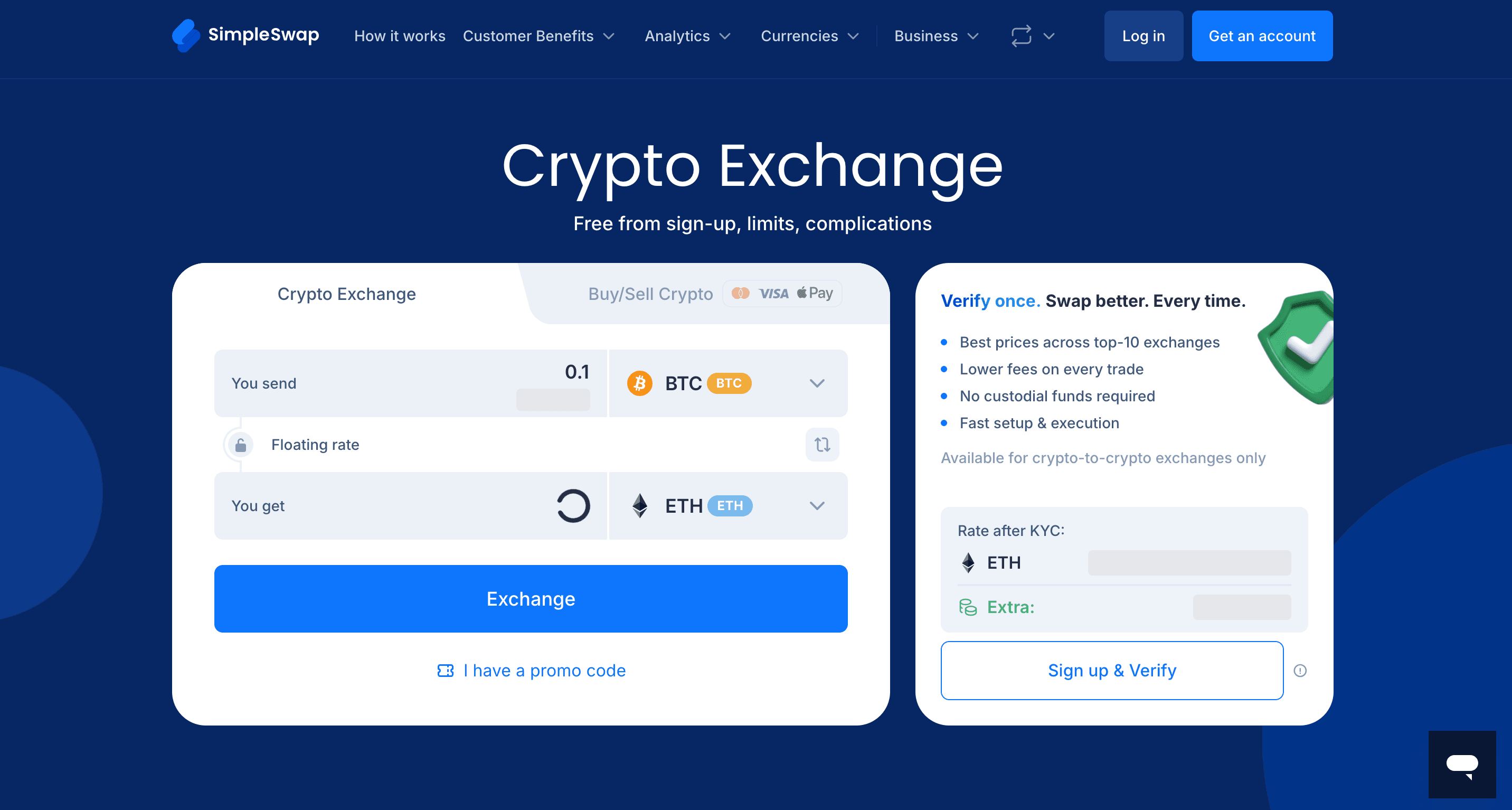 Simple Swap is a Non-Custodial Crypto Swap Aggregator Connecting Multiple Liquidity Sources. Image via SimpleSwap
Aggregator vs Exchange
That broader definition becomes clearer when SimpleSwap is compared with a traditional exchange model.
A standard crypto exchange usually runs its own trading environment. Users create accounts, deposit funds, and place orders in an internal marketplace. Prices are set through the exchange’s order book, where buyers and sellers meet, and trades are matched.
If you're unsure where to start, our crypto exchange comparison guide for beginners and advanced traders lays out the key differences clearly.
SimpleSwap works differently. It does not build that market itself. It pulls from markets that already exist elsewhere. When someone starts a swap, the platform searches across external providers and routes the order according to available pricing and liquidity. So instead of being the market, it acts more like the connector to several markets.
This affects account requirements first. Traditional exchanges usually expect sign-up, account management, and often a deposited balance before trading begins. A swap aggregator reduces that friction because the user typically completes a single conversion flow rather than entering a full trading environment.
It changes custody, too. On a conventional centralized exchange, the user often hands over custody of funds during the period those assets remain on the platform. With SimpleSwap, the process is more transactional. The user sends funds for a specific swap and receives the output asset in their own wallet, rather than storing a portfolio balance in that wallet for ongoing trading.
Pricing works differently as well. A traditional exchange shows you its own market depth and internal execution environment. SimpleSwap presents rates based on what its integrated liquidity sources can offer at that moment. So the quote is shaped by outside venues, not by a native order book inside SimpleSwap itself.
Speed and support expectations follow the same logic. Since execution depends on both partner liquidity and blockchain confirmation times, the final experience can vary based on the asset, provider, and network conditions. And when something goes wrong, support may involve issues not only in the interface layer but also in the underlying provider handling execution.
That is why calling SimpleSwap an exchange misses the sharper point. It is better described as an access layer for swaps. It simplifies crypto conversion by routing users to external liquidity rather than operating a full trading marketplace of its own.
Who Should Use SimpleSwap?
Not every crypto platform serves the same type of user. Some tools are built for active traders who rely on charts, order books, and complex trading strategies. Others focus on convenience and quick asset conversion. SimpleSwap falls into the second category.
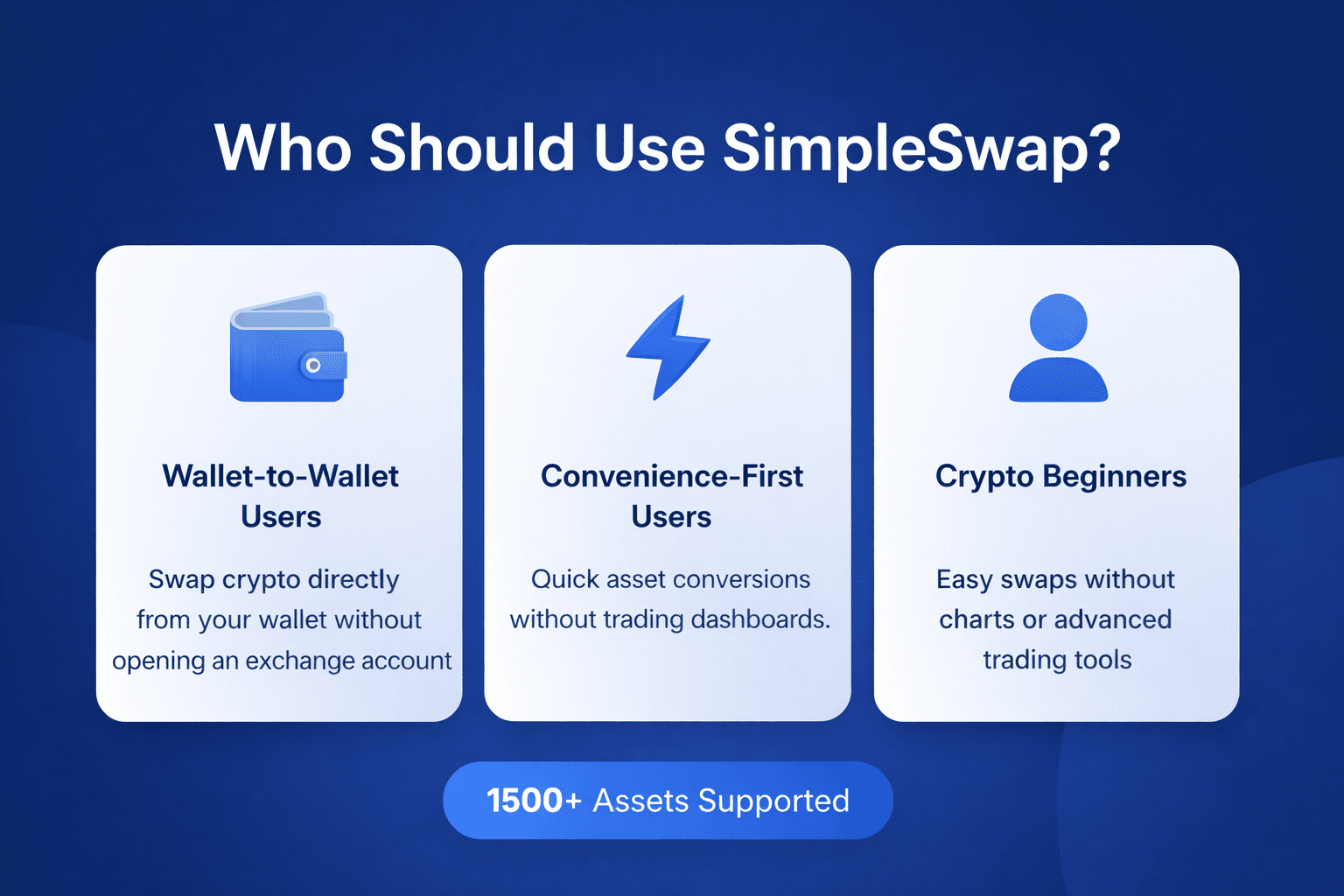 Ideal For Quick Wallet To Wallet Crypto Swaps
Best For
SimpleSwap is particularly useful for users who prioritize speed, simplicity, and direct asset conversion rather than active trading environments.
The platform works well for individuals who want to swap assets quickly without setting up a full exchange account. Because swaps occur directly between wallets, users can convert cryptocurrencies without maintaining balances on an exchange or navigating a trading dashboard.
It also appeals to privacy-conscious users who prefer minimizing account creation and platform exposure. Since swaps can be completed without maintaining an ongoing trading profile, the experience feels closer to a transactional service than a full trading platform.
Beginners often find this structure easier to navigate as well. Traditional exchanges can introduce complexity through trading interfaces, order types, and market depth charts. SimpleSwap removes most of that friction by focusing on a single function: converting one cryptocurrency into another.
Another advantage is access. The platform aggregates liquidity from multiple providers, allowing users to swap a wide range of digital assets from a single interface. Instead of opening accounts across multiple exchanges, users can access many markets through a single swap workflow.
Not Ideal For
The same design choices that make SimpleSwap simple also create limitations for more advanced trading needs.
Active traders who rely on chart analysis, order books, and conditional order types will likely find the platform too limited. SimpleSwap does not provide a trading terminal or advanced execution tools because it is built for swaps rather than market trading. Day trading demands low fees and deep liquidity, and this analysis of top exchanges optimized for day trading highlights where active traders actually operate.
Large-volume traders may also prefer traditional exchanges. When executing sizable transactions, transparency around fee structures and liquidity depth becomes more important. On aggregator platforms, final pricing can depend on external providers and routing conditions.
Users who need extensive fiat support may face similar constraints. While some swaps may involve fiat gateways through partners, the platform itself is primarily focused on crypto-to-crypto conversions rather than full fiat trading environments.
Finally, traders seeking instant centralized exchange execution may find the process slower than direct exchange trading. Since swaps depend on blockchain confirmations and routing through partner venues, timing can vary based on network conditions and liquidity.
These differences highlight the role SimpleSwap is designed to play. It is not trying to replace full-featured exchanges. Instead, it focuses on providing a streamlined way to convert digital assets between wallets.
How SimpleSwap Works
SimpleSwap removes many of the steps normally associated with trading on a cryptocurrency exchange. Instead of opening an account, depositing funds, and navigating a trading interface, users simply initiate a direct asset conversion.
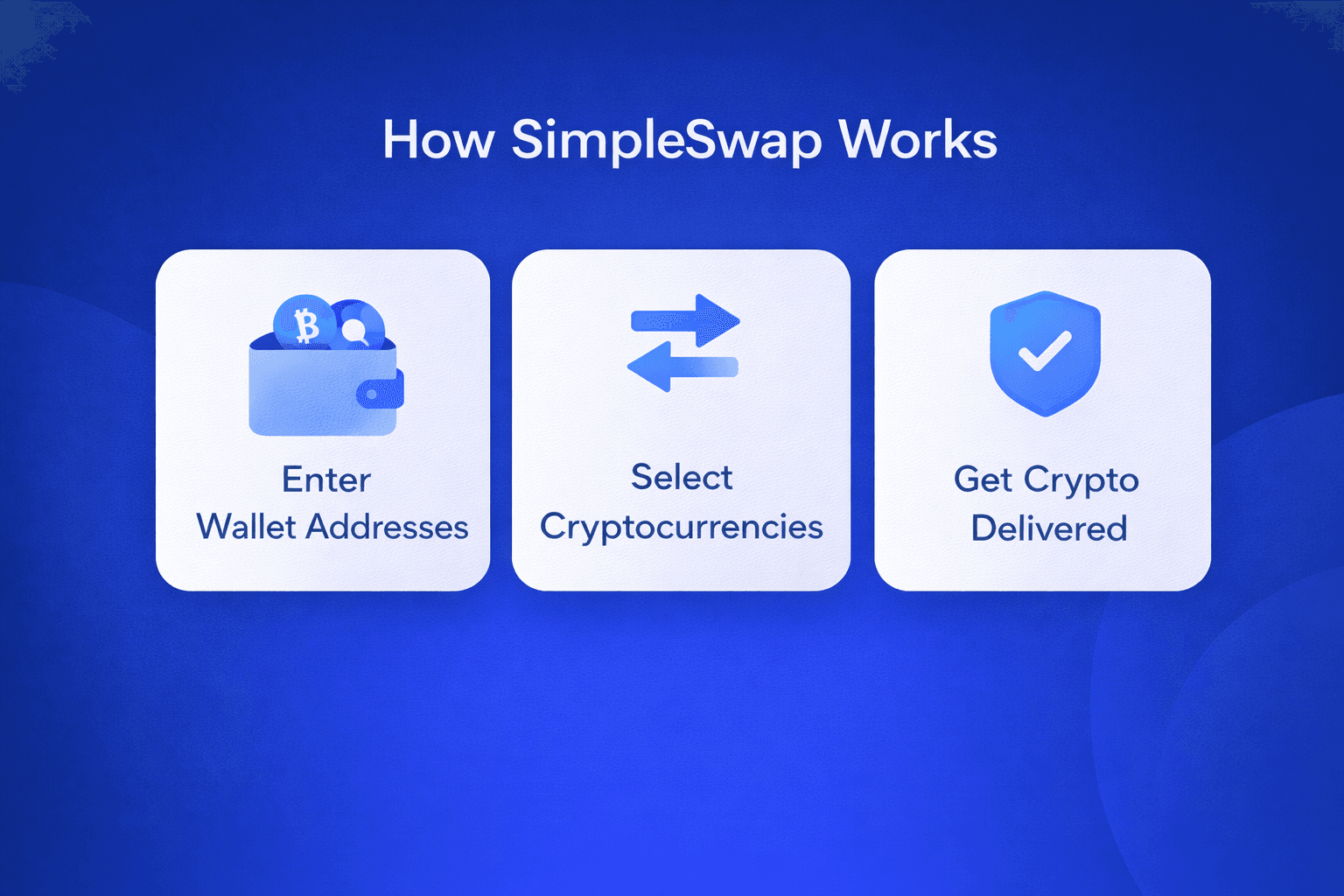 Simple Wallet To Wallet Swap Process Without Custody
The Basic Swap Flow
A SimpleSwap transaction follows a short sequence that moves funds from one wallet to another while routing the conversion through external markets. Although the interface appears simple, several steps occur in the background to complete the swap.
The process typically unfolds in the following order:
- Choose the asset pair: The user selects the cryptocurrency they want to exchange and the asset they want to receive. The platform immediately calculates an estimated conversion rate based on liquidity available through its partner exchanges.
- Enter the receiving wallet address: Next, the user provides the destination address where the swapped cryptocurrency should be delivered. This step ensures the final asset goes directly to the user’s wallet rather than being stored on the platform.
- Send funds to the generated deposit address: Once the swap details are confirmed, SimpleSwap generates a unique deposit address for the transaction. The user sends the cryptocurrency they want to exchange to this address from their own wallet.
- Blockchain confirmation: After the transaction is broadcast to the network, SimpleSwap waits for the required number of confirmations. This ensures the incoming funds are verified before the swap proceeds.
- Swap execution through liquidity providers: When the deposit is confirmed, the platform routes the funds through one of its connected liquidity partners. The partner exchange executes the conversion using available market liquidity.
- Delivery of the swapped asset: After the trade completes, the converted cryptocurrency is sent directly to the receiving wallet address provided earlier. At this point, the swap process is finished.
From the user’s perspective, the process feels similar to a simple wallet transfer. In reality, the platform has coordinated several steps across external exchanges and blockchain networks to complete the conversion.
Read: Best Crypto Swapping Platforms
Fixed vs Floating Rates
Another detail users encounter during a swap is the choice between fixed and floating exchange rates. These options determine how the final conversion price is calculated during the transaction.
A fixed rate locks in the exchange price when the swap is created. The platform guarantees the amount of the destination asset the user will receive, provided the deposit arrives within the allowed time window. This option protects the user from short-term market volatility while the transaction is being processed.
A floating rate works differently. In this model, the final conversion rate is determined when the swap is executed through the liquidity provider. Because cryptocurrency markets move constantly, the final amount received may vary slightly due to price changes during the transaction.
Slippage can occur when prices shift while the deposit is being confirmed on the blockchain or while the swap is routed through external exchanges. In volatile markets, these movements can slightly change the final output amount.
For users who want certainty about the final result, fixed rates often provide more predictability. Floating rates, however, may sometimes yield slightly better pricing if market movements favor the user before execution.
Key Features
SimpleSwap is designed around a single idea: reducing the friction of converting one cryptocurrency to another. Instead of building a full trading terminal with charts and order books, the platform focuses on simplifying the swap experience.
That focus shows up in several practical features. Most of them focus on accessibility, asset coverage, and ease of execution rather than on advanced trading tools.
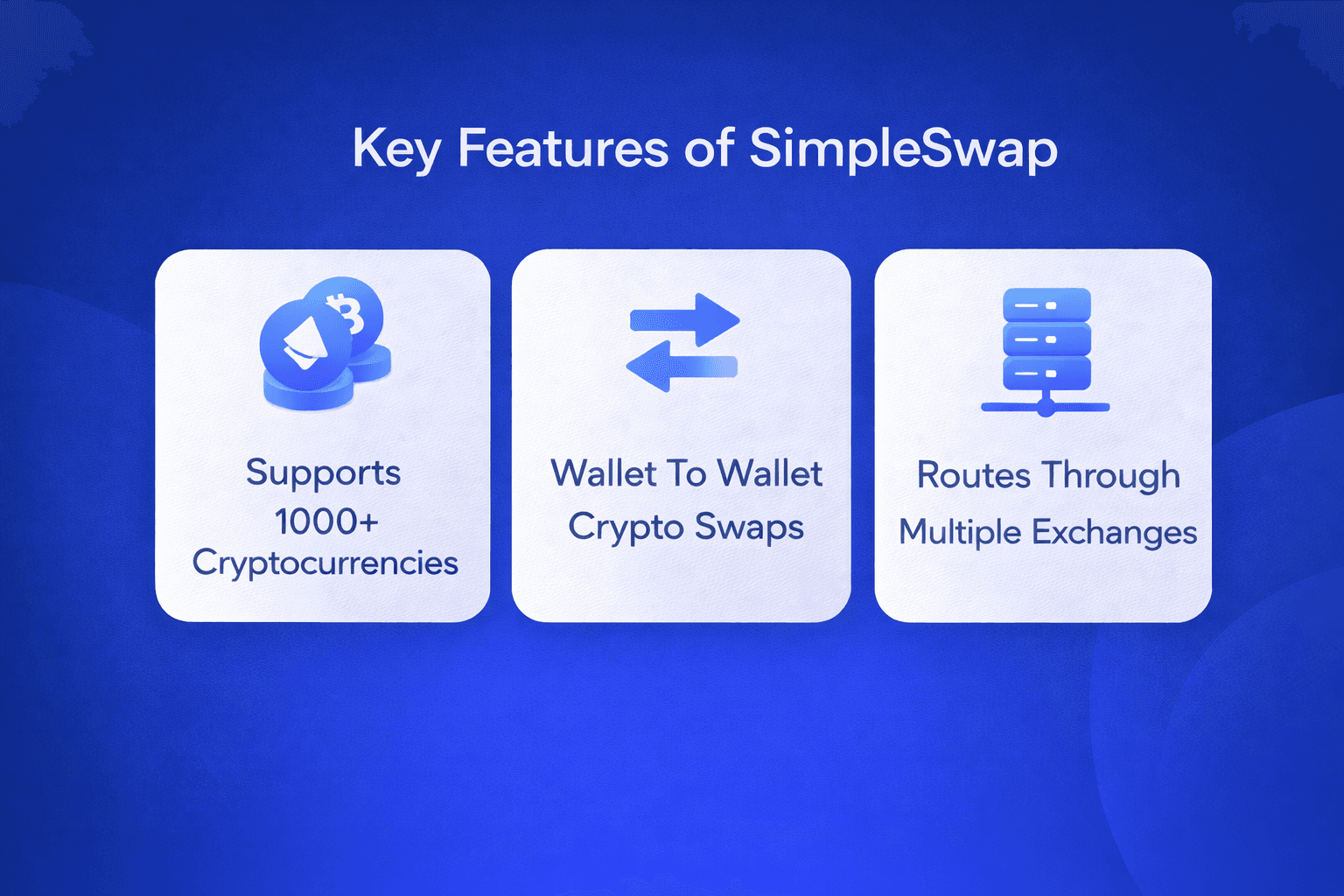 SimpleSwap Platform Features Enabling Fast And Flexible Crypto Swaps
No Account for Most Crypto Swaps
One of the platform’s most noticeable characteristics is that many crypto-to-crypto swaps can be completed without creating a full user account. In a typical transaction, the user simply selects the asset pair, provides a receiving wallet address, and sends the deposit transaction. The swap then proceeds without requiring account registration or an ongoing platform balance.
This approach lowers the barrier to entry compared with centralized exchanges that require sign-ups before trading. For users who only need occasional asset conversions, avoiding account creation can make the process significantly faster.
However, the absence of mandatory registration should not be confused with guaranteed anonymity. Like most crypto service providers, SimpleSwap may request identity verification in certain situations. This can happen when risk monitoring systems flag unusual activity, when regulatory requirements apply, or when transactions involve fiat gateways or compliance-sensitive assets.
In other words, many standard swaps can be performed without signing up, but the platform still operates within broader compliance frameworks that may trigger verification requirements.
Large Asset Selection
SimpleSwap lists more than 1,500 digital assets across multiple blockchain ecosystems, including major cryptocurrencies, stablecoins, and a large range of altcoins.
In practical terms, this wide selection matters because it eliminates the need to open accounts on multiple exchanges to access different assets. A trader who wants to move between smaller tokens or cross-chain ecosystems can often complete the conversion directly through the swap interface.
Wallet-to-Wallet Convenience
SimpleSwap also emphasizes a wallet-to-wallet transaction model. The user sends funds directly from their own wallet and receives the swapped asset back to another wallet address they control.
This workflow differs from traditional exchanges, where assets are first deposited into a custodial account before any trade takes place. In the SimpleSwap model, the platform acts as a transaction coordinator rather than a balance-holding service.
For users who prefer self-custody, this approach can feel more aligned with the broader philosophy of cryptocurrency ownership. Assets are not stored on the platform long term, and the swap itself becomes a single transactional event rather than part of an ongoing account balance.
The platform also supports integrations that let users initiate swaps through certain wallet interfaces or browser environments, making the process feel more like native wallet operations than a separate trading activity.
Mobile App and Price Alerts
Beyond the web interface, SimpleSwap offers a mobile application that replicates the same swap functionality on smartphones. The app allows users to perform conversions, monitor supported assets, and track swap activity while away from a desktop environment.
One practical feature of the mobile experience is price alerts. Users can set notifications for specific cryptocurrencies, so they receive updates when the market reaches selected price levels. This feature is particularly useful for users who monitor market movements before initiating a swap. Rather than constantly checking charts, they can wait for alerts that indicate when a target price or market condition is reached.
The mobile app, therefore, functions primarily as a convenience layer for monitoring assets and executing swaps on the go, rather than as a fully featured trading terminal.
Customer Support and Order Tracking
Swap services rely heavily on transaction tracking because blockchain confirmations and liquidity routing can sometimes introduce delays. SimpleSwap includes order-tracking tools that let users monitor the progress of their swaps in real time.
Each transaction is assigned a unique order ID that can be used to check status updates on the platform’s tracking page. This system shows whether the platform is waiting for a deposit, processing the swap, or sending the converted asset to the receiving address.
In situations where a transaction is delayed or requires investigation, these tracking tools help users identify where the process currently stands.
Customer support is available through several channels, including live chat and support requests submitted through the website. These support options become particularly important when network congestion, incorrect deposit amounts, or blockchain delays affect the timing of a swap.
Together, order tracking and support channels provide a mechanism for users to monitor and resolve issues that may arise during the swap process.
Fees, Rates, and What You Actually Pay
Instead of charging a visible trading fee, SimpleSwap calculates a final conversion rate that already includes liquidity spreads, service markups, and blockchain network costs.
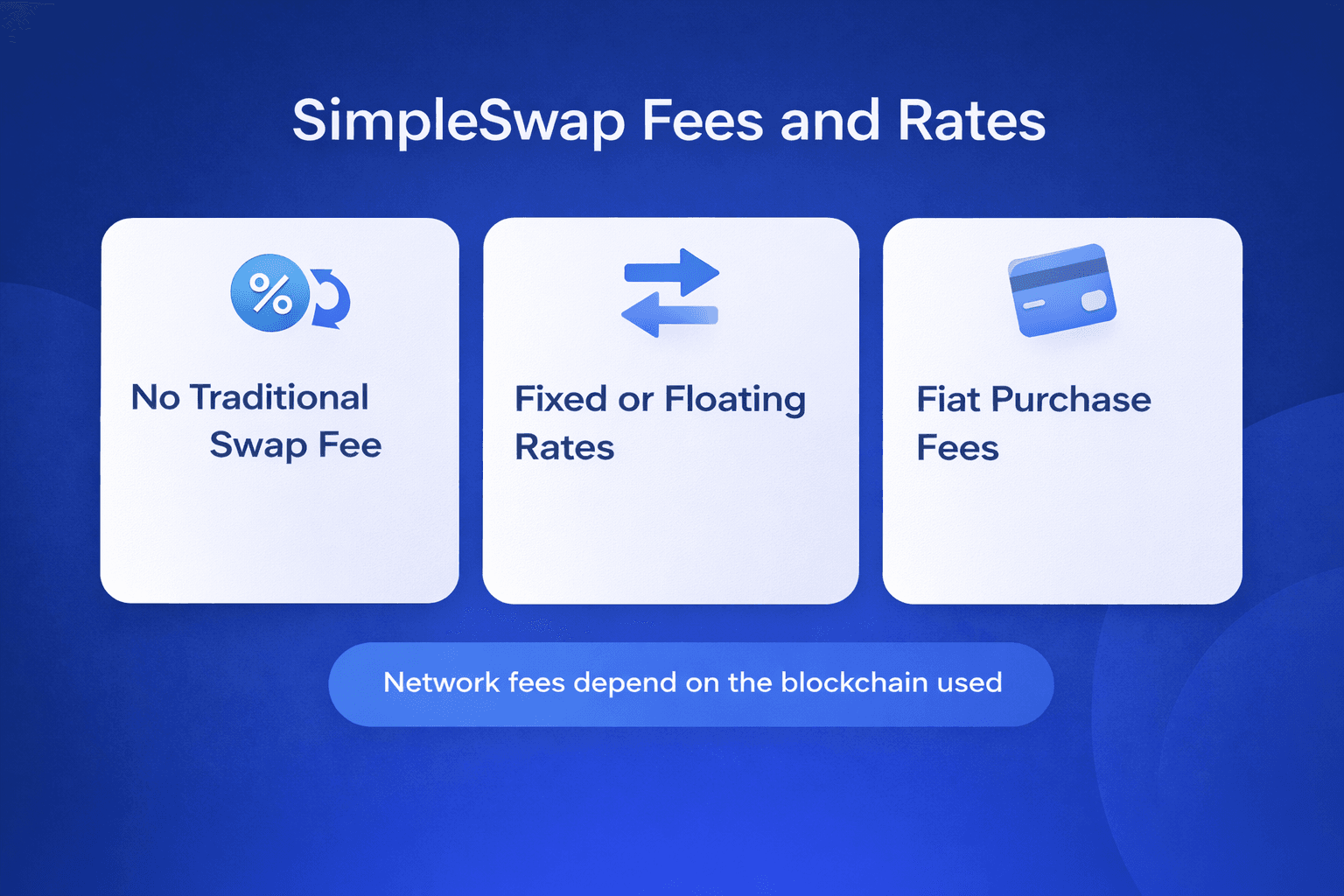 Swap Costs Embedded Inside Exchange Rate Quotes
Does SimpleSwap Charge Fees?
Yes, but the platform does not publish a fixed percentage trading fee for standard crypto-to-crypto swaps.
According to SimpleSwap’s official FAQ and documentation, the platform does not revolve around a traditional percentage commission. Instead, the quoted rate is calculated based on liquidity conditions and includes all relevant costs upfront.
In most cases, the total cost of a swap is reflected through several components embedded in the final rate:
- Liquidity spread: Typically around 0.5%–2%, depending on market depth and asset pair
- Service markup: Generally at around 0.4%–1%, though the exact figure is not publicly disclosed
- Blockchain network fees: Determined by the underlying network used for the transaction
- Routing costs: Associated with executing the swap through partner exchanges or liquidity providers
When these elements are combined, independent comparisons often place the effective total swap cost between roughly 1% and 3% of the transaction value. The actual number varies depending on asset liquidity, transaction size, and current market volatility.
Network fees themselves are not charged by SimpleSwap directly. Instead, they are the standard transaction fees required by the blockchain network involved. For example:
- Bitcoin network fees may range from $1–$10 depending on congestion
- Ethereum gas fees may range from $2–$20+ depending on network demand
- Lower-cost networks such as BNB Chain or Polygon often cost under $0.10
Because all of these elements are bundled into the quoted rate, SimpleSwap’s pricing structure can appear less transparent than centralized exchanges that display a fixed fee per trade. The platform instead emphasizes that users see the final amount they will receive before confirming the swap.
Cost-conscious users should check out our top picks for the best crypto exchanges with the lowest fees.
Fixed Rate vs Floating Rate Cost Trade-Off
The final cost of a swap can also depend on whether the user chooses a fixed rate or a floating rate transaction.
A floating rate reflects real-time market conditions. The platform shows an approximate receive amount, but the final output is determined when the swap executes through liquidity providers. Because cryptocurrency prices move constantly, the final amount received can vary slightly from the initial estimate.
A fixed rate locks in the exchange price when the swap is created. This option protects the user from short-term market volatility by guaranteeing the output amount, provided the deposit arrives within the required time window.
For fixed-rate swaps on SimpleSwap:
- The exchange rate is locked for 20 minutes
- The user must send the funds within this time window
- The transaction typically requires at least one blockchain confirmation before execution
Because fixed rates shield users from market movement, they sometimes include a slightly wider spread compared with floating swaps.
Regardless of the rate type chosen, users should always review the final quoted output amount before confirming the transaction. That value represents the most accurate measure of the total cost.
Fee Transparency Verdict
SimpleSwap’s pricing model prioritizes convenience rather than granular fee transparency.
By bundling spreads, service markup, and network costs into a single conversion rate, the platform keeps the swap interface simple. Users do not need to calculate multiple fee layers before completing a transaction.
However, this structure can make it harder to analyze the exact fee breakdown or compare spreads across platforms. For users executing large trades or frequent conversions, centralized exchanges with explicit trading fees, sometimes as low as 0.1%, may offer clearer pricing.
In practice, SimpleSwap is best evaluated as a convenience-focused swap service rather than a platform optimized for the lowest possible trading fees. For quick asset conversions and wallet-to-wallet swaps, the bundled pricing model works well. For high-volume trading strategies, traditional exchanges may still offer tighter spreads.
Is SimpleSwap Safe and Legit?
SimpleSwap has been operating long enough to establish a recognizable presence in the swap-service market. However, like any crypto platform, its security depends on both how the service is structured and how carefully users handle their transactions.
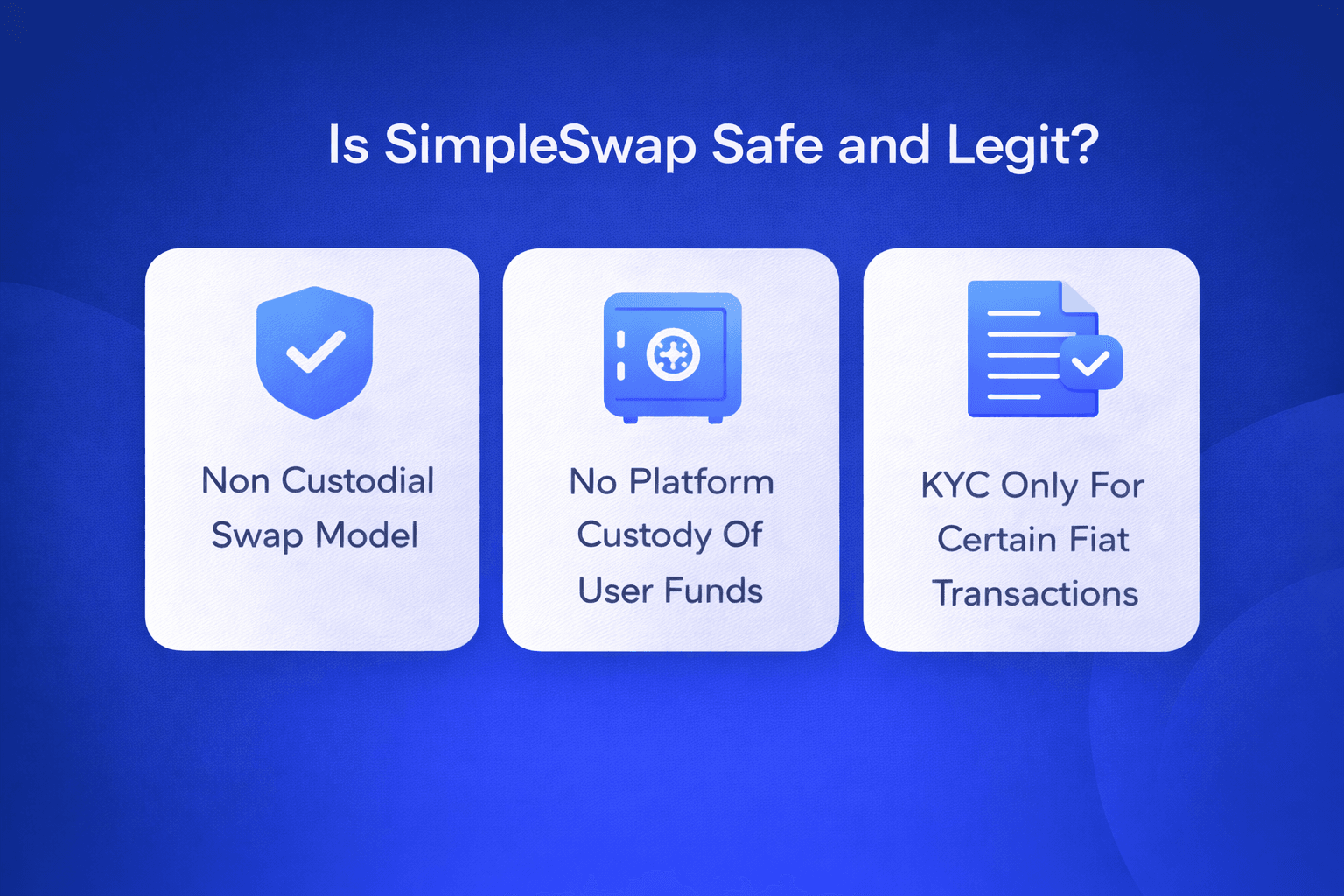 Non Custodial Model Reduces Exchange Custody Risks For Users
Is SimpleSwap Legit?
Yes. SimpleSwap is a legitimate cryptocurrency swap service with a long-running public presence in the crypto ecosystem.
The platform was founded in 2018 and operates as a crypto swap aggregator, routing asset conversions through external liquidity providers rather than maintaining its own internal trading order book. Over the years, it has maintained a visible public platform, active support channels, and integrations with several partner exchanges that provide liquidity for swaps.
Longevity is one of the strongest indicators of legitimacy in the crypto industry. Services that remain operational through multiple market cycles often demonstrate stable infrastructure and a functioning operational model.
It's important to note that Trustpilot detected and removed a number of fake reviews for SimpleSwap. As a result, its rating is unavailable. There are over 2,500 reviews for SimpleSwap on the platform with 5-star reviews making up 80% of the total. One-star reviews come in at 13%.
Is SimpleSwap Safe to Use?
Yes, SimpleSwap reduces certain risks by operating through a wallet-to-wallet transaction model rather than a custodial exchange account system.
In traditional centralized exchanges, users deposit funds into an account that the exchange controls. Those funds remain on the platform until withdrawn, which introduces custodial risk if the exchange is hacked or becomes insolvent.
SimpleSwap works differently. Users send cryptocurrency from their own wallet and receive the swapped asset directly back to a wallet they control. Because the platform does not maintain long-term custody of user balances, it removes some of the risks associated with exchange-held funds.
However, the non-custodial structure does not eliminate all risks. Users still face the normal responsibilities associated with self-custody transactions.
Common risks include:
- Sending funds to the wrong wallet address
- Selecting the wrong blockchain network for a deposit
- Delays caused by blockchain confirmation times
- Irreversible transactions if mistakes occur
Unlike traditional financial transfers, blockchain transactions cannot be reversed once confirmed. This means that user errors during the swap process can result in permanent loss of funds.
For this reason, non-custodial convenience should be viewed as reduced custodial exposure rather than complete transaction safety.
KYC, Privacy, and Compliance
Another common question from users is whether SimpleSwap requires identity verification.
For many standard crypto-to-crypto swaps, users can complete transactions without creating an account or submitting KYC documentation. This makes the platform appealing for users who want a straightforward conversion process without maintaining a full exchange profile.
However, the absence of mandatory KYC for basic swaps does not mean the platform operates outside compliance frameworks.
Identity verification may still appear in several situations:
- Fiat-to-crypto purchases processed through partner providers
- Transactions flagged by automated risk monitoring systems
- Regulatory or compliance checks
- Disputes or investigations related to a swap
Because of these factors, SimpleSwap should not be considered fully anonymous in an absolute sense. Instead, it offers a lighter onboarding process for many crypto swaps while still maintaining compliance mechanisms when required.
If anonymity is your priority, our comparison of the top no-KYC crypto exchanges lists platforms that skip identity checks entirely.
SimpleSwap vs Alternatives
Crypto swap services rarely exist in isolation. Platforms such as SimpleSwap compete with other swap aggregators that offer similar wallet-to-wallet conversion tools. Two of the closest alternatives are ChangeNOW and Changelly, both of which offer comparable crypto swap functionality but take slightly different approaches to pricing, compliance, and user experience.
 Comparing SimpleSwap With Popular Non Custodial Swap Aggregators
SimpleSwap vs ChangeNOW vs Changelly
| Feature | SimpleSwap | ChangeNOW | Changelly |
|---|---|---|---|
| KYC Requirements | Often not required for standard crypto swaps, but may appear in flagged cases | Similar approach; KYC usually triggered only in certain transactions | More likely to require KYC depending on transaction risk |
| Custody Model | Non-custodial wallet-to-wallet swap flow | Non-custodial swap routing through liquidity providers | Semi-custodial in some cases, depending on partner exchange execution |
| Rate Types | Fixed and floating rates available | Fixed and floating rates available | Fixed and floating rates available |
| Asset Coverage | 1,500+ cryptocurrencies | 900+ cryptocurrencies | 500+ cryptocurrencies |
| Fee Transparency | Costs embedded in the quoted rate | Similar bundled rate model | Historically clearer fee disclosure but still rate-based |
| Best For | Fast wallet-to-wallet swaps and wide asset coverage | Users who want similar functionality with slightly different liquidity routes | Users familiar with the Changelly ecosystem and integrations |
When SimpleSwap Is the Better Choice
SimpleSwap tends to perform best when users value speed and simplicity over advanced trading features.
Because the platform focuses on a straightforward wallet-to-wallet workflow, it works well for users who want to convert assets quickly without managing exchange accounts or navigating trading dashboards.
The platform is particularly appealing for convenience-focused users who want access to a wide range of cryptocurrencies through a single interface. Its large asset selection also makes it useful for swaps involving smaller altcoins that may not be easily accessible on major exchanges.
For occasional swaps and simple conversions, the streamlined process can feel more efficient than logging into a full trading platform.
When an Alternative Makes More Sense
Despite its convenience, SimpleSwap is not always the best option for every situation.
Users who are highly sensitive to trading costs may prefer comparing quotes across multiple swap aggregators. Since pricing depends on liquidity routing, some platforms may occasionally offer slightly better rates for specific asset pairs.
Similarly, users who want different liquidity-routing behavior may explore alternatives, such as ChangeNOW, which sometimes sources liquidity from a different mix of partner exchanges.
Finally, traders who want deeper market functionality, including order books, charting tools, and advanced order types, will likely find traditional exchanges more suitable than swap aggregators. Platforms like Changelly may integrate more closely with exchange environments depending on the specific transaction.
In short, swap services are best viewed as conversion tools rather than full trading platforms. Choosing between them often comes down to convenience, current pricing, and the specific assets involved.

Final Verdict
Yes, SimpleSwap is worth using in 2026 if your goal is straightforward crypto-to-crypto swaps without the complexity of a traditional exchange. The platform does not try to compete with full trading terminals or high-frequency trading platforms. Instead, it focuses on making the process of converting one asset into another as simple as possible.
For many users, that simplicity is the main appeal. You can swap assets directly from one wallet to another without maintaining an exchange account, navigating order books, or managing trading balances. The platform also supports a very large range of cryptocurrencies, which makes it convenient for moving between different ecosystems or accessing smaller altcoins.
At the same time, it is important to understand what SimpleSwap is not designed for. The platform is not optimized for traders trying to squeeze the lowest possible fees out of every transaction. Because pricing is bundled into the quoted exchange rate, cost comparisons can be less precise than on centralized exchanges that publish explicit trading fees.