Changelly is built for users who want to swap or buy crypto without opening a full exchange account. That convenience is the main appeal, but it comes with trade-offs.
This Changelly review breaks down how the platform works, whether it is safe, what it costs and who should consider using it.
Editor's Note (June 23, 2026): We fully updated this Changelly review in June 2026 to reflect the platform's current fees, supported assets, country restrictions, KYC and AML policies, mobile app experience, Changelly PRO offering, reputation signals and best alternatives. We also added a clearer quick verdict, risk-focused scorecard, updated fee tables and safer-use guidance so readers can judge whether Changelly fits their needs before sending funds.
Changelly Review 2026: Quick Verdict
Changelly is built for convenience. It is a decent pick for small crypto swaps, quick wallet delivery and broad asset access, but it is not the place for large first-time trades or bargain-hunting fiat buys. The catch is simple: no full exchange account does not mean no checks, no delays or no KYC.
Scorecard
-
1Platform and App 4/5 Changelly keeps the swap flow simple across web and mobile, with guided crypto swaps, fiat provider access and wallet delivery instead of a full trading dashboard.
-
2Fees and Payout Structure 3/5 The 0.25% floating swap fee looks clean, but the final payout can be shaped by network fees, spread, rate movement, fixed-rate buffers and fiat provider charges.
-
3Regulation and Trust 3/5 Changelly has a long operating history and no widely documented major platform hack, but it is not a regulated exchange substitute and has a polarized public review profile.
-
4Deposits and Withdrawals 3.5/5 Standard swaps send funds to the wallet address the user provides, but wrong networks, missing memos, late payments, reused addresses and compliance holds can slow or complicate payouts.
-
5Ease of Use 4/5 The interface is easy to follow: choose a pair, pick fixed or floating rate, enter a receiving address, send funds and track the transaction.
-
6Risk Profile 3/5 Changelly is reasonable for small swaps, but large transactions, restricted regions, fiat payments, flagged wallets and users who cannot pass KYC raise the risk sharply.
-
7Overall Score 3.5/5 Changelly scores well for convenience, asset coverage and simple wallet-to-wallet swaps, but weaker fee clarity, risk-based KYC and execution risk keep it from being a go-to option for larger trades.
Best For
- Small crypto-to-crypto swaps
- Wallet users making occasional exchanges
- Users who value convenience over the lowest possible fee
- Users who want broad asset and network support
- Users comfortable checking final quotes before paying
Not Ideal For
- Large first-time swaps
- Users who cannot pass KYC if asked
- Users in restricted countries
- Fiat buyers who want the lowest possible cost
- Users who need regulated exchange protections
Key Risk Warning
Changelly should not be treated as a guaranteed no-KYC platform. Basic swaps may be possible without creating a full exchange account, but Changelly can still apply AML and KYC checks to specific users, wallet addresses or transactions. Users also need to check the correct asset, network, memo, destination tag and refund address before sending funds.
Main Fee Issue
The headline swap fee is not the full cost. Floating-rate crypto swaps list a 0.25% Changelly fee, but the real cost depends on the final amount received after network fees, exchange rate movement, spread, fixed-rate pricing buffers and any third-party fiat provider fees. Fiat buys and crypto-to-fiat sales can be much more expensive than simple crypto swaps.
Better Alternatives For Specific Users
- Lowest fees: Use Kraken, Coinbase Advanced, Binance or a strong regional exchange with clear maker and taker fees.
- No-account-style swaps: Compare ChangeNOW, SimpleSwap, StealthEX or SwapSpace before choosing a quote.
- Large swaps: Use a regulated exchange, OTC desk or RFQ service with better documentation, liquidity and support.
- Fully onchain swaps: Use Uniswap, 1inch, CoW Swap or Jupiter if you understand wallets, gas, slippage, approvals and smart contract risk.
- Fiat purchases: Compare the final crypto received against a regular exchange deposit and trade, especially for card buys.
Disclosure and Methodology
Some links in this article may be affiliate links. If you choose to use a service through these links, we may earn a commission at no additional cost to you.
For this Changelly review, we evaluated the platform across six main categories: platform and app experience, fees and payout structure, regulation and trust, deposits and withdrawals, ease of use, and overall risk profile.
We also weighed the main limitations carefully, including risk-based KYC, transaction holds, country restrictions, fiat provider fees, fixed versus floating rate costs, wrong-network risk, memo and destination tag mistakes, refund handling, support delays and the difference between an instant swap service and a regulated exchange account.
Changelly at a Glance
| Category | Details |
|---|---|
| Founded | 2015 |
| Platform Type | Instant crypto exchange and fiat on-ramp |
| Main Products | Crypto swaps, fiat-to-crypto purchases, crypto-to-fiat sales, mobile app, Changelly PRO, API tools and business products |
| Crypto Support | 1,000+ cryptocurrencies across 185 blockchains |
| Fiat Support | 100+ fiat currencies through third-party fiat providers, with availability depending on country, currency, payment method and provider |
| Fiat Providers | MoonPay, Banxa, Simplex, Revolut, Unlimit, Topper, Transak, Skrill, Switchere and others |
| Swap Fee | Floating-rate crypto swaps incur a 0.25% Changelly fee from the output amount. Fixed-rate pricing may differ because the rate is locked for a short window. |
| Fiat Buy Fees | Vary by provider, country, currency, payment method and order size. Compare the final crypto received before paying. |
| KYC Model | Risk-based. Some crypto swaps may not require account creation, but Changelly can apply AML/KYC checks to specific users, wallet addresses or transactions. Fiat purchases usually involve verification through the selected payment provider. |
| Custody Model | Standard swaps do not require users to keep an ongoing balance on Changelly. However, users still send funds to a transaction address during the swap, so execution delays, refunds or compliance checks can affect the transaction. |
| Mobile App | Available on iOS and Android. The app supports buying, selling and swapping crypto. |
| Best Use Case | Small to mid-sized crypto swaps where convenience, wallet delivery and broad asset support matter more than getting the absolute lowest fee. |
| Main Caution | Do not treat "no account" as "no KYC ever." Large swaps, fiat purchases, flagged wallet activity, wrong networks and restricted jurisdictions can create problems. |
What Is Changelly?
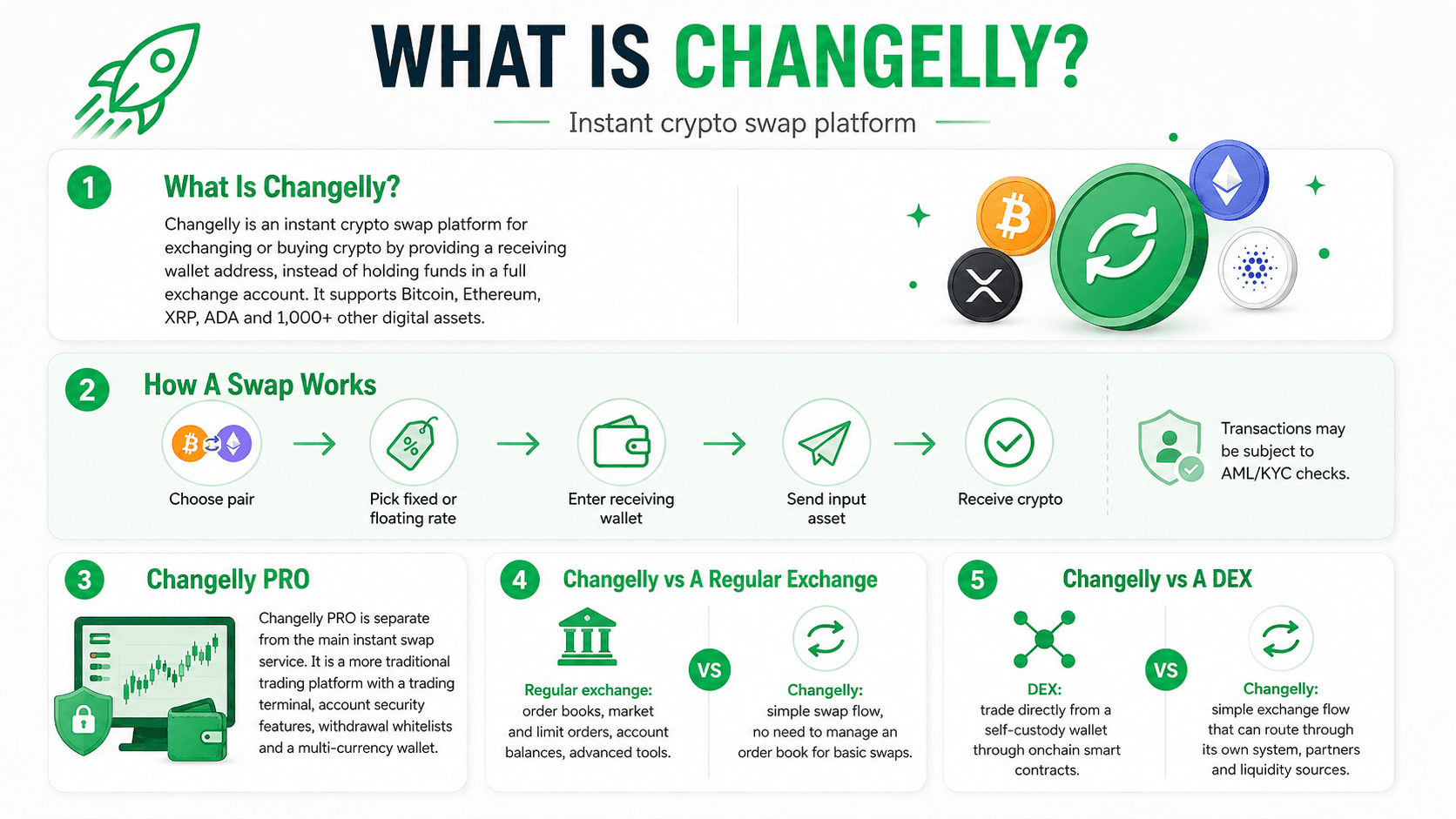
Changelly is an instant crypto swap platform that lets users exchange or buy crypto by providing a receiving wallet address, rather than holding funds in a full exchange account. As of June 23, 2026, Changelly describes itself as an instant cryptocurrency exchange for Bitcoin, Ethereum, XRP, ADA and 1,000+ other digital assets. Its core product is built around quick swaps and fiat purchases, not a full trading terminal for everyday users.
In a typical Changelly swap, the user chooses the crypto pair, selects a fixed or floating rate, enters the wallet address where they want to receive the output asset, sends the input asset, and waits for Changelly to process the transaction. Changelly's terms say it can apply AML/KYC procedures to particular users, addresses and crypto transactions.
Changelly PRO is separate from the main instant swap product. The standard Changelly service is aimed at quick swaps and fiat on-ramp access, while Changelly PRO is a more traditional trading platform with a trading terminal, account security features, withdrawal whitelists and a multi-currency wallet.
For a broader look at CEX swaps, DEXs, aggregators and cross-chain routes, check out our full guide to the best crypto swap platforms.
 Changelly Is An Instant Swap Platform
Changelly vs a Regular Crypto Exchange
A regular centralized exchange usually gives users a full trading dashboard with order books, market orders, limit orders, account balances and, in many cases, advanced trading tools. Changelly's is a simple swapping platform. Users do not need to manage an order book or hold a long-term trading balance on the platform for basic swaps. They choose the asset pair, provide a receiving wallet address and follow the transaction steps.
Still choosing where to trade? Our best crypto exchanges guide breaks down the top platforms by fees, security, features and user type.
Changelly vs a DEX
A decentralized exchange, or DEX, usually lets users trade directly from a self-custody wallet through onchain smart contracts. With Changelly, users do not need to connect a DEX wallet for every basic swap, and the platform can route transactions through its own exchange flow, partners and liquidity sources.
Our best decentralized exchanges guide compares the top DEXs for swaps, perps, cross-chain trades, fees and self-custody.
How Changelly Works
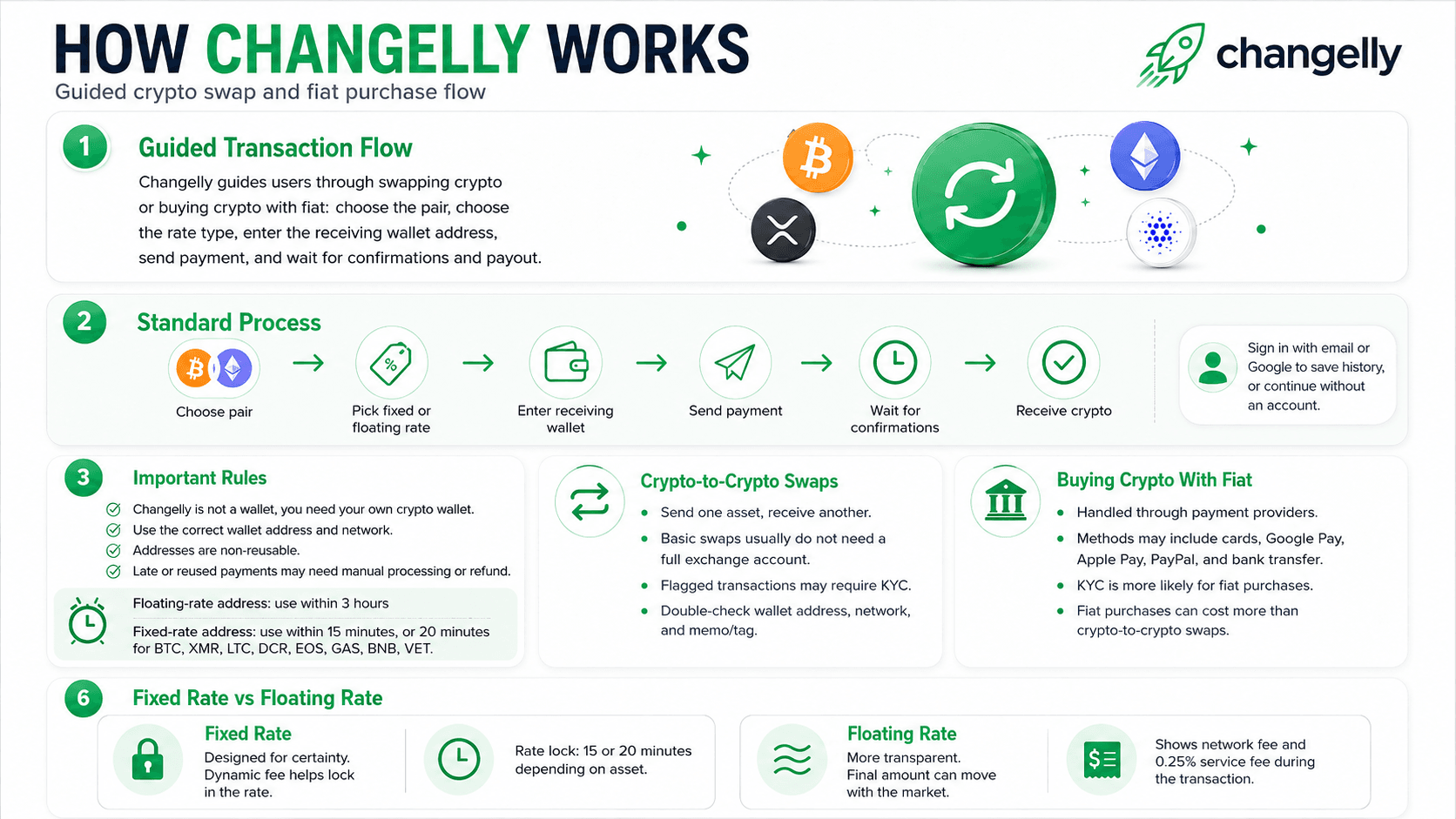
Changelly works by giving users a guided transaction flow for swapping crypto or buying crypto with fiat.
The standard process is simple: choose the pair, choose the rate type, enter the wallet address where the new asset should be sent, send the payment, then wait for confirmations and payout. Changelly says users can also sign in or sign up with an email address or Google account to save transaction history, though it also says users can continue without an account for an anonymous transaction.
Changelly is not a wallet. Users need their own crypto wallet before starting, and Changelly sends the exchanged or purchased cryptocurrency to the recipient address the user provides. That wallet address needs to match the correct asset and network, because blockchain transactions are not easy to unwind once they are processed.
 Changelly Guides Users Throughout The Process
Here is the normal transaction flow:
| Step | What Happens | What to Check |
|---|---|---|
| 1 | Choose the asset pair | Make sure you selected the right input and output assets |
| 2 | Choose fixed or floating rate | Fixed gives more certainty; floating can change before completion |
| 3 | Enter the receiving wallet address | Confirm the address belongs to the asset and network you want to receive |
| 4 | Enter a refund address where required | Use an address you control and that supports the original asset |
| 5 | Send crypto or pay through a fiat provider | Send the exact amount and pay attention to time limits |
| 6 | Wait for confirmations and payout | Blockchain congestion, liquidity or verification can slow the transaction |
| 7 | Contact support if delayed, failed or held | Keep the transaction hash, Changelly transaction ID, wallet addresses and payment receipt |
Changelly uses non-reusable addresses. Its support page says floating-rate addresses should be used within 3 hours, while fixed-rate addresses should be used within 15 minutes, or 20 minutes for BTC, XMR, LTC, DCR, EOS, GAS, BNB and VET. Late or reused payments may require manual processing or a refund if the pay-in amount covers the network commission.
Crypto-to-Crypto Swaps
For a crypto-to-crypto swap, the user sends one crypto asset and receives another. For example, a user might send BTC and receive ETH, or send USDT on one supported network and receive another asset in their own wallet. Changelly’s exchange flow asks users to choose the pair, select a fixed or floating rate, enter the wallet address where the output crypto should be sent, and then send the exact pay-in amount to the address Changelly provides.
A full exchange account is usually not needed for basic swaps. Changelly says users can sign in or sign up with email or Google to save transaction history, but can also continue without an account for an anonymous transaction. That is useful for convenience, but it does not remove every check. Changelly can still put a transaction on hold if it is flagged by its risk-scoring system, and users may need to pass KYC verification in that case.
The most important user-side checks are the wallet address, network and memo or destination tag. Changelly's troubleshooting page says a failed transaction can be caused by a missing memo or destination tag, a bad rate, sending below the minimum, liquidity issues or exchange-partner maintenance.
Buying Crypto With Fiat
Buying crypto with fiat on Changelly is handled through payment providers rather than through Changelly alone. Depending on the user's country, asset, currency and selected provider, payment methods can include cards, Google Pay, Apple Pay, PayPal and bank transfer.
KYC is more likely when fiat is involved. Final transaction time depends on blockchain activity and whether verification is required. Higher purchase limits may require verification.
Fiat purchases can also be more expensive than crypto-to-crypto swaps. Card and payment-provider quotes may include transaction fees, blockchain network fees and processing fees.
Changelly says a 3.95% fee applies to crypto-to-fiat transactions, meaning selling crypto for fiat, not buying crypto with fiat. The final crypto-to-fiat fee depends on the currency pair, country of residence, market rates, volatility and other factors.
Fixed Rate vs Floating Rate
Changelly offers fixed-rate and floating-rate swaps. Fixed rate is designed for users who want more certainty about the final received amount. These fixed-rate users pay a dynamic fee that protects against market volatility and helps ensure the user receives the exact amount of crypto shown.
Floating rate can be more transparent, but the final amount can change. Changelly says floating-rate transactions show the network fee and its 0.25% service fee during the transaction process. Because crypto prices can move before the swap completes, the final received amount may be slightly higher or lower than expected.
Fixed rates are locked for 15 or 20 minutes depending on the asset, while floating-rate addresses cannot be used after 3 hours.
Is Changelly Safe?
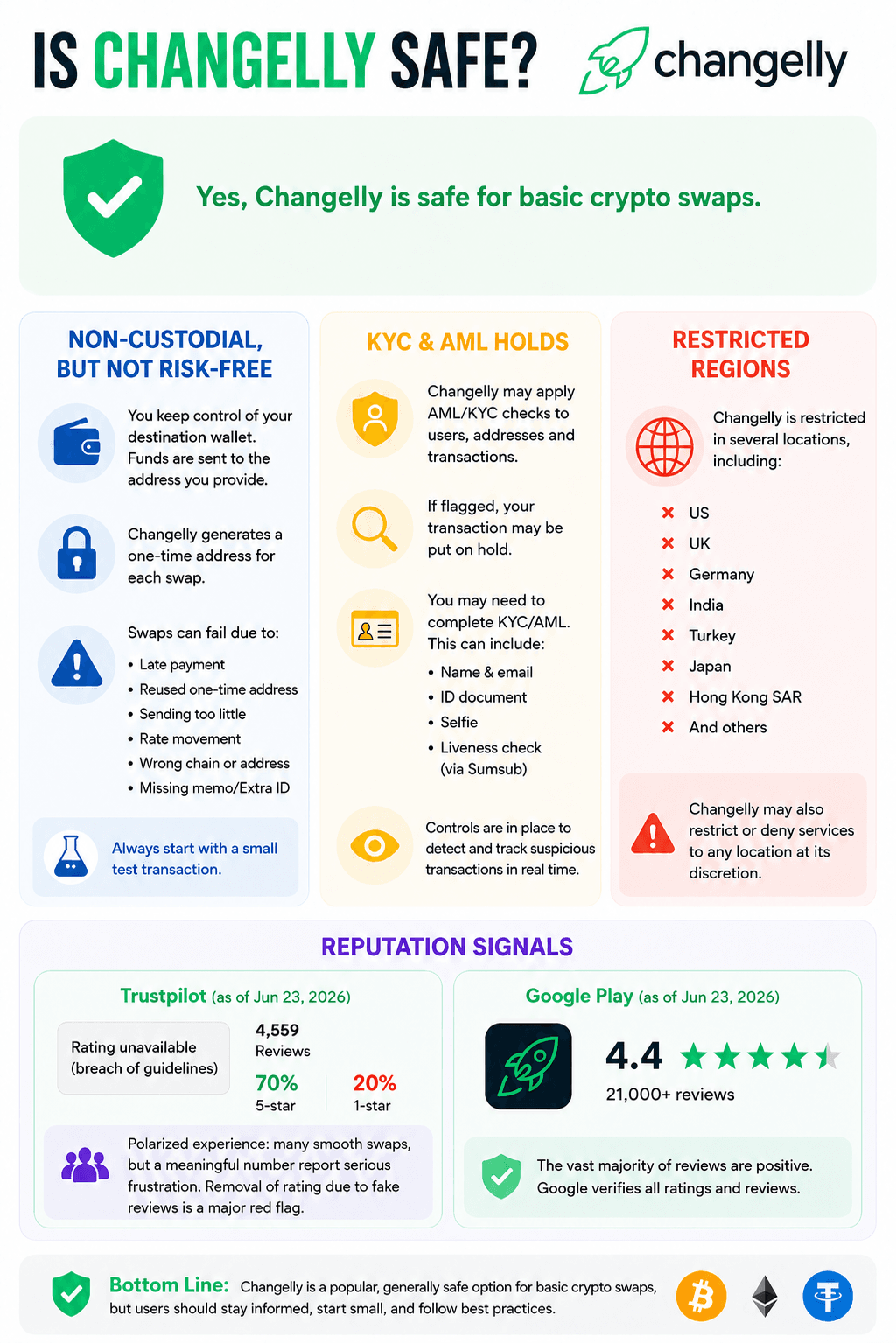
Yes, Changelly is safe for basic crypto swaps, especially small transactions, and there is no widely documented evidence that Changelly has suffered a major platform hack. Public reviews and security audits of available information also point to no known successful Changelly hack, which is a meaningful positive in crypto.
That said, safe does not mean nothing can go wrong. Changelly’s standard swap service does not work like keeping a long-term balance on a centralized exchange, but users still send funds to a transaction address during the swap. Once that happens, the transaction depends on Changelly’s processing, liquidity, network conditions, refund handling and risk controls.
 Changelly Is Safe For Small Crypto Swaps
Non-Custodial, But Not Risk-Free
Changelly’s standard swap model gives users control of the destination wallet. In other words, the exchanged crypto is sent to the receiving address the user provides, rather than being left as a long-term balance inside a Changelly account. That makes it different from holding funds on a full centralized exchange account.
However, that does not mean there is no execution risk. Changelly says its system automatically generates a one-transaction address for the initiated exchange, and the user transfers the crypto being exchanged to that address. Fixed and floating transactions may fail or require manual handling in certain cases, including late payment, reused one-time addresses, sending too little crypto, significant rate movement, wrong chains, incorrect addresses or missing Extra ID details such as a memo or destination tag.
That is why users should start with a small test transaction before sending a large amount.
KYC and AML Holds
Changelly may apply AML/KYC checks to specific users, wallet addresses and transactions. Its Terms state that Changelly reserves the right to apply AML/KYC procedures to particular users, addresses and crypto-asset transactions.
Changelly’s AML/KYC policy says it may make reasonable efforts to determine a customer's true identity, beneficial ownership, source of funds, the nature of the customer's business and the reasonableness of account operations. It also says its controls are designed to detect funds involved in illicit activity and that suspicious transactions may be tracked in real time.
If a transaction is flagged, users should be ready for identity checks. Changelly's KYC guide says a transaction put on hold means the user has to pass KYC/AML. The process can include entering name and email, submitting an identity document, taking a selfie and completing a liveness check through Sumsub.
Our no-KYC crypto exchanges guide compares the top CEX and DEX options by limits, access, fees and risk.
Changelly Restricted Regions
Changelly lists several restricted locations as of June 23, 2026, including the US, UK, Germany, India, Turkey, Japan, Hong Kong SAR and others. Changelly may also restrict or deny services to any location at its discretion.
Reputation Signals From Reviews
As of June 23, 2026, Changelly’s Trustpilot rating is unavailable due to a breach of guidelines. It currency shows 4,559 reviews, of which 70% are five-star reviews and 20% one-star reviews. That split suggests a polarized user experience: many users report smooth swaps, while a meaningful report serious frustration. That Trustpilot removed Changelly's rating due to fake reviews is a major red flag.
Over on Google Play, the Changelly app boasts over 21,000 reviews and a 4.4 rating as of June 23, 2026. The vast majority of the reviews are positive. Google says all of its ratings and reviews are verified.
Changelly Fees Explained
Changelly's fees are not just about the headline swap fee. The number that's important is the final amount of crypto or fiat the user receives after the service fee, network fee, rate movement, spread and payment provider costs are all included.
For crypto-to-crypto swaps, Changelly says floating-rate transactions incur a 0.25% fee from the output amount. The network fee is separate and depends on the blockchain used for the transaction. Fixed-rate swaps work differently because the quoted rate is locked for a short period, which can add a volatility buffer into the price.
Fiat transactions are more expensive. Changelly Buy routes users through third-party fiat providers such as MoonPay, Banxa, Simplex, Revolut, Topper, Transak, Switchere and others. The payment method, country, currency, provider and transaction size can all affect the final price.
A simple way to think about it:
| Fee Layer | What It Means | Why It Matters |
|---|---|---|
| Changelly Service Fee | Changelly’s own fee for processing the exchange | Floating-rate crypto swaps are listed at 0.25% from the output amount |
| Network Fee | Blockchain fee paid to move funds onchain | Can change depending on the network, congestion and asset |
| Spread or Rate Movement | Difference between market price and the rate used for the swap | Fixed rates may include a buffer; floating rates can shift before execution |
| Fiat Provider Fee | Fee charged by the payment provider for card, bank transfer or other fiat rails | Can make fiat buys much more expensive than crypto-to-crypto swaps |
Fee formula: Effective cost = market value of assets sent minus market value of assets received, plus payment provider and network costs.
Crypto Swap Fees
For crypto swaps, the advertised fee is only part of the picture. Changelly says floating-rate transactions incur a 0.25% fee from the output amount, while network fees are separate. This means a user swapping BTC to ETH, for example, should not only look at the 0.25% figure. They should compare the final ETH received against the live market value of the BTC they sent.
Network fees can make a big difference. A swap involving ERC-20 tokens on Ethereum may feel more expensive than a swap using a cheaper network, even if Changelly’s service fee looks the same.
Users should also check whether they are using a fixed or floating rate. Floating-rate swaps show Changelly’s 0.25% fee and network fee, but the final amount can change if the market moves before the transaction is completed. Fixed-rate swaps are designed to give more certainty, but the rate may already include a buffer for market volatility.
Fiat Buy and Sell Fees
Buying crypto with fiat through Changelly can cost more than swapping crypto. That is because fiat transactions are handled through third-party providers, not Changelly. Depending on the region and payment method, users may see card payments, bank transfers, Apple Pay or other options. The provider, currency, payment method, country and order size can all change the final quote.
Card buys are usually the most convenient option, but they are often not the cheapest. A user buying $100 of BTC with a card may receive less crypto than they would by depositing fiat on a lower-fee exchange and buying through a trading interface. Convenience is the trade-off.
For crypto-to-fiat selling, Changelly says the minimum fee is 3.95%, while the final fee depends on the selected currency pair, country of residence, market rates, volatility and other factors. This figure applies to selling crypto for fiat.
| What to Compare | Why It Matters |
|---|---|
| Fiat amount paid | Shows the real starting cost |
| Crypto amount received | Shows the actual value after fees |
| Provider selected | MoonPay, Banxa, Simplex, Transak and others can quote different prices |
| Payment method | Card payments can cost more than bank transfer |
| Network used | A cheaper network can reduce transfer costs |
| KYC requirement | Some providers may require verification before payment |
Fixed Rate vs Floating Rate Costs
Changelly offers fixed and floating rates. The right choice depends on whether the you value certainty or flexibility.
- A fixed rate gives more certainty over the final amount received. The trade-off is that the fixed price may include a buffer because Changelly is taking on short-term market volatility risk.
- A floating rate can be cheaper if the market moves in the user's favor, but the final amount can also change before completion.
| Rate Type | Best For | Main Trade-Off |
|---|---|---|
| Fixed Rate | Users who want a predictable final amount | May include a volatility buffer |
| Floating Rate | Users who are comfortable with the final amount changing | Output can move before execution |
| Fiat Provider Quote | Users buying crypto with card, bank transfer or Apple Pay | Provider fees can vary widely |
Changelly Fee Table
| Fee Type | Fee/Cost as of June 23, 2026 | Applies To | Notes |
|---|---|---|---|
| Floating-Rate Crypto Swap Fee | 0.25% | Crypto-to-crypto swaps | Changelly says floating-rate transactions include a 0.25% service fee from the output amount. Network fees are separate. |
| Fixed-Rate Crypto Swap Fee | Dynamic | Crypto-to-crypto swaps | Changelly says fixed-rate swaps use a dynamic fee to lock the quoted amount and protect against market volatility. |
| Network Fee | Variable | Crypto withdrawals / swap payouts | Paid to blockchain miners or validators. Changelly estimates this fee when the transaction is created, but the final network fee can differ. |
| Fiat Buy Fees | Set by fiat provider | Buying crypto with fiat | Changelly says each fiat partner determines purchase fees. Users should compare the final crypto received from providers such as MoonPay, Banxa, Simplex, Transak, Revolut, Topper, Skrill and Switchere. |
| Crypto-to-Fiat Sell Fee | Minimum 3.95% | Selling crypto for fiat | Changelly says the minimum fee for crypto-to-fiat transactions is 3.95%, with the final fee depending on the pair, country, market rates, volatility and other factors. |
| Changelly PRO Crypto Deposit Fee | 0% | Depositing crypto to Changelly PRO | Changelly PRO says it does not charge a fee for crypto deposits. |
| Changelly PRO Fiat Deposit Fee | 1% to 7% | Depositing fiat to Changelly PRO | Fee varies by payment method and fiat provider. |
| Changelly PRO Trading Fee | From 0.1% maker / 0.1% taker | Changelly PRO spot trading | Starter accounts are advertised at 0.1% maker and 0.1% taker. Higher-volume Trader and PRO accounts can access lower tiers. |
| Changelly PRO Withdrawal Fee | Flat, asset-specific | Withdrawing from Changelly PRO | Changelly PRO gives examples such as 0.0004 BTC for Bitcoin, 0.25 XRP for Ripple, 0.003 ETH for Ethereum and 4 USDT for Tether. |
Does Changelly Require KYC?
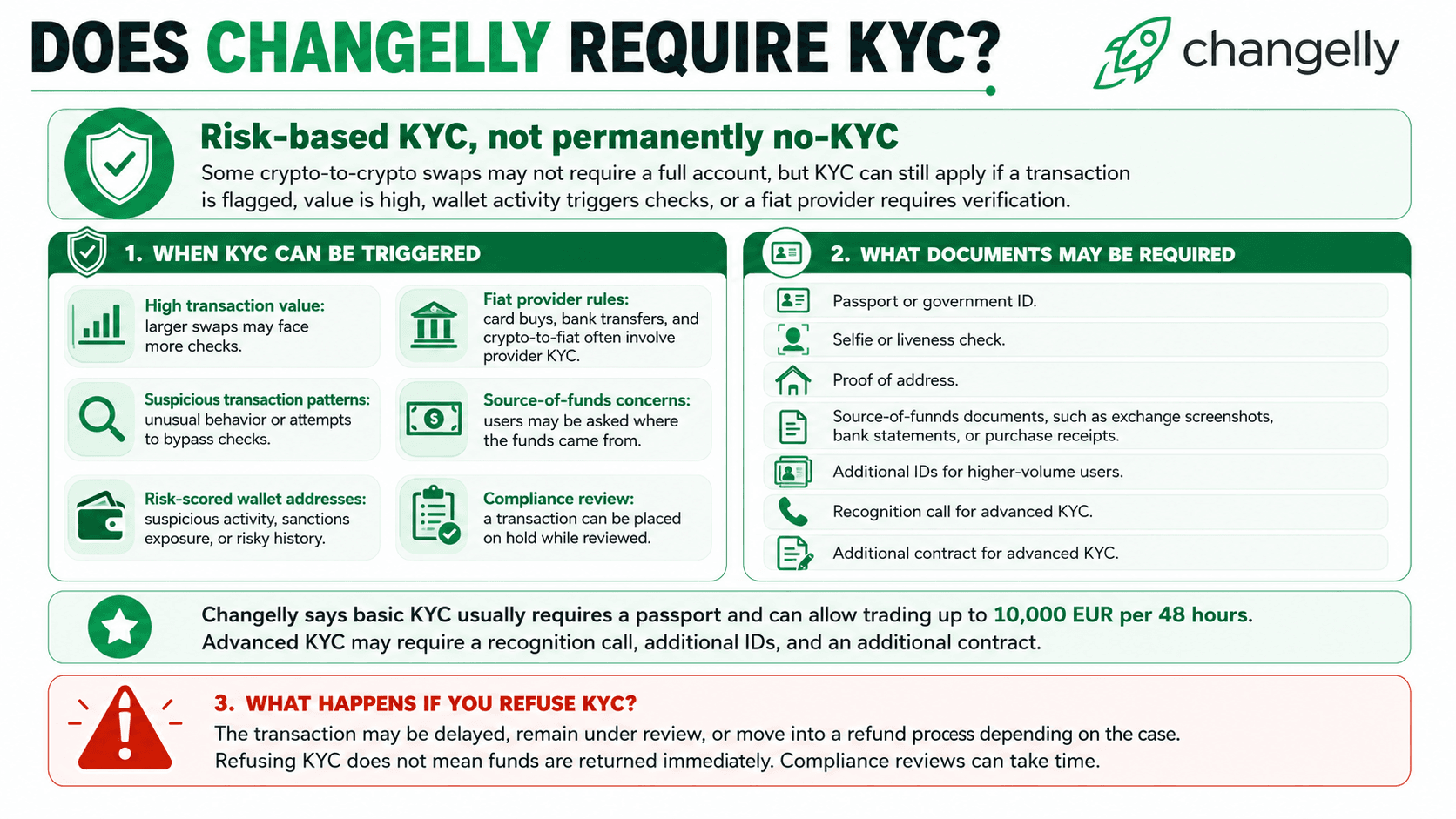
Changelly is better described as risk-based KYC, not permanently no-KYC.
Some crypto-to-crypto swaps may not require users to create a full exchange account, but KYC can still apply if a transaction is flagged, if the transaction value is high, if wallet activity triggers risk checks, or if a fiat provider requires identity verification. Fiat purchases are more likely to involve KYC because card, bank transfer and on-ramp payments are handled through third-party payment providers.
 Changelly Uses Risk-Based KYC
When KYC Can Be Triggered
Changelly may ask for KYC when a transaction is flagged by its risk controls. This can happen before or during processing, including after the user has sent funds to the transaction address.
KYC may be triggered by:
| Trigger | What It Means |
|---|---|
| High Transaction Value | Larger swaps may face more checks, especially if they cross internal risk thresholds. |
| Suspicious Transaction Patterns | Multiple accounts, unusual transaction behaviour or attempts to bypass checks may trigger review. |
| Risk-Scored Wallet Addresses | Wallets linked to suspicious activity, sanctioned exposure or risky transaction history may be flagged. |
| Fiat Provider Rules | Card buys, bank transfers and crypto-to-fiat transactions often involve payment provider KYC. |
| Source-of-Funds Concerns | Changelly may ask where the funds came from and request supporting documents. |
| Compliance Review | A transaction can be placed on hold while Changelly or its partners review the case. |
What Documents May Be Required
The exact documents can depend on the case, the transaction size and the risk review. For standard identity checks, Changelly’s KYC guide lists identity verification, a selfie and a liveness check through Sumsub.
Changelly may ask for:
| Requirement | What Users May Need to Provide |
|---|---|
| Passport or Government ID | Used to verify the user’s identity. |
| Selfie or Liveness Check | Used to confirm the person matches the submitted ID. |
| Proof of Address | May be requested during enhanced checks. |
| Source-of-Funds Documents | Could include exchange screenshots, bank statements, crypto purchase receipts or other supporting records. |
| Additional IDs | May be required for higher-volume users. |
| Recognition Call | Changelly says Advanced KYC for high-volume traders may require a face-to-face recognition call. |
| Additional Contract | Changelly says Advanced KYC may also require signing an additional contract. |
Changelly says basic KYC usually requires a passport and can allow trading up to 10,000 EUR per 48 hours. For users above that level, Changelly describes advanced KYC as requiring a recognition call, additional IDs and an additional contract.
What Happens If You Refuse KYC?
If Changelly asks for KYC and the user refuses, the transaction may be delayed, remain under review, or move into a refund process depending on the reason for the hold and Changelly's compliance decision.
Users should not assume that refusing KYC means funds will be returned immediately. Compliance reviews can take time, and Changelly says held transactions may involve AML/KYC checks.
Supported Coins, Networks and Fiat Currencies
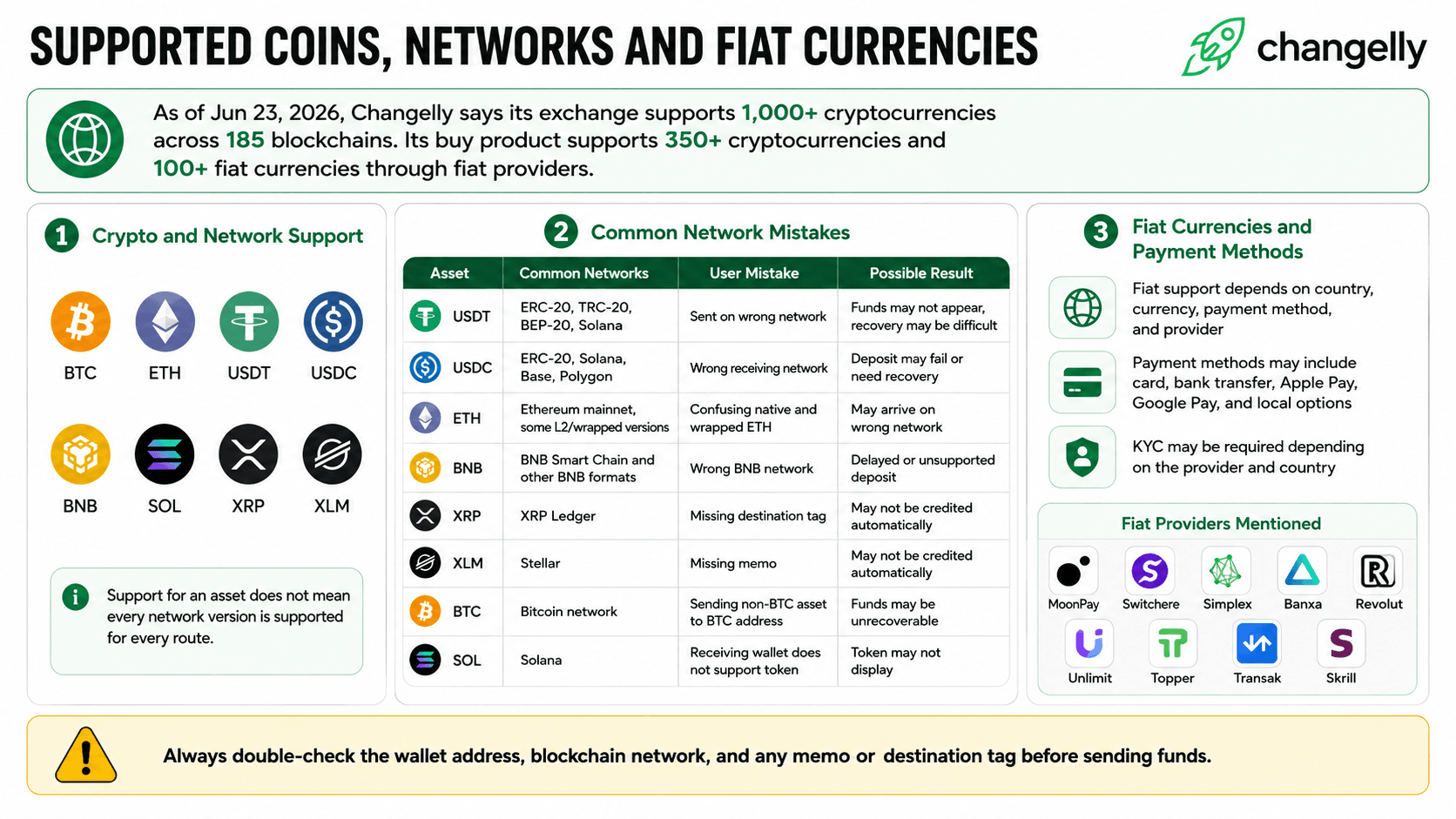
Changelly says its exchange product supports over 1,000 cryptocurrencies across 185 blockchains, as of June 23, 2026, while its buy product supports 350+ cryptocurrencies with over 100 fiat currencies through fiat providers.
 Changelly Supports Many Assets And Fiat Routes
Crypto and Network Support
Changelly lists support for major assets such as Bitcoin, Ethereum, USDT, USDC, BNB, Solana, XRP and many smaller altcoins. However, users should not assume that asset support means every network version of that asset is supported for every route.
Stablecoins are the best example. USDT can exist on Ethereum as an ERC-20 token, on Tron as TRC-20, on BNB Chain as BEP-20 and on other networks. These are not interchangeable at the address level. If you send USDT on the wrong network, the receiving wallet may not see it, and recovery may depend on whether the platform or wallet controls the destination address and supports that network.
| Asset | Common Networks | User Mistake | Possible Result |
|---|---|---|---|
| USDT | ERC-20, TRC-20, BEP-20, Solana and others | Sending USDT on Tron to an Ethereum-only address | Funds may not appear in the receiving wallet and recovery may be difficult or impossible |
| USDC | ERC-20, Solana, Base, Polygon and others | Choosing the wrong USDC network for the receiving wallet | Deposit may fail, be delayed or require manual recovery |
| ETH | Ethereum mainnet and some L2 or wrapped versions | Confusing native ETH with bridged or wrapped ETH | Funds may arrive on the wrong network or not be credited by the recipient |
| BNB | BNB Smart Chain and other BNB formats | Sending to a wallet or exchange address that supports a different BNB network | Funds may be delayed, unsupported or require support intervention |
| XRP | XRP Ledger | Forgetting a destination tag when sending to an exchange wallet | Funds may not be credited automatically and support may need to locate the deposit |
| XLM | Stellar | Forgetting a memo when sending to an exchange wallet | Funds may not be credited automatically and support may need to locate the deposit |
| BTC | Bitcoin network | Sending a non-BTC asset to a BTC address | Funds may be unrecoverable |
| SOL | Solana | Sending a token to a wallet that does not support that Solana asset | Token may not display or may require wallet support/import steps |
Fiat Currencies and Payment Methods
Changelly says fiat transactions are processed through partners MoonPay, Switchere and Simplex, while its app listings and fiat product pages also reference providers such as Banxa, Revolut, Unlimit, Topper, Transak and Skrill. Ultimately, fiat support depends on the user’s country, currency, payment method and the provider available for that specific transaction.
Payment methods can include credit or debit card, bank transfer, Apple Pay, Google Pay and other local options where available. Changelly says users should confirm their country of residence, compare available offers, choose a payment method and complete the provider's checkout process. For some transactions, KYC verification may be required depending on the country and provider.
Where Is Changelly Available?
Changelly is available every where except United States (all territories), United Kingdom, Germany, Hong Kong, Turkey, Japan, Afghanistan, Austria, Bangladesh, Crimea, Cuba, Donetsk People's Republic, India, Iran, Iraq, Luhansk People's Republic, North Korea, Syria, Venezuela and Yemen.
| Country/Region | Official Restriction as of June 23, 2026 | User Caution |
|---|---|---|
| United States | Yes. Changelly’s Terms list the United States, including all territories, as a restricted location. | US users should avoid using Changelly and use a US-regulated exchange instead. |
| United Kingdom | Yes. Changelly’s Terms list the UK as restricted. | UK users should not treat Changelly as an FCA-authorized platform. |
| Germany | Yes. Germany is listed as a restricted location in Changelly’s Terms. | German users should check the current Terms before attempting any transaction. |
| India | Yes. India is listed as a restricted location in Changelly’s Terms. | Indian users should not assume a visible quote means they are eligible to use the service. |
| Turkey | Yes. Turkey is listed as a restricted location in Changelly’s Terms. | Turkish users should check the Terms and local rules before sending funds. |
| Japan | Yes. Japan is listed as a restricted location in Changelly’s Terms. | Japanese users should be cautious, as public pages and Terms eligibility do not appear fully aligned. |
| Hong Kong SAR | Yes. Hong Kong SAR is listed as a restricted location in Changelly’s Terms. | Users in Hong Kong SAR should avoid relying on the service unless Changelly’s current Terms clearly allow it. |
| Canada | Not listed as a restricted location in the Terms checked | Canadian users should still check live provider availability, fees and KYC requirements. |
| Australia | Not listed as a restricted location in the Terms checked | Australian users should compare provider fees and check whether verification is required. |
| Pakistan | Not listed as a restricted location in the Terms checked | Pakistani users should check live quotes, provider support and local rules before paying. |
| UAE | Not listed as a restricted location in the Terms checked | UAE users should check the selected provider, payment method, KYC requirement and final crypto received. |
| EU General | Some European countries are restricted. Germany and Austria are specifically listed as restricted in Changelly’s Terms. | EU users should check country-specific eligibility rather than assuming all EU access is the same. |
How to Use Changelly Safely
Before sending funds, check the asset, network, wallet address, rate type and transaction limits. Most problems come from rushing the final screen.
Before You Send Funds
Use this checklist before making a Changelly swap or fiat purchase:
| Check | What to Do |
|---|---|
| Country Support | Confirm that your country is not restricted and that the selected provider supports your region. |
| Asset and Network | Make sure the coin and network match. USDT-TRC20 is not the same as USDT-ERC20. |
| Minimum and Maximum Amounts | Check the limits on the final transaction screen before sending funds. Sending below the minimum can cause a failed transaction. |
| Memo or Destination Tag | Add the memo, message or destination tag where required, especially for assets such as XRP, XLM and XEM. |
| Refund Address | Use a refund address you control, and make sure it supports the original asset and network. |
| Fixed or Floating Rate | Choose fixed rate if you want more certainty. Choose floating rate if you are comfortable with the final amount changing. |
| Transaction Records | Save the Changelly transaction ID, transaction hash, wallet addresses and payment receipt. |
| Test Swap | Start with a small test transaction before sending a large amount. |
Changelly says users can choose a fixed or floating rate, enter the wallet address where they want to receive the exchanged crypto, and continue with or without an account for basic exchange flow. It also says transactions may fail or require support if the user sends below the minimum amount.
How to Swap Crypto
To swap crypto on Changelly:
- Choose the crypto pair
- Select a fixed or floating rate
- Enter the receiving wallet address
- Enter a refund address if requested
- Send the exact amount of crypto to the transaction address
- Track the transaction using the Changelly ID and blockchain transaction hash
- Confirm that the output asset arrives in the receiving wallet
Do not reuse old Changelly deposit addresses. Changelly says it uses non-reusable addresses, and payments sent too late or to a reused address may need manual processing or a refund. Floating-rate addresses should be used within 3 hours, while fixed-rate addresses have a shorter payment window.
How to Buy Crypto With Fiat
To buy crypto with fiat on Changelly:
- Choose the fiat currency and crypto asset
- Compare available fiat providers
- Review the payment method, fees and final crypto received
- Complete the provider’s KYC if required
- Enter the wallet address where the crypto should be sent
- Complete the payment
- Confirm the crypto arrives in your wallet
Changelly's app listings say fiat purchases can be made through providers such as MoonPay, Banxa, Simplex, Revolut, Unlimit, Topper, Transak, Skrill and Switchere, with payment methods such as card, bank transfer and Apple Pay depending on provider availability.
Changelly Mobile App Review
The Changelly app is convenient for small swaps and price checks. The app is available for iOS and Android and supports buying, selling and swapping crypto from a mobile device. Changelly’s Google Play listing says the app supports Bitcoin, Ethereum, Tether and 1,000+ altcoins, and describes the platform as trusted by 10 million users.
The app is mainly useful for users who want quick access to Changelly's core features without using the desktop site. Users can swap crypto, buy crypto with card or other supported payment methods, sell crypto where available, view market information and access support.
The same risks apply on mobile as on the web version. Users still need to check the asset, network, receiving wallet address, memo or destination tag, rate type and final amount received.
| App Feature | What It Does | What to Watch |
|---|---|---|
| Buy Crypto | Lets users buy crypto with fiat through supported providers | Provider fees, KYC, country support and final crypto received |
| Sell Crypto | Lets users sell supported crypto where available | Crypto-to-fiat fees, provider availability and withdrawal method |
| Swap Crypto | Lets users exchange one crypto for another | Asset, network, memo/tag, fixed vs floating rate and transaction limits |
| Market Tools | Lets users check prices and market movement | Price checking is useful, but it does not guarantee the final swap rate |
| 24/7 Support | Gives users access to help inside the Changelly ecosystem | Support access does not guarantee instant resolution for stuck or flagged transactions |
For small swaps, the Changelly app is easy enough to use. For larger transactions, users should slow down, compare the final quote, use a small test swap first and save the transaction ID or hash until the funds arrive.
Is Changelly PRO Worth Using?
Changelly PRO is not the same thing as the standard Changelly swap product. Changelly = instant swaps and fiat buying. Changelly PRO = account-based trading.
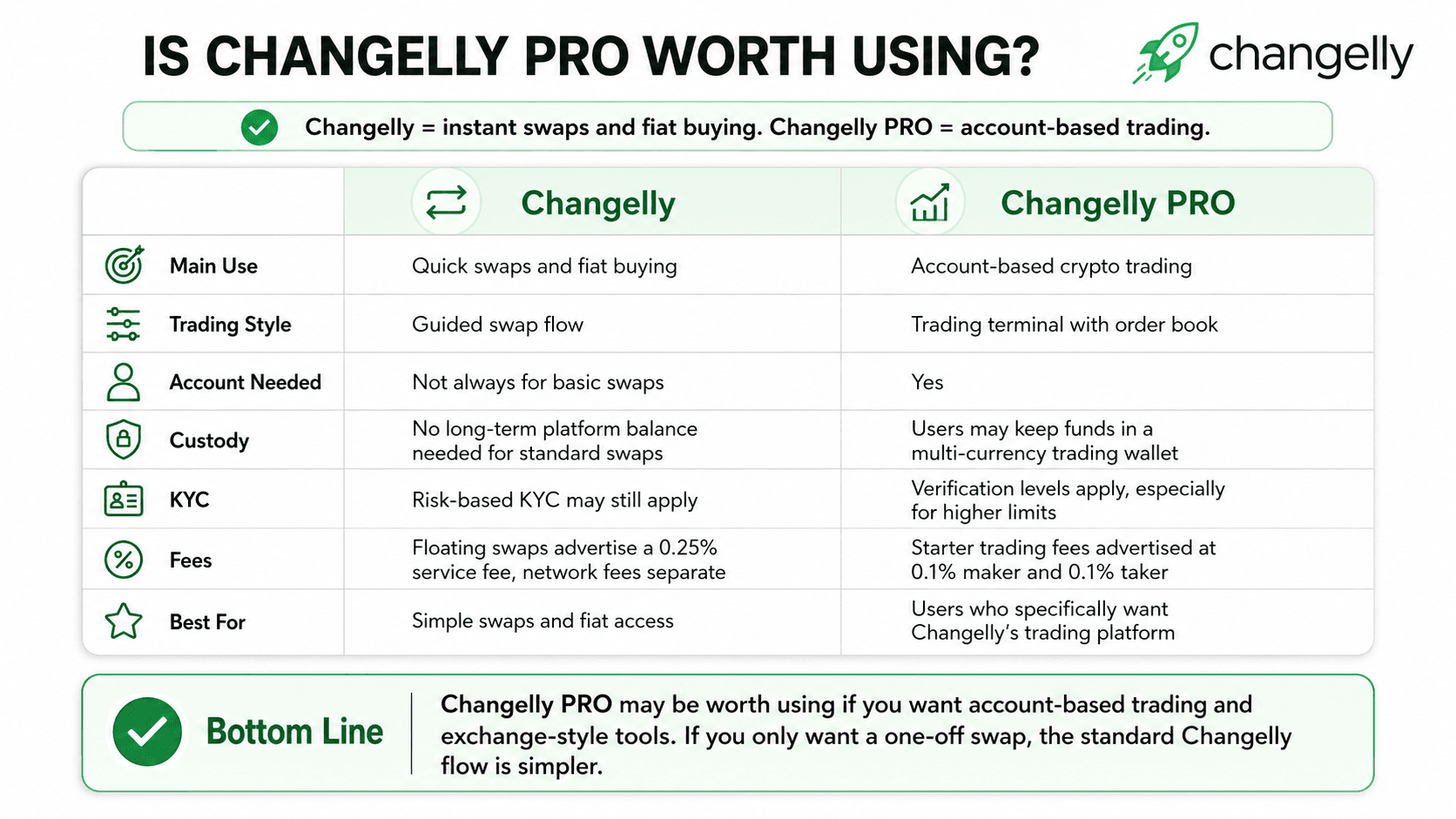 Changelly PRO Is Better For Account-Based Trading
The main Changelly platform is built for quick crypto swaps and fiat purchases, while Changelly PRO is closer to a centralized exchange with a trading account, order book, maker and taker fees, and a multi-currency wallet.
Standard Changelly swaps do not require users to manage an exchange balance for everyday swaps. Changelly PRO, by contrast, is designed for users who want a trading terminal, account-based trading and exchange-style tools.
| Feature | Changelly | Changelly PRO |
|---|---|---|
| Main Use | Quick swaps and fiat buying | Account-based crypto trading |
| Trading Style | Guided swap flow | Trading terminal with order book |
| Account Needed | Not always for basic swaps | Yes |
| Custody | No long-term platform balance needed for standard swaps | Users may keep funds in a multi-currency trading wallet |
| KYC | Risk-based KYC may still apply | Verification levels apply, especially for higher limits |
| Fees | Floating swaps advertise a 0.25% service fee, with network fees separate | Starter trading fees are advertised at 0.1% maker and 0.1% taker |
| Best For | Simple swaps and fiat access | Users who specifically want Changelly’s trading platform |
Changelly PRO may be worth using if you want an account-based trading platform and are comfortable with exchange custody, verification levels and order-book trading. It is less compelling if you only want a one-off swap, because the standard Changelly flow is simpler and avoids turning a quick exchange into a full trading-account setup.
Changelly Alternatives
The best Changelly alternative depends on what the you are trying to do. Someone chasing lower fees does not need the same platform as someone who wants a no-account swap, a large OTC-style transaction or a fully onchain route. Use the table below as the quick answer, then choose the route that fits the transaction.
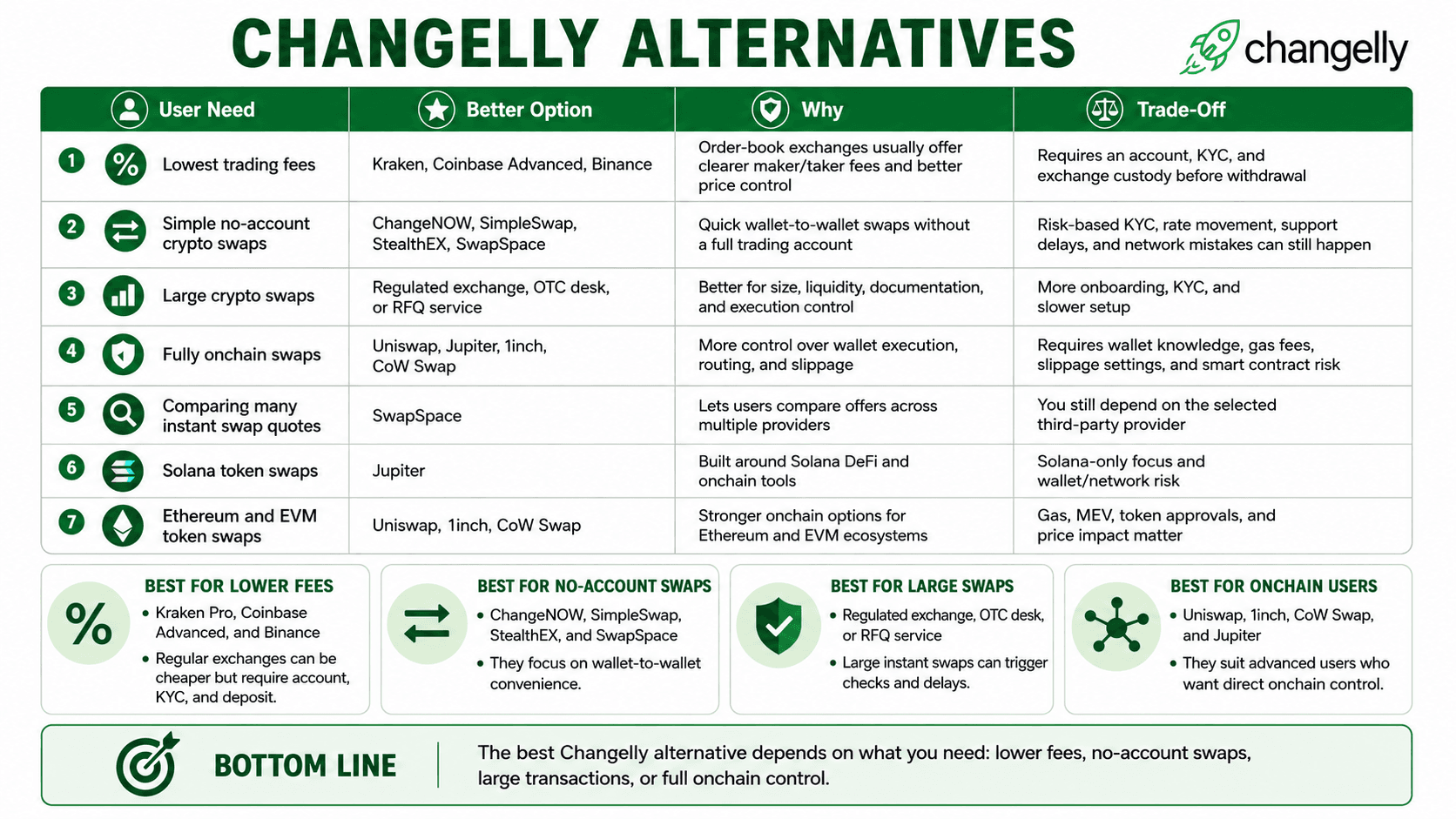 The Best Changelly Alternative Depends On What You Want
| User Need | Better Option | Why | Trade-Off |
|---|---|---|---|
| Lowest trading fees | Kraken, Coinbase Advanced, Binance or a regional equivalent | Order-book exchanges usually offer clearer maker/taker fees and better price control than instant swap services | Requires an account, KYC and exchange custody before withdrawal |
| Simple no-account crypto swaps | ChangeNOW, SimpleSwap, StealthEX or SwapSpace | These platforms focus on quick wallet-to-wallet swaps without a full trading account | Risk-based KYC, rate movement, support delays and network mistakes can still happen |
| Large crypto swaps | Regulated exchange, OTC desk or RFQ service | Better suited for size, liquidity, documentation and execution control | More onboarding, KYC and slower setup |
| Fully onchain swaps | Uniswap, Jupiter, 1inch or CoW Swap | Gives advanced users more control over wallet execution, routing and slippage | Requires wallet knowledge, gas fees, slippage settings and smart contract risk |
| Comparing many instant swap quotes | SwapSpace or another swap aggregator | Lets users compare offers across multiple providers before choosing | The user still depends on the selected third-party exchange provider |
| Solana token swaps | Jupiter | Jupiter is built around Solana DeFi and supports swaps, perps, lending and other onchain tools | Solana-only focus, and users must understand wallet/network risk |
| Ethereum and EVM token swaps | Uniswap, 1inch or CoW Swap | Stronger onchain options for Ethereum and EVM ecosystems | Gas, MEV, token approvals and price impact matter |
Best for Lower Fees
For users who care most about cost, a regular exchange can be cheaper than Changelly.
Kraken Pro uses a maker/taker schedule that starts at 0.25% maker and 0.40% taker for the lowest 30-day volume tier, then falls at higher volumes. Coinbase Advanced also uses maker/taker fees based on 30-day trading volume, while Binance's regular spot tier lists 0.100% maker and 0.100% taker, with lower rates available through BNB discounts and higher VIP tiers.
The trade-off is that exchanges usually require an account, KYC and a deposit before trading.
Read our full reviews for Kraken, Coinbase and Binance.
Best for No-Account Crypto Swaps
Users who like Changelly because it avoids a full trading account can compare it with ChangeNOW, SimpleSwap, StealthEX and SwapSpace.
SimpleSwap says sign-up is not required, supports 2,800+ cryptocurrencies and sends crypto directly to the user’s wallet. StealthEX supports 2,000+ digital assets and does not require registration. SwapSpace positions itself as a crypto exchange aggregator that compares offers across providers with no sign-up.
Read our SimpleSwap review.
Best for Large Swaps
Large first-time instant swaps are where users should be most careful. A big transaction through a convenience swap service can trigger risk checks, source-of-funds questions, liquidity issues or support delays. If the user is swapping a meaningful amount, a regulated centralized exchange, OTC desk or RFQ service is usually a better fit.
Best for Onchain Users
Advanced users may prefer DEX aggregators and onchain swap tools.
Uniswap is a decentralized exchange protocol built on Ethereum that lets users swap tokens directly onchain through AMM smart contracts. 1inch is a DEX aggregator that combines liquidity from multiple decentralized exchanges to seek better prices and reduce slippage. CoW Swap focuses on DEX aggregation with MEV protection, while Jupiter is a major Solana DeFi platform for swaps and other onchain tools.
Read our full reviews of Uniswap, 1inch and our explainer on Jupiter.

Final Verdict: Should You Use Changelly?
Yes, Changelly is worth considering if you want a simple way to make small crypto-to-crypto swaps without using a full trading account. It is best for convenience, broad asset support and wallet-to-wallet delivery. It is not the best choice for large first-time swaps, users who cannot pass KYC if asked, or anyone who needs the protections of a regulated exchange.
Changelly is a good fit for:
- Small crypto-to-crypto swaps: Changelly is quick, simple and does not require users to manage an ongoing exchange balance for standard swaps.
- Wallet users making occasional swaps: Users can receive crypto directly in their own wallet instead of leaving funds on an exchange.
- Users who value convenience: The guided swap flow is easier than using an order book or routing a trade through a DEX aggregator.
Changelly is a poor fit for:
- Large first-time swaps: Larger amounts are more likely to trigger KYC, AML review, source-of-funds checks or delays.
- Users who cannot pass KYC: If a transaction is flagged, refusing verification may delay the swap, refund or compliance review.
- Users who need regulated exchange protection: Changelly is not the same as using a fully regulated exchange in your jurisdiction.
For small swaps, Changelly can be useful. For larger transactions, fiat purchases, users should compare the final quote against a centralized exchange, OTC desk, DEX aggregator or another swap platform before sending funds.