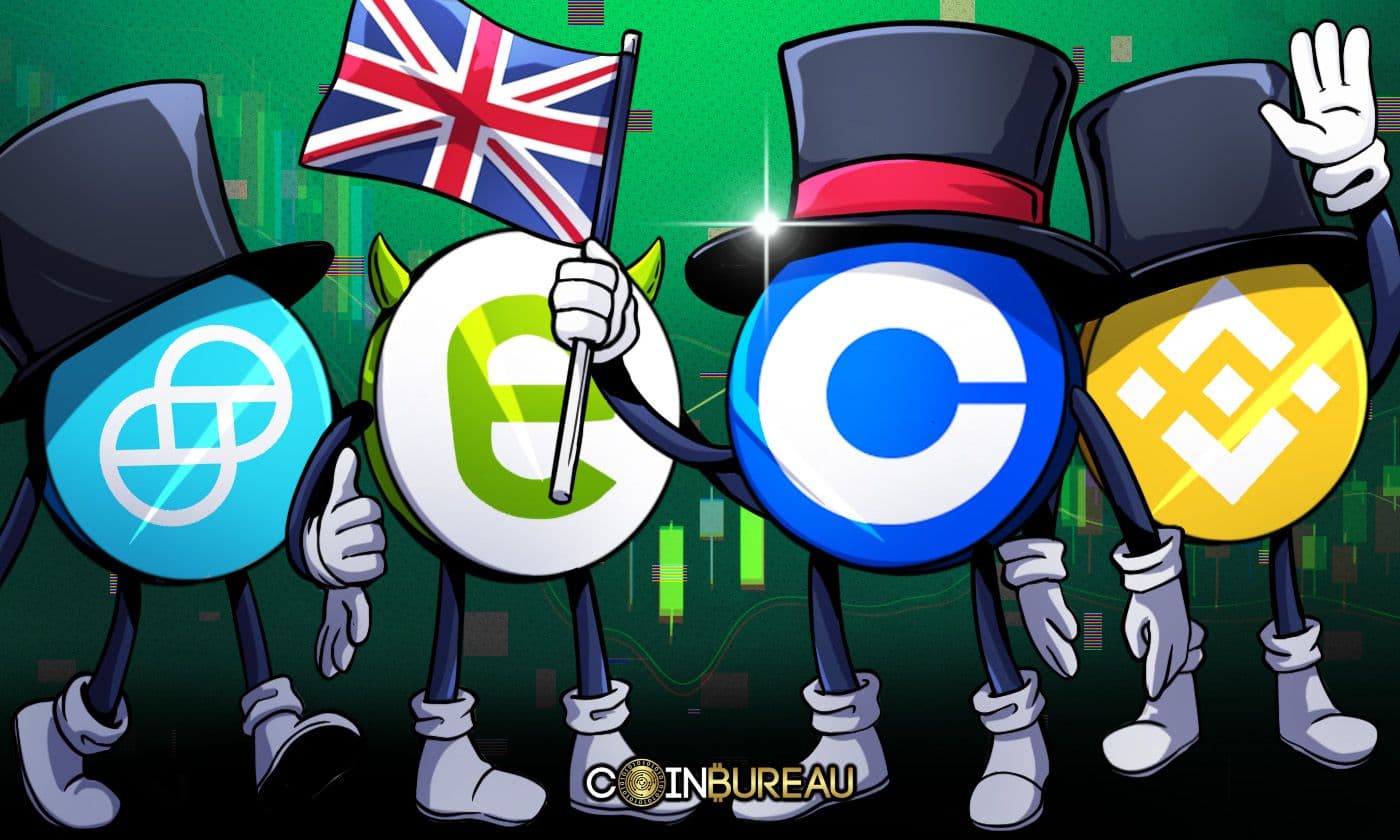
Comparison Table of Top Exchanges for Altcoins
Note: One thing to keep in mind is that DEX fees are less standardized than CEX fees because they can vary by pool, route, or protocol version, while centralized exchange fees can also change by VIP tier, token discounts, or promotional programs, so this table works best as a quick comparison rather than a permanent pricing snapshot.
Data is current as of April 1, 2026.
What Makes a Good Altcoin Exchange?
A good altcoin exchange does more than list lots of coins. The strongest platforms combine broad market access with transparent costs, reliable execution, strong security, and support for your region. In other words, the best exchange is the one that lets you trade altcoins efficiently without adding avoidable friction or risk.
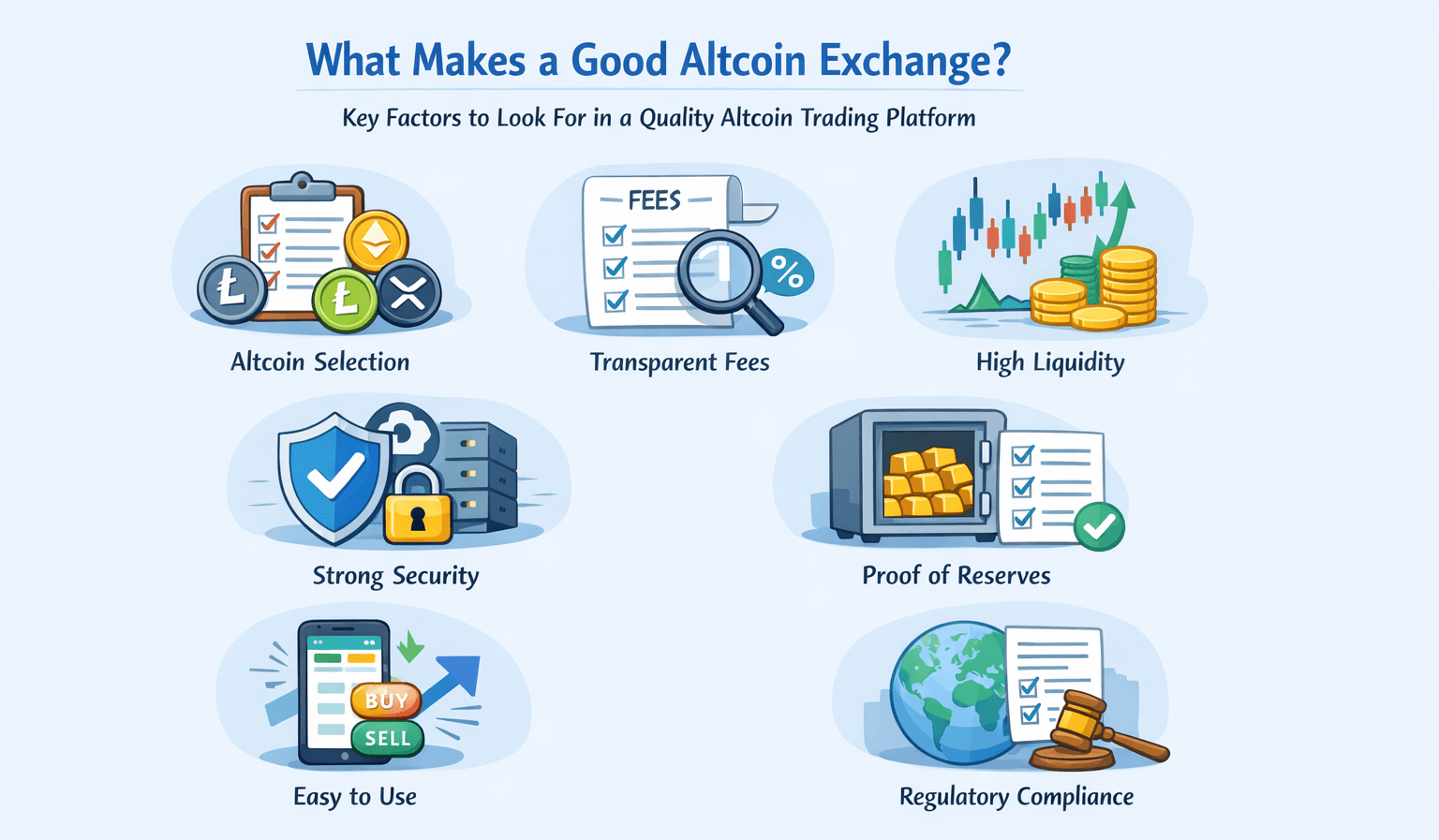
A Good Altcoin Exchange Does more than List Lots of Coins
Altcoin Selection and New Listings
A useful exchange should offer a wide range of altcoins, but it should also have clear listing standards and a visible process for new asset listings. That matters because more listings can mean more opportunity, but it also increases the chance of weaker projects and future delistings.
Fees, Spreads, and Withdrawal Costs
Trading cost is not just the headline fee. A good exchange makes maker and taker fees, spreads, and other charges easy to understand before you place an order. That is similar to comparing exchange counters at an airport: the posted fee may look fine, but the real rate still matters.
Liquidity and Trade Execution
Liquidity affects whether your trade is filled near the price you expect. In practical terms, a deeper order book usually means less slippage and smoother execution, which is especially important when trading smaller altcoins.
Security, Proof of Reserves, and Custody Risk
Security should be non-negotiable. Core protections include 2-step verification, cold storage, a withdrawal whitelist, and ideally Proof of Reserves. These improve safety and transparency, but they do not remove custodial risk entirely because the platform still controls the keys.
Ease of Use and Trading Features
Beginners usually need simple funding, clear navigation, and basic spot orders, while experienced traders may want advanced charts, order controls, and derivatives tools. A good exchange matches the complexity of its interface to the needs of its users instead of forcing everyone into the same setup.
Availability and Regulation
Finally, the “best” exchange also depends on where you live. Identity verification, licensed entities, and prohibited regions can all affect whether you can legally use a platform and which services are available to you.
In simple terms, DEXs are better when you want self-custody and long-tail on-chain altcoin access. Centralized exchanges are still easier for fiat onboarding and beginner simplicity, while DEXs reward users who are comfortable managing a wallet, gas fees, and trade settings themselves.
Which Altcoin Exchange Is Best for You?
The right altcoin exchange depends less on brand name and more on what you actually need. Some traders want simplicity, others care most about fees, and some need deeper coin coverage or more advanced tools. Here is the quickest way to match the platform to the job.
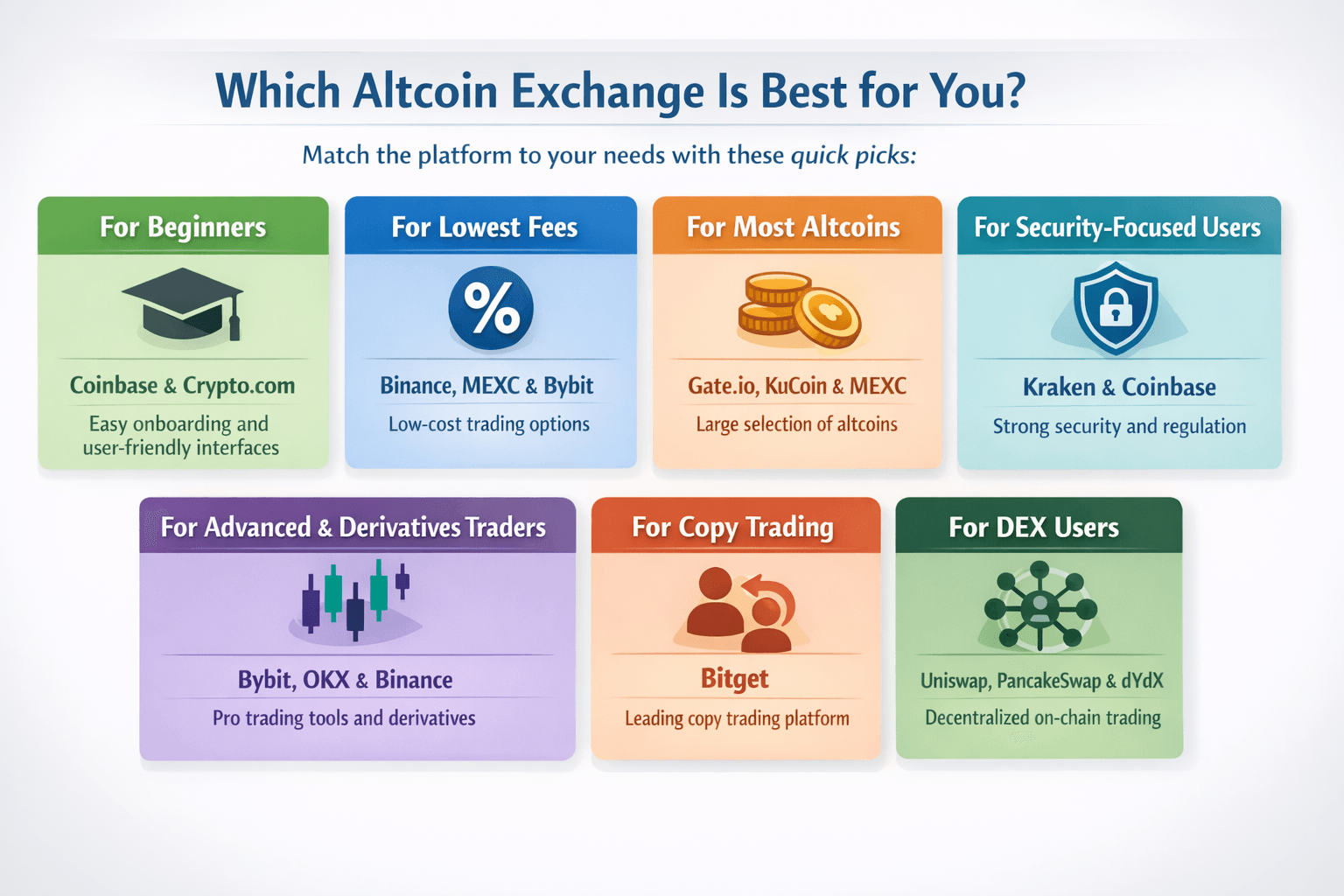
Some Traders want Simplicity, Others Care most about Fees, and Some need Deeper Coin Coverage or more Advanced Tools
For Beginners
If you want the easiest starting point, Coinbase and Crypto.com are the most approachable picks thanks to their cleaner onboarding, simple funding options, and retail-friendly interfaces. Coinbase is especially useful if you want a platform that starts simple but still gives you a path into more advanced tools later on.
For Lowest Fees
For lower base spot trading costs, Binance, MEXC, and Bybit are the strongest options in this roundup. They are particularly attractive to active traders because even small fee differences can add up quickly over time.
For Most Altcoins
If variety is the main goal, Gate.com, KuCoin, and MEXC stand out for broad coin coverage and steady new listings. These are the exchanges that make the most sense for readers who care more about access to long-tail assets than having the simplest interface.
For Security-Focused Users
For traders who care most about security and trust, Kraken and Coinbase are the strongest fits. Both put more emphasis on visible account protections and a more regulation-aware operating profile than many altcoin-first rivals.
For Advanced and Derivatives Traders
If you want more active trading tools, Bybit, OKX, and Binance offer the deepest feature sets. These platforms are a better fit for traders who want more than simple spot orders, especially if they use leverage, multiple products, or faster execution workflows.
For Copy Trading
If copy trading is the priority, Bitget is the clearest specialist choice. Its social-trading setup is much more central to the platform experience than it is on most large general-purpose exchanges.
For DEX Users
If you prefer self-custody and on-chain access, Uniswap, PancakeSwap, and dYdX are the best decentralized options covered here. They make the most sense for users who are comfortable managing their own wallet and trading directly through smart-contract-based infrastructure.
How to Start Trading Altcoins
Starting is usually simpler than it looks. Think of it like using a stock app for the first time: you open an account, add money, choose what you want to buy, place an order, and then decide whether to keep it on the platform or move it somewhere safer. The main difference is that crypto adds things like wallets, networks, and trading pairs.
Check our our crypto starting guide for beginners.
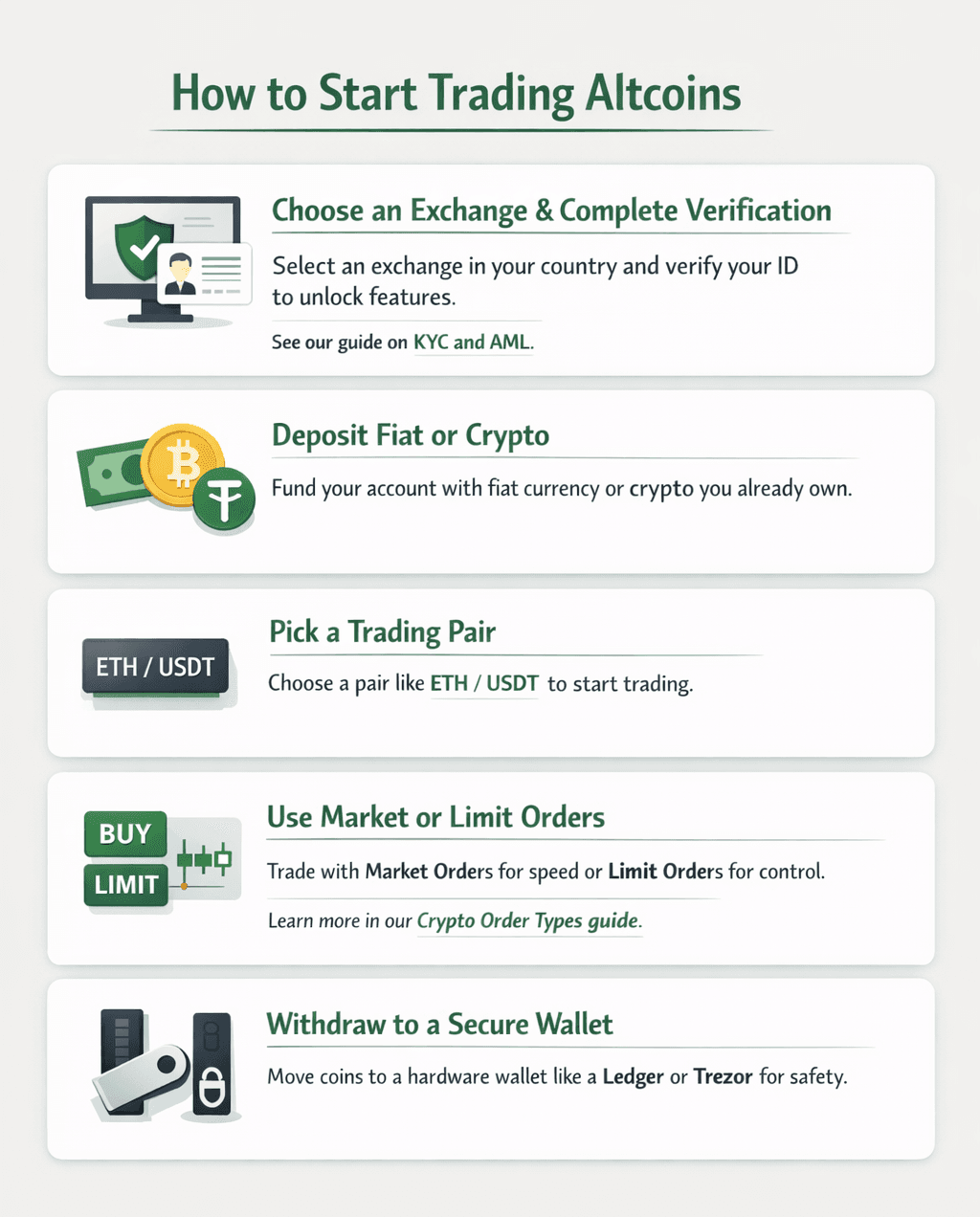
Starting is Usually Simpler than it Looks
Choose an Exchange and Complete Verification
Pick an exchange that works in your country and supports the altcoins you want. Most major platforms require identity verification before you can unlock full account features, so be ready to submit basic personal details and an ID.
Check out our guide on KYC and AML for more information.
Deposit Fiat or Crypto
Next, fund the account with regular money such as USD or with crypto you already own. If you deposit fiat, make sure the payment method is in your name and supported by the exchange.
Pick a Trading Pair
A trading pair is simply what you are buying and what you are paying with, such as ETH/USDT. For beginners, simpler pairs are easier to follow because the price is shown against a familiar asset or currency.
Use Market or Limit Orders
A market order buys or sells right away at the best available price. A limit order lets you choose your price and wait for the market to reach it. Market orders are faster, while limit orders give you more control.
Check out more in our guide on Crypto Order Types.
Withdraw to a Secure Wallet
If you plan to hold for the long term, moving coins off the exchange can reduce custodial risk. A hardware wallet like a Ledger or Trezor stores your private keys offline, which helps protect them from online threats.
Risks of Using Altcoin Exchanges
Altcoin exchanges can make trading easier, but convenience comes with trade-offs. The biggest risks are not always dramatic market crashes. Often, they come from how the platform works, how thin a market is, or how much leverage a trader takes on without realizing how quickly things can move.
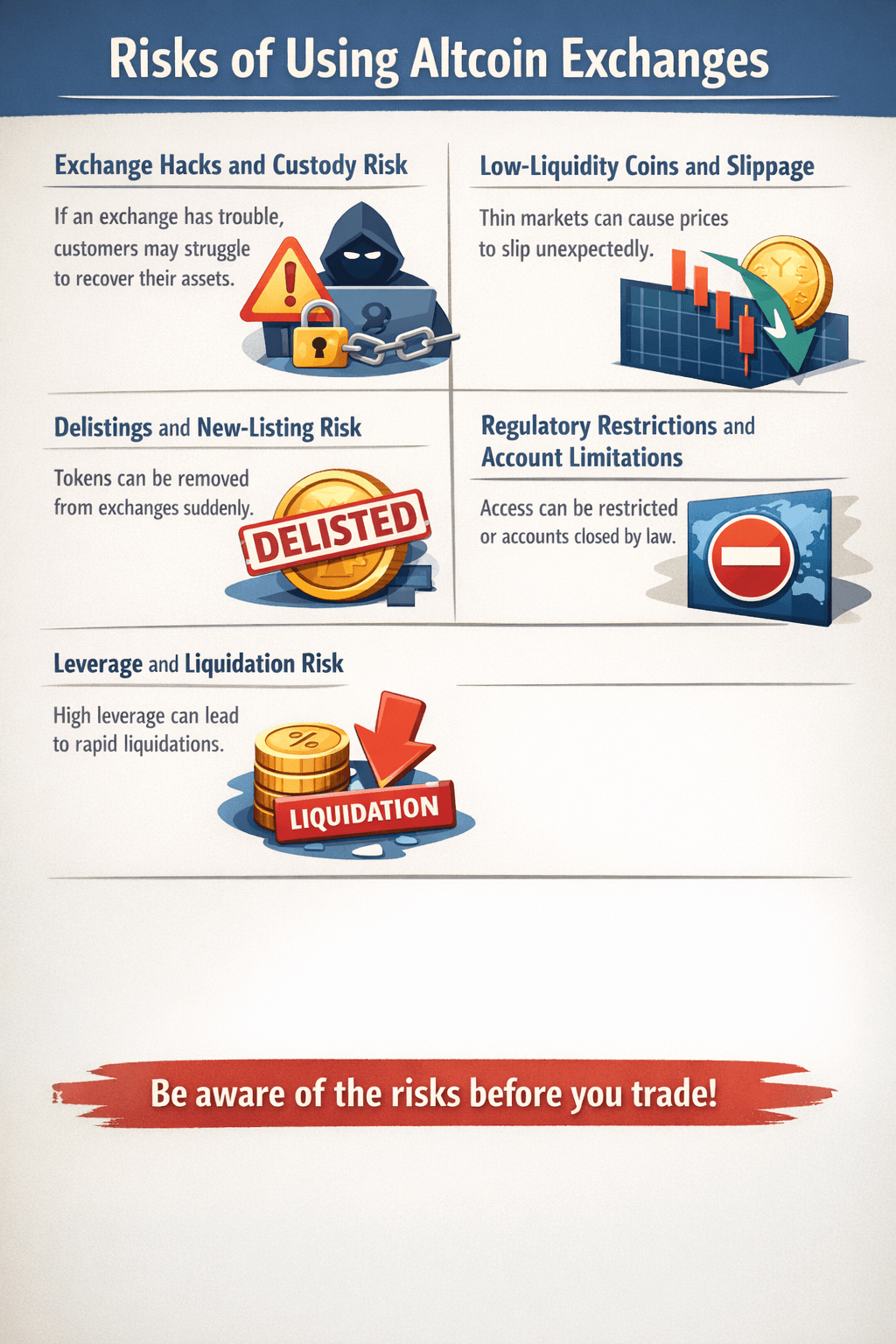
Altcoin Exchanges can make Trading Easier, but Convenience Comes with Trade-Offs
Exchange Hacks and Custody Risk
When you keep coins on a centralized exchange, the platform controls the custody of those assets. The SEC’s investor alert warns that customers may struggle to recover assets if a crypto platform runs into serious financial or operational trouble, which is why long-term holders often move funds off-exchange.
Low-Liquidity Coins and Slippage
Small altcoins can look tradable on paper but still have weak market depth. Kraken’s trading analytics guidance notes that wider spreads usually mean slippage is more likely, so the price you get can be worse than the one you expected.
Delistings and New-Listing Risk
New listings can create excitement, but they can also be unstable. Binance’s delisting guidance makes clear that tokens can be removed, and traders may then need to sell, convert, or withdraw before deadlines.
Regulatory Restrictions and Account Limitations
An exchange may be available today and restricted tomorrow depending on where you live. Coinbase’s prohibited regions policy says access can be restricted and accounts can be closed where required by law.
Leverage and Liquidation Risk
Leverage can magnify gains, but it also magnifies losses. Bybit’s liquidation guidance explains that when the mark price reaches the liquidation price, the position can be closed automatically, which is why even a small move can become expensive fast.
You can learn a lot more in our Risk Mitigation Guide.
Best Practices for Safer Altcoin Trading
Safer altcoin trading is mostly about reducing avoidable mistakes. The goal is not to remove all risk, because that is impossible, but to avoid turning a normal trade into a preventable loss through weak security, poor liquidity, or too much leverage.
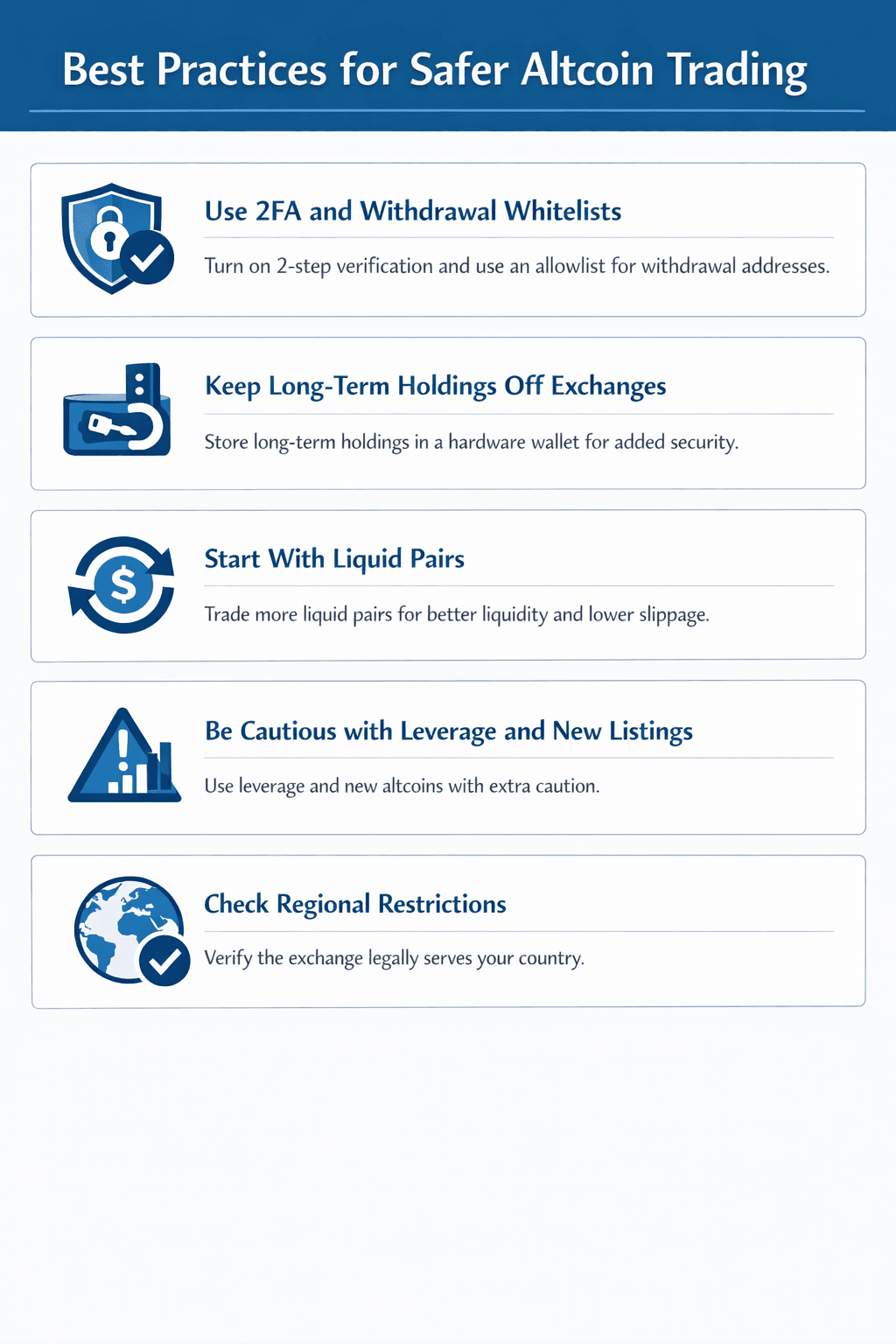
Safer Altcoin Trading is mostly about Reducing Avoidable Mistakes
Use 2FA and Withdrawal Whitelists
Turn on 2-step verification and use an allowlist for withdrawal addresses where available. These add an extra checkpoint before funds can leave your account.
Keep Long-Term Holdings Off Exchanges
For long-term holdings, a hardware wallet keeps private keys in an environment separate from the internet, which lowers online attack risk.
Start With Liquid Pairs
More liquid pairs usually mean tighter spreads and less slippage, which makes execution more predictable.
Be Cautious With Leverage and New Listings
Leverage can lead to liquidation, and newly listed altcoins can be unusually volatile.
Check Regional Restrictions Before Signing Up
Always confirm that the exchange legally serves your country before depositing funds by checking its prohibited regions or restricted-jurisdiction guidance.
Final Verdict
If you want the simplest answer, Binance is still the best overall choice for most altcoin traders because it combines broad coin access, strong liquidity, and a deep trading toolkit in one place. Coinbase makes the most sense for beginners, while Kraken is the better fit for users who care most about security and trust.
If your priority is sheer variety or earlier access to smaller assets, Gate.com, MEXC, and KuCoin are stronger picks. More active traders will usually get more value from Bybit, OKX, or Bitget, especially if they want derivatives, copy trading, or a broader product stack.
In the end, the best altcoin exchange depends on your geography, risk tolerance, and whether you want the convenience of a CEX or the self-custody of a DEX. Do remember that many altcoins are highly volatile, thinly traded, or tied to ideas that never gain real traction. That is why altcoin investing should never begin with hype alone. Careful research, realistic expectations, and a clear understanding of market risks still matter.
Further Reading