


If you want to spend crypto like you spend cash, a “crypto debit card” can be one of the easiest ways to connect your digital assets to everyday payments. Rather than treating crypto as something you only hold or trade, these cards make it possible to use it for shopping, travel, and daily expenses in a way that feels much more familiar.
This guide compares the best crypto debit cards and spend cards for rewards, low fees, travel, self-custody, and everyday spending. Some are true debit cards, some are prepaid cards, and some blur into credit-backed or wallet-linked spend cards. Availability also changes by region and regulation, so what’s “best” depends heavily on where you live and what you’re optimizing for.
Editor’s Note (March 11, 2026): We fully updated this guide in March 2026 to reflect the latest crypto card programs, fee structures, regional availability, custody models, and rewards mechanics. We also expanded the comparison set beyond the original six cards to include newer and more relevant spend options for different use cases, including self-custodial, DeFi-native, Bitcoin-focused, and travel-friendly cards.
Quick Answer: What Is the Best Crypto Debit Card in 2026?
For many users, Crypto.com Card is the strongest overall program, while Coinbase Card is a simple entry point for US beginners. If you want self-custody, Gnosis Pay is the clearest route.
Top Recommendations
- Best overallCrypto.com Card
- Best for beginnersCoinbase Card
- Best for rewardsCrypto.com Card
- Best for no stakingNexo Card or Bybit Card
- Best for self-custodyGnosis Pay
- Best for Bitcoin usersFold
- Best for EuropeGnosis Pay / Plutus / Wirex (depends on your preference)
- Best DeFi-native optionether.fi Cash
- Best Solana ecosystem angleKAST
Key Takeaways
- The best crypto cards differ more by region, fees, and custody model than by headline rewards.
- High cashback often comes with staking, subscriptions, token exposure, or tier lockups.
- Self-custodial cards can offer more control, but often less “plug-and-play” simplicity.
- Many cards are not globally available and usually require KYC.
- Spending crypto can trigger taxable events in many jurisdictions, and rewards may also need tracking.

Best Crypto Debit Cards Compared Side by Side
This section is a high-level comparison so you can quickly narrow your shortlist. Treat it as orientation, not a substitute for checking your local issuer terms. Card programs change frequently due to regulation and issuer partnerships.
| Card | Card Type | Best For | Supported Assets | Cashback / Rewards | Staking Required | Annual Fee | ATM Fee / Limit | FX Fee | Conversion Fee / Spread | Virtual Card | Apple Pay / Google Pay | Availability | Custody Model | Our Rating |
| Coinbase Card | Debit-style (exchange-linked) | Beginners (US) | Multi-asset via Coinbase | Program-based | No | $0 annual fee | $0 from Coinbase; ATM operator may charge | Not separately disclosed | No spending fee, but crypto conversions can include a spread (Coinbase) | Yes (Coinbase) | Usually yes | US (excl. HI) (Coinbase) | Custodial | 8.5/10 |
| Bybit Card | Debit-style (exchange-linked) | Fee transparency | Multi-asset via Bybit | Program-based | No | None | 2% after first 100 EUR/USD monthly (region dependent) | ~1%–2% depending on issuance region | 0.5% to 0.9% region-based | Usually yes | Region-based | Region-based | Custodial | 8/10 |
| Nexo Card | Hybrid (debit + credit mode) | Flexibility, no staking | Multi-asset via Nexo | Program-based | No | No monthly or annual fee stated | Free monthly tier allowance, then 2% after limit | 0.2% for EEA/UK/CH currencies | Not clearly disclosed as a standalone spread on public card page | Yes | Apple Pay / Google Pay supported | EEA/UK focus | Custodial | 7.8/10 |
| Crypto.com Card | Debit/prepaid-style program | Rewards seekers | Multi-asset via Crypto.com | Tier-based | Often for top tiers | No simple annual fee, but tier economics matter | 2% above free ATM limit | Midnight tier: 0.2% in EU/UK, 2.0% outside EU/UK; other tiers: no fee | Not published as one universal spread | Usually yes | Usually yes | Region-based | Custodial | 8.7/10 |
| Gnosis Pay | Self-custodial spend card | Self-custody | Stablecoin-forward flows | Program-based | No | No annual fee disclosed; card order free | 5 free withdrawals/month or 200 total, then 2% | No added FX markup (Visa exchange rate applies) | No transaction fees for spending | Yes | Apple Pay focus | EEA/UK focus | Self-custodial | 8.6/10 |
| BitPay Card | Prepaid (paused / status-dependent) | Legacy users only | Historically major coins | Limited | No | Not clearly confirmed | Not clearly confirmed | Not clearly confirmed | Not clearly confirmed | N/A | N/A | Program status dependent | Custodial top-up | 5/10 |
| ether.fi Cash | DeFi-native spend | DeFi users | Collateral + on-chain design | Program-based | No | No annual fee clearly stated on fee page | 2% ATM fee; 250 USD limit | 1% across tiers | Not clearly disclosed as separate spread | Yes | Region-based | Region-based | DeFi-native | 8.2/10 |
| KAST Card | Spend card (stablecoin focus) | Solana angle | Stablecoins + conversions | Program-based | Not required | Standard: $0; Premium tiers available | ATM fees are not clearly summarized on the main fee page | 0.5% to 1.75% non-USD | 0% transaction fee / 0% USD card spend | Yes | Apple Pay / Google Pay supported | Verify | App-based | 7.4/10 |
| Zypto | Reloadable card product | Convenience + limits | App-funded | Program-based | No | $0 monthly fee | 1% ATM fee | 1.75% non-USD | 3% crypto off-ramp fee | Yes | Mobile-pay ready | Region-based | App-based | 7.3/10 |
| Plutus | Debit rewards program | Perks + tiers (UK/EEA) | Fiat spend + rewards | Tier-based | Often | Subscription / plan-based economics | 2.5% ATM withdrawal fee | Not clearly specified on fee page | Trading fee: 1% Starter / 0% higher plans | Yes | Region-based | UK/EEA focus | Custodial program | 7.2/10 |
| Wirex | Debit + loyalty | Travel-friendly | Crypto + fiat | Tier-based | Optional | Optional paid plans / regional pricing | Free up to £200 monthly in UK, then 2% | Not clearly specified on UK fee page | Exchange pricing shown in-app / region-based | Yes | Region-based | Region-based | Custodial | 7.5/10 |
| Fold | Debit + BTC rewards | Bitcoin users | BTC rewards | Program-based | No | $0 standard / Fold+ $100 yearly or $10 monthly | $3.50 standard / $0 Fold+ | Foreign transaction fee: $3 per transaction (standard) / $0 Fold+ | N/A | Yes | Region-based | US focus | App-based | 7.9/10 |
| Bitpanda Card | Debit-style | Europe portfolio spend | Portfolio assets | Program-based | Optional | No annual fee clearly stated | 2% or at least €2 | No non-EUR fee stated; Visa markup may still apply | Asset-to-fiat trade incurs normal trading fee | Yes | Region-based | EEA | Custodial | 7.6/10 |
Our Top Picks by Use Case
Different people want different things from a crypto card. Some want the least friction. Others want maximum rewards. Others want self-custody and accept more complexity. The picks below match how people actually choose cards in real life.
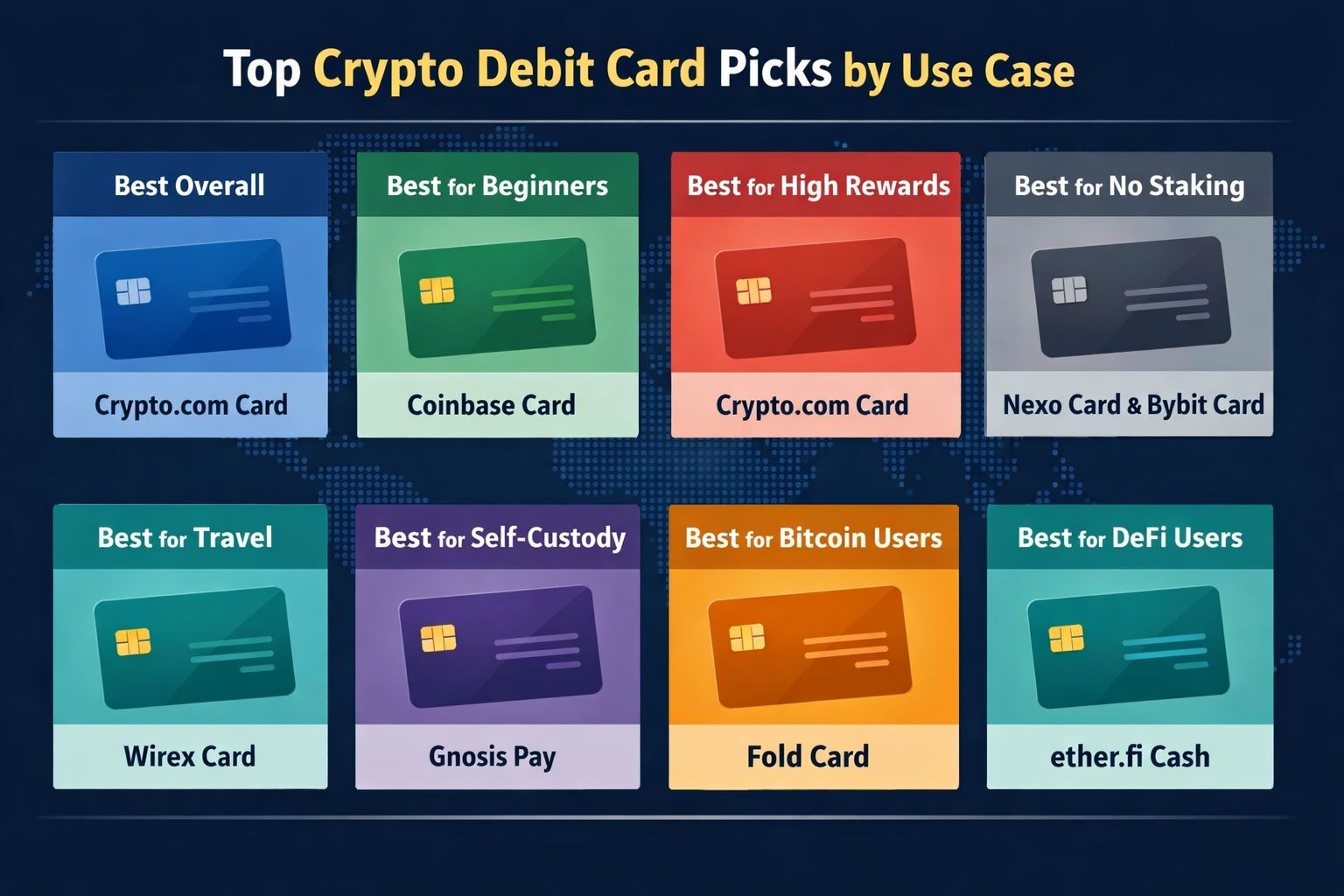 Crypto Card Choices Vary Based on Individual Priorities, Ranging From Low Friction and High Rewards to Complex Self-Custody
Best Overall Crypto Debit Card
Winner summary: Offered by Crypto.com, the Crypto.com Card works as the broadest “default” pick because it’s designed as a consumer card program with a mature tier structure and widely recognized UX. The trade-off is that top rewards usually require tier commitments and can introduce token exposure.
Pros
Mature program structure with clear tiering.
Strong “all-in-one app” experience for everyday users.
Good fit for people who want rewards plus card perks in one place.
Drawbacks
Highest reward tiers often come with lockups, subscriptions, or token exposure.
Caps, exclusions, and changing terms can reduce real-world value.
Choose this if… you want a mainstream card program and you’re comfortable with tier mechanics.
Best for Beginners
Winner summary: Coinbase's Coinbase Card is often the simplest start for US-based users already using Coinbase because the setup and spend tracking live in the same mainstream app. The trade-off is custody: you’re spending from a platform account rather than your own wallet.
Pros
Simple onboarding for users already in the Coinbase ecosystem.
Clear in-app visibility into spending and balances.
Familiar “traditional finance” feel compared to DeFi-native options.
Drawbacks
Region-limited, mainly US availability.
Custodial model adds counterparty risk.
Choose this if… you want the easiest setup and you already use Coinbase.
Best for High Rewards
Winner summary: Crypto.com Card is the most common “high rewards” pick because rewards are explicitly tier-based, which can be attractive if you spend enough to justify the tier costs. The trade-off is that “high rewards” are rarely free and often require lockups or exposure to program tokens.
Pros
High headline rewards at upper tiers.
Perks can add value beyond cashback for frequent users.
Clear ladder structure for people who like predictable targets.
Drawbacks
Token exposure and tier requirements can introduce real risk.
Caps and exclusions can weaken the effective cashback rate.
Choose this if… you spend heavily and you’ve stress-tested the tier math.
Best for No Staking
Winner summary: Nexo's Nexo Card and Bybit's Bybit Card are common “no staking” candidates because you can usually access the card experience without locking tokens upfront. The trade-off is that you still need to watch spreads, FX costs, and region-specific issuer terms.
Pros
No need to lock capital just to start using the card.
Better fit for users who prioritize liquidity and flexibility.
Often simpler than managing staking tiers to preserve benefits.
Drawbacks
Availability varies by region and issuer partnerships.
“No staking” doesn’t mean “no hidden costs,” spreads can still bite.
Choose this if… you want card utility without locking tokens or chasing tiers.
You can find comprehensive information regarding the Bybit Card in our guide.
Best for Travel
Winner summary: Wirex is a common travel-oriented option because the product is built around multi-currency handling and a loyalty layer. The trade-off is that fees and limits can vary by region, so you must confirm your local terms.
Pros
Multi-currency orientation suits cross-border spending.
Loyalty features can reward frequent usage.
Fits travelers who want one card for fiat and crypto balances.
Drawbacks
Fees and limits are often region-specific rather than universal.
Rewards may depend on subscriptions or tier mechanics.
Choose this if… you travel often and want a multi-currency style card.
Best for Self-Custody
Winner summary: Gnosis' Gnosis Pay stands out because it’s designed around a self-custodial model. That reduces reliance on an exchange balance, but it increases your responsibility for wallet security and transaction hygiene.
Pros
Self-custody-first model appeals to on-chain users.
More control over funds compared to exchange-linked cards.
Stablecoin-forward spending can reduce checkout volatility.
Drawbacks
More complexity than “download app, spend immediately” cards.
User error risk is higher because you control the wallet layer.
Choose this if… you want control and you’re confident in your wallet security habits.
Best for Bitcoin-Only Users
Winner summary: Fold is the cleanest “Bitcoin rewards” angle because its value proposition is BTC-first rather than paid-out-in-a-platform-token. The trade-off is that it’s typically more US-centric than global.
Pros
Bitcoin-native rewards framing.
Easier to evaluate rewards value if BTC is your unit of account.
Strong fit for users who want BTC back from normal spending.
Drawbacks
Regional availability is more limited than “global” card programs.
Value depends on membership math, categories, and caps.
Choose this if… you want BTC rewards and don’t care about altcoin ecosystems.
Best for DeFi Users
Winner summary: ether.fi Cash is a DeFi-native spend product aimed at users who already operate on-chain and want spending to connect to that workflow. The trade-off is that issuer terms and mechanics can look different from traditional debit.
Pros
Better ecosystem fit for users already in DeFi.
Spend experience designed to feel “crypto-native.”
Cashback framing can be straightforward if you accept the model.
Drawbacks
Mechanics may resemble credit-backed spending depending on setup.
Region and issuer constraints can limit availability.
Choose this if… you already use DeFi and want spending integrated into that world.
Best for Europe / Best for UK / Best for EEA
Winner summary: Europe and the UK are where “availability beats hype.” If you want self-custody, Gnosis Pay is a standout. If you want rewards and perks, Plutus is a common pick. If you want flexible debit and credit-style modes, Nexo Card is often considered. The trade-off is that terms shift quickly with issuers and compliance.
Pros
Multiple viable options across custody and rewards preferences.
Strong competition in UK/EEA card offerings.
Better chance of local issuance compared to some US-first cards.
Drawbacks
Programs can change quickly due to issuer and regulatory shifts.
Higher rewards often involve subscriptions, tiers, or token mechanics.
Choose this if… you want something reliably available where you live, even if rewards are less flashy.
What Is a Crypto Debit Card?
A crypto debit card is a card that lets you spend value connected to crypto holdings, usually by converting crypto to fiat automatically when you pay, or by spending from a preloaded balance.
It helps to separate four categories:
- Crypto debit card: Usually linked to an exchange account balance that gets debited.
- Prepaid crypto card: You top up first, then spend from the loaded balance.
- Crypto credit card or line-of-credit model: You spend using credit-like mechanics, often borrowing against collateral.
- Self-custodial spend card: Card spending routes through a wallet you control.
The key idea: many “crypto debit cards” are not pure debit cards like a traditional bank card. They are debit-like experiences built on custodial balances, prepaid rails, or credit-backed mechanisms.
Crypto Debit Card vs Crypto Credit Card
Credit-backed models are “spend now, settle later.” That can add liquidation or interest-like risk depending on structure. Debit-style models are closer to spending what you already hold, even if conversion happens automatically behind the scenes.
If you are in the market for a crypto credit card, we have a great article for you, feel free to check out our article on the best crypto credit cards.
Crypto Debit Card vs Prepaid Card
Prepaid cards shift the conversion moment earlier. You load value, then spend from that balance. This can separate your “spending money” from your main holdings, but adds steps and sometimes top-up fees.
Custodial vs Self-Custodial Crypto Cards
Custody is a major decision point:
- Custodial cards are simpler but add counterparty risk.
- Self-custodial cards give more control but require stronger security habits.
How Crypto Debit Cards Work
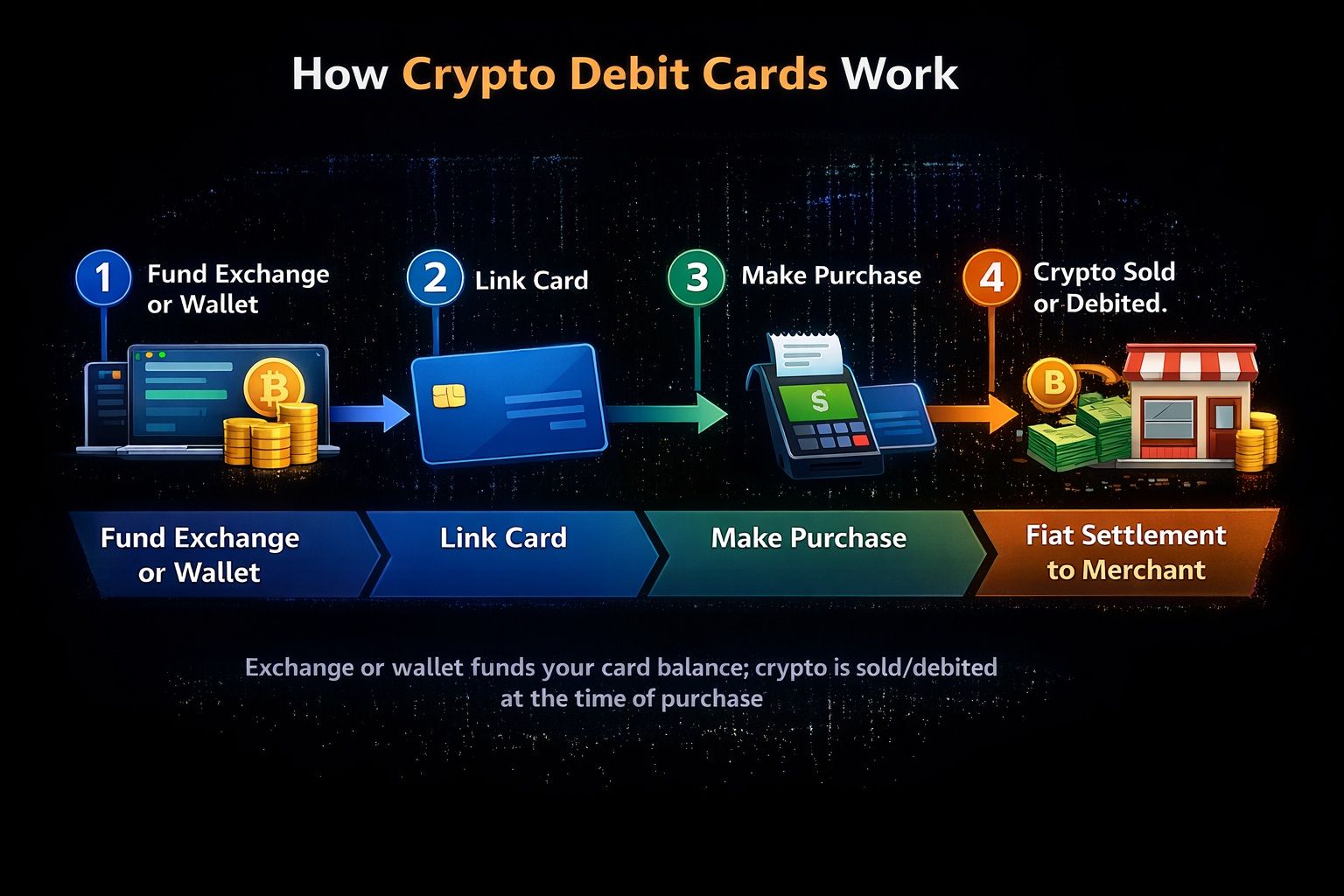 Users Fund A Wallet, Link Their Card, And Make A Purchase, Triggering An Automated Crypto-to-fiat Conversion For Merchant Settlement
Here’s the typical flow, even though products brand it differently:
- User funds an exchange or wallet.
- Card is linked to the account.
- User makes a purchase.
- Crypto is sold or debited (or a preloaded balance is used).
- Merchant receives fiat settlement through card rails.
The hidden details that matter are spreads, FX fees, and whether conversion happens per transaction or during top-up. Virtual cards and mobile wallets can reduce friction, but they don’t change the underlying conversion logic.
What Happens at the Point of Sale?
At checkout, the merchant typically receives fiat settlement. Your provider handles conversion or debiting in the background to cover the settlement amount.
Do You Spend Crypto Directly or Is It Converted First?
Most of the time, it’s converted first, either:
- in real time per transaction, or
- during top-up for prepaid balances.
Even when the UX feels like you’re “spending stablecoins,” merchants generally receive fiat settlement on traditional rails.
Can You Use Crypto Cards Online and Abroad?
Usually yes, if:
- your issuer supports your country,
- online and international spending are enabled in the app, and
- you understand the FX and conversion fee model.
Best Crypto Debit Cards Reviewed
This section uses a consistent structure so every card is easy to compare and extract. Always confirm your local availability, fees, and limits, because card terms can change frequently.
Coinbase Card
Best for: Beginners in the US who want the simplest setup.
Coinbase Card
Card details
Latest fees (official)
- Purchases: Coinbase states there are no transaction fees for spending with the Coinbase Card, with conversion spread potentially applied when buying or selling crypto.
- ATM withdrawals: Coinbase states it charges no ATM withdrawal fees, but ATM operators may charge their own fees.
- Foreign exchange: Not presented as a standalone FX fee on the same page, so confirm your cardholder terms in-app for your region and transaction type.
Bybit Card
Best for: Users who want clear published fee categories and exchange-linked spending.
Bybit Card
Card details
Latest fees (official)
- Crypto conversion fee: 0.9% as listed in Bybit’s published card fee examples and terms, though this may vary by region.
- ATM withdrawals: first 100 USD or 100 EUR per month free, then 2% thereafter, depending on region.
- Foreign exchange fee: region-dependent. A 2% fee is listed in the Asia Pacific terms, while other regional programs may differ.
- Monthly maintenance fee: listed as none in certain regional terms.
Nexo Card
Best for: Debit-style spending with optional credit-like flexibility.
Nexo Card
Card details
Latest fees (official)
- FX fee: 0.2% for EEA, UK, and CH currencies, as listed in Nexo’s limits and fees article.
- Free ATM withdrawals per month: tier-based allowance, from Base €200 or £180 up to Platinum €2,000 or £1,800.
- ATM fee after free limit: 2%, with a minimum of 1.99 EUR or GBP per additional withdrawal until monthly reset.
Crypto.com Card
Best for: Users optimizing rewards and perks through tiering.
Crypto.com Card
Card details
Latest fees (official)
- ATM withdrawals: 2% on amounts above the monthly free ATM limit, with limits varying by tier and region.
- Top-ups: Europe lists debit and credit card top-up at 1%, while the US lists debit top-up at 1% and credit top-up at 2.99%.
- Always check the in-app Fees & Limits section for your specific card tier, as Crypto.com states tiers differ.
Gnosis Pay
Best for: Self-custody users who want card-based spending.
Gnosis Pay
Card details
Latest fees (official)
- ATM withdrawals under fair usage: up to 5 free ATM withdrawals per month or up to 200 EURe, GBPe, or USDCe, whichever comes first.
- ATM fee after allowance: 2% per additional withdrawal.
- No added FX markup, with Visa exchange rates applying.
BitPay Card
Best for: Legacy users only, depending on issuance status.
BitPay Card
Card details
Latest fees (official)
- BitPay’s card availability and terms can change. Use the official card page to confirm current issuance status, fees, and limits before relying on it.
ether.fi Cash Card
Best for: DeFi-native users who want a spend product connected to crypto balances.
ether.fi Cash Card
Card details
Latest fees (official)
- ATM withdrawals: 2% ATM fee per withdrawal.
- ATM limit: 250 USD with a maximum of 3 attempts in a rolling 24-hour period, with approved and declined attempts both counting.
- FX fees: check the current cash card fee page for your tier and region.
KAST Card
Best for: Stablecoin-centric spending with a Solana ecosystem narrative.
KAST Card
Card details
Latest fees (official)
- Top-up fee: 0%.
- FX fee for non-USD transactions: 0.5% to 1.75% depending on where you live and where you transact.
- Card spend in USD: 0%.
- Small transaction fee for non-USD transactions under $25: $0.10.
- Declined transaction fee for insufficient balance: $0.50.
Zypto Card
Best for: Convenience and virtual-first spending.
Zypto Card
Card details
Latest fees (official)
- Monthly fee: $0.
- Transaction fee: $0.30.
- FX fee for non-USD transactions: 1.75%.
- Crypto off-ramp fee: 3%.
- ATM withdrawal fee: 1%.
- Card cost, activation, and shipping: $50 one-time, as listed.
Wirex
Best for: Travelers and multi-currency spenders.
Wirex
Card details
Latest fees (official)
- UK example: card issuance listed as free.
- UK example: ATM withdrawals are free up to 200 GBP monthly, then 2% thereafter.
- Wirex publishes region-specific fee pages, so users outside the UK should use the general fee directory to find their local schedule.
Plutus
Best for: UK and EEA users who actively manage perks and tiers.
Plutus
Card details
Latest fees (official)
- Plutus publishes a plan-by-plan Fees & Limits breakdown that includes deposit and withdrawal costs, trading fees, and program-specific charges.
- Example from the fee table: trading fee is listed as 1% on the Starter plan and 0% on Everyday and Premium, as presented on the Fees & Limits page.
- Non-domestic POS transactions: 2.5%.
- ATM withdrawals: 2.5%.
- Because day-to-day costs and limits are plan-dependent, use the official table for your plan before comparing rewards.
Fold
Best for: Bitcoin rewards on everyday spending.
Fold
Card details
Latest fees (official)
- Fold+ membership: $100 per year billed annually, with monthly pricing also shown on the pricing page.
- ATM withdrawals: Fold’s cardholder agreement shows an ATM withdrawal fee of $3.50, while Fold+ members are not charged that fee by Fold. ATM operators may still charge their own fees.
Optional: Monolith / Bitpanda Card (relevance check)
Monolith: shutdown status. Bitpanda: Europe portfolio spend contender.
Optional: Monolith / Bitpanda Card (relevance check)
Bitpanda Card (Europe)
- Bitpanda markets 0% FX fees for non-Euro transactions, with Visa markup fees potentially applying.
- Bitpanda support states ATM withdrawals cost 2% of the withdrawal amount or at least EUR 2, and that payments or withdrawals in non-EUR currencies no longer incur any fees.
- Bitpanda also notes each card payment triggers an asset-to-fiat trade, which incurs the usual trading fee.
Crypto Card Fees Explained
Fees decide whether a “high cashback” card is actually good value. Your true cost is usually a mix of conversion spreads, FX fees, ATM rules, and any subscriptions or lockups needed to maintain rewards. The key fix here is replacing vague “varies” language with officially published fee examples where providers disclose them.
Annual Fees
Most crypto cards do not charge a traditional annual fee, but some programs do charge tier fees or memberships.
No annual fee (examples): Bybit lists Annual Fee: None in its fee table.
Membership as an annual fee (example): Fold’s cardholder agreement lists $0 for Fold Card and $100 per year or $10 per month for Fold+.
Tiered annual fees (example): KAST lists Standard: $0, Premium: $1,000/year, and other paid tiers.
Conversion Fees and Spreads
Even when a provider advertises “no transaction fee,” you can still pay through the conversion mechanism.
Spread model (example): Coinbase states that card spending has no transaction fee, but crypto conversions may include a spread.
Explicit conversion fee (example): Bybit lists a crypto conversion fee that is commonly around 0.5–0.9% depending on region and program.
Implicit conversion fee via “asset-to-fiat trade” (example): Bitpanda explains that each card payment triggers an asset-to-fiat trade and incurs the usual trading fee.
Analogy: it’s like exchanging cash at a tourist kiosk. The sign might say “no commission,” but you still pay in the rate.
FX Fees
FX fees apply when you spend in a currency different from your card’s settlement currency, or when your issuer treats the purchase as cross-border.
No added FX fee from the program (example): Gnosis Pay says no added fees for currency conversions and Visa’s exchange rate is applied.
Tiered FX fee (example): Crypto.com’s Europe fee table shows Midnight has a foreign transaction fee schedule (for non-EUR/GBP) of 0.2% within the EU/UK and 2.0% outside the EU/UK, while other tiers show no fee.
Explicit FX fee by region (example): Bybit lists a Foreign Exchange Fee that varies by program region (for example 1%, 1.5%, 2%, or higher depending on issuance).
ATM Withdrawal Fees
ATM costs can come from:
Your issuer, and
The ATM operator.
Examples from official fee tables:
Coinbase: Coinbase says no fees from Coinbase for ATM withdrawals, but the ATM may charge a fee.
Gnosis Pay: “Fair usage” includes up to 5 free withdrawals per month or up to 200 EURe/GBPe/USDCe, then 2% per additional withdrawal.
Bybit: Bybit’s fee table shows 2% ATM withdrawal fee after a monthly free allowance (amount varies by program region).
Crypto.com Europe: 2% on amounts above the monthly free ATM limit.
Plutus: ATM withdrawal fee listed as 2.5% across plans.
Bitpanda: ATM withdrawals cost 2% or at least €2.
ether.fi Cash: 2% ATM fee per withdrawal, with a 250 USD limit and attempt limits.
Wirex UK: ATM withdrawals are free up to 200 GBP monthly, then 2% thereafter.
Fold: ATM withdrawal is $3.50 for Fold Card and $0 for Fold+ (ATM operators may still charge).
Inactivity Fees
Not all providers charge inactivity fees, but some do.
Crypto.com Europe: €5 per month after 12 months of inactivity (as defined on the fee page).
Fold: $0 inactivity fee (after 12 months with no transactions) in the short-form disclosure.
Nexo: Nexo’s card page claims no inactivity card fees.
Top-Up Fees
Top-up fees often depend on method (bank transfer vs debit/credit card).
Crypto.com Europe: debit/credit card top-up fee listed as 1%.
Crypto.com US: debit top-up 1%, credit top-up 2.99%, PayPal top-up 2.1%.
KAST: top-up fee listed as 0%.
Wirex UK: bank transfer, SEPA, and Faster Payments listed as free, while “local card” funding is shown as fee based on top-up currency (viewable in-app).
Staking or Token Lockup Costs
Staking-based rewards aren’t free. Your cost is:
The risk of holding a volatile token.
The opportunity cost of locking funds.
The risk that rules change while you’re locked in.
Even if the card fee page looks cheap, rewards tiers can be expensive in hidden ways if they require capital lockups.
Hidden Costs Most Users Miss
Rewards caps that shrink your effective cashback.
Merchant category exclusions that block rewards in common spend categories.
FX plus spread stacking on international purchases.
Token reward volatility between earning and selling.
Replacement and admin fees (examples: Crypto.com card replacement fees and account closure fees are listed on the Europe page).
Takeaway: the highest cashback card is not always the cheapest card to use.
Fee Comparison Table
This table focuses on fee categories people commonly overlook. Where the provider publishes a clear number, it’s included. Where the provider’s fees are explicitly region-program dependent, the table reflects that.
| Card | Annual fee | Issuance fee | Conversion fee | FX fee | ATM fee | Inactivity fee | Notes |
| Coinbase Card | $0 (no transaction fees for spending) | Not specified on fee page | Spread applies when buying/selling crypto | Not specified on fee page | Coinbase: $0, ATM operator may charge | Not specified | Main cost is spread and tax tracking when spending crypto. |
| Bybit Card | None | Virtual: none; Physical varies by region (examples shown) | Region-based (often 0.9%) | Region-based (fee table varies) | 2% after monthly allowance | Not shown in parsed table | One of the clearest official fee tables, but varies by issuance program. |
| Nexo Card | Nexo claims no monthly, annual, or inactivity fees | Not specified on public page | Not specified on public page | ~0.2% for EEA/UK/CH currencies | Free ATM allowance by tier on Nexo page; fee after allowance not shown on this page | Claimed none | Some fee details appear in-app or in terms that are not easily extractable publicly. |
| Crypto.com Card (Europe) | Not an “annual fee,” but tier rules apply | Midnight physical issuance €4.99 | Not specified as a single “conversion fee” | Midnight: 0.2% EU/UK and 2.0% outside EU/UK (other tiers: no fee) | 2% above free ATM limit | €5/month after 12 months inactivity | Also lists replacement fees and close account fee (€50). |
| Crypto.com Card (US) | Not an “annual fee,” but tier rules apply | Physical issuance fee varies by tier/conditions ( | Not specified as a single “conversion fee” | Foreign transaction fee depends on tier (example: 3% for some tiers; none for higher tiers) | 2% above free ATM limit | Not specified here | Also lists debit top-up 1% and credit top-up 2.99%. |
| Gnosis Pay | Card order free | Card order free; replacement 4.99 EURe/GBPe/USDCe | No transaction fees for spending | No added FX fees, Visa rate applies | 5 free withdrawals or 200, then 2% | Not specified | Also clarifies no gas fees for card transactions. |
| BitPay Card | Not confirmed | Not confirmed | Not confirmed | Not confirmed | Not confirmed | Not confirmed | Official page should be checked for current issuance and fees. |
| ether.fi Cash | Not presented as annual fee | Not specified in the fees article | Not specified | 1% across tiers | 2% per withdrawal | Not specified | Also lists ATM limits (250 USD, attempt limits). |
| KAST | Standard: $0; Premium: $1,000/year | Physical: free, $40 shipping (Standard) | Transaction fee 0% (as listed) | 0.5% to 1.75% non-USD | Not listed on this fee page | Not listed | Also lists small transaction fee ($0.10 under $25, non-USD) and decline fee ($0.50). |
| Zypto | Monthly fee: $0 (Premium physical card section) | Card cost + activation + shipping: $50 | Crypto off-ramp fee: 3% | FX (non-USD): 1.75% | ATM withdrawal: 1% | Not stated | Zypto page also mentions different fees for other card variants, so match your exact product. |
| Plutus | Subscription affects benefits (not priced on fee page) | Virtual card order: free | Trading fee: 1% on Starter, 0% on other plans | Not specified | ATM withdrawal: 2.5% | Not specified | Rewards payout fees listed as “Dynamic”; plan rules matter. |
| Wirex (UK example) | Not listed as annual fee | Card issuance: free | Exchange fees shown as in-app | Not specified | ATM: free up to 200 GBP monthly, then 2% | Not specified | Delivery fee listed as 5 GBP for UK example. |
| Fold | $0; Fold+ $100/year or $10/month | Not specified | N/A | Foreign transaction fee: $3.00 per transaction (Standard), $0 for Fold+ | ATM: $3.50 (Fold), $0 (Fold+) | $0 | Treat membership like an annual fee and do the math against your spend. |
| Bitpanda Card | Not listed as annual fee | Card marketed as free | Trading fee applies due to asset-to-fiat trade | No non-EUR fee (per support), Visa markups may apply | 2% or at least €2 | Not specified | Bitpanda notes ATM operators may add their own fees |
Rewards Comparison: Which Crypto Card Gives the Best Value?
Rewards come in different shapes, and each shape changes your risk.
- Simple cashback: Spend, earn a percentage back with minimal tiers.
- Native-token rewards: Rewards paid in a platform token, which adds volatility exposure.
- Tier-based staking rewards: Higher rewards require holdings or lockups.
- Spending-linked perks: Rebates, subscriptions, lounge access, and partner perks.
- Partner rewards: Merchant-specific boosts that can be good, but narrow.
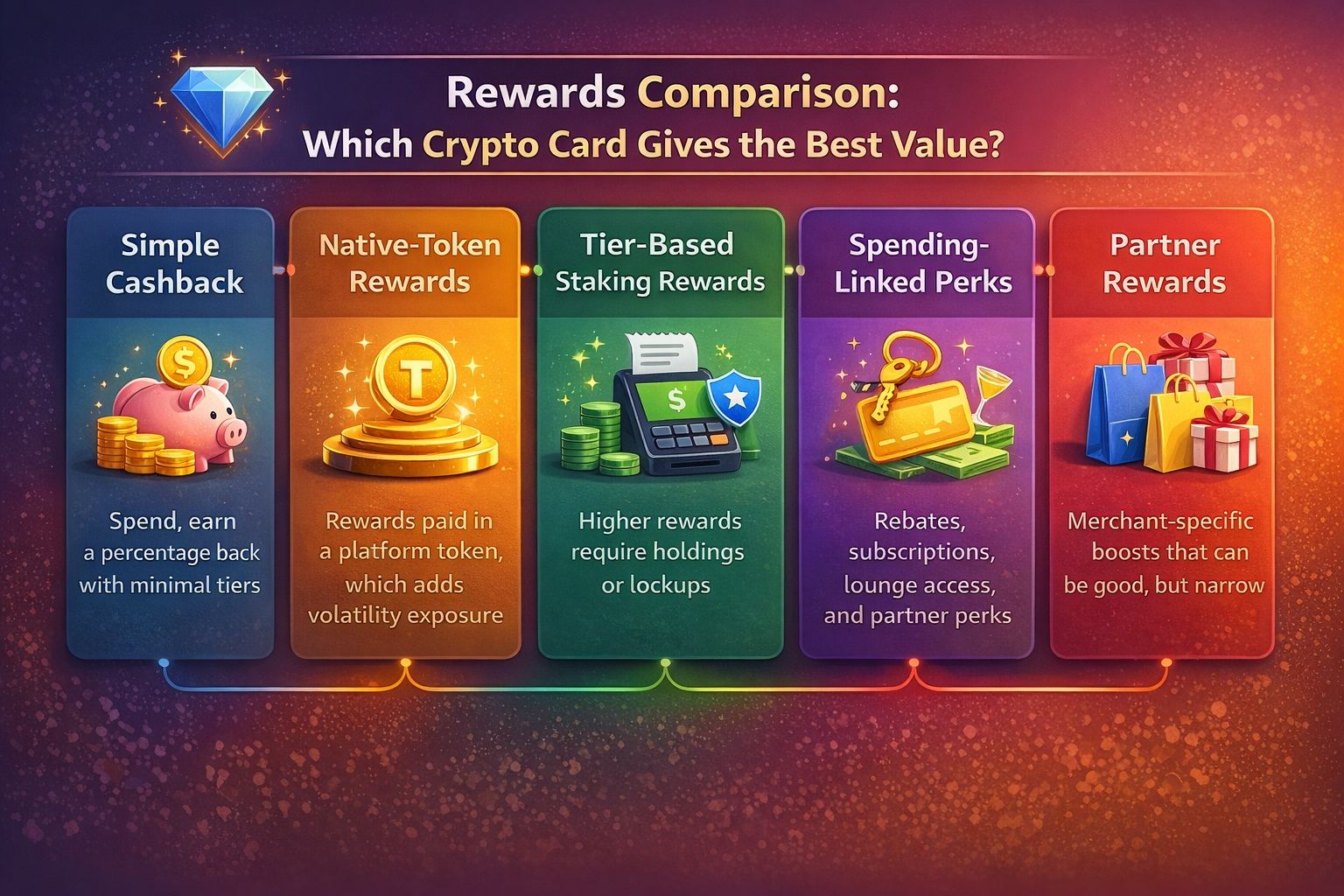 Rewards Range From Simple Cashback and Merchant Perks to Volatile Native Tokens or Tier-based Staking Requirements
Best Simple Cashback Cards
Simple cashback is most valuable when:
- redemption is frictionless, and
- there are limited caps and exclusions.
In practice, “simple cashback” tends to be best for users who don’t want to track tiers and lockups, even if the headline percentage is lower.
Best Staking-Based Rewards Cards
Staking-based cards can look unbeatable on paper, but the real cost is the risk of holding the required token through market cycles. If you wouldn’t hold that token anyway, the rewards may not compensate for the added volatility.
Best Bitcoin Rewards Cards
Bitcoin rewards cards are best when you want BTC back without juggling altcoins. Fold is a strong example because its entire framing is Bitcoin-first, and its membership math is explicit.
Best Rewards for Frequent Spenders
Frequent spenders should prioritize:
- low conversion spreads,
- low FX costs,
- high or no caps, and
- easy redemption.
A “3% back” card with a low cap can become a “0.3% back” card once you exceed the cap.
When High Cashback Is Not Actually Better
High cashback is not better when:
- a subscription fee eats most of the value,
- token rewards drop sharply before you convert them, or
- conversion spreads and FX fees quietly cancel the cashback.
A simple stress test: calculate expected monthly rewards minus fees, then assume the reward token drops 30% before you sell. If the deal fails under stress, it was never that good.
Availability by Region
Availability is the most practical filter, and it changes frequently due to regulation and issuer partnerships. EU-wide rules like MiCA shape how crypto services operate across Europe, which can influence card programs over time.
Best Crypto Cards in the US
Common US-accessible options often include:
- Coinbase Card for a beginner-friendly exchange-linked experience.
- Fold for Bitcoin-oriented rewards.
US users should also be mindful that the IRS treats digital assets under specific tax rules and reporting expectations.
Best Crypto Cards in Europe and the EEA
Europe tends to offer more variety across custody models:
- Gnosis Pay for self-custodial spending.
- Nexo Card for hybrid flexibility.
- Plutus and Wirex for tiered rewards ecosystems.
- Bitpanda Card as a portfolio-linked regional contender.
Best Crypto Cards in the UK
The UK often overlaps with EEA-oriented issuers, but availability still differs by issuer and banking partner. For tax context, the UK government explains crypto disposals and when tax might apply.
Best Crypto Cards for International Travelers
Travelers should prioritize:
- transparent FX policy,
- predictable ATM allowances,
- mobile wallet support, and
- strong in-app security controls.
Cards marketed as “travel-friendly” can still be expensive if spreads stack with FX fees.
Regions Where Availability Is Limited or Unclear
If your region is underserved, treat “global availability” marketing carefully. Merchant acceptance is not the same thing as being eligible to pass KYC and receive a card in your country.
Availability changes frequently due to regulation and issuer partnerships.
Are Crypto Debit Cards Safe?
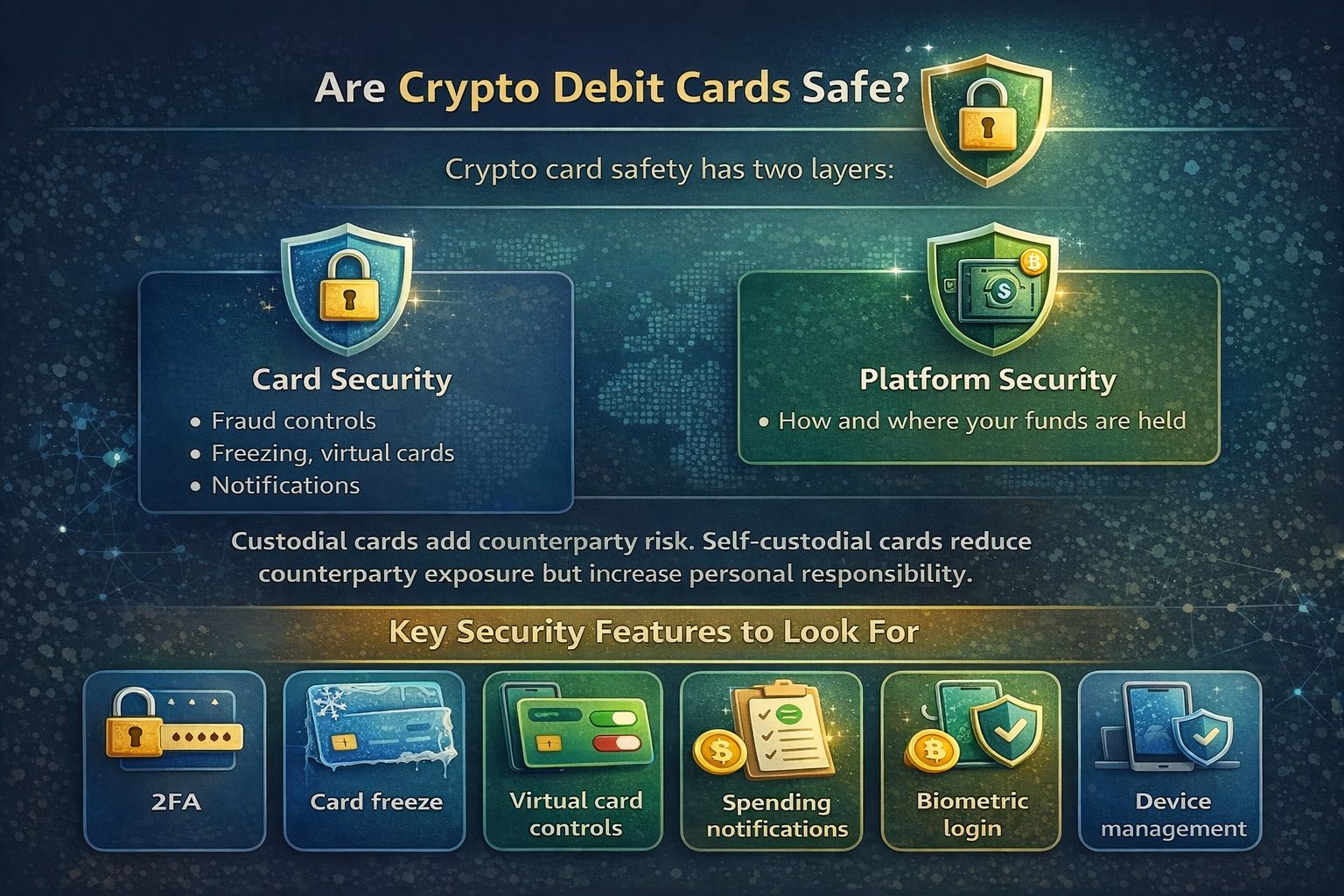 Crypto Card Safety Relies on Integrated Fraud Controls and The Underlying Security of How Assets are Stored.
Crypto card safety has two layers:
- Card security: Fraud controls, freezing, virtual cards, notifications.
- Platform security: How and where your funds are held.
Custodial cards add counterparty risk. Self-custodial cards reduce counterparty exposure but increase personal responsibility.
Key Security Features to Look For
- 2FA.
- Card freeze.
- Virtual card controls.
- Spending notifications.
- Biometric login.
- Withdrawal whitelists.
- Device management.
Custodial Risk vs Self-Custodial Responsibility
Custodial risk looks like account freezes, downtime, or platform failure. Self-custodial responsibility looks like losing keys, signing malicious approvals, or unsafe wallet habits.
Pick the failure mode you can manage.
Security Best Practices Before You Start Spending
- Use a password manager and unique passwords.
- Turn on 2FA and spending notifications.
- Keep only “spending money” on card-linked balances.
- Freeze your physical card when not using it.
- If using self-custody, learn approvals, revocations, and safe transaction hygiene first.
Tax Implications of Using a Crypto Debit Card
In many jurisdictions, spending crypto can count as a taxable disposal. Rewards may also have tax implications depending on your country and the program structure. Check local rules or speak to a qualified tax professional.
Is Spending Crypto a Taxable Event?
In the US, tax treatment and reporting expectations exist for digital asset transactions. IRS digital assets guidance is the starting point for US readers.
Are Cashback Rewards Taxable?
It depends on local rules and how rewards are structured. Some places treat rewards more like rebates, others may treat them as income depending on specifics.
Why Stablecoin Spending May Still Need Tracking
Stablecoins can still have small price movements, fees, and spreads. Your cost basis can still matter, especially at scale.
Record-Keeping Tips for Crypto Card Users
- Export your transaction history monthly.
- Record asset spent, fiat value, and fees.
- Track rewards separately by asset, amount, and date received.
- Keep your accounting method consistent.
Alternatives to Crypto Debit Cards
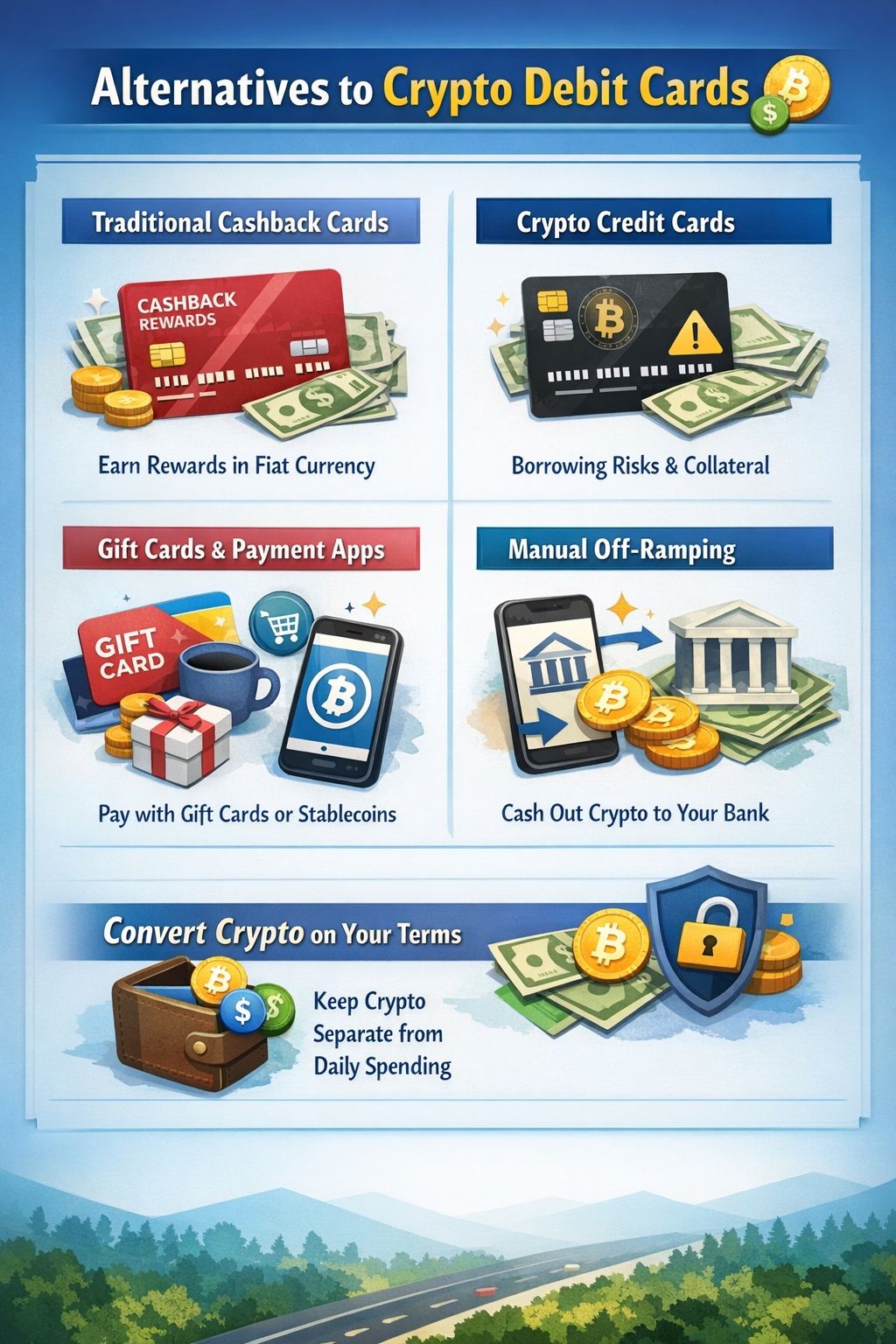 Crypto Cards Aren't The Only Option. There are Alternatives That are Often Cheaper, Simpler, and Better for Taxes
Crypto cards aren’t the only way to convert crypto value into spending. In many cases, alternatives are cheaper, simpler, or easier to track for taxes.
Traditional Cashback Cards
If your goal is rewards with minimal complexity, a normal cashback card is often simpler and more predictable. You can still hold crypto separately and avoid conversion spreads on every purchase.
Crypto Credit Cards
Credit-backed crypto spend products can work if you understand repayment and collateral mechanics. The risk is that borrowing models can add liquidation risk and interest-like costs depending on the structure.
Gift Cards and Payment Apps
Gift card routes can work for specific merchants, especially when you don’t need global acceptance. Some payment apps also let you pay merchants while you manage crypto off to the side, reducing “crypto at checkout” complexity.
This bucket also includes stablecoin payment apps, where you pay with stablecoins in-app rather than via card rails. These can be useful, but acceptance is more limited than Visa or Mastercard networks.
For an in-depth study on stablecoins, take a look at our guide.
Manual Off-Ramping Before Spending
A simple alternative is to sell crypto to fiat on your schedule, move fiat to your bank, and spend with a normal bank card. This also includes the “hybrid” approach many people prefer:
Off-ramp crypto into your bank once per week or month.
Spend using your regular bank debit card.
Keep crypto separate from day-to-day spending.
For users who want more control without custodial card balances, there are also self-custodial settlement tools that let you settle payments from a wallet you control, but these can require more technical comfort and do not always provide universal merchant acceptance.
Pros and Cons of Crypto Debit Cards
Pros
- Lets users spend crypto easily.
- Rewards and cashback can be meaningful for the right user.
- Convenient for travel and online spending.
- Bridges crypto and everyday finance.
Cons
- Tax complexity.
- Platform or custody risk.
- Rewards may depend on staking or native tokens.
- Availability is highly regional.
- Fees can quietly erode value.

Final Verdict
There is no universal best crypto card in 2026. The right pick depends on your region, your tolerance for rewards tier mechanics, your custody preference, your sensitivity to fees, and your spending habits.
A practical wrap-up:
- Best overall: Crypto.com Card.
- Best for rewards: Crypto.com Card if you accept tier mechanics and token risk.
- Best for self-custody: Gnosis Pay if you can handle the responsibility.
- Best for beginners: Coinbase Card if you’re in the US.
- Best for travel: Wirex for a multi-currency style approach, but verify your region’s fees.
If you’re unsure, default to the lowest-complexity option available in your country, keep only small balances on card-linked accounts, and prioritize security controls and fee transparency over flashy reward numbers.