



Best Overall
Binance Wallet
MPC-based self-custody, native BNB ecosystem integration, and tight exchange connectivity.
- MPC key management for self-custody.
- Built for the BNB ecosystem.
- Fast bridge between wallet and exchange.
BNB exists across two networks, the BNB Beacon Chain and BNB Smart Chain. When someone says “BNB wallet,” they almost always mean BNB Smart Chain, because that’s where DeFi, tokens, NFTs, and most on-chain activity take place. The real goal is not just storage. You want a wallet that keeps your BNB and BSC tokens secure, and also helps you swap, stake, and use DApps without falling for scams, bad approvals, or the wrong network settings.
Now, before we jump into the wallet list, it helps to get one thing straight: what the “BNB wallet” needs to support, and what features are non-negotiable for BSC users.
Most wallet roundups skip the basics and go straight to brand names. That’s backwards. On BNB Smart Chain, small UX choices become security issues fast, especially around token approvals and fake DApps. So we’ll start by defining what to look for, then map each wallet to a real user profile.
Editor's note: We fully updated this guide in February 2026 to reflect how BNB is actually used today across BNB Smart Chain, including the shift away from BEP-2/Beacon Chain in most real-world scenarios. This refresh adds a new 2026 quick-answer shortlist, an expanded comparison table + feature matrix, and deeper sections on gas fees, token standards, staking mechanics, and opBNB wallet support. We also reviewed each recommended wallet for current functionality, security model changes (hardware vs MPC/seedless), and practical DeFi safety risks like token approvals and phishing.
If you just want the shortlist, here are the five best BNB wallets in 2026 and why they stand out. These picks are based on current 2026 documentation, feature updates, and ecosystem compatibility.
MPC-based self-custody, native BNB ecosystem integration, and tight exchange connectivity.
BNB-native, strong mobile UX, built-in staking, and dApp browser.
Secure Element hardware isolation with BNB Smart Chain support via Ledger Live and external integrations.
Full EVM compatibility, deep dApp support, and a familiar workflow on BNB Smart Chain.
Air-gapped QR signing with BNB and BSC token support at a lower cost.
If the quick picks gave you direction, this is the moment for the shopping aisle. Instead of jumping between individual reviews, you can scan the core differences in one place.
| Wallet | Type | Overall Score (Weighted) | Official Price (MSRP) | BNB Staking | opBNB Support | BEP-20 / BEP-721 | DeFi / dApp Connection | Setup Time + Difficulty |
| Binance Web3 Wallet | MPC (App-integrated) | 9.2/10 | Free | Native + via dApp | Yes | Yes / Yes | Built-in + WalletConnect | 3 min · Easy |
| Trust Wallet | Mobile | 9.0/10 | Free | Native + dApp | Yes | Yes / Yes | Built-in browser + WalletConnect | 2 min · Easy |
| MetaMask | Browser / Mobile | 8.8/10 | Free | Via dApp | Yes (manual RPC) | Yes / Yes | Extension + WalletConnect | 5 min · Moderate |
| Ledger (Nano S Plus / Nano X) | Hardware | 9.5/10 (Security-weighted) | Nano S Plus: $79; Nano X: $149 | Via Ledger Live / dApp | Yes (via integration) | Yes / Yes | Ledger Live + MetaMask | 15 min · Moderate |
| Trezor Safe 5 | Hardware | 8.9/10 | $129 | Via dApp | Yes (via integration) | Yes / Yes | Trezor Suite + MetaMask | 15 min · Moderate |
| Exodus | Desktop / Mobile | 8.6/10 | Free | Limited native / via dApp | Yes (manual add) | Yes / Yes | Built-in + WalletConnect | 5 min · Easy |
| Edge Wallet | Mobile | 8.3/10 | Free | Via dApp only | Manual network add | Yes / Yes | WalletConnect | 3 min · Easy |
| SafePal S1 | Hardware (Air-gapped) | 8.7/10 | $49.99 | Via SafePal app | Yes | Yes / Yes | QR signing + App | 10 min · Moderate |
| Tangem Wallet | Hardware Card (NFC) | 8.5/10 | $54.90–$69.90 (Discounted offer) | Via Tangem app | Yes | Yes / Yes | NFC + WalletConnect | 5 min · Easy |
| Zengo Wallet | MPC (Seedless) | 8.4/10 | Wallet: Free; Pro: $19.99/mo or $89.99/yr | Via dApp | Yes | Yes / Yes | WalletConnect | 3 min · Easy |
A few notes that matter for BNB users in 2026:
BNB Staking: Native staking is smoother in Binance Wallet, Trust Wallet, OKX, and TokenPocket. Hardware wallets require dApp delegation.
opBNB: Most EVM wallets support it once the network RPC is configured. Binance and Trust pre-integrate faster.
Security tradeoff: MPC (Binance Wallet) reduces single seed exposure. Hardware wallets isolate private keys fully offline.
That’s the structural view. Now let’s zoom out and simplify feature presence across wallets for quick scanning.
If you don’t care about scores and just want to know what exists where, this condensed matrix helps.
Legend:
✅ = Built-in
🟡 = Supported via integration or config
❌ = Not supported
| Wallet | Staking | opBNB | Hardware-grade Security | Mobile App | Browser Extension | NFT Gallery (BEP-721) | On/Off-Ramp |
| Binance Wallet | ✅ | ✅ | 🟡 (MPC) | ✅ | ❌ | ✅ | ✅ |
| Trust Wallet | ✅ | ✅ | ❌ | ✅ | ❌ | ✅ | ✅ |
| MetaMask | 🟡 | 🟡 | ❌ | ✅ | ✅ | 🟡 | ❌ |
| Ledger | 🟡 | 🟡 | ✅ | 🟡 | 🟡 | 🟡 | ❌ |
| Trezor | 🟡 | 🟡 | ✅ | ❌ | 🟡 | 🟡 | ❌ |
| Exodus | 🟡 | 🟡 | ❌ | ✅ | ❌ | ✅ | ✅ |
| Edge | 🟡 | 🟡 | ❌ | ✅ | ❌ | 🟡 | ✅ |
| SafePal S1 | 🟡 | ✅ | ✅ (Air-gapped) | ✅ | ❌ | ✅ | 🟡 |
| Tangem | 🟡 | ✅ | ✅ (Secure chip) | ✅ | ❌ | ✅ | 🟡 |
| Zengo | 🟡 | ✅ | 🟡 (MPC) | ✅ | ❌ | ✅ | 🟡 |
Quick Interpretation:
For detailed reviews on hardware and software solutions, check out the best crypto wallets analysis.
Most wallet guides rush into brand comparisons without explaining the network those wallets actually operate on. That creates a shallow decision process where users choose based on interface polish rather than structural compatibility. If you want to choose the right BNB wallet in 2026, you need to understand how BNB Chain works at a mechanical level, how gas is calculated, what token standards actually mean, how staking locks liquidity, and where opBNB fits into the architecture.
BNB Chain today primarily refers to BNB Smart Chain (BSC), an EVM-compatible blockchain that mirrors Ethereum’s transaction model while maintaining lower gas costs and faster block times. That EVM compatibility is not a marketing phrase; it means transactions, smart contracts, gas pricing, and token standards function in the same way as Ethereum. If you understand Ethereum mechanics, you already understand BSC. If you don’t, this section will fix that.
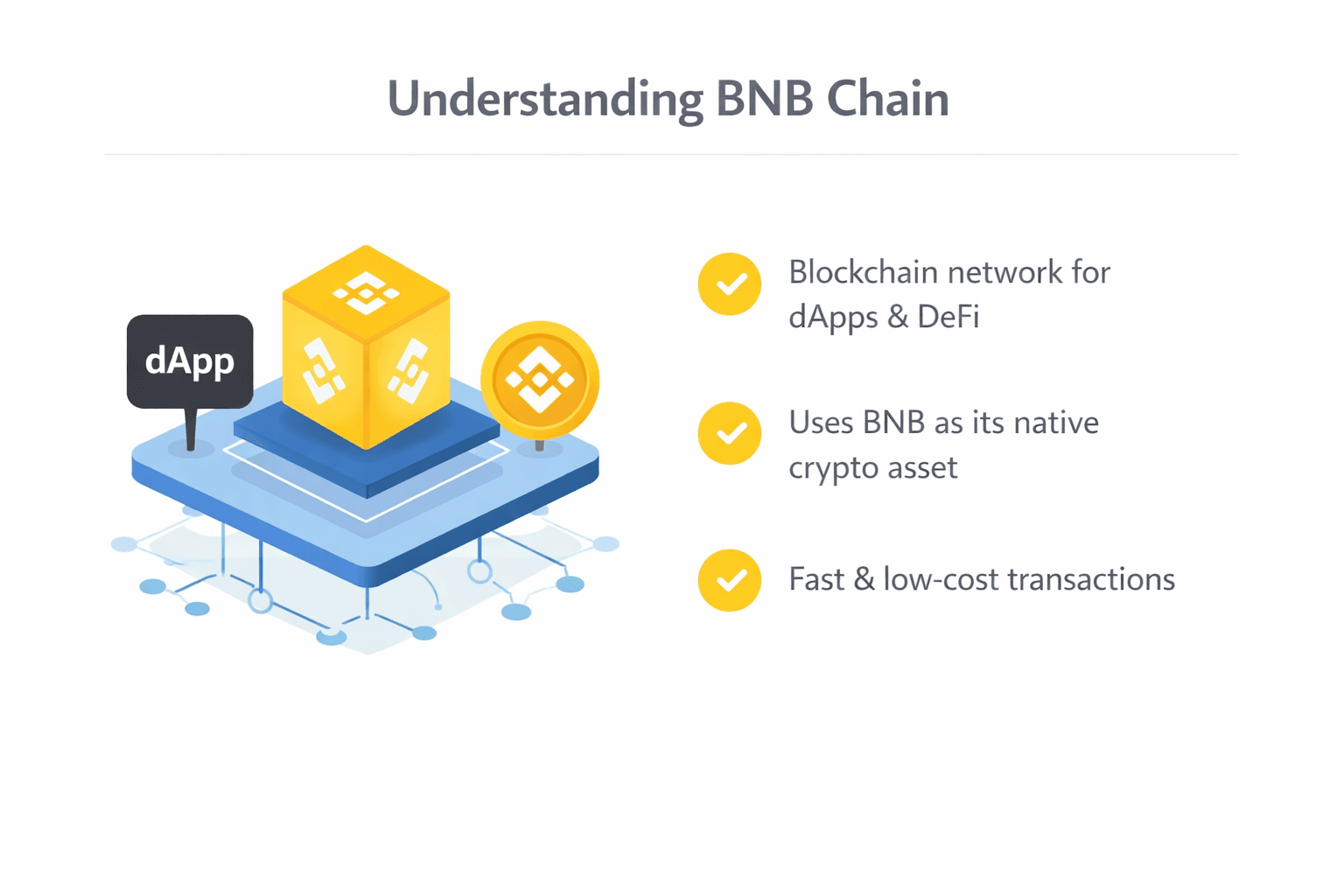 Core Architecture And Ecosystem Of BNB Chain
Gas on BNB Smart Chain operates under the same logic as Ethereum’s execution model. Every action, whether transferring BNB, swapping tokens, minting an NFT, or staking, requires computational effort from validators. That effort is measured in gas units. The total fee you pay is determined by multiplying those gas units by the gas price, which is quoted in gwei.
Here is the core formula that governs every transaction:
TransactionFee = GasUnits × GasPrice
Gas units are mostly predictable for common actions. The variable part is gas price, quoted in gwei.
What is gwei?
Gas price is denominated in gwei. One BNB equals one billion gwei. When you see a gas price of 0.05 gwei, you are looking at an extremely small fraction of a BNB.
1 BNB = 1,000,000,000 gwei (so gwei is just a tiny fraction of a BNB).
21,000 × 0.05 gwei
1,050 gwei
0.00000105 BNB
120,000–200,000 × 0.05 gwei
6,000–10,000 gwei
0.000006–0.00001 BNB
If the network is busy and gas price rises, these totals rise too.
Wallet UX tip (why it matters): The best BNB wallets don’t just show a single “fee” number. They clearly display gas limit, gas price, and the total cost, and they let you manually adjust gas when you need faster confirmations or want to avoid failed transactions.
See our best crypto exchanges with the lowest fees to find platforms that cut your trading costs.
If gas mistakes waste small amounts, network mistakes can cost everything. This is where users most often lose funds, not because the wallet failed, but because the wrong token standard was used.
BNB exists across multiple standards, each tied to different layers of the ecosystem. Understanding the distinction prevents irreversible errors.
BEP-20 is the token standard for BNB Smart Chain. It functions similarly to Ethereum’s ERC-20 standard and is the backbone of almost every modern BNB interaction.
When you:
Trade tokens
Use decentralized exchanges
Transfer stablecoins
Interact with DeFi protocols
Deposit to most exchanges
You are using BEP-20.
Addresses begin with 0x, identical to Ethereum-style formatting. If you are unsure which network to select, BEP-20 is almost always correct in 2026.
BEP-2 belongs to the original Beacon Chain architecture, which predates BSC’s dominance. Some exchanges still list BEP-2 for compatibility reasons, but ecosystem momentum has shifted decisively toward BSC.
The problem is structural incompatibility. BEP-2 addresses and mechanics differ. Sending BEP-20 tokens to a BEP-2 address can create recovery complications. While technical recovery may be possible in certain custodial environments, it is not guaranteed.
Treat BEP-2 as legacy unless explicitly required.
BEP-721 is the NFT standard on BNB Smart Chain. It mirrors Ethereum’s ERC-721 logic and governs non-fungible token ownership and metadata references.
If your wallet supports NFTs on BNB, it supports BEP-721. However, display support and indexing vary by wallet. Some wallets technically hold NFTs but do not render them in a gallery view.
Before confirming any transaction, verify:
Network selection (BNB Smart Chain / BEP-20)
Address format (0x style)
Exchange deposit network
Memo requirements, if interacting with legacy infrastructure
Test transfer if uncertain
Wallets sign transactions. They do not correct logical mistakes.
Staking BNB involves delegating tokens to validators who produce blocks and secure the network. In return, you earn a portion of block rewards. On paper, this sounds simple. In practice, staking mechanics introduce liquidity and yield dynamics that wallet users must understand.
BNB staking APR in 2026 typically fluctuates between 4% and 8% annually. This is not a fixed rate. It shifts based on:
Total BNB staked
Validator participation
Network emission parameters
Slashing events
As more BNB is delegated, rewards are distributed across a larger pool, lowering APR. When participation declines, APR increases. Yield reflects network participation dynamics, not a guaranteed fixed return.
Validators charge commission on rewards, generally ranging from 5% to 20%. This commission applies only to rewards, not principal.
Choosing a validator with the lowest commission is not automatically optimal. Validator uptime, performance history, and decentralization footprint matter. A validator with lower uptime may earn you less, even with lower commission.
When you unstake BNB, tokens enter a 7-day unbonding period. During that time:
Tokens cannot be transferred
No rewards are earned
Liquidity is frozen
This matters for liquidity management. If you actively trade, use BNB as collateral, or anticipate volatility, consider staking only a portion of your holdings.
Wallet interfaces vary in how clearly they communicate this constraint. A well-designed staking interface should make the unbonding delay explicit.
BNB Smart Chain already operates with low fees and fast block times. opBNB extends this further by introducing an optimistic rollup Layer 2 designed for high-throughput use cases.
opBNB is particularly relevant for:
Blockchain gaming
NFT micro-transactions
High-frequency trading environments
Social and micro-payment systems
Layer 2 transactions batch and settle to the main chain, reducing load and improving scalability.
However, “wallet support” for opBNB can mean different things.
Native support: The network appears automatically within the wallet.
Manual configuration: You add RPC settings manually.
WalletConnect compatibility: Access through dApps rather than built-in listing.
For active Layer 2 users, native support improves the experience. For long-term holders or stakers, opBNB support is less critical.
The key is alignment between usage pattern and wallet capability.
By understanding gas mechanics, token standards, staking economics, and Layer 2 architecture, you shift from choosing a wallet based on surface features to choosing based on structural compatibility. The rest of this guide builds on that foundation, examining each wallet through the lens of security model, staking pathway, DeFi integration, and opBNB support.
Not everyone using BNB is doing the same thing. Some are staking long-term. Some are farming on BNB Smart Chain every day. Some are holding size and want cold storage isolation. Others just want a clean mobile app that works.
Instead of ranking everything on a single scale, it makes more sense to group wallets by how people actually use them. This section aligns wallet type with usage intent, so you can narrow your decision quickly before diving into deeper reviews.
Tap to expand a wallet for details.
If your priority is private key isolation and long-term capital protection, hardware wallets are the standard. They store keys offline and require physical confirmation for transactions, which drastically reduces remote attack vectors.
Ledger remains a strong security-first choice for BNB holders in 2026. The Nano S Plus is usually the best value option, while the Nano X adds Bluetooth support for mobile use.
Ledger supports BNB Smart Chain through Ledger Live and via integrations with wallets like MetaMask. That means you can:
Tradeoff: most BSC DeFi flows happen through an external interface (often MetaMask), with final signing confirmed on the device.
Trezor offers hardware-grade protection with a different ecosystem model. The Safe 5 is the more modern device, while the Model T is a well-known option for users who prefer Trezor’s approach.
BNB Smart Chain interaction typically happens through external wallet integrations, similar to Ledger. You connect Trezor to MetaMask, configure BSC, and sign transactions via the hardware device.
In practice, Ledger vs Trezor often comes down to interface preference, firmware philosophy, and integration comfort.
SafePal S1 uses an air-gapped QR signing model, meaning the device never connects via USB or Bluetooth. Transactions are signed through QR code scanning between the device and the SafePal mobile app.
For BNB users, this creates a hybrid experience. You get:
Security is strong for the price point, though it doesn’t carry the same long-standing reputation as Ledger for some users.
Mobile wallets dominate retail usage because they balance control and convenience. If you interact with BNB daily or stake directly from your phone, this category matters.
Trust Wallet has long been a default mobile wallet for BNB users. It supports BEP-20 tokens natively, integrates BNB staking in-app, and includes Web3 browsing capabilities.
Best suited for retail staking, NFT holding, and moderate DeFi participation.
If you already operate inside the Binance ecosystem, Binance Wallet simplifies transitions between exchange balances and on-chain BNB. Its MPC-based architecture reduces traditional seed phrase management while keeping user control intact.
Not a hardware substitute, but a lower-friction option for ecosystem-aligned users.
Edge is a mobile-first, multi-asset wallet with a strong focus on client-side encryption. It supports BNB Smart Chain assets and suits users who want a simple, multi-coin wallet without deep DeFi complexity.
Works well for moderate balances and mainstream usage.
If you’re interacting with PancakeSwap, lending protocols, bridges, or NFT marketplaces regularly, browser extension wallets provide speed and control.
Desktop-native wallets are less common for BNB specifically, but they can offer a broader portfolio view for users managing multiple assets from one system.
Exodus provides a desktop interface with built-in portfolio tracking and a visually clean experience. It supports BNB Smart Chain assets and appeals to users who want multi-asset management without extension-based workflows.
Not optimized for heavy DeFi execution, but strong for long-term monitoring and diversified holdings.
The comparison table showed how the wallets stack up. Now we zoom in. Each review below breaks down security architecture, staking support, opBNB compatibility, real-world usability, and where each wallet genuinely stands in 2026.
We start with the option most tightly integrated into the BNB ecosystem.
Tap to expand a wallet to read the full review.
Binance Wallet is designed specifically for users operating inside the Binance ecosystem, but it has matured into a serious standalone Web3 wallet in 2026. It uses an MPC architecture instead of a traditional seed phrase, splitting key material into encrypted shards rather than generating a single 12-word recovery phrase. For many users, that removes the psychological friction of managing seed backups, while still preserving self-custody principles.
Unlike generic EVM wallets, Binance Wallet feels natively aligned with BNB Smart Chain. That alignment shows up in staking integration, token discovery, and opBNB visibility.
Binance Wallet is strongest when the user is operating directly within the BNB infrastructure rather than hopping chains constantly. It works particularly well for:
For users who actively move between Binance exchange accounts and on-chain positions, this wallet reduces transfer complexity significantly.
One of its strongest advantages is ecosystem depth. It does not feel like a third-party EVM wallet retrofitted for BNB — it feels purpose-built.
There is no manual RPC friction for most BNB use cases. That matters for mainstream users.
Binance Wallet uses MPC rather than a single private key stored locally. This reduces the risk of seed phrase theft, but it introduces a different trust assumption: recovery depends on shard reconstruction and account-level authentication.
Phishing risk remains relevant because transactions are still signed at the user level. The wallet includes:
However, advanced contract simulation tools are less granular compared to extension-first wallets like Rabby. For high-value holdings, MPC is strong. For highly technical DeFi activity, some users prefer the transparency of extension wallets.
Common praise
“Easy transition from Binance exchange.” “Staking and token management feel seamless.”
Common complaints
“Limited advanced DeFi configuration.” “Less transparent gas settings.”
Best practice tip
If using Binance Wallet for large holdings, enable all available account security layers and avoid signing blind contract interactions without reviewing transaction details.
Trust Wallet has been tightly associated with BNB from the early days of BNB Smart Chain, and that alignment still shows in 2026. While it supports dozens of chains, its BNB implementation feels native rather than bolted on. Token discovery works smoothly, staking is integrated directly into the interface, and most BSC dApps connect without friction.
Unlike Binance Wallet’s MPC model, Trust Wallet follows the traditional seed phrase architecture. You generate and store a 12-word recovery phrase, which fully controls your assets. That makes security entirely user-dependent. If you protect your seed correctly, you control your funds. If you lose it, there is no recovery layer.
This makes Trust Wallet structurally simpler than MPC wallets, but also less forgiving.
Trust Wallet excels when BNB is part of active daily usage rather than long-term cold storage. The mobile design supports quick transfers, DeFi interactions, and NFT management without requiring browser extensions or desktop connections.
It is particularly strong for:
Because the wallet includes a built-in dApp browser in certain regions and supports WalletConnect broadly, it removes the need for extension-heavy workflows. That matters for users who primarily operate from mobile devices.
The strength of Trust Wallet lies in usability. It abstracts complexity without fully hiding mechanics. Gas fees are visible. Transactions are previewed before signing. Validator choices are surfaced clearly during staking.
In practical terms, Trust Wallet handles almost every mainstream BNB Smart Chain use case without requiring manual configuration.
Trust Wallet’s security is only as strong as the user’s seed management. The private key is generated locally and never leaves the device, but that means recovery depends entirely on the 12-word phrase.
Threat vectors include:
Trust Wallet provides transaction previews and permission confirmations, but it does not simulate contracts as deeply as advanced browser wallets like Rabby. Users interacting with complex DeFi contracts must manually review what they are signing.
The most common mistake is approving unlimited token allowances without understanding contract permissions. For higher-value holdings, pairing Trust Wallet with a hardware wallet for large allocations while keeping a mobile wallet for active use is a balanced strategy.
Common praise
“Smooth staking and token management.” “Works perfectly with PancakeSwap and BSC dApps.”
Common complaints
“Security depends entirely on seed backup.” “Limited advanced gas fine-tuning compared to browser wallets.”
Best practice tip
Regularly review token approvals on BNB Smart Chain using an approval management tool, especially if you actively farm or trade.
Ledger’s Nano S Plus is the most practical hardware option for BNB users in 2026. While the Nano X adds Bluetooth support, the S Plus delivers the same Secure Element architecture at a lower cost, which makes it the better default recommendation unless you specifically need mobile Bluetooth connectivity.
Ledger is not designed to feel frictionless. It is designed to isolate risk. Your private keys never leave the device. Every transaction must be physically confirmed. That physical confirmation layer changes the threat model completely compared to hot wallets.
For BNB users managing serious capital, that difference matters.
Ledger becomes relevant the moment BNB holdings shift from “active trading capital” to “long-term allocation.” It is not optimized for rapid mobile swaps. It is optimized for secure custody. It works particularly well for:
Most BNB Smart Chain activity on Ledger occurs through an interface such as MetaMask. Ledger provides the signing layer. MetaMask provides the execution layer. This separation ensures that even if the browser environment is compromised, the attacker cannot sign transactions without the physical device.
That layered architecture is Ledger’s core strength.
Ledger Live provides basic portfolio visibility, but most advanced BSC interaction happens through third-party integrations. The workflow is slower than hot wallets. That is intentional.
Ledger does not include a built-in BNB staking UI. You must connect to a staking dApp and sign transactions on the device. For users who prefer a native staking interface, Trust Wallet or Binance Wallet may feel smoother. For users prioritizing security over convenience, Ledger remains stronger.
Ledger isolates private keys in hardware. That eliminates:
However, it does not eliminate phishing. If you approve a malicious transaction on the device screen, the hardware will execute it. The device protects keys, not judgment.
Threat considerations include:
Best practice is to pair Ledger with a clear transaction preview environment such as MetaMask and verify contract addresses carefully before signing. For BNB users holding substantial assets, hardware isolation remains the gold standard.
Common praise
“Peace of mind for long-term storage.” “Works reliably with MetaMask for BSC.”
Common complaints
“Less convenient for frequent DeFi users.” “Setup is more complex than mobile wallets.”
Best practice tip
Use Ledger as your primary storage vault and connect it to MetaMask for occasional DeFi interaction, rather than keeping large BNB balances in a hot wallet.
Trezor approaches hardware security with a slightly different philosophy than Ledger. Where Ledger emphasizes Secure Element isolation, Trezor emphasizes open-source firmware transparency. For users who care deeply about auditability and community-reviewed code, that distinction matters.
From a BNB perspective, Trezor Safe 5 functions similarly to Ledger in structure. It isolates private keys offline and requires physical confirmation for every transaction. The difference lies less in daily workflow and more in design philosophy and ecosystem integration preferences. Trezor is not designed to compete with mobile-first wallets. It is built for capital preservation.
Trezor Safe 5 is most appropriate when BNB is treated as a long-term asset allocation rather than daily execution capital. It is particularly well-suited for:
Like Ledger, Trezor does not provide a native BNB staking interface inside its desktop suite. Staking and DeFi interaction happen through dApp integrations, typically via MetaMask. This makes Trezor structurally secure but slightly less convenient for frequent interaction.
Trezor Safe 5 improves over older models in display clarity and device responsiveness, making transaction verification easier. When interacting with smart contracts on BNB Smart Chain, transaction details are displayed directly on the device before approval. That final confirmation layer differentiates hardware wallets from extension-only options.
As with Ledger, Trezor relies on external interfaces for BNB Smart Chain execution. It provides the signing layer, not the application layer. Users who expect an all-in-one mobile experience will find it restrictive. Users who prioritize cold storage will find it sufficient.
Trezor isolates private keys from internet-connected devices. This mitigates remote key extraction, malware scanning for private keys, and direct browser compromise.
However, hardware wallets do not eliminate phishing risk. If you approve a malicious transaction on the device screen, it will execute. The device protects private keys, not transaction intent.
Key risk considerations include signing blind contract approvals, unlimited token allowances, and fake dApps mimicking real BNB protocols.
Because Trezor relies on integration with MetaMask or other interfaces for BSC, security is layered. The browser handles interaction. The hardware handles signing. The weakest layer determines overall risk. For users who value open-source firmware transparency, Trezor offers peace of mind in how the device operates internally.
Common praise
“Trustworthy open-source architecture.” “Solid hardware security for long-term storage.”
Common complaints
“Less convenient for daily DeFi.” “Requires MetaMask integration for most BNB activity.”
Best practice tip
Use Trezor as a primary storage vault and delegate BNB staking via a trusted staking dApp, rather than keeping all BNB in hot wallets for yield.
Exodus sits in a different category from MetaMask, Trust Wallet, and hardware devices. It is not optimized for hardcore DeFi execution, nor is it designed purely as a cold storage vault. Instead, it positions itself as a polished desktop wallet for managing diversified crypto holdings in one place. For BNB users, Exodus works best when BNB is part of a broader portfolio strategy rather than a daily DeFi tool.
Exodus is particularly useful for users who:
It supports BNB and BEP-20 tokens, but its DeFi connectivity is not as deep as MetaMask’s browser-injected model. You can connect Exodus to certain dApps through WalletConnect, but heavy DeFi users will likely find it less flexible. That said, for long-term portfolio tracking and moderate activity, Exodus is structurally comfortable.
One of Exodus’s strengths is visual clarity. Portfolio allocation, transaction history, and token balances are presented cleanly without requiring manual token imports in most cases. It removes complexity, but that also means less customization.
Unlike Trust Wallet or Binance Wallet, Exodus does not feel BNB-native. It feels multi-chain first, BNB-compatible second. That distinction matters if BNB is your primary ecosystem rather than just one of many holdings.
Exodus stores private keys locally on your device, encrypted by a password. It is a hot wallet, which means it is connected to the internet during operation.
Primary risks include malware on the host device, phishing through WalletConnect, and compromised device environments.
The wallet does not include a Secure Element or hardware isolation layer unless paired with Ledger. For moderate BNB allocations, this may be acceptable. For large capital allocations, hardware pairing is advisable. Exodus emphasizes usability over granular security tooling. It does not simulate smart contracts or deeply analyze token approvals.
Common praise
“One of the cleanest wallet interfaces.” “Great for tracking multiple assets.”
Common complaints
“Not ideal for advanced BSC DeFi.” “Less flexible than MetaMask.”
Best practice tip
If using Exodus for BNB, consider pairing it with a hardware wallet for long-term storage and use Exodus primarily as an interface rather than a primary custody layer.
Edge Wallet is a mobile-first wallet that emphasizes privacy, simplicity, and cross-chain support. It isn’t built specifically for BNB, but it supports BNB Smart Chain alongside a wide range of other networks, tokens, and assets. That broad support makes it a comfortable choice for users who hold BNB as part of a broader digital asset mix without needing heavy DeFi execution tooling.
Edge does not compete with native staking interfaces or heavy dApp execution environments. What it aims for is a clean mobile experience that minimizes clutter while still giving users control over their keys and assets.
Edge Wallet works best when BNB is one of several assets you’re managing, and you prioritize a clean, privacy-respecting interface over deep DeFi power. Key use cases include:
Because Edge is not primarily designed around heavy staking or DeFi workflows specific to BNB Smart Chain, users with daily trading or advanced DeFi needs will find it less optimized than MetaMask or Trust Wallet.
Edge does not maintain its own embedded browser for BNB dApps, which means most contract interactions happen through WalletConnect sessions initiated on external interfaces.
Edge stores private keys locally and encrypts them with your device passcode and optional biometrics. This remains a hot wallet model. For moderate balances and everyday use, this is often acceptable. For larger allocations or regular DeFi interaction, consider stronger isolation options.
Common praise
“Easy to set up and use across many different chains.” “Good for multi-asset holders who don’t need heavy DeFi.”
Common complaints
“Not as powerful for BSC DeFi as Trust Wallet or MetaMask.” “NFT support metrics vary by region and version.”
Best practice tip
Use Edge for diversified holdings and simple BNB management, but connect to dedicated interfaces via WalletConnect for staking or heavier DeFi tasks.
SafePal S1 represents a different approach to hardware wallets compared to mainstream devices like Ledger or Trezor. Instead of USB or Bluetooth connectivity, it uses an air-gapped workflow: the device signs transactions using QR codes scanned between the device and a mobile app. This minimizes attack vectors tied to direct connections while keeping the device relatively affordable.
Private keys are never exposed via physical connection to another device. However, the recovery phrase must be secured offline, and the phone/app environment remains a hot layer.
Common praise
“Solid hardware isolation for a lower price.” “Air-gapped model feels genuinely secure.”
Common complaints
“Workflow is slower than connected devices.” “Requires contextual care when signing complex contracts.”
Best practice tip
Keep the recovery phrase offline and use the SafePal app only on trusted devices. For large BNB allocations, review transaction details on every QR prompt.
Tangem takes a different hardware path: it’s a physical card rather than a dongle or device with buttons. When interacting with crypto, you tap the card to your phone (NFC) and sign transactions within a companion wallet app. That combination creates a simple “hardware + mobile” experience.
Tangem secures keys in a hardware secure element. NFC signing requires physical proximity. The key defense is verifying transaction details in the companion app before tapping.
Common praise
“Feels like a mainstream physical wallet with real hardware security.” “Simplest hardware custody I’ve tried.”
Common complaints
“Not ideal if I interact with DeFi every day.” “Needs better in-app staking workflows.”
Best practice tip
Use Tangem to secure primary BNB holdings and pair it with a trusted dApp interface via WalletConnect for occasional DeFi actions rather than daily experimentation.
Zengo takes a different direction from seed-phrase wallets by eliminating the traditional mnemonic altogether. Instead, it uses multi-party computation (MPC) to split key material across multiple parties so there’s no single seed to back up or lose. This appeals to users who want self-custody but hate the idea of a 12- or 24-word phrase that can be lost, copied, stolen, or mistyped.
MPC reduces risk from written seed phrases that can be lost or copied, but introduces trust assumptions about how key shares are distributed and reconstructed. The phone environment remains a hot wallet surface, so device hygiene still matters.
Common praise
“Seedless model removes the fear of losing keys.” “Great onboarding experience for newcomers.”
Common complaints
“Not as flexible as MetaMask for DeFi.” “Recovery flow has more moving pieces.”
Best practice tip
Even with seedless MPC recovery, maintain secure backups of any recovery proofs and link trusted recovery contacts to ensure you can regain access if your device is lost.
At this point, you’ve seen the mechanics, the custody models, and the trade-offs. Now we simplify it.
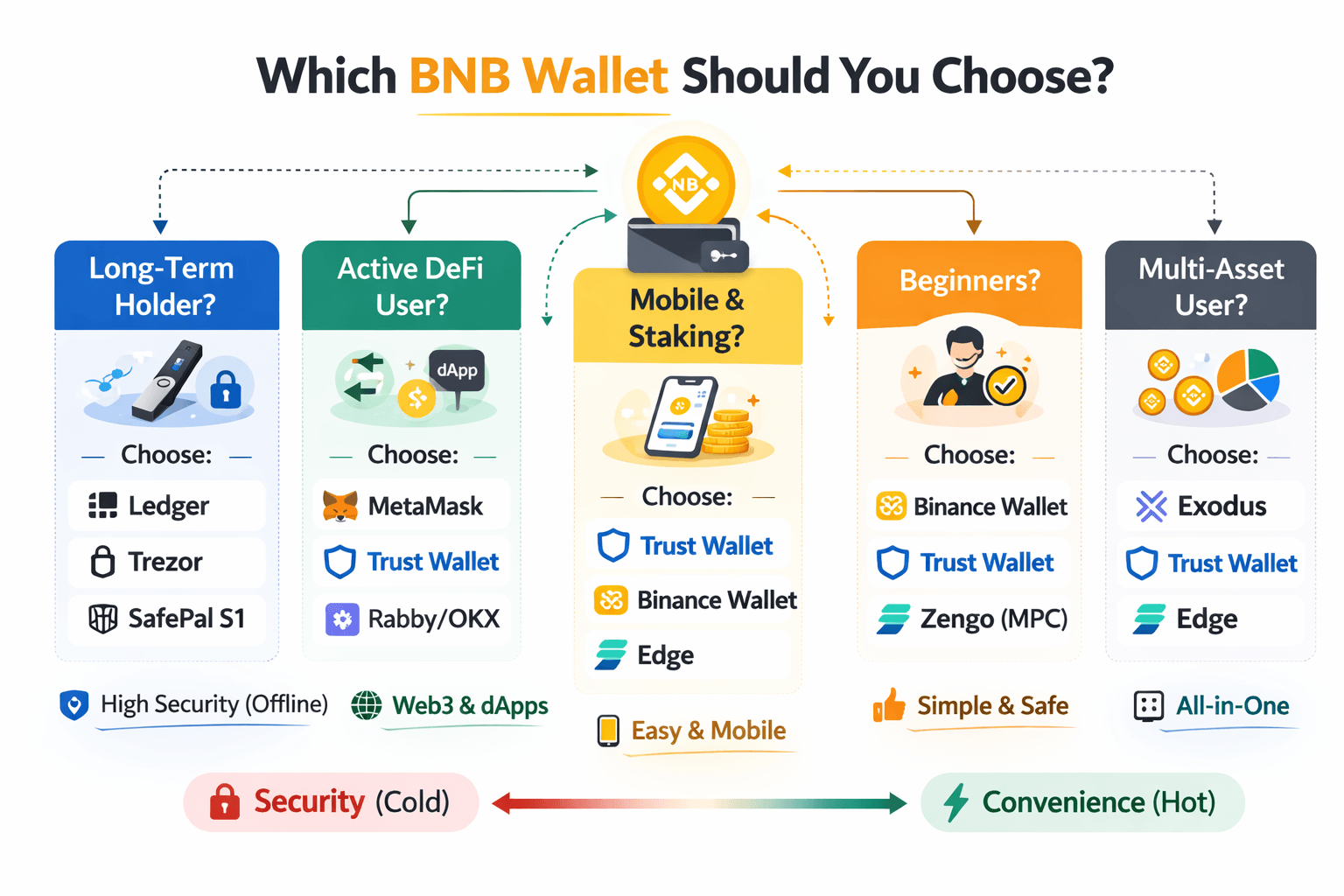 Guide To Picking The Right Wallet For Your Needs
Choosing the best BNB wallet is not about brand reputation. It’s about matching your usage pattern to the right security model. Most mistakes happen when someone picks a wallet built for one type of user and uses it for something completely different.
So instead of another ranking, let’s filter the decision properly.
Before picking anything, answer these three questions honestly.
Once you have those answers, the decision becomes straightforward.
Now we align behavior with structure. This is where most wallet guides fail. They recommend tools without mapping them to risk tolerance and execution frequency.
Wallet choice is not permanent. Many experienced BNB users split roles: Hardware for storage, a mobile wallet for staking, extension wallet for DeFi execution.
That layered approach reflects how risk actually works on BNB Smart Chain.
Now we shift to execution. Because the truth is simple: the “best BNB wallet” is meaningless if it’s set up incorrectly. Most losses don’t come from protocol exploits. They come from rushed setups, wrong networks, blind approvals, or skipping test transfers.
This section walks throughthe setup properly, not mechanically. The goal is not just to get a wallet running, but to get it running safely.
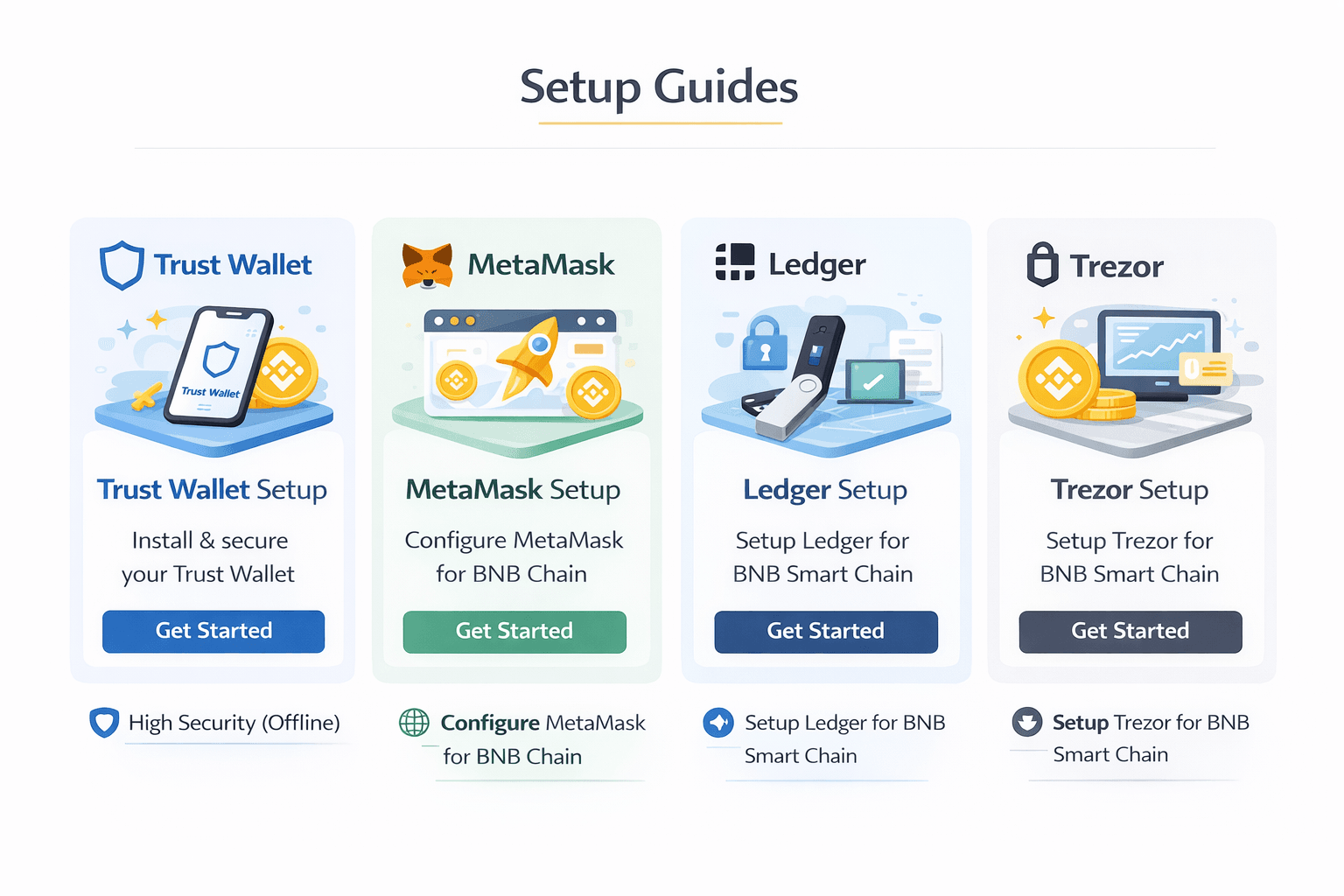 Step By Step Wallet BNB Wallet Setup Instructions
No matter which wallet you choose, hardware, mobile, extension, or MPC, the underlying setup logic follows the same security principles. The interface may differ, but the risk model does not.
The first step is installing the wallet from the official source only. That means the verified website, Apple App Store, Google Play Store, or official browser extension store. Never search for download links inside ads, Telegram groups, or random blog comments. Phishing wallet clones are one of the most common attack vectors in crypto.
Once installed, you create a new wallet. This is where custody model differences appear. If it’s a seed-based wallet like Trust Wallet or MetaMask, you will generate a 12- or 24-word recovery phrase. If it’s MPC-based like Zengo or Binance Wallet, you will set up a shard-based or authentication-based recovery flow. If it’s hardware like Ledger or Tangem, the device will generate keys internally and require you to initialize backup options.
This is the critical step. Backup must happen offline. A recovery phrase should never be screenshotted, emailed, or stored in cloud notes. If using MPC, make sure recovery methods are fully configured before funding the wallet.
After wallet creation, confirm that BNB Smart Chain is visible. Many wallets include BNB by default, but MetaMask may require manual RPC addition. Always verify the network label before sending funds.
Before transferring significant value, send a small test transaction first. Even experienced users do this when interacting with new wallets or new networks. It confirms:
Once the test arrives successfully, proceed with the larger transfer.
This habit alone prevents most network-related loss mistakes.
MetaMask does not always auto-load BNB Smart Chain by default. Adding it manually is simple, but it must be done correctly.
Inside MetaMask, go to network settings and select “Add Network.” You can either use the auto-detection prompt triggered by a BSC dApp or manually input the network parameters. The critical fields to verify are:
Do not rely on random blog posts for RPC URLs. Use trusted documentation sources or official BNB Chain documentation to confirm parameters.
Once added, switch to the BNB Smart Chain network and verify that the explorer link directs you to BscScan and not an imitation site.
Before interacting with DeFi protocols, perform a small transfer or token swap to confirm the network configuration behaves as expected.
MetaMask gives you full control. That control requires verification discipline.
Staking BNB is often presented as “passive yield,” but there are mechanics that matter.
First, you select a validator. Validators differ in commission rate, uptime, and reputation. A lower commission increases your share of rewards, but stability and uptime matter more than shaving off a fraction of a percent. Look at validator history, not just commission.
Second, understand the reward structure. BNB staking rewards fluctuate depending on validator performance and network participation. APR is not fixed. It adjusts dynamically.
Third, and most important, understand the unbonding period. BNB staking includes a 7-day unbonding window. That means once you initiate unstaking, your BNB is locked and not transferable during that period.
This has liquidity implications. If you anticipate needing fast access to funds, do not stake your entire balance.
Fourth, rewards are distributed at defined intervals depending on the validator and wallet interface. Some wallets auto-compound, others require manual claim-and-restake cycles.
Before confirming delegation:
Staking is simple mechanically, but planning the liquidity prevents frustration ahead. Evaluating staking opportunities? Read our analysis of leading crypto staking coins.
Setting up a BNB wallet safely is not about memorizing steps. It’s about building habits:
Wallets differ in interface, but discipline is universal.
Most wallet losses on BNB are not caused by complex hacks. They are caused by simple misunderstandings repeated at scale. The BNB ecosystem is fast, inexpensive, and heavily DeFi-oriented, which means mistakes propagate quickly.
If you understand the following five errors, you eliminate most avoidable risks.
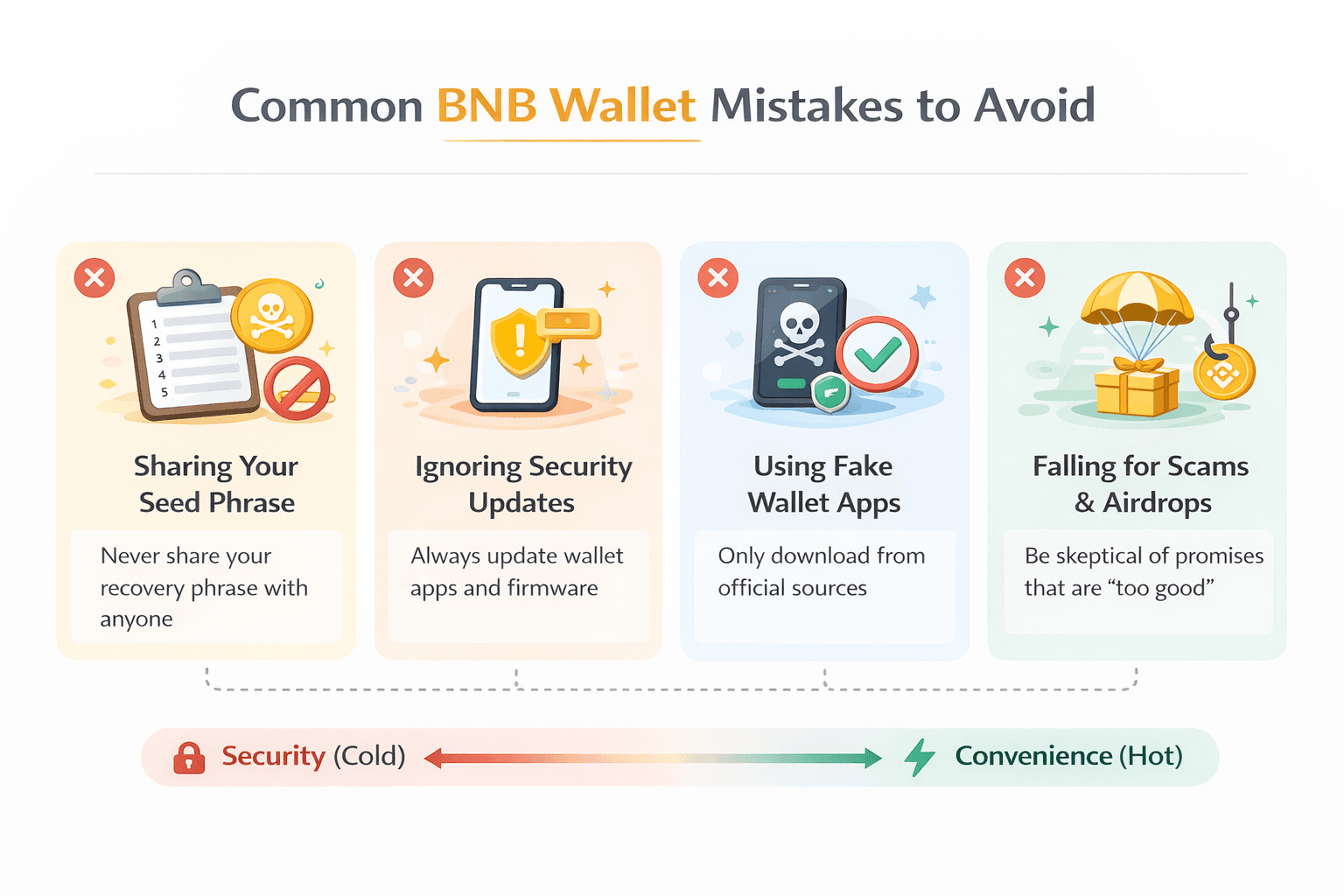 Frequent Security And Setup Errors BNB Users Make
BNB exists across different standards. BEP-2 is tied to the older BNB Beacon Chain. BEP-20 operates on BNB Smart Chain and is the standard used by nearly all DeFi, NFTs, and token contracts.
In practice, most transfers today should use BEP-20.
Sending funds on BEP-2 to a destination expecting BEP-20 can result in stuck or inaccessible tokens unless recovery tools are available. Exchanges typically support both networks but require you to select the correct deposit network manually.
If you are interacting with DeFi, PancakeSwap, NFTs, or staking on BNB Smart Chain, you are almost certainly using BEP-20.
The safest habit is to verify three things before sending:
Treat network selection as a confirmation step, not a default assumption.
BNB is not the only asset that can move across the BNB Smart Chain. Many tokens are bridged versions of assets originally native to Ethereum or other chains.
The most common failure scenario looks like this: a user copies an address, selects the wrong network, confirms the transaction, and realizes too late that the receiving platform does not support that chain.
Even experienced users occasionally skip the network dropdown because gas fees are low and transfers are fast. That speed becomes the trap.
Always:
Low fees make testing inexpensive. There is no excuse to skip it.
BNB Smart Chain has a vibrant DeFi ecosystem. That also means it has a high volume of new tokens, forks, and experimental protocols. Some are legitimate. Some are not.
Blind signing occurs when you approve a transaction without understanding what permissions you are granting. The most dangerous approvals are unlimited token allowances, which allow a contract to spend your tokens indefinitely.
Wallets will show transaction data, but they do not always translate it into plain language. If you see a request for token approval with no obvious reason, pause.
Key defensive habits:
Hardware wallets protect keys. They do not protect you from approving bad contracts.
Staking BNB locks your funds under validator rules. When you decide to unstake, there is a 7-day unbonding period during which your tokens cannot be transferred.
Many users only discover this when they need liquidity urgently.
If you stake 100 percent of your BNB and then need funds for a transfer or opportunity, you are locked for the duration of the unbonding window. Plan staking around liquidity needs. Keep a small unstaked buffer for gas and flexibility. Yield is attractive, but liquidity is power.
Hot wallets are convenient. They are also permanently connected to the internet.
If your BNB allocation grows beyond what you would comfortably carry in a physical wallet, it should probably not live exclusively in a browser extension or mobile app.
A simple tiering model works well:
Splitting roles across wallets reduces catastrophic exposure from a single compromise. Listen to the experts at Coin Bureau explain the top 10 mistakes to avoid in 2026 to sidestep common crypto investor pitfalls.
Security is not binary. It scales with the amount of capital you protect and the complexity of your activity. What is sufficient for a small experimental balance is inadequate for a six-figure allocation.
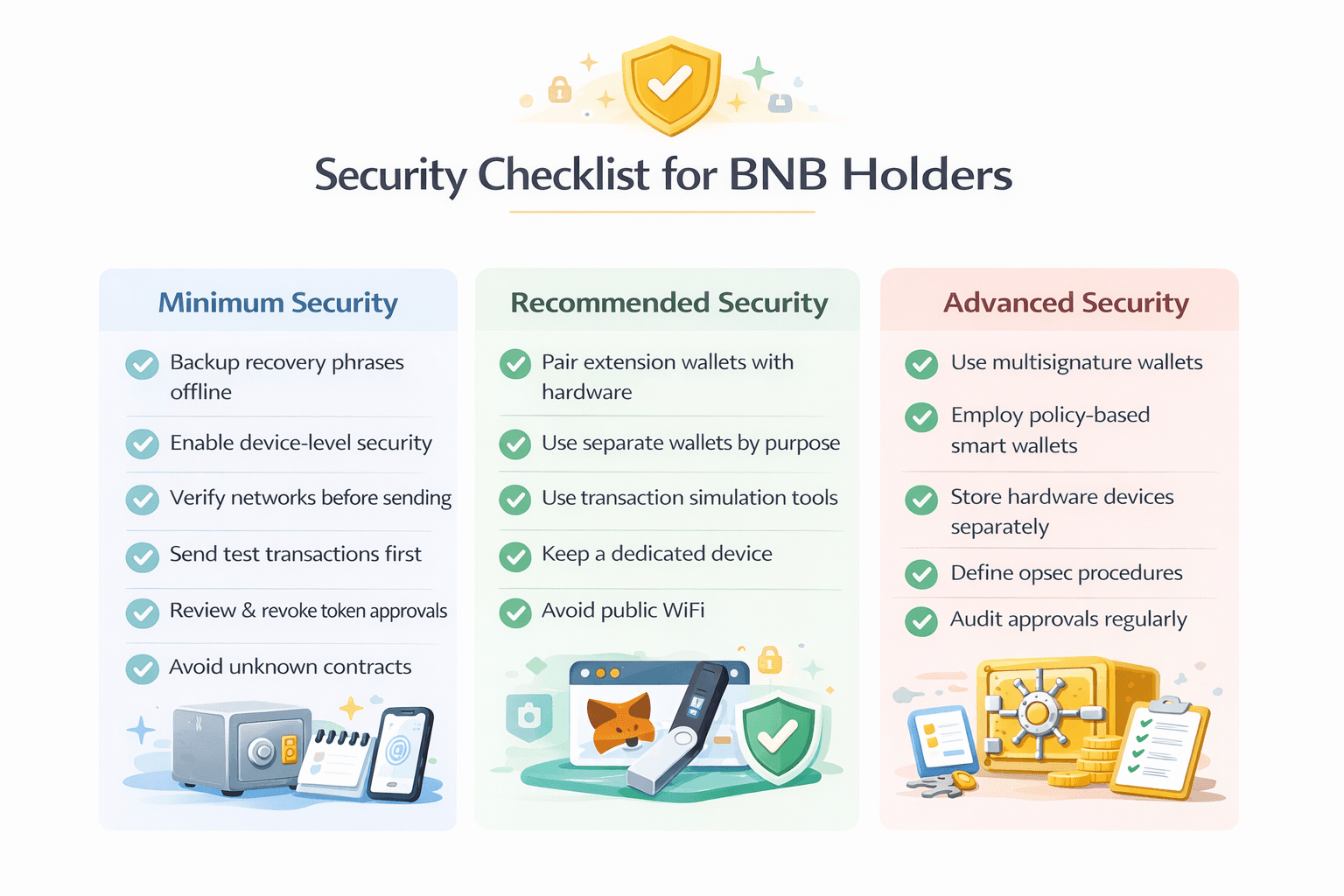 Essential Security Practices For Protecting Your BNB
This checklist is structured by security tier.
Every BNB holder, regardless of balance size, should implement the following baseline:
This level alone eliminates most preventable losses.
If your BNB holdings represent meaningful value, move beyond minimum protection.
Consider:
The goal at this tier is risk segmentation. Do not let your experimental DeFi wallet be the same wallet that stores your long-term allocation.
At higher capital levels, security moves from personal habits to structural architecture.
Advanced approaches include:
Once the capital size grows, a single-key model becomes a single point of failure. Security maturity should always scale with portfolio size.
Specifications explain what a wallet can do. Public reviews show how it behaves when real money is on the line. Below is a structured snapshot of recurring sentiment patterns drawn directly from public review platforms. All review sources are linked so readers can verify context themselves.
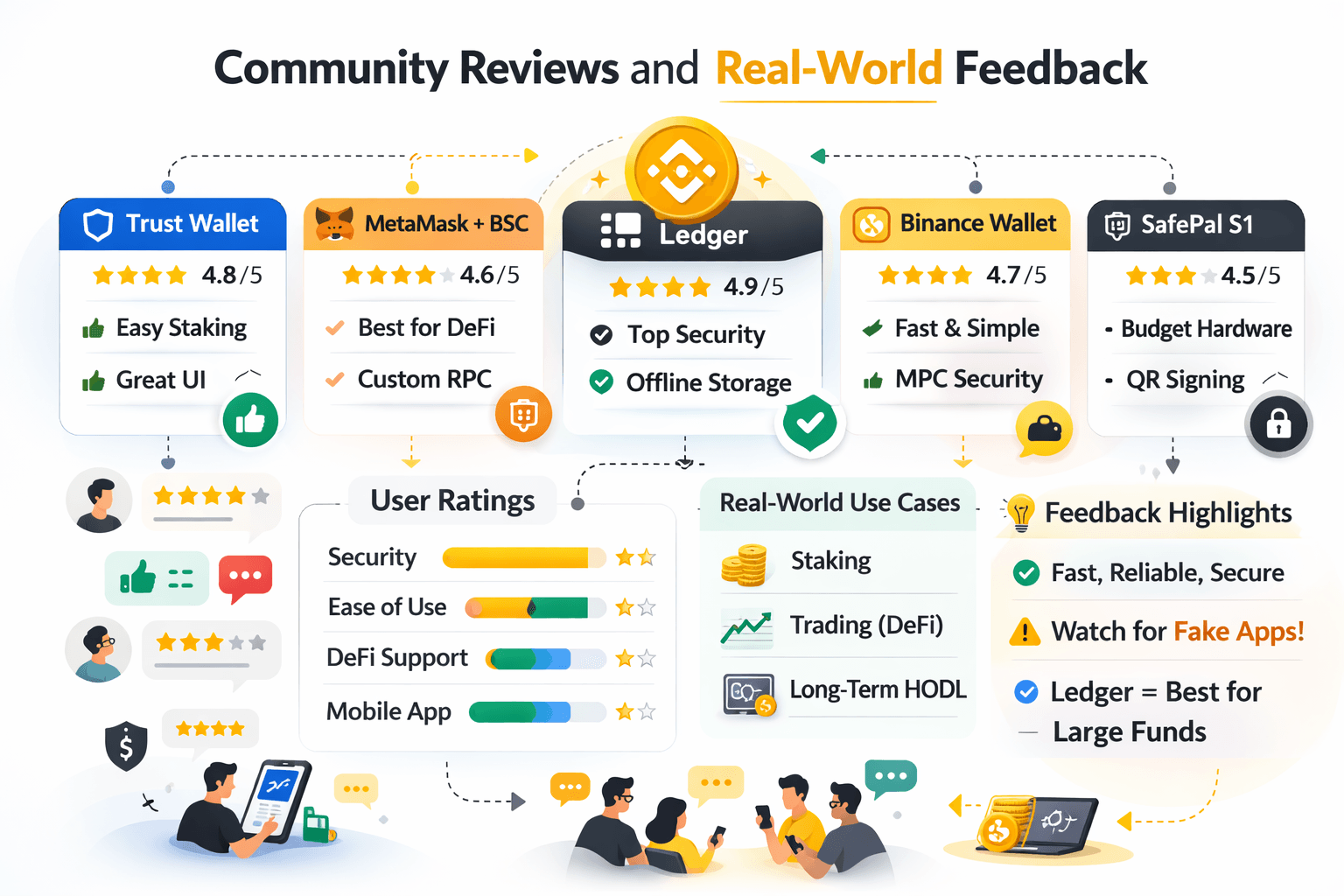 User Opinions And Practical Wallet Experiences Summary
Review sources:
Apple App Store: https://apps.apple.com/us/app/trust-crypto-bitcoin-wallet/id1288339409#see-all/reviews
Google Play: https://play.google.com/store/apps/details?id=com.wallet.crypto.trustapp&showAllReviews=true
Trustpilot: https://www.trustpilot.com/review/trustwallet.com
Average Sentiment Summary
Pros frequently mentioned:
Clean mobile interface and easy onboarding
Native BNB staking support inside the app
Reliable BEP-20 token handling
Cons frequently mentioned:
Loss of funds due to seed phrase mismanagement
Exposure to phishing tokens and scam airdrops
Occasional connection issues with dApps
Who It Suits
Retail BNB holders who stake or use DeFi casually from mobile and are comfortable managing their own seed phrase.
Since the Web3 wallet operates inside the Binance app, sentiment is reflected within Binance reviews:
Review sources:
Apple App Store (Binance App): https://apps.apple.com/sg/app/binance-buy-bitcoin-crypto/id1436799971
Google Play (Binance App): https://play.google.com/store/apps/details?id=com.binance.dev&hl=en
Trustpilot (Binance): https://www.trustpilot.com/review/binance.com
Average Sentiment Summary (Pros / Cons Themes)
Pros frequently mentioned:
Smooth transfer between exchange and wallet
Reduced seed phrase anxiety via MPC structure
Strong ecosystem integration
Cons frequently mentioned:
Account lock or KYC-related friction
Customer support delays in edge cases
Less flexibility compared to standalone DeFi wallets
Who It Suits (Based on Feedback)
Users already active within the Binance ecosystem who prioritize convenience and integration.
Review sources:
Apple App Store: https://apps.apple.com/us/app/metamask-blockchain-wallet/id1438144202#see-all/reviews
Google Play: https://play.google.com/store/apps/details?id=io.metamask&showAllReviews=true
Trustpilot: https://www.trustpilot.com/review/metamask.io
Average Sentiment Summary
Pros frequently mentioned:
Strong DeFi compatibility across EVM networks
Gas control and advanced settings
Hardware wallet pairing capability
Cons frequently mentioned:
Phishing-related fund losses from malicious approvals
Learning curve for beginners
Limited live support
Who It Suits
Experienced DeFi users interacting regularly with BNB Smart Chain protocols who understand contract permissions.
Review sources:
Trustpilot: https://www.trustpilot.com/review/ledger.com
Apple App Store (Ledger Live): https://apps.apple.com/us/app/ledger-live-crypto-wallet/id1361671700#see-all/reviews
Google Play (Ledger Live): https://play.google.com/store/apps/details?id=com.ledger.live&showAllReviews=true
Average Sentiment Summary (Pros / Cons Themes)
Pros frequently mentioned:
Strong cold storage security reputation
Hardware-level isolation of private keys
Long-term reliability for asset storage
Cons frequently mentioned:
Device cost
Set up complexity for beginners
Past data breach concerns affecting brand perception
Who It Suits:
Long-term BNB holders protecting larger allocations who prioritize isolation over transaction speed.
Review sources:
Apple App Store: https://apps.apple.com/us/app/safepal-crypto-wallet-btc-nft/id1548297139#see-all/reviews
Google Play: https://play.google.com/store/apps/details?id=io.safepal.wallet&showAllReviews=true
Trustpilot: https://www.trustpilot.com/review/safepal.com
Average Sentiment Summary (Pros / Cons Themes)
Pros frequently mentioned:
Affordable hardware wallet option
Air-gapped QR signing appreciated by security-focused users
Multi-chain compatibility
Cons frequently mentioned:
Slower QR-based transaction flow
Mixed support response experiences
App stability complaints in some reviews
Who It Suits (Based on Feedback):
Users seeking hardware-level protection at a lower cost who do not require rapid DeFi execution.
Submit Your Review

If we strip away marketing claims and focus on the custody model, BNB-native compatibility, staking support, and real-world usability, the decision becomes straightforward. For most users operating inside the BNB ecosystem, Trust Wallet remains the most balanced default because it supports BEP-20 seamlessly, offers native staking, and handles NFTs and DeFi without complex setup. If you are already anchored to Binance and frequently move between the exchange and on-chain activity, Binance Wallet reduces friction and keeps everything within one controlled environment.
For larger allocations or long-term holdings, convenience should not drive the decision. Hardware isolation becomes the rational baseline. A Ledger or Trezor paired with MetaMask or Trust Wallet as a spending layer gives you structural separation between storage and execution. That layered approach is what experienced BNB holders migrate toward over time. There is no single “best” wallet in absolute terms. There is only the wallet that matches your capital size, activity level, and risk tolerance. Pick based on how you actually use BNB, not what ranks highest on a comparison table.

Adept at leading editorial teams and executing SEO-driven content strategies, Devansh Juneja is an accomplished content writer with over three years of experience in Web3 journalism and technical writing.
His expertise spans blockchain concepts, including Zero-Knowledge Proofs and Bitcoin Ordinals. Along with his strong finance and accounting background from ACCA affiliation, he has honed the art of storytelling and industry knowledge at the intersection of fintech.
March 29th, 2023
By
June 19th, 2023
By
March 26th, 2024
Bitcoin SV (BSV) is the most well-known fork of the Bitcoin Cash network, which occurred in November 2018. It was developed by nChain and financially backed by CoinGeek mining. Since the hard fork, BSV has reached the top 10 in market cap and has an active community, creating a need for safe and secure BSV storage. This article provides a list of the top six BSV wallets and offers tips on securely storing BSV.The first wallet on the list is the Electrum SV Desktop Wallet, which is a fork of the popular Bitcoin Electrum wallet. It is a Hierarchical Deterministic (HD) wallet that automatically creates a hierarchical structure of private/public addresses. The wallet supports hardware wallets such as KeepKey, Trezor, and Ledger.The second wallet mentioned is Exodus, a third-party multicurrency wallet that has support for BSV. Exodus has been around since 2016 and has a good track record in the cryptocurrency community. It is available on desktop and mobile devices and has inbuilt exchange functionality.Coinomi is another multicurrency third-party wallet that supports over 380 tokens and coins. It provides privacy by hiding the IP address used to connect to their servers and has integrations with Changelly and Shapeshift for easy swapping of BSV. Coinomi is available on desktop and mobile devices.Centbee is a mobile-only wallet exclusively designed for BSV. It offers functionality and ease of use, allowing users to send BSV easily and quickly. Centbee is also focused on increasing merchant adoption of BSV through its ScanPay global payment system.Edge Wallet, formerly known as Airbitz, is a mobile-only multicurrency wallet that supports 21 different coins/tokens. It has an intuitive user interface and offers an exchange function. The wallet allows password recovery using security questions and email address and is fully open source.Guarda Wallet is a multicurrency wallet based in Estonia that supports a wide range of tokens from 40 chains. It has an inbuilt exchange function and offers web, desktop, mobile, and chrome extension wallets. The Guarda wallet has received positive feedback for its level of customer support and is open source.In conclusion, the choice of wallet depends on individual preferences and use cases. Hardware wallets like Ledger or Trezor in conjunction with the ElectrumSV or Exodus wallets provide the highest level of security. However, there are also safe and secure options provided by standalone wallets like Exodus or other multicurrency third-party wallets. Following wallet security best practices is crucial to protect your BSV holdings.Further ReadingBest Bitcoin Lightning WalletsBest Bitcoin Cash Wallets Best Bitcoin Gold WalletsBest Multisignature WalletsBest Ordinal WalletsBest Anonymous Bitcoin Wallets
By
Get exclusive access to premium content, member-only tools, and the inside track on everything crypto.