



Buying cryptocurrency is easier than ever, but choosing the right exchange takes more than finding the lowest trading fees. A simple buying interface can come with higher spreads, while a cheaper platform may offer limited bank withdrawals or weaker security protections. For beginners, clear pricing, convenient payment methods, reliable withdrawals, and account security should take priority over advanced trading features.
This guide compares beginner-friendly exchanges based on ease of use, total purchase costs, security, and regional availability. We also explain how to fund an account, make your first crypto purchase, and withdraw money or cryptocurrency, so you can choose a platform that supports your needs without paying for features you do not need.
Editor's Note (Nov. 18, 2026): We fully updated this guide in November 2026 to focus on the best crypto exchanges for first-time buyers, with revised rankings and beginner-friendly scores. The update includes current buying fees, spreads, payment methods, regional availability, and withdrawal conditions. We also expanded our security assessments to cover recent exchange incidents, custody risks, proof of reserves, and insurance limitations. New sections compare the real costs of buying crypto, explain how to make a first purchase and withdraw funds, and help beginners choose an exchange based on their needs.
Quick Answer: What Is the Best Crypto Exchange for Beginners in 2026?
Coinbase is our best overall crypto exchange for beginners, earning a 4.8/5 Coin Bureau Beginner Score for its simple buying experience and accessible fiat funding. Kraken follows closely at 4.7/5, offering greater control over trading costs through Kraken Pro. Crypto.com suits mobile-first buyers, while Gemini appeals to eligible U.S. users who prioritize regulatory oversight. The right choice depends on purchase costs, payment methods, withdrawal conditions and regional availability.
-
1Best Overall for Beginners: Coinbase Coin Bureau Beginner Score: 4.8/5 Coinbase offers straightforward crypto purchases, familiar bank funding and beginner-friendly account tools. Its main drawback is higher Simple Buy costs, including potential spreads.
-
2Best for Fee Control: Kraken Coin Bureau Beginner Score: 4.7/5 Kraken combines easy purchases with optional Pro trading, transparent maker-taker fees and strong account security. Instant Buy costs and funding holds are its main limitations.
-
3Best for Mobile-First Buyers: Crypto.com Coin Bureau Beginner Score: 4.4/5 Crypto.com combines app-based purchases, recurring buys and portfolio tracking. Its mobile convenience comes with quote-dependent costs and regional product differences.
-
4Best for Compliance-Focused U.S. Buyers: Gemini Coin Bureau Beginner Score: 4.2/5 Gemini provides straightforward buying, defined U.S. custody oversight and optional ActiveTrader tools. Higher trading fees and limited international availability reduce its broader appeal.
Disclosure
Some links in this guide may be affiliate links. If you register or trade through these links, we may earn a commission at no additional cost to you.

Best Crypto Exchanges for Beginners at a Glance
- Coinbase: Best overall for a first cryptocurrency purchase.
- Kraken: Best for learning to reduce trading costs.
- Crypto.com: Best for mobile-first crypto buyers.
- Gemini: Best for eligible U.S. buyers seeking a compliance-focused exchange.
| Exchange | Coin Bureau Beginner Score | Best For | Buying Experience | Buying Costs | Fiat Support | Availability | Main Drawback |
|---|---|---|---|---|---|---|---|
| Coinbase | 4.8/5 | First purchases | Simple Buy; optional Advanced | Advanced: 0.50% maker / 0.90% taker (U.S.); Simple Buy fee + spread | ACH, cards, local bank methods, cash-outs | U.S., U.K., EEA, Canada, Australia, other eligible markets | Simple Buy can cost more |
| Kraken | 4.7/5 | Cost-conscious learners | Instant Buy; optional Kraken Pro | Pro: 0.40% maker / 0.80% taker; Instant Buy: 1% + spread | ACH, wires, SEPA, cards, local withdrawals | Major markets, with U.S. state and product exclusions | Pro takes some learning |
| Crypto.com | 4.4/5 | Phone-first buying | Crypto.com App; separate Exchange | Exchange: 0.25% maker / 0.50% taker; App: quoted spread and variable charges | Fiat wallet, ACH, cards, local banks | Many markets; unavailable in New York | App pricing differs from Exchange |
| Gemini | 4.2/5 | Compliance-focused U.S. buyers | Gemini Mode; optional ActiveTrader | ActiveTrader: 0.60% maker / 1.20% taker; Gemini Mode: retail fee + spread | ACH, wires, cards, bank cash-outs | U.S. and selected markets; not U.K., EEA, Australia, Canada | High entry-level trading fees |
Note: Costs and eligibility reflect published information reviewed Nov. 18, 2026. The quoted price, funding rail, account entity, and available products vary by customer.
Not everyone needs a full exchange. Cash App can suit Bitcoin-only buyers; Robinhood can suit existing stock investors. Both differ from dedicated exchanges in asset access, tools, and withdrawals.
How We Chose the Best Crypto Exchanges for Beginners (Methodology)
We evaluate crypto exchanges based on how well they support a first purchase, not how many trading features they offer. A beginner-friendly exchange should make it easy to register, understand the total cost of buying crypto, fund an account, and withdraw money or digital assets securely.
We prioritize country eligibility, reliable fiat deposits and withdrawals, transparent pricing, and account security. Advanced trading tools carry less weight because most beginners do not need them.
Our Evaluation Criteria
Our evaluation considers six criteria, with greater emphasis on the features that affect first-time buyers.
| Criterion | Weight | What We Assess |
|---|---|---|
| First-Purchase Experience | 25% | Signup, navigation, purchase previews, and app usability |
| Fiat Funding and Withdrawals | 20% | Bank deposits, cards, local cash-outs, and restrictions |
| Real Buying Costs | 20% | Purchase fees, spreads, minimums, and withdrawal charges |
| Security and Consumer Protection | 20% | Account safeguards, custody, security incidents, and insurance limitations |
| Customer Support and Education | 10% | Help resources, support channels, and beginner explanations |
| Room to Grow | 5% | Optional advanced interfaces and additional trading tools |
How We Evaluate Exchange Safety, Fees and Availability
Our research involved using official exchange documentation, published fee schedules, regulatory records, and security disclosures.
- For fees, we examine retail buying charges, maker/taker rates, bid-ask spreads, minimum purchases, payment processing costs, and withdrawal fees. We distinguish published trading rates from actual purchase quotes, which can vary by account, region, and payment method.
- For security, we review custody arrangements, authentication controls, disclosed incidents, independent audits or attestations, proof-of-reserves reports, and insurance limitations. We also examine applicable regulatory authorization and know-your-customer (KYC) requirements.
- For availability, we check supported countries, regional restrictions, fiat on-ramps, fiat off-ramps, and withdrawal conditions against official documentation.
Best Crypto Exchanges for Beginners Reviewed
The best crypto exchange for beginners should make buying, holding and withdrawing cryptocurrency straightforward. We compare Coinbase, Kraken, Crypto.com and Gemini across buying experience, transaction costs, fiat funding, security, withdrawal reliability and regional availability. Each exchange receives a Coin Bureau Beginner Score to help first-time buyers compare their options.
1
Coinbase: Best Overall Crypto Exchange for Beginners
Simple first purchases, broad fiat support and optional advanced trading
4.8/5
CB Score
Coinbase: Best Overall Crypto Exchange for Beginners
Our highest-rated option for first-time buyers, combining simple onboarding, accessible payment methods and beginner-friendly account tools.
Coinbase is our top recommendation for eligible first-time crypto buyers who prioritize straightforward purchases, familiar banking methods and a manageable learning curve. Its simple interface makes buying Bitcoin and Ethereum accessible without requiring knowledge of order books. However, retail purchasing costs can be relatively high, and newly deposited funds may be subject to withdrawal holds.
Coinbase provides one of the simpler cryptocurrency buying experiences. Users select an asset, enter a fiat amount, review the purchase quote and confirm the transaction.
- Simple Buy: Purchase Bitcoin, Ethereum and other supported cryptocurrencies without using an order book.
- App and website: Provide portfolio tracking, transaction history and straightforward navigation.
- Educational resources: Beginner lessons explain common cryptocurrency concepts and account features.
- Coinbase Advanced: Adds charts, order books and advanced order types for users seeking greater trading control.
- Customer support: Coinbase provides chat, help articles and eligible callback options. Availability differs by region.
Coinbase Simple Buy uses transaction quotes that can include a trading fee and embedded spread. The final cost depends on the cryptocurrency, purchase amount, payment method and account location.
Coinbase Advanced uses a separate maker-taker fee schedule. The applicable entry-level reference rates include:
- United States: 0.50% maker and 0.90% taker.
- United Kingdom and EU: 0.25% maker and 0.50% taker.
- Selected international markets: 0.09% maker and 0.10% taker.
- Payment methods: Eligible ACH, debit cards, bank transfers and supported local payment services.
These Advanced rates do not apply to Simple Buy purchases. Qualifying users may receive lower fees under the Coinbase Advanced fee schedule.
Beginners should compare the final purchase quote, including fees and spreads, instead of relying only on advertised trading commissions.
Fee reference: Nov. 18, 2026. Published entry-level reference schedules. Account-specific pricing and purchase quotes may differ.Coinbase offers several protections designed to reduce unauthorized account access. However, funds held on the exchange remain in Coinbase's custody.
- Authentication: Passkeys, authenticator-based two-factor authentication and supported security keys.
- Withdrawal protections: Address controls, identity checks and additional verification for sensitive account activity.
- 2025 security incident: Compromised support personnel exposed certain customer information, increasing impersonation and social engineering risks. Coinbase reported that passwords and private keys were not stolen.
- Funding holds: ACH-funded purchases may become available for trading before external withdrawals are permitted.
- Insurance limitations: Company crime insurance does not cover every customer loss. Cryptocurrency is not automatically insured against theft or market losses.
Coinbase serves eligible customers in the United States, United Kingdom, European Economic Area, Canada, Australia and other markets.
Supported cryptocurrencies, purchasing methods, trading fees and cash-out options vary by country and account eligibility. Some services remain unavailable in specific jurisdictions.
Beginners should verify local payment methods and withdrawal options before funding an account.
- Simple onboarding and buying.
- Broad fiat payment support.
- Beginner educational resources.
- Optional Advanced interface.
- Strong authentication options.
- Relatively high Simple Buy costs.
- Spreads can increase purchase prices.
- Deposit and withdrawal holds.
- Centralized custody exposure.
- Regional pricing differences.
- First-time cryptocurrency buyers.
- Users prioritizing simple navigation.
- Occasional crypto purchases.
- Beginners using familiar bank payments.
- Users who may later try Advanced.
- Buyers seeking minimum fees.
- High-frequency traders.
- Users requiring immediate withdrawals.
- Investors seeking full self-custody.
Coinbase earns a 4.8/5 Coin Bureau Beginner Score for its accessible buying experience, fiat funding options and straightforward account management. It is our preferred starting point for eligible beginners who value simplicity over the lowest fees. Users should still review purchase costs and withdrawal restrictions before depositing.
2
Kraken: Best for Beginners Who Want More Control Over Fees
Simple buying with an optional lower-cost Pro interface
4.7/5
CB Score
Kraken: Best for Beginners Who Want More Control Over Fees
A strong choice for newcomers who want simple purchases, established account security and a clear route to more controlled spot trading.
Kraken is an excellent alternative to Coinbase for beginners who want straightforward buying alongside greater control over trading costs. Its standard app handles simple purchases, while Kraken Pro provides order books, limit orders and transparent maker-taker pricing. The main drawbacks are Instant Buy spreads, potential withdrawal holds and the additional learning required to use Pro effectively.
Kraken separates everyday buying from professional trading. Beginners can use the standard app for direct purchases and portfolio management without navigating advanced market tools.
- Standard Kraken app: Supports direct purchases, conversions, recurring buys and portfolio tracking.
- Kraken Pro: Provides charts, order books, limit orders and more control over execution.
- Learning curve: The standard interface is approachable. Kraken Pro requires some understanding of order types and liquidity.
- Customer support: Kraken provides a searchable Help Center and support chat. Resolution times vary depending on the issue.
Beginners can start with simple purchases and transition to Kraken Pro as their trading knowledge improves.
Kraken's standard Instant Buy and recurring purchases carry a 1% trading fee, with a spread included in the quoted price. Custom orders and certain smaller transactions can have different charges.
- Instant Buy: Standard 1% trading fee plus an applicable spread.
- Kraken Pro entry tier: 0.40% maker and 0.80% taker.
- Qualifying Pro tier: 0.22% maker and 0.38% taker at the applicable third tier.
- Fee discounts: Eligible spot volume, futures activity or qualifying asset balances can determine lower Pro fee tiers.
- Funding options: Eligible ACH, bank transfers, cards, digital wallets, SEPA and regional payment methods.
- Purchase minimums: Eligible cash-balance purchases can start at $1. U.S. card or digital-wallet purchases generally start at $10.
Card and digital-wallet processing can add charges. Instant Buy and Kraken Pro do not share the same pricing structure.
Kraken's published trading fee schedule explains account qualification and applicable fee tiers.
Fee reference: Nov. 18, 2026. Published standard Kraken and Kraken Pro pricing. Fees, spreads, payment charges and discounts depend on eligibility.Kraken offers extensive account security controls and publishes independently reviewed proof-of-reserves disclosures for selected assets. These measures are useful, but they do not eliminate exchange custody risk.
- Account protection: Passkeys, authenticator apps, hardware security keys and funding-related 2FA.
- Global Settings Lock: Helps prevent unauthorized changes to sensitive account settings.
- Proof of Reserves: Publishes snapshot-based verification for selected customer assets. This is not a complete solvency audit.
- Security history: A June 2024 deposit-crediting vulnerability resulted in approximately $3 million in treasury losses. Customer custody assets were not reported stolen.
- ACH withdrawal holds: Eligible Plaid ACH deposits can trigger a seven-day withdrawal hold on the deposited amount.
- Card-related holds: Certain card and digital-wallet purchases can trigger a 72-hour withdrawal hold.
Trading availability and external withdrawal eligibility are not always the same. Buyers should confirm the applicable hold before funding.
Kraken serves eligible customers in the United States, United Kingdom, European Economic Area, Canada, Australia and other markets.
U.S. availability excludes New York and Maine residents. Additional state restrictions can affect funding methods and product access.
Spot trading, margin products, derivatives and local payment services have separate eligibility rules.
- Simple and Pro buying interfaces.
- Transparent Pro trading fees.
- Strong account security controls.
- Proof-of-reserves disclosures.
- Established fiat funding options.
- Instant Buy spreads and fees.
- High entry-level Pro taker fees.
- Possible withdrawal holds.
- Pro requires additional learning.
- State and product restrictions.
- Beginners planning to learn spot trading.
- Security-conscious customers.
- Buyers seeking order-price control.
- Users who may qualify for Pro discounts.
- Buyers wanting only one simple interface.
- Users expecting zero-fee Instant Buy.
- Customers requiring immediate withdrawals.
- Residents of excluded jurisdictions.
Kraken earns a 4.7/5 Coin Bureau Beginner Score for combining approachable buying tools with strong account security and an optional path to lower-cost order-book trading. It is particularly suitable for beginners who expect to become more active traders. However, Instant Buy costs and funding holds remain important drawbacks.
3
Crypto.com: Best for Mobile-First Crypto Buyers
App-based purchases, recurring buys and integrated portfolio management
4.4/5
CB Score
Crypto.com: Best for Mobile-First Crypto Buyers
A convenient mobile-first option with integrated buying, portfolio tools and recurring purchases, although pricing requires careful quote comparisons.
Crypto.com is a practical choice for beginners who prefer buying and managing cryptocurrency from their phones. Its App combines purchases, portfolio tracking, recurring buys and eligible payment services. However, the interface includes numerous additional products, and quoted buying costs can be less transparent than order-book trading fees. Cost-sensitive users should compare the final purchase price before confirming.
The Crypto.com App is designed around mobile account management. Users can buy supported assets, review balances, arrange recurring purchases and access available payment services.
- Mobile buying: Select a cryptocurrency, enter the purchase amount, review the quote and confirm the order.
- Portfolio tools: Track balances, transaction history and supported account services.
- Recurring purchases: Schedule eligible purchases without placing each order manually.
- Crypto.com Exchange: A separate trading product with order books, advanced tools and different fee structures.
- Customer support: In-app assistance and Help Center resources cover payments, transfers and account problems.
The App is convenient for phone-first users, although additional products can make navigation feel crowded.
Crypto.com App purchases use transaction-specific quotes. The quoted exchange rate can reflect market conditions, liquidity, spreads and applicable administrative charges. There is no single universal App purchase fee.
- App purchases: Quoted costs depend on the asset, payment route and applicable spread or administrative charge.
- Bank funding: Eligible local transfers, fiat wallets and U.S. ACH funding where supported.
- Card purchases: Debit cards and supported payment wallets may be available. Additional processing charges can apply.
- Apple Pay and Google Pay: Available to eligible users and regions.
- Exchange trading: Uses a separate maker-taker schedule that should not be applied to App purchases.
- Crypto withdrawals: Network-dependent charges appear before confirmation.
Crypto.com's purchase fee information explains why final costs differ by transaction.
Beginners should compare the cryptocurrency received for a fixed fiat amount across competing platforms. This captures differences that advertised trading fees may not reveal.
Fee reference: Nov. 18, 2026. Crypto.com App pricing is quote-dependent. Confirm the displayed rate, processing charges and payment terms before each purchase.Crypto.com provides account authentication, custodial storage and withdrawal security controls. Users should still distinguish platform safeguards from guarantees against loss.
- Account protection: Supports authentication controls and security verification for sensitive account actions.
- Withdrawal security: Address checks and applicable verification requirements help reduce unauthorized transfers.
- Custody: Assets held in the App remain exposed to centralized platform risk.
- Reserve disclosures: Published reserve information does not establish continuous solvency or guarantee customer reimbursement.
- Funding settlement: Unsettled deposits, verification requirements and account reviews can delay withdrawals.
- Network selection: Sending cryptocurrency through an incompatible blockchain network can result in permanent loss.
New users should test a small withdrawal, confirm the destination network and check available balances before sending larger amounts.
The Crypto.com App operates across numerous eligible markets, although supported products and payment methods differ substantially.
In the United States, the App is offered in 49 states and several territories, excluding New York.
Availability of the App does not automatically establish eligibility for Crypto.com Exchange, card products or other financial services.
- Convenient mobile buying.
- Recurring purchase tools.
- Integrated portfolio tracking.
- Multiple eligible funding methods.
- Additional payment services.
- Quote-dependent buying costs.
- Spreads can increase total costs.
- Potential card processing charges.
- Feature-heavy interface.
- Regional product differences.
- Mobile-first crypto buyers.
- Users making recurring purchases.
- Beginners tracking investments by phone.
- Customers using eligible local payment rails.
- Buyers seeking fixed transparent rates.
- Users prioritizing minimum spreads.
- Customers who dislike crowded apps.
- Residents in unsupported regions.
Crypto.com receives a 4.4/5 Coin Bureau Beginner Score for its mobile convenience, portfolio tools and flexible purchasing options. It is most suitable for users who prefer managing crypto through one phone-based interface. However, buyers should carefully compare quoted prices and payment charges before purchasing.
4
Gemini: Best for U.S. Beginners Seeking a Compliance-Focused Exchange
Straightforward U.S. buying, regulated custody and optional ActiveTrader tools
4.2/5
CB Score
Gemini: Best for U.S. Beginners Seeking a Compliance-Focused Exchange
A compliance-focused option for eligible U.S. beginners, offering straightforward buying and defined custody oversight, but with higher trading costs and limited international reach.
Gemini is a specialized choice for eligible U.S. beginners who prioritize regulatory oversight and established custody arrangements. Its standard buying interface is approachable, while ActiveTrader provides greater trading control. However, high entry-level fees, limited international availability and its historical Gemini Earn exposure prevent it from being a universal beginner recommendation.
Gemini offers a relatively straightforward purchasing interface for customers who want to buy and hold supported cryptocurrencies.
- Gemini Mode: Supports direct buying, selling and portfolio tracking through a simplified interface.
- ActiveTrader: Provides advanced charts, order books and more control over execution.
- Beginner suitability: Basic purchases do not require knowledge of margin or derivatives.
- Account management: Users can access transaction history, account settings and available funding methods.
- Customer support: Gemini primarily directs exchange inquiries through an online support form, which is less immediate than live chat.
Gemini's interface is approachable, although its support model and advanced trading options may not suit every beginner.
Gemini Mode purchases may include a transaction fee, embedded spread and payment processing charge. ActiveTrader uses a separate maker-taker fee schedule.
- Gemini Mode: Retail purchase fees vary by transaction, payment method and quoted exchange rate.
- ActiveTrader entry tier: 0.60% maker and 1.20% taker.
- ACH transfers: Eligible U.S. ACH deposits and withdrawals carry no Gemini fee.
- Debit card purchases: Published processing fee of 3.49%.
- USD wire withdrawals: Published Gemini fee of $25.
- Crypto withdrawals: Dynamic network-related charges may apply.
Gemini's ActiveTrader fee schedule provides the applicable maker-taker tiers.
Beginners should distinguish Gemini Mode retail quotes from ActiveTrader commissions. Payment costs can make small card purchases relatively expensive.
Fee reference: Nov. 18, 2026. Published U.S. reference fees and ActiveTrader entry pricing. Confirm current charges and eligibility in the account before trading.Gemini Trust Company operates under oversight from the New York Department of Financial Services. This provides a defined regulatory custody framework but does not eliminate platform or counterparty risk.
- Regulatory oversight: Gemini Trust Company is overseen by NYDFS.
- Authentication: Supports authenticator-based login protections and hardware security keys.
- Withdrawal controls: Address restrictions and account verification help protect transfers.
- Custody: Exchange-held cryptocurrency remains exposed to custodial and operational risk.
- Gemini Earn history: The lending program exposed users to Genesis counterparty risk and frozen withdrawals. Customers subsequently received in-kind recoveries through the resolution process.
- Insurance limitations: Regulatory oversight does not provide blanket insurance against cryptocurrency losses.
Beginners should distinguish ordinary exchange custody from lending arrangements involving third-party counterparties.
Gemini's beginner use case is primarily focused on eligible U.S. customers, including residents of supported states.
Gemini no longer serves customers in the United Kingdom, European Economic Area, Australia or Canada.
U.S. product access, funding methods and account services remain subject to eligibility and applicable restrictions.
- Beginner-friendly buying interface.
- Defined U.S. custody oversight.
- Strong authentication controls.
- Optional ActiveTrader interface.
- Eligible free ACH transfers.
- High ActiveTrader entry fees.
- Expensive debit card purchases.
- Limited international availability.
- Historical Gemini Earn exposure.
- Less immediate customer support.
- Eligible U.S. crypto beginners.
- Users prioritizing custody oversight.
- Occasional long-term buyers.
- Customers using eligible ACH funding.
- Residents of unsupported countries.
- Frequent fee-sensitive traders.
- Buyers relying on debit cards.
- Users requiring immediate live support.
Gemini earns a 4.2/5 Coin Bureau Beginner Score for its straightforward buying experience, authentication controls and defined U.S. custody oversight. It is a reasonable choice for eligible American buyers who prioritize these characteristics. However, higher fees, limited international access and historical lending risks reduce its appeal compared with Coinbase and Kraken.
These exchanges offer features that may appeal to beginners, including spot purchases, competitive trading fees and mobile apps. However, regional restrictions, advanced interfaces, derivatives exposure and differences in banking support make them less suitable as universal first-choice platforms.
Binance offers competitive spot trading fees and substantial liquidity, but its advanced products can overwhelm newcomers. Binance.com is unavailable to U.S. residents, while Binance.US operates as a separate service.
Bybit combines spot trading with advanced derivatives products. Its global platform excludes U.S. residents, and leveraged trading introduces risks that beginners may not fully understand.
OKX offers sophisticated spot trading tools and a broader Web3 ecosystem. However, its interface, regional product rules and multiple trading services add complexity for first-time buyers.
KuCoin provides extensive altcoin markets and competitive standard trading fees. Its regulatory limitations, restricted jurisdictions and emphasis on advanced products make it less suitable for beginners seeking simple fiat access.
Toobit and CoinCatch offer competitive trading fees and derivatives-focused features. However, beginners should carefully evaluate regional eligibility, available fiat services, custody arrangements and withdrawal procedures before choosing either platform.
Security and withdrawal warning: Binance suffered a major security breach in October 2026 involving approximately $6.34 billion in affected assets. Binance reported substantial asset replenishment and phased withdrawal restoration. Published proof-of-reserves snapshots do not guarantee uninterrupted withdrawals, continuous solvency or protection against future attacks. Beginners should prioritize reliable funding, clear withdrawal conditions and manageable custody risk over access to leveraged products.
How Much Does It Cost to Buy Crypto as a Beginner?
A low advertised trading fee can conceal a more expensive purchase. Compare the quote, spread, payment charge, and eventual withdrawal cost.
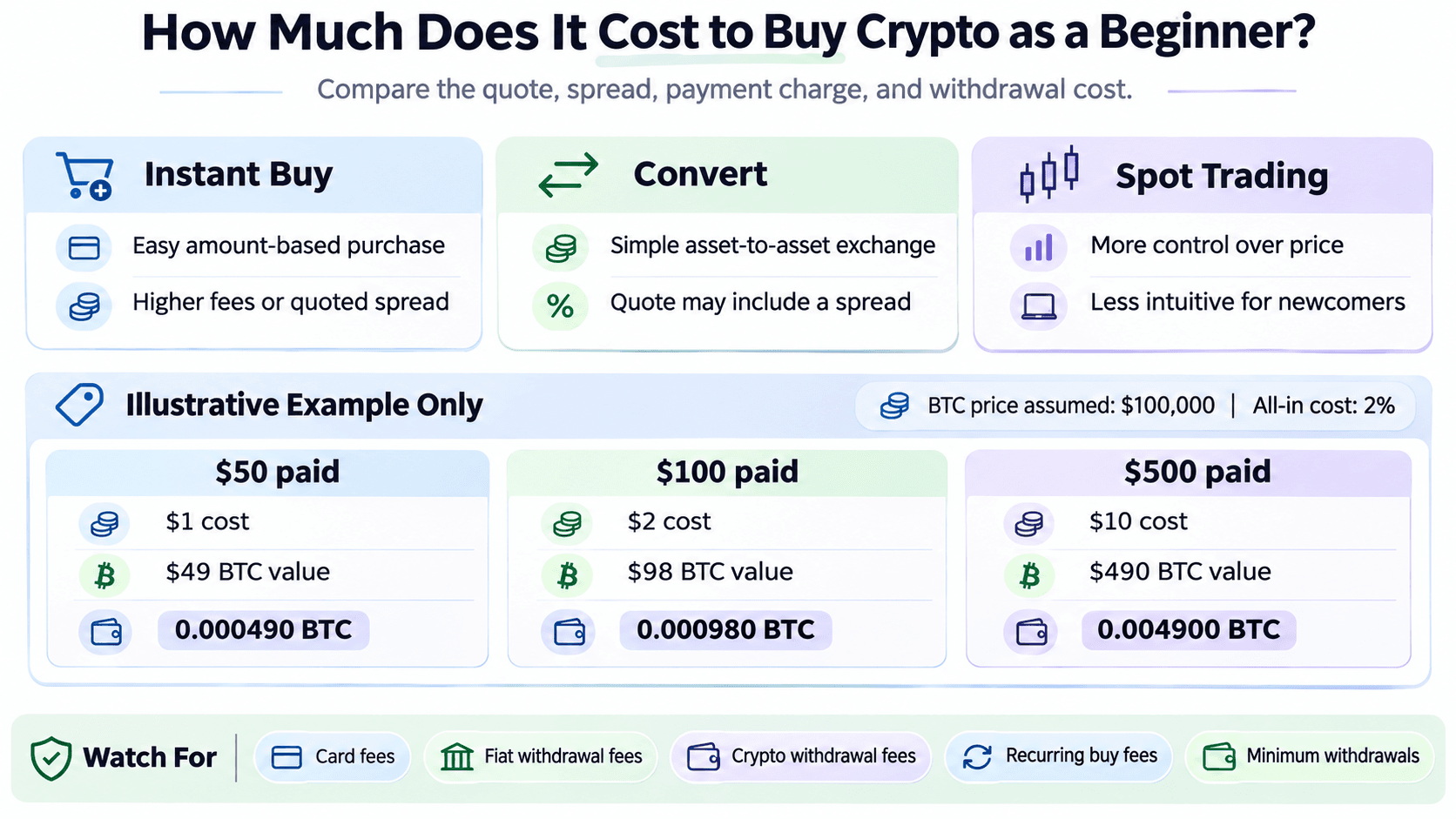 Instant Buy Offers Convenience, While Spot Trading Provides Greater Price Control. Fees, Spreads, and Withdrawal Charges Affect Total Costs
Instant Buy vs. Spot Trading: Which Costs Less?
Instant Buy provides a ready-made price for a chosen dollar amount. Convert exchanges one asset for another at a quoted rate. Spot trading matches orders on an order book, as on Coinbase Advanced or Kraken Pro.
| Buying Method | Main Advantage | Main Drawback |
|---|---|---|
| Instant Buy | Easy amount-based purchase | Higher fees or quoted spread possible |
| Convert | Simple asset-to-asset exchange | Conversion quote may include a spread |
| Spot Trading | Greater control over price and orders | Less intuitive for newcomers |
Spot platforms charge maker fees for orders that add liquidity to the book and taker fees for orders that execute against existing orders. A market order usually pays a taker fee. A limit order is not automatically a maker order.
The bid-ask spread separates the best available buying and selling prices. Retail buying quotes can also include a provider's spread, so the displayed purchase price may exceed a reference market rate. Slippage can further change the cost of an order. Coinbase Simple Buy and Kraken Instant Buy prioritize ease; their Advanced and Pro interfaces offer more fee and execution control.
What Does Buying $50, $100, or $500 of Crypto Actually Cost?
A fair comparison needs the same BTC purchase amount, U.S. dollars, funding rail, and quote timestamp. We could not obtain four comparable authenticated checkout quotes. The table therefore identifies where to get the real total rather than fabricating exchange-level results.
| Exchange | $50 Purchase Cost | $100 Purchase Cost | $500 Purchase Cost | Fee Basis |
|---|---|---|---|---|
| Coinbase | Checkout preview | Checkout preview | Checkout preview | Simple Buy: fee and spread |
| Kraken | Checkout preview | Checkout preview | Checkout preview | Instant Buy: 1% plus spread; small-order rules |
| Crypto.com | Checkout preview | Checkout preview | Checkout preview | App quote: variable charges |
| Gemini | Checkout preview | Checkout preview | Checkout preview | Gemini Mode: retail fee and spread |
The following hypothetical example assumes BTC costs $100,000 and the all-in fee plus spread totals 2%. It is not a quote from any of these exchanges.
| Amount Paid | Illustrative Cost | Value of BTC Acquired | BTC Received |
|---|---|---|---|
| $50 | $1 | $49 | 0.000490 BTC |
| $100 | $2 | $98 | 0.000980 BTC |
| $500 | $10 | $490 | 0.004900 BTC |
To see the effect of different rates, the hypothetical fee on a $100 order is $1 at 1%, $2 at 2%, or $3 at 3%. At the assumed BTC price, those purchases yield 0.000990 BTC, 0.000980 BTC, and 0.000970 BTC, respectively. Compare the final BTC quantity and the amount charged, not just the stated trading commission.
Deposit, Withdrawal, and Recurring Purchase Fees
Bank transfers generally cost less than cards, though settlement times may be longer. Some exchanges charge card-processing fees in addition to their purchase quote; others have region-specific promotions. A fiat withdrawal transfers an eligible cash balance to a bank. A crypto withdrawal sends assets to an external wallet and can incur a network fee or exchange charge.
Minimum withdrawals and fixed fees can make moving small holdings costly. Weekly or monthly recurring buys provide dollar-cost averaging (DCA), but they do not eliminate volatility and can repeat the same retail transaction charges. Kraken's standard recurring purchases, for example, use its Instant Buy pricing rather than Kraken Pro maker/taker rates. Compare total monthly fees before scheduling purchases.
Which Crypto Exchange Can You Use in Your Country?
An exchange can offer accounts in one region while restricting particular coins, services, local bank deposits, or fiat withdrawals in another.
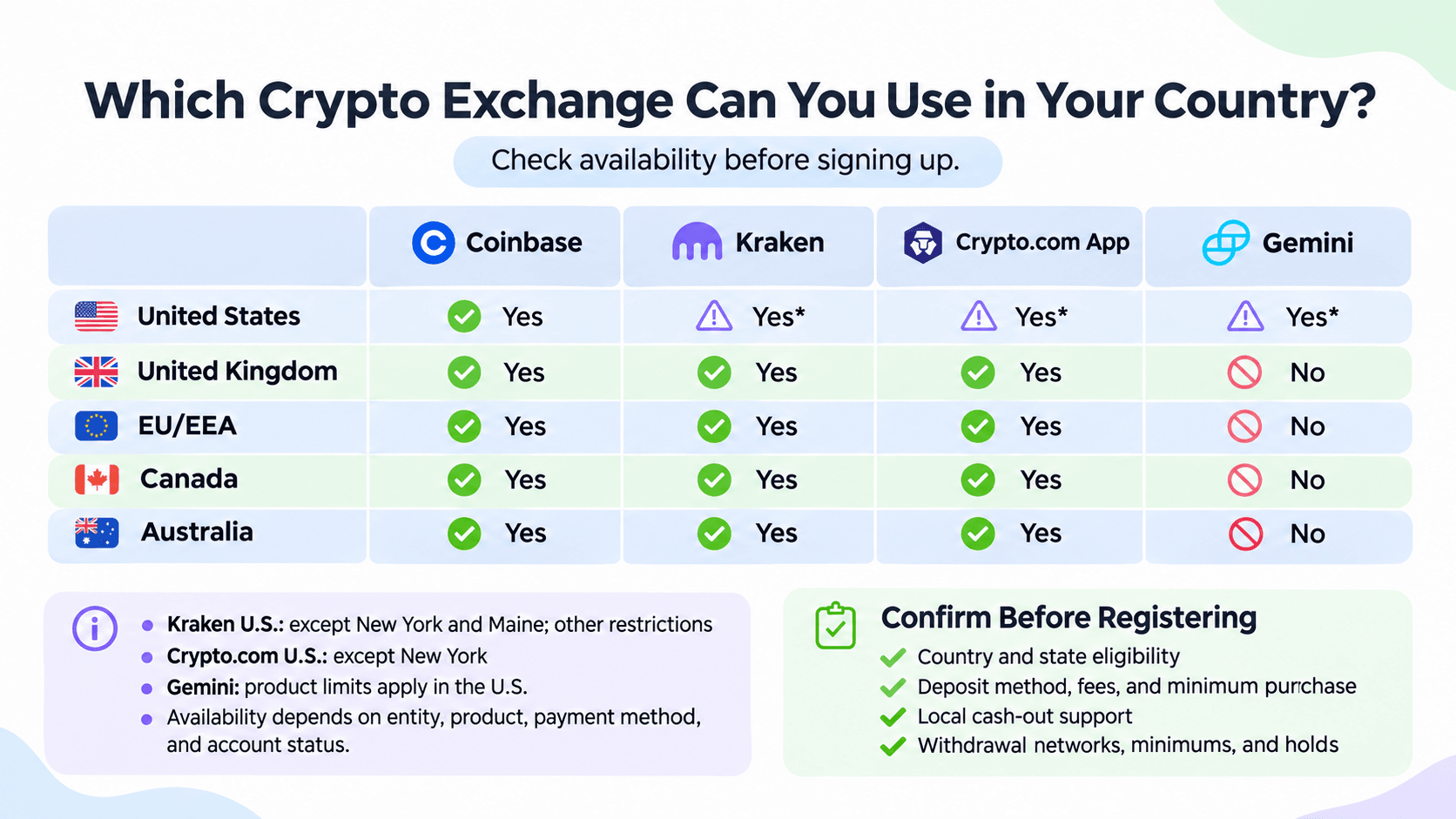 Exchange Availability Varies by Country, With Additional Restrictions on Payment Methods, Supported Services, and Local Withdrawals
Check Exchange Availability Before Signing Up
| Region | Coinbase | Kraken | Crypto.com App | Gemini |
|---|---|---|---|---|
| United States | Yes, conditions apply | Yes, except New York and Maine; other restrictions | Yes, except New York | Yes, product limits apply |
| United Kingdom | Eligible services | Eligible services | Eligible services | No |
| EU/EEA | Eligible services | Eligible services | Eligible services | No |
| Canada | Eligible services | Eligible services | Eligible services | No |
| Australia | Eligible services | Eligible services | Eligible services | No |
Note: General availability only. The operating entity, product, payment method, and account status determine actual eligibility.
Gemini exited the U.K., European Economic Area, and Australia in 2026. European platforms may operate under the Markets in Crypto-Assets Regulation (MiCA), while U.K. obligations involve the Financial Conduct Authority (FCA) and other authorities. Authorization does not mean every customer product is approved.
Our U.S. crypto exchange guide compares state eligibility, funding options, and exchange-specific consumer protections for U.S. residents.
Check Deposit Methods, Cash-Out Options and Account Requirements
Common fiat on-ramps include U.S. ACH, European SEPA, domestic bank transfers, debit cards, and wires. Some methods support deposits but not withdrawals. Check the local fiat off-ramp first.
Most exchanges require identity documents under know-your-customer (KYC) and anti-money laundering (AML) rules; banks may request further checks. Before registering, confirm:
- Country and state eligibility, plus the applicable legal entity.
- Supported bank or card, fees, and minimum purchase.
- Ability to sell crypto and withdraw fiat locally.
- Crypto withdrawal networks, minimums, and funding-related holds.
How to Buy Crypto on an Exchange for the First Time
The basic process is similar on Coinbase and Kraken: secure an eligible account, add a payment method, buy an asset, and decide whether to keep it on the exchange or withdraw it. Avoid leveraged products for this first transaction.
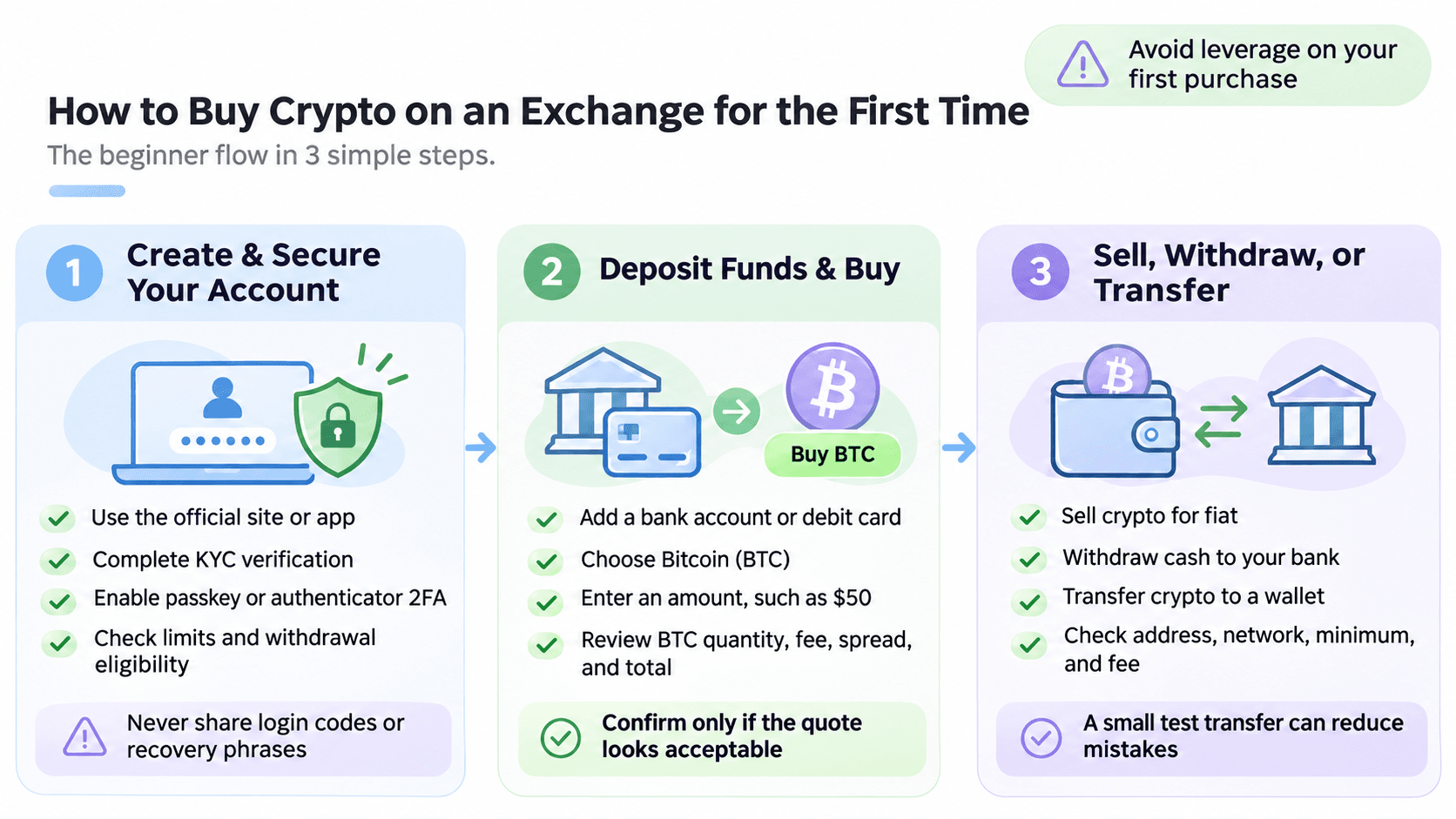 Buying Crypto Involves Verifying Your Identity, Securing Your Account, Funding a Purchase, and Understanding Withdrawal Options
Step 1: Create and Secure Your Exchange Account
- Visit the official exchange website or verified mobile app, and confirm your country is supported.
- Register and complete identity verification with the required KYC documents.
- Enable a passkey or authenticator-based 2FA; secure the connected email account too.
- Check payment limits, new-account restrictions, and withdrawal eligibility before funding.
Step 2: Deposit Funds and Make Your First Purchase
- Add a supported bank account or debit card, and check its funding fee.
- Select Bitcoin (BTC) in the standard Buy interface and enter an amount, such as $50.
- Review the BTC quantity, transaction fee, spread, payment charge, and total shown in the preview.
- Confirm only if the quote is acceptable, then check your BTC balance and purchase record.
Bitcoin is divisible, so you do not need a whole BTC. A BTC/USD spot pair quotes Bitcoin in dollars; the simple interface handles the calculation without advanced market orders or leveraged futures.
Step 3: Sell Crypto, Withdraw Cash or Transfer to a Wallet
Sell crypto to convert it into an available fiat balance. Withdraw fiat to transfer eligible cash to a linked bank account. Withdraw crypto to send assets to a personal wallet address. Each has different fees and conditions.
Bank-funded purchases can remain under withdrawal holds after trading becomes available. For crypto transfers, verify the address, blockchain network, minimum, and fee. Mistakes can cause permanent loss; consider a small test transfer.
Self-custody becomes worth exploring when direct control over private keys is more important than account-based convenience. Our beginner wallet guide compares software and hardware storage, recovery, and self-custody risks.
Are Crypto Exchanges Safe for Beginners?
Security controls can reduce account theft, but an exchange also carries custody and operational risks that customers cannot manage through their own settings. Authentication cannot guarantee access to funds.
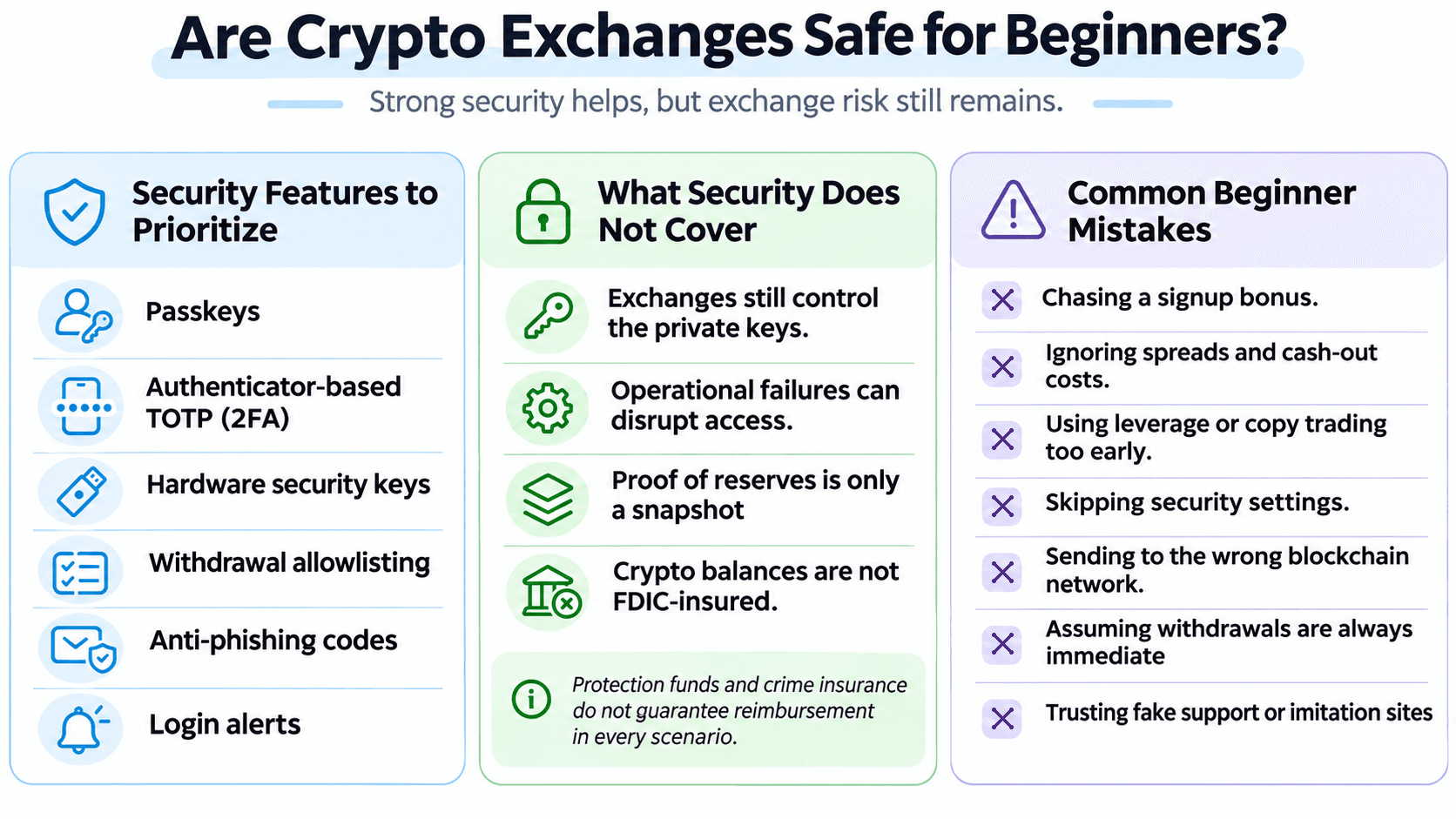 Strong Account Security Reduces Theft Risks, but Exchange Custody, Operational Failures, and Limited Insurance Leave Investors Exposed
How to Evaluate an Exchange's Security
Prioritize passkeys, authenticator-based TOTP codes, hardware security keys, and withdrawal allowlisting, where available. Anti-phishing codes and login alerts can help detect impersonation. Custodial exchanges hold private keys and typically combine online operating wallets with cold storage, but authorization-system failures can still expose assets.
Look at both security incidents and responses. Coinbase's 2025 customer-data incident created a phishing risk despite no reported private-key theft. Binance's 2026 compromise resulted in major unauthorized withdrawals and service disruption. Its subsequent fund replenishment does not mean users faced no loss of access during recovery.
Proof of reserves shows selected asset backing at a snapshot, not every liability or future solvency. Kraken's attestations and Binance's expanded snapshot are useful, but cannot replace scrutiny of custody controls, financial obligations, withdrawal reliability, and the operating entity.
Are Crypto Exchange Balances Insured?
Cryptocurrency is generally not covered by FDIC bank deposit insurance. The Federal Deposit Insurance Corporation protects eligible bank deposits within applicable limits, not Bitcoin or Ethereum on an exchange.
Coinbase's insurance terms distinguish company-held digital-asset crime coverage from potential pass-through FDIC insurance for qualifying U.S. dollar balances at insured banks. Its crime policy covers only specified losses and does not cover every compromised personal account or market decline. Qualifying cash deposit protection does not insure the exchange itself against all failures.
Protection funds such as Binance's SAFU, corporate crime insurance, and proof-of-reserves disclosures perform different functions. None guarantees reimbursement in every scenario. Users retain counterparty risk while an exchange controls their assets.
Common Mistakes Beginners Should Avoid
- Choosing a platform for a signup bonus without checking total costs and cash-outs.
- Treating a zero-fee offer as a zero-spread purchase.
- Using leverage or copy trading without understanding losses and liquidation.
- Skipping passkeys, TOTP, and withdrawal security settings.
- Sending assets to an address on an incompatible blockchain network.
- Assuming freshly purchased crypto can always be withdrawn immediately.
- Trusting imitation websites, social-media support accounts, or urgent transfer requests.
Volatility can encourage compulsive price-checking. Spot purchases avoid liquidation from borrowing, but prices can still fall sharply.

Closing Thoughts: Which Crypto Exchange Is Best for Beginners?
Coinbase is our overall choice for eligible first-time buyers who prefer a clear purchasing workflow and straightforward fiat funding. Kraken is the better progression for beginners seeking more control over execution costs. Crypto.com suits mobile-first customers who compare final app quotes, while Gemini serves a narrower U.S. audience prioritizing its regulatory and custody structure.
Cash App suits Bitcoin-only buyers; Robinhood suits some stock investors. Neither necessarily replaces a full exchange.
Verify country eligibility and cash-out support before choosing any platform. Compare how much BTC you receive for the total amount paid, protect the account, and understand the risks of leaving coins under exchange custody. Straightforward spot purchases are enough for a beginner; leveraged trading introduces costs and risks without improving the first-buy experience.