An In-Depth Comparison Of Bybit And Kraken For Crypto Trading In 2026

Last updated: Feb 04, 2026
33 Min Read
AI Generated Summary
Summary
Summary
bybit_inline
bybit_inline

Choosing a crypto exchange in 2026 is not about hunting for one “best” platform. It’s about picking the one that actually fits how you trade.

Bybit and Kraken get compared a lot because they optimize for different priorities. Bybit is built for active traders who care about fast execution, deep derivatives tools, and competitive maker-taker fees. Kraken, on the other hand, leans into trust and durability, with a long operating track record, strong account security, and a clearer compliance paper trail.

In this guide, we’ll break down where each exchange shines, where the trade-offs show up in real-world costs and access, and which type of trader each platform makes the most sense for.

Quick Verdict

Kraken is the security-first default, while Bybit is the active-trader value play (eligibility and risk discipline required).

Kraken: Stronger disclosures + client-verifiable Proof of Reserves, plus a more US-friendly posture for many users.
Bybit: Lower published fees and derivatives-first tooling for frequent traders, but more jurisdiction and platform-risk to manage.

Who Should Choose Which?

Choose Bybit if you want:

  • Lower published baseline spot maker–taker fees for frequent order-book trading
  • Derivatives-first workflows, deeper perps/options focus, and active-trader tooling
  • High leverage products (where eligible) and fast execution-oriented UI
  • Copy trading/bots and other “pro feature density” in one venue
  • A platform you treat as active trading infrastructure (not long-term custody)

Choose Kraken if you need:

  • A more conservative default with deeper disclosures and a longer operating history
  • US-friendly onboarding and clearer fiat rail documentation (fees, minimums, timelines)
  • Client-verifiable Proof of Reserves workflow with stated limitations
  • Security-first account posture and risk-reduction controls for long-term holders
  • Operational predictability for compliance-minded or institutional workflows

Comparison Table

CriterionBybitKrakenWinner
Overall Rating5.1 / 107.2 / 10Kraken
Total Users (company-reported)“80M users” claim“15M+ clients globally” claimDepends (self-reported)
Best ForHigh-leverage & active tradersSecurity-first & US-based usersDepends (your priorities)
Fees & Value8.2 / 106.6 / 10Bybit
Security & Trust5.4 / 108.4 / 10Kraken
Trading Tools8.7 / 107.1 / 10Bybit
Ease of Use6.5 / 106.9 / 10Kraken (slightly)
Customer Support5.8 / 106.8 / 10Kraken

"Data verified Feb. 4, 2026."

bybit_inline

Why Compare Bybit and Kraken in 2026?

Bybit and Kraken get cross-shopped because they’re built to solve different problems for different traders.

Bybit is usually the pick for active traders who want deep derivatives, leverage, fast execution, and competitive maker-taker pricing. Kraken, on the other hand, tends to suit users who care more about track record, a clearly documented compliance approach, and security controls designed to lower the risk of account takeovers. history, clearly documented compliance posture, and security controls designed to reduce account-takeover risk.

Take a look at our detailed reviews of Bybit and Kraken.

Why Compare Bybit and Kraken in 2026?
Bybit And Kraken are Built to Solve Different Problems For Different Traders

Regulation, Proof of Reserves & Leverage Scrutiny

In 2026, exchange selection is less about “best overall” and more about what’s legally available to you and what you can verify.

Regulation is getting more standardized in major markets, especially across Europe as the Markets in Crypto-Assets regime gets operationalized. European Securities and Markets Authority published a supervisory briefing aimed at harmonizing authorization expectations for crypto-asset service providers under MiCA, which is part of why exchanges are tightening product gating and disclosures.

Proof of reserves (PoR) has become “baseline expectation,” but PoR is still not the same as a full financial audit. Kraken frames PoR as a client-verifiable cryptographic process with stated shortcomings and a clear verification flow.

Leverage scrutiny is rising because leverage products amplify consumer-risk outcomes and tend to draw regulator attention. That usually shows up as stricter eligibility checks, changing product availability, and tighter disclosures.

Market Positioning Contrast

Bybit = derivatives-first, offshore, cost efficiency: Product surface area and fee framing emphasize perpetuals/futures and active trading. But availability is explicitly shaped by excluded jurisdictions

Kraken = regulated, transparent, fiat-friendly: Kraken leans regulated, transparent, and fiat-first. Its jurisdiction-by-jurisdiction disclosures and funding-rail docs make it easier to understand what’s available where, and what to expect when depositing or withdrawing fiat.

Our Review Methodology & Disclosure

This section explains exactly how this comparison was built, what sources were used, and where readers should do their own verification. Exchange fees, features, and regional access can change quickly, sometimes without notice, so treat everything here as point-in-time guidance.

How We Evaluated Both Exchanges

Approach: Desk-based review using official exchange documentation and published tables.
What we used:

  • Fee schedules and explainers
  • Kraken’s published cash funding tables (deposit/withdrawal rails, fees, processing guidance)
  • Official app store listings (iOS and Android) for Bybit and Kraken Pro to confirm availability and platform context

What This Review Covers

  • Spot vs derivatives fee structure (maker/taker tiers and product differences)
  • Known cost variables that can change the “real price” (Instant Buy vs Pro, spread, funding, borrowing/rollover fees)
  • Proof of Reserves approach and transparency notes (what each portal claims, what it does and doesn’t prove)
  • Regulatory and jurisdictional disclosures (where each exchange says it operates, and who it says it’s registered with)

What You Should Verify Before Using Either Exchange

Because outcomes can vary based on region, account type, payment method, and market conditions, readers should confirm the following inside their own account before depositing meaningful funds:

  • Your live fee tier and the exact product fee table applied to you
  • Withdrawal rules, limits, and expected processing windows for your funding rails
  • KYC requirements and how long verification typically takes in your region
  • Liquidity and slippage for your specific pairs and order sizes (test with small, controlled orders)
  • Support responsiveness during busy periods (important around volatility events)

Limitations & Bias Disclosure

  • Jurisdiction differences: Availability and feature access can vary by country, so eligibility should be confirmed first using each exchange’s restricted/regulated region pages.
  • Market variability: Slippage, spreads, and funding costs are dynamic and can dominate fees depending on conditions.
  • Affiliate transparency: This article may include affiliate links. If you use them, we may earn a commission at no extra cost to you. We do not accept payment in exchange for rankings or coverage, and our opinions remain our own.

Side-by-Side Comparison

If you just want the “what matters most” view, this section compresses fees, transparency, and compliance posture into one scan-friendly table.

Bybit vs Kraken Comparison Table

FeatureBybitKrakenOverall winner
Active user countCompany-reported “80M users” claim. (Celebrate Bybit’s 80M users announcement)“More than 15 million clients globally” claim in Kraken press materials. (Kraken press release page)Depends (self-reported)
Spot trading fees (typical entry tier)0.10% maker, 0.10% taker (non-VIP)Maker/taker starts higher on Kraken Fee Schedule for low-volume tiers. Bybit
Perpetual / futures fees (headline)0.01% maker, 0.06% taker (non-VIP)Derivatives fee schedule starts at 0.0200% maker / 0.0500% taker on Kraken Fee Schedule.Depends (product + tier + holding time)
Proof of reserves approachPoR portal with reserve snapshots and account-level verification tools. (Bybit Proof of Reserves)PoR portal with client self-verification flow and stated shortcomings. (Kraken Proof of Reserves)Kraken
Mobile app ratings (iOS + Android)*iOS: 4.7/5 (46K ratings); Android: 4.4/5 (1.39M reviews)iOS: 4.7/5 (24K ratings); Android: 4.2/5 (46.2K reviews)Depends
Welcome bonusesPromos vary by region and change frequently (verify during onboarding).Referral promos vary by region and change frequently (verify during onboarding).Depends
Regulatory bodies (named)Examples of named approvals/contexts include the UAE Securities and Commodities Authority (SCA) license claim in Bybit’s announcement. (Bybit SCA license announcement)Named registrations/disclosures include FinCEN MSB and UK FCA registration in Kraken Legal Disclosures, plus FINTRAC/AUSTRAC coverage on Where is Kraken licensed or regulated?; NYDFS is the New York licensing framework context. (NYDFS Virtual Currency Business Licensing)Kraken

*App store ratings and review counts change over time; treat them as point-in-time signals, not guarantees.

Data verified Feb. 4, 2026.

Exchange Background & Market Positioning

Before fees and features, it helps to understand what each platform is optimizing for.

History Footprint Audience Trust
Bybit
Newer-generation, derivatives-forward
Derivatives-first
Founded
2018 ( About Bybit )
Founder
Ben Zhou ( About Bybit )
Headquarters & footprint
Commonly positions operations around Dubai/UAE and global reach; entity structure can be jurisdiction-dependent ( About Bybit ).
Active users
Publishes large user-base claims on corporate pages; treat as company-reported rather than independently verified ( 80M users announcement ).
Core audience
Pro & derivatives traders; fee framing foregrounds perpetuals/futures and active workflows ( Fees That You Need to Know ).
Market role
Frequently ranks highly across industry dashboards; rankings vary by methodology/timeframe. CoinGecko’s market-share research lists Bybit among top venues ( CoinGecko CEX market share report ).
Positioning in practice: Optimized for execution speed, leverage depth, and active trading toolkits.
Kraken
Long-lived, trust and disclosures-forward
Trust-first
Founded
2011 ( Kraken About )
Founder
Jesse Powell ( Kraken About )
US roots
Positions roots in the United States and operates with extensive US and international disclosures ( Kraken About ).
Longevity advantage
13+ years across multiple market cycles in 2026 is a meaningful trust signal for risk-sensitive users.
Institutional & compliance focus
Publishes jurisdiction disclosures and named registrations ( Kraken Legal Disclosures ).
Industry trust signals
Emphasizes “don’t trust, verify” via a client-checkable Proof of Reserves workflow.
Positioning in practice: Optimized for controls, disclosures, and a security-first account posture.
Note: “User count” and some footprint language are company-reported; market rankings vary by data source and methodology.

Fees & Real Cost Analysis

This section is about what you actually pay in the real world, where the interface you use (simple buy vs Pro), your maker/taker mix, and holding time can matter as much as the headline fee.

Bybit fee structure

Spot, perpetuals/futures, and options fees

According to Bybit’s Trading Fee Structure page, the base (VIP 0) rate for spot (crypto-crypto) starts at 0.1000% maker / 0.1000% taker. On perpetuals and futures, the same schedule lists 0.0200% maker / 0.0550% taker, while options start at 0.0200% maker / 0.0300% taker. Bybit also flags that fee rates can differ depending on where you’re based, so the most dependable number is what you see inside your account on the My Fee Rate view.

One detail worth spelling out for readers: Bybit’s Trading Fee Structure is the baseline schedule, but Bybit also maintains product-specific fee tables in some cases (for example, specialized trading zones), which is why you may occasionally see different “default” rates mentioned elsewhere.

VIP tiers

Bybit’s VIP program reduces fees as users qualify through asset balance or 30-day volume, using whichever route places them at a higher tier. Bybit also notes that VIP status refreshes daily at 7:00 AM UTC, and the fee rate applied is based on your VIP level at the moment the order is placed.

In Bybit’s published table, VIP 0 starts at 0.1000% / 0.1000% on spot (maker/taker) and 0.0200% / 0.0550% on perps/futures (maker/taker). Moving up to VIP 1 brings spot down to 0.0675% maker / 0.0800% taker, and perps/futures down to 0.0180% maker / 0.0400% taker, while options at VIP 1 list 0.0150% maker / 0.0200% taker. At the top end, Supreme VIP lists spot at 0.0300% maker / 0.0450% taker, perps/futures at 0.0000% maker / 0.0300% taker, and options at 0.0050% maker / 0.0150% taker.

Funding rates explained

For perpetuals, trading fees are only part of the cost picture. The other moving piece is funding, which can be paid (or received) repeatedly as long as a position stays open. Bybit walks through the math in its Funding fee calculation article, where it defines Funding Fee = Position Value × Funding Rate. For linear contracts, Bybit explains that Position Value = Quantity × Mark Price.

Liquidation and other “hidden” costs

Bybit states in its Bybit Fees That You Need to Know explainer that it does not charge liquidation fees for perpetuals and futures trading. Where liquidation-related fees do appear is on other product lines, Bybit lists a 2% liquidation fee for Spot Margin Trading / Crypto Loans and 0.2% for Options (where applicable).

Kraken and Kraken Pro fees

Kraken vs Kraken Pro distinction

Kraken makes a clear separation between simple purchase flows and order-book trading. On the standard Kraken experience, the Kraken pricing page describes a fixed 1% fee for instant buy/sell/convert, and Kraken’s Instant Buy FAQ also notes that a spread can be included in the quoted price depending on the transaction.

On Kraken Pro, fees shift to a volume-based maker–taker schedule. Kraken publishes the full ladder on its fee schedule, where the headline tier begins at $0+ (30-day volume): 0.25% maker / 0.40% taker, then steps down with volume, reaching 0.00% maker / 0.10% taker at $10,000,000+, with takers listed at 0.08% at $100,000,000+ and 0.05% at $500,000,000+. 

Kraken also points out on the same fee schedule page that Instant Buy volume doesn’t count toward the 30-day volume tiers used for Kraken Pro pricing. For certain lower-liquidity pairs, Kraken also references maker incentives that can result in maker rebates under specific conditions.

Margin vs futures fees

Kraken’s margin trading materials describe margin costs as an opening fee plus a rollover fee that applies while a position remains open. Kraken explains that the opening fee typically ranges from 0.01% to 0.05% (pair-dependent), with a rollover fee of the same amount every four hours as long as the position stays open.

For derivatives, Kraken publishes a separate maker–taker schedule in its support documentation. The derivatives fee schedule lists fees starting at 0.0200% maker / 0.0500% taker, stepping down at higher volume tiers, and showing negative maker fees (rebates) at certain levels, meaning eligible makers can receive a rebate instead of paying a fee.

Fiat deposit and withdrawal costs

Kraken publishes detailed tables for cash rails, minimums, fees, and processing times in its support center. For USD funding, Kraken’s cash deposit options page lists ACH (Plaid) with a $1 minimum, no deposit fee, and “near-instant” processing, alongside a 7-day withdrawal hold for those deposits. The same cash deposit options table lists debit card deposits with a $10 minimum and a fee of $0.25 + 3.75%. For withdrawals, Kraken maintains a separate set of rails and fees on its cash withdrawal options page.

Staking as a cost offset

Kraken states in its staking overview that there are no transaction fees to stake or unstake; instead, Kraken earns by taking a commission from the rewards. That same staking overview lists a 30% commission for Flexible staking and Auto Earn, and it also publishes bonded staking commission tiers based on AUM: 25% for $0–$1M, 20% for $1M–$5M, 10% for $5M–$50M, 5% for $50M–$100M, and 0% for $100M+. Kraken also notes that staking availability can vary by region and by asset.

Real Trading Cost Scenarios

Below are modeled examples using published spot taker fees to isolate trading fees (not spreads, slippage, funding, or borrowing). Rates are from Bybit “Fees That You Need to Know” and “Kraken Fee Schedule.”

Assumptions:

“Round trip” = buy then sell (two fee events).

Annual notional = trade size × trades per period × number of periods.

Taker execution assumed for simplicity.

Trader profile (assumption)Annual notional tradedBybit spot taker (0.10%)Kraken Pro spot taker (0.40% at low tier)
Casual: 1 round trip/week on $1,000 (2 trades/week)$104,000$104$416
Active: 1 round trip/day on $5,000 (2 trades/day)$2,600,000$2,600$10,400
Very active: 5 round trips/day on $5,000 (10 trades/day)$13,000,000$13,000$52,000

Funding rate impact

Funding can dominate fees for perpetuals if you hold positions through multiple funding timestamps. Bybit describes how funding is calculated and exchanged on schedule in Introduction to Funding Rate.

Quick example (math only, not a prediction):

A $100,000 perp position with a 0.01% funding rate would pay:

$100,000 × 0.0001 = $10

Since funding changes by market and contract, don’t “set and forget” perps. Check the live funding rate and recent funding history before holding a position overnight or longer.

Slippage considerations

Slippage is the gap between expected execution price and actual fills, and it becomes more visible when order size is large relative to the order book.

Kraken’s documentation explicitly distinguishes order-book trading from simplified purchase flows; your cost basis can differ substantially between “simple” buys and Pro order placement. 

The practical implication:

  • Order-book trading can reduce “embedded” spread costs but still faces slippage if the book is thin.
  • Simplified flows are easier but can raise effective cost versus Pro execution for frequent traders.

Fee Verdict by Trader Type

Casual
If you reliably use Pro/order-book trading, Bybit’s published spot taker fee is structurally lower than Kraken Pro’s lowest-volume taker tier (based on published schedules). If you tend to use simplified purchase flows, Kraken’s simplicity may reduce mistakes but can increase cost per trade.

High-volume
Both platforms discount fees with volume/tier progression, but the decision shifts from “headline taker rate” to execution quality, liquidity, and product mix, especially where funding or borrowing dominates.

Institutional
Fees rarely stand alone. Kraken’s jurisdictional disclosures and published banking rails can reduce operational uncertainty for regulated entities, while Bybit’s product depth may appeal to active derivatives desks, but eligibility and legal structure require careful review.

Security, Proof of Reserves & Regulation

This section separates three things that often get mixed up: account security controls, proof-of-reserves transparency, and regulatory/compliance footprint.
Security, Proof of Reserves & Regulation
Both Exchanges Utilize Industry-standard Cold Storage And Two-factor Authentication

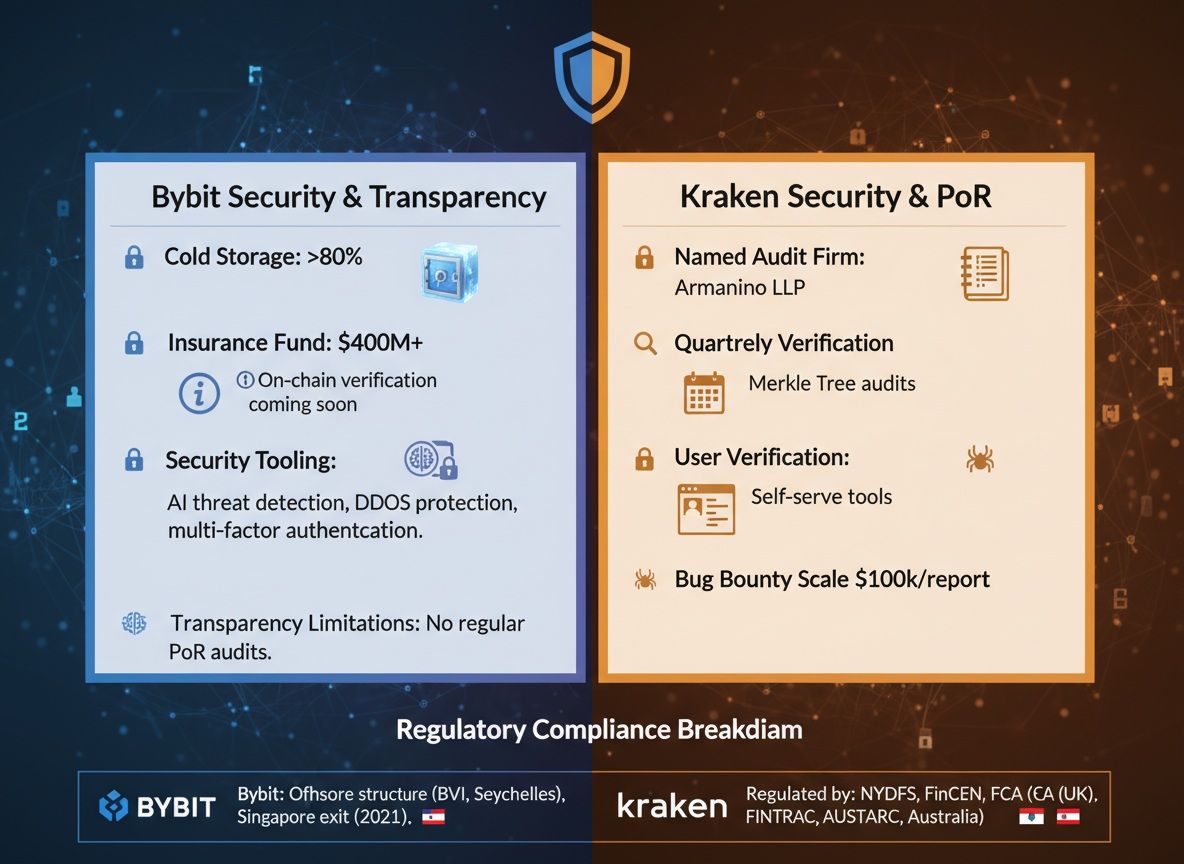
Bybit Security Architecture

Cold storage %
Bybit states it stores the “vast majority” of user funds offline in cold wallets, but it does not provide a precise percentage in that disclosure.

Insurance fund (with verification notes)
Bybit describes its derivatives insurance fund as a backstop for losses when liquidations execute worse than bankruptcy price, and it states the balance is viewable and updated daily at 12AM UTC. 

Security tooling
Bybit documents anti-phishing code setup and withdrawal address controls in its help center.

Transparency limitations
Bybit maintains a PoR portal and publishes reserve snapshots, but PoR is still point-in-time and scope-limited. Bybit Proof of Reserves.

Kraken Security & Proof of Reserves

Named audit firm
Kraken has named The Network Firm in its PoR communications.

Quarterly verification process
Kraken has publicly committed to a quarterly PoR cadence.

How users verify reserves themselves
Kraken’s PoR portal provides a client verification flow and also lists shortcomings and future improvement notes.

Bug bounty scale
Kraken’s bug bounty page lists published payout tiers.. Kraken also documents account-hardening controls like Global Settings Lock and Master Key.

Regulatory Compliance Breakdown

Kraken: NYDFS, FinCEN, FCA, FINTRAC, AUSTRAC

Kraken’s disclosures cite the following registrations: Payward Interactive, Inc. as a FinCEN Money Services Business, and Payward Limited as a UK FCA-registered cryptoasset business.

Kraken also publishes jurisdictional licensing/availability notes, including New York availability constraints. New York’s primary licensing framework is the NYDFS virtual currency licensing regime.

Bybit: Offshore structure, Singapore exit context

Bybit publishes an explicit restricted jurisdictions list including the United States and Singapore.

For Singapore context, Monetary Authority of Singapore clarified that from 30 June 2025, DTSPs serving only customers outside Singapore still require licensing under the DTSP regime and licensing is set at a high bar.

Security Comparison Table

Security / Transparency itemBybitKrakenVerification notes
Cold storage disclosureStates “vast majority” stored offline; no precise % in the cited disclosure.Not expressed as a single “cold %” claim in the sources used here.Treat “cold %” as not precisely disclosed unless a clear % is published.
Account takeover protectionsAnti-phishing code; withdrawal address controls.Global Settings Lock + Master Key (account-hardening).Kraken’s GSL/Master Key are explicitly positioned as “last-line” defenses.
Insurance / backstop mechanismsDerivatives insurance fund with daily balance update notes.Not framed as an exchange-wide insurance fund in the sources used here.Insurance funds are market-structure tools, not blanket guarantees.
Proof of reservesPoR portal with reserve snapshot framing.PoR portal with client verification flow + shortcomings.PoR ≠ full financial audit; both are point-in-time and scope-limited.
Named third party for PoRPoR portal exists; third-party attestations vary by snapshot.The Network Firm named in Kraken PoR communications.Treat as attestation/examination context, not a “security audit.”
Regulatory transparencyRestricted jurisdiction list is central to access.Detailed jurisdiction disclosures + named regulators in disclosures.Availability is jurisdiction-dependent for both; Kraken publishes deeper compliance mapping.

Available Markets & Trading Products

This is the “what can I trade here, and how do those products behave under stress?” section, because access and mechanics often matter more than UI.

Spot Trading

Coin counts
Counts change frequently. As a point-in-time snapshot, CoinGecko lists Bybit with a published “coins” and “pairs” figure on its exchange profile. CoinGecko also lists Kraken’s “coins” and “pairs” figure on its exchange profile.

Liquidity depth
Liquidity is pair-specific and time-dependent. If you trade size, you should test with controlled limit orders in your target pairs.

Fiat pairs
Kraken is more explicitly fiat-rail-forward, publishing cash deposit/withdrawal tables and processing-time guidance. Bybit offers fiat deposit/buy flows, but available rails vary by supported countries and payment methods.

Listing standards
Kraken describes legal/compliance standards for listings and EEA whitepaper expectations.  Bybit documents token evaluation and delisting mechanics

Derivatives & Leverage

Exact leverage by asset
Kraken states it offers up to 10x leverage on selected assets and up to 5x across a broader set of margin-enabled markets. It also publishes a detailed table of margin pairs and their maximum leverage

Bybit leverage is contract- and risk-limit-dependent, but Bybit explicitly references up to 100x leverage on BTCUSDT in its derivatives risk/TP-SL explainer.

Liquidation mechanics
Liquidation depends on maintenance margin, mark price, and risk limits. Bybit’s maintenance margin explainer shows how liquidation is triggered once maintenance margin thresholds are breached.

Settlement types
Bybit describes USDT/USDC perpetuals as linear, cash-settled products and inverse contracts as settled in the underlying coin. Kraken documents how settlement works for derivatives contracts (including how final settlement amounts are calculated and delivered).

Best platform for pro traders

  • If your strategy is derivatives-heavy and execution-focused, Bybit’s product emphasis and fee framing can be attractive.
  • If you want clearer compliance mapping and a more documented operational footprint, Kraken’s disclosures tend to be more explicit.

Passive & Advanced Features

Staking
Kraken documents staking mechanics and its commission model. Bybit offers earn/passive products that vary by region and eligibility; verify availability during onboarding.

Copy trading
Bybit offers copy trading features and documentation.

Bots
Bybit offers trading bots (e.g., grid/DCA-style tools).

Launchpads
Bybit runs launch-style event pages that change over time and are often region-gated.

NFTs
NFT marketplace offerings across exchanges have shifted materially since the 2021–2022 cycle. Treat NFT support as unstable and verify current status before relying on it.

Trading Platforms & User Experience

This section is about the “daily driver” reality: charting, order entry, and the specific controls you’ll use when markets move fast.

Trading Platforms & User Experience
Choose Bybit For High-leverage Derivatives And A Massive Selection of Altcoins, Or Kraken For Security And A Fully Regulated Platform

Bybit Platform Walkthrough

UI strengths
Bybit’s derivatives-first workflow is reflected in how quickly you can move between markets, positions, and risk controls.

Charting depth
Bybit documents that its charting interface includes TradingView-powered charts and a set of chart features and indicators. (Bybit Trading Chart FAQ)

Order types
Bybit lists a range of supported order types (with product-specific availability) in its help documentation.

API quality
Bybit publishes API documentation and rate-limit guidance (important for automation)

Kraken & Kraken Pro Experience

Interface split
Kraken separates simplified flows from Kraken Pro’s order-book interface; the fee model and tooling differ depending on which you use.

Desktop vs mobile
Kraken supports Pro-style experiences across devices, but the depth of order entry and analytics typically remains best on desktop terminals.

Pro terminal capabilities
Kraken Pro documents advanced derivatives execution controls like Conditional Close (OTO-style) and bracket-style TP/SL for derivatives.

UX Verdict by Skill Level

Beginners

  • Kraken’s simplified experience can reduce mistakes, but it can cost more if you rely on non-Pro flows.
  • Bybit’s feature density can overwhelm beginners, especially around leverage and liquidation risk.

Intermediate

  • Kraken Pro becomes more attractive once you’re comfortable with order books and want tighter execution control.
  • Bybit remains attractive if you want one venue optimized for spot + derivatives workflows.

Advanced

  • Bybit often fits high-frequency discretionary traders who live in derivatives markets. It tends to suit high-frequency discretionary traders who spend most of their time in derivatives.
  • Kraken can be a better fit for systematic traders who want clear documentation, predictable API behavior, and a more transparent compliance setup.

Deposits, Withdrawals & Payment Methods

Funding rails and withdrawal rules are where many real-world exchange frustrations show up.

Fiat On-Ramps Compared

Kraken’s cash funding tables name processors/banks for certain rails. For example, the deposit table includes ACH via Plaid and wire options via named banks/providers (e.g., FedWire via Dart Bank; SWIFT via Customers Bank; SWIFT via Bank Frick; SEPA providers including Banking Circle, Openpayd, and others listed).

Kraken’s withdrawal table names rails and processors/banks as well (e.g., ACH; FedWire via Customers Bank/Dart Bank; SWIFT via Bank Frick; SEPA via Bank Frick/Banking Circle; SEPA/SEPA Instant via Openpayd).

Bybit supports fiat deposit flows with payment-method availability varying by country (card networks and wallets are region-dependent).

Kraken publishes fee tables by rail and currency; Bybit states fiat deposit fees and processing time are visible when selecting the payment method (How to Deposit Fiat Currencies on Bybit).

Kraken includes processing-time estimates in the cash funding tables and explicitly notes they’re estimates outside of Kraken’s control.

Crypto Transfers & Limits

Confirmation speed is chain-dependent and congestion-dependent, not exchange-dependent.

Some exchanges batch withdrawals depending on network conditions and risk controls; this can affect “time to receive.”

Crypto withdrawal fees and minimums change frequently by asset and network. Best practice: check the withdrawal screen in-app right before sending.

Accessibility Verdict

Best for US

Kraken’s US onboarding and restrictions are explicitly documented.

Best internationally

Bybit can be attractive for derivatives-focused users, but eligibility must be confirmed first because excluded jurisdictions include the United States and Singapore.

Customer Support & Education

Support is hard to measure without ticket testing, so the most responsible approach is to document what exists (channels and resources) and clearly label what was not tested.

Learning Resources

Guides

  • Kraken maintains extensive support documentation and education content, including PoR explainers.
  • Bybit publishes product and security setup guides in its help center and Learn portal (e.g., How to Set Up the Anti-Phishing Code).

Webinars

Kraken maintains a webinars/events listing.

Bybit runs educational/community programming that can include event-style sessions; availability and cadence change over time.

Pro education

Advanced traders should prioritize exchange docs for order types, margin mechanics, and API rate limits.

Support Verdict

Urgent traders

  • If fast withdrawals matter to your strategy, run small deposit/withdrawal tests before committing meaningful capital, especially ahead of major volatility events.

Beginners

  • Kraken’s account-hardening features (GSL/Master Key) can reduce the impact of compromised email/password events.
  •  Bybit’s security tooling helps, but leverage products can increase support dependency if used too early.

User Reviews & Community Feedback

This section uses Trustpilot and G2 because they provide structured review collection and show patterns across many users. No review platform is perfect; focus on recurring failure modes (withdrawal delays, verification friction, account holds), not single anecdotes.

User Reviews & Community Feedback
Bybit Is Preferred For Advanced Features And High Leverage, While Kraken Is Favored For Its Superior Security And Regulatory Trust

Verified Bybit User Reviews

Trustpilot examples below are point-in-time and can change quickly. Also, do not assume “Verified/Invited” labels unless they are explicitly shown on the review card. Bybit examples below are presented exactly as labeled on the page.

Trustpilot:

Jan 7, 2026: 5/5 (no “Invited” label shown on the card in the captured view): Positive sentiment tied to feature convenience (card-related mention).

Jan 4, 2026: 2/5 (no “Invited” label shown on the card in the captured view): Negative sentiment tied to verification/EDD friction.

Jan 29, 2026: 3/5 (shown as “4 days ago” on Feb 2, 2026 view; no “Invited” label shown): Complaint about service restrictions/access.

Jan 27, 2026: 1/5 (shown as “6 days ago” on Feb 2, 2026 view; no “Invited” label shown): Complaint tied to card/charge dispute narrative.

G2 note (scope transparency): during this update pass, we did not find a stable, clearly attributable standalone Bybit.com exchange product page on G2 comparable to Kraken’s product page. For that reason, Trustpilot is treated as the primary structured review source for Bybit in this draft.

Verified Kraken User Reviews

Trustpilot: 

Jan 28, 2026: 5/5 — “Invited” label shown: Positive sentiment tied to ease of use.

Jan 19, 2026: 1/5 — “Invited” label shown: Complaint about withdrawal delays.

Jan 5, 2026: 4/5 — “Invited” label shown: Generally positive with minor UX/expectation notes.

G2:

Jun 13, 2022: 3.5/5 — “Current User” + “Validated Reviewer” badges shown (in page legend): Praises token access; notes past latency issues.

Jun 13, 2022: 5/5 — “Current User” + “Validated Reviewer” badges shown (in page legend): Praises ease of setup and buying; notes documentation burden.

Bybit vs Kraken – Who Should Use Which? (Decision Framework)

This practical decision layer considers what's most important given your trading style, custody habits, and jurisdictional constraints.

Quick Decision Table

If you are…Better fitWhy
Fee-sensitive spot trader (order-book)BybitLower published baseline spot maker–taker fees (Bybit “Fees That You Need to Know”).
High-frequency derivatives traderBybitDerivatives-first UX + published derivatives fees and tooling emphasis.
Security-first, long-term holderKrakenAccount-hardening features like GSL/Master Key + PoR verification workflow (Kraken Proof of Reserves).
Fiat-heavy userKrakenTransparent banking rails, fees, and processing-time tables (Cash deposit options / Kraken Cash withdrawal options).
API-driven / systematic traderKrakenClear API rate-limit guidance and documentation (What are the API rate limits?).
Needs maximum clarity on PoR verificationKrakenPoR portal includes verification flow + stated shortcomings (Kraken Proof of Reserves).

If/Then Decision Logic

Quick rules of thumb based on typical user priorities.

If US-based Kraken

Kraken is typically the simpler choice for US users because it supports US-facing onboarding and commonly used domestic fiat rails, reducing friction for deposits/withdrawals compared with offshore-focused venues.

Best for: US access + fiat rails
If leverage-focused Bybit

Bybit is built around derivatives, so its product flow, risk controls, and fee disclosures tend to be optimized for margin and perpetuals trading rather than “spot-first” usage.

Best for: Perps + margin tools
If long-term storage Kraken

For “park it and protect it” behavior, Kraken emphasizes account-hardening options (for example, extra lock features and security controls) and publishes proof-of-reserves workflows that help users verify holdings.

Best for: Security controls + PoR
If day trading Bybit

For frequent entries/exits, Bybit’s trading-first interface and derivatives tooling are typically geared toward fast execution workflows and active trader features.

Best for: Active trading workflow

Final Verdict

If you want the most conservative “default,” Kraken is typically the better choice for users who prioritize security posture, transparency mechanics, and predictable fiat rails. Its Proof of Reserves portal is client-verifiable and includes explicit limitations, and its account-hardening tools (Global Settings Lock and Master Key) are unusually strong advantages in retail exchange security.

Bybit is typically the better value choice for traders who prioritize active trading, derivatives tooling, and low published maker–taker fees, provided they are eligible to use the platform in their jurisdiction and are comfortable managing platform risk actively.

Crypto trading involves risk of loss. Leverage can liquidate positions quickly. Even strong exchanges can experience outages, delays, or policy changes. Use small test transactions, enable strong account security, and consider self-custody for long-term holdings.

Frequently Asked Questions

Can I use both Bybit and Kraken at the same time?

Yes. Many traders use Kraken for regulated fiat on/off-ramps and custody-style holding, and Bybit for derivatives or specific trading tools. Just keep track of fees, withdrawal networks, and tax records across both platforms.

How long does account verification take on Bybit vs Kraken?
  • Bybit: Often completes quickly (Bybit says it “usually takes about 5 minutes,” but can take up to 1 working day for further review).
  • Kraken: Kraken states verification is typically fast (often under 30 minutes), but can take longer if manual review is required; another Kraken article notes most applications are processed in five days or fewer if documents are complete.
Is Bybit or Kraken cheaper for spot trading in 2026?

It depends on your order type and volume tier, but both can be very competitive:

  • Bybit: Commonly lists 0.10% maker / 0.10% taker for non-VIP spot trading (with tiers that can reduce fees).
  • Kraken: Fees vary by product and tier; Kraken publishes a full fee schedule and maker/taker explanations, with rates depending on 30-day volume and market.

Practical takeaway: If you mostly place limit (maker) orders and/or have meaningful volume, either exchange may be cheaper depending on your tier and the specific market you trade. Always check the exact fee table for the pair/product you use.

Which exchange has lower fees for futures and derivatives trading?

At base tiers (before VIP/volume discounts), Bybit often advertises very low maker fees for perps/futures, while Kraken’s derivatives fees start low but are more volume-tiered:

  • Bybit (non-VIP example): Perpetual & futures shown as 0.01% maker / 0.06% taker in its fee explainer (exact rates can vary by product and your account page).
  • Kraken Derivatives: Published schedule shows 0.02% maker / 0.05% taker at the $0+ tier (then decreases with volume).
Does Bybit or Kraken offer better liquidity for large trades?

For very large trades, both offer “off-order-book” options designed to reduce slippage:

  • Kraken OTC: Designed for large orders (Kraken markets access to deep liquidity and OTC for larger sizes).
  • Bybit OTC / RFQ: Bybit offers OTC and RFQ-style block trading tools intended for substantial size and quoted execution.

Rule of thumb: If you’re routinely trading $50k+ per clip, comparing OTC/RFQ quotes from both platforms is usually more meaningful than comparing normal order books.

Is Bybit safe to use despite being an offshore exchange?

“Safe” depends on what risks you mean:

  • Regulatory/jurisdiction risk: Bybit explicitly restricts service in multiple jurisdictions (including the United States and others).
  • Transparency risk: Bybit provides a Proof of Reserve mechanism and explains how users can self-verify via Merkle tree proofs (helpful, but not a blanket guarantee against all risks).

If your priority is strong local regulatory coverage, Kraken is often the more straightforward fit because it operates as a regulated exchange in many markets (availability still depends on where you live).

How secure is Kraken compared to Bybit?

Both invest heavily in security controls, but they emphasize different trust signals:

  • Kraken: Actively promotes security posture and publishes transparency pages like Proof of Reserves and security resources.
  • Bybit: Publishes Proof of Reserve verification steps and maintains derivatives risk tooling like an insurance fund mechanism (aimed at reducing negative-equity impacts in certain liquidation scenarios).

No centralized exchange is risk-free. Using 2FA, withdrawal address allowlists (if available), and minimizing idle balances are still best practices

Does Kraken really have full proof of reserves, and how can I verify it?

Kraken publishes Proof of Reserves (PoR) materials and provides an in-account way to verify whether your balance was included in a PoR snapshot:

  • Kraken’s PoR page outlines steps in Kraken Pro (Account icon → Proof of Reserves) where you can view reserve ratios and verification details for your account.
  • Kraken also describes the concept and client verification flow in its PoR communications.

Important limitation: PoR generally shows assets held and matching liabilities at a point in time; it does not automatically prove the absence of debt or other obligations unless the report scope includes that.

What leverage limits does Bybit offer compared to Kraken?
  • Bybit: Offers high leverage on certain products; Bybit’s “Smart Leverage” materials mention up to 200x for selected contracts/products.
  • Kraken: Kraken’s derivatives materials commonly reference up to 50x leverage (and margin trading on spot is lower, depending on the product/market).

Always check the specific contract and your region—leverage availability can change based on regulation and eligibility.

Is Bybit available in the United States?

No. Bybit lists the United States among its “Excluded Jurisdictions.”

Which countries restrict access to Bybit or Kraken?
  • Bybit: Publishes a list of excluded jurisdictions (including United States, Mainland China, Hong Kong, Singapore, Canada, and several sanctioned/high-risk regions, among others).
  • Kraken: Kraken says it serves clients globally with “a few specific exceptions,” and availability/restrictions can depend on residency and product.

Because restrictions can change, the safest approach is to verify eligibility inside each exchange’s official “supported/eligible regions” pages before depositing.

Can I transfer crypto directly between Bybit and Kraken?

Yes, via on-chain withdrawals and deposits:

  1. Withdraw from Exchange A to a wallet address on Exchange B.
  2. Make sure you select the same network on both sides (for assets with multiple networks, like USDT).
  3. Consider doing a small test transfer first.
Do Bybit and Kraken insure customer funds?

Generally, no traditional “deposit insurance” like a bank account:

  • Kraken: Explicitly states balances are not covered by deposit insurance programs, and its legal disclosures emphasize no insurance for digital assets/accounts.
  • Bybit: Its insurance fund is designed to address certain derivatives liquidation/negative-equity scenarios. This is not the same as insuring customer deposits against exchange failure.
Which exchange is better for beginners in crypto trading?

It depends on what “beginner” means:

  • If you want a more traditional onboarding experience (fiat funding, regulated footprint in many regions, structured help resources), Kraken is often simpler.
  • If you want to learn advanced trading features sooner (derivatives tooling, bots, high leverage products), Bybit has more complexity—great for learning, but easier to make costly mistakes.

Derivatives and leverage can magnify losses quickly. Beginners generally benefit from starting with spot trading and strict position sizing.

Which platform is better for professional or high-frequency traders?

Both support professional workflows, but the deciding factors are usually APIs, fee tiers, and market structure:

  • Kraken: Offers REST, WebSocket, and FIX options via its API center.
  • Bybit: Provides REST + WebSocket API documentation and frequent API changelog updates.

If you’re truly HFT (latency-sensitive), you’ll also care about colocation, matching engine behavior, and venue-specific microstructure—details that usually require direct testing.

Does Kraken or Bybit offer better customer support during high-volatility periods?

Both advertise 24/7 support, but access methods differ:

  • Kraken: Promotes 24/7 live chat, and notes voice support may be available in-app for select situations.
  • Bybit: States it has dedicated support and uses web forms/support hub, with messaging indicating response times can vary with inquiry volume.

During extreme volatility, delays can happen on any exchange—self-service status pages, help centers, and clear escalation paths matter as much as promises.

What payment methods are supported on Bybit vs Kraken?
  • Bybit: Supports card payments (Bybit lists Visa/Mastercard and also mentions Apple Pay/Google Pay in its card payment FAQ), and also has P2P with “80+ payment methods.”
  • Kraken: Supports a range of bank funding options (including ACH in the U.S. and SEPA in Europe, among others) via its funding options and cash deposit/withdrawal pages.

Availability depends heavily on your country and verification level.

Are there hidden fees on Bybit or Kraken that traders should know about?

Not usually “hidden,” but commonly overlooked:

  • Instant buy/sell & card rails: Third-party providers can add fees/spreads (Bybit explicitly notes provider fees for “Buy Crypto”).
  • Withdrawals: Crypto withdrawals typically include per-asset minimums and fees (Kraken publishes a table; Bybit notes withdrawal fees are fixed per asset/network and can be adjusted).
  • Derivatives funding rates: Not an “exchange fee,” but a real cost for perpetual positions.
Can I stake crypto or earn passive income on both exchanges?

Yes.

  • Bybit: Offers Bybit Earn products (including “Easy Earn” and “On-Chain Earn”).
  • Kraken: Offers staking and “Auto Earn” features (availability and terms vary by region/asset).

Earning products can carry smart contract, validator, slashing, and platform risks. Rewards are not guaranteed.

Which exchange is better for crypto tax reporting and record keeping?

Both provide exports and integrations, but Kraken’s built-in document center + exports are very straightforward, while Bybit leans on exports + Tax API partners:

  • Kraken: Provides tax forms guidance and lets users export trade/ledger history from the Documents Center.
  • Bybit: Offers a Tax API program with third-party partners and also supports exporting account data (web-only per Bybit’s export article).

If you trade on both, you’ll typically want a dedicated tax app to merge data sources cleanly.

Do Bybit and Kraken provide API access for automated trading?

Yes.

  • Bybit: REST + WebSocket APIs and official API documentation/changelog.
  • Kraken: REST + WebSocket (+ FIX) via its API Center.
What happens to my funds if Bybit or Kraken shuts down?

In any exchange shutdown scenario, outcomes depend on custody practices, legal jurisdiction, and whether the exchange is solvent:

  • You may be able to withdraw normally if it’s an orderly wind-down.
  • In insolvency/bankruptcy, withdrawals can pause and user claims can become part of a legal process.

Proof of Reserves can improve transparency, but it does not remove all counterparty risk.

Are there minimum deposit or withdrawal limits on either exchange?

Yes, especially on withdrawals.

  • Kraken: Publishes cryptocurrency withdrawal fees and minimums by asset/network.
  • Bybit: Withdrawal fees/minimums vary by asset/network; Bybit also explains how it sets withdrawal fees and processing behavior.
Which exchange has the better mobile app for active trading?

This is subjective, but here’s a practical way to decide:

  • If you need spot + staking + fiat funding in one app with strong account management and support flows, Kraken’s app ecosystem is built for that.
  • If you need derivatives-first features (high leverage products, bots, advanced order types), Bybit’s app is designed around active trading tools.

Best practice: test both with small amounts and confirm the features you personally need (alerts, order types, charting, transfer UX).

Is Kraken or Bybit better for long-term crypto holders?

For long-term holders, the main concerns are custody risk, fees to buy/sell occasionally, and withdrawals to self-custody:

  • Kraken: Often preferred by long-term holders who want a more regulated venue and clear documentation/export tools.
  • Bybit: Can still work for long-term holding, but many users primarily choose it for active trading features and product breadth.

For true long-term holding, many investors keep the majority in a self-custody wallet and only leave trading balances on exchanges.

Jibran coin bureau.jpg

With 13 years of experience as a writer and editor, I’m bringing my storytelling instincts into the fast-moving world of crypto. I’m actively expanding my knowledge in this space, translating complex ideas into clear, engaging narratives that resonate with readers. When I’m not shaping content, you’ll likely find me on the cricket pitch or the football field.

Disclaimer: These are the writer’s opinions and should not be considered investment advice. Readers should do their own research.

next article
Explore The Most Secure & Trusted Crypto Exchanges In 2026