



Crypto.com is one of the stronger large centralized cryptocurrency exchanges from a security-controls perspective. It combines layered account security, institutional custody infrastructure, reserve disclosures, regulatory permissions and several insurance or reimbursement arrangements.
This guide examines Crypto.com's custody model, Proof of Reserves, insurance, regulation, security history and account protections to answer a simple question: Is Crypto.com safe to use in 2026?
Editor's Note (Aug. 21, 2026): We fully updated this analysis in August 2026 to reflect Crypto.com's current security, custody and regulatory position. The refresh adds clearer distinctions between Proof of Reserves and a full financial audit, separates Crypto.com's different insurance arrangements instead of combining them into one headline figure, updates the Account Protection Program and FDIC-eligible cash protections, and incorporates newer regulatory developments. We also expanded coverage of Crypto.com App vs Exchange vs Onchain custody risks, account-security controls, and when self-custody may be preferable for long-term holdings.
Quick Verdict: Is Crypto.com Safe?
Yes, Crypto.com is one of the stronger centralized exchanges for security, with layered account protections, cold-storage controls, insurance arrangements and broad regulatory oversight.
Its security stack includes passkeys, FIDO2 support, authenticator-based 2FA, trusted-device controls, withdrawal-address whitelisting, anti-phishing tools and an optional 24-hour lock on newly added withdrawal addresses. Crypto.com also maintains Proof of Reserves tools, although the detailed independent verification it currently references dates to 2022.
Crypto.com still carries the usual centralized-exchange risks, including custody, account access, withdrawal restrictions and counterparty exposure. Long-term holders who can manage private keys safely may prefer self-custody for assets that do not need immediate exchange liquidity.
Crypto.com Safety Scorecard
Crypto.com combines strong custody and account controls with broad regulatory coverage, but Proof of Reserves, insurance and licensing do not eliminate centralized-exchange risk.
| Security Area | Assessment | Core Reason |
|---|---|---|
| Custody security | Cold-storage controls, HSMs and least-privilege access | |
| Account security | Passkeys, FIDO2, TOTP, trusted devices and account locking | |
| Withdrawal protection | Address whitelisting and optional 24-hour new-address lock | |
| Reserve transparency | Merkle verification remains available, but the referenced independent snapshot is from 2022 | |
| Insurance protection | Multiple insurance arrangements exist, but coverage depends on entity and loss type | |
| User reimbursement | APP may cover qualifying unauthorized transactions subject to eligibility rules | |
| Regulatory oversight | Entity-specific oversight across the US, EU, UK, Singapore and other markets | |
| Security track record | 2022 customer-account incident and reported 2023 employee-account compromise | |
| External security testing | HackerOne bug bounty, SOC 2 Type II and multiple ISO certifications |
Crypto.com Safety by User Type
Crypto.com's safety profile changes depending on whether you use it for basic purchases, active trading, long-term storage or self-custodial Web3 activity.
| User Type | Safety Verdict | Main Risk | Safer Approach |
|---|---|---|---|
| Beginner | Phishing, weak authentication and custody dependence | Enable passkeys, TOTP, whitelisting and the anti-phishing code | |
| Active trader | Account compromise, API misuse and trading losses | Restrict API permissions, use IP controls and limit leverage | |
| Long-term holder | Counterparty, custody and withdrawal-access risk | Keep only assets requiring exchange liquidity under centralized custody | |
| High-value account | Targeted phishing, social engineering and account takeover | Use phishing-resistant authentication, whitelisting and strict email security | |
| Leverage trader | Liquidation and market losses | Control position size and keep leverage conservative | |
| Crypto.com Onchain user | Seed theft, malicious DApps and unsafe approvals | Protect the recovery phrase and verify every signature and approval | |
| User expecting deposit insurance | Crypto balances are not FDIC insured | Do not treat exchange-held cryptocurrency as an insured bank deposit |
Safety assessments reflect Crypto.com's custody structure, account controls, Proof of Reserves, insurance disclosures, regulatory framework, security history and user-protection programs. They do not guarantee protection against insolvency, withdrawal restrictions, phishing, authorized scam transfers, market losses, malicious DApps or losses caused by user error.
Disclosure
Some links in this guide may be affiliate links. If you choose to use a service through these links, we may earn a commission at no additional cost to you.

How We Assessed Whether Crypto.com Is Safe
Exchange safety involves custody, solvency, account protection and operational resilience. A platform can have strong authentication while still carrying counterparty or liquidity risk.
Custody and asset security
We assessed how Crypto.com protects customer crypto while it controls custody, including cold storage, private-key infrastructure, access restrictions and institutional custody arrangements. This assessment focuses on theft and operational misuse rather than broader corporate solvency.
Reserves and financial transparency
We examined Crypto.com's asset-backing claims, reserve disclosures and whether users can verify that covered balances were included in its Proof of Reserves system. Reserves are only part of a solvency assessment because liabilities, debt and off-chain obligations can sit outside a reserve snapshot.
Account and authentication security
We assessed passkeys, two-factor authentication, trusted devices, session controls, withdrawal restrictions and anti-phishing systems against account takeover, phishing and unauthorized withdrawals.
Legal and operational protection
Regulatory oversight, insurance and reimbursement programs can strengthen asset protection, but coverage depends on the relevant legal entity, jurisdiction and terms. A license is not a deposit guarantee, and reimbursement programs can impose security, reporting and eligibility requirements.
Security track record
Crypto.com's record includes the January 2022 customer-account security incident and a separate employee-account compromise reportedly dating to 2023. We also considered the incident-response controls and security programs introduced later.
How Crypto.com Protects Customer Crypto
Crypto.com's security model combines custody controls with authentication, withdrawal restrictions, anti-phishing tools and external security testing.
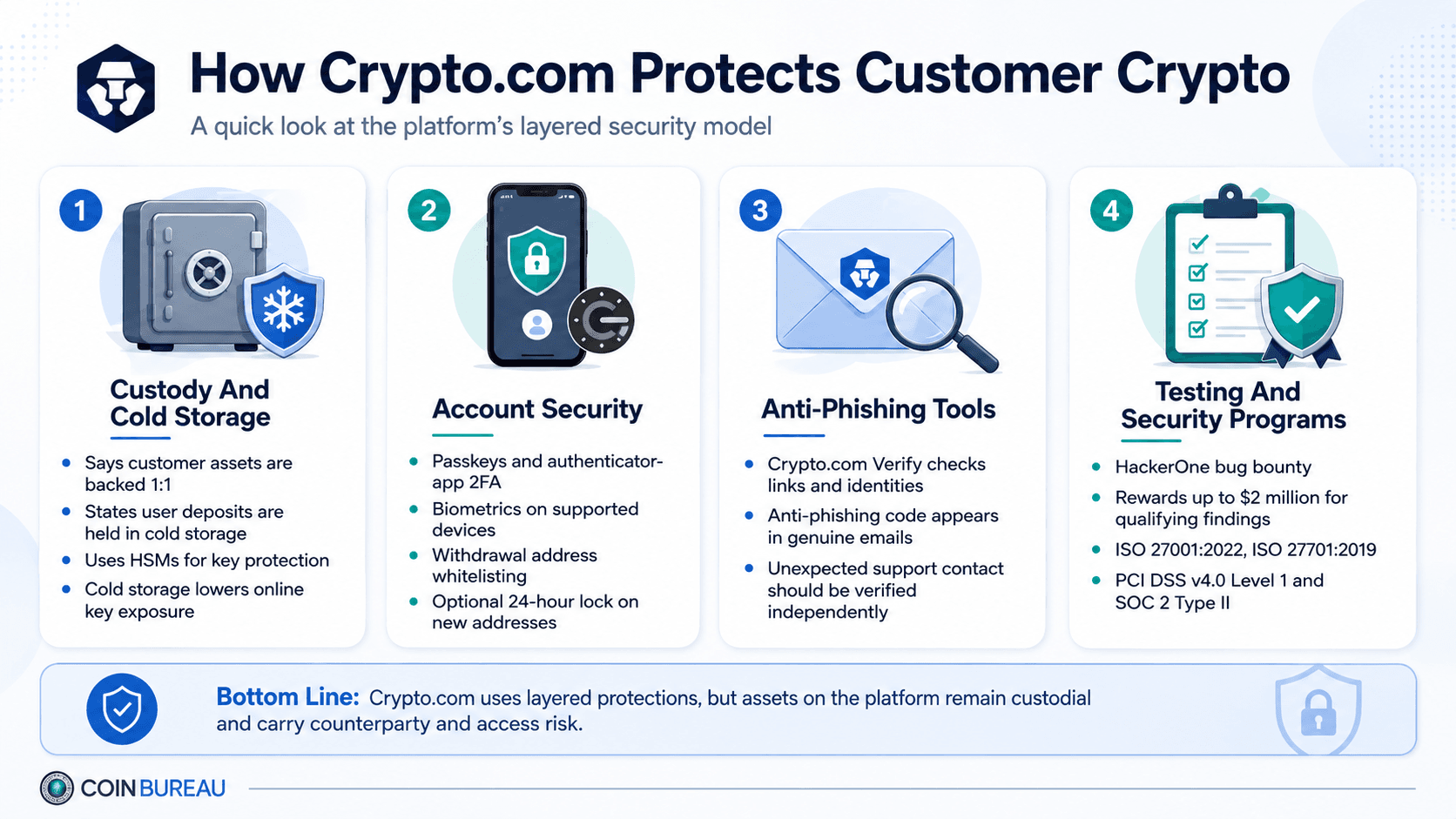 Layered Crypto.com Security Controls Combine Cold Storage, Account Protection, Anti-Phishing Tools, and External Testing
Custody and Cold Storage
Crypto.com says customer assets are maintained on a 1:1 basis in reserve accounts. Its current withdrawal documentation states that all user deposits are held in cold storage, while withdrawals are automated.
Its security documentation describes Hardware Security Modules, or HSMs, least-privilege access and strict controls over cold and hot wallets. HSMs are specialized devices used to protect cryptographic keys and sensitive signing operations.
Crypto.com's public retail-security materials describe least-privilege access and strict wallet controls, but do not publish one universal multi-signature, multi-party authorization or segregation-of-responsibilities model for every retail custody flow.
Crypto.com Custody Trust Company provides a separate institutional cryptocurrency custody structure in the United States. Its legal and insurance arrangements should not automatically be treated as the terms governing every retail Crypto.com balance.
Cold storage limits online private-key exposure, while custodial balances remain exposed to Crypto.com's counterparty, operational and withdrawal-access risks.
Read our full Crypto.com review.
Account Security and Withdrawal Controls
Crypto.com supports passkeys, FIDO2-compatible methods, biometrics and authenticator-based multifactor authentication. Its security architecture separately uses HSMs to protect cryptographic keys. Crypto.com's App uses Time-based One-Time Passwords, or TOTP, for authenticator-app two-factor authentication.
Withdrawal addresses must be whitelisted. Crypto.com also offers an optional 24-hour withdrawal lock for newly added addresses. Withdrawal flows distinguish between trusted and untrusted devices and can require a passkey, authenticator code, passcode or SMS verification depending on the setup.
If an attacker obtains a password, a configured passkey or TOTP requirement, trusted-device controls, withdrawal whitelisting and the new-address delay can still block or slow an unfamiliar withdrawal.
Withdrawal requests can trigger confirmation emails and completion notifications. Suspected unauthorized-login alerts can also provide access to Crypto.com's One-Button Lock, which restricts account activity. Users can remove unfamiliar trusted devices and review account access.
Crypto.com Verify and Anti-Phishing Protections
Crypto.com Verify checks whether a link, email address or social media identity is associated with Crypto.com. It can be used to check a suspicious email, website or account claiming to represent customer support.
An anti-phishing code serves a separate purpose. Users create a personalized code that appears in genuine Crypto.com emails.
Crypto.com also uses protections around suspicious calls and impersonation. Users should independently verify unexpected support contact and never provide a password, private key, recovery phrase or authentication code to someone making an unsolicited customer-support call or message.
Bug Bounty and External Security Testing
Crypto.com operates a HackerOne vulnerability-disclosure program with rewards of up to $2 million for qualifying findings.
It also boasts certifications including ISO/IEC 27001:2022, ISO/IEC 27701:2019, ISO 22301:2019, PCI DSS v4.0 Level 1 and SOC 2 Type II. Crypto.com also describes peer review and static and dynamic source-code analysis as part of its software-development process.
A bug bounty supplements internal testing, penetration testing, vulnerability disclosure and cybersecurity audits. Certifications assess defined controls and processes rather than every future software release.
Does Crypto.com Have Proof of Reserves?
Yes. Crypto.com provides a Proof of Reserves system for covered customer assets, although the detailed independent verification it currently references dates to 2022.
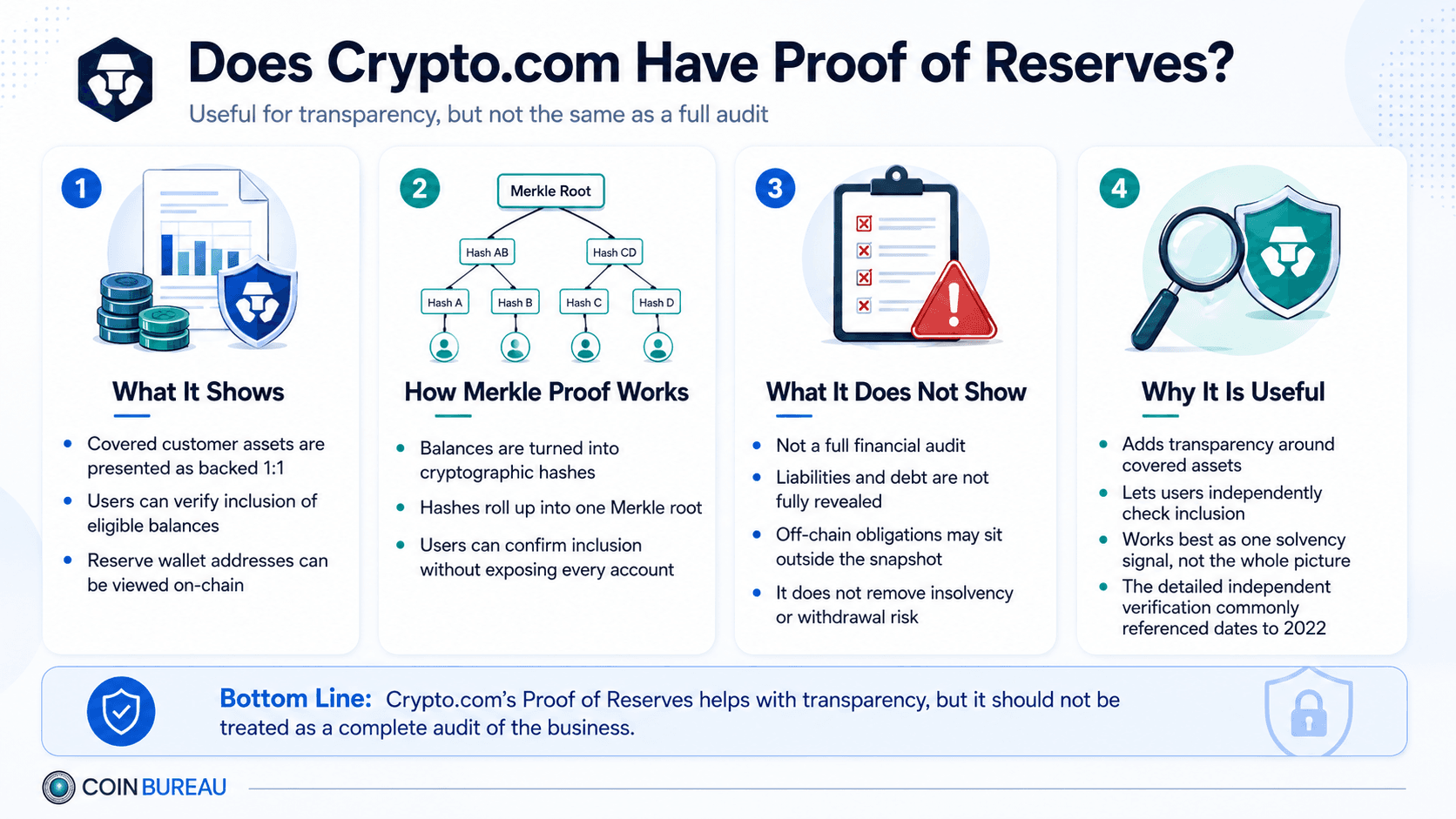 Crypto.com Proof of Reserves Adds Transparency While Leaving Liabilities, Solvency, and Audit Limitations Unresolved
What Crypto.com's Proof of Reserves Shows
Crypto.com's Proof of Reserves supports its claim that covered customer assets are backed 1:1. Users can verify the inclusion of eligible balances through a Merkle proof.
A Merkle tree converts account data into cryptographic hashes and combines them into a Merkle root. A user can check that their balance was included without Crypto.com publishing every customer's account information.
The 2022 independent exercise covered major assets including BTC, ETH and USDC, alongside several other cryptocurrencies. On-chain reserve wallet addresses can also be inspected on public blockchains.
On-chain balances support the reserve claim only when wallet addresses are correctly attributed to Crypto.com and the corresponding customer liabilities are captured by the exercise.
How Current Is Crypto.com's Independent Verification?
The detailed independent reserve verification Crypto.com still references used a Dec. 7, 2022, snapshot and was performed by Mazars under an agreed-upon-procedures engagement.
Mazars subsequently paused its crypto Proof of Reserves work. Crypto.com continues to offer user reserve-verification tools.
What Proof of Reserves Does Not Prove
Proof of Reserves does not by itself establish:
- Full corporate solvency
- Every customer or corporate liability
- Off-chain obligations
- Corporate debt
- Fiat assets outside the exercise
- Absence of intercompany exposure
- Immediate withdrawal liquidity under every scenario
Is Crypto.com Insured?
Yes, Crypto.com has several insurance arrangements.
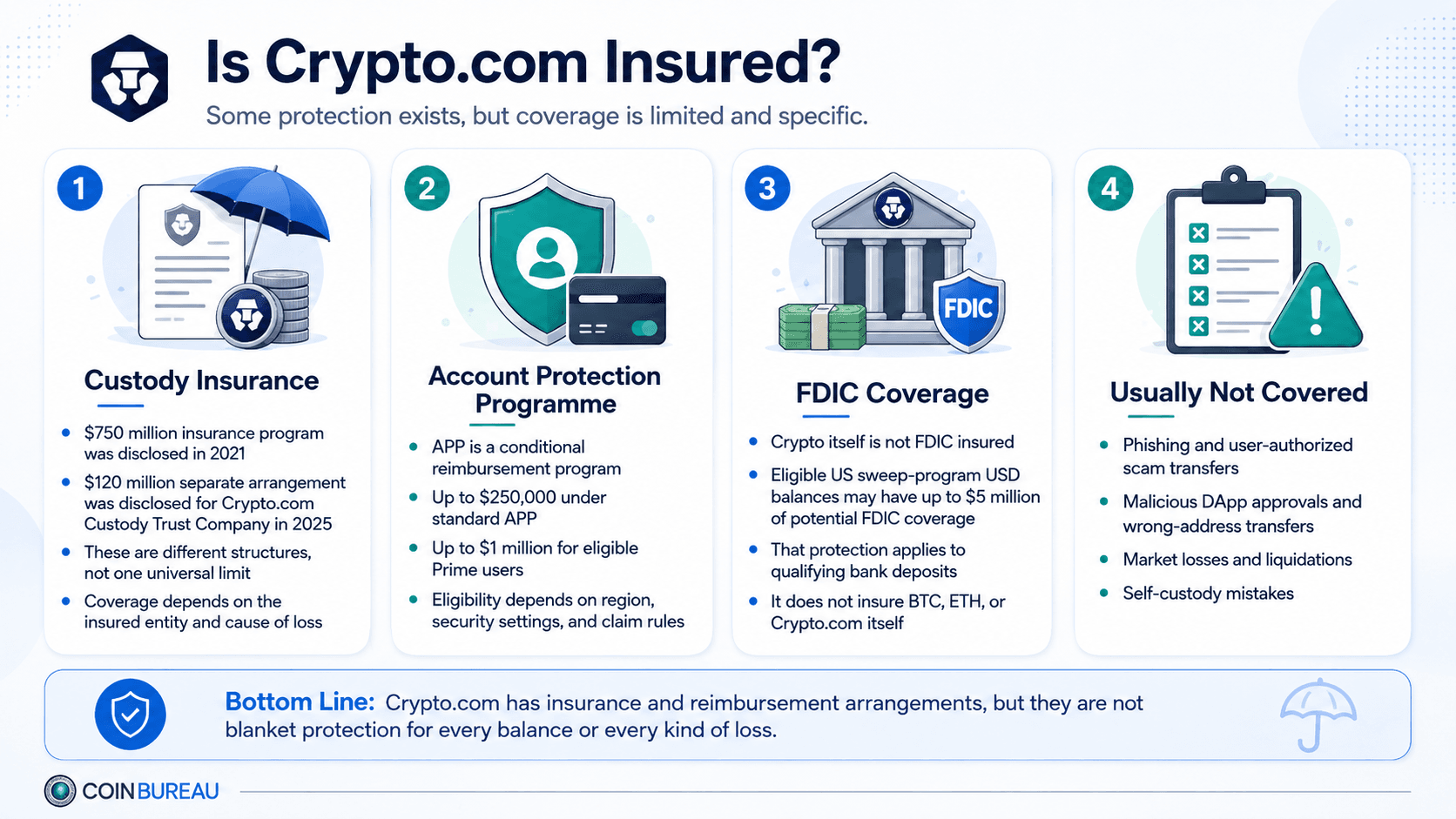 Crypto.com Insurance Includes Custody Coverage and Reimbursement Programs, but Protection Depends on Specific Loss Conditions
Crypto.com's Custody Insurance
Crypto.com has a $750 million digital-asset insurance program. The announcement covered direct and indirect custodian protection against specified physical damage, destruction and third-party theft risks.
In 2025, Crypto.com announced a separate $120 million crime and specie insurance arrangement for Crypto.com Custody Trust Company. Aon arranged the coverage with Lloyd's-market underwriters. Crypto.com said $100 million related to specified cold-storage risks and $20 million covered crime and third-party theft, with coverage effective from the first quarter of 2025.
What Crypto.com Insurance Does Not Cover
Insurance protection depends on the insured entity, policy wording and cause of loss.
| Loss type | Protection to expect |
|---|---|
| Qualifying custody theft | May fall within applicable custody or crime coverage |
| Certain criminal losses | Potentially covered under the relevant policy |
| Specified cold-storage loss | May fall within specie/custody coverage |
| Phishing | Generally outside ordinary custody insurance |
| User-authorized scam transfer | Generally outside custody insurance |
| Malicious DApp approval | Self-custody/Web3 risk |
| Wrong-address transfer | Generally not insured |
| Market loss | Not a custody-insurance event |
| Leveraged liquidation | Trading loss |
| Lost recovery phrase | Self-custody risk |
Crypto.com's Account Protection Program
Crypto.com's Account Protection Programme, or APP, is separate from custody insurance. Under the policy, qualifying unauthorized transactions may be eligible for discretionary recovery of up to $250,000 under standard APP and up to $1 million for eligible Crypto.com prime users.
Geographic eligibility varies. The current policy lists the United States and Canada as Prime-only APP markets. Claimants must meet specified account-security requirements, cooperate with the investigation and contact Crypto.com within 30 working days of the occurrence of the unauthorized transaction.
Transactions the user personally authorizes after being deceived can fall outside the definition of an unauthorized transaction. User negligence can also affect eligibility under the policy.
APP is conditional reimbursement, not blanket account insurance.
Is Crypto.com FDIC Insured?
No. Cryptocurrency held on Crypto.com is not insured by the Federal Deposit Insurance Corporation (FDIC).
For eligible US users, Crypto.com's Green Dot Cash Earn structure can use a deposit-sweep program that provides up to $5 million in potential FDIC coverage, subject to program rules and the user's other deposits at participating banks. The standard FDIC limit is generally $250,000 per depositor, per insured bank, per ownership category; the sweep structure can distribute eligible USD balances among participating banks.
FDIC pass-through or sweep protection applies to qualifying bank deposits when an insured bank fails. It does not insure BTC, ETH or other cryptocurrency, market losses, scams or a failure of Crypto.com itself. FDIC coverage, APP reimbursement and private custody insurance are separate protections.
Has Crypto.com Ever Been Hacked?
Yes. Crypto.com suffered a significant customer-account security incident in January 2022, followed by a separate employee-account incident reportedly occurring in 2023.
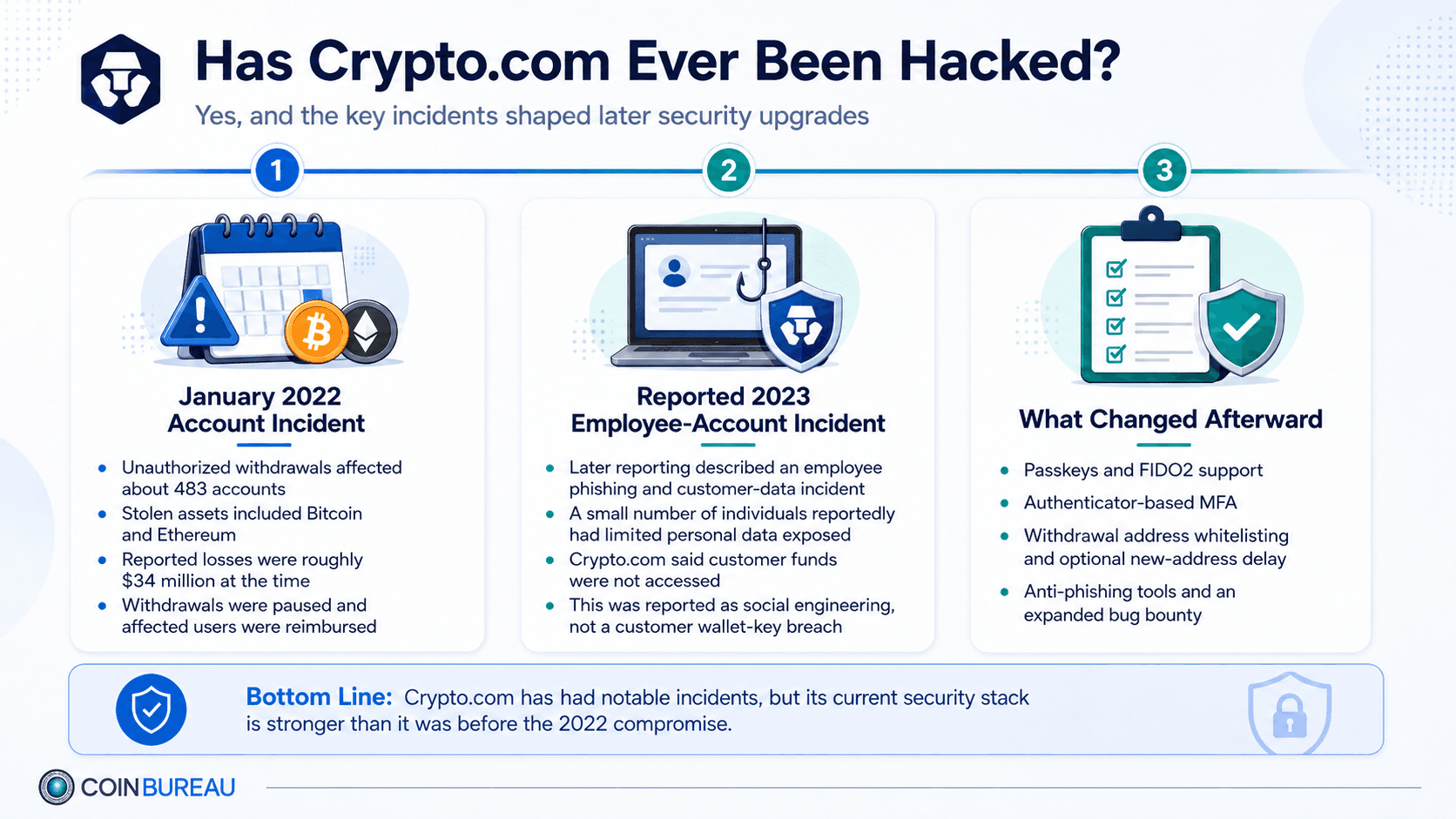 Crypto.com Security Incidents Show How Past Breaches Led to Stronger Authentication, Withdrawal, and Anti-Phishing Controls
The January 2022 Crypto.com Hack
On Jan. 17, 2022, unauthorized withdrawals affected approximately 483 customer accounts. The stolen assets included Bitcoin and Ethereum, with the total value reported at roughly $34 million at the time. Crypto.com paused withdrawals and said affected customers were reimbursed.
Crypto.com subsequently replaced parts of its 2FA infrastructure and expanded withdrawal protections after the account compromise.
The 2023 Employee-Account Security Incident
A separate employee-related security incident reportedly occurred in 2023 and became prominent in reporting during 2025. Reports linked the attackers to people associated with Scattered Spider and described the event as an employee phishing and customer-data incident rather than a theft of customer crypto.
Crypto.com said a very small number of individuals had limited personal information exposed, said customer funds were not accessed and disputed claims that it concealed a major data breach.
The incident involved employee-account access and social engineering rather than a reported compromise of customer wallet keys.
What Changed After the Incidents?
Crypto.com's current account stack includes passkeys, FIDO2, authenticator-based MFA, trusted-device controls, mandatory withdrawal-address whitelisting, optional new-address delays and anti-phishing tools.
Its wider security and transparency framework later expanded to include Proof of Reserves, the Account Protection Program, cybersecurity monitoring and an enlarged HackerOne bug bounty with rewards of up to $2 million. These later programs form part of the platform's broader incident-response and security framework rather than direct technical fixes for the incidents.
Is Crypto.com Regulated?
Crypto.com operates through multiple legal entities, so regulation and product availability vary by jurisdiction and service.
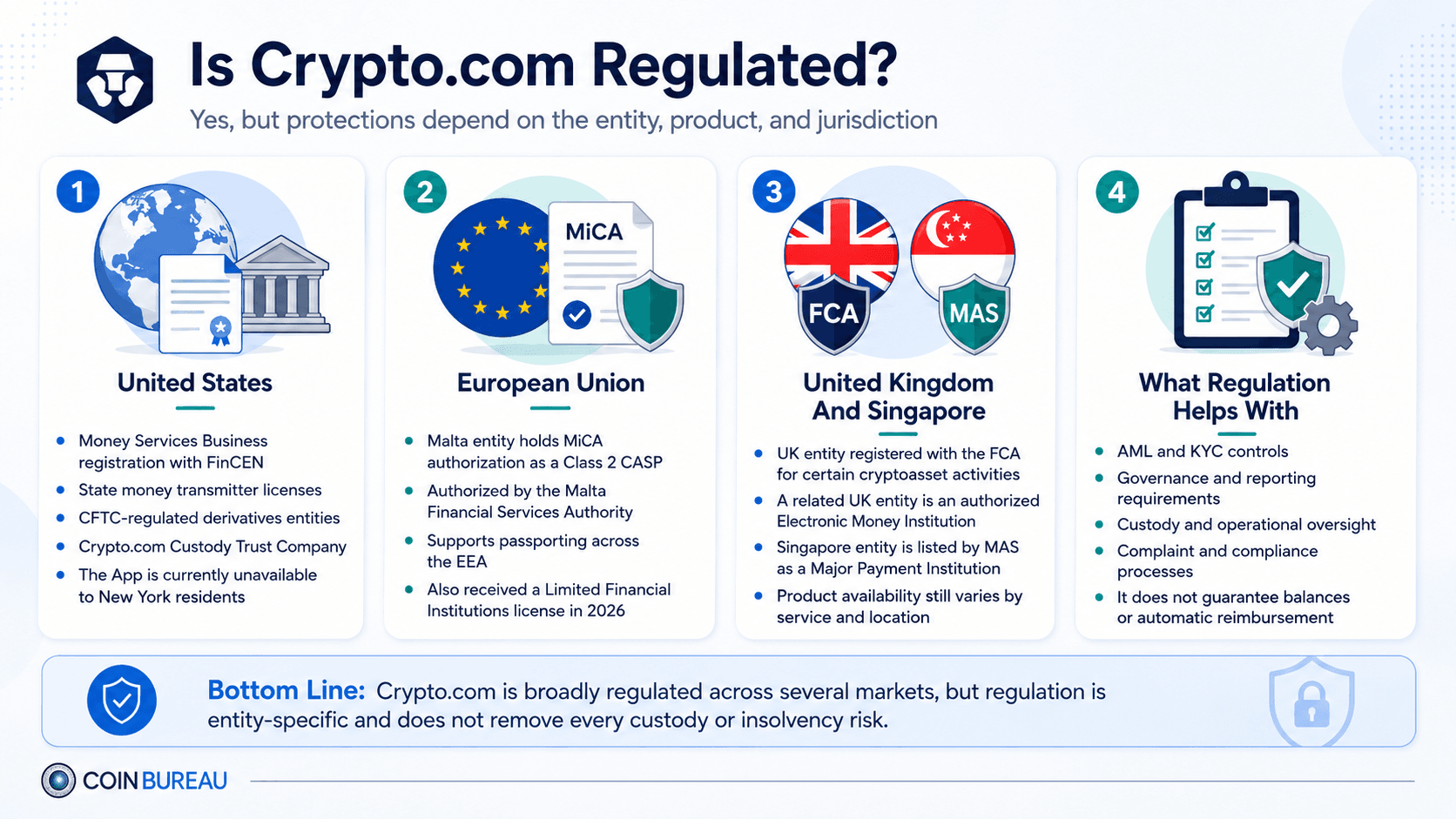 Crypto.com Regulation Spans Major Markets, but Oversight and Consumer Protections Vary by Legal Entity
United States
Crypto.com's US regulatory disclosures include Money Services Business registration with the Financial Crimes Enforcement Network (FinCEN), state money transmitter licenses and federally regulated derivatives entities.
Its US derivatives operations include entities overseen by the Commodity Futures Trading Commission (CFTC), including Designated Contract Market and Derivatives Clearing Organization permissions. Crypto.com also operates Crypto.com Custody Trust Company.
On Feb. 20, 2026, the Office of the Comptroller of the Currency (OCC) granted preliminary conditional approval for Foris DAX National Trust Bank. That status is not the same as Crypto.com operating an ordinary FDIC-insured retail bank.
The Crypto.com App is unavailable to residents of New York as of Aug. 21, 2026. Product availability can also differ for derivatives and other services.
European Union
Crypto.com's Malta entity holds authorization under the Markets in Crypto-Assets Regulation (MiCA) as a Class 2 Crypto-Asset Service Provider, or CASP. The Malta Financial Services Authority (MFSA) authorization supports passporting of covered services across the European Economic Area (EEA).
In February 2026, Crypto.com's MiCA-regulated Malta entity also received a Limited Financial Institutions license from the MFSA for relevant electronic-money-token and stablecoin payment services. Different products can still fall under different regulatory regimes.
United Kingdom and Singapore
In the UK, Foris DAX UK is registered with the Financial Conduct Authority (FCA) for certain cryptoasset activities under the Money Laundering Regulations. A related Crypto.com entity, ForisGFS UK, is an authorized Electronic Money Institution.
In Singapore, Foris DAX Asia is listed by the Monetary Authority of Singapore (MAS) as a Major Payment Institution providing Digital Payment Token services.
What Regulation Actually Protects You From
Crypto regulation can impose AML and KYC controls, governance requirements, custody rules, reporting obligations, consumer complaint processes and operational oversight.
The level of consumer and investor protection varies by product and legal entity. Regulatory status does not guarantee cryptocurrency balances, eliminate insolvency risk, prevent every hack or require reimbursement for an authorized scam transfer.
Crypto.com App vs Exchange vs Onchain: Which Is Safer?
The Crypto.com App and Crypto.com Exchange use centralized custody, while Crypto.com Onchain puts control of private keys with the user.
| Product | Custody model | Who controls keys? | Main risks |
|---|---|---|---|
| Crypto.com App | Custodial | Crypto.com | Account takeover, custody, access |
| Crypto.com Exchange | Custodial | Crypto.com | API, trading, account and custody risk |
| Crypto.com Onchain | Self-custodial | User | Seed phrase, DApps, smart contracts |
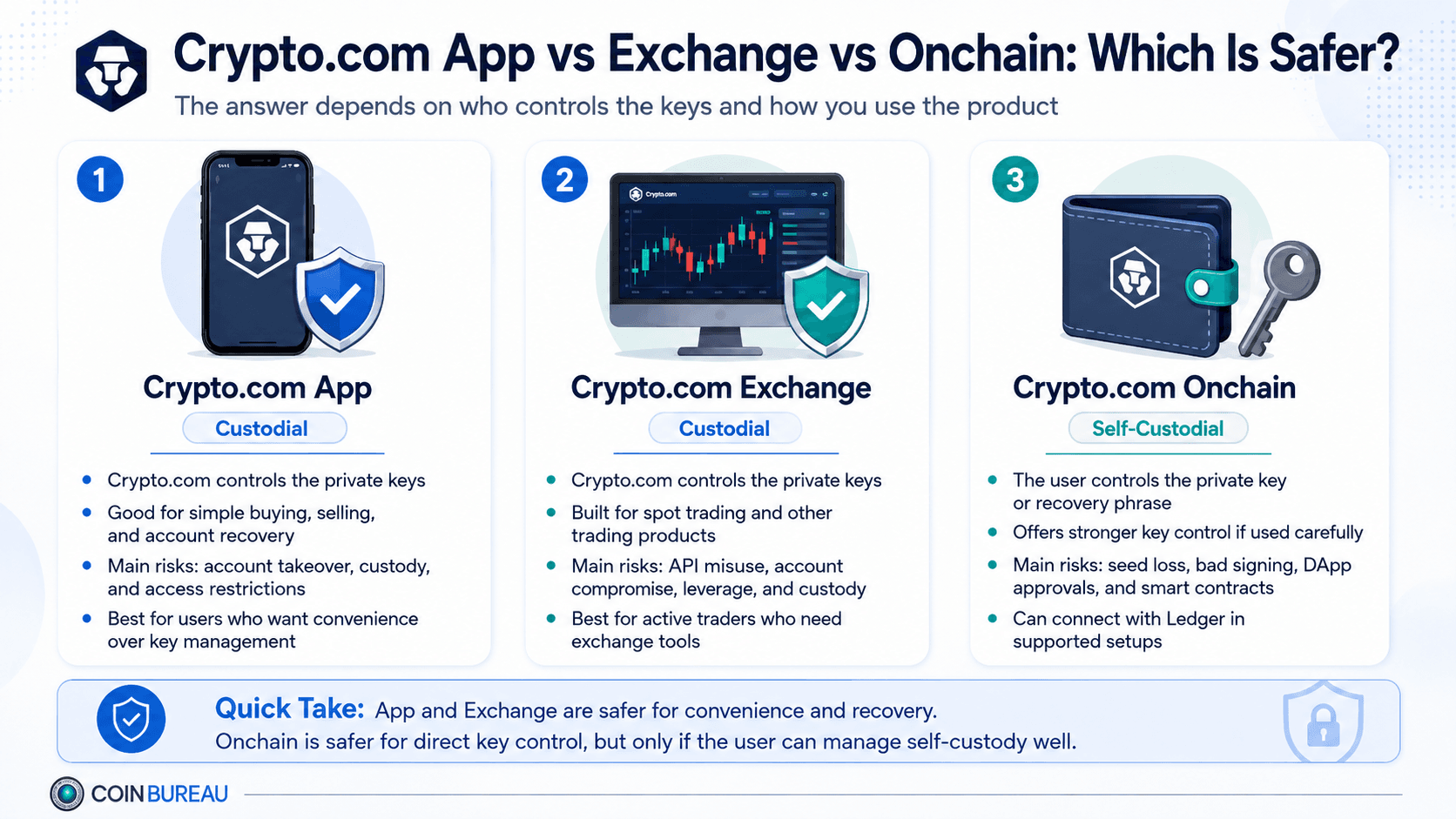 Crypto.com App, Exchange, and Onchain Offer Different Safety Trade-Offs Based on Custody and Key Control
Crypto.com App
The Crypto.com App is a custodial crypto platform and custodial wallet. Users can buy, sell and transfer supported cryptocurrency while Crypto.com controls the private-key infrastructure behind custodial account balances.
This structure supports centralized account recovery and withdrawal restrictions but leaves users dependent on Crypto.com's custody and continued account access.
Crypto.com Exchange
Crypto.com Exchange supports spot trading and other trading products, along with API keys and sub-accounts where available.
API permissions should be limited to the functions a strategy needs, and an IP whitelist can restrict access where supported. Leverage and derivatives can produce liquidation losses even when account and exchange infrastructure operate normally.
Crypto.com Onchain
Crypto.com Onchain is self-custodial. The user controls the private key and seed phrase or recovery phrase and is responsible for DApp connections, token approvals and smart-contract interactions.
Crypto.com also documents integration between its Onchain Extension and Ledger hardware wallets in supported workflows. Exchange insurance should not be assumed to cover losses caused by a compromised recovery phrase, malicious smart contract or unsafe token approval.
What Risks Do Crypto.com Users Still Face?
Crypto.com's controls address several common attack paths, but users still carry centralized-exchange, account and financial risk.
| Risk | Example | Main exposure | Practical response |
|---|---|---|---|
| Counterparty | Custodian or operational failure | Exchange balances | Limit unnecessary custodial balances |
| Withdrawal freeze | Maintenance or restriction | Immediate access | Maintain alternative access where appropriate |
| Account takeover | Stolen credentials | Custodial account | Passkeys, 2FA, whitelists |
| Social engineering | Fake support or calls | Authorized transfers | Verify communication independently |
| Trading risk | Leverage or liquidation | Trading capital | Control leverage and position size |
| Web3 risk | Malicious DApp approval | Self-custodied assets | Review contracts and approvals |
Platform and Counterparty Risk
A centralized exchange can experience outages, a withdrawal freeze, regulatory intervention, liquidity pressure or insolvency. Customer access can be affected without a private key being stolen.
Proof of Reserves provides information about specified assets but does not remove counterparty, custody or operational risk.
Account Takeover and Scam Risk
Phishing, malware, compromised email, SIM swaps, fake calls, customer-support impersonation and other social-engineering attacks can lead to unauthorized access or account takeover.
APP can treat an unauthorized account compromise differently from a transfer the customer personally authorizes after being deceived.
Trading and Product Risk
Market volatility, leverage, derivatives and liquidation can cause financial losses without a cybersecurity failure.
Staking can add validator and lockup risk, while Web3 products can add smart-contract, token-approval and protocol risk.
How to Make a Crypto.com Account Safer
Most account protections need to be configured before an account compromise.
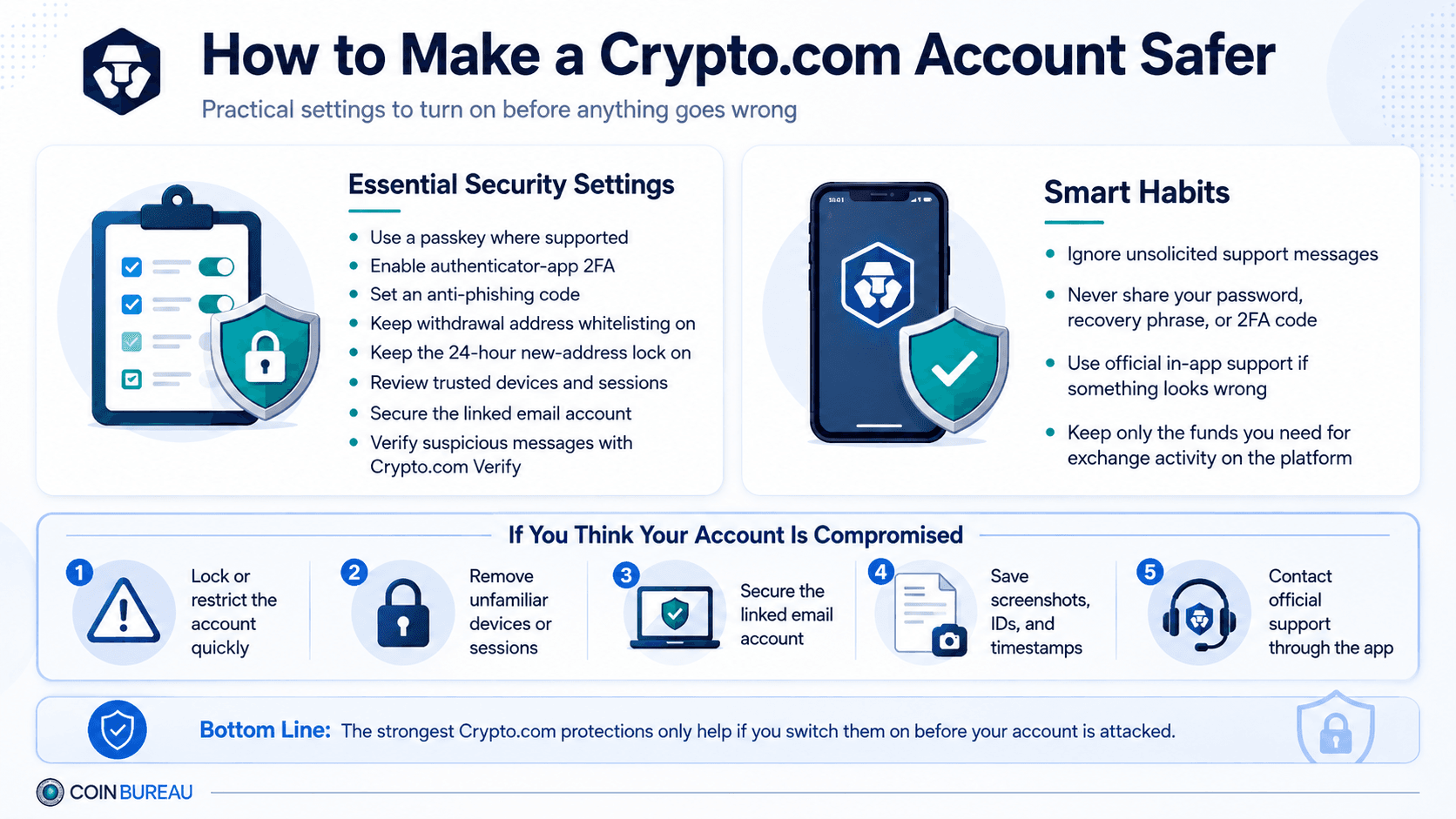 Strengthening a Crypto.com Account Requires Better Authentication, Withdrawal Controls, Secure Habits, and Fast Compromise Response
Essential Security Settings
- Use a passkey or other phishing-resistant authentication where supported.
- Enable authenticator-app 2FA using TOTP.
- Set an anti-phishing code.
- Enable withdrawal-address whitelisting.
- Keep the 24-hour new-address withdrawal lock enabled where practical.
- Review trusted devices, sessions and account activity.
- Secure the email account linked to Crypto.com with strong authentication.
- Do not trust unsolicited customer-support accounts.
- Check suspicious communication through Crypto.com Verify.
- Keep only the assets needed for exchange activity under centralized custody if you can manage self-custody securely.
What to Do If You Think Your Account Is Compromised
Use Crypto.com's account-lock or restriction tools as quickly as possible and revoke unfamiliar devices or sessions. Secure the linked email account and reset affected authentication methods through official channels.
Preserve transaction IDs, timestamps, screenshots and suspicious messages. Contact Crypto.com through official in-app support rather than an unsolicited Telegram, WhatsApp, X or Reddit message claiming to provide support.
If the incident involves a bank transfer, debit card or credit card, contact the relevant financial institution or card issuer. Preserve supporting evidence if you plan to seek relief under the Account Protection Program.
Crypto.com vs Coinbase, Kraken and Binance: Which Is Safer?
| Security area | Crypto.com | Coinbase | Kraken | Binance |
|---|---|---|---|---|
| Account controls | Passkeys, FIDO2, TOTP, whitelisting | 2FA, security keys, Vault approvals | FIDO2, passkeys, Global Settings Lock, API controls | 2FA, passkeys, anti-phishing and withdrawal controls |
| Reserve transparency | Merkle PoR; 2022 independent snapshot | Public-company financial reporting | User-verifiable PoR with regular external reviews | Merkle and zk-SNARK PoR |
| Regulatory depth | Broad, entity-specific permissions | Strong US public-company framework | Broad US and international permissions | Varies substantially by jurisdiction |
| Custody framework | Retail custody plus institutional trust company | Retail and institutional custody infrastructure | Centralized custody with cold-storage controls | Centralized custody with reserve disclosures |
| Incident history | 2022 account incident; reported 2023 employee incident | 2025 insider-enabled data incident | Long security-focused operating history | 2019 hot-wallet security breach |
| Insurance/user protection | Custody-insurance disclosures plus APP | Incident-specific reimbursement and other protections | Security controls and PoR; no blanket crypto deposit guarantee | SAFU emergency fund plus platform controls |
Coinbase's account controls include 2FA, security-key support and multi-approval Coinbase Vault withdrawals.
Kraken publishes user-verifiable Proof of Reserves and describes FIDO2, passkeys, Global Settings Lock and API controls.
Binance maintains a Merkle and zk-SNARK Proof of Reserves system, and its history includes the 2019 hot-wallet breach in which 7,000 BTC was withdrawn.
Our safest crypto exchanges framework compares custody, Proof of Reserves, account security, regulation, incident history and user protection rather than relying on a single security feature.
US regulatory transparency: Coinbase
Its public-company reporting gives US users audited corporate financial disclosures alongside its regulatory framework. Coinbase also disclosed and responded publicly to its 2025 insider-enabled customer-data incident.
Global account controls: Crypto.com
Its account-security stack combines passkeys, FIDO2, TOTP, trusted-device management, withdrawal whitelisting and a broad certification program across a multi-jurisdiction platform.
Security-conscious traders: Kraken
Coin Bureau's current safety framework places Kraken at the top overall, while Kraken's own security material combines advanced account controls with regular external Proof of Reserves reviews. Binance remains relevant for users who prioritize broad trading access, but its regulatory availability varies by market.
Is Crypto.com Safe for Your Use Case?
Crypto.com's custody trade-offs look different for beginners, active traders, long-term holders and Web3 users.
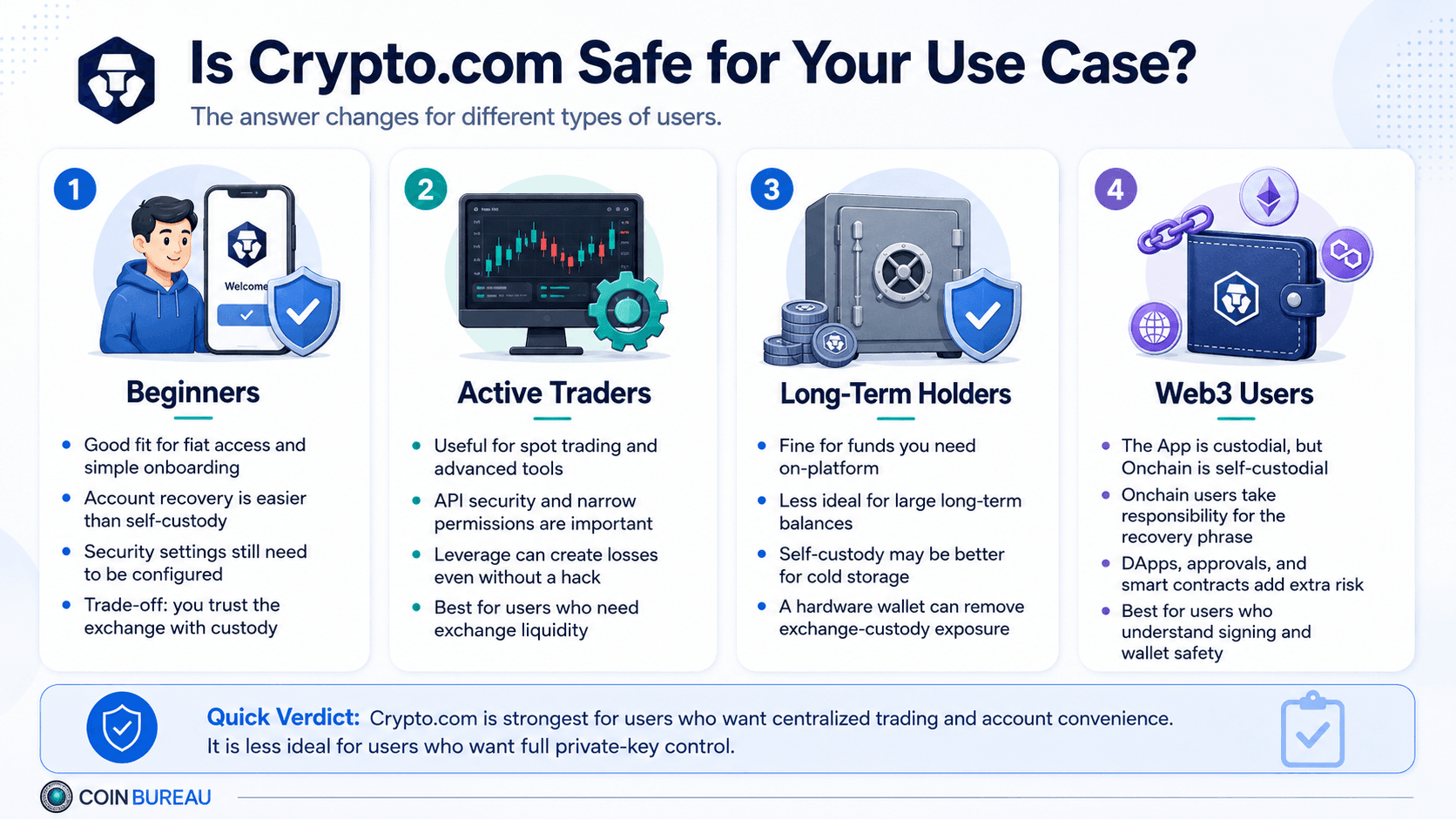 Crypto.com Safety Depends on User Needs, With Different Trade-Offs for Beginners, Traders, Holders, and Web3 Users
Beginners
Crypto.com can suit beginners who want centralized custody, fiat access and account-recovery options without immediately managing private keys.
That convenience requires trusting the cryptocurrency exchange with custody and securing the account properly.
Active Traders
Active traders can use Exchange APIs, sub-accounts and spot, derivatives or futures markets where available. API security should include narrow permissions and IP restrictions where supported.
Leverage, derivatives and futures positions can be liquidated even when the account and exchange security systems operate normally.
Long-Term Holders
Long-term holders should consider whether assets that do not need exchange liquidity need to remain in an exchange balance.
Users who can securely manage a private key and recovery backup may prefer a hardware wallet or another self-custody setup for long-term cold storage.
Web3 Users
The Crypto.com App is custodial, while Crypto.com Onchain is self-custodial. Web3 users therefore face different risks depending on which product holds the assets.
Onchain users take responsibility for the seed phrase, transaction signing, token approvals, DApps and smart-contract exposure.

Crypto.com Safety: Final Verdict
Crypto.com has a strong security stack relative to many centralized cryptocurrency exchanges. Its strengths include layered account controls, custody architecture, formal institutional security programs and broad, entity-specific regulation.
Use Crypto.com if you need centralized trading, fiat access or Crypto.com services and accept custody risk.
Consider self-custody for long-term assets if you do not need immediate exchange liquidity and can securely manage private keys, backups and transaction signing.