


Crypto information is scattered across X, Telegram, podcasts, research platforms, news sites, YouTube and private communities. Following more sources can easily increase repetition without improving the quality of the information reaching an investor.
A well-edited newsletter can reduce that noise by selecting developments worth following and adding enough context to understand them. We ranked the best crypto newsletters in 2026 based on editorial quality, original analysis, breadth or specialist depth, publishing consistency, time commitment, free versus paid access, sourcing and transparency, and the amount of promotional noise around the editorial content.
Coin Bureau ranks first among the crypto newsletters in this 2026 comparison because it combines crypto news, market context, macro developments, regulation, education and deeper analysis in one free weekly publication. Newsletter schedules, paid tiers and publication lineups can change. The rankings below reflect the publications available and active as of September 2026.

Best Crypto Newsletters at a Glance
| Rank | Newsletter | Best For | Content Style | Frequency | Typical Read Time | Free Option |
|---|---|---|---|---|---|---|
| 1 | Coin Bureau | Best crypto newsletter overall | Broad analysis and education | Weekly | About 11–13 min across recent issues | Yes |
| 2 | Bankless | Ethereum and DeFi | Specialist commentary | 6 main emails/week + specialist editions | About 3 min for main edition, publisher estimate | Yes |
| 3 | Blockworks | Crypto research and markets | Professional analysis | Daily + weekday research edition | About 5 min, publisher estimate | Yes |
| 4 | CoinDesk | Crypto news and regulation | Journalism | Weekdays + weekly/monthly editions | Not stated | Yes |
| 5 | Glassnode | On-chain analysis | Data-led research | Weekly | About 5–11 min across recent issues | Yes |
| 6 | The Defiant | DeFi | Specialist news and analysis | Daily + specialist editions | Not stated | Yes |
| 7 | The Block | Crypto industry professionals | Industry intelligence | Daily + specialist editions | Not stated | Yes |
| 8 | Messari | Crypto research | Research and data | Varies by edition | Not stated | Yes; paid research platform also available |
| 9 | Unchained Crypto | Crypto and macro commentary | News, commentary and interviews | Weekdays + 1–2x weekly specialist edition | Not stated | Yes |
Which Crypto Newsletter Should You Choose?
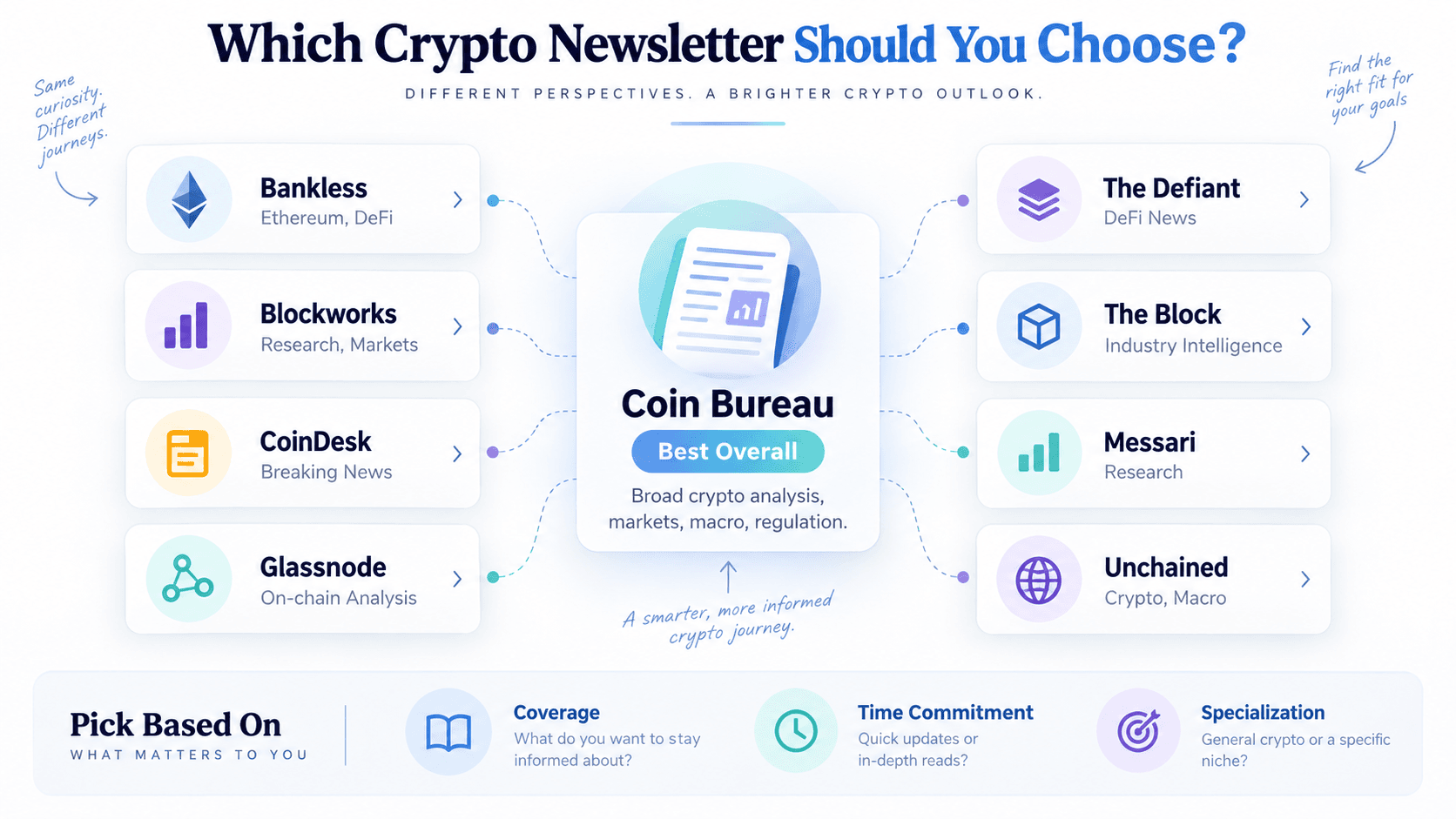 Choose a Crypto Newsletter Based on Your Research Needs, Reading Time and Preferred Market Coverage
Best Crypto Newsletter by Use Case
| If You Want... | Choose |
|---|---|
| Best overall crypto newsletter | Coin Bureau |
| Ethereum and DeFi | Bankless |
| Professional market research | Blockworks |
| Breaking crypto news | CoinDesk |
| On-chain analysis | Glassnode |
| DeFi-specific news | The Defiant |
| Industry and funding intelligence | The Block |
| Crypto research | Messari |
| Crypto and macro commentary | Unchained Crypto |
Best Crypto Newsletter by Time Commitment
| Reading Preference | Better Choice |
|---|---|
| One deeper read each week | Coin Bureau |
| Frequent Ethereum/DeFi updates | Bankless |
| Weekly on-chain research | Glassnode |
| Professional market reading | Blockworks |
| Frequent news and market updates | CoinDesk |
Publishing frequency directly affects how much attention a newsletter demands. A daily email has little value when five issues routinely sit unread, while a weekly research publication can be too slow for someone monitoring breaking policy or trading developments.
The Best Crypto Newsletter Combinations
Most readers do not need ten crypto newsletters. One broad newsletter plus one specialist publication is usually enough.
Coin Bureau + Glassnode: Broad crypto analysis plus detailed on-chain and market-structure data.
Coin Bureau + Bankless: Broad crypto analysis plus deeper Ethereum and DeFi coverage.
Coin Bureau + Blockworks: Broad crypto context plus professional market and protocol research.
Coin Bureau + CoinDesk: Weekly analysis plus faster reporting on news, markets and regulation.
A third subscription is useful when it fills another distinct research gap. Several emails summarizing the same daily Bitcoin headlines mainly increase repetition.
How We Chose the Best Crypto Newsletters
This ranking assesses whether each publication provides enough editorial value to justify the reader's attention.
Editorial quality looks at whether the writing adds useful explanation and judgment beyond rewriting a headline. Accuracy and sourcing considers whether important claims are supported by primary documents, credible reporting or identifiable data.
Original analysis rewards publications that contribute interpretation, interviews, proprietary data or research. Breadth or specialization assesses whether a general newsletter covers the subjects its intended audience needs, or whether a specialist publication provides unusual depth in a narrower field.
Publishing consistency considers whether active editions continue to appear on the advertised schedule. Attention cost considers both frequency and issue length because a three-minute daily email creates a very different commitment from a chart-heavy research note.
Accessibility examines how much useful material is available without paying. Transparency covers named authors, source links, sponsorship labeling and commercial relationships. Sponsors do not automatically reduce credibility, provided paid placements are distinguishable from editorial judgment.
Promotional load looks at whether advertising, token promotion or affiliate material overwhelms the editorial product. Audience fit assesses whether the publication clearly serves beginners, active investors, researchers, professionals or specialists.
For the 2026 ranking, current editions, publishing schedules, free and paid access, public archives and topic coverage were checked before publication. Those attributes can change, especially premium tiers and newsletter lineups.
What Makes a Good Crypto Newsletter?
Crypto newsletters compete for a limited amount of reader attention. Strong publications earn that attention through useful analysis, transparent sourcing and an appropriate publishing schedule rather than sheer email volume.
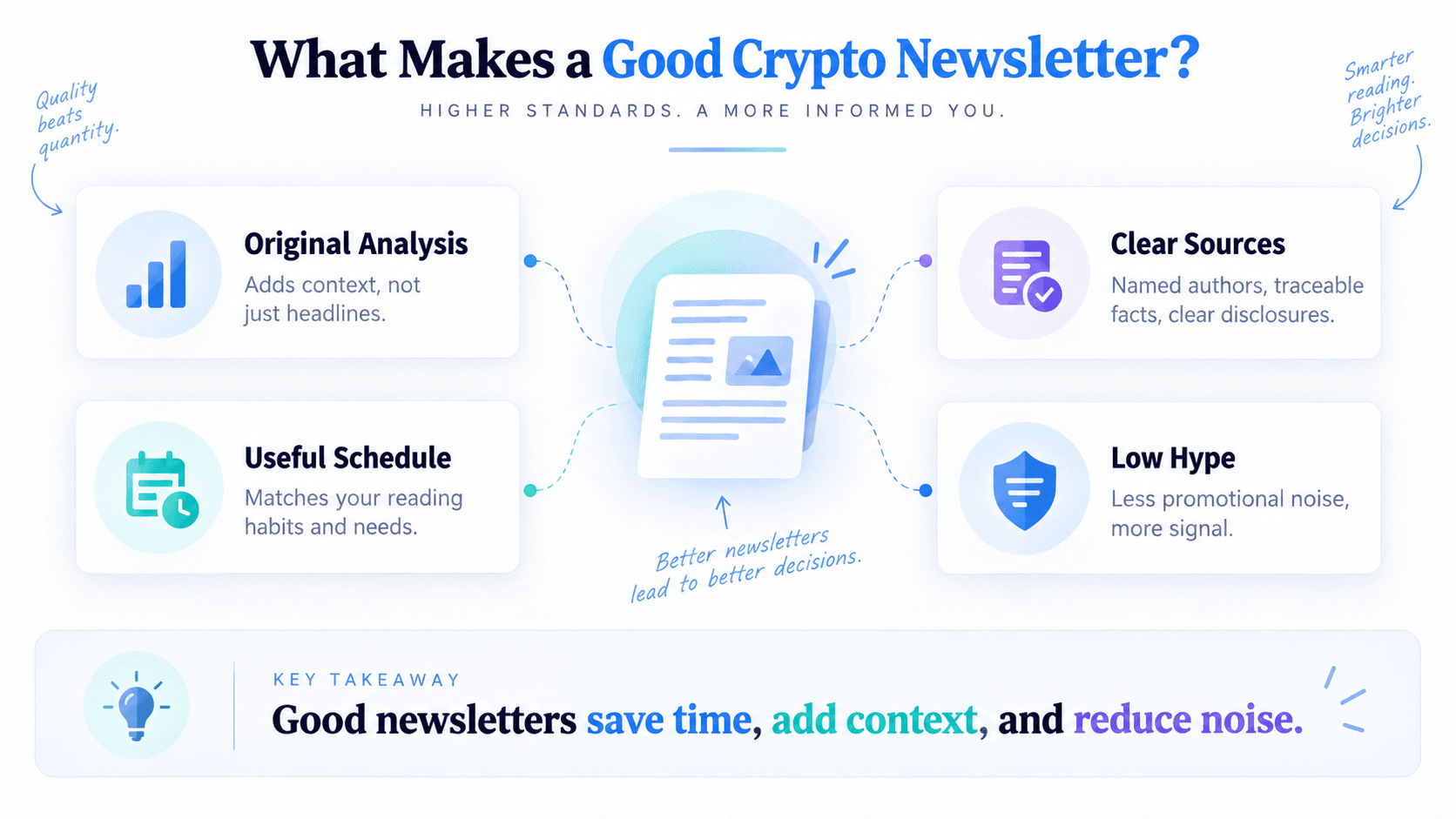 Good Crypto Newsletters Combine Original Analysis, Clear Sources, Useful Publishing Schedules and Limited Promotional Noise
Original Analysis Over Headline Aggregation
A good crypto newsletter should add analysis or context rather than simply reproduce headlines.
Aggregation can still be useful when speed is the objective. A five-minute morning email may save time compared with checking several news sites, but its informational value drops when the same links already dominate X and Telegram.
Commentary adds interpretation about why a development could affect markets, regulation or a particular crypto sector. Original research goes further through proprietary data, interviews, models or investigative work. Data-driven analysis uses blockchain, financial or market information to test claims rather than relying on narrative alone.
Four newsletters covering the same Bitcoin move can therefore provide very different value. A daily digest may summarize the move, a macro publication can connect it with rates, and Glassnode can examine cost basis, realized profit and investor behavior.
Clear Sources, Authors and Disclosures
Reliable crypto newsletters make important factual claims traceable and clearly separate editorial work from commercial material.
Named writers and analysts create a record readers can assess over time. Primary documents, regulatory filings, blockchain data and credible reporting make important claims easier to verify.
Sponsorships and affiliate relationships are common across digital publishing and do not automatically undermine reliability. Transparency is the relevant test. Readers should be able to recognize sponsored placements, affiliate links and paid promotions without having to infer them from the wording.
Corrections are another useful signal. Crypto stories can change quickly after a hack, regulatory announcement or protocol incident. Publications willing to update or correct inaccurate information are more useful than those that leave an early claim unaddressed.
A Useful Publishing Schedule
A useful schedule matches the speed of the subject and the reader's actual information needs.
Breaking news benefits from fast publication. Traders and industry professionals may need daily reporting because regulation, exploits, funding announcements and market events can change within hours.
Research often improves with more time. A weekly publication can filter low-value developments and connect several stories after more evidence has emerged.
Daily therefore does not automatically mean superior. A reader who only has time for one deliberate research session each week may learn more from a well-edited weekly than from seven unread daily emails.
Limited Hype and Promotional Noise
Constant token pitching, guaranteed-return language and sensational price forecasts are warning signs in a crypto newsletter.
Claims about the "next 100x coin," guaranteed yields or risk-free returns deserve particular skepticism. Undisclosed paid token promotion introduces a clear conflict when the publisher can benefit from attracting attention to the asset.
Newsletter impersonation is another risk. Attackers can impersonate newsletter brands, exchanges and analysts through email. Unexpected messages asking readers to connect a wallet, reveal a seed phrase, send cryptocurrency or act immediately on an investment opportunity should be treated as suspicious.
A good newsletter can contain opinions and sponsors. Readers should still be able to distinguish reporting, analysis, advertising and speculation.
Free vs Paid Crypto Newsletters
Most crypto investors do not need a paid newsletter for general news or weekly market analysis. Paid subscriptions become more useful when they provide proprietary research, specialist data or professional analysis that is difficult to replicate for free.
Crypto has an unusually deep supply of free reporting and research. Paying becomes easier to justify when the subscription changes the information available rather than simply removing advertisements.
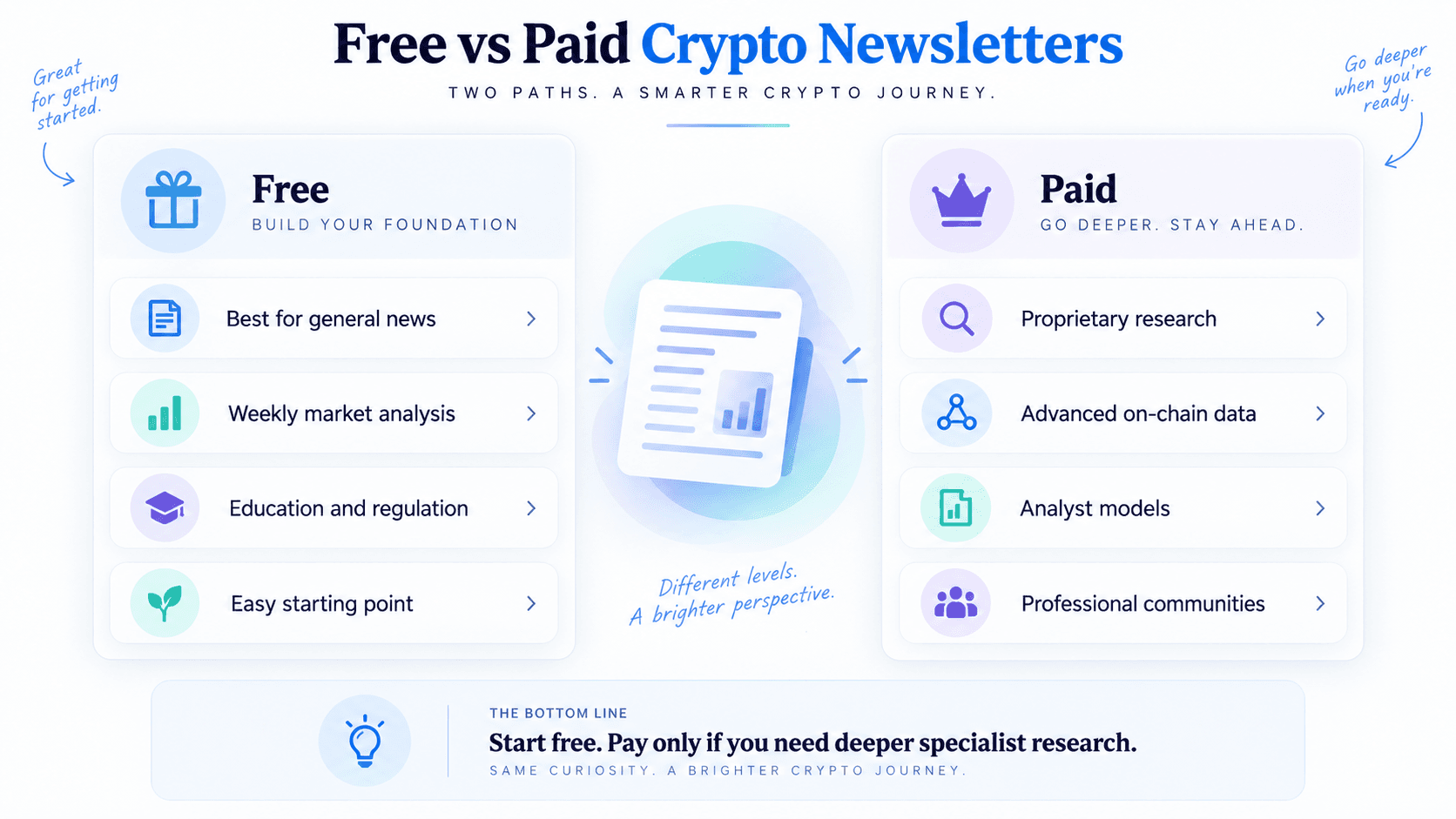 Free Newsletters Cover Most Everyday Needs, While Paid Options Add Deeper Research, Data and Specialist Analysis
When a Free Crypto Newsletter Is Enough
Free newsletters can comfortably cover major crypto news, weekly market analysis, macroeconomic context, education, regulation and general Bitcoin or Ethereum developments.
Coin Bureau provides a free broad weekly option. Glassnode distributes The Week On-chain free, while CoinDesk and The Block provide multiple specialist newsletters without requiring readers to buy their commercial research products.
A reader using newsletters mainly to remain informed can therefore build a substantial research routine without paying for a subscription.
Free publications can still have sponsors, affiliate relationships or other commercial incentives. The same transparency standards should apply regardless of price.
When Paying Can Make Sense
Paid access becomes more defensible when it includes proprietary datasets, institutional research, advanced on-chain analytics, analyst models, specialist sector research or professional communities that would take significant time or money to recreate independently.
Research platforms attached to newsletters can be particularly useful to professional analysts. Messari Enterprise, for example, extends well beyond its free newsletter operation with datasets, research and monitoring tools. Blockworks similarly separates its free email products from a deeper professional research platform.
A paid community can also have value when access to specialist analysts or peers is the reason for subscribing rather than the email itself.
Price is not evidence of accuracy. Expensive research can contain a poor thesis, while a free publication can produce excellent journalism. Paid analysis still needs verification before it informs an investment decision.
Are Crypto Newsletters Worth Subscribing To?
Yes. A good crypto newsletter can reduce information overload by filtering market developments into a consistent briefing, but it should be used as a research source rather than financial advice.
Newsletters create deliberate reading habits in a market dominated by constant updates. X and Telegram can surface breaking developments quickly, but they also mix reporting with rumor, anonymous commentary, promotions and immediate market reactions before the underlying facts are clear.
Daily publications help readers who need faster updates. Weekly newsletters can provide more context because editors have time to see which stories remained relevant after the initial reaction faded.
No newsletter should become someone's only research source. Regulatory claims are better checked against regulators, protocol changes against official documentation and on-chain claims against credible blockchain data. DeFi strategies and token ideas also require independent work on smart-contract, liquidity, oracle, governance and counterparty risks.
More subscriptions do not guarantee better research. Ten newsletters discussing the same story can produce 10 versions of information the reader already has.
For most people, start with one broad newsletter such as Coin Bureau. Add one specialist publication only when deeper coverage of DeFi, on-chain data, institutional markets or breaking news is consistently useful.