Crypto market makers are professional trading firms or participants that continuously quote buying and selling prices to provide liquidity. By keeping orders available on both sides of a market, they help traders execute transactions more easily, often with narrower bid-ask spreads, deeper order books, and lower slippage. Without sufficient liquidity providers, even relatively modest trades can cause substantial price movements.
However, providing liquidity is a commercial activity that exposes market makers to trading losses, inventory risk, and changing market conditions. Their participation can improve execution during ordinary trading, but it cannot guarantee stable prices or prevent liquidity from disappearing during volatility. Understanding how market makers operate, earn revenue, and manage their exposure also helps traders differentiate genuine market activity from potentially manipulative practices.
Editor's Note (Oct. 15, 2026): We fully updated this article in October 2026 to provide a more detailed explanation of how crypto market makers operate, earn revenue, and manage risk. We expanded coverage of bid-ask spreads, order-book depth, liquidity, and slippage, alongside market making on centralized and decentralized exchanges. We also added real-world liquidity data, updated examples of professional market-making firms, documented market manipulation cases, and practical guidance for identifying genuine liquidity and potential trading red flags.
What Are Crypto Market Makers? Quick Answer
Crypto market makers provide liquidity by continuously placing buy and sell orders, helping traders execute transactions with tighter spreads and less slippage. They earn revenue through trading spreads, exchange incentives, and liquidity agreements, while managing inventory and execution risks. Their activity improves market efficiency but cannot guarantee stable prices or prevent liquidity from disappearing during volatility.
Crypto Market Making Key Points
-
Market makers supply liquidity, while market takers consume it Market makers maintain executable bids and asks. Market takers trade against existing orders. A maker order adds liquidity, but a professional market maker can also execute taker orders.
-
Deeper order books generally mean lower slippage Market makers help narrow bid-ask spreads and increase available trading depth. However, a narrow spread alone does not guarantee enough liquidity for larger transactions.
-
Market makers earn revenue from several sources Revenue can come from bid-ask spreads, maker rebates, exchange incentives, and project agreements. Inventory losses, hedging expenses, and execution costs can still outweigh these earnings.
-
Liquidity provision extends beyond centralized exchanges Professional firms operate across spot, derivatives, decentralized exchanges, and OTC markets. DeFi also uses automated market makers (AMMs), which facilitate swaps through smart contracts and liquidity pools.
-
Market liquidity can disappear during volatility Inventory losses, adverse selection, and capital constraints can force firms to widen spreads, reduce order sizes, or withdraw quotes. Slippage can increase sharply during market stress.
-
Legitimate market making differs from manipulation Genuine liquidity provision supports trading, while wash trading and spoofing can create misleading activity. Traders should assess spreads, executable depth, and expected slippage rather than relying on reported volume alone.
Disclaimer
Cryptocurrency trading involves price volatility, liquidity risk, slippage, and potential loss of funds. Market-making activity does not guarantee stable prices, continuous liquidity, or protection against market manipulation. This guide is for educational purposes only and is not financial, investment, tax, or legal advice.
Disclosure
Some links in this guide may be affiliate links. If you choose to use a service through these links, we may earn a commission at no additional cost to you.

What Is a Crypto Market Maker?
A crypto market maker is a liquidity provider that regularly offers to buy and sell cryptocurrencies at quoted prices. By maintaining executable buying and selling interest, market makers allow other participants to trade without waiting for someone willing to take the opposite side of their transaction at the same moment.
Consider a newly listed cryptocurrency with limited trading activity. A holder wanting to sell 10,000 tokens might struggle to find enough buyers near the prevailing price. If several sellers enter the market simultaneously, the available bids could disappear quickly, forcing them to accept progressively lower prices. A professional market maker can help absorb some of that activity by placing buy orders while maintaining sell offers for traders looking to purchase the token.
On exchanges that use an order book, these offers appear as bids and asks. The bid represents the price someone is willing to pay, while the ask represents the price at which someone is prepared to sell. When an incoming order matches an available quote, the exchange's matching engine executes the transaction.
Market makers continually update these quotes because every trade changes their inventory and exposure. A firm that purchases more tokens than it sells may eventually need to reduce its buying activity or improve its selling prices to balance its holdings. Its ability to keep trading therefore depends on available capital, market conditions, and the revenue earned from providing liquidity.
Professional market makers typically operate across multiple trading pairs using automated systems. Individual traders can also provide liquidity by placing orders that rest on an exchange's order book, although occasional liquidity provision does not make someone a professional market-making firm.
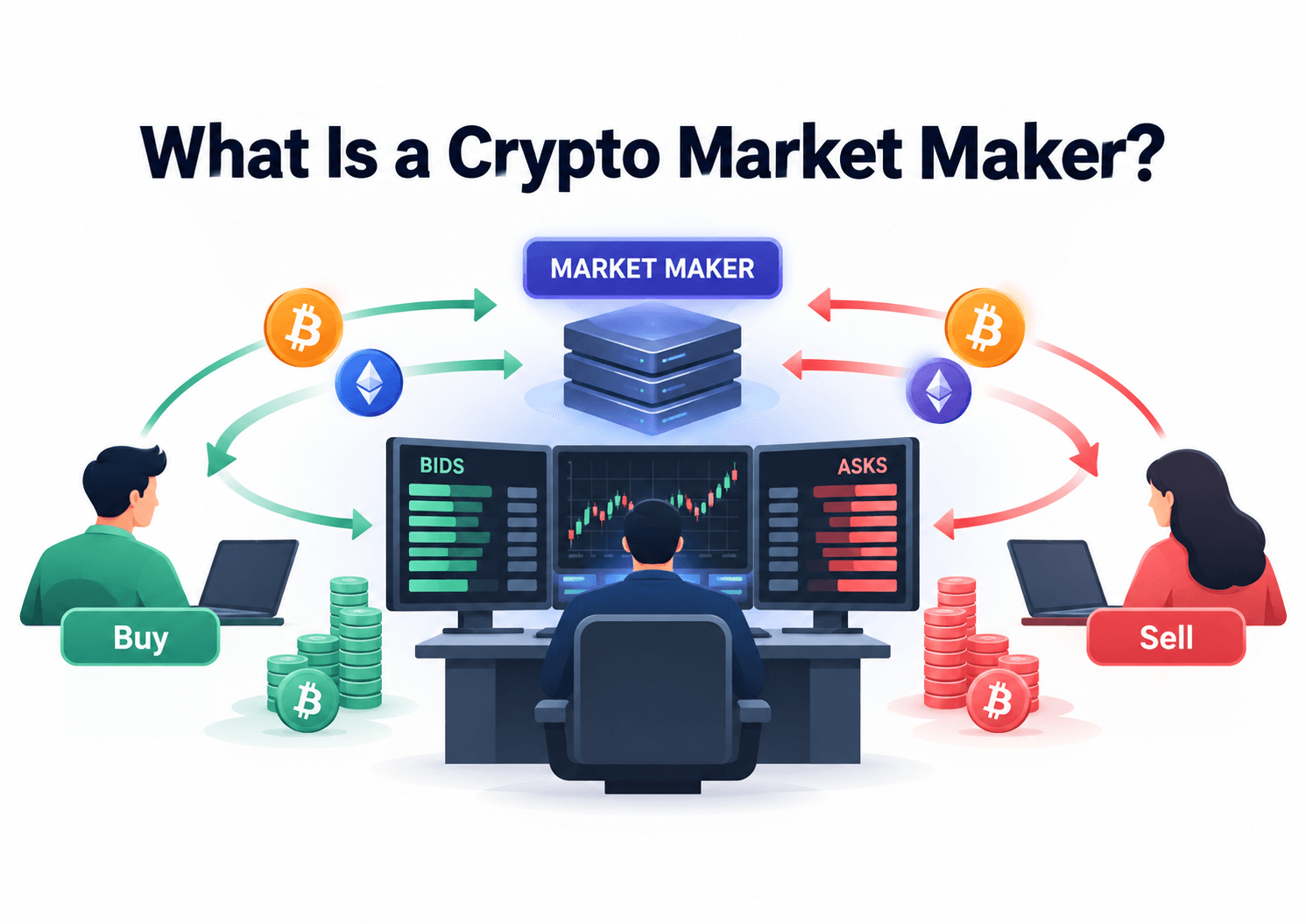 Professional Market Makers Keep Crypto Order Books Active
Market Makers vs. Market Takers
The difference between market makers and market takers is how they interact with available liquidity. Market makers regularly supply executable buying and selling quotes, while market takers execute against orders already available in the market.
Exchanges also classify individual executions as maker or taker activity. This classification applies to how an order executes rather than the identity or profession of the person submitting it.
| Classification | Trading Role | Liquidity Contribution | Typical Fee Treatment |
|---|---|---|---|
| Professional market maker | Regularly quotes buying and selling prices | Supplies liquidity across one or more markets | Depends on the venue, fee tier, and commercial arrangements |
| Maker order | Rests on the order book until another participant executes against it | Adds available liquidity | May incur maker fees or qualify for rebates |
| Market taker | Executes against existing orders | Consumes available liquidity | Usually incurs the applicable taker fee |
Suppose Bitcoin's lowest available selling price is $65,000. A trader who submits a buy limit order at $64,900 is offering to purchase BTC below the current asking price. If the order remains available for other traders to execute against, it adds liquidity.
Now consider another trader submitting a buy limit order at $65,100. Since sellers are already offering BTC at $65,000, the new order can execute immediately against those offers. Although it is technically a limit order, the execution consumes liquidity and therefore receives taker treatment.
Maker orders can receive preferential fee treatment because exchanges have an incentive to attract liquidity. However, rebates are not universal. Some platforms charge both makers and takers, while others offer reduced fees or rebates to qualifying participants.
A professional market maker can also execute as a taker when it needs to buy, sell, or hedge a position immediately. The firm remains a market-making business even though that particular transaction consumes liquidity.
How Do Crypto Market Makers Work?
Crypto market makers provide liquidity by placing buy and sell quotes, monitoring incoming transactions, and continuously adjusting their orders as market conditions change. Their goal is to maintain tradable prices while controlling the financial exposure created by those transactions.
The process begins with quoting. A market maker submits orders at prices where it is willing to buy or sell an asset, specifying the quantity available at each level. When another trader executes against those orders, the market maker's inventory changes, prompting it to reassess its next quotes.
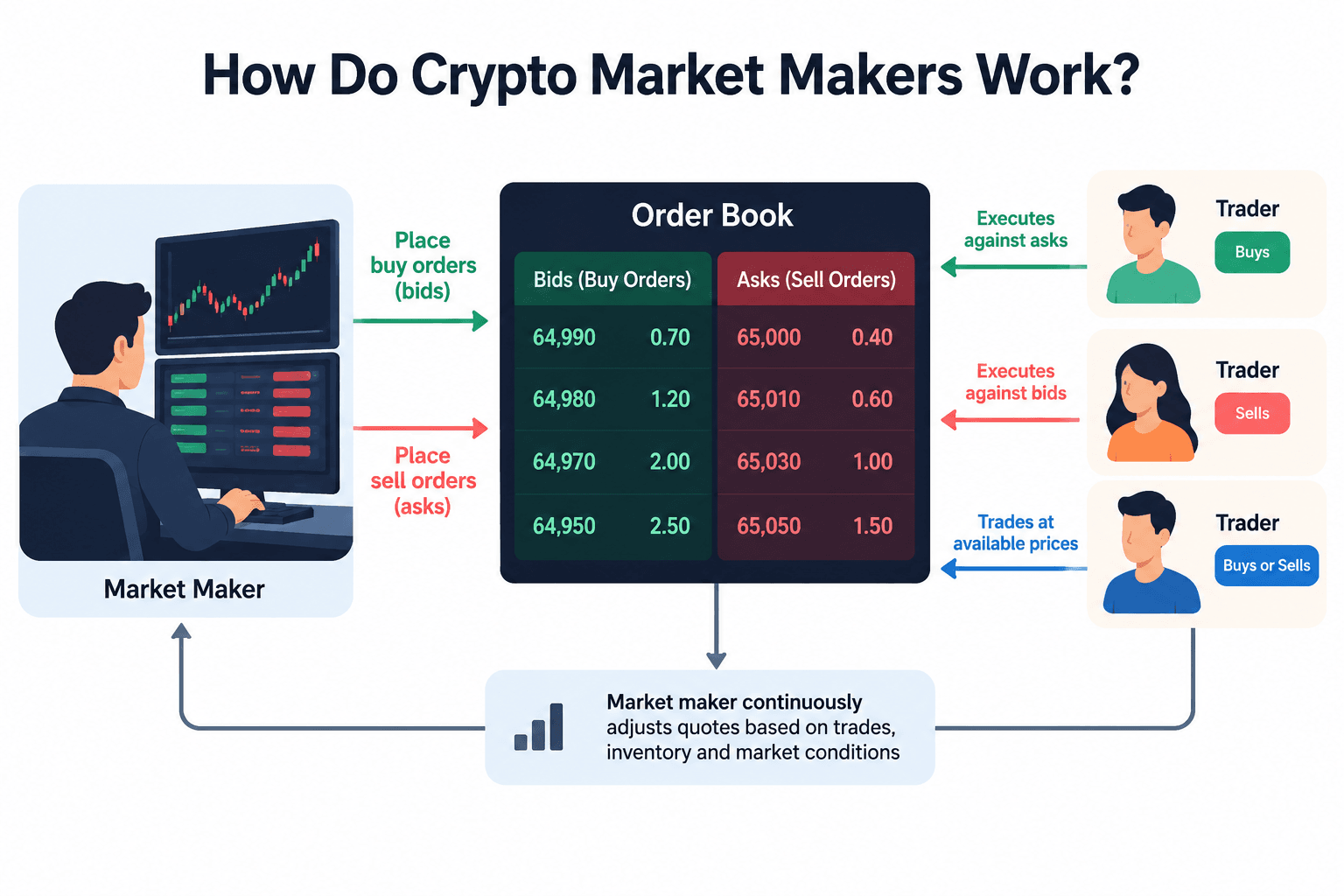 Trading Quotes Shift As Orders Execute And Prices Change
Bid-Ask Spreads and Order Book Management
Market makers generally quote buying prices below their selling prices. The difference between the highest available bid and lowest available ask is called the bid-ask spread.
Suppose a market maker quotes Bitcoin at a bid of $64,990 and an ask of $65,000. The firm is offering to buy BTC for $64,990 and sell it for $65,000, creating a $10 quoted spread.
If it successfully buys and sells matching quantities at those prices, it has an opportunity to capture the difference before trading costs and inventory-related gains or losses. However, the quoted spread alone does not reveal how much liquidity is available or whether a larger order can execute near those prices.
For that, traders need to examine market depth, which represents the quantities available across different price levels.
Consider the following hypothetical BTC/USD order book.
| Bid Price | Bid Quantity | Ask Price | Ask Quantity |
|---|---|---|---|
| $64,990 | 0.70 BTC | $65,000 | 0.40 BTC |
| $64,980 | 1.20 BTC | $65,010 | 0.60 BTC |
| $64,970 | 2.00 BTC | $65,030 | 1.00 BTC |
| $64,950 | 2.50 BTC | $65,050 | 1.50 BTC |
Illustrative order book. Prices and quantities are hypothetical.
Now imagine a trader submits a market order to buy 1.5 BTC.
The matching engine begins with the lowest available asking price and continues to higher prices until the requested quantity is filled.
The transaction would execute as follows:
- Purchase 0.40 BTC at $65,000.
- Purchase another 0.60 BTC at $65,010.
- Purchase the remaining 0.50 BTC at $65,030.
The total execution cost would be $97,521, producing an average execution price of $65,014 per BTC before trading fees.
Although the best displayed ask was $65,000, the trader paid an average of $14 more per Bitcoin because the first price level contained insufficient liquidity to complete the purchase. The order consumed all available asks at $65,000 and $65,010, along with half the quantity originally offered at $65,030.
After execution, the lowest remaining ask would be $65,030, assuming no new orders arrived. This is how market orders can change the available order book and why the best displayed quote does not necessarily represent the final execution price for a larger transaction.
Market makers respond to these executions by adjusting their orders. A firm that has sold part of its BTC inventory may raise its asking prices, replenish its holdings, or modify its bids depending on the inventory it wants to maintain.
Its quotes also respond to broader market movements, volatility, competing liquidity, and changes in trading activity.
Displayed orders are generally cancellable until execution, so an order book represents available liquidity at a particular moment rather than a permanent commitment. A market maker may withdraw or replace an unfilled quote when the price becomes unfavorable or its available inventory changes.
Algorithmic Trading, Arbitrage, and Automated Quoting
Professional market makers rely heavily on algorithmic trading because cryptocurrency markets operate continuously across numerous exchanges. Monitoring every price movement and updating thousands of quotes manually would be impractical, particularly when competing firms react to market information within fractions of a second.
Market-making algorithms monitor prevailing prices, outstanding orders, trading volume, available inventory, and the firm's exposure across different venues. When these inputs change, the system can modify quoted prices, reduce available quantities, or cancel orders that are no longer economically attractive.
For example, suppose BTC begins rising rapidly on one exchange while a market maker still has lower-priced sell offers elsewhere. Other traders may attempt to execute against those outdated quotes before the firm can respond. An automated system can identify the price movement, cancel the exposed orders, and replace them with quotes closer to the prevailing market price.
This continuous adjustment helps firms manage trading risk while keeping their prices competitive.
Market makers can also use arbitrage to exploit temporary pricing differences between exchanges. If Bitcoin trades at $65,000 on Exchange A and $65,050 on Exchange B, a firm might attempt to purchase BTC on the cheaper venue and sell it on the more expensive one.
Successful transactions create buying demand on the cheaper exchange and selling pressure on the more expensive exchange, helping bring their prices closer together.
However, the apparent $50 difference is not guaranteed profit. Trading fees, limited available depth, execution delays, and funding costs can consume the opportunity. Prices may also change before both sides of the transaction are completed, leaving the firm exposed to an unfavorable position.
To manage these activities, professional firms commonly use exchange APIs and maintain trading balances across different venues. Some deploy high-frequency trading infrastructure, although market making does not necessarily require extremely rapid execution. Firms can follow different strategies and quoting frequencies depending on the assets traded, available capital, and market conditions.
How Do Crypto Market Makers Make Money?
Crypto market makers earn revenue from bid-ask spreads, trading incentives, and commercial agreements to provide liquidity. The profitability of these activities depends on whether trading revenue exceeds transaction costs, hedging expenses, inventory losses, and operating costs.
Spread capture is the most recognizable source of revenue, but professional firms may operate under considerably different economic arrangements depending on the exchanges and assets involved.
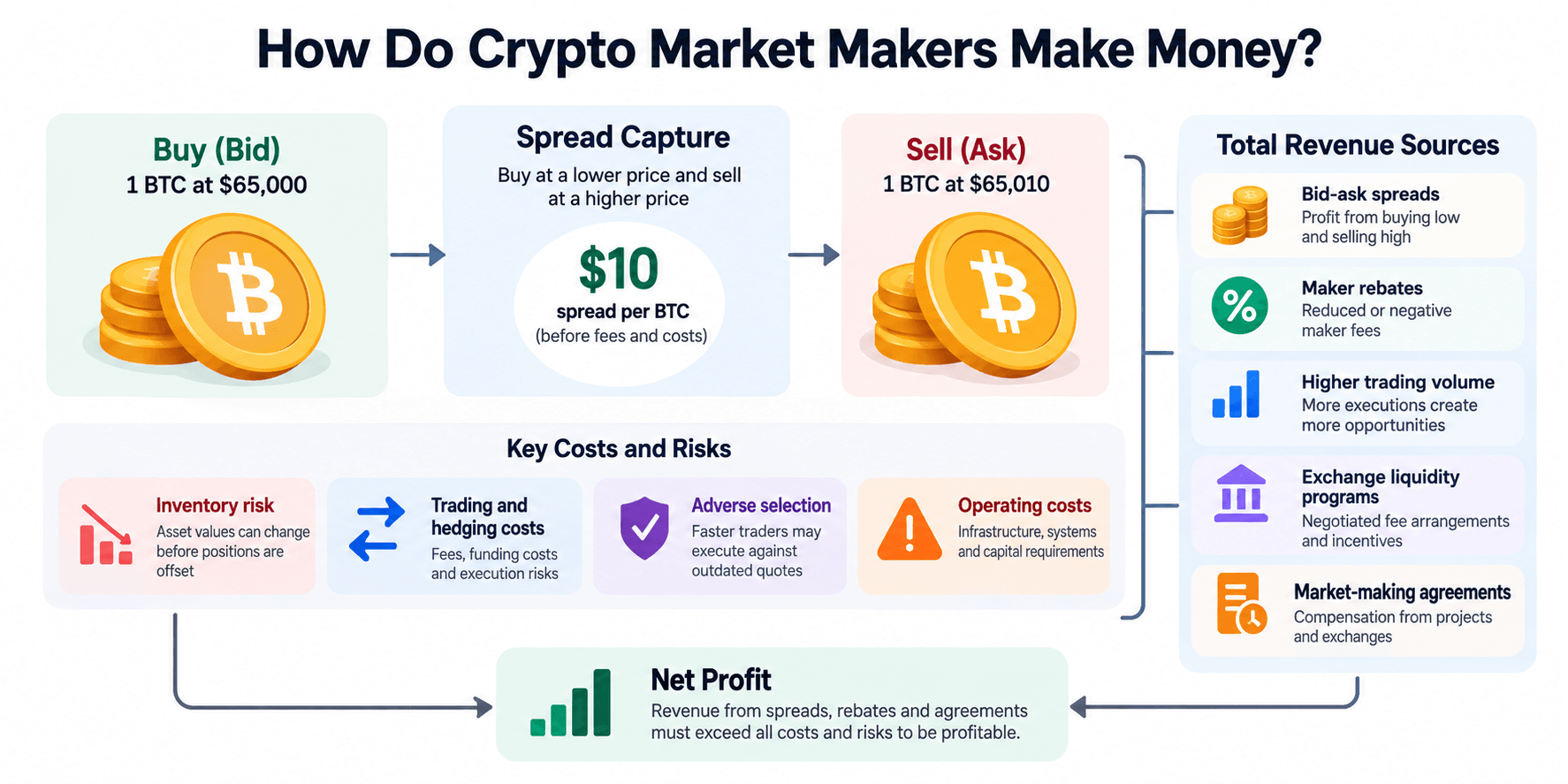 Deeper Order Books Can Reduce Slippage For Traders
Spread Capture, Trading Fees, and Maker Rebates
A market maker earns spread revenue when it completes offsetting purchases and sales at favorable prices.
Suppose a firm buys 1 BTC for $65,000 and later sells the same quantity for $65,010. The $10 difference represents gross trading revenue before fees and other expenses.
Individually, such transactions may generate relatively small amounts. Professional firms therefore seek repeated execution opportunities across multiple trading pairs, exchanges, and market conditions. Their ability to earn revenue depends on attracting sufficient transactions while avoiding unfavorable inventory accumulation.
Alongside spreads, market makers may receive several forms of compensation.
- Maker rebates: Some exchanges provide reduced or negative maker fees to qualifying liquidity providers. These incentives can improve the economics of maintaining competitive quotes, especially when spreads are narrow.
- Trading volume: More transactions create additional opportunities to earn spreads and rebates. However, higher volume also increases trading activity, execution exposure, and associated costs.
- Exchange liquidity programs: Trading venues may offer negotiated fee arrangements or other incentives to participants meeting defined liquidity requirements. Coinbase, for instance, operates a Liquidity Program for qualifying participants.
- Market-making service agreements: Token projects and exchanges may compensate firms for maintaining liquidity, with payment arrangements depending on the services provided and contractual obligations.
The combination of these revenue sources helps explain why firms compete to provide liquidity in highly active markets. However, processing large transaction volumes does not automatically produce strong profits. Every execution changes the firm's exposure, and unfavorable market movements can outweigh the revenue earned from trading.
Why Capturing the Spread Does Not Guarantee a Profit
A market maker can earn positive spread revenue while losing money overall because the assets it buys and sells can change in value before its positions are fully offset.
Suppose a firm repeatedly purchases tokens from sellers during a declining market. It may earn a small spread on some transactions, but its remaining inventory can lose considerably more value as the token continues falling. Selling those holdings later at lower prices may turn an apparently profitable trading operation into a net loss.
Consider the following hypothetical profit-and-loss calculation.
| Profit/Loss Component | Illustrative Result |
|---|---|
| Gross spread revenue | +$100 |
| Maker rebates | +$5 |
| Trading and hedging costs | -$30 |
| Inventory loss | -$90 |
| Net result | -$15 |
Illustrative figures, assuming all gains, losses, and costs are recognized over the same measurement period.
Despite generating $105 in spread revenue and rebates, the firm finishes with a $15 loss.
Inventory risk is one reason. Market makers need assets or capital available to complete transactions, exposing them to changes in market prices. A firm accumulating tokens during heavy selling may find that its inventory is worth substantially less than the amount paid to acquire it.
Another source of losses is adverse selection, which occurs when faster or better-informed participants execute against quotes before the market maker can adjust them.
For example, if Bitcoin begins rising across major exchanges, a trader may purchase BTC against a market maker's outdated sell quote. The market maker then faces the possibility of replacing that inventory at a higher price, leaving the earlier spread insufficient to cover the difference.
Professional firms often use derivatives or offsetting positions to hedge their exposure. Hedging can reduce the impact of unfavorable price movements, but it introduces trading fees, funding requirements, and additional execution risks.
Ultimately, profitability depends on the relationship between trading revenue, inventory management, and the cost of maintaining liquidity. High trading volume may produce substantial gross revenue without translating into positive net profit.
How Do Market Makers Improve Crypto Liquidity and Reduce Slippage?
Market makers improve cryptocurrency liquidity by supplying executable buying and selling orders near prevailing prices. When these orders provide sufficient depth, traders can complete transactions without moving far from the quoted market price.
Their contribution is especially visible when larger orders enter the market. A deep order book can absorb transactions across several price levels while limiting the change in the average execution price. Conversely, a thin market may experience substantial price movements from orders that would barely affect a more liquid trading pair.
Market Liquidity, Order Book Depth, and Slippage
Market liquidity describes how easily an asset can be bought or sold without substantially affecting its price. Order-book depth measures how much buying and selling interest is available across different price levels, while slippage refers to the difference between an expected execution price and the price actually received.
These concepts describe different aspects of the same transaction.
Suppose an exchange has $5 million in sell-side liquidity within 0.5% of Bitcoin's prevailing market price. A trader submitting a $20,000 market buy may consume only a small portion of the available orders, allowing the transaction to execute relatively close to the best ask.
Now consider an exchange with only $10,000 in comparable sell-side depth. The same $20,000 purchase would need to consume additional orders at higher prices, increasing the average execution cost.
Market makers can reduce this impact by supplying more orders near the prevailing price. Their activity can also narrow bid-ask spreads as competing liquidity providers offer better buying and selling prices to attract transactions.
However, narrow spreads and deep liquidity do not always occur together.
A cryptocurrency may display a spread of only 0.05%, yet have relatively little available at its best bid and ask. A small trade could execute efficiently, while a larger transaction might consume several price levels and incur substantial slippage.
This problem can be particularly pronounced in smaller altcoins, where trading activity may be concentrated on a handful of exchanges.
The direction of a trade also affects which side of the order book is relevant. Buyers need sufficient ask-side liquidity, while sellers depend on available bids. A market with substantial selling liquidity can still offer poor execution to someone attempting to sell a large position.
How to Tell Whether a Crypto Market Has Good Liquidity
A useful liquidity assessment should examine the actual cost of executing a trade rather than relying exclusively on reported trading volume. The relevant measurements include bid-ask spreads, available order-book depth, expected slippage, and whether liquidity remains reasonably consistent over time.
Each reveals something different about market quality.
| Liquidity Metric | What It Reveals | Main Limitation |
|---|---|---|
| Bid-ask spread | The difference between the best buying and selling quotes | Narrow spreads can coexist with limited depth |
| Order-book depth | Available liquidity within 0.5%, 1%, or 2% of the prevailing price | Displayed orders can change before execution |
| Expected slippage | How average execution prices change as order size increases | Estimates depend on current market conditions |
| 24-hour trading volume | Historical trading activity over the preceding day | Reported volume does not establish current executable liquidity |
| Depth consistency | Whether liquidity remains available across repeated observations | Stable liquidity during normal trading may disappear during market stress |
For a practical assessment, begin with the spread and then examine how much liquidity is available near the current market price.
Suppose a trader intends to purchase $50,000 worth of a cryptocurrency. If the available ask-side depth within 0.5% is only $15,000, the remaining purchase may need to execute farther from the prevailing price.
The trader can then compare available depth within 1% and 2% to estimate how execution costs increase as the order consumes additional price levels.
This approach also helps compare exchanges. A venue displaying a slightly wider bid-ask spread might still provide better execution for a large order if its order book contains substantially more liquidity near the market.
Trading volume provides additional context, but historical activity cannot guarantee immediate execution quality. A token reporting millions in daily volume may have relatively few orders available at any given moment. Reported activity can also include transactions that contribute little to persistent market depth.
Liquidity should therefore be assessed against the intended order size and observed over time.
Market depth can vary with trading sessions, volatility, and the participation of professional firms. Cryptocurrency markets operate continuously, but liquidity can still change considerably between regional trading hours and weekends. Our guide to crypto trading hours examines these differences.
No single liquidity metric establishes market quality conclusively. Combining spreads, available depth, expected execution costs, and repeated observations gives traders a more reliable basis for deciding where and how to execute their orders.
Real-World Example: Bitcoin vs. Altcoin Liquidity
CoinGecko's 2026 Crypto Liquidity Report, updated n Sept. 30, 2026, illustrates how order-book depth differs across cryptocurrencies and exchanges.
The research examined BTC, ETH, XRP, SOL, and DOGE across eight centralized exchanges. Its methodology used daily order-book snapshots collected from July 6 to September 3, 2026, at 4:00 p.m. UTC+8, allowing the researchers to calculate median liquidity across the observation period.
For Bitcoin, Binance recorded approximately $7.3 million in buy-side depth and $8.3 million in sell-side depth within $100 of the prevailing market price.
Across all eight exchanges, cumulative median BTC liquidity reached approximately $29 million on the buying side and $37 million on the selling side within that price range.
Dogecoin presented a shallower liquidity profile under the report's percentage-based measurements.
Across the same eight exchanges, DOGE recorded approximately $9 million to $12 million in cumulative single-sided liquidity within 2% of its market price. Among the five cryptocurrencies examined, DOGE had the lowest liquidity at that percentage threshold.
| Asset and Market | Reported Liquidity | Measurement Range |
|---|---|---|
| BTC on Binance | $7.3 million buy-side; $8.3 million sell-side | Within $100 of market price |
| BTC across eight exchanges | $29 million buy-side; $37 million sell-side | Within $100 of market price |
| DOGE across eight exchanges | Approximately $9 million to $12 million per side | Within 2% of market price |
Source: CoinGecko's Sept. 30, 2026 report, using observations from July 6 to Sept. 3, 2026. Figures represent historical median depth measurements, not live liquidity.
The BTC and DOGE measurements use different price-distance ranges, so the figures should not be interpreted as a direct numerical comparison of execution quality between the assets.
Instead, they illustrate why measuring liquidity requires specifying both the trading venue and the distance from the market price.
A cryptocurrency can have substantial trading volume or a relatively large market capitalization while offering limited liquidity for a particular order size.
Similarly, an exchange may provide strong liquidity for BTC while displaying shallower order books for other trading pairs.
For traders, the useful comparison is the amount available to buy or sell within an acceptable price range, along with the expected cost of executing their intended order.
Where Do Crypto Market Makers Operate?
Crypto market makers operate across centralized exchanges, decentralized trading platforms, derivatives markets, and institutional trading arrangements. Their methods depend on the execution system used by each venue and the types of assets being traded.
Some firms provide liquidity through conventional order books, while others manage positions in decentralized liquidity pools or quote prices directly to institutional counterparties.
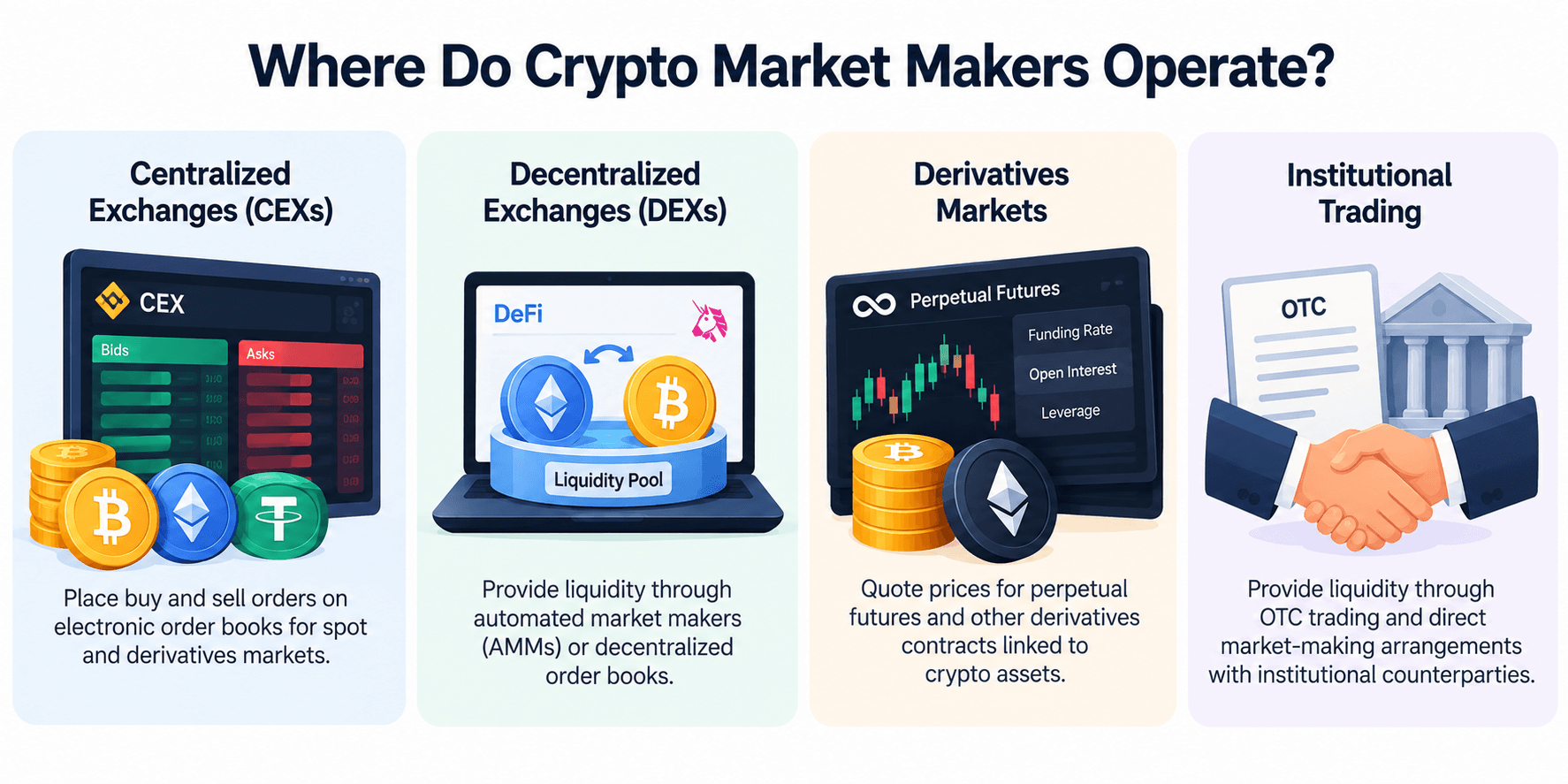 Inventory Losses And Volatility Can Quickly Drain Liquidity
Market Making on Centralized Exchanges
On centralized exchanges, professional market makers submit executable orders into electronic order books. Their trading systems typically connect through exchange APIs, enabling them to place, modify, and cancel orders as prices and inventory positions change.
Exchanges have an incentive to attract these firms because more competitive liquidity can improve execution for users. A trading venue with narrow spreads and substantial available depth may be more attractive to traders than one where even modest orders cause considerable price movement.
Market-making arrangements can therefore involve requirements or incentives linked to quoting activity, spreads, and available order-book depth.
Some exchanges also measure quoting uptime, which indicates how consistently a firm maintains orders during an agreed period. However, the precise obligations depend on the exchange's rules and any commercial arrangements with liquidity providers.
Market making operates in both spot and derivatives markets.
In spot markets, firms quote prices for the underlying cryptocurrency. In perpetual futures and other derivatives, they provide liquidity for contracts linked to cryptocurrency prices. These contracts introduce additional considerations, including margin requirements, funding payments, and the need to hedge contract exposure.
Exchanges and market makers generally remain separate participants. The exchange provides the trading venue and matching infrastructure, while independent market makers manage their own orders and positions. Some venues may also maintain affiliated trading operations or internal liquidity functions, depending on their organizational arrangements.
Professional firms often operate across several exchanges simultaneously. This allows them to manage inventory across venues, respond to pricing differences, and provide liquidity in markets where activity might otherwise be fragmented.
Market Making on Decentralized Exchanges
Decentralized exchanges can use different systems for matching trades and supplying liquidity, including conventional order books and smart-contract-based liquidity pools.
Within DeFi, many trading platforms use automated market makers, or AMMs, to facilitate swaps without relying on traditional resting bids and asks.
An AMM is a system of smart contracts that facilitates trading using liquidity deposited into pools.
For example, Uniswap allows users to exchange tokens against assets available in liquidity pools. When someone purchases one token from a pool, the pool's asset balances change, affecting the price at which subsequent transactions execute.
Liquidity providers deposit assets into these pools and earn a share of eligible trading fees. Under Uniswap's fee distribution mechanism, earnings depend on factors including active liquidity, pool configuration, and any applicable protocol fees.
Professional market makers can also participate in these systems by actively managing liquidity positions, supplying assets across pools, or quoting through decentralized execution mechanisms.
The main roles differ as follows:
| Participant or Mechanism | How It Provides Liquidity | Revenue Source | Main Risk |
|---|---|---|---|
| Professional market maker | Actively manages quotes, inventory, or liquidity positions | Trading revenue and commercial compensation | Inventory losses, execution costs, and market exposure |
| Automated market maker | Uses smart contracts and liquidity pools to facilitate swaps | Distributes applicable trading fees through protocol rules | Smart contract and pricing-mechanism risks |
| Ordinary liquidity provider | Deposits assets into liquidity pools | Share of eligible trading fees and incentives | Token-price movements, impermanent loss, and protocol risk |
An automated market maker is the mechanism that facilitates the swap. The liquidity providers supply the assets used in those transactions, while professional firms may manage more sophisticated positions within the same system.
Some AMMs support concentrated liquidity, allowing providers to allocate capital within selected price ranges. This can improve capital efficiency because more liquidity is available where trading activity is expected to occur.
However, these positions require greater management. A position may stop earning fees if the market price moves outside its selected range, while changes in token prices can cause impermanent loss relative to holding the deposited assets separately.
Not every decentralized exchange uses a traditional AMM pool. Some rely on order books, auctions, or request-for-quote systems, allowing professional firms to compete directly to provide execution.
The venue's design determines whether liquidity comes from continuously managed orders, pooled assets, or a combination of trading mechanisms.
Why Crypto Projects Hire Market Makers
New cryptocurrency projects often face thin order books, wide bid-ask spreads, and fragmented liquidity when their tokens begin trading.
A newly listed token may have substantial investor interest but insufficient buying and selling orders near its current price. In these conditions, even a relatively small transaction can cause sharp price movements, making it harder for investors to enter or exit positions efficiently.
Projects may therefore engage professional market makers to maintain executable quotes across the exchanges where their tokens are listed.
The arrangement can help establish more consistent trading conditions, particularly during the early stages of a token's market activity.
Market-making agreements may specify performance indicators such as bid-ask spreads, available depth, quoting uptime, and trading activity. GSR, for example, identifies spread, depth, volume, market share, uptime, and volatility among the metrics used to evaluate its market-making services.
Compensation structures can vary considerably.
Some projects pay fixed service fees, while others provide token loans that allow market makers to access inventory for trading. Certain arrangements also involve call options or other negotiated financial terms.
A call option can give a market maker the right to acquire tokens at a specified price under agreed conditions. Depending on the contract, such an arrangement may expose the firm to additional gains or losses linked to the token's market price.
These incentives can create conflicts of interest if a firm's financial objectives differ from those of the project or its investors. The terms governing inventory access, compensation, and trading obligations therefore influence how the arrangement functions.
Hiring a market maker can improve the availability of quotes, but it cannot manufacture sustainable investor demand through legitimate liquidity provision alone. Nor can it guarantee that a token's price will appreciate or that the same liquidity will remain available during heavy selling.
Notable Crypto Market-Making Firms
Several established firms provide liquidity across cryptocurrency markets.
| Firm | General Operating Areas |
|---|---|
| Wintermute | Algorithmic trading, token liquidity provision, institutional OTC execution, and decentralized markets |
| GSR | Centralized and decentralized market making, institutional execution, and trading risk management |
| Cumberland | Institutional OTC liquidity, spot cryptocurrency trading, futures, and options |
These firms illustrate different areas of professional liquidity provision. Their inclusion is not a ranking or endorsement of their services.
What Are the Risks and Limitations of Crypto Market Making?
Crypto market makers face inventory risk, adverse selection, hedging costs, and capital constraints. These risks affect how aggressively firms can quote prices and how much liquidity they are willing to provide.
For ordinary traders, the consequences often appear through changes in bid-ask spreads, reduced market depth, and higher execution costs.
Inventory Risk, Adverse Selection, and Hedging
Inventory risk arises when a market maker accumulates assets that subsequently decline in value.
Suppose an altcoin trades at $2 and a market maker repeatedly buys tokens from sellers. If selling pressure persists, the firm may accumulate substantial inventory while the market price moves toward $1.80.
The firm now holds assets purchased at higher prices, leaving it exposed to further losses if the decline continues. Maintaining aggressive buy orders could increase its inventory when it would prefer to reduce exposure.
In response, the market maker may lower its bids, quote smaller quantities, or sell part of its existing holdings. These adjustments protect the firm's capital but also reduce the liquidity available to other sellers.
Other risks can create similar pressure.
- Adverse selection: Faster or better-informed traders can execute against outdated quotes before a market maker adjusts them, producing losses relative to prevailing market prices.
- Hedging risk: Offset positions can reduce directional exposure, but imperfect hedges, trading costs, and execution delays may leave the firm with additional losses.
- Capital constraints: Market making requires sufficient funding, inventory, and collateral. Losses or restricted access to capital can limit the firm's ability to maintain liquidity.
- Execution risk: Orders intended to hedge or rebalance positions may receive partial fills, execute at unfavorable prices, or fail during exchange disruptions.
These exposures can interact.
A firm accumulating an altcoin during heavy selling might attempt to hedge the position using derivatives. However, if the derivative market is also experiencing volatility, the hedge could become more expensive or difficult to execute.
Firms using margin trading or leveraged derivatives may face additional funding requirements and liquidation risk if their positions move against them.
A market maker's decision to reduce inventory therefore reflects more than its expectations about future prices. It also depends on how much capital the firm can commit, how efficiently it can hedge, and whether trading revenue adequately compensates for the risks involved.
Why Liquidity Can Disappear During Market Volatility
Market makers may reduce or withdraw liquidity when volatility increases because maintaining their existing quotes becomes financially riskier.
Under ordinary trading conditions, a firm may confidently quote relatively narrow spreads. It expects to manage incoming transactions through subsequent trades, inventory adjustments, and hedging.
During a sudden market decline, however, selling pressure can become highly concentrated.
A market maker repeatedly buying from sellers may accumulate inventory faster than it can offset those positions. Meanwhile, the market value of that inventory continues falling. The revenue earned from spreads may no longer compensate for the losses developing across its holdings.
The firm can respond by lowering its bids, reducing quoted quantities, or canceling unfilled orders. Other liquidity providers facing similar conditions may make comparable adjustments, removing additional buying interest just as more traders attempt to sell.
The resulting deterioration can be substantial.
| Market Condition | Normal Trading | Market Stress |
|---|---|---|
| Bid-ask spread | Generally narrower | Often widens |
| Displayed depth | More consistent near market prices | May decline sharply |
| Market-maker participation | More regular quoting | Orders may be reduced or withdrawn |
| Expected slippage | Usually lower for a given order size | Can increase considerably |
| Execution conditions | More predictable under stable conditions | Greater risk of unfavorable or incomplete execution |
As available bids disappear, incoming market sell orders must execute against progressively lower prices.
This can create a feedback loop. Falling prices increase inventory losses, market makers reduce their exposure, and the resulting decline in buying depth allows subsequent sales to move prices even further.
Exchange outages, trading halts, and funding constraints can intensify these conditions. A firm may hold assets on one exchange but lack immediate access to sufficient funds or inventory on another. Moving capital between venues can also become slower or more expensive during market stress.
In derivatives markets, forced liquidations can introduce additional selling pressure as leveraged positions are closed. Those transactions may consume liquidity faster than market makers are willing to replenish it.
Traders can manage some execution exposure by monitoring available depth, using appropriate order types, and reducing position sizes when market conditions deteriorate. Our risk management guide provides a broader framework for position sizing, liquidity risk, and execution planning.
However, risk controls cannot guarantee execution at a desired price when available liquidity disappears.
Market makers generally improve liquidity while they remain active, but their participation cannot prevent a cryptocurrency crash or guarantee that previously displayed order-book depth will remain available during market stress.
Can Crypto Market Makers Manipulate Prices?
Crypto market makers can influence short-term trading conditions through their quotes, order sizes, and execution decisions. However, legitimate market-making activity does not automatically give firms control over a cryptocurrency's market price.
Market manipulation occurs when participants engage in deceptive trading practices intended to create misleading impressions of demand, volume, prices, or available liquidity.
Normal inventory management, arbitrage, and quote adjustments should therefore be distinguished from deliberate efforts to mislead other traders.
Legitimate Market Making vs. Wash Trading and Spoofing
Legitimate market making involves placing genuine executable buying and selling interest while accepting the financial risks associated with those orders.
Market makers routinely modify their quotes when prices move or inventory changes. These adjustments help firms manage exposure and remain competitive in markets where trading conditions change continuously.
Manipulative practices differ because they use trading activity or displayed orders to deceive other participants.
| Trading Practice | How It Works | Market Implication |
|---|---|---|
| Legitimate market making | Maintains genuine executable buying and selling interest | Supports liquidity and price discovery |
| Wash trading | Creates misleading activity through transactions lacking genuine economic purpose | Can artificially inflate volume or create false demand signals |
| Spoofing | Places orders with the intent to cancel before execution to mislead other traders | Creates false impressions of buying or selling interest |
| Artificial liquidity | Uses deceptive trading activity or displayed orders to exaggerate available participation | Can distort perceptions of liquidity and execution quality |
Wash trading can make a token appear substantially more active than it is.
For example, coordinated transactions between accounts controlled by the same operator may generate large amounts of reported trading volume without reflecting independent investor demand. Other traders may interpret that activity as evidence of growing interest and become more willing to purchase the token.
Spoofing involves a different form of deception.
A participant might place a large buy order intended to convince other traders that substantial demand exists. If the order was submitted with the intention of canceling it before execution, rather than genuinely purchasing the asset, the conduct may constitute spoofing.
The CFTC's spoofing interpretation emphasizes the intent to cancel an order before execution.
Legitimate market makers routinely cancel and replace orders, particularly when prices change rapidly. An individual cancellation is therefore insufficient to establish spoofing, just as an unusual increase in trading volume does not automatically prove wash trading.
Determining whether trading activity was manipulative requires examining the conduct, intent, and surrounding circumstances.
Documented Crypto Market-Making Manipulation Cases
U.S. enforcement actions involving MyTrade and Gotbit demonstrate how purported market-making services can be used to generate artificial trading activity.
Case 1: MyTrade, August 2026
On Aug. 6, 2026, the U.S. Department of Justice announced the sentencing of Liu Zhou, founder and primary operator of MyTrade.
Zhou pleaded guilty to conspiracy to commit market manipulation and wire fraud. The court imposed a $10,000 fine.
MyTrade provided cryptocurrency-related financial services, including wash-trading activity designed to create artificial trading volume for client tokens across multiple exchanges.
The firm's clients could specify desired daily wash-trading activity through its service, allowing trading bots to generate transactions that gave the appearance of greater market participation.
Case 2: Gotbit, June 2025
Gotbit Consulting and its founder, Aleksei Andriunin, were sentenced in June 2025 in connection with cryptocurrency market manipulation and fraud.
Andriunin received an eight-month prison sentence, followed by one year of supervised release. Gotbit was ordered to forfeit approximately $23 million in seized cryptocurrency and received a five-year probation term requiring it to cease operating.
Gotbit admitted to manipulative trading intended to artificially increase client tokens' trading prices and volumes.
The firm's activities included wash trading on behalf of cryptocurrency projects, creating activity that could mislead investors about genuine market demand.
Both cases involved services marketed within the cryptocurrency market-making industry that generated artificial transactions rather than supporting legitimate trading interest.
They demonstrate how manufactured volume can give an asset an appearance of liquidity or investor demand that does not correspond to genuine market participation.
How Investors Can Identify Potential Liquidity Red Flags
Investors can identify possible liquidity problems by comparing reported trading activity with the buying and selling interest actually available in the market.
No single indicator establishes manipulation, but unusual combinations of volume, order-book behavior, and liquidity concentration can justify closer examination.
Several warning signs are particularly relevant:
- High reported volume with shallow order books: A token showing millions in daily trading activity but limited executable liquidity near the current price may warrant closer scrutiny. Historical volume and immediately available liquidity measure different things.
- Liquidity concentrated on a single venue: Heavy dependence on one exchange can expose traders to greater execution risk if that venue experiences an outage or liquidity withdrawal.
- Repeatedly disappearing large orders: Large bids or asks that consistently vanish before execution may indicate unstable displayed depth. Additional evidence would be needed to determine whether deceptive conduct occurred.
- Sudden changes in trading activity: Unusual volume increases without a corresponding rise in genuine participation may justify examining transaction patterns and available liquidity.
- Limited transparency around market-making arrangements: Unclear compensation, token loans, options, or liquidity obligations can make potential conflicts of interest harder to assess.
These signals require interpretation in context.
A legitimate token may experience shallow liquidity during periods of limited trading activity. Professional market makers may also withdraw orders rapidly during volatility without engaging in manipulation.
Likewise, a cryptocurrency project hiring a professional liquidity provider does not automatically imply deceptive trading.
Investors should compare quoted spreads, depth, trading volume, and execution quality across exchanges and observation periods. Consistent liquidity supported by genuine transactions provides stronger evidence of a functioning market than a large reported volume figure alone.
Thin liquidity can also increase the risk of becoming exit liquidity for larger holders. If a token attracts buying interest while substantial holders are preparing to sell, those incoming purchases may provide the demand needed for the larger holders to exit.
In decentralized markets, investors may face additional risks from rug pulls, where insiders remove liquidity or otherwise extract value from a token project.
The practical assessment remains the same: examine the liquidity available for real transactions, the concentration of that liquidity, and whether market activity appears consistent with genuine trading demand.

Closing Thoughts
Crypto market makers help improve trading efficiency by maintaining executable buying and selling quotes, contributing to market depth, and reducing execution costs when sufficient liquidity is available.
Their activity also involves commercial incentives and financial risks. Firms must manage inventory, absorb trading costs, and adjust their exposure as conditions change. During periods of sharp volatility, these pressures can cause liquidity to decline precisely when traders need it most.
Their participation cannot guarantee fair prices, permanently deep order books, or protection from market crashes. Documented manipulation cases also show why reported trading volume should not be treated as conclusive evidence of genuine demand.
For traders, bid-ask spreads, available order-book depth, and expected slippage at the intended order size provide a more practical assessment of liquidity than trading volume alone.