Axiom Trade is a Solana-focused trading terminal built mainly for memecoin traders. It combines token discovery, fast on-chain trading, wallet tracking, X/Twitter monitoring, MEV protection settings, and perpetual futures access through Hyperliquid.
For active traders, Axiom can be a powerful command centre for finding and trading fast-moving Solana tokens. For passive investors, beginners or users who only want simple swaps, it may be more than they need.
This Axiom Trade review breaks down how the platform works, what its Pulse discovery tool offers, how its fees compare with the real cost of trading, whether Axiom is safe to use, and which alternatives may be better depending on your trading style.
Editor's Note (June 9, 2026): We fully updated this Axiom Trade review in June 2026 to reflect the platform's latest features, fees, staking options, Hyperliquid perps access, safety considerations, trust concerns, and competitive position against tools such as Jupiter, Photon, BullX, GMGN, Telegram trading bots, and Hyperliquid.
Axiom Trade Review: Quick Verdict
Axiom Trade is one of the stronger trading terminals for active Solana memecoin traders in 2026. Its main edge is that it combines token discovery, Pulse filters, wallet tracking, X/Twitter monitoring, fast on-chain execution, MEV settings, limit orders, staking, and Hyperliquid perps access in one interface.
Our take: Axiom is worth using if you actively trade Solana memecoins and understand liquidity, slippage, priority fees, MEV, wallet security, and rug-pull risk. It is not the best choice for beginners, passive investors, simple swap users, or anyone who wants a low-risk crypto app.
Scorecard
-
1Trading and Execution 4.4/5 Axiom gives active traders market orders, limit orders, Quick Buy, Pulse-linked trading, MEV settings, slippage controls, priority fees, bribes, and fast Solana execution tools.
-
2Fees 4.5/5 Axiom uses a tiered fee model with SOL cashback. Higher-volume traders can reduce their net platform fee through the platform's multiplier tiers.
-
3Security 4.6/5 Axiom uses a non-custodial setup, supports connected wallets, offers MEV protection options, and gives traders direct control over wallet funding and execution settings.
-
4Trust 3.5/5 Axiom is a legitimate trading platform with strong utility for Solana traders. This score also reflects the 2026 data-privacy allegations discussed later in the review.
-
5Extra Features 4.5/5 Axiom adds wallet tracking, X/Twitter monitoring, staking, axiSOL, token filters, portfolio tools, and Hyperliquid perps access alongside its main Solana trading terminal.
-
6User Experience 4.0/5 Axiom brings discovery, charts, token data, wallet tracking, social signals, order controls, portfolio tools, and execution settings into one dashboard for active traders.
-
7Overall Score 4.25/5 Axiom scores well as a Solana trading terminal, with strong marks for trading tools, fees, security, extra features, and active-trader usability.
Best For
- Active Solana memecoin traders
- Users who want Pulse, filters, wallet tracking, and fast execution
- Traders who understand liquidity, slippage, MEV, and priority fees
- Users who monitor Pump.fun, Raydium, and new token migrations
- Traders who want Solana spot tools plus Hyperliquid perps access
Not Ideal For
- Beginners who are still learning wallet security
- Passive investors or long-term holders
- Users who only want simple Solana swaps
- Risk-averse users uncomfortable with memecoin volatility
- Perps-only traders who may prefer using Hyperliquid directly
Disclosure and Methodology
Some links in this article may be affiliate links. If you choose to use a service through these links, we may earn a commission at no additional cost to you.
For this Axiom Trade review, we evaluated the platform across six main categories: trading and execution, fees, security, trust, extra features, and user experience. We looked at Axiom as a live Solana trading terminal rather than judging it only as a simple swap tool. That included Pulse, market orders, limit orders, Quick Buy, wallet tracking, X/Twitter monitoring, slippage controls, priority fees, bribes, MEV protection settings, staking, axiSOL, and Hyperliquid perps access.
We also weighed the main limitations carefully, including memecoin volatility, thin liquidity, rug-pull risk and comparisons with Jupiter, Photon, BullX, GMGN, Telegram trading bots, and Hyperliquid.

What Is Axiom Trade?
Axiom Trade is a Solana-focused trading terminal that helps users discover, analyze, and trade memecoins while also offering wallet tracking, social monitoring, staking, and perps access through Hyperliquid.
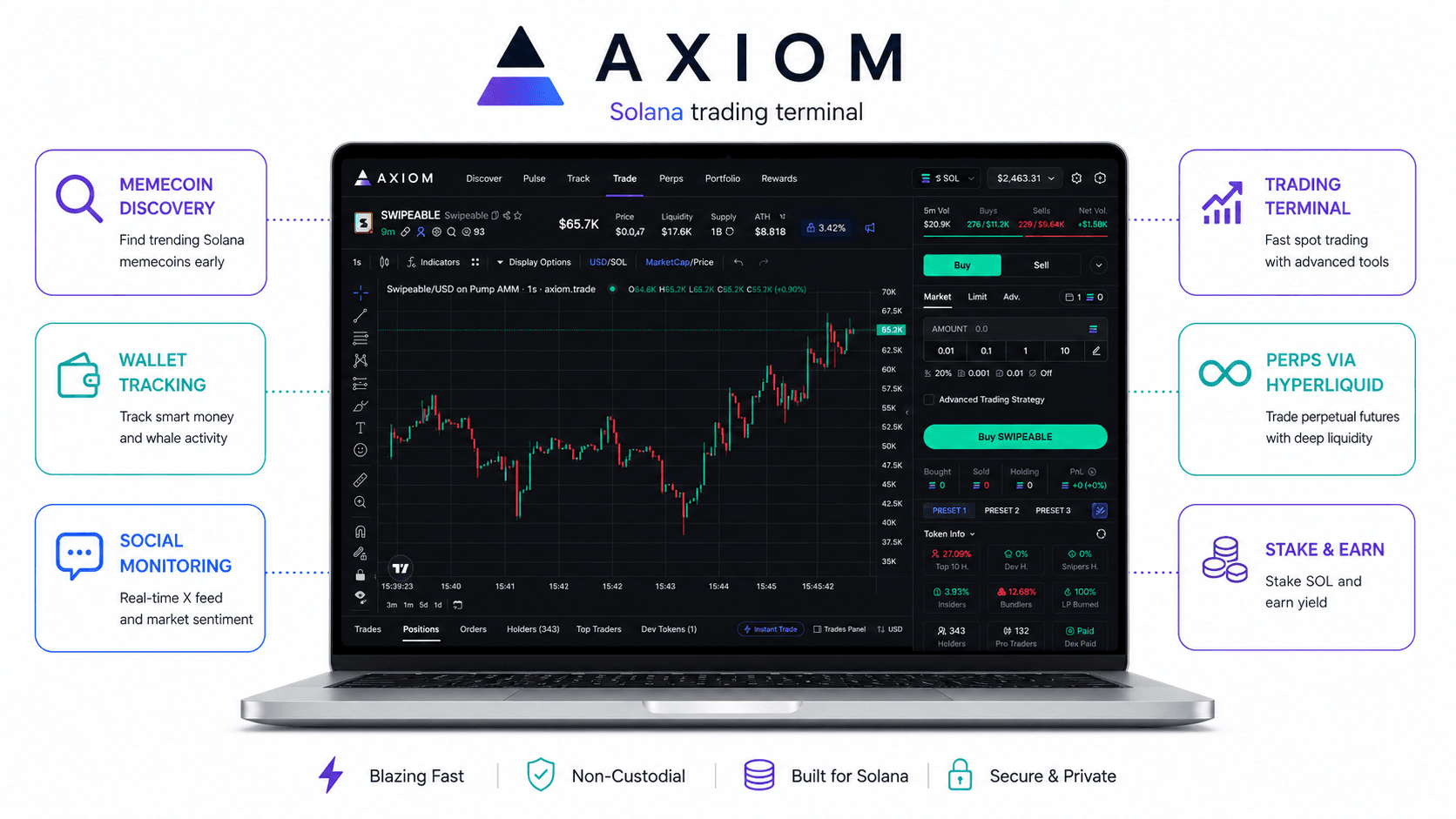 Axiom Trade is Solana Memecoin Trading Terminal
The easiest way to understand Axiom is to think of it as a trading dashboard built for fast-moving Solana markets. It brings together token discovery, spot trading, wallet tracking, X/Twitter monitoring, charting, order controls, and execution tools in one interface. Instead of jumping between Pump.fun, Raydium, wallet explorers, social feeds, and separate trading apps, users can track and trade tokens from one place.
Axiom is especially focused on Solana memecoin trading. Its Pulse feature helps traders monitor new token launches, tokens close to completing their bonding curve, and tokens that have migrated to Raydium. The platform also supports perpetual futures through Hyperliquid, giving users access to leveraged trading from within the Axiom interface.
Axiom also includes staking and yield features, but these are secondary to its main role. The core product is still built around token discovery, fast on-chain execution, and trader-focused tools for Solana markets.
Is Axiom a DEX, Wallet, Bot or Trading Terminal?
Axiom is best described as a trading terminal, not just a DEX, wallet, or bot.
It routes and executes on-chain trades, so it overlaps with decentralized exchange activity. It can also generate a wallet or connect to an existing wallet, so it has wallet-like functions. However, Axiom is broader than both. It gives users a full trading interface with charts, token filters, wallet tracking, social monitoring, order controls, MEV settings, and execution tools.
It is also not the same as a centralized exchange. Users are not simply opening a standard exchange account to trade assets held inside a company-controlled order book. Axiom is built around on-chain Solana trading, where users interact with blockchain-based liquidity and wallet-linked accounts.
Axiom is not the same as a Telegram trading bot either. Telegram bots are usually command-based tools built for quick mobile execution. Axiom is a visual trading terminal with more screen space, market data, token filters, and trading controls. That makes it better suited to users who want a fuller view before entering or exiting a trade.
What Assets Can You Trade on Axiom?
Axiom is mainly used for Solana memecoins and newly launched tokens. This includes tokens created on Pump.fun, tokens that are close to completing their bonding curve, and tokens that have migrated to Raydium for wider liquidity.
The platform is also useful for tracking Solana tokens listed through other launch or liquidity sources, including Moonshot where supported. For spot trading, users typically fund their Axiom wallet or connected wallet with SOL, since SOL is needed for Solana trading and network fees.
Axiom also offers perpetual futures access through Hyperliquid. These markets are separate from Solana memecoin spot trading and usually use USDC as collateral. That means users should treat Axiom’s spot trading and Hyperliquid perps access as two different trading environments inside the same broader platform.
Who Should Use Axiom Trade?
Axiom Trade is best suited to active Solana memecoin traders who want speed, token discovery tools, wallet tracking and more control over execution. It is not the best fit for everyone. The platform gives users a lot of control, but that also means users need to understand liquidity, slippage, wallet security, and the risks of fast-moving memecoin markets.
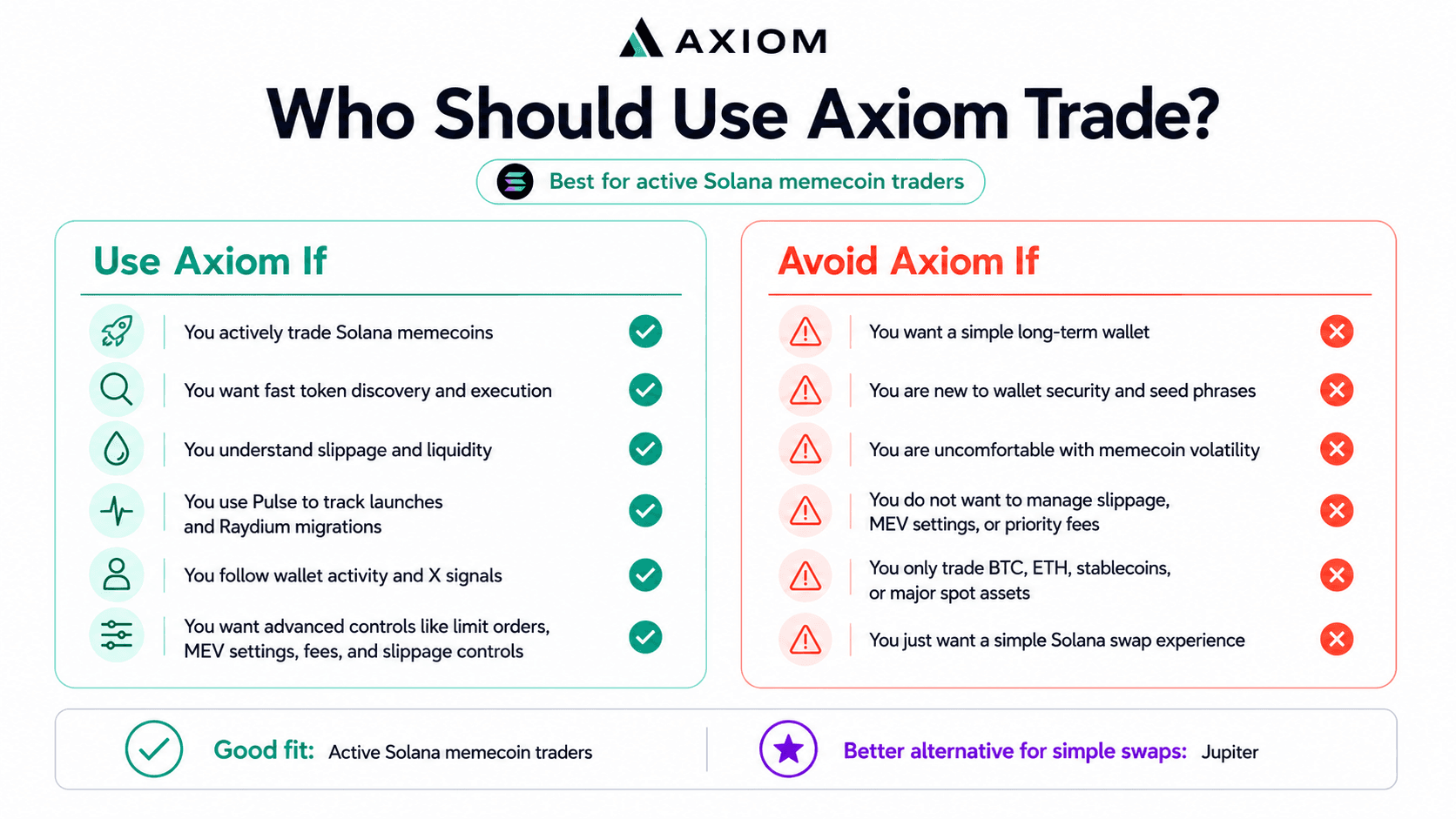 Axiom Trade Is Ideal For Active Solana Memecoin Traders
| User Type | Should They Use Axiom? | Why |
|---|---|---|
| Active Solana memecoin trader | Yes | Axiom offers Pulse, fast execution, token filters, wallet tracking, and social monitoring. |
| Beginner crypto user | Usually no | The platform has too many risk controls and fast-moving assets for someone still learning the basics. |
| Simple swap user | Probably no | Jupiter is simpler for users who only want to swap tokens on Solana. |
| Perps trader | Maybe | Axiom gives access to Hyperliquid, but direct Hyperliquid may be cleaner for users focused only on perps. |
| Yield user | Maybe | Axiom offers staking and yield features, but these should not be the main reason to use the platform. |
| Risk-averse investor | No | Memecoin trading is highly volatile and can lead to fast losses. |
Use Axiom If
- You actively trade Solana memecoins and want a faster way to discover, analyze and trade new tokens.
- You understand slippage, liquidity, and how quickly prices can move in thin memecoin markets.
- You want to use Pulse to monitor new launches, tokens close to migration, and recently migrated Raydium pairs.
- You track wallet activity, X/Twitter accounts, or social signals before entering trades.
- You want custom trade controls, including limit orders, MEV settings, priority fees, bribes, and slippage controls.
- You want a trading terminal built for active decision-making rather than passive holding.
Avoid Axiom If
- You want a simple buy-and-hold wallet for long-term storage.
- You do not understand seed phrases, wallet security, or the risks of connecting wallets to trading platforms.
- You are uncomfortable with memecoin volatility, low liquidity, holder concentration, insider activity, or rug-pull risk.
- You do not want to manage slippage, MEV settings, priority fees, or bribes.
- You only trade BTC, ETH, stablecoins, or major spot assets.
- You want a simple Solana swap experience, in which case Jupiter may be easier to use.
Core Features: What You Can Actually Do on Axiom?
Axiom Trade is more than a simple Solana swap interface. Its main value is that it combines token discovery, trading, wallet tracking, social monitoring, execution settings, perps access, and staking features in one place. That makes it useful for active traders who want to move quickly.
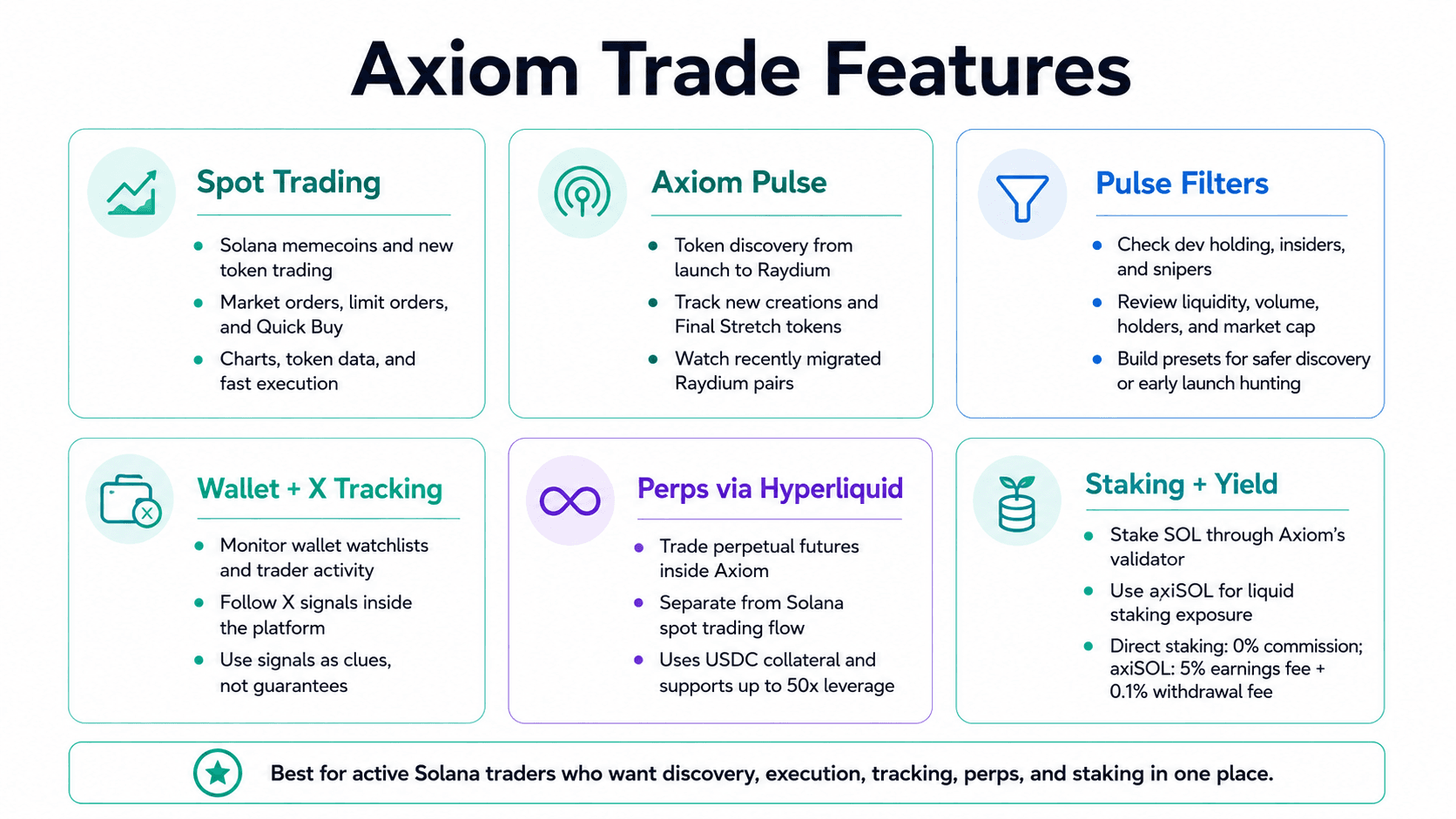 Axiom Combines Token Discovery, Trading, Wallet Tracking, Perps Access and Staking In One Platform
Spot Trading for Solana Memecoins
Axiom’s core feature is spot trading for Solana tokens, especially memecoins and newly launched assets. And boy, there are a lot of it. A LOT. Every few minutes, the Discover section auto-refreshes with the latest Solana memecoins.
Users can trade tokens through a dashboard that includes charts, token data, order controls, and execution settings.
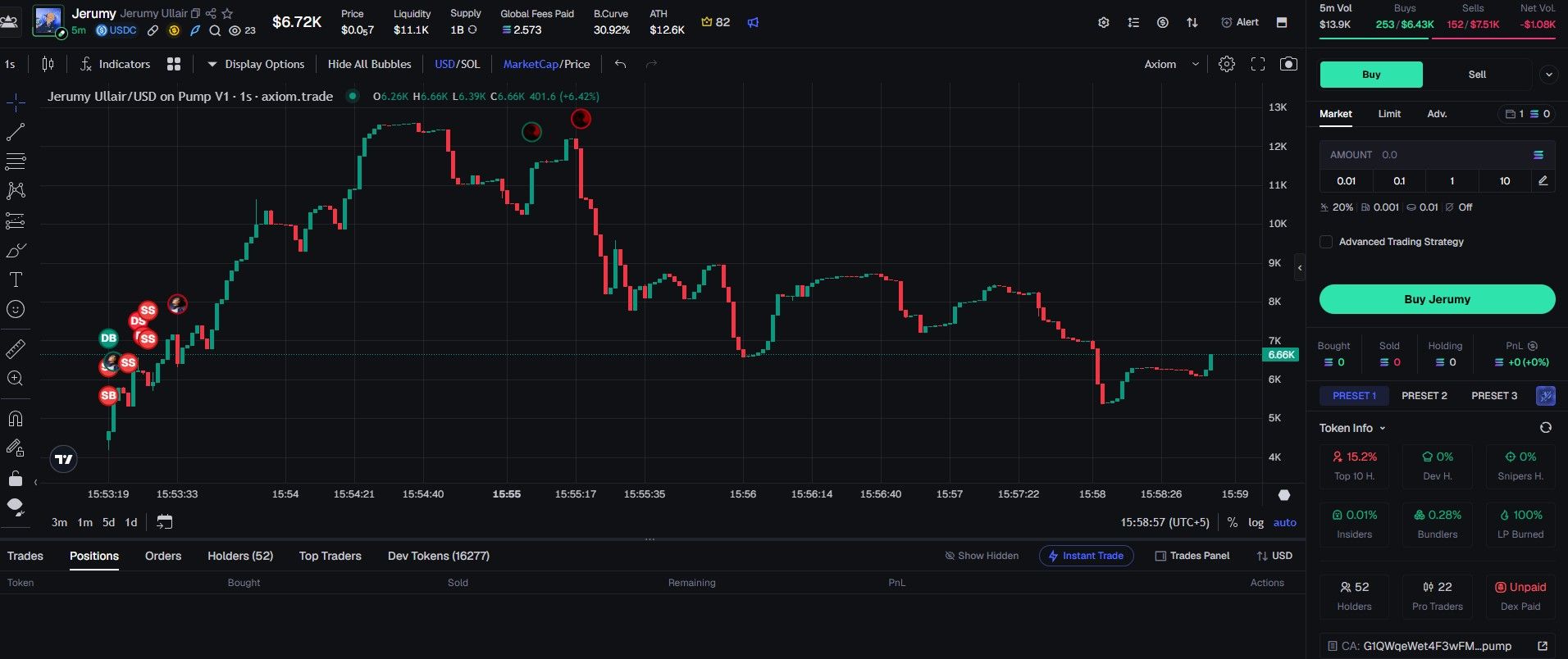 A Look At The Trading Screen on Axiom Trade For
The platform supports market orders for immediate trades and limit orders for users who want to set a target price. It also includes Quick Buy, which lets traders enter a position directly from token tables such as Pulse. This can be useful when speed is important.
Axiom gives traders access to tokens from fast-moving Solana venues such as Pump.fun and Raydium. It is particularly useful for tracking tokens that are newly launched, close to migration, or already trading with deeper liquidity after moving to Raydium.
For each token, users can review key market data such as liquidity, market cap, volume, holders, transactions, and buy/sell activity.
Axiom Pulse for Token Discovery
Axiom Pulse is the platform’s main token discovery tool. It helps users follow the lifecycle of Solana memecoins from launch to Raydium migration.
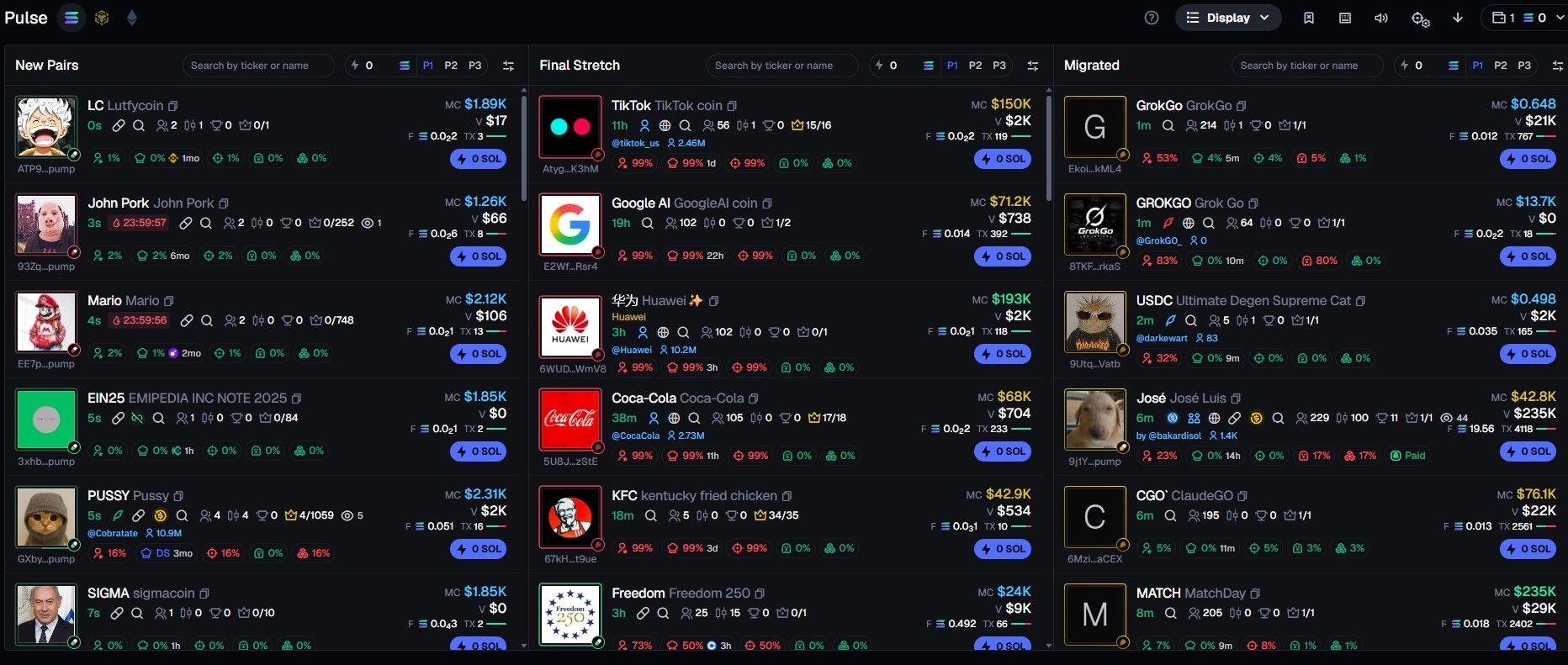 Axiom Pulse Is A Token Discovery Tool
Instead of manually checking Pump.fun, Raydium, and other sources, Pulse groups tokens into different views so traders can scan the market faster.
| Pulse View | What It Shows | Best For | Main Risk |
|---|---|---|---|
| New Creations / New Pairs | Recently created tokens | Finding launches early | Very high risk, thin liquidity, limited history |
| Final Stretch | Tokens close to completing their bonding curve and migrating to Raydium | Watching tokens before migration | Traders may overpay before liquidity improves |
| Migrated to Raydium | Tokens that have recently moved to Raydium | Finding tokens with wider trading access | Post-migration pumps can reverse quickly |
Axiom's Pulse is most useful when combined with filters.
Pulse Filters and Risk Signals
Pulse filters are one of Axiom’s most useful features because they help traders sort tokens by risk, activity, and market quality.
Important Pulse filters include:
- Top 10 Holders %: Shows how much of the token supply is held by the largest wallets. A high percentage can mean concentrated supply and higher dump risk.
- Dev Holding %: Shows how much supply is still controlled by the developer wallet. High dev ownership can be a warning sign.
- Snipers %: Shows how much supply was bought by fast early buyers. High sniper activity can increase sell-pressure risk.
- Insiders %: Helps identify tokens where supply may be concentrated among wallets linked to early or privileged buyers.
- Bundle %: Shows bundled buying activity, which can indicate coordinated launches or artificial-looking distribution
- Holders: Tracks how many wallets hold the token. Growing holder count can indicate wider adoption, though it does not prove quality.
- Pro Traders %: Shows whether wallets tagged as experienced traders are involved.
- Liquidity: Shows how much trading depth is available. Thin liquidity can lead to poor fills and violent price moves.
- Volume: Shows trading activity over a given period. High volume can signal attention, but it can also reflect short-term speculation.
- Market Cap: Helps estimate the token’s current size.
- Buy/Sell Activity: Shows whether recent activity is tilted toward buying or selling.
A practical way to use Pulse is to build filter presets around your trading style.
| Use Case | Filters To Watch | Why |
|---|---|---|
| Safer discovery | Lower dev holding, lower insider %, growing holders, stronger liquidity | Reduces obvious concentration risk |
| Early launch hunting | Low age, rising transactions, rising holders | Finds new activity before a token becomes widely visible |
| Raydium migration watch | Final Stretch, liquidity, volume, holders | Tracks tokens close to migration |
| Avoid list | High dev %, high insiders, thin liquidity, extreme slippage | Flags tokens with higher obvious risk |
Wallet and X/Twitter Tracking
Axiom also includes wallet tracking and X/Twitter monitoring for traders who use social and on-chain signals.
Wallet tracking lets users create watchlists of wallets they want to monitor. This can be useful for following known traders, checking what certain wallets are buying, or spotting patterns across repeated trades. It can also create false confidence. A profitable wallet may be early, hedged elsewhere, or trading with information that ordinary users do not have.
Axiom’s social monitoring tools are designed to help traders follow market-moving X/Twitter activity without leaving the trading interface. This can be useful in memecoin markets, where attention often moves before fundamentals. However, social signals are noisy. A viral post does not make a token safe, liquid, or fairly distributed.
There is a privacy and ethics angle to all this, however. Wallet tracking uses public blockchain data, but copying wallets blindly can be risky and can turn trading into a game of chasing shadows. Social monitoring should also be treated as a signal source, not a substitute for checking liquidity, holders, token distribution, and execution settings.
Perps Through Hyperliquid
Axiom also gives users access to perpetual futures through Hyperliquid. This means users can trade perps from within the Axiom interface rather than using Axiom only for Solana memecoin spot trading.
Perps are separate from Axiom’s spot memecoin trading flow. Users typically need USDC for Hyperliquid perps, while Solana spot trading usually involves SOL for funding trades and paying network fees. Axiom supports up to 50x leverage for perps.
This feature is best suited to experienced derivatives traders. Leverage can amplify profits, but it can also wipe out a position quickly. If your main goal is to trade perps and you do not care about Axiom's Solana memecoin tools, using Hyperliquid directly may be cleaner. Axiom makes more sense if you want memecoin spot trading and perps access inside one broader trading workflow.
Staking and Yield Features
Axiom also offers staking and yield features, though these should be treated as secondary to its trading tools.
Users can stake SOL directly through Axiom's validator. Axiom also offers axiSOL, a liquid staking token managed through Solana’s Stake Pool Program. With liquid staking, users can earn staking rewards while holding a tokenized staking position, but this adds LST-specific risks such as liquidity risk, smart contract risk, validator risk, and withdrawal conditions.
As of June 9, 2026, Axiom says direct validator staking has 0% commission, while its stake-pool managed LST charges a 5% fee on earnings and a 0.1% withdrawal fee. These fees can change, so users should always check the live staking page before depositing.
Axiom Trade Fees
Axiom’s listed platform fee is only one part of the total cost. Traders also need to account for Solana network costs, priority fees, optional bribes, slippage, MEV settings, failed transactions, liquidity, trade size, execution price, and the effect of cashback tiers.
What Are Axiom Platform Fees and Cashback Tiers?
Axiom charges a trading fee on swaps. Its fee system is tiered, meaning active traders can reduce their net fee as their trading volume increases.
As of June 9, 2026, Axiom lists the lowest tier, Wood, at a 0.95% net fee with 0.05% cashback. The highest listed tier, Champion, has a 0.75% net fee with 0.25% cashback. Cashback is paid in SOL and increases as users move up the platform's multiplier tiers.
| Axiom Tier | Net Fee | SOL Cashback |
|---|---|---|
| Wood | 0.95% | 0.05% |
| Bronze | 0.90% | 0.10% |
| Silver | 0.875% | 0.125% |
| Gold | 0.85% | 0.15% |
| Platinum | 0.825% | 0.175% |
| Diamond | 0.80% | 0.20% |
| Champion | 0.75% | 0.25% |
Solana Network Fees, Priority Fees and Bribes
Because Axiom executes Solana trades on-chain, users also pay Solana network fees. These are usually small compared with many EVM networks, but they can still change based on congestion, transaction demand, and the settings used for execution.
Axiom gives users control over two important execution settings:
- Priority Fee: An extra payment used to increase the chance of faster transaction confirmation, especially during busy periods.
- Bribe: An additional validator tip used to improve transaction priority, often used during high-volume token launches.
As of June 9, 2026, Axiom lists 0.001 SOL as the default value for both priority fee and bribe. These settings can be adjusted, and Axiom can also recommend settings based on current network conditions.
Slippage and MEV Settings
Slippage is the difference between the expected trade price and the actual execution price. For example, if you expect to buy at one price but the token moves before your trade confirms, the final price may be worse than expected.
Slippage is a major cost in memecoin trading because many new tokens have thin liquidity, fast price movement, and heavy bot activity. Setting slippage too low can cause failed transactions. Setting it too high can expose you to a much worse entry price.
Axiom also offers MEV protection settings. MEV, or Maximal Extractable Value, refers to value that can be extracted through transaction ordering. In trading, this can include front-running and sandwich attacks, where bots or validators exploit pending trades.
| MEV Mode | What It Means | Trade-Off |
|---|---|---|
| Off | No MEV protection | Faster execution, but more exposure to front-running |
| Reduced | Sends transactions through Jito for better execution protection | Some MEV risk may remain |
| Secure | Waits for a whitelisted validator before processing | Better protection, but may be slower |
Axiom recommends using Secure mode where possible.
Example: What An Actual Trade on Axiom Can Cost?
The examples below are simplified. They are not fixed prices and should not be treated as exact trading costs. The real cost depends on your fee tier, referral discount, Solana network conditions, priority fee, bribe, slippage, liquidity, and execution price.
| Trade Size | Platform Fee Example | Priority/Bribe Example | Slippage Impact | Main Takeaway |
|---|---|---|---|---|
| $100 | About $0.75 to $0.95 before any referral discount | If priority fee and bribe are both set to 0.001 SOL, this adds 0.002 SOL before standard network costs | A 1% worse fill would cost about $1 | On small trades, fixed SOL settings can feel large relative to trade size. |
| $1,000 | About $7.50 to $9.50 before any referral discount | Priority and bribe settings still depend on SOL amounts, not trade size | A 1% worse fill would cost about $10 | Slippage can cost more than the platform fee if liquidity is thin. |
| $10,000 | About $75 to $95 before any referral discount | Traders may raise priority fees and bribes during busy launches | A 1% worse fill would cost about $100 | Large trades need deeper liquidity and stricter execution planning. |
Is Axiom Trade Safe?
Yes, Axiom Trade is a safe and legitimate platform.
However, users should understand the difference between platform risk, wallet risk, and trading risk. Axiom's non-custodial design means users control their own funds, but memecoin trading remains inherently high risk.
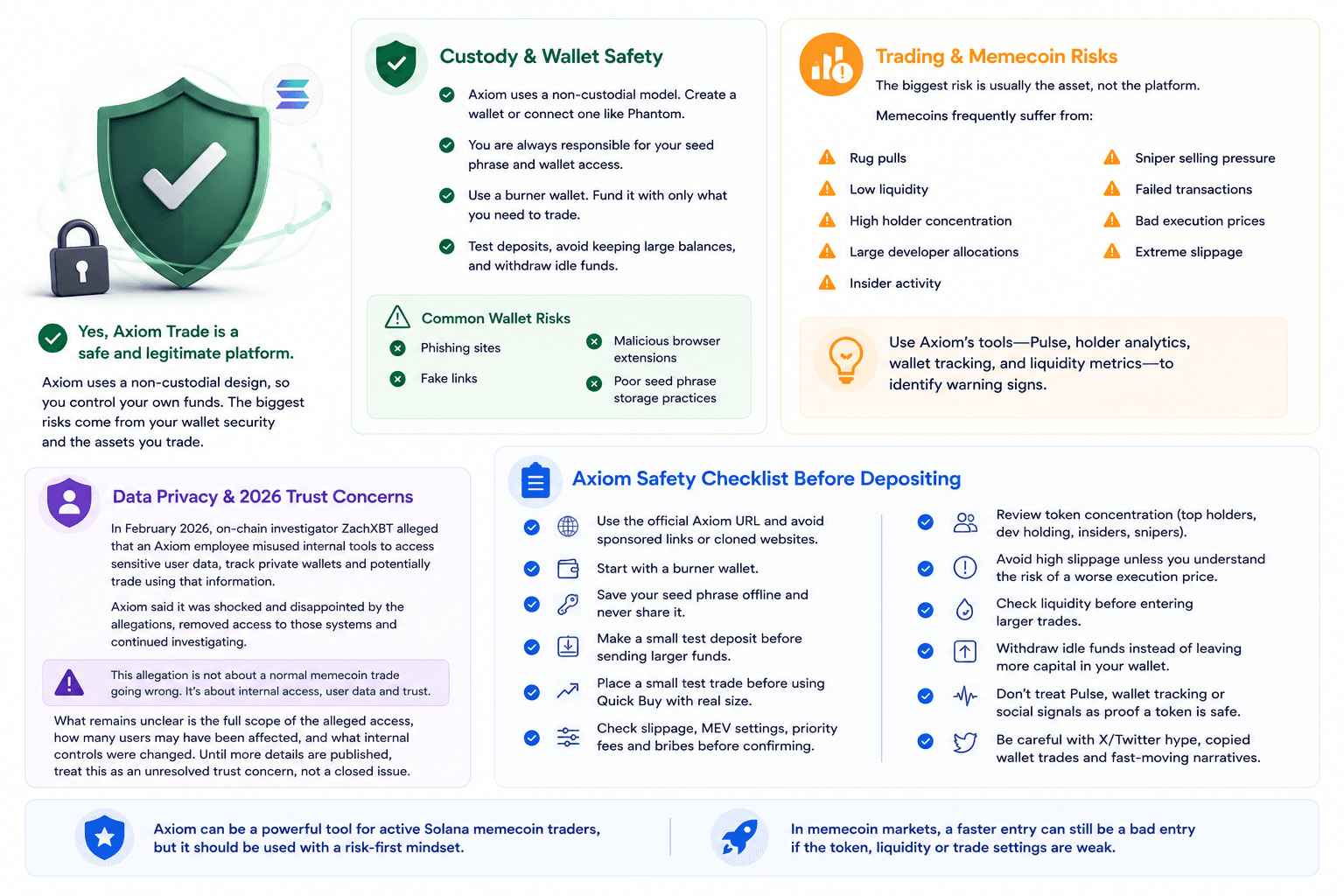 A List Of Axiom Trade's Safety Features And Top Tips on How to Stay Safe
Custody and Wallet Safety
Axiom uses a non-custodial model. Users can either create a wallet through Axiom or connect an existing wallet such as Phantom. In both cases, users remain responsible for protecting their seed phrase and wallet access.
For most traders, a burner wallet is the safest approach. Fund it with only the amount needed for trading, test deposits before sending larger amounts, and withdraw idle funds when they are not actively being used.
The most common wallet risks are phishing sites, fake links, malicious browser extensions, and poor seed phrase storage practices.
Trading and Memecoin Risks
The largest risk on Axiom is usually the asset being traded, not the platform itself.
Memecoins frequently suffer from:
- Rug pulls
- Low liquidity
- High holder concentration
- Large developer allocations
- Insider activity
- Sniper selling pressure
- Failed transactions
- Bad execution prices
- Extreme slippage
Tools such as Pulse, holder analytics, wallet tracking, and liquidity metrics can help identify warning signs.
Data Privacy and 2026 Trust Concerns
Axiom also needs to be assessed from a data privacy perspective.
In February 2026, on-chain investigator ZachXBT alleged that an Axiom employee misused internal tools to access sensitive user data, track private wallets and potentially trade using that information. Axiom said it was shocked and disappointed by the allegations, removed access to those systems and continued investigating.
The important point for users is that the allegation was not about a normal memecoin trade going wrong. It was about internal access, user data and trust. That makes it relevant to anyone using Axiom’s wallet tracking, account tools or connected-wallet features.
What remains unclear is the full scope of the alleged access, how many users may have been affected, what internal controls were changed. Unless Axiom publishes more detail, users should treat this as an unresolved trust concern rather than a closed issue.
Axiom Safety Checklist Before Depositing
- Before depositing funds or placing trades on Axiom, users should run through a basic safety checklist:
- Use the official Axiom URL and avoid sponsored links or cloned websites.
- Start with a burner wallet rather than your main wallet.
- Save your seed phrase offline and never share it with anyone.
- Make a small test deposit before sending larger funds.
- Place a small test trade before using Quick Buy with real size.
- Check slippage, MEV settings, priority fees and bribes before confirming.
- Review token concentration, including top holders, dev holding, insiders and snipers.
- Avoid high slippage unless you understand the risk of a worse execution price.
- Check liquidity before entering larger trades.
- Withdraw idle funds instead of leaving more capital than needed in a trading wallet.
- Do not treat Pulse, wallet tracking or social signals as proof that a token is safe.
- Be careful with X/Twitter hype, copied wallet trades and fast-moving launch narratives.
Axiom can be a powerful tool for active Solana memecoin traders, but it should be used with a risk-first mindset. In memecoin markets, a faster entry can still be a bad entry if the token, liquidity or trade settings are weak.
Axiom Trade vs Competitors
Axiom Trade is not the only tool for Solana memecoin trading. Its main appeal is that it combines token discovery, wallet tracking, social monitoring, execution controls, spot trading and Hyperliquid perps access in one dashboard. The best alternative depends on what you actually need: faster memecoin execution, deeper token analytics, a Telegram bot, simple swaps or direct perps trading.
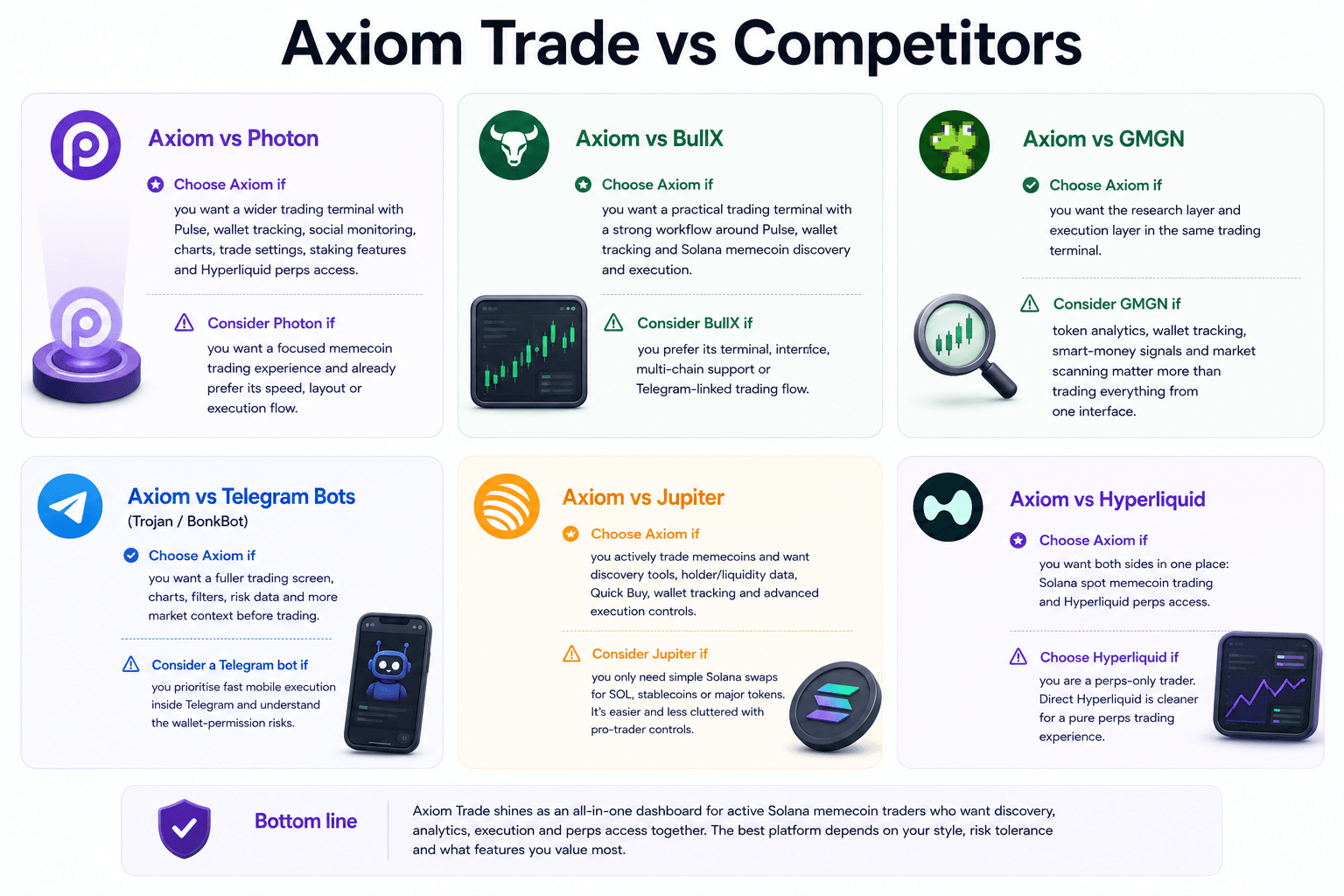 Here's How Axiom Trade Stands When Compared To Its Competitors
| Platform | Best For | Where Axiom Wins | Where a Rival Wins |
|---|---|---|---|
| Photon | Fast memecoin trading | Axiom feels broader as an all-in-one trading terminal with Pulse, tracking tools and perps access | Photon may suit users who prefer its token discovery and execution flow |
| BullX | Memecoin traders who want terminal-style tools | Axiom has a strong integrated workflow around Pulse, wallet tracking and Solana trading | BullX may appeal to users who prefer its interface, multi-chain support or Telegram-linked flow |
| GMGN | Token analytics and smart-money tracking | Axiom is stronger as a trading terminal for discovery plus execution | GMGN may suit analytics-first users who want token alerts, wallet tracking and market scanning |
| Trojan / BonkBot | Telegram-based trading | Axiom gives users richer desktop visibility, charts, filters and trade controls | Telegram bots may be faster for mobile-native traders who want chat-based execution |
| Jupiter | Simple Solana swaps | Axiom gives active traders more memecoin discovery tools and execution controls | Jupiter is simpler and better for normal swaps |
| Hyperliquid | Perps trading | Axiom lets users combine Solana spot memecoin tools with Hyperliquid perps access | Direct Hyperliquid is cleaner for perps-only users |
Axiom vs Photon
Axiom and Photon both appeal to active Solana memecoin traders, but they are not identical tools.
Photon is built around fast token discovery and trading. It may suit users who want a focused memecoin trading flow and prefer Photon’s interface, alerts and execution style. Traders who already use Photon efficiently may not need to switch just because Axiom has more features.
Axiom is broader. It combines Pulse, spot trading, wallet tracking, X/Twitter monitoring, charting, trade settings, staking features and Hyperliquid perps access. That makes it better for users who want one dashboard for more of their trading workflow.
- Choose Axiom if you want a wider trading terminal.
- Consider Photon if you want a focused memecoin trading experience and already prefer its speed, layout or execution flow.
Axiom vs BullX and GMGN
BullX and GMGN sit closer to Axiom than Jupiter does because they are also aimed at active traders rather than simple swap users.
BullX is generally positioned as a trading platform for memecoin traders who want fast execution, token discovery and terminal-style tools. It may appeal to users who like its interface, multi-chain angle or Telegram-linked access. Axiom’s advantage is that its Pulse workflow, wallet tracking and trading controls are tightly built around Solana memecoin discovery and execution.
GMGN is more analytics-heavy. It focuses on finding meme tokens, tracking smart money, following KOL activity, sending alerts and surfacing market signals. That can be useful for traders who want to research tokens before trading. Axiom is more attractive if you want the research layer and the execution layer in the same trading terminal.
- Choose Axiom if you want a practical trading dashboard.
- Consider BullX if you prefer its terminal and trading flow.
- Consider GMGN if token analytics, wallet tracking and smart-money signals are more important than trading everything from one interface.
Axiom vs Telegram Bots
Telegram trading bots such as Trojan and BonkBot are built for traders who want fast execution inside Telegram. They can be useful for mobile-native users who already spend time in Telegram groups, alerts and trading channels.
- Choose Axiom if you want a fuller trading screen and more market context before trading.
- Consider a Telegram bot if you prioritise fast mobile execution and understand the wallet-permission risks.
Axiom vs Jupiter
Jupiter is the better choice for most simple Solana swaps. If you only want to swap SOL, stablecoins or common Solana tokens, Jupiter is easier to understand and less cluttered with pro-trader controls.
Axiom is built for a different job. It is better suited to users who want to discover new Solana memecoins, monitor Pump.fun and Raydium activity, check holder and liquidity data, use Quick Buy, track wallets and adjust execution settings such as slippage, MEV protection, priority fees and bribes.
You do not need Axiom if your goal is basic swaps. Jupiter is simpler for that. Axiom makes more sense if you want a trading terminal for active memecoin discovery and execution.
Axiom vs Hyperliquid
Axiom offers access to perpetual futures through Hyperliquid, but that does not automatically mean Axiom is the best way to trade perps.
If your main goal is perps trading, using Hyperliquid directly may be cleaner. Direct Hyperliquid gives you the native perps experience without adding Axiom’s Solana memecoin tools into the workflow.
Axiom makes more sense if you want both sides in one place: Solana spot memecoin trading and Hyperliquid perps access. That can be useful for traders who actively move between memecoins, SOL exposure and leveraged markets.
- Choose Hyperliquid if you are a perps-only trader.
- Choose Axiom if you want Hyperliquid perps as part of a broader Solana memecoin trading dashboard.
How to Use Axiom Trade Without Overcomplicating It
Axiom can feel busy at first. The simplest way to approach it is to start small, use a separate trading wallet and learn the basic flow before using larger amounts.
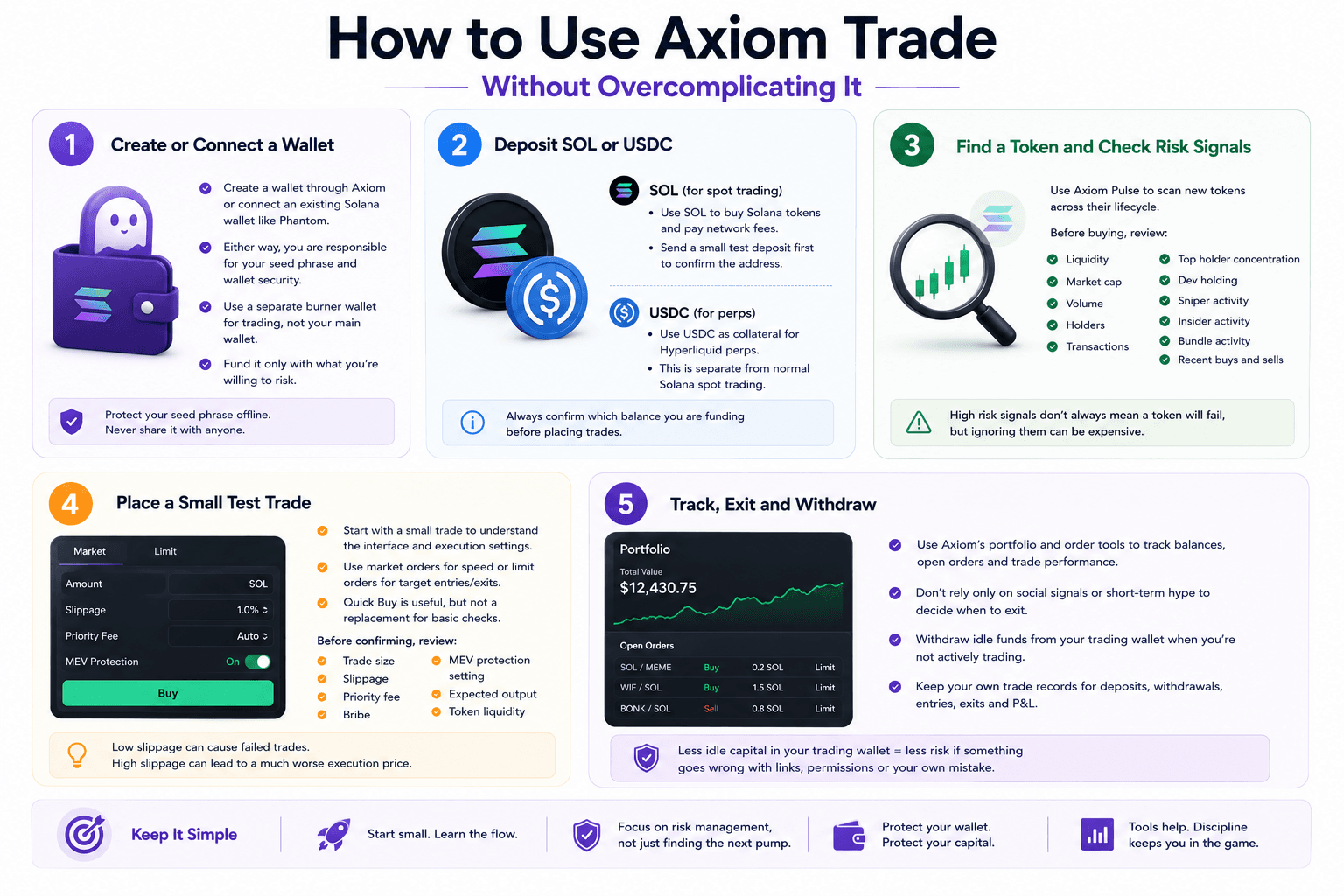 A Flow of Using Axiom Trade
Create or Connect a Wallet
To use Axiom, you can either create a wallet through the platform or connect an existing Solana wallet such as Phantom.
Creating a wallet through Axiom can make onboarding faster, but you still need to protect your seed phrase and wallet access. Connecting an existing wallet may feel easier if you already use Phantom, but it is better to avoid connecting a main wallet that holds long-term funds.
For most memecoin traders, a separate burner wallet is the safer option. Use it only for trading, fund it with what you are willing to risk and keep long-term holdings elsewhere.
Deposit SOL or USDC
For Solana spot trading, users generally need SOL. SOL is used to buy Solana tokens and pay network costs. Before depositing a larger amount, send a small test transaction to confirm the address and funding flow.
For perps through Hyperliquid, users generally need USDC as collateral. This is separate from normal Solana memecoin spot trading, so users should understand which account or balance they are funding before placing trades.
Find a Token and Check Risk Signals
Axiom Pulse is the main place to scan for new Solana tokens. Users can look at new launches, tokens close to migration and tokens that have recently migrated to Raydium.
Before buying, check the basics:
- Liquidity
- Market cap
- Volume
- Holders
- Transactions
- Top holder concentration
- Dev holding
- Sniper activity
- Insider activity
- Bundle activity
- Recent buys and sells
Place a Small Test Trade
Start with a small trade before using real size. This helps you understand the interface, order flow and execution settings without exposing too much capital.
Axiom supports market orders for immediate execution and limit orders for target-price entries or exits. Quick Buy can be useful when speed is important, but it should not replace basic checks.
Before confirming a trade, review:
- Trade size
- Slippage
- Priority fee
- Bribe
- MEV protection setting
- Expected output
- Token liquidity
Low slippage can cause failed trades. High slippage can lead to a much worse execution price. The right setting depends on liquidity, volatility and how quickly the token is moving.
Track, Exit and Withdraw
After entering a position, use Axiom’s portfolio and order tools to track balances, open orders and trade performance. Do not rely only on social signals or short-term hype to decide when to exit.
If you are not actively trading, consider withdrawing idle funds from your Axiom trading wallet. This reduces exposure if you click a fake link, connect to the wrong site or make a wallet-security mistake later.
Users should also keep their own trade records. Axiom can help with trading activity, but tracking deposits, withdrawals, entries, exits and P&L is still useful for personal accounting and tax reporting where applicable.
Common Axiom Trade Problems and Fixes
Axiom is built for fast trading, but fast markets can also create failed transactions, missed orders and worse-than-expected fills. Most issues come down to Solana congestion, liquidity changes, trade settings or wallet funding.
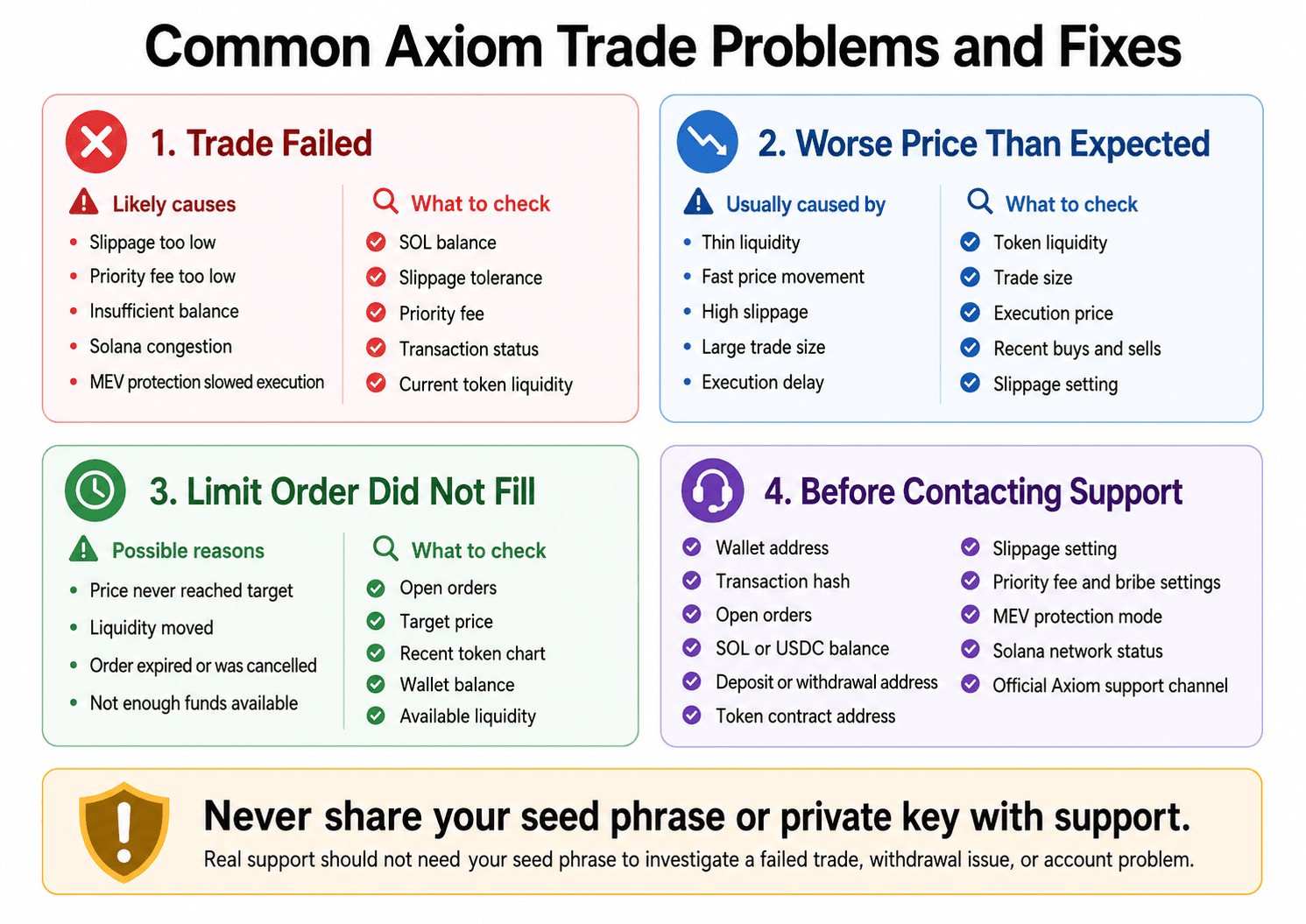 Here's How You Can Fix Common Axiom Trade Problems
| Problem | Likely Cause | What to Check |
|---|---|---|
| Trade failed | Slippage too low, low priority fee, insufficient balance or network congestion | Wallet balance, slippage tolerance, priority fee, transaction status |
| Worse price than expected | Thin liquidity, fast price movement or high slippage | Token liquidity, trade size, execution price, recent buys and sells |
| Limit order did not fill | Price never reached, liquidity moved or order was cancelled | Open orders, target price, token chart, wallet funding |
| Withdrawal issue | Wrong address, pending transaction or network delay | Withdrawal address, transaction hash, wallet balance, official support channel |
Why Did My Axiom Trade Fail?
An Axiom trade can fail for several reasons. The most common are Solana network congestion, low priority fees, insufficient wallet balance, changing token liquidity, slippage set too low or MEV protection slowing execution.
In fast memecoin markets, the token price and available liquidity can change before your transaction confirms. If your slippage tolerance is too low, the trade may fail because the final execution price falls outside your allowed range. If your priority fee is too low during a crowded launch, your transaction may also confirm too slowly or fail.
Before retrying, check your SOL balance, slippage setting, priority fee, MEV protection mode and the token's current liquidity.
Why Did I Get a Worse Price Than Expected?
A worse-than-expected execution price is usually caused by slippage. Slippage happens when the final trade price is different from the quoted price you saw before confirming.
This is common with thinly traded memecoins. If liquidity is low, even a modest buy or sell can move the price. Large trade sizes can make this worse because they consume more of the available liquidity. Fast-moving tokens can also change price while your transaction is waiting to confirm.
MEV protection and execution delays can also affect timing. More protection may reduce some MEV risk, but it can also slow execution. Faster settings may improve speed, but they can expose the trade to worse ordering or front-running risk.
Why Did My Limit Order Not Fill?
A limit order only fills if the market reaches your selected price and there is enough liquidity available to execute the trade.
If your Axiom limit order did not fill, the most likely reason is that the token never reached your target price. It is also possible that liquidity moved, the order expired, the order was cancelled or the wallet/account did not have enough funds available when the order could have executed.
Check your open orders, wallet balance, target price and the token’s recent chart. For thin memecoins, price candles can move quickly without enough liquidity for every order to fill cleanly.
What Should I Check Before Contacting Support?
Before contacting Axiom support, gather the details that can help identify the issue.
Check:
- Wallet address
- Transaction hash
- Open orders
- SOL or USDC balance
- Deposit address or withdrawal address
- Token contract address
- Slippage setting
- Priority fee and bribe settings
- MEV protection mode
- Solana network status
- Whether you used the official Axiom support channel
Never share your seed phrase, private key or full wallet access with anyone claiming to be support. Real support should not need your seed phrase to investigate a failed transaction, withdrawal issue or account question.

Final Verdict: Should You Use Axiom Trade in 2026?
Yes. Axiom Trade is worth considering if you actively trade Solana memecoins. Its strongest edge is the way it combines discovery and execution. You can find new tokens, check risk signals, monitor wallets, adjust trade settings and place orders without constantly moving between different apps.
For active Solana memecoin traders, Axiom is one of the stronger trading terminals available. For beginners or risk-averse investors, it is probably not the right starting point.
| Best For | Avoid If | Better Alternative |
|---|---|---|
| Active Solana memecoin traders | You want simple swaps | Jupiter |
| Users who want Pulse, wallet tracking and fast execution | You only trade major spot assets | A standard wallet or centralized exchange |
| Traders who understand slippage, MEV and liquidity | You are new to wallet security | Beginner-friendly wallets or exchanges |
| Users who want spot memecoin tools plus perps access | You only want perps | Direct Hyperliquid |
| Traders comparing advanced memecoin terminals | You already prefer another execution flow | Photon or BullX |