Kraken offers lower entry-level trading fees, deeper liquidity, a much larger crypto selection and broader international access, while Gemini stands out for its simpler experience, wider U.S. state coverage and products such as Gemini Predictions and the Gemini Credit Card.
This Gemini vs Kraken comparison looks at fees, trading tools, crypto selection, staking, security, availability, funding and other key features to determine which exchange is the better choice in 2026.
Editor's Note (Sept. 3, 2026): We fully updated this Gemini vs Kraken comparison in September 2026 to reflect the latest trading fees, supported cryptocurrencies, staking options, margin and derivatives products, geographic availability, funding and withdrawal rules, security features, proof-of-reserves disclosures, liquidity data and newly launched products. We also re-evaluated which exchange is better for beginners, active traders, U.S. users and international customers.
Quick Verdict: Gemini or Kraken?
Kraken is the better exchange for most users, while Gemini makes more sense for beginners, New York and Maine residents, and users drawn to its prediction markets or credit-card ecosystem.
Kraken wins overall with lower entry-level professional trading fees, deeper liquidity, more than 600 listed tokens, broader staking and derivatives markets, stronger international availability and customer-verifiable proof of reserves. Gemini has a smaller and simpler platform, serves U.S. states Kraken does not, and offers distinctive products including Gemini Predictions and the Gemini Credit Card.
Who Should Choose Which?
Choose Kraken if you want:
- The stronger all-round exchange for most users
- Lower entry-level Kraken Pro spot trading fees
- Deeper liquidity across major markets such as BTC, ETH and SOL
- A much larger crypto selection and broader staking offering
- More advanced margin, derivatives and professional trading tools
- Broader international availability, including the UK, EEA and Australia
- Public proof of reserves with customer balance verification
Choose Gemini if you want:
- A smaller and slightly simpler exchange experience for beginners
- Exchange access in New York or Maine, where Kraken is unavailable
- Gemini Predictions for event-contract trading
- The Gemini Credit Card and its crypto-rewards ecosystem
- Gemini's specific U.S. product mix rather than Kraken's broader global platform
Gemini vs Kraken Winner by Category
| Category | Winner | Why |
|---|---|---|
| Overall | Kraken | Kraken combines lower entry-level pro fees, deeper liquidity, more crypto assets, broader advanced trading, stronger international access and public reserve verification. |
| Beginner experience | Gemini | Gemini's smaller product universe creates a slightly simpler experience for users mainly interested in buying, holding and managing a basic portfolio. |
| Active trading | Kraken | Kraken Pro offers more advanced order controls, deeper markets, TradingView execution, professional mobile tools and a dedicated desktop application. |
| Entry pro spot fees | Kraken | Kraken Pro starts at 0.40% maker and 0.80% taker, compared with 0.60% maker and 1.20% taker on Gemini ActiveTrader. |
| Crypto selection | Kraken | Kraken lists more than 600 tokens, while Gemini's Trust Center lists 99 supported cryptocurrencies as of Sept. 3, 2026. |
| Liquidity | Kraken | Our Sept. 3, 2026 snapshot showed substantially greater trading volume and order-book depth on Kraken across BTC/USD, ETH/USD and SOL/USD. |
| Staking | Kraken | Kraken supports a much broader range of staking assets and offers both flexible and bonded staking arrangements for eligible customers. |
| Margin trading | Kraken | Kraken supports margin across more eligible markets and can offer higher leverage on selected pairs, while Gemini margin is limited to qualifying U.S. ECPs outside New York. |
| Derivatives | Kraken | Kraken has the broader derivatives ecosystem, including perpetual and fixed-term futures internationally and regulated perpetual contracts for eligible U.S. users. |
| Stocks | Kraken | Kraken advertises more than 11,000 stocks and ETFs for eligible U.S. users, compared with Gemini's thousands of supported stocks and ETFs. |
| Prediction markets | Gemini | Gemini Predictions lets eligible users trade Yes or No event contracts. Kraken does not currently offer a comparable funded consumer prediction-market product. |
| U.S. availability | Gemini | Both exchanges broadly serve U.S. customers, but Gemini is available in New York and Maine, while Kraken currently does not serve residents of either state. |
| International availability | Kraken | Kraken operates across a much larger international footprint, including all 30 EEA countries under MiCA and regulated operations in the UK and Australia. |
| Self-custody withdrawals | Depends | Kraken supports more assets and networks, but funding holds differ. The better option depends on the deposit rail, withdrawal timing, asset, network and current withdrawal fee. |
| Security and transparency | Kraken | Both offer strong account-security controls, but Kraken adds public proof of reserves with published reserve ratios and customer verification of covered balances. |
| Customer support | Kraken | Kraken provides a broader set of live support routes, while Gemini relies primarily on its support form and email for general customer assistance. |
Availability, fees and product eligibility were checked against information available as of Sept. 3, 2026. Exchange access does not guarantee access to every product, and trading fees, staking terms, funding holds, withdrawal charges and regional restrictions can change.
Disclosure
Some links in this guide may be affiliate links. If you choose to use a service through these links, we may earn a commission at no additional cost to you.
Disclaimer
This guide is educational only and is not financial advice. The comparison is based on public fee schedules, exchange documentation, product availability, liquidity data, security information, regulatory disclosures and proof-of-reserves information available at the time of writing.
Gemini vs Kraken at a Glance
| Feature | Gemini | Kraken |
|---|---|---|
| Founded | 2014 | 2011 |
| Best for | Beginners and specific U.S. users | Most users and active traders |
| U.S. availability | Broad, including New York and Maine | Broad, except New York and Maine |
| International availability | Limited after 2026 exits | Broad, including UK, EEA and Australia |
| Spot trading | Yes | Yes |
| Advanced trading | Gemini ActiveTrader | Kraken Pro |
| Entry pro spot fee | 0.60% maker / 1.20% taker | 0.40% maker / 0.80% taker |
| Crypto selection | 99 supported cryptocurrencies | 600+ tokens |
| Trading pairs | 655 | Broad market selection |
| Margin trading | Up to 5x for qualifying U.S. ECPs | Broader market selection, leverage varies |
| Derivatives | Yes, region-dependent | Broader U.S. and international offering |
| Liquidity | Lower on major pairs checked | Deeper on BTC/USD, ETH/USD and SOL/USD |
| Staking | ETH, SOL and MON | Broader staking selection |
| Stocks and ETFs | Thousands for eligible U.S. users | 11,000+ advertised |
| Tokenized stocks | No comparable range | xStocks in eligible regions |
| Prediction markets | Gemini Predictions | No comparable funded consumer market |
| Crypto rewards card | Gemini Credit Card | No direct equivalent |
| ACH deposit fee | Free for U.S. users | Free via Plaid for U.S. users |
| ACH withdrawal hold | Typically 4-5 business days to clear | 7 days on Plaid ACH deposits |
| Crypto withdrawals | Dynamic asset/network fees | Asset/network-specific fees |
| Proof of reserves | Full-reserve disclosures, no comparable customer-verification tool | Public proof of reserves with customer verification |
| Security | 2FA, passkeys, WebAuthn security keys, withdrawal protection | 2FA, passkeys, security keys, Global Settings Lock |
| Mobile trading | Standard app plus advanced trading functionality | Kraken app and dedicated Kraken Pro app |
| Desktop trading | ActiveTrader web interface | Kraken Pro web plus desktop app |
| Customer support | Primarily support form and email | Broader live support options |
| Best overall for | Beginners, NY/ME residents and Gemini-specific products | Most users, active traders and international users |
Fee, product and eligibility details were checked on Sept. 3, 2026. Live availability, fees and supported assets can still change by jurisdiction.
How This Gemini vs Kraken Comparison Was Built (Methodology)
This comparison checks the main areas users should review before choosing between Gemini and Kraken:
- Trading fees
- Spot and advanced trading
- Liquidity and market depth
- Crypto selection
- Margin and derivatives
- Staking
- Stocks and other investment products
- Deposits and withdrawal holds
- Self-custody withdrawals
- Proof of reserves
- Account security
- Known security incidents
- Customer support
- U.S. availability
- International availability
- Beginner fit
For fees, we used official Gemini ActiveTrader and Kraken Pro fee schedules, along with each exchange's current funding, withdrawal and consumer-purchase documentation. Fee schedules, spreads and payment charges can change, so the figures in this comparison should be treated as a Sept. 3, 2026 snapshot.
For liquidity, we compared BTC/USD, ETH/USD and SOL/USD using the same market-data snapshot for both exchanges. We looked at 24-hour trading volume, quoted spreads and order-book depth to avoid judging liquidity from headline volume alone.
For security and reserves, we reviewed Gemini's Trust Center, security documentation and full-reserve disclosures, along with Kraken's security documentation and proof-of-reserves reports. We also considered publicly disclosed security incidents and whether customers can independently verify covered reserve balances.
For product comparisons, we checked official exchange documentation for spot trading, margin, derivatives, staking, stocks, prediction markets, mobile and desktop trading, APIs, funding methods and crypto withdrawals.
For availability, we checked current exchange and product restrictions by jurisdiction.
Gemini vs Kraken Availability: Which Can You Use Where You Live?
Gemini and Kraken have substantially different geographic footprints. Gemini remains broadly accessible in the United States, while its international footprint contracted during 2026. Kraken has moved in the opposite direction, particularly across Europe.
Gemini vs Kraken in the United States
Both exchanges serve U.S. customers broadly, but Kraken currently does not offer services to residents of New York or Maine. Gemini operates in both states.
Exchange availability does not guarantee access to every product.
Gemini, for example, expanded staking to eligible New York customers in February 2026, while its margin product has a much narrower eligibility test. Gemini margin is currently limited to U.S. users outside New York who qualify as eligible contract participants, with leverage of up to 5x. Gemini Stocks is available to eligible U.S. residents except Texas and Guam. Kraken similarly applies separate eligibility rules to stocks, staking, margin and derivatives.
International Availability
Kraken is the much stronger international option in 2026.
Gemini closed all customer accounts in the United Kingdom, European Economic Area and Australia effective April 6, 2026.
Kraken has a much larger footprint. Its MiCA authorization covers all 30 EEA countries, while it also operates regulated businesses in markets including the UK and Australia.
| Region | Gemini | Kraken | Key restriction |
|---|---|---|---|
| Most U.S. states | Yes | Yes | Product eligibility still varies |
| New York | Yes | No | Kraken does not serve NY residents |
| Maine | Yes | No | Kraken does not serve ME residents |
| UK | No | Yes | Kraken product restrictions apply |
| EEA | No | Yes | Kraken operates under MiCA; individual products vary |
| Australia | No | Yes | Kraken product access varies by customer type |
The useful check before account creation is therefore two-stage: can you use the exchange, and can you use the particular product you are joining for?
Gemini vs Kraken Fees: Which Is Cheaper?
Kraken is currently cheaper for most entry-level advanced spot traders.
Anyone comparing exchange fees should first separate professional spot trading from simple-buy interfaces. Mixing the two produces fee comparisons that look precise while measuring different transactions.
Gemini ActiveTrader vs Kraken Pro Trading Fees
Gemini ActiveTrader starts at 0.60% maker and 1.20% taker as of Sept. 3, 2026, while Kraken Pro starts at 0.40% maker and 0.80% taker. At the entry tier, Kraken charges one-third less on both sides of the book.
The gap narrows as qualifying activity rises.
| 30-day qualifying activity | Gemini ActiveTrader | Kraken Pro | Lower maker fee | Lower taker fee |
|---|---|---|---|---|
| Entry tier | 0.60% / 1.20% | 0.40% / 0.80% | Kraken | Kraken |
| $10,000 | 0.40% / 0.80% | 0.22% / 0.38% | Kraken | Kraken |
| $100,000 | 0.125% / 0.25%* | 0.12% / 0.25% | Kraken, narrowly | Tie |
| $1 million | 0.05% / 0.10% | 0.06% / 0.18% | Gemini | Gemini |
*Gemini's relevant tier begins at $75,000, so $100,000 of qualifying activity remains in its 0.125% maker / 0.25% taker bracket.
Gemini determines the applicable tier using either trailing 30-day trading volume or the customer's total asset balance, whichever produces the lower fee. Kraken's July 9, 2026, fee overhaul introduced cross-platform tiering that can also factor qualifying assets held on the platform, with the precise qualifying measures depending on account and region.
Kraken is clearly cheaper for low- and mid-volume professional traders. Around $100,000, the difference becomes very small. At $1 million of qualifying spot activity, Gemini's current schedule undercuts Kraken on both maker and taker orders.
Most retail traders will never reach that point, which is why Kraken still wins the fee category overall.
Instant Buy and Recurring Purchase Costs
Gemini calculates the fee for its standard purchase interface when the order is quoted. The amount can vary with the payment method, order size, asset, jurisdiction and market conditions. Instant and recurring orders also include a spread between the market price and the price shown to the customer.
Kraken is more explicit about its standard transaction charge. Its consumer interface currently charges 1% on instant and recurring trades and 1.5% on custom orders, before considering any payment-processing cost. A spread is also incorporated into the quoted price.
Kraken+ changes one part of that calculation. The subscription currently costs $4.99 per month or $49.99 per year and waives the standard consumer trading fee on up to $10,000 of qualifying monthly volume.
Zero trading fees do not equal zero total cost. Kraken+ can remove the transaction charge, while the spread and any payment-processing fee remain. The waiver also does not apply to Kraken Pro spot, futures, API or OTC transactions.
For a recurring buyer, the relevant number is therefore the final execution quote rather than the largest fee advertised on the page.
Deposit and Withdrawal Fees
For U.S. Gemini customers, ACH deposits and withdrawals are free. Domestic wire deposits are also free from Gemini's side, although the sending bank may charge. USD wire withdrawals cost $25. Debit-card purchases carry a 3.49% charge and PayPal deposits cost 2.50%.
Kraken currently lists U.S. ACH deposits through Plaid as free and near-instant for trading, but the deposited amount carries a seven-day withdrawal hold. FedWire deposits through its listed Dart Bank route are free, while U.S. debit-card funding costs $0.25 plus 3.75%.
On the way out, Kraken currently lists free U.S. ACH withdrawals with a 0-2 business-day estimate, $4 FedWire withdrawals and an RTP option charging 1.50%, capped at $50. These fiat withdrawal charges and processing windows can change as banking partners or account eligibility change.
Crypto withdrawals are harder to compress into a single platform-wide number. Gemini uses dynamic withdrawal fees based on the asset and network. Kraken also applies asset- and network-specific minimums and withdrawal charges. Both show the relevant amount before confirmation.
For someone who frequently buys crypto and moves it into self-custody, the exact asset, blockchain and funding rail can matter as much as the trading fee.
What Does a $100, $1,000 and $10,000 Trade Cost?
The table below assumes a standard spot order at each exchange's entry professional tier. It excludes deposit fees, withdrawal fees, card charges and blockchain costs, and assumes the user has no qualifying activity or asset balance that moves them into a cheaper tier.
| Scenario | Gemini ActiveTrader | Kraken Pro | Cheaper |
|---|---|---|---|
| $100 taker order | $1.20 | $0.80 | Kraken |
| $1,000 taker order | $12.00 | $8.00 | Kraken |
| $10,000 taker order | $120.00 | $80.00 | Kraken |
| $1,000 maker order | $6.00 | $4.00 | Kraken |
These are trading-fee examples rather than estimates of the entire transaction journey. Adding a card purchase, fiat transfer or later blockchain withdrawal would introduce separate costs.
For an occasional $100 trade, the dollar difference is small. For a strategy repeatedly crossing the order book, the same fee gap compounds quickly.
Gemini ActiveTrader vs Kraken Pro: Which Is Better for Trading?
Kraken Pro is the stronger trading platform for most active traders. Gemini ActiveTrader covers the core order-book functions an experienced spot trader needs, but Kraken combines more advanced order management with deeper liquidity, broader margin markets and a much larger derivatives stack.
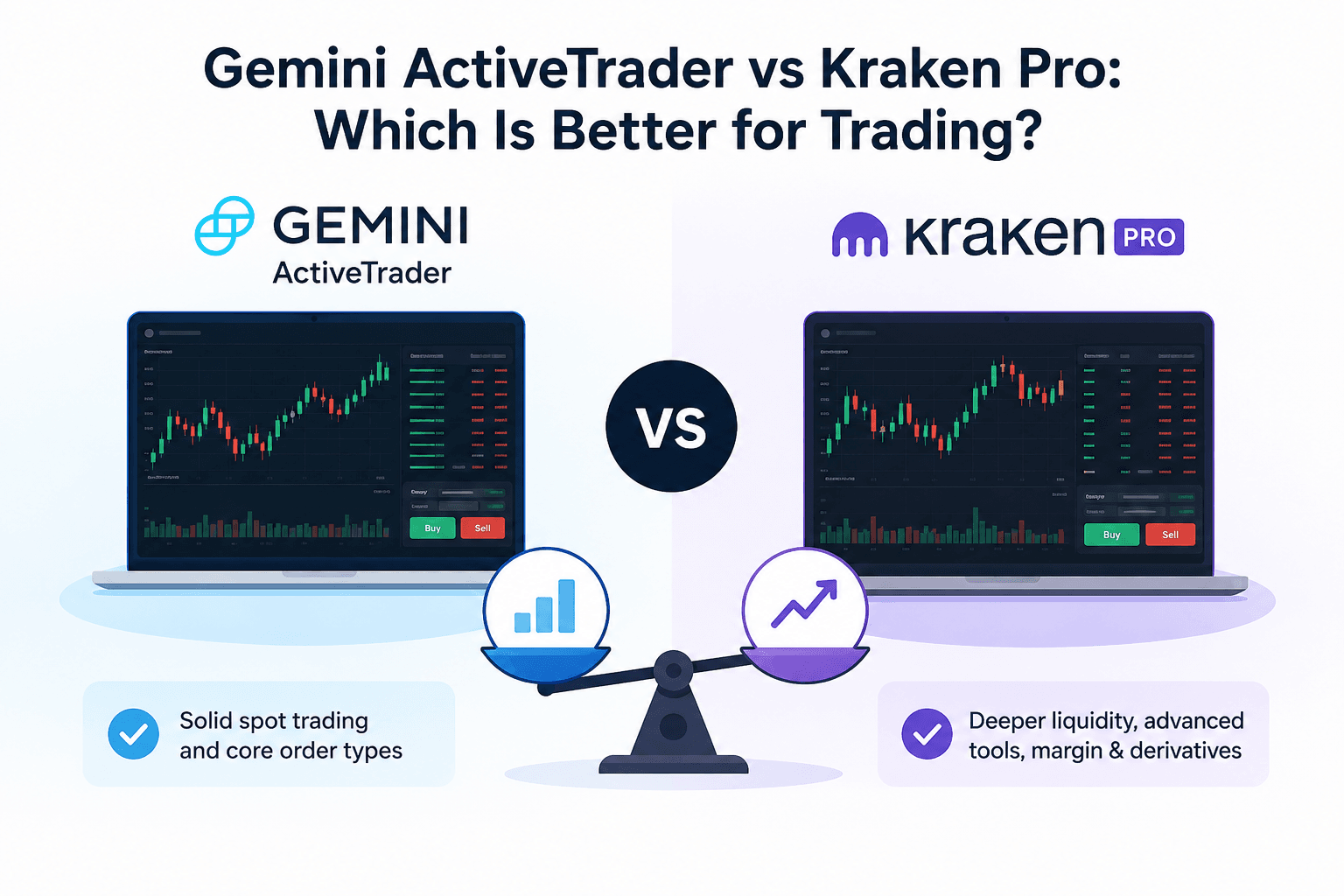 Kraken Pro Offers Deeper Liquidity And Trading Tools
Trading Interface and Order Types
Gemini ActiveTrader offers advanced charting, deeper order-book visibility and a wider set of order controls than Gemini's basic interface. Its supported order configurations include market, limit, stop-limit, immediate-or-cancel, fill-or-kill and maker-or-cancel orders, along with more specialized auction and block-trading workflows.
Kraken Pro goes further. The platform supports market and limit orders alongside stop-loss, take-profit, trailing-stop, post-only, iceberg and other advanced configurations. Kraken also supports OCO-style risk management and has added TWAP bot orders for splitting a larger position into smaller executions over a specified period.
The charting layer is similarly trader-focused. Kraken Pro provides multi-timeframe charts, drawing tools and more than 100 indicators, while its TradingView integration lets eligible users execute supported Kraken orders directly from TradingView.
ActiveTrader remains Gemini's full professional web interface, while Gemini also provides advanced trading tools on mobile. Kraken has the dedicated Kraken Pro mobile app and a separate desktop application, so an active trader can keep a similar workflow across more device types.
Both give users ways to save or monitor preferred markets rather than repeatedly searching for pairs. Kraken's overall market-navigation workflow becomes more useful as the number of available markets grows; Gemini's smaller market universe keeps the interface simpler.
Liquidity, Spreads and Execution
We checked BTC/USD, ETH/USD and SOL/USD on Sept. 3, 2026, using the same CoinGecko market snapshot for both exchanges. The quoted spread was roughly 0.01% on all three pairs at the time, but the volume and order-book depth behind those quotes differed substantially.
| Pair | Gemini 24h volume | Kraken 24h volume | Gemini +2% / -2% depth | Kraken +2% / -2% depth |
|---|---|---|---|---|
| BTC/USD | ~$3.52M | ~$46.53M | ~$2.05M / $3.33M | ~$25.72M / $31.70M |
| ETH/USD | ~$1.24M | ~$14.96M | ~$1.15M / $1.43M | ~$12.53M / $13.16M |
| SOL/USD | ~$3.15M | ~$17.86M | ~$0.40M / $0.70M | ~$4.15M / $5.62M |
The difference appears across Bitcoin, Ethereum and the Solana market rather than being driven by one unusual pair.
Margin, Derivatives and API Trading
Kraken also wins once leveraged trading enters the decision, although Gemini has become far more competitive than it was previously.
Gemini introduced margin trading with leverage of up to 5x in January 2026 and added short selling in April. Current access is considerably narrower than ordinary Gemini spot access: the product is restricted to qualifying U.S. customers outside New York who meet eligible contract participant requirements.
A regular U.S. Gemini account does not automatically qualify for margin merely because the feature appears in the platform's broader product catalog.
For readers still learning the mechanics, margin trading uses borrowed capital to increase exposure. Higher available leverage can reduce the capital required to open a position, but it also pushes liquidation closer.
Kraken supports margin across a wider selection of eligible markets. Leverage depends on the pair and jurisdiction, and Kraken expanded selected markets further in 2026, including BTC/USD with leverage reaching 20x for eligible users in certain regions.
The derivatives gap is wider. Kraken offers fixed-term and perpetual futures across its international ecosystem and launched CFTC-regulated perpetual contracts for eligible U.S. users. Gemini also offers derivatives in eligible jurisdictions, but the breadth and geographic structure are narrower.
API users are well served by both. Gemini provides programmatic trading and market-data APIs, while Kraken offers REST and WebSocket APIs alongside FIX connectivity for appropriate workflows. Combined with its broader order set and deeper markets, Kraken is the stronger fit for systematic trading.
For users choosing an exchange specifically for leverage rather than spot trading, our crypto derivatives exchanges guide compares the wider market before either Gemini or Kraken becomes the default.
Gemini vs Kraken Crypto, Staking and Other Products
Kraken offers the broader product universe, but Gemini has become more differentiated in 2026. Kraken wins on crypto breadth, staking selection and advanced markets. Gemini has built a more unusual U.S. combination of crypto, conventional equities, prediction markets and card rewards.
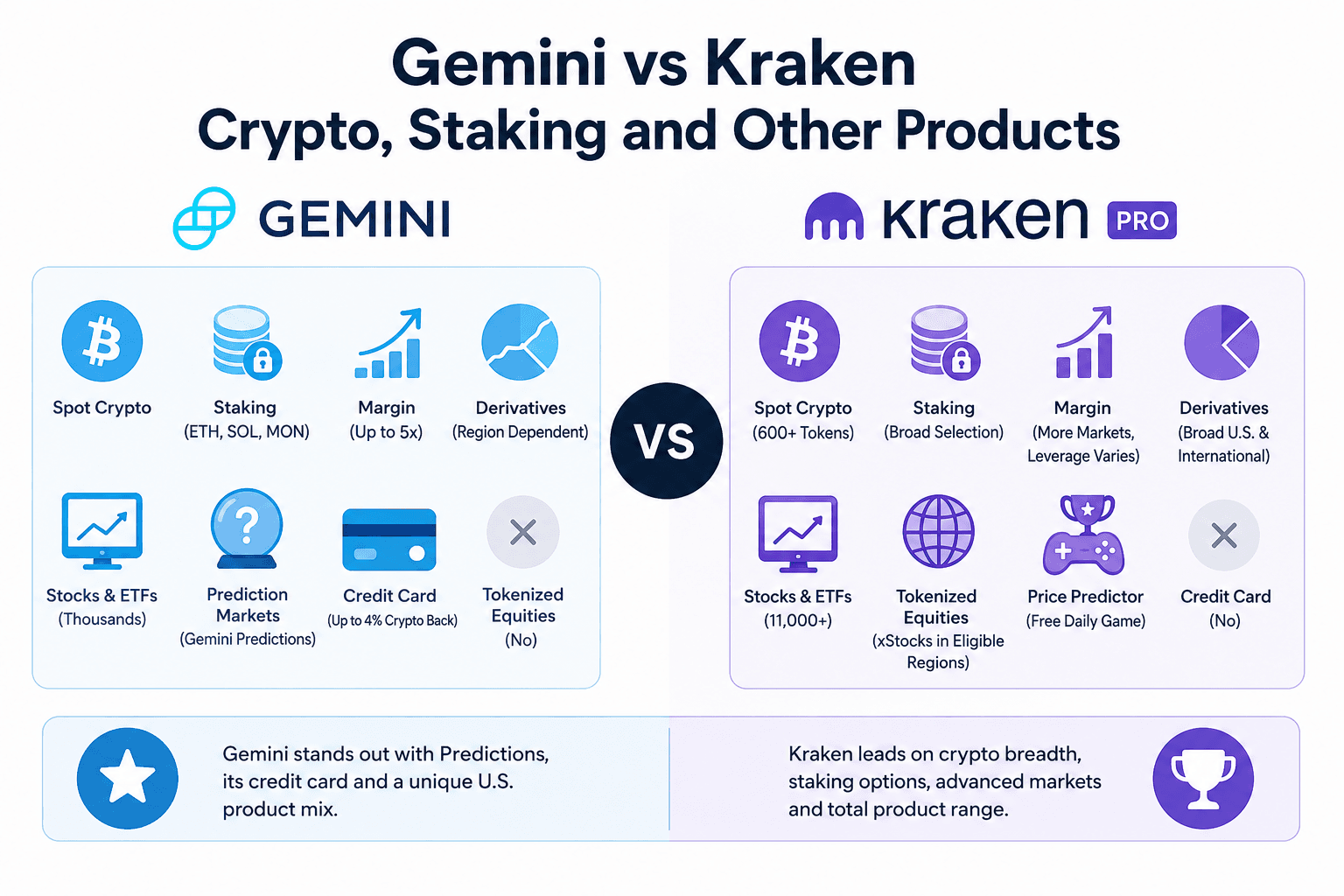 Kraken Leads Breadth While Gemini Adds Distinct Products
Cryptocurrencies and Trading Pairs
Kraken wins comfortably on crypto selection.
Gemini's Trust Center lists 99 supported cryptocurrencies, eight fiat currencies and 655 trading pairs, as of Sept. 3, 2026. Kraken currently lists more than 600 tokens.
For mainstream BTC, ETH, SOL and XRP portfolios, both exchanges cover the core markets. Kraken's selection becomes more valuable as the portfolio moves further down the market-cap curve.
Staking
Kraken is also the stronger staking platform for users eligible for both services.
Gemini currently supports staking around ETH, SOL and MON. Its staking agreement applies a 35% service fee to protocol rewards as of Sept. 3, 2026, while availability depends on jurisdiction.
Unstaking is not instantaneous for every asset. Gemini currently estimates SOL unstaking at roughly three to four days and MON at up to four days, while ETH timing is variable and can range from several days to considerably longer depending on the Ethereum exit queue. That delay comes from the underlying network process rather than an arbitrary instant-withdrawal promise from the exchange.
Kraken supports a much larger set of staking assets and divides its offering into flexible and bonded arrangements. Flexible staking is designed for faster access to funds, while bonded staking can subject assets to the protocol's unbonding period.
Its current commission structure also varies by product and balance. As of Sept. 3, 2026, Kraken applies a 30% commission to flexible staking and Auto Earn, while bonded staking currently starts at a 25% commission below $1 million of relevant assets and falls at higher balance tiers.
Stocks, Derivatives and Other Investment Products
The two companies are increasingly competing for a larger share of the user's financial activity rather than only crypto trades.
Gemini launched commission-free stock trading in 2026 and now offers eligible U.S. users thousands of exchange-listed stocks and ETFs through the same broader platform. Availability currently excludes Texas and Guam.
Gemini Predictions adds something Kraken does not currently match with a funded consumer event-contract market. Eligible users can buy Yes or No contracts around defined outcomes, with a correct contract settling at just $1. Users can also sell an open position before resolution where a market remains available.
| Product | Gemini | Kraken |
|---|---|---|
| Spot crypto | Yes | Yes |
| Staking | Yes | Yes, broader selection |
| Margin | Up to 5x for qualifying ECPs | Broader market selection; leverage varies |
| Derivatives | Yes, region dependent | Broader U.S. and international offering |
| Stocks/ETFs | Thousands for eligible U.S. users | 11,000+ advertised |
| Tokenized equities | No comparable xStocks range | xStocks in eligible regions |
| Prediction markets | Gemini Predictions | No comparable funded event-contract market |
| Credit card | Gemini Credit Card | No direct crypto-rewards credit-card equivalent |
Kraken has gone much broader on conventional securities. Kraken Stocks currently advertises more than 11,000 stocks and ETFs for eligible U.S. users. Internationally, its xStocks offering adds tokenized representations of equities in supported regions.
xStocks should not be confused with ordinary U.S. brokerage shares. They are tokenized products with their own eligibility and legal structure. Kraken currently excludes xStocks from the United States, Australia, Canada and the UK, while selected xStocks can be traded with margin in eligible jurisdictions.
Gemini's credit card remains another genuine ecosystem difference. The Gemini Credit Card has no annual fee and currently offers up to 4% crypto back in selected spending categories, subject to category limits and terms.
Kraken therefore wins on total product breadth. Gemini's case is more specific: predictions, its credit-card ecosystem or a preference for having Gemini's particular U.S. products inside one account.
Gemini vs Kraken Deposits and Withdrawals
Being able to trade deposited money does not always mean the same money can immediately leave the exchange as crypto. Funding settlement and withdrawal eligibility are separate stages, and that distinction is especially visible with ACH, cards and digital wallets.
The practical journey is:
Fiat deposit → funds available to trade → withdrawal hold expires → crypto withdrawal → self-custody
Deposit Methods and Funding Holds
For U.S. users, both exchanges support familiar bank rails.
Gemini ACH deposits can be made available for trading before settlement, but they normally take four to five business days to clear for withdrawal. Domestic wires usually avoid that same ACH clearing structure once the funds have been credited.
Kraken's U.S. ACH route through Plaid is typically near-instant for trading but applies a seven-day withdrawal hold to the deposited amount. Certain PayPal, debit-card, credit-card and digital-wallet transactions can instead trigger a 72-hour hold.
Withdrawing Crypto
Crypto withdrawals require a little more than entering an amount.
The user first needs to select a supported blockchain network, satisfy the exchange's minimum withdrawal amount and pay the fee displayed for that asset/network combination. Those minimums and fees can change, so a single platform-wide figure would be misleading.
Address security differs in implementation but both exchanges provide controls around new destinations. Gemini's withdrawal protection can restrict transfers to approved addresses and can impose a seven-day waiting period for newly added addresses. Kraken requires new crypto withdrawal addresses to be added and confirmed, while its Global Settings Lock can prevent address changes when enabled.
Those protections are useful precisely because control of the receiving private keys sits outside the exchange. Once a correctly signed blockchain transaction is broadcast and confirmed, the exchange cannot simply reverse it like a card payment.
Which Is Better for Self-Custody Users?
Kraken has the broader asset and network ecosystem and is generally the stronger exchange for users moving a wide range of tokens. Its seven-day ACH hold, however, is a poor match for someone expecting to fund through Plaid and move the resulting crypto into self-custody immediately.
Gemini's ACH route can also keep funds locked for four to five business days while the bank transfer clears. Its smaller crypto selection means Kraken often has more withdrawal-network options once a user moves beyond the major assets.
The better choice depends on four questions:
- Which fiat rail will you use?
- How long does that rail restrict withdrawals?
- Does the exchange support the exact blockchain network you want?
- What withdrawal minimum and fee does it show for that asset today?
A hardware wallet also solves a different problem from choosing an exchange. One determines how the asset is bought; the other determines who controls it afterward.
For readers planning to move meaningful balances off-platform, our hardware wallet comparison covers Ledger, Trezor and other cold-storage options separately.
Gemini vs Kraken Security: Which Is Safer?
Both exchanges have strong account and custody controls, but Kraken currently offers the clearer public reserve-verification mechanism.
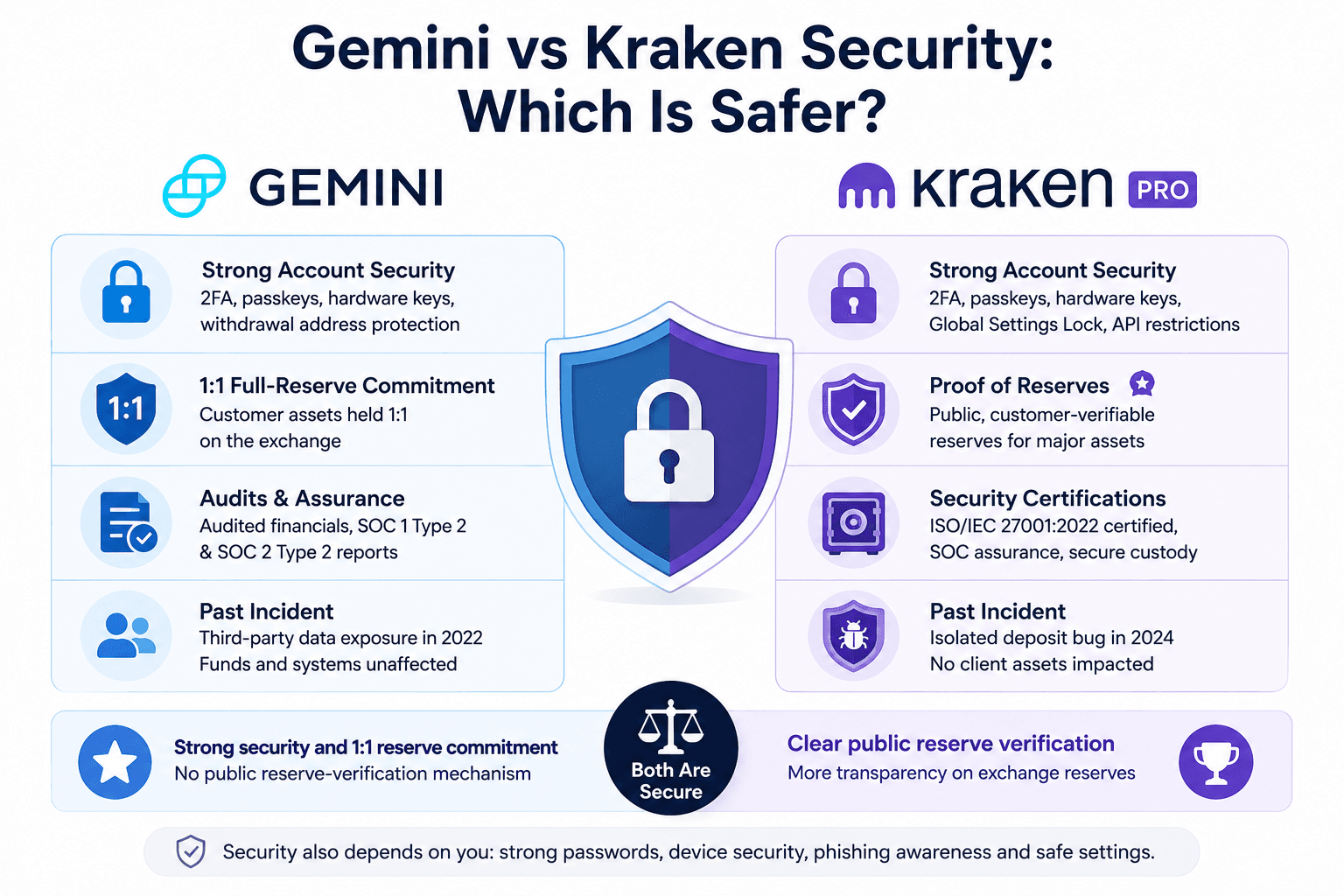 Kraken Leads Reserve Transparency Across Comparable Security Controls
Account and Platform Security
Gemini requires two-factor authentication and supports authenticator apps, passkeys and hardware security keys using WebAuthn. Withdrawal-address protection adds another barrier between a compromised login and an unauthorized transfer.
Gemini also publishes a substantial assurance stack through its Trust Center. The current disclosures include audited financial statements, SOC 1 Type 2 and SOC 2 Type 2 examinations, along with its full-reserve statement that customer assets held on the exchange are maintained 1:1.
Kraken offers two-factor authentication, passkeys and hardware security keys as well. Its Global Settings Lock can prevent sensitive account changes, including the addition of withdrawal addresses, and users can set an unlock delay. API permissions can also be restricted rather than giving every key unrestricted account control.
At the organizational level, Kraken reports ISO/IEC 27001:2022 certification and SOC assurance work. It also describes a custody setup using both cold- and hot-wallet infrastructure with tightly controlled physical and information-security access.
Those features reduce account-takeover and operational risk. They do not make an exchange account equivalent to controlling the keys yourself, nor do they remove market or product risk.
Our guide to crypto security goes further into device security, phishing, wallet approvals and other risks that remain the user's responsibility regardless of exchange.
Custody and Proof of Reserves
Kraken has the stronger public reserve-verification case.
Its latest published proof-of-reserves snapshot is dated June 30, 2026. The exercise reported 102.9% reserves for BTC, 100.5% for ETH and 100.6% for SOL, with additional covered categories including XRP, ADA, USDC, USDT and USDG.
Kraken also lets eligible customers check whether their covered account balances were included in the exercise.
Proof of reserves still has boundaries. It verifies specified assets and liabilities at a particular snapshot under a defined methodology. It does not automatically reveal every corporate liability, off-balance-sheet exposure or future change in solvency.
Gemini takes a different route. Its Trust Center describes the exchange and custodian as operating on a full-reserve basis with customer assets held 1:1, while audited financial statements and SOC examinations provide additional financial and control information. Gemini does not currently offer the same type of public, customer-verifiable reserve mechanism that Kraken does.
On transparency of exchange reserves specifically, Kraken wins.
Security Incidents and Counterparty Risk
In December 2022, Gemini disclosed a third-party vendor incident that exposed some customer email addresses and partial phone numbers. Gemini said its account systems and customer funds were not affected. The practical risk was increased phishing rather than a compromise of exchange wallets.
Kraken disclosed an isolated deposit and funding bug in June 2024. A security research company exploited the flaw to artificially increase account balances before reporting it, but Kraken said no client assets were impacted or vulnerable and that the issue was patched.
Gemini vs Kraken Ease of Use, Mobile Apps and Customer Support
Gemini has a slight edge for a beginner who wants a smaller, simpler exchange experience. Kraken becomes stronger once the user needs advanced mobile trading or more direct support channels.
Which Is Easier for Beginners?
Gemini is easier for beginners by a narrow margin.
The basic workflow is straightforward: create an account, complete identity verification, connect a payment method, choose an asset and buy. A new user does not need to interact with ActiveTrader until order books, limit orders or professional fee tiers become useful.
Kraken's standard app is also accessible, but the overall ecosystem now includes Kraken Pro, stocks, staking, margin, futures and other products. That breadth becomes an advantage later while giving a first-time user more choices to navigate.
Both exchanges require KYC for ordinary regulated account access. Verification can require additional documents or manual review depending on the customer and jurisdiction, so neither exchange has a meaningful universal verification-time guarantee.
Kraken has the cleaner path once the user graduates into advanced trading. The same broader account ecosystem connects naturally with Kraken Pro rather than forcing the trader to build a separate relationship elsewhere.
Mobile Apps
Kraken wins the advanced mobile comparison.
Both companies provide mobile access for routine purchases, portfolio monitoring, deposits and withdrawals. Gemini's standard mobile experience is the simpler of the two for a user mainly buying and holding.
Advanced trading is where the split grows. Gemini provides mobile advanced-trading functionality, while its full ActiveTrader experience remains centered on the professional web workflow. Some Gemini help pages currently distinguish the mobile advanced interface from the complete ActiveTrader web interface.
Kraken Pro is explicitly designed as a professional mobile app. It supports advanced order placement, deposits, withdrawals and controls such as post-only and time-in-force settings. Kraken also has a separate desktop application, giving active traders another dedicated interface beyond the browser.
For basic portfolio management, either app is sufficient. For someone who expects the phone to function as a serious trading terminal, Kraken is ahead.
Customer Support
Kraken offers the broader set of live support routes.
Gemini's general support team is staffed 24/7, but the primary channel is its support form and email. Gemini explicitly tells customers that email is its primary general support channel and warns users about phone impersonation scams. Gemini Credit Card customers have a separate 24/7 phone-support number available from the card settings area.
Kraken provides support through its help center and authenticated chat flow
Gemini vs Kraken: Which Exchange Should You Choose?
Kraken is the better exchange for most users in 2026. Its lower entry-level professional fees, deeper major-market liquidity, broader advanced trading stack, larger crypto universe, stronger international availability and public proof-of-reserves mechanism give it the stronger all-round package.
Gemini still wins when one of its narrower advantages directly matches the user.
| User | Better choice |
|---|---|
| Most users | Kraken |
| Beginners | Gemini, slight edge |
| Active traders | Kraken |
| Low-volume advanced traders | Kraken |
| High-volume traders | Compare the exact tier; Gemini becomes cheaper at some high-volume levels |
| New York residents | Gemini |
| Maine residents | Gemini |
| Self-custody users | Depends on funding rail, asset and network |
| Staking users | Kraken |
| Stocks + crypto investors | Kraken for breadth; Gemini where its specific ecosystem appeals |
| Prediction-market users | Gemini |
| Security/transparency-focused users | Kraken |
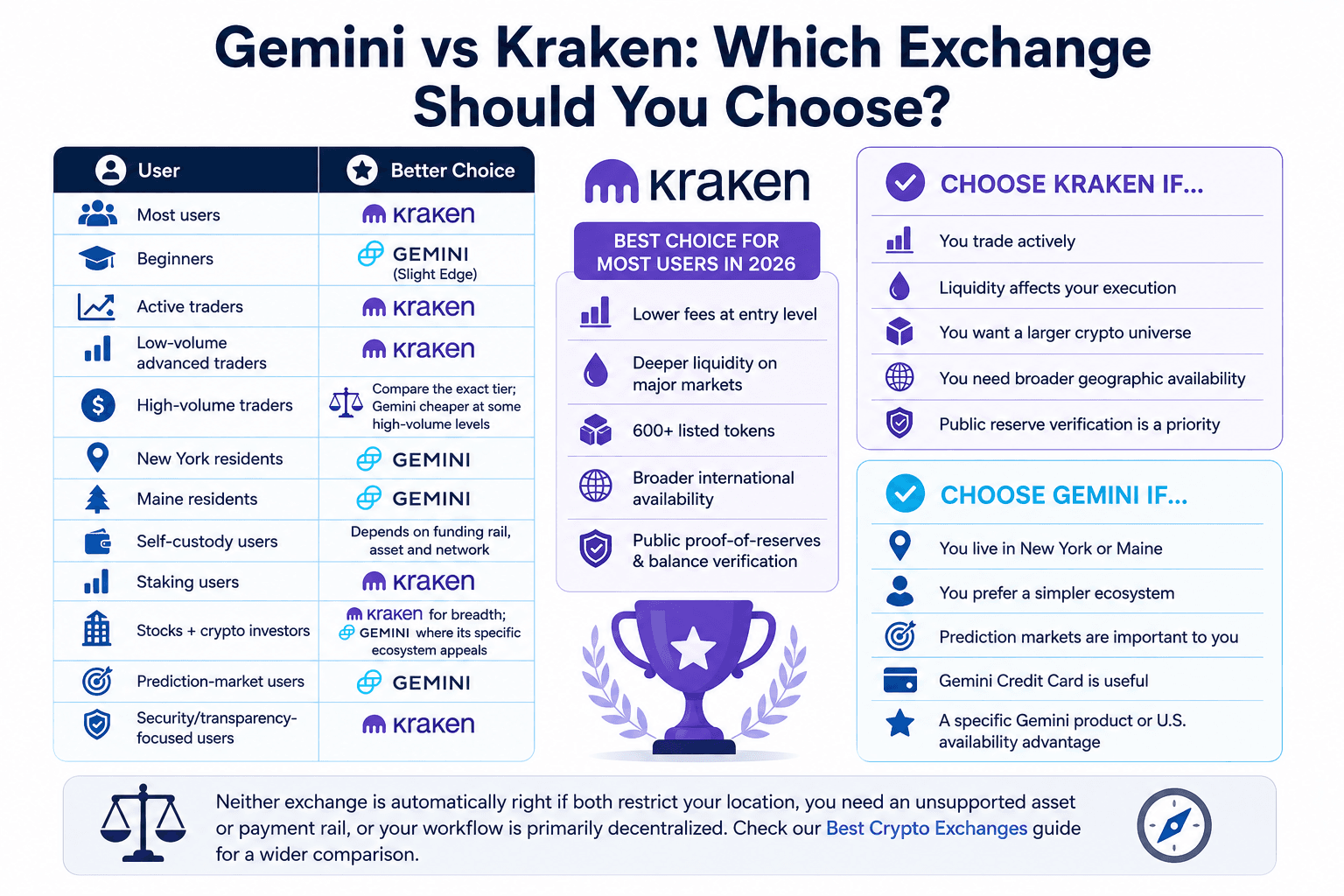 Kraken Wins Overall While Gemini Serves Specific Users
Choose Kraken If...
- You trade actively. Kraken Pro starts with lower maker and taker fees and provides more sophisticated order management.
- Liquidity affects your execution. Our BTC/USD, ETH/USD and SOL/USD snapshot showed much deeper order books on Kraken.
- You want a larger crypto universe. Kraken's 600+ listed tokens far exceed Gemini's current selection.
- You need broader geographic availability. Kraken still operates across markets Gemini exited during 2026.
- Public reserve verification is a priority. Kraken publishes current asset-level reserve ratios and lets customers verify covered balances.
Choose Gemini If...
- You live in New York or Maine. Kraken currently does not serve residents of either state.
- You prefer a smaller, simpler consumer ecosystem and do not need Kraken's larger advanced-trading stack.
- Prediction markets are part of what you want from the account. Gemini Predictions has no direct funded-market equivalent at Kraken.
- The Gemini Credit Card is useful to you.
- A specific Gemini product or U.S. availability advantage overrides Kraken's broader feature set.
When Neither Exchange Is the Best Fit
Neither exchange is automatically right if both restrict your location, you need an unsupported asset or payment rail, or your normal workflow is primarily decentralized rather than exchange-based.
In that case, our best crypto exchanges guide gives a wider centralized-exchange comparison before forcing a Gemini-versus-Kraken decision.

Final Verdict
Kraken is the better exchange for most users. It offers lower entry-level professional fees, deeper liquidity, more cryptocurrencies, broader staking and derivatives access, stronger international availability and clearer proof-of-reserves transparency.
Gemini is the better fit for some U.S. users, particularly beginners, New York and Maine residents, and anyone specifically interested in Gemini Predictions or the Gemini Credit Card.