


Gemini has grown from a crypto exchange into a broader U.S. markets platform offering digital assets, stocks, prediction contracts, margin, staking and a rewards credit card. Its strongest selling points are security controls, regulated custody and a clean user experience. Its biggest weakness is cost, with ActiveTrader fees starting well above many major competitors.
This Gemini review examines its fees, products, safety, regional availability, funding methods, customer support and how it compares with Coinbase, Kraken and Robinhood.
Editor's Note (July 15, 2026): We fully updated this Gemini review to reflect the exchange’s expansion into a broader U.S.-focused markets platform. The refresh covers Gemini Stocks, prediction contracts, margin trading, the revised ActiveTrader fee structure, completed UK, EEA and Australian account closures, and current crypto availability. We also added clearer cost examples, a detailed withdrawal-hold guide, product-specific security and regulatory protections, updated app and support coverage, and new comparisons with Coinbase, Kraken and Robinhood.
Gemini Review 2026: Quick Verdict
Gemini is no longer just a U.S. crypto exchange. Its push into stocks, prediction contracts, margin and other financial products makes it a broader U.S. markets platform, High entry-level trading fees, however, weaken the pitch for frequent crypto traders.
Our take: Gemini is best suited to security-conscious U.S. users who trade established cryptocurrencies and value withdrawal controls, hardware-key support and access to several financial products in one app. Kraken is generally better for lower crypto trading fees, while Coinbase offers a broader crypto ecosystem.
Scorecard
-
1Trading and Execution 3.7/5 ActiveTrader supports market, limit and stop-limit orders, time-in-force controls, APIs, auctions and negotiated clearing, although liquidity can vary across smaller markets.
-
2Fees and Costs 2.8/5 The base ActiveTrader tier charges 0.60% maker and 1.20% taker, while Gemini Mode can combine a transaction fee, embedded spread and payment charge.
-
3Security 4.5/5 Gemini offers hardware security keys, withdrawal-address controls, offline storage, account notifications, Withdrawal Protection and independently assessed control frameworks.
-
4Trust and Regulation 4.0/5 Gemini operates its core U.S. crypto services through a New York trust company, but the Gemini Earn episode remains an important warning about custody and counterparty exposure.
-
5Products and Features 4.3/5 Eligible users can access crypto, stocks, predictions, margin, staking, GUSD, a crypto rewards credit card and institutional custody within the wider Gemini platform.
-
6User Experience 4.1/5 Gemini Mode is approachable for beginners, while ActiveTrader provides more control. Withdrawal holds, regional restrictions and ticket-led support can complicate the experience.
-
7Overall Score 3.9/5 Gemini combines strong security controls and a growing U.S. product range, but high entry-level crypto fees and limited international availability reduce its broader appeal.
Best For
- Security-conscious U.S. crypto investors
- Users who want hardware-key and withdrawal-address controls
- Investors trading established cryptocurrencies
- Eligible users combining crypto, stocks and predictions
- Institutions seeking regulated custody and clearing services
Not Ideal For
- Frequent traders seeking low maker and taker fees
- Altcoin traders who want hundreds of smaller assets
- Users in unsupported or restricted regions
- Investors who want full control of their private keys
- Users who depend on rapid access to human support
Disclosure and Methodology
Some links in this article may be affiliate links. If you choose to use a service through these links, we may earn a commission at no additional cost to you.
For this Gemini review, we evaluated the platform across six main categories: trading and execution, fees and costs, security, trust and regulation, products and features, and user experience. We assessed Gemini as both a custodial crypto exchange and a broader U.S. markets platform.
This was primarily a documentation-led review. We checked official fee schedules, product terms, regulatory records, public market data, app navigation, funding methods, withdrawal controls and product availability. We did not fund a purchase, place a live order or execute a withdrawal.
We also weighed Gemini's main limitations, including high entry-level ActiveTrader fees, Gemini Mode spreads, dynamic withdrawal charges, custodial exposure, account-review risk, regional restrictions and comparisons with Coinbase, Kraken and Robinhood.

Gemini At a Glance
| Category | Details |
|---|---|
| Founded | 2014 |
| Headquarters | New York, United States |
| Platform Type | Custodial crypto exchange and multi-market trading platform |
| Main Regulatory Structure | Gemini Trust Company is a New York limited-purpose trust company licensed by the NYDFS |
| Current Crypto Offering | Over 99 cryptocurrencies and 655 trading pairs, as of 2026 |
| Beginner Interface | Gemini Mode |
| Advanced Platform | ActiveTrader |
| Entry-Level ActiveTrader Fee | 0.60% maker and 1.20% taker |
| Fiat Funding Methods | ACH, bank wire, debit card and PayPal, subject to location |
| Stocks | Thousands of U.S.-listed securities for eligible U.S. customers |
| Prediction Contracts | Yes-or-no event contracts |
| Margin Trading | Available to eligible users and supported assets |
| Staking | Custodial staking for selected proof-of-stake assets |
| Credit Card | Gemini Credit Card for eligible U.S. applicants |
| Main Supported Regions | United States and selected international markets |
| Key Regional Exclusions | UK, EEA and Australian accounts closed on April 6, 2026; individual products have additional restrictions |
| Best For | Security-focused U.S. users seeking several markets in one app |
| Main Drawback | Expensive entry-level ActiveTrader pricing |
How We Reviewed Gemini
This is primarily a documentation-led review. We checked official fee schedules, product terms, regulatory records, public market data, app navigation and product availability. We did not fund a purchase, place a live order or execute a withdrawal, so quote-dependent costs and account-specific transfer behavior were not independently tested.
| Review task | What we checked | Result |
|---|---|---|
| Preview a $100 Gemini Mode purchase | Checkout structure, fee disclosure and spread policy | No authenticated live quote captured |
| Assess an ActiveTrader limit order | Order types, maker and taker treatment, partial fills and time-in-force rules | Simulated from published rules; no live order submitted |
| Add a withdrawal address | Address Book, allowlisting and Withdrawal Protection workflow | Documentation reviewed |
| Check a crypto withdrawal fee | Dynamic network-fee policy | No account-specific quote captured |
| Find transaction history | Export instructions and statement access | Verified from support documentation |
| Locate support escalation | Help Centre, status page, support request and complaint routes | Verified |
The review also compared ACH, wire, debit-card, PayPal and crypto funding; security certifications; custody arrangements; regional restrictions; and published competitor features and fees.
No live crypto purchase, withdrawal, stock trade, margin position or prediction contract was executed. Calculated examples are labelled illustrative rather than presented as completed transactions.
What Is Gemini?
Gemini is a custodial crypto exchange that now also offers conventional securities and event contracts.
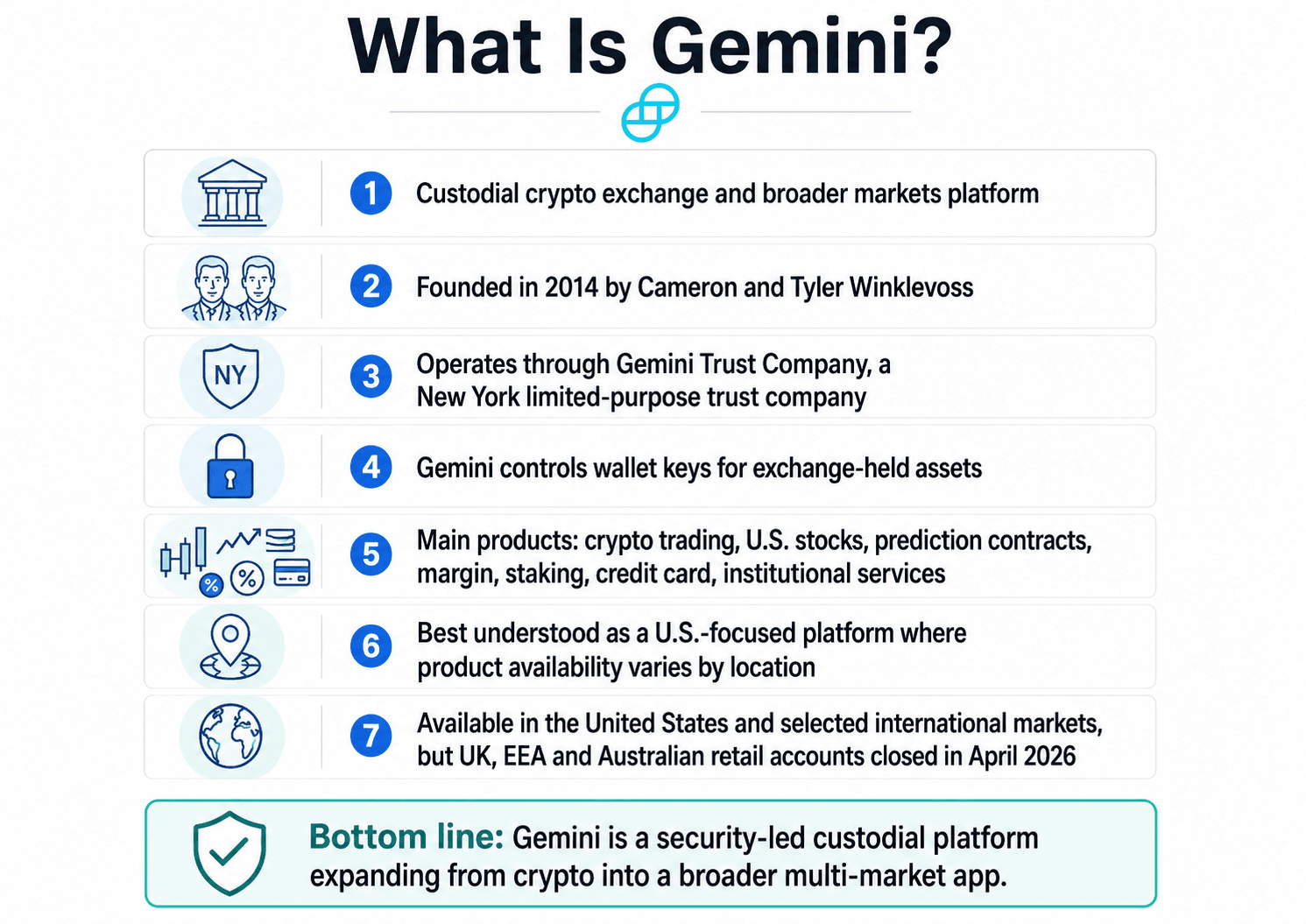 Gemini at a Glance: Custody, Products, Regulation, and Regional Availability Explained Clearly
From Crypto Exchange to Broader Markets Platform
Cameron and Tyler Winklevoss founded Gemini in 2014. Gemini Trust Company operates as a New York limited-purpose trust company and custodian for its core U.S. crypto services.
Gemini controls the wallet keys for assets held in exchange accounts, so customers rely on the platform for safekeeping and withdrawals.
Crypto trading remains the central product, but Gemini now includes stocks, predictions, margin, staking, a credit card and institutional services. Gemini describes its strategy as moving from a crypto company toward a markets company.
Gemini is a custodial crypto and markets platform offering crypto trading, U.S. stocks, prediction contracts and other financial products, with availability varying by product and location.
Where Gemini Is Available
Exchange access does not guarantee access to stocks, predictions, margin, staking or the credit card.
Gemini's availability directory says the exchange is available in more than 50 countries as of July 15, 2026. Gemini remains available in the United States, including New York, although state restrictions apply to individual products. UK, EEA and Australian retail accounts closed on April 6, 2026, after entering withdrawal-only status a month prior.
Gemini Products and Trading Experience
Gemini offers simple purchases, order-book trading and several non-crypto products. Pricing and protections differ across each service.
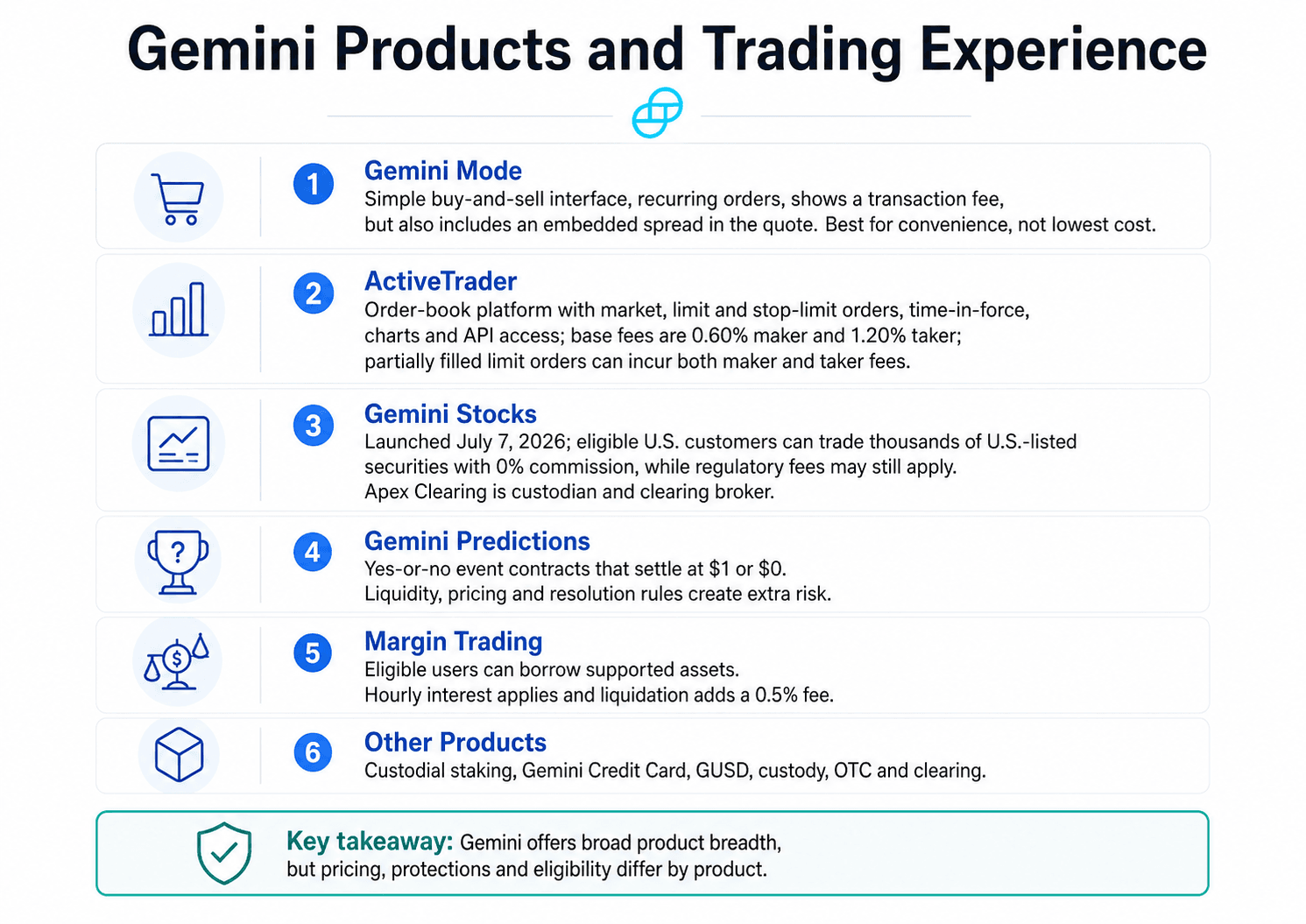 A Clear Guide to Gemini Mode, ActiveTrader, Stocks, Predictions, Margin, and Other Products
Gemini Mode: Simple Buying and Recurring Orders
Gemini Mode is the beginner buy-and-sell interface for convenience-focused customers, but its displayed transaction fee excludes the embedded spread. It supports asset search, basic market research, portfolio tracking, price alerts and recurring purchases.
The checkout displays a transaction fee, while a spread is included in the quoted price. As per Gemini's fee schedule, fees can vary by payment method, order size, market conditions, jurisdiction and asset. Similar transactions can receive different fees.
Gemini Mode suits convenience-focused buyers. It is usually not the cheapest route because users pay the displayed fee and the economic cost embedded in the quote.
ActiveTrader: Advanced Crypto Trading
ActiveTrader is Gemini's order-book platform for experienced traders, but its entry-level fees are high. It provides market, limit and stop-limit orders, time-in-force controls, charts and API access.
Maker orders rest on the order book and add liquidity, while taker orders execute immediately against existing orders. The base tier is 0.60% maker and 1.20% taker. Gemini uses trailing 30-day volume or eligible asset balance, whichever produces the lower fee.
A partially filled limit order can incur taker fees on the immediately executed portion and maker fees on the remainder after it rests and later fills. ActiveTrader suits experienced traders, but the base taker rate is expensive for small, frequent orders.
Advanced execution tools: Daily auctions concentrate orders at a scheduled clearing price. Gemini Clearing settles eligible negotiated trades arranged away from the central order book. Users should confirm current market support.
Gemini Stock Trading
Gemini stock trading is for eligible U.S. customers seeking crypto and conventional securities in one app, but regional exclusions are its main drawback. The service launched on July 7, 2026. Gemini advertises 0% commission on thousands of U.S.-listed securities, although regulatory charges may apply. Nasdaq provides real-time data, while Apex Clearing Corporation acts as custodian and clearing broker.
As of July 15, 2026, Gemini stock trading remains unavailable in Alabama, Arkansas, Illinois, Massachusetts, Texas, Puerto Rico, Washington, D.C. and Guam. Users should recheck the Gemini Stocks terms because state approvals can change.
These are conventional securities, not tokenized stocks. Stock accounts are offered through Gemini Galactic, an SEC-registered broker-dealer and FINRA/SIPC member, with Apex acting as clearing broker and custodian. SIPC protection applies according to the brokerage arrangements and does not protect against falling security prices or cover ordinary crypto balances.
Gemini Predictions
Gemini Predictions offers yes-or-no event contracts for eligible users comfortable with probability and settlement rules. A winning contract settles at $1 and a losing contract at $0. Prices represent market-implied probability, not a reliable forecast, and users can sell early only when liquidity is available.
Gemini's prediction fee schedule uses separate formulas:
- Maker: 0.0175 × contracts × price × (1 − price)
- Taker: 0.07 × contracts × price × (1 − price)
Dollar fees peak near a $0.50 contract price. For 100 contracts priced at $0.50, the formula produces a $0.44 maker fee after rounding and a $1.75 taker fee. At $0.10, the same quantity produces a $0.16 maker fee and a $0.63 taker fee. The examples show why one flat percentage would misrepresent Gemini's pricing. Gemini rounds charges up to the nearest cent and lists no settlement or membership fee.
Resolution rules, liquidity, legal availability and taxation create risks beyond spot crypto. A correct view can still lose money after entry price, fees or an unfavorable early sale.
Gemini Margin Trading
Gemini margin trading lets eligible experienced users borrow supported assets, but hourly interest and liquidation can rapidly increase losses. Interest can apply to borrowed assets attached to accepted open orders before execution.
| Asset | Hourly rate | Annualized example |
|---|---|---|
| USD | 0.003% | 26.3% |
| BTC | 0.0012% | 10.5% |
| ETH, HYPE and ZEC | 0.0014% | 12.3% |
Executed liquidation orders carry a 0.5% fee. Borrowing $1,000 of USD for 24 complete hourly charging periods would cost approximately $0.72 at the published rate, before compounding, trading fees or liquidation costs. A $1,000 liquidation can add $5, excluding the trading loss. Rates and supported assets should be checked in-account.
Staking, Credit Card, GUSD and Institutional Tools
These products target users seeking staking, card rewards, stablecoins or institutional execution.
| Product | Main use | Best for | Main cost | Main risk | Availability |
|---|---|---|---|---|---|
| Gemini Staking | Custodial proof-of-stake rewards | Users who prefer exchange-managed staking | Gemini can deduct up to 35% of protocol rewards | Slashing, unbonding, protocol and custody risk | Asset and location dependent |
| Gemini Credit Card | Crypto rewards on eligible purchases | Eligible U.S. cardholders who want automatic crypto rewards | No advertised annual fee; interest and other card charges may apply | Borrowing costs and reward-asset volatility | Eligible U.S. applicants |
| Gemini Dollar | Dollar-linked GUSD stablecoin | Users transferring or trading a Gemini-issued stablecoin | Selected GUSD pairs can have reduced or zero trading fees | Reserve, redemption, issuer and smart-contract risk | Supported Gemini accounts |
| Gemini Custody | Segregated institutional asset custody | Institutions and approved high-value clients | 0.40% annual custody fee and $125 per withdrawal | Custodian, access and counterparty risk | Approved clients |
| OTC and Clearing | Large negotiated transactions and settlement | Institutions and large traders | Quote-based pricing | Counterparty, settlement and liquidity risk | Eligible clients |
As of July 15, 2026, Gemini's staking page lists ETH, SOL and MON and says the service deducts up to 35% of protocol rewards. Network rewards, waiting periods and slashing conditions vary.
As of July 15, 2026, the Gemini Credit Card terms advertise 4% back on qualifying gas, EV charging and transit spending up to $300 monthly, then 1%. Dining earns 3%, groceries 2% and other qualifying purchases 1%.
The Gemini Custody fee schedule is separate from a standard Gemini Exchange account. Gemini states a 0.40% annual custody fee and an additional $125 per withdrawal fee as of July 15, 2026. Transfers from Gemini Exchange to Gemini Custody are free, while transfers from Custody back to the Exchange incur the $125 charge.
Gemini Fees: What You Actually Pay
Gemini fees vary by trading interface, funding method, order type and withdrawal network. ActiveTrader publishes fixed maker and taker rates, while Gemini Mode combines a displayed transaction fee with a spread built into the quote.
Gemini’s cheapest route is usually bank funding followed by a carefully placed ActiveTrader order. Gemini Mode, debit cards and PayPal can add further costs.
Gemini Mode Fees and Spread
Gemini Mode has two main trading costs:
- A transaction fee shown before confirmation
- A spread included in the quoted crypto price
The Gemini Mode fee schedule does not publish one standard transaction fee. Pricing can vary by payment method, order size, asset, location and market conditions. The checkout fee may therefore understate the full cost. Buyers should compare the quoted crypto quantity with the ActiveTrader market price at roughly the same time.
A proper Gemini Mode cost test needs four figures: Transaction fee + payment fee + estimated spread + withdrawal fee. The spread must be measured from a live quote. Any Gemini Mode example without a recorded checkout quote is illustrative rather than an exact current cost.
ActiveTrader Fees
The ActiveTrader fee schedule starts at 0.60% maker and 1.20% taker.
| 30-Day Trading Volume | Eligible Asset Balance | Maker | Taker |
|---|---|---|---|
| Below $10,000 | Below $1 million | 0.60% | 1.20% |
| $10,000+ | $1 million+ | 0.40% | 0.80% |
| $25,000+ | $5 million+ | 0.25% | 0.50% |
| $75,000+ | $15 million+ | 0.125% | 0.25% |
| $250,000+ | $25 million+ | 0.075% | 0.15% |
Gemini checks both trailing 30-day trading volume and eligible asset balance, then applies the more favorable qualifying tier. Tiers recalculate daily at midnight UTC.
The fee tier active when an order is placed controls the charge. A trade that pushes the account into a lower tier does not receive the lower rate retroactively. A maker order rests on the order book before execution. A taker order matches immediately. Limit orders can still pay taker fees when priced to execute at once.
Partial fills can receive both rates. The immediately executed portion pays the taker fee, while any remainder that rests on the book can later pay the maker fee. API orders follow the standard ActiveTrader schedule.
Gemini applies separate pricing to selected stablecoin pairs:
| Stablecoin Pairs | Maker | Taker |
|---|---|---|
| RLUSD/USD, USDC/GUSD and GUSD/USD | 0% | 0% |
| Other stablecoin pairs | 0% | 0.01% |
Stablecoin-pair volume does not count toward normal volume-tier qualification. Holding $1 million on Gemini purely to qualify for a lower fee tier creates significant exchange custody and counterparty exposure.
Deposit and Withdrawal Fees
Gemini lists the following charges in its transfer fee schedule as of July 15, 2026:
| Method | Gemini Fee |
|---|---|
| ACH deposit | Free |
| ACH withdrawal | Free |
| Incoming USD wire | Free from Gemini |
| USD wire withdrawal | $25 |
| Debit-card purchase | 3.49% |
| PayPal deposit | 2.50% |
| Crypto deposit | Free from Gemini |
| Crypto withdrawal | Dynamic fee |
| Gemini Exchange to Gemini Custody | Free |
| Gemini Custody to Gemini Exchange | $125 |
Banks and payment providers may add their own charges.
Crypto withdrawal fees vary by asset, blockchain and network conditions. Gemini displays the fee before confirmation, so users should check the selected network rather than assume one fixed withdrawal cost.
Gemini Custody also has separate institutional charges under the custody fee schedule. These do not apply to a standard Gemini exchange account.
Real-World Gemini Cost Examples
The Gemini Mode rows below show the information users need to collect from a live checkout. No authenticated July 15 quote was captured, so they are not presented as measured transactions. The ActiveTrader examples use Gemini’s published base-tier rates.
| Scenario | Trading fee | Payment fee | Spread | Withdrawal | Effective cost |
|---|---|---|---|---|---|
| $100 Gemini Mode purchase via ACH | Displayed at checkout | $0 from Gemini | Included in quote; not measured | Dynamic if withdrawn | Cannot be calculated without a live quote |
| $1,000 Gemini Mode purchase via ACH | Displayed at checkout | $0 from Gemini | Included in quote; not measured | Dynamic if withdrawn | Cannot be calculated without a live quote |
| $1,000 ActiveTrader taker order | $12 at the base tier | $0 via ACH | Slippage possible | Dynamic if withdrawn | 1.20% before slippage and withdrawal |
| $10,000 ActiveTrader maker order | $60 at the base tier | $0 via ACH | No Gemini Mode spread | Dynamic if withdrawn | 0.60% before withdrawal |
The $10,000 maker example uses the fee tier active when the order is placed. The order may contribute to a lower tier after Gemini’s next fee-tier calculation, but the lower rate does not apply retroactively.
Payment methods can materially increase the total:
| Payment Method | Cost on $1,000 |
|---|---|
| ACH | $0 |
| PayPal | $25 |
| Debit card | $34.90 |
For Gemini Mode, calculate the final cost as follows:
(Transaction fee + payment fee + spread cost + withdrawal fee) ÷ purchase amount × 100
This also explains why Gemini fees can feel high. A low-volume ActiveTrader taker order starts at 1.20%, while Gemini Mode can include a transaction fee, spread and payment charge.
How to Pay Less on Gemini
Use ACH or another low-cost bank funding method where available. Compare the Gemini Mode quote with ActiveTrader before buying.
Place limit orders carefully and confirm whether they will rest as maker orders or execute immediately as taker orders. Review partial fills because one order can incur both fee types.
Check the crypto withdrawal fee and selected network before confirming. Avoid leaving excess assets on Gemini solely to reach a balance-based fee tier.
- Finally, compare the total execution cost with competing exchanges. Published trading fees do not include every spread, payment charge, slippage cost or withdrawal fee.
Supported Crypto, Liquidity and Order Execution
Gemini covers established cryptocurrencies and selected smaller assets, but its offering is curated rather than extensive.
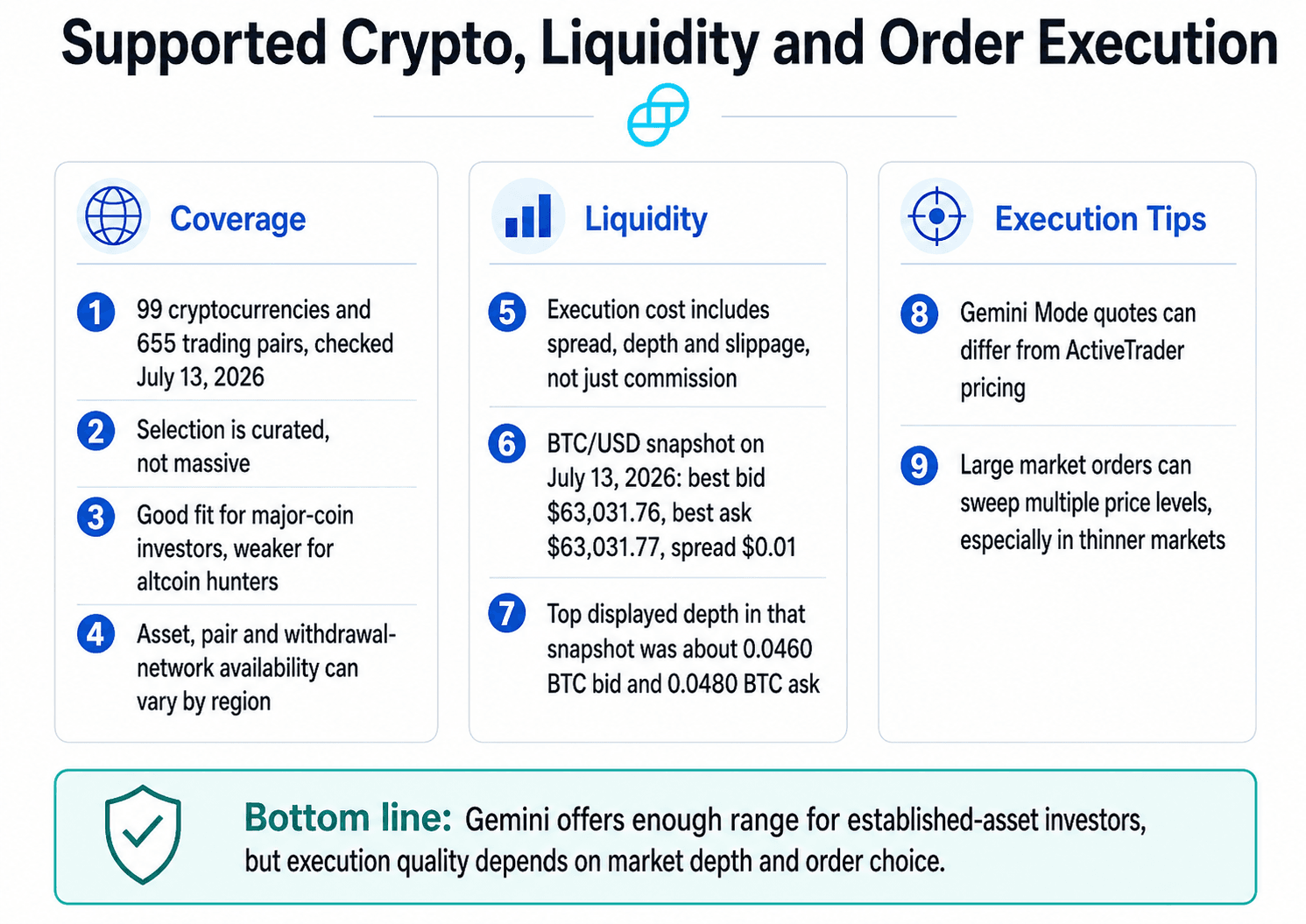 How Gemini’s Crypto Selection, Liquidity, Spreads, and Order Execution Affect Real Trading Costs
Supported Cryptocurrencies and Trading Pairs
As of July 15, 2026, Gemini supports more than 90 cryptocurrencies and over 655 trading pairs, although available assets and markets vary by jurisdiction. Major markets include Bitcoin and Ether, alongside fiat, stablecoin and selected altcoin pairs.
Users should check Gemini's live cryptocurrency directory for the exact asset, pair and withdrawal network. Custody support does not guarantee trading access in every region. Delistings and network changes can also affect deposits, trading and withdrawals.
Our guide to the best U.S. crypto exchanges covers wider market selections.
Liquidity, Spreads and Slippage
Fees are only one part of execution cost. Bid-ask spread, depth and slippage can outweigh a commission difference.
Gemini provides a public BTC/USD order book through its REST API. The endpoint reports current bid and ask price levels and the aggregate amount available at each level. Order-book conditions can change immediately, and liquidity on BTC/USD should not be treated as representative of thinner markets.
Gemini Mode quotes can differ from ActiveTrader pricing, and large market orders can consume several price levels. Gemini's market-data documentation explains how traders can inspect current bids, asks and order-book depth before execution.
Deposits, Withdrawals and Account Management
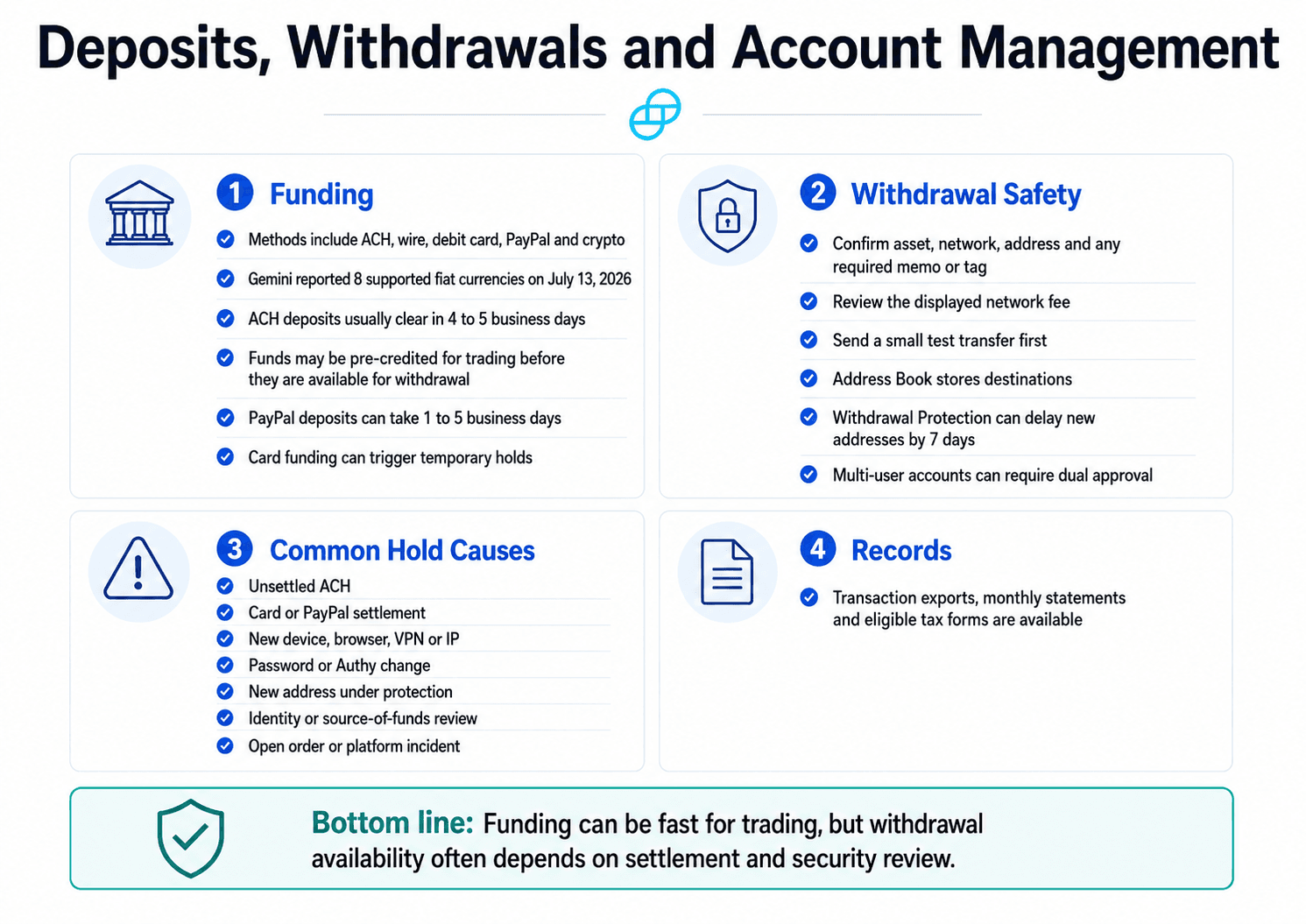
Funding can be quick for trading, but withdrawal availability often waits for settlement or security review.
 How Gemini Deposits, Withdrawal Holds, Address Protection, and Account Records Work in Practice
Funding Methods and Transfer Limits
Eligible users can fund Gemini through ACH, wire, debit card, PayPal or crypto. Gemini reported seven supported fiat currencies as of July 15, 2026, with methods varying by location.
ACH deposits generally take four to five business days to clear. Gemini may make deposited funds available for trading before settlement, while keeping the related cash or crypto unavailable for withdrawal. PayPal deposits can take one to five business days to clear. Debit-card purchases generally become available for crypto withdrawal after 48 hours, although separate account restrictions or security reviews may still apply.
Account-specific limits appear in the transfer interface. Users should not rely on limits quoted for another region or payment method.
Crypto Withdrawals and Approved Addresses
A withdrawal requires the correct asset, network, address and any required memo or tag. Gemini shows the dynamic network fee before confirmation, and two-factor authentication can be required for approval.
Gemini's Address Book stores withdrawal destinations. Optional Withdrawal Protection imposes a seven-day delay on newly added addresses, while multi-user accounts can require dual approval.
Before sending crypto, complete these security checks:
- Confirm the asset and network at both ends.
- Check the first and final address characters.
- Include any required memo or tag.
- Review the displayed network fee before approving the transfer.
- Send a small test transfer first.
- Ignore unsolicited instructions to move funds into a supposedly "secure" wallet.
Sending through an unsupported network can cause permanent loss. Our best crypto wallets and best hardware wallets guides cover self-custody options.
Withdrawal Holds and Account Reviews
Gemini may allow trading while temporarily restricting withdrawals. The cause may involve payment settlement, account security, address allowlisting, identity verification or a wider compliance review.
| Problem | Likely cause | First action |
|---|---|---|
| Trading works but withdrawal fails | Unsettled ACH transfer, payment hold or open order | Check the available withdrawal balance and pending deposits |
| Hold follows debit-card or PayPal funding | Payment settlement period | Review the payment status and settlement date |
| Hold follows a login | New device, browser, VPN or IP address | Check Gemini’s security email and account notifications |
| Hold follows a password or Authy change | Temporary security restriction | Review two-factor authentication settings and recent notices |
| A new address cannot be selected | Withdrawal Protection or allowlisting delay | Check the Address Book approval countdown |
| Gemini requests documents | Identity, source-of-funds or account review | Submit the requested records through the authenticated account |
| A product or account became unavailable | Compliance or regional restriction | Review Gemini’s regional notice and existing support ticket |
| Several platform functions are unavailable | System incident | Check the Gemini status page |
Open sell orders can reduce the available balance because the assets remain committed to those orders. Users should also check outstanding verification requests and avoid opening duplicate tickets.
Gemini does not guarantee one resolution time for every withdrawal hold or account review. Payment settlement, security checks, identity verification, source-of-funds requests and compliance reviews can follow different timelines. When ordinary support does not resolve the issue, users can follow Gemini’s formal complaint route.
Statements, Tax Forms and Transaction Records
Gemini users can download a transaction-history export for a selected date range and retrieve monthly account statements from the Statements and Taxes area. Depending on eligibility and jurisdiction, available tax records may include Form 1099-DA, Form 1099-MISC or a gain/loss statement.
Users should not assume Gemini has complete cost-basis information for assets transferred from another exchange or wallet. Save the original purchase price, acquisition date, trading fees and transfer records for those assets.
Before closing an account, download and retain:
- Complete trade and transaction history
- Deposits, withdrawals and wallet addresses
- Monthly account statements
- Staking and other reward records
- GUSD and prediction-market activity, where applicable
- Trading, withdrawal and network fees
- Available tax forms and gain/loss statements
- Cost-basis and acquisition-date records
Account access may end after closure, so these records should be saved beforehand. For form eligibility, cost-basis treatment and filing considerations, see Gemini’s tax reporting guide.
Readers comparing reporting tools can also consult our guide to the best crypto tax software.
Is Gemini Safe?
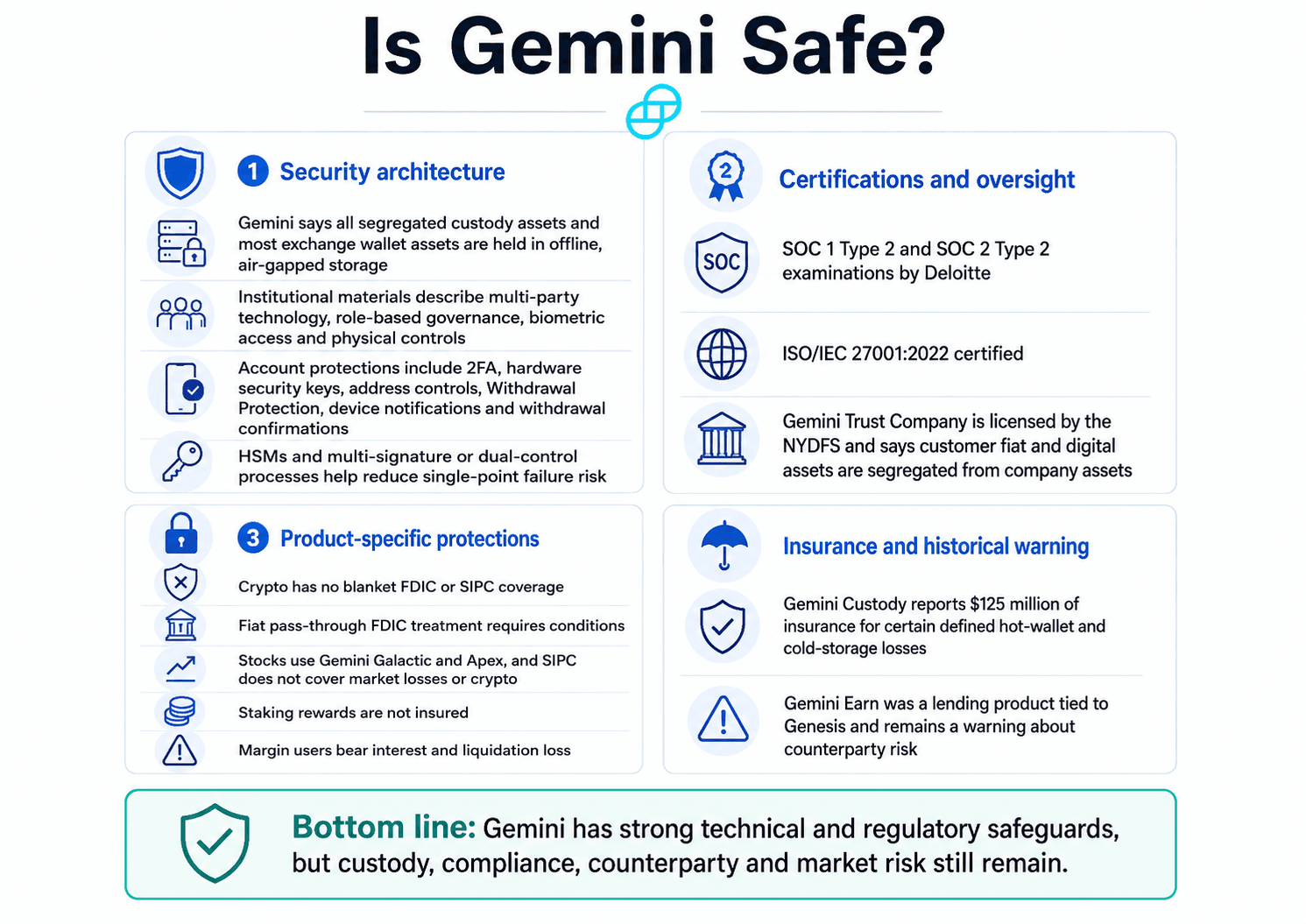
Gemini has extensive account and custody controls, but technical safeguards do not remove custodial, compliance, counterparty or market risk.
 Gemini Security Explained: Custody Controls, Certifications, Insurance Limits, and Remaining User Risks
Gemini Security Architecture
Gemini says all segregated custody assets and most exchange wallet assets are held in offline, air-gapped storage. Its institutional materials describe multi-party technology, role-based governance, biometric access and physical controls.
Account controls include two-factor authentication, hardware security keys, address controls, Withdrawal Protection, device notifications and withdrawal confirmations. Hot-wallet controls limit online operational exposure. Hardware security modules protect signing keys, while multi-signature or dual-control processes reduce single-person authorization risk.
Gemini's GUSD whitepaper separately says high-risk Gemini Dollar actions use hardware security modules rated FIPS 140-2 Level 3 or higher and require approval from at least two signers. That document describes GUSD controls, not every Gemini custody workflow.
Gemini reports SOC 1 Type 2 and SOC 2 Type 2 examinations conducted by Deloitte and ISO/IEC 27001:2022 certification. These assessments review defined controls; they do not guarantee that an account or product cannot fail.
Gemini has strong technical account and custody controls. It is still a custodial platform, so users remain exposed to account restrictions, policy changes, counterparty failures and loss of private-key control.
Regulation and Product-Specific Protections
Gemini Trust Company is a fiduciary and qualified custodian under New York Banking Law and is licensed by the NYDFS. Gemini says customer fiat and digital assets are segregated from company assets.
| Product | Structure | Limitation |
|---|---|---|
| Crypto | Gemini Trust custody | No universal FDIC or SIPC protection |
| Fiat cash | Segregated banking arrangements | Pass-through FDIC treatment requires conditions |
| Stocks | Gemini Galactic and Apex brokerage | SIPC does not cover market losses or crypto |
| Predictions | DCM and DCO-affiliated structure | Contract rules differ from spot crypto |
| Staking | Custodial protocol participation | Rewards are not insured |
| Margin | Borrowed-asset trading | User bears interest and liquidation loss |
Gemini Titan became a CFTC-designated contract market on Dec. 10, 2025, while Gemini Olympus was registered as a derivatives clearing organization on April 29, 2026. These registrations relate to the operation and clearing of regulated contracts. They do not insure users against market losses, settlement disputes or contract-resolution risk.
As of March 1, 2024, Gemini reported $125 million in digital-asset insurance for certain covered losses. It comprised $25 million of commercial crime insurance for assets held in hot wallets and $100 million of coverage for assets held in offline cold storage. Policy terms, limits and exclusions apply, so the coverage does not protect every customer balance or every type of loss.
Gemini Earn and Counterparty Risk
Gemini Earn was a lending product involving third-party borrower Genesis, not the current staking service. The arrangement created credit and counterparty exposure that exchange security certifications could not remove.
Earn users eventually received final in-kind distributions, but the episode remains a warning about lending risk. Users should distinguish direct protocol staking, custodial staking and lending products.
Gemini App and Customer Support
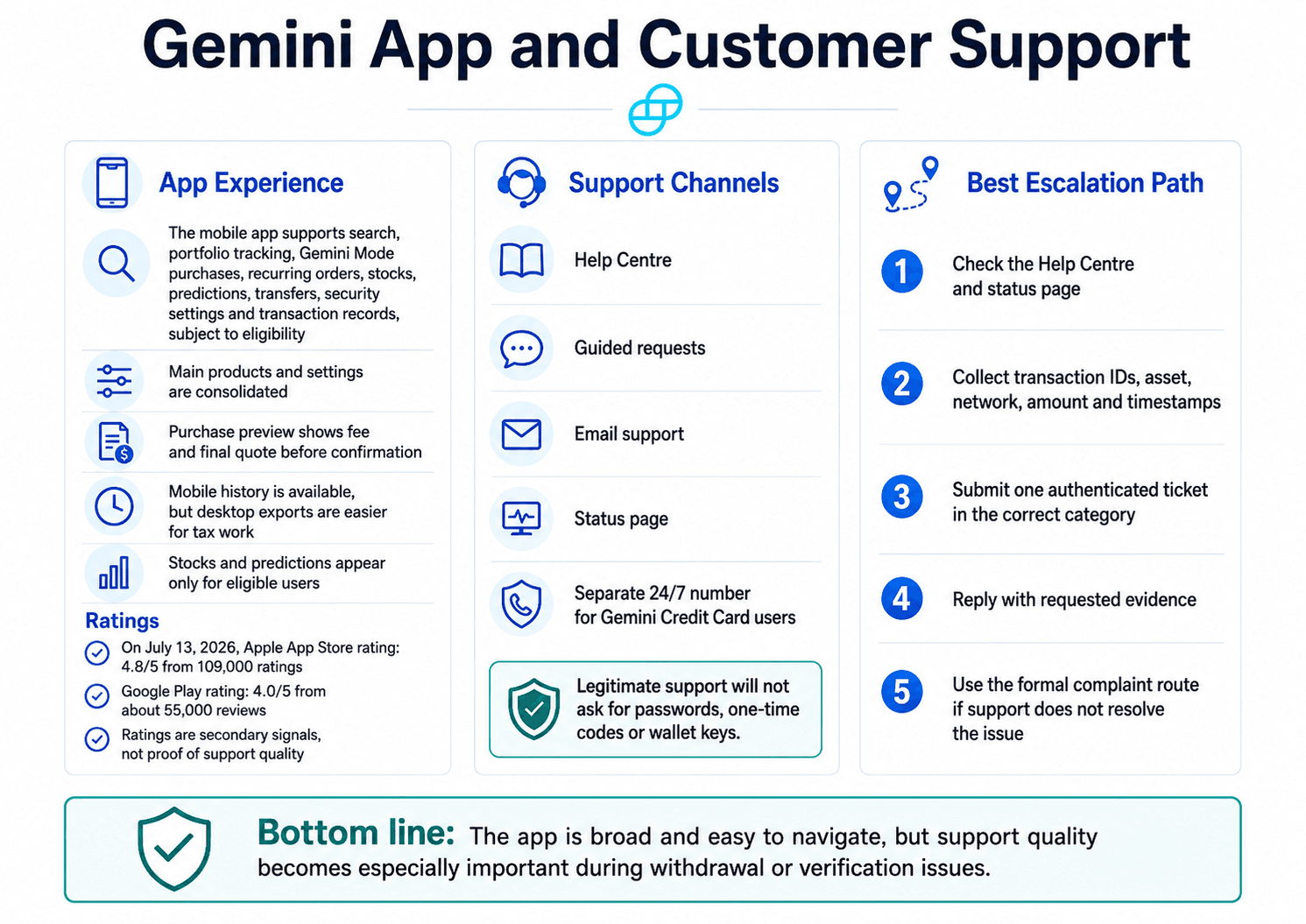
The app consolidates several markets, while support quality becomes critical during withdrawal or verification problems.
 A Practical Look at Gemini’s Mobile App, Support Channels, Ratings, and Escalation Process
Mobile App Experience
The Gemini mobile app supports search, portfolio tracking, Mode purchases, recurring orders, stocks, predictions, transfers, security settings and transaction records, subject to eligibility.
| Task | Assessment |
|---|---|
| Navigation | Main products and settings are consolidated |
| Purchase preview | Fee and final quote appear before confirmation |
| Recurring buys | Available for supported crypto |
| Stocks and predictions | Visible only to eligible users |
| Transfers | Available through portfolio controls |
| Security | Address Book and authentication settings are accessible |
| Records | Mobile history is available; desktop exports are easier for tax work |
As of July 15, 2026, Gemini’s U.S. Apple App Store listing showed a rating of 4.8 out of 5 from 109,000 ratings, while its Google Play listing showed 4.5 out of 5 from about 55,000 reviews. App-store ratings are secondary user-sentiment indicators and do not independently verify withdrawal reliability, customer-support performance or trade execution. Displayed ratings can also vary by market and over time.
Customer Support and Escalation
Gemini offers a Help Centre, guided requests, email support and a status page. Credit-card users can find a separate 24/7 number in card settings.
Use the following support-escalation sequence:
- Check the Help Centre and status page.
- Collect transaction IDs, asset, network, amount and timestamps.
- Submit one authenticated ticket in the correct category.
- Reply to that ticket with requested evidence.
- Use the formal complaint route if support does not resolve the issue.
Gemini warns that legitimate exchange support will not pressure users to transfer crypto or disclose passwords, one-time codes or wallet keys. Trustpilot and app-store reviews contain recurring complaints about verification, withdrawals and restrictions, but they do not show how frequently each issue occurs.
Gemini vs Coinbase, Kraken and Robinhood
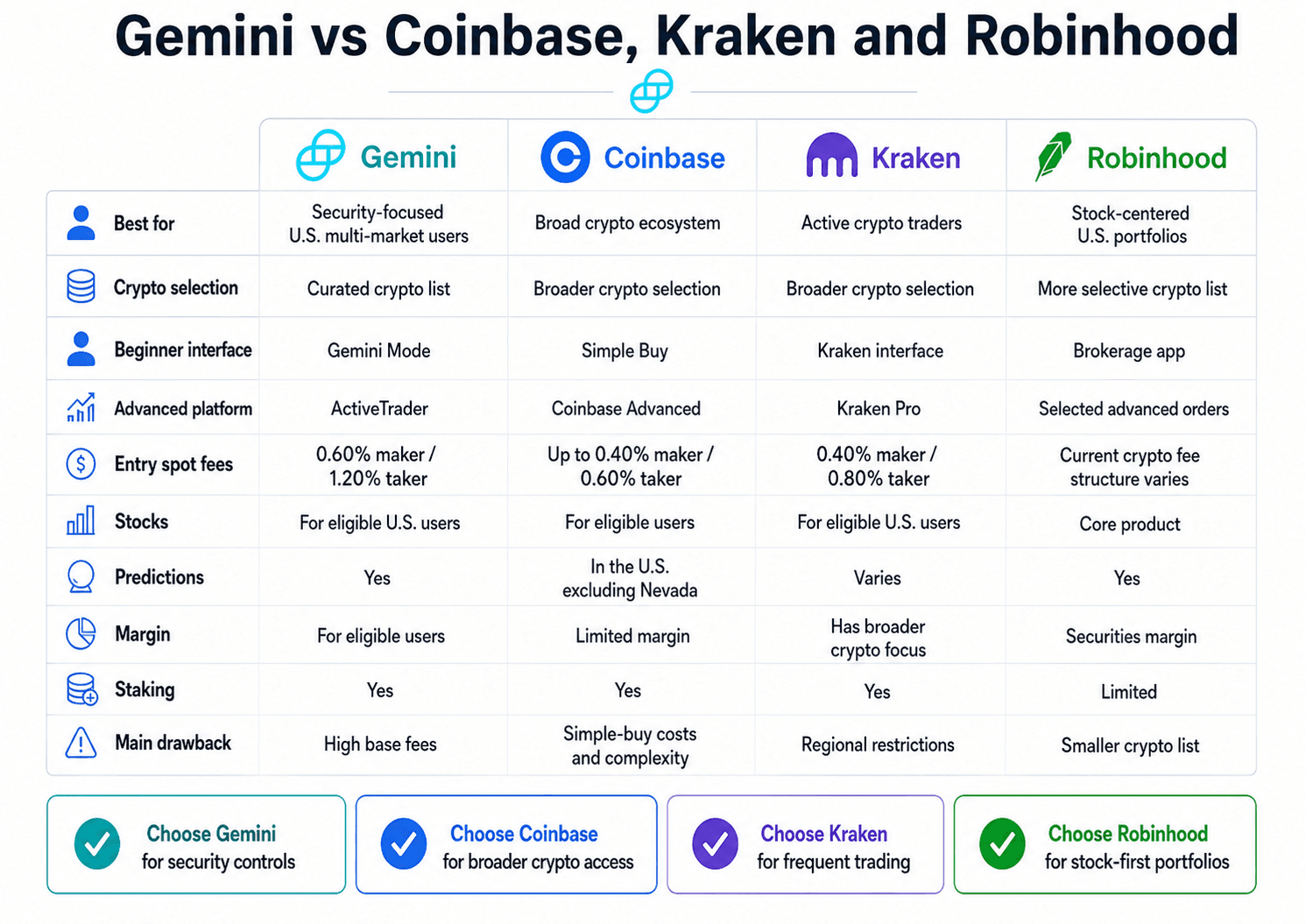
These competitors represent three common choices: a broad crypto ecosystem, an active-trading exchange and a stock-centered super app.
 Gemini Compared With Coinbase, Kraken, and Robinhood Across Fees, Features, Markets, and Best Use Cases
| Factor | Gemini | Coinbase | Kraken | Robinhood |
|---|---|---|---|---|
| Best for | Security-focused U.S. users seeking crypto and additional market products | Users seeking a broad crypto ecosystem | Active crypto traders | U.S. investors building stock-centered portfolios |
| Crypto selection as of July 15, 2026 | Over 90 | 550 cryptocurrencies and trading pairs | Over 600 cryptocurrencies | Over 90 cryptocurrencies |
| Beginner interface | Gemini Mode | Standard Coinbase buy and sell interface | Kraken app and web interface | Brokerage app with crypto access |
| Advanced platform | ActiveTrader | Coinbase Advanced | Kraken Pro | Advanced charts and selected crypto order types |
| Entry spot fees | 0.60% maker and 1.20% taker | Volume-based maker and taker tier shown in the user’s account | 0.40% maker and 0.80% taker at the lowest-volume Kraken Pro spot tier | Account-dependent maker-taker pricing where crypto fee tiers apply |
| Simple-buy costs | Transaction fee plus a spread included in the quote | Transaction pricing can include fees and a spread | Instant Buy charges a displayed fee, with spread and payment costs potentially applying | Market-order execution reflects the available bid-ask spread |
| Stocks and ETFs | Available to eligible U.S. users | Available to eligible U.S. users through Coinbase’s brokerage offering | Available to eligible users in supported U.S. locations | Core brokerage product, with regulatory and other charges potentially applying |
| Prediction markets | Available to eligible users | Available to eligible U.S. users outside Nevada | Product access varies by jurisdiction | Event contracts available through Robinhood Derivatives |
| Margin | Available to eligible users | Limited and product-dependent | Crypto margin available to eligible users in supported jurisdictions | Securities margin available to approved brokerage customers |
| Staking | Available for supported assets | Available for supported assets in eligible jurisdictions | Flexible, bonded and other reward options available to eligible users | Available for selected supported cryptocurrencies |
| Security controls | Hardware security keys, address controls and Withdrawal Protection | Two-factor authentication, security-key support and address allowlisting | Two-factor authentication, device controls and withdrawal-address confirmation | Brokerage, custody and account-security controls |
| Fiat funding | ACH, wire transfer, debit card and PayPal, subject to eligibility | Bank and card methods vary by country and account | Funding methods and fees vary by currency and region | Bank accounts, debit cards and instant bank transfers available to eligible users |
| Customer support | Primarily ticket-led | Help Centre, messaging and account-dependent support channels | Guided requests, chat and other support channels | In-app support and eligible callback options |
| Main drawback | High entry-level ActiveTrader fees | Simple-buy costs and a complex product range | Product availability differs by jurisdiction | Smaller crypto selection than major crypto-first exchanges |
Fees, supported assets and product eligibility can change by jurisdiction, trading volume and account type. Users should check the applicable fee preview and product-availability page before depositing or trading.
Gemini vs Coinbase
Coinbase offers a broader crypto ecosystem and asset selection. Gemini places greater emphasis on withdrawal-address controls, hardware security keys and its New York trust-company structure.
Coinbase’s simple buy and sell service, like Gemini Mode, can include a transaction fee and a spread in the quoted price. Coinbase Advanced uses volume-based maker-taker pricing, but the applicable rate is displayed within the customer’s account rather than published as one universal entry tier. Gemini publishes a 0.60% maker fee and 1.20% taker fee at the lowest ActiveTrader spot tier.
Coinbase also combines crypto with products such as stocks, staking and prediction markets for eligible U.S. users outside Nevada. Product access remains subject to location and account eligibility.
Choose Gemini if you want detailed withdrawal controls and a security-led U.S. multi-market account.
Choose Coinbase if you want broader crypto access and a larger connected product ecosystem. Compare the applicable Coinbase Advanced tier with Gemini’s published rate before trading.
Gemini vs Kraken
Kraken is stronger for frequent crypto trading. Its lowest-volume Kraken Pro spot tier charges 0.25% for maker orders and 0.40% for taker orders, below Gemini’s corresponding 0.60% and 1.20% rates.
Kraken also provides a broader trading-focused product set. Kraken Pro supports crypto trading, funding, withdrawals, staking and margin for eligible users, while geographic restrictions differ across spot markets, margin, derivatives, staking and equities.
Gemini has a New York trust-company structure, address protection, prediction markets and a crypto rewards credit card. Kraken has wider international reach, lower base professional-trading fees and more tools aimed at active crypto traders.
Choose Gemini if you prioritize its security controls and U.S.-focused product mix.
Choose Kraken if you trade frequently, need more markets or want lower base fees.
Gemini vs Robinhood
Robinhood is the closest alternative for users who want crypto inside a wider U.S. investment account. Robinhood began as a securities brokerage, while Gemini began as a crypto exchange and custodian.
Robinhood has the more established stock and ETF workflow. Gemini provides an exchange-style crypto order book through ActiveTrader and more explicit withdrawal-address controls. Robinhood supports crypto purchases and eligible onchain crypto transfers, with applicable blockchain network fees, but the supported assets and networks remain more limited than those available through many crypto-first exchanges.
Robinhood also offers stocks, options, retirement accounts, securities margin and prediction-market event contracts. Gemini is more specialized around crypto custody, crypto trading and controls governing where digital assets can be withdrawn.
Choose Gemini if ActiveTrader and crypto withdrawal controls are central to your decision.
Choose Robinhood if stocks are the priority and crypto is one part of a broader brokerage portfolio.
Who Should Use Gemini?
Gemini serves clear U.S. user profiles, but its pricing and regional limits exclude others.
Choose Gemini If
- You want hardware keys and withdrawal controls.
- You mainly trade established cryptocurrencies.
- You want eligible crypto and stock access in one app.
- You qualify for reduced ActiveTrader fees.
- You want predictions or the Gemini Credit Card.
Choose Another Platform If
- You seek lower maker and taker fees.
- You want hundreds of smaller tokens.
- Your region is unsupported.
- You do not want a custodian controlling keys.
- You frequently need fast human help.

Gemini Review: Final Verdict
Gemini is strongest as a security-led U.S. markets app rather than a low-cost crypto exchange. Its offline storage, hardware-key support, withdrawal controls and New York trust-company structure provide substantial safeguards for its intended customer, although custody and account-review risks remain.
The 0.60% maker and 1.20% taker entry tier is expensive for small, frequent ActiveTrader users. Gemini Mode can cost more after its transaction fee and spread are combined.
Stocks and prediction contracts are useful for eligible U.S. customers who want several markets in one application. They do not offset high crypto fees or restricted international access. Gemini provides its best value to security-conscious U.S. users trading established assets. Coinbase suits broader crypto participation, Kraken suits regular crypto traders, and Robinhood suits stock-centered portfolios.