KuCoin stands out for its large altcoin selection and trading bots, while Bitget offers stronger copy trading and a growing range of multi-asset products.
This comparison examines fees, markets, safety, fiat access and regional availability to help you decide which exchange fits your needs.
Editor's Note (Aug. 6, 2026): We fully updated this comparison in August 2026 with the latest fees, supported markets, regional restrictions, Proof of Reserves data, security developments, copy-trading tools, trading bots, fiat routes and multi-asset products available on KuCoin and Bitget.
Quick Verdict: KuCoin or Bitget?
Bitget is the better overall choice for most active traders, while KuCoin is better for altcoins and configurable trading bots.
Bitget wins with its stronger copy-trading ecosystem, cleaner interface, simpler standard fees and expanding multi-asset platform. KuCoin remains the specialist option for traders seeking a wider altcoin catalogue, more crypto-native products and deeper control over automated strategies.
Who Should Choose Which?
Choose KuCoin if you want:
- A wider selection of smaller and less widely listed altcoins
- More control over grid, DCA, Martingale and rebalancing bots
- A crypto-focused platform with extensive trading tools
- Access to spot margin and long-tail trading pairs
- The ability to test liquidity and withdrawal support before trading obscure assets
Choose Bitget if you want:
- The stronger overall platform for most active traders
- Spot, futures and bot copy trading
- A cleaner interface and easier mobile navigation
- Simpler standard spot fees across supported pairs
- Tokenized stocks, stock perpetuals, options and other multi-asset tools
KuCoin vs Bitget Winner by Category
| Category | Winner | Why |
|---|---|---|
| Overall | Bitget | Bitget offers the stronger balance of copy trading, usability, standard pricing and multi-asset tools. |
| Spot Fees | Bitget | Both charge 0.10% on standard markets, but Bitget avoids KuCoin’s more expensive Class B and Class C fee tiers. |
| Futures Fees | Tie | Both list standard entry-tier rates of 0.02% for makers and 0.06% for takers. |
| Altcoins | KuCoin | KuCoin listed 858 active coins and 1,029 pairs, compared with 534 coins and 600 pairs on Bitget. |
| Copy Trading | Bitget | Bitget supports spot, futures and bot copy trading with stronger leader discovery and performance data. |
| Trading Bots | KuCoin | KuCoin provides greater strategy variety and more detailed manual control over bot parameters. |
| Liquidity | Tie | Execution quality varies by pair, order size and market conditions, so traders should compare live order books. |
| Beginner Experience | Bitget | Bitget has cleaner navigation and makes spot, futures, copy trading and bot tools easier to find. |
| Multi-Asset Trading | Bitget | Bitget offers tokenized stocks, stock perpetuals, options, CFDs and other traditional-market products. |
| Safety | Bitget | Bitget has the cleaner public incident record and maintains a separately valued Protection Fund. |
| Fiat Access | Bitget | Bitget supports a wider range of documented bank-deposit currencies, although access still varies by region. |
Data was checked on Aug. 6, 2026. Fees, restrictions, reserves, supported markets and payment routes can change, so confirm the live exchange pages before depositing funds.
Disclosure
Some links in this guide may be affiliate links. If you choose to use a service through these links, we may earn a commission at no additional cost to you.
Disclaimer
This guide is educational only and is not financial advice. The comparison is based on platform documentation, public fee schedules, regional restrictions, market data, reserve disclosures and confirmed regulatory or security events.
KuCoin vs Bitget at a Glance
KuCoin is the broader altcoin exchange, while Bitget is developing into a multi-asset trading platform that reaches beyond crypto. The comparison below reflects publicly available information checked on Aug. 6, 2026.
| Field | KuCoin | Bitget |
|---|---|---|
| Founded | 2017 | 2018 |
| Exchange Model | Centralized cryptocurrency exchange | Centralized multi-asset exchange |
| Primary Strength | Altcoins and trading bots | Copy trading and multi-asset tools |
| Active Spot Assets | 858 in CoinGecko’s Aug. 6 snapshot | 534 in CoinGecko’s Aug. 6 snapshot |
| Active Spot Pairs | 1,029 | 600 |
| Standard Spot Fees | Class A: 0.10%; Class B: 0.20%; Class C: 0.30% | 0.10% maker and taker |
| Standard Futures Fees | 0.02% maker and 0.06% taker | 0.02% maker and 0.06% taker |
| Fee Token | KCS | BGB |
| Token Fee Discount | 20% on eligible spot and margin fees | 20% on eligible spot fees |
| Spot Margin | Available where permitted | Available where permitted |
| Futures | Perpetuals and other contracts, region dependent | Perpetuals and other derivatives, region dependent |
| Copy Trading | Primarily futures-focused | Spot, futures and bot copy trading |
| Trading Bots | Grid, DCA, Martingale, AI trend, rebalancing and margin bots | Grid, Martingale, auto-invest, arbitrage and trend bots |
| Tokenized Assets | Limited stock-index perpetual exposure | Tokenized stocks, stock perpetuals and CFDs |
| Fiat Deposits | Regional banks, cards, P2P and third-party providers | Regional banks, cards, P2P and third-party providers |
| Fiat Withdrawals | Limited by currency and entity | Limited by currency and entity |
| KYC | Required for full platform access | Required for full platform access |
| Latest Reserve Snapshot | 31 July 2026 | Report published 28 July 2026 |
| Protection Arrangement | No comparable separately valued current fund identified | Protection Fund averaged $346 million in June 2026 |
| Best For | Altcoin and bot users | Copy and multi-asset traders |
| Main Limitation | Regulatory and fiat-access constraints | Regional and product complexity |
| Last Checked | Aug. 6, 2026 | Aug. 6, 2026 |
CoinGecko listed 858 coins and 1,029 pairs on KuCoin, compared with 534 coins and 600 pairs on Bitget as of Aug. 6, 2026 These figures are snapshots rather than permanent attributes, and they do not measure withdrawal support or executable liquidity.
Readers comparing the platforms separately can use our full KuCoin and Bitget reviews for deeper product walkthroughs.
How This KuCoin vs Bitget Comparison Was Built (Methodology)
This comparison focuses on the main checks users should make before depositing funds:
- Trading fees
- Spot and futures markets
- Altcoin selection
- Liquidity and market depth
- Copy trading
- Trading bots
- Fiat access
- Proof of Reserves
- Protection funds
- Security incidents
- Regional restrictions
- Beginner experience
We used official fee schedules, product pages, terms of use, restricted-country lists and reserve disclosures from KuCoin and Bitget. CoinGecko exchange pages were used for dated snapshots of listed coins, trading pairs and market activity.
Security claims were checked against official disclosures and confirmed regulatory actions. Proof of Reserves was treated as evidence of selected assets and liabilities, not as a full financial audit.
All figures and platform details are current as of Aug. 6, 2026. Fees, products, reserves and regional access can change.
KuCoin vs Bitget Availability, KYC and Regional Restrictions
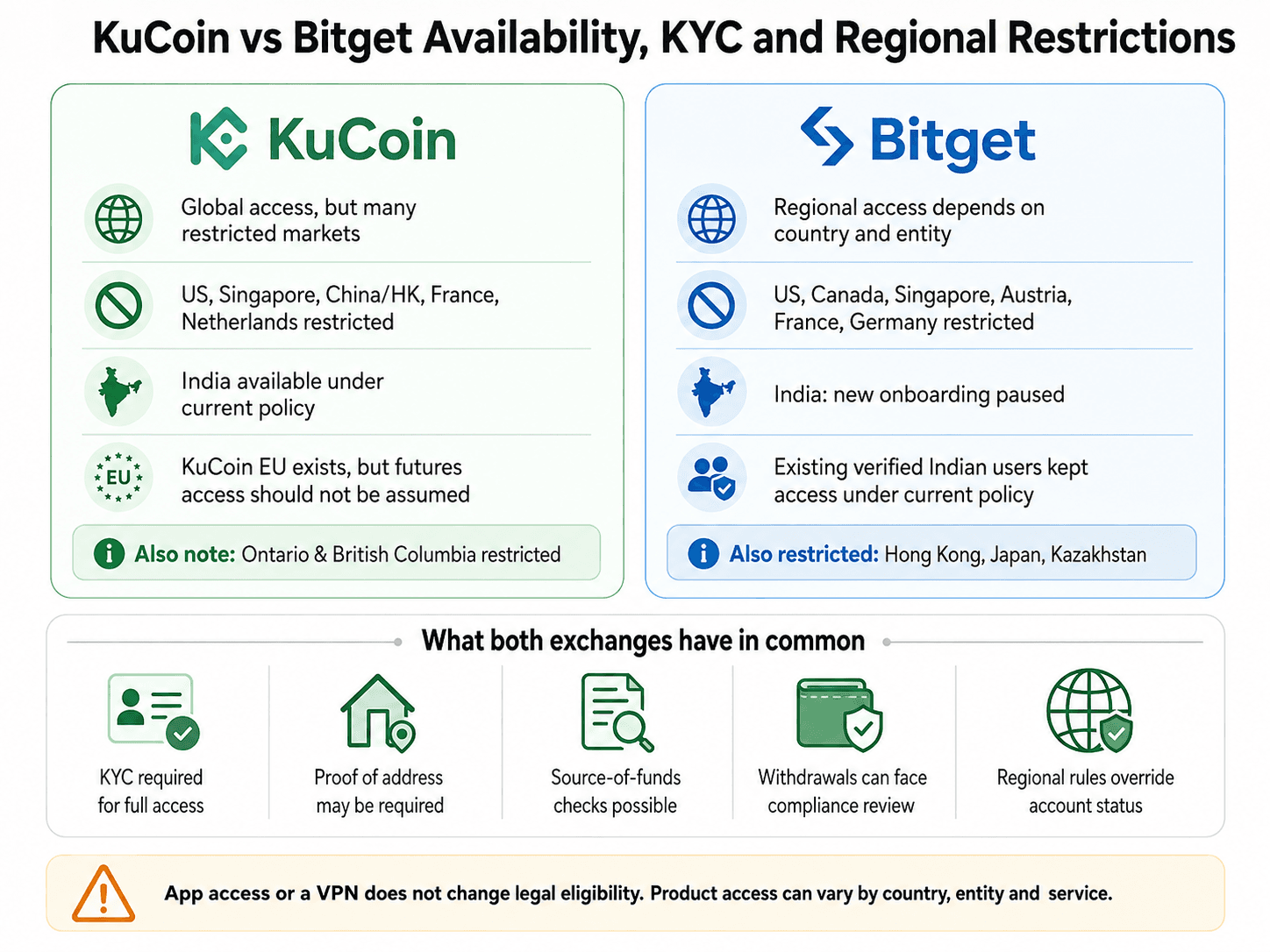
The first decision is whether the required product is available through the entity serving your country. Registration, spot trading, derivatives, copy trading and fiat access can each have separate eligibility rules.
 Regional Rules Shape Access Before Product Choice Begins
Where Is KuCoin Available?
KuCoin remains available across many markets, but its global terms prohibit users from several major jurisdictions. As of Aug. 6, 2026, KuCoin is unavailable in United States and its territories, Singapore, mainland China, Hong Kong, Malaysia, Kazakhstan, Uzbekistan, France, the Netherlands, Ontario and British Columbia, among other restricted markets.
KuCoin is also moving toward a more regional structure. Its European platform lists spot trading, margin, KuCard, Spotlight and OTC services. Futures were not included in the publicly listed KuCoin EU product menu during the review, so European account access should not be confused with unrestricted global derivatives access.
| Market | Registration And Spot | Futures And Copy Trading | Fiat Access | Practical Position |
|---|---|---|---|---|
| United States | Prohibited | Prohibited | Unavailable | KuCoin agreed to exit the market |
| United Kingdom | Conditional | Product restrictions may apply | Route dependent | Confirm entity and product eligibility |
| EEA | KuCoin EU where supported | Global derivatives access should not be assumed | Entity and country dependent | France and the Netherlands remain restricted under global terms |
| Canada | Ontario and British Columbia restricted | Restricted in those provinces | Limited | Other provinces require an eligibility check |
| Australia | Local platform available | Product and entity dependent | AUD routes available | Australian subsidiary is AUSTRAC registered |
| Singapore | Prohibited | Prohibited | Unavailable | Listed as a restricted location |
| India | Available under current policy | Product dependent | P2P INR and selected routes | KuCoin is registered with India’s FIU |
| UAE | Conditional global access | Product dependent | Route dependent | Website access does not establish local authorization |
KuCoin’s Australian subsidiary announced AUSTRAC Digital Currency Exchange registration in November 2025. Its Australian platform also supports AUD withdrawals using bank transfer and PayID, giving eligible users a native cash off-ramp.
For India, KuCoin maintains an FIU registration and localized compliance framework. That does not make every global product or payment method permanently available to Indian users.
Existing users in a newly restricted jurisdiction may be moved into withdrawal-only or account-closing flows. App availability does not establish contractual eligibility, and a VPN does not change the user’s legal residence.
Read our full KuCoin review.
Also Read
Where Is Bitget Available?
Bitget also operates through global and regional entities, with product access changing by jurisdiction. As of Aug. 6, 2026, its terms listed the United States, Canada, Singapore, Austria, France, Germany, Hong Kong, Japan and Kazakhstan among prohibited markets.
| Market | Registration And Spot | Futures And Copy Trading | Multi-Asset Products | Practical Position |
|---|---|---|---|---|
| United States | Prohibited | Prohibited | Prohibited | Listed in the prohibited-country terms |
| United Kingdom | Conditional | Product restrictions may apply | Eligibility dependent | Confirm the contracting entity |
| EEA | Country dependent | Country and entity dependent | Country dependent | Austria, France and Germany are restricted under global terms |
| Canada | Prohibited | Prohibited | Prohibited | Listed as a prohibited market |
| Australia | Conditional | Product dependent | Product dependent | Confirm current local access |
| Singapore | Prohibited | Prohibited | Prohibited | Listed as a prohibited market |
| India | New onboarding paused from 6 February 2026 | Existing verified users retain access under current policy | Existing-account and product dependent | New registrations remain paused |
| UAE | Conditional | Product dependent | Product dependent | Local product eligibility requires confirmation |
Bitget paused new-user onboarding in India from Feb. 6, 2026. Existing verified Indian users could continue depositing, trading and withdrawing under the policy available during this review.
Read our full Bitget review.
Also Read
- Bitget Copy Trading Review
- Bitget Wallet Review
- Bitget Trading Guide
- Is Bitget Safe?
- How To Sign Up on Bitget
- What is Bitget Stock Futures
KYC, Source-of-Funds Checks and Account Reviews
Both exchanges require identity verification for full platform access. Either can request further documents after the initial KYC process has been completed.
| Compliance Question | KuCoin | Bitget |
|---|---|---|
| KYC Required | Yes for full access | Yes for full access |
| Proof of Address Possible | Yes | Yes |
| Source-of-Funds Check Possible | Yes | Yes |
| Enhanced Due Diligence Possible | Yes | Yes |
| Account Review After KYC | Yes | Yes |
| Regional Rules Override KYC | Yes | Yes |
| Withdrawal Review After Verification | Possible | Possible |
| VPN Or Foreign Login Risk | Yes | Yes |
A source-of-funds review may ask how assets were acquired, where fiat originated, who controls the sending wallet and whether transaction history matches the user's profile. Bitget can require a source-of-funds questionnaire alongside further identity evidence.
Deposit and withdrawal limits can increase with verification, but higher KYC status does not prevent compliance reviews. A user moving to another country may need to update proof of address, change regional entities or accept narrower product access.
KuCoin vs Bitget Fees and Real Trading Costs
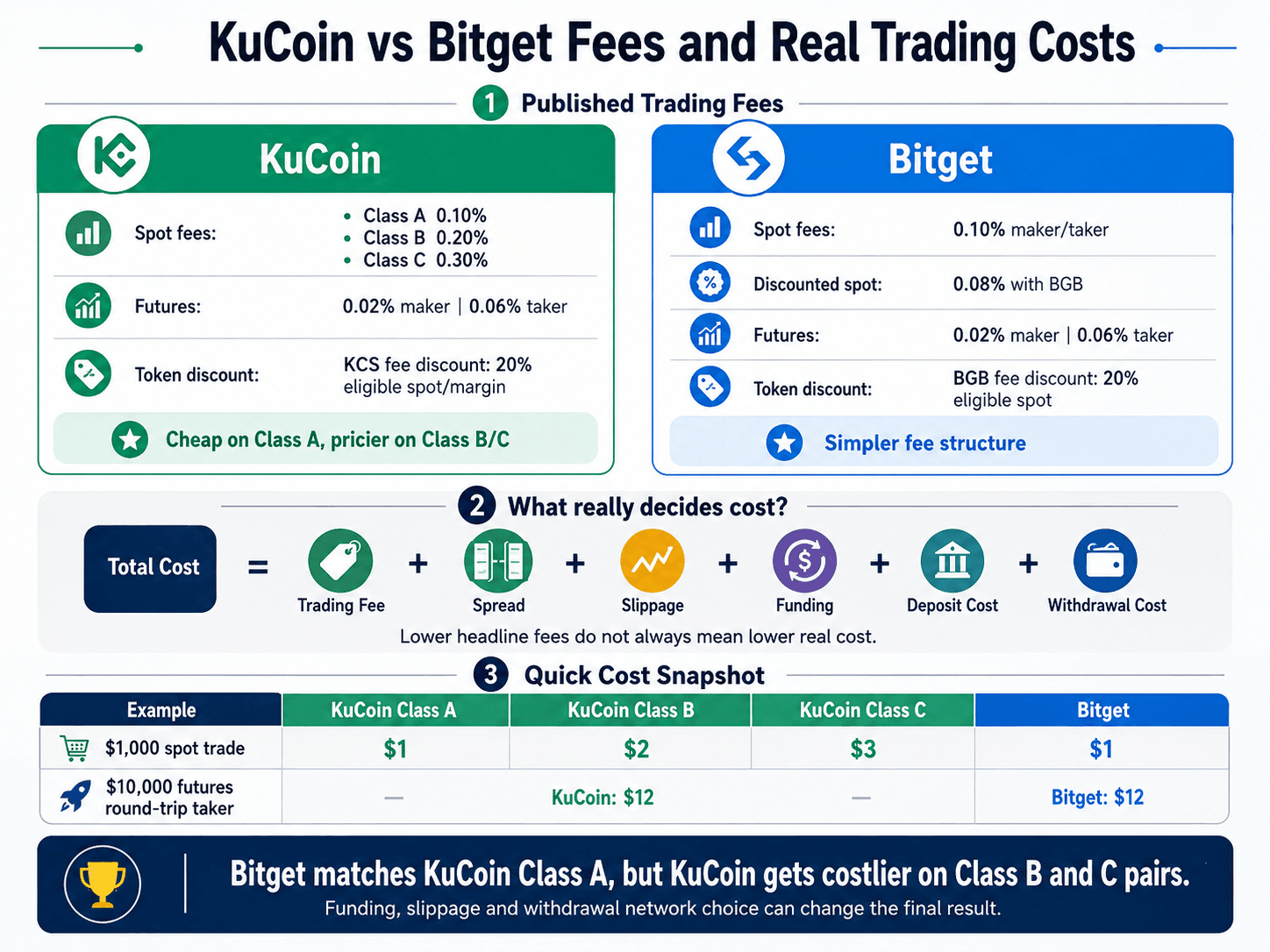
Bitget has the simpler standard spot-fee structure, while KuCoin can be equally cheap or substantially more expensive depending on the asset’s fee class. At the entry futures tier, the published maker and taker rates are the same.
 Headline Fees Reveal Only Part Of Trading Costs
Spot and Futures Trading Fees
Bitget lists a standard 0.10% maker and taker spot fee, with a 0.08% rate when eligible fees are paid using BGB. Its standard futures rates are 0.02% for makers and 0.06% for takers.
KuCoin uses Class A, B and C spot pairs. Its VIP 0 fee schedule listed the following rates:
| Market | KuCoin Maker | KuCoin Taker | Bitget Maker | Bitget Taker |
|---|---|---|---|---|
| Spot, Class A Or Standard | 0.10% | 0.10% | 0.10% | 0.10% |
| KuCoin Class B | 0.20% | 0.20% | Not Applicable | Not Applicable |
| KuCoin Class C | 0.30% | 0.30% | Not Applicable | Not Applicable |
| Futures, Standard Entry Tier | 0.02% | 0.06% | 0.02% | 0.06% |
KuCoin matches Bitget on a standard Class A spot pair. It becomes more expensive when the selected asset falls into Class B or Class C unless the user qualifies for a lower VIP rate.
KCS and BGB Fee Discounts
KCS and BGB are exchange tokens that can reduce eligible fees.
KuCoin provides a 20% KCS fee rebate on eligible spot and margin trades. The feature must be enabled, and the account needs enough KCS to settle the charge.
Bitget reduces its standard spot rate from 0.10% to 0.08% when eligible fees are paid using BGB. Futures discounts should be checked separately through the relevant VIP schedule.
| Feature | KCS | BGB |
|---|---|---|
| Exchange | KuCoin | Bitget |
| Standard Spot Discount | 20% | 20% |
| Discounted Standard Rate | 0.08% on Class A | 0.08% |
| Automatic Enrollment | No | No |
| Token Balance Required | Yes | Yes |
| Token Price Risk | Yes | Yes |
| Applies To Every Product | No | No |
A $10,000 monthly spot trader paying 0.10% incurs $10 in trading fees. A 20% discount saves $2. A 4% fall on a $50 token balance removes the entire monthly saving.
The discount is most useful when the trader holds only enough KCS or BGB to pay near-term fees. Promotional referral discounts should not be confused with permanent standard pricing.
Spreads, Slippage, Funding and Withdrawal Costs
Published commissions are only one part of the final cost:
Total Cost = Trading Fee + Spread + Slippage + Funding + Deposit Cost + Withdrawal Cost
Different costs apply to different users:
- Spot traders: Trading fees, spread, slippage, deposit costs and withdrawals
- Futures traders: Trading fees, spread, slippage and funding
- Copy traders: Trading costs, funding and lead-trader profit share
- Card buyers: Card fees, provider markup and currency conversion
- Bot users: Fees on every execution, with funding added for futures bots
A platform with a lower published taker fee can cost more when the spread is wider or the order book is thinner.
Withdrawal costs vary by token and blockchain. Sending USDT over Ethereum can cost more than using Tron or another supported chain, though the destination must support the chosen network.
KuCoin vs Bitget Cost Examples
The examples below use standard retail rates and exclude spread, slippage, funding and withdrawal costs.
Example 1: $1,000 Spot Taker Purchase
| Exchange And Pair Type | Standard Fee | Token-Discounted Fee |
|---|---|---|
| KuCoin Class A | $1.00 | Approximately $0.80 |
| KuCoin Class B | $2.00 | Approximately $1.60 |
| KuCoin Class C | $3.00 | Approximately $2.40 |
| Bitget Standard Spot | $1.00 | Approximately $0.80 |
Bitget and KuCoin Class A cost the same. Bitget is cheaper than KuCoin Class B or C before execution and withdrawal costs.
Example 2: $10,000 Monthly Spot Volume
| Exchange And Pair Type | Standard Monthly Fee | Token-Discounted Fee |
|---|---|---|
| KuCoin Class A | $10.00 | Approximately $8.00 |
| KuCoin Class B | $20.00 | Approximately $16.00 |
| KuCoin Class C | $30.00 | Approximately $24.00 |
| Bitget Standard Spot | $10.00 | Approximately $8.00 |
KuCoin’s pair classification has a larger impact than the exchange-token discount.
Example 3: $10,000 Futures Position Opened and Closed as a Taker
A $10,000 position charged 0.06% on entry and exit produces a $12 round-trip fee.
| Exchange | Entry Fee | Exit Fee | Round-Trip Fee |
|---|---|---|---|
| KuCoin | $6.00 | $6.00 | $12.00 |
| Bitget | $6.00 | $6.00 | $12.00 |
The published futures fee is tied. Funding and slippage decide the real cost.
KuCoin vs Bitget Markets, Liquidity and Trading Experience
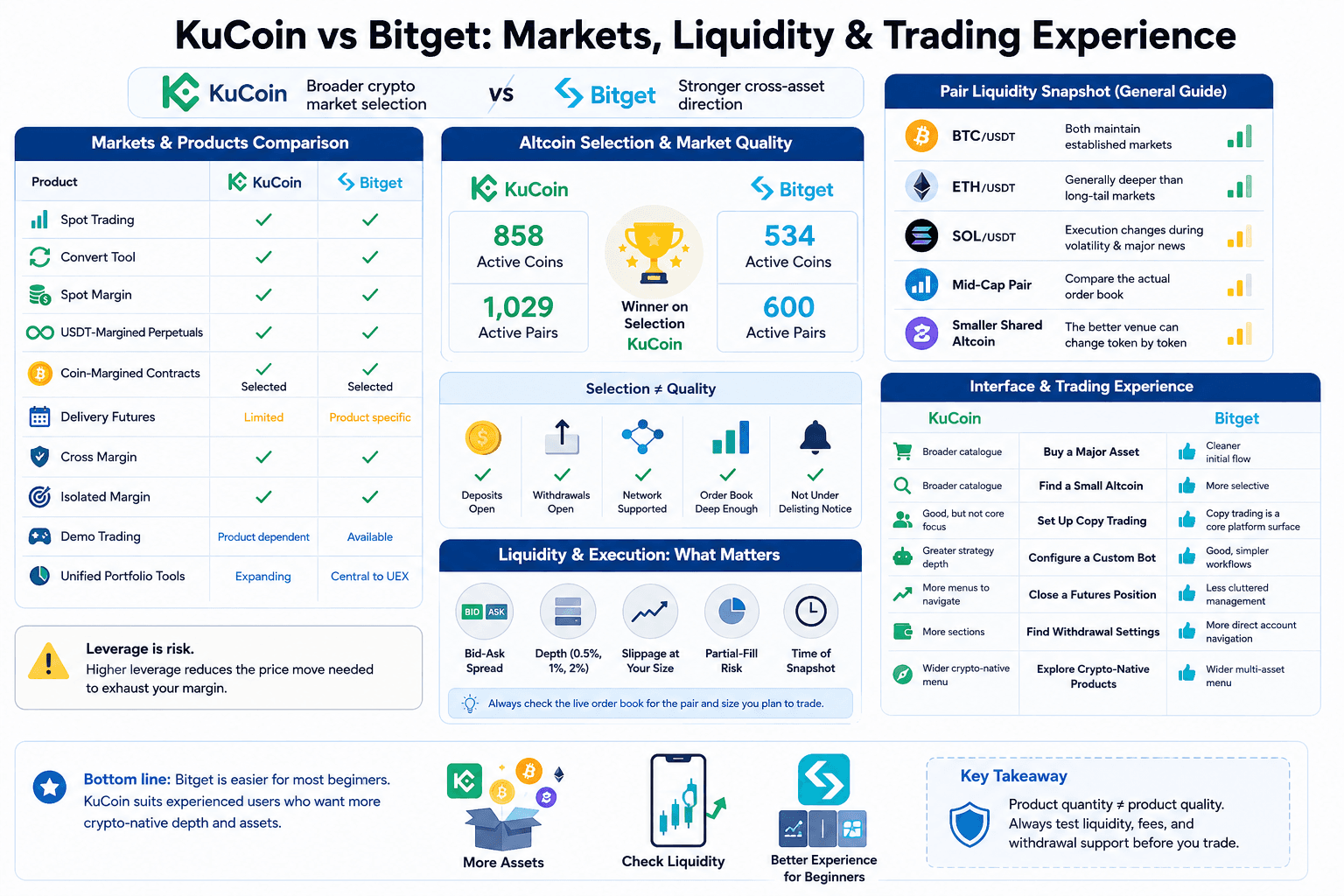
KuCoin offers the broader crypto-native market catalogue, while Bitget has the stronger cross-asset direction. Product quantity must still be separated from product quality.
 KuCoin Leads Altcoins While Bitget Broadens Market Access
Spot, Margin and Futures Markets
Both exchanges cover spot trading, instant conversion, spot margin and perpetual futures. Product access varies by region and account entity.
| Product | KuCoin | Bitget | Main Restriction | Best-Suited User |
|---|---|---|---|---|
| Spot Trading | Yes | Yes | Country and asset eligibility | Most crypto traders |
| Convert Tool | Yes | Yes | Supported assets and quote spread | Beginners and quick swaps |
| Spot Margin | Yes | Yes | Region, pair and borrowing availability | Experienced spot traders |
| USDT-Margined Perpetuals | Yes | Yes | Regional derivatives rules | Active derivatives traders |
| Coin-Margined Contracts | Selected products | Selected products | Contract availability | Traders holding margin assets |
| Delivery Futures | Limited or product specific | Product specific | Region and listing | Specialist derivatives users |
| Cross Margin | Yes | Yes | Asset and account configuration | Portfolio-level margin users |
| Isolated Margin | Yes | Yes | Pair availability | Traders containing position risk |
| Demo Trading | Product dependent | Available for selected workflows | Account and interface | New derivatives users |
| Unified Portfolio Tools | Expanding | Central to UEX direction | Product eligibility | Multi-market traders |
Altcoin Selection and Market Quality
KuCoin wins on raw altcoin breadth.
| Metric | KuCoin | Bitget |
|---|---|---|
| Active Coin Snapshot | 858 | 534 |
| Active Pair Snapshot | 1,029 | 600 |
| Long-Tail Selection | Stronger | More selective |
| Major Asset Coverage | Broad | Broad |
| Small-Cap Liquidity | Highly variable | Highly variable |
| Withdrawal-Network Coverage | Asset dependent | Asset dependent |
| Delisting Risk | Higher across a broader catalogue | Present across a smaller catalogue |
| Data Last Checked | Aug. 6, 2026 | Aug. 6, 2026 |
KuCoin’s catalogue creates more opportunities to find early or obscure listings. It also creates more weak markets. A token may have shallow bids, one usable withdrawal network or an elevated Class B or C fee.
Before buying a smaller token, users should confirm:
- Deposits are open.
- Withdrawals are open.
- The receiving wallet supports the available network.
- The order book can absorb the intended trade.
- The asset is not under a migration or delisting notice.
KuCoin remains the better choice for dedicated altcoin hunters. Bitget can still provide better execution on an individual token when its order book is deeper or its withdrawal support is cleaner.
Liquidity, Spreads and Order Execution
Neither exchange wins liquidity across every pair. BTC/USDT can behave differently from SOL/USDT, while a platform that handles a $1,000 market order cleanly may produce more slippage at $10,000.
Reported volume provides supporting context, but order-book depth gives the clearer execution picture. The relevant measurements are:
- Bid-ask spread
- Depth within 0.5%, 1% and 2% of the mid-price
- Estimated slippage at the intended order size
- Partial-fill risk
- The time of the snapshot
| Pair Type | Practical Conclusion |
|---|---|
| BTC/USDT | Both maintain established markets; compare live depth |
| ETH/USDT | Generally deeper than long-tail markets on both platforms |
| SOL/USDT | Execution changes during volatility and major news |
| Mid-Cap Pair | Compare the actual order book rather than reported volume |
| Smaller Shared Altcoin | The better venue can change token by token |
Before placing a material market order, traders can add the available asks up to the intended size and calculate the weighted average fill price. Comparing that figure with the mid-price gives an estimated slippage cost.
A limit order controls the maximum purchase price but may remain unfilled. A market order prioritizes completion and accepts available liquidity.
Interface, Order Types and Mobile Trading
Bitget provides the cleaner experience for most beginners, while KuCoin gives experienced users more crypto-native tools within a denser interface.
Both platforms provide:
- Market and limit orders
- Stop-loss and take-profit controls
- Trigger orders
- Trailing controls on supported products
- Cross and isolated margin
- Position-closing tools
- Watchlists and price alerts
- TradingView-style charting
Bitget makes it easier to switch between spot, futures, copy trading and bot workflows. Portfolio information and lead-trader discovery are closer to the main navigation.
KuCoin gives experienced traders more direct access to assets, account types and bot settings. A new user may need to understand the difference between funding, trading, margin, futures and bot accounts before locating assets.
| Task | Better Experience | Reason |
|---|---|---|
| Buy a Major Asset | Bitget | Cleaner initial flow |
| Find a Small Altcoin | KuCoin | Broader catalogue |
| Set Up Copy Trading | Bitget | Copy trading is a core platform surface |
| Configure a Custom Bot | KuCoin | Greater strategy depth |
| Close a Futures Position | Slight Bitget Edge | Less cluttered position management |
| Find Withdrawal Settings | Bitget | More direct account navigation |
| Explore Crypto-Native Products | KuCoin | Wider menu |
Most beginners will reach the intended action faster on Bitget. KuCoin better suits users who already understand centralized exchange account structures.
KuCoin vs Bitget Copy Trading, Bots and AI Tools
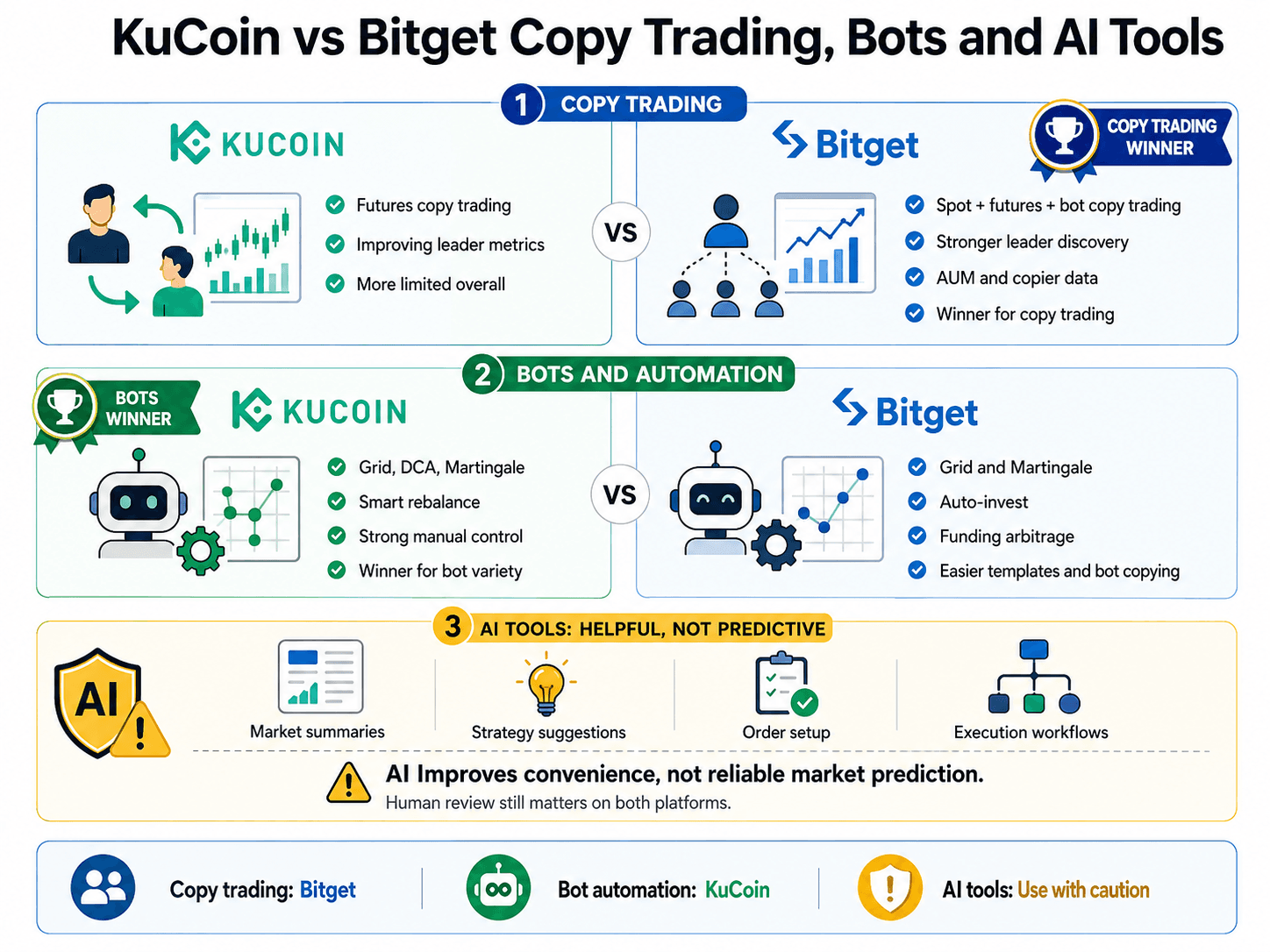
Bitget wins copy trading, while KuCoin wins configurable bot automation.
 Copy Trading Favors Bitget, Automation Depth Favors KuCoin
Copy Trading
Bitget is the stronger copy-trading platform. It supports spot, futures and bot copy trading, while KuCoin remains primarily focused on futures copy trading.
Bitget’s copy-trading interface displays metrics such as 30-day ROI, assets under management and copier profit. Lead traders can receive a share of qualifying follower profits depending on their status and settings.
KuCoin has expanded its lead-trader system with follower metrics, trader levels and profit sharing.
| Copy-Trading Factor | KuCoin | Bitget |
|---|---|---|
| Futures Copy Trading | Yes | Yes |
| Spot Copy Trading | Not a central current offering | Yes |
| Bot Copy Trading | Limited relative to Bitget | Yes |
| Leader Discovery | Improving | More developed |
| Displayed ROI | Yes | Yes |
| AUM And Copier Data | Available to varying degrees | Prominent |
| Profit Sharing | Tier dependent | Commonly 10% to 20% |
| Copier Controls | Allocation and position controls | Allocation, leverage and loss controls |
| Manual Position Closure | Available subject to product rules | Available subject to product rules |
| Overall Winner | Bitget |
A lead trader’s displayed ROI may not match the copier’s realized result. The follower may enter later, receive worse fills, use different leverage or miss trades because of insufficient balance.
Copy traders also face:
- Funding costs
- Profit-sharing deductions
- Slippage between leader and follower
- Unrealized losses
- Maximum follower limits
- Strategy changes after following begins
Copy trading is strategy replication rather than guaranteed passive income. Our guide to copy trading explains the mechanics, while the copy-trading mistakes checklist covers survivorship bias, leverage and poor leader selection.
Trading Bots and Strategy Automation
KuCoin offers the better bot environment for users who want strategy variety and manual configuration. Bitget is easier for users who prefer templates or want to copy an existing bot.
The main bot categories work differently:
- Grid bot: Buys and sells across a predefined range
- DCA bot: Accumulates according to a schedule or trigger
- Martingale bot: Increases exposure after adverse price moves
- Rebalancing bot: Restores target portfolio weights
- Futures bot: Automates a leveraged derivatives strategy
- Signal bot: Places trades from predefined external or internal signals
KuCoin offers Spot Grid, Infinity Grid, AI Spot Trend, Martingale, DCA, Smart Rebalance, Margin Grid and related strategies.
Bitget’s bot platform covers grid, Martingale, auto-invest, funding-rate arbitrage and trend-following strategies. Users can choose AI parameters, configure the strategy manually or copy another bot.
| Bot Factor | KuCoin | Bitget |
|---|---|---|
| Spot Grid | Yes | Yes |
| Futures Grid | Yes | Yes |
| DCA Or Auto-Invest | Yes | Yes |
| Martingale | Yes | Yes |
| Smart Rebalancing | Stronger | More limited emphasis |
| Funding Arbitrage | Product dependent | Yes |
| AI Parameters | Yes | Yes |
| Bot Copying | Limited | Stronger |
| Manual Configuration | Strong | Good |
| Beginner Templates | Good | Strong |
| Overall Winner | KuCoin |
KuCoin’s advantage is strongest for users who understand strategy parameters. Bitget’s advantage is easier discovery and deployment.
Bots execute configured instructions. A grid bot can accumulate a falling token below its intended range, while Martingale can compound exposure into a prolonged decline. Futures bots add funding and liquidation risk.
Backtesting can expose weaknesses in a strategy but cannot reproduce future volatility or liquidity. Our guide to backtesting a crypto strategy provides a filter before live deployment.
Before connecting external software or enabling API permissions, use the crypto trading-bot mistakes guide as a security check.
Bitget AI Tools vs KuCoin Automation
Bitget has the more ambitious AI assistant, while KuCoin uses AI mainly for bot configuration and market analysis.
Bitget GetAgent can produce market briefings, surface technical information, suggest strategies and support user-authorized execution workflows.
| AI Function | Meaning | Main Risk |
|---|---|---|
| Market Information | Summarizes prices, indicators or news | Missing or stale data |
| Strategy Generation | Suggests a trading approach | Poor assumptions or model error |
| Order Configuration | Converts an idea into parameters | Incorrect sizing or leverage |
| Order Execution | Sends an approved trade | Financial loss occurs immediately |
| Automated Management | Adjusts positions or bots | Errors can compound |
Bitget is moving further from information toward execution. This makes the assistant more useful but also reduces the distance between a flawed answer and a funded position.
KuCoin’s AI-labelled tools remain more closely tied to bot templates, trend analysis and parameter suggestions. Human confirmation remains necessary on both platforms.
Products Beyond Core Crypto Trading
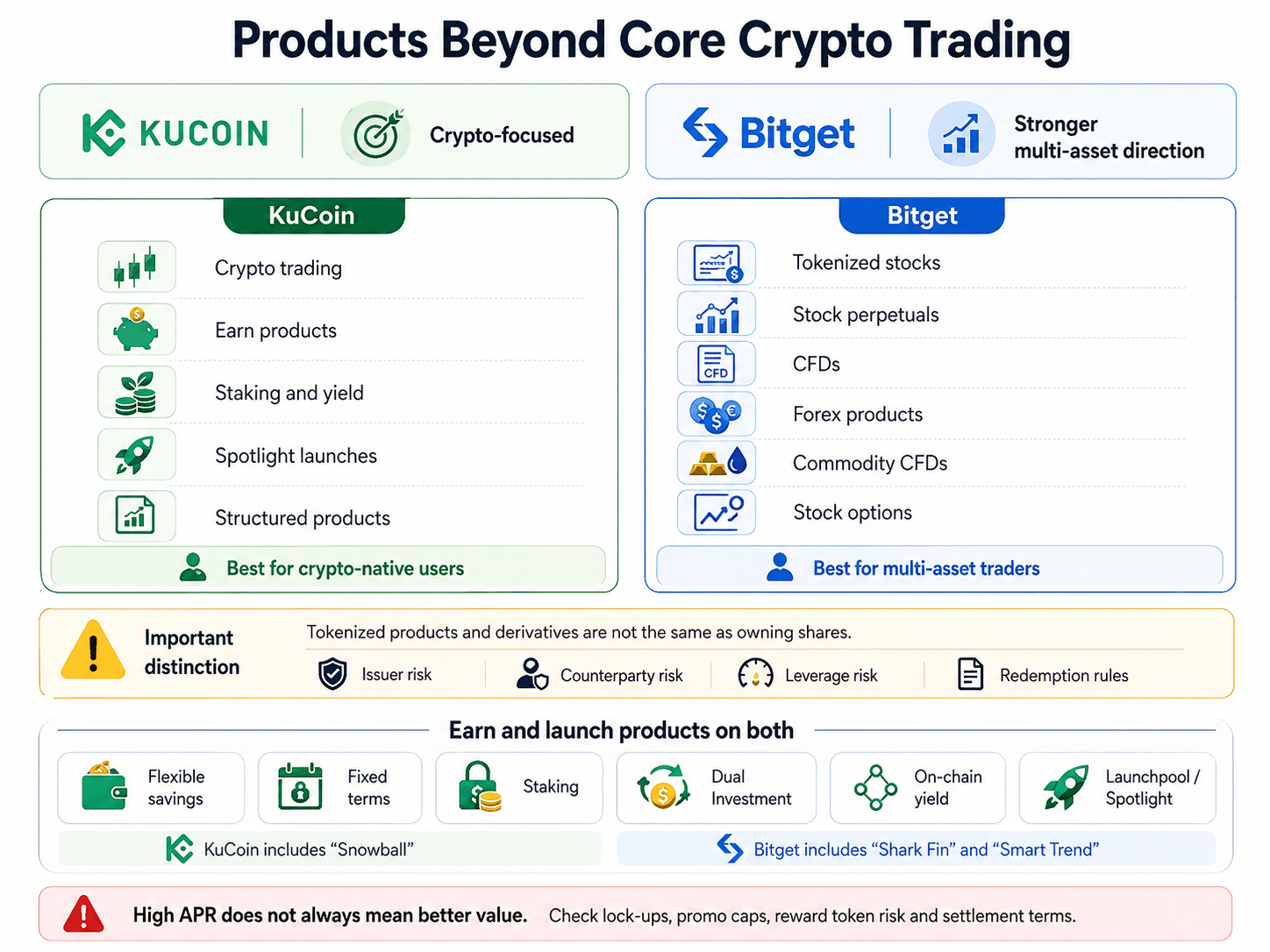
Bitget has the stronger non-crypto product direction. KuCoin remains centered on crypto trading, yield products and token launches.
 Bitget Expands Beyond Crypto While KuCoin Stays Focused
Bitget UEX, Tokenized Stocks and Traditional-Market Products
Bitget UEX is designed to combine crypto and traditional-market exposure within one account.
| Product | What It Represents | Conventional Share Ownership? | Main Risk |
|---|---|---|---|
| Tokenized Stock | Blockchain-based representation linked to an equity | Depends on issuer structure | Issuer, custody and redemption risk |
| Stock Perpetual | Derivative tracking a stock-linked index | No | Leverage, funding and liquidation |
| CFD | Contract settling a price difference | No | Counterparty and leverage risk |
| Forex Product | Exposure to currency movements | Usually no direct currency custody | Leverage and pricing risk |
| Commodity CFD | Contract linked to a commodity price | No physical ownership | Counterparty and market risk |
| Stock Option | Contractual right linked to an equity price | No direct ownership | Premium can expire worthless |
Bitget listed more than 200 stock perpetuals in July 2026. These contracts trade around the clock, settle in USDT and provide synthetic exposure rather than shareholder ownership.
It also launched U.S. stock options on July 2, 2026, initially supporting long calls and puts for eligible users. The option buyer can lose the entire premium.
Users should confirm:
- Whether the product is a token, perpetual, CFD or option
- The contracting entity
- Issuer and counterparty
- Trading hours
- Redemption rights
- Dividend and voting treatment
- Margin rules
- Regional eligibility
For spot-only crypto users, UEX adds little value. For multi-asset derivatives traders, it is one of Bitget’s strongest advantages.
Earn, Launchpads and Other Crypto Products
Both exchanges provide savings, staking, on-chain yield, structured products and token-launch platforms.
| Risk Category | Typical Products | Main Exposure |
|---|---|---|
| Lower Complexity | Flexible savings and selected staking products | Exchange custody and variable yield |
| Locked Or Protocol Based | Fixed terms, staking and on-chain Earn | Lock-up, protocol and liquidity risk |
| Market Linked | Launchpools and token campaigns | Token price and allocation risk |
| Structured Or Higher Risk | Dual Investment, Shark Fin and trend products | Conditional settlement and principal risk |
KuCoin Earn includes flexible and fixed products, staking, on-chain opportunities, Dual Investment and Snowball. Bitget Earn includes flexible savings, fixed terms, staking, Dual Investment, Shark Fin, Smart Trend and on-chain yield products.
A high APR may reflect:
- A short promotional period
- A small subscription cap
- A volatile reward token
- A DeFi incentive
- A lock-up
- A structured settlement condition
- Elevated borrowing demand
Users should check whether the return is fixed, variable or promotional, whether early redemption is available and which asset will be returned at settlement.
KuCoin Spotlight and Bitget Launchpool provide access to token distributions and launches. Their practical value depends on allocation caps, token-locking requirements and the market value of the distributed asset.
Fiat Deposits, Crypto Withdrawals and P2P Trading
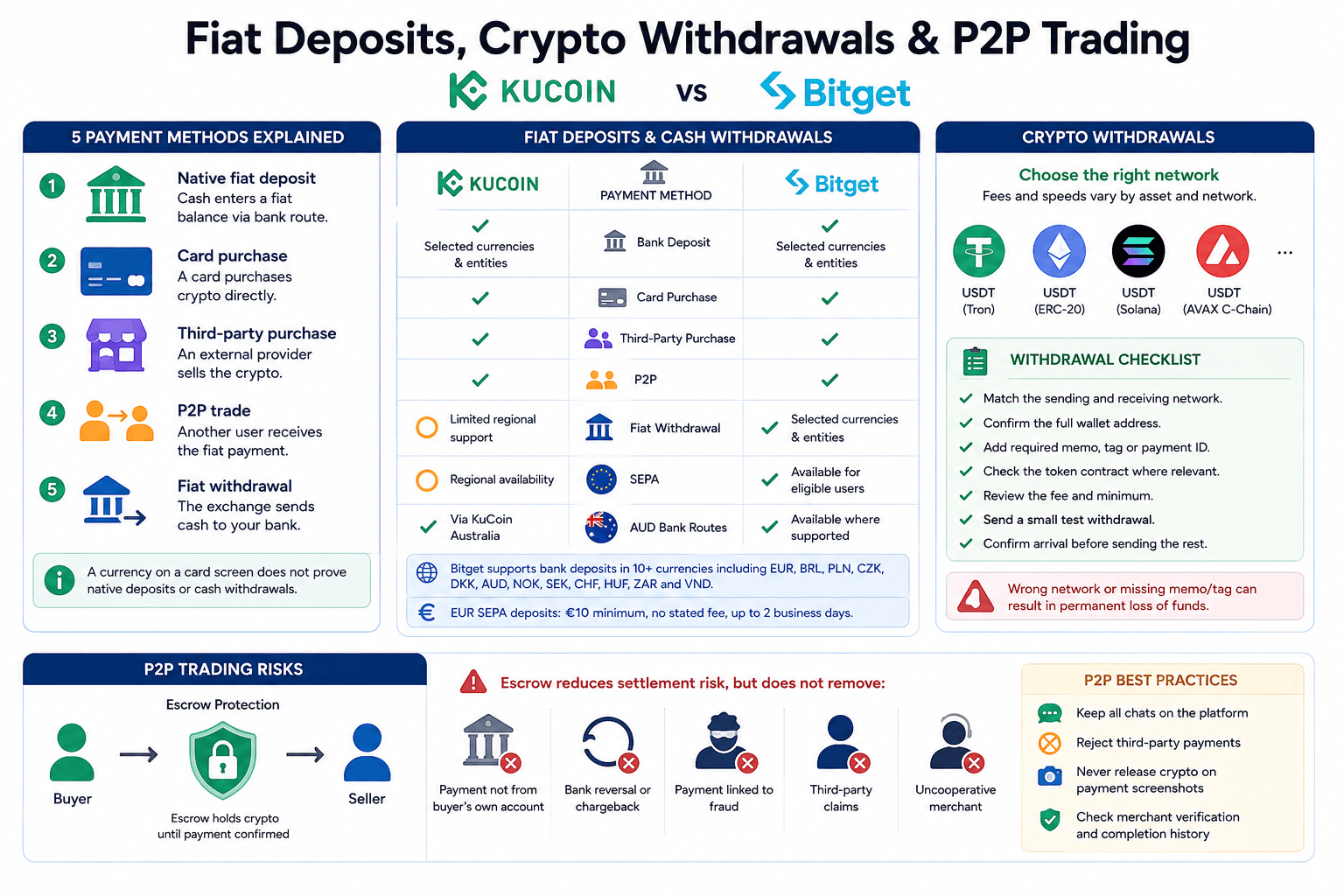
Neither exchange has one worldwide fiat system. Bank routes, currencies, processing times and withdrawal eligibility depend on the user’s country and account entity.
 Payment Routes And Withdrawal Costs Depend On Region
Fiat Deposits and Cash Withdrawals
Bitget has the wider bank-currency menu, while KuCoin’s strongest native routes are concentrated in selected markets such as Australia.
Five payment methods are often confused:
- Native fiat deposit: Cash enters a fiat balance through an exchange banking route.
- Card purchase: A card purchases crypto directly.
- Third-party purchase: An external provider sells the crypto.
- P2P trade: Another user receives the fiat payment.
- Fiat withdrawal: The exchange sends cash to a bank account.
A currency appearing on a card-purchase screen does not prove that the exchange supports native deposits or cash withdrawals in that currency.
| Payment Method | KuCoin | Bitget | Main Caveat |
|---|---|---|---|
| Bank Deposit | Selected currencies and entities | Selected currencies and entities | KYC and account-name matching |
| Card Purchase | Yes | Yes | Provider and conversion markup |
| Third-Party Purchase | Yes | Yes | Separate provider terms |
| P2P | Yes where permitted | Yes where permitted | Merchant and banking risk |
| Fiat Withdrawal | Limited regional support | Selected currencies | Country and entity eligibility |
| SEPA | Regional availability | Available for eligible users | Account ownership requirements |
| AUD Bank Routes | Available through KuCoin Australia | Available where supported | Local account requirements |
Bitget’s bank-deposit documentation lists routes for EUR, BRL, PLN, CZK, DKK, AUD, NOK, SEK, CHF, HUF, ZAR and VND, among others.
For eligible EUR users, SEPA deposits had a €10 minimum and no stated Bitget deposit fee, with standard transfers generally taking up to two business days.
KuCoin Australia supports AUD balances and direct bank withdrawals. Users elsewhere may rely more heavily on cards, P2P or outside providers.
The final amount of crypto received is more useful than the advertised payment fee because provider markups and conversion spreads can exceed the visible commission.
Crypto Withdrawals and Network Selection
There is no universal withdrawal-fee winner. Fees and minimums change by asset, network and blockchain conditions.
USDT illustrates the problem. An exchange may support Ethereum, Tron, Solana and several other networks, each with a different fee. The destination must support the same network.
The same issue applies to:
- BTC across Bitcoin and wrapped representations
- ETH across Ethereum and Layer 2 networks
- USDC across multiple smart-contract chains
- Tokens issued through several bridges or contract addresses
Use this withdrawal checklist:
- Match the sending and receiving network.
- Confirm the full wallet address.
- Add the required memo, tag or payment ID.
- Check the token contract where relevant.
- Review the fee and minimum.
- Send a small test withdrawal.
- Confirm arrival before moving the remaining balance.
Selecting the wrong network can permanently lose funds. Network suspensions can also delay withdrawals during maintenance, chain upgrades or security reviews.
Address whitelisting reduces the chance of an attacker replacing the destination address. Large withdrawals should still begin with a test transaction.
P2P Trading Risks
Both exchanges offer P2P marketplaces in eligible regions. Escrow reduces settlement risk but does not remove banking, fraud or chargeback risk.
Escrow can stop crypto from being released before payment is confirmed. It cannot guarantee that:
- The fiat came from the buyer’s own account
- A bank will not investigate or reverse the payment
- The payment is unconnected to fraud
- A third party will not claim unauthorized activity
- The merchant will cooperate during an appeal
Merchant verification and completion history help with screening, but they do not provide the protections of a conventional bank transfer.
Users should keep communication inside the platform, reject third-party payments and never release crypto based on a payment screenshot.
Is KuCoin or Bitget Safer?
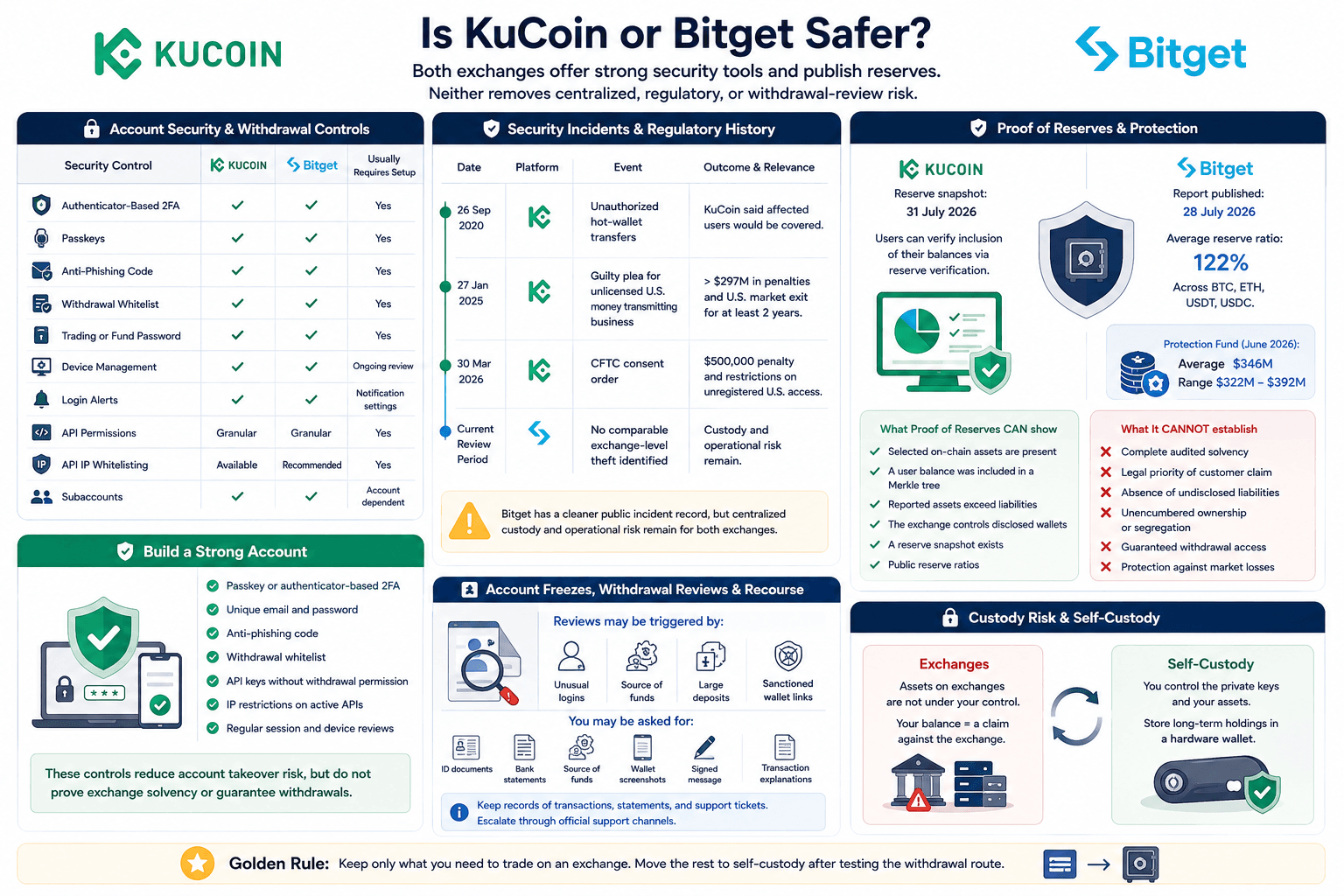
Both exchanges provide standard account-security controls and publish reserve information. Neither removes centralized custody, regulatory or withdrawal-review risk.
 Security Evidence Remains Mixed Across Both Centralized Exchanges
Account Security and Withdrawal Controls
KuCoin and Bitget provide broadly comparable account protections.
| Security Control | KuCoin | Bitget | Usually Requires Setup |
|---|---|---|---|
| Authenticator-Based 2FA | Yes | Yes | Yes |
| Passkeys | Yes | Yes | Yes |
| Anti-Phishing Code | Yes | Yes | Yes |
| Withdrawal Whitelist | Yes | Yes | Yes |
| Trading Or Fund Password | Yes | Yes | Yes |
| Device Management | Yes | Yes | Ongoing review |
| Login Alerts | Yes | Yes | Notification settings |
| API Permissions | Granular | Granular | Yes |
| API IP Whitelisting | Available | Recommended | Yes |
| Subaccounts | Yes | Yes | Account dependent |
KuCoin supports passkey-based login, anti-phishing codes, address whitelisting and an additional trading password.
Bitget supports passkeys, anti-phishing codes, withdrawal whitelisting, cross-device confirmation and IP-bound API keys.
A strong account setup includes:
- Passkey or authenticator-based 2FA
- A unique email and password
- Anti-phishing code
- Withdrawal whitelist
- API keys without withdrawal permission
- IP restrictions on active APIs
- Regular session and device reviews
These controls reduce account-takeover risk. They do not prove exchange solvency, legal asset segregation or unrestricted withdrawal access.
Security Incidents and Regulatory History
KuCoin has the more serious confirmed incident and enforcement history. Bitget has no comparable publicly confirmed exchange-level theft in the evidence reviewed, though it remains exposed to custody and operational risk.
| Date | Platform | Event | Outcome And Relevance |
|---|---|---|---|
| Sept. 26, 2020 | KuCoin | Unauthorized hot-wallet transfers | KuCoin said affected users would be covered |
| Jan. 27 2025 | KuCoin | Guilty plea for operating an unlicensed U.S. money transmitting business | More than $297 million in penalties and a U.S. exit |
| March 30, 2026 | KuCoin | CFTC consent order | $500,000 penalty and restrictions on unregistered U.S. access |
| Current Review Period | Bitget | No comparable confirmed exchange-level theft identified | Custody and operational risk remain |
During KuCoin’s September 2020 security incident, assets were moved from hot wallets without authorization. KuCoin suspended deposits and withdrawals and said affected user funds would be covered.
Peken Global, a KuCoin operator, pleaded guilty, to operating an unlicensed U.S. money transmitting business. The settlement included more than $297 million in penalties and a commitment to leave the U.S. market for at least two years.
On March 30, 2026, a federal court entered a CFTC consent order requiring a $500,000 penalty and barring unregistered U.S. access to KuCoin’s trading system.
Bitget’s cleaner public incident record favors it in this category.
Proof of Reserves and User Protection Arrangements
Both exchanges publish Proof of Reserves. Bitget adds a publicly valued Protection Fund, but neither arrangement creates bank-style deposit insurance.
KuCoin’s reserve page showed a July 31, 2026 snapshot with reserve ratios above 100%
Bitget’s report published on July 28, 2026 reported an average reserve ratio of 122% across BTC, ETH, USDT and USDC. Wallet balances, addresses and Merkle-tree attestations were included in the disclosure.
| What Proof of Reserves Can Show | What It Does Not Establish |
|---|---|
| Selected on-chain assets are present | Complete audited solvency |
| A user balance was included in a Merkle tree | Legal priority of the customer claim |
| Reported assets exceed reported liabilities | Absence of undisclosed liabilities |
| The exchange controls disclosed wallets | Unencumbered ownership or segregation |
| A reserve snapshot exists | Guaranteed withdrawal access |
| Public reserve ratios | Protection against market losses |
Bitget’s Proof of Reserves system publishes wallet data and Merkle-tree verification.
Its Protection Fund averaged about $346 million. The fund adds a separate pool that Bitget may use in qualifying circumstances, but it is not universal insurance.
Account Freezes, Withdrawal Reviews and User Recourse
Either exchange may review a withdrawal after KYC. Common triggers include unusual login behavior, source-of-funds concerns, sanctioned-wallet exposure, large deposits, recent account changes or transactions that conflict with the user’s profile.
A review may require:
- Updated identity documents
- Proof of address
- Bank statements
- Source-of-funds evidence
- Wallet screenshots
- A signed wallet message
- Transaction explanations
- Evidence connecting the user to a sending wallet
Users should retain deposit and withdrawal transaction IDs, bank statements, purchase receipts, trade-history exports, wallet evidence and support-ticket numbers.
Anonymous online complaints can identify possible failure modes, but they do not establish a platform-wide pattern. Formal escalation should remain inside the exchange’s support and complaint process.
KuCoin vs Bitget: Which Exchange Should You Choose?
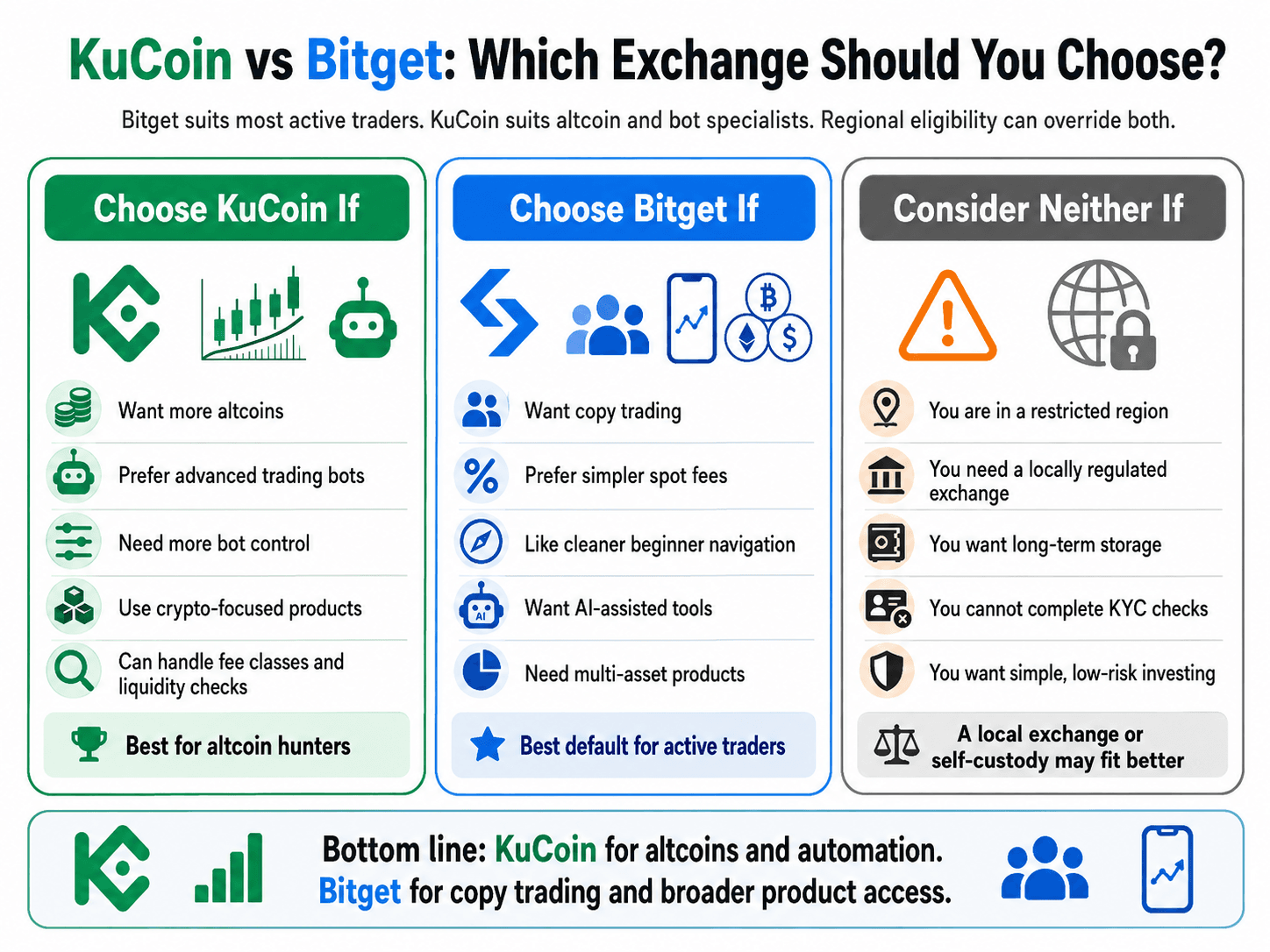
Bitget is the stronger default for most active traders, while KuCoin remains the specialist choice for altcoins and configurable automation. Regional eligibility can override either recommendation.
 Bitget Wins Broadly, KuCoin Serves Specialist Crypto Traders
Choose KuCoin If
KuCoin is likely the better fit when you:
- Prioritize smaller and less widely listed altcoins
- Want grid, DCA, Martingale or rebalancing strategies
- Need more control over bot parameters
- Use spot margin and crypto-focused products
- Understand Class A, B and C trading fees
- Can legally access the required markets and withdrawal networks
- Are prepared to test liquidity rather than rely on coin counts
KuCoin is less compelling when the chosen altcoin has a thin order book, a higher fee class or restricted withdrawals.
Choose Bitget If
Bitget is likely the better fit when you:
- Prioritize spot or futures copy trading
- Want clearer lead-trader discovery
- Prefer cleaner beginner and mobile navigation
- Want AI-assisted trading tools
- Need tokenized stocks, stock perpetuals, options or other TradFi products
- Prefer a simpler standard spot-fee structure
- Can access the desired products through your regional entity
Bitget's advanced products remain high risk. Copy trading can reproduce another trader’s leverage mistake, while stock perpetuals and CFDs provide contractual exposure rather than conventional ownership.
Consider Neither Exchange If
Consider another setup when you:
- Live in a prohibited jurisdiction
- Require a locally regulated domestic exchange
- Expect insured, bank-like deposits
- Cannot provide KYC or source-of-funds documentation
- Plan to leave long-term holdings on the platform
- Do not understand leverage or liquidation
- Expect copy trading or bots to generate reliable profits
- Need direct legal ownership of conventional securities
- Want a simple spot-only purchase and withdrawal flow
A regulated local exchange, spot-only venue or self-custody setup may be more suitable depending on the objective.

Final Verdict
- Overall Winner: Bitget for most active traders.
- Best for Altcoins and Bots: KuCoin.
- Best for Copy Trading and Multi-Asset Access: Bitget.
- Best for Long-Term Storage: Neither.
Bitget wins because its copy-trading ecosystem, cleaner interface and multi-asset expansion serve a wider group of active traders. KuCoin retains a defensible niche among altcoin specialists and users who want greater control over automated strategies.