TrustSwap sits at the intersection of crypto launchpads and token infrastructure. It helps Web3 projects raise funds, lock tokens, manage vesting schedules and handle post-launch token operations, while giving investors access to selected IDOs through SWAP staking.
This TrustSwap review breaks down how the platform works, what the SWAP token is used for, how Team Finance fits in, where TrustSwap is useful, and where the risks sit in 2026.
Editor's Note (May 28, 2026): We fully updated this TrustSwap review in May 2026 to reflect the platform's current positioning as both a crypto launchpad and Web3 token infrastructure provider. We refreshed the article with updated details on SWAP staking, Team Finance, launchpad access, supported chains, fees, restrictions, competitors, safety risks, and TrustSwap’s role in the 2026 IDO market.
TrustSwap Review 2026: Quick Verdict
TrustSwap is best understood as a Web3 infrastructure platform with a crypto launchpad attached, not just another IDO site. Its core strength is the mix of launchpad access, SWAP staking, Team Finance, token locks, vesting, and token operations across 26 chains.
Key Takeaways on TrustSwap
-
TrustSwap is more than an IDO platform TrustSwap combines a crypto launchpad with token infrastructure, giving projects tools for fundraising, token locks, vesting, distribution, and post-sale token operations.
-
The Launchpad is built for curated token sales The TrustSwap Launchpad gives users access to selected IDOs, but participation usually requires SWAP staking, KYC, application approval, and project-specific allocation rules.
-
SWAP staking is central to access SWAP token utility is tied mainly to staking and launchpad participation. That can improve access to sales, but it also adds direct SWAP price risk on top of normal early-stage token risk.
-
TrustSwap has a real launchpad track record TrustSwap says its launchpad has helped raise $100M+ across 80+ completed launches, which gives it a stronger operating history than many smaller IDO platforms.
-
Team Finance is the infrastructure layer Team Finance is aimed at project teams and covers token creation, SmartLock, token locks, liquidity locks, vesting, staking, distribution, payroll, and whitelabel widgets.
-
Token locks improve visibility, not project quality Token locks, liquidity locks, and vesting schedules can reduce founder dump risk and liquidity pull risk, but they do not guarantee demand, execution, liquidity, or long-term project success.
-
TrustSwap supports 26 chains TrustSwap’s infrastructure spans 26 chains, with listed networks including Ethereum, BNB Chain, Avalanche, Polygon, and Solana.
-
Launchpad access is restricted TrustSwap Launchpad participation requires KYC and is restricted for US residents and users in certain blocked jurisdictions, so access depends on location and compliance rules.
-
The Crypto App is a supporting product TrustSwap’s Crypto App adds portfolio tracking, alerts, market data, and news, but it is secondary to the launchpad, SWAP staking, and Team Finance infrastructure stack.
-
TrustSwap is a specialist platform Binance Launchpad has more exchange reach, CoinList has a more compliance-heavy sale model, PinkSale is more open, and Seedify is more niche. TrustSwap stands out most when launch access and token infrastructure are both important.
Disclaimer
This guide is for educational purposes only and is not financial advice. TrustSwap, SWAP token, IDOs, crypto launchpads, token locks, vesting tools, and early-stage token sales can involve market volatility, liquidity risk, smart contract risk, regulatory restrictions, and total loss. Always review the project, tokenomics, lock schedule, jurisdiction rules, fees, and contract risks before using or investing in crypto.
Disclosure
Some links in this guide may be affiliate links. If you choose to use a service through these links, we may earn a commission at no additional cost to you.

What Is TrustSwap?
TrustSwap is best understood as a Web3 infrastructure platform, not just an IDO platform. In simple terms, it gives crypto projects the tools to raise funds, manage token supply, and handle distribution, while also giving investors a route into selected sales through SWAP staking. If a normal launchpad is like a storefront, TrustSwap is closer to the full back office as well, covering parts of the launch, the token mechanics, and the post-sale setup. Web3 infrastructure is the wider frame that makes the platform easier to understand.
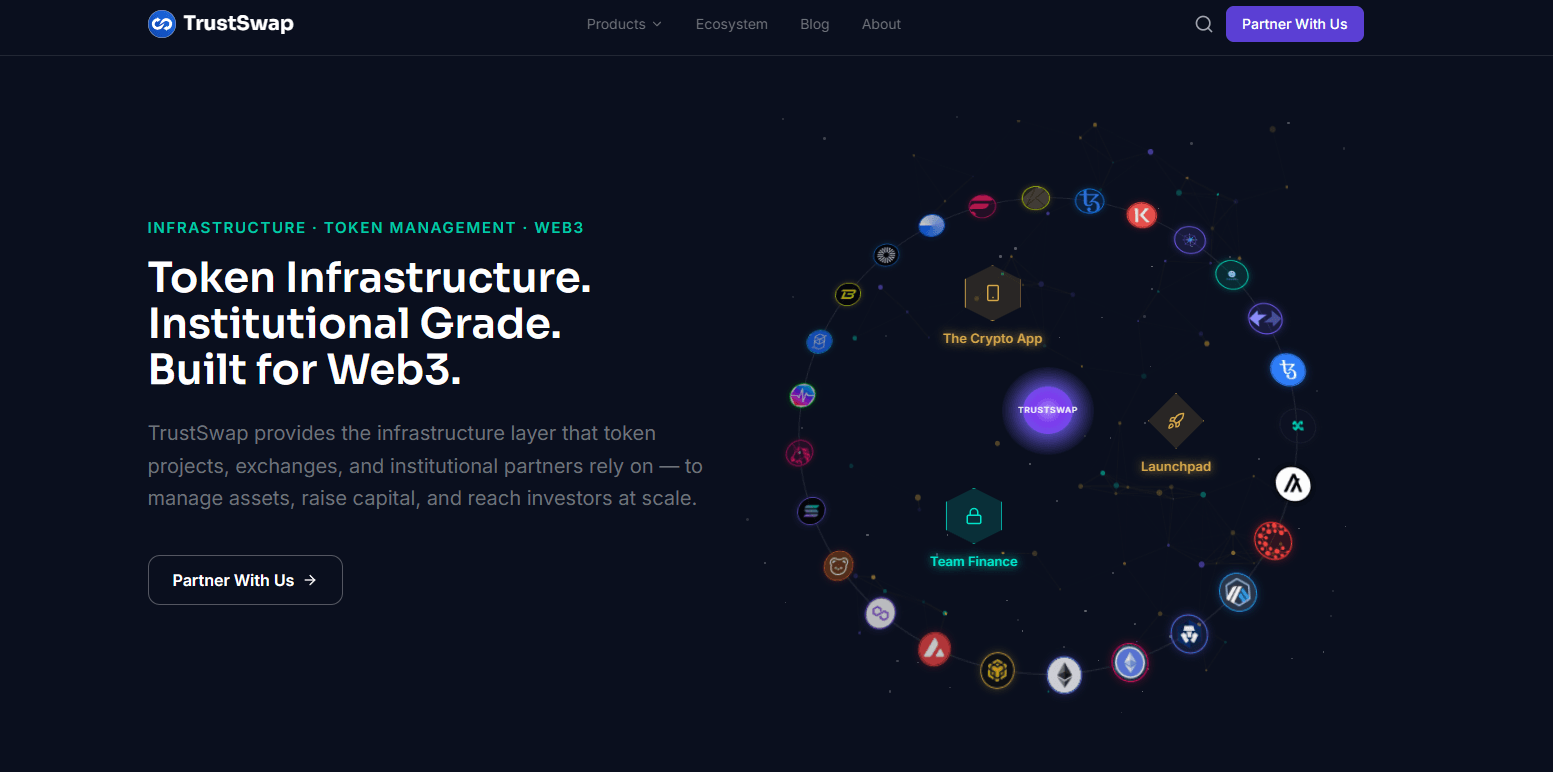 TrustSwap is best Understood as a Web3 Infrastructure Platform, not just an IDO Platform. Image via TrustSwap
The first pillar is the TrustSwap Launchpad, which handles token fundraising for selected projects. TrustSwap describes it as a fundraising platform with due diligence, KYC infrastructure, and integrated token management. For investors, access is tied to staking SWAP, so participation is not completely open in the way it is on some permissionless launch sites.
The second pillar is Team Finance, where tools such as SmartLock, token locks, liquidity locks, and vesting sit. This is the operational side of TrustSwap. A useful analogy is a timed safe: tokens can be seen on-chain, but they cannot be moved until the agreed schedule unlocks them. That does not guarantee a project will succeed, but it can make token handling more transparent.
TrustSwap also includes The Crypto App, a consumer product focused on portfolio tracking, alerts, market data, and news. Older tools such as SmartSwap, escrow, and subscription payments still matter as part of TrustSwap’s history, but in 2026 they are supporting context rather than the platform’s main draw. Portfolio tracking is the clearest use case there.
TrustSwap at a Glance
Category | Details |
|---|---|
Founded | 2020 |
Native Token | |
Main Products | Launchpad, Team Finance, Token Locks, Vesting, Staking, Token Operations |
Best For | IDO Investors and Project Teams |
Launchpad Track Record | $100M+ Raised Across 80+ Completed Launches |
Supported Chains | 26 Chains |
Token Lock Tools | |
KYC | Required for Launchpad Participation |
US Access | |
Main Risks | SWAP Price Volatility, Early-Stage Token Risk, Liquidity Risk, Allocation Competition |
How TrustSwap Works
TrustSwap is easier to understand when you break it down by user type rather than by feature list. At a high level, it serves three groups:
- Launchpad investors
- Project teams
- Token communities
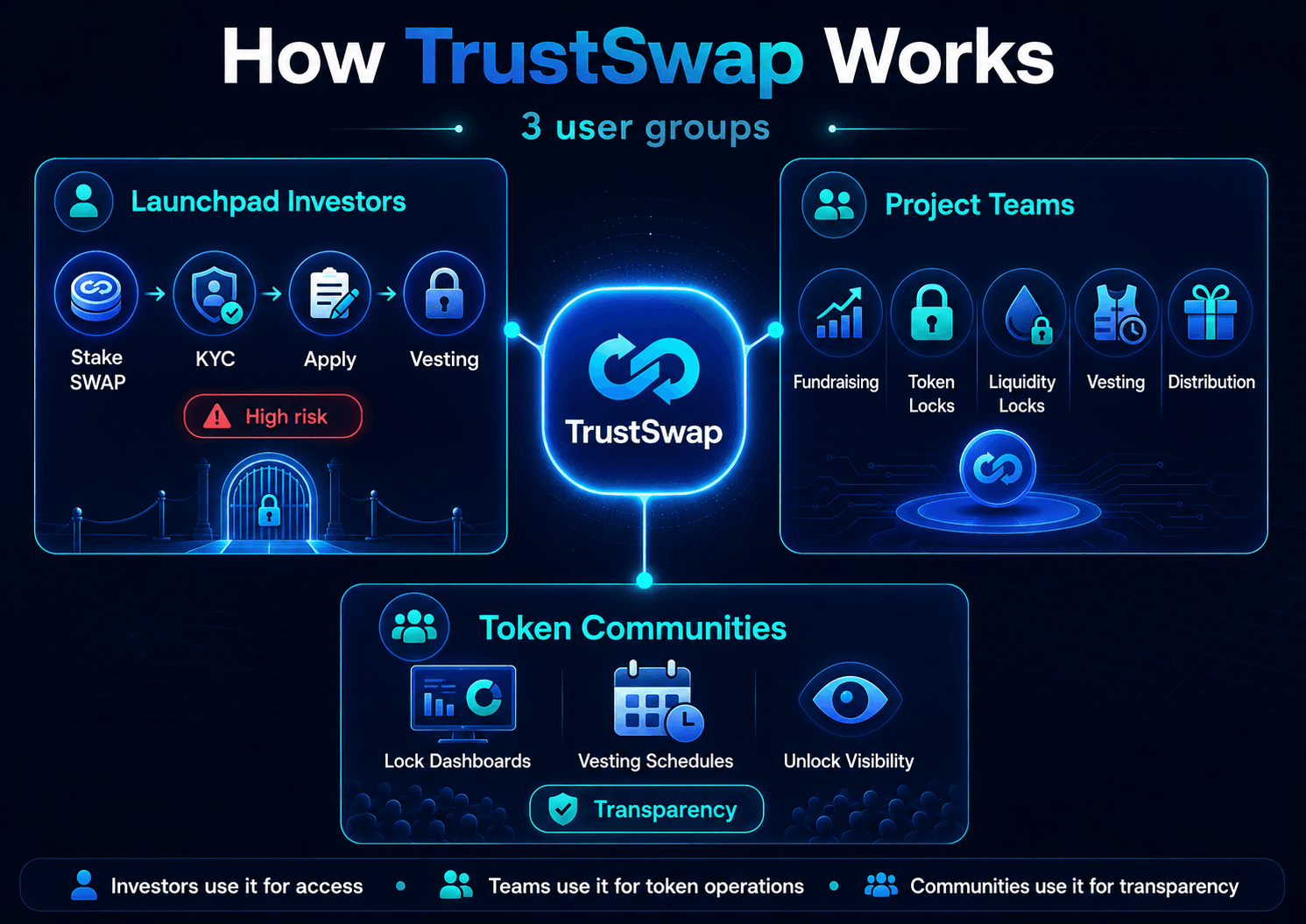 At a High Level, TrustSwap Serves Three Groups: Launchpad Investors, Project Teams, and Token Communities
For Launchpad Investors
For investors, TrustSwap works like a gated sale system. Users stake SWAP, complete KYC, and then apply for a sale through the TrustSwap Launchpad. With TrustSwap’s Long Term Staking Pools (LTSP), staking level and platform rules can influence access or weighting for an IDO allocation.
If an investor is approved, tokens are often released through vesting rather than unlocked all at once. That is important because launchpad access is not the same as guaranteed profit. TrustSwap’s own terms and conditions make that clear, stating that launch participation carries a high degree of risk.
For Project Teams
For project teams, TrustSwap is more than a fundraising page. It can be used for fundraising, launch support, and token management, while Team Finance adds token locks, liquidity locks, vesting, and distribution tooling. This is where the platform’s B2B value sits: it helps project founders control when tokens unlock, how supply is released, and how those rules are shown on-chain.
For Token Communities
For token communities, the main benefit is transparency. Public lock dashboards and vesting schedules can make it easier to see when team allocations or LP positions are due to unlock, which can reduce some forms of rug pull risk. But they do not fix weak demand, poor tokenomics, bad execution, or wider market selloffs. TrustSwap’s tools can make token movement easier to monitor, not make a weak project strong.
That is the core of how TrustSwap works: investors use it for gated launch access, teams use it for token operations, and communities use it for better visibility around token movement.
TrustSwap Launchpad
The TrustSwap Launchpad is a curated fundraising platform for Web3 projects. Its main appeal is not just access to early token sales, but the fact that fundraising sits alongside token locks, vesting, and post-sale infrastructure. TrustSwap says its launchpad has raised $100M+ across 80+ completed launches, which gives it a stronger operating record than many smaller IDO platforms.
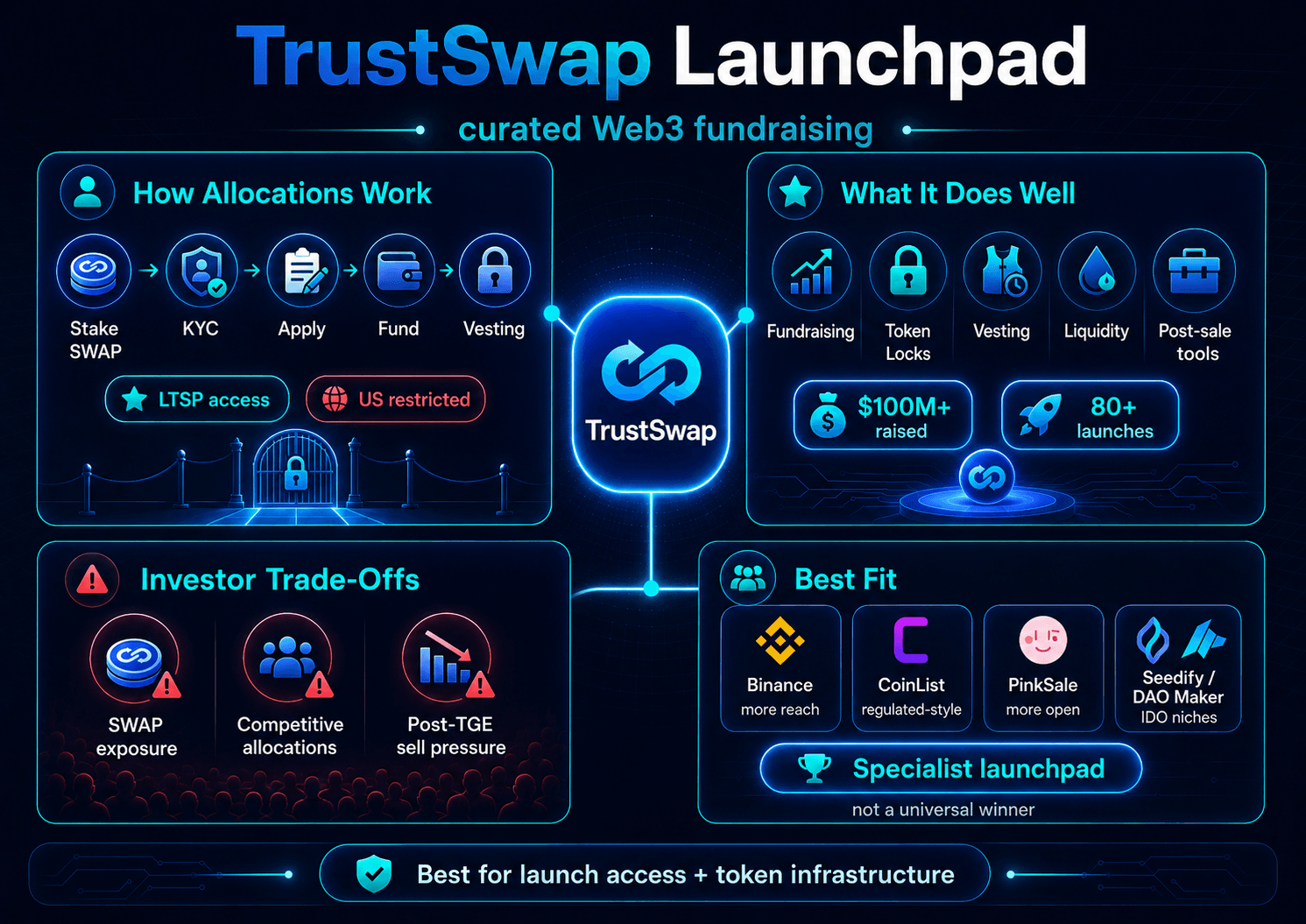 The TrustSwap Launchpad is a Curated Fundraising Platform for Web3 Projects
How TrustSwap Launchpad Allocations Work
For investors, the process starts with staking SWAP, completing KYC, and applying for a sale. With TrustSwap's Long Term Staking Pools (LTSP), allocation access can depend on staking level, platform rules, and project-specific terms. Once approved, users fund their place in the sale and then receive tokens based on the project’s release schedule. In many cases, that means vesting rather than a full unlock on day one. US residents are restricted from launchpad participation.
What TrustSwap Does Well as a Launchpad
TrustSwap’s strongest feature is that it combines fundraising with token infrastructure. Many launches do not fail at the sale stage, but later when token distribution, liquidity, or unlock schedules are poorly handled. TrustSwap is better positioned than many simple IDO sites because it also supports lockups, vesting, and founder-side token operations.
Where TrustSwap Launchpad Falls Short
The main weakness is the trade-off required from investors. Access often depends on staking SWAP, which adds token exposure on top of normal early-stage project risk. Allocations can also be competitive, and even a strong launch can face post-TGE sell pressure once trading begins.
Is TrustSwap the Best Crypto Launchpad?
TrustSwap can be a strong option for users who want launch access tied to token infrastructure, but it is not the best fit for everyone. Binance Launchpool has more exchange reach, CoinList offers a more regulated-style model, PinkSale is more open, and Seedify and DAO Maker serve different IDO niches. In that sense, TrustSwap is best seen as a specialist launchpad, not a universal winner.
Is TrustSwap Safe?
Yes, TrustSwap has useful safety tools, especially token locks, liquidity locks, vesting schedules, and launchpad vetting. These can reduce specific risks such as team dumps and sudden liquidity pulls, but they do not make early-stage crypto investing safe.
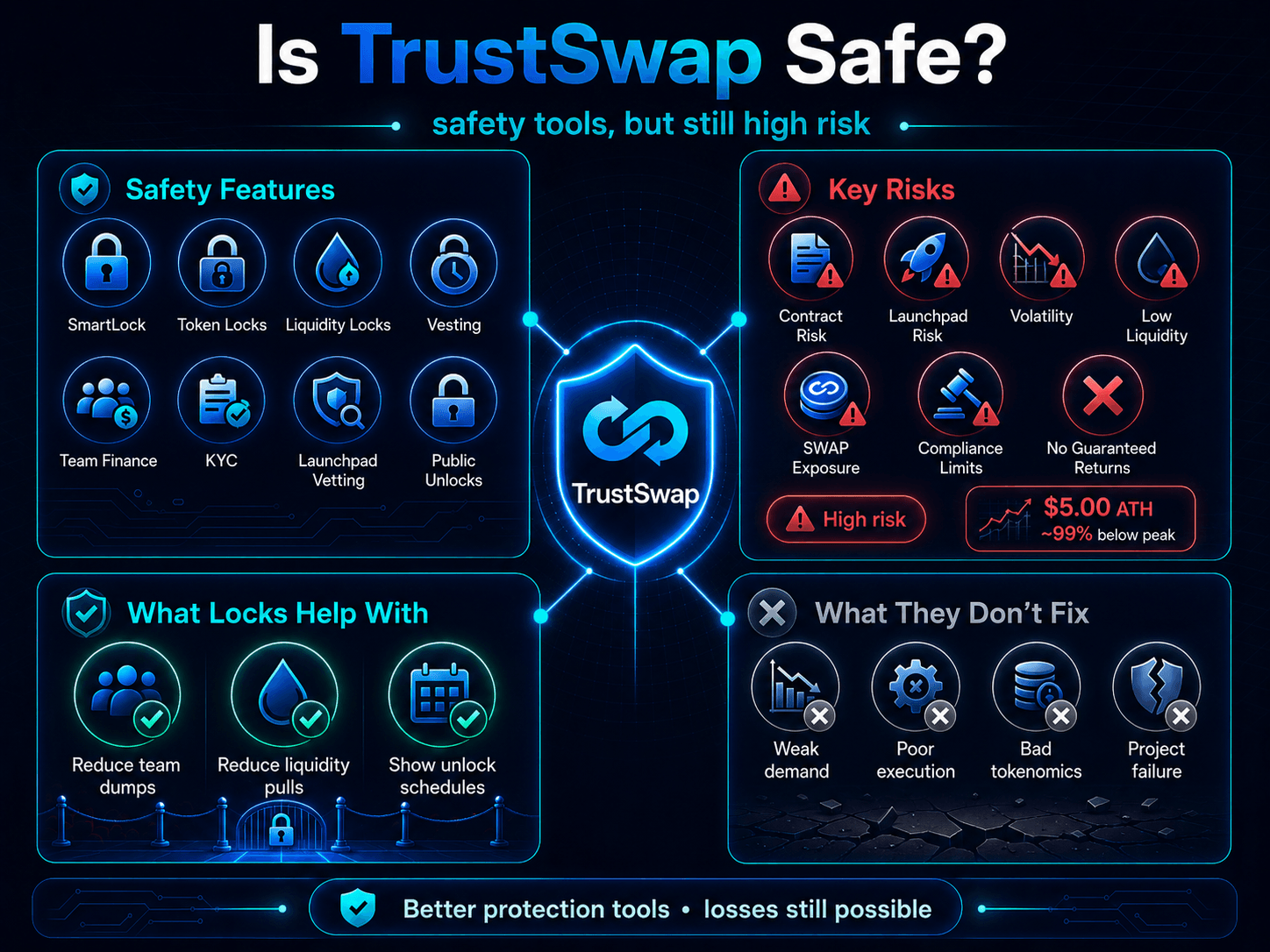 TrustSwap has useful Safety Tools, especially Token Locks, Liquidity Locks, Vesting Schedules, and Launchpad Vetting
TrustSwap Safety Features
- SmartLock: Helps lock tokens on a time-based schedule.
- Token Locks: Can reduce the risk of founders or insiders selling immediately.
- Liquidity Locks: Can make sudden liquidity removals harder.
- Vesting Schedules: Spread token releases over time instead of unlocking everything at once.
- Team Finance: Provides the infrastructure layer for locks, vesting, and token operations.
- KYC: Adds an identity check for launchpad participation.
- Launchpad Vetting: TrustSwap presents its launchpad as a curated environment rather than an open listing board.
- Public Release Schedules: Help users see when tokens are due to unlock.
TrustSwap Risks
- Smart Contract Risk: No on-chain platform is completely free from contract failure or exploits.
- Launchpad Risk: Even vetted early-stage projects can fail after launch.
- Token Price Volatility: Launchpad tokens can swing sharply once trading begins.
- Low-Liquidity Tokens: Small markets can fall fast when selling starts.
- SWAP Staking Exposure: Access to deals can require holding a volatile asset.
- Regulatory Limits: TrustSwap’s terms and conditions make clear that participation may require identity verification and other onboarding checks, and access can be restricted based on compliance requirements or jurisdiction. TrustSwap also makes clear that users face substantial risk, including total loss, token volatility, smart-contract or network issues, and limited recourse if something goes wrong.
- No Guaranteed Returns: TrustSwap does not promise profit, and neither does access to a sale.
- SWAP Price History on CoinGecko: CoinGecko lists SWAP’s all-time high at $5.00 and shows it trading about 99% below that peak.
For readers thinking through that trade-off, our explainer on Most Common Smart Contract Attacks is a useful companion.
What Token Locks Actually Protect Against
- They can reduce founder dump risk.
- They can reduce liquidity pull risk.
- They can make token unlock schedules visible.
- They do not guarantee demand, strong execution, or project success.
TrustSwap has stronger investor protection tools than many basic launch setups, but it still operates in a high-risk part of crypto where losses remain possible.
Team Finance: TrustSwap's Token Infrastructure Layer
Team Finance is the part of TrustSwap built for founders and Web3 teams rather than retail investors. It is a token management toolkit covering token creation, locks, vesting, staking, distribution, payroll, and whitelabel widgets across 26 chains. In other words, if the launchpad is the public-facing sale layer, Team Finance is the operational layer behind it.
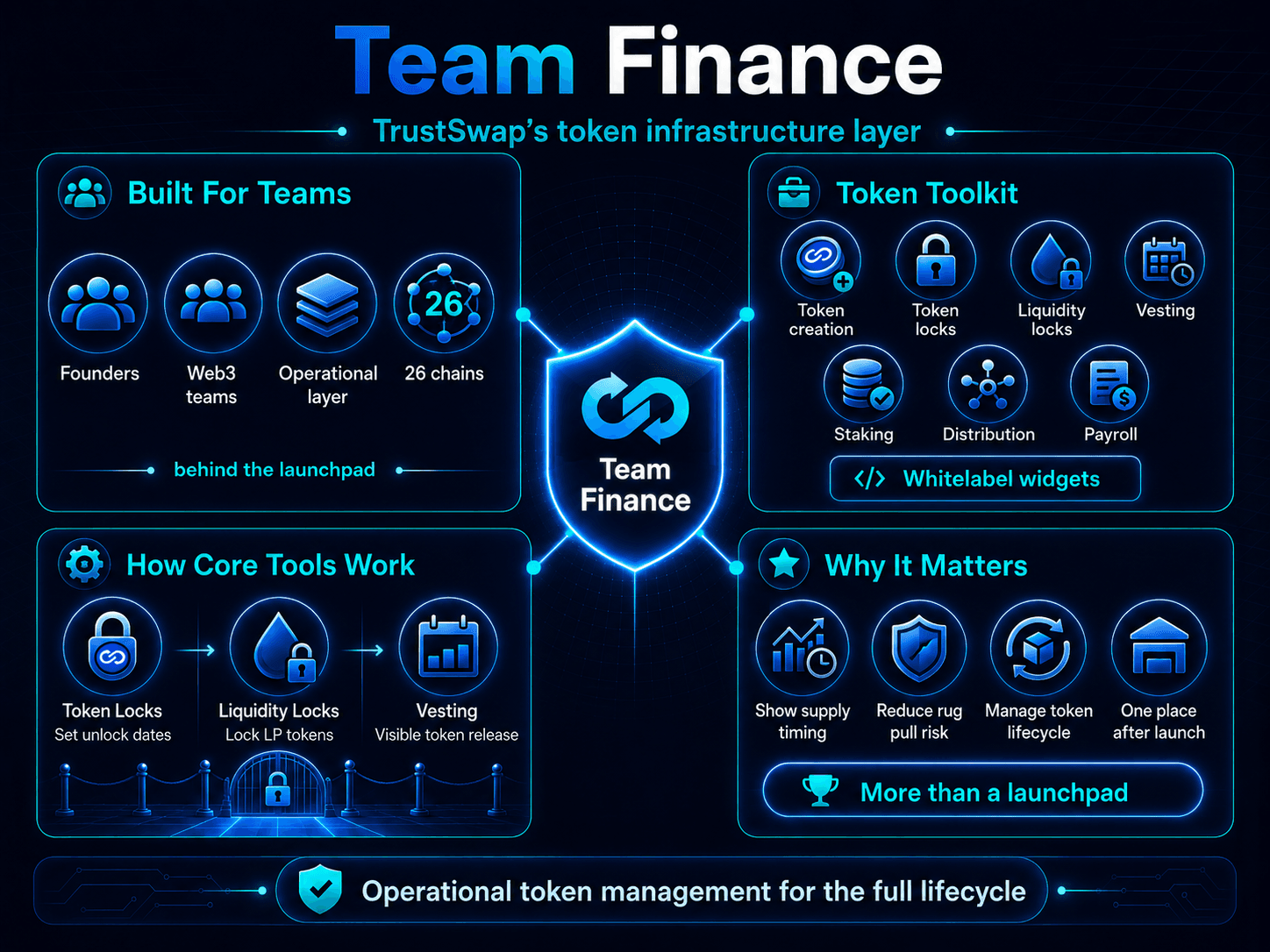 Team Finance is the Part of TrustSwap Built for Founders and Web3 Teams rather than Retail Investors
Token Locks
For teams and early investors, token locks are used to hold allocations on a set unlock schedule. That makes it easier for communities to see when supply may enter the market instead of guessing when insider wallets could move.
Liquidity Locks
Liquidity locks address a different problem. When a team provides liquidity, it receives LP tokens. If those LP tokens stay under direct team control, liquidity can potentially be removed. Locking them until a fixed date reduces that risk and gives users more visibility into how long liquidity is meant to remain in place.
Vesting
Vesting applies to team allocations, seed rounds, private rounds, advisors, airdrops, and community incentives. Good vesting can reduce sudden supply shocks. Bad vesting can still create sell pressure, but at least the schedule is visible in advance.
Token Creation and Distribution Tools
TrustSwap also positions Team Finance as a broader token operations stack, with tooling for token creation, staking, distribution, payroll, and whitelabel widgets as its homepage lists out. The key point is not that it does everything, but that it gives projects one place to manage the token lifecycle after launch.
All in all, Team Finance is not a side product, but a big part of what makes TrustSwap more than just another launchpad.
SWAP Token Review: Utility, Staking and Price Risk
SWAP token can be both a utility asset and a source of risk. That is because SWAP is tied to launchpad access, but holding or staking it also exposes users to normal token volatility.
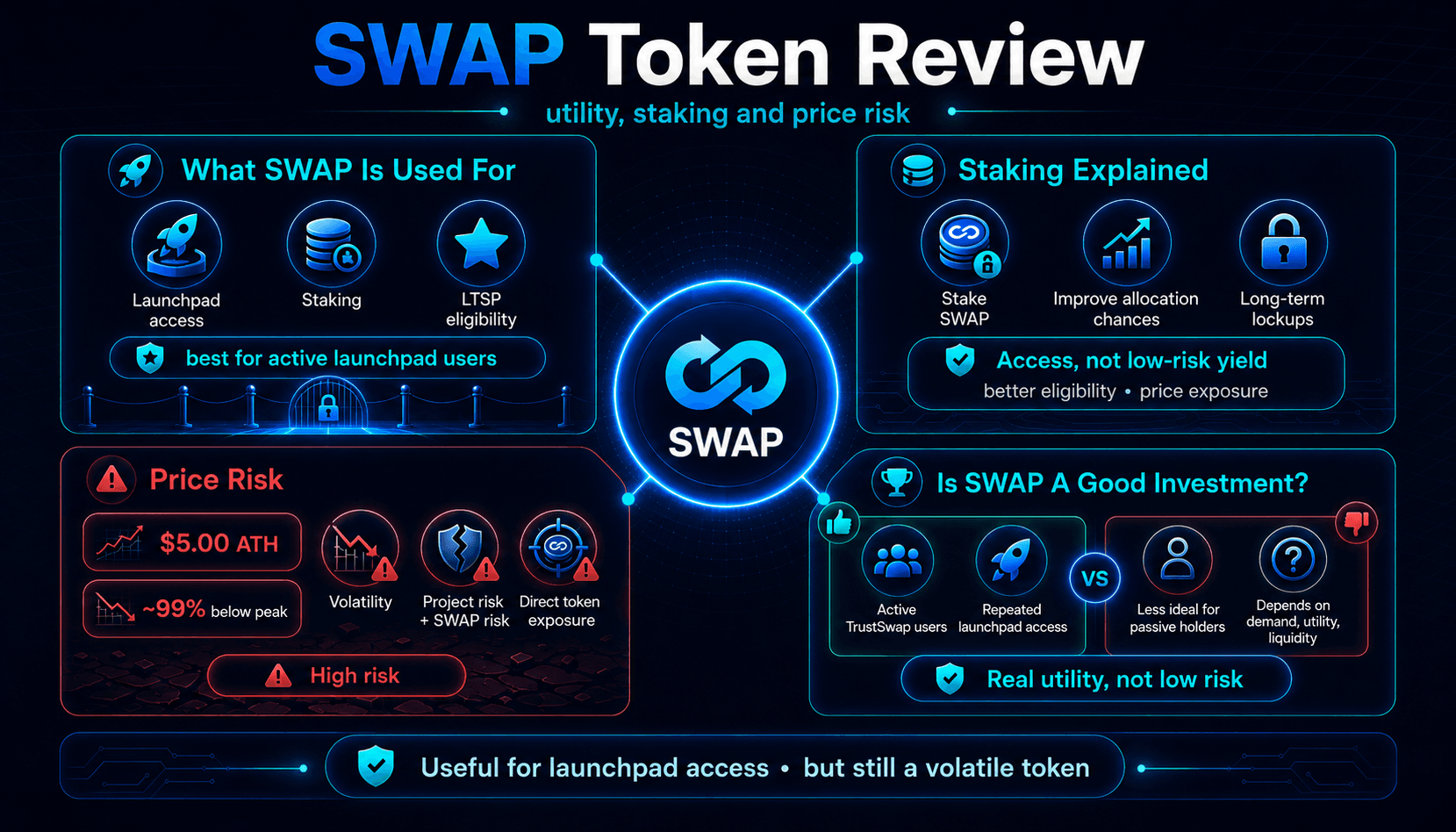 SWAP Token can be both a Utility Asset and a source of Risk
What Is SWAP Used For?
SWAP is mainly used for launchpad access and staking. TrustSwap's Long Term Staking Pools (LTSP) links staking activity to allocation eligibility for some sales. That makes SWAP more useful for active launchpad users than for passive holders looking for a simple value token.
SWAP Staking Explained
Users stake SWAP to improve their chances of getting into selected token sales. In other words, staking is less about low-risk yield and more about unlocking IDO access. TrustSwap’s staking model has also included long-term staking pools, which reward users who lock tokens for longer periods. The trade-off is straightforward: staking can improve launch eligibility, but it also means holding an asset that can move sharply in price.
For readers comparing that trade-off with simpler passive-income models, our explainer on staking adds useful context.
SWAP Price History and Risk
This is where the credibility gap comes in. CoinGecko’s SWAP page lists SWAP’s all-time high at $5.00 and shows it still trading far below that peak.
Is SWAP a Good Investment?
SWAP may make sense for users who actively use TrustSwap and want repeated launchpad access. It is much harder to justify for users who only want passive exposure. The investment case depends on launchpad demand, token utility, staking incentives, liquidity, and broader market conditions.
SWAP has real platform utility, but that does not make it a low-risk token.
TrustSwap’s Crypto App
The Crypto App is a consumer-facing product within the broader TrustSwap ecosystem, but it is supporting context rather than the core reason why most customer's might opt for TrustSwap.
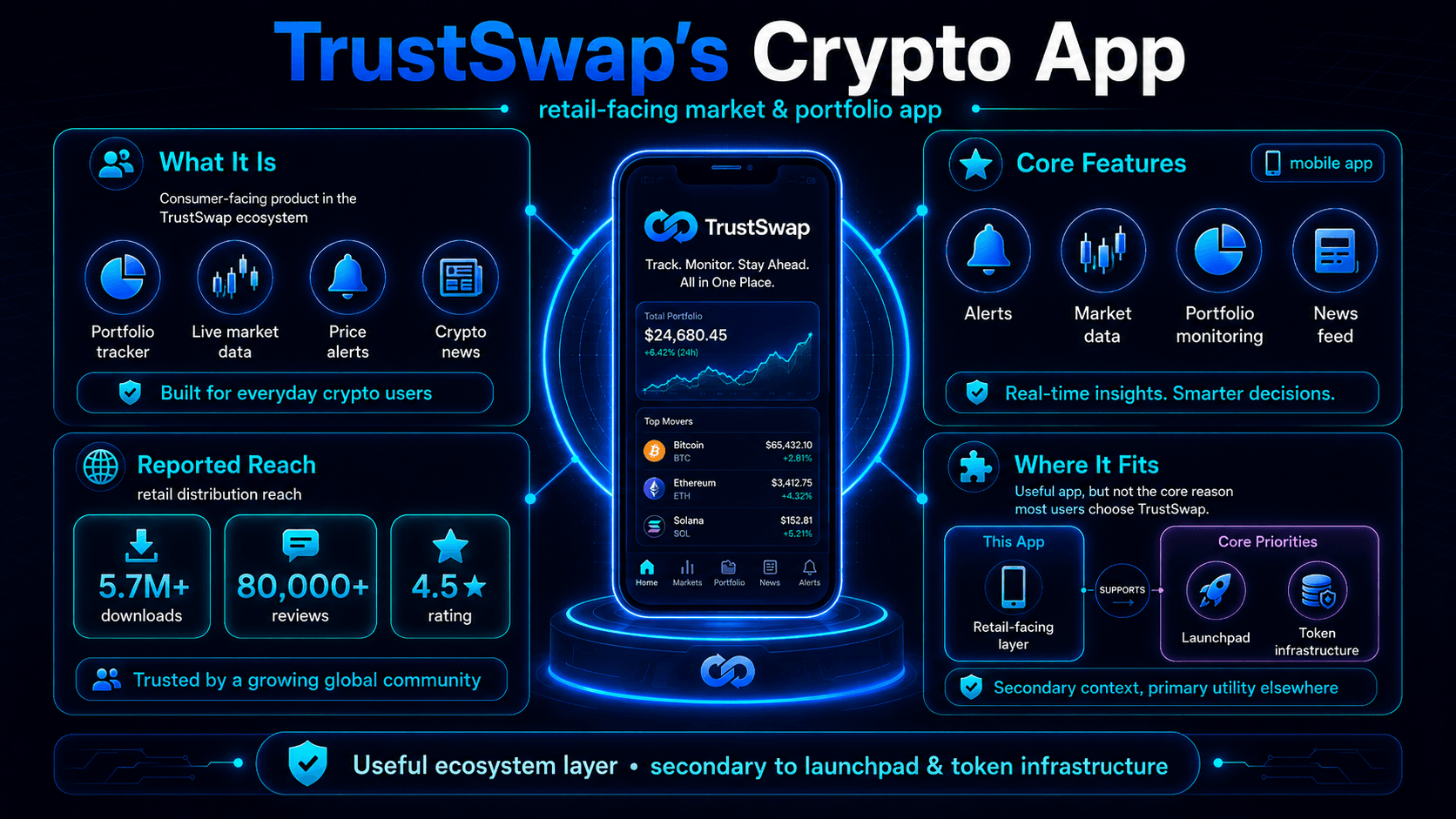 TrustSwap's Crypto App Acts as a Portfolio Tracker and Market-Data App for Mobile Users
It acts as a portfolio tracker and market-data app for mobile users, with features such as price alerts, live market data, portfolio monitoring, and a built-in crypto news feed. TrustSwap’s claims The Crypto App on Google Play Store has 1M+ downloads, 80,000+ reviews, and a 4.3-star rating, while its ecosystem page also positions the app as part of TrustSwap’s wider distribution reach.
On the Apple store, the Crypto App averages 4.7 star rating from around 2.5 thousand ratings.
The Crypto App adds a retail-facing layer to the SWAP ecosystem, but it is still secondary to TrustSwap’s launchpad and token infrastructure products.
Swappable, SmartSwap and Other TrustSwap Tools
These are secondary TrustSwap tools, so they matter more as platform context than as the core reason most users look at TrustSwap today.
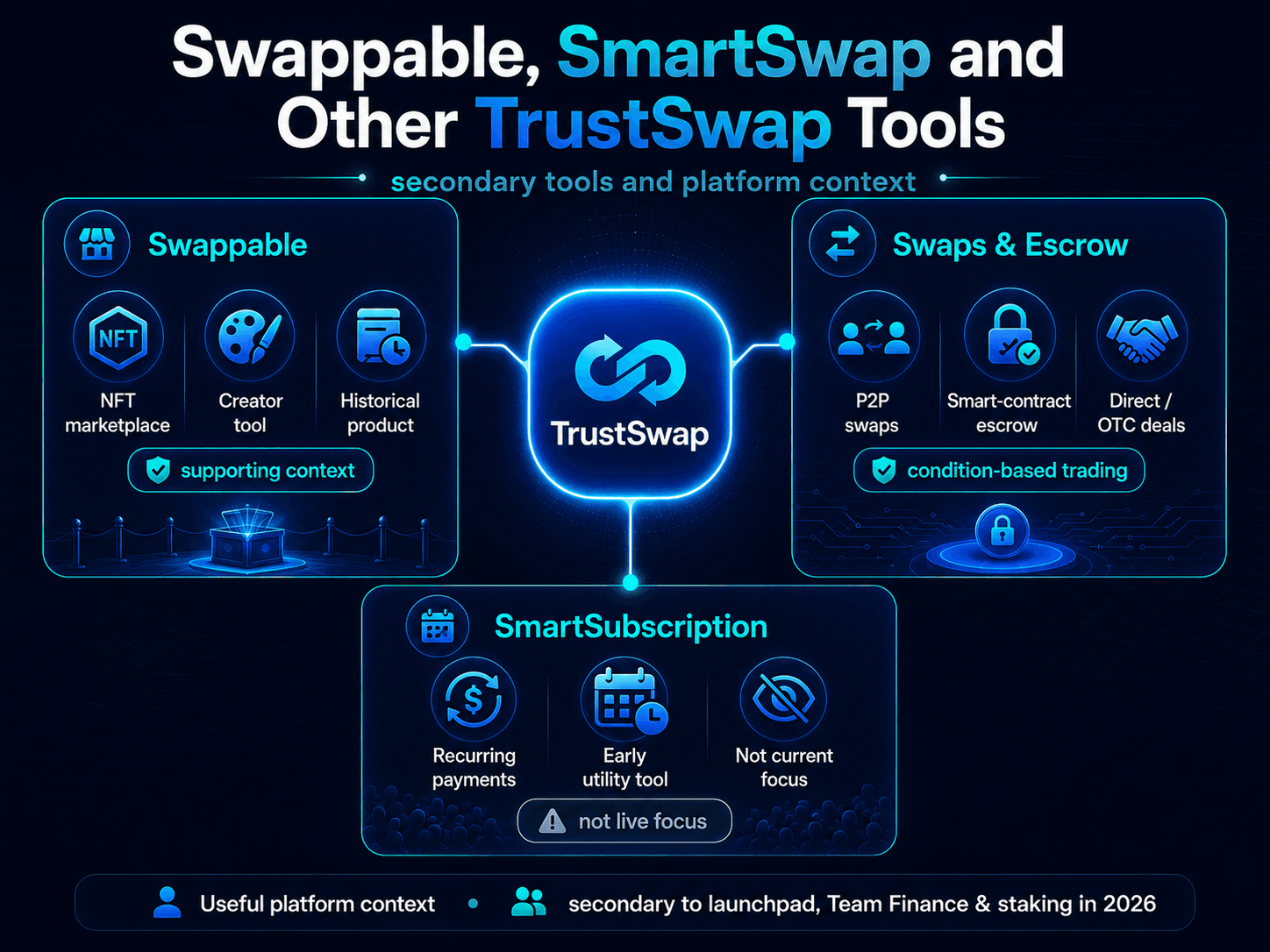 These Secondary Tools matter more as Platform Context than as the Core Reason most Users Look at TrustSwap in 2026
Swappable
Swappable was TrustSwap’s NFT marketplace and creator-facing NFT product. It is still part of the company’s historical product mix, but based on current public TrustSwap materials, it looks more like supporting context than a major active growth driver today.
Swaps and Escrow
Swaps & Escrow tools were built around a peer-to-peer token swap model. Users could set trade conditions in advance, while smart contracts held assets until those conditions were met, making the tool useful for direct deals or OTC crypto transactions without relying on a middleman.
SmartSubscription
SmartSubscription was one of TrustSwap’s earlier tools for recurring crypto payments as per the whitepaper available. It reflected the platform’s broader push to build practical smart-contract utilities beyond fundraising and token locks. However, it does not appear to be part of TrustSwap’s current live product focus and is not available anymore.
Taken together, these products help explain TrustSwap’s broader history, but they are clearly secondary to its launchpad, Team Finance, and staking model.
TrustSwap Fees, Access and Supported Chains
This is where practicality is in focus. For most users, the key questions are who can access TrustSwap, what is required to use it, which networks it supports, and whether pricing is clearly published.
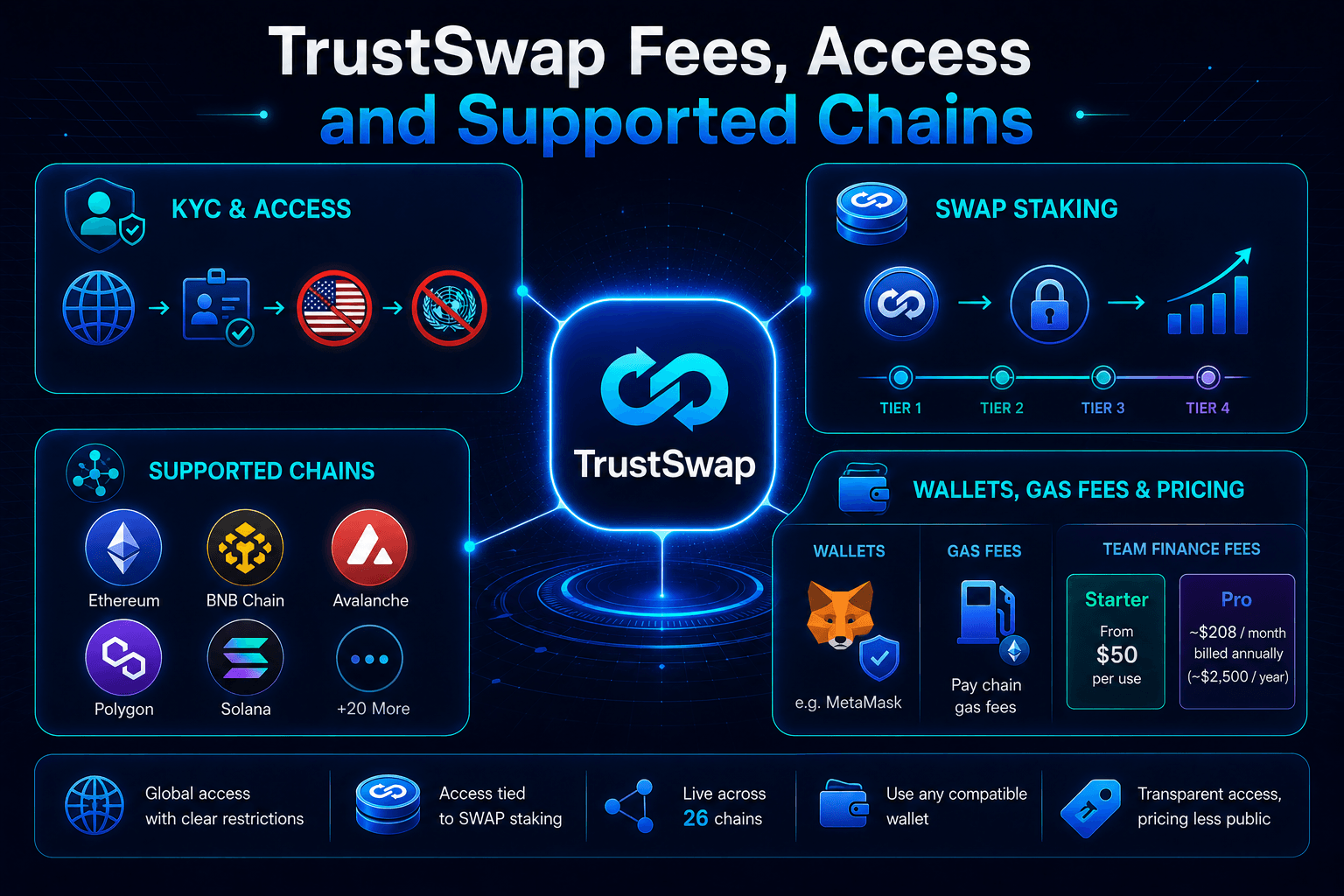 The Key Questions are who can Access TrustSwap, what is required to Use it, which Networks it Supports, and whether Pricing is clearly Published
- KYC and Access: WE have mentioned earlier as well that TrustSwap's launchpad uses global KYC infrastructure. Its current terms and conditions also say that citizens and residents of the United States and UN-sanctioned countries are not eligible to participate in Launchpad or FlashLaunch offerings.
- SWAP Staking: For launchpad users, access is tied to SWAP staking, so participation is not simply open entry. Staking level can affect launch eligibility and allocation mechanics.
- Supported Chains: TrustSwap is live across 26 chains. The listed networks include Ethereum, BNB Chain, Avalanche, Polygon, and Solana.
- Wallets and Gas Fees: TrustSwap recommends connecting a compatible wallet such as MetaMask. TrustSwap does not present one flat network fee for all actions, and s users still pay the underlying chain’s gas fees. You can read more about MetaMask in our exclusive review.
- Team Finance Fees: Team Finance currently uses a two-tier model. Depending on the blockchain you chose, the Starter plan begins at $50 per use, which is aimed at smaller projects and one-off use cases, and the Pro plan costs around $208 per month billed annually, or around $2,500 per year, and includes unlimited use of core services.
TrustSwap is broad on chain support and clear on launchpad restrictions, but current public pricing is less transparent than its access rules.
TrustSwap vs Competitors
TrustSwap is strongest when you care about launchpad access plus token infrastructure. Other platforms may be better for exchange visibility, regulated-style sales, permissionless launches, or narrower niches within the IDO market.
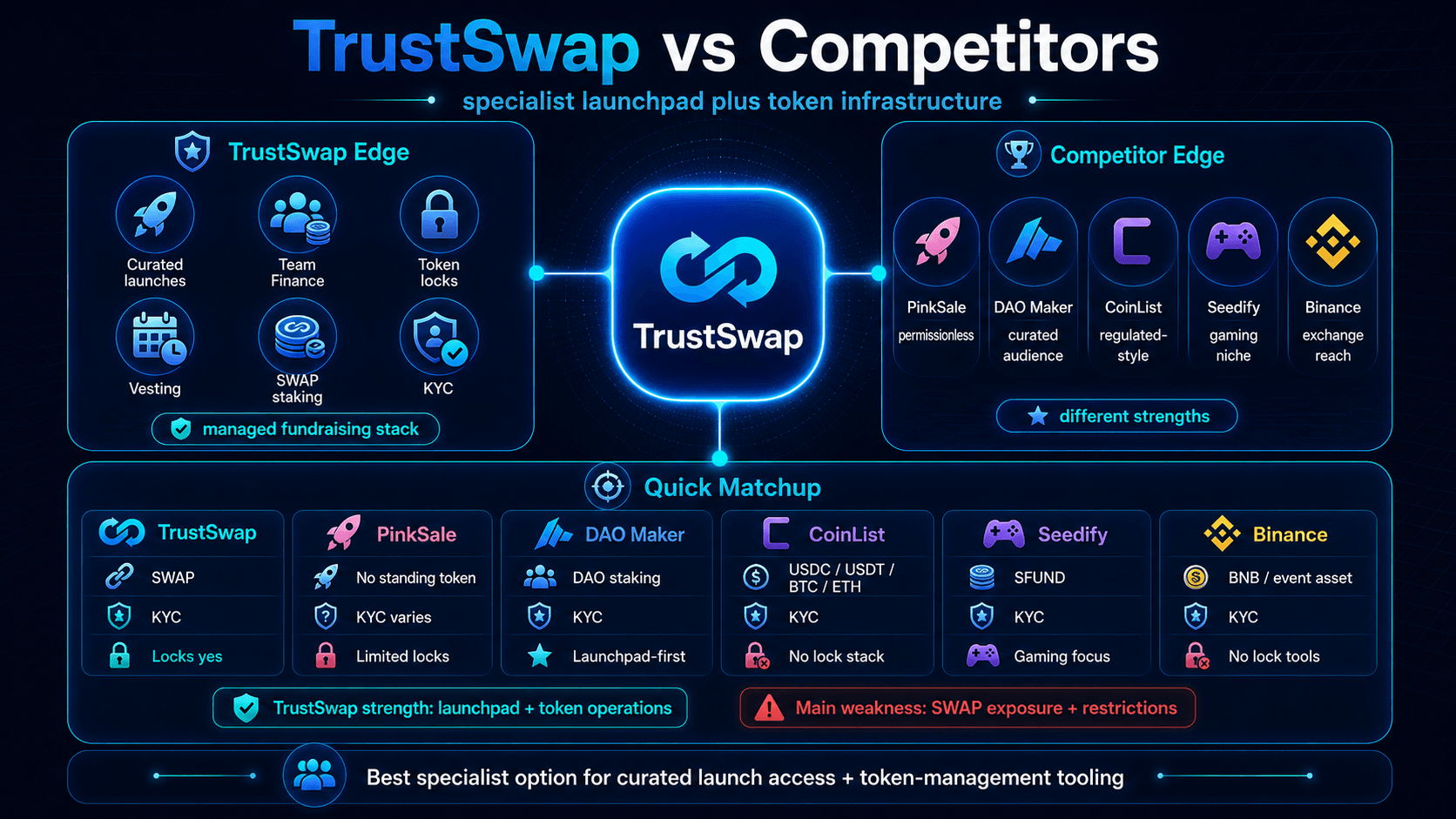 TrustSwap is Strongest when You Care about Launchpad Access Plus Token Infrastructure
Platform | Best For | Token Requirement | KYC | Token Lock Tools | Main Strength | Main Weakness |
|---|---|---|---|---|---|---|
| Curated launches plus token operations | SWAP staking for launchpad access | Yes | Yes | Launchpad plus Team Finance in one stack | SWAP exposure and launch restrictions | |
| Permissionless launches | No standing buyer token requirement; creators can pay fees in BNB or PINKSALE | Limited. Uses PinkLock | Open access and easy launch creation | Project quality varies more | ||
| Curated fundraising | DAO for Staking and DAO Power | Yes | Not a core public product focus | Large curated launch audience | Allocation model is less straightforward | |
| Regulated-style token sales | USDC, USDT, BTC, and ETH generally | Yes | More compliance-heavy sale environment | Jurisdiction limits and high competition | ||
| Gaming, metaverse, and Web3 launches | SFUND staking for IDO access. | Yes | No dedicated public token-lock toolkit prominently offered | Strong niche focus | Narrower launch category focus | |
| Exchange reach and visibility | Usually BNB or other designated assets, depending on the event | Yes | No | Massive distribution and liquidity | Very competitive and jurisdiction-dependent |
TrustSwap vs PinkSale
TrustSwap is more curated and more infrastructure-heavy. By contrast, PinkSale is designed to let almost anyone create a token and launch a sale, which makes it broader and more permissionless but also less consistent on project quality. PinkSale is the easier route for open access, while TrustSwap is the better fit for teams that want token locks, vesting, and a more managed fundraising setup.
TrustSwap vs DAO Maker
Both TrustSwap and DAO Maker focus on curated token sales rather than fully open listings. The difference is that TrustSwap stands out more on token operations, especially locks, vesting, and post-sale infrastructure, while DAO Maker is more centered on the launchpad audience and its own allocation system.
TrustSwap vs CoinList
CoinList is a stronger option for users who want a more regulated-style token sale environment. KYC/AML checks are required for participation. TrustSwap is more DeFi-native and more useful for teams that care about infrastructure around the sale, not just the sale itself.
TrustSwap vs Seedify
Seedify is more focused on gaming, metaverse, and Web3 launches. It's access is tied to SFUND staking and KYC. TrustSwap is broader across launchpad access and token infrastructure, while Seedify is more niche and sector-focused.
TrustSwap vs Binance Launchpad
Binance Launchpad and Launchpool offer much more exchange visibility and a much larger user base. Current Binance launchpool events show users locking assets such as BNB, FDUSD, and USDC to earn token rewards. TrustSwap is the smaller specialist option, and it may appeal more to users who value token lock transparency and founder tooling over pure exchange reach.
TrustSwap is one of the stronger specialist options if you want curated launch access plus token-management tooling.
For readers comparing models more broadly, our guide to the best crypto launchpads gives added context on how these platforms differ in practice.
Final Verdict: Is TrustSwap Worth Using in 2026?
TrustSwap is worth considering in 2026 for two groups in particular: experienced launchpad users and project teams that need token infrastructure as well as fundraising. TrustSwap’s positioning is broader than a simple IDO platform, with Team Finance, token creation, token locks, vesting, distribution tooling, and support across 26 blockchain networks all sitting alongside the launchpad.
The main drawback is just as important: launchpad access is tied to SWAP staking, so investors are not only taking IDO risk but also direct token-price risk.
So, TrustSwap is a strong specialist platform, but not a universal best pick. It works best for users who understand early-stage token volatility, staking trade-offs, and the limits of launchpad investing. Due diligence and clear trading strategy is your best start.