


A crypto tax report can contain correct calculations and still show the wrong tax liability. Missing purchases, duplicated imports, unmatched wallet transfers, and incorrect classifications can distort reported capital gains even when the arithmetic is flawless.
Accuracy is only one test. Taxpayers also need to protect their transaction histories, reconstruct individual gains, and keep evidence that remains accessible years after filing or switching providers. Form 1099-DA adds another check: broker-reported proceeds may not include the original acquisition information needed to calculate gains.
This article examines accuracy, auditability, security, privacy, and data portability, using CoinTracking, Koinly, and CoinLedger as documented examples.
Crypto Tax Software Accuracy and Audit-Readiness: Quick Answer
Trustworthy crypto tax software should identify missing transactions, produce traceable cost-basis calculations, protect financial records, and allow users to preserve their tax history. Accurate calculations alone are not enough. Missing purchases, duplicate imports, and misclassified wallet transfers can produce incorrect capital gains. As Form 1099-DA reporting expands, taxpayers also need to reconcile broker-reported proceeds with their complete transaction histories. CoinTracking, Koinly, and CoinLedger provide different tools for these tasks, but no platform can guarantee an accurate return from incomplete source records.
Crypto Tax Software Accuracy and Security Key Points
-
Missing transactions can produce incorrect capital gains A missing purchase can leave the cost basis unknown. For example, selling Bitcoin for $30,000 after buying it for $20,000 produces a $10,000 gain. Incorrectly assigning zero basis would inflate the reported gain to $30,000.
-
Audit-ready reports must trace gains back to original transactions A verifiable audit trail connects exchange records, wallet transfers, acquisition lots, fees, accounting methods, and disposals to the final tax figures. Annual gain totals alone are not enough to reconstruct historical calculations.
-
Form 1099-DA creates new reconciliation requirements Brokers generally began reporting applicable 2025 gross proceeds on forms furnished in 2026. Basis reporting generally begins for qualifying covered assets sold in 2026. Purchases made elsewhere may remain outside the broker's basis records, so taxpayers must reconcile their own histories.
-
Security certifications do not guarantee tax calculation accuracy ISO 27001 and SOC 2 address information-security and related controls within defined scopes. CoinTracking publishes an ISO/IEC 27001:2022 certificate valid until October 2028. Koinly publishes ISO and SOC 2 claims, while a current equivalent certificate or report for CoinLedger was not independently verified.
-
Data retention and export options affect long-term audit readiness Historical acquisition records may be needed years after a purchase. CoinTracking documents deletion 90 days after paid-plan expiry without retention coverage and offers a paid view-only option. Koinly and CoinLedger offer exports, but transaction-history files may not restore complete account settings or tax-lot choices.
-
CoinTracking, Koinly, and CoinLedger emphasize different verification tools CoinTracking offers missing-transaction checks, Form 8949 section assignment for 1099-DA reconciliation and a Roll Forward / Audit Report. Koinly provides guided import warnings and itemized gains reports. CoinLedger offers an Audit Trail CSV and a dedicated 1099-DA reconciliation dashboard. These capabilities do not establish which platform has the most accurate calculation engine.
Disclaimer
Cryptocurrency tax rules, reporting requirements, software features, security certifications, and provider policies can change. The examples and comparisons in this article reflect documented information reviewed as of Nov. 6, 2026, and do not guarantee calculation accuracy, regulatory compliance, or a successful audit outcome. Tax treatment depends on individual circumstances and applicable law. This content is for educational purposes only and does not constitute tax, legal, financial, or investment advice. Consult a qualified tax professional before filing or correcting a return.
Disclosure
Some links in this guide may be affiliate links. If you choose to use a service through these links, we may earn a commission at no additional cost to you.

Why Crypto Tax Software Gets Reports Wrong
Crypto tax software calculates gains from imported transactions. A correct calculation applied to an incomplete or misclassified history can produce a wrong return.
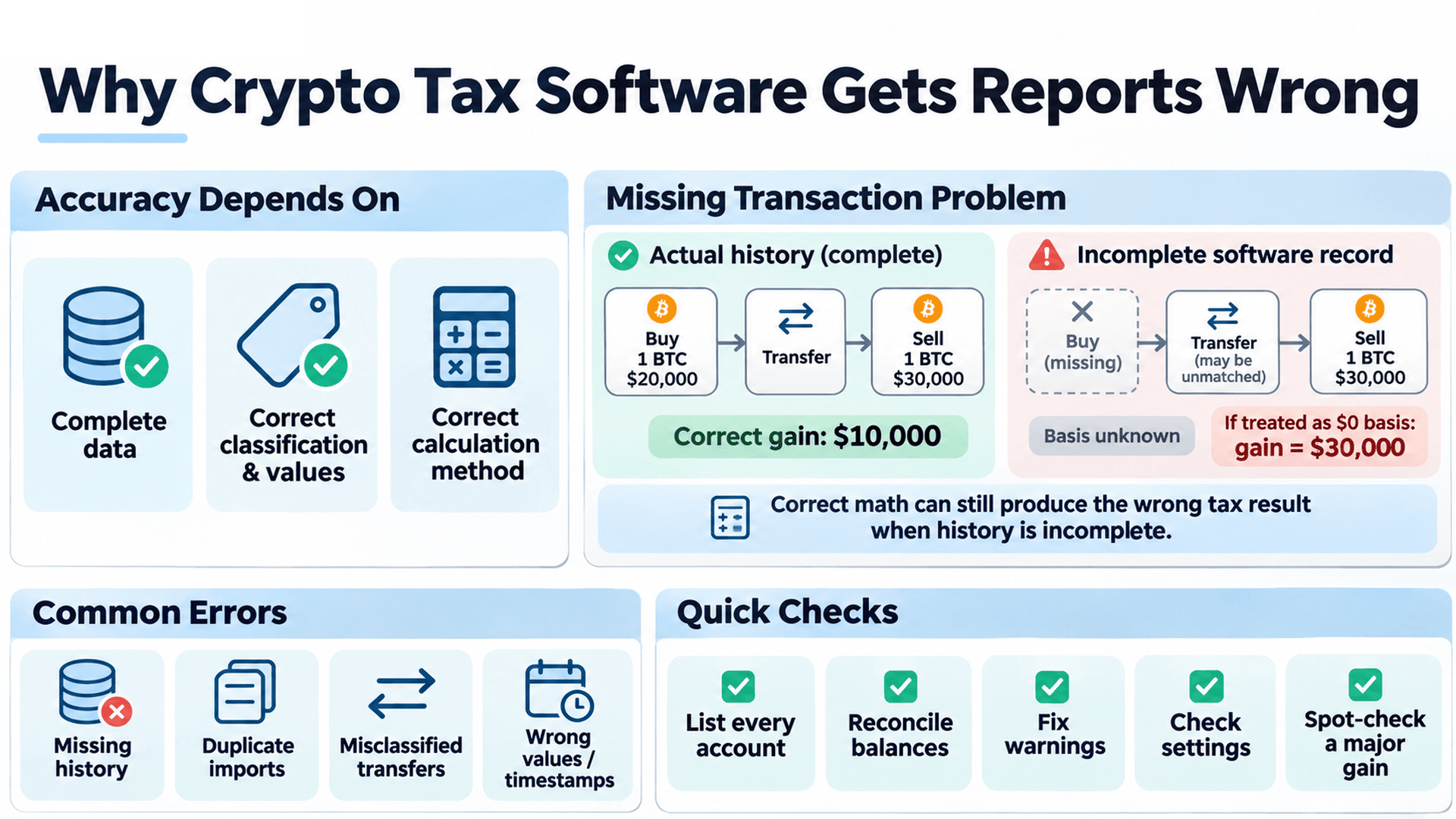 Missing Transactions, Duplicate Imports, and Incorrect Classifications Can Distort Capital Gains Calculations
The Missing Transaction Problem: When Correct Math Produces Wrong Gains
Accuracy has three components:
- Data completeness: All relevant purchases, sales, fees, income, and wallet transfers appear in the transaction history.
- Classification and valuation: Dates, assets, transaction categories, quantities, and historical fair-market values reflect what happened.
- Calculation accuracy: The software applies the appropriate accounting method, such as first-in, first-out (FIFO), to match acquisition lots with disposals and calculate gains.
A missing acquisition undermines the result regardless of how well the calculation engine works. Consider this hypothetical Bitcoin example, which returns throughout the article.
| Transaction | Actual Record | Incomplete Software Record |
|---|---|---|
| Buy 1 BTC | $20,000 | Purchase missing |
| Transfer to personal wallet | No sale | Transfer may be unmatched |
| Sell 1 BTC | $30,000 | $30,000 |
| Cost basis | $20,000 | Unknown |
| Correct capital gain | $10,000 | Cannot be reliably determined |
| Gain if software incorrectly assumes $0 basis | Not applicable | $30,000 |
Illustrative figures, excluding fees and other adjustments. They are not live Bitcoin prices.
The correct calculation is $30,000 - $20,000 = $10,000. Incorrectly treating the missing basis as zero produces a $30,000 gain, three times the actual amount. Some platforms flag missing acquisitions rather than assigning zero; the taxpayer must reconstruct the purchase.
Common Import and Classification Errors
Four errors repeatedly undermine tax records:
- Missing historical activity: Older purchases, staking income, trades on closed exchanges, and activity in unconnected wallets leave gaps in acquisition history or taxable income.
- Duplicate imports: Overlapping API and CSV records can count one trade twice. Even when a provider attempts deduplication, different exchange identifiers can prevent reliable matching.
- Misclassified wallet transfers: Moving assets between the taxpayer's own wallets generally is not a taxable sale under U.S. federal rules. An unmatched withdrawal may instead appear as a disposal, or the receiving deposit as income. Cost-basis continuity then breaks.
- Wrong valuations or timestamps: Incorrect token mapping, historical prices, time zones, or fees can alter proceeds, income values, and adjusted basis. A date shifted across Dec. 31 can even affect the tax year.
DeFi swaps, bridging, and staking add records that may be difficult to pair or classify. The task is to reconcile those events, not assume that every automated label is correct.
How to Verify That Your Crypto Tax Data Is Complete
Use original records to check the software before exporting Form 8949:
- Inventory accounts. List every exchange, self-custody wallet, and historical account, including closed or empty ones.
- Reconcile holdings. Compare imported balances and major transaction totals with statements and blockchain records.
- Investigate warnings. Resolve missing purchases, negative balances, duplicate records, and unmatched transfers using source transaction IDs.
- Review settings. Check fair-market valuations, time zones, applicable FIFO or other cost-basis settings, and wallet-level accounting.
- Recalculate a significant gain. Match the original acquisition, fees, adjusted basis, and proceeds independently against the software's figure.
Equal ending balances alone cannot prove that tax lots or classifications are correct. Two ledgers can show the same BTC holdings while assigning very different costs to the units sold.
CoinTracking documents a Missing Transactions Report for unmatched deposits and withdrawals, duplicate-transaction guidance, and a Balance Check for differences between imported and reported holdings. Its Transaction Flow and ValiCheck tools offer further validation. These are investigation aids, not automatic recovery of every missing purchase or proof that all transactions are correct.
Read our full CoinTracking review.
What Makes Crypto Tax Software Audit-Ready?
An audit-ready report preserves the evidence behind the figures. A final gains total alone is insufficient for someone trying to reproduce a calculation years later.
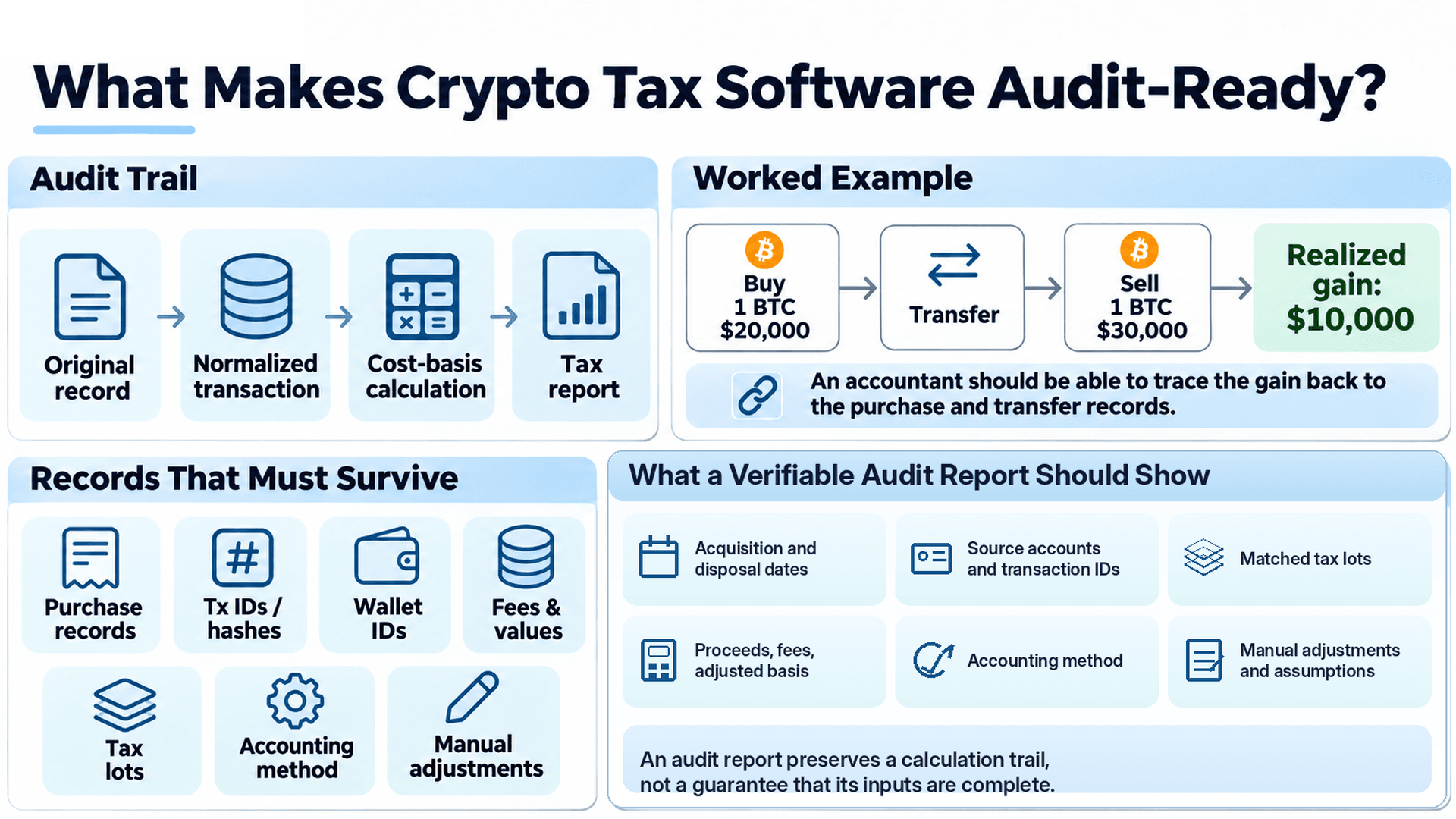 How Transaction Records, Cost-Basis Calculations, and Supporting Evidence Create a Verifiable Audit Trail
How an Audit Trail Connects Transactions to Reported Gains
A crypto tax audit trail connects a reported amount to the records and accounting choices used to produce it. The evidence chain has four stages:
- Original record: Exchange export, API transaction, trade confirmation, or blockchain transaction hash.
- Normalized transaction: Asset, date, quantity, fees, account, and transaction classification.
- Cost-basis calculation: Matched acquisition lot, disposal, adjusted basis, proceeds, and accounting method.
- Tax report: The resulting gain or loss carried into Form 8949 and Schedule D where applicable.
The Bitcoin example produces a straightforward trail:
| Evidence Stage | Verifiable Record |
|---|---|
| Acquisition | 1 BTC bought for $20,000, supported by an exchange confirmation |
| Self-custody transfer | Matched withdrawal and deposit, with basis carried forward |
| Disposal | 1 BTC sold for $30,000, with exchange transaction ID |
| Tax result | $10,000 realized gain tied to the original acquisition |
* Illustrative acquisition-to-disposal diagram, excluding fees.
An accountant should be able to work backward from the $10,000 gain to the $30,000 sale, $20,000 purchase, and intermediate transfer. The blockchain explorer can corroborate the transfer, while the exchange purchase confirmation supports the acquisition price.
A tax report contains reported figures. A transaction export lists activity. An audit trail additionally explains which acquisitions were matched to each disposal and how the resulting figures were calculated. If 1 BTC sold came from four purchases, the trail should identify the relevant lots and their contribution to adjusted basis.
Why Cost-Basis Records Must Survive Across Tax Years
Assets bought years before a sale retain their historical acquisition dates and basis, subject to applicable adjustments. A Bitcoin sale in 2026 may depend on a purchase made in 2021, with intervening moves through multiple exchanges and personal wallets.
Retain purchase statements, transaction hashes, wallet identifiers, fees, historical fair-market values, acquisition-lot records, the accounting method, and any manual corrections. Keep original source exports alongside corrected ledgers and final reports. A historical account balance or annual gains total cannot recreate individual tax lots.
Closed exchanges and expired subscriptions create practical risks: old trade statements may disappear, and a later migration may lose custom classifications or settings. The IRS recordkeeping guidance generally requires property records to be kept until the applicable limitations period expires for the year of disposal. The ordinary three-year period can be longer in specified circumstances, so acquisition evidence often needs to survive for many years.
What a Verifiable Audit Report Should Show
A useful report identifies acquisition and disposal dates, source accounts and transaction IDs, matched tax lots, FIFO or another applicable method, proceeds, fees, adjusted basis, realized gains, and unresolved assumptions or manual adjustments.
CoinTracking's Roll Forward / Audit Report shows asset movements, opening and closing balances, cumulative cost, realized gains, and expandable acquisition-to-disposal pools. Its documentation identifies exchange and transaction IDs, plus CSV, Excel, and PDF exports. Users can follow the report back to individual ledger entries.
Missing original purchases can prevent a gain from being calculated, and certain asset types may initially receive default zero-basis treatment unless corrected. The selected tax-lot method, valuations, and transaction classifications still control the result. An audit report preserves a calculation trail, not a guarantee that its inputs are complete.
How Form 1099-DA Changes Crypto Tax Accuracy and Reconciliation
Form 1099-DA makes broker-reported digital asset activity more visible to the IRS, but the broker's records may cover less activity than a taxpayer's consolidated history.
What the IRS Can See Through Form 1099-DA
The 2026 IRS instructions for Form 1099-DA establish phased reporting:
| Transaction Period | General Reporting Requirement |
|---|---|
| 2025 sales | Applicable gross proceeds generally reported, with the first forms furnished in 2026; basis reporting not yet mandatory |
| 2026 sales | Gross proceeds continue; basis generally required for qualifying covered securities, with forms furnished in 2027 |
| Noncovered assets and exceptions | Basis may be absent or voluntary; special optional methods exist for certain qualifying stablecoins and NFTs |
For this purpose, covered securities generally involve eligible assets acquired after 2025 within a reporting broker's custodial account and held there until the broker effects the sale. An asset originally purchased elsewhere and subsequently transferred in generally is noncovered. Selling crypto in 2026 therefore does not automatically mean the broker must report its basis.
The IRS receives reportable broker information, not a universal inventory of personal-wallet transfers or DeFi activity through Form 1099-DA. Taxpayers must still report applicable transactions outside those forms.
Read our full 2027 crypto tax guide.
Why Your Crypto Tax Software May Not Match Form 1099-DA
Four explanations are especially common:
- Missing acquisition history: A broker sees a disposal but lacks a purchase made elsewhere.
- Different scope: One broker reports its transactions, while software consolidates exchanges and personal wallets.
- Valuation or fee treatment: Execution prices, price feeds, timing, and transaction costs may differ.
- Import or classification errors: Missing sales, duplicate entries, or incorrect transfer labels change software results.
We'll return to the same Bitcoin example to illustrate this. The taxpayer buys 1 BTC for $20,000 on Exchange A, moves it through self-custody, and sells it for $30,000 on Exchange B. Exchange B may report $30,000 in proceeds without knowing the $20,000 acquisition basis. With complete history, tax software calculates the $10,000 gain.
A mismatch calls for reconciliation. It does not automatically indicate underreported gains or an incorrect tax return.
How to Reconcile Form 1099-DA Before Filing
- Match broker-reported disposals, quantities, dates, and proceeds to software transactions.
- Locate acquisition evidence, wallet transfers, fees, and adjusted basis.
- Separate differences in broker reporting scope from missing history, valuation differences, accounting treatment, and actual errors.
- Correct documented mistakes and retain original forms, source statements, and reconciliation records.
- Confirm how resulting figures map to Form 8949 and seek professional review for unresolved material differences.
CoinLedger's 1099-DA Dashboard documents direct comparisons between uploaded broker forms and the platform's transactions and calculations.
Koinly's 1099-DA upload workflow collects broker forms and reporting status for U.S. tax exports. CoinTracking lets users assign each disposal to the matching Form 8949 section through a 1099-DA flag, so the filed return lines up with broker-issued Forms 1099-DA. It tracks cost basis wallet by wallet under Rev. Proc. 2024-28, and its Missing Transactions Report helps locate acquisitions a broker could not see.
Coin Bureau's CoinTracking vs. Koinly vs. CoinLedger comparison examines these workflows more broadly.
How to Evaluate Crypto Tax Software Security, Privacy and Data Ownership
Crypto tax platforms can hold years of financial activity, exchange accounts, and wallet addresses. Assess protection of that information separately from the accuracy of tax calculations.
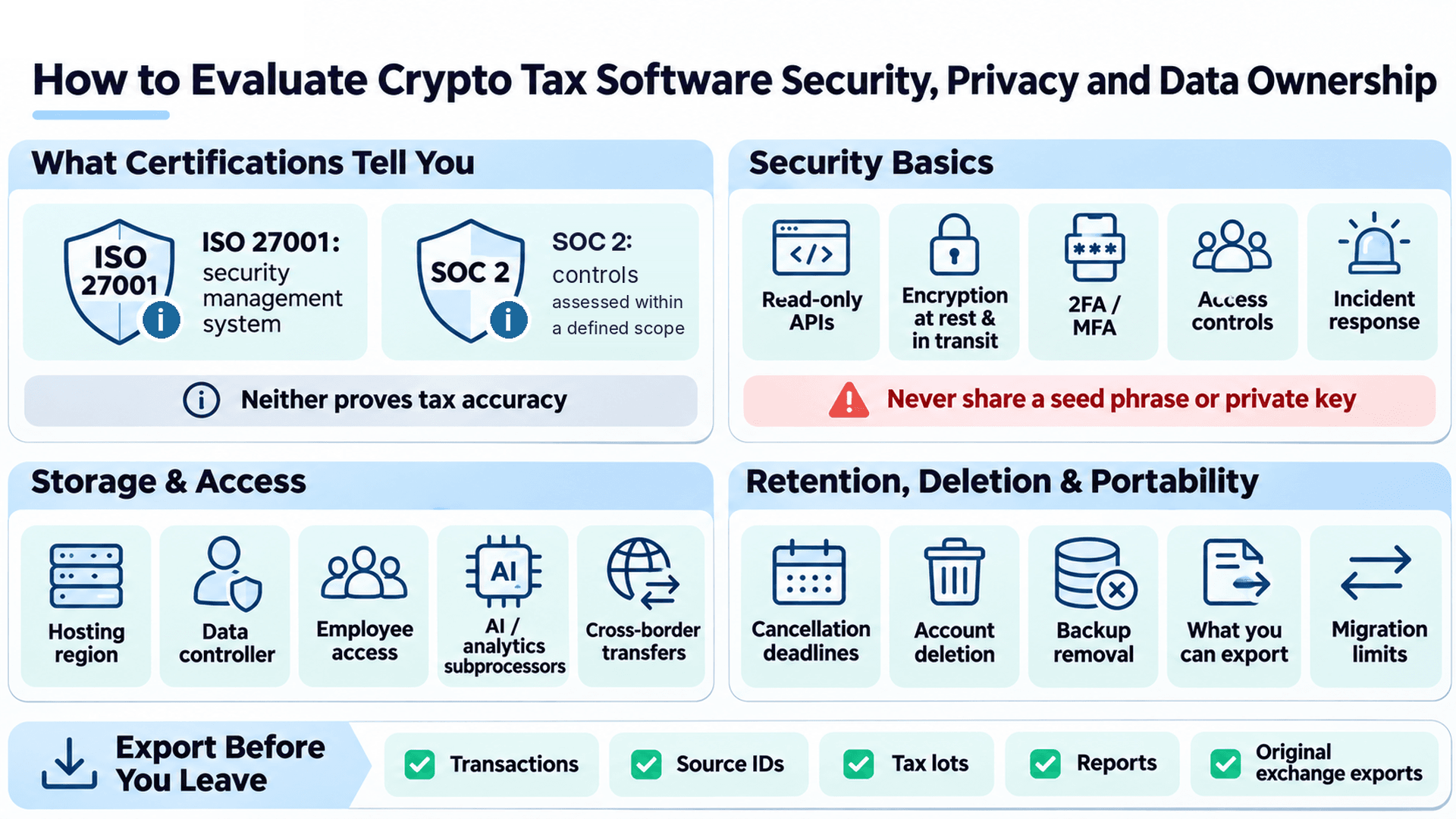 Evaluating Certifications, Data Protection, Storage Locations, Retention Policies, and Export Rights
What ISO 27001, SOC 2 and Other Security Controls Actually Verify
ISO/IEC 27001:2022 sets requirements for an information security management system (ISMS). Certification assesses the organization's risk management, documented controls, reviews, and improvement processes within a defined scope. It does not certify that its cost-basis engine calculates taxes correctly.
SOC 2 examinations assess controls against selected Trust Services Criteria, including security and potentially availability, processing integrity, confidentiality, or privacy. Type I concerns control design at a point in time; Type II assesses operating effectiveness over a defined period. Neither proves tax accuracy unless the specific calculation controls have actually been examined within the report's scope.
Check the legal entity, standard, assessor, certificate validity, systems covered, and examination dates. CoinTracking's independently issued ISO/IEC 27001:2022 certificate covers processes relating to crypto portfolio tracking, tax reporting, and supporting operations and is valid until Oct. 1, 2028.
Koinly publishes ISO 27001 and SOC 2 assurance claims, but the complete current examination report and its scope were not independently reviewed. A current ISO certificate or SOC 2 report covering CoinLedger could not be independently verified from the public materials reviewed.
Beyond certifications, check read-only API permissions, encryption in transit and at rest, two-factor authentication, employee access restrictions, and documented security testing and incident response. Read-only API keys should prevent trading and withdrawals, but still disclose sensitive transaction history. Never provide a wallet seed phrase or private key to a tax application.
Where Your Tax Data Is Stored and Who Can Access It
Confirm the hosting region, legal data controller, access granted to employees, and use of cloud services, analytics, or AI subprocessors.
CoinTracking's security page claims EU hosting. It also allows account registration without an email address. Its privacy policy discloses processing through Anthropic's Claude API in the United States for optional AI features. Its AI Tax Saver sends selected pseudonymized, already-calculated values; its File Converter can send column headers and approximately 20 sample rows, potentially containing transaction details. CoinTracking says its own systems perform the tax calculations.
Koinly's security guidance places most services and data on AWS infrastructure in the United States and describes encryption, infrastructure monitoring, and third-party reviews.
CoinLedger describes a protected virtual private cloud, encrypted traffic, and read-only integrations, but its public security materials reviewed do not identify a precise primary hosting region. Its website privacy policy describes third-party data use but is not a complete technical inventory of application processing.
Third-party exposure has practical consequences. CoinLedger disclosed a November 2025 incident at analytics provider Mixpanel involving certain names, email addresses, and approximate locations. CoinLedger said connected transaction histories, tax forms, passwords, and private keys were not exposed. This was an analytics-provider incident, not a reported breach of its core transaction ledger.
Read-only access limits custody risk, not financial-data exposure. A leaked transaction history may reveal balances, trading patterns, or wallet relationships even when funds cannot be moved.
Data Retention, Deletion and Portability: What Happens if You Leave?
CoinTracking's cancellation guidance says that, without its retention option, transactions, imports, tax history, and reports are deleted 90 days after a canceled paid subscription ends. Lifetime licenses do not expire, so this deletion window does not apply to them. Its Data Retention plan costs $19 or €19 per year, according to account currency, and preserves view-only records. New editing or reporting requires a paid plan; the retention option was documented for Stripe subscribers.
Koinly's account-deletion guidance describes irreversible deletion. Its tax-year purchases govern report downloads, while a universal inactive-account or backup-deletion period was not independently verified. CoinLedger supports hard deletion of imports and API keys and purchased report downloads, but an exact inactive-account and backup-retention period was likewise not independently verified from public documentation. Legal retention requirements may affect complete erasure.
Before leaving any provider, export the complete transaction history, source IDs and wallet identifiers, original acquisition and disposal details, adjusted basis, realized-gain calculations, and tax and audit reports. Keep original exchange exports separately. A CSV of transactions is not necessarily a restorable account backup because custom classifications, lot choices, and settings can be missing.
CoinTracking documents Trades Backup for restoring transaction history inside its service, plus report exports. Koinly's Transaction History Report records activity but cannot restore a full account. CoinLedger likewise says its Audit Trail CSV cannot be re-imported as an account backup.
| Questions to Ask Before Trusting a Provider | Evidence to Request |
|---|---|
| Security assurance | Certificate or SOC 2 report, scope, assessor, and period |
| Processing and residency | Hosting location, subprocessors, cross-border transfers, AI or analytics access |
| Retention and deletion | Cancellation deadlines, purchased-report access, account deletion, backup rules |
| Exportability | Transactions, source IDs, tax lots, calculation evidence, reports, and migration limits |
CoinTracking vs. Koinly vs. CoinLedger: Accuracy, Security and Audit-Readiness Compared
The three providers document different ways to identify gaps, trace gains, and safeguard financial records. The comparison is about trust and audit evidence, not overall product rankings.
Comparing Transaction Accuracy, Audit Trails and Data Protection
This comparison reviews public product guidance, policies, and certifications. Provider claims are attributed; an unpublished detail is not assumed to exist or be absent. Security assurance is assessed by its disclosed scope. Subscription access, actual deletion, and report downloads are separate. No hands-on calculation benchmark or penetration test was performed.
Note: Data is current as of Nov. 6, 2026:
| Evaluation Dimension | CoinTracking | Koinly | CoinLedger |
|---|---|---|---|
| Import accuracy controls | Missing Transactions, duplicate review, Balance Check, Transaction Flow, and ValiCheck help locate transfer and ledger inconsistencies; Form 8949 section assignment supports 1099-DA reconciliation. | Guided warnings, missing-purchase checks, transfer matching, and balance review help users correct imported records. | Missing-cost-basis review and a 1099-DA matching dashboard support transaction and broker-form reconciliation. |
| Audit trail | Roll Forward / Audit Report shows matched acquisition and disposal pools, basis, gains, and source IDs. | Itemized capital gains and transaction-history reports show acquisitions, disposals, and underlying calculations. | Audit Trail CSV identifies disposal lots, acquisition information, basis, proceeds, and price sources. |
| Security certification | Published ISO/IEC 27001:2022 certificate, valid until October 2028, covers tracking and tax-reporting processes. | Claims ISO 27001 and SOC 2; full current examination scope not independently reviewed. | Publishes security controls; a current ISO or SOC 2 report was not independently verified. |
| Data location | Security page says Germany; privacy policy identifies AWS Dublin and U.S. processing for certain AI features. The discrepancy needs clarification. | Reports primarily U.S.-based AWS hosting and external processing arrangements. | VPC infrastructure disclosed; precise primary region not independently verified from public materials. |
| Data retention | 90-day deletion after canceled paid-plan expiry without retention coverage; paid view-only option available. | Deletion is irreversible; fixed inactive-account and backup periods not independently verified. | Hard-delete tools available; precise inactive-account and backup periods not independently verified. |
| Data exports | CSV, Excel, and PDF audit reports plus Trades Backup for restoring its transaction ledger. | Transaction-history, capital gains, and tax reports; exported history is not a complete restorable backup. | Transaction and tax reports plus Audit Trail CSV; that audit file cannot be re-imported to restore an account. |
Every entry describes documented functionality or a verification limitation. More audit-report features do not prove that a platform calculates taxes more accurately than another under identical conditions.
What the Comparison Reveals About Each Provider
CoinTracking: Its combination of missing-transfer investigation, duplicate review, balance checks, and the Roll Forward / Audit Report addresses a common problem in complicated, multi-year records: tracing exactly where a disposal's basis came from. Exportable lot matching and transaction IDs are useful to accountants. Its published ISO certificate provides scoped information-security assurance. For users who prefer to hand the work over, an optional, separately priced Full-Service is available in more than 25 countries. In the U.S., preparation and e-filing run through U.S.-based CPA partners.
Koinly: Guided error identification and transfer matching can help users diagnose imports before filing. Itemized capital gains reports support acquisition and disposal review, and the Form 1099-DA upload workflow informs U.S. reporting categories. Koinly publishes ISO and SOC 2 claims. Its primarily U.S.-based hosting, pending native MFA feature, and nonrestorable transaction-history export are relevant when assessing security and portability.
CoinLedger: The dedicated 1099-DA dashboard directly compares broker information with software records. Its separate Audit Trail CSV provides acquisition and disposal evidence, including valuation sources, for professional review. Published technical controls and the disclosed Mixpanel incident clarify both the protections and third-party privacy exposure users should consider. No current ISO/SOC 2 report or precise hosting region was independently verified from the public materials reviewed.
Users with complex historical lots may emphasize acquisition-to-disposal reconstruction; those facing broker-form discrepancies may emphasize direct 1099-DA matching. The appropriate test is whether a provider can expose and explain your records, not whether it advertises the most features. A controlled comparison of calculation accuracy would require identical verified inputs, methods, and expected outputs.
How to Make Your Crypto Tax Records Audit-Ready Before Filing
Complete these checks before trusting the final report. Retain evidence of each correction rather than relying only on a completed status indicator.
Seven Checks to Complete Before Trusting Your Crypto Tax Report
Pre-Filing Accuracy Checklist
- Include every exchange, wallet, and historical account. An omitted source can hide acquisition records. Save your full account inventory and original exports.
- Reconcile imported balances and major transaction totals. Differences may indicate missing activity. Keep dated statements or blockchain evidence.
- Review missing purchases, duplicates, and unmatched transfers. Each can distort gains. Retain the original transaction identifiers and corrections.
- Check cost-basis methods, acquisition records, and significant gains. Incorrect lot matching changes taxable figures. Preserve calculation settings and worked reconciliations.
- Investigate relevant Form 1099-DA discrepancies. Broker scope or basis can differ. Save the broker forms and your reconciliation.
- Export original files, audit evidence, and tax reports. Preserve Form 8949, Schedule D, transaction exports, and lot-matching evidence independently of the provider.
- Review security, retention, and deletion settings. Check read-only API permissions, authentication, cancellation deadlines, and account-erasure terms.
Finishing all seven reviews improves record quality; it cannot certify that every tax treatment is correct.
When to Stop Troubleshooting and Consult a Tax Professional
Consult a qualified digital asset tax accountant for significant unresolved basis differences, acquisitions that cannot be reconstructed, complex DeFi or derivatives activity, difficult multi-year accounting, material broker-form mismatches, IRS notices, audits, or corrections to earlier returns.
Software organizes records and applies accounting rules. Taxpayers remain responsible for the figures they file. A professional can evaluate unsupported assumptions, review Form 8949 and Schedule D, and identify a defensible approach where the records are incomplete.

Final Verdict: What Makes Crypto Tax Software Trustworthy?
Trustworthy crypto tax software meets four requirements: reconcilable records that expose missing transactions and duplicates; traceable calculations connecting disposals to acquisition lots and cost-basis methods; documented security and privacy controls that identify assurance scope and processors; and portable historical evidence that survives a change of software, subscription, or tax year.
CoinTracking's validation reports and Roll Forward / Audit Report provide documented examples of transaction reconciliation and traceability. Koinly and CoinLedger offer other ways to review errors, calculations, and broker forms. None can turn missing source evidence into a reliably known cost basis, and neither an ISO certificate nor an audit report guarantees the correctness of a tax return or the outcome of an IRS audit.
Choose software that helps you find incomplete records, explain each material gain, protect financial history, and keep the evidence.
For a broader comparison of products, see Coin Bureau's best crypto tax software guide.