

GhostSwap is an account-free cryptocurrency swap interface. Users choose a pair, provide a receiving address, send crypto, and receive another asset. Its Bitcoin, Monero and Zcash routes appeal to privacy-conscious users.
However, third-party processors execute its swaps and temporarily receive customer deposits. Standard swaps generally require no upfront KYC identity verification, but processors can request documents or hold transactions for AML compliance review.
GhostSwap offers a simple way to reach privacy coins, but its processor exposure and unresolved complaint record prevent a broad recommendation. This review covers live quotes, policies and public reports checked October 27, 2026. No funded swaps or support-response tests were performed.
GhostSwap Review 2026: Quick Verdict
GhostSwap is an account-free cryptocurrency swap interface offering access to Bitcoin, Monero, Zcash and more than 1,600 advertised cryptocurrencies. Its simple conversion workflow, cross-chain routes, Private Send feature and Tor accessibility appeal to privacy-conscious users. However, third-party processors temporarily control deposited funds, identity verification can be required during compliance reviews, and publicly reported fund-hold disputes raise concerns about reliability and transparency.
Our take: GhostSwap is worth considering only for small, nonurgent cryptocurrency conversions by users who understand its processor-related risks. Its privacy-focused features and account-free access are useful, but they do not guarantee anonymity or freedom from KYC checks. Limited corporate transparency, uncertain refund timelines and an unresolved 20.5 ETH complaint prevent us from recommending GhostSwap as a first-choice exchange. ChangeNOW, SimpleSwap and StealthEX offer alternatives worth comparing for rates, available networks and refund policies.
Category Assessment
-
1Security & Custody Significant Processor and Counterparty Risk GhostSwap does not require users to deposit funds into a permanent exchange account or disclose private keys. However, third-party processors receive and control deposits during execution. No independent audit of the full processing chain was identified. Public complaints involving 12.441 ETH and 20.5 ETH describe extended fund holds, with the latter still reported unresolved as of October 22, 2026. The 12.441 ETH case was marked resolved by its complainant, although the precise settlement details remain independently unverified.
-
2Fees & Exchange Rates Embedded Pricing With Limited Transparency GhostSwap includes its service charge within the quoted exchange rate and separately identifies payout network fees. Users also pay deposit network charges through their wallets. A quote-only check on October 28, 2026 found an estimated 1.34% shortfall for an ETH-to-USDT swap against Coinbase's reference price, excluding deposit gas. This was not a completed trade or a direct measurement of GhostSwap's commission. Standard consumer swaps generally use floating rates, leaving final payouts exposed to market movements.
-
3Supported Assets & Networks Broad Selection With Strong Privacy-Coin Coverage GhostSwap advertises more than 1,600 coins and tokens, including BTC, ETH, SOL, XMR, ZEC, USDT and USDC. Cross-chain conversions and Monero routes are prominent features. However, network support varies by pair, and its documented Zcash workflow requires transparent addresses rather than direct shielded deposits or payouts. Advertised asset counts do not guarantee liquidity or availability for every conversion.
-
4Execution & Refund Reliability Dependent on Third-Party Processing GhostSwap relies on external processors for deposit confirmation, exchange execution and settlement. Blockchain congestion, liquidity conditions, compliance screening and third-party delays can affect completion times. Publicly reported disputes highlight the possibility of prolonged holds, and no universal refund deadline or comprehensive refund-fee schedule was identified. No funded swaps, actual execution speeds or refund requests were independently tested.
-
5Privacy Features & Usability Simple Workflow With Qualified Privacy Benefits Standard swaps require no account registration. Users select a pair, enter a receiving address and send funds to a generated deposit address. Private Send separates the direct sender-recipient transfer path, while Telegram and Tor access provide alternative ways to interact with the service. However, blockchain records and processor logs can still connect transactions. These features improve certain aspects of privacy without providing complete anonymity.
-
6KYC, Compliance & Transparency No Routine Upfront KYC, But Limited Accountability GhostSwap generally permits standard swaps without identity verification, but its terms allow processors to request KYC and source-of-funds documentation or hold flagged transactions. The published terms do not clearly identify a registered operating company, registration number or specific governing jurisdiction. A complete independently verifiable list of processing partners and applicable licenses was also not established. The removal of GhostSwap's Trustpilot profile following a fake-review guideline breach further weakens its public reputation signals.
-
7Overall Verdict Limited Use for Small, Nonurgent Privacy-Oriented Swaps GhostSwap combines a straightforward account-free interface with broad advertised cryptocurrency coverage, Monero conversions and useful privacy-oriented payment options. Nevertheless, processor custody, conditional KYC requirements, unclear refund guarantees, limited corporate disclosures and an unresolved public fund-hold complaint create substantial uncertainty. It may suit users willing to risk a small amount on a nonurgent conversion, but it is not a preferred venue for substantial transfers, time-sensitive payments or anyone requiring guaranteed no-KYC execution.
Best For
- Users exploring small, nonurgent cryptocurrency swaps
- Privacy-conscious users seeking account-free access
- People comparing Bitcoin-to-Monero and other XMR routes
- Users who prefer simple wallet-to-wallet conversion workflows
- Users seeking Private Send functionality to reduce direct wallet linkage
- People comfortable with floating exchange rates and third-party execution
Not Ideal For
- Users transferring large or financially significant amounts
- Anyone requiring guaranteed no-KYC cryptocurrency swaps
- Time-sensitive payments or conversions requiring predictable settlement
- Users unwilling to accept possible AML-related fund holds
- Traders seeking transparent, fixed and independently verified service fees
- Users requiring direct shielded Zcash deposits or payouts
- People prioritizing clearly identified corporate operators and regulatory oversight
- Users requiring guaranteed refund timelines or independently verified execution reliability
Disclosure and Methodology
Some links in this article may be affiliate links. If you choose to use a product or service through these links, we may earn a commission at no additional cost to you.
For this GhostSwap review, we evaluated six main categories: security and custody, fees and exchange rates, supported assets and networks, execution and refund reliability, privacy features and usability, and KYC, compliance and transparency.
Our research examined GhostSwap's published terms, privacy and KYC policies, fee explanations, cryptocurrency listings, swap documentation, API materials and publicly accessible quote information. We also reviewed available third-party complaints, dispute updates and independent reputation signals through Oct. 28, 2026.
We compared GhostSwap with ChangeNOW, SimpleSwap and StealthEX using their published features, rate options, compliance policies and refund conditions. Our Oct. 28, 2026, quote-only checks also examined estimated swap payouts against a Coinbase spot-price reference and a reported ChangeNOW estimate.
This is a documentation-led review, not a funded trading test. We did not send cryptocurrency, execute swaps, request refunds, submit KYC documents, contact customer support or independently verify processor settlement times. Consequently, actual execution reliability, realized fees, refund turnaround times and support responsiveness were not independently established.
Paid Article
This is a paid article, not a paid opinion.
This is a paid article, not a paid opinion.
This article was created as part of a paid partnership. That commercial relationship does not influence our editorial take, which means our views, analysis, and conclusions remain our own. If a product, platform, or service has drawbacks, limitations, or risks, we will say so plainly.
GhostSwap At a Glance
| Field | GhostSwap |
|---|---|
| Platform | GhostSwap |
| Type | Account-free cryptocurrency swap interface |
| Launch | October 2024, according to GhostSwap |
| Registration | Not required for standard swaps |
| KYC | Generally absent upfront; processor verification remains possible |
| Supported assets | 1,600+ coins |
| Custody | A third-party processor or liquidity provider receives deposits |
| Exchange rates | Floating for standard swaps |
| Fiat support | Advertises card and bank-payment purchases through providers; no verified bank cash-out service |
| Main use case | Crypto-to-crypto and cross-chain swaps |
| Main limitation | Processor dependency and compliance-related holds |
A separate buy-crypto page advertises Visa, Mastercard, Apple Pay and SEPA purchases through payment providers. Availability, charges and identity checks vary by provider.
What Is GhostSwap and How Does It Work?
GhostSwap connects users to third-party cryptocurrency exchange services. It provides no order book, stored balance or wallet application.
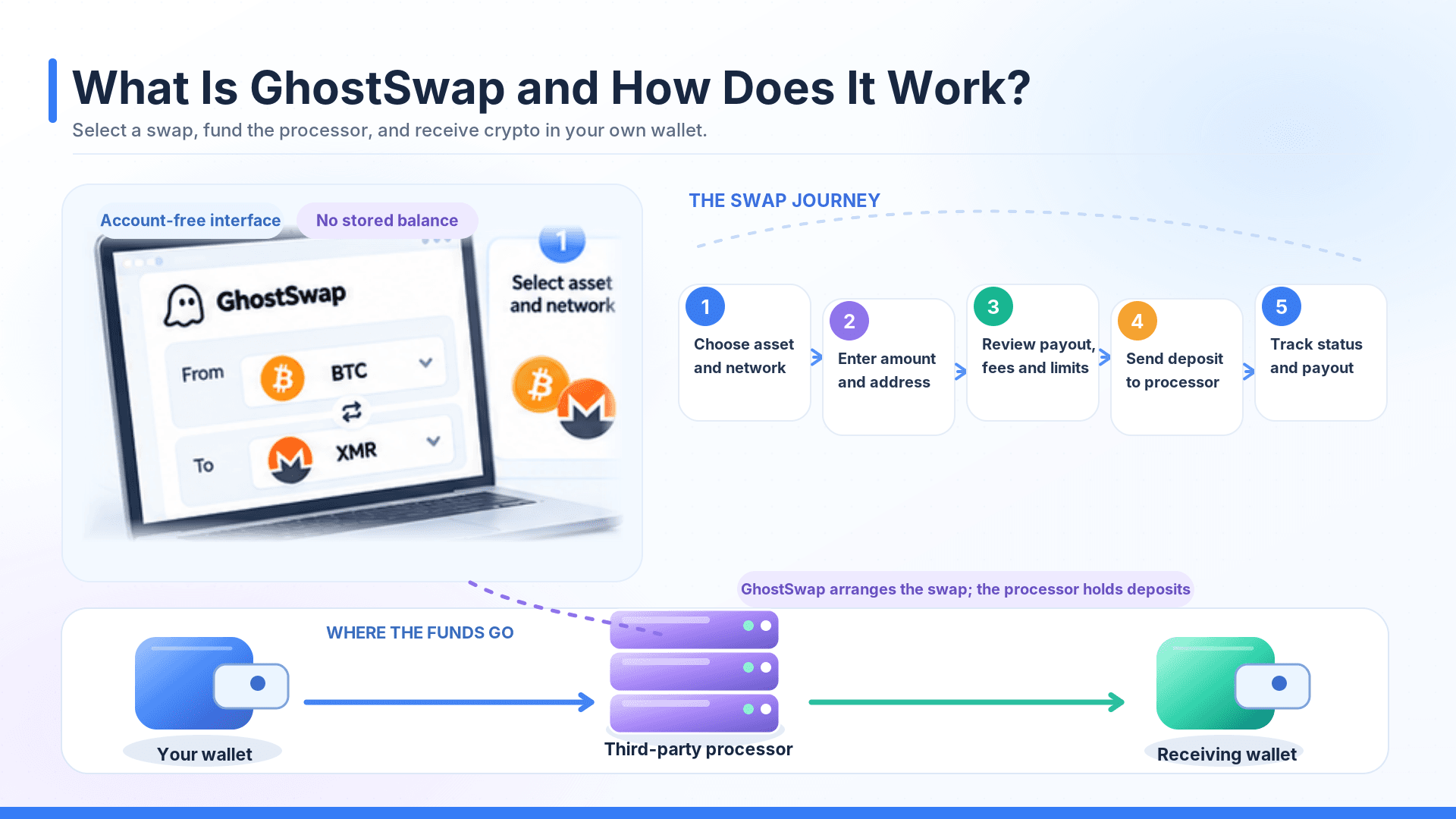 How GhostSwap Connects User Wallets With Third-Party Processors To Execute Cryptocurrency Swaps Without Holding Account Balances
How GhostSwap Processes Cryptocurrency Swaps
A standard crypto swap follows this sequence:
- Select the asset and blockchain network to send and receive.
- Enter the amount, receiving wallet address and any requested sender or refund details.
- Review the estimated payout, network charge and transaction limits.
- Send the required deposit to the generated address.
- Track confirmations, processing and payout through the swap status page.
Transaction flow: User wallet → GhostSwap interface → Third-party processor → Receiving wallet.
Funds go to the processor's deposit address. After the deposit blockchain transaction gains sufficient confirmations, the processor converts the assets and sends the payout. Liquidity provider and payout-network delays can extend execution.
GhostSwap's current operating model assigns deposit-address generation, fund receipt, execution and settlement to a third-party service. Its non-custodial exchange description refers to the interface and absence of stored user balances. During execution, the processor can control the deposited funds.
GhostSwap arranges conversions, resembling an exchange aggregator. It provides neither a centralized exchange order book nor a decentralized exchange's automated market maker pools. Its processor-based execution offers no directly verifiable on-chain swap contract.
GhostSwap's Background and Operating Structure
GhostSwap dates its operation to October 2024. The terms name the operator as GhostSwap without clearly identifying a registered company, registration number or specific business jurisdiction. The governing-law clause refers to the jurisdiction where GhostSwap is established without naming it.
The disclosures also lack a complete, verifiable processor list and corresponding licenses.
Is GhostSwap Safe and Legit?
GhostSwap exposes users to counterparty risk: a processor may fail to deliver or return funds.
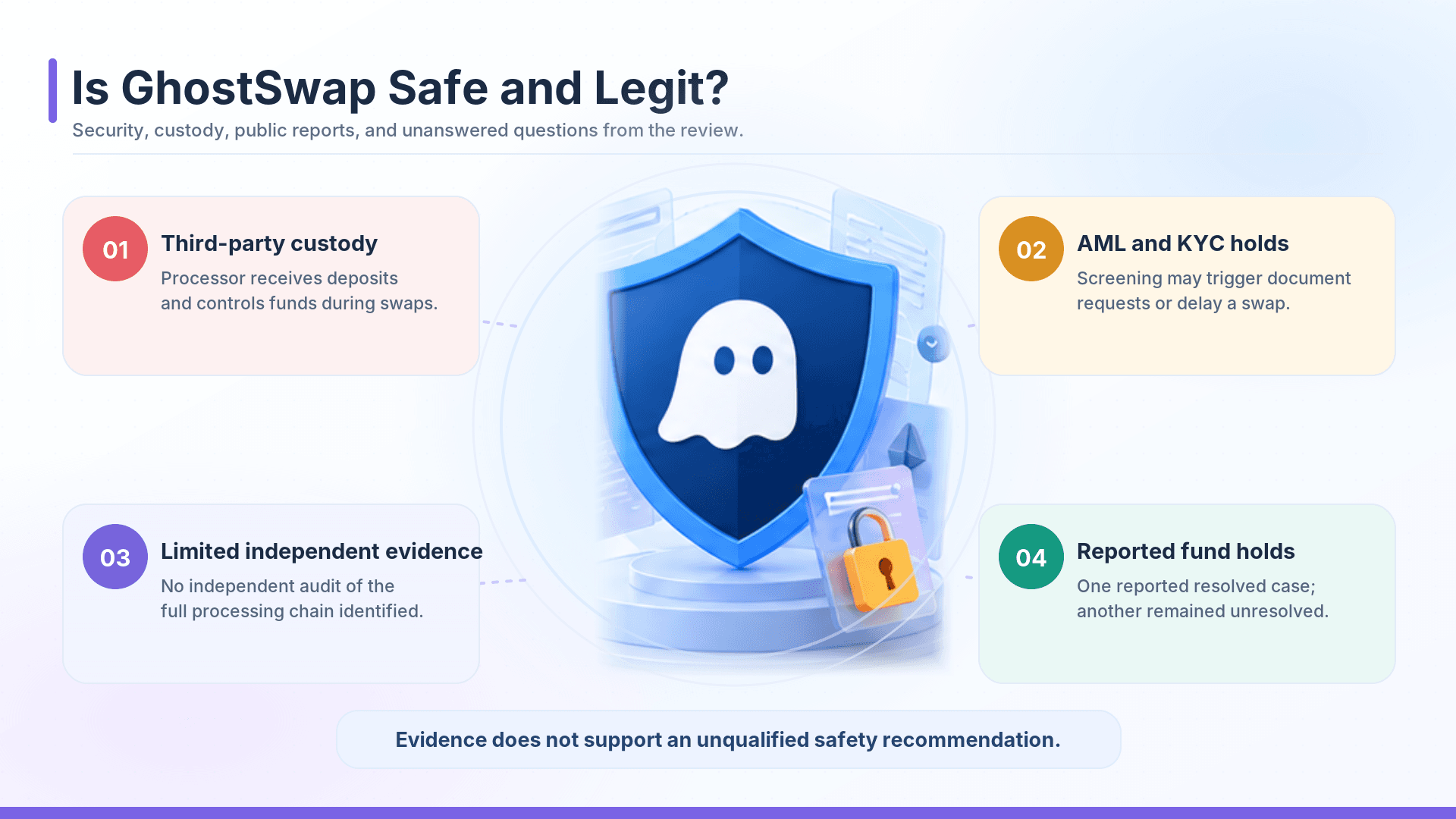 GhostSwap's Safety Risks Include Third-Party Custody, Potential Compliance Holds, Limited Transparency, And Reported Customer Disputes
GhostSwap Security and Custody Risks
GhostSwap describes TLS encryption for data in transit and access controls. Its workflow requires no recovery phrase or private key. These protections address communication and wallet access.
No public independent security audit, penetration-test report or technical review of the full processing chain was identified. Nor was a comprehensive, independently supported incident register found. These gaps leave security claims underverified; they do not prove an undisclosed breach.
Reported Fund Holds and Customer Complaints
Two 2026 Bitcointalk complaints describe separate held orders. Their timing overlaps, and a person presenting themselves as their mediator said the funds belonged to closely related parties.
12.441 ETH, reported resolved: Benedesuuuk's July 3 complaint concerned a May 24 deposit under swap ID 41gf6aamcb79iw8o. The user alleged that the conversion remained unexecuted after Sumsub verification and source-of-funds documents. The post supplied a deposit transaction hash and attributed onward transfers to HitBTC-linked infrastructure.
The complainant marked the thread solved on Aug. 31. A Sept. 15 mediator account described compensation while the original deposit allegedly remained blocked. KYCnot.me separately describes an XMR refund from funds held with OrangeFren. These accounts support a reported customer resolution, without independently establishing the exact repayment amount, date or release of the original ETH.
20.5 ETH, reported unresolved: XLXer's Sept. 15 complaint concerned order r6gfns7qebjs43e4. The user said they received about 88.9 ETH on May 24, made four swaps, and saw three complete while the third remained blocked. They had not completed the requested KYC when posting.
In an Oct. 22 update, XLXer still alleged no response for more than a month. KYCnot.me continues to flag the dispute as unresolved and says its checks traced the funds to HitBTC.
Reputation, Reviews and Independent Trust Signals
GhostSwap's Trustpilot profile was removed following a guideline breach concerning fake reviews.
The KYCnot.me listing offers two different kinds of evidence. Its general attributes are community-contributed and marked as not team-reviewed. A separate incident notice describes checks concerning the held ETH.
GhostSwap KYC, AML Checks and Privacy
Privacy varies by processor, access method and blockchain.
Does GhostSwap Require KYC?
GhostSwap's KYC help page describes entry requirements; broader legal disclosures allow checks during processing.
Under its terms, swaps undergo the processor's automated AML and sanctions screening. GhostSwap and its partners reserve the right to block, reject or refund flagged transactions. The platform also makes swaps subject to the processing exchange's own terms.
Blockchain analytics can trigger questions about transaction history or links to flagged addresses. A review may request identity verification or source-of-funds evidence, such as records explaining how the deposited assets were acquired.
Refusing verification may leave funds held while the processor decides whether release or return is permitted.
What Information Does GhostSwap Collect?
The privacy policy lists wallet addresses, currencies, amounts, order IDs, timestamps and blockchain transaction identifiers. Technical records include a session identifier, hashed IP information, browser details, referring pages and visit times.
Processors retain their own records under separate policies. GhostSwap may preserve or disclose records for legal requests, investigations and disputes.
Is GhostSwap Completely Anonymous?
No. Account-free access, transaction privacy and anonymity are separate properties.
Tor Browser can reduce direct IP exposure when accessing GhostSwap. It cannot erase blockchain records, remove information already supplied to a processor, or prevent a recipient from recognizing a payment.
| Privacy Feature | What It Helps Protect | Main Limitation |
|---|---|---|
| No registration | Account-level personal information | Processor verification may still occur |
| Tor access | Direct network-level IP exposure | Blockchain records and service records remain |
| Private Send | Direct sender-recipient transfer linkage | Public-chain amounts and timing remain visible |
| Monero support | Public visibility of Monero transaction details | Exchange and processor records may still exist |
Private Send reduces an obvious wallet-to-wallet link. The recipient sees less than a processor holding both sides of the order; those are different levels of privacy.
GhostSwap Features and Supported Cryptocurrencies
GhostSwap supports crypto-to-crypto conversions, cross-chain swaps and privacy-focused payments. Its available routes depend on blockchain compatibility, liquidity and the processing services handling each transaction.
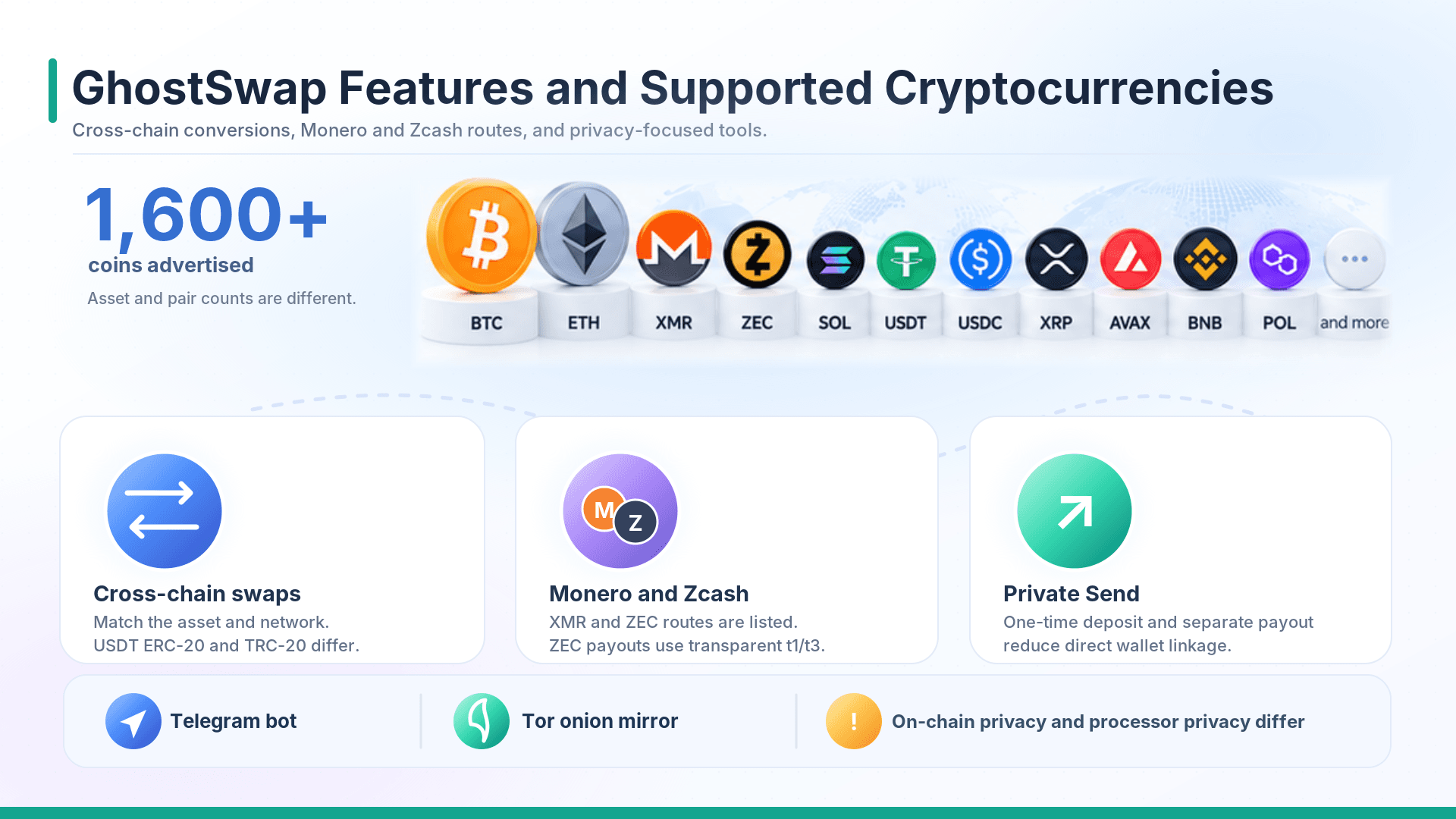 GhostSwap Supports Cross-Chain Cryptocurrency Swaps, Privacy Coin Routes, Private Send, Telegram Access, And Tor Connectivity
Instant Swaps and Supported Networks
GhostSwap advertises more than 1,600 coins and tokens, including Bitcoin (BTC), Ethereum (ETH), Solana (SOL), Monero (XMR), Zcash (ZEC), Tether (USDT) and USDC.
The exchange directory lists routes such as BTC-to-XMR, ETH-to-USDT and USDT on Tron to Monero.
Coin Bureau's beginner crypto wallet comparison explains wallet compatibility and recovery responsibilities.
Monero and Zcash Swaps
Monero is a prominent part of GhostSwap's offering. The Monero exchange interface supports conversions into and out of XMR, including commonly requested routes involving Bitcoin, Ethereum and USDT.
During our Oct. 28, 2026 quote-only check, GhostSwap's public endpoint returned an estimated 1.32185204 XMR for 0.01 BTC, after its stated payout network charge.
Monero conceals transaction senders, recipients and amounts by default. Zcash offers a different model, supporting both transparent and shielded transactions.
GhostSwap's Zcash exchange guide specifies transparent payout addresses beginning with t1 or t3. It does not support direct payouts to shielded u1 or zs addresses. Users can move received ZEC into a shielded balance through a compatible wallet, although the initial transparent payout remains visible on-chain.
For ZEC-to-crypto conversions, GhostSwap also instructs users to send ZEC through a transparent address. Anyone seeking direct shielded Zcash deposits or payouts needs another supported route.
Private Send, Telegram Bot and Tor Access
Private Send lets users pay someone without making a direct wallet-to-wallet transfer. The sender deposits cryptocurrency into a one-time address, and the recipient receives funds from a separate payout address.
This separation prevents the recipient from seeing the sender's wallet as the direct source of the payout. However, it does not make the transaction untraceable. Public blockchains still reveal amounts, addresses and timestamps that may allow transactions to be linked through blockchain analysis.
Paying with Monero conceals more source-chain information than using Bitcoin or Ethereum because Monero hides transaction details by default. Even then, the processing service retains information connecting the deposit and payout. GhostSwap has not published independent cryptographic evidence proving complete transaction unlinkability.
GhostSwap also provides a Telegram swap bot and an onion mirror for Tor Browser. Its privacy policy identifies the official Tor access method, which can reduce direct exposure of a user's IP address. Tor does not conceal public blockchain activity or information retained by processing partners.
GhostSwap Fees, Exchange Rates and Swap Limits
GhostSwap includes its service charge within the quoted exchange rate rather than presenting a universal percentage for every swap.
How Much Does GhostSwap Charge?
GhostSwap's consumer fee explanation identifies three pricing components:
- Service fee: Included in the quoted exchange rate rather than charged separately at checkout.
- Payout network fee: Covers the blockchain transfer of the converted cryptocurrency to the receiving wallet.
- Deposit network fee: Paid separately by the sender's wallet when transferring assets to the swap address.
An exchange-rate spread measures the difference between a quoted conversion price and a reference market price. It can reflect service charges, liquidity costs and execution pricing. A separately itemized network fee is a distinct deduction.
GhostSwap does not disclose a single fixed service-fee percentage for direct consumer swaps.
Its API commissions documentation describes a 2% platform baseline plus an additional partner-selected markup of 0% to 4%.
Floating Exchange Rates and Final Payouts
GhostSwap's standard consumer swaps use floating exchange rates. The initial quote follows market conditions until the deposit confirms, meaning volatility, available liquidity and blockchain delays can change the final payout.
Its fee guidance states that standard swaps have no fixed-rate option. However, the Private Send interface displays a fixed/floating selector, while GhostSwap's payment guide describes time-limited fixed pricing.
The authenticated Partners API documentation also supports a fixed quote mode using a short-lived rate-lock identifier. This confirms documented fixed-rate functionality at the API level, but does not establish that a fixed-rate consumer checkout currently works end to end. No such checkout was tested for this review.
Quote check: Oct. 28, 2026
Our recorded pricing test requested estimates for 1 ETH to USDT on Ethereum
GhostSwap's public quote endpoint returned the following figures:
| Test Metric | Recorded Value |
|---|---|
| Input amount | 1 ETH |
| Output before payout network fee | 2,278.918895 USDT |
| Payout network fee | 0.366587 USDT |
| Estimated net receipt | 2,278.552308 USDT |
| Coinbase reference price | 2,309.45 USDT per ETH |
The reference price came from the Coinbase ETH-USDT spot-price endpoint.
Comparing GhostSwap's estimated net receipt against this reference gives:
(2,309.45 − 2,278.552308) ÷ 2,309.45 × 100 = 1.34%
The 1.34% figure represents the indicative shortfall against Coinbase's reference price, including the quoted payout network fee but excluding deposit gas. It is not GhostSwap's independently identified service commission or the realized cost of a completed swap.
Coinbase's spot price is also a market reference rather than a guaranteed executable offer.
For comparison, ChangeNOW's ETH-to-USDT estimate endpoint reportedly returned 2,280.603199 USDT during the same test window, approximately 2.05 USDT more than GhostSwap's estimate.
The figures represent recorded API observations, not completed transactions. Their exact historical values cannot be reconstructed from the linked live endpoints without the original responses.
GhostSwap vs Alternatives: Which Crypto Swap Service Is Better?
ChangeNOW, SimpleSwap and StealthEX offer similar workflows. Compare their pricing, routes and verification exceptions.
GhostSwap vs ChangeNOW, SimpleSwap and StealthEX
All four generally allow account-free crypto swaps, with verification exceptions.
| Platform | Main Use | Advertised Assets And Example Networks | Rate Options |
|---|---|---|---|
| GhostSwap | Privacy-oriented swaps and Private Send | 1,600+ coins advertised; BTC, Ethereum, Solana, Monero, USDT on Ethereum and Tron | Standard floating swaps |
| ChangeNOW | Rate selection and broad conversion routes | 1,000+ coins in its FAQ; BTC, Ethereum, Solana, Monero and multichain USDT | Fixed and floating |
| SimpleSwap | Straightforward swaps with rate choice | 2,800+ cryptocurrencies in its FAQ; BTC, Ethereum, Solana, Monero and multichain USDT | Fixed and floating |
| StealthEX | Broad cross-chain conversion selection | 2,000+ assets advertised; BTC, Ethereum, Solana, Monero and USDT on Tron | Fixed and floating |
Verification And Custody
- GhostSwap assigns execution and screening to its processor.
- ChangeNOW screens transactions and also uses third-party routes, whose verification policies can differ.
- SimpleSwap aggregates centralized and decentralized liquidity and can request identity, address or source-of-funds evidence.
- StealthEX permits risk-based KYC before, during or after a transaction.
Support And Refunds
| Platform | Support Route | Refund Conditions To Know |
|---|---|---|
| GhostSwap | Email and advertised live chat | Completion or return when processor review permits; no universal deadline or published refund-fee schedule identified |
| ChangeNOW | Support ticket or email | Failed-order status guides returns; refusing KYC can allow a refund, with investigation exceptions |
| SimpleSwap | Contact form, chat or email | Terms allow up to 31 calendar days to process requests; status, ownership checks and transfer errors affect eligibility |
| StealthEX | Support chat or email | Failed execution can lead to return minus incurred service, network and third-party charges; compliance review can delay release |
At ChangeNOW, refusing verification can allow a refund, with exceptions for suspected illegal activity and investigations.
Network and recovery charges can apply at SimpleSwap, and several user-error scenarios are ordinarily ineligible. Its processing period is a policy provision, rather than a measured turnaround time.
StealthEX can hold transactions for compliance and deduct incurred costs after failed execution under its July 2026 terms. Its non-custodial wording does not give the user unilateral control over a transaction under review. Check the liquidity provider and refund status alongside price.
When Should You Choose an Alternative?
- For a stronger quoted payout, choose ChangeNOW.
- For exchange-rate certainty, Consider a supported fixed-rate route through ChangeNOW, SimpleSwap or StealthEX.
- For a specific asset or network, ChangeNOW and SimpleSwap document several USDT networks beyond Ethereum and Tron. StealthEX lists routes involving native and Base-network ETH.

GhostSwap Review: Final Verdict
GhostSwap offers convenient account-free cryptocurrency swaps, Monero access and payment routing that reduces direct wallet linkage.
The evidence does not support recommending it for large or time-sensitive transfers. A liquidity processor controls deposits during execution, AML screening can introduce identity checks, and the reported 20.5 ETH dispute remains unresolved in the public record examined.
Occasional holders considering a small conversion should be willing to accept a hold as well as price movement. A small amount limits exposure; it does not qualify for assured execution. Privacy-conscious users requiring an absolute no-KYC exchange or direct shielded Zcash receipt should choose another route.
GhostSwap is worth considering in 2026 only for limited, nonurgent swaps by users who accept its custody risk and privacy limits; it is not a first-choice cryptocurrency exchange on the evidence available.