The Binance app packs everything from simple crypto purchases to advanced trading tools into a single mobile platform. With Binance Lite for beginners and Binance Pro for experienced traders, it caters to different needs. But how well does it actually perform, and is it safe to use in 2026?
I've been using the Binance app for roughly three years, so this review draws on my firsthand experience alongside an assessment of its features, trading fees, security, and usability. I'll also examine how it compares with competing apps and whether Binance is still worth using following its October 2026 security breach.
Editor's Note (Nov. 17, 2026): We fully updated this review in November 2026. This refresh includes a hands-on assessment of Binance Lite and Pro, mobile trading tools, wallet management, and app performance. We also examine the impact of Binance's October 2026 security breach, compare the app with leading alternatives, and introduce a new scoring methodology to help readers decide whether Binance is worth using in 2026.
Binance App Review 2026: Quick Verdict
After three years of using the Binance app, I still find it one of the most versatile mobile crypto trading platforms. Binance Lite makes buying and managing crypto straightforward for beginners, while Binance Pro offers greater control over trades. However, the interface can feel overwhelming at times, and the October 2026 security breach highlights the risks of keeping funds on a centralized exchange.
Category Assessment
-
1Security & Custody Strong Account Controls, Significant Exchange Risk Passkeys, authenticator-based 2FA, device management, and withdrawal allowlisting help secure accounts. However, Binance's October 2026 infrastructure breach affected approximately $6.34 billion in digital assets, highlighting risks beyond individual account protection.
-
2Trading Fees & Costs Competitive Spot Fees, Variable Purchase Costs Standard Spot fees start at 0.10% maker/taker, falling to 0.075% with the eligible BNB discount. Buy Crypto, Convert, and withdrawals use different pricing structures, making final execution quotes important.
-
3Trading Features & Tools Comprehensive Mobile Trading Functionality Binance Pro offers advanced charts, technical indicators, order books, conditional orders, and position management. Eligible users can also access margin, futures, trading bots, and other advanced services.
-
4Ease of Use & Mobile Experience Flexible Lite and Pro Interfaces Lite simplifies purchases and portfolio tracking, while Pro provides more sophisticated trading controls. Navigation can become complicated, and detailed technical analysis remains easier on desktop.
-
5Wallet Management & Additional Services Convenient Asset Management With Custody Trade-Offs Users can manage Spot and Funding balances, transfer assets, access eligible Earn products, and withdraw crypto. Binance Wallet offers a separate self-custodial experience, but exchange balances remain under Binance's custody.
-
6Regional Availability & Support Extensive Services, Important Geographic Restrictions Binance.com is unavailable to U.S. residents, who must use Binance.US where supported. European, UK, and other regional restrictions can affect registration and product access. Support includes 24/7 chat and self-service recovery tools.
-
7Overall Verdict Recommended for Eligible Active Mobile Traders Binance combines competitive Spot fees, advanced trading tools, and versatile account management in one mobile app. Its main drawbacks are interface complexity, regional restrictions, exchange custody, and the consequences of its October 2026 security breach. It is a strong trading option where available, but not the ideal choice for everyone.
Best For
- Active Spot traders seeking competitive fees
- Experienced users who value advanced mobile charts
- Traders managing orders and positions on the go
- Users wanting Lite and Pro in one application
- Investors accessing multiple Binance services
- Eligible traders using the BNB fee discount
Not Ideal For
- U.S. residents seeking the global Binance app
- Beginners wanting the simplest possible interface
- Users uncomfortable with centralized exchange custody
- Long-term holders seeking direct private-key control
- Traders requiring unrestricted regional access
- Users performing extensive technical analysis on mobile
- Investors seeking guaranteed access to withdrawals
Disclosure
Some links in this article may be affiliate links. If you choose to use a product or service through these links, we may earn a commission at no additional cost to you.
Binance App At A Glance
| Feature | Details |
|---|---|
| App Name | Binance |
| Available On | iOS and Android |
| App Interfaces | Binance Lite and Binance Pro |
| Best For | Beginners, active traders, and mobile portfolio management |
| Ease of Use | Beginner-friendly Lite mode; more complex Pro interface |
| Mobile Trading | Spot, Convert, P2P, and eligible advanced trading products |
| Charting Tools | Candlestick charts, technical indicators, and multiple timeframes |
| Order Types | Market, limit, stop-limit, and other supported conditional orders |
| Price Alerts | Custom price alerts and percentage-change notifications |
| Portfolio Tracking | Real-time balances, asset performance, and transaction history |
| Account Management | Deposits, withdrawals, internal transfers, and account settings |
| Security Features | Passkeys, biometric authentication, 2FA, and device management |
| Additional App Features | Binance Earn, Binance Pay, and Binance Wallet access |
| Customer Support | In-app live chat, Help Center, and account recovery tools |
| Desktop Sync | Account balances, orders, and trading history accessible across mobile and web |
| Main Drawback | Feature-heavy Pro interface and limited screen space for advanced analysis |
How We Evaluated the Binance App (Methodology)
I've been using the Binance app for about three years, so this review draws on my firsthand experience navigating the platform, managing crypto, and using its trading features. The goal is to assess how well Binance works as a mobile cryptocurrency exchange, not simply repeat its advertised features.
My evaluation focuses on the following areas:
- Ease of use: How intuitive the interface is, how easily I can find important features, and the differences between Binance Lite and Binance Pro.
- Trading experience: Placing Spot orders, accessing charts, monitoring positions, and managing trades from a mobile screen.
- Fees and costs: Standard trading fees, BNB discounts, buying methods, spreads, and crypto withdrawal charges.
- Wallet management: Managing account balances, transferring funds, and withdrawing crypto to external wallets.
- Notifications and reliability: Price alerts, order notifications, navigation, and the overall mobile experience.
- Security: Two-factor authentication, passkeys, device management, withdrawal protections, and the risks of holding assets on a custodial exchange.
- Customer support: Access to support, account recovery options, and troubleshooting resources.
I also cross-check my experience against Binance's official documentation, particularly for trading fees, Know Your Customer (KYC) requirements, security features, and regional restrictions. These details can change independently of the app's interface, so I distinguish published policies from my personal observations.
Ultimately, I judge the Binance app on how well it handles everyday tasks, how transparent its costs are, and whether its features justify the added complexity compared with simpler crypto trading apps.
Binance Lite vs Pro: Which Mobile Interface Is Better?
Lite is better for beginners who want to buy, sell, and monitor cryptocurrency without navigating complex trading screens. Pro is better for active traders who need advanced charts, order books, and greater control over their trades.
Having used the Binance app for years, I can say that Lite is the better starting point for someone who primarily wants to buy cryptocurrency and monitor a portfolio. Pro is the more useful choice for traders who regularly place Spot orders, examine charts, and manage positions.
Read our full Binance exchange review.
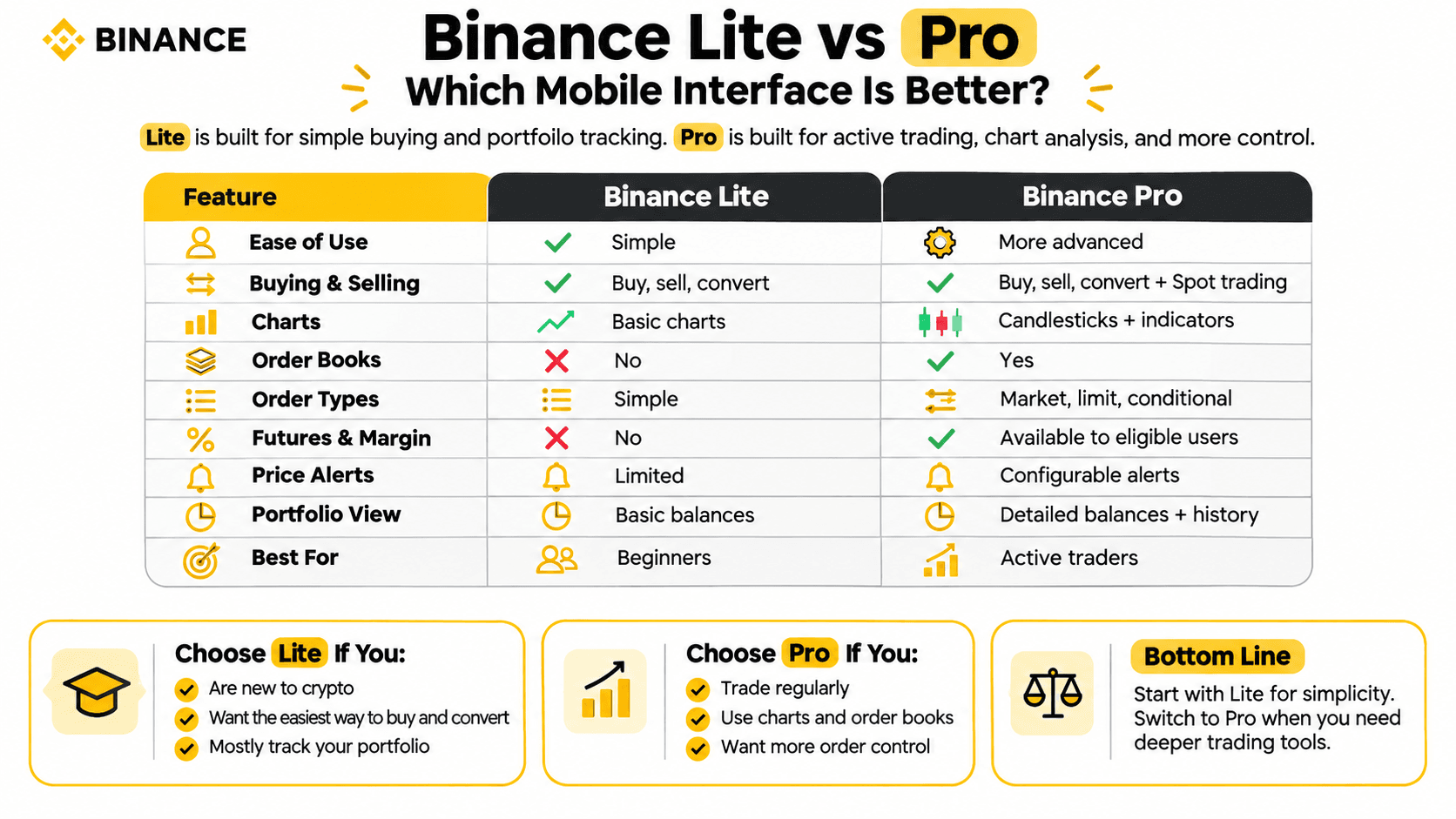 How Binance Lite And Pro Compare In Ease Of Use, Trading Tools, And Portfolio Management
Binance Lite vs Pro: Feature Comparison
The table below summarizes the main differences between the two interfaces.
| Feature | Binance Lite | Binance Pro |
|---|---|---|
| Ease of use | Simpler interface for beginners | More complex, designed for experienced users |
| Buying and selling | Simplified Buy, Sell, and Convert workflows | Buy, Sell, Convert, and advanced Spot trading |
| Charts | Basic price charts | Candlestick charts, technical indicators, and advanced tools |
| Order books | Not part of the simplified interface | Detailed Spot order books |
| Order types | Simplified purchase and sale instructions | Market, limit, and supported conditional orders |
| Futures and margin | Not available through the Lite trading interface | Available to eligible users |
| Price alerts | No advanced price-alert setup | Configurable price and percentage-change alerts |
| Portfolio tracking | Basic balances and asset values | Detailed balances, order history, and trading information |
| Trading costs | Depend on purchase method, quotes, and applicable charges | Published Spot trading rates apply to eligible Spot orders; other methods have different pricing |
| Best for | Beginners and occasional investors | Active Spot traders and experienced users |
Binance Lite: Simpler Crypto Buying and Portfolio Tracking
Binance Lite strips away much of the complexity associated with cryptocurrency trading. Instead of opening an interface packed with candlestick charts, order books and trading controls, you get a simpler dashboard focused on prices, purchases and account balances.
The main functions include:
- Buy and sell crypto: Purchase or sell supported cryptocurrencies using available fiat payment methods and eligible P2P channels.
- Convert assets: Exchange supported cryptocurrencies through a simplified interface without manually placing an order on the Spot market.
- Track your portfolio: Check crypto balances, view prices, and monitor basic market movements.
- Explore cryptocurrencies: Find supported assets and view simplified price charts.
Binance Lite is particularly useful for someone making their first Bitcoin purchase or occasionally checking their portfolio. It removes much of the information that can distract new users, while keeping essential actions accessible.
However, that simplicity comes with limitations. Lite does not provide the same advanced charting, order-book visibility, or trading controls available in Pro. Users who want to analyze candlestick patterns, place conditional orders, or manage more complex trading strategies will find it restrictive.
Another important distinction is cost. Lite's simplified buying experience does not necessarily produce the same execution price as placing an order through Binance Pro's Spot market.
Binance Pro: Advanced Trading From Your Phone
Binance Pro is where the app's broader trading functionality becomes available. It provides access to Spot markets, detailed charts, order books, and advanced trading products.
This is the interface I would favor for active trading because it offers considerably more control over how orders are placed and managed.
Key features include:
- Spot trading: View live order books and place market, limit, and supported conditional orders.
- Advanced charts: Analyze price movements using candlestick charts, technical indicators, and charting tools.
- Order management: Review open orders, monitor trade history, and manage positions.
- Price alerts: Set notifications for price targets and market movements.
- Advanced products: Access margin trading, futures, options, and other eligible products, subject to regional restrictions.
- Additional services: Access supported P2P trading, Earn products, and other Binance functions.
Pro brings together numerous features, markets, and account functions, which can make navigation less intuitive. You will need to move between several screens to find a particular setting or trading tool.
Binance App Features: What Can You Actually Do on Mobile?
I think the Binance app's biggest strength is how much functionality Binance manages to fit into a mobile interface. On the flip side, some features are buried behind multiple menus, and more complex tasks are still easier to handle on a larger screen.
Buying, Selling and Trading Cryptocurrency
Binance offers several ways to buy or trade cryptocurrencies such as Bitcoin (BTC) and Ethereum (ETH). Each method serves a slightly different purpose.
- Buy Crypto: Purchase crypto using supported bank cards, bank transfers, or other available payment methods. It is straightforward, although processing fees and quoted prices vary.
- Binance Convert: Exchange one supported cryptocurrency for another without navigating an order book. It is convenient, but the quoted exchange rate includes a spread.
- Spot Trading: Buy and sell cryptocurrencies through the Binance Pro interface using market, limit, and supported conditional orders. This gives you more control over execution.
- Binance P2P: Buy or sell crypto directly with other users through supported payment methods, with Binance providing an escrow service. Availability depends on your region.
For a straightforward Bitcoin purchase, open Buy Crypto, select BTC, enter the amount, choose an available payment method, and review the quote before confirming.
For greater control over the purchase price, switch to Binance Pro, open Trade > Spot, select a pair such as BTC/USDT, and choose a Market or Limit order. After submitting it, you can monitor pending orders under Open Orders and find completed trades through the Order Records > Trade History menu.
For a fuller walkthrough, see Coin Bureau's how to buy Bitcoin on Binance.
Mobile Charts, Order Types, and Trading Tools
Binance Pro provides a capable set of mobile trading tools. You can examine candlestick charts, use technical indicators, view order-book depth, and manage orders without switching to desktop.
The main capabilities include:
- Charts and technical analysis: Multiple chart intervals, technical indicators, and tools for examining price movements.
- Order types: Market, limit, stop-limit, and other supported conditional orders, including stop-loss and take-profit controls.
- Order management: Monitor pending orders, review completed trades, and inspect trading history.
- Price alerts: Receive notifications when an asset reaches a target price or meets specified price-change conditions.
Binance also provides mobile access to more advanced services, including futures, margin trading, trading bots, and copy trading, subject to account eligibility and regional restrictions.
The app is particularly convenient for checking markets, setting alerts, and responding to price movements when away from a computer. However, reviewing detailed charts or managing several positions simultaneously can become cumbersome on a mobile phone screen.
Binance Pro supports up to 10 price alerts per trading pair and 50 active alerts in total, with alerts valid for 90 days. Notifications must also be enabled in the phone's settings.
Portfolio Management, Earn and Other App Functions
Trading is only part of what the Binance app offers. It also provides tools for tracking assets and managing different account balances.
Through the Assets section, users can check holdings, review transaction history, and access Spot, Funding, Earn, and other eligible account balances. Internal transfers make it possible to move funds between supported account types.
Binance Earn is also available through the app, offering access to eligible staking and yield-generating products. However, these products are not interchangeable. Some involve native blockchain staking, while others use different yield mechanisms with varying redemption terms, reward rates, and risks.
Other functions include Binance Pay, where supported, and the ability to manage deposits and withdrawals.
One useful feature is transaction-history exporting. Binance allows users to generate and download Spot trading records through the mobile app, although report limits and processing times apply.
Binance App vs Desktop: Where Does Mobile Fall Short?
The Binance app offers much of the functionality available on desktop, but the experience is not identical.
| Task | Mobile app | Desktop |
|---|---|---|
| Buying and selling crypto | Convenient | Convenient |
| Placing Spot orders | Well suited | Well suited |
| Checking balances | Convenient | Convenient |
| Price alerts | Useful for on-the-go notifications | Useful for monitoring markets |
| Detailed chart analysis | Limited by screen size | More room for charts and tools |
| Managing multiple positions | More screen switching | Easier to view information simultaneously |
| Reviewing transaction history | Supported, including exports | More room for examining records |
Mobile is useful for routine trading, checking balances, and monitoring positions throughout the day. The main limitation is screen space, especially when technical analysis requires several indicators or comparisons between different markets.
Personally, I prefer the mobile app for everyday account management and trading on the go, while reserving detailed market research and more complex trade planning for desktop. One practical benefit is that you do not need a desktop session for most routine account tasks.
For more detailed instructions, Coin Bureau's Binance trading guide covers order types, execution, and mobile trading workflows.
Binance App Fees: How Much Does Mobile Trading Cost?
Binance offers competitive trading fees on its mobile app, but the amount you pay depends on how you buy or sell crypto. Standard Spot trading starts at 0.10% per transaction, while eligible users paying fees with BNB can reduce that to 0.075%. However, instant purchases, Convert trades, and withdrawals follow different pricing structures.
Spot Trading Fees and the BNB Discount
Binance charges regular users a 0.10% maker fee and 0.10% taker fee on standard Spot pairs.
- Maker orders: Limit orders that add liquidity to the order book.
- Taker orders: Orders that execute immediately against existing liquidity, including market orders.
- BNB discount: Paying eligible trading fees with BNB reduces the standard rate by 25%, to 0.075%.
Some trading pairs have special rates or zero-fee promotions. These are exceptions rather than the default, and fiat trading pairs may have separate fee schedules.
Buy Crypto vs Convert vs Spot: Which Costs Less?
Having used Binance for years, I prefer comparing the final amount of crypto received rather than focusing solely on advertised fees.
| Method | How pricing works | Best for |
|---|---|---|
| Buy Crypto | Quoted purchase price plus applicable card or provider charges | Quick fiat purchases |
| Binance Convert | No separate trading commission; price differences are reflected in the quote | Convenient crypto conversions |
| Spot Trading | Explicit maker/taker fees, plus potential spread and slippage | Greater control over execution |
Binance confirms that Convert uses dynamic quotes that may differ from Spot prices, with no additional conversion fee beyond the displayed quote.
Here is what standard Spot trading costs at different transaction sizes:
| Trade amount | Standard fee (0.10%) | With BNB (0.075%) |
|---|---|---|
| $100 | $0.10 | $0.075 |
| $1,000 | $1.00 | $0.75 |
| $10,000 | $10.00 | $7.50 |
Deposit and Withdrawal Fees
Binance does not charge for cryptocurrency deposits, although sending funds from another wallet may incur blockchain network fees. Withdrawals have network-dependent charges, while fiat deposit and withdrawal costs depend on the currency, payment provider and region.
| Transaction | Typical fee structure |
|---|---|
| Crypto deposit | Free on Binance; external network charges may apply |
| Fiat deposit | Varies by currency and payment method |
| Crypto withdrawal | Network-dependent fee displayed before confirmation |
| Fiat withdrawal | Varies by region and withdrawal method |
| Internal Binance transfer | Generally free when using the supported internal transfer mechanism |
For me, spot trading offers the clearest fee structure, particularly with the BNB discount. However, I would always compare the final quoted amount before using Buy Crypto or Convert, especially for larger transactions where small pricing differences can add up.
Is the Binance App Safe? Security, Hacks and User Protection
I consider account security essential, especially when keeping funds on the exchange for trading. Having used Binance extensively, I'd say it's reasonably well equipped to protect individual accounts, provided users enable its security features. However, the October 2026 breach shows that account protections are only one part of the picture.
I would be comfortable using Binance for active trading, but I would avoid treating an exchange account as a substitute for long-term self-custody.
All told, the Binance app offers strong account security features, but that does not make holding cryptocurrency on Binance risk-free. Passkeys, two-factor authentication (2FA), and withdrawal controls can help protect your account.
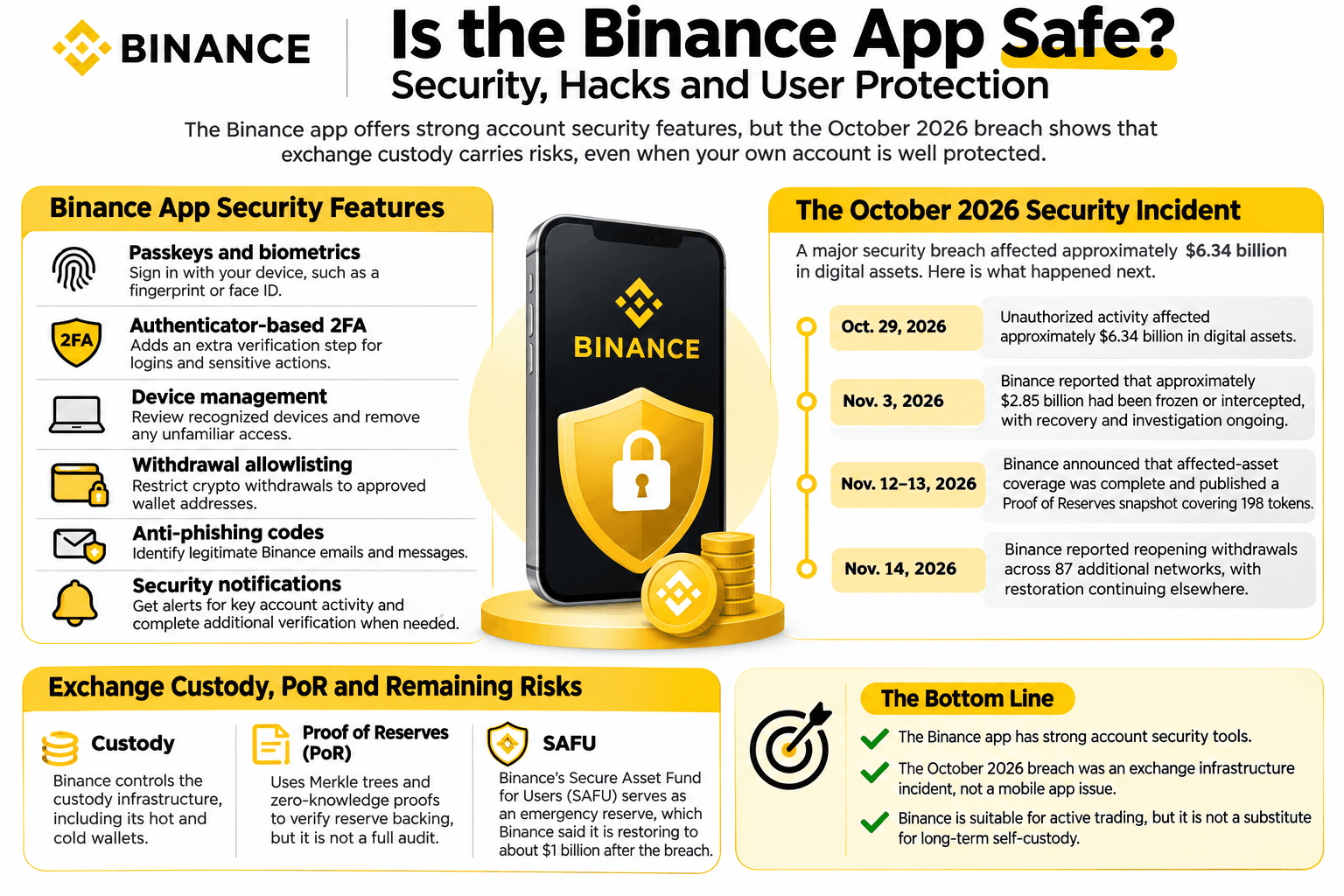 How Binance Protects User Accounts And What The October 2026 Breach Reveals About Exchange Risks
Binance App Security Features
Binance provides several security controls that users can manage through their accounts:
- Passkeys and biometrics: Enable passwordless authentication using supported device security, such as fingerprint or facial recognition.
- Authenticator-based 2FA: Adds another verification step when signing in or authorizing sensitive actions.
- Device management: Lets users review recognized devices and remove unfamiliar access.
- Withdrawal allowlisting: Restricts crypto withdrawals to approved wallet addresses.
- Anti-phishing codes: Help users identify legitimate Binance communications.
- Security notifications: Alert users to certain account activities, while additional verification protects sensitive actions.
I recommend enabling a passkey or authenticator-based 2FA, reviewing authorized devices regularly, and using withdrawal allowlisting where practical. These precautions reduce the risk of account takeover, although they cannot eliminate every threat.
Binance's October 2026 Security Incident: What App Users Should Know
On Oct. 29, 2026, Binance suffered a major security breach involving unauthorized activity in its internal wallet infrastructure. Approximately $6.34 billion in digital assets was affected.
This was an exchange infrastructure compromise, not evidence that the Binance mobile app itself contained malware.
Binance reported the following recovery milestones:
| Date | Development |
|---|---|
| Oct. 29, 2026 | Unauthorized activity affected approximately $6.34 billion in digital assets. |
| Nov. 3, 2026 | Binance reported that approximately $2.85 billion had been frozen or intercepted, with recovery and investigation ongoing. |
| Nov. 12–13, 2026 | Binance announced that affected-asset coverage was complete and published a Proof of Reserves snapshot covering 198 tokens. |
| Nov. 14, 2026 | Binance reported reopening withdrawals across 87 additional networks, with restoration continuing elsewhere. |
Binance's Nov. 14 announcement confirmed that additional withdrawal networks remained unavailable, with the exchange targeting further restoration. Users should check the availability of their specific asset and network before attempting a withdrawal.
Exchange Custody, Proof of Reserves, and Remaining Risks
Binance operates as a centralized cryptocurrency exchange. When you hold crypto in your exchange account, Binance controls the custody infrastructure, including its hot and cold wallets.
This creates risks that even strong mobile authentication cannot eliminate.
Binance publishes Proof of Reserves (PoR) using cryptographic verification methods, including Merkle trees and zero-knowledge proofs. These allow users to verify aspects of reserve backing, but they are not a complete financial audit and do not eliminate operational or counterparty risk.
Binance also maintains its Secure Asset Fund for Users (SAFU), an emergency protection reserve. Following the October incident, Binance said it used a combination of corporate funds, excess futures insurance funds, and SAFU resources to replenish affected assets. It also committed to restoring SAFU to approximately $1 billion.
For a deeper examination of Binance's security history, see our dedicated article: Is Binance safe after the October 2026 hack?.
Binance Wallet vs Exchange Wallet: Who Controls Your Crypto?
The Binance app lets you manage cryptocurrency in both custodial exchange accounts and a separate self-custodial wallet. The key difference is who controls your assets. Binance manages the private keys for crypto held in its exchange accounts, while Binance Wallet gives you control over transactions through its own wallet security system.
I find Binance's exchange wallet convenient for keeping funds accessible for trading. However, I prefer separating trading balances from longer-term holdings. A self-custodial wallet gives me more direct control over my crypto, although it also makes me responsible for protecting my recovery credentials and approving transactions safely.
Binance Exchange Wallet vs Binance Wallet
When you deposit crypto into Binance, the assets are held within the exchange's custody infrastructure. Your Spot Wallet is primarily used for trading, while the Funding Account supports functions such as P2P transactions and other eligible payment services. These are internal account balances, not separate self-custodial wallets.
| Feature | Binance Exchange Wallet | Binance Wallet |
|---|---|---|
| Custody | Binance controls custody | Self-custodial |
| Private keys | Managed by Binance | Managed through wallet credentials or MPC key shares |
| Access | Binance account login and verification | Wallet authentication and recovery credentials |
| Recovery | Binance account recovery procedures | Wallet-specific backup and recovery process |
| Transactions | Spot trading, internal transfers, deposits and withdrawals | On-chain transfers, swaps and DApp interactions |
| Main risks | Exchange breaches, account restrictions and withdrawal suspensions | Compromised credentials, malicious transactions and lost recovery access |
Binance Wallet, meanwhile, is a self-custodial Web3 wallet designed for managing on-chain assets and interacting with decentralized applications (DApps).
Its Keyless Wallet uses Multi-Party Computation (MPC) to split cryptographic key material into three shares stored across separate locations, including your device and cloud backup. Recovery relies on the wallet's backup and authentication arrangements rather than Binance simply resetting an exchange account password.
Sending Crypto to an External Wallet
You can withdraw cryptocurrency from Binance to an external wallet.
The process is straightforward:
- Open the Binance app and navigate to Assets > Overview > Send, then select Withdraw Asset.
- Choose the cryptocurrency and the account you want to withdraw from.
- Enter the destination wallet address and select the correct blockchain network.
- Add a memo or destination tag if required, review the network fee and receiving amount, and confirm the withdrawal using the required security verification.
Withdrawal fees vary by asset and network. Availability can also change during maintenance or security-related restrictions, so check the withdrawal status before initiating a transfer.
Where Is the Binance App Available? U.S., UK, EU, and Regional Restrictions
The Binance mobile app is available in many countries, but downloading the app does not guarantee access to every Binance service. Trading, fiat deposits, P2P, futures, and withdrawals may be restricted depending on your country of residence and account verification status.
One thing worth checking before registering is whether Binance supports the specific features you intend to use, not just whether the app appears in your app store.
Binance App vs Binance.US: What American Users Need to Know
Binance.com is not available to U.S. residents. Instead, eligible American users can register with Binance.US, a separate platform with its own mobile app, fee schedules, supported assets, and regulatory restrictions.
| Feature | Binance.com (Global) | Binance.US |
|---|---|---|
| U.S. availability | Unavailable to U.S. residents | Available in supported states |
| Spot maker/taker fees | 0.10% / 0.10% standard | 0% / 0.02% on most pairs |
| Special fee tier | Pair-specific promotions and discounted rates | BNB/USD: 0% maker, 0.01% taker |
| BNB fee discount | 25% on eligible Spot fees | 5% on eligible Spot fees |
| Spot trading | Yes, broad global market selection | Yes, more limited U.S. selection |
| Futures and margin | Available where permitted | No comparable futures or margin offering |
| P2P trading | Available in eligible regions | No equivalent global P2P marketplace |
| Staking | Binance Earn and eligible staking products | Staking and Soft-Staking |
| USD deposits | Region-dependent fiat support | ACH and wire in eligible states |
| ACH fees | Not applicable to the global U.S.-restricted platform | Free deposits and withdrawals |
| Card deposits | Provider- and region-dependent | Published card deposit fee of 3.99% |
| Wire withdrawals | Region-dependent | $25, excluding bank charges |
| Withdrawal holds | Depend on funding method and security restrictions | Seven-day hold on recent ACH and eligible card-funded deposits |
| Identity verification | Binance KYC requirements | U.S.-specific Basic and Advanced verification |
Binance.US is not available in every state. As of Nov. 17, 2026, its official restrictions include New York, Texas, Washington, and Vermont, alongside several other jurisdictions. Some supported states also have limits on U.S. dollar services.
Binance App Availability in Europe, the UK, and Other Regions
Binance's availability in Europe and the UK is more complicated because of regulatory restrictions.
European Union and EEA: Binance withdrew its application for authorization under the Markets in Crypto-Assets Regulation (MiCA) in Greece on June 24, 2026, and said it would pursue licensing in another EU member state. Binance also warned that some customers could face service restrictions depending on their country and account status.
An August 2026 investigation reported that Binance was still onboarding some European customers despite not having secured MiCA authorization. However, successful registration does not establish that the exchange is authorized to provide services throughout the EU.
United Kingdom: Binance stopped accepting new UK users on Oct. 16, 2023, following restrictions relating to financial promotions. Existing eligible customers could continue accessing certain services, subject to investor declarations and appropriateness assessments.
Other regions: Binance's availability varies by jurisdiction. Even where Spot trading is accessible, users may face restrictions on fiat deposits, P2P trading, derivatives, or other financial products.
Before depositing funds, I recommend checking three things:
- Whether Binance accepts new accounts from your country of residence.
- Whether your intended payment methods and trading products are supported.
- Whether your account has completed the necessary Know Your Customer (KYC) verification.
Binance App Reliability and Customer Support: What Happens When Something Goes Wrong?
The Binance app offers extensive trading functionality, but reliability is just as important as features. Delayed notifications, login problems, or restricted withdrawals can be frustrating, particularly when markets are volatile.
App Performance, Notifications and Common Complaints
Binance Pro combines trading, portfolio management, and account settings in a feature-heavy interface. This is useful once you know where everything is, but finding specific controls can require navigating several menus.
The app supports price alerts, order notifications, transaction history, and account security prompts on Android and iOS. However, notifications can be affected by phone permissions, connectivity, and app settings.
Public app reviews also describe occasional login difficulties, delayed updates, and navigation complaints. In my years of use, however, I've never faced a problem I couldn't solve on my own, and I've had to turn to support for help.
Common Binance App Problems and How to Resolve Them
| Problem | Possible cause | What to do |
|---|---|---|
| Login or 2FA failure | Lost authenticator, changed device, security verification | Use Binance's official 2FA recovery process. Security-related withdrawal restrictions may follow. |
| KYC verification pending | Document issues, identity mismatch, additional review | Check verification status and use the official KYC appeal process if rejected. |
| Withdrawal pending | Network congestion, account restrictions, service suspension | Check withdrawal status, network availability, and transaction records before contacting support. |
| Price alerts not working | Disabled push notifications, expired alerts, connectivity | Check app and phone notification permissions, then review alert settings. |
| Missing balances | Wrong account view, pending transfer, delayed refresh | Check Spot, Funding, and other balances alongside transaction history. |
| Suspicious app or APK | Fake download, phishing link, unofficial distributor | Verify the app through Binance's official website or recognized app-store listing. |
Binance Customer Support: Is It Useful?
Binance provides 24/7 access to its support system, including live chat, automated assistance, and a searchable Help Center. Users can also access self-service tools for 2FA resets, KYC appeals, account recovery, and transaction-history downloads.
The main advantage is that many routine issues can be addressed without speaking to an agent. More complicated cases involving compliance checks, restricted accounts, or missing withdrawals may require additional investigation.
As I've noted earlier, I've never had to contact Binance customer support for a problem I was facing.
Binance App vs Coinbase, Kraken, OKX, and Bybit: Which Is Better?
Binance is one of the more versatile crypto trading apps, but it is not necessarily the best choice for everyone. Coinbase and Kraken offer simpler experiences for occasional investors, while OKX and Bybit compete more directly with Binance Pro on advanced trading functionality.
Binance remains my preferred all-around mobile trading platform because I am familiar with its interface and value its range of features and competitive Spot fees.
Which Crypto Trading App Should You Choose?
| App | Best for | Main mobile strength | Key limitation |
|---|---|---|---|
| Binance | Versatile mobile trading | Lite and Pro modes, broad trading tools, low Spot fees | Complex interface, custody risks, unavailable to U.S. residents |
| Coinbase | Beginners and U.S. investors | Simple purchasing with optional Coinbase Advanced tools | Higher or variable trading costs depending on method |
| Kraken / Kraken Pro | Security-conscious users and active traders | Separate beginner and advanced apps, strong account controls | Higher entry-level Spot fees than Binance |
| OKX | Advanced traders and Web3 users | Trading functionality and integrated Web3 access | Product availability varies by region |
| Bybit | Eligible derivatives traders | Futures interface and position-management tools | U.S. restrictions and leveraged-trading risks |
Note: Comparison reflects publicly documented features and standard fee schedules as of Nov. 17, 2026. Fees may vary by trading volume, product, and jurisdiction.
Binance vs Coinbase and Kraken Mobile Apps
Coinbase is better suited to beginners who prioritize simplicity, particularly in the United States. Its standard mobile interface makes buying and managing crypto straightforward, while Coinbase Advanced provides order books, detailed charts, and advanced orders.
The main difference is cost. Binance's standard Spot maker/taker fees are 0.10%/0.10%, compared with Coinbase Advanced's volume-based fees. Coinbase's simple purchase interface also uses different pricing, including applicable spreads and transaction charges.
For a detailed comparison of both exchanges, check out our Binance vs Coinbase review.
Kraken follows a similar approach with separate Kraken and Kraken Pro apps. The standard app focuses on simple purchases, while Kraken Pro provides advanced charts, order types, and trading controls.
Kraken Pro's entry-level Spot fees are 0.40% maker and 0.80% taker, higher than Binance's standard rates. Kraken also offers security features such as passkeys and withdrawal protections, although neither exchange eliminates custodial risk.
For beginners, I would lean toward Coinbase or the standard Kraken app. For frequent Spot trading, Binance Pro's lower standard fees make it more attractive, assuming the user is eligible to access it.
Binance vs OKX and Bybit Mobile Apps
OKX and Bybit are closer competitors to Binance Pro because their mobile apps emphasize advanced trading rather than just simple cryptocurrency purchases.
OKX combines Spot trading, advanced charts, order management, and access to a separate Web3 wallet experience. Its standard Spot fees are 0.08% maker and 0.10% taker for regular users on applicable markets, making it competitive with Binance.
Our Binance vs OKX review compares both exchanges across trading costs, features, security, and supported products.
Bybit focuses heavily on active trading, with mobile derivatives tools, advanced order controls, and position monitoring. Its standard non-VIP fees are 0.10% maker/taker for Spot and 0.02% maker/0.055% taker for perpetual futures.
Check out our Binance vs Bybit review for an in-depth comparison of their trading platforms, fees, and features.

Binance App Review: Final Verdict
The Binance app is worth using in 2026, particularly for active traders and investors who want access to multiple crypto services from their phones. After roughly three years of using it, I still find it one of the more practical mobile trading platforms, thanks to its extensive features, competitive fees, and flexible trading interface.
Binance Lite makes buying and managing crypto more approachable for beginners, while Binance Pro offers advanced charts, order types, and portfolio tools. I prefer Pro for everyday trading, although desktop remains more convenient for detailed technical analysis and managing multiple positions.
I would choose Binance for active mobile trading, provided its services are available in my region. Beginners who prioritize simplicity may prefer Coinbase or Kraken, while long-term holders should consider self-custody rather than leaving substantial balances on any exchange.