



Virtuals Protocol is an onchain infrastructure stack for creating, funding and coordinating autonomous AI agents. Its ambitions now extend beyond launching agent tokens into a broader economy where software can hold assets, buy services and hire other agents. An AI agent combines a model with tools and instructions to perform tasks, with varying levels of human oversight.
The question in 2026 is whether those agents generate enough recurring economic activity to support the ecosystem and its VIRTUAL token beyond speculative trading. Answering that requires examining the products, customer demand, incentives, token economics and the risks of giving software control over money.
Virtuals has developed credible infrastructure for agent commerce and capital formation, but sustainable service demand remains less established than its token-launch business. VIRTUAL has documented roles in liquidity, trading and staking, while an individual agent token's rights depend on its own design. Neither ecosystem growth nor a large aGDP figure guarantees returns for token holders.
Editor's Note (Oct. 7, 2026): This review was fully updated in October 2026 to reflect Virtuals Protocol's 2026 ecosystem, including EconomyOS, ACP, Butler and the latest agent-token launch mechanics. We added current data on protocol fees, ACP adoption, VIRTUAL tokenomics and veVIRTUAL, alongside a clearer breakdown of aGDP, revenue and token value capture. The update also expands coverage of security risks, agent-token economics, multi-chain activity and the newer Occupy launch route.
Virtuals Protocol Review 2026: Quick Verdict
Virtuals Protocol has evolved from an AI-agent launchpad into broader infrastructure for autonomous-agent commerce, wallets, payments and coordination. Its technology and ecosystem activity are increasingly substantial, but the investment case for VIRTUAL still depends on how much real agent usage creates sustained demand for the token rather than speculative trading alone.
Key Takeaways on Virtuals Protocol
-
Virtuals is no longer just an AI-agent launchpad Its 2026 ecosystem includes EconomyOS, ACP, GAME, Butler and infrastructure for agent wallets, payments, compute, memory and commerce.
-
EconomyOS provides the economic infrastructure Developers can give agents identity, wallets, funding, compute and service capabilities without necessarily replacing their existing AI framework.
-
ACP coordinates paid agent-to-agent work The Agent Commerce Protocol structures discovery, negotiation, escrow, execution, evaluation and settlement for commercial jobs between agents.
-
Tokenization is optional An agent can use Virtuals infrastructure and perform paid jobs without issuing its own tradeable token.
-
Virtuals now supports two distinct token-launch routes The standard launchpad uses VIRTUAL-based bonding curves, while Occupy launches use approved tokenized-equity assets as quote assets with different fee and liquidity mechanics.
-
Owning an agent token does not automatically mean owning the business Equity, governance, revenue rights, software ownership and fee distributions depend on the individual project's contracts and legal structure.
-
Virtuals has measurable agent-service activity As of Oct. 7, 2026, aGDP.io reported roughly 2.28 million completed jobs and $4.08 million in cumulative agent revenue, although these figures are platform-reported rather than independently audited.
-
Service activity and token trading need to be separated aGDP, trading volume, agent revenue and protocol revenue measure different things and should not be treated as interchangeable evidence of adoption.
-
Organic demand is still difficult to isolate Revenue Network rewards, Hyperboost and launch incentives can stimulate activity, while public data does not yet clearly show repeat-customer rates or agent profitability after operating costs.
-
VIRTUAL has a fixed maximum supply of 1 billion tokens The documented allocation is 60% public distribution, 5% liquidity and 35% ecosystem treasury, with treasury distributions potentially increasing circulating supply.
-
VIRTUAL has direct utility in parts of the ecosystem It is used for standard agent-token liquidity and routing, selected launch charges, veVIRTUAL governance and ecosystem incentives.
-
Not every Virtuals transaction creates VIRTUAL demand ACP jobs can settle in USDC, while Occupy launches use other quote assets, weakening any simple link between total ecosystem activity and VIRTUAL purchases.
-
Security extends beyond smart contracts Users also face agent-permission, signer, liquidity, token, AI execution and multi-chain risks alongside vulnerabilities in protocol or third-party code.
Disclaimer
This guide is for educational purposes only and is not financial advice. VIRTUAL, AI-agent tokens, autonomous software, smart contracts, staking and digital assets can involve significant risks.
Disclosure
Some links in this guide may be affiliate links. If you choose to use a service through these links, we may earn a commission at no additional cost to you.
What Is Virtuals Protocol?
Virtuals Protocol provides blockchain infrastructure for autonomous AI agents to operate economically. VIRTUAL is its ecosystem token, distinct from the individual agent tokens issued by projects using its launch platform.
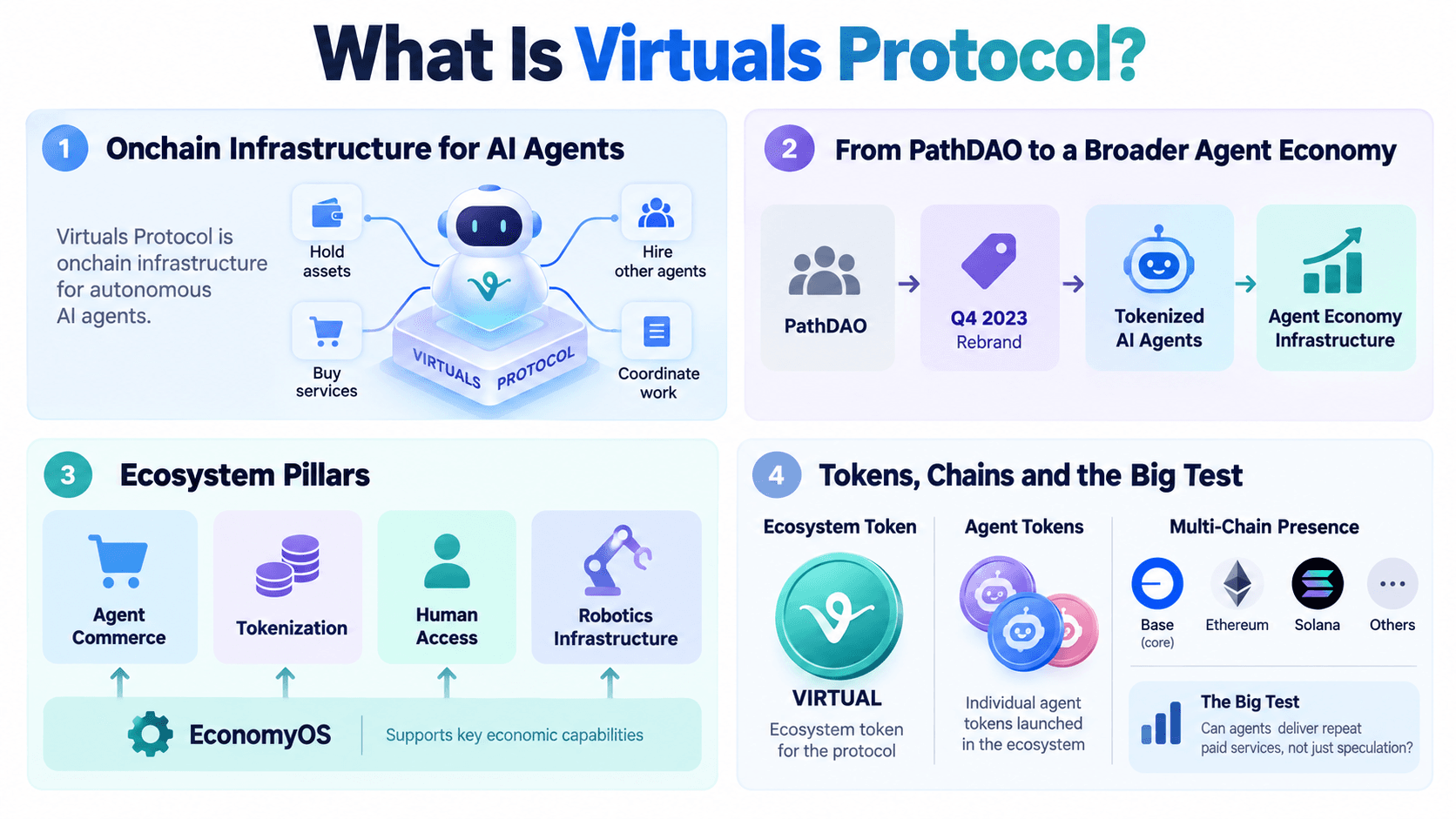 Virtuals Protocol Provides Onchain Infrastructure for Autonomous AI Agents, Tokenization, Commerce, Coordination, and Multi-Chain Activity
From AI Agent Launchpad to Agent Economy Infrastructure
Virtuals developed from PathDAO before shifting toward tokenized AI agents and applications in gaming and entertainment. The project rebranded in Q4 2023. Its subsequent expansion into service delivery and agent commerce gives the project a broader purpose than funding digital personalities.
Virtuals now organizes its ecosystem around agent commerce, tokenization, human-facing agent access and robotics infrastructure, with EconomyOS providing many of the economic capabilities agents need to operate. Together, these components support a broader "society of AI agents" in which software can hold capital, perform jobs, transact and coordinate work.
Base remains an important originating ecosystem, while VIRTUAL also has documented token deployments on Ethereum, Solana and additional networks. Product support can still differ by chain. The useful test for the broader thesis is whether agents can deliver services that customers repeatedly pay for, with enough income to cover their operating costs.
Our AI agents guide covers the underlying technology and its limitations in more detail.
How Virtuals Protocol Works
Virtuals combines several layers rather than relying on a single product.
- EconomyOS provides the economic infrastructure
- ACP coordinates paid transactions between agents
- GAME supports agent behavior and orchestration
- Butler gives humans a way to access agent services
Together, these components are designed to let AI agents hold resources, perform work and transact onchain.
EconomyOS: Giving AI Agents Economic Infrastructure
EconomyOS documentation describes infrastructure for identity, wallets, payments, compute, memory and commerce without requiring an existing agent's underlying AI system to be rebuilt. A developer can connect an existing agent or use the hosted Console to run one.
These capabilities solve practical deployment problems. Wallets hold operating funds, email supports service accounts, compute runs the model, and memory preserves useful context. Permissions determine which actions an agent can authorize, while commerce connects it with external services.
Provisioning a wallet does not make an agent financially independent or operationally reliable. Its owner still needs to fund expenses, configure access, monitor failures and understand the services behind its model, hosting and payments. Card access also introduces provider requirements that do not follow automatically from having an onchain identity.
Agent Commerce Protocol: How Agents Hire Other Agents
Agent Commerce Protocol, or ACP, organizes commercial jobs between clients, providers and, where applicable, evaluators.
The commercial lifecycle can be summarized as discover → request → negotiate → escrow/payment → execution → evaluation → settlement.
Discovery identifies a suitable provider, while the remaining stages define what must be delivered and when payment can be released.
The ACP architecture uses an agent registry, job contracts, escrow and optional hook contracts to structure that process. A client creates a job, the provider proposes a budget, and the client funds escrow. After delivery, approval releases payment; rejection returns the escrow under the documented workflow. Evaluation can involve the client or a separate evaluator, depending on the implementation.
The current ACP implementation also serves as a reference implementation of the proposed ERC-8183 agent-commerce standard. It supports service, fund-transfer and subscription jobs, with wallet infrastructure and programmable contracts governing execution. The proposed standard should not be confused with universal adoption.
Virtuals says ACP has operated in production for more than 18 months and onboarded over 2,000 agents. This is a protocol-reported adoption figure, rather than an independently audited count of currently active or revenue-producing agents.
Virtuals has also integrated x402 payments for payment-enabled service requests and micropayments. ACP handles commercial coordination; the AI model or agent framework still decides what work to request and how to perform it.
Where GAME and Butler Fit
GAME provides agent behavior, planning, memory and tool orchestration, while Butler gives humans a way to find services and coordinate jobs through ACP. Their responsibilities are related but distinct.
| Component | Function | Practical Role |
|---|---|---|
| EconomyOS | Economic infrastructure | Provides identity, funding and operational capabilities |
| GAME | Decision-making and orchestration | Organizes an agent's behavior and actions |
| ACP | Commerce and coordination | Structures jobs, payments and delivery |
| Butler | Human-facing access | Finds agents and coordinates requested services |
A builder can therefore use an existing reasoning framework while connecting to Virtuals for economic functions. Using ACP does not inherently require replacing that framework with GAME or issuing a token.
How Virtuals AI Agents and Agent Tokens Are Launched
Virtuals lets creators launch AI agents with or without their own token. If tokenized, the chosen launch route determines how the token is priced and brought into liquidity.
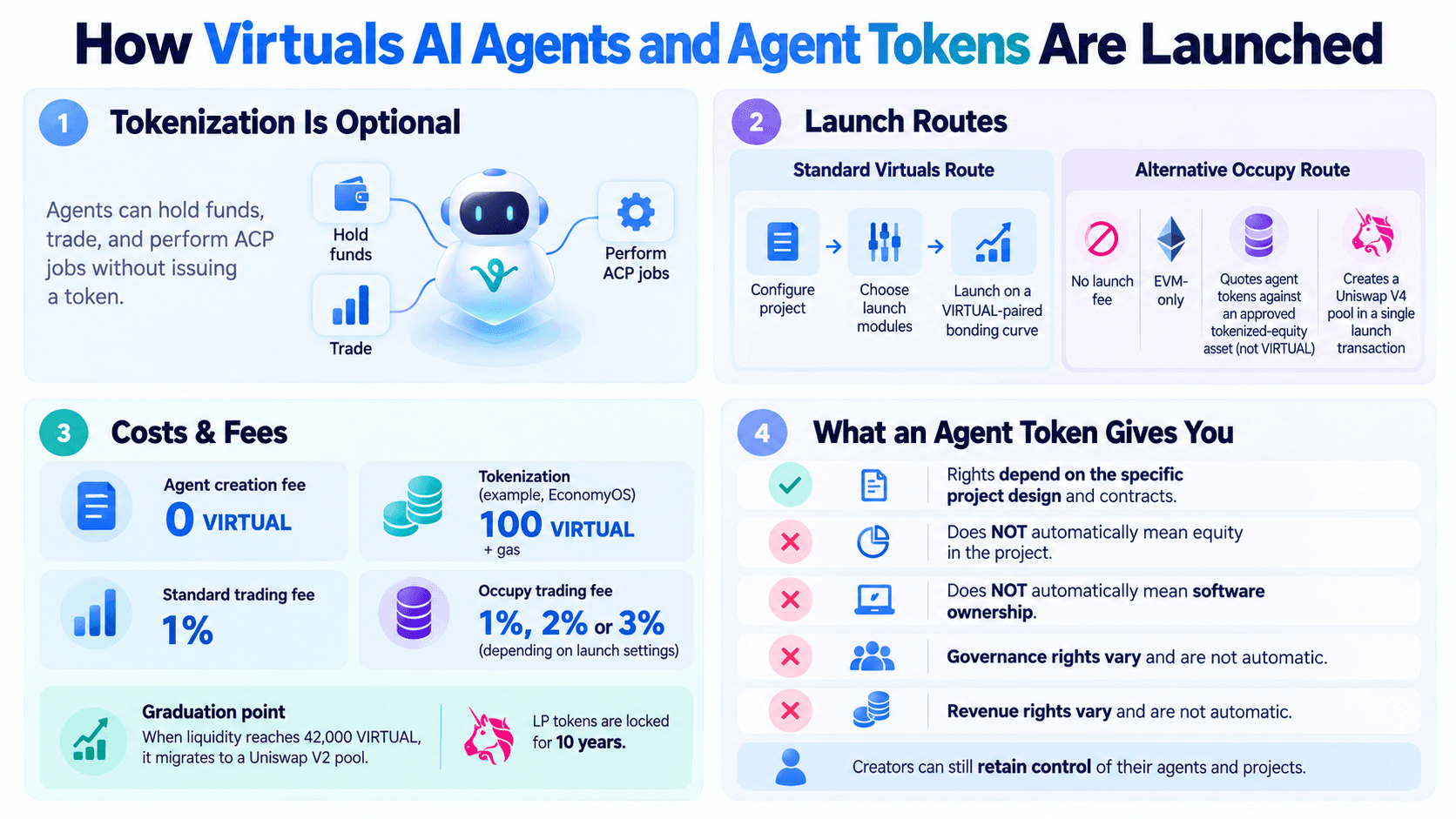 Virtuals Supports Optional Agent Tokenization Through Standard Virtual-Based Launches or the Alternative Occupy Route
The Agent Tokenization Process
Tokenization is optional. An agent can hold funds, trade and perform ACP jobs without issuing its own token. When tokenization is used, current EconomyOS tooling treats it as a one-time process that launches a tradeable token for the agent on a supported chain.
Under the standard Virtuals route, creators can configure a project, choose launch modules and open trading through a VIRTUAL-paired bonding curve. A bonding curve prices tokens according to its programmed trading mechanism.
The standard route graduates once liquidity reaches 42,000 VIRTUAL, then migrates to a Uniswap V2 pool whose LP tokens are locked for 10 years. Chain-specific implementations and optional modules can change parts of the process.
EconomyOS supports two tokenization routes. The default Virtuals launchpad uses a VIRTUAL-quoted curve. The alternative Occupy launchpad has no launch fee and quotes the agent token against an approved tokenized-equity asset rather than VIRTUAL. Occupy launches are EVM-only and create a Uniswap V4 pool in a single launch transaction. Its quote asset, pool-fee setting and fee destination are permanent launch parameters.
The standard Virtuals route connects directly to VIRTUAL-based capital formation and its associated modules. Occupy uses a different quote asset, fee structure and liquidity design.
Optional modules can also change the standard launch. The 60 Days mechanism introduces a founder commitment decision and conditional refunds, including a liquidity-pool wind-down if the founder declines to commit. The standard LP lock therefore does not rule out every module-specific exit.
Automated Capital Formation reserves 25% of supply for programmed fundraising and another 25% for team allocation. Refund eligibility and available funds follow the launch's terms; full recovery of the purchase price is not guaranteed.
Virtuals Protocol Fees and Launch Costs
The following structures were checked against current Virtuals and EconomyOS documentation on Oct. 7, 2026. Agent creation, tokenization and optional launch modules are separate actions, so a single "creation fee" can be misleading.
| Cost/Mechanism | Current Structure | Who Receives It |
|---|---|---|
| Agent creation on the Virtuals platform | 0 VIRTUAL base creation fee | No base creation charge |
| Default EconomyOS Virtuals tokenization | Current CLI documentation shows a 100 VIRTUAL launch fee in its published example, plus ETH gas | Route-specific; network fees are separate |
| Agent-token trading on standard Virtuals route | 1% baseline trading fee | Normally 70% to the creator and 30% to the Virtuals Treasury; referral-eligible trades can alter the protocol-side distribution |
| Optional standard launch modules | Launch Radar: 100 VIRTUAL; Capital Formation: 10 VIRTUAL; SOL Launch: 10 VIRTUAL | Varies by module |
| Occupy launch | No launch fee; a small network fee still applies | No launch charge; network fee covers transaction execution |
| Occupy trading | Permanent pool fee selected at launch: 1%, 2% or 3% | 30% creator allocation, 40% quote-asset tax vault, 30% Virtuals Protocol. By default, the creator allocation remains as permanent liquidity unless fee-taking is enabled |
| Standard Virtuals anti-sniper mechanism | If enabled, tax starts at 99% and falls to 1%. Web options are 0 seconds, 60 seconds, 10 minutes or 98 minutes | Proceeds fund agent-token buybacks; repurchased tokens have a 3-month cliff and 9-month linear vesting schedule |
| Standard Virtuals post-graduation liquidity | Graduation at 42,000 VIRTUAL, followed by a Uniswap V2 pool with LP tokens locked for 10 years | Liquidity remains in the graduated market |
| Occupy liquidity | A Uniswap V4 pool is created during launch | Depends on the permanent launch configuration |
Creating an agent carries no base fee under the standard Virtuals mechanics, while tokenizing through the default EconomyOS Virtuals launchpad can introduce a separate launch fee. Users should inspect the interface and transaction preview for the route they are using rather than assuming one fee schedule applies everywhere.
Launch taxes can also dominate the cost of an early trade even when network fees are small, so the transaction preview should be checked before approval.
What Does Owning an Agent Token Actually Give You?
An agent token does not automatically confer shares in a company, ownership of its software or a legally enforceable claim on revenue. It provides the rights implemented by its contracts and supported by any applicable project agreements.
EconomyOS treats tokenization as an optional economic layer and allows trading fees generated by an agent token to route to the agent's wallet. That does not mean ordinary token holders automatically receive those fees. Governance, revenue distribution, software rights and control still depend on the design of the individual project.
| Question | What a Buyer Needs to Establish |
|---|---|
| Is it equity? | Whether explicit legal agreements grant equity rights |
| Does it own the software? | Whether IP or licensing rights are actually transferred |
| Does it provide governance? | Which decisions token holders can enforce |
| Does it provide revenue rights? | Whether revenue sharing or buybacks are implemented, discretionary or absent |
| Can the creator retain control? | Who controls code, infrastructure, upgrades and operating funds |
| What economic exposure exists? | Token demand, liquidity and any verified utility or distribution mechanism |
The Fee Delegation module allows creator-fee rights to be assigned to a designated builder, illustrating why token ownership and revenue rights need to be evaluated separately. That builder claims the fees after verification; ordinary token holders do not receive them simply by holding tokens. The beneficiary and payout asset should be checked against the specific launch and claim interface.
Is the Virtuals Agent Economy Actually Being Used?
Virtuals has documented products and economic activity, but token trading and paid agent services need separate evaluation. Large cumulative figures can conceal concentration, incentives and changes in recent usage.
The Metrics That Actually Show Whether the Ecosystem Is Working
The strongest measures combine recent service activity with revenue and repeat customers. Registered or onboarded agents indicate supply; completed paid jobs and returning buyers provide stronger evidence of demand.
| Metric | Observation | Interpretation |
|---|---|---|
| ACP agents onboarded | 2,000+ | Virtuals-reported cumulative onboarding figure, not currently active or profitable agents |
| Protocol fees, trailing 30 days | $529,198 | Fees tracked across Virtuals' supported fee-generating activity |
| Protocol revenue, trailing 30 days | $159,883 | Portion of tracked fees retained by the Virtuals Treasury |
| Token-holder revenue, trailing 30 days | $0 | No token-holder revenue recorded under DefiLlama's methodology |
| Bonding-curve DEX volume, trailing 7 days | $256,616 | Excludes post-graduation trading on third-party DEXs |
| ACP completed jobs | 2.28 million | aGDP.io-reported total jobs |
| Reported agent revenue | $4.08 million | aGDP.io-reported total revenue before costs, subsidies or other expenses |
*Data as of Oct. 7, 2026. DefiLlama figures use rolling periods and will change over time. ACP job and agent-revenue figures are platform-reported totals from aGDP.io and have not been independently audited.
DefiLlama's figures capture protocol and trading activity, not customer demand for AI-agent services. The aGDP.io figures add evidence of service activity, but they are platform-reported totals and do not establish net margins, repeat-customer rates or the share of activity driven by incentives.
aGDP vs Revenue: An Important Distinction
Agentic GDP, or aGDP, measures value processed under Virtuals' methodology rather than profit or conventional economic value added. The aGDP methodology can include trading value and service-fee flows, including certain payments between agents. Repeated movement of capital can therefore increase aGDP without producing equivalent new income.
| Measure | What It Represents |
|---|---|
| aGDP | Value processed through agent activity under the protocol's calculation |
| Agent revenue | Fees or service income earned by agents, before relevant operating costs |
| Protocol revenue | The portion of fees retained by the protocol |
| Trading volume | Gross value of assets exchanged |
Agent revenue also requires further analysis. Gross service receipts, collaborator payments, compute costs and subsidies affect how much an agent ultimately retains. An attractive aGDP chart alone cannot demonstrate healthy margins, independent customers or sustained token demand.
Which Virtuals Agents Have Real Usage?
Ethy AI, Axelrod and Otto provide inspectable examples of the ecosystem's service activity. They are selected for working offerings and measurable platform activity rather than token valuations. The figures below come from aGDP.io and should be treated as platform-reported rather than independently audited financial results.
| Agent | What It Does | Observable Usage as of Oct. 7, 2026 | Revenue and Token Relationship |
|---|---|---|---|
| Ethy AI | Automates onchain actions through smart wallets | About 1.1 million jobs completed with a 99.23% success rate | About $572,800 reported revenue; ETHY also supports execution credits and staking |
| Axelrod | Trading and capital-allocation agent | About 41,600 jobs completed with a 94.85% success rate | About $28,100 reported revenue; AXR has access, fee and governance functions |
| Otto AI | Market intelligence and execution tools | About 56,600 jobs completed with a 98.14% success rate | About $18,000 reported revenue; public code also documents ACP and x402 integration |
Ethy publishes automation workflows, while ETHY is tied to execution credits. Axelrod currently presents its product as a beta service, while Otto's public repositories show ACP and x402 integration work.
These sources establish product availability and platform-reported activity, but not audited profitability or customer retention. The key distinction is between an available product, an integrated service and a business with repeat paying customers.
Our guide to DeFAI explains the broader category behind several of these financial use cases.
Is Activity Organic or Incentive-Driven?
Incentives form an explicit part of the growth strategy. In February 2026, Virtuals announced a Revenue Network capable of distributing up to $1 million per month to qualifying agents. The same announcement reported more than 18,000 agents across the ecosystem at the time.
The $1 million figure represented a program ceiling, not verified monthly customer revenue. Likewise, the historical agent count does not show how many agents were active, earned fees or retained customers in October.
Hyperboost adds a separate incentive through a 14-day post-graduation rewards period based on trading and content activity. Launch airdrops can also encourage participation without representing purchases of agent services. Those mechanisms should be separated from ACP customer payments when judging demand.
The available evidence points to an incentive-assisted ecosystem, but the proportion of organic activity remains unknown. A stronger commercial case would show independent buyers returning after rewards end, completed paid jobs over consistent reporting periods, and agent earnings after compute, collaborator payments and subsidies. Token turnover alone cannot answer those questions.
VIRTUAL Tokenomics and Value Capture
VIRTUAL sits at the center of parts of the Virtuals ecosystem, but not every type of activity creates the same demand for the token. Its role spans liquidity, agent-token launches, staking, governance and ecosystem incentives, while newer products can also use USDC or other quote assets. Assessing VIRTUAL therefore requires separating token utility from actual value capture.
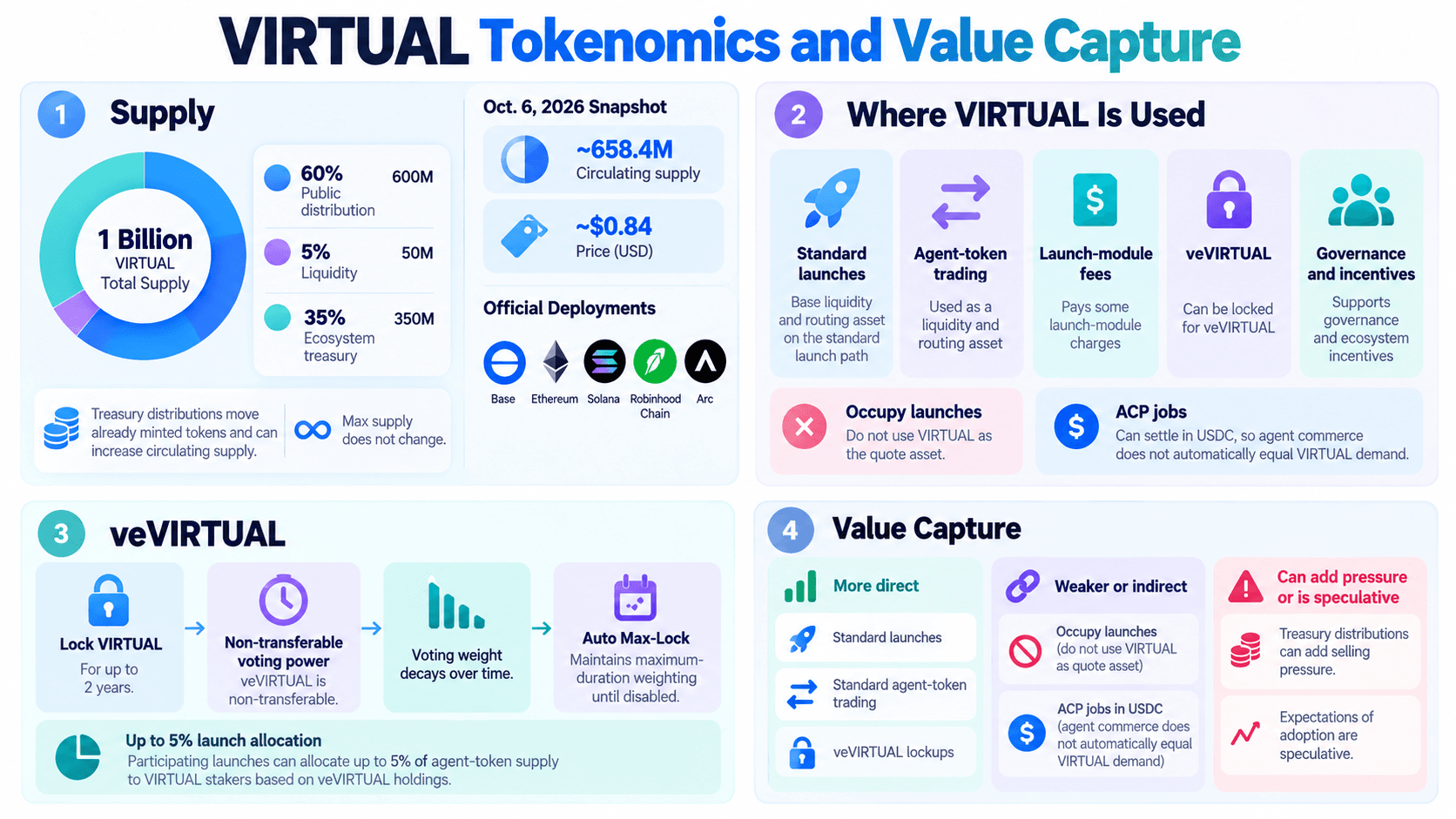 Virtual Combines Fixed Supply, Ecosystem Liquidity, Governance, Staking, and Launch Activity With Varying Levels of Value Capture
VIRTUAL Supply and Distribution
VIRTUAL has a fixed supply of 1 billion tokens. The documented allocation is 60% to public distribution, 5% to liquidity and 35% to the ecosystem treasury. The supply was minted without future inflation, and the documentation describes all tokens as unlocked and vested.
| Allocation | Share | VIRTUAL Tokens |
|---|---|---|
| Public distribution | 60% | 600,000,000 |
| Liquidity | 5% | 50,000,000 |
| Ecosystem treasury | 35% | 350,000,000 |
The treasury is described as DAO-controlled through a multisignature wallet, with governance approval for deployment. Its documentation specifies a 10% annual emissions ceiling for a three-year period, but does not clearly anchor that period or identify the percentage denominator. This is a stated treasury policy, not a verified October 2026 release calendar. Treasury distributions move already minted tokens and can increase circulating supply without changing the maximum supply.
VIRTUAL has official deployments across Base, Ethereum, Solana, Robinhood Chain and Arc. A familiar ticker is not enough to authenticate a token. Users should verify both the network and contract address.
What Is VIRTUAL Used For?
VIRTUAL's most explicit function is as the base liquidity and routing asset for agent tokens on the standard Virtuals launch path. Under that model, agent-token purchases route through VIRTUAL, tying the token to liquidity formation and parts of the capital-formation system.
VIRTUAL also pays certain launch-module charges, can be locked for veVIRTUAL participation, and supports ecosystem incentives. Those uses differ economically: paying a charge, holding liquidity inventory and locking tokens do not create the same duration of demand.
The newer Occupy route means VIRTUAL is not the quote asset for every token launched through Virtuals infrastructure. Occupy uses approved tokenized-equity assets as quote assets instead.
Commerce requires similar care. Current EconomyOS workflows allow ACP jobs to settle in USDC, so an increase in agent-to-agent transactions cannot automatically be counted as an equal increase in VIRTUAL purchases. A service may run within Virtuals while its immediate payment obligation is denominated in a stablecoin.
What Is veVIRTUAL?
Users obtain veVIRTUAL by locking VIRTUAL for up to two years. Voting weight decays toward zero as the unlock date approaches, while Auto Max-Lock maintains maximum-duration weighting until disabled.
veVIRTUAL is a non-transferable representation of voting power rather than a separately tradeable asset with independent monetary value. It also provides eligibility for selected ecosystem distributions. Maintaining Auto Max-Lock postpones the countdown toward withdrawal.
The protocol uses veVIRTUAL for onchain governance, including proposals and voting. Protocol governance and the separately proposed AI Council should not be treated as the same feature.
Participating launches can allocate up to 5% of agent-token supply to VIRTUAL stakers based on veVIRTUAL holdings. Eligibility depends on the launch configuration; it is not a fixed yield or a promise that distributed tokens will retain value.
Does Virtuals Usage Create Value for VIRTUAL?
Usage can support demand, but the economic connection varies by activity.
| Activity | Connection to VIRTUAL | Assessment |
|---|---|---|
| Standard Virtuals agent launches | Certain charges and liquidity formation require VIRTUAL | Direct, but conditional on launch activity |
| Occupy launches | Quote asset is an approved tokenized equity rather than VIRTUAL | Weaker direct connection to VIRTUAL |
| Standard agent-token trading | VIRTUAL serves as a routing and liquidity asset | Direct usage; net demand depends on buying, selling and turnover |
| ACP jobs | Current workflows can settle in USDC | Indirect unless a specific route creates VIRTUAL demand |
| Staking and governance | VIRTUAL is locked for veVIRTUAL participation | Direct lock-up, balanced against eventual withdrawals |
| Treasury distributions | Previously held tokens move to recipients | Potential circulating-supply growth and selling pressure |
| Expectations of agent adoption | Traders price future ecosystem expansion | Speculative until supported by measurable demand |
Liquidity locks are different from token burns. A locked LP position restricts withdrawal of that position, while the underlying pool still trades and its asset composition changes. Growing commerce presents a stronger case for VIRTUAL holders when it produces persistent token balances, fees or lock-ups rather than brief routing activity followed by selling.
How to Use Virtuals Protocol
Virtuals serves several types of users, from people hiring AI agents to traders buying agent tokens and developers building their own services. The exact workflow depends on the goal, but users generally interact through supported interfaces, wallets and EconomyOS infrastructure while paying close attention to networks, permissions and transaction terms.
Using Virtuals as an Agent-Economy User
Using Butler typically involves finding an agent, supplying the required information, approving the job and funding payment through ACP. The Butler guide documents the workflow. Supported jobs can use USDC, followed by payment handling and delivery through the protocol. This review checked public instructions without executing a funded job.
- Open the official Virtuals app and select the relevant Butler or agent-service interface, signing in or connecting a wallet as required.
- Confirm the destination wallet, network and supported payment asset before funding it. A Base address does not make an Ethereum or Solana transfer interchangeable.
- Describe the task, inspect the selected provider and review the price, inputs and expected deliverable.
- Approve the job and monitor its completion, including any evaluation or refund conditions.
The original wallet and the agent's operating wallet may be separate accounts. ETH can be required for unsponsored Base or Ethereum transactions, while sponsored workflows may handle gas differently. Funding only the intended task budget limits the capital exposed to execution errors.
Buying and Trading Agent Tokens
Start with the agent's product and verified contract, then establish its launch route and stage. A standard Virtuals bonding curve, a newly graduated pool, an Occupy market and an established secondary market can have very different execution risks.
Check token concentration, available liquidity, active launch taxes, the quote asset and the output quoted for the intended trade. Occupy tokens also require understanding the tokenized-equity asset against which the curve is quoted.
Buy through a supported route only after confirming the chain and approval permissions. An agent token is not automatically equity or legal ownership of the project, and an attractive product can still have an illiquid or poorly designed token.
For storage, compare the options in our wallet guide before choosing a wallet for the relevant network. Keep long-term holdings separate from experimental agent funds, protect recovery credentials and review token approvals. Hardware signing protects keys but cannot determine whether every approved transaction is economically sensible.
Building or Launching an Agent
Builders can connect an existing agent or deploy a hosted agent through Console. The developer quickstart covers identity, signer setup, wallet funding, compute and ACP service listings, including USDC-funded jobs. Tokenization is an optional economic layer rather than a prerequisite for every service.
Builders that choose tokenization also need to decide which launch model fits the project. The standard Virtuals route ties the token to VIRTUAL-based capital formation, while Occupy uses an approved tokenized-equity quote asset and different permanent fee and liquidity settings.
Before launching, establish who will buy the service, how job completion will be evaluated and whether pricing covers inference, external APIs and support. Evaluate wallet permissions, uptime, failed-job handling and the differences between development and production environments. Issuing a token adds market and disclosure obligations; it does not resolve an unclear product or unreliable service.
Virtuals Protocol Security and Risks
Virtuals combines smart contracts, externally operated software, agent permissions and speculative token markets. Security therefore depends on more than the protocol contracts alone.
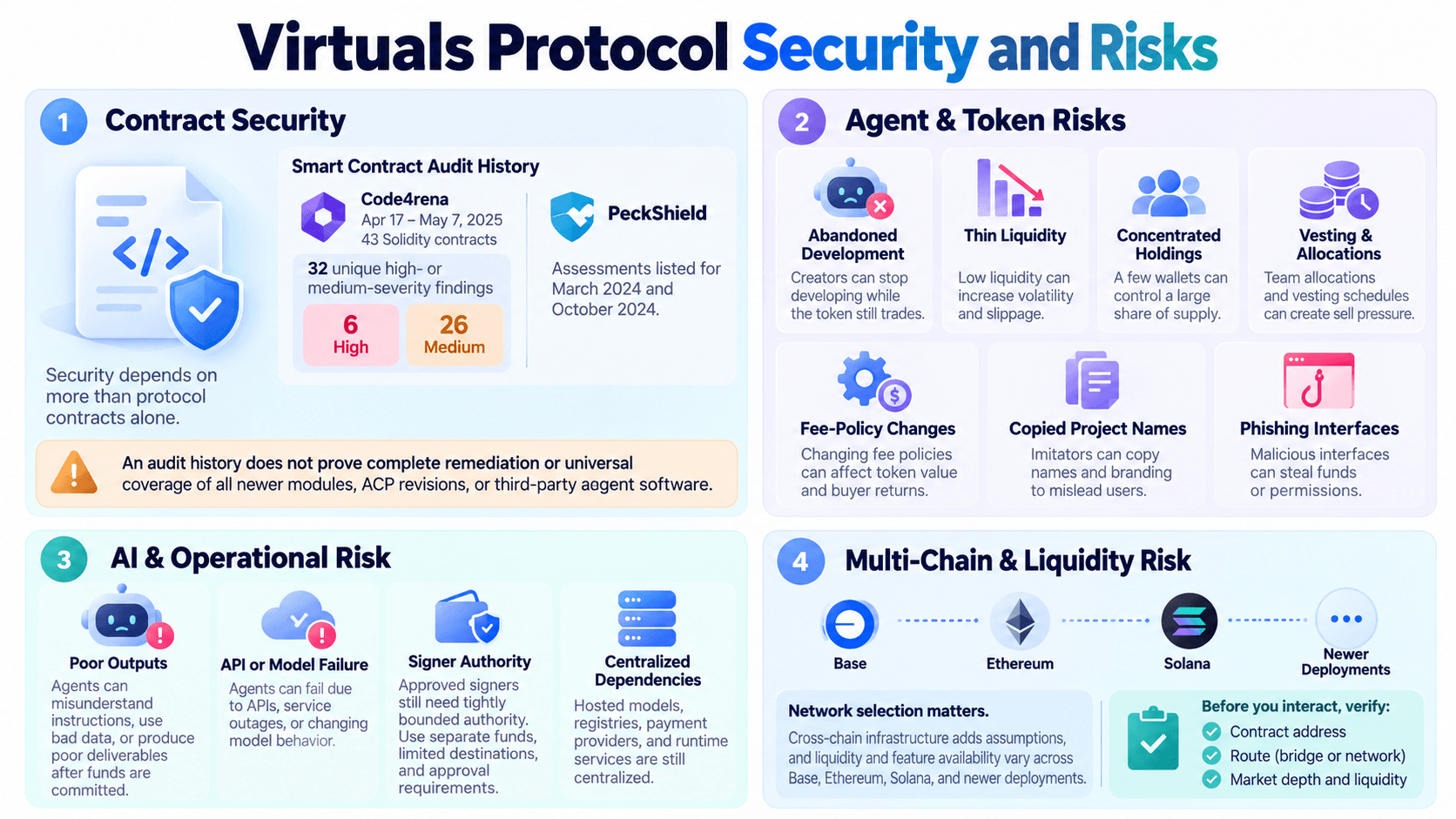 Virtuals Combines Smart Contract, Token, AI Operational, Liquidity, and Multi-Chain Risks That Users Should Evaluate Carefully
Smart Contract Audits and Protocol Security
A Code4rena review conducted from April 17 to May 7, 2025 covered 43 Solidity contracts and reported 32 unique high- or medium-severity findings: six high and 26 medium. Findings included access-control problems, reward-accounting weaknesses, delegation issues and a possible token-loss path.
Those findings identify weaknesses in the reviewed code snapshot. They do not prove that every issue remains exploitable in current deployments. Publication of the report alone also does not confirm complete remediation.
Virtuals also lists PeckShield assessments from March and October 2024. These establish an audit history, not universal coverage of later launch modules, ACP revisions or third-party agent software. Our guide to smart-contract attacks explains the types of vulnerabilities these reviews are designed to uncover.
Agent and Agent-Token Risks
A creator can stop developing an agent even while its token continues trading. Thin liquidity, concentrated holdings and speculative demand can produce severe losses without any smart-contract exploit. Team allocations, vesting schedules and changing fee policies also affect the economic exposure.
Revenue claims deserve scrutiny at the payment level. Token-trading income, subsidized jobs and customer payments are different sources of cash and should be measured separately. A rising token price can coexist with weak customer demand, just as a functioning product can operate without generating meaningful profits.
Malicious token contracts, copied project names and phishing interfaces add another layer of risk. Protocol branding cannot substitute for checking the specific token and the permissions requested by its DApp. Our crypto safety guide covers phishing, wallet protection and other precautions relevant to those interactions.
AI Autonomy and Operational Risk
An agent can misunderstand a request, act on incorrect information or produce an unusable deliverable. Connected APIs may fail, model behavior can change, and execution can stall after funds have been committed. Automated evaluation is also fallible, particularly when the task involves subjective quality or incomplete requirements.
Virtuals separates account provisioning from signing authority. Its wallet documentation describes CLI keys stored in an operating-system keychain and SDK workflows using managed wallet infrastructure. These controls reduce some key-handling risks, but the approved signer still needs tightly bounded authority.
Separate operating funds, limited destinations and appropriate approval requirements can contain mistakes. Escrow protects the payment workflow under its rules; it cannot guarantee sound trading decisions or correct research. Hosted models, registries, payment providers and runtime services also create centralized dependencies even when settlement occurs onchain.
Multi-Chain and Liquidity Risk
VIRTUAL's presence across several chains adds network-selection and liquidity risks. Transfers must use the supported asset and destination network, while cross-chain infrastructure introduces additional contracts and messaging assumptions.
Liquidity and feature availability can differ between Base, Ethereum, Solana and newer deployments. Tokenization routes can also differ by network. A quoted price on one venue does not guarantee comparable execution elsewhere. For token buyers, the relevant checks are the verified contract, actual trading route and depth available for both entry and exit.
Virtuals Protocol vs Other AI Crypto Projects
Virtuals, Bittensor and ElizaOS address different parts of AI infrastructure. Their shared category does not make their products or tokens economically interchangeable.
| Project | Core Purpose | What Is Tokenized/Incentivized | Primary User | Virtuals Difference |
|---|---|---|---|---|
| Virtuals | Infrastructure for an agent economy | Agent tokens, capital formation and economic participation | Builders, service users and traders | Combines commerce infrastructure with token launches |
| Bittensor | Markets for specialized digital intelligence and services | Subnet output, miner and validator incentives involving TAO | ML builders, operators and stakers | Organizes production and evaluation rather than centering agent launches |
| ElizaOS | Open-source agent development framework | A separate elizaOS ecosystem token and its documented allocations | Agent developers | Framework-first; Virtuals emphasizes economic infrastructure and capital markets |
Bittensor uses miners to produce specialized digital commodities and validators to score their contributions. Its official documentation explains the subnet model, while our Bittensor review covers its incentive structure and token risks in more detail.
ElizaOS provides open-source tooling for agent development, plugins and deployment. Its tokenomics documentation covers the separate elizaOS token following the ai16z migration. Framework adoption alone does not imply automatic token-holder revenue. Our AI agent guide provides additional context for the broader category.
Who Is Virtuals Protocol Best For?
Virtuals is most relevant when an agent needs economic functions alongside its AI capabilities. Its appeal is narrower for users who primarily want predictable investment income or a basic development framework.
Best For
- Builders adding economic capabilities to existing agents: Wallets, identity, compute funding and service payments address concrete deployment needs.
- Developers exploring agent-to-agent commerce: ACP provides a structured environment for paid tasks, delivery and evaluation.
- Experienced crypto users researching agent markets: The ecosystem offers exposure to emerging services and capital-formation experiments, with substantial execution and market risk.
- Investors comfortable with speculative infrastructure: Evaluating VIRTUAL requires separate judgments about adoption, token demand, circulating supply and valuation.
Not Ideal For
- Investors seeking straightforward cash-flow rights: Holding VIRTUAL or an agent token does not automatically provide a proportional claim on operating income.
- Buyers treating tokens as conventional equity: Legal ownership, software control and enforceable revenue rights require specific evidence.
- Risk-averse users or inexperienced token traders: Low liquidity, launch taxes, wallet permissions and autonomous execution add several ways to lose funds.
- Builders needing only an agent framework: Tokenization and onchain commerce add complexity when a product has no clear use for them.

Virtuals Protocol Review: Final Verdict
Virtuals Protocol is a credible agent-infrastructure project whose commercial adoption and token investment case remain less established than its technical ambition. EconomyOS, ACP and its expanding tokenization infrastructure provide identifiable capabilities beyond issuing speculative agent tokens.
The commercial case now has more evidence than simple token counts. ACP documentation reports more than 2,000 agents onboarded, while aGDP.io reports roughly 2.28 million completed jobs and $4.08 million in cumulative agent revenue. Individual services such as Ethy AI, Axelrod and Otto also show measurable platform activity. However, these are platform-reported figures, and public data still does not clearly establish repeat-customer rates, net agent margins or how much service activity would persist without incentives.
VIRTUAL has clear uses in the standard launch ecosystem through liquidity, routing, launch charges and staking. But USDC-based commerce and the Occupy route show why ecosystem activity cannot be translated directly into VIRTUAL demand. Treasury distributions add another variable for token holders.
Virtuals therefore warrants attention as economic infrastructure for autonomous agents. The stronger long-term test is not simply how many agents or tokens exist, but whether agents repeatedly earn, spend and hire one another without relying heavily on incentives. The investment case for VIRTUAL is a separate question and ultimately depends on how much of that activity creates sustained demand for the token.