


The Xapo Bank Card is a debit card for Xapo Bank members who want to spend US dollars or access their Bitcoin balance through familiar card payment networks. It combines everyday payments, ATM access and international spending with Xapo's wider Bitcoin-focused banking service.
Unlike a standard bank card, it can use Bitcoin as well as USD as a spending source, and unlike many crypto cards, it is connected to a banking relationship rather than operating solely as a prepaid exchange card or relying on a proprietary token.
Xapo Bank Card: Quick Answer
The Xapo Bank Card is a premium debit card for eligible Xapo Bank members who want to spend from USD or Bitcoin balances. It offers high spending limits, international card use and no additional Xapo FX fee, but the $1,000 annual membership means it is best suited to users who also value Xapo's wider banking and Bitcoin services.
Xapo Bank Card Key Points
-
Spend USD or Bitcoin Members can select USD or BTC as their card spending source, with Bitcoin converted for settlement through the applicable card network.
-
High daily spending limits Published limits reach $50,000 per day for in-store purchases, $50,000 for online spending, $2,000 for ATM withdrawals and up to $750,000 for larger purchases.
-
No additional Xapo FX fee Xapo currently charges no additional foreign exchange fee on foreign-currency card purchases, although network rates and third-party charges can still apply.
-
BTC cashback is campaign-based Permanent general cashback ended in July 2026, with rewards now offered through targeted promotions such as the current 3% BTC taxi and rideshare campaign.
-
Membership costs $1,000 per year The card is part of Xapo Bank membership rather than a standalone low-cost card product, so its value depends on using the wider banking and Bitcoin services.
-
Best suited to higher-value Bitcoin users The strongest fit is for internationally active Bitcoin holders who want integrated BTC and USD spending, high limits and broader banking services under one relationship.
Disclaimer
This guide is for educational purposes only and is not financial advice.
Disclosure
Some links in this guide may be affiliate links. If you choose to use a service through these links, we may earn a commission at no additional cost to you.
Paid Article
This is a paid article, not a paid opinion.
This is a paid article, not a paid opinion.
This article was created as part of a paid partnership. That commercial relationship does not influence our editorial take, which means our views, analysis, and conclusions remain our own. If a product, platform, or service has drawbacks, limitations, or risks, we will say so plainly.
Xapo Bank Card at a Glance
The Xapo Bank Card combines standard debit-card functions with access to Bitcoin and USD balances. Here are the main features currently available to eligible members.
| Field | Xapo Bank Card |
|---|---|
| Card type | Debit card |
| Provider | Xapo Bank |
| Card networks | Visa or Mastercard, depending on program and region |
| Funding | USD and Bitcoin balances |
| Bitcoin spending | Yes |
| Physical card | Yes |
| Virtual card | Available in supported program |
| BTC cashback | Targeted BTC cashback campaigns; currently up to 3% on eligible rideshare spending |
| Current cashback offer | 3% BTC cashback on eligible taxi and rideshare spending through Aug. 31, 2026 |
| FX fee | No Xapo FX fee |
| ATM withdrawals | Supported |
| In-store spending limit | $50,000/day |
| Online spending limit | $50,000/day |
| ATM limit | $2,000/day |
| Membership required | Yes |
| Membership cost | $1,000/year |
| Best for | High-value Bitcoin holders wanting integrated banking and spending |
Xapo lists daily limits of $50,000 for in-store purchases, $50,000 for online payments and $2,000 for ATM withdrawals. Xapo may also consider temporary card limits of up to $750,000 for larger purchases on a case-by-case basis.
Cashback recently changed. Xapo ended its general everyday cashback program on July 1, 2026, and moved to targeted campaigns.
What Is the Xapo Bank Card?
The Xapo Bank Card is a debit card linked to a Xapo Bank account. Members can spend directly from their available USD or Bitcoin balance without manually loading a separate prepaid card balance.
 Xapo Bank Debit Card Enables Direct Purchases and ATM Withdrawals Without Prepaid Loading
Xapo's Mastercard card terms describe the product as a debit card rather than a prepaid, charge or credit card. Physical and virtual cards can be made available depending on the member's program and region.
The card connects to balances available through Xapo. Members can select USD or Bitcoin as their spending source. With USD selected, the card works much like a conventional debit card. With Bitcoin selected, Xapo handles the conversion needed for settlement through the card network.
The physical card can be used for in-store payments and ATM withdrawals, while virtual cards can be useful for online purchases. Exact card formats and benefits can vary between regional programs.
Read our full Xapo Bank review.
Who Issues the Xapo Bank Card?
Xapo Bank Ltd. is incorporated in Gibraltar and is regulated by the Gibraltar Financial Services Commission. Its permissions include banking and payment-related activities. The exact card-issuing structure varies by region.
Under Xapo's European Visa program, Transact Payments Malta Limited issues the card under its Visa licence, while Xapo Bank acts as program manager and provides the connected account. The European terms apply to eligible residents covered by that program.
Outside Europe, Xapo Bank itself issues the Xapo Card. Under the European Visa program, Transact Payments Malta Limited is the card issuer, while Xapo Bank acts as program manager and provides the connected account. The legal issuer, card network and applicable terms therefore depend on the regional program assigned to the member.
How Does the Xapo Bank Card Work?
Using the Xapo Bank Card starts with Xapo membership rather than a standalone card application. Once approved, members can fund their account, obtain an eligible card and choose which available balance they want to use.
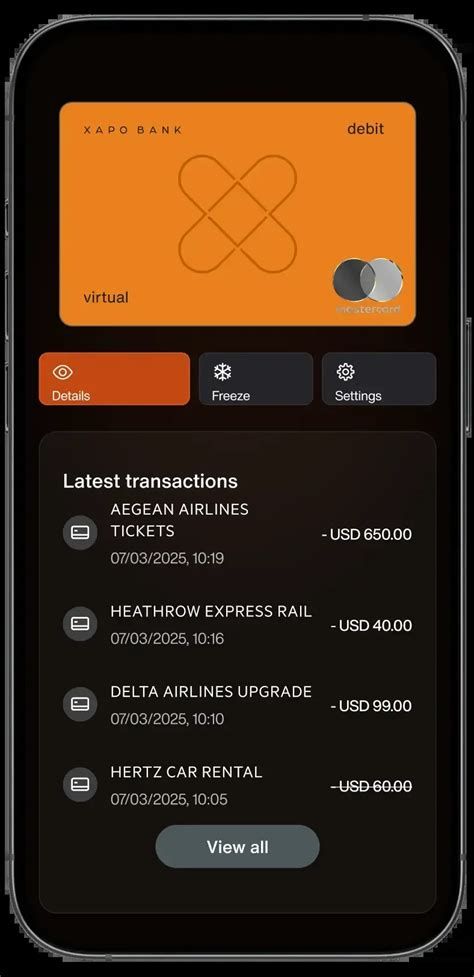 Unlock Your Xapo Card Membership: Fund, Choose Balance, And Spend Safely
The process works as follows:
- Become a Xapo Bank member. Card access sits within the broader membership.
- Open and fund the account. Members can hold supported balances including USD and Bitcoin.
- Request the available card. Physical and virtual options vary by program.
- Choose the spending balance. Members can select USD or Bitcoin.
- Pay through the card network. The transaction runs through the applicable Visa or Mastercard infrastructure.
- Receive eligible BTC cashback. Cashback applies when the transaction qualifies under a current reward campaign.
The merchant does not need to accept Bitcoin directly. Card settlement takes place through conventional payment infrastructure even when Bitcoin has been selected as the funding source.
Can You Spend Bitcoin With the Xapo Bank Card?
Yes. Xapo lets members select Bitcoin as the balance used for card payments. This makes BTC spending closer to a normal debit-card experience because the conversion happens at checkout rather than requiring the user to sell BTC and preload fiat beforehand.
When BTC is selected, the merchant does not receive an on-chain Bitcoin transfer. Xapo converts the required value so the purchase can settle through the card network.
According to Xapo, Bitcoin-funded card payments have no conversion fee and use a 0.29% spread as of Aug. 13, 2026. A spread is the difference incorporated into the quoted Bitcoin exchange price. Xapo's fee schedule also lists no transaction fee for USD/BTC exchanges and a current Bitcoin exchange spread of 0.29%. The spread can change, so members should check the live conversion shown in the app before completing a transaction.
For Bitcoin holders, this removes several manual steps. There is no need to sell BTC separately, withdraw USD to another bank and then spend through a different debit card.
Spending Bitcoin can still have tax consequences. In jurisdictions where disposing of BTC creates a taxable event, using Bitcoin for a card purchase may need to be recorded and reported.
Can You Spend USD?
Yes. Members can use their USD balance as the card's spending source.
USD is the more conventional option for routine purchases because no Bitcoin sale is required each time the card is used. Someone who prefers to hold BTC for the long term can maintain a separate USD spending balance while keeping Bitcoin within the same broader account relationship.
Users who actively manage both assets can change their spending source depending on whether they want to use USD or reduce part of their Bitcoin position.
Xapo Bank Card Cashback
Xapo pays eligible card rewards in Bitcoin, although the reward model changed in July 2026. Xapo has moved from permanent general cashback to higher-rate, category-specific reward campaigns.
The current Summer 2026 cashback campaign pays eligible Metal cardholders 3% in BTC on qualifying taxi and rideshare spending from July 1 through Aug. 31, 2026.
Eligibility depends partly on merchant classification. Under the current promotion, qualifying transactions must fall within the relevant taxi and limousine merchant category. A ride processed under another merchant classification may not qualify. Members can use an eligible physical or virtual card under the campaign terms. Promotional conditions, eligible merchant categories and reward rates can change between campaigns.
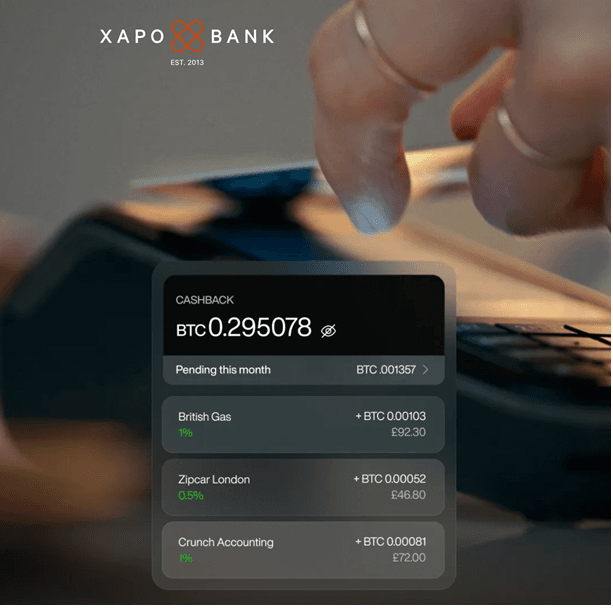 Earn Bitcoin Rewards With Xapo Bank’s Target Spending Campaigns
Xapo Bank Card Fees
Xapo's published card fees are not identical across programs.
Its general fee schedule lists Metal Card issuance at $0 and emergency replacement production at $100, while the Visa Europe card terms list an $89 Metal Card issue fee and $25 plus shipping for an emergency replacement. Xapo's current Summer 2026 cashback FAQ also says Metal cards are currently free to order.
Members should therefore treat some issuance and replacement charges as program-specific and confirm the fee shown in the Xapo app before ordering or replacing a card.
| Fee | Current Treatment |
|---|---|
| Annual membership/account package | $1,000/year |
| Metal Card issuance | $0 under Xapo's general fee schedule; Visa Europe terms list $89; Xapo's current Summer 2026 FAQ says Metal cards are free to order |
| Debit card payment | $0 Xapo fee |
| Foreign-currency card payment | $0 additional Xapo FX fee; card-network conversion rates can apply |
| ATM withdrawals up to $100/month | $0 Xapo fee; ATM operator fees can apply |
| ATM withdrawals after the $100 monthly allowance | 2% of the withdrawal amount; ATM operator fees can also apply |
| First replacement per calendar year | $0 |
| Additional replacement | $25 |
| Emergency replacement | $100 production plus variable shipping under the general fee schedule; Visa Europe terms list $25 plus shipping |
| Emergency cash access | $120 |
| New card after user-cancelled card | $25 |
| Non-substantiated dispute fee | $45 |
Third parties can impose their own charges. ATM operators are one example, while merchants can offer dynamic currency conversion using a rate set by the merchant or terminal provider.
Does the Xapo Bank Card Charge Foreign Transaction Fees?
As of Aug. 13, 2026, Xapo charges no Xapo foreign exchange fee on foreign-currency debit-card payments.
The savings can become meaningful for frequent international spenders. For example, someone spending $30,000 abroad would pay $900 in foreign transaction fees if their alternative card charged 3%. Xapo's 0% FX fee would avoid that $900 charge, before accounting for card-network rates, merchant conversion charges or the cost of Xapo membership.
When currency conversion is required, the applicable Visa or Mastercard network exchange rate is used. Xapo does not advertise an additional Xapo FX charge on those card purchases. However, there are still two potential costs to watch.
First, a merchant or ATM may offer dynamic currency conversion, where the terminal converts a local-currency transaction into another currency. The provider can build a markup into that rate.
Second, an ATM operator can impose its own surcharge.
When given a choice abroad, paying in the merchant's local currency generally avoids accepting a separate terminal conversion service.
Are ATM Withdrawals Free?
Xapo currently provides a limited monthly fee-free ATM allowance.
The first $100 of ATM withdrawals each month carries no Xapo ATM fee. Once monthly withdrawals move above the allowance, Xapo can charge 2%. Whereas, the ATM operator may impose a separate fee regardless of whether the withdrawal is inside Xapo's free allowance.
For members who mainly pay by card and only occasionally need cash, the allowance covers smaller withdrawals. Frequent cash users should account for the additional cost above the threshold.
Xapo Bank Membership Cost
Xapo membership costs $1,000 per year, and the card is one component of that membership. Comparing it only with a free debit card misses the broader services covered by the fee.
Unlike some premium crypto-card tiers, the membership fee does not require users to hold or stake a volatile platform token.
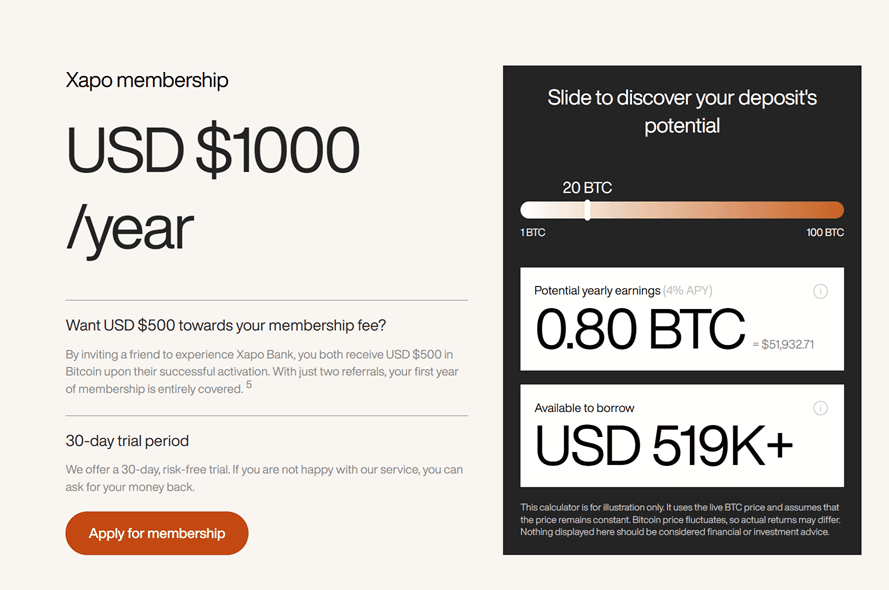 Xapo's $1,000 Annual Membership Includes Premium Wealth Services Beyond A Standard Card
The Xapo Bank membership can include access to:
- USD banking services
- Bitcoin services
- International payment rails
- A Metal debit card
- Bitcoin and USD savings products
- Selected investment products
- Bitcoin-backed borrowing in eligible regions
- Beneficiary and inheritance features
- Dedicated relationship support
Individual products have separate eligibility requirements, regional restrictions and, in some cases, additional fees.
Xapo Bank Card Spending and ATM Limits
The Xapo Bank Card has high published spending limits for a consumer debit card, which can suit members making larger purchases.
Current daily limits are:
- In-store purchases: $50,000
- Online purchases: $50,000
- ATM withdrawals: $2,000
Xapo may also consider a temporary card limit of up to $750,000 for a larger purchase on a case-by-case basis. Approval is not guaranteed. The temporary limit fits Xapo's focus on customers who may manage larger balances and occasionally need to make transactions above ordinary retail card limits.
Available balance, compliance requirements, transaction characteristics and Xapo's approval process can all affect whether a higher payment is permitted.
Where Can You Use the Xapo Bank Card?
The Xapo Bank Card is designed for conventional card spending rather than Bitcoin-only merchants. Members can use it for in-store purchases, online payments and cash withdrawals wherever the applicable card network is accepted, subject to program restrictions.
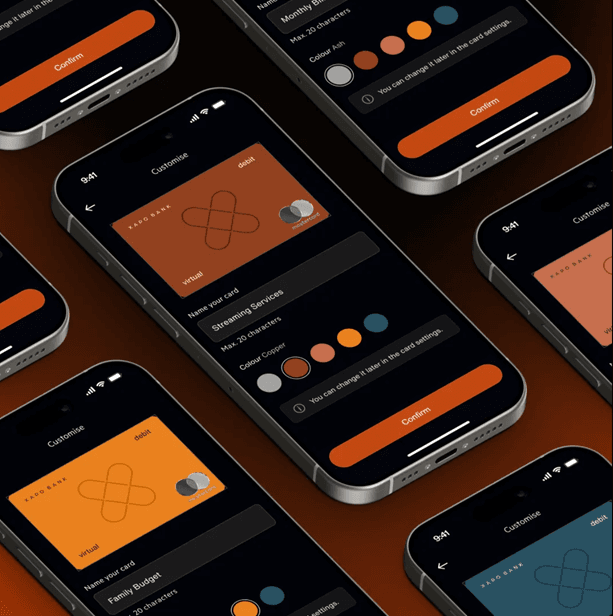 Versatile Xapo Card Spending Across Global Networks For Online, In-Store, And ATM Cash Transactions
Xapo'a debit card supports purchases and ATM use in more than 100 countries.
Typical uses include:
- Physical retail purchases
- Online shopping
- Hotels and travel bookings
- Restaurants
- International purchases
- Compatible ATMs
Acceptance is not universal. Certain merchant categories can be restricted, while individual merchants and ATM operators can decline particular cards.
Members may receive Visa or Mastercard cards depending on the program available in their region. The assigned network affects the exact acceptance and conversion infrastructure used for transactions.
Card usage abroad should also be separated from account eligibility. Being able to use a card in a country does not mean residents of that country can necessarily open a Xapo account.
Xapo Bank Card Availability and Eligibility
Access to the card starts with eligibility for Xapo membership. Residency requirements, identity checks and regional card programs determine what an applicant can receive.
Xapo's membership eligibility guidance requires individual applicants to be at least 18, live in a supported jurisdiction and complete identity verification and compliance checks. Government-issued identification and proof of address can be required.
Xapo also maintains a list of jurisdictions whose residents it cannot currently serve. As of Aug. 13, 2026, the United States is among the excluded jurisdictions, alongside a number of sanctioned or otherwise restricted locations.
The list can change as regulatory requirements and Xapo's service footprint evolve.
Regional arrangements also affect the card program:
- EEA: Eligible users can fall under Xapo's European Visa arrangement.
- UK: Eligible residents can access Xapo membership, although individual products and terms can differ.
- Other supported regions: Visa or Mastercard programs can apply depending on the member's location.
KYC is not limited to initial onboarding. Xapo can request additional identity, source-of-funds or compliance information during the banking relationship. Applicants should confirm eligibility inside Xapo before assuming a particular card network, feature or product is available in their jurisdiction.
Xapo Bank Card Security
Xapo provides controls aimed specifically at card and account usage, including app-based card management, transaction monitoring and authentication. These safeguards are separate from the security model used for Bitcoin custody.
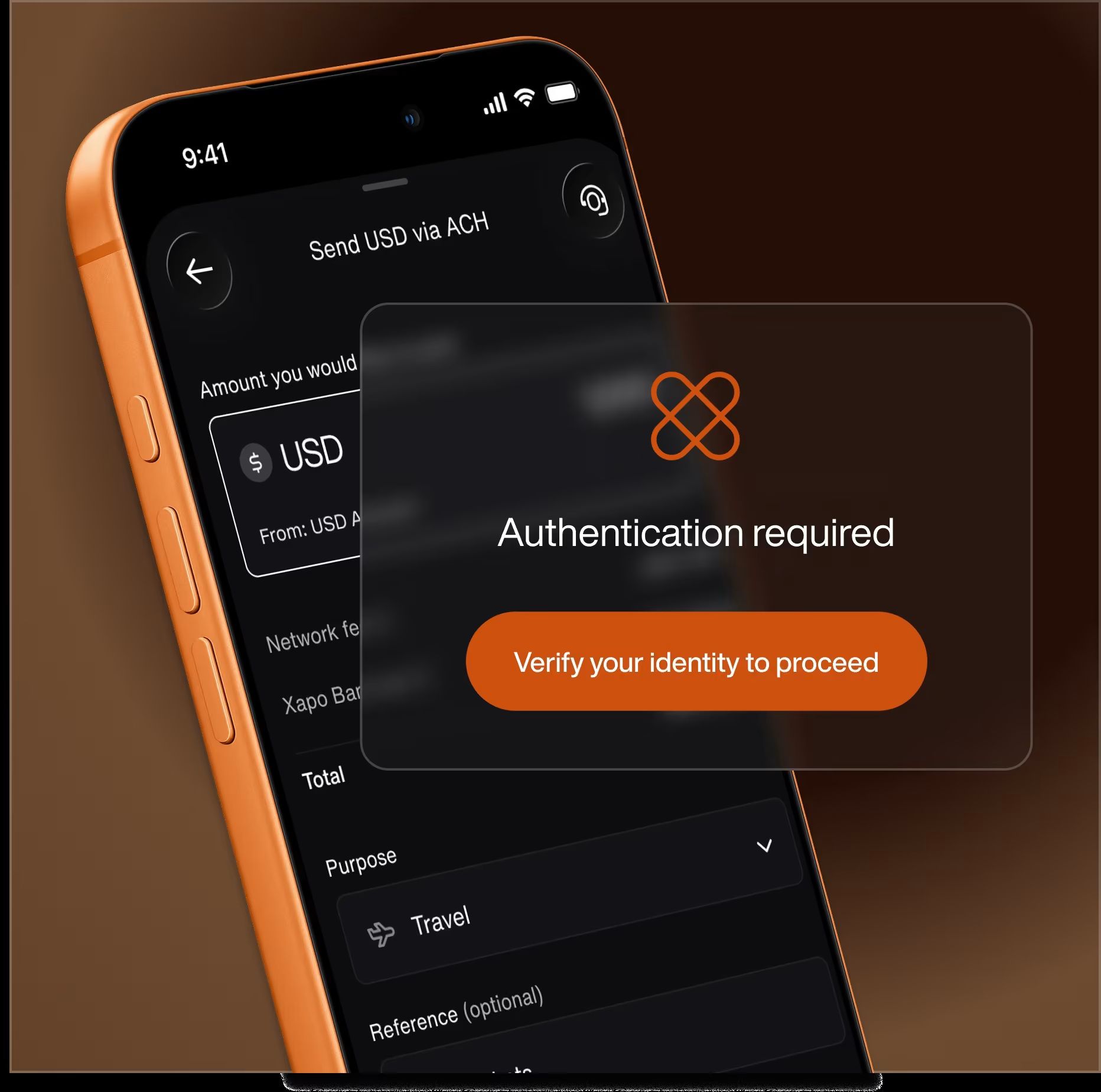 Manage Card Safety Directly In App With Controls Distinct From Bitcoin Custody Protections
Xapo's security information describes protections including two-factor authentication, biometrics, trusted-device controls and hardware security-key support.
Card users can freeze and unfreeze supported cards through the app, review transaction history and manage relevant card controls. Virtual cards are available in supported programs and can reduce the need to expose physical-card details during online purchases.
No security system removes fraud entirely. Phishing, malicious merchants, compromised devices, stolen credentials and social engineering remain risks.
What Happens If Your Xapo Card Is Lost or Stolen?
If a physical card is lost or stolen, users should stop using it and freeze or cancel it promptly.
Xapo's Visa card terms explain that a misplaced card can be frozen in the app. If it is later recovered and the member is satisfied that its details have not been compromised, it may be possible to unfreeze it. A card believed to be stolen or compromised should instead be reported and replaced.
After the required security checks, a replacement card can be arranged. Replacement charges depend on the member's program. Xapo lists the first replacement in a calendar year at $0 and additional replacements at $25, while emergency replacement charges differ under the Visa Europe terms.
Liability also depends on the program. A member who reports a lost, stolen or unauthorized-use event is generally responsible for the first €50 of qualifying losses. Reimbursement can be affected where the cardholder acted fraudulently, negligently or intentionally breached the card-security requirements.
The same European terms require unauthorized or incorrect transactions to be reported as soon as possible and no later than 13 months after the transaction date. Other regional card programs can apply different liability rules, so members should check the agreement attached to their card.
Are Xapo Bank Card Purchases Protected?
Xapo card payments operate through card-network systems that provide transaction-dispute and refund procedures under applicable rules.
That process differs from sending Bitcoin directly to a blockchain address. An on-chain Bitcoin transfer is generally irreversible after confirmation, while a debit-card transaction can pass through established merchant refund and dispute mechanisms.
Xapo currently lists a $45 fee for a card dispute that is found to be non-substantiated. A chargeback is not guaranteed reimbursement. Eligibility depends on the transaction, supporting evidence, card-network rules and the agreement applying to the member's card program.
Xapo Bank Card vs Traditional Debit Cards
The Xapo Bank Card handles many of the same tasks as a normal debit card while adding direct Bitcoin integration and a banking setup aimed at crypto holders.
 Normal Debit Functionality Meets Direct Bitcoin Integration And Specialized Banking Tools For Crypto Holders
| Feature | Xapo Bank Card | Typical Debit Card |
|---|---|---|
| Spend USD | Yes | Yes |
| Spend BTC balance | Yes | No |
| BTC cashback | Campaign-based | Uncommon |
| FX fee | Xapo advertises 0% | Often 1% to 3%, depending on bank |
| ATM access | Yes | Yes |
| Annual membership | $1,000 | Usually much lower |
| Bitcoin integration | Extensive | Generally none |
A standard debit card is easier to justify for someone who only needs domestic everyday payments. Many conventional checking accounts have much lower annual costs.
Xapo becomes more attractive when Bitcoin access, international payments and high limits are priorities. Members can maintain USD and Bitcoin within the same broader relationship and choose how card purchases are funded.
The $1,000 membership places Xapo in a different segment from a basic checking-account debit card. Its value is tied to the wider banking and Bitcoin package rather than low-cost card access alone.
Xapo Bank Card vs Crypto Cards
Crypto cards can use very different structures even when the checkout experience looks similar. Xapo takes a bank-linked debit approach rather than centering the product on an exchange token or prepaid card balance.
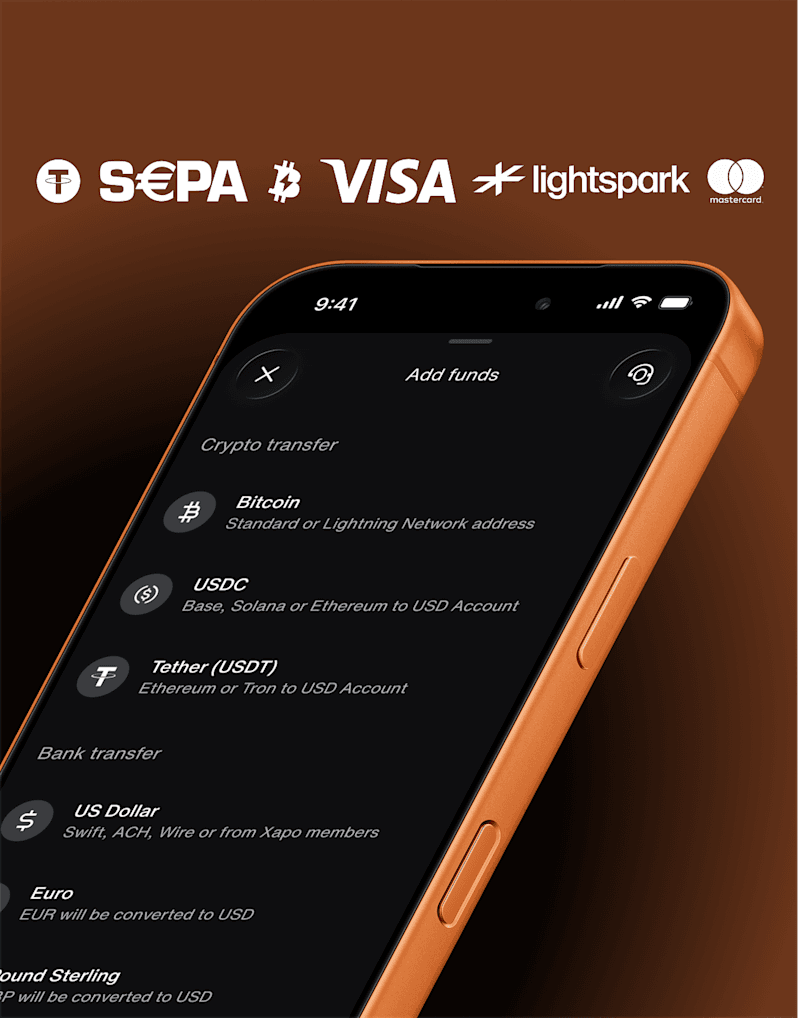 Xapo’s Bank-Linked Debit Approach Differs From Standard Exchange Tokens And Prepaid Crypto Cards
| Feature | Xapo Bank Card | Typical Crypto Card |
|---|---|---|
| Card structure | Bank-linked debit card | Debit, prepaid or credit |
| USD spending | Yes | Varies |
| BTC-funded spending | Yes | Available on some cards |
| Rewards | BTC campaigns | Crypto, points or platform tokens |
| Pre-loading required | No separate card balance | Required by some prepaid cards |
| BTC conversion | At the point of purchase | Varies by provider |
| Token staking required | None | Some premium tiers require substantial holdings or staking of a platform token |
| Bank account connection | Yes | Often exchange or fintech account |
| Annual cost | $1,000 membership | Often free or lower cost |
| Target audience | Bitcoin-focused international users | Broad crypto audience |
One of Xapo's main usability advantages is that members do not need to manually sell Bitcoin and preload a separate fiat card balance before spending. When BTC is selected as the funding source, Xapo converts the required amount at the point of purchase. By contrast, some crypto cards require users to move funds into a dedicated card balance before they can spend.
Xapo does not require members to buy or stake a proprietary token to access its premium card benefits. Some competing crypto cards reserve their highest reward tiers for users who hold or stake large amounts of a platform token, exposing them to the price risk of that asset.
The trade-off is the annual membership cost. Xapo asks substantially more upfront than many entry-level crypto cards, but the fee covers a broader regulated banking relationship and additional Bitcoin-focused services.
Our comparison of the best crypto debit cards covers other card structures for readers comparing the wider category.
Who Is the Xapo Bank Card Best For?
Xapo's strongest use cases involve customers who can take advantage of several card and banking features at once. Users focused on one narrow benefit have fewer reasons to pay the membership fee.
Good fit:
- Bitcoin holders: BTC can be used as a card funding source without separately moving funds through another exchange and bank account.
- Frequent international travelers: Xapo does not add its own FX fee to foreign-currency card purchases.
- Higher spenders: Published daily card limits reach $50,000 for in-store and online purchases.
- People already interested in Xapo membership: The card adds everyday spending to banking and Bitcoin services they may already want.
- Users combining Bitcoin and USD: Both balances can sit within one broader financial relationship.
Less suitable for:
- Low spenders: The $1,000 annual membership is significant if card usage is limited.
- Users wanting a free crypto card: Lower-cost alternatives are available.
- People outside supported jurisdictions: Account eligibility comes before card access.
- Users mainly chasing cashback: Xapo now uses targeted campaigns rather than permanent general cashback.
- People who do not need Xapo's wider banking services: The card alone may not justify the full annual membership.
Is the Xapo Bank Card Safe?
Xapo has a regulated banking structure and conventional card safeguards, but the protections applying to USD, Bitcoin and card transactions are not identical.
Card payment risk: App-based card freezing, PIN controls, authentication, fraud monitoring and card-network dispute procedures can reduce common payment risks. They cannot prevent every case of fraud.
Xapo Bank counterparty risk: Card protection and bank-deposit protection are separate. The card itself is a payment service product and is not covered by a deposit compensation scheme. Separately, eligible fiat deposits held at Xapo Bank can qualify for protection under the Gibraltar Deposit Guarantee Scheme up to £120,000 per depositor per credit institution.
Bitcoin custody risk: Bitcoin is treated separately. Xapo's regulatory and compliance disclosures state that crypto services are provided through Xapo VASP Limited, which operates under Gibraltar's DLT regulatory framework. Crypto asset balances are not covered by the Gibraltar Deposit Guarantee Scheme.
Fraud risk: Phishing, social engineering, account takeover and compromised merchants remain possible. Members still need to protect their devices and account credentials.
Bitcoin market risk: BTC prices can move sharply. Spending Bitcoin also reduces the member's BTC position and may create tax consequences.
Xapo's regulatory status and card controls are meaningful safeguards, but users should not assume every asset held through the wider Xapo ecosystem receives identical legal or financial protection.
Is the Xapo Bank Card Worth It?
The Xapo Bank Card is most compelling as part of Xapo Bank's wider Bitcoin banking membership, not as a standalone cashback card.
| User | Verdict |
|---|---|
| Existing Xapo member | Strong fit |
| High-value BTC holder | Worth considering |
| Frequent international spender | Potentially useful |
| Cashback-focused user | Limited fit |
| Casual crypto user | Probably unnecessary |
Existing Xapo members have the simplest case for using the card because it extends an account they already maintain into everyday spending.
Bitcoin holders who regularly move between BTC and fiat can also benefit from the integrated setup. The ability to select either balance, spend internationally through conventional card networks and request unusually high temporary limits gives Xapo a well-defined audience.
Frequent international spenders may find the zero Xapo FX fee particularly useful, although network conversion rates and third-party charges still need to be considered.
Cashback alone is a weaker reason to join. Rewards are now campaign-based, and the annual fee is much higher than the cost of many mass-market cards. For high international spenders, avoided FX charges can offset a substantial portion of the annual membership cost.
How to Get the Xapo Bank Card
Applying for the Xapo Bank Card is part of the wider Xapo onboarding process rather than a separate card-only application.
- Check eligibility. Confirm that Xapo accepts residents of your jurisdiction.
- Apply for Xapo Bank membership. Start the application through the Xapo app.
- Complete verification. Provide the requested identification and compliance information.
- Fund the account. Add funds using an available method after approval.
- Request the card. Order the physical card and access any virtual-card option available under your programme.
- Activate the card. Physical cards must be activated before spending.
- Choose the preferred spending balance. Configure USD or Bitcoin for card payments.
Xapo can request additional identity or source-of-funds information during the relationship, and approval is not automatic.
Card network, delivery options and exact benefits vary by jurisdiction.

Final Verdict
The Xapo Bank Card is a Bitcoin-focused debit card designed for users who want conventional spending and BTC access within the same financial relationship.
Its main strengths are clear. Members can spend from Bitcoin or USD, use the card internationally, avoid an added Xapo FX fee and access daily purchase limits of up to $50,000. Eligible users can also obtain physical and virtual cards, use ATMs and participate in Bitcoin cashback campaigns.
The main barrier is the $1,000 annual membership, although Xapo charges this directly rather than requiring users to lock capital into a proprietary token.
That cost is difficult to justify for someone looking only for a basic debit card or occasional crypto rewards. Xapo looks considerably more attractive when the card is assessed alongside the banking, Bitcoin, payment and other services included within membership.
Xapo's move from permanent general cashback to category-specific campaigns means rewards can be higher on selected spending, but they are less predictable for users who want cashback on every purchase.
For higher-value Bitcoin holders and internationally active users who want Bitcoin and traditional banking services under one account relationship, the Xapo Bank Card is a well-rounded option worth considering.