As the digital asset industry has matured from a niche trading market into a broader financial ecosystem, users increasingly expect more than a place to buy and sell crypto. They now look for secure custody, clearer regulatory footing, easier spending tools, and products that fit into everyday financial life. That shift has created room for more specialized platforms, especially for long-term Bitcoin holders who want convenience without juggling multiple services.
Xapo Bank sits squarely in that niche. Through its Gibraltar-regulated, VASP and credit entity and a product suite built around Bitcoin custody, card spending, savings, and borrowing, it is aimed less at casual traders and more at users seeking a premium, Bitcoin-first financial setup.
Quick Verdict
Xapo Bank is best viewed as a premium Bitcoin-focused banking service rather than a general crypto app. Its membership combines long-term Bitcoin custody, global card spending, savings features, and Bitcoin-backed loans inside one ecosystem.
That makes it more complete than a simple wallet or exchange account, but it also means users are paying for a bundled service rather than low-cost access. The biggest tradeoff is the $1,000 annual membership fee, which immediately makes Xapo a niche product rather than an obvious mainstream option.
Best For
- Users with meaningful BTC holdings
- Members who want custody, spending, and borrowing in one app
- People comfortable paying for a premium service layer
Avoid If
- You want a free or low-cost crypto platform
- You prefer full self-custody
- You mainly need broad trading access rather than a Bitcoin-first banking setup
Key Takeaways
- Xapo Bank positions itself as a members-only private bank for Bitcoin holders, combining Bitcoin and US dollar balances inside one service.
- Its model is built around paid membership, regulated banking and crypto entities in Gibraltar, and a focus on custody, payments, savings, and borrowing rather than mass-market trading.
- The BTC Vault is designed for long-term storage and adds extra withdrawal protection, but vault balances do not earn interest.
- Xapo also offers BTC Savings, USD Savings, Bitcoin-backed loans, global card spending, and access to stocks, ETFs, and altcoins within the same app.
- The biggest cost is the fixed $1,000 annual membership fee, so value for money depends heavily on whether you will actually use the full product stack.
Disclosure and Methodology
Some links in this Xapo Bank review may be affiliate links. If you choose to use a service through these links, we may earn a commission at no additional cost to you. That does not change how we assess Xapo Bank’s membership model, custody setup, savings products, card features, Bitcoin-backed loans, or overall fit for long-term Bitcoin holders.
For this review, we evaluated Xapo Bank as a premium Bitcoin-focused banking service rather than a general-purpose crypto platform. We reviewed its official product pages, fee schedule, terms, and regulatory disclosures to understand how its custody, savings, card, borrowing, and investment features work in practice. We also considered where Xapo stands out, where the tradeoffs are clearest, and which type of user is most likely to find value in its all-in-one membership model.

Paid Article
This is a paid article, not a paid opinion.
This is a paid article, not a paid opinion.
This article was created as part of a paid partnership. That commercial relationship does not influence our editorial take, which means our views, analysis, and conclusions remain our own. If a product, platform, or service has drawbacks, limitations, or risks, we will say so plainly.
What Is Xapo Bank?
Xapo Bank presents itself as a members-only private bank for Bitcoin holders. In simple terms, it is designed for people who want to manage both Bitcoin and US dollar balances in one place, rather than splitting them across a bank account, a crypto exchange, and a separate custody provider. Think of it as a service that combines banking, Bitcoin storage, and wealth tools under one roof.
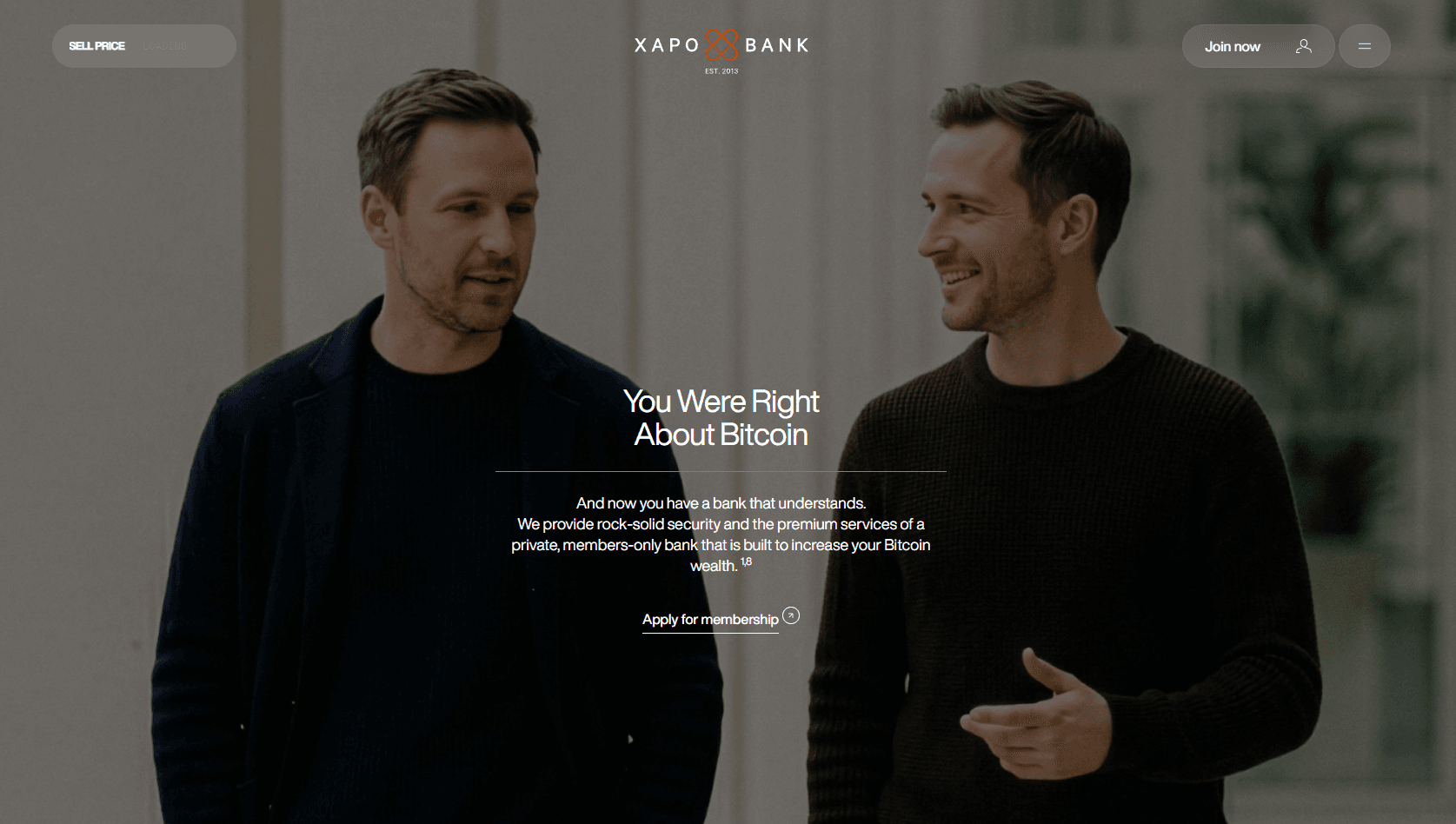 Xapo Bank Presents itself as a Members-only Private Bank for Bitcoin Holders. Image via Xapo Bank
Company Background And Positioning
According to Xapo, the company was founded in 2013 and originally built its name around long-term Bitcoin custody. Today, it positions itself less like a trading platform and more like a premium financial service for long-term holders who want secure storage, spending tools, and access to products such as savings and Bitcoin-backed borrowing. Xapo also states that it operates through separate regulated entities for banking and crypto-related services in Gibraltar.
What Makes It Different
What sets Xapo Bank apart is that it is not built as a free, mass-market crypto app. Its model is centered on:
A paid membership, with an annual fee of $1,000
A regulated bank entity in Gibraltar
A separate DLT-regulated entity for crypto services
A focus on custody, payments, and borrowing rather than broad crypto speculation
In short, Xapo’s pitch is convenience and structure for serious Bitcoin holders, not low-cost access for casual traders.
Xapo Bank Features And Products
Xapo Bank’s product lineup is built around a fairly specific use case: helping members store Bitcoin securely, access liquidity without selling it, and use a small set of banking-style tools from the same app. It is not trying to be the broadest crypto platform on the market. Instead, it focuses on a narrower mix of custody, savings, borrowing, spending, and wealth features that fit its Bitcoin-first identity.
BTC Vault And Long-Term Custody
The BTC Vault is Xapo’s security-first storage product for Bitcoin that is meant to be kept separate from everyday activity.
What it is: A dedicated Bitcoin storage option designed for long-term holdings.
How it differs from a wallet or savings balance: Vault balances are kept separate from the wallet, card, and savings functions.
Extra protection: Xapo says the vault includes a 48-hour withdrawal delay and PIN confirmation.
Important tradeoff: BTC held in the vault does not earn interest.
In simple terms, this is the “store it, don’t touch it” part of the platform.
BTC Savings And USD Savings
For members who want idle balances to be productive, Xapo offers BTC Savings and USD Savings.
What they do: BTC deposits can go into BTC Savings, while dollar deposits can go into USD Savings.
How interest works: Xapo says the annual interest rate is variable, which means it can change over time rather than staying fixed.
How payouts are made: Interest on both products is currently paid in BTC and added daily.
Flexibility: Funds can be moved back out of savings at any time, with no minimum lock-up period.
Xapo currently offers a rate of 4.1% on its USD Savings product.
That setup makes savings more flexible than the vault, but also more active in purpose.
Bitcoin-Backed Loans
Xapo’s Bitcoin-backed loans are aimed at members who want cash without selling BTC.
Key Terms
Loan size: Xapo says members can borrow up to 40% of their BTC collateral value.
Maximum per loan: Up to $1 million.
Repayment: The company says loans can be repaid early without penalties.
Core benefit: You keep exposure to Bitcoin rather than selling it to raise dollars.
Main risk: If BTC falls sharply, the loan can come under pressure and may lead to collateral action.
It is a useful feature for liquidity, but it still carries the normal risks of collateralized crypto lending.
Debit Card And Global Spending
Xapo also includes a global debit card, which helps turn the app into more than just a storage product.
Funding source: Members can spend from BTC or USD balances.
Rewards: Qualifying purchases can earn Bitcoin cashback.
Travel use: Xapo highlights fee-free foreign exchange for multi-currency spending.
Convenience: Users can create virtual cards while waiting for a physical one.
That gives Xapo a more practical “hold and use” angle than a pure custody product.
You can check out our top picks for the best crypto debit cards as well.
Trading, Stocks, ETFs, And Altcoins
Xapo has expanded beyond custody and payments by giving members access to U.S. stocks, ETFs, and altcoins in one app. Its official fee schedule also lists stock and ETF trading charges, which shows this is now a real part of the membership rather than a vague roadmap item. It still does not look like the main reason to join Xapo, but it does make the platform broader than a Bitcoin vault plus card.
We will also dive into the detailed fee structure ahead.
Beneficiaries And Legacy Planning
Xapo’s beneficiary feature is one of its more unusual additions, and it addresses a problem many crypto platforms barely touch.
What members can do: Nominate beneficiaries and assign percentages of their holdings.
Why it matters: Crypto inheritance can be messy if there is no formal plan.
Who it helps most: Long-term holders thinking beyond trading and short-term portfolio management.
This is less flashy than cashback or yield, but for some users it may be one of the most practical features in the whole product suite.
Fees And Real-World Costs
Xapo Bank is not a platform where the headline cost hides in tiny print. The biggest expense is visible right away: a $1,000 annual membership fee. After that, the real question is whether the rest of the pricing structure actually fits how you plan to use the product. Xapo also notes that its current pricing can change, so the live fee schedule matters more than old screenshots or summaries.
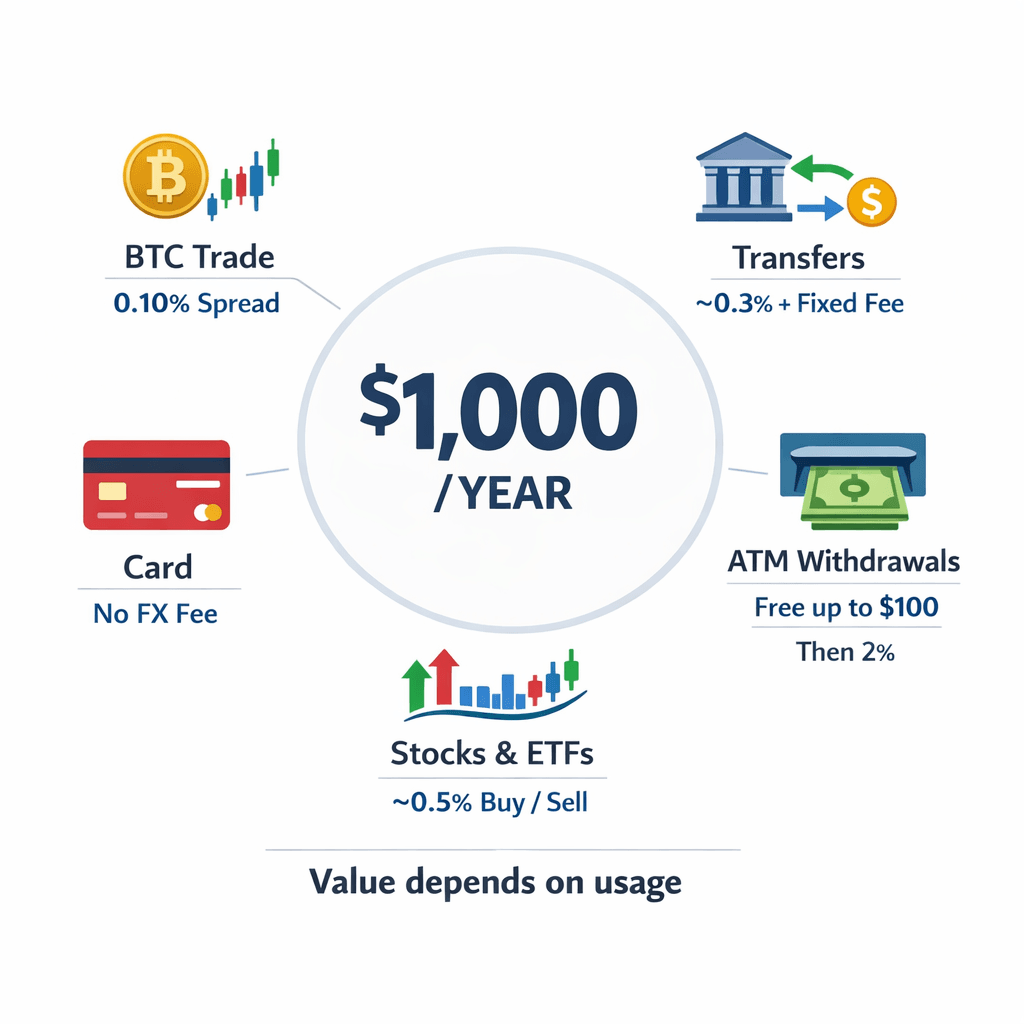 The $1,000 Annual Membership Fee is the First and most important Filter
Membership Fee And What It Includes
The membership fee is the first and most important filter. Xapo says the annual fee is deducted once your balance reaches $1,000 or the equivalent in Bitcoin, and that it covers core access to the service, including card creation, delivery, and one free replacement per year. In other words, this is not a casual “try it for free” app. You need enough value from the platform to justify that fixed yearly cost before any trading, savings, or borrowing benefits even enter the picture.
Trading, Card, Payment, And ATM Fees
Here is the practical fee picture:
Bitcoin exchange: No separate transaction fee for BTC/USD exchange, but Xapo applies a 0.10% spread, which it says can change over time.
USD transfers: SWIFT deposits cost 0.3%, while SWIFT withdrawals cost 0.2% plus the USD equivalent of GBP 25. ACH and Fedwire charges also apply for supported routes.
Card and ATM use: Card FX has no extra bank fee, ATM withdrawals are free up to $100 per month, then 2%, and ATM operators may add their own fee.
Stocks and ETFs: 0.5% when buying, and 0.5% plus SEC and FINRA Trading Activity Fee charges when selling.
Real-World Cost Scenarios
For a long-term Bitcoin holder, the membership fee is the main hurdle, but the relatively low BTC spread may still appeal if you trade occasionally. For a traveler, the card is more attractive because zero extra FX fees and Bitcoin cashback can offset some usage costs, though ATM use becomes less attractive above the free monthly limit. For a borrower, Xapo says its Bitcoin-backed loans have no arrangement, closure, margin call, or liquidation fees, but interest is variable and can change daily.
Value For Money?
Whether Xapo is good value comes down to one question: will you use enough of the custody, card, savings, or lending stack to make that fixed yearly fee feel justified? For high-balance Bitcoin holders, maybe. For cost-sensitive users, probably not.
Security, Custody, And Regulation
When a platform mixes banking services with Bitcoin products, security is not just a technical detail. It shapes how funds are stored, what protections apply, and what risks still remain. With Xapo Bank, the key thing to understand is that “secure” does not mean “risk-free.” It means there are multiple layers of protection, but also clear limits depending on whether you are holding fiat, Bitcoin, or using investment and lending products.
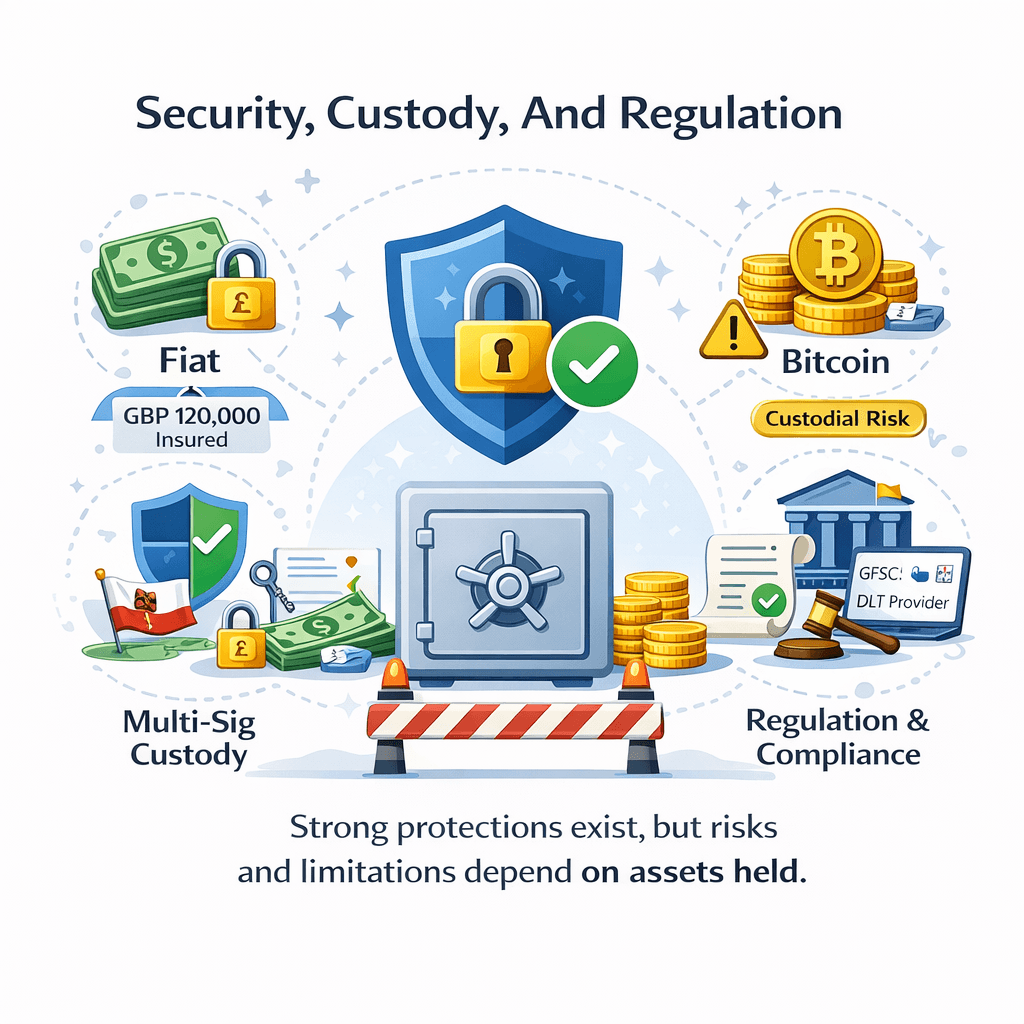 The Key Thing to Understand is that “Secure” does not mean “Risk-Free”
Security Architecture Explained Simply
Xapo says its custody system combines multi-party computation with a distributed physical infrastructure. In plain English, that means there is no single private key sitting in one place for an attacker to steal. Instead, Xapo says key “shards” are encrypted and stored in separate undisclosed locations, while its broader setup includes offline physical security infrastructure and extra controls around vault withdrawals. The BTC Vault also adds practical safeguards such as delayed withdrawals, helping separate long-term storage from day-to-day app activity.
Regulation And Compliance
On the regulatory side, Xapo operates through two Gibraltar-regulated entities. Xapo Bank Limited appears on the GFSC register as a credit institution, while Xapo VASP Limited appears as a DLT provider for crypto-related services. That structure matters because it helps explain why some protections apply to fiat banking activity but not in the same way to crypto custody or investment products.
Custody Model And User Control
Xapo’s terms for digital asset services state that it acts as a custodian of bitcoins transferred to a Xapo wallet, while also saying it does not obtain legal or beneficial title to those bitcoins. For beginners, the easiest way to think about this is: Xapo holds the infrastructure and control layer, but the assets are not described as becoming Xapo’s property. That is still very different from self-custody, where you control the private keys directly.
Risks That Still Exist
Even with strong controls, some important risks remain:
BTC held in the Vault is not insured, while eligible fiat deposits are covered by the Gibraltar Deposit Guarantee Scheme up to GBP 120,000.
Xapo’s fund terms say crypto assets may not be protected under investor protection schemes if Xapo VASP, a sub-custodian, or a service provider becomes insolvent.
Its VASP terms also warn that storing and transferring digital currency involves significant risk of financial loss.
So, Xapo’s setup looks more structured than many crypto platforms, but users are still relying on a custodial system rather than removing third-party risk entirely.
We recommend you check out our guide on risk mitigation for more knowledge.
Xapo Bank vs Alternatives
Xapo Bank makes the most sense when you judge it against the type of product it is trying to be. It is not the cheapest way to buy crypto, the most direct way to control your own Bitcoin, or the broadest app for casual finance. Its pitch is narrower: a paid membership that combines Bitcoin custody, card spending, and Bitcoin-backed borrowing in one place.
Option | Best For | Main Strength | Main Tradeoff |
|---|---|---|---|
Xapo Bank | Long-term BTC holders who want an all-in-one service | Custody, card, savings, and loans under one membership | High fixed annual fee and custodial reliance |
| Users who want direct control | You control the keys and remove platform dependence | More personal responsibility and no built-in banking layer | |
| Active traders | Broader markets and volume-based trading fees | Not designed like a private-banking product | |
Multi-Currency Fintech Apps | Travel and everyday spending | Easy fiat management, cards, and multi-currency support | Usually less Bitcoin-native than Xapo |
Xapo Bank Vs Self-Custody Options
Against self-custody options, Xapo offers convenience and service. A hardware wallet gives you direct key control, but also places more of the recovery and security burden on you. Xapo removes some of that friction, but in exchange you rely on a custodian.
Xapo Bank Vs Crypto Exchanges
Against exchanges, Xapo looks less like a trading venue and more like a wealth product. Exchanges can offer broader market access and trading infrastructure, while Xapo focuses more on custody, spending, and borrowing.
Xapo Bank Vs Crypto-Friendly Fintech Apps
Against a fintech app, Xapo is stronger on Bitcoin-specific features, while fintech platforms tend to be more compelling for day-to-day fiat convenience and lower-friction spending.
Best Alternatives By Need
Best for full control: Choose a self-custody wallet
Best for active trading: Choose a crypto exchange
Best for travel and fiat flexibility: Go for a multi-currency fintech app
Best for a premium Bitcoin-first all-in-one stack: Xapo Bank positions itself as a good option

Final Verdict
Xapo Bank is best understood as a premium Bitcoin banking service, not a low-cost crypto app. Its strongest appeal is the way it brings together custody, card spending, savings, and Bitcoin-backed loans inside one membership. That can make sense for long-term holders who value convenience, structure, and human support. The main drawback is simple: the $1,000 annual membership fee is high, and the product still carries custodial, lending, and product-access risks.
Who Should Consider Xapo Bank
Long-term Bitcoin holders,
Users who want an all-in-one premium service,
Members likely to use the card, custody, and lending stack.
Who Should Skip It
Fee-sensitive users,
Traders who want broader market access,
Anyone who prefers full self-custody.