Arc is an open Layer 1 blockchain built by Circle for stablecoin-native finance. BlackRock, Visa, Goldman Sachs and AWS are among over 100 major institutions testing the network.
- Purpose-built for stablecoin finance: Arc is not a general-purpose Layer 1 chasing every crypto use case. It is designed specifically for payments, settlement, FX, and financial coordination.
- Public testnet is already live: Arc launched its public testnet on October 28, 2025, making it available for developers to explore even though it is still in a pre-production phase.
- USDC-native gas model: Arc uses USDC for gas fees instead of a volatile native token, which makes transaction costs more predictable and easier for businesses to budget and account for.
- Deterministic sub-second finality: Arc uses the Malachite consensus engine to provide deterministic finality in less than one second, which is especially useful for payments and settlement-heavy financial workflows.
- EVM-compatible infrastructure: Developers can build on Arc using familiar Ethereum tooling such as Solidity, Foundry, and Hardhat rather than learning a completely new environment.
- Built for builders and institutions: Arc is aimed at developers, fintechs, enterprises, and financial institutions that want stablecoin-native infrastructure for cross-border payments, treasury movement, tokenized assets, and onchain financial applications.
What Is Circle Arc Blockchain?
Arc is an open Layer 1 blockchain built by Circle for stablecoin-native financial activity. Put simply, it is a blockchain designed from the ground up for moving, settling, and programming digital money, rather than trying to support every on-chain trend under one roof. Circle describes Arc as part of an “Economic OS” for the internet, which is easiest to understand as a base financial layer for online money movement, much like an operating system gives apps the core tools they need to run on a computer.
 Arc is an Open Layer 1 Blockchain Built by Circle for Stablecoin-Native Financial Activity. Image via Circle
While Arc is clearly aimed at serious financial use cases, it is also public and permissionless for builders, meaning developers can use familiar EVM tools to deploy applications on an open network rather than a closed institutional system.
In simple terms, Arc is an open, EVM-compatible Layer-1 blockchain built by Circle for stablecoin-native finance, giving developers a public settlement layer optimized for payments, financial applications, and internet-scale value transfer.
What Arc Is Not
Arc is not a general-purpose Layer 1 trying to compete through meme-coin activity or the broadest possible app ecosystem. The official Arc documentation frames it as purpose-built rather than general-purpose, with a focus on economic activity, open composability, and financial coordination. That narrower scope is intentional. Circle is positioning Arc as infrastructure for internet finance first, and only second as a chain for broader experimentation.
Why Circle Built Arc
Circle built Arc because existing blockchains were not designed around the practical needs of stablecoin-based finance. Payments, FX, and capital-markets activity need infrastructure that behaves more like dependable financial plumbing than a general crypto network. That means lower uncertainty around costs, less operational friction for treasury teams, more suitable privacy controls for sensitive transfers, and smoother coordination across ecosystems for applications built around digital dollars and other regulated assets.
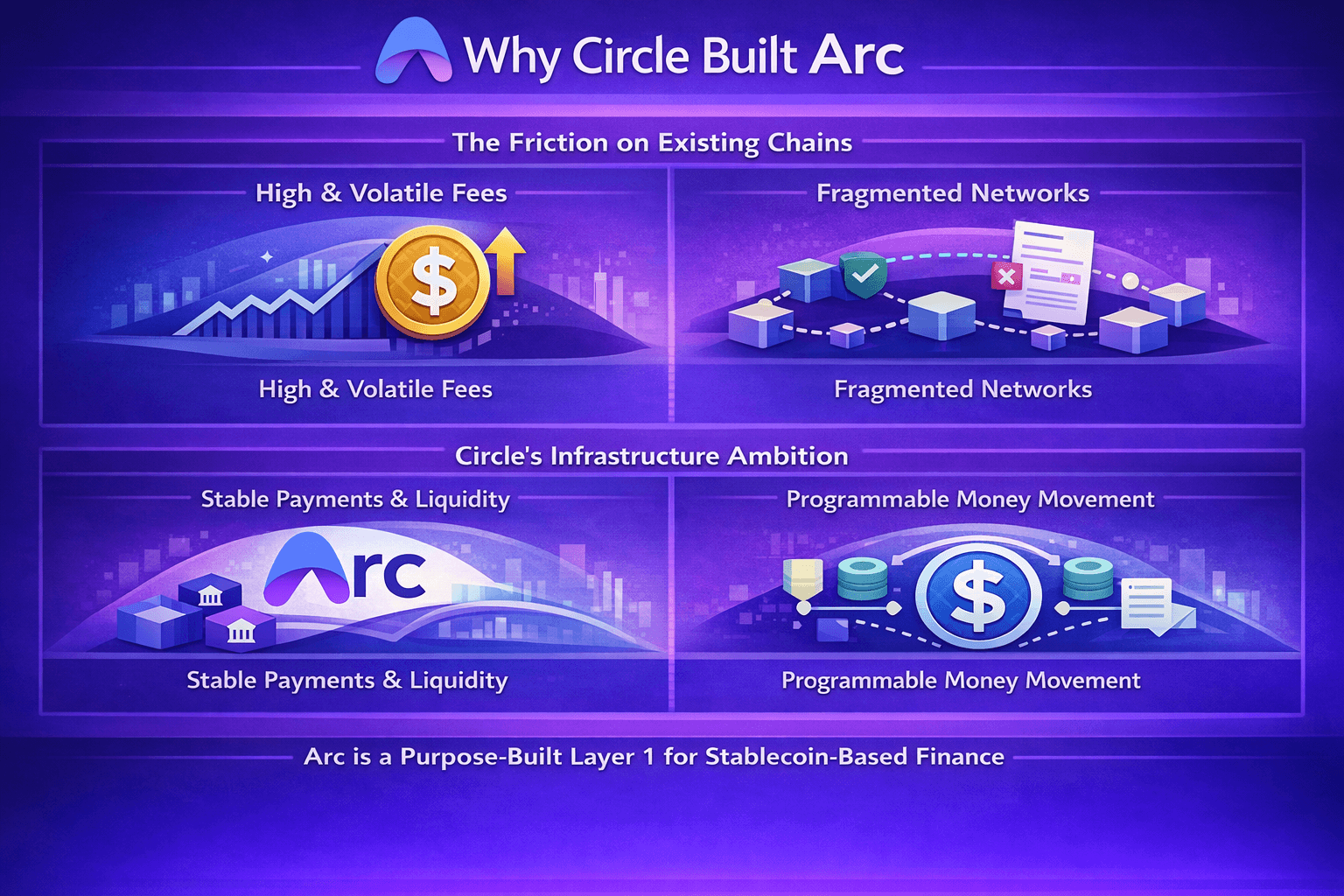 Circle Built Arc because Existing Blockchains were not Designed Around the Practical Needs of Stablecoin Based Finance
The Friction on Existing Chains
One of the clearest pain points is fees. On many blockchains, transaction costs are paid in a volatile native asset, which means the real cost in dollars can change with both token prices and network demand. For developers and treasury teams, that makes budgeting harder and introduces a layer of financial risk that feels out of place in normal business operations. Arc uses USDC as gas fees to reduce that friction and make costs easier to forecast, manage, and account for.
Another problem is fragmentation. Arc is designed to be market-neutral and multichain-aligned, which reflects a broader weakness across today’s blockchain landscape: liquidity, users, and applications are often scattered across separate networks that do not connect efficiently. On top of that, sensitive payment data can be exposed on fully public rails, creating added settlement and compliance friction for institutions trying to scale financial activity onchain.
Circle’s Infrastructure Ambition
Arc also signals a broader shift in Circle’s role within crypto. Rather than stopping at issuing stablecoins, the company is building deeper financial infrastructure for settlement, liquidity movement, and programmable money flows. In practical terms, Arc is part of a larger push to give stablecoin applications a purpose-built base layer, rather than asking them to adapt to blockchains that were designed with very different priorities in mind.
How Arc Works
Arc is a standalone Layer 1, not a Layer 2 built on top of another chain. Its architecture combines a dedicated consensus layer with an Ethereum-style execution environment, then adds financial features that are designed specifically for stablecoin-based activity.
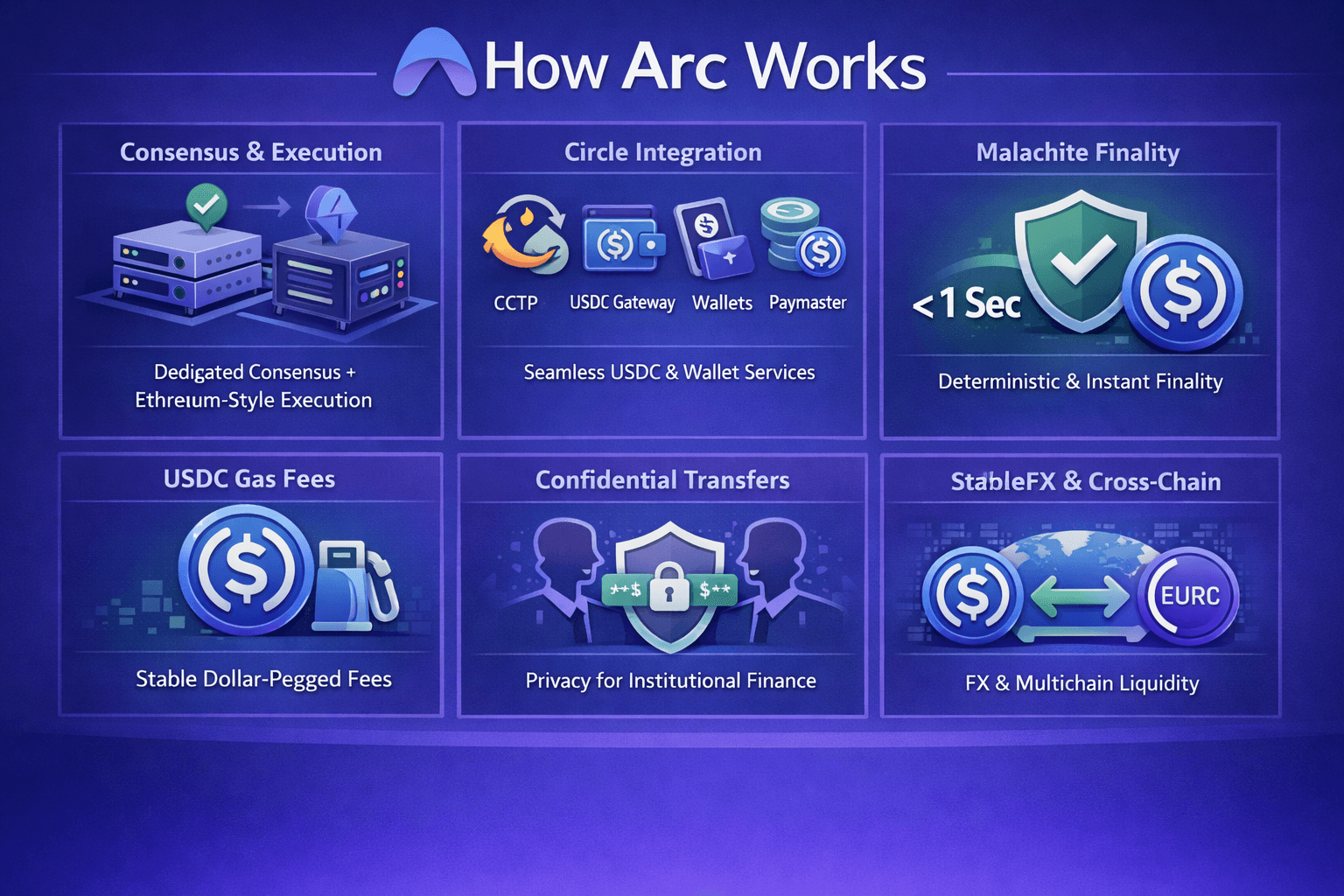 Arc is a Standalone Layer 1, Not a Layer 2 Built On Top of Another Chain
Arc’s Core Architecture
At the highest level, Arc has two main moving parts: consensus and execution.
- The consensus side decides the order of transactions and finalizes them, while the execution side processes accounts, balances, and contract logic.
- Arc’s execution layer is based on Reth, which gives developers a familiar Ethereum-style environment while extending it with stablecoin-native modules.
That familiarity is important because Arc is EVM-compatible as mentioned earlier, so developers can use the same languages and frameworks they already know, including Solidity, Foundry, and Hardhat. The benefit is simple: teams do not have to learn an entirely new programming model just to build payments, lending, or treasury applications on a new chain.
Arc also ties directly into Circle’s broader product stack rather than treating those services as disconnected add-ons. Taken together, that gives Arc a more integrated feel than a typical chain where builders have to source payments, interoperability, and wallet tooling from separate providers.
Malachite and Deterministic Finality
Arc’s consensus engine is called Malachite. It comes from the Malachite team that joined Circle from Informal Systems, bringing expertise in Byzantine Fault Tolerance, formal verification, and consensus design into Arc’s core architecture.
The key idea here is deterministic finality. In plain English, once a transaction is confirmed on Arc, it is final and cannot be rolled back later. That is different from systems where users often wait for extra confirmations just to feel safe that a payment will really stick. Arc delivers deterministic finality in less than one second.
Why does that matter? Because payments, FX, and capital-markets workflows all work better when parties know a transfer is actually settled, not just probably settled. It is the difference between seeing a payment marked “pending” and seeing funds fully cleared.
USDC as the Native Gas Token
Arc does not use a volatile native asset for fees. Instead, USDC is used for gas fees, which is unusual compared with ETH- or SOL-style fee models, where the cost of using the network can move around with the price of the chain’s own token.
For businesses, this has a very practical advantage:
- Dollar-denominated fees are easier to budget for.
- Accounting becomes more straightforward.
- Treasury teams do not need to hold a separate volatile asset just to operate onchain.
- Costs are easier to forecast over time.
That may sound like a small detail, but for financial applications it matters a lot. A stable fee model is much closer to how real-world finance teams already think about operational costs.
Privacy Controls for Institutional Finance
Arc’s privacy model is opt-in rather than all-or-nothing. Its design centers on confidential transfers, where transaction amounts can be shielded while sender and receiver addresses remain visible. That creates a middle ground between total public exposure and full anonymity.
For institutional users, that distinction is important. The goal is not to hide everything, but to keep sensitive payment details private while preserving auditability and selective disclosure when needed.
In practice, this makes Arc’s privacy model easier to understand:
- Amounts can be shielded without making the whole transaction invisible.
- Transactions remain more compatible with compliance and reporting needs.
- Privacy is positioned as a tool for financial confidentiality, not for total obscurity.
One important caveat is that some privacy features remain part of Arc’s broader design roadmap, so they should be understood as developing functionality rather than assumed to be fully live across production use today.
StableFX and On-chain FX
StableFX is an institutional foreign exchange capability built on Arc. It combines Request-for-Quote execution with onchain settlement for stablecoin pairs such as USDC and EURC. Rather than working like a simple token swap tool, it is structured around the needs of firms that care about liquidity access, settlement certainty, and operational control.
The practical value is easier to see in a few points:
- It supports 24/7 stablecoin FX activity.
- It reduces the need for prefunding across fragmented systems.
- It is designed to remove some of the friction found in legacy FX infrastructure.
- It makes cross-border settlement more programmable.
That helps position Arc as more than a payments chain. It is also being built as infrastructure for foreign exchange and institutional money movement.
Cross-Chain Liquidity and Interoperability
Arc is not designed to be a silo. Its broader model depends on moving value across networks and treating multichain access as a feature rather than a workaround. With CCTP’s burn-and-mint design, USDC can move between supported chains without relying on wrapped assets, while Gateway allows users to hold a chain-abstracted balance that can be accessed across supported blockchains.
Serious onchain finance rarely lives on one network alone. Developers may want to settle on Arc, route liquidity from elsewhere, or connect workflows across ecosystems.
What Assets and Products Are Native to Arc?
Different financial use cases need different building blocks. A payment app may need a dollar stablecoin for settlement, a business operating in Europe may prefer euro-denominated flows, and an institutional treasury desk may want access to tokenized short-term yield without leaving the same ecosystem.
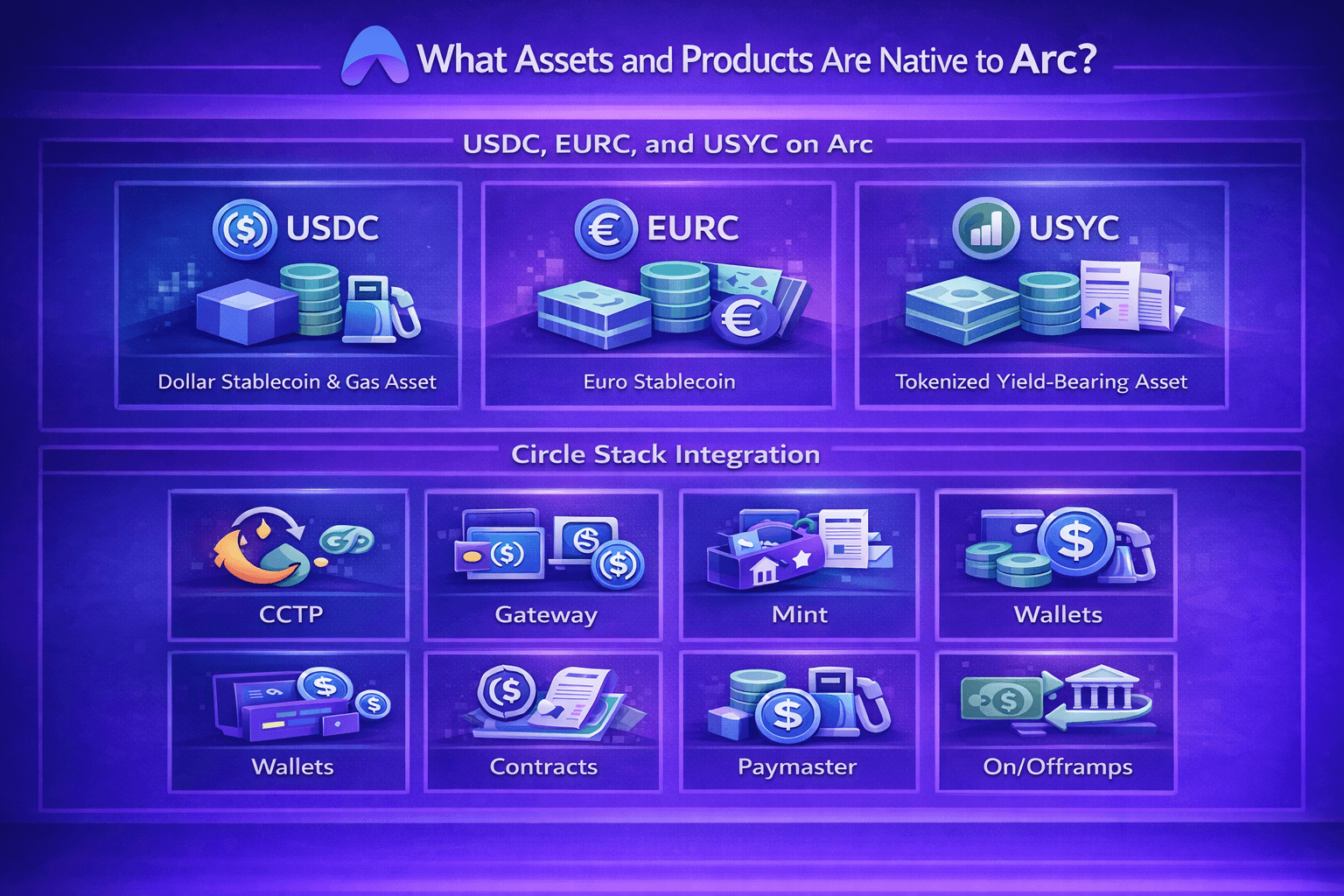 Arc is Being Built as a Financial Network Around Multiple Forms of Regulated Digital Money
USDC, EURC, and USYC on Arc
The core native assets on Arc include:
- USDC, which serves as the native EVM asset and is used for gas fees as well as settlement.
- EURC, which gives Arc support for euro-denominated payments, FX, and financial applications.
- USYC, which represents tokenized money market fund exposure backed by short-duration US Treasury securities.
Arc is being designed around a broader idea of digital money, not just a single token. USDC handles the role of core settlement asset, EURC expands that model into euro-based activity, and USYC adds a yield-bearing instrument that can be used in more institutional or treasury-focused workflows.
Circle Stack Integration
Arc’s practical advantage is not just the assets themselves, but the products that sit around them. Its native integrations include:
- CCTP, for moving native USDC across chains.
- Circle Gateway, for unified USDC balances across supported blockchains.
- Mint, for accessing and distributing USDC liquidity.
- Wallets, for embedded and programmable wallet infrastructure.
- Contracts, for deploying and managing smart contracts.
- Paymaster, for paying gas in USDC.
- Institutional on/offramps, which help connect blockchain activity with traditional fiat movement.
Together, these integrations make Arc look less like a bare blockchain and more like a ready-made financial stack. For developers and businesses, that reduces the need to stitch together separate providers for liquidity, wallets, payments, and settlement. It also strengthens Arc’s pitch as infrastructure for real-world financial applications, not just another chain competing for token activity.
What Can Arc Be Used For?
Arc is designed mainly for payments and cross-border settlement, stablecoin FX as well as capital-markets and treasury use cases.
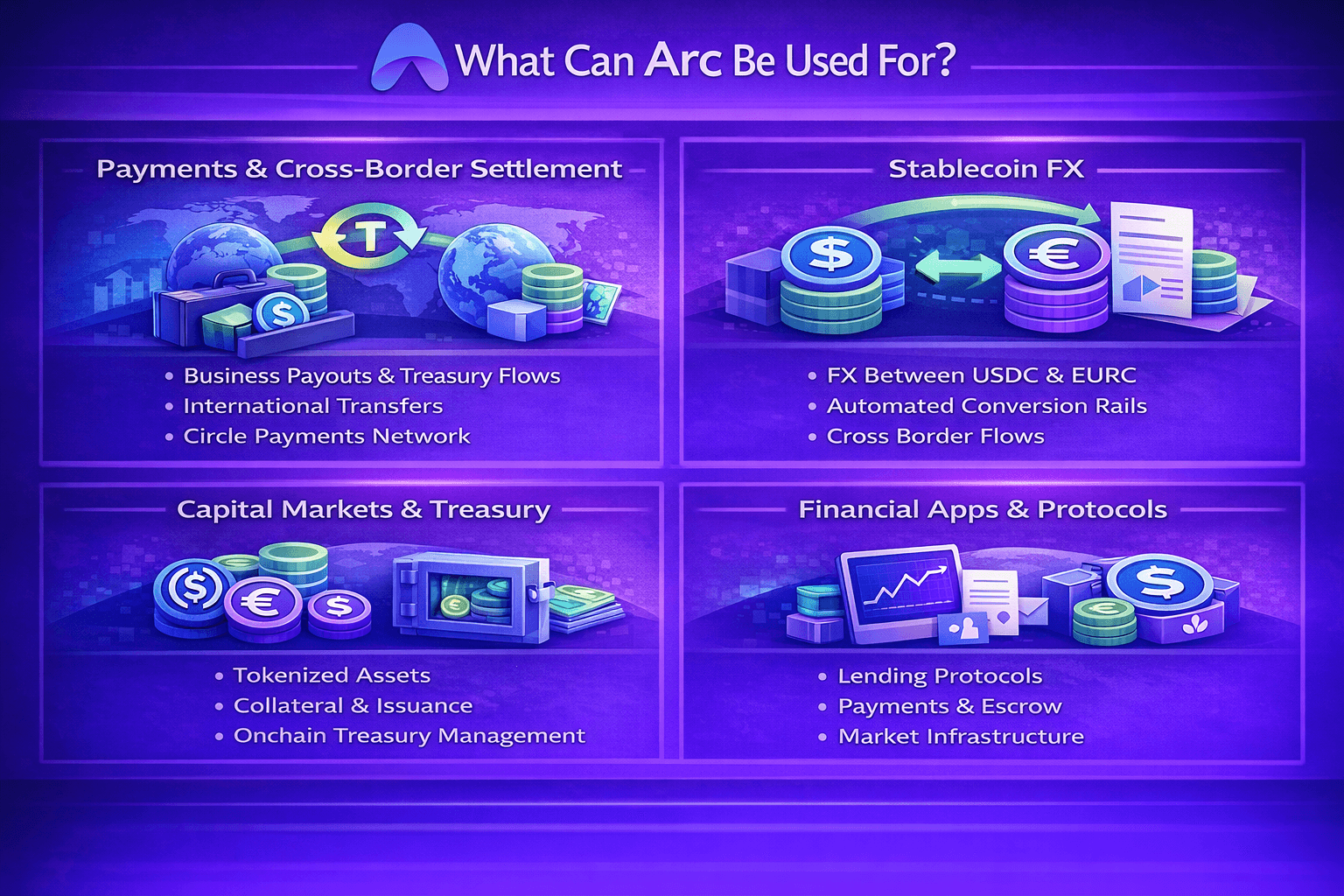 Arc's Strongest Fit is in Areas where Stablecoins, Fast Settlement, and more Predictable Financial Infrastructure matter more than Broad App Variety
Payments and Cross-Border Settlement
One of Arc’s clearest use cases is moving money quickly across borders using stablecoins as the settlement asset. That includes everything from business payouts to treasury transfers between entities in different countries. Because the network is built around stable fee design and deterministic finality, it is better suited to this kind of workflow than a chain where users still need to manage a separate volatile gas token.
In practical terms, Arc is being positioned for:
- Cross-border Payments that settle on-chain without relying on legacy banking cut-off times.
- Payouts that benefit from near-instant settlement and easier cost forecasting.
- Treasury Management between business entities that want money movement to be faster and more programmable.
- Payment Flows that can connect into the Circle Payments Network, which is designed for compliant global money movement between financial institutions.
Stablecoin FX
Arc is also designed for foreign exchange, which is where StableFX becomes especially important. StableFX handles conversion between fiat-backed stablecoins such as USDC and EURC, combining RFQ-based execution with onchain settlement. That makes it much closer to financial market infrastructure than a simple token swap interface.
Its main use cases include:
- Stablecoin currency-pair settlement.
- Automated Conversion Rails between supported fiat-backed stablecoins.
- FX Workflows that need programmable and auditable on-chain settlement.
- Cross-border Flows where funds may need to be converted before final payout.
Capital Markets, RWAs, and Treasury
Arc is also being positioned for capital-markets and treasury use cases, especially where tokenized assets need fast settlement and clearer operational controls. That includes tokenized funds, collateral movement, issuance workflows, and treasury management activity that would benefit from on-chain transfer without losing auditability.
The basic idea is straightforward:
- Tokenized Assets become easier to move and settle when the base layer is built for financial workflows.
- Tokenized Funds can operate in an environment where payments and settlement tools are already close at hand.
- Collateral and Issuance processes can be coordinated on-chain with less operational friction.
- Treasury Workflows benefit from predictable fees, stable settlement assets, and more transparent movement of value.
Arc’s support for USYC is especially relevant here because it introduces tokenized money-market-fund exposure into the same environment as USDC and EURC. That creates a more useful toolkit for institutions that care about liquidity management, capital efficiency, and short-duration yield-bearing instruments.
Developer-Built Financial Applications
Arc is also meant to be a base layer for developers building financial applications rather than consumer crypto apps with a broader entertainment focus. Because it is public and EVM-compatible, developers can use familiar tooling such as Solidity to build products around payments, lending, and market infrastructure without having to adapt to a completely new execution model.
That opens the door to applications such as:
- Lending Protocols built around stable settlement assets.
- Payments Apps that need predictable transaction costs.
- Market Infrastructure Tools for settlement, escrow, and treasury coordination.
- More Automated Forms of on-chain economic activity, where software agents can move value according to predefined rules.
In other words, Arc’s use cases are selective by design. It is strongest where finance needs settlement certainty, currency stability, and infrastructure that feels closer to a purpose-built financial system than a general crypto playground.
Who Is Arc Built For?
Arc is built for a fairly specific audience. It is aimed at organizations and developers that want blockchain infrastructure for payments, settlement, FX, and tokenized finance, rather than a chain optimized mainly for retail trading or broad consumer crypto activity. In practice, that puts four groups at the center: financial institutions, fintechs, enterprises, and DeFi or infrastructure developers.
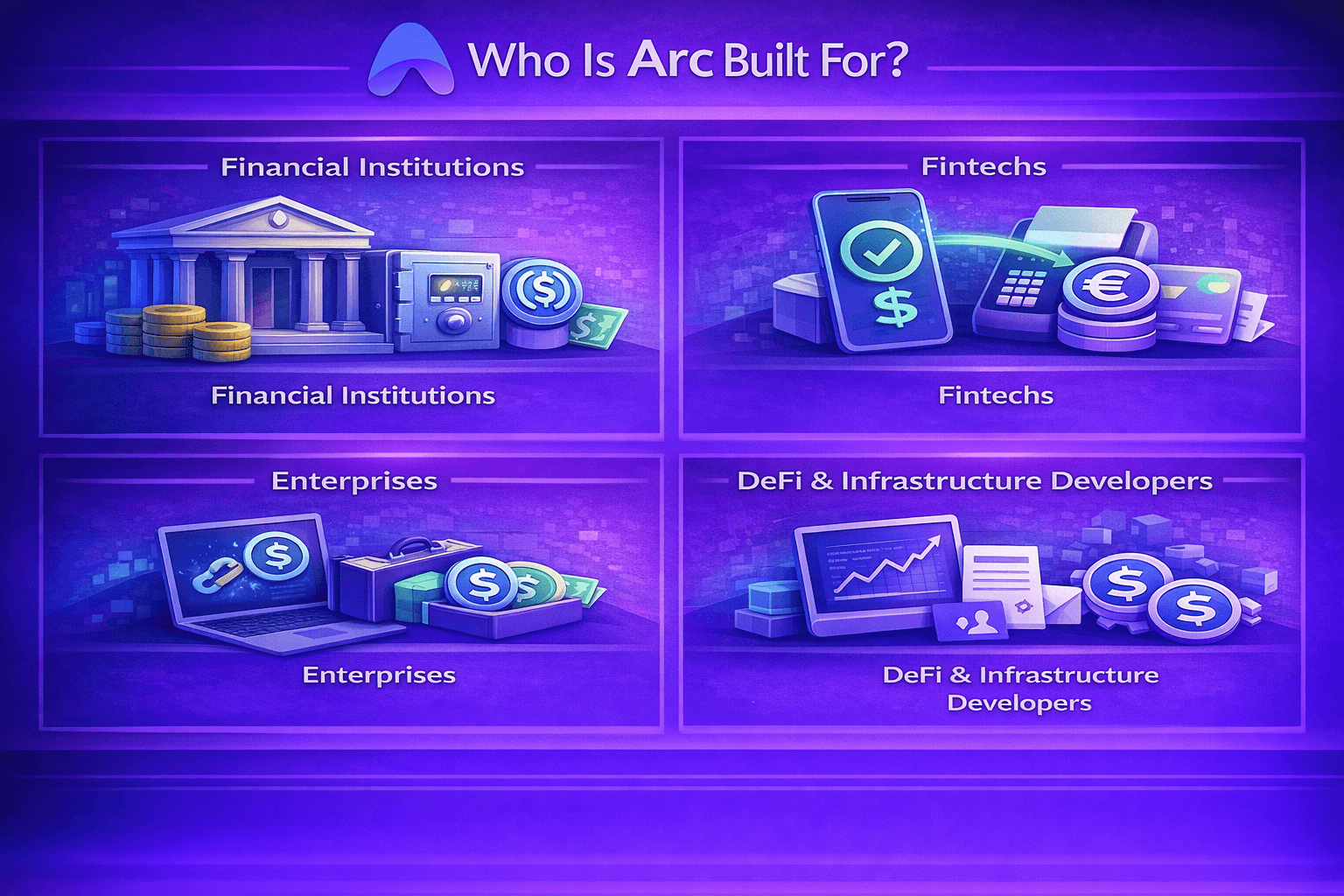 Arc Puts Four Groups at the Center: Financial Institutions, Fintechs, Enterprises, and DeFi or Infrastructure Developers
Its public testnet also gives some weight to that positioning. Circle launched Arc’s public testnet with more than 100 launch and design participants. That does not guarantee adoption on its own, but it does suggest that Arc is being taken seriously by the kinds of firms it is designed to serve.
Institutions and Enterprises
For institutions and enterprises, Arc is meant to solve a fairly practical problem: how to use blockchain rails for financial activity without having to rebuild everything around volatile gas tokens, fragmented liquidity, or public-by-default transaction exposure.
The strongest fit is with groups such as:
- Financial Institutions exploring cross-border settlement, treasury movement, and tokenized asset workflows
- Fintechs building payment, remittance, or embedded-finance products on stablecoin rails
- Enterprises that want faster payouts, programmable money movement, or more efficient treasury coordination
- Firms working with tokenized assets where auditability, stable settlement assets, and multichain liquidity matter
BlackRock, Goldman Sachs, Deutsche Bank, Visa, and AWS point to the kinds of institutions Arc is trying to attract, not just to headline value.
Developers and Builders
Arc is also built for developers, especially those creating payment tools, lending products, market infrastructure, and other financial applications. The network is public, and the builder experience is already structured around live testnet access and familiar tooling rather than a closed institutional environment.
For developers, the practical entry points include:
- Testnet Docs that explain how Arc works and how to connect to the network.
- a Faucet for requesting testnet assets needed to deploy and test applications.
- Sample Applications and quickstarts that walk through wallet setup, deployment, and crosschain flows.
- Testnet Access through Arc Testnet RPC endpoints and the Arcscan Explorer.
Arc is not just courting large institutions directly. It also needs developers who can turn the network into useful financial software. If the institutions are the users Arc wants to attract, builders are the group that helps make the ecosystem actually usable.
Arc vs Ethereum and Solana
Arc, Ethereum, and Solana can all support on-chain applications, but they were built with different priorities. Ethereum is the broadest general-purpose smart contract platform, Solana is optimized for high-throughput performance, and Arc is designed more narrowly around stablecoin settlement and financial coordination.
Feature | Arc | Ethereum | Solana |
|---|---|---|---|
Primary Focus | Stablecoin-native financial infrastructure | General-purpose smart contracts and decentralized applications | High-performance blockchain applications |
Gas Token | USDC | ||
Fee Predictability | Stable, dollar-based transaction costs | More predictable than before because of the base fee, but still paid in ETH and can rise with network demand | Low fees, but still paid in SOL with a base fee plus optional prioritization fee |
Finality Model | Deterministic finality with irreversible settlement in less than one second | Proof-of-stake consensus with Gasper finality | Tower BFT finality when nodes representing two-thirds of stake have a common root |
EVM Compatibility | No native EVM, though other tooling and environments can bridge the gap | ||
Stablecoin-Native Design | Yes | No | No |
Built-in FX Capability | Yes, through StableFX | No native built-in FX layer | No native built-in FX layer |
Privacy / Compliance Controls | Opt-in privacy with confidential transfers and selective disclosure | No protocol-level privacy layer designed around institutional confidentiality | No protocol-level privacy layer designed around institutional confidentiality |
Ethereum remains the broadest and most proven smart contract ecosystem of the three. It has the deepest base of developers, tools, and applications, which makes it the default choice for many teams building general-purpose onchain products. But it was not designed specifically around stablecoin settlement, so businesses still have to work around ETH-denominated gas, broader network congestion dynamics, and a structure that serves many use cases beyond finance.
Solana is closer to Arc in one respect: both care a lot about speed. But the design priorities are still different. Solana focuses on high-performance execution for a wide range of applications, while Arc is more narrowly tuned for financial workflows such as payments, stablecoin FX, and treasury movement. That narrower focus means Arc is less of an all-purpose app chain and more of a dedicated settlement layer.
That is really the main distinction. Arc is not trying to beat Ethereum or Solana at being the biggest ecosystem. Its edge is that it is more tightly aligned with stablecoin-native settlement workflows, with USDC gas, deterministic finality, and a built-in FX layer all pointing in the same direction.
Arc Development Timeline and Current Status
Arc’s rollout has moved in clear stages so far: announcement first, public testnet next, and continued builder activity after that. As of April 4, 2026, Arc is still in its public testnet phase, with live developer docs, RPC access, a faucet, and a testnet explorer already available.
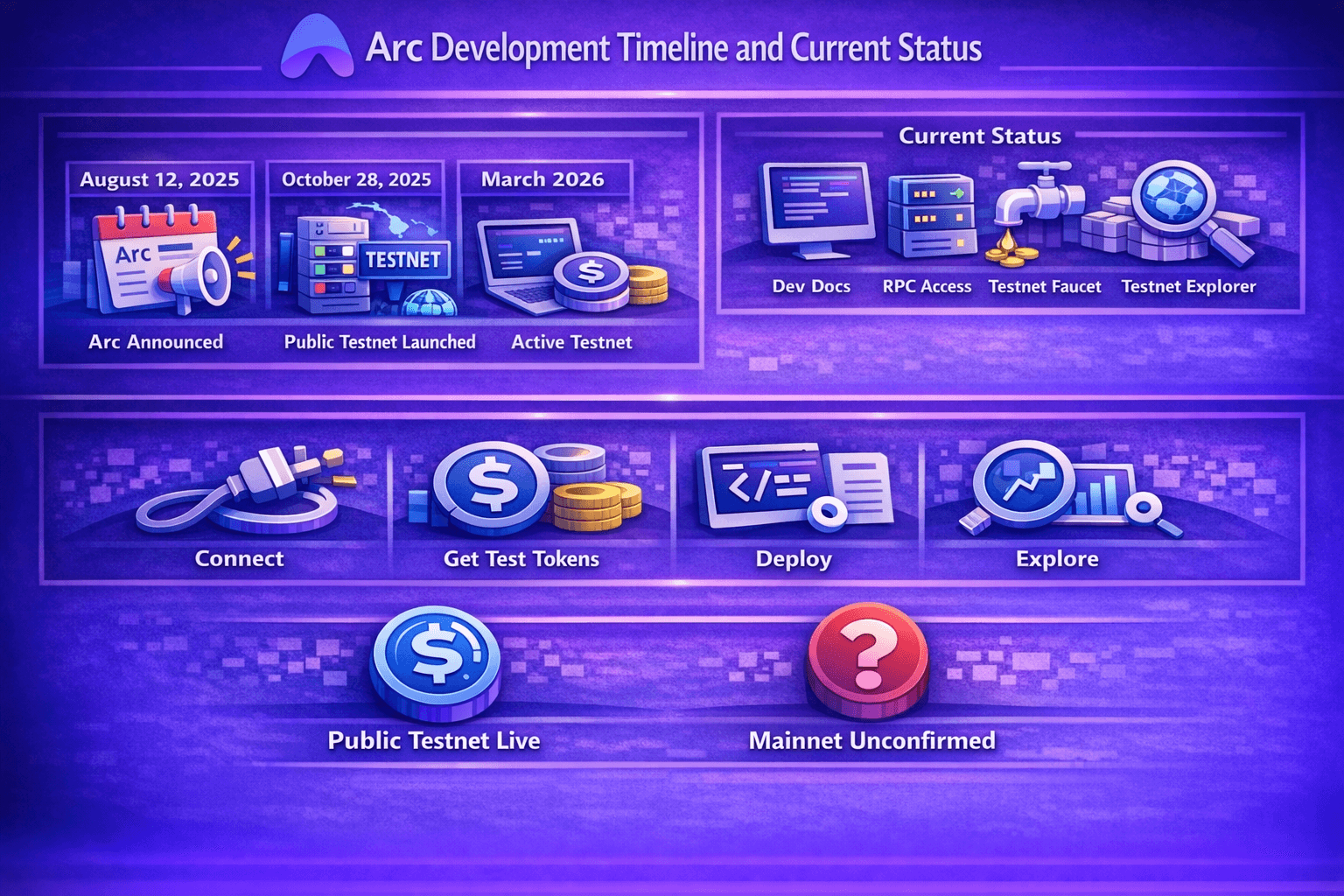 Arc is still in its Public Testnet Phase, with Live Developer Docs, RPC Access, a Faucet, and a Testnet Explorer Already Available
Key Milestones So Far
The timeline is fairly straightforward:
- August 12, 2025: Arc was introduced as an open Layer 1 built for stablecoin finance.
- October 28, 2025: Circle launched the public testnet.
- April 2026: Arc remains in an active testnet phase, with testnet tooling available through the docs and faucet.
That current status matters because Arc is no longer just a concept or roadmap item. Developers can already connect to Arc Testnet, request testnet assets, deploy contracts, and inspect activity through the explorer. At the same time, the network is still explicitly framed as a pre-production environment for testing and experimentation rather than a live production mainnet.
Does Arc Have a Native Token?
Arc does not have a separate native token in use today. Instead, USDC is the native gas token, which means transaction fees on Arc Testnet are paid in USDC rather than in a separate volatile asset.
However, a separate Arc token is at least being considered. In Circle’s third-quarter 2025 results, the company said a native token on Arc is “under exploration.” Still, this falls well short of a launch plan or confirmed issuance decision. For now, the cleanest conclusion is simple: USDC is the gas asset today, while any standalone Arc token remains exploratory rather than official.
Arc has passed the announcement stage and is already live in public testnet, but it is still not publicly confirmed as a mainnet network as of April 4, 2026. The token picture is similar: USDC is live as gas now, while any future Arc token remains unconfirmed.
Why Arc Matters for Stablecoin Finance
Arc signals a broader shift in how Circle wants to participate in the stablecoin market. For years, Circle’s role was mainly associated with issuing USDC. Arc pushes that strategy further down the stack by giving Circle a bigger role in the infrastructure that stablecoin-based payments, settlement, FX, and tokenized finance can run on.
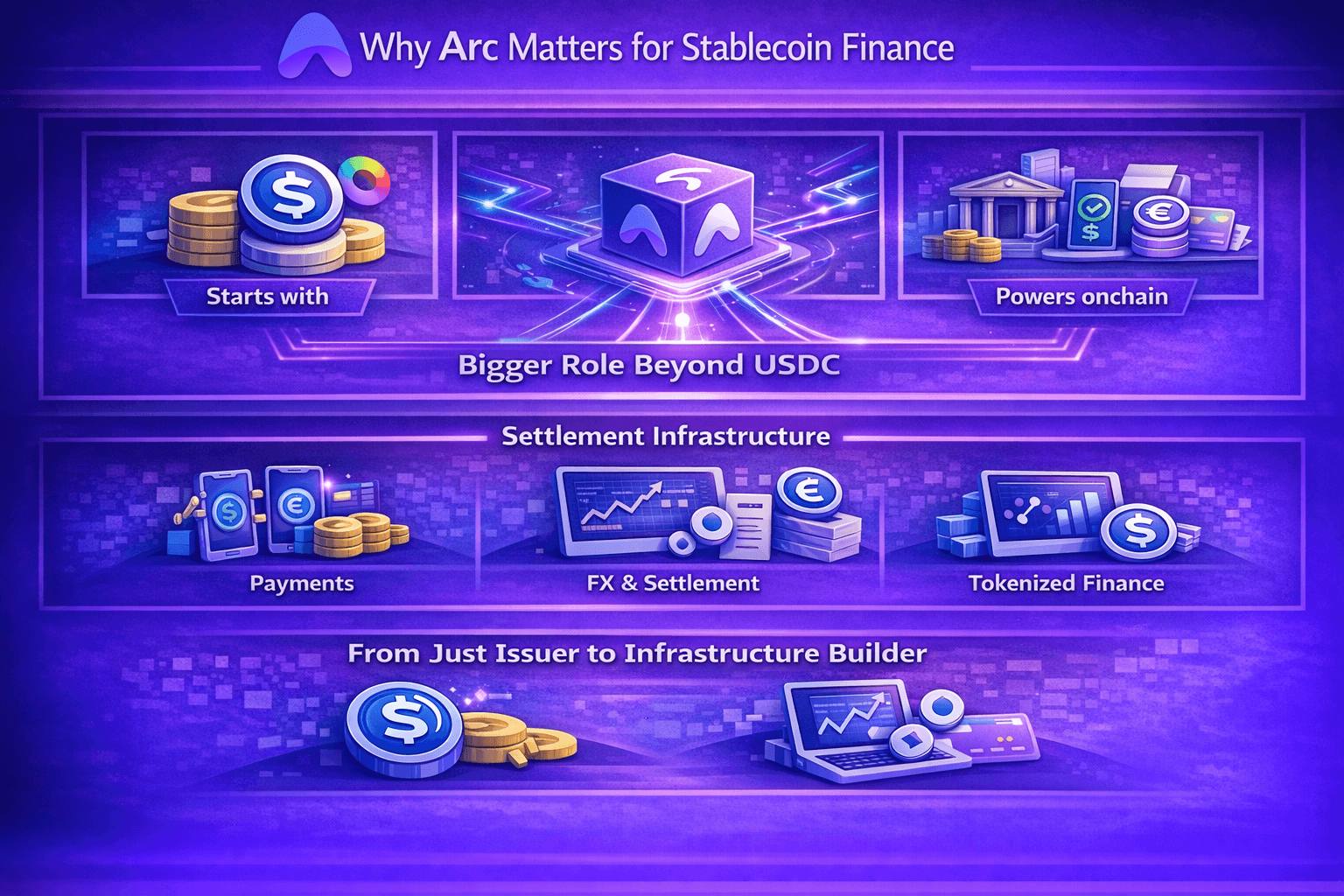 Arc matters because it Signals a Broader Shift in How Circle Wants to Participate in the Stablecoin Market
That is the key point. Arc is not just another product sitting next to USDC. It is part of a wider move into stablecoin infrastructure, where the goal is not only to provide the asset, but also more of the rails that help move, settle, and coordinate that asset across financial applications. In that sense, Arc matters because it shows Circle aiming to own more of the settlement stack rather than stopping at issuance.
There is also a broader strategic backdrop here. Circle completed its IPO in June 2025, which gave the company a stronger public-market profile at roughly the same time it was expanding its infrastructure narrative. By early 2026, Arc was already being framed as part of an internet financial system that connects digital assets, payments, and on-chain financial services more directly.
That does not mean Arc will automatically become the default settlement layer for stablecoins. But it does make Circle’s direction clearer. The company is no longer positioning itself only as a stablecoin issuer. It is increasingly presenting itself as a builder of the rails that stablecoin finance may depend on.
How to Get Started With Arc
Getting started with Arc depends on who you are. For developers, the entry point is direct. For businesses and institutions, the path is more about evaluating Arc as settlement infrastructure and working through Circle’s commercial channels. For end users, the likely experience is indirect. Let's break it down.
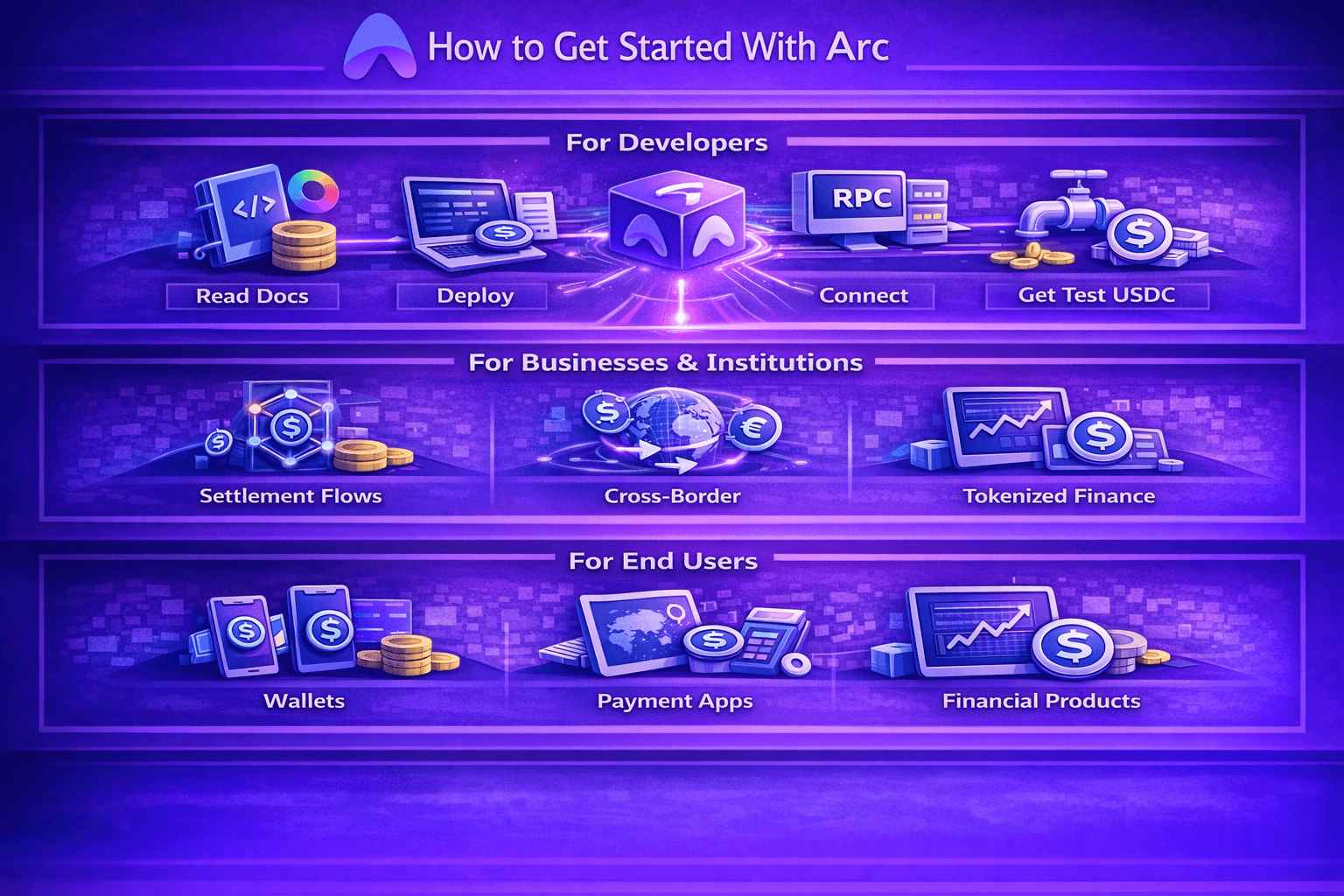 Getting Started with Arc Depends on if You are a Developer, Business, Institution, or an End User
For Developers
Arc already has the core tooling a builder would expect from a public testnet environment. The main starting points are the Arc docs, the Deploy on Arc quickstart, and the Connect to Arc page for wallet and RPC setup.
The practical setup looks like this:
- Use the quickstarts to deploy and test contracts.
- Connect to Arc Testnet through the published RPC endpoints.
- Request testnet USDC from the faucet.
- Review sample applications and reference pages.
- Inspect transactions through Arcscan or the block explorer docs.
That makes Arc fairly approachable for developers already comfortable with EVM tooling. The network details, chain ID, RPC endpoints, faucet, and explorer are all already published, so builders can move from reading docs to testing workflows without waiting for a mainnet launch.
For Businesses and Institutions
For businesses and institutions, getting started is more about assessing where Arc fits into payment, treasury, FX, or tokenized-asset workflows. The most relevant path is through Circle’s developer platform and Circle’s institutional product stack, especially where firms want to explore settlement, liquidity movement, or integration with broader Circle infrastructure.
In practical terms, Arc is best suited to firms that want to evaluate:
- Stablecoin-based settlement flows.
- Cross-border payment or payout infrastructure.
- Multichain liquidity access.
- Treasury and tokenized-finance use cases that may eventually run on Arc as production infrastructure.
For End Users
Most end users are unlikely to “get started” with Arc in the same direct way a developer would. Arc is primarily infrastructure, so the more realistic path for retail users is indirect exposure through wallets, payment apps, or financial products that choose to settle on Arc in the background.
It is important to note that Arc is not being presented as a consumer-first chain where everyday users are expected to manage every technical detail themselves. In many cases, the chain interaction may be abstracted away, with the user only seeing the end result: faster settlement, stablecoin-based transfers, or financial apps that feel smoother under the hood.

Closing Thoughts
Circle’s Arc is best understood as infrastructure rather than a finished product. Its design choices, from USDC gas to fast finality and stablecoin-focused tooling, show a clear attempt to tailor blockchain rails for payments, settlement, and programmable finance. But understanding its potential means looking past the branding and examining how it performs in practice, especially as the network develops beyond testnet.
For developers, institutions, and curious observers alike, the real opportunity lies in learning how platforms like Arc could reshape digital money workflows if they deliver on their goals. Staying informed, testing the tools, and following the underlying mechanics will matter far more than headlines. In crypto, knowledge is usually the first step toward spotting genuine utility as it emerges.