Kraken remains one of the stronger cryptocurrency exchanges for security-conscious users and active traders, but it is no longer a simple crypto-only venue. Its expansion during 2026 has turned it into a multi-asset platform spanning Kraken Pro, conventional stock trading, xStocks, perpetual futures, staking, payments and self-custody.
Kraken is best for users who value detailed account security and professional order-book trading.
This review examines Kraken's real costs, apps, fund-access policies, safety evidence and newer markets to determine where it remains competitive overall.
Editor's Note (July 22, 2026): We fully updated this Kraken review in July 2026 with revised fees, withdrawal and KYC guidance, expanded coverage of Kraken Pro, stocks, xStocks, futures, staking, wallet and Krak, and comparisons with Coinbase, Binance and Robinhood. We also strengthened the review’s analysis of security, Proof of Reserves, regional availability, custody and leverage risks.
Kraken Review 2026: Quick Verdict
Kraken has grown from a crypto spot exchange into a wider platform spanning crypto, stocks, tokenized equities, derivatives, payments and self-custody. Its security controls, fiat routes and professional trading tools are major strengths, although Instant Buy fees, regional fragmentation and increasingly complex products weaken the beginner experience.
Our take: Kraken is best suited to security-conscious investors and active traders who will use Kraken Pro, configure its account protections and verify product access before depositing. Binance is generally cheaper for spot trading, Coinbase offers a simpler beginner experience and Robinhood remains more cohesive for stock-first investors.
Scorecard
-
1Trading and Execution 4.6/5 Kraken Pro, Desktop, APIs, advanced orders, margin, RFQ, OTC and derivatives provide strong execution tools, although liquidity and slippage can vary across smaller markets.
-
2Fees and Costs 3.6/5 Kraken Pro and bank funding can reduce costs, but Instant Buy, custom orders, embedded spreads, card-processing charges and withdrawal fees can make convenient transactions expensive.
-
3Security 4.7/5 Passkeys, FIDO2 keys, funding 2FA, withdrawal allowlists, Global Settings Lock, a Master Key and device monitoring provide one of the stronger account-control packages among major exchanges.
-
4Trust and Regulation 4.4/5 Kraken combines recurring Proof of Reserves with regulated U.S. and EEA entities, but reserve attestations are not full financial audits and product protections differ by entity.
-
5Products and Features 4.8/5 Eligible users can access crypto, stocks, ETFs, xStocks, margin, futures, perpetuals, staking, Auto Earn, payments, self-custody and proprietary trading challenges.
-
6User Experience 4.1/5 The standard app is approachable and Pro offers greater control, but separate interfaces, onboarding requirements, withdrawal holds and regional restrictions add friction.
-
7Overall Score 4.4/5 Kraken is a strong security-focused and professional trading platform with broad fiat support, but higher convenience fees and region-dependent products prevent it from being the best fit for everyone.
Best For
- Security-conscious crypto investors
- Active traders using Kraken Pro, Desktop or APIs
- Users who need several fiat deposit and withdrawal routes
- Eligible investors combining crypto, stocks and advanced markets
- Users willing to verify regional product access before funding
Not Ideal For
- Beginners who want one simple interface
- Frequent Instant Buy or debit-card users
- Traders seeking the lowest entry-level spot fees
- Investors who require native multisig or offline signing
- Users who do not understand leverage, liquidation or xStocks issuer risk
Disclosure and Methodology
Some links in this article may be affiliate links. If you choose to use a service through these links, we may earn a commission at no additional cost to you.
For this Kraken review, we evaluated the platform across six main categories: trading and execution, fees and costs, security, trust and regulation, products and features, and user experience. We assessed Kraken as a custodial crypto exchange, professional trading platform and expanding multi-asset group.
This was primarily a documentation-led review. We checked official fee schedules, product terms, regulatory records, Proof of Reserves disclosures, security controls, funding methods, withdrawal policies, app interfaces and geographic eligibility.
We also weighed Kraken's main limitations, including Instant Buy spreads, payment-processing charges, withdrawal holds, custodial exposure, account-review risk, regional restrictions, leveraged-product risk and comparisons with Coinbase, Binance and Robinhood.
What Is Kraken?
Kraken has pivoted from a crypto spot exchange into a group of trading, securities, derivatives, payment and self-custody products. Users need to identify both the asset and the Kraken service holding it.
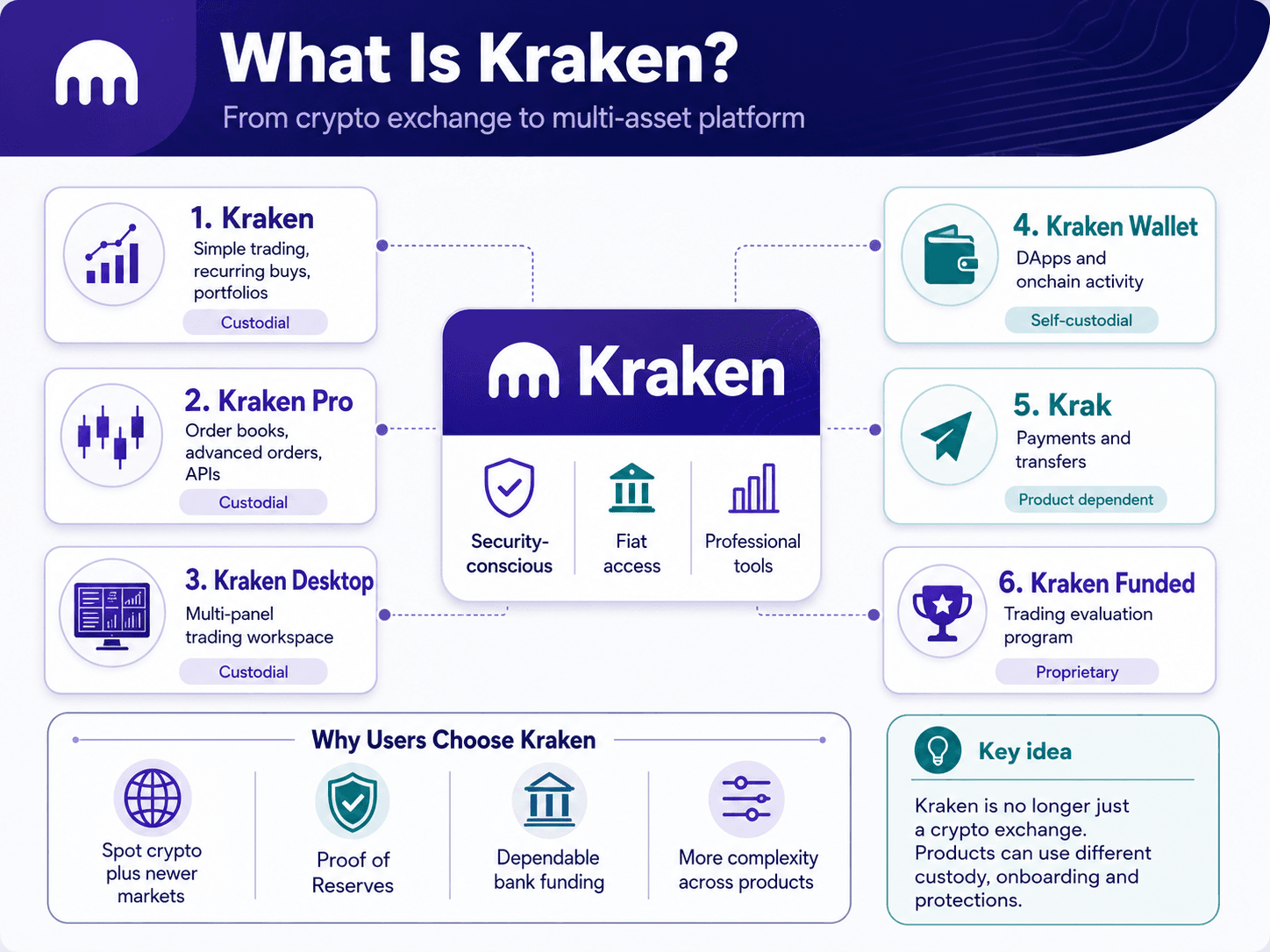 Kraken Has Grown From a Crypto Exchange Into a Broader Platform With Trading, Payments, Wallets And Professional Tools
From Crypto Exchange to Multi-Asset Platform
Kraken's core remains spot trading across crypto and fiat pairs. Kraken Pro adds order books, charts, advanced orders, margin and APIs; the standard interface emphasizes direct purchases, recurring buys and portfolios. Payward has expanded into stocks and ETFs, xStocks, margin, futures, perpetual futures, U.S. derivatives, staking, Auto Earn, payments and proprietary trading. U.S. stocks and xStocks arrived in 2025; U.S. margin and xStocks perpetuals followed in 2026.
NinjaTrader supplied U.S. futures infrastructure, Small Exchange added a CFTC-regulated market, and Breakout supported Kraken Funded. Crypto uses exchange custody, securities use a brokerage, derivatives require collateral, and Kraken Wallet gives private-key control to the user.
Kraken Products and Apps Explained
| Product | Main purpose | Custody | Best for |
|---|---|---|---|
| Kraken | Simple trading and portfolios | Custodial | Casual users |
| Kraken Pro | Order-book trading | Custodial | Active traders |
| Kraken Desktop | Professional workspaces | Custodial | Desktop traders |
| Kraken Wallet | Onchain activity | Self-custodial | DApp and DeFi users |
| Krak | Payments and transfers | Product dependent | Money transfers |
| Kraken Funded | Evaluation and funded account | Proprietary | Experienced traders |
The Kraken app and Pro normally share one login, account balance and custodial wallet, although stocks, margin and derivatives can require separate onboarding. Desktop uses the same trading infrastructure. Kraken Wallet remains separate from exchange custody, while Krak handles transfers and Kraken Funded supplies a performance account.
Kraken Fees and Real Trading Costs
Kraken can be expensive through Instant Buy, but Kraken Pro, bank funding and Kraken+ can reduce the stated fee. Total cost can include the trading fee, spread, payment charge, slippage, subscription and withdrawal fee.
Instant Buy and Custom Order Fees
The Kraken fee schedule lists a 1% fee for Instant Buy and recurring buy transactions and 1.5% for custom orders. The quoted price also includes a variable spread between the wider market rate and Kraken's execution rate.
A funded bank balance can avoid the debit-card processing charge. For USD deposits, Kraken lists a 3.75% plus $0.25 payment-processing fee. These examples combine the 1% Instant Buy fee with that card charge but exclude spread.
| Purchase | Bank-funded fee | Card charge | Card-funded total before spread |
|---|---|---|---|
| $100 | $1.00 | $4.00 | $5.00 |
| $1,000 | $10.00 | $37.75 | $47.75 |
| $10,000 | $100.00 | $375.25 | $475.25 |
A $1,000 custom order costs $15 before spread and funding charges. A weekly $100 recurring buy produces $52 in stated annual fees before those extra costs.
Stablecoin, pegged-token and FX order books use separate pricing, while Kraken’s small-balance conversion feature charges 3% on eligible amounts below the normal minimum. The visible transaction fee may be lower than the difference between the market price and final execution price.
Kraken Pro Maker and Taker Fees
Kraken Pro uses a maker-taker schedule for spot trading on an order book. A maker fee applies when an order rests and adds liquidity. A taker fee applies when a market order, or marketable limit order, executes immediately.
| Qualification | Maker | Taker |
|---|---|---|
| Entry | 0.40% | 0.80% |
| $2,500 30-day spot volume | 0.30% | 0.60% |
| $10,000 volume or $20,000 holdings | 0.22% | 0.38% |
| $25,000 volume or $50,000 holdings | 0.20% | 0.35% |
At entry tier, a $10,000 market order costs $80 before slippage, compared with $40 for a maker fill. A limit order pays taker pricing when it crosses the spread and executes immediately.
Higher 30-day trading-volume tiers reduce rates further. Stablecoin and FX books start at 0.20% maker and taker for most covered pairs. Derivatives start at 0.0200% maker and 0.0500% taker before funding, margin and liquidation costs. Access and fee treatment vary by region.
Kraken's 2026 Holding-Based Fee Tiers
Since July 9, 2026, Kraken’s cross-platform fee tiers use qualifying trading volume or Assets on Platform, whichever produces the higher fee tier. Holdings do not combine with volume and do not replace the maker-taker schedule.
Eligible holdings include fiat, cryptoassets and tokenized assets in the Kraken account, plus staking, Opt-In Rewards and Dual Investment balances. Equities and loans are excluded. The first holding-based spot discount starts at $20,000.
Kraken Pro spot volume uses a rolling 30-day window. Instant Buy, conversions and stablecoin or FX order-book trades do not build qualifying spot volume. Assets on Platform use the current USD value, not a 30-day average, so a deposit, withdrawal or market move can change the account’s fee tier immediately. Futures-volume qualification has regional limits.
Is Kraken+ Worth It?
Kraken+ costs $4.99 monthly or $49.99 annually. Kraken web currently offers annual signup, while eligible app stores may offer monthly billing.
The subscription waives eligible transaction fees on up to $10,000 of monthly Buy, Sell, Convert, custom-order and recurring volume through Kraken web or app. Spreads and card-processing fees remain. Kraken Pro, futures, API and OTC trades are excluded.
| Monthly purchases | Standard 1% fee | Kraken+ | Result before spread |
|---|---|---|---|
| $100 | $1.00 | $4.99 | Costs more |
| $500 | $5.00 | $4.99 | Rough break-even |
| $1,000 | $10.00 | $4.99 | Can save |
| $10,000 | $100.00 | $4.99 | Full allowance |
The monthly break-even point is about $499. The annual plan averages about $4.17 monthly and breaks even near $417. Both calculations exclude spreads and payment charges.
Deposit and Withdrawal Fees
Kraken’s cash deposit table and cash withdrawal table vary by currency, provider and region.
| Method | Common published charge |
|---|---|
| ACH deposit or withdrawal | $0 |
| FedWire deposit / withdrawal | $0 / $4 |
| SEPA deposit / withdrawal | Usually €0 / €0.90 to €1 |
| Faster Payments deposit / withdrawal | Usually £0 / £1.95 |
| SWIFT withdrawal | Examples include $13, €5 or £13 |
| USD debit card | 3.75% plus $0.25 |
| BTC withdrawal | Network-specific |
| ETH withdrawal | Network-specific |
| Stablecoin withdrawal | Asset and network dependent |
ACH Plaid is free but creates a seven-day withdrawal hold. Some card purchases can trigger a 72-hour hold. For BTC, ETH and stablecoins, the crypto withdrawal fee table and confirmation screen control the current charge. Bitcoin network fees, Ethereum gas conditions and stablecoin routes can change. The receiving platform must support the selected network.
The Cheapest Way to Use Kraken
| User action | Usually the better route |
| Small one-time purchase | Compare Instant Buy with Pro |
| Recurring purchase | Kraken+ may help above break-even |
| Active trading | Kraken Pro |
| Large trade | Pro limit order, RFQ or OTC |
| Card purchase | Convenient, but usually expensive |
| Crypto withdrawal | Compare supported networks first |
Kraken Trading Experience and Apps
Kraken’s interfaces serve different users. The standard app favors convenience, Pro favors execution control, desktop supports multi-panel workflows, wallet handles self-custody and Krak focuses on payments.
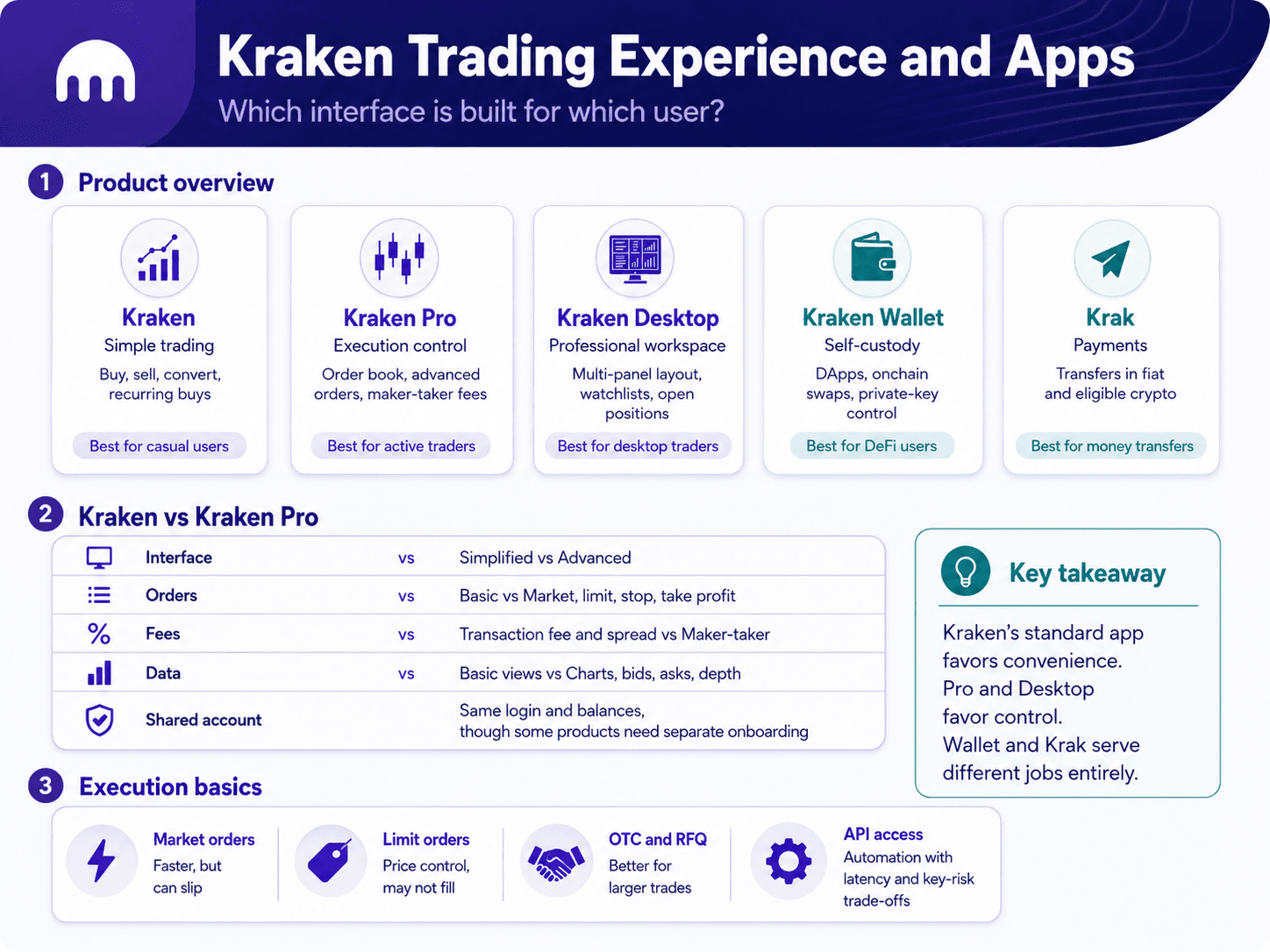 Kraken Offers Separate Interfaces For Casual Buyers, Active Traders, Desktop Workflows, Self-Custody And Fast Payment Transfers
Kraken vs Kraken Pro
| Feature | Kraken | Kraken Pro |
|---|---|---|
| Interface | Simplified | Advanced |
| Orders | Buy, sell, convert, recurring buy | Market, limit, stop loss, take profit, conditional |
| Fees | Transaction fee, spread, payment charge | Maker-taker |
| Data | Basic views | Charts, bids, asks and depth |
| Best fit | Casual buyer | Active trader |
Both interfaces normally share login credentials and custodial balances, although margin, futures and stocks can require separate onboarding. Kraken provides quoted transactions and recurring buys; Pro exposes the order book and advanced orders. A limit order receives maker pricing only when it rests on the book.
Kraken Desktop
Kraken Desktop is a Windows, macOS and Linux trading terminal with a trading chart, watchlist, order book and open positions across more than 800 crypto markets. Multi-panel and keyboard workflows suit professional traders, but latency, slippage and outages still apply; occasional users may prefer Pro web.
Kraken Wallet and Krak
Kraken Wallet is self-custodial, so the user controls the private key and recovery phrase. It supports DApps, each onchain transaction and onchain swaps, but a lost phrase, malicious approval or authorized phishing transfer can cause permanent loss. Krak handles each payment transfer rather than trading. Its supported currencies include USD, EUR, GBP, CAD, CHF and AUD plus eligible cryptoassets; transfers can remain internal, use a blockchain or reach a bank.
Liquidity, Order Types and Execution
Major Bitcoin, Ethereum and stablecoin pairs generally have a tighter bid-ask spread and greater order book depth than small altcoin markets. Market orders prioritize speed and can slip, limit orders control price but may remain unfilled, and stop or conditional orders can execute away from their trigger. Large trades can use RFQ or Kraken’s OTC desk. API users gain automation but accept key-permission, rate-limit, latency and strategy risk. No live execution test was completed, so traders should inspect current spreads and depth before a large order.
Crypto, Stocks, xStocks and Advanced Markets
Kraken offers spot crypto, conventional securities, tokenized equities and leveraged contracts. Ownership, custody, market hours and protection differ across them.
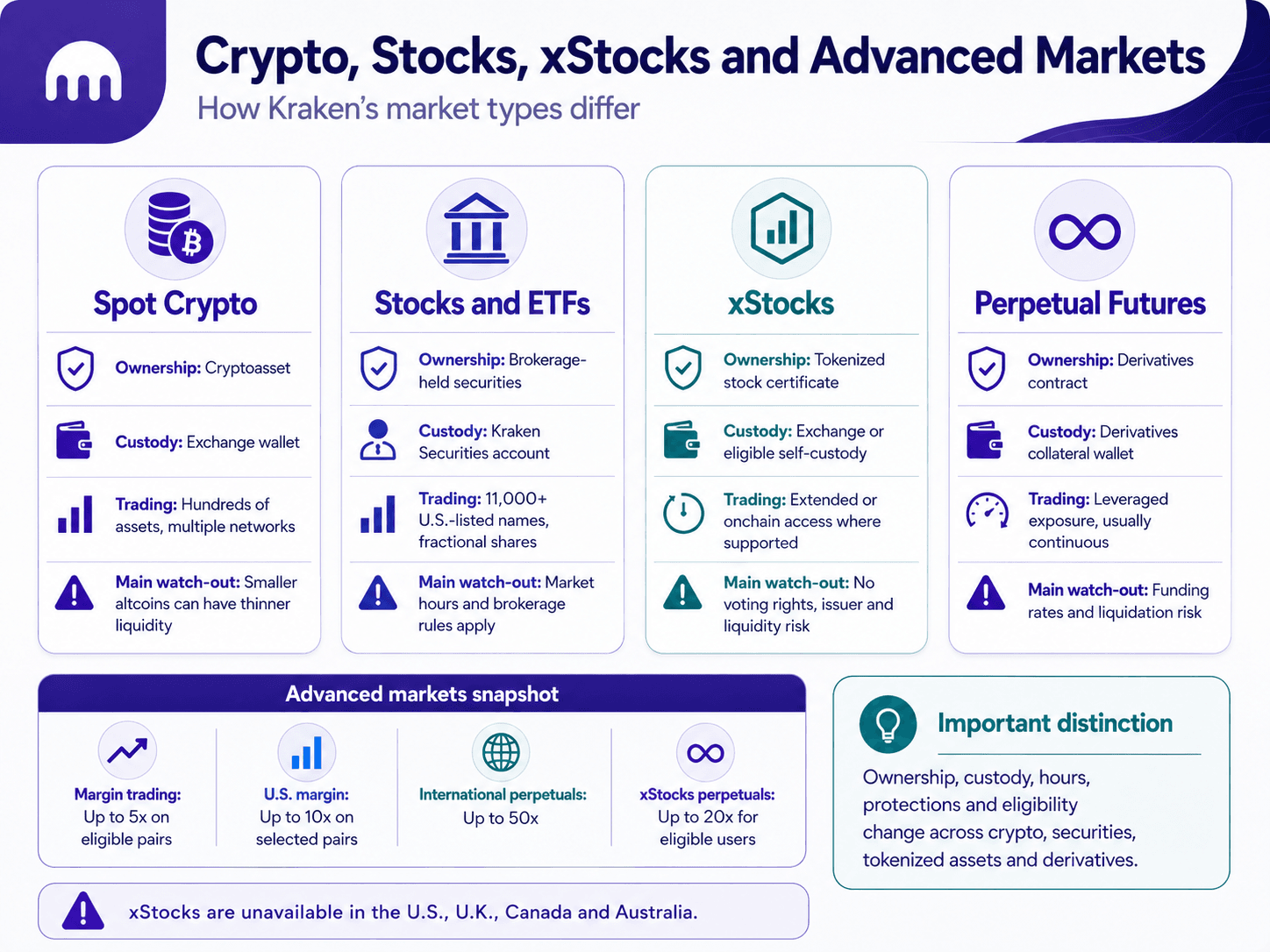 Kraken’s Markets Span Spot Crypto, Brokerage Stocks, Tokenized xStocks And Leveraged Derivatives With Different Risks
Spot Crypto Trading
Kraken supports hundreds of cryptoassets across Bitcoin, Ethereum, stablecoins and altcoins, with each spot market and trading pair denominated in an eligible fiat currency or cryptoasset. Check the asset and blockchain network list before funding because trading support does not guarantee every blockchain route.
Major pairs usually have tighter spreads and deeper liquidity than small altcoin markets. A crypto deposit remains pending until required confirmations arrive, and assets such as ETH, USDC and USDT support several networks. Token data can change quickly. Prices, supply, volume, TVL and market cap are time-sensitive.
Conventional Stocks and ETFs
Kraken’s stock documentation lists more than 11,000 U.S.-listed stocks and exchange-traded fund products, including fractional shares, for eligible U.S. customers outside Maine and New York and eligible residents of Germany, the Netherlands and France. Kraken charges no brokerage commission, although regulatory, spread and transfer charges may apply.
Customers become beneficial owners through a brokerage account at Kraken Securities LLC, a FINRA and SIPC member, while stock and crypto balances can appear in one interface. Regular U.S. hours are 9:30 a.m. to 4:00 p.m. Eastern Time; unsupported outside-hours orders queue for the next session. Securities custody supports ACATS transfers for full shares, but fractional shares cannot. SIPC can protect missing securities up to $500,000, including $250,000 for cash, after brokerage failure, but not market losses, crypto or xStocks.
What Are Kraken xStocks?
Kraken's xStocks FAQ describes tokenized stocks and tracker certificates issued by Backed Assets (JE) Limited and intended to be backed 1:1 by corresponding U.S. securities. Holders receive no shareholder voting rights and depend on the issuer, custodians and market makers. Selected xStocks trade beyond U.S. market hours and can move to self-custody on Solana, Ethereum, TON or Ink where supported.
Dividend value is generally passed through by token rebasing after deductions, while prices can diverge from the underlying share when liquidity is thin or markets are closed. Direct issuance or redemption generally requires KYC and a $5,000 minimum. Issuer, custodian, smart-contract, blockchain, liquidity and redemption risks remain. xStocks is unavailable in the U.S., U.K., Canada and Australia.
Stocks vs xStocks vs Perpetual Futures
| Feature | Stocks | xStocks | Perpetual futures |
|---|---|---|---|
| Ownership | Stock ownership | Tokenized security certificate | Perpetual futures contract |
| Custody | Brokerage | Exchange or self-custody | Derivatives wallet |
| Hours | Market sessions | Extended or onchain | Usually continuous |
| Voting rights | Generally available | None | None |
| Dividends | Cash or credit | Token rebasing | Price and funding |
| Funding/collateral | Fully paid unless margined | Issuer backing | Collateral plus funding rate |
| Geographic access | Eligible U.S./EEA users | Eligible non-restricted users | Contract and region dependent |
| Leverage | With margin | None for spot xStocks | Yes |
| Liquidation | With margin | No when unleveraged | Yes |
| Counterparty | Broker and custodian | Issuer, custodian, platform | Exchange and clearing |
| Protection | Securities regulation; possible SIPC | Limited | Derivatives rules vary |
| Onchain withdrawal | No | Yes | No |
Margin, Futures and U.S. Perpetuals
Traditional margin trading offers up to 5x leverage on eligible pairs, with trading, opening and rollover charges. U.S. margin uses a separate structure and can offer up to 10x on selected pairs, subject to suitability, collateral and limits. A traditional futures contract may expire and requires initial margin. International perpetual futures have no expiry, exchange funding payments and can offer up to 50x leverage.
EEA derivatives use separate permissions and often lower limits; U.S. futures and perpetuals require separate CFTC-regulated and NFA-member onboarding. xStocks perpetual futures offer eligible international users up to 20x leverage without ownership of the share or token. Collateral haircuts, funding rates, maintenance margin, maintenance windows, oracle failures and liquidation prices affect leveraged positions. Negative-balance controls differ by entity, and stablecoin depegging or falling crypto collateral can weaken margin.
Kraken Funded
Kraken Funded is a mobile-only proprietary trading evaluation challenge, not standard exchange trading. Participants pay $20 for a $1,000 challenge, $50 for $5,000 or $90 for $10,000, face a 12% profit target, and fail after a 5% maximum drawdown. Successful participants can receive an 80% payout on eligible profits while trading program capital across more than 50 cryptoassets.
The fee is non-refundable, the funded balance is not the participant’s property, and Payward Oceanic Ltd. operates outside the regulated exchange relationship. Users prone to repurchasing challenges or chasing losses should avoid it.
Kraken Staking and Rewards
Kraken offers flexible staking, bonded staking and Auto Earn for eligible users. Returns vary with network issuance, validator performance, commission and regional access.
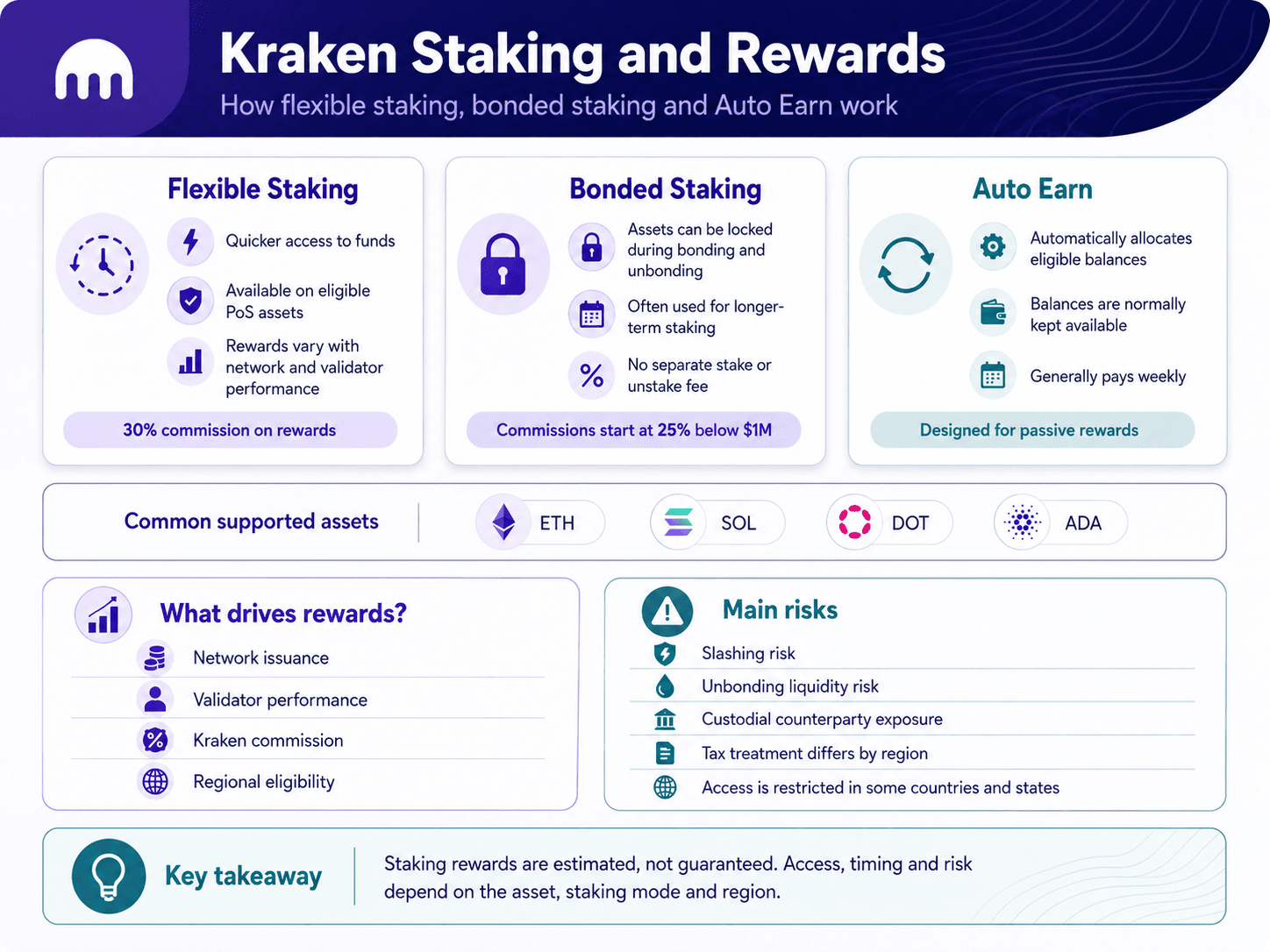 Flexible Staking, Bonded Options And Auto Earn Give Eligible Users Multiple Ways to Pursue Yield
Onchain Staking and Auto Earn
Kraken supports proof of stake assets including Ethereum, Solana, Polkadot and Cardano. Flexible staking is designed for quicker access, while bonded staking can block trading and withdrawals during bonding and unbonding. The staking overview lists a 30% commission on rewards for Flexible Staking and Auto Earn.
Bonded staking commissions begin at 25% below $1 million and decline at higher balance tiers; there is no separate stake or unstake transaction fee. Auto Earn allocates eligible balances automatically, normally keeps them available, and generally pays weekly. Each annual percentage yield and staking reward is an estimate, not a guaranteed return.
Staking Risks and Regional Restrictions
Slashing and validator risk can reduce rewards or principal, and an unbonding period creates liquidity risk during market declines. Custodial staking adds Kraken counterparty exposure; self-staking avoids Kraken’s commission but requires private-key security, validator selection and protocol knowledge. Staking tax treatment also varies.
The rewards eligibility guide states that U.S. users cannot access Opt-In Rewards and that staking is limited by state and asset. EEA, U.K., Canadian and Australian customers can face separate restrictions, so eligibility should be confirmed before staking ETH, SOL, DOT, ADA or another asset.
Is Kraken Safe?
Kraken has strong security controls, but no custodial exchange is risk-free. Technical security, reserve evidence, fund access and product risk require separate assessment.
Platform Security and Incident History
Kraken reports cold storage, operational hot wallets, encryption, restricted access, a bug bounty and vulnerability disclosure. Its security disclosures list ISO 27001, formally ISO/IEC 27001:2022, certification and a SOC 2 Type 1 examination for the retail platform. Institutional custody separately completed a SOC 2 Type 2 examination; that scope does not cover every retail product, and Kraken does not publish a platform-wide SOC 1 Type 2 claim.
In June 2024, CertiK researchers exploited a deposit-crediting flaw and withdrew almost $3 million from Kraken’s treasury. Kraken fixed it and said customer funds were unaffected; the funds were later returned.
Kraken Proof of Reserves
Kraken’s Proof of Reserves uses a Merkle tree and Merkle root so users can verify inclusion in customer liabilities. Proof of reserves is a point-in-time attestation, not a full financial audit. It does not disclose every liability, loan, affiliate exposure, claim or encumbrance, and it cannot prove continuing solvency or exclusive wallet ownership after the snapshot.
Account Security Controls
Passkeys and FIDO2 keys provide phishing-resistant login, while login two-factor authentication and funding 2FA protect access and transfers. Withdrawal allowlists limit destinations; Global Settings Lock freezes sensitive changes; a Master Key protects settings and account recovery; device monitoring identifies unfamiliar sessions. These controls work best when email, recovery and security credentials remain separate. They cannot stop a user from approving a malicious transfer or DApp permission.
What Kraken Cannot Protect Users From
Kraken cannot reverse a user-approved phishing attack transfer or prevent every account takeover, recover exposed self-custody phrases or eliminate leverage risk, token failure or issuer risk, xStocks counterparty risk, stablecoin depegging, bridge or smart-contract exploits, oracle errors or governance failures. Compliance reviews can restrict withdrawals without a cyberattack, and custodial risk or insolvency remains possible outside Proof of Reserves.
Our analysis of whether Kraken is safe provides more context.
KYC, Withdrawals and Customer Support
Kraken's technical security does not guarantee immediate access to every balance. KYC, bank settlement, recovery, blockchain confirmations and compliance checks can delay withdrawals.
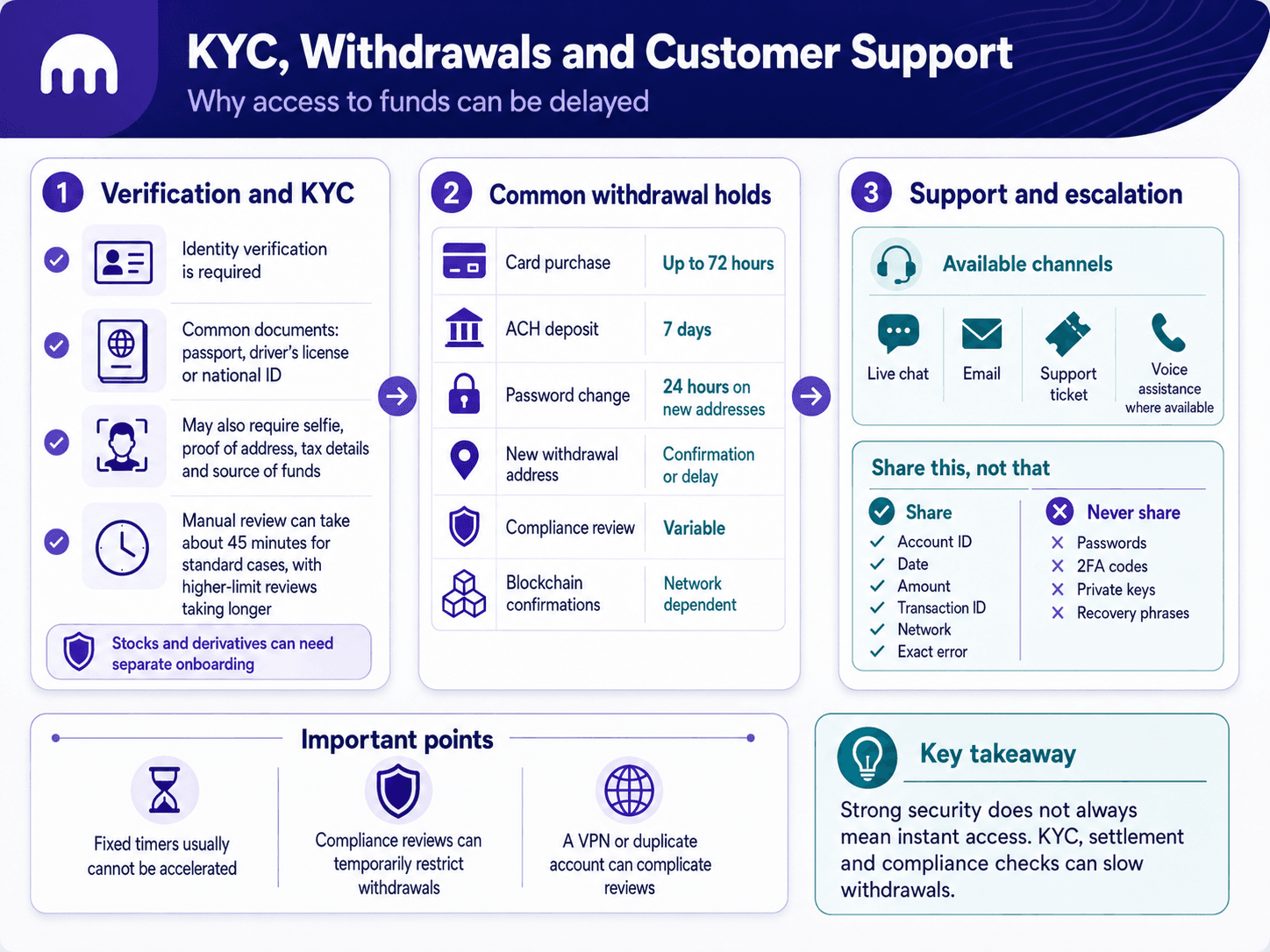 Verification, Settlement Delays And Support Processes Can Slow Fund Access Even on a Security-Focused Platform
Kraken Verification and KYC
Kraken requires Know Your Customer, Anti-Money Laundering and identity verification before most users can fund and trade. Documents can include a passport, driver’s license or national identity card, tax and residence details, a selfie or liveness check, and proof of address dated within three months.
Automated reviews may finish quickly, while Kraken estimates about 45 minutes for a manual Standard review and several days for higher-limit or business cases. Source of funds requests can include bank statements, payslips, tax records or transaction histories, and periodic re-verification may follow account or regulatory changes. Timelines are not guarantees; stocks and derivatives require separate onboarding.
Why Kraken Places Withdrawals on Hold
| Situation | Cause | Restriction | Trading? | User action | Cannot accelerate |
|---|---|---|---|---|---|
| Card purchase | Chargeback risk | Up to 72 hours | Usually | Wait | Fixed timer |
| ACH deposit | Reversal risk | Seven days | Usually | Use settled funds | Settlement |
| New withdrawal address | Security hold | Confirmation or delay | Often | Confirm settings | Active timer |
| Password change | Takeover protection | 24 hours on new addresses | Often | Use existing address | Fixed timer |
| Recovery | Identity review | Funding restricted | Varies | Provide documents | Manual review |
| Compliance review | AML or sanctions | Account restrictions | Varies | Respond to case | Regulatory review |
| Blockchain delay | Few confirmations | Deposit pending | Sometimes | Check transaction ID | Network timing |
| Bank reversal | Unsettled payment | Value held | Often | Contact bank | Bank review |
Kraken’s withdrawal-hold policy confirms the 72-hour card hold, seven-day ACH Plaid hold and 24-hour restriction after a password change. Fixed timers cannot be accelerated.
Account Restrictions and Closures
An account restriction pauses selected actions during review; an account closure ends the relationship. Kraken may request supporting documents for identity, residence or source of funds without disclosing fraud or sanctions criteria. A withdrawal request can generally return remaining fiat to a linked same-name bank account, subject to manual review and law; crypto may require conversion. A VPN can complicate checks when location conflicts with residence or a restricted jurisdiction. Opening a duplicate account to bypass restrictions can prolong the review.
Support Channels and Escalation
Kraken Support provides live chat, email, a support ticket and voice assistance where available. Include the public account ID, date, amount, funding method, transaction ID, network and exact error, but never passwords, 2FA codes, private keys or recovery phrases. Unauthorized-access cases should use Kraken’s security escalation route. Unresolved matters can move through Kraken’s complaint procedure and then the relevant regulator or ombudsman. Trustpilot, App Store, Google Play and Reddit complaints commonly involve verification, withdrawals, fee clarity, closures, app reliability and response times, but show sentiment rather than universal outcomes.
Kraken Regulation and Availability
Kraken uses several legal entities and licenses. General access does not guarantee every product, asset or funding route.
Kraken in the United States
Kraken is unavailable in Maine and New York. Payward Interactive Inc. is registered with FinCEN as a money services business and uses a state money transmitter license or equivalent where required. Securities brokerage requires separate onboarding through Kraken Securities LLC, an SEC-registered broker-dealer and FINRA and SIPC member. Staking varies by state and asset, margin requires eligibility, and U.S. users cannot access spot xStocks or Opt-In Rewards. Futures and U.S. perpetuals require separate CFTC-regulated and NFA-member onboarding.
Kraken in the European Economic Area
Payward Europe Solutions Ltd. holds Markets in Crypto-Assets Regulation (MiCA) authorization as a cryptoasset service provider under the Central Bank of Ireland, with an EEA regulatory passport. The onboarding entity governs custody, transfers and complaints. MiCA does not automatically cover stocks, tokenized securities or derivatives. Stocks currently serve eligible residents of Germany, the Netherlands and France; xStocks and derivatives use separate assessments, entities and limits.
United Kingdom, Canada and Australia
| Region | Regulator | Fiat rails | Derivatives | Staking | Stocks/xStocks | Complaints |
|---|---|---|---|---|---|---|
| U.K. | Financial Conduct Authority (FCA); EMI permissions | Faster Payments, SWIFT | Retail unavailable | Varies; no Opt-In Rewards | Unavailable | Kraken, then eligible ombudsman/regulator |
| Canada | FINTRAC; Ontario Securities Commission and provincial oversight | Bank, Interac | Retail unavailable | Limits apply | Unavailable | Kraken, then provincial authority |
| Australia | AUSTRAC; ASIC derivatives entity | Bank, PayID, Osko | Mainly wholesale clients | No Opt-In Rewards | Unavailable | Kraken, then AFCA/regulator |
Registration does not insure crypto.
Check Product Availability, Not Just Kraken Availability
| Product | Main test |
|---|---|
| Spot crypto | Residence, entity, asset and network |
| Staking | Country, state, asset and program |
| Stocks | Eligible U.S. and selected EEA users |
| xStocks | Eligible non-restricted regions |
| Margin | Residence, pair and suitability |
| Futures | Separate derivatives onboarding |
| Perpetual futures | Domestic, EEA or international structure |
| Kraken+ | Billing region and account |
| Kraken Funded | Account offer and jurisdiction |
Residency, legal entity, product eligibility, state restriction and classifications such as accredited investor or professional client control access. A restricted country can override them. Check Kraken’s geographic eligibility page before registration, travel or relocation.
Kraken vs Coinbase, Binance and Robinhood
Kraken competes with exchanges and stock-first brokers. Coinbase challenges it on usability, Binance on price and liquidity, and Robinhood on brokerage simplicity.
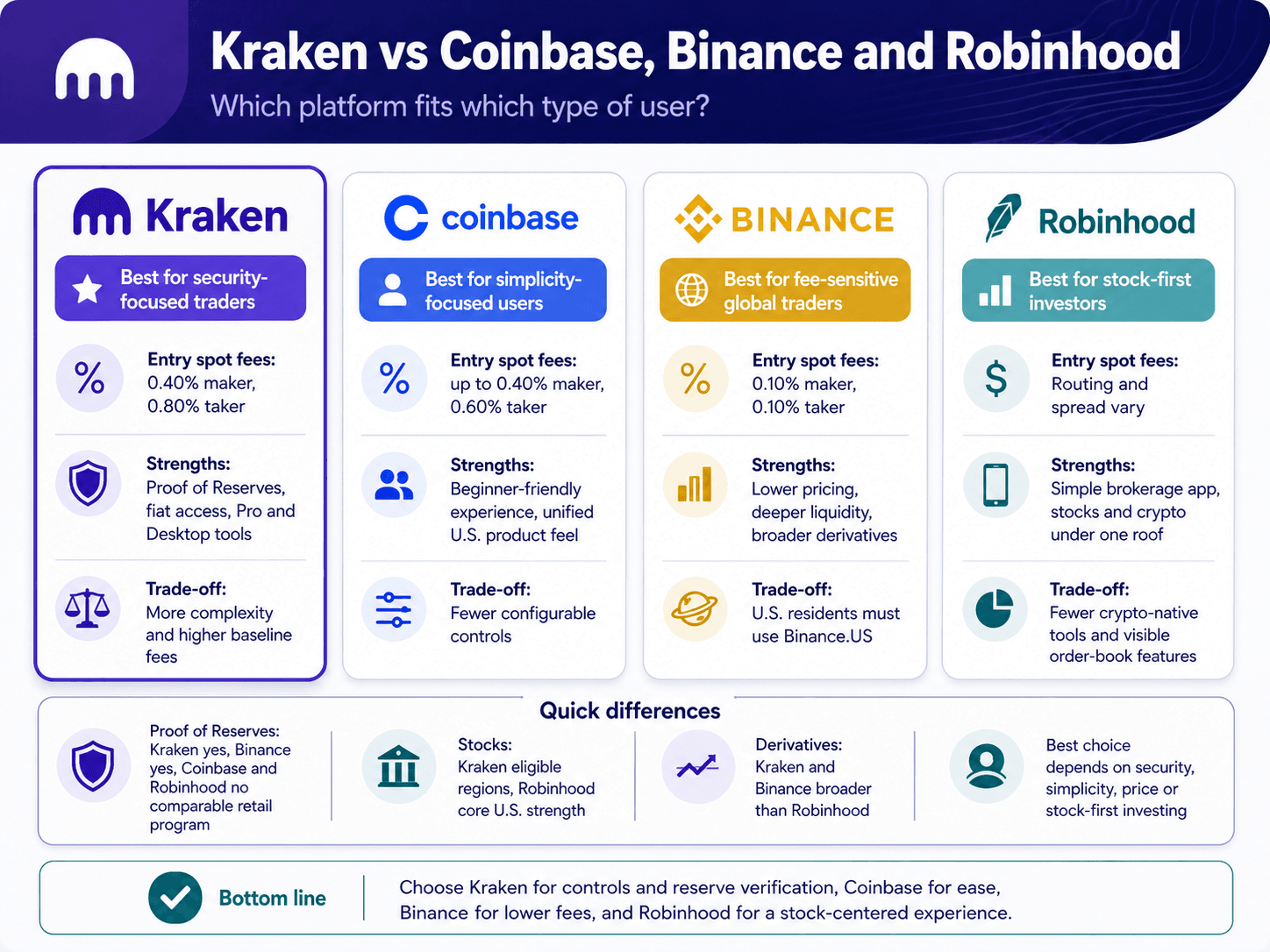 Kraken Leads on Controls And Reserve Verification, While Rivals Win on Simplicity, Lower Fees or Stocks
| Feature | Kraken | Coinbase | Binance | Robinhood |
|---|---|---|---|---|
| Entry spot fees | 0.40% maker, 0.80% taker | Up to 0.40% maker, 0.60% taker | 0.10% maker and taker | Tiered routing where enabled |
| Simple purchase | 1% or 1.5% plus spread/processing | Variable fee and spread | Region dependent | Routing and spread vary |
| Advanced trading | Pro, Desktop, API, OTC | Coinbase Advanced | Broad global suite | Legend, ladder and API |
| Stocks | Eligible U.S. and selected EEA users | Region dependent | No standard global brokerage | Core U.S. product |
| Tokenized equities | xStocks in eligible regions | Region dependent | Region dependent | International products vary |
| Derivatives | U.S., EEA and international | U.S. and international | Broad globally | Selected U.S. products |
| Staking | Eligible regions | Eligible regions | Broad international range | Selected assets |
| Proof of Reserves | User-verifiable | No equivalent retail Merkle program | Merkle disclosures | No comparable program |
| U.S. availability | Most states; product limits | Broad | Binance.US is separate | Broad |
| Best fit | Security-focused trader | Simplicity-focused user | Fee-sensitive global trader | Stock-first investor |
Kraken vs Coinbase
Coinbase offers a more unified beginner experience; Kraken divides activity across its standard app, Pro and Desktop. Kraken provides more configurable controls and recurring Proof of Reserves, while Coinbase has a unified U.S.-regulated product experience; both are expanding beyond crypto. Coinbase Advanced also has a lower entry taker rate. Choose Kraken if reserve verification, controls and desktop trading are priorities. Choose Coinbase if simplicity and the lower entry taker fee matter more.
Read our full Coinbase review and our Kraken vs Coinbase comparison.
Kraken vs Binance
Binance charges 0.10% maker and 0.10% taker on its standard global spot tier, with an eligible BNB discount. It generally offers deeper liquidity and broader derivatives; Kraken has stronger integration with several Western banking systems and clearer U.S. and EEA product separation. U.S. residents must use Binance.US rather than the global platform. Both publish Proof of Reserves, while Binance also maintains SAFU; neither is deposit insurance. Choose Kraken if fiat access and controls justify higher fees. Choose Binance if lower pricing and derivatives breadth are priorities.
Read our Binance review.
Kraken vs Robinhood
Robinhood crypto uses broker routing inside a stock-first platform; Kraken is an order-book exchange with more blockchain routes, staking, xStocks and international derivatives. Robinhood offers a more cohesive conventional-investing experience. Choose Kraken if crypto withdrawals and visible order books are central. Choose Robinhood if stocks and simplicity dominate.
Our Coinbase vs Robinhood comparison explains both models
Who Should Use Kraken?
Kraken works best for users who configure security, choose the right interface and confirm eligibility before depositing. Instant Buy users and those expecting identical products receive less value.
Choose Kraken If
- You are an active trader who needs limit orders, stop-loss orders, take-profit orders, APIs and customizable multi-panel workspaces.
- You are eligible to access crypto and conventional markets through the same brand.
- You need several fiat funding routes, including ACH, FedWire, SEPA, Faster Payments and SWIFT.
- You are willing to use Kraken Pro to access lower trading fees.
- You are prepared to confirm regional product availability before depositing funds.
Consider an Alternative If
- You are a beginner who wants one simple interface.
- You are searching for the lowest possible spot trading fees.
- You require native multisig, offline transaction signing or complete control of your private keys.
- You do not fully understand xStocks issuer exposure, funding rates or liquidation risk.
- You plan to use tokenized equities or leverage without understanding how those products work.
How to Start Safely
- Confirm regional product availability.
- Complete account verification before a large deposit.
- Enable a passkey or FIDO2 key, funding 2FA and a withdrawal allowlist.
- Use Kraken Pro when it is cheaper.
- Complete a small test withdrawal first.

Final Verdict
Kraken remains strong for security-conscious users and active traders. Its controls, fiat routes, Proof of Reserves and Pro infrastructure stand out, while newer products increase complexity. As a crypto exchange, Kraken is strong despite higher entry fees. As a professional trading platform, Pro, Desktop, APIs, margin, RFQ, OTC and derivatives are strong. As a multi-asset platform, it is promising but region dependent.
As a beginner app, it is good but rarely cheapest because Instant Buy includes a fee and spread. Kraken is worth using when security, fiat access and professional tools outweigh complexity. Confirm eligibility, verify early, use Pro when cheaper and self-custody long-term holdings.