The top Solana projects in 2026 are Jupiter, Kamino, Drift, Raydium, Phantom, Jito, Pyth, Pump.fun, Helium, and Tensor or Mad Lads, depending on what you want to do on Solana.
In this guide, “top Solana projects” means the most important Solana-native products across apps, wallets, infrastructure, DePIN, staking, and NFTs, not just the loudest tokens. We ranked them using real usage, security and resilience, ecosystem importance, product moat, and staying power, and we reviewed the key metrics and sources.
Editor’s Note (March 19, 2026): We fully updated this guide in March 2026 to better reflect to reflect where real activity on Solana is happening now. The refresh narrows the focus to the most important Solana-native projects across DeFi, wallets, staking, infrastructure, NFTs, DePIN, and newer high-momentum apps, while adding a cleaner ranking system, updated onboarding guidance, and a stronger emphasis on real usage, risk, and long-term relevance over short-lived narrative spikes.
Top-10 Solana Projects Ranked
-
1
Jupiter
Best overall Solana trading and routing project.
-
2
Kamino Finance
Best Solana lending and yield hub.
-
3
Drift Protocol
Best Solana perps and advanced trading venue.
-
4
Raydium
Best all-round Solana DEX and liquidity hub.
-
5
Phantom
Best Solana wallet for most users.
-
6
Jito
Best Solana staking project for liquid staking exposure.
-
7
Pyth Network
Best Solana infrastructure project and oracle layer.
-
8
Pump.fun
Best Solana launchpad and memecoin creation platform.
-
9
Helium
Best Solana DePIN project.
-
10
Tensor or Mad Lads
Best NFT ecosystem exposure (Tensor for marketplace activity; Mad Lads for blue-chip collection exposure).
Best Solana Projects by Use Case
Best DeFi project: Jupiter.
Best staking project: Jito.
Best infrastructure project: Pyth.
Best NFT marketplace: Tensor.
Best NFT collection: Mad Lads.
Best launchpad: Pump.fun.
Best DePIN project: Helium.
Best beginner-friendly project: Raydium or Phantom.
Why These Are the Top Solana Projects
“Top” means more than hype. Solana moves fast, and it is easy to mistake a short burst of attention for a durable advantage. The projects in this guide matter because they sit on core rails of the ecosystem. They route liquidity, custody users, secure the network, provide essential data, or connect Solana to real-world utility.
Selection is based on:
- Real usage: Sustained activity, not one-week spikes.
- Category leadership: Clear positioning in a major Solana niche.
- Ecosystem importance: Solana would feel meaningfully worse without it.
- Resilience and security: Battle-tested through volatility and stress.
- Likelihood of still mattering in 12 months: Moats that do not rely only on incentives.
How We Ranked Them
We used a condensed scoring framework that weighs:
- Adoption and usage
- Security and resilience
- Product moat
- Token and incentive sustainability
- Developer activity
- User experience
Full methodology appears near the end of this guide.
Top Solana Projects by Category
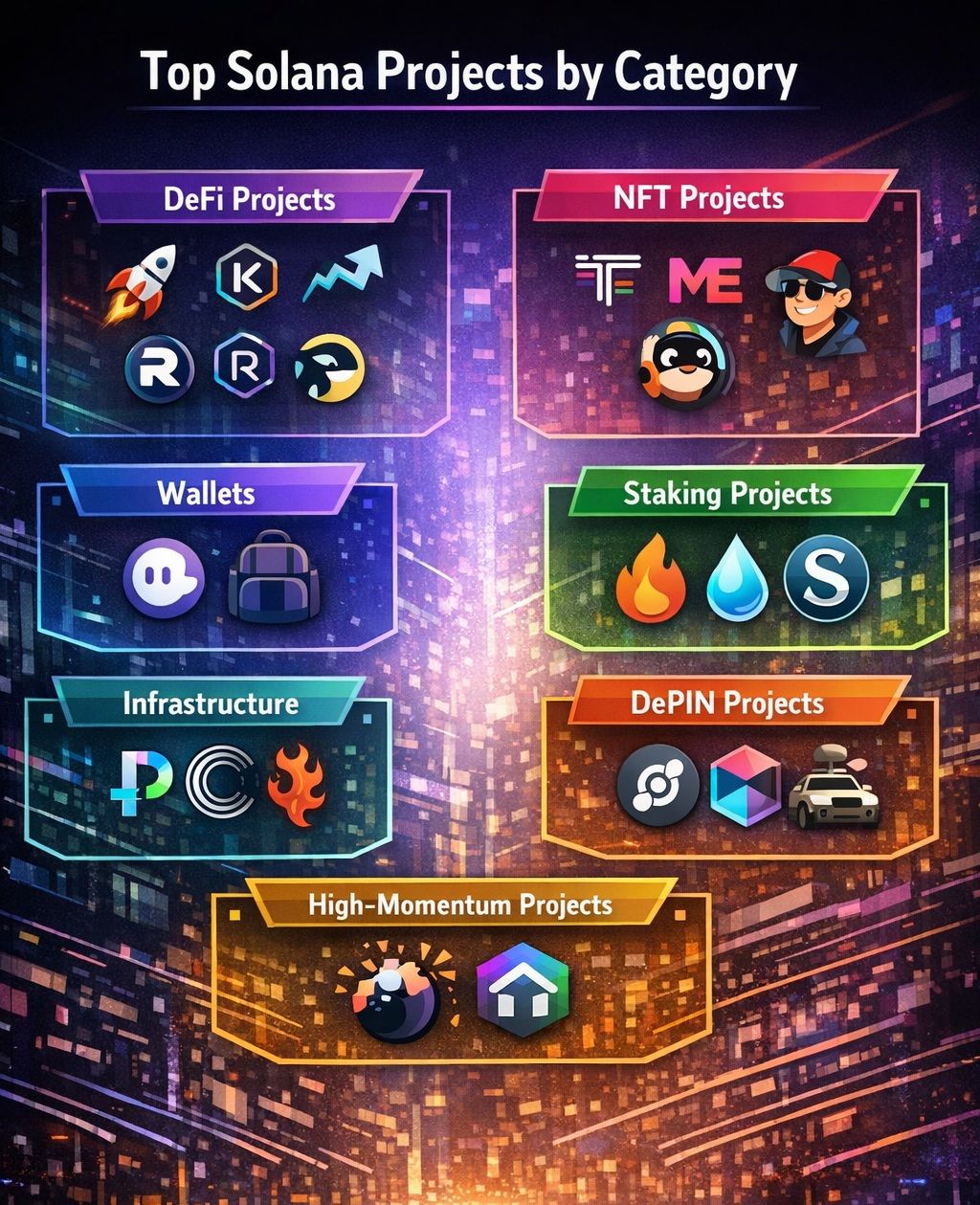
A Visual Snapshot of the Major Solana Project Categories, From DeFi and NFTs to Infrastructure and DePIN
Best Solana DeFi Projects
- Jupiter
- Kamino
- Drift
- Raydium
- Orca
DeFi remains one of Solana’s strongest categories because low fees and fast confirmations make active trading and position management feel closer to a normal app. That also increases the importance of routing, liquidity venues, and solid risk controls.
For a deeper venue-by-venue breakdown, see our guide to the best Solana DEX platforms.
Best Solana NFT Projects
Marketplaces matter for liquidity. Collections matter for culture and community, and on Solana, that culture can drive where attention and trading activity concentrates.
If you are newer to the category, our complete guide to NFTs gives the bigger picture.
Best Solana Wallet Projects
Wallets are the front door. They are also the permissions layer. Your wallet decides what you sign, what warnings you see, and how easily you can tell a safe transaction from a malicious one.
If you want a full wallet breakdown, see our guide to the top Solana wallets.
Best Solana Staking Projects
Liquid staking is a big deal on Solana because it makes staking reusable. Instead of locking SOL and waiting, you stake and receive a “receipt token” you can still use across DeFi.
If you want the concept explained in plain English first, our guide to liquid staking is a helpful primer.
Best Solana Infrastructure Projects
- Pyth Network
- Wormhole
- Firedancer (ecosystem context)
Infrastructure is the stuff most users never think about until it fails. Oracles, messaging layers, and performance upgrades are the plumbing that keeps the app layer working.
Best Solana DePIN Projects
DePIN stands for decentralized physical infrastructure networks. In plain English: networks that reward people for contributing real-world resources like connectivity, compute power, or mapping coverage.
And if you want the full angle, see our guide to the top DePIN crypto projects.
Best Newer or High-Momentum Solana Projects
Momentum does not equal quality. But it can reveal where users are spending time, and what kinds of apps the chain’s performance makes possible. This bucket tends to carry higher risk.
Readers looking specifically at launchpad-driven speculation should also read our guide on how to buy Solana memecoins.
Top Solana Project Reviews
Click any project card to expand it.
Jupiter
Best for: overall Solana trading and routing.
⌄
Toggle Jupiter details
What it does
Jupiter routes swaps across Solana liquidity venues to find efficient execution, acting like a route finder for on-chain trading.
Why it matters
Solana liquidity is fragmented across venues, so aggregation helps users swap without hopping between apps.
Best for
Most users who want a simple way to swap tokens with competitive routing.
Key strengths
- Broad routing coverage across major liquidity venues.
- Execution-focused product design.
- High ecosystem gravity for spot activity.
Main risks
- Smart contract and integration risk.
- Front-end impersonation and phishing risk.
- Overtrading risk in volatile markets.
Kamino Finance
Best for: Solana lending and yield hub.
⌄
Toggle Kamino Finance details
What it does
Kamino combines lending markets with structured yield workflows, supporting borrowing, leverage, and strategy automation.
Why it matters
Lending is a foundational DeFi primitive. Large lending venues can become systemic because many strategies depend on them.
Best for
Users comfortable with collateral, variable rates, and liquidation mechanics.
Key strengths
- Strong position in Solana lending activity.
- Product suite that reduces strategy “app-hopping.”
- Clear integration into broader DeFi workflows.
Main risks
- Liquidation risk from volatile collateral.
- Oracle dependency and liquidation engine risk.
- Complexity risk for newer users.
Drift Protocol
Best for: Solana perps and advanced trading.
⌄
Toggle Drift Protocol details
What it does
Drift provides perpetual futures and margin trading on Solana, enabling leverage and hedging on-chain.
Why it matters
Perps concentrate activity. A major perps venue influences liquidity, oracle usage, and risk dynamics across the ecosystem.
Best for
Experienced traders who understand liquidation, funding, and position sizing.
Key strengths
- Clear focus on derivatives and advanced tooling.
- High activity footprint compared with many alternatives.
- On-chain transparency relative to centralized venues.
Main risks
- Leverage and liquidation risk.
- Complexity risk and user error.
- Stress-period liquidity and oracle risk.
Raydium
Best for: all-round Solana DEX and liquidity hub.
⌄
Toggle Raydium details
What it does
Raydium is a major liquidity venue on Solana, supporting swaps and liquidity provision that aggregators route through.
Why it matters
Liquidity venues remain essential even with aggregation. Depth and fee generation are structural signals of relevance.
Best for
Users who want a large DEX venue and LPs comfortable with liquidity risks.
Key strengths
- Large pool footprint and market longevity.
- High relevance to Solana trading routes.
- Fee generation as a “real usage” proxy.
Main risks
- Impermanent loss and LP risk.
- Competition and liquidity migration risk.
- Smart contract risk.
Phantom
Best for: Solana wallet for most users.
⌄
Toggle Phantom details
What it does
Phantom is a self-custody wallet that lets users manage assets and sign transactions across Solana apps.
Why it matters
Wallets are the permissions layer. Most user losses come from phishing and bad approvals, not “bad chains.”
Best for
Most users who want a simple Solana wallet experience with broad app compatibility.
Key strengths
- Mainstream onboarding and UX.
- Strong ecosystem integration.
- Safety prompts and transaction clarity improvements over time.
Main risks
- Phishing, fake extensions, and site impersonation.
- Malicious approvals and signature risk.
- Device compromise risk.
Jito
Best for: liquid staking exposure on Solana.
⌄
Toggle Jito details
What it does
Jito provides liquid staking, letting users stake SOL and receive an LST that can be used across DeFi.
Why it matters
Liquid staking makes staking composable. LSTs often become core collateral and liquidity building blocks.
Best for
Users who want staking exposure without fully giving up liquidity.
Key strengths
- Large stake pool footprint and integration breadth.
- Composability across lending and yield strategies.
- Clear product-market fit for Solana DeFi.
Main risks
- LST depeg and liquidity risk during stress.
- Validator concentration risk.
- Smart contract and operational risk.
Pyth Network
Best for: infrastructure and oracle layer exposure.
⌄
Toggle Pyth Network details
What it does
Pyth delivers price feeds and market data used by smart contracts for lending, perps, and other on-chain applications.
Why it matters
Oracles are systemic. If inputs fail, downstream protocols can liquidate incorrectly or settle positions wrong.
Best for
Builders and users focused on infrastructure reliability and systemic risk.
Key strengths
- Foundational role in DeFi plumbing.
- Wide coverage of feeds and integrations.
- Network effects through dependency and distribution.
Main risks
- Data integrity risk and downstream liquidation risk.
- Systemic dependency risk when many protocols share the same oracle layer.
- Incentive and governance design risk.
Pump.fun
Best for: launchpad and memecoin creation on Solana.
⌄
Toggle Pump.fun details
What it does
Pump.fun makes it easy to create and launch tokens on Solana, shaping memecoin-era activity patterns.
Why it matters
Launchpads can change chain-wide behavior and fee flows, even if many launches are short-lived or low quality.
Best for
Users who understand the risks of speculative launches and want to observe the category responsibly.
Key strengths
- Very low friction token creation and discovery loop.
- Strong product-market fit for Solana’s low fees.
- High paid-activity footprint via fees.
Main risks
- Rug pulls, impersonation, and scam risk.
- Spam, manipulation, and wash trading risk.
- Behavioral risk from high-variance trading loops.
Helium
Best for: DePIN and real-world network exposure.
⌄
Toggle Helium details
What it does
Helium coordinates decentralized wireless infrastructure, rewarding contributors who deploy and maintain network coverage.
Why it matters
Helium is a visible DePIN narrative because it connects crypto incentives to physical network buildout, and Solana provides the throughput to support that scale.
Best for
Users who want exposure to DePIN concepts tied to connectivity infrastructure.
Key strengths
- Clear real-world utility narrative.
- Strong alignment with DePIN vertical growth.
- Consumer traction signals relative to many DePIN peers.
Main risks
- Adoption and competition risk in telecom-like markets.
- Reward sustainability and unit economics risk.
- Regulatory, operational, and hardware network risks.
Tensor
Best for: NFT marketplace activity on Solana.
⌄
Toggle Tensor details
What it does
Tensor is a Solana NFT marketplace built for active trading, with workflows for listing, sweeping, and bidding.
Why it matters
Marketplaces are the liquidity engine for NFTs. Where trading concentrates often shapes the broader NFT ecosystem.
Best for
Users who trade Solana NFTs and want advanced marketplace tools.
Key strengths
- Trader-focused UX and workflows.
- Relevance to liquidity and price discovery.
- Strong positioning in Solana NFT activity cycles.
Main risks
- NFT liquidity and gap risk in thin markets.
- Impersonation and malicious link risk.
- Cycle risk as NFT demand fluctuates.
Other Solana Projects Worth Watching
These are names that come up a lot when people talk about “what’s actually happening on Solana,” but they’re not expanded into full reviews here to keep this guide from getting bloated.
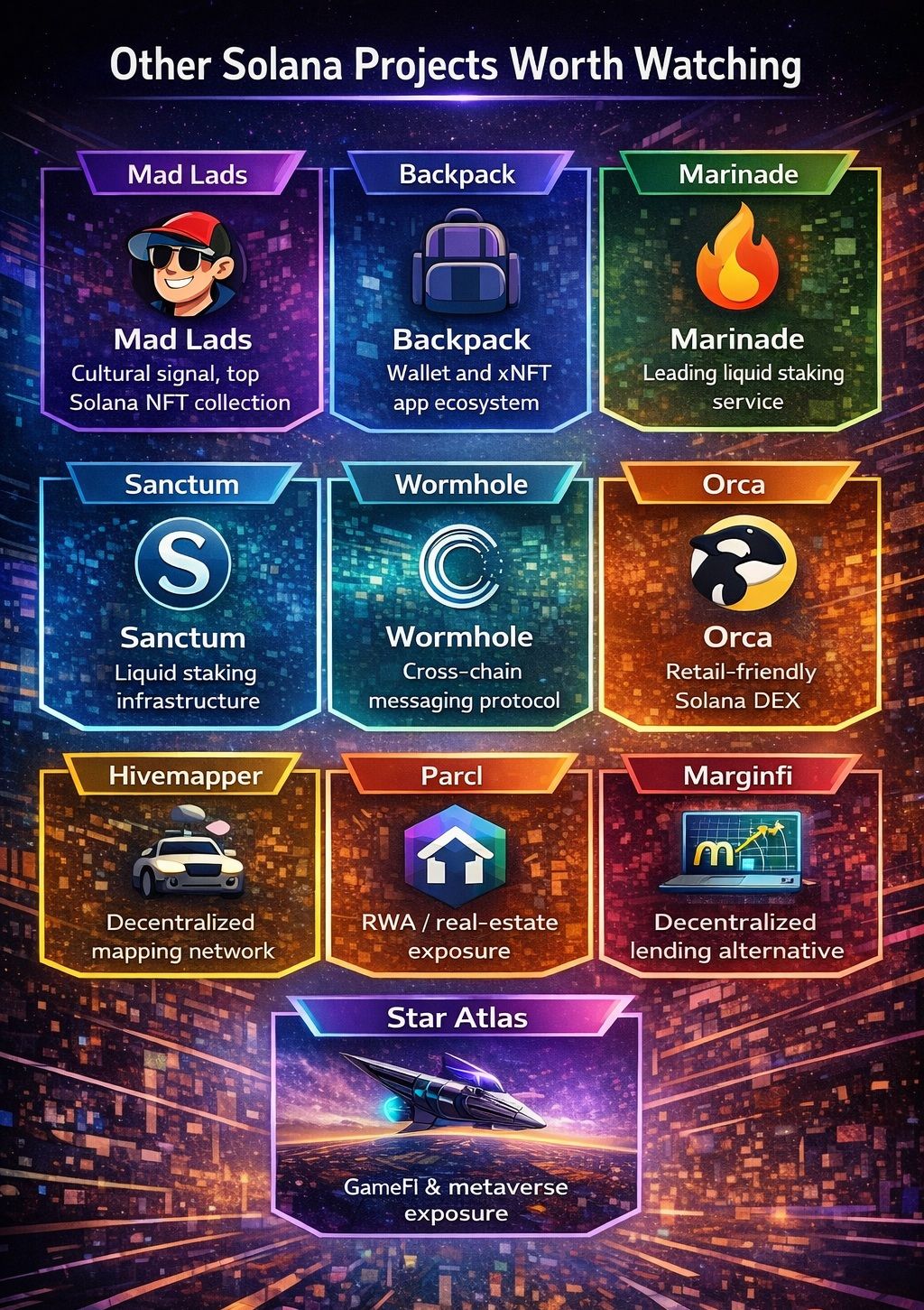
A Selection of Notable Solana Projects Shaping Activity Across NFTs, DeFi, Infrastructure, and Gaming
- Mad Lads — blue-chip NFT collection / cultural signal
- Why it matters: On Solana, Mad Lads has become one of those “you kind of know it when you see it” blue chips — it’s a cultural signal as much as it is an NFT collection. When it’s active, the broader NFT segment often feels more “alive.”
- Worth watching: Whether it continues to anchor attention and liquidity as NFT volumes rotate between chains and marketplaces.
- Backpack — wallet + app ecosystem
- Why it matters: Wallets quietly decide what Solana feels like day-to-day: onboarding, safety prompts, defaults, and which apps users end up trying first. Backpack’s push toward tighter app-style experiences (including xNFT-style ideas) is worth tracking because it can influence the “standard” for wallet UX.
- Worth watching: New app integrations, security features, and whether it can win mainstream users without sacrificing the power-user tooling.
- Marinade — staking diversification
- Why it matters: Marinade has been around long enough to be part of the default Solana liquid staking conversation. It’s often used as a diversification option across stake pools and LST choices — which matters because staking concentration and LST monocultures are real risks as DeFi leans more heavily on staked assets.
- Worth watching: How its stake distribution evolves, plus how widely its LST is used as collateral across Solana DeFi.
- Sanctum — LST infrastructure
- Why it matters: This is “plumbing,” not a flashy front-end — but plumbing becomes systemic once enough apps rely on it. Sanctum focuses on improving liquidity across different Solana LSTs, and that matters more as LSTs become common building blocks for borrowing, trading, and yield strategies.
- Worth watching: Depth of LST liquidity routes, major DeFi integrations, and whether things still work smoothly when markets get choppy.
- Wormhole — interoperability
- Why it matters: Wormhole is a major interoperability and messaging layer used across chains. These layers are high-impact because they move assets and data between ecosystems — and high-risk because bridges and messaging have historically been some of crypto’s most attacked components.
- Worth watching: Security posture and incident history, plus whether usage is trending more toward messaging, asset bridging, or both.
- Orca — retail-friendly DEX
- Why it matters: Orca is often pitched as the “friendly” Solana DEX — the one you can hand to a newer user without them immediately feeling lost. It’s also a meaningful alternative liquidity venue, and a UX benchmark that other Solana trading apps frequently get compared against.
- Worth watching: Whether it keeps attracting consistent liquidity and volume, especially as routing-heavy platforms compete for the same order flow.
- Hivemapper — DePIN mapping network
- Why it matters: Hivemapper is a DePIN mapping network built around community-contributed, street-level imagery. Mapping is a real-world resource with measurable demand, which makes this one of the easier DePIN stories to sanity-check compared to more speculative “network effects” narratives.
- Worth watching: Coverage expansion, contributor incentives, and evidence of sustained demand from data users.
- Parcl — RWA / real-estate exposure
- Why it matters: Parcl offers on-chain real estate market exposure and related data products. It’s worth watching as Solana experiments with real-world markets and index-style products — a different audience than classic DeFi yield hunters, but potentially a sticky one if the product fits.
- Worth watching: Whether liquidity sticks around outside of hype cycles, and how credible/useful the underlying market data feels to users.
- Marginfi — lending alternative
- Why it matters: Marginfi remains relevant as a borrow/lend venue even as Solana money markets compete aggressively. Lending competition can improve rates and UX, but it can also fragment liquidity and make conditions change quickly when incentives move around.
- Worth watching: Market depth, risk parameters, and how it behaves during volatility (when bad debt and liquidations become real stress tests).
- Star Atlas — GameFi / metaverse exposure
- Why it matters: Star Atlas is a long-running Solana GameFi project aiming for a large-scale space MMO. Games are a long-cycle category — winners tend to emerge over years, not weeks — so it’s less about short-term hype and more about whether real progress keeps landing over time.
- Worth watching: Delivery cadence, actual player activity, and whether the in-game economy feels lived-in (not just tradable).
How to Evaluate a Solana Project
Lists are useful, but the real edge is having a framework you can reuse when the next “top project” appears next month.
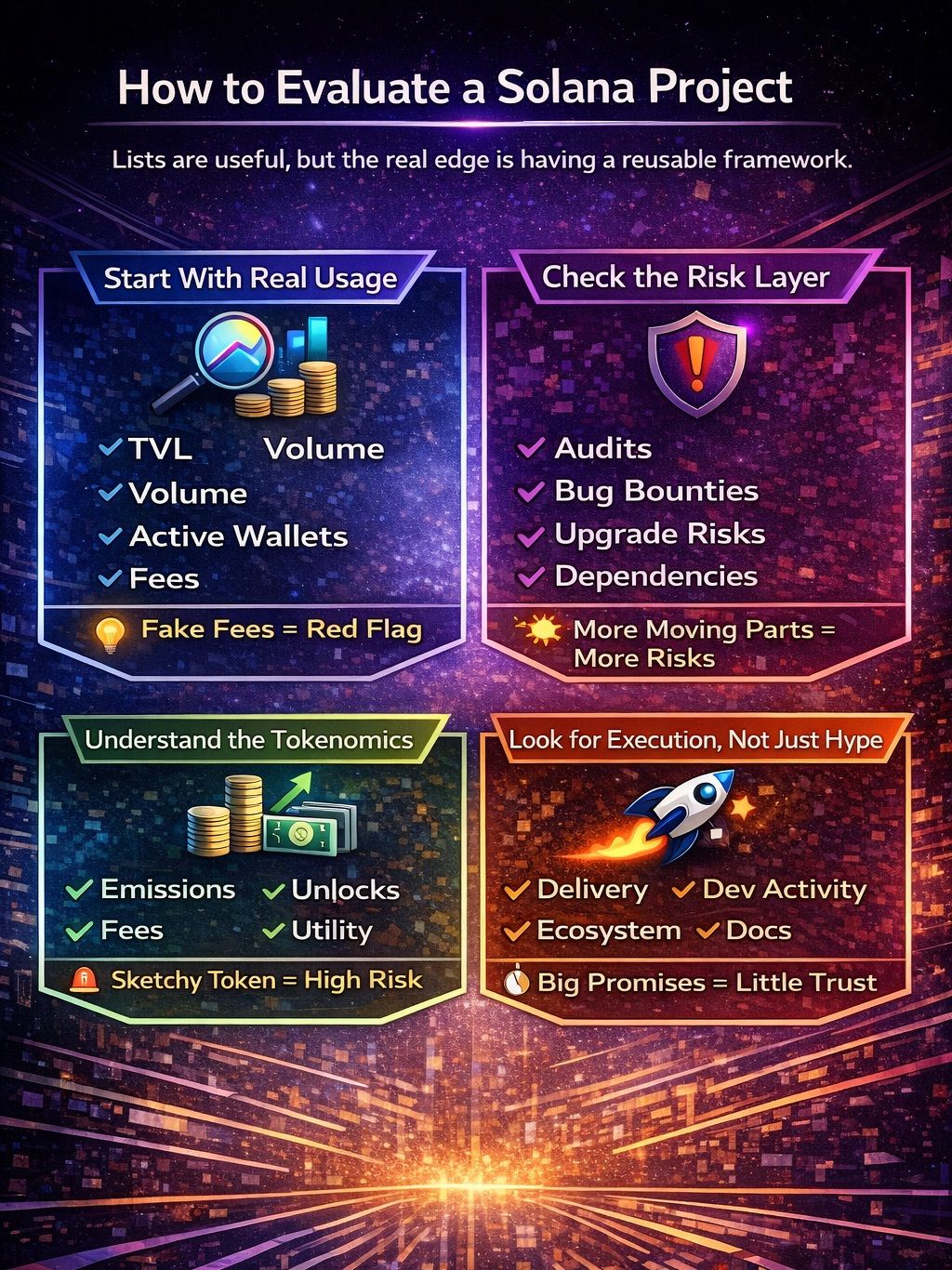
A Simple Framework for Analyzing Solana Apps Using Usage Metrics, Risk Factors, Tokenomics, and Execution
Start With Real Usage
Good projects leave footprints you can measure:
- TVL: Useful for lending, liquid staking, and some DeFi protocols.
- Volume: Useful for DEXes and marketplaces, but easier to game.
- Active wallets: Helpful for consumer apps and retention signals.
- Protocol fees and revenue: Often a better reality check than volume, because fees are harder to fake.
A practical habit: if an app claims it is “huge,” but its fee footprint is tiny, treat that as a yellow flag. DefiLlama’s Solana dashboard is a quick way to keep your expectations grounded across the whole ecosystem.
Check the Risk Layer
Before using any Solana app, ask:
- Has it been audited, and is the audit recent and relevant?
- Is there a bug bounty and a clear disclosure process?
- Are there admin keys or upgrade controls that can change rules?
- What are the dependencies, like oracles, bridges, stablecoins, or LSTs?
A simple rule: more moving parts means more failure modes.
Understand the Tokenomics
Not every important Solana project needs a token. If it does have one, look for:
- Emissions: Do rewards prop up usage that disappears without incentives?
- Unlock schedules: Can large unlocks shift governance and add sell pressure?
- Fee sinks: Do fees go somewhere meaningful, or are they mostly recycled?
- Utility vs narrative: Does the token do something necessary, or mostly branding?
If you cannot explain the token’s purpose in one sentence, treat it as higher risk.
Look for Execution, Not Just Hype
Execution is what creates staying power:
- Roadmap delivery: Did they ship what they said they would?
- Developer activity: Maintenance reduces long-term risk.
- Ecosystem integrations: Do other serious apps rely on it?
- Documentation quality: Clear docs usually means fewer user mistakes.
Are Solana Projects Safe to Use?
Solana is fast, but fast does not mean safe. Most risk comes from the app layer and user behavior, not from the chain’s speed.
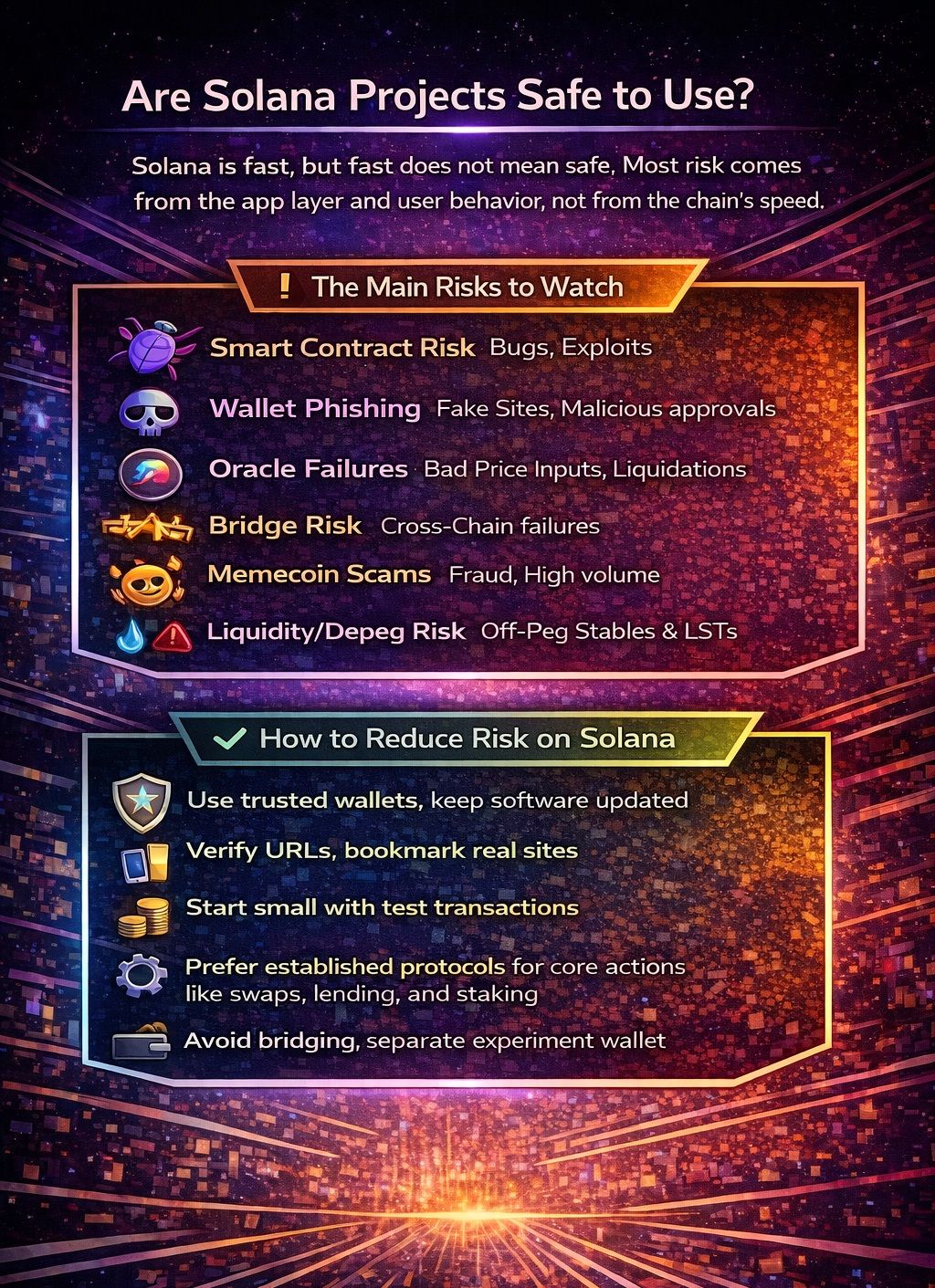
A Quick Overview of the Main Risks in the Solana Ecosystem and Practical Steps to Reduce Them
The Main Risks to Watch
- Smart contract risk: Bugs, economic exploits, and integration failures.
- Wallet phishing: Fake sites, fake extensions, and malicious approvals.
- Oracle failures: Bad price inputs can trigger incorrect liquidations.
- Bridge risk: Cross-chain bridges can fail, and failures can be catastrophic.
- Memecoin and launchpad scams: High-volume environments attract fraud.
- Liquidity and depeg risk: LSTs and some stablecoins can trade off-peg during stress.
How to Reduce Risk on Solana
- Use trusted wallets and keep your OS and browser updated.
- Verify URLs and bookmark real sites.
- Start with small test transactions before moving meaningful amounts.
- Prefer established protocols for core actions like swaps, lending, and staking.
- Avoid bridging unless you truly need to, and double-check every step.
- Separate your experiment wallet from your main wallet.
Getting Started With Solana Projects
If you’re new to Solana, the fastest path is: set up a wallet, do a small on-chain transaction, then try a few beginner-friendly apps. This section is for first-time users who want to get hands-on without diving into developer tools, advanced DeFi strategies, or full tutorials.
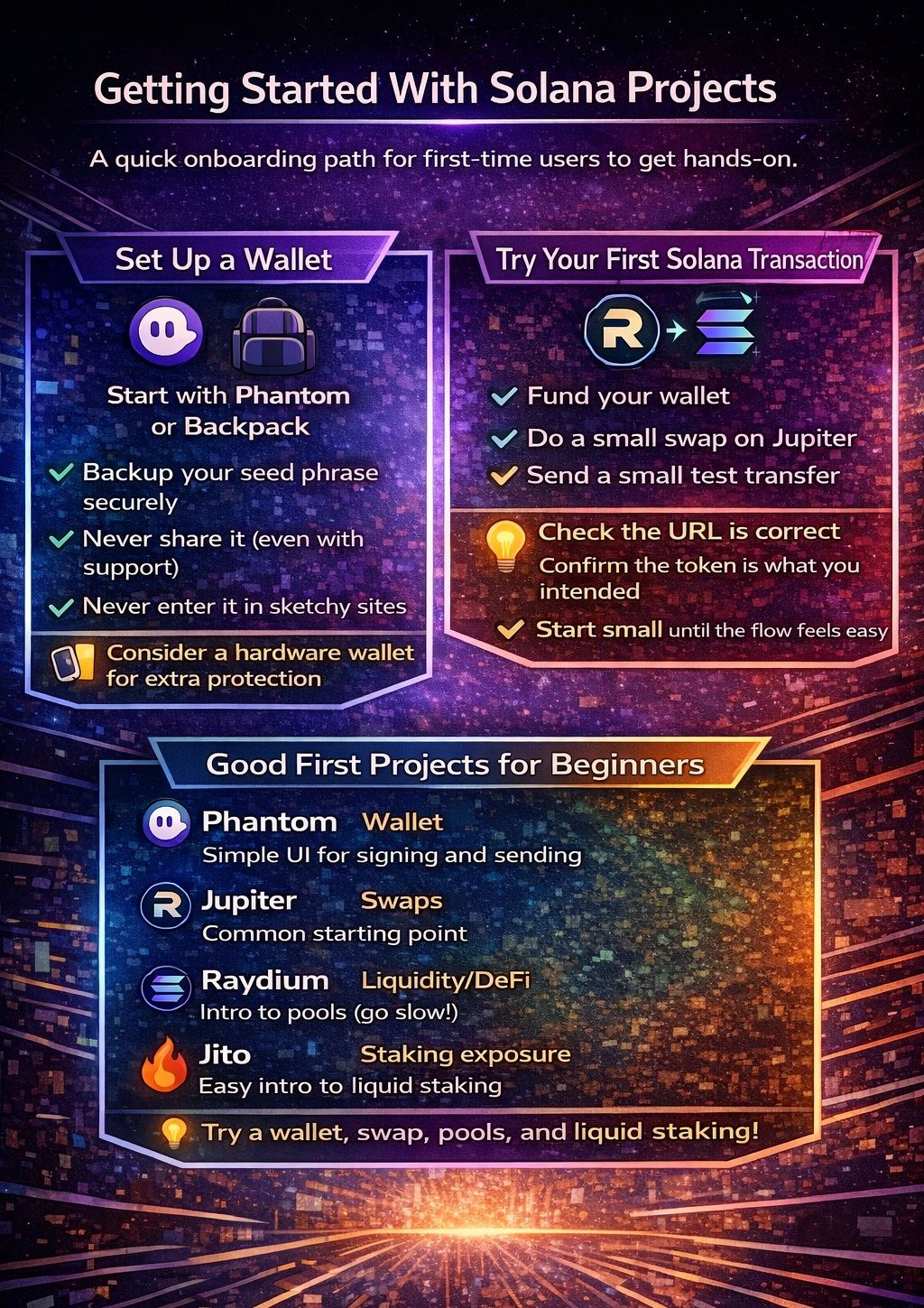
A Beginner-friendly Onboarding Path: Set Up a Wallet, Complete a Test Transaction, and Explore Core Apps
Set Up a Wallet
Start with Phantom or Backpack. They’re popular, beginner-friendly wallets that let you store SOL and interact with most Solana apps.
What to do (and what not to do):
Write your seed phrase on paper (or store it in another offline method) and keep it somewhere safe.
Never share your seed phrase with anyone, even “support” or “admins.”
Never type it into a website, Google Form, or “wallet verification” page — legitimate apps won’t ask for it.
If you plan to hold meaningful value, consider using a hardware wallet for stronger protection.
Your seed phrase is the master key. Anyone who has it can take your funds, and Solana transactions generally can’t be reversed.
If you also need help acquiring SOL and storing it safely, our how to buy Solana guide walks through exchanges, fees, and storage basics.
Try Your First Solana Transaction
Before exploring apps, do a small “practice loop” to make sure you understand fees, signing, and transfers.
Fund your wallet with a small amount of SOL (enough to cover transaction fees).
Do a tiny swap on Jupiter (start small so a mistake is cheap).
Send a small test amount to another address you control (for example, a second wallet or another account) so you’re comfortable with receiving and transfers.
Quick safety checks before you hit Confirm:
Verify the site URL is correct (bookmark it after the first visit).
Confirm the token you’re swapping is the one you intended (scam tokens often mimic names/tickers).
Start with small amounts until the flow feels routine.
Good First Projects for Beginners
These four cover the core Solana loop: Wallet, swap, liquidity exposure, and staking exposure without forcing you into complex strategies.
| Project | What it’s for | Why it’s beginner-friendly |
|---|
| Phantom | Wallet | Simple UI for signing, sending, and app connections. |
| Jupiter | Swaps | Common starting point for small token swaps. |
| Raydium | Liquidity/DeFi | A first look at pools and DeFi concepts (go slow). |
| Jito | Staking exposure | Intro to staking-related flows and ecosystem participation. |
You don’t need to “master” each app. The goal is just to complete the loop once with small amounts so the basics become familiar.
This is a compressed onboarding path that avoids turning this guide into a full tutorial.
Methodology and Sources
This guide treats “top Solana projects” as the most important Solana-native products across apps, wallets, infrastructure, DePIN, staking, and NFT, not simply the loudest tokens. Rankings are based on a condensed, repeatable scoring model built around usage, security, ecosystem importance, product moat, and staying power. Metrics and sources were reviewed in March 2026.
Ranking Criteria
We scored each project across five pillars, then used the weighted total to produce the ranked list.
| Pillar | Weight | What we looked for |
|---|
| Adoption and usage | 30% | Sustained activity (not one-week spikes), share of category volume/TVL, user footprint, and fee generation where applicable (harder to fake than raw volume). |
| Security and resilience | 25% | Evidence of battle-testing, clear incident response culture, audits and/or formal security processes, bug bounties, and dependency risk (oracles, bridges, LSTs). |
| Ecosystem importance | 20% | “If this broke or disappeared, would Solana feel meaningfully worse?” We favored projects that sit on core rails: routing, custody/onboarding, lending collateral loops, oracle data, or real-world networks. |
| Product moat | 15% | Durable advantages such as distribution, integrations, liquidity network effects, data partnerships, or technical edge that is difficult to copy quickly. |
| Staying power | 10% | Signals that the project can remain relevant over the next 12 months: credible maintenance cadence, ecosystem integrations, and incentive structures that don’t collapse when rewards fade. |
How we used these pillars in practice:
- Usage needed to be sustained. We preferred metrics like fees/revenue and consistent on-chain activity over one-off marketing spikes.
- Security wasn’t optional. A great UX didn’t outweigh unclear admin controls or fragile dependencies (especially oracles and cross-chain messaging).
- Category leadership mattered. Being “good” wasn’t enough if another Solana-native product clearly dominated the same job-to-be-done.
- We separated “important app” from “important token.” Some projects matter because the product is a core rail, not because the token is trending.
Sources We Reviewed
We prioritized primary sources and widely used data dashboards, then triangulated between them when numbers or definitions differed.
- DeFiLlama: Chain and protocol-level metrics such as TVL, DEX/perps volume, fees/revenue, and other activity indicators used to sanity-check “real usage.”
- Official project documentation and security pages (project docs / FAQs / risk docs): Used to confirm how products work, what risks are acknowledged, and what controls exist (for example, upgrade authority, admin roles, liquidation logic, and oracle dependencies).
- GitHub repositories (where relevant): Used as a supporting signal for maintenance and developer activity (release cadence, open issues/PRs, and ongoing work), not as a sole proxy for quality. Example: Solana program tooling and SPL-related repositories.
- Dune and Dune Docs: Used when we referenced on-chain dashboards, custom queries, or wallet/activity cohorts beyond what chain-level dashboards show.
- Flipside: Used as an additional on-chain analytics source for dashboards and query-based validation when needed.
- Immunefi bug bounty listings and FAQs: Used as a signal for whether projects run public bug bounties and how disclosures are handled (a meaningful indicator of security maturity, though not a guarantee).
- Solana Status and uptime history: Used for ecosystem context on network incidents and performance history (important when discussing resilience and user experience expectations).
- Solana RPC documentation: Used for definitions and verification workflows when referencing on-chain transaction concepts or how data can be independently checked.
Editorial Standards
Why You Can Trust The Coin Bureau
We do the digging, the testing, and the updating, so readers get crypto education that is clear, grounded, and built on real editorial work, not fluff wrapped in buzzwords.
50+ Years
Combined editorial experience
Combined experience in journalism across our writers and editors, covering finance, technology, and global markets long before crypto went mainstream.
25+ Hours / Week
Active testing and updates
Dedicated to hands-on testing, research, and content updates so pages do not gather digital dust.
90K
Monthly readers
Monthly readers who rely on The Coin Bureau for clear, unbiased crypto education and analysis.
Expert-Led Editorial Team
Our content is written and reviewed by specialists, not anonymous freelancers or AI-only pipelines.